SUCCESSOR-2 Key Takeaways
Design - Phase 3, two-stage, randomized, multicenter, open-label trial (NCT05552976) of oral mezigdomide (a CELMoD) plus carfilzomib and dexamethasone (MeziKd) versus Kd in RRMM previously treated with lenalidomide and an anti-CD38 antibody (~85% anti-CD38-refractory). Presented at ASCO 2026 (Abstract LBA7506, Richardson); reported analysis N=479. Sponsor: Bristol Myers Squibb.
Efficacy / PFS (primary, met) - Median PFS 18.0 vs 8.3 months (HR 0.48; P<0.0001) - roughly a 52% reduction in risk of progression or death, nearly doubling PFS. ORR 80.2% vs 53.4%; >=CR 26.7% vs 8.9%. PFS2 also favored MeziKd: 23.6 vs 13.0 months (HR 0.53).
Overall survival - Immature at median follow-up 10.6 months: HR 0.79 (95% CI 0.54-1.15) - a numerical trend whose confidence interval crosses 1.0. An early signal, not an established survival benefit; longer follow-up required.
Safety - More toxicity than Kd: grade 3/4 AEs 83.7% vs 56.5%; grade 3/4 neutropenia 61.1% vs 9.1%; grade 3/4 infections 34.0% vs 15.6%; grade 5 (fatal) infections 2.4% vs 1.1%. Growth-factor support and infection prophylaxis are central to safe delivery.
Regulatory / sponsor - Mezigdomide is investigational - not FDA approved in any indication. SUCCESSOR-2 is the first randomized Phase 3 win for the CELMoD class and the first to pair carfilzomib with an IMiD/CELMoD. Sponsor: Bristol Myers Squibb.
Compiled and reviewed by the KOL Pulse research team, led by Brian Shields, Founder, KOL Pulse. Last updated August 19, 2026.
KOLs Discussing SUCCESSOR-2


SUCCESSOR-2 Key Slides & Visuals
Presentation figures and KOL infographics shared at ASCO 2026 (Abstract LBA7506, presented by Paul Richardson). Click any image to expand.


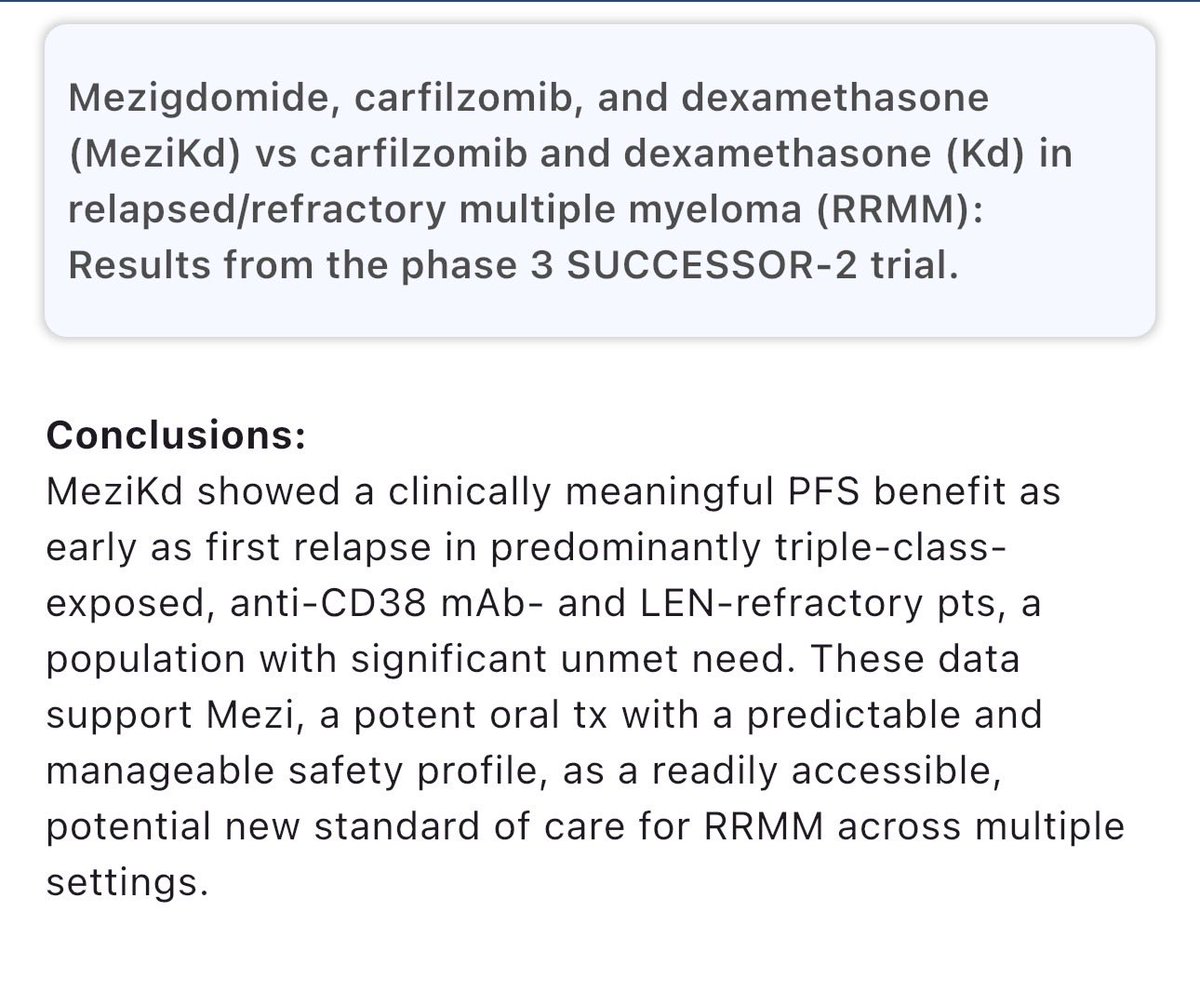

also shared by @DrRishabhOnco
Top SUCCESSOR-2 Tweets

The SUCCESSOR-2 trial in Relapsed/Refractory myeloma discussed in detail on #HealthcareUnfiltered EXPRESS by Dr. Paul Richardson of @DanaFarberNews tomorrow. Are CELMoDs changing how we treat myeloma. Tune in tomorrow, but here is a clip. Please share & subscribe.

We now have release of SUCCESSOR-2 data! Mezi + weekly Kd vs twice weekly Kd - 85% anti cd38 refractory - mPFS 18 vs 8 months (control arm did the same as MajesTEC-9) My take: 18 months is nothing to scoff at, and compares favorably with KPd data. It still leaves something to be
3) SUCCESSOR-2. Mezi-Kd vs. Kd. It's a late breaker so stay tuned for the data. This will be an important study as it will serve as the FIRST randomized study of carfilzomib with an IMiD/CELMoD. This could help to establish an effective regimen for anti-CD38 refractory patients

Why SUCCESSOR-2 is a valid, practice-informing trial and should support approval of Mezigdomide in combination with Carfilzomib and Dexamethasone. I hear some grievance about Kd as control, would argue they are ill informed. 1/x #mmsm

SUCCESSOR-2: where success met Mezigdomide and when success becomes Meziurable.! #ASCO26 @TheIACH @COMyCongress

Day 1 of #ASCO26 is the one everyone underestimates. CROWN (7-yr), EV-302 (3.5-yr), CHRYSALIS-2, AcceleRET-Lung, SUCCESSOR-2, LINKER-AL2. And the LBAs to come: RASolute 302, HARMONi-6, LIBRETTO-432, PROTEUS, SERENA-6, NHS-Galleri. Full breakdown in the article. #LCSM #blcsm
#ASCO26 LBA 🚨 Mezigdomide may become a major new option in early relapsed/refractory multiple myeloma. Phase 3 SUCCESSOR-2 showed that adding the oral CELMoD mezigdomide to carfilzomib/dexamethasone nearly doubled PFS in heavily pretreated RRMM. 🩸 SUCCESSOR-2 | RRMM
Thought of the day at #ASCO26 SUCCESSOR-2 + MAJESTEC-9 = the age of immune dominance in myeloma ! From SUCCESSOR to MAJESTEC, immunomodulation empowers immunotherapy ! @TheIACH @COMyCongress #Immunotherapy #CELMoD #Bispecifics
#ASCO26 LBA7506 SUCCESSOR-2: Mezigdomide + carfilzomib + dexamethasone vs Kd in relapsed/refractory multiple myeloma

Phase 3 SUCCESSOR-2: Mezigdomide + carfilzomib + dexamethasone (MeziKd) demonstrated improved outcomes vs Kd alone in relapsed/refractory multiple myeloma, highlighting a promising new option for RRMM treatment. #mmsm #ASCO26 Congratulations to Paul Richardson et al. We badly
Cartitude 4, Tec-3, Tec-9, Tal-3, Tal-6, successor-2, MagnetisMM-5, MagnetisMM-32 are all valid practice-informing trial. Their controls were appropriate given the evidence at time of design and accrual. But they set a new benchmark against which future Rx must be compared.

SUCCESSOR-2 (LBA7506) | ASCO 2026 🔑 The problem: Most modern myeloma patients now relapse after lenalidomide and anti-CD38 therapy. 🧬 The innovation: Mezigdomide is a CELMoD (Cereblon E3 Ligase Modulator)—a next-generation cereblon-targeting agent designed to overcome

#ASCO26 #mmsm Oral sessions myeloma SUCCESSOR-2 : Mezi-KD Patients characteristics summarized below
Overview
SUCCESSOR-2 (NCT05552976) is a Phase 3, two-stage, randomized, open-label trial of oral mezigdomide, a cereblon E3 ligase modulator (CELMoD), added to carfilzomib and dexamethasone (MeziKd) versus carfilzomib and dexamethasone (Kd) in relapsed/refractory multiple myeloma. All patients had prior lenalidomide and an anti-CD38 monoclonal antibody, with roughly 85% anti-CD38 refractory — a population that increasingly relapses with limited oral options. The trial randomized 479 patients to MeziKd (n=288) vs Kd (n=191). The primary endpoint is progression-free survival. SUCCESSOR-2 is the first randomized Phase 3 trial pairing carfilzomib with an IMiD/CELMoD agent, and the first Phase 3 readout for the CELMoD class. Primary results were presented at #ASCO26 (Abstract LBA7506) by Dr. Paul G. Richardson (Dana-Farber Cancer Institute).
Study Design
Phase 3, two-stage, randomized, open-label (MeziKd n=288 vs Kd n=191). Oral mezigdomide + carfilzomib + dexamethasone (MeziKd) vs carfilzomib + dexamethasone (Kd). Median follow-up 10.6 months. Sponsor: Bristol Myers Squibb.
Population
N=479 with RRMM, ≥1 prior line, prior lenalidomide and anti-CD38 mAb with progressive disease. Approximately 85% anti-CD38 refractory — heavily pretreated, double-class–exposed disease.
Intervention
Experimental: Oral mezigdomide (CELMoD) + carfilzomib + dexamethasone. Control: Carfilzomib + dexamethasone (Kd). All-oral CELMoD backbone, non-CAR-T / non-bispecific.
Endpoints
Primary: progression-free survival. Secondary: PFS2, overall survival, ORR, depth of response, safety. OS tested after PFS in the hierarchy.
Primary Results — #ASCO26 (Abstract LBA7506)
Progression-Free Survival (Primary Endpoint — MET)
Adding mezigdomide to carfilzomib/dexamethasone produced a statistically significant and clinically meaningful improvement in PFS, with a hazard ratio of 0.48 (P<0.0001) — roughly a 52% reduction in the risk of progression or death. Median PFS was 18.0 months with MeziKd vs 8.3 months with Kd, nearly doubling progression-free survival in a heavily pretreated, ~85% anti-CD38–refractory population. Responses were deeper with the triplet: ORR 80.2% vs 53.4% and ≥CR 26.7% vs 8.9%. Second progression-free survival (PFS2) also favored MeziKd: 23.6 vs 13.0 months (HR 0.53).
Median PFS 18.0 vs 8.3 mo · HR 0.48 (P<0.0001) · ORR 80.2% vs 53.4% · ≥CR 26.7% vs 8.9% · PFS2 23.6 vs 13.0 mo (HR 0.53)Sources: ASCO 2026 Abstract LBA7506 (Richardson) · BMS press release · ClinicalTrials.gov NCT05552976Overall Survival (Secondary — Immature, Not Yet Significant)
At a median follow-up of 10.6 months, overall survival data were immature and did not reach statistical significance. The hazard ratio for death was 0.79 (95% CI 0.54–1.15) — a numerical trend favoring MeziKd whose confidence interval crosses 1.0. This should be read as an early signal, not an established survival benefit; longer follow-up is required, and several KOLs explicitly noted “no difference in OS” at this cut. The high rate of effective subsequent therapy in the control arm may also blunt any OS separation.
OS HR 0.79 (95% CI 0.54–1.15) — immature, CI crosses 1.0 · median follow-up 10.6 moSources: ASCO 2026 Abstract LBA7506 · BMS press releaseSafety & Tolerability
The MeziKd combination carried more toxicity than Kd, consistent with the known mezigdomide profile. Grade 3/4 adverse events occurred in 83.7% vs 56.5%. The dominant signals were myelosuppression and infection: grade 3/4 neutropenia 61.1% vs 9.1% and grade 3/4 infections 34.0% vs 15.6%. Grade 5 (fatal) infections were 2.4% vs 1.1%. The added neutropenia and infection burden makes growth-factor support and infection prophylaxis central to safe delivery of this regimen.
Grade 3/4 AEs 83.7% vs 56.5% · neutropenia 61.1% vs 9.1% · G3/4 infections 34.0% vs 15.6% · G5 infections 2.4% vs 1.1%Sources: ASCO 2026 Abstract LBA7506 (Hadidi/Richardson safety slides) · ClinicalTrials.gov NCT05552976Clinical Implications
SUCCESSOR-2 is the first randomized Phase 3 win for the CELMoD class and the first to pair carfilzomib with an IMiD/CELMoD. It establishes an all-oral, non-CAR-T / non-bispecific option for double-class–exposed, anti-CD38–refractory patients — a setting where many cannot access or wait for cell therapy. KOLs welcomed the near-doubling of PFS while flagging open questions: the Kd comparator drew debate (defended as appropriate for the design era by some, e.g. Luciano Costa), overall survival remains immature, and the added neutropenia/infection burden requires active management. Sequencing mezigdomide relative to bispecifics and CAR-T — as bridging, holding, or post-immunotherapy salvage — is the central question KOLs raised.
First Ph3 CELMoD win · all-oral option for CD38-refractory RRMM · OS immature, comparator & sequencing debatedSources: ASCO 2026 Abstract LBA7506 · IMF / myeloma.org · ClinicalTrials.gov NCT05552976Key KOL Sentiments — SUCCESSOR-2
SUCCESSOR-2 FAQ
What is the SUCCESSOR-2 trial?
SUCCESSOR-2 (NCT05552976) is a Phase 3, two-stage, randomized, open-label trial comparing oral mezigdomide - a cereblon E3 ligase modulator (CELMoD) - plus carfilzomib and dexamethasone (MeziKd) against carfilzomib and dexamethasone alone (Kd) in relapsed/refractory multiple myeloma patients previously treated with lenalidomide and an anti-CD38 antibody. Results were presented at ASCO 2026 as Abstract LBA7506 by Paul Richardson. The sponsor is Bristol Myers Squibb.
What did SUCCESSOR-2 show?
MeziKd nearly doubled progression-free survival: median PFS 18.0 vs 8.3 months (HR 0.48; P<0.0001) in a heavily pretreated, ~85% anti-CD38-refractory population. Responses were deeper with the triplet (ORR 80.2% vs 53.4%; CR or better 26.7% vs 8.9%), and PFS2 also favored MeziKd (23.6 vs 13.0 months; HR 0.53). Overall survival remains immature (HR 0.79; 95% CI 0.54-1.15).
Is mezigdomide FDA approved?
No. Mezigdomide is an investigational agent and is not FDA approved in any indication. Carfilzomib and dexamethasone are separately approved in multiple myeloma, but the MeziKd combination remains investigational. SUCCESSOR-2 is the first randomized Phase 3 win for the CELMoD class.
What is the safety profile of MeziKd in SUCCESSOR-2?
The triplet carried more toxicity than Kd, consistent with the known mezigdomide profile: grade 3/4 adverse events 83.7% vs 56.5%, driven by myelosuppression and infection - grade 3/4 neutropenia 61.1% vs 9.1% and grade 3/4 infections 34.0% vs 15.6%. Grade 5 (fatal) infections were 2.4% vs 1.1%, making growth-factor support and infection prophylaxis central to safe delivery.
Why is SUCCESSOR-2 important?
It is the first randomized Phase 3 win for the CELMoD class and the first trial to pair carfilzomib with an IMiD/CELMoD, establishing an all-oral-backbone, non-CAR-T, non-bispecific option for double-class-exposed, anti-CD38-refractory patients - a group that often cannot access or wait for cell therapy. Open questions include the Kd comparator's relevance, immature OS, and how to sequence mezigdomide relative to bispecifics and CAR-T.