The Phase 2 multinational pivotal study of oral sunvozertinib (Zegfrovy) in platinum-pretreated EGFR exon 20 insertion NSCLC. Its confirmed objective response rate supported the FDA accelerated approval (July 2, 2025) of sunvozertinib — the first oral targeted therapy for this hard-to-treat mutation. Developed by Dizal; global rights licensed to AstraZeneca in July 2026. On October 22, 2026, AstraZeneca announced ZEGFROVY is now commercially available in the US.
FDA Accelerated Approval · Jul 2, 2025EGFR Exon20ins NSCLCPlatinum-Pretreated (2L+)Phase 2 PivotalSunvozertinib (Zegfrovy) · DizalAstraZeneca Global License · Jul 2026Now Available in the US · Oct 22, 2026
Update · October 22, 2026
ZEGFROVY Now Available in the US
US LAUNCHSunvozertinib (ZEGFROVY) commercially available for post-platinum EGFR exon20ins NSCLC
On October 22, 2026, AstraZeneca announced that ZEGFROVY (sunvozertinib) is now available in the US for adults with locally advanced or metastatic NSCLC with EGFR exon 20 insertion mutations, as detected by an FDA-approved test, whose disease has progressed on or after platinum-based chemotherapy. It is supplied through the ZEGFROVY Specialty Distribution and Pharmacy network. Availability follows the FDA accelerated approval of July 2, 2025; continued approval may be contingent upon verification and description of clinical benefit in a confirmatory trial. (AstraZeneca US press release, Oct 22, 2026)
Label efficacy (WU-KONG1B, 200 mg, primary efficacy population): confirmed ORR 46% (n=85; 95% CI 35–57); median DoR 11.1 months (n=39 responders; 95% CI 8.2–NE) (FDA, Jul 2, 2025; AstraZeneca US press release, Oct 22, 2026); 72% of responders had a DoR of at least 6 months (AstraZeneca US press release, Oct 22, 2026). NCCN lists sunvozertinib as a Category 2A recommended subsequent-therapy option (AstraZeneca US press release).
✅ FDA-approved: post-platinum (previously treated) EGFR exon20ins NSCLC, 200 mg orally once daily with food. ⚠️ Investigational: first-line use. A supplemental NDA based on the Phase III WU-KONG28 trial has been submitted to the FDA and China's CDE, and both agencies have granted Breakthrough Therapy Designation in the first-line setting; it is not approved in that setting. (AstraZeneca US press release, Oct 22, 2026)
Design: Phase 2, open-label, multinational dose-optimization study (sunvozertinib 200 mg vs 300 mg once daily) in platinum-pretreated EGFR exon20ins NSCLC (NCT03974022). Primary endpoint (confirmed ORR): ~46% by blinded independent review — 45.9% (200 mg), 47.2% (300 mg randomized), 45.8% (300 mg all-comers); P<.0001 (JCO 2025). Duration of response: 11.1 months at 200 mg; 13.8 months at 300 mg (JCO 2025). Hard-to-treat subsets: responses seen with baseline brain metastases and prior amivantamab. Regulatory: FDA accelerated approval (Jul 2, 2025) in post-platinum EGFR exon20ins NSCLC; confirmatory trial = WU-KONG28 (first-line) (FDA approval letter, NDA 219839, PMR 4867-1). US availability: commercially available in the US as of Oct 22, 2026 (AstraZeneca); first-line sNDA (WU-KONG28) submitted to the FDA — first-line use investigational. Sponsor / drug: sunvozertinib (Zegfrovy), Dizal — global rights licensed to AstraZeneca (Jul 2026).
The pivotal WU-KONG1B data presented by James Chih-Hsin Yang, MD, PhD at ASCO 2024, captured by Stephen V Liu, MD (@StephenVLiu). Toggle the OCR panel under each slide to read the transcribed data.
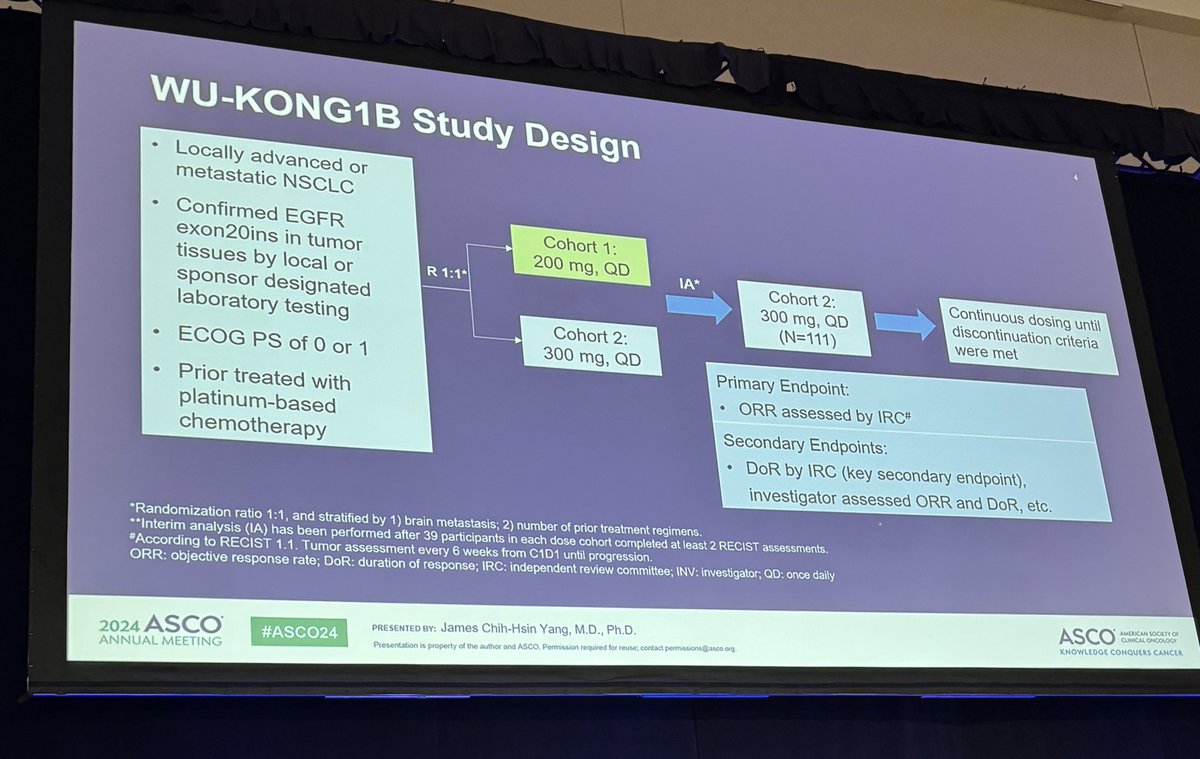
WU-KONG1B Study Design (ASCO 2024 — presented by James Chih-Hsin Yang, MD, PhD)
Eligibility: locally advanced or metastatic NSCLC; confirmed EGFR exon20ins in tumor tissue (local or sponsor-designated testing); ECOG PS 0 or 1; prior platinum-based chemotherapy.
Randomized 1:1 (stratified by brain metastasis and number of prior treatment regimens):
- Cohort 1: 200 mg once daily
- Cohort 2: 300 mg once daily
After a predefined interim analysis, additional patients were enrolled at 300 mg once daily (N=111), with continuous dosing until discontinuation criteria were met.
Primary endpoint: ORR assessed by independent review committee (IRC), RECIST 1.1, tumor assessment every 6 weeks.
Key secondary endpoint: duration of response (DoR) by IRC; plus investigator-assessed ORR and DoR.
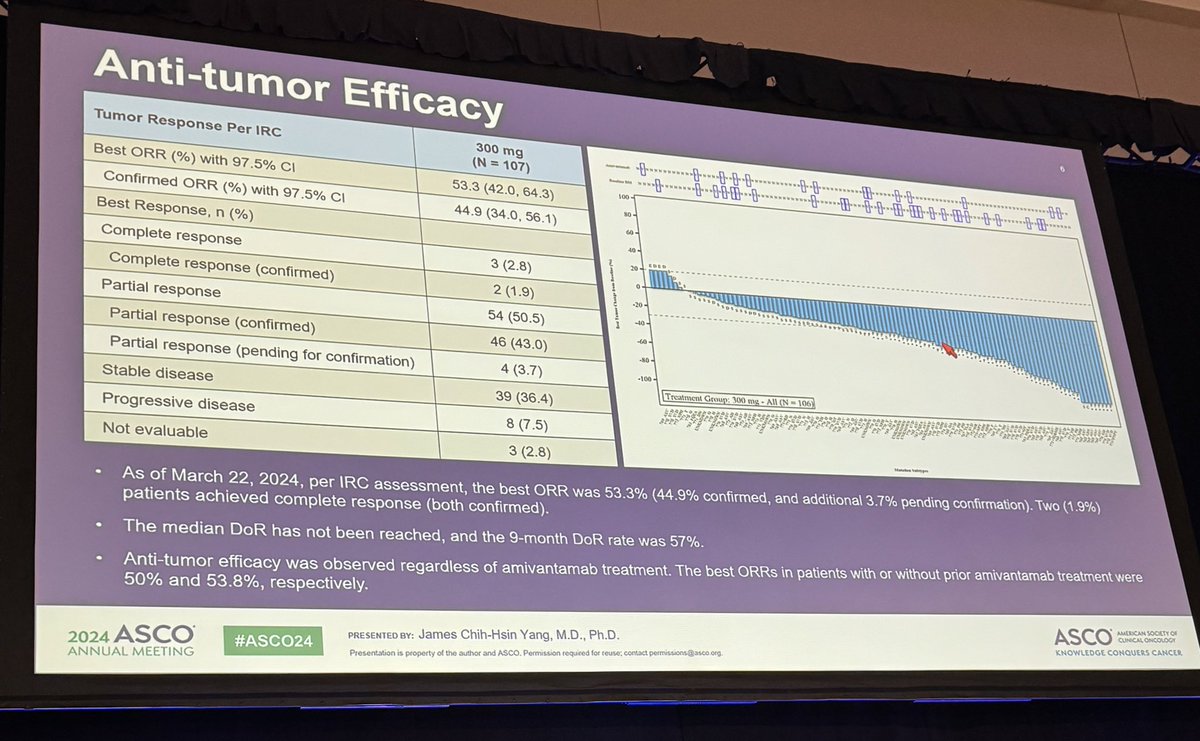
Anti-tumor Efficacy — Tumor Response per IRC (300 mg cohort, N=107; data cutoff March 22, 2024)
Best ORR: 53.3% (97.5% CI 42.0-64.3)
Confirmed ORR: 44.9% (97.5% CI 34.0-56.1), with an additional 3.7% pending confirmation
Confirmed complete response: 2 patients (1.9%)
Median duration of response was not reached; the 9-month DoR rate was 57%.
Anti-tumor efficacy was observed regardless of prior amivantamab treatment — best ORR 50% (with prior amivantamab) vs 53.8% (without).
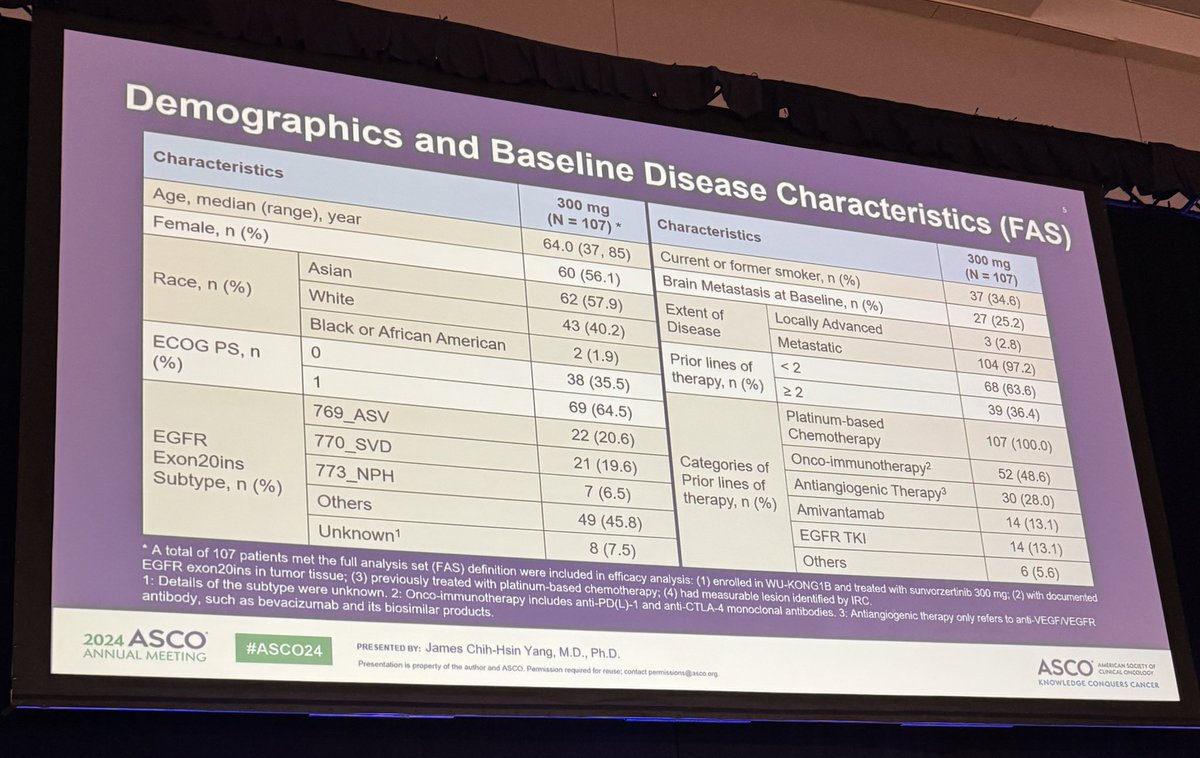
Demographics & Baseline Disease Characteristics (300 mg, N=107 full analysis set)
Median age: 64 years (range 37-85).
Brain metastasis at baseline: 34.6%.
Prior therapy: platinum-based chemotherapy 100%; onco-immunotherapy 48.6%; antiangiogenic therapy 28.0%; amivantamab 13.1%; EGFR TKI 13.1%.
(All patients had progressed on or after platinum-based chemotherapy.)
Overview
What Is the WU-KONG1B Trial?
WU-KONG1B (WU-KONG1 Part B; NCT03974022) is the Phase 2, multinational pivotal study that established the efficacy of sunvozertinib in patients with advanced NSCLC harboring EGFR exon 20 insertion (exon20ins) mutations whose disease progressed after platinum-based chemotherapy. EGFR exon20ins is a rare, difficult-to-treat oncogenic driver that has historically been resistant to classic EGFR tyrosine kinase inhibitors, leaving these patients with limited options.
Sunvozertinib is an oral, irreversible EGFR inhibitor discovered by Dizal scientists that targets a broad spectrum of EGFR mutations while maintaining selectivity over wild-type EGFR. WU-KONG1B enrolled a globally representative population — more than 40% of patients were non-Asian — and the trial's confirmed objective response rate became the basis for sunvozertinib's US accelerated approval, making it the first oral targeted therapy for this population.
Phase 2, open-label, multinational. Patients randomized 1:1 to sunvozertinib 200 mg or 300 mg once daily; additional patients enrolled at 300 mg after a predefined interim analysis. (JCO 2025)
Population
Advanced/metastatic EGFR exon20ins NSCLC with prior platinum-based chemotherapy. Baseline brain metastases and prior amivantamab were permitted; ~40% of enrollees were non-Asian. (JCO 2025)
Endpoints
Primary: blinded independent review committee (IRC)-assessed confirmed ORR per RECIST v1.1. Key secondary: duration of response (DoR). (JCO 2025)
Trial Details
NCT03974022. Sponsor: Dizal Pharmaceutical. Lead principal investigator: Prof. James Chih-Hsin Yang (National Taiwan University). Biomarker: EGFR exon20ins by an FDA-authorized test.
By blinded IRC assessment, the confirmed objective response rate (cORR) was 45.9% in the 200 mg cohort, 47.2% in the 300 mg randomized cohort, and 45.8% in the 300 mg all-comers cohort. The predefined null hypothesis was rejected with statistical significance (P<.0001). (JCO 2025, JCO-25-00788) The FDA accelerated approval was based on 85 patients treated at the 200 mg once-daily dose, in whom the ORR was 46% (95% CI, 35%–57%). (FDA label, NDA 219839)
cORR ~46% — first oral option in post-platinum EGFR exon20ins NSCLC
Duration of Response
Median duration of response was 11.1 months at 200 mg and 13.8 months at 300 mg, with durable responses observed across EGFR exon20ins subtypes. (JCO 2025)
DoR 11.1–13.8 months
Activity in Hard-to-Treat Subgroups
Responses were observed in patients with baseline brain metastases (cORR 52.4% at 300 mg vs 28.6% at 200 mg) and in those previously treated with amivantamab (41.7% vs 25%) — subgroups with historically poor outcomes. (JCO 2025)
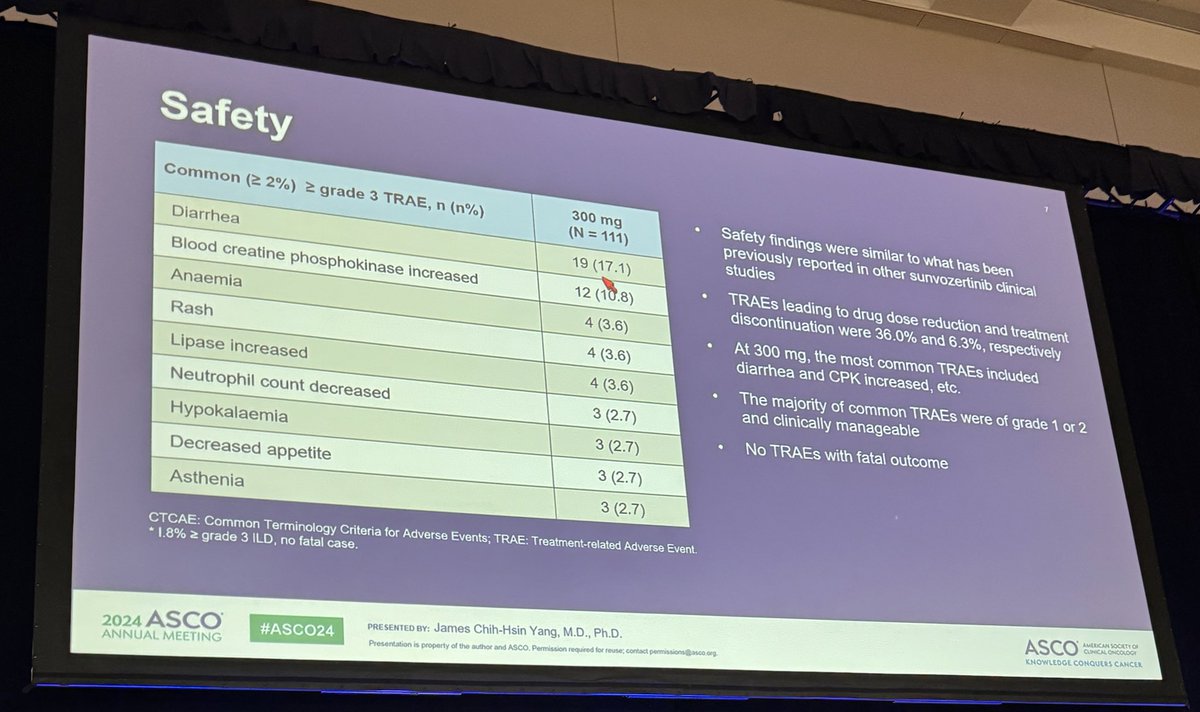
Sunvozertinib's safety profile was consistent with on-target EGFR inhibition. The most common treatment-related adverse events were diarrhea, skin rash, and blood creatine phosphokinase (CPK) increase; the majority were grade 1/2 and reversible. Grade ≥3 diarrhea and CPK elevation were more frequent at 300 mg than at 200 mg — data that informed the approved 200 mg once-daily starting dose. (JCO 2025 / FDA label)
APPROVEDSunvozertinib (Zegfrovy) — FDA accelerated approval, post-platinum EGFR exon20ins NSCLC
On July 2, 2025, the FDA granted sunvozertinib (Zegfrovy) accelerated approval for adults with locally advanced or metastatic EGFR exon 20 insertion–positive NSCLC whose disease has progressed on or after platinum-based chemotherapy — the first oral targeted therapy approved for this mutation. The approval was supported by the WU-KONG1B pivotal study (and the WU-KONG6 study). As an accelerated approval, continued approval may be contingent on confirmatory evidence — the Phase 3 WU-KONG28 first-line trial serves as the confirmatory study. FDA’s approval letter lists it under postmarketing requirement 4867-1, with final progression-free and overall survival results required.
DEALAstraZeneca to globally develop & commercialize Zegfrovy
On July 14, 2026, AstraZeneca entered an exclusive global license agreement with Dizal Pharmaceutical for Zegfrovy (sunvozertinib), acquiring worldwide rights to develop and commercialize the drug. AstraZeneca will pay Dizal $600M upfront plus up to $900M in development, regulatory and sales-related milestones, plus tiered royalties on global sales. The transaction is expected to close in the second half of 2026, adding Zegfrovy to AstraZeneca's EGFR-focused lung cancer franchise.
US LAUNCHZEGFROVY now available in the US — Oct 22, 2026
AstraZeneca announced US commercial availability of ZEGFROVY (sunvozertinib) on October 22, 2026 for the FDA-approved post-platinum EGFR exon20ins NSCLC indication. A supplemental NDA for first-line use based on Phase III WU-KONG28 has been submitted to the FDA and China's CDE (Breakthrough Therapy Designation from both); first-line use remains investigational. See the Oct 22 update.
Yes. On October 22, 2026, AstraZeneca announced that ZEGFROVY (sunvozertinib) is commercially available in the US for adults with locally advanced or metastatic NSCLC with EGFR exon 20 insertion mutations, as detected by an FDA-approved test, whose disease progressed on or after platinum-based chemotherapy. First-line use is investigational: a supplemental NDA based on the Phase III WU-KONG28 trial has been submitted to the FDA.
What is the WU-KONG1B trial?
WU-KONG1B (WU-KONG1 Part B; NCT03974022) is a Phase 2 multinational pivotal study of oral sunvozertinib (Zegfrovy) in patients with advanced EGFR exon 20 insertion NSCLC whose disease progressed after platinum-based chemotherapy. Its confirmed objective response rate supported sunvozertinib's FDA accelerated approval.
Is sunvozertinib (Zegfrovy) FDA approved?
Yes. On July 2, 2025 the FDA granted sunvozertinib (Zegfrovy) accelerated approval for adults with locally advanced or metastatic EGFR exon 20 insertion–positive NSCLC whose disease progressed on or after platinum-based chemotherapy. It is the first oral targeted therapy approved for this mutation.
What were the WU-KONG1B response rates?
By blinded independent review, the confirmed objective response rate was ~46% (45.9% at 200 mg, 47.2% at 300 mg randomized, 45.8% at 300 mg all-comers; P<.0001). Median duration of response was 11.1 months at 200 mg and 13.8 months at 300 mg.
How does WU-KONG1B relate to WU-KONG28?
WU-KONG1B is the Phase 2 pivotal study supporting sunvozertinib's accelerated approval in the previously-treated (second-line and later) setting. WU-KONG28 is the confirmatory Phase 3 trial in the first-line setting (FDA approval letter, PMR 4867-1), which met its primary endpoint (PFS) versus chemotherapy and was published in NEJM in 2026.
What is the AstraZeneca–Dizal deal for Zegfrovy?
On July 14, 2026, AstraZeneca entered an exclusive global license agreement with Dizal for Zegfrovy (sunvozertinib), acquiring worldwide rights to develop and commercialize the drug for $600 million upfront plus up to $900 million in milestones and tiered royalties. The deal is expected to close in the second half of 2026.
About
About This Profile
Compiled and reviewed by the KOL Pulse research team, led by Brian Shields, Founder, KOL Pulse. Every clinical figure is traceable to a primary source (peer-reviewed publication, FDA label, or sponsor press release) as cited above. Last updated October 22, 2026.