11 min read
The DOL Launch: How Digital Opinion Leaders Ran Rasonque's Day One Product Launch

“But an oral medication brings benefits to a life beyond the chair.”
KRASKickers (@KRASKickers), patient advocacy, replying to Dr. Anirban Maitra on approval day
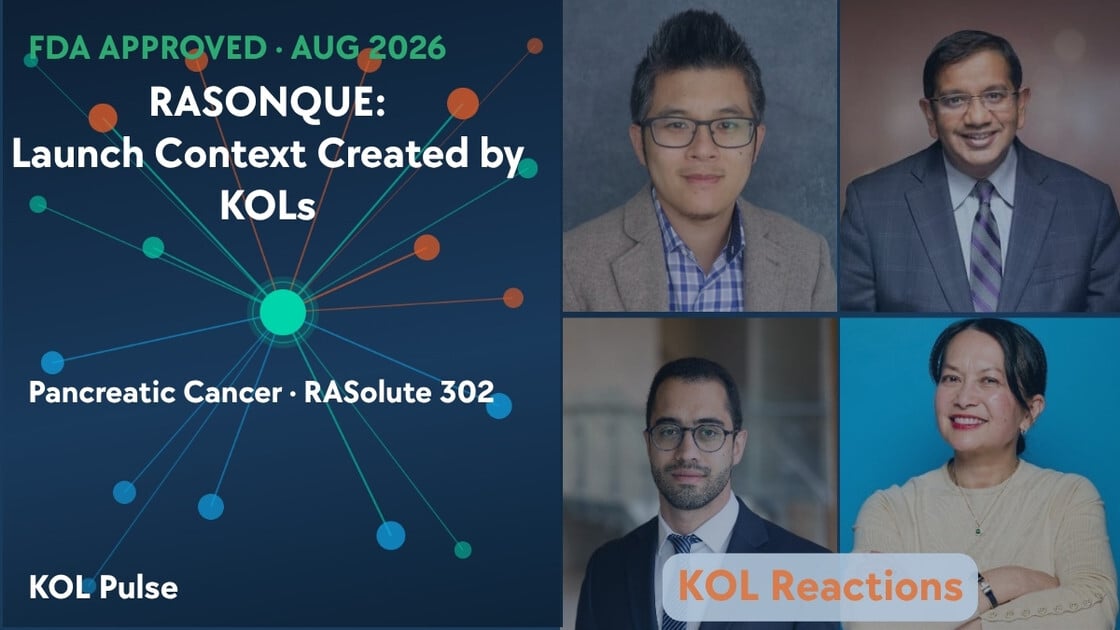
On August 26, the FDA approved daraxonrasib (Rasonque, Revolution Medicines) for metastatic pancreatic adenocarcinoma. The label covers patients who have received at least one prior systemic therapy, or who are not candidates for multiagent systemic therapy. In RASolute 302, the first approved RAS inhibitor in this disease doubled median overall survival: 13.2 versus 6.7 months against chemotherapy (HR 0.40). The NDA was accepted July 22. Approved August 26. That's 35 days.
Here's what nobody's launch plan accounted for: the KOLs ran the launch themselves. Within hours, and in two cases months early, GI oncologists, a patient advocacy group, and a radiation oncology voice built the sequencing debate, the label analysis, the patient education materials, and the cost conversation. That's work a launch team spends quarters on with their expanded agency partners. It happened in public, for free, written by the doctors who will actually prescribe the drug, and some that have already used it either on study or through the Expanded Access Program. Here are the threads from X.
1. Dr. Jun Gong opened the treatment sequencing debate on day one
“Enroll on study!”
Dr. Nicholas Hornstein (@GIMedOnc), answering the day-one sequencing question
Hours after the approval, Dr. Jun Gong (Cedars-Sinai) asked the GI oncology community the label's hardest question: “as the label is written, in a pt fit for multi-agent chemo would you ➡️ to daraxonrasib or ➡️ w/chemo #1L? Imagine co-pay and drug will be costly w/payor pushback.” This is the conversation a medical affairs team spends months preparing for. It played out in one afternoon, on the record. Do some patients get Rasonque in first line? Do they get monotherapy or with chemo? What will insurance cover?
❓@GIcancerDoc @GIMedOnc @IbrahimSahinMD1 @ronanhsieh @guildsman @CathyEngMD @Salthecancerguy @DanZhaoMD @OncoAlert as the label is written, in a pt fit for multi-agent chemo would you ➡️ to daraxonrasib or ➡️ w/chemo #1L? Imagine co-pay and drug will be costly w/payor pushback
— Jun Gong, MD (@jgong15) August 26, 2026
The replies came fast. Dr. Ronan Hsieh: “Yup enroll in RASolute 303 or DAWN (KRAS G12D)!” Dr. Nicholas Hornstein (@GIMedOnc): “Enroll on study!” Dr. Cathy Eng added precision to the thread: “Just to clarify: The current @FDA @Rev_Medicine indication is after >/= 1 prior line of therapy in #previously treated #pancreatic #cancer. There is an ongoing Phase III trial in the 1st-line setting for panc.” Then she expanded the discussion to the broader industry impact: “Fantastic so many additional companies right now in this RAS space. It opens up the possibilities.” For fit first-line patients, the thread's answer was clear: enroll on the trial. However, this brings up a very important issue. Why would patients enroll on the first line trial if the drug is already commercially available? Also, won't the clinical trial be impacted by informative censoring?
Gong asked the same thing, with numbers. Pointing at RASolute 302 itself, he noted that 55 of 214 control-arm patients (26%) withdrew or deteriorated on treatment, with another 38 dropping out at randomization to the control arm. His question: does that mean high attrition for future first-line trials that keep chemo control arms? That is the censoring debate, and the KOLs opened it in public within a day of approval.
#1L trials in #mPDAC are vital. Assuming control arms will be chemo pending #1L chemo + RASi data, learning from RASolute 302 ➡️ 55/214 (26%) pts withdrew/deteriorated upon tx in ctrl arm, also an add’l 38 pt dropout on rand to ctrl arm 🟰high future attrition rates❓@OncoAlert
— Jun Gong, MD (@jgong15) August 27, 2026
@jgong15 @GIcancerDoc @GIMedOnc @IbrahimSahinMD1 @ronanhsieh @guildsman @Salthecancerguy @DanZhaoMD @OncoAlert Just to clarify: The current @FDA @Rev_Medicine indication is after >/= 1 prior line of therapy in #previously treated #pancreatic #cancer. There is an ongoing Phase III trial in the 1st -line setting for panc.
— Dr. Cathy Eng (@CathyEngMD) August 26, 2026
@jgong15 @CathyEngMD @GIcancerDoc @GIMedOnc @IbrahimSahinMD1 @guildsman @Salthecancerguy @DanZhaoMD @OncoAlert Yup enroll in RASolute 303 or DAWN (KRAS G12D)!
— Ronan Hsieh, MD, MS (@ronanhsieh) August 26, 2026
2. Patient selection: Maitra mentions the "soft 1st line" extension of the Rasonque Label
“ECOG 2 patients may struggle. I would use carefully.”
Dr. Fernand Bteich (@fernandbteich), on the label's frail-patient arm
Dr. Anirban Maitra (NYU Langone’s Perlmutter Cancer Center) posted the sharpest regulatory read of the day: “Important caveat: The @FDA Daraxonrasib (Rasonque) approval is REALLY broad & the ‘OR’ in the indication below potentially opens the door for a ‘soft 1st line’ extension. Also, no requirement to document KRAS status, acknowledging that 95% of #PancreaticCancer harbor a mutation.”
Important caveat: The @FDA Daraxonrasib (Rasonque) approval is REALLY broad & the "OR" in the indication below potentially opens the door for a "soft 1st line" extension. Also, no requirement to document KRAS status, acknowledging that 95% of #PancreaticCancer harbor a mutation.
— Anirban Maitra (@Aiims1742) August 26, 2026
Then it got better. The patient advocacy group KRASKickers engaged him on the clinical substance: “Tracking the population who is medically fragile will be an issue for PDAC experts. The EAP is for ECOG 0 or 1. So this ‘new’ population could be challenging re dose reductions, needed time off treatment, etc. But an oral medication brings benefits to a life beyond the chair.” Dr. Fernand Bteich added the treating clinician's caution on the same arm of the label: “ECOG 2 patients may struggle. I would use carefully.” A GI pathologist, an advocacy group, and a GI oncologist stress-testing the "soft 1st line" extension arm of a brand-new label on day one. That usually takes a year of post-launch experience to surface, or months of Advisory Board discussions in stuffy hotel conference rooms.
Tracking the population who is medically fragile will be an issue for PDAC experts. The EAP is for ECOG 0 or 1. So this "new" population could be challenging re dose reductions, needed time off treatment, etc. But an oral medication brings benefits to a life beyond the chair.
— KRASKickers (@KRASKickers) August 26, 2026
@KRASKickers @Aiims1742 @FDA ECOG 2 patients may struggle. I would use carefully.
— Fernand Bteich, MD, MS (@fernandbteich) August 27, 2026
And the selection question wasn't limited to performance status. Back on June 30, almost two months before the FDA acted, Dr. Andrew Ko (UCSF) sat down with the Oncology Brothers to work through exactly this: who will be a candidate for daraxonrasib. The candidacy debate was already running on video before the label existed! Dr. Ko answered the question, "Who would be a candidate for Daraxonrasib (in the 2L setting)? 👉"Virtually Everyone, up to a level of declining performance status." He also discussed the broad applicability of the drug, independent of biomarkers.
⭐️Practice Changing in #Metastatic #PancreaticCancer, Who Will Be A Candidate for Daraxonrasib 🤔 👉Dr.Andrew Ko discusses this 🔑 question with @OncBrothers #OncTwitter #pcsm #gism #MedTwitter #ASCO #CancerResearch #Cancer #MedEd @RoswellPark @WilmotCancer @UCSFCancer
— OncUpdates (@OncUpdates) June 30, 2026
The biomarker side of selection was further discussed with the RASolute 302 Primary Author. Dr. Eileen O’Reilly (Memorial Sloan Kettering) discussed the efficacy of daraxonrasib across various patient types based on biomarker status with the Oncology Brothers. This is exactly the question Maitra's label read raised in his tweet: no requirement to document KRAS status. Dr. O'Reilly outlines the data supporting this broad patient benefit from the trial's subgroup analyses:"
92% of patients in the study had a G12 alteration..."
"the benefit is directionally very consistent in the non G12, so in the rare individual that had a G13 mutation, ...small percentage of people that had a Q61mutation, ...and even in the wild type group, ...directionally very consistent".
Watch the Video👉
🚨GAME CHANGER in #PancreaticCancer now #FDA Approved @EileenMOReilly discusses w/@OncBrothers efficacy of #Daraxonrasib in #RAS mutations. #OncTwitter #GIOnc #gism #MedTwitter #CancerResearch #cancer @DrShubhamPant @rachnatshroff 🔗 Full video👇
— OncUpdates (@OncUpdates) August 27, 2026
3. Dr. Fernand Bteich built the patient materials two months before approval
“Here is a handy infographic for doctors and patients alike. Please feel free to share!”
Dr. Fernand Bteich (@fernandbteich), June 28, two months before approval
This one is my favorite. Back on June 28, while daraxonrasib was still investigational and available through expanded access, Dr. Fernand Bteich (Montefiore Einstein) published his own patient brochure: “Managing Your Daraxonrasib Treatment.” Daily routine: 300 mg, same time every day, missed-dose rules. Mouth care. Digestive health. And a skin-care protocol that starts before the first pill: prophylactic oral antibiotics, fragrance-free moisturizer, SPF 30+, steroid creams, plus the red-flag symptoms that mean call your care team.
With #Daraxonrasib becoming more available for #PancreaticCancer, I wanted to make the treatment process a bit easier to navigate. Here is a handy infographic for doctors and patients alike. Please feel free to share! 🩺📈
— Fernand Bteich, MD, MS (@fernandbteich) June 28, 2026
A practicing GI oncologist translated the toxicity profile into a patient-facing one-pager before the label existed. “For doctors and patients alike. Please feel free to share!” That's launch-readiness material. A KOL made it. Resources like this have typically been developed by a Pharma company's creative agency after a series of discussion with KOLs, patients, creative artists, and of course their Medical, Legal, and Regulatory Review. Now the Digital Opinion Leaders create the high quality content on their own, and use social media to share it.
4. Dr. Jeff Ryckman brought the radiation oncology lens and said the quiet part about price
“Half a million dollars for a year of therapy is steep.”
Jeff Ryckman (@jryckman3), radiation oncology voice
The conversation didn't stay inside GI oncology. Dr. Jeff Ryckman, a radiation oncology voice, brought the cross-specialty tumor board discussion to the social media threads: “Excited about this too. As systemic therapy improves, arguably the importance of LR-PFS in selected patients increases as well, at least in my view.” The impact of Rasonque on the treatment strategies of other modalities is already in the conversation. This didn't require a year of "insights generation from a field force of MSLs. The KOLs are sharing their insights with the social media community.
Excited about this too. As systemic therapy improves, arguably the importance of LR-PFS in selected patients increases as well, at least in my view. But to play devil’s advocate a bit, how much is too much to ask for? Half a million dollars for a year of therapy is steep. I’m used to thinking of even very expensive new drugs as ~$10k/month, not pricing that starts getting into CAR-T territory... And of course, that’s the cost of the drug, not what the individual patient is necessarily paying.
— Jeff Ryckman (@jryckman3) August 27, 2026
Dr. Ryckman expanded upon the elephant in the room...what Dr. Gong alluded to in his mention of "payor pushback": 👉“But to play devil’s advocate a bit, how much is too much to ask for? Half a million dollars for a year of therapy is steep. I’m used to thinking of even very expensive new drugs as ~$10k/month, not pricing that starts getting into CAR-T territory... And of course, that’s the cost of the drug, not what the individual patient is necessarily paying.” The access conversation, opened by physicians, within 24 hours of approval.
He was right on the number. News coverage, including the New York Times report Dr. Yakup Ergün (Bower Hospital) pointed to, put the list price at $39,800 for a 30-day supply, roughly $480,000 a year. Ergün's read: “The results are truly a milestone✅️ However, if the price is as reported by The New York Times, access to the drug is likely to be a major challenge”
The results are truly a milestone✅️ However, if the price is as reported by The New York Times, access to the drug is likely to be a major challenge👇
— Yakup Ergün (@dr_yakupergun) August 27, 2026
Distribution adds a second gate. Dr. Bijoy Telivala (Cancer Specialists of North Florida) flagged that the drug will not be dispensed at local pharmacies: specialty pharmacy only, through Onco360 and Biologics. His warning to the community: “Now be ready for the PBM shenanigans.” Price and pharmacy access, mapped by practicing oncologists before most launch teams had sent their first email.
Great news !!!! Happy to see this happen Now be ready for the PBM shenanigans Drug can't be dispensed in local pharmacy Only Onco 360 and Biologics No idea why the drug manufacturer went that route
— Bijoy Telivala (@BijoyTelivala) August 26, 2026
5. The Oncology Brothers shipped the data card
“One of the biggest advances/news in 2026 for cancer!”
The Oncology Brothers (@OncBrothers), with the RASolute 302 numbers
Every launch needs the one-slide summary. The Oncology Brothers put it on the feed within hours. Actually, they shared both a one-pager of the efficacy/safety breakdown, and also the key slides from the #ASCO26 RASolute 302 presentation.
One pager/summary of RASolute-302 trial that we touched on with #BrianWolpin from @DanaFarber after #ASCO26 plenary discussion! This study led to the approval of Daraxonrasib in 2L Pancreatic adenocarcinoma. @OncUpdates #MedX #gism https://t.co/Dmp2ihDG7X pic.twitter.com/CbaWCaGGs4
— Oncology Brothers (@OncBrothers) August 27, 2026
Daraxonrasib now @US_FDA ✅ based off RASolute302: Daraxonrasib vs. Chemo in 2L metastatic pancreatic cancer: - ⬆️ OS: 13.2 vs. 6.7mos (HR: 0.4) - RAS mutation present in >90% pancreatic adenocarcinoma - One of the biggest advances/news in 2026 for cancer! #OncTwitter
— Oncology Brothers (@OncBrothers) August 26, 2026
6. Dr. Michael Shusterman showed the launch had already happened in clinic
“Incredible EAP efforts and now ready to move into practice!”
Dr. Michael Shusterman (@guildsman), NYU Perlmutter
The last piece of a launch is real-world readiness, and the expanded access program meant some centers were already there. Dr. Michael Shusterman (NYU Perlmutter) shared that his center had already incorporated Rasonque treatment into their operations through the EAP program. As many Pharma companies tend to push back on the FDA's focus on EAP, this is a powerful reminder that the EAP program may help practices better prepare for a product's treatment upon an eventual FDA approval.
Super excited! Daraxonrasib from @RevMedicines approved by FDA! We were very fortunate with EAP @Perlmutter_CC and team led by @md_oberstein @Aiims1742 @DrMhidalgo. Incredible EAP efforts and now ready to move into practice!
— Michael Shusterman, MD (@guildsman) August 26, 2026
What this means if you're launching a drug
Add it up. The sequencing debate (Gong). The label analysis with the advocacy community (Maitra and KRASKickers). Patient selection and the biomarker question, on video (Ko and O'Reilly). Patient support education materials, two months early (Bteich). The cross-specialty view and the price question (Ryckman). The data card summary (Oncology Brothers). Real-world readiness (Shusterman). That's a launch communications plan that would take an agency staff months to complete. The KOLs (and Digital Opinion Leaders)wrote it themselves, on social media, before and during hour one of the product launch. Prescribers heard about sequencing, toxicity, selection, and access from each other first. This was before any visits from a sales rep.
If you're launching a drug, this conversation happens with or without you. The question is whether you can see it, map who leads it, and engage it credibly. That's why we built KOL Pulse. Every verbatim post, slide, and thread on the approval is on our RASolute 302 trial profile.
Frequently Asked Questions
Who is a candidate for Rasonque (daraxonrasib)?
The FDA label covers adults with metastatic pancreatic adenocarcinoma who have received at least one prior systemic therapy, or who are not candidates for multiagent systemic therapy. Trial investigator Dr. Andrew Ko framed candidacy broadly in his video discussion, while the advocacy group KRASKickers and Dr. Fernand Bteich flagged that frailer patients (ECOG 2 and beyond) were not the expanded access population and warrant caution.
Is KRAS testing required before starting Rasonque?
No. The label carries no companion diagnostic gate and no requirement to document KRAS status. In the RASolute 302 publication, 91.8% of enrolled patients had RAS G12 mutations, and roughly 95% of pancreatic cancers harbor a RAS mutation, the point Dr. Anirban Maitra made in his label analysis.
What data supported the FDA approval of Rasonque?
RASolute 302 (NCT06625320, N=500): median overall survival 13.2 versus 6.7 months against chemotherapy (HR 0.40, p<0.0001), median PFS 7.2 versus 3.6 months, and ORR 30% versus 11%. The trial was published in the New England Journal of Medicine with Dr. Eileen O'Reilly as first author. The FDA approved on August 26, 2026, 35 days after NDA acceptance.
How much does Rasonque cost?
The reported list price is $39,800 for a 30-day supply, roughly $480,000 a year, per news coverage including the New York Times report circulating among oncologists. That matched Dr. Jeff Ryckman's day-one estimate of half a million dollars for a year of therapy, with his caveat that the drug's cost is not necessarily what an individual patient pays. Dr. Jun Gong flagged co-pay burden and payor pushback within hours of approval.
How is Rasonque dispensed?
Not through local pharmacies. Dr. Bijoy Telivala reported that Rasonque is available only through the specialty pharmacies Onco360 and Biologics, and warned oncologists to expect PBM friction. Patients and practices should plan for specialty pharmacy enrollment rather than retail pickup.
What is the censoring debate around RASolute 302 and first-line trials?
With daraxonrasib commercially available in later lines, oncologists are asking who will enroll in first-line trials with chemotherapy control arms, and whether results will be skewed by informative censoring. Dr. Jun Gong pointed to RASolute 302 itself: 26% of control-arm patients (55 of 214) withdrew or deteriorated on treatment, plus 38 more dropped out at randomization to control, and he asked whether future first-line trials should expect high attrition.
What is a Digital Opinion Leader (DOL) in pharma?
A Digital Opinion Leader is a clinician or expert whose influence runs through digital channels: X threads, videos, and self-published education rather than podium talks alone. The Rasonque launch is a working case study: DOLs produced the sequencing debate, label analysis, patient selection guidance, and patient education before and during approval week. Mapping who leads those conversations is what KOL Pulse does.
Compiled and reviewed by the KOL Pulse research team, led by Brian Shields, Founder, KOL Pulse. All physician and advocacy quotes are verbatim from public posts on X or transcribed from the linked video discussions, all linked above. Regulatory details verified against the FDA approval notice (August 26, 2026). Last updated August 27, 2026.