Brian Shields
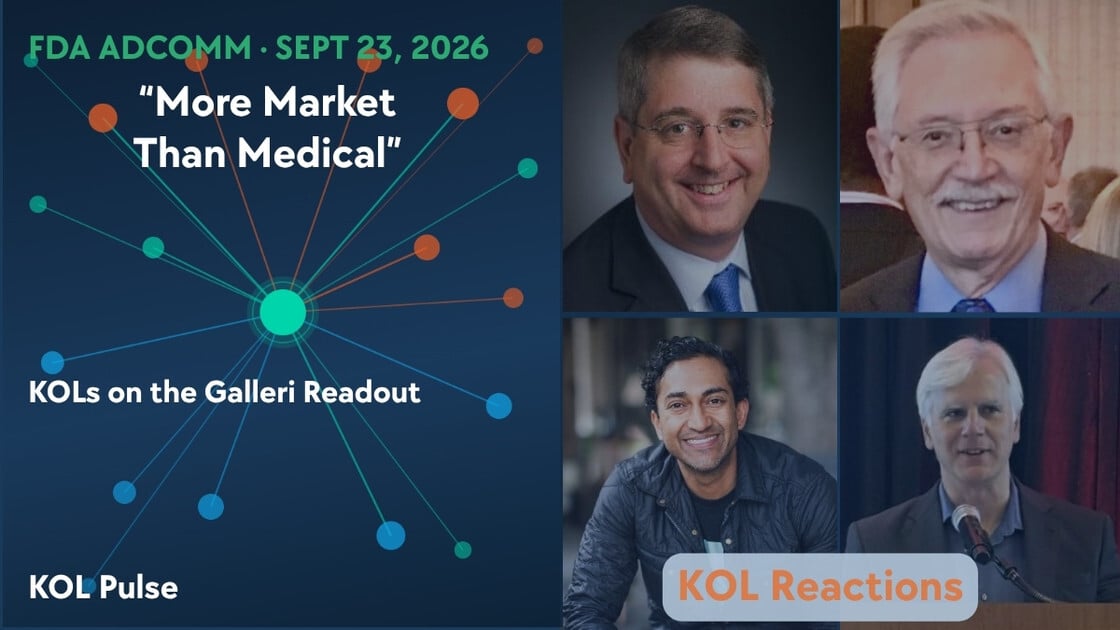
“More Market Than Medical” — The Oncologists Doubting Galleri as the FDA Panel Meets
The FDA’s Molecular and Clinical Genetics Panel meets today, September 23, 2026 to review GRAIL’s premarket approval application for the Galleri multi-cancer early detection (MCED) blood test — the first MCED test ever brought before an FDA advisory committee. Overnight, NEJM published the full NHS-Galleri results: the primary endpoint was not met. Prominent oncologists — Harold Burstein, David Gandara, Vinay Prasad, Balazs Halmos — are saying so, verbatim, below.
What was published the night before the FDA panel?
Eric Topol quoted the NEJM conclusion directly:
The GRAIL NHS Galleri randomized trial with over 142,000 participants was published today @NEJM "In this trial, we did not observe a lower incidence rate of stage III or IV cancers [the primary endpoint] across 12 prespecified cancers after three screening rounds with multicancer early-detection testing plus usual care than with usual care alone."
— Eric Topol (@EricTopol)
What do the NHS-Galleri numbers actually show?
In PATHFINDER 2 — single-arm, so no comparisons and no benefit claims — the test as run showed a positive predictive value of 60.3% and specificity of 99.6%, with episode-level sensitivity of 39.3%. Full figures, sourced stat by stat, are on our NHS-Galleri and PATHFINDER-2 trial pages.
Harold Burstein on NHS-Galleri: “more market than medical”
Harold J. Burstein, MD, PhD (Dana-Farber) posted the sharpest framing of the week on the NHS-Galleri randomized trial — “the study” in his post is that 142,318-participant UK RCT, whose primary endpoint was not met. He also points at why NHS-Galleri’s strongest signal, colorectal cancer, may not translate to the US, where screening colonoscopy is widespread and the UK’s is not:

His read is consistent with what he posted when the NHS-Galleri data were first presented at ASCO 2026 in June:
the @NHS-Galleri trial is 1st RCT for molecular screening for early cancer detection. 142K participants; found ~1400 cancers overall (i.e. 1% ). No sig reduction in incidence rates of stage III/IV cancers. No change in rate @ prevalent vs incident rds.
— Harold J. Burstein, MD, PhD (@DrHBurstein)
David Gandara: why is the coverage “rosy”?
David Gandara, MD (UC Davis, lung cancer) took aim at the gap between the data and the press coverage:

The replies became a real physician thread. Simon C:
Thanks David. A strange article in many ways. Anyone would think it hadn’t failed its’ primary endpoint
— Simon C (@scserendipity1)
Yüksel Ürün, MD (Ankara University):
Agreed. Earlier detection is the promise, but stage shift and ultimately mortality benefit are the real tests. Detecting more cancers is not enough if many are still found at an advanced stage.
— Yüksel Ürün, MD (@DrYukselUrun)
And Patrick C. Ma, MD (Penn State) on where this debate is heading:
It's a topic that can and likely is already turning into a polarizing and emotional discussion, esp btw patients and researchers, esp in the era of stage 4 cancer disease being more and nore "treatable" with notably improved survival across many cancer types, lung included, even at stage 4.
— Patrick C. Ma, MD (@PatrickCMa1)
Vinay Prasad: are these tests ready for primetime?
Vinay Prasad, MD, MPH posted a 7.8-minute video breakdown of MCED testing — what we know, what we don’t, and access versus payment — the night before the panel. Watch it here:
Prasad also re-posted his American Journal of Medicine analysis, “Are Blood-Based Cancer Screening Tests Ready for Primetime?”, co-authored with Alyson Haslam — flagged by Timothée Olivier as “couldn’t be more timely.”
Balazs Halmos: “Holy Grail or holy sh..t?”
Balazs Halmos, MD (Montefiore Einstein) posted the morning of the panel — intrigued by the late separation of the stage IV curves, unsparing about the endpoint miss and the false-negative math:

Note: the randomized endpoint he references (stage III/IV reduction across 12 cancer types) is NHS-Galleri’s, published in NEJM; PATHFINDER-2 is GRAIL’s single-arm registrational study, published the same evening in Nature Medicine, and had no comparator arm.
What happens at today’s FDA panel?
Reshma Ramachandran, MD, MHS (Yale) raised the payment dimension:
#Galleri is designated as a breakthrough device which means that Medicare (aka taxpayers) will not only pay for the cost of the test but also an additional supplemental payment. Will @FDA require post approval studies as the primary or clinically meaningful endpoints weren't met?
— Reshma Ramachandran, MD, MHS (@reshmagar)
Where can I follow the full KOL debate?
Every primary source behind this page — all six FDA advisory-committee briefing documents, GRAIL’s press releases and ASCO decks, journal abstracts, registry records, physician commentary and expert video — in one AI research notebook you can question directly, with cited answers.
KOL Pulse tracks what verified oncology and hematology physicians are actually discussing on X — not press releases, the real clinical debate. Every KOL post quoted here is verbatim and links to its source. Featured voices: Drs. Harold Burstein, David Gandara, Vinay Prasad, Balazs Halmos, Eric Topol, Yüksel Ürün, Patrick C. Ma, and Reshma Ramachandran.
Clinical figures verified against the NEJM publication, the Nature Medicine publication, and the FDA advisory-committee briefing documents. NHS-Galleri and PATHFINDER 2 ran MCED-V2, an investigational version of the test; Galleri is not FDA approved.