Brian Shields
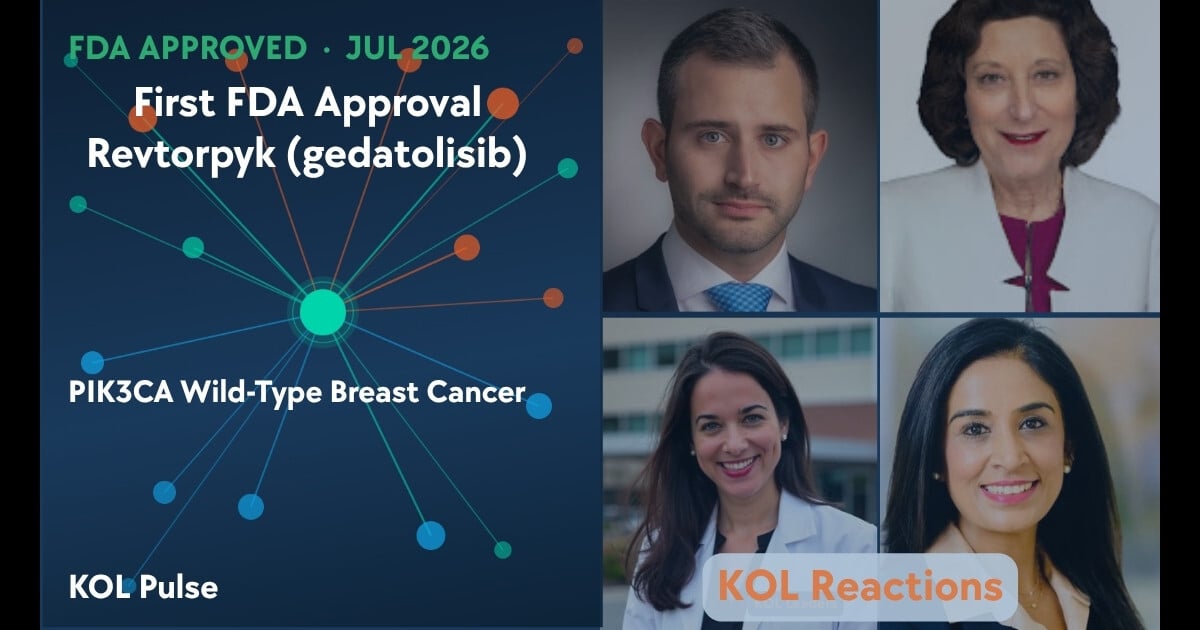
Gedatolisib (Revtorpyk) Is FDA Approved: What Breast Oncology KOLs Said on Day One
On July 14, 2026 the FDA approved gedatolisib (Revtorpyk, Celcuity) — the first pan-PI3K/AKT/mTOR (PAM) inhibitor — with fulvestrant, with or without palbociclib, for HR+/HER2−, PIK3CA wild-type advanced breast cancer after at least one line of endocrine therapy for metastatic disease. Median PFS was 9.3 months (triplet) and 7.4 months (doublet) versus 2.0 months for fulvestrant. Within hours, breast oncology's leading voices were debating not whether to use it, but how.
At a Glance
- Approved Jul 14, 2026 — gedatolisib + fulvestrant, ± palbociclib.
- Population: HR+/HER2−, PIK3CA wild-type, after ≥1 line of endocrine therapy (VIKTORIA-1 Study 1).
- Not approved: the PIK3CA-mutant cohort (Study 2) — a separate filing is signaled.
- Efficacy: mPFS 9.3 (triplet) / 7.4 (doublet) vs 2.0 mo; HR 0.24 / 0.33.
- Burden: 180 mg IV weekly, Days 1/8/15 q28d — the KOLs' single biggest reservation.
- OS: immature at approval (~25% events).
- Where they landed: doublet-leaning; the control arm and the IV burden are the live debates.
What exactly did the FDA approve on July 14, 2026?
| Arm | Regimen | Median PFS | HR vs fulvestrant |
|---|---|---|---|
| A — Triplet | gedatolisib + fulvestrant + palbociclib | 9.3 mo (95% CI 7.2–16.6) | 0.24 (0.17–0.35), p<0.0001 |
| B — Doublet | gedatolisib + fulvestrant | 7.4 mo (5.5–9.9) | 0.33 (0.24–0.48), p<0.0001 |
| Control | fulvestrant alone | 2.0 mo (1.8–2.3) | — |
Dose is 180 mg IV over 30 minutes, weekly on Days 1/8/15 of a 28-day cycle. Overall survival was immature at approval. Source: FDA approval notice and Hurvitz SA et al., J Clin Oncol 2026;44(12) (NCT05501886). Full data: the VIKTORIA-1 trial profile.
Why is gedatolisib approved only for PIK3CA wild-type disease?
The KOLs were alert to this from the first hour. Neil Vasan framed the wild-type approval as the arrival of a new option while explicitly "anticipating impending approval" for the mutant population — two distinct regulatory events, not one.
What did breast oncology KOLs say within 24 hours?
Day One (July 14) — Paolo Tarantino was the loudest Day-One voice, and notably led with the open questions rather than the win. Yakup Ergün was the other major Day-One voice, and was the first to say where the triplet might earn its place. The Oncology Brothers and Dr. Harold Burstein delivered the fast factual reads.

Gedatolisib now approved for PIK3CAwt ER+ MBC. Very active regimen, many open questions: - triplet vs doublet. I’d favor doublet to optimize the benefit/risk ratio - IV infusions clearly add burden, shared decision making is key - if ESR1 mutant, SERD combos may be prioritized

Encouraging news for breast cancer✅️ Gedatolisib has received FDA approval for patients with PIK3CA wild-type disease. We already know that outcomes in the PIK3CA-mutant cohort are also very promising... In the PIK3CA wild-type cohort, PFS was numerically longer with the triplet. I would therefore be more inclined to add palbociclib in pre/perimenopausal patients, those with rapidly progressive disease or substantial visceral burden, and patients with good hematologic tolerance. For now, the main practical limitation remains its intravenous administration!

Gedatolisib is now @US_FDA ✅ based off VIKTORIA-1: PhIII, Gedato (PI3K/mTORi) + Fulv +/- Palbo vs. Fulv in HR+ after one line of ET in HR+ - mPFS: 9.3mos w/triplet vs. single agent Fulv (HR: 0.24) - mPFS: 7.4mos w/doublet vs. single agent Fulv (HR: 0.33) - AEs (IV/⏰ toxicity)

The @FDA approves gedatolisib as 2nd line therapy in combo with fulvestrant in tumors w/o PIK3CA mutations. Median PFS F, 2.0m, F+G, 7.4m, F+G+palbo 9.3m.

FDA approves gedatolisib in combination with fulvestrant, with or without palbociclib, for adults with HR+/HER2-locally advanced or metastatic breast cancer without a PIK3CA mutation detected following progression on or after treatment with at least one line of endocrine therapy

FDA approved gedatolisib (Revtorpyk) + fulvestrant ± palbociclib for HR+/HER2−, PIK3CA wild-type advanced/metastatic breast cancer after progression on endocrine therapy. @Larvol @OncoAlert
Day Two (July 15) — the analysis deepened. Dr. Tarantino returned with a ten-point case for the doublet; Dr. Sarah Sammons put the regimen in context against everything else on the shelf; Dr. Mali Barbi wrote the most detailed analytical read; Dr. Hope Rugo named the practical problem.

Post-CDK4/6i, PIK3CA-WT HR+/HER2- MBC: how does gedatolisib stack up to other options? PFS by regimen: Everolimus + ET: 5.5 mo Oral SERD alone (ESR1m): 5.5-8 mo Abema + imlunestrant: 10.9 mo Gedatolisib + fulv: 7.4 vs 2.0 mo, HR 0.33 Gedatolisib + fulv + palbo: 9.3 vs 2.0 mo, HR 0.24 Not a clean cross-trial comparison, different populations and control arms. Clearly looks better than everolimus.

FDA approved gedatolisib (PI3K/AKT/mTOR-PAM inhibition) + fulvestrant ± palbociclib for PIK3CA-WT HR+/HER2- mBC post-CDK4/6i. First PAM inhibitor to land in the WT space. PFS- WT: triplet 9.3m, doublet 7.4m vs fulvestrant 2.0m (HR 0.24 / 0.33). Two caveats. No head-to-head triplet vs doublet, each was benchmarked separately, so palbociclib’s contribution is unproven. And a 2.0m control tells you how bad single-agent fulvestrant is post-CDK4/6i, not how this performs against what I’d actually reach for. But the alternatives don’t cover this patient. Elacestrant and vepdegestrant need ESR1. Capivasertib needs PIK3CA/AKT1/PTEN. In PIK3CA-WT/ESR1-WT the oral shelf is empty, and that’s exactly where this is indicated. Not a reflexive 2L default. Not dismissible either.

Clearly an important step forward and we expect approval in those with PIK3CAm in the future. IV an issue so figuring out the right population and 2 vs 3 drugs will be our challenge until SC available. Steroid MW key. And how to pronounce Revtorpyk?!! @OncoAlert

Gedatolisib FDA approved in patients with ER+ MBC not bearing PIK3CA mutations - a new therapeutic option for patients! Anticipating impending approval for ER+ MBC with PIK3CA mutations soon. @PIK3CApathbreak @SusanGKomen @BCRFcure
Doublet or triplet: should you add palbociclib to gedatolisib?
This is the heart of the divergence between what the label allows and what the experts will do. Tarantino's ten-point argument is the most detailed public statement of the doublet case among these voices — and reasons 6 through 10 are not about efficacy at all. They are about toxicity, burden, cost and quality of life: he cites >50% grade 3 neutropenia with palbociclib versus 0% without, and notes treatment-related deaths occurred only in the triplet arm. Dr. Rebecca Shatsky's reply — "Agree with doublet. The difference is minimal and tox is high".

Agree with doublet. The difference is minimal and tox is high.
The challenge: weekly IV dosing and mucositis/stomatitis burden, a real ask compared to oral regimens. The doublet (gedatolisib + fulvestrant) likely offers the better risk/benefit tradeoff for many patients: still a strong PFS gain over control (7.4 vs 2.0 mo) with a lighter toxicity load than adding palbociclib on top.
Dr. Ergün supplies the counterweight, and it is the most clinically actionable nuance here: PFS was numerically longer with the triplet, so he would still reach for palbociclib in pre/peri-menopausal patients, rapidly progressive or high visceral burden disease, and patients with good haematologic tolerance. That is not a disagreement about the data — it is a disagreement about which patient is in front of you.
Was the 2.0-month fulvestrant control arm a fair comparison?
Dr. Sarah Sammons amplified it from the ESMO 2025 floor — an audience question she relayed and endorsed — and the answer she passed on is the crux: the FDA, reportedly, mandated the design. Dr. Kelly Shanahan, patient advocate, pressed the same point independently at SABCS 2025 and again on the JCO publication. Nine months later, Mali Barbi landed it on approval day with the sentence that best captures the whole debate: "a 2.0m control tells you how bad single-agent fulvestrant is post-CDK4/6i, not how this performs against what I'd actually reach for."
Why it matters practically: it means the headline HR of 0.24 should be read as "versus a weak control," not "versus best available therapy." Sammons' own cross-trial framing — which she is careful to label as not a clean comparison — is the more useful mental model, and it still leaves gedatolisib looking better than everolimus in this space.
Excellent question from the audience. Why in the world are we still using single agent fulvestrant control arms in 2025? Apparently @US_FDA mandated this in Viktoria 1.

My question: is fulvestrant alone really SOC in a pretreated population? Would a better comparator be a CDKi + ET?
And the comparator arm is just fulvestrant??? Especially with the triplet that seems like cheating - should have compared to fulv + palbo.
Is weekly IV gedatolisib worth the time toxicity?
What makes this section different from every other outlet's coverage is who is talking. Dr. Kelly Shanahan is a physician and patient advocate, and she reframed the conversation around a cost that does not appear in any efficacy table: time toxicity — being tied to an infusion chair three weeks out of four. Drs. Tarantino, Jhaveri and Sammons engaged her directly. This is the exchange:
In 2+ line comparing anything to single agent fulv is 🙄 IV 3 out of 4 weeks 😭 💉 🍑 q 4 weeks 😣 Signif stomatitis 🤕 Seems a little better than postMonarch data (altho beware cross trial comparisons 🍎 🍊) My opinion: 🫤
I hear you, Kelly! A subcutaneous formulation is being developed. This hopefully will make the treatment much easier to pursue. 🤞

Won’t be available for 2-3 years! I hear @stage4kelly point about postMONARCH and fulvestrant + everolimus which yields ~6 months with doublets (cant do cross trial comparisons but certainly imp to put these data into context). Shared decision making and how to sequence key!
SQ will help IF it can be self administered and avoid a trip to the infusion center. Still waiting for that beautiful intersection of efficacy and minimal side effects, including time toxicity.
The time toxicity with this regimen is 😭. Even if a SQ formulation is eventually approved unless it can be self administered at home it doesn’t change that.
Note what Dr. Shanahan does to the SQ answer: a subcutaneous formulation only solves the problem if it can be self-administered at home. If it still requires an infusion-centre visit, the time cost is unchanged. That distinction went straight into how the KOLs are framing the drug — Dr. Tarantino's reasons 8 and 10, and Dr. Rugo's "IV an issue… until SC available," are the same objection in clinical language.
Where does gedatolisib fit — against capivasertib, elacestrant and everolimus?
Dr. Harold Burstein supplied the frame the whole field is now fitting this drug into: one agent from Column A (endocrine), one from Column B (targeted), repeat each line. Gedatolisib enters as a new Column B option for a patient who previously had very little in that column.
Treatment algorithm in outline for ER+ MBC: Column A: endocrine agent (fulvestrant, oSERD, AI, tamoxifen) Column B: targeted agent (CDK46i, PIK3CAi) Choose one from column A and one from column B. Repeat with each line of treatment.
Encouraging news for breast cancer✅️ Gedatolisib has received FDA approval for patients with PIK3CA wild-type disease. We already know that outcomes in the PIK3CA-mutant cohort are also very promising... In the PIK3CA wild-type cohort, PFS was numerically longer with the triplet. I would therefore be more inclined to add palbociclib in pre/perimenopausal patients, those with rapidly progressive disease or substantial visceral burden, and patients with good hematologic tolerance. For now, the main practical limitation remains its intravenous administration!
Dr. Barbi's closing verdict is the most quotable summary of where this drug actually sits, and it resists both hype and dismissal: "Not a reflexive 2L default. Not dismissible either." Dr. Tarantino adds the sequencing caveat that completes the algorithm — "if ESR1 mutant, SERD combos may be prioritized" — and Dr. Jhaveri's insistence on "shared decision making and how to sequence" is, in the end, what every voice on this page converged on.
Related on KOL Pulse: CAPItello-281 (capivasertib) · EMBER-3 (imlunestrant) · SERENA-6 (camizestrant) · all trial profiles.
How the read changed: ESMO 2025 → SABCS 2025 → ASCO 2026 → FDA
Dr. Hurvitz presents. Dr. Tarantino calls it a major PFS improvement while flagging moderate toxicity, two treatment-related deaths and three different routes of administration. Dr. Rugo flags 19% grade 3 stomatitis (triplet arm) and 3-of-4-weekly IV. An audience question — relayed by Dr. Sammons — asks why the control arm is single-agent fulvestrant.
Dr. Pistilli presents the update. Dr. Rugo: benefit maintained across prior-ET duration, glucose stable, stomatitis early and mostly resolving — and, critically, "Don't know if triplet better than doublet." The question that would dominate approval day was already open, seven months early.
Celcuity announces that the PIK3CA-mutant cohort read out positive against alpelisib + fulvestrant; full data followed at ASCO 2026 (May 29–Jun 2). Dr. Tarantino: gedatolisib is "an active option irrespective of PIK3CA status. Key caveat: the weekly IV formulation." Dr. Rugo notes it is the only agent with positive data in wild-type and mutant disease since everolimus.
Wild-type only. The doublet-vs-triplet question Dr. Rugo raised at SABCS becomes the central clinical decision; the control-arm critique aired at ESMO becomes the lens for reading the label's hazard ratios; and the IV burden remains the #1 caveat — now with a subcutaneous formulation in development.
VIKTORIA-1: major improvement in PFS (9.3 vs 2 months, HR 0.24, p<0.001) with gedatolisib/palbo/fulvestrant vs fulvestrant as 2L after CDK4/6i for PIK3CAwt disease. Moderate toxicity, with 2 treatment-related deaths. 3 different routes of administration. #ESMO25 #ESMOAmbassadors
#SABCS2025 @BarbaraPistill2 presents updated data from Viktoria1. PFS by various Rx duration of ET maintained, Glucose stable. Stomatitis an early event mostly better in 2wks, with delayed TTD in both arms. Don’t know if triplet better than doublet. @OncoAlert
BREAKING: positive results from the VIKTORIA-1 PIK3CA-mutant cohort Both the gedatolisib triplet and doublet improved PFS vs fulv/alpelisib, positioning gedatolisib as an active option irrespective of PIK3CA status. Key caveat: the weekly IV formulation.
The only agent with positive data in wild type and mutant BC since everolimus! Caveats as noted. IV 3 out of 4 weeks and stomatitis. @OncoAlert
Frequently asked questions
On July 14, 2026 the FDA approved gedatolisib (Revtorpyk, Celcuity) in combination with fulvestrant, with or without palbociclib, for adults with HR-positive, HER2-negative, PIK3CA wild-type locally advanced or metastatic breast cancer that progressed on or after at least one line of endocrine therapy in the metastatic setting. It is the first pan-PI3K/AKT/mTOR (PAM) inhibitor approved in this setting.
The approval rests on VIKTORIA-1 Study 1 — the PIK3CA wild-type cohort, tested against single-agent fulvestrant. The separate PIK3CA-mutant cohort (Study 2), which compared gedatolisib against alpelisib plus fulvestrant and read out at ASCO 2026, is not part of this label. Celcuity has signaled a supplemental filing for the mutant population.
VIKTORIA-1 was not designed to compare its two experimental arms — each was benchmarked separately against fulvestrant, so palbociclib's incremental contribution is unproven. Median PFS was 9.3 months with the triplet (HR 0.24) and 7.4 months with the doublet (HR 0.33), both versus 2.0 months for fulvestrant. Grade 3 neutropenia and both treatment-related deaths occurred in the triplet arm. Dr. Paolo Tarantino: "I'd favor doublet to optimize the benefit/risk ratio."
180 mg intravenously over 30 minutes, weekly on Days 1, 8 and 15 of each 28-day cycle. Hope Rugo called the route "IV an issue" and framed the right population and 2-vs-3 drugs as the challenge until a subcutaneous option exists; Paolo Tarantino said a subcutaneous formulation "is being developed," and Komal Jhaveri replied that it "won't be available for 2-3 years."
Stomatitis is the signature toxicity (grade 3 roughly 19% with the triplet and 12% with the doublet), along with dermatologic reactions and hyperglycemia. Grade 3 neutropenia and the two treatment-related deaths in VIKTORIA-1 occurred in the palbociclib-containing triplet arm. Steroid mouthwash is the KOL-cited mitigation.
It is the most persistent KOL critique, aired at ESMO 2025 and still live at approval. Dr. Sarah Sammons relayed and endorsed an audience question asking why single-agent fulvestrant control arms were still being used, adding that the FDA had reportedly mandated it in VIKTORIA-1. Dr. Mali Barbi put it directly: "a 2.0m control tells you how bad single-agent fulvestrant is post-CDK4/6i, not how this performs against what I'd actually reach for."
Biomarker eligibility decides it. Elacestrant and vepdegestrant require an ESR1 mutation; capivasertib requires a PIK3CA, AKT1 or PTEN alteration. In PIK3CA wild-type / ESR1 wild-type disease after a CDK4/6 inhibitor, none of those qualify. Everolimus plus endocrine therapy remains a biomarker-agnostic oral option (Dr. Sammons cites roughly 5.5 months PFS, cross-trial), but among biomarker-directed agents, as Dr. Barbi put it, "the oral shelf is empty, and that's exactly where this is indicated."
What's the bottom line for community oncologists?
1. It fills a real gap. PIK3CA wild-type / ESR1 wild-type after a CDK4/6 inhibitor had limited options. Gedatolisib is the first PAM inhibitor to land there.
2. Most KOLs lean doublet. No head-to-head exists; on their read palbociclib adds toxicity, cost and complexity without proven incremental benefit. Ergün is the counterweight: he would still add palbociclib in pre/peri-menopausal patients, rapidly progressive or high-visceral-burden disease, and those with good hematologic tolerance.
3. Time toxicity is the gating issue. Weekly IV, three weeks of four. The patient-advocate voice made it the headline — and a subcutaneous formulation only helps if it can be self-administered.
4. Read the hazard ratios against the control arm you actually use. The 2.0-month single-agent fulvestrant comparator — a design point KOLs have questioned since ESMO 2025, and one Dr. Sammons relayed as reportedly FDA-mandated — is why HR 0.24 means "versus a weak control," not "versus best available therapy."
See the full VIKTORIA-1 trial profile →Track oncology’s top KOLs in your specialty
Create a free account, pick the tumor types you cover, and go beyond the tweet — the intelligence pharma teams use to map influence and prepare for engagement:
- ✓Enhanced KOL profiles
- ✓Pharma influence & potential advisory-board patterns
- ✓2025 Open Payments financial analysis
- ✓Social-media sentiment & trend signals
KOL Pulse tracks what verified oncology and hematology physicians are actually discussing on X — not press releases, the real clinical debate. Every KOL tweet quoted here is verbatim and links to its source post; congress remarks are summarized from the presentations. Featured voices: Drs. Paolo Tarantino, Harold Burstein, Hope Rugo, Sarah Sammons, Komal Jhaveri, Neil Vasan, Mali Barbi, Yakup Ergün, Rebecca Shatsky, the Oncology Brothers, and patient advocate Dr. Kelly Shanahan.
Clinical figures verified against the FDA approval notice and Hurvitz SA et al., J Clin Oncol 2026;44(12). Editorial/educational content; not medical advice. © 2026 KOL Pulse.