ENDURANCE Key Takeaways
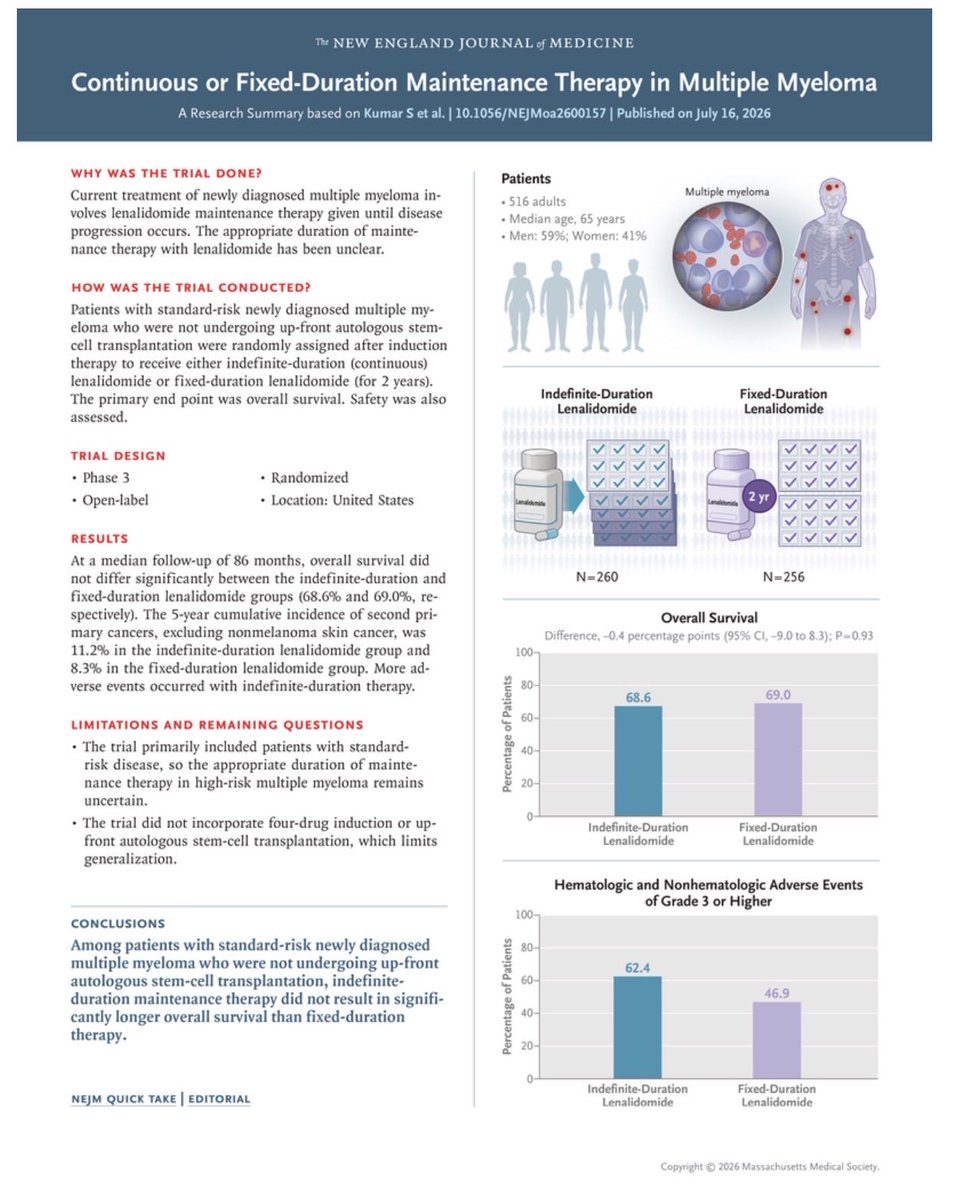
Design - Phase 3 NCI-funded academic trial (ECOG-ACRIN with Alliance and SWOG), N=516, standard-risk newly diagnosed multiple myeloma, no up-front autologous stem-cell transplant; second randomization compared indefinite-duration vs fixed-duration (2-year) lenalidomide maintenance (NCT01863550).
Overall survival (primary) - 7-year OS 68.6% (indefinite-duration) vs 69.0% (fixed-duration); difference -0.4%, P=0.93; 80 deaths in each group - indefinite maintenance did NOT significantly prolong overall survival (NEJM, Jul 2026).
Progression-free survival (not primary) - Median 42.5 mo (indefinite) vs 38.9 mo (fixed); 7-year PFS 36.1% vs 29.7%.
Safety / second cancers - Grade >=3 non-hematologic adverse events (all-cause) 48.2% (indefinite) vs 31.5% (fixed); 5-year cumulative incidence of second primary cancers (excluding non-melanoma skin) 11.2% vs 8.3%.
Population - Standard-risk NDMM not undergoing up-front autologous transplant; did NOT enroll high-risk disease or transplant-eligible patients receiving up-front transplant.
Regulatory - Academic NCI-funded trial (NEJM Jul 16, 2026) - not a drug approval; lenalidomide (Revlimid) is FDA approved for myeloma maintenance.
Top KOLs Discussing ENDURANCE


Top KOL Discussion Threads
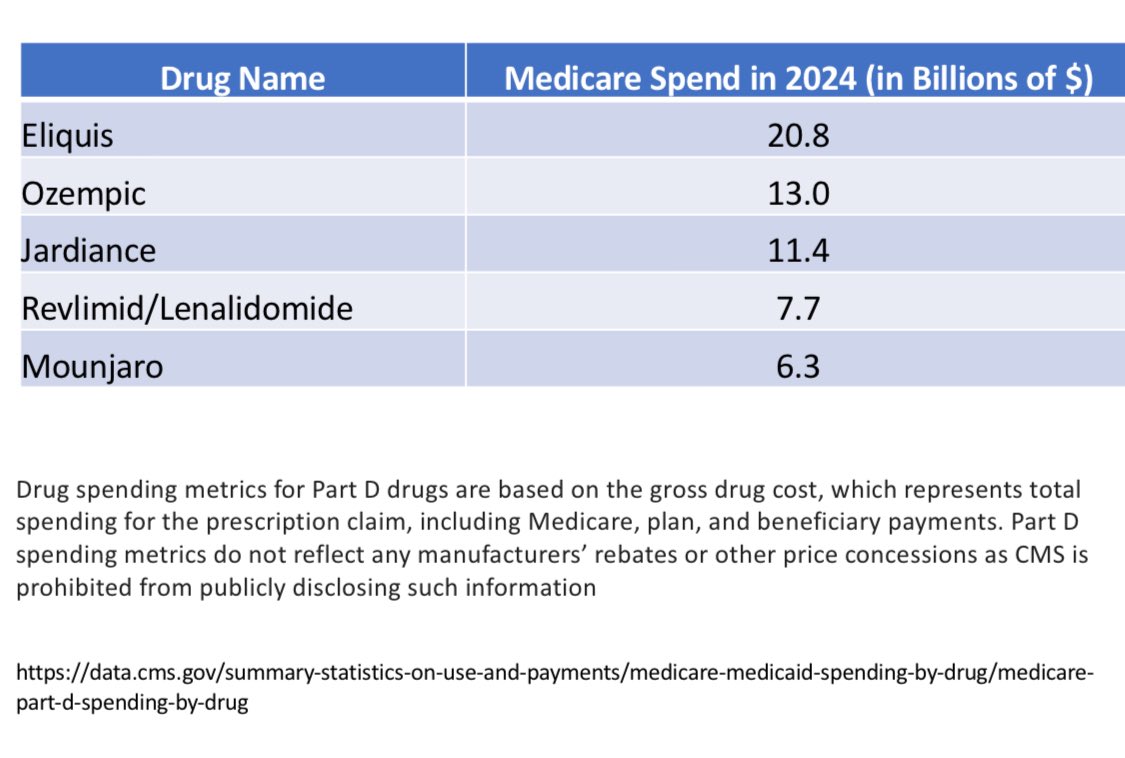
Just out!! In @NEJM - Our randomized trial in myeloma (ENDURANCE trial) shows limited duration of lenalidomide maintenance is just as good as indefinite therapy, with less side effects!!! @eaonc @theNCI Implications are HUGE. This is a drug we spends billions on each year: -Less side effects -Less second cancers -Similar overall survival -Less cost @myelomaMD @Myeloma_Doc @SagarLonialMD National NCI funded trial led by @eaonc and joined by @ALLIANCE_org & @SWOG https://t.co/k8nGWeSA03
This trial was done in standard risk myeloma in patients not undergoing transplant But I think its implications will probably extend to other situations in practice, similar to the low dose vs high dose dex trial. Time will tell. Side effects of long term lenalidomide can be troublesome especially fatigue, diarrhea, and cramps. If Len 2 years is sufficient with triplet induction and no transplant then it makes sense that if we improve induction further (quads) and add transplant, the benefit of indefinite duration maintenance will be even less since there will be less of the clone for the maintenance to eradicate or control. For high risk patients it may support an MRD driven maintenance approach. https://t.co/k8nGWeSA03
In oncology, regulatory studies often compare indefinite therapy with a drug given till progression versus nothing. But for practice we left not knowing whether indefinite therapy is needed or whether one year or two years etc will be sufficient. These are not trials that are easy to conduct. Only the @theNCI NCTN like @eaonc @SWOG @ALLIANCE_org can do these randomized trials. We are grateful that we were able to complete this trial and provide these results. We need more of these trials. My colleague @myelomaMD spearheaded this trial. And is already working on the next generation trial for our group.
This trial shows more is not better. And this is something we have seen in myeloma before. With low dose dex compared to high dose dex. With once weekly bortezomib compared to twice weekly. And more recently with immunotherapy this is even more important. This is another lesson from this trial. @RahulBanerjeeMD @GKaurMD @NorthTxMSG @MyelomaTeacher @JanakiramMurali
Drug costs are always a major consideration. This is a very expensive medicine and if we can reduce the duration of therapy from several years to 2 years, it will help patients, and Medicare. I have written about costs of therapy and how many solutions are beyond the influence of physicians to implement. But designing trials that can produce value is one way physicians can help. See related article.
As we move into powerful bispecifics and trispecifics we need to constantly evaluate duration of therapy in our trials. Even at the regulatory stage. But definitely in subsequent IITs.
@chadinabhan @Rfonsi1 The more is not better trial we did @eaonc that showed low dose Dex is better than high dose Dex. @TheLancetOncol Link: https://t.co/GdRGk5oZhR Story of the trial👇 https://t.co/uCXd0Oi4zi

@VincentRK @NEJM @eaonc @theNCI What were the number of deaths in both groups AFTER 2 years of maintenance? This is the only way to answer how the strategies differ since this is the timepoint when they differ. It doesn't matter you planned for indefinitely at six months total! Cancer can't see the future
@VincentRK @NEJM @eaonc @theNCI So all those earlier deaths do not tell you what to do in people alive and not progressing at 2 years. They inform little about the strategy.
@VincentRK @NEJM @eaonc @theNCI And with randomization 2 years from when therapy diverges by strategy, you're assuming a lot about non randomized differences accruing between day 1 and day 731. Even with landmark, it is not really an rct anymore. This is a substantial design flaw
@VincentRK @NEJM @eaonc @theNCI I think these type of studies are super important. But I put it to the Twitter verse that this study was flawed because of this temporal issue. Also cannot salvage using landmark as I explained above Unless I read it wrong?
I’m sorry. I’m confused. The figure you see is starting from the time of maintenance. Not from initial therapy. Overall survival, intent to treat, in patients randomized to indefinite vs 2 years, the curves you see start from the time maintenance starts. Exactly 80 deaths in both groups from that point through the 7 years of follow up.
@DrToddLee @NEJM @eaonc @theNCI You are reading it wrong.
Second randomization occurred only in patients who completed induction. That’s why if you have a patient in front of you who has completed induction and you wanted to find out whether to give maintenance for two years or indefinite, you randomize that population and do an intent to treat analysis. This is basic trial design. Any other design will be fatally flawed. I have no idea what you are talking about.
If you are referring to first two years of maintenance: You can see the OS curves. There are hardly any deaths in the first two years- like 8 per arm. And 70-72 per arm after the two years. The curves tell the story. The two arms were exactly on top of each other for 0-24 months and 24-end of study. And start to finish, and anywhere to anywhere. Clinicians need to just look at the curves.

@VincentRK @NEJM @eaonc @theNCI Revlimid now has a generic. So savings less than one might think.
Congratulations! Excellent and important study challenging indefinite lenalidomide maintenance. That said, I would be cautious about universally stopping at 2 years. Maintenance duration should be guided by modern risk stratification and, ideally, sustained MRD negativity rather than the calendar alone. The definition of "standard-risk" has evolved considerably over the past decade. Our goal should be precision medicine: don't overtreat, but don't undertreat patients with persistent biologic risk.

@VincentRK @myelomaMD @NEJM @eaonc @theNCI And we have to remember that FIRST trial RD continuous had the same OS than RD18 !!!!

@VincentRK @mtmdphd @TheLancetOncol Huge impact on the potential impact of clonal expansion of pre-existing CH clones especially TP53. Time limited Rev therapy will likely reduce development of sec heme malignancies in these patients.

@VincentRK @NEJM @eaonc @theNCI Did individuals stop maintenance after 2 year independent of response status / example VGPR vs MRD- ?
Congratulations to the ENDURANCE investigators on an impactful trial - they should be applauded for running a successful cooperative group phase 3 trial with two randomizations! My thoughts below... ENDURANCE enrolled patients without high-risk disease and without intention for ASCT. The 1st randomization evaluated KRd vs. VRd (no difference in PFS). The 2nd randomization evaluated 2 years vs indefinite lenalidomide maintenance with OS as the primary endpoint. After 9 years of follow-up, there is no difference in OS! Let's dive in and take a closer look... https://t.co/ifxqtqDdmV
Adherence to the protocol: - 1087 patients were randomized to step 1 (VRd vs KRd) but only 516 patients to step 2, marking a 50% dropoff. Some dropout is natural due to progression and proceeding to ASCT, but this is quite significant. - There was a difference in the patients who proceeded to step 2 as well. Patients receiving VRd were less likely (40%) to proceed to step 2 than KRd (55%). Could this be due to more withdrawal and/or proceeding with off-protocol therapies in VRd arm given that there was no difference in PFS in step 1 analysis?
Patients in the indefinite arm certainly had more cumulative lenalidomide exposure, though 44% of patients in indefinite arm had less than or equal to 24 months of therapy. There is also an interesting phenomenon of nominal PFS difference in the VRd subgroup but not the KRd subgroup. Surprisingly, no differences in second cancers between groups.
All in all, my take is that this study provides some evidence that indefinite maintenance therapy in patients with standard risk disease who did not receive a transplant may not extend survival. I want to believe this is true for all patients....but... There are some systematic issues inherent to the complexities of large cooperative group trials that we must acknowledge too. For now, I will continue to use sustained MRD negativity to trigger discussion regarding discontinuation of therapy.
@bdermanmd Now we have randomized evidence that even among patients with likely lower rates of MRD negativity as they got triplet induction & no asct, two year versus indefinite Len did not make any meaningful difference for PFS or OS that is enough for me to change what I do for SR pts

@bdermanmd @MedwatchKate Valid points Is there any randomized phase 3 trial which has shown that indefinite Len has OS benefit ? Based on what data did it become SOC ?
Good question. We have meta analyses that showed a benefit. But with much older induction regimens. My comments stem from how we think about the discontinuation question. Are we stopping because of qol benefits or because we think the patient could be cured? For the latter part, fixed duration without regard for depth of response is flying blind. We have the ability to know more with MRD. Wrote about all of this here https://t.co/9ORIhEs3wf

@bdermanmd Credit to the group- amazing job. I agree with your summary. Concerns- definitions of SR vs HR has changed. The skimming of almost half the population, mostly to salvage or ASCT suggests a selection pressure which leaves a ultra low risk population behind.
Read and don’t Judge this 🧵 🧵 NEJM Practice-Changer? Can We Finally Stop Lenalidomide Maintenance at 2 Years in Standard-Risk Myeloma? 💊🩸 A deep dive into the ENDURANCE maintenance trial published in the New England Journal of Medicine. 👇 #MultipleMyeloma #Myeloma #HemOnc #ASCO #ASH #NEJM 1️⃣ Background For years, lenalidomide maintenance has been continued until progression, largely because previous trials compared maintenance vs no maintenance—not continuous vs fixed duration. This phase III trial finally addressed a question we’ve all been asking: 👉 Is indefinite maintenance really necessary? #MultipleMyeloma #Myeloma #HemOnc #mmsm #NEJM #USMIRC @USMIRCNEWS @oncodaily @US_HMC @MedwatchKate @Larvol
2️⃣ Study Design 📌 Phase III ENDURANCE trial 👥 516 patients with standard-risk, transplant-deferred/ineligible newly diagnosed MM ➡️ After KRd or VRd induction: 🔹 Continuous lenalidomide until progression 🆚 🔹 Fixed-duration lenalidomide for 2 years Primary endpoint: 🎯 Overall Survival (OS) #MultipleMyeloma #Myeloma #HemOnc #mmsm #NEJM #USMIRC @USMIRCNEWS @oncodaily @US_HMC @MedwatchKate @Larvol
3️⃣ The Headline Result 🚨 No Overall Survival benefit 📊 7-year OS: • Continuous: 68.6% • Fixed 2 years: 69.0% ❌ P = 0.93 After nearly 7 years of follow-up, longer maintenance did not improve survival. #MultipleMyeloma #Myeloma #HemOnc #mmsm #NEJM #USMIRC @USMIRCNEWS @oncodaily @US_HMC @MedwatchKate @Larvol
4️⃣ Progression-Free Survival There was only a numerical, not statistically convincing, improvement. 📈 Median PFS • 42.5 months • vs 38.9 months 📈 7-year PFS • 36.1% • vs 29.7% Absolute difference: ➡️ 6.4% No clear clinically meaningful separation. #MultipleMyeloma #Myeloma #HemOnc #mmsm #NEJM #USMIRC @USMIRCNEWS @oncodaily @US_HMC @MedwatchKate @Larvol
5️⃣ Toxicity Matters ⚠️ Continuous therapy came at a cost. Grade ≥3 adverse events: 🔺62.4% vs 46.9% Grade ≥3 non-hematologic toxicity: 🔺48.2% vs 31.5% More discontinuations due to: Fatigue Cytopenias Diarrhea Neutropenia Higher cumulative incidence of second primary cancers: 11.2% vs 8.3% #MultipleMyeloma #Myeloma #HemOnc #mmsm #NEJM #USMIRC @USMIRCNEWS @oncodaily @US_HMC @MedwatchKate @Larvol
6️⃣ Why is this Important? Longer treatment means: 💰 Higher cost 🏥 More clinic visits 💊 More chronic toxicity 😊 Lower treatment-free time If survival is unchanged, we should carefully ask: Are patients benefiting enough to justify indefinite therapy? #MultipleMyeloma #Myeloma #HemOnc #mmsm #NEJM #USMIRC @USMIRCNEWS @oncodaily @US_HMC @MedwatchKate @Larvol
7️⃣ Critiques 🧐 Every landmark study deserves careful interpretation. 🔹 Only standard-risk patients were included. 🔹 No upfront ASCT population. 🔹 Modern MRD-guided discontinuation was not incorporated. 🔹 High-risk disease remains unanswered. 🔹 Only 516 of 1087 enrolled patients reached the maintenance randomization. 🔹 The trial observed 160 deaths, fewer than the planned 364, reducing statistical power for OS. #MultipleMyeloma #Myeloma #HemOnc #mmsm #NEJM #USMIRC @USMIRCNEWS @oncodaily @US_HMC @MedwatchKate @Larvol
8️⃣ Clinical Perspective This trial should be interpreted as: ✅ Maintenance remains beneficial. ❌ Extending therapy beyond 2 years may not improve overall survival for standard-risk patients treated without upfront transplant. Duration—not simply maintenance itself—is the question. #MultipleMyeloma #Myeloma #HemOnc #mmsm #NEJM #USMIRC @USMIRCNEWS @oncodaily @US_HMC @MedwatchKate @Larvol
9️⃣ Take-Home Messages 🎯 ✅ First randomized trial directly comparing continuous vs 2-year lenalidomide maintenance. ✅ No improvement in overall survival with indefinite therapy. ✅ Only modest numerical PFS difference. ✅ Continuous treatment caused substantially more toxicity. ✅ Results apply only to standard-risk, non-transplant patients. ✅ Supports future strategies using individualized, MRD-guided maintenance duration rather than routine indefinite therapy. #MultipleMyeloma #Myeloma #HemOnc #mmsm #NEJM #USMIRC @USMIRCNEWS @oncodaily @US_HMC @MedwatchKate @Larvol
Clinical Takeaways — in the KOLs’ Own Words
TRUTHS vs MYTHS: Lenalidomide Maintenance in Multiple Myeloma The ENDURANCE maintenance trial is an important addition to the myeloma literature. Like every randomized trial, however, its findings should be interpreted within the population it studied. Over the past two decades, maintenance strategies have evolved alongside advances in induction therapy, transplant, risk stratification, and MRD assessment. For me, the future is biology-guided, MRD-informed, and patient-centered, not simply calendar-driven. This figure summarizes what the current evidence supports and addresses several common misconceptions. 📚 Coming Soon: The Evolution of Lenalidomide Maintenance (6-part PSNS educational mini-series). In Biology We Trust. Dr. Fun + G ✨ #MultipleMyeloma #Medwatch #Hemetwitter
View post on X · Jul 16, 2026 · 4.5K impressions →ALERT: Major MM therapy paradigm shift with ENDURANCE trial showing less therapy as good as indefinite therapy. On behalf of patients and clinicians, thank you for doing this study. https://t.co/iL2THHddD9
View post on X · Jul 15, 2026 · 3.6K impressions →Details on the ENDURANCE trial just published by @NEJM just now are streaming on @YouTube #HealthcareUnfiltered EXPRESS - hear what @VincentRK has to say. Indefinite maintenance Lenalidomide is now obsolete. https://t.co/WjJXb6mJUu
View post on X · Jul 15, 2026 · 2.2K impressions →
Important #mmsm data from ENDURANCE: in standard-risk, transplant-ineligible NDMM, indefinite lenalidomide maintenance did not improve OS vs stopping at 2 years. Median PFS: 42.5 vs 38.9 months, with more toxicity on continuous therapy. In practice, I would favor an MRD-guided approach to maintenance duration rather than a fixed stop for all patients.
View post on X · Jul 16, 2026 · 995 impressions →Raj, you have said it the best! Indefinite Len is dead and future trials need to change more broadly to evaluate shorter duration of treatments. MM treatment is underoing a paradigm shift- the MASTER @End_myeloma and ENDURANCE trial with @myelomaMD @VincentRK show its possible. https://t.co/KqJjtk86ji
View post on X · Jul 15, 2026 · 908 impressions →
Update on ENDURANCE showing no difference in survival with 2 yr vs indefinite Len maintenance after VRd induction for standard risk #myeloma not undergoing auto transplant. While I’m hesitant to apply this broadly, it provides strong data to consider time limited maintenance. https://t.co/fYBsdVLJil
View post on X · Jul 16, 2026 · 702 impressions →Trial Design & Data
Design
Phase 3, NCI-funded academic trial led by ECOG-ACRIN with the Alliance and SWOG (additional support from Amgen). N = 516, standard-risk newly diagnosed multiple myeloma, no up-front autologous stem-cell transplant. Randomized after induction with a proteasome-inhibitor + lenalidomide combination (VRd/KRd) to indefinite-duration vs fixed-duration (2-year) lenalidomide maintenance. Primary endpoint: overall survival. Median follow-up ~7 years (86 months). Lead author Shaji K. Kumar, MD (Mayo Clinic). This was the second of the trial’s two randomizations; the first compared KRd vs VRd induction and showed KRd was not superior to VRd (The Lancet Oncology). (NEJM, Jul 2026)
Overall survival (primary endpoint)
7-year overall survival 68.6% (indefinite-duration) vs 69.0% (fixed-duration); difference −0.4%, P=0.93; 80 deaths in each group. Indefinite-duration maintenance did not result in significantly longer overall survival than fixed-duration maintenance. (NEJM, Jul 2026)
7-yr OS 68.6% (indefinite) vs 69.0% (fixed) · −0.4% · P=0.93 Kumar SK, et al. “Continuous or Fixed-Duration Maintenance Therapy in Multiple Myeloma.” N Engl J Med, Jul 16, 2026. DOI 10.1056/NEJMoa2600157 →Progression-free survival (not the primary endpoint)
Median progression-free survival 42.5 months (indefinite-duration) vs 38.9 months (fixed-duration). 7-year progression-free survival 36.1% vs 29.7%. (NEJM, Jul 2026)
Median PFS 42.5 vs 38.9 mo · 7-yr PFS 36.1% vs 29.7% PubMed record, N Engl J Med 2026 →Adverse events and second primary cancers
Non-hematologic adverse events of grade 3 or higher (all-cause): 48.2% (indefinite-duration) vs 31.5% (fixed-duration). 5-year cumulative incidence of second primary cancers, excluding non-melanoma skin cancer: 11.2% vs 8.3%. (NEJM, Jul 2026 — all-cause grade ≥3 non-hematologic)
Grade ≥3 non-heme AEs 48.2% vs 31.5% · 5-yr SPM 11.2% vs 8.3% Kumar SK, et al. N Engl J Med, Jul 16, 2026 →Population studied
ENDURANCE enrolled patients with standard-risk newly diagnosed multiple myeloma who were not undergoing up-front autologous stem-cell transplant. The trial did not enroll patients with high-risk disease, and did not enroll patients who received an up-front autologous stem-cell transplant. (NEJM, Jul 2026)
ENDURANCE Key Slides & Visuals


ENDURANCE in the News
The ENDURANCE trial was just published in @NEJM hot off the press: @VincentRK joined #HealthcareUnfiltered EXPRESS to explain the importance of this trial and why it mattered. Check it out right here.
— chadi nabhan MD, MBA, FACP (@chadinabhan) July 15, 2026
Video posted by @chadinabhan, July 15, 2026 · ~5.6 min
ENDURANCE Trial FAQ
What did the ENDURANCE trial show about lenalidomide maintenance duration?
Indefinite-duration lenalidomide maintenance did not result in significantly longer overall survival than fixed-duration (2-year) maintenance. Seven-year overall survival was 68.6% with indefinite-duration maintenance versus 69.0% with fixed-duration maintenance — a difference of −0.4% (P=0.93), with 80 deaths in each group. Overall survival was the primary endpoint.
Which patients did ENDURANCE enroll?
516 patients with standard-risk newly diagnosed multiple myeloma who were not undergoing up-front autologous stem-cell transplant, randomized to maintenance after induction with a proteasome-inhibitor plus lenalidomide combination (VRd or KRd). The trial did not enroll patients with high-risk myeloma, and did not enroll patients who received an up-front autologous stem-cell transplant.
What were the adverse event and second primary cancer rates?
Non-hematologic adverse events of grade 3 or higher (all-cause) were reported in 48.2% of the indefinite-duration group and 31.5% of the fixed-duration group. The 5-year cumulative incidence of second primary cancers, excluding non-melanoma skin cancer, was 11.2% with indefinite-duration maintenance and 8.3% with fixed-duration maintenance.
How have myeloma physicians publicly responded to the ENDURANCE results?
ENDURANCE co-author Vincent Rajkumar (@VincentRK) wrote that the trial “shows limited duration of lenalidomide maintenance is just as good as indefinite therapy, with less side effects”. NEJM editorial co-author Hira Mian (@HiraSMian) wrote: “Indefinite Len is dead and future trials need to change more broadly to evaluate shorter duration of treatments.” Henry C Fung (@HenrychihangFu1) wrote that “the future is biology-guided, MRD-informed, and patient-centered, not simply calendar-driven.” Prerna Mewawalla (@myelomadoctor) wrote: “In practice, I would favor an MRD-guided approach to maintenance duration rather than a fixed stop for all patients.” Marc Braunstein (@docbraunstein) wrote: “While I’m hesitant to apply this broadly, it provides strong data to consider time limited maintenance.” Todd C. Lee (@DrToddLee), Professor of Medicine at McGill, challenged the design in reply to Rajkumar: “This is a substantial design flaw”. Rajkumar replied: “The figure you see is starting from the time of maintenance. Not from initial therapy.” See the full conversation trees on this page.