EXCALIBER-RRMM is the Phase 3 trial behind the FDA’s August 13, 2026 accelerated approval of iberdomide (Zenbexus, Bristol-Myers Squibb Company) with daratumumab and hyaluronidase-fihj and dexamethasone for multiple myeloma after at least one prior line of therapy including a proteasome inhibitor and an immunomodulatory agent. MRD-negative complete response was 41% versus 21%. On October 8, 2026 the sponsor reported topline progression-free survival, the second dual-primary endpoint: median PFS 42 versus 20 months (HR 0.49; 800-patient confirmatory population, median follow-up 23 months), with full data due at ASH 2026. Grade 4 neutropenia occurred in 53.4%.
FDA Accelerated Approval · Aug 13, 2026Phase 3 · NCT04975997Relapsed/Refractory Multiple MyelomaIberdomide (Zenbexus) · First CELMoDMRD-negative CR 41% vs 21%PFS 42 vs 20 mo, HR 0.49 · topline Oct 8, 2026OS not yet reported
Phase 3, two-stage, randomized, multicenter, open-label trial. 939 patients randomized overall — stage 1 (n=279) tested three iberdomide dose levels against DVd and selected 1.0 mg; stage 2 (n=660) compared iberdomide 1 mg plus daratumumab and hyaluronidase-fihj and dexamethasone (IberDd) against daratumumab and hyaluronidase-fihj, bortezomib and dexamethasone (DVd). (FDA approval notice; ClinicalTrials.gov NCT04975997)
Primary result — MRD-negative CR
In the primary efficacy population of the first 420 patients randomized, MRD-negative complete response at any time was 41% (95% CI: 34, 48) with IberDd (n=207) versus 21% (95% CI: 15, 27) with DVd (n=213), p<0.0001. Median follow-up approximately 16 months. (FDA approval notice, interim MRD analysis)
41% vs 21% MRD-negative CR — surrogate endpoint; PFS topline now reported (see below)
Safety — the trade-off
Boxed warning for embryo-fetal toxicity and serious venous and arterial thromboembolism. In the safety population (IberDd n=204): Grade 4 neutropenia 53.4%, serious infections 40%, venous thromboembolic events 6.4% despite mandatory prophylaxis, second primary malignancies 6.9% versus 4.9% (DVd) at 16 months, serious adverse reactions 58.3%, and fatal adverse reactions in 10 patients (4.9%). (Zenbexus PI §5.3–5.6, 6.1)
PFS — dual primary endpoint met (topline, Oct 8, 2026)
Median PFS 42 months (ZDd) versus 20 months (DVd), HR 0.49, p<0.000001; median follow-up 23 months; PFS confirmatory analysis population of all 800 patients randomized to ZDd (n=400) or DVd (n=400). Press-release figures only — no confidence intervals or data-cutoff date disclosed; full results to be presented at ASH 2026. (BMS press release, Oct 8, 2026 — topline; CancerNetwork; OncoDaily)
Median PFS 42 vs 20 months, HR 0.49 — topline
What is not yet known
Overall survival, a key secondary endpoint, has not been reported. The PFS result above is a sponsor topline announcement: confidence intervals, the data-cutoff date, subgroup results and the updated safety tables have not been released, and the result has not been reviewed by the FDA or reflected in the label, which remains an accelerated approval on the MRD-negative CR surrogate. After the planned interim MRD analysis the Data Monitoring Committee had recommended the trial continue without modification to evaluate PFS and OS. (BMS release Oct 8, 2026; BMS release Sep 23, 2025)
Population — read the exclusions
Adults with one or two prior lines of therapy. Patients whose disease was refractory to prior anti-CD38 monoclonal antibody therapy, or refractory to prior bortezomib, were excluded. Only 4% of the primary efficacy population had received any prior anti-CD38 monoclonal antibody, and the label states there is limited data in patients who have received or are refractory to prior anti-CD38 therapy. (FDA approval notice; Zenbexus PI §14)
Regulatory
Accelerated approval granted August 13, 2026 on the MRD-negative CR surrogate endpoint. Continued approval may be contingent upon verification and description of clinical benefit in confirmatory trial(s). Boxed warning for embryo-fetal toxicity and serious venous and arterial thromboembolism. Available only through the ZENBEXUS REMS. (FDA approval notice; Zenbexus prescribing information)
Sponsor and drug
Iberdomide (Zenbexus), Bristol-Myers Squibb Company — the first cereblon E3 ligase modulator (CELMoD) approved in multiple myeloma. Trial sponsor of record: Celgene. (FDA; ClinicalTrials.gov; BMS press release, Aug 13, 2026)
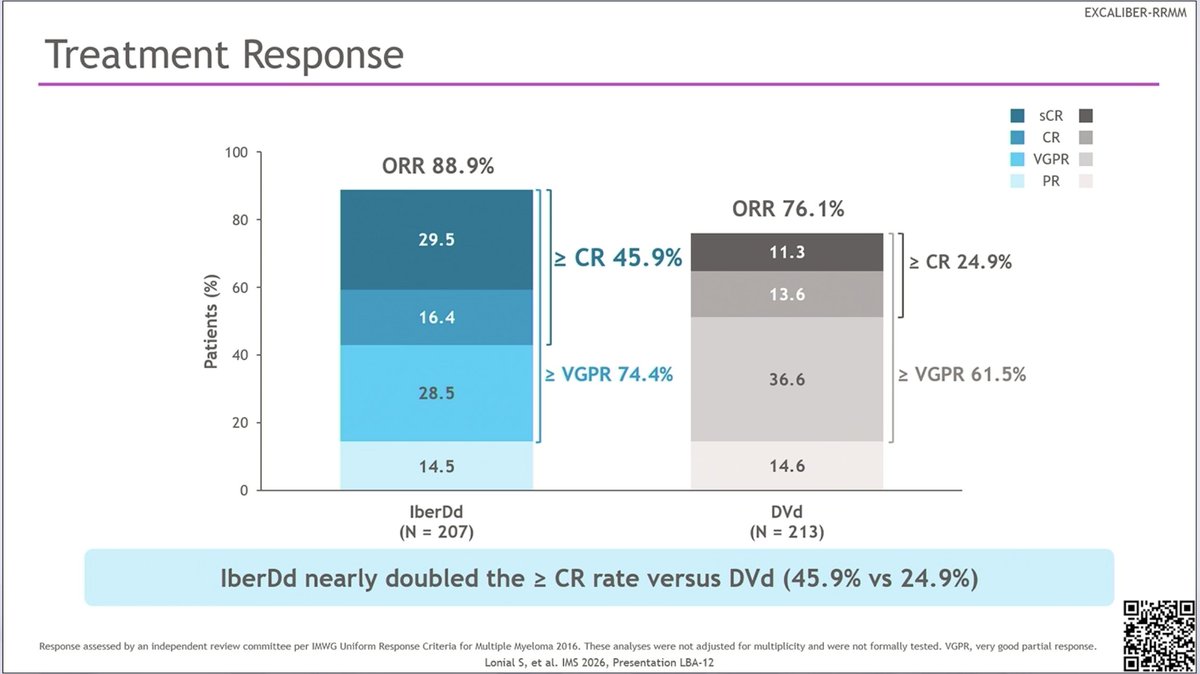
Full results were presented by Dr. Sagar Lonial (Emory) in the IMS26 plenary session (Presentation LBA-12, chaired by Marc Raab) and published simultaneously in The Lancet Oncology. At a longer median follow-up of ~15.7 months: CR or better 46% vs 24%; MRD-negative CR (10-5, any time) 40–41% vs 20–21% (consistent with the FDA accelerated-approval figures above). Grade 3/4 neutropenia was 84% vs 11% — higher than the label’s Grade 4-only figure suggested. A previously unpublished early haematologic second-primary-malignancy signal also surfaced: 4 of 14 IberDd second cancers were haematologic (2 AML, 2 MDS) vs 1 of 10 on DVd, at this same ~15.7-month follow-up — small numbers, but flagged by multiple physicians as worth watching given the CELMoD mechanism. PFS and OS were not presented at IMS 2026 (the PFS topline followed on October 8, 2026 — see the readout update below). (Lonial S, et al. IMS 2026, Presentation LBA-12; Lancet Oncology, published Sept 25, 2026)
Readout Update · October 8, 2026
PFS Readout: EXCALIBER-RRMM Meets Its Second Dual-Primary Endpoint
On October 8, 2026 Bristol Myers Squibb announced positive topline results for progression-free survival, the second of the trial’s two dual-primary endpoints. The announcement is a press release; the full dataset is to be presented at the 68th Annual Meeting of the American Society of Hematology (ASH 2026, New Orleans). Numbers below are the press-release figures only.
Median PFS was 42 months with ZDd (iberdomide + daratumumab + dexamethasone) versus 20 months with DVd, HR 0.49, p<0.000001, described by the sponsor as a 51% reduction in the risk of disease progression or death. Median follow-up was 23 months. Analysis population, per the release: “all 800 patients randomized to ZDd (n=400) or DVd (n=400)” — the PFS confirmatory analysis population, which is a different and larger cohort than the first-420-patient MRD primary analysis reported above (median follow-up 15.7 months). No 95% confidence intervals for the medians or the hazard ratio, no data-cutoff date, and no OS data were disclosed. The sponsor states the safety profile “remained consistent with previously reported safety findings from the study.” (BMS press release, Oct 8, 2026 — topline; CancerNetwork; OncoDaily)
Median PFS 42 vs 20 months, HR 0.49 — topline; full data at ASH 2026
What this does and does not change
Overall survival, a key secondary endpoint, remains unreported. The regulatory status is unchanged: the August 13, 2026 accelerated approval was granted on the MRD-negative CR surrogate endpoint, and continued approval may be contingent upon verification and description of clinical benefit in confirmatory trial(s); the PFS result has not yet been reviewed by the FDA or added to the label. The two analysis populations are not interchangeable and are kept separate on this page: MRD-negative CR (first 420 patients, median follow-up 15.7 months; FDA notice, IMS 2026 LBA-12, Lancet Oncology) versus PFS (800 patients, median follow-up 23 months; press release). (BMS press release, Oct 8, 2026; FDA approval notice)
Physician reaction to the PFS readout
Myeloma physicians only, quoted verbatim, ordered by impressions. Captured October 8, 2026 from @KolPulseAI bookmarks and an X recent search.
[Slide 1 - Screenshot of the Bristol Myers Squibb press release, Oct 8, 2026 (transcribed by KOL Pulse from the posted image; automated OCR not yet run on this post)]
Bristol Myers Squibb Announces ZENBEXUSTM (iberdomide) in Combination with Daratumumab and Dexamethasone (ZDd) Demonstrates Superior Progression-Free Survival vs. Standard of Care in Relapsed and Refractory Multiple Myeloma in Phase 3...
In the EXCALIBER study, results showed a progression-free survival hazard ratio of 0.49 compared with daratumumab, bortezomib and dexamethasone
PRINCETON, N.J.--(BUSINESS WIRE)--
Bristol Myers Squibb (NYSE: BMY) today announced positive topline results from the Phase 3 EXCALIBER-RRMM study, evaluating ZENBEXUSTM (iberdomide) in combination with daratumumab and dexamethasone (ZDd) in 800 patients with multiple myeloma (MM), as early as first relapse. Results showed ZDd demonstrated a statistically significant improvement in the dual-primary endpoint of progression-free survival (PFS), with median PFS of 42 months for ZDd vs. 20 months for daratumumab, bortezomib and dexamethasone (DVd) [HR:0.49, p<0.000001], representing a 51% reduction in the risk of disease progression or death. Median follow-up was 23 months. The safety profile of ZENBEXUS in combination with standard therapies remained consistent with previously reported safety findings from the study.
Free Access · KOL Pulse Intelligence
Track oncology’s top KOLs in your specialty
Create a free account, pick the tumor types you cover, and go beyond the tweet — the intelligence pharma teams use to map influence and prepare for engagement:
Choose the tumor types you follow. No cost, unsubscribe anytime.
Influence Leaders
Top KOLs Discussing EXCALIBER-RRMM
Myeloma physicians driving the conversation around the August 2026 iberdomide approval. Impressions are totals across their posts captured in this profile. Dr. Sagar Lonial is included as EXCALIBER-RRMM lead investigator.
Sagar Lonial
@SagarLonialMD
Lead investigator
Rahul Banerjee
@RahulBanerjeeMD
12,251 impressions
Oncology Brothers
@OncBrothers
6,920 impressions
Surbhi Sidana
@SurbhiSidanaMD
2,320 impressions
Joshua Richter
@JoshuaRichterMD
1,286 impressions
Samer Al Hadidi
@HadidiSamer
2,340 impressions
Prerna Mewawalla
@myelomadoctor
539 impressions
Gareth Morgan
@DrGarethMorgan1
481 impressions
The split worth reading. Dr. Surbhi Sidana called this a “Major milestone in the field as the first FDA approval based on MRD negative CR rate.” Dr. Samer Al Hadidi urged the opposite reflex: “Need to be careful interpreting this as a positive study.” Both are quoted verbatim below.
Conference Presentations
EXCALIBER-RRMM Key Slides & Visuals
Study schematic and regulatory documentation shared by myeloma physicians. Full text of each image is available via the OCR toggle.
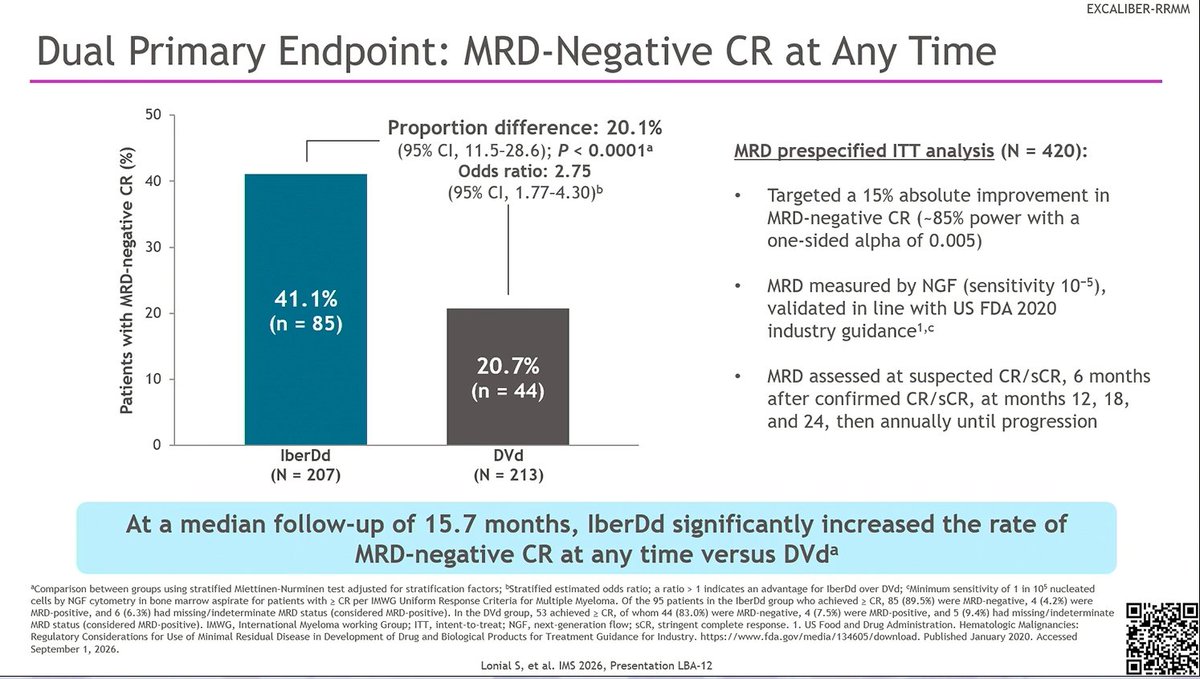
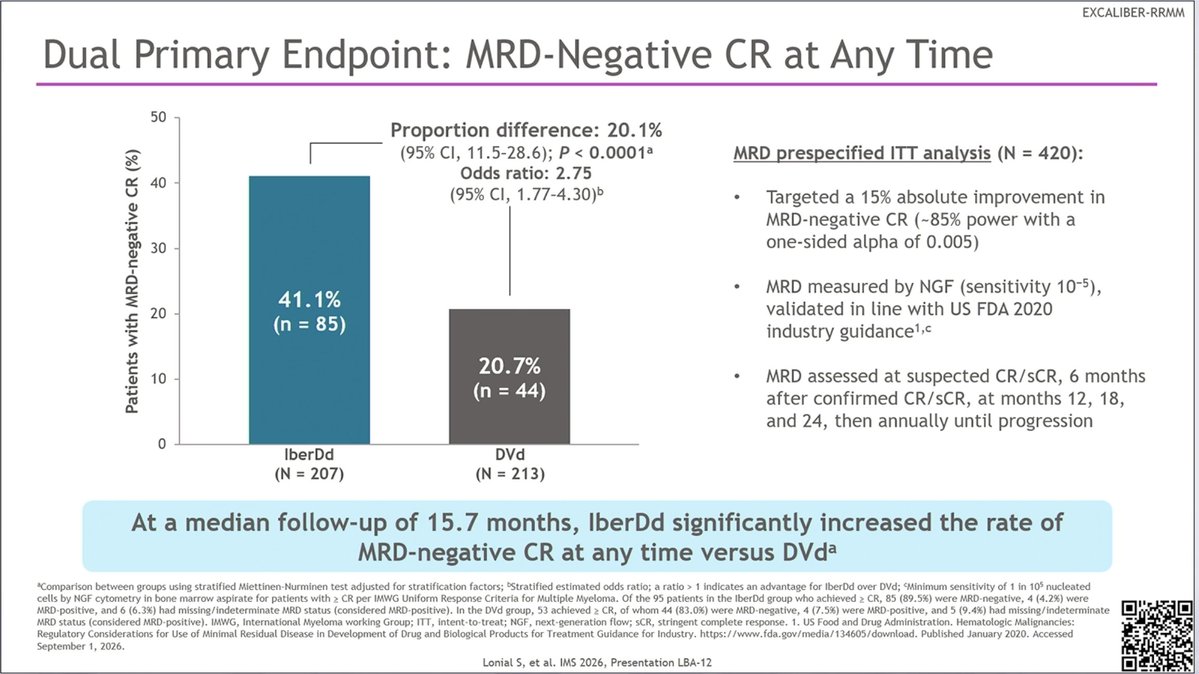
[Slide 1 - EXCALIBER-RRMM: Dual Primary Endpoint — MRD-Negative CR at Any Time]
MRD-negative CR at any time: IberDd (N=207) 41.1% (n=85) vs DVd (N=213) 20.7% (n=44)
Proportion difference: 20.1% (95% CI 11.5–28.6); P<0.0001. Odds ratio: 2.75 (95% CI 1.77–4.30)
MRD prespecified ITT analysis (N=420): targeted 15% absolute improvement, MRD measured by NGF (sensitivity 10^-5) per FDA 2020 guidance, assessed at suspected CR/sCR, 6 months after, months 12/18/24, then annually
At a median follow-up of 15.7 months, IberDd significantly increased the rate of MRD-negative CR at any time versus DVd
Lonial S, et al. IMS 2026, Presentation LBA-12
---
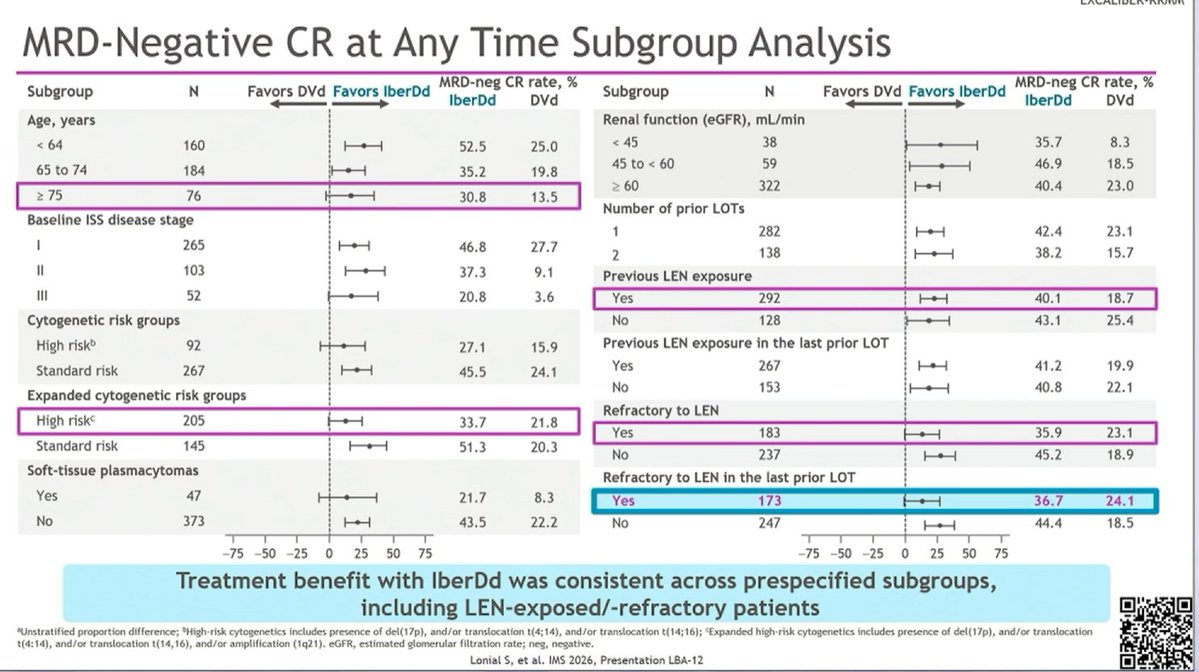
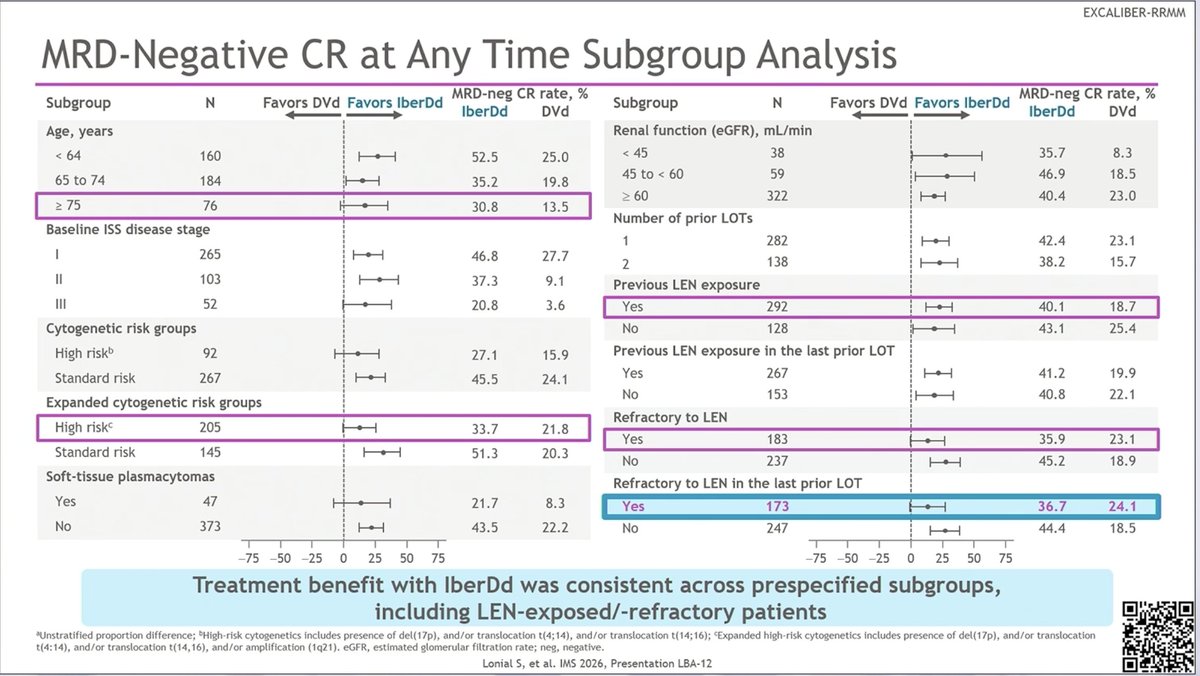
[Slide 2 - EXCALIBER-RRMM: MRD-Negative CR at Any Time Subgroup Analysis]
Forest plot of MRD-neg CR rate (%, IberDd vs DVd) across subgroups — age, ISS stage, cytogenetic risk, expanded cytogenetic risk, soft-tissue plasmacytomas, renal function, number of prior LOTs, prior/refractory lenalidomide exposure
High-risk cytogenetics: 33.7% vs 21.8%. LEN-refractory: 35.9% vs 23.1%. ≥75 years: 30.8% vs 13.5%
Treatment benefit with IberDd was consistent across prespecified subgroups, including LEN-exposed/-refractory patients
Lonial S, et al. IMS 2026, Presentation LBA-12
---
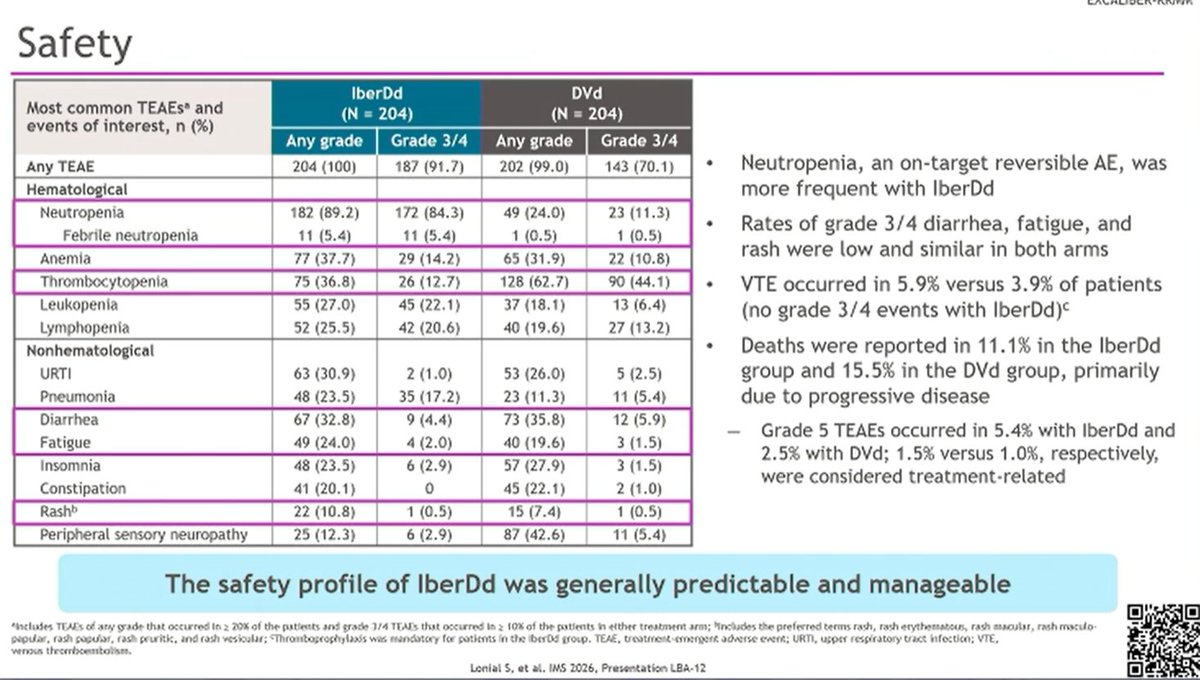
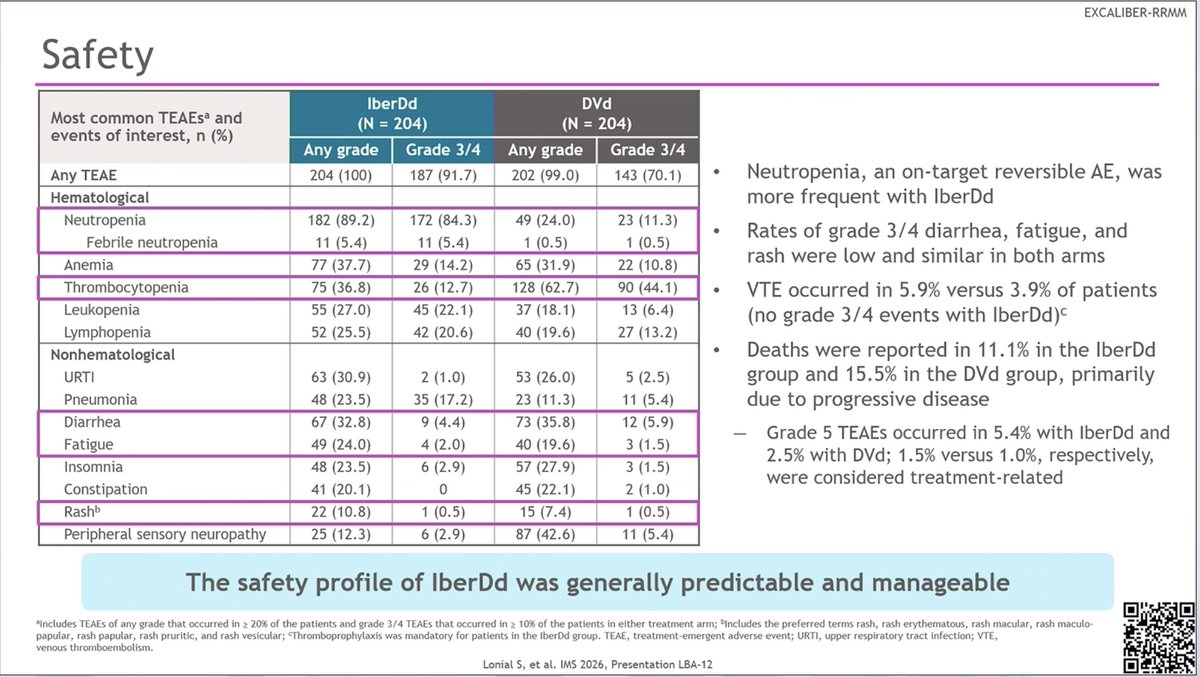
[Slide 3 - EXCALIBER-RRMM: Safety]
Most common TEAEs (IberDd N=204 vs DVd N=204): Any TEAE 100% vs 99.0%. Neutropenia 89.2% vs 24.0% (Gr3/4: 84.3% vs 11.3%). Anemia 37.7% vs 31.9%. Thrombocytopenia 36.8% vs 62.7% (Gr3/4: 12.7% vs 44.1%). Leukopenia 27.0% vs 18.1%. URTI 30.9% vs 26.0%. Pneumonia 23.5% vs 11.3%. Diarrhea 32.8% vs 35.8%. Peripheral sensory neuropathy 12.3% vs 42.6%
Neutropenia (on-target reversible AE) more frequent with IberDd. VTE 5.9% vs 3.9% (no grade 3/4 with IberDd). Deaths 11.1% (IberDd) vs 15.5% (DVd), primarily progressive disease; Grade 5 TEAEs 5.4% vs 2.5%
The safety profile of IberDd was generally predictable and manageable
Lonial S, et al. IMS 2026, Presentation LBA-12
---
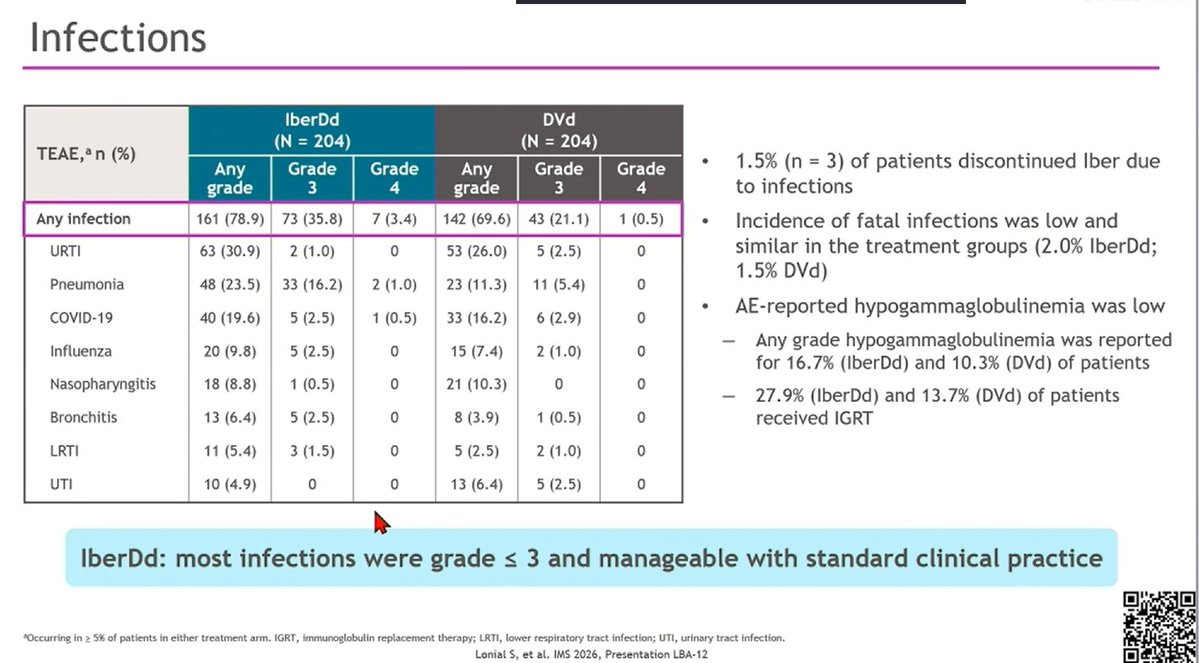
[Slide 4 - EXCALIBER-RRMM: Infections]
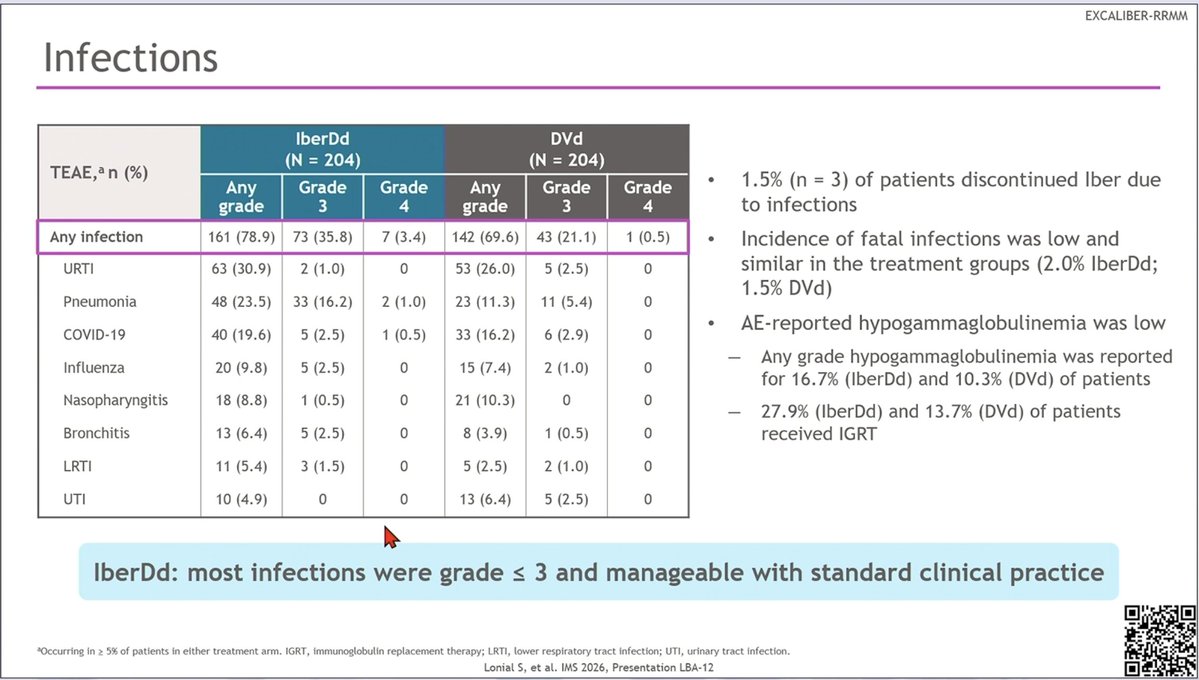
TEAE infections (IberDd N=204 vs DVd N=204): Any infection 78.9% vs 69.6% (Gr3: 35.8% vs 21.1%, Gr4: 3.4% vs 0.5%). URTI 30.9% vs 26.0%. Pneumonia 23.5% vs 11.3%. COVID-19 19.6% vs 16.2%. Influenza 9.8% vs 7.4%. Bronchitis 6.4% vs 3.9%
1.5% (n=3) discontinued Iber due to infections. Fatal infections low and similar between arms (2.0% IberDd; 1.5% DVd). Hypogammaglobulinemia low; IGRT received by 27.9% (IberDd) vs 13.7% (DVd)
IberDd: most infections were grade ≤3 and manageable with standard clinical practice
Lonial S, et al. IMS 2026, Presentation LBA-12
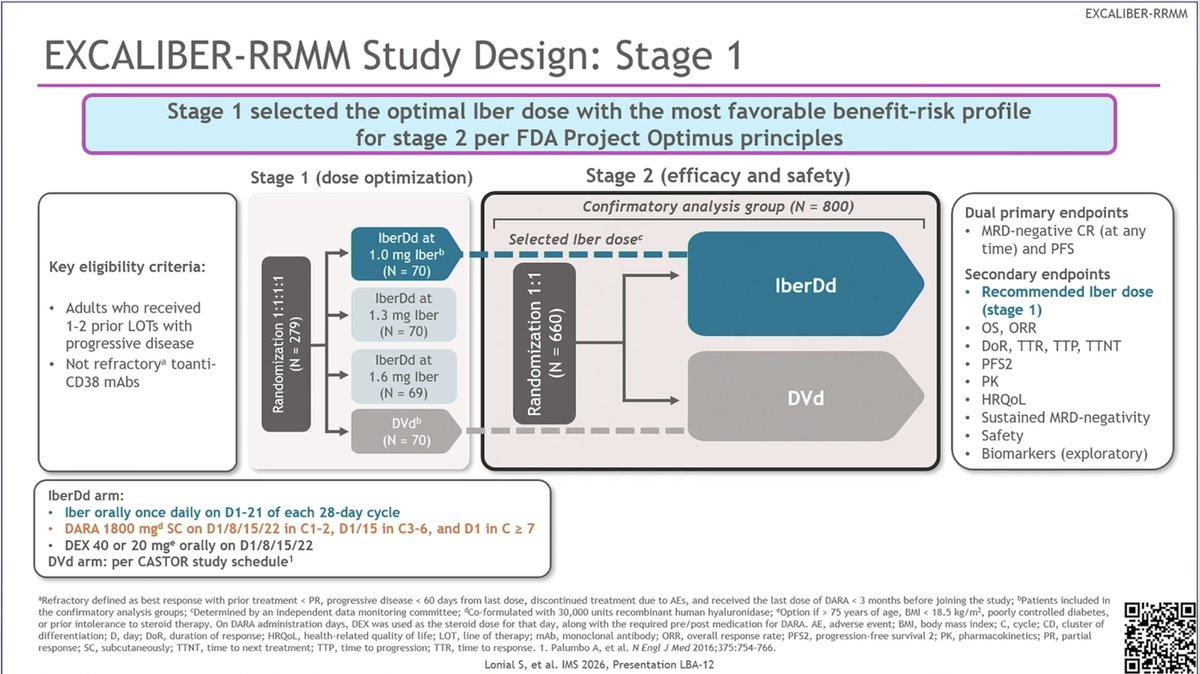
[Slide 1] EXCALIBER-RRMM Study Design: Stage 1. Stage 1 selected the optimal Iber dose with the most favorable benefit-risk profile for stage 2 per FDA Project Optimus principles. Key eligibility: adults who received 1-2 prior LOTs with progressive disease; not refractory to anti-CD38 mAbs. Randomization 1:1:1:1 to IberDd 1.0mg (n=70), 1.3mg (n=70), 1.6mg (n=70), or DVd (n=70). Selected Iber dose -> Stage 2 (N=460 planned): randomized 1:1 to IberDd (selected dose) vs DVd. Dual primary endpoints: MRD-negative CR (at any time) and PFS. Secondary: recommended Iber dose, OS, ORR, DoR/TTR/TTP/TTNT, PFS2, PK, HRQoL, sustained MRD-negativity, Safety, biomarkers (exploratory).
---
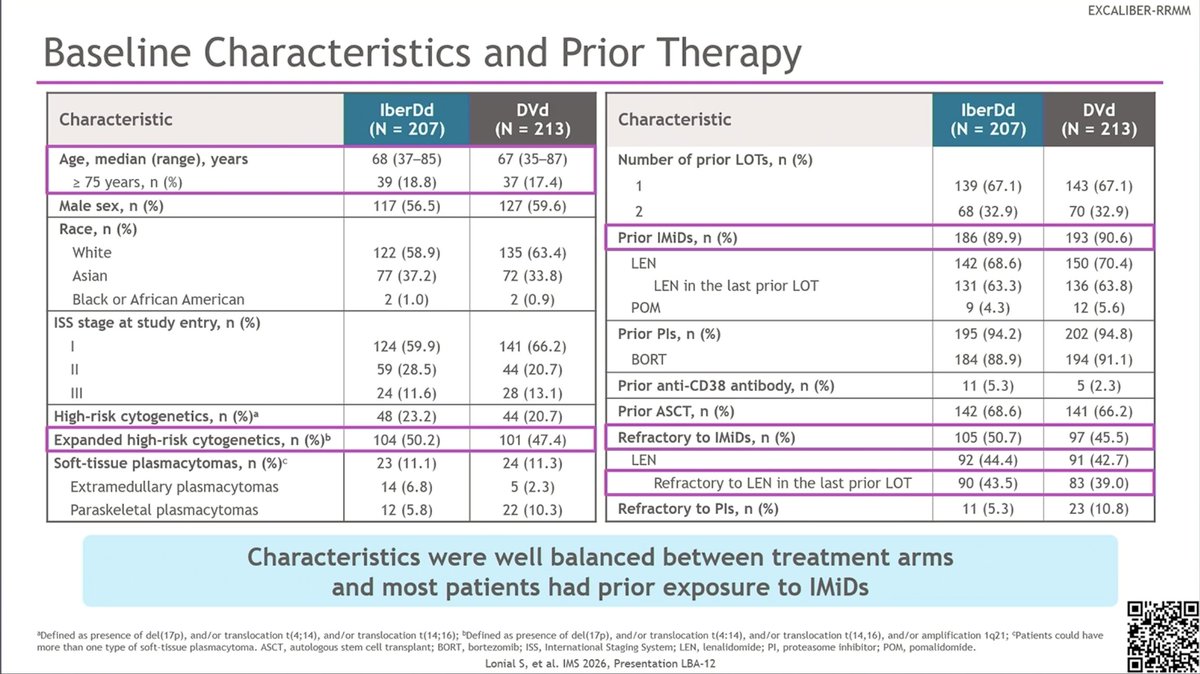
[Slide 2] Baseline Characteristics and Prior Therapy. IberDd (N=207) vs DVd (N=213): Age median 68 vs 67 years, >=75y 18.8% vs 17.4%. Male sex 56.5% vs 59.6%. Race: White 58.9% vs 63.4%, Asian 37.2% vs 33.8%, Black/African American 1.0% vs 0.9%. ISS stage I 59.9% vs 66.2%, II 28.5% vs 20.7%, III 11.6% vs 13.1%. High-risk cytogenetics 23.2% vs 20.7%; expanded high-risk cytogenetics 50.2% vs 47.4%. Number of prior LOTs: 1 line 67.1% both arms, 2 lines 32.9% both arms. Prior IMiDs 89.9% vs 90.6% (LEN 68.6% vs 70.4%, LEN in last prior LOT 63.3% vs 63.8%). Prior PIs 94.2% vs 94.8% (bortezomib 88.9% vs 91.1%). Prior anti-CD38 antibody 5.3% vs 2.3%. Prior ASCT 68.6% vs 66.2%. Refractory to IMiDs 50.7% vs 45.5% (LEN 44.4% vs 42.7%, refractory to LEN in last prior LOT 43.5% vs 39.0%). Refractory to PIs 5.3% vs 10.8%. Characteristics were well balanced between treatment arms and most patients had prior exposure to IMiDs.
---
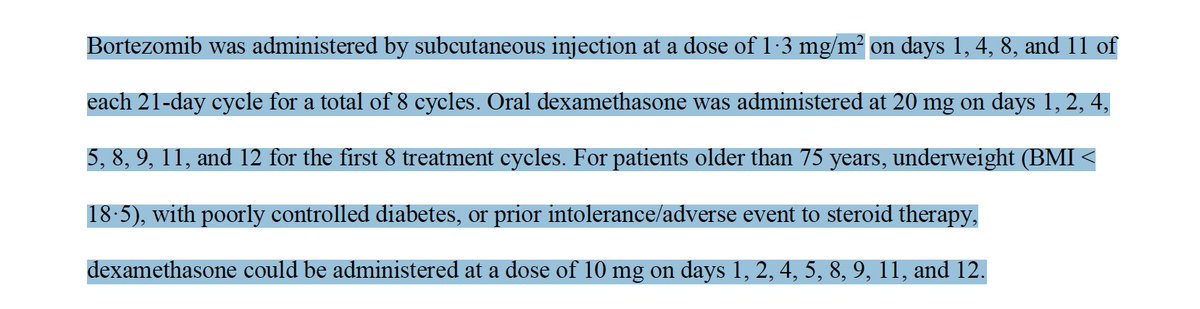
[Slide 3, from the published Lancet Oncology methods] Bortezomib was administered by subcutaneous injection at a dose of 1.3 mg/m^2 on days 1, 4, 8, and 11 of each 21-day cycle for a total of 8 cycles. Oral dexamethasone was administered at 20 mg on days 1, 2, 4, 5, 8, 9, 11, and 12 for the first 8 treatment cycles. For patients older than 75 years, underweight (BMI < 18.5), with poorly controlled diabetes, or prior intolerance/adverse event to steroid therapy, dexamethasone could be administered at a dose of 10 mg on days 1, 2, 4, 5, 8, 9, 11, and 12.
[Slide 1] Patient Disposition and Treatment Exposure. IberDd (N=207) vs DVd (N=213): received study treatment 98.6% vs 95.8%. Ongoing treatment 62.3% vs 46.0%; discontinued 36.2% vs 49.8% (progressive disease 15.9% vs 35.2%, AE 8.7% vs 3.3%). Duration of treatment, median: 14.8 vs 13.8 months. Relative dose intensity, median: Iber 90.5%; DARA 93.8% vs 95.2%; BORT (DVd only) 81.7%. Dose reductions: Iber 34.3%; BORT (DVd only) 51.5%. At a median follow-up of 15.7 months, discontinuations due to AEs were infrequent and Iber relative dose intensity was high at 90.5%.
---
[Slide 2 - PRIMARY ENDPOINT] Dual Primary Endpoint: MRD-Negative CR at Any Time. IberDd 41.1% (n=85) vs DVd 20.7% (n=44). Proportion difference 20.1% (95% CI 11.5-28.6), P<0.0001. Odds ratio 2.75 (95% CI 1.77-4.30). MRD prespecified ITT analysis (N=420): targeted 15% absolute improvement (~85% power, one-sided alpha 0.005); MRD measured by NGF (sensitivity 10^-5), validated per US FDA 2020 industry guidance; MRD assessed at suspected CR/sCR, 6 months after confirmed CR/sCR, at months 12/18/24, then annually until progression. At a median follow-up of 15.7 months, IberDd significantly increased the rate of MRD-negative CR at any time versus DVd.
---
[Slide 3] MRD-Negative CR at Any Time Subgroup Analysis. Treatment benefit with IberDd was consistent across prespecified subgroups, including LEN-exposed/-refractory patients. Selected subgroups (MRD-neg CR%, IberDd vs DVd): Age <64: 52.5 vs 25.0; Age >=75: 30.8 vs 13.5; ISS I: 46.8 vs 27.7, II: 37.3 vs 9.1, III: 20.8 vs 3.6; standard cytogenetic risk: 45.5 vs 24.1, high risk: 27.1 vs 15.9; expanded high-risk: 33.7 vs 21.8; renal function eGFR<45: 35.7 vs 8.3; previous LEN exposure yes: 40.1 vs 18.7; refractory to LEN yes: 35.9 vs 23.1, refractory to LEN in last prior LOT yes: 36.7 vs 24.1.
---
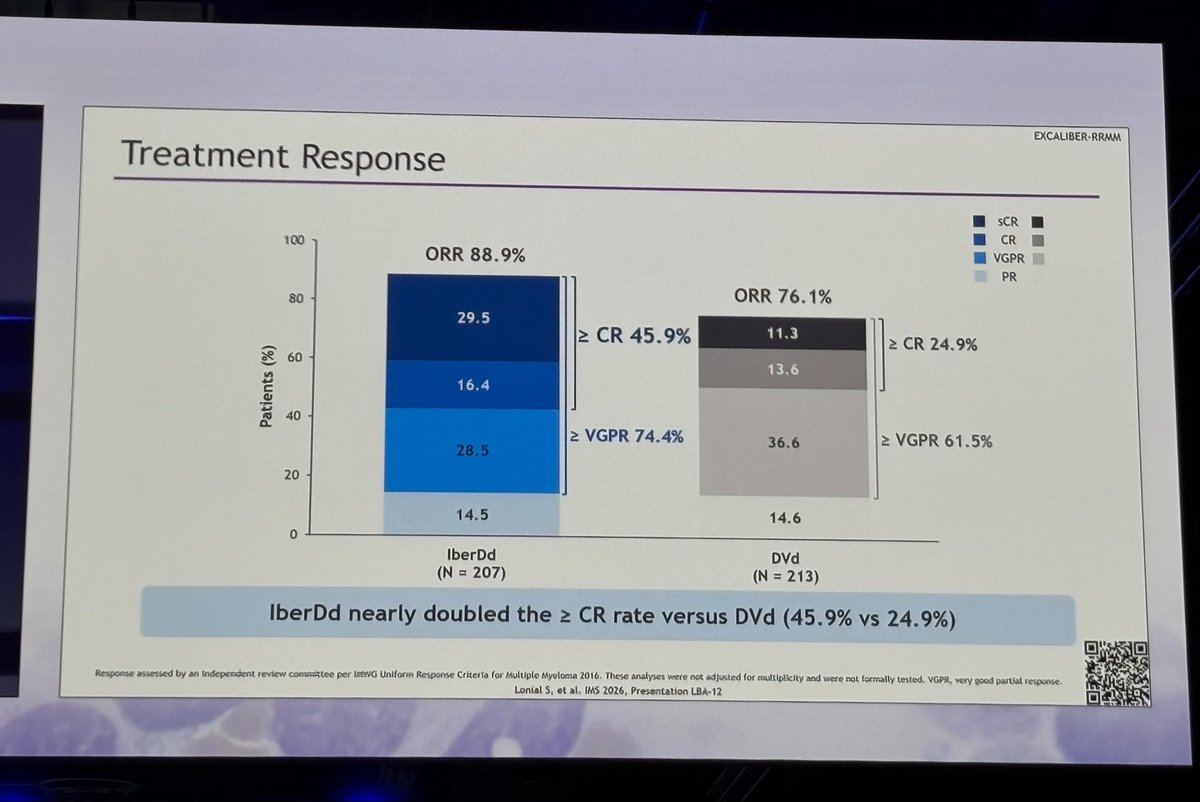
[Slide 4] Treatment Response. IberDd (N=207): ORR 88.9% (sCR/CR 29.5%+16.4%=45.9% >=CR, VGPR 28.5% [>=VGPR 74.4%], PR 14.5%). DVd (N=213): ORR 76.1% (sCR/CR 11.3%+13.6%=24.9% >=CR, VGPR 36.6% [>=VGPR 61.5%], PR 14.6%). IberDd nearly doubled the >=CR rate versus DVd (45.9% vs 24.9%). Response assessed by independent review committee per IMWG Uniform Response Criteria for Multiple Myeloma 2016; analyses not adjusted for multiplicity, not formally tested.
[Slide 1] Safety - TEAEs. IberDd (N=204) vs DVd (N=204), Any grade/Grade 3-4: Any TEAE 100%/91.7% vs 99.0%/70.1%. Neutropenia 89.2%/84.3% vs 24.0%/11.3% (febrile neutropenia 5.4%/5.4% vs 0.5%/0.5%). Anemia 37.7%/14.2% vs 31.9%/10.8%. Thrombocytopenia 36.8%/12.7% vs 62.7%/44.1%. Leukopenia 27.0%/22.1% vs 18.1%/6.4%. Lymphopenia 25.5%/20.6% vs 19.6%/13.2%. URTI 30.9%/1.0% vs 26.0%/2.5%. Pneumonia 23.5%/17.2% vs 11.3%/5.4%. Diarrhea 32.8%/4.4% vs 35.8%/5.9%. Fatigue 24.0%/2.0% vs 19.6%/1.5%. Rash 10.8%/0.5% vs 7.4%/0.5%. Peripheral sensory neuropathy 12.3%/2.9% vs 42.6%/5.4%. Neutropenia was more frequent with IberDd; grade 3/4 diarrhea/fatigue/rash were low and similar; VTE 5.9% vs 3.9% (no grade 3/4 with IberDd); deaths 11.1% (IberDd) vs 15.5% (DVd), primarily progressive disease; Grade 5 TEAEs 5.4% vs 2.5% (1.5% vs 1.0% treatment-related). The safety profile of IberDd was generally predictable and manageable.
---
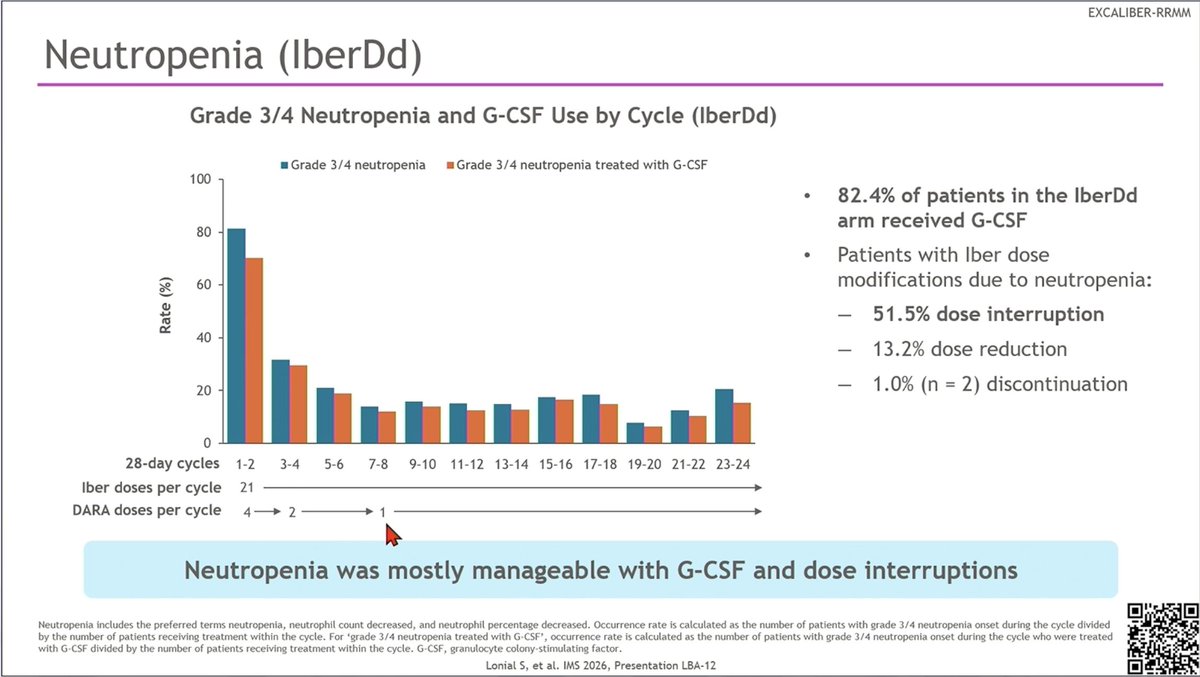
[Slide 2] Neutropenia (IberDd) - Grade 3/4 Neutropenia and G-CSF Use by Cycle. 28-day cycles 1-2 through 23-24 tracked; peak Grade 3/4 neutropenia rate ~82% in cycles 1-2, declining to 10-20% by later cycles as Iber/DARA dosing frequency decreases. 82.4% of patients in the IberDd arm received G-CSF. Dose modifications due to neutropenia: 51.5% dose interruption, 13.2% dose reduction, 1.0% (n=2) discontinuation. Neutropenia was mostly manageable with G-CSF and dose interruptions.
---
[Slide 3] Infections. IberDd (N=204) vs DVd (N=204): any infection 78.9%/35.8%/3.4% (any/G3/G4) vs 69.6%/21.1%/0.5%. URTI 30.9% vs 26.0%. Pneumonia 23.5% vs 11.3%. COVID-19 19.6% vs 16.2%. Influenza 9.8% vs 7.4%. 1.5% (n=3) of patients discontinued Iber due to infections. Incidence of fatal infections was low and similar (2.0% IberDd, 1.5% DVd). AE-reported hypogammaglobulinemia was low: any grade 16.7% (IberDd) vs 10.3% (DVd); IGRT received by 27.9% (IberDd) vs 13.7% (DVd). IberDd: most infections were grade <=3 and manageable with standard clinical practice.
---
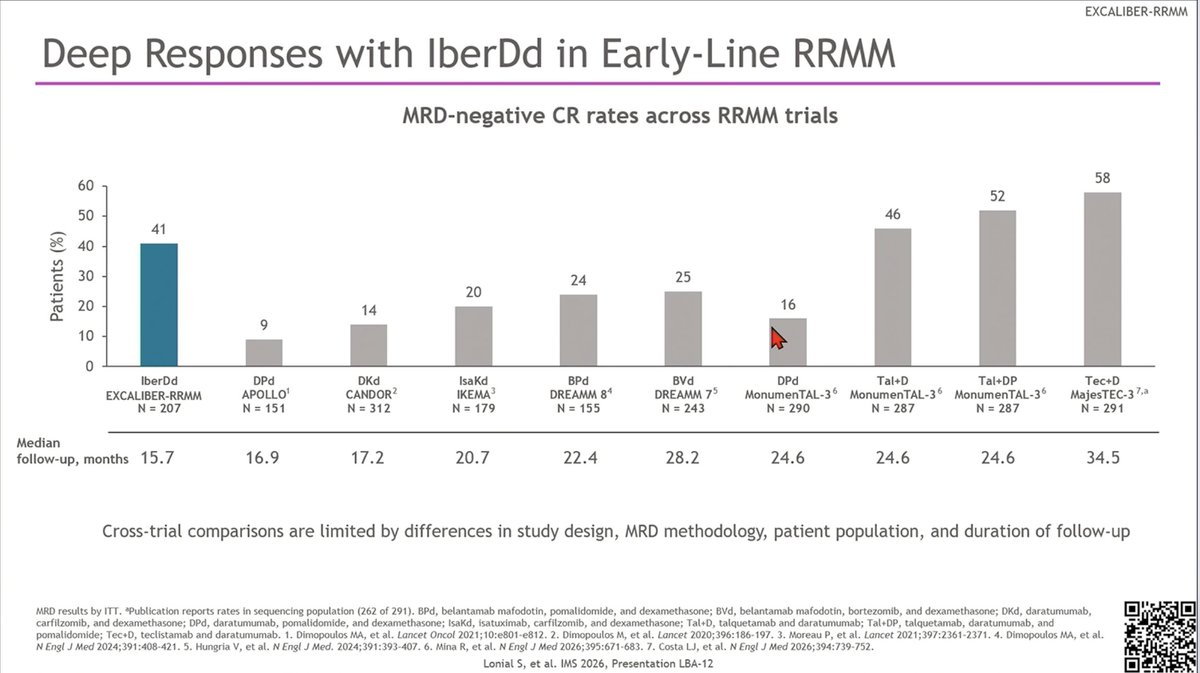
[Slide 4] Deep Responses with IberDd in Early-Line RRMM - MRD-negative CR rates across RRMM trials (cross-trial context, limited by design/methodology/population/follow-up differences): IberDd EXCALIBER-RRMM 41% (N=207, follow-up 15.7mo); DPd APOLLO 9% (N=151); DKd CANDOR 14% (N=312); IsaKd IKEMA 20% (N=179); BPd DREAMM-8 24% (N=155); BVd DREAMM-7 25% (N=243); DPd MonumenTAL-3 16% (N=290); Tal+D MonumenTAL-3 46% (N=287); Tal+DP MonumenTAL-3 52% (N=287); Tec+D MajesTEC-3 58% (N=291, follow-up 34.5mo).
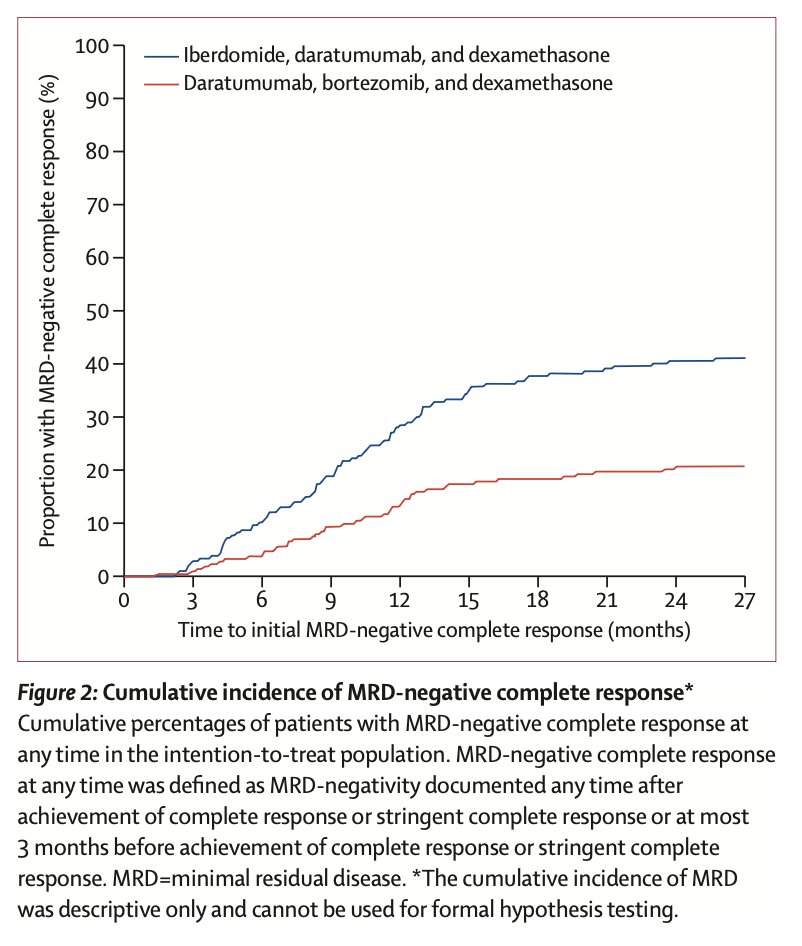
[Lancet Oncology, Figure 2] Cumulative incidence of MRD-negative complete response. Cumulative percentages of patients with MRD-negative CR at any time in the intention-to-treat population. IberDd (blue line) separates from DVd (red line) beginning around month 3, reaching approximately 41% by month 24-27 versus approximately 21% for DVd. MRD-negative CR at any time was defined as MRD-negativity documented any time after achievement of CR or stringent CR, or at most 3 months before achievement of CR or stringent CR. The cumulative incidence of MRD was descriptive only and cannot be used for formal hypothesis testing.
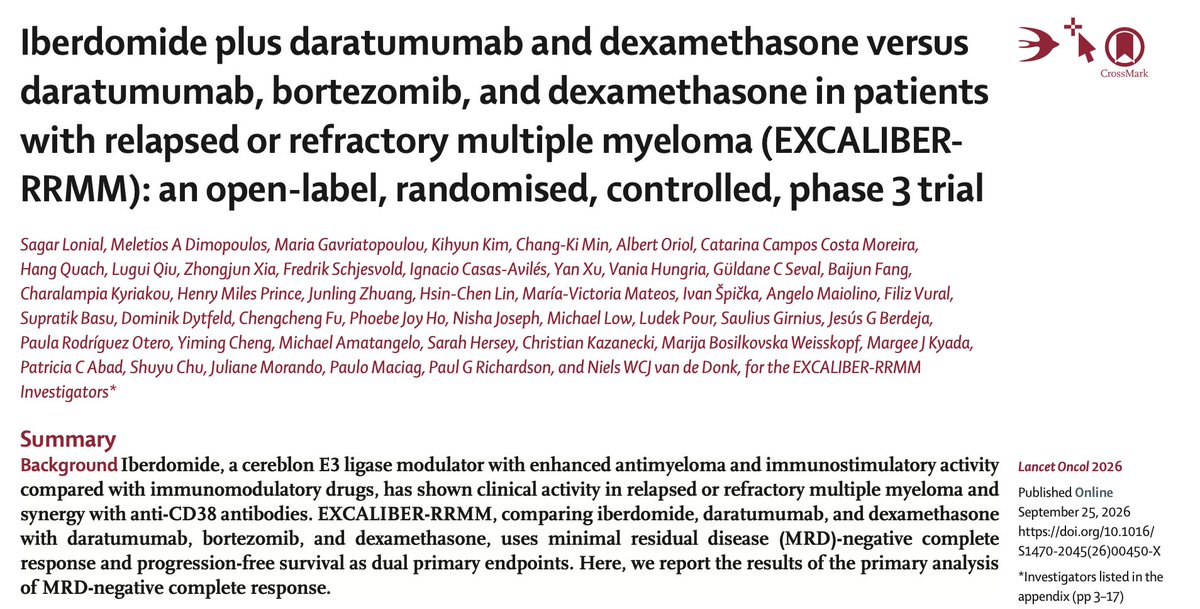
[Lancet Oncology, published online Sept 25, 2026] "Iberdomide plus daratumumab and dexamethasone versus daratumumab, bortezomib, and dexamethasone in patients with relapsed or refractory multiple myeloma (EXCALIBER-RRMM): an open-label, randomised, controlled, phase 3 trial." Authors: Sagar Lonial, Meletios A Dimopoulos, Maria Gavriatopoulou, Kihyun Kim, Chang-Ki Min, Albert Oriol, Catarina Campos Costa Moreira, Hang Quach, Lugui Qiu, Zhongjun Xia, Fredrik Schjesvold, Ignacio Casas-Aviles, Yan Xu, Vania Hungria, Guldane C Seval, Baijun Fang, Charalampia Kyriakou, Henry Miles Prince, Junling Zhuang, Hsin-Chen Lin, Maria-Victoria Mateos, Ivan Spicka, Angelo Maiolino, Filiz Vural, Supratik Basu, Dominik Dytfeld, Chengcheng Fu, Phoebe Joy Ho, Nisha Joseph, Michael Low, Ludek Pour, Saulius Girnius, Jesus G Berdeja, Paula Rodriguez Otero, Yiming Cheng, Michael Amatangelo, Sarah Hersey, Christian Kazanecki, Marija Bosilkovska Weisskopf, Margee J Kyada, Patricia C Abad, Shuyu Chu, Juliane Morando, Paulo Maciag, Paul G Richardson, and Niels WCJ van de Donk, for the EXCALIBER-RRMM Investigators. Summary/Background: Iberdomide, a cereblon E3 ligase modulator with enhanced antimyeloma and immunostimulatory activity compared with immunomodulatory drugs, has shown clinical activity in relapsed or refractory multiple myeloma and synergy with anti-CD38 antibodies. EXCALIBER-RRMM, comparing iberdomide, daratumumab, and dexamethasone with daratumumab, bortezomib, and dexamethasone, uses minimal residual disease (MRD)-negative complete response and progression-free survival as dual primary endpoints. Here, we report the results of the primary analysis of MRD-negative complete response.
[Slide 1] Treatment Response (photographed live from the plenary session floor) - same data as the official deck: ORR 88.9% (IberDd) vs 76.1% (DVd); >=CR 45.9% vs 24.9%; >=VGPR 74.4% vs 61.5%. IberDd nearly doubled the >=CR rate versus DVd.
---
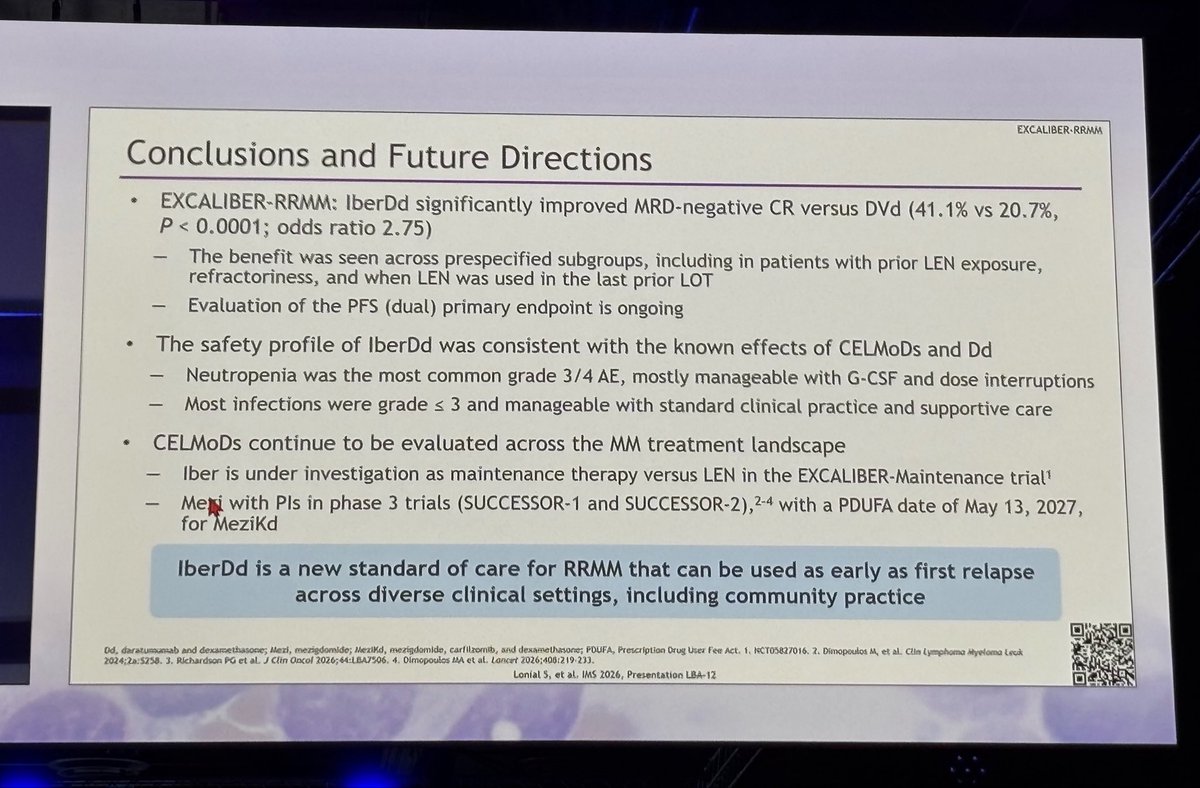
[Slide 2] Conclusions and Future Directions. EXCALIBER-RRMM: IberDd significantly improved MRD-negative CR versus DVd (41.1% vs 20.7%, P<0.0001; odds ratio 2.75). The benefit was seen across prespecified subgroups, including in patients with prior LEN exposure, refractoriness, and when LEN was used in the last prior LOT. Evaluation of the PFS (dual) primary endpoint is ongoing. The safety profile of IberDd was consistent with the known effects of CELMoDs and Dd - neutropenia was the most common grade 3/4 AE, mostly manageable with G-CSF and dose interruptions; most infections were grade <=3 and manageable with standard clinical practice and supportive care. CELMoDs continue to be evaluated across the MM treatment landscape: Iber is under investigation as maintenance therapy versus LEN in the EXCALIBER-Maintenance trial; mezigdomide (Mezi) with PIs in phase 3 trials (SUCCESSOR-1 and SUCCESSOR-2), with a PDUFA date of May 13, 2027 for MeziKd. IberDd is a new standard of care for RRMM that can be used as early as first relapse across diverse clinical settings, including community practice.
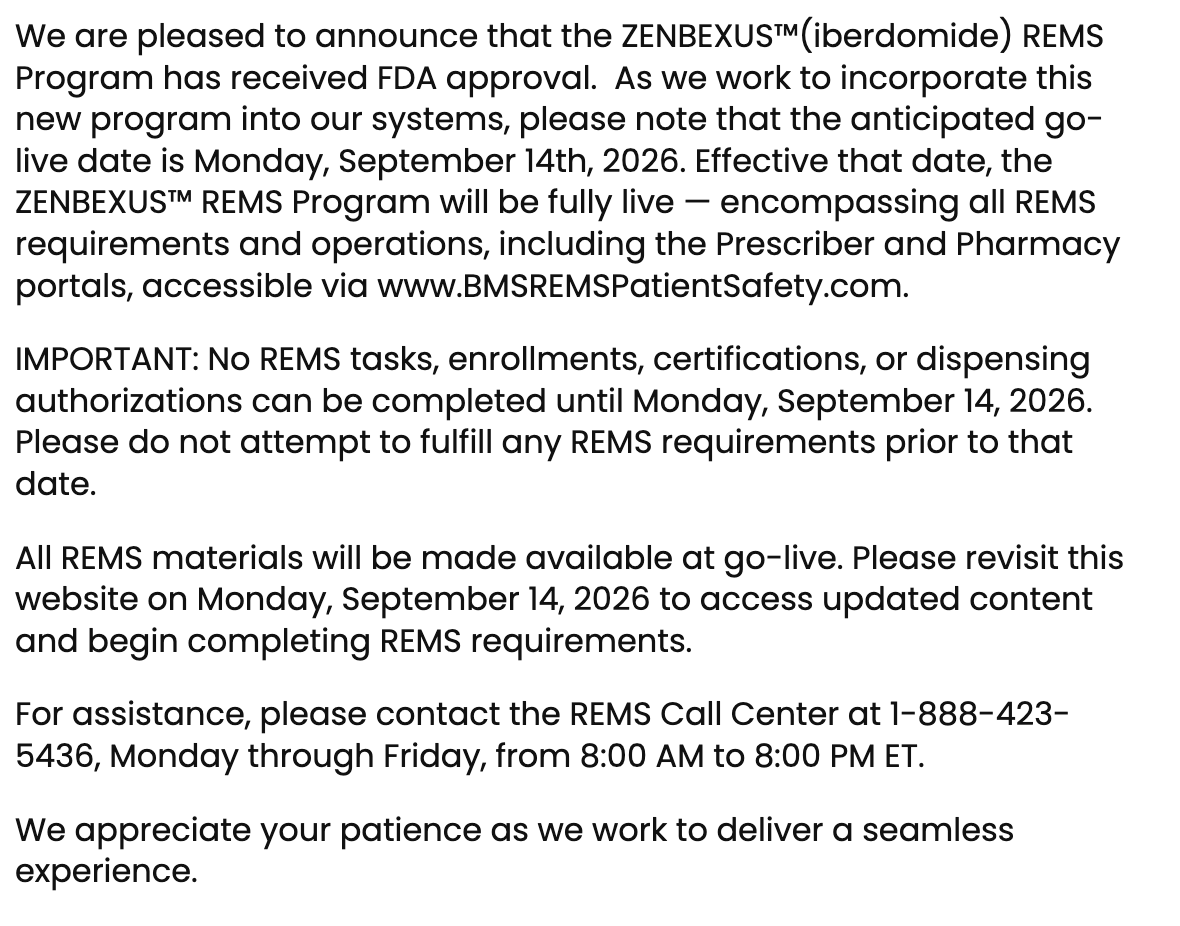
[ZENBEXUS REMS Program notice]
We are pleased to announce that the ZENBEXUS(TM) (iberdomide) REMS Program has received FDA approval. As we work to incorporate this new program into our systems, please note that the anticipated go-live date is Monday, September 14th, 2026. Effective that date, the ZENBEXUS(TM) REMS Program will be fully live - encompassing all REMS requirements and operations, including the Prescriber and Pharmacy portals, accessible via www.BMSREMSPatientSafety.com.
IMPORTANT: No REMS tasks, enrollments, certifications, or dispensing authorizations can be completed until Monday, September 14, 2026. Please do not attempt to fulfill any REMS requirements prior to that date.
All REMS materials will be made available at go-live. Please revisit this website on Monday, September 14, 2026 to access updated content and begin completing REMS requirements.
For assistance, please contact the REMS Call Center at 1-888-423-5436, Monday through Friday, from 8:00 AM to 8:00 PM ET.
We appreciate your patience as we work to deliver a seamless experience.
[EXCALIBER-RRMM study design - Figure 2]
Stage 1 - dose optimization
RRMM, 1 or 2 prior lines (N >= 200), RANDOMIZED 1:1:1:1
Treatment arm A1 (IberDd) 1.0 mg IBER dose level (n = 50)
Treatment arm A2 (IberDd) 1.3 mg IBER dose level (n = 50)
Treatment arm A3 (IberDd) 1.6 mg IBER dose level (n = 50)
Treatment arm B (DVd) (n = 50)
Recommended dose selected(a)
Stage 2 - efficacy and safety
RRMM, 1 or 2 prior lines (n = 664), RANDOMIZED 1:1
Treatment arm A (IberDd) selected IBER dose level (n = 332)
Treatment arm B (DVd) (n = 332)
Inclusion in stage 2 analysis
Figure 2. Study design. EXCALIBER-RRMM is a phase III study evaluating the efficacy and safety of IberDd versus DVd in patients with RRMM.
(a) The recommended dose for stage 2 will be determined by an independent data monitoring committee.
DVd: daratumumab + bortezomib + dexamethasone; IBER: iberdomide; IberDd: iberdomide + daratumumab + dexamethasone; RRMM: relapsed/refractory multiple myeloma.
[KOL Pulse note: this figure shows the PLANNED stage 2 enrollment of 664 (332 per arm). The FDA approval notice reports actual stage 2 randomization of n=660, and 939 patients randomized overall. Stage 1 tested three iberdomide dose levels; 1.0 mg was selected and is the approved dose.]
Community Discussion
EXCALIBER-RRMM Top Posts
Verbatim physician commentary, ordered by impressions.
Two approval-day threads, reproduced verbatim in reply order. Both converge on the same question the accelerated approval leaves open: how much weight an MRD-negative complete response can carry before progression-free survival reads out.
100s · every quote verbatim
Thread 1 — reading the endpoint, and the missing publication
@HadidiSamer · Associate Professor, UT Southwestern · plasma cell disorders
Need to be careful interpreting this as a positive study. Note that the endpoint that got the accelerated approval is MRD -ve CR. Data on only 420 patients: ZDd arm (n=207) vs. DVd (n=213)- only 45% of patients enrolled. PFS may not be different with longer follow up.
@RahulBanerjeeMD · Associate Professor, UW Medicine / Fred Hutch · myeloma
CELMoDs - from the subject of podcasts to the subject of 🇺🇸 clinic discussions!
.... but we'll still need podcasts :)
1️⃣ Be ready to give G-CSF during Cycle 1 and push through... neutropenia will often improve with time.
2️⃣ VTE PPx still imperative from what we know.
#MMsm https://t.co/Tp89NO9vbw
@Giguere_P · Hematologist · evidence-based medicine & clinical trial design
@RahulBanerjeeMD Interested to see the data. How valid is an estimand like "MRD at any time" is considering censoring and competing risks?
Also, are there published statistical models that estimate how a change in MRD translates to OS? Or is it buried in the FDA docs?
@OncBrothers · Rohit & Rahul Gosain, MD · community oncologists
Iberdomide (first CELMoD) now @US_FDA ✅ based off EXCALIBER-RRMM in 2L and beyond for R/R #MultipleMyeloma.
IberDd:
- Improved MRD (41% vs. 21%)
- PFS still immature
- AEs: Cytopenias and Infections
#OncTwitter #MedTwitter #HemeTwitter https://t.co/VB0XTr0EWW
@BijoyTelivala · Partner physician, Cancer Specialists of North Florida · Jacksonville
Glad to have another drug in our Arsenal but it's toxic
We don't even have PFS data
It's an accelerated approval
Probably has a niche role and much after Bispecifics https://t.co/uhMBvMFIts
Dr. Al-Ola Abdallah (University of Kansas Medical Center) walked the approval end to end the night it landed — design, the MRD result, the full safety profile, and the limitation. Every incidence rate he cites matches the Zenbexus prescribing information. Reproduced verbatim in thread order.
@Abdallah81MD · Associate Professor & Plasma Cell Disorder Program Director, University of Kansas Medical Center
🧵 EXCALIBER‑RRMM: Iberdomide/ Daratumimab/Dex FDA approval!
Just FYI; this is from BMS News
1/🔬 EXCALIBER‑RRMM is a randomized phase 3 trial comparing:
🔹 IberDd vs DVd
A total of 939 patients were randomized
💊 The trial used a two-stage design:
Stage 1 evaluated iberdomide at 1.0, 1.3 and 1.6 mg.
The selected dose was 1 mg orally on days 1–21 of each 28-day cycle.
Dual primary endpoints: MRD-negative CR and PFS.
#mmsm #myeloma #MedEd #medtwitter #USMIRC @US_HMC @USMIRCNEWS @MedwatchKate @Larvol @oncodaily
@Abdallah81MD · Associate Professor & Plasma Cell Disorder Program Director, University of Kansas Medical Center
5/Important limitation:
PFS, OS, ORR, duration of response, sustained MRD negativity and quality-of-life results have not yet been fully reported.
The trial remains ongoing, and the published manuscript currently available describes the study design—not the complete results.
#mmsm #myeloma #MedEd #medtwitter #USMIRC @US_HMC @USMIRCNEWS @MedwatchKate @Larvol @oncodaily
@Abdallah81MD · Associate Professor & Plasma Cell Disorder Program Director, University of Kansas Medical Center
6/ Some conclusions:
🔹 The first FDA-approved CELMoD
🔹 The first RRMM approval based on MRD-negative CR
🔹 A new oral treatment backbone potentially available as early as first relapse
Longer follow-up will determine whether deeper MRD responses translate into improved PFS and OS.
A major milestone for targeted protein degradation!
#mmsm #myeloma #MedEd #medtwitter #USMIRC @US_HMC @USMIRCNEWS @MedwatchKate @Larvol @oncodaily
@Abdallah81MD · Associate Professor & Plasma Cell Disorder Program Director, University of Kansas Medical Center
@US_HMC @USMIRCNEWS @oncodaily @MedwatchKate @Larvol 8/ Comparing AEs in both groups! Showing Pneumonia was common in the Iberdomise arm! Though questions if hypogammaglobunemia and neutropenia likely to occur at the Iberdomide arm!!
#mmsm #myeloma #MedEd #medtwitter #USMIRC @US_HMC @USMIRCNEWS @oncodaily @MedwatchKate @Larvol https://t.co/MxJQTGOmqB
@Abdallah81MD · Associate Professor & Plasma Cell Disorder Program Director, University of Kansas Medical Center
11/ Second primary malignancies
At 16 months:
IberDd: 6.9%
DVd: 4.9%
In the IberDd arm:
Second primary malignancies classified as serious adverse reactions: 5.9%
One fatal case of lung adenocarcinoma was reported
#mmsm #myeloma #MedEd #medtwitter #USMIRC @US_HMC @USMIRCNEWS @oncodaily @MedwatchKate @Larvol
APPROVEDIberdomide (Zenbexus) + daratumumab and hyaluronidase-fihj + dexamethasone
Approved indication, verbatim: iberdomide, “in combination with daratumumab and hyaluronidase-fihj and dexamethasone for adults with multiple myeloma who have received at least one prior line of therapy including a proteasome inhibitor and an immunomodulatory agent.”
This is an accelerated approval based on MRD-negative complete response at any time — a surrogate endpoint. Continued approval may be contingent upon verification and description of clinical benefit in confirmatory trial(s). On October 8, 2026 the sponsor reported topline progression-free survival (median 42 vs 20 months, HR 0.49; press release, not yet FDA-reviewed or in the label); overall survival has not been reported.
Safety labeling: boxed warning for embryo-fetal toxicity and serious venous and arterial thromboembolism; warnings and precautions for neutropenia, infections, and second primary malignancies.
Access: available only through the ZENBEXUS Risk Evaluation and Mitigation Strategy (REMS). The REMS program notice set go-live for Monday, September 14, 2026; the ZENBEXUS REMS website is now live and handles prescriber and pharmacy certification.
Iberdomide is the first — and currently the only — FDA-approved CELMoD. A second Bristol Myers Squibb CELMoD, mezigdomide, is under FDA review but is NOT approved. The agency accepted a New Drug Application on July 13, 2026 for mezigdomide plus carfilzomib and dexamethasone (MeziKd) in relapsed or refractory multiple myeloma after at least one prior line including lenalidomide and an anti-CD38 monoclonal antibody, with a PDUFA target action date of May 13, 2027. It is supported by the Phase 3 SUCCESSOR-2 trial (NCT05552976), in which median progression-free survival was 18.0 versus 8.3 months (HR 0.48; 95% CI 0.36–0.63; P<0.0001). (OncLive, July 13 2026; Richardson et al, ASCO 2026 LBA7506; Lancet 2026;408:219–233)
The populations are not interchangeable. SUCCESSOR-2 required prior anti-CD38 monoclonal antibody exposure, whereas EXCALIBER-RRMM excluded patients whose disease was refractory to prior anti-CD38 therapy — and only 4% of its primary efficacy population had received any prior anti-CD38 monoclonal antibody at all. (ClinicalTrials.gov NCT05552976; FDA approval notice)
EXCALIBER-RRMM (NCT04975997) is a Phase 3, two-stage, randomized, multicenter, open-label trial comparing iberdomide plus daratumumab and dexamethasone (IberDd) against daratumumab, bortezomib and dexamethasone (DVd) in adults with relapsed or refractory multiple myeloma after one or two prior lines of therapy. Stage 1 randomized patients 1:1:1:1 across three iberdomide dose levels (1.0 mg, 1.3 mg, 1.6 mg) and DVd, with an independent data monitoring committee selecting 1.0 mg as the recommended dose. Stage 2 randomized patients 1:1 to the selected dose or DVd.
Iberdomide is a cereblon E3 ligase modulator (CELMoD). It binds cereblon and directs the degradation of Ikaros and Aiolos, two transcription factors myeloma cells depend on. Unlike earlier immunomodulatory agents, CELMoDs are designed to remain active in the presence of low levels of functional cereblon — the mechanism behind lenalidomide and pomalidomide resistance. Zenbexus is the first agent of this class approved in myeloma.
The trial carries dual primary endpoints: MRD-negative complete response at any time, and progression-free survival. The MRD-negative CR endpoint read out first and supported the August 2026 accelerated approval; the PFS endpoint was reported as a positive topline on October 8, 2026 (median 42 vs 20 months, HR 0.49), with full data to follow at ASH 2026. The approval-day physician commentary below was written when only the MRD result was known; the October 8 reaction is in the readout update above.
Adults with relapsed/refractory multiple myeloma, one or two prior lines. Excluded: disease refractory to prior anti-CD38 monoclonal antibody therapy or to prior bortezomib. Only 4% of the primary efficacy population had received any prior anti-CD38 monoclonal antibody; the prescribing information states there is limited data in patients who have received or are refractory to prior anti-CD38 therapy.
Interventions
IberDd: iberdomide 1 mg orally once daily, Days 1–21 of a 28-day cycle, with daratumumab and hyaluronidase-fihj 1800 mg SC and dexamethasone 20 or 40 mg. Comparator: DVd.
Endpoints
Dual primary: MRD-negative complete response at any time, and progression-free survival. Key secondary: overall survival, ORR, DoR, TTP, TTNT, HR-QoL.
Lead Investigator
Sagar Lonial, MD, FACP, FASCO — Winship Cancer Institute of Emory University.
Sponsor
Celgene, a Bristol-Myers Squibb company. Applicant for approval: Bristol-Myers Squibb Company.
MRD-negative complete response (primary readout)
In the primary efficacy population — the first 420 patients randomized to iberdomide 1 mg plus daratumumab and hyaluronidase-fihj and dexamethasone (n=207) or DVd (n=213) across stages 1 and 2 — the MRD-negative CR rate at any time was 41% (95% CI: 34, 48) versus 21% (95% CI: 15, 27), p<0.0001. Median follow-up was approximately 16 months. Response was assessed by an Independent Review Committee per IMWG 2016 criteria, and MRD negativity was defined at a sensitivity threshold of 10-5 using a Hematogenix Next Generation Flow Cytometry assay (per the Zenbexus prescribing information, Section 14 table footnote).
Progression-free survival (dual primary endpoint) — topline, Oct 8, 2026
Median PFS 42 months with ZDd versus 20 months with DVd; HR 0.49; p<0.000001; a 51% reduction in the risk of disease progression or death per the sponsor. Median follow-up 23 months. PFS confirmatory analysis population: all 800 patients randomized to ZDd (n=400) or DVd (n=400). Press-release figures: no 95% confidence intervals, data-cutoff date, subgroup data or updated safety tables have been released; the sponsor states safety remained consistent with previously reported findings. Full data to be presented at the 68th ASH Annual Meeting, New Orleans. No PFS results are posted on ClinicalTrials.gov yet.
Not reported. OS is a key secondary endpoint; following the planned interim MRD analysis announced September 23, 2025, the Data Monitoring Committee recommended that the trial continue without modification to evaluate PFS and OS. No OS results are posted on ClinicalTrials.gov.
Safety was assessed in patients in the MRD Primary Analysis Group who received at least one dose (IberDd n=204; DVd n=204). The prescribing information carries a boxed warning for embryo-fetal toxicity and for serious venous and arterial thromboembolism, plus warnings and precautions for neutropenia, infections, and second primary malignancies.
Neutropenia — all grades 90.2%, Grade 3 30.9%, Grade 4 53.4%; febrile neutropenia 5.4%. Median time to Grade 3/4 neutropenia 21 days, median duration 8 days; treatment interruption due to neutropenia 51.5%, discontinuation 1%.
Infections — any 78.9%, Grade 3 35.8%, Grade 4 3.4%, serious 40%, fatal 2%. Pneumonia 34% (IberDd) versus 17% (DVd); upper respiratory tract infection 54% versus 52%; hypogammaglobulinemia 24% versus 12%.
Second primary malignancies — at a median follow-up of 16 months, 6.9% (IberDd) versus 4.9% (DVd).
Overall tolerability — serious adverse reactions 58.3%. Fatal adverse reactions occurred in 10 patients (4.9%); sepsis (1.5%) was the only fatal reaction in more than one patient. Permanent discontinuation of iberdomide 7.8%; dosage interruption 84%; dosage reduction 29%.
Yes. On August 13, 2026 the FDA granted accelerated approval to iberdomide (Zenbexus, Bristol-Myers Squibb Company) in combination with daratumumab and hyaluronidase-fihj and dexamethasone for adults with multiple myeloma who have received at least one prior line of therapy including a proteasome inhibitor and an immunomodulatory agent. The approval was based on EXCALIBER-RRMM (NCT04975997).
What did EXCALIBER-RRMM actually show?
In the primary efficacy population of the first 420 patients randomized, the minimal residual disease (MRD)-negative complete response rate at any time was 41% (95% CI: 34, 48) with iberdomide plus daratumumab and hyaluronidase-fihj and dexamethasone (n=207) versus 21% (95% CI: 15, 27) with daratumumab and hyaluronidase-fihj, bortezomib and dexamethasone (n=213), p<0.0001. Median follow-up was approximately 16 months.
Has EXCALIBER-RRMM reported progression-free survival or overall survival?
PFS, yes, as a topline result; OS, no. On October 8, 2026 Bristol Myers Squibb announced that EXCALIBER-RRMM met its dual-primary PFS endpoint: median PFS 42 months with ZDd versus 20 months with DVd (HR 0.49, p<0.000001), a 51% reduction in the risk of progression or death, at a median follow-up of 23 months in the 800-patient PFS confirmatory analysis population. Confidence intervals, the data-cutoff date and the full dataset have not been released; the data are to be presented at the 68th ASH Annual Meeting in New Orleans. Overall survival, a key secondary endpoint, has not been reported. Because this is an accelerated approval, continued approval may be contingent upon verification and description of clinical benefit in confirmatory trial(s).
When will the full EXCALIBER-RRMM PFS data be presented?
Per the October 8, 2026 press release, Bristol Myers Squibb will present the PFS data at the 68th Annual Meeting of the American Society of Hematology (ASH 2026) in New Orleans. The MRD-negative CR results were presented at the International Myeloma Society annual meeting (IMS 2026, Glasgow, late-breaking abstract LBA-12) on September 25, 2026 and published simultaneously in The Lancet Oncology.
Which patients were excluded from EXCALIBER-RRMM?
Patients whose disease was refractory to prior anti-CD38 monoclonal antibody therapy, or refractory to prior bortezomib, were excluded. Enrollment was limited to adults with one or two prior lines of therapy. Only 4% of the primary efficacy population had received any prior anti-CD38 monoclonal antibody, and the prescribing information states there is limited data in patients who have received or are refractory to prior anti-CD38 therapy. This matters when generalizing the result, because much of the real-world relapsed population is anti-CD38 exposed or refractory.
Can physicians prescribe Zenbexus immediately?
Only through the REMS. Because of the risk of embryo-fetal toxicity, iberdomide is available only through a restricted distribution program, the ZENBEXUS Risk Evaluation and Mitigation Strategy (REMS). The REMS program notice shared by Dr. Rahul Banerjee set go-live for Monday, September 14, 2026; the ZENBEXUS REMS website (zenbexusrems.com) is now live, and prescribers and pharmacies must be certified through it before dispensing.
What is the safety profile of the iberdomide regimen?
The prescribing information carries a boxed warning for embryo-fetal toxicity and for serious venous and arterial thromboembolism. In the safety population (IberDd n=204), Grade 4 neutropenia occurred in 53.4% of patients and Grade 3 in 30.9%; serious infections in 40%; venous thromboembolic events in 6.4% despite mandatory thromboembolism prophylaxis; and second primary malignancies in 6.9% versus 4.9% with DVd at a median follow-up of 16 months. Serious adverse reactions occurred in 58.3% of patients and fatal adverse reactions in 10 patients (4.9%). Iberdomide is available only through the ZENBEXUS REMS. Zenbexus prescribing information, sections 5.3–5.6 and 6.1.
Physician Opinions
Key KOL Sentiments - EXCALIBER-RRMM
Physician voices only, quoted verbatim. Sentiment reflects the stance expressed in the post.
Compiled and reviewed by the KOL Pulse research team, led by Brian Shields, Founder, KOL Pulse. Every clinical value on this page is traced to the FDA approval notice, the Zenbexus prescribing information, ClinicalTrials.gov NCT04975997, or Bristol Myers Squibb press releases, and is labeled with its source and analysis population. Physician commentary is reproduced verbatim. Last updated October 8, 2026 (PFS topline readout added).
Free access — track oncology’s top KOLs in your specialty: profiles, pharma influence, ad-board patterns & 2025 Open Payments analysis.KOL Pulse Insider