MAIA is the phase 3 trial of daratumumab (DARZALEX, Janssen/Johnson & Johnson) plus lenalidomide and dexamethasone (D-Rd) versus Rd in 737 transplant-ineligible patients with newly diagnosed multiple myeloma. The 2026 final analysis reported median overall survival of 90.3 versus 64.1 months (HR 0.67) — a new OS benchmark. D-Rd has been FDA-approved in this setting since June 27, 2019.
Phase 3 · NCT02252172Transplant-Ineligible NDMMN=737 · D-Rd vs RdFinal OS: 90.3 vs 64.1 mo · HR 0.67FDA Approved · Jun 27, 2019
Randomized, open-label phase 3: 737 transplant-ineligible patients with newly diagnosed multiple myeloma, randomized 1:1 to daratumumab + lenalidomide/dexamethasone (D-Rd, n=368) or Rd (n=369), treated until progression or unacceptable toxicity. Primary endpoint: PFS. (NEJM 2019; FDA)
Final Overall Survival — the headline
Median OS 90.3 months (95% CI, 80.8–NE) with D-Rd vs 64.1 months (56.0–70.8) with Rd; HR 0.67 (0.55–0.82). 7-year OS 53.1% vs 39.3%. Median follow-up 89.3 months. (Leukemia 2026, final OS, DCO 30 Nov 2023, 89.3-mo follow-up)
Progression-Free Survival
Primary analysis: median PFS not reached vs 31.9 months; HR 0.56 (0.43–0.73), P<0.001 (NEJM 2019, 28.0-mo data cut). Long-term update: median PFS 61.9 vs 34.4 months; HR 0.55 (0.45–0.67), P<0.0001 (Leukemia 2025, DCO 21 Oct 2021, 64.5-mo follow-up).
Depth of Response
≥CR 51.1% vs 30.1%; MRD-negativity (10-5) 32.1% vs 11.1%; sustained MRD-negativity ≥18 months 16.8% vs 3.3% (all P<0.0001). (Leukemia 2025, DCO 21 Oct 2021, 64.5-mo follow-up)
Regulatory
FDA approved daratumumab (DARZALEX, Janssen Biotech) + lenalidomide + dexamethasone for adult patients with transplant-ineligible newly diagnosed multiple myeloma on June 27, 2019, based on MAIA. (FDA)
Sponsor & Drug
Sponsor: Janssen Research & Development (Johnson & Johnson). Daratumumab (DARZALEX) is an anti-CD38 monoclonal antibody; lenalidomide (REVLIMID, Bristol Myers Squibb) and dexamethasone complete the regimen.
Free Access · KOL Pulse Intelligence
Track oncology’s top KOLs in your specialty
Create a free account, pick the tumor types you cover, and go beyond the tweet — the intelligence pharma teams use to map influence and prepare for engagement:
Choose the tumor types you follow. No cost, unsubscribe anytime.
Free access — track oncology’s top KOLs in your specialty: profiles, pharma influence, ad-board patterns & 2025 Open Payments analysis.KOL Pulse Insider
Influence Leaders
Top KOLs Discussing MAIA
Breno Moreno de Gusmão
@morenodegusmao
9,607 impressions
Robert Z. Orlowski
@Myeloma_Doc
5,185 impressions
Rahul Banerjee, MD, FACP
@RahulBanerjeeMD
2,962 impressions
Rafael Fonseca MD
@Rfonsi1
965 impressions
Saurabh Zanwar
@ZanwarSaurabh
388 impressions
Philippe Giguère
@Giguere_P
92 impressions
Publication Figures
MAIA Key Slides & Visuals — The Story in Sequence
Figures shared by physicians across the MAIA trial’s eight-year readout history, shown in chronological order — from the ASH 2018 primary readout to the final overall survival analysis (Leukemia 2026) — so each data cut is read in sequence. Kaplan–Meier curves are captured as structured data tables beside each image, and every table is labeled with its data cut; earlier interim values are superseded by the final analysis at the end. One KOL-made infographic is grouped separately at the foot of the section rather than in date order.
Interim overall survival at the primary readout (ASH 2018 Facon oral; median follow-up 28.0 mo — the slide’s own footer reads “Data are immature after median follow-up of 28 months”; see the final OS analysis below)
Arm
OS events
Interim OS HR (95% CI)
D-Rd (n=368)
62 (17%)
0.78 (0.56–1.1)
Rd (n=369)
76 (21%)
—
Source: OS hazard ratio and event counts as presented on the ASH 2018 oral slide (ASH_2018_Slide, DCO1 interim). NEJM 2019 reports the same 62 and 76 deaths (16.8% and 20.6%) and median OS not reached in both arms, but publishes no OS hazard ratio at this cut. Primary endpoint PFS: HR 0.56 (95% CI 0.43–0.73), P<0.001 — Facon et al., N Engl J Med 2019 — MAIA primary analysis (DCO1, 28.0-mo median follow-up).
[MAIA study design schema (ASH 2018 deck)]
MAIA Study Design
Phase 3 study of D-Rd vs Rd in transplant-ineligible NDMM (N = 737)
Key eligibility criteria:
- Transplant-ineligible NDMM
- ECOG 0-2
- Creatinine clearance >=30 mL/min
1:1 Randomization
D-Rd (n = 368)
Daratumumab (16 mg/kg IV)a
Cycles 1-2: QW
Cycles 3-6: Q2W
Cycles 7+: Q4W until PD
R: 25 mg PO daily on Days 1-21 until PD
d: 40 mg(b) PO or IV weekly until PD
Rd (n = 369)
R: 25 mg PO daily on Days 1-21 until PD
d: 40 mg(b) PO or IV weekly until PD
Cycle: 28 days
Primary endpoint:
- PFS
Key secondary endpoints(c):
- >=CR rate
- >=VGPR rate
- MRD-negative rate (NGS; 10^-5)
- ORR
- OS
- Safety
Stratification factors
- ISS (I vs II vs III)
- Region (NA vs other)
- Age (<75 vs >=75 years)
Footnotes:
(a) On days when daratumumab was administered, dexamethasone was administered to patients in the D-Rd arm and served as the treatment dose of steroid for that day, as well as the required pre-infusion medication.
(b) For patients older than 75 years of age or with BMI <18.5, dexamethasone was administered at a dose of 20 mg weekly.
(c) Efficacy endpoints were sequentially tested in the order shown.
Abbreviation footer (partially legible): ECOG, Eastern Cooperative Oncology Group; ISS, International Staging System; NA, North America; IV, intravenously; QW, once weekly; Q2W, every 2 weeks; Q4W, every 4 weeks; PD, progressive disease; PO, orally; CR, complete response; VGPR, very good partial response; MRD, minimal residual disease; NGS, next-generation sequencing; ORR, overall response rate; OS, overall survival...
American Society of Hematology [slide 4]
---
[PFS by MRD status Kaplan-Meier]
Efficacy: PFS by MRD Status
Y-axis: % surviving without progression — 0 to 100
X-axis: Months — 0, 3, 6, 9, 12, 15, 18, 21, 24, 27, 30, 33, 36, 39, 42
Curve labels (top to bottom):
- D-Rd MRD negative
- Rd MRD negative
- D-Rd MRD positive
- Rd MRD positive
No. at risk:
Rd MRD negative: 27 27 27 27 27 27 27 25 21 12 5 1 0 0 0
D-Rd MRD negative: 89 89 88 88 86 86 86 84 70 55 33 12 5 1 0
Rd MRD positive: 342 305 280 253 227 209 192 175 128 82 45 17 3 2 0
D-Rd MRD positive: 279 258 247 232 223 214 204 187 133 91 53 23 6 0 0
Banner:
- >3-fold higher MRD negativity achieved with D-Rd
- Lower risk of progression or death with MRD negativity
American Society of Hematology [slide 11]
[Slide]
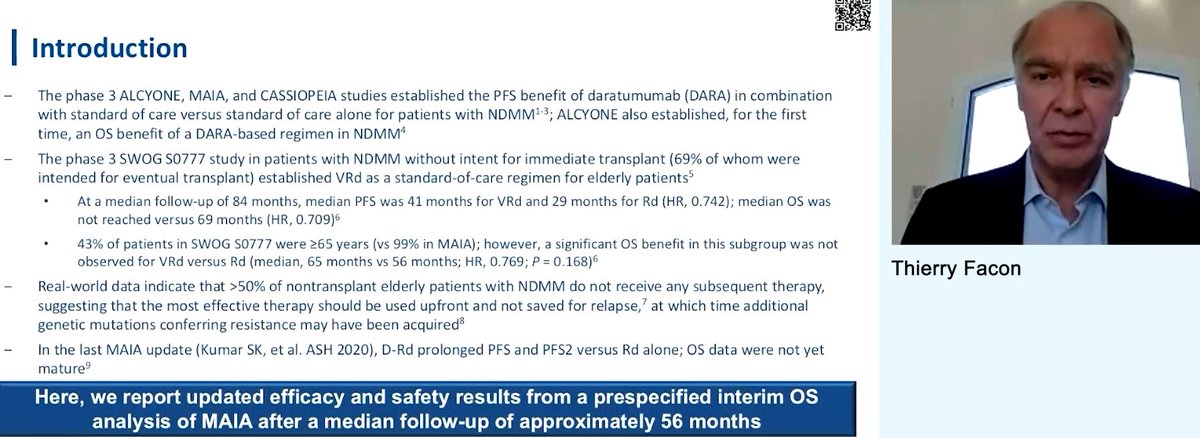
Introduction
- The phase 3 ALCYONE, MAIA, and CASSIOPEIA studies established the PFS benefit of daratumumab (DARA) in combination with standard of care versus standard of care alone for patients with NDMM(1-3); ALCYONE also established, for the first time, an OS benefit of a DARA-based regimen in NDMM(4)
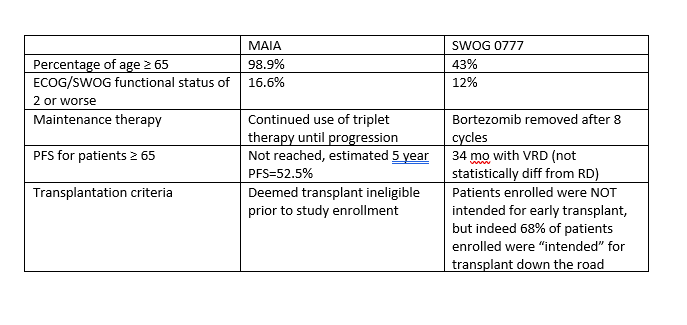
- The phase 3 SWOG S0777 study in patients with NDMM without intent for immediate transplant (69% of whom were intended for eventual transplant) established VRd as a standard-of-care regimen for elderly patients(5)
• At a median follow-up of 84 months, median PFS was 41 months for VRd and 29 months for Rd (HR, 0.742); median OS was not reached versus 69 months (HR, 0.709)(6)
• 43% of patients in SWOG S0777 were ≥65 years (vs 99% in MAIA); however, a significant OS benefit in this subgroup was not observed for VRd versus Rd (median, 65 months vs 56 months; HR, 0.769; P = 0.168)(6)
- Real-world data indicate that >50% of nontransplant elderly patients with NDMM do not receive any subsequent therapy, suggesting that the most effective therapy should be used upfront and not saved for relapse,(7) at which time additional genetic mutations conferring resistance may have been acquired(8)
- In the last MAIA update (Kumar SK, et al. ASH 2020), D-Rd prolonged PFS and PFS2 versus Rd alone; OS data were not yet mature(9)
Here, we report updated efficacy and safety results from a prespecified interim OS analysis of MAIA after a median follow-up of approximately 56 months
[Presenter webcam inset, right: Thierry Facon]
---
[EHA 2021 MAIA Study Design schematic]
Study Design
- Patients were enrolled in MAIA from March 2015 through January 2017
Key eligibility criteria:
• TIE NDMM
• ECOG PS score 0-2
• CrCl ≥30 mL/min
1:1 randomisation
D-Rd arm:
D: 16 mg/kg IV — QW Cycles 1-2, Q2W Cycles 3-6, then Q4W thereafter until PD
R: 25 mg PO — Days 1-21 until PD
d(a): 40 mg(b) PO or IV — Days 1, 8, 15, 22 until PD
Rd arm:
R: 25 mg PO Days 1-21 until PD
d: 40 mg PO — Days 1, 8, 15, 22 until PD
Cycles: 28 days
→ End-of-treatment visit (30 days after last dose) → Long-term follow-up
Primary endpoint:
• PFS
Key secondary endpoints:
• OS
• PFS2
• ORR
• CR/sCR rate
• MRD (NGS; 10^-5)
MAIA is a multicentre, randomised, open-label, active-controlled, phase 3 study of D-Rd versus Rd alone in patients with NDMM who are transplant ineligible
---
[Slide]
Treatment Exposure and Patient Disposition
Median duration of follow-up, 56.2 months
Safety population (received ≥1 dose of study treatment): D-Rd (n = 364) | Rd (n = 365)
Median duration of study treatment, months (range): 47.5 (0.10-69.26) | 22.6 (0.03-69.22)
Lenalidomide median RDI, % (range): 66 (8-206) | 86 (5-239)
Discontinued lenalidomide only while continuing other study treatment, n (%): 33 (9) | 14 (4)
Intravenous daratumumab median RDI, % (range): 98 (3-107) | —
Discontinued daratumumab only while continuing other study treatment, n (%): 5 (1) | —
ITT population: D-Rd (n = 368) | Rd (n = 369)
Remaining on study treatment, %: 42 | 18
Discontinued study treatment, %: 57 | 81
Progressive disease: 27 | 34
Adverse event: 13 | 23
Death: 7 | 7
Noncompliance with study drug: 5 | 8
Physician decision: 4 | 6
Other: 1 | 1
Lost to follow-up: <1 | 1
Patient withdrawal: 0 | 2
42% of patients in the D-Rd arm and 18% of patients in the Rd arm remained on treatment; more patients discontinued Rd for AEs
---
[Slide]
ORR(a)
Median follow-up — Primary: 28.0 months(1)
D-Rd (n = 368): ORR 93% — sCR 30% | CR 17% | VGPR 32% | PR 14%
Rd (n = 369): ORR 81% — sCR 13% | CR 13% | VGPR 28% | PR 28%
Median follow-up — Update: 56.2 months
D-Rd (n = 368): ORR 93% — sCR 35% | CR 16% | VGPR 30% | PR 12%
Rd (n = 369): ORR 82% — sCR 15% | CR 15% | VGPR 27% | PR 25%
Legend: sCR, CR, VGPR, PR (D-Rd purple / Rd orange)
• D-Rd induced deeper responses with significantly higher rates of ≥CR and ≥VGPR, compared with Rd
• With >28 months of additional follow-up, responses deepened with continued DARA therapy
Posted Aug 26, 2022 · Audience photo of the conclusions slide, presented by Philippe Moreau at the 19th IMS Annual Meeting · same 56.2-mo data cut as the EHA 2021 analysis above, reported separately
Landmark, post-hoc analysis: patients are grouped by how long they remained on treatment, so only those who survived and stayed on therapy for ≥18 months can enter the ≥18-month group. Comparisons between duration groups are not randomised and are subject to guarantee-time bias. (IMS_2022_Slide, 56.2-mo cut)
[Slide]
Conclusions
• At a median follow-up of >4.5 years, D-Rd improved PFS and OS versus Rd for patients who received ≥18 months of treatment
• For D-Rd patients, discontinuation of R ± d did not appear to compromise efficacy
• No new safety concerns were identified with long-term D-Rd treatment
• These results support D-Rd treatment for ≥18 months to achieve deep clinical responses
- Our findings suggest that stopping D-Rd earlier based on response level may compromise long-term patient outcomes
[Slide number: 14]
[MAIA frail TIE subgroup PRO slide (ASH 2022)]
MAIA: LS Mean Change From Baseline in EORTC QLQ-C30 Scores Over Time in Frail TIE Patients With NDMM
Median follow-up, 64.5 months
Pain Symptoms
D-Rd — Rd —
Y-axis: LS mean change from BL (95% CI), scale +15 to -35
X-axis: Time (cycles C3 C6 C9 C12 C18 C24 C30 C36 C42 C48 C54 C60 C66)
[Both arms show LS mean pain reductions of roughly -10 to -25 points from baseline across cycles; orange arrow labeled "Improvement" pointing down]
Number of patients:
Rd n=122 114 99 99 75 68 56 44 37 28 23 16 8
D-Rd n=140 133 118 112 106 98 85 84 74 67 53 43 25
Fatigue Symptoms
D-Rd — Rd —
Y-axis: LS mean change from BL (95% CI), scale +15 to -35
X-axis: Time (cycles C3 C6 C9 C12 C18 C24 C30 C36 C42 C48 C54 C60)
Number of patients:
Rd n=122 114 99 99 75 68 56 44 37 28 23 16
D-Rd n=140 133 118 112 106 98 85 84 74 67 53 43
More patients remained on D-Rd vs Rd after cycle 42
- Patients treated with D-Rd showed large reductions in pain from baseline (>=20-point change)
- Pain symptoms improved more with D-Rd vs Rd
- Fatigue moderately improved with D-Rd and Rd
- The triplet regimen D-Rd did not increase fatigue
Note: The number of patients shown below the graphs starts at cycle 3.
BL, baseline; C, cycle; D-Rd, daratumumab, lenalidomide, and dexamethasone; EORTC QLQ-C30, European Organization for Research and Treatment of Cancer Quality of Life Questionnaire Core 30-Item; LS, least squares; NDMM, newly diagnosed multiple myeloma; Rd, lenalidomide and dexamethasone; TIE, transplant-ineligible.
---
[MAIA frail TIE subgroup PRO slide (slide 10)]
MAIA: LS Mean Change From Baseline in EORTC QLQ-C30 Scores Over Time in Frail TIE Patients With NDMM
Median follow-up, 64.5 months
Emotional Functioning
D-Rd — Rd —
Y-axis: LS mean change from BL (95% CI), scale +30 to -15
X-axis: Time (cycles C3 C6 C9 C12 C18 C24 C30 C36 C42 C48 C54 C60 C66)
[Both arms improve ~+5 to +15 points; purple arrow labeled "Improvement" pointing up]
Rd n=122 114 99 99 75 68 56 44 37 28 23 16 8
D-Rd n=140 133 118 112 106 98 85 84 74 67 53 43 25
Social Functioning
D-Rd — Rd —
Y-axis: LS mean change from BL (95% CI), scale +30 to -15
X-axis: Time (cycles C3 C6 C9 C12 C18 C24 C30 C36 C42 C48 C54 C60 C66)
[Both arms improve ~+5 to +20 points; purple arrow labeled "Improvement" pointing up]
Rd n=122 113 99 99 75 68 56 44 37 28 23 16 8
D-Rd n=140 133 118 112 106 98 85 84 74 67 53 43 25
More patients remained on D-Rd vs Rd after cycle 42
- Improvements in emotional and social functioning were seen with both treatment arms and were numerically greater with D-Rd at several time points
- In addition, improvements in role functioning were seen with both treatment arms with no difference between treatments and no meaningful changes from baseline were observed in nausea and vomiting for either treatment group
BL, baseline; C, cycle; D-Rd, daratumumab, lenalidomide, and dexamethasone; EORTC QLQ-C30, European Organization for Research and Treatment of Cancer Quality of Life Questionnaire Core 30-Item; LS, least squares; NDMM, newly diagnosed multiple myeloma; Rd, lenalidomide and dexamethasone; TIE, transplant-ineligible.
Slide number: 10
---
[MAIA frail TIE subgroup slide (slide 11)]
MAIA: D-Rd Preserved EORTC QLQ-C30 Subscales in Frail TIE Patients With NDMM(a)
Median follow-up, 64.5 months
Median time to worsening (months) — D-Rd (n=172) vs Rd (n=169):
GHS: HR: 0.91 (95% CI, 0.65-1.26)
Physical functioning: HR: 0.66 (95% CI, 0.45-0.95)
Role functioning: HR: 0.74 (95% CI, 0.53-1.05)
Cognitive functioning: HR: 1.02 (95% CI, 0.76-1.37)
Emotional functioning: HR: 0.78 (95% CI, 0.55-1.09)
Social functioning: HR: 0.80 (95% CI, 0.59-1.08)
Pain: D-Rd bar extends to NR (arrow); HR: 0.66 (95% CI, 0.44-1.00)
Fatigue: HR: 1.19 (95% CI, 0.86-1.66)
Nausea and vomiting: HR: 0.91 (95% CI, 0.65-1.27)
X-axis: Median time to worsening (months), 0 to 70
Bullets:
- In general, D-Rd preserved HRQoL scores longer than Rd
- In particular, D-Rd maintained physical functioning almost twice as long as Rd (68.1 months vs 39.6 months)
- At a median follow-up of 64.5 months median time to worsening of pain symptoms was not reached with D-Rd
- Fatigue symptoms were maintained for almost 2 years (22 months) with D-Rd vs almost 3 years (35 months) with Rd
- Cognitive symptoms deteriorated with both regimens within a year; 8 months with D-Rd and 10 months with Rd
(a)Worsening was defined as an increase of symptom scores or a decrease in other scores that was at least half of standard deviation from baseline values, where the standard deviation was calculated from the scores at baseline combining both treatment groups
D-Rd, daratumumab, lenalidomide, and dexamethasone; EORTC QLQ-C30, European Organization for Research and Treatment of Cancer Quality of Life Questionnaire Core 30-Item; GHS, global health status; HR, hazard ratio; NDMM, newly diagnosed multiple myeloma; NR, not reached; Rd, lenalidomide and dexamethasone; TIE, transplant ineligible.
Slide number: 11
---
[Slide]
MAIA: Conclusions
- The phase 3 MAIA study demonstrated that the triplet regimen D-Rd improved PFS and OS in frail patients(1) with accompanying improvements in PROs(2)
- This analysis of outcomes in frail patients in MAIA showed improvements over time with D-Rd in Global Health Status (an overall HRQoL measure) and in physical functioning
- Clinically meaningful reductions in pain were observed with D-Rd during treatment
- Additional updates of the MAIA study at ASH 2022 confirm superior outcomes with D-Rd vs Rd
- In an analysis of OS at a longer median follow-up (73.6 months) and an overall analysis of updated efficacy and safety after a median follow-up of 64.5 months (Poster #4559)
- In clinically important subgroups (Poster #3245) and in patients aged <70, <75, and >=70 to <75 years (Poster #4553) both at a median follow-up of 64.5 months
Frail patients see clinically meaningful improvements and preservation of HRQoL and Global Health Status with D-Rd
D-Rd, daratumumab, lenalidomide, and dexamethasone; HRQoL, health-related quality of life; OS, overall survival; PFS, progression-free survival; PRO, patient-reported outcome; Rd, lenalidomide and dexamethasone; TIE, transplant-ineligible.
1 Facon T, et al. Leukemia 2022; 36(4):1066-77. 2. Perrot A, et al. Presented at ASH; December 11-14, 2021, Atlanta, GA. P1655.
Slide number: 12
Table 3 (Leukemia 2025 long-term update, DCO 21 Oct 2021) - Most common any-grade or grade 3/4 TEAEs, safety population. D-Rd (n=364) vs Rd (n=365):
Neutropenia any-grade 61.5% vs 45.5%; grade 3/4 54.1% vs 37.0%
Anemia any-grade 42.3% vs 41.1%; grade 3/4 17.0% vs 21.6%
Diarrhea any-grade 65.9% vs 51.5%
Fatigue any-grade 45.1% vs 31.2%
Pneumonia any-grade 31.0% vs 18.1%; grade 3/4 pneumonia 19.5% vs 10.7% (Table 3). Separately, pneumonia was also the most common SERIOUS TEAE: 18.7% vs 10.7% (publication text).
Table 1: ORR 92.9% (D-Rd) vs 81.6% (Rd), ITT population (P<0.0001); Fig. 3A: deepening sCR/CR fractions over time in both arms, greater with D-Rd. (Leukemia 2025, 64.5-mo cut)
PFS / OS / depth of response, long-term update (KM curves captured as a table, not raw OCR)
Patients aged ≥80 years, long-term update (KM curves captured as a table, not raw OCR)
Endpoint (≥80 y)
D-Rd (n=66)
Rd (n=71)
HR (95% CI); P
Median PFS
52.2 mo
30.4 mo
0.48 (0.31–0.76); P=0.0011
Median OS
Not reported
Not reported
0.71 (0.44–1.14); P=0.1574 (not significant)
Note: at the later final-OS data cut (Leukemia 2026, 89.3-mo follow-up), the ≥80-year OS subgroup trended further in favor of D-Rd: median 67.6 mo (40.6–NE) vs 48.9 mo (37.1–60.9); HR 0.64 (0.42–0.97). The authors report this as an exploratory subgroup trend; no p-value was published. (Leukemia 2026, final OS cut)
Final MAIA analysis: D-Rd reached median OS of 90.3 months (HR 0.67 vs. Rd) after 89.3 months of follow-up in transplant-ineligible NDMM. A tough number to beat - will quadruplet regimens have to work hard to surpass it? https://t.co/FqBAWQUd0p #MM #mmsm
D-Rd prolonged OS versus Rd, regardless of MRD status and in patients who did not achieve sustained MRD negativity. Reiterates the fact that fitness; disease biology and access to second line Rx maybe more relevant measures of outcome than MRD kinetics !
They will surpass it, but how many will end up with peripheral neuropathy? Don’t come to me “but weekly subcutaneous is fine.” No, neuropathy still happens. More to come
Will quadruple combinations surpass these excellent OS results? I hope so! And as @rfonsi1 said, yes, they will succeed, but some will pay the price of neuropathy. #mmsm
FDA APPROVEDDaratumumab + Lenalidomide + Dexamethasone — June 27, 2019
On June 27, 2019, the FDA approved daratumumab (DARZALEX®, Janssen Biotech, Inc.) in combination with lenalidomide and dexamethasone for adult patients with newly diagnosed multiple myeloma who are ineligible for autologous stem cell transplant. Approval was based on MAIA (NCT02252172): median PFS was not reached in the D-Rd arm versus 31.9 months in the Rd arm (HR 0.56; 95% CI, 0.43–0.73; p<0.0001). The application used Real-Time Oncology Review and was granted priority review. (FDA, June 2019 announcement)
MAIA (NCT02252172) is a randomized, open-label, active-controlled, multicenter phase 3 study that enrolled 737 patients with newly diagnosed multiple myeloma who were not candidates for high-dose chemotherapy and autologous stem cell transplant. Patients were randomized 1:1 to daratumumab plus lenalidomide and low-dose dexamethasone (D-Rd) or lenalidomide and low-dose dexamethasone alone (Rd), with treatment continued until disease progression or unacceptable toxicity. The trial population skewed elderly: 43–44% of patients were aged 75 or older and roughly one in five was 80 or older, with nearly half classified as frail — making MAIA the pivotal frontline evidence base in older, transplant-ineligible patients, and the trial the authors say continues to support frontline D-Rd use. (Leukemia 2026)
The primary PFS analysis (NEJM 2019) established D-Rd as a standard of care and supported FDA approval in June 2019. A protocol amendment in July 2021 extended follow-up for survival, and the final analysis (Leukemia 2026, median follow-up 89.3 months) reported a median OS of 90.3 months with D-Rd — described by the authors as a new benchmark for median OS (7.5 years) in transplant-ineligible NDMM. First author: Thierry Facon, MD (University of Lille, CHU Lille, France).
Randomized (1:1), open-label, active-controlled, parallel-group, multicenter phase 3 trial. Treatment until progression or unacceptable toxicity. (NEJM 2019)
Population
737 adults with newly diagnosed multiple myeloma, ineligible for high-dose chemotherapy + ASCT; ECOG PS 0–2. 43–44% aged ≥75; 18–19% aged ≥80; ~46–47% frail by simplified frailty score. (Leukemia 2026)
Interventions
D-Rd: daratumumab 16 mg/kg IV + lenalidomide + low-dose dexamethasone vs Rd alone. (FDA; NEJM 2019)
Endpoints
Primary: progression-free survival. Key secondary/other: OS, ≥CR rate, MRD negativity (10-5), safety; final analysis added long-term OS and time to subsequent antimyeloma therapy. (NEJM 2019; Leukemia 2026)
Lead Author / PI
Thierry Facon, MD (University of Lille, CHU Lille) — first author of the NEJM primary analysis and the Leukemia 2025/2026 updates, for the MAIA Trial Investigators.
Sponsor
Janssen Research & Development, LLC (Johnson & Johnson). Daratumumab is DARZALEX®.
Progression-Free Survival
Primary analysis (NEJM 2019, 28.0-mo data cut): median PFS not reached with D-Rd vs 31.9 months with Rd; HR 0.56 (95% CI, 0.43–0.73; P<0.001); 30-month PFS 70.6% vs 55.6%. Long-term update (Leukemia 2025, DCO 21 Oct 2021, 64.5-mo follow-up): median PFS 61.9 vs 34.4 months; HR 0.55 (95% CI, 0.45–0.67; P<0.0001).
45% reduction in the risk of disease progression or death with D-Rd vs Rd (Leukemia 2025) NEJM 2019 ↗Leukemia 2025 ↗
Overall Survival — Final Analysis
At a median follow-up of 89.3 months, median OS was 90.3 months (95% CI, 80.8–NE) with D-Rd versus 64.1 months (56.0–70.8) with Rd; HR 0.67 (95% CI, 0.55–0.82). Estimated 7-year OS rates were 53.1% vs 39.3%. In exploratory subgroup analyses, OS trended in favor of D-Rd in older patients: age ≥75, median OS 72.3 vs 54.8 months (HR 0.67; 0.51–0.88); age ≥80, 67.6 vs 48.9 months (HR 0.64; 0.42–0.97). Median time to subsequent antimyeloma therapy was not reached vs 42.4 months (HR 0.51; 0.41–0.63; P<0.0001); 38% vs 55% of treated patients received ≥1 subsequent line on study. (Leukemia 2026, final OS, DCO 30 Nov 2023, 89.3-mo follow-up)
Median OS 90.3 months (7.5 years) — described by the authors as a new benchmark in transplant-ineligible NDMM (Leukemia 2026) Leukemia 2026 final survival analysis ↗
Depth of Response & MRD
≥CR 51.1% vs 30.1%; MRD-negativity (10-5) 32.1% vs 11.1%; sustained MRD-negativity ≥18 months 16.8% vs 3.3% (all P<0.0001). (Leukemia 2025, DCO 21 Oct 2021, 64.5-mo follow-up)
Most common grade 3/4 TEAE with D-Rd vs Rd: neutropenia 54.1% vs 37.0%. Grade 3/4 infections 42.6% vs 29.6%; grade 3/4 pneumonia occurred in 19.5% vs 10.7% (Table 3), and pneumonia was also the most common serious TEAE (18.7% vs 10.7%). Treatment discontinuation due to TEAEs was lower with D-Rd (14.6% vs 23.8%). (Leukemia 2025, 64.5-mo data cut.) In the final analysis, death due to adverse events occurred in 12% (D-Rd) vs 11% (Rd) of treated patients; no new safety concerns were identified. (Leukemia 2026)
MAIA (NCT02252172) is a randomized, open-label phase 3 trial that enrolled 737 patients with newly diagnosed multiple myeloma who were ineligible for autologous stem cell transplant. Patients were randomized 1:1 to daratumumab plus lenalidomide and dexamethasone (D-Rd) or lenalidomide and dexamethasone alone (Rd). The primary endpoint was progression-free survival. The trial is sponsored by Janssen (Johnson & Johnson), with Thierry Facon, MD, as lead author.
What were the final overall survival results of MAIA?
In the final survival analysis (Facon et al., Leukemia 2026; median follow-up 89.3 months), median overall survival was 90.3 months with D-Rd versus 64.1 months with Rd (HR 0.67; 95% CI, 0.55-0.82). Estimated 7-year OS rates were 53.1% versus 39.3%. Median time to subsequent antimyeloma therapy was not reached with D-Rd versus 42.4 months with Rd (HR 0.51; P<0.0001).
Is daratumumab plus lenalidomide and dexamethasone FDA approved for transplant-ineligible newly diagnosed multiple myeloma?
Yes. On June 27, 2019, the FDA approved daratumumab (DARZALEX, Janssen Biotech) in combination with lenalidomide and dexamethasone for adult patients with newly diagnosed multiple myeloma who are ineligible for autologous stem cell transplant, based on the MAIA trial (median PFS not reached vs 31.9 months; HR 0.56; 95% CI, 0.43-0.73).
How did older patients do on D-Rd in MAIA?
In the final OS analysis (Leukemia 2026), OS trended in favor of D-Rd in exploratory older-age subgroups: patients aged 75 or older had median OS of 72.3 versus 54.8 months (HR 0.67; 95% CI, 0.51-0.88), and patients aged 80 or older had median OS of 67.6 versus 48.9 months (HR 0.64; 95% CI, 0.42-0.97). At the earlier 64.5-month data cut, PFS in patients 80 or older was 52.2 versus 30.4 months (HR 0.48; P=0.0011).
What did MAIA show for progression-free survival and MRD?
At the long-term update (Leukemia 2025; median follow-up 64.5 months), median PFS was 61.9 months with D-Rd versus 34.4 months with Rd (HR 0.55; 95% CI, 0.45-0.67; P<0.0001). Rates of complete response or better were 51.1% versus 30.1%, and MRD-negativity (10^-5) rates were 32.1% versus 11.1% (all P<0.0001).
Compiled and reviewed by the KOL Pulse research team, led by Brian Shields, Founder, KOL Pulse. Last updated August 25, 2026. Every statistic on this page is labeled with its source publication and data cut; tweet text is reproduced verbatim.