MAVERICK (SWOG S1827) at a Glance
Design
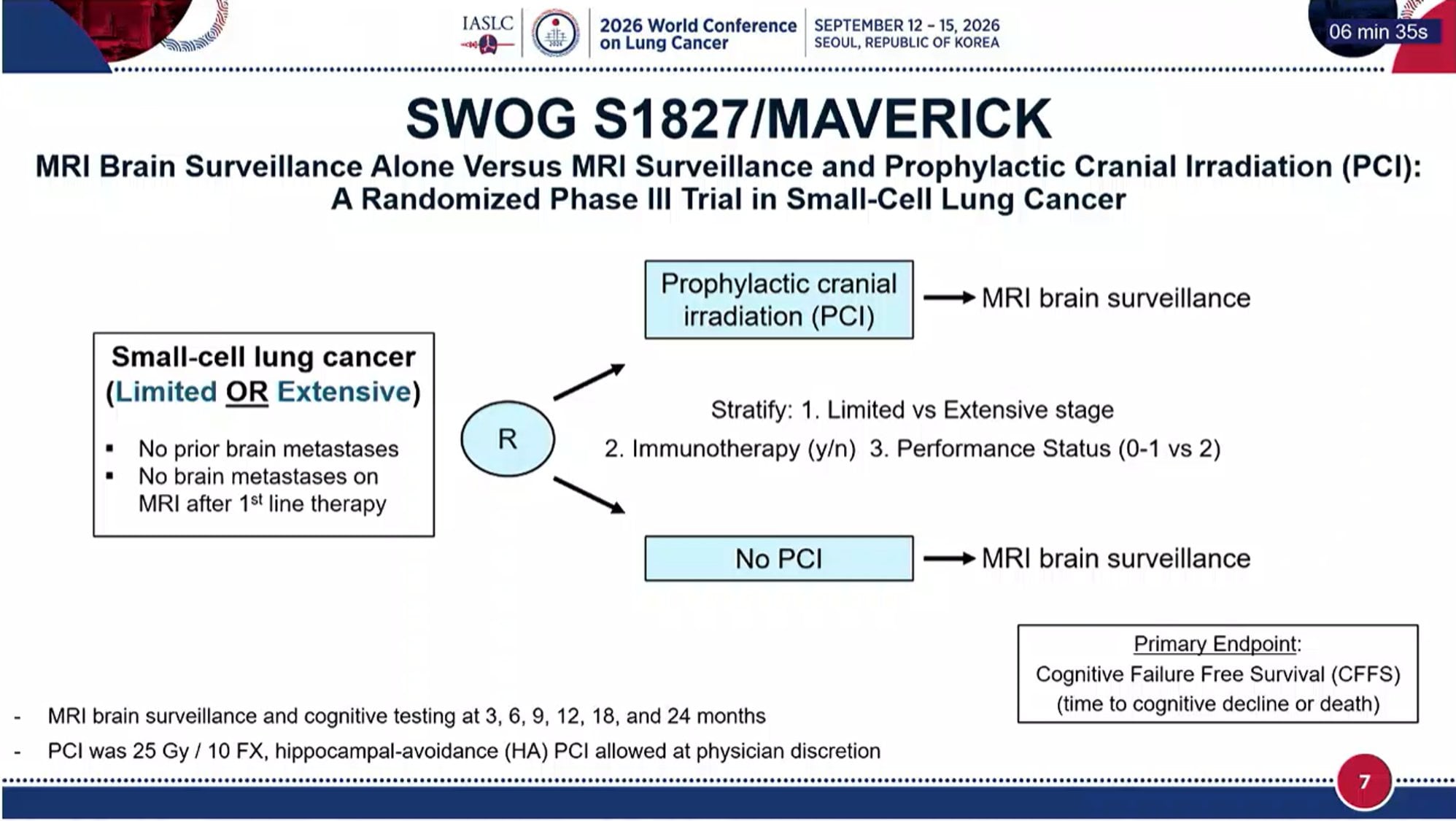
Phase III, randomized: MRI brain surveillance alone versus PCI plus MRI surveillance in patients with SCLC (limited and extensive stage) responding to initial therapy; brain-metastasis-directed SRS/WBRT on development of lesions. (Presented slides, WCLC 2026)
Primary endpoint — cognitive-failure-free survival
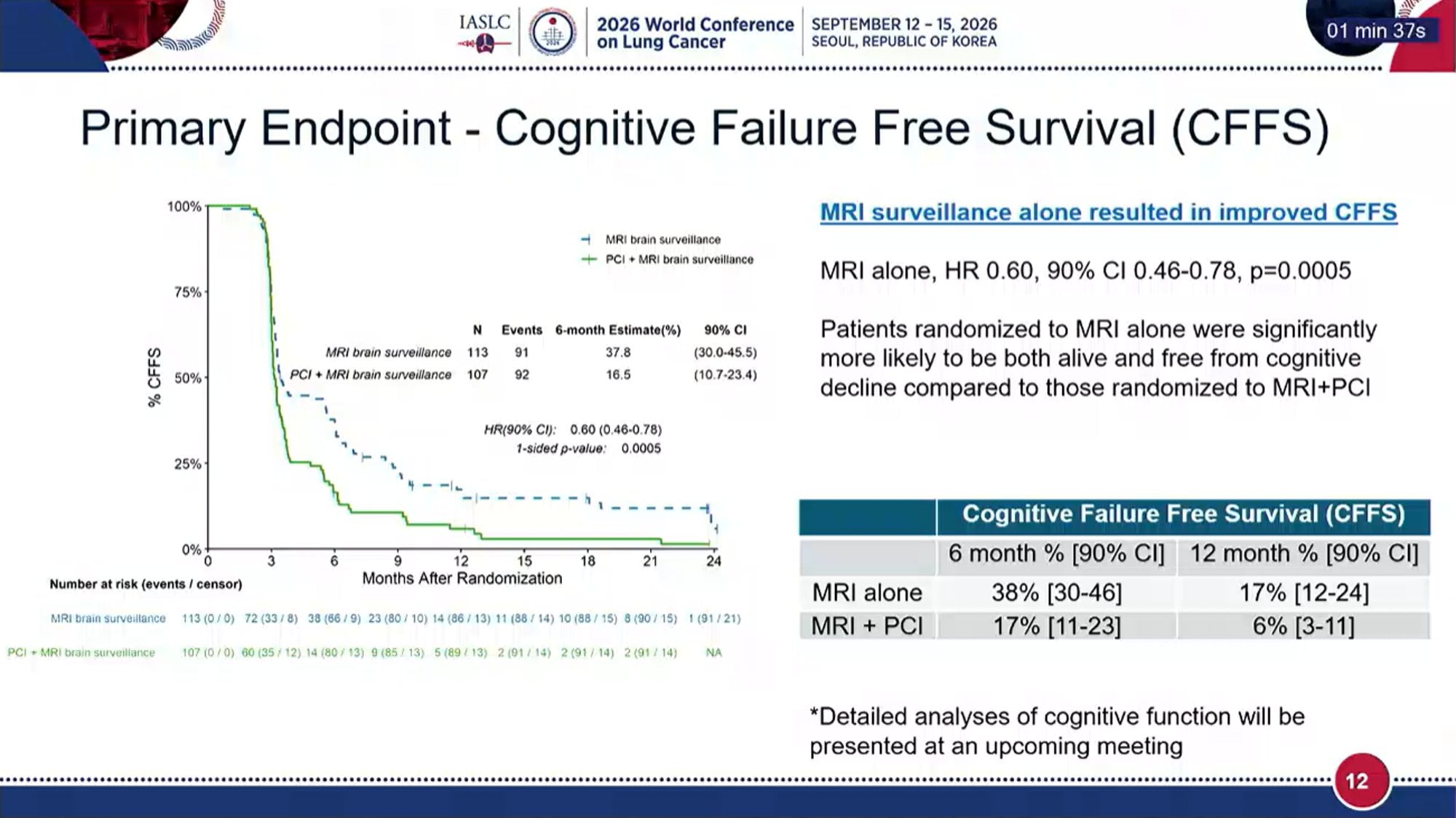
The primary endpoint (amended from OS to CFFS during accrual) was met: MRI surveillance alone reduced the risk of cognitive failure or death, HR 0.60 (90% CI 0.46–0.78, one-sided p=0.0005; CFFS analysis population 113 vs 107), with Grade ≥3 toxicity 0.8% vs 7.9%. (Presented slides, verbatim capture; primary-endpoint amendment per @M_Torasawa's capture)
Overall survival (secondary)
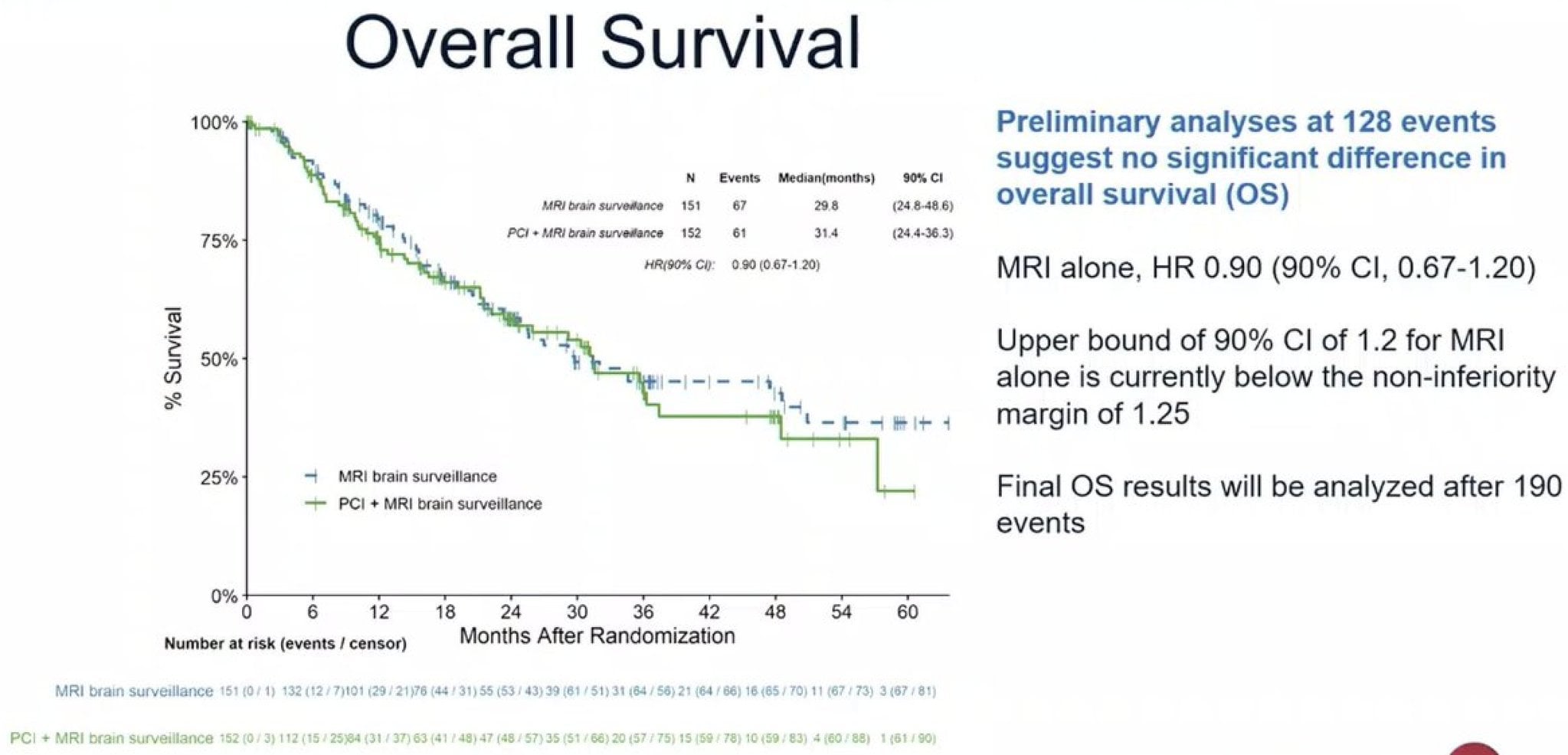
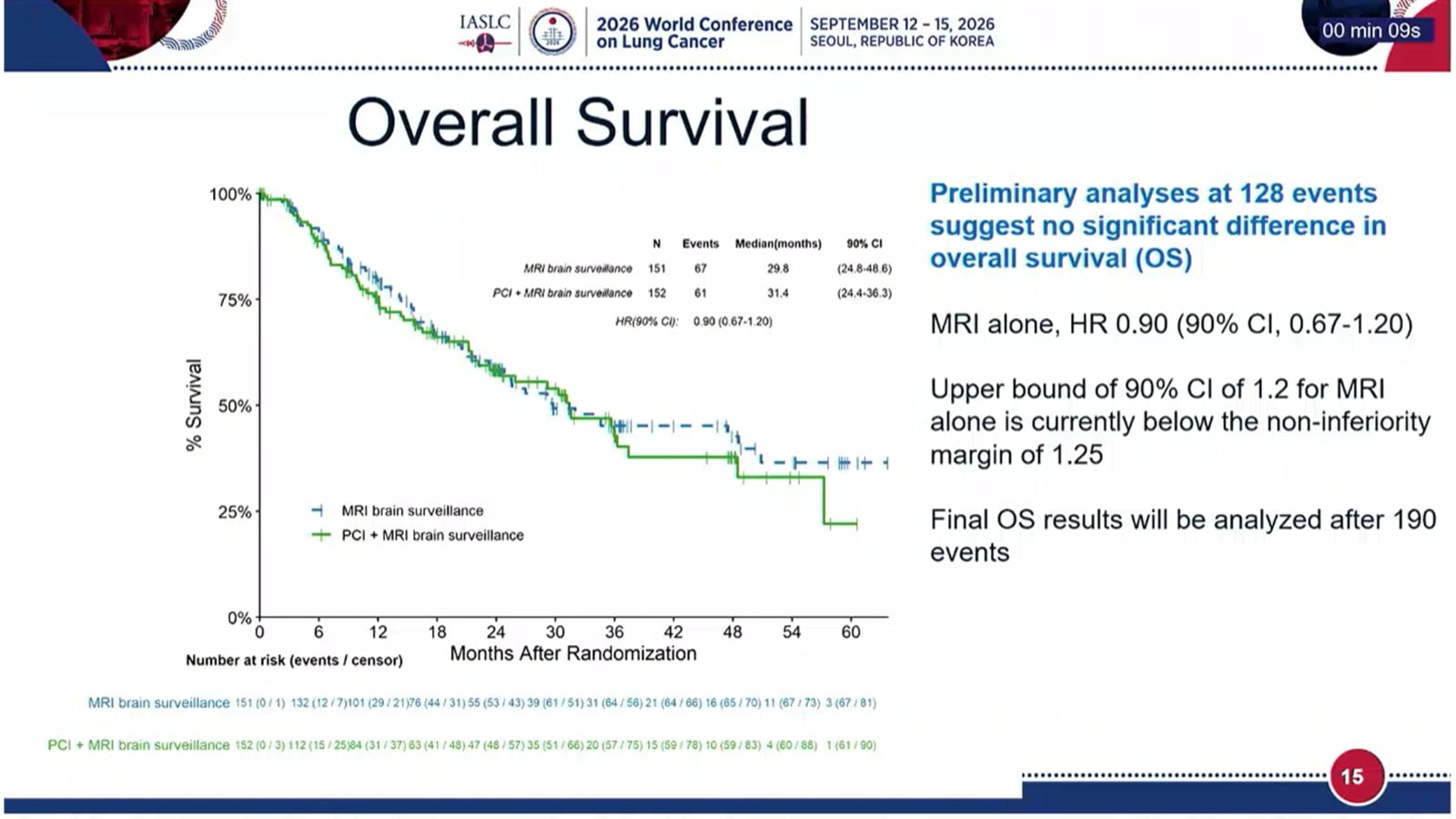
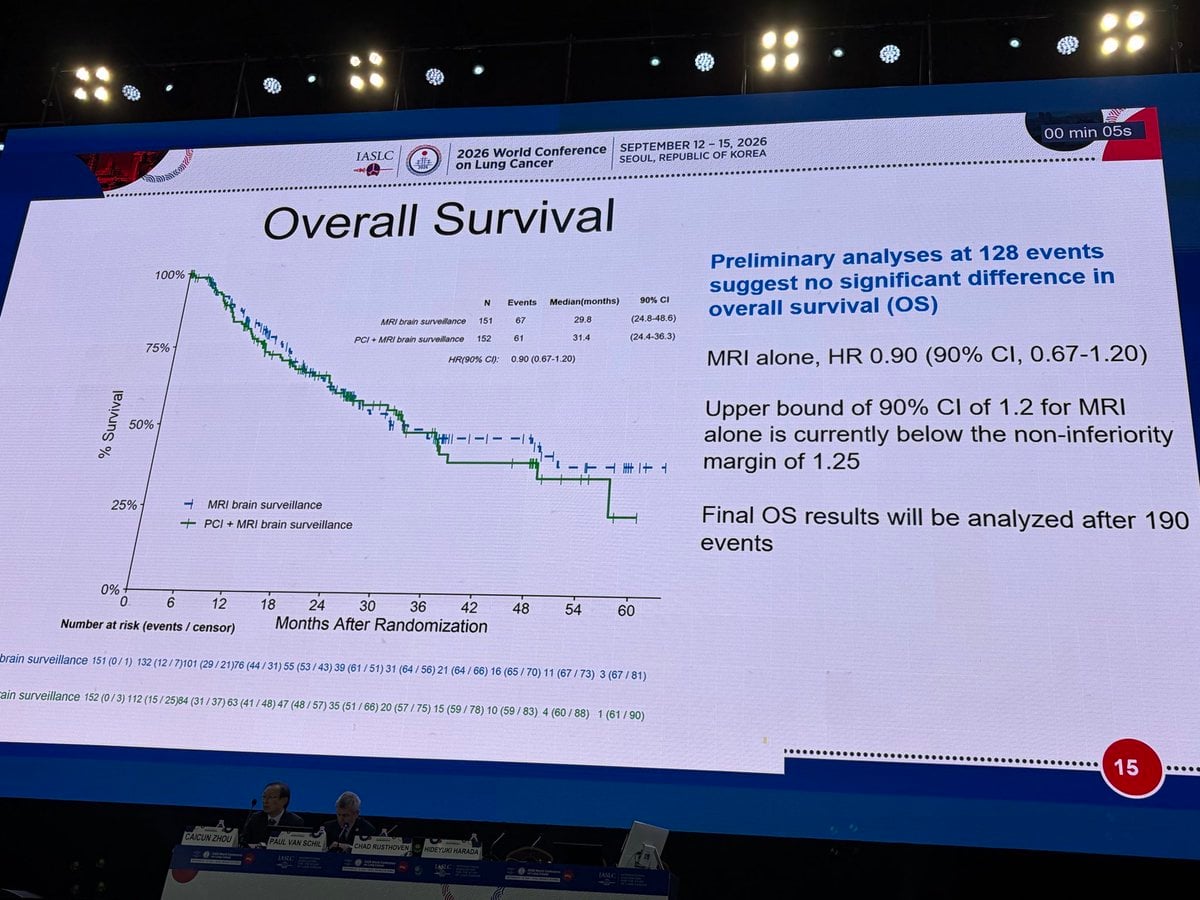
Preliminary analysis at 128 of 190 planned events: median OS 29.8 months (MRI alone, 90% CI 24.8–48.6) vs 31.4 months (PCI + MRI, 24.4–36.3); HR 0.90 (90% CI 0.67–1.20) — the upper bound sits below the 1.25 non-inferiority margin. Final OS analysis comes at 190 events. (Presented OS slide, verbatim capture)
What PCI still does
PCI reduced brain-metastasis incidence — 12-month cumulative incidence roughly 15% vs 30% favoring PCI (sub-HR ≈2.19 for MRI alone) — without improving PFS or preliminary OS. The skeptic's read is on this page too: “whopping NI margin of 25% greater hazard of death ❗” and OS called premature (@5_utr, verbatim below). (Presented slides via physician captures)
Practice impact
“Landmark, practice changing study” (Liu); “Close MRI surveillance in all SCLC (q3 mo) is essential!” (Alder, study team). The presented conclusion supports MRI surveillance as the preferred strategy; the final OS analysis at 190 events is pending. (Verbatim KOL posts; presented conclusions per Torasawa)
KOLs Discussing MAVERICK (SWOG S1827)


Key Slides & Data
What Physicians Said
MAVERICK trial. This KM curve says it all. It's RIP for PCI in SCLC. @SWOG https://t.co/njpBBUv1aH
MAVERICK settles it: skip PCI☢️, do 🧠MRI surveillance instead. Incredible effort by the investigators and thanks to all patients who participated 👏🏻 Huge win for patients with SCLC! https://t.co/Lkym1LC4Es
A true Maverick trial asking can we avoid PCI in management of (both LS/ES) SCLC pts? While there are some shortcomings given redesigned trial/complex primary endpoint (cognitive failure free survival) Still- w improved CFFS and clearly no OS detriment w MRI surveillance- Conclusion must be: RIP- rest in PCI!
🚨🔥‼️@OncoAlert Hot off the press. #BigDeal & #PracticeChanging Just presented @IASLC #WCLC26 ⭐️Results of the long awaited #MAVERICK phase 3 study of: ❇️ #PCI vs #Surveillance with #MRI for #SmallCell #LungCancer: ❌NO #OverallSurvival (#OS) benefit with PCI in either #Limited or #Extensive stages. 🔴WORSE #CognitiveFailure free survival & ⬆️#Toxicity in PCI arm.
Potentially practice-changing #WCLC26 Presidential Symposium result: SWOG S1827/MAVERICK MRI surveillance alone vs PCI + MRI surveillance in SCLC. Primary endpoint favored MRI alone: CFFS HR 0.60 6 mo: 38% vs 17% 12 mo: 17% vs 6% https://t.co/mj0Hm3VmJU
Practice changing #SWOG S18 MAVERICK trial by C Rusthoven. I think this should be seen as then end of using PCI in SCLC. Endpoints changed bc slow recruitment. Although more CNS mets pfs was the same. Less toxicity, which increases over time. Not a surprise, but well conducted. https://t.co/NigLq6LSO7
MRI surveillance with no PCI is now SOC for limited- and extensive-stage SCLC. OS not yet mature but no early signal for detriment with omitting PCI. QOL pending presentation at #ASTRO26 @ASTRO_org. Congratulations to Dr. Chad Rusthoven, @SWOG S1826/MAVERICK team, #WCLC26 @IASLC https://t.co/NiwJCdPaJW
Important point from Dr. Chad Rusthoven at #WCLC26: MAVERICK did not show equivalence without PCI. It showed notable clinical benefit with an MRI surveillance strategy omitting PCI. https://t.co/wvVa33Sa7v
Important findings from the MAVERICK study. Cognitive toxicity is not an abstract endpoint! Memory, concentration, independence, work, driving, child care and simply feeling like yourself significantly impacts #QOL. But surveillance isn’t burden free for patients & families. It’s regular brain MRIs, living with scan-xiety, time off work, transportation, access to timely imaging AND treatment when needed. We don’t want MRI surveillance to become a recommendation only available for people who have the resources and ability. #WCLC26
Good question & complicated. IMO looking at Cumulative incidence of brain metastases S1827 PCI did NOT move the needle as much as prior trials (Slotman for example) likely due to improving systemic therapy. Next there is no PFS diff on S1827 due to "squeezing the balloon" the PCI patients developed earlier systemic disease prog. Which partially leads to no obvious diff in OS (the other part is salvage therapy) at this early stage since brain met free survival includes survival as part of its endpoint. Therefore with smaller gains in brain mets and no obvious OS difference we get BM-free survival that numerically does favor MRI+PCI, just not statistically significant
MAVERICK discussant Dr Harada rightly discusses MR in context of machine availability; huge variation…. UK at 8.6 scanners per million (according to Gemini) #WCLC26 https://t.co/ibPdkMXn8i
Landmark, practice changing study at #WCLC26. The phase III MAVERICK study shows no improvement in OS with PCI for SCLC, across limited and extensive stages, with worse cognitive failure free survival and increased toxicity in PCI arm. The end of the PCI era. https://t.co/SWOPM7iKux
🆙#WCLC26 #LCSM Plenary Session 🔥SWOG S1827 MAVERICK: Phase III Trial of Brain MRI Surveillance +/- Prophylactic Cranial Irradiation for Small-Cell Lung Cancer 🎯Primary: CFFS (Cognitive Failure Free Survival) 🎯MRI alone: HR 0.60 (90% CI 0.46-0.78) 🎙️Dr. Chad G. Rusthoven 🔢PL02.01 ☑️NCT04155034 🔗 https://t.co/JvkpEBLlSo @OncoAlert @Larvol @IASLC
Very excited about the #MAVERICK study for our patients with SCLC. Is PCI still needed in the modern day MRI brain surveillance era? #WCLC26 @IASLC https://t.co/TvIHH1m6DH
#WCLC26 | SWOG S1827/MAVERICK 🧠 Ph3: MRI surveillance vs PCI + MRI after 1L therapy in LS/ES-SCLC (n=303) 📌 Primary endpoint amended from OS → cognitive failure-free survival (CFFS) due to accrual 📉 CFFS favored MRI alone: HR 0.60 (90% CI 0.46–0.78) • 6-mo: 38% vs 17% • 12-mo: 17% vs 6% 🧠 PCI ↓ brain mets: 12-mo 15% vs 30% (sHR 2.19) 📊 No PFS difference: HR 0.96 ⏳ Preliminary OS similar: HR 0.90 (final OS at 190 events) ⚠️ G3+ TRAEs: 0.8% vs 7.9% 👉 PCI reduced brain metastases but did not improve PFS or preliminary OS, while CFFS and toxicity favored MRI surveillance. These data support MRI surveillance as the preferred strategy in SCLC.
MAVERICK: MRI surveillance +/- PCI for SCLC; SRS/WBRT if development of brain mets Primary endpoint, OS with a whopping NI margin of 25% greater hazard of death ❗️ and OS results premature https://t.co/lpKoASZHq8
Groundbreaking data at #WCLC26 , MAVERICK! So honored to play a small role in this practice changing study! ⭐️Close MRI surveillance in all SCLC (q3 mo) is essential! -PCI with no clear OS benefit, however real toxicities. In era of Tarlatamab and novel ADCs even more relevant. @ALLIANCE_org @SWOG @SclcSMASHERS @IASLC
The Non-Inferiority Margin Debate
The full conversation under @5_utr’s critique of the MAVERICK design — radiation oncologists and methodologists on the 1.25 non-inferiority margin, Bayesian alternatives, absolute versus relative differences, and whether limited- and extensive-stage disease can be analyzed together. All 16 posts verbatim, threaded as they appeared.
MAVERICK: MRI surveillance +/- PCI for SCLC; SRS/WBRT if development of brain mets Primary endpoint, OS with a whopping NI margin of 25% greater hazard of death ❗️ and OS results premature https://t.co/lpKoASZHq8
Secondary endpoint of “cognitive failure free survival” of very low 5% vs 16% OS benefit to PCI was always relatively modest, patients often get beat up by chemo, and patterns of failure data for SRS has been reasonable. More practice affirming than changing?
My practice has been discussing PCI, but in light of tech changes since historical PCI trials, with widespread MRI and also SRS, cisplatin/etoposide typical toxicities such that telling patients expected more fatigue with PCI has been a recent no-go. @jryckman3 @TonyFelefly

@5_utr @jryckman3 @TonyFelefly As the results of Maverick are out, it will be quiet intresting to see the coupling of PCI/MRI surveillance with the new DelLphi 3 data.

@5_utr @jryckman3 Agree! I was hoping to get more data on Limited-Stage disease. This was the missing part. Would have been nice to perform an interaction analysis for OS x Stage
@TonyFelefly @jryckman3 Yes; was hoping to learn more specifically about limited stage
@5_utr Agree the NI margin is pretty large. But in all fairness, a lower NI, say 1.1, would require at least 5x more patients. Would be nearly impossible to recruit in LS-SCLC. A bayesian design would have helped here?
@TonyFelefly I think so, given we have prior information, and also we want a probabilistic statement like the probability that HR < a = b, where a is any and every level of efficacy you want

@5_utr @TonyFelefly Don’t we need to evaluate NI margins in the context of absolute differences? In a disease like ES SCLC, a NI margin if 1.25 could represent a relatively small difference in absolute terms.
@Xristodouleas @TonyFelefly Yes, both ideally. Also, it’s not clear to me from what was released so far they adjusted for limited vs extensive stage, which if the case reminds me of @f2harrell point on how marginalizing over heterogeneity makes it difficult to apply to any single patient.
@Xristodouleas @TonyFelefly @f2harrell For small cell lung cancer, the baseline hazard of death is unfortunately high, so a relative measure like HR corresponds to clinically meaningful absolute risks
@Xristodouleas @5_utr Good point! I think for an Extensive stage population, 25% isn't high, but considering median survival for LS in ADRIATIC was 55.9 months, a 1.25 NI would translate into ~12 month in median, which is substantial

@5_utr Accepting a whopping NI margin of 25% I think forces myself to evaluate every single supposed SoC that's ever been published without an HR <0.75
@DiazaOA It is truly hard to see how an NI margin of 1.25 for survival is acceptable. Also, from data presented so far it looks like they marginalized over limited and extensive stage which reminds me of this @f2harrell piece https://t.co/yRZSRRtGt2
@5_utr @f2harrell Yes and if that marginalization is true, that'd be misleading, right? I hope we'll know the specific separated result on LS and ES because they can't be treated as equal.
@DiazaOA @f2harrell Lots of questions at this point and hopefully manuscript will provide more clarity especially if can get a hold of their SAP
About the MAVERICK (SWOG S1827) Trial
Prophylactic cranial irradiation has been part of SCLC management for decades on the strength of trials predating modern MRI surveillance. MAVERICK (SWOG S1827) asked whether close MRI surveillance alone — with stereotactic or whole-brain radiotherapy only on actual brain-metastasis development — can replace prophylactic irradiation of every responding patient. The answer presented at WCLC 2026: PCI still reduces brain-metastasis incidence, but that does not translate into longer survival, and it costs cognition and toxicity.
The cooperative-group readout (SWOG, with NCI funding) was the most-discussed dataset of the meeting's first results day on our tracking. The final OS analysis at 190 events is still to come; physicians already framed the preliminary non-inferiority plus the cognitive-failure benefit as enough to change practice toward MRI surveillance.
Trial Methodology & Results
Study Design
Phase III randomized: MRI brain surveillance vs PCI + MRI surveillance in SCLC after response to initial therapy; SRS/WBRT on brain-metastasis development. (Presented slides)
Population
Limited- and extensive-stage SCLC; N=151 (MRI) vs 152 (PCI + MRI) in the presented OS analysis. (Presented OS slide)
Endpoints
PRIMARY: cognitive-failure-free survival (amended from OS due to accrual; analysis N 113 vs 107). Secondary: OS non-inferiority (margin 1.25 on 90% CI, N 151 vs 152), brain-metastasis incidence, toxicity. (Presented slides; amendment per @M_Torasawa capture)
Presenter
Chad Rusthoven, MD — WCLC 2026 Presidential Symposium; co-PI Paul D. Brown. (Title slide, verbatim capture)
Primary endpoint met — cognitive-failure-free survival
MRI surveillance alone reduced the risk of cognitive failure or death: HR 0.60, 90% CI 0.46–0.78, one-sided p=0.0005 (CFFS analysis population 113 vs 107 — smaller than the OS population because CFFS required serial cognitive assessment), with Grade ≥3 toxicity of 0.8% vs 7.9%. CFFS became the primary endpoint in a protocol amendment when accrual slowed; OS moved to a secondary, non-inferiority question. (Presented slides, verbatim capture; amendment per @M_Torasawa)
PRIMARY: CFFS HR 0.60 (90% CI 0.46–0.78, p=0.0005) · Gr≥3 tox 0.8% vs 7.9%Source: WCLC 2026 presented slides (verbatim capture) ↗
Overall survival (secondary) — preliminary non-inferiority
At the preliminary analysis (128 of 190 planned events): median OS 29.8 months with MRI surveillance alone (90% CI 24.8–48.6; 67 events, N=151) versus 31.4 months with PCI + MRI (24.4–36.3; 61 events, N=152); HR 0.90 with the 90% CI (0.67–1.20) entirely below the 1.25 non-inferiority margin. Final OS will be analyzed after 190 events. PCI did reduce brain-metastasis incidence (12-month cumulative incidence ≈15% vs 30%; sub-HR ≈2.19 for surveillance alone) without a PFS or preliminary-OS benefit — and the dissent is on record: @5_utr called the 1.25 margin “whopping” and the OS read premature (verbatim in the sentiment table). (Presented OS slide, photographed in session and transcribed verbatim)
OS HR 0.90 (90% CI 0.67–1.20) · margin 1.25 · final at 190 eventsSource: WCLC 2026 presented OS slide (verbatim capture) ↗
WCLC 2026: Live KOL Reaction
Physician posts about this trial captured live during the IASLC 2026 World Conference on Lung Cancer (Seoul, September 12–15). Quotes are verbatim; each card links to the original post. Last updated 2026-09-15.
🆙#WCLC26 #LCSM Plenary Session 🔥SWOG S1827 MAVERICK: Phase III Trial of Brain MRI Surveillance +/- Prophylactic Cranial Irradiation for Small-Cell Lung Cancer 🎙️Dr. Chad G. Rusthoven 🔢PL02.01 ☑️NCT04155034 🔗 https://t.co/icbDk1Zjnh @OncoAlert @Larvol @IASLC https://t.co/ZOmILs19Ds
Dr. Chad Rusthoven at #WCLC26 presents results from SWOG S1827, the phase III MAVERICK study exploring the benefit of PCI in pts with SCLC. Historic studies before the era of MRI surveillance showed a decrease in brain metastases with PCI and an improvement in OS but recent ES-SCLC studies called the OS improvement into question. MAVERICK looks at both LS and ES disease - note primary endpoint here is cognitive failure free survival (time to cognitive failure or death) with OS as a key secondary.
2/6 MAVERICK / SWOG S1827 The question: in the MRI era, do patients with SCLC still need prophylactic cranial irradiation? (both limited and extensive stage) We know: PCI reduces brain metastases, but cognition and the role of modern MRI surveillance remain major concerns. At WCLC: Can MRI surveillance safely replace PCI without compromising survival — and what happens to brain control, cognition and QoL? This one could directly change practice.

1. SWOG S1827 MAVERICK ⭐️Perhaps my TOP pick for most important study that will be presented at #WCLC26 🧠PCI reduces brain metastases in SCLC by about 50%, based on older studies that did not mandate MRI surveillance. In the Takahasi et al study, the OS benefit was less clear whe modern MRI surveillance + SRS techniques were used. Add to that the integration of immunotherapy (both PD1 and DLL3 TCE), and the role of PCI will be put to the test. 🧑⚖️MAVERICK will finally adjudicate the decades old question around the role of PCI among patients with #SCLC. SOURCES 👉🏽https://t.co/0jTayyrCXp 👉🏽https://t.co/PuLS2Gdg4R 👉🏽https://t.co/mfZh0P4FFj 👉🏽https://t.co/CNQCIy0Zps [FANTASTIC REVIEW] @SclcSMASHERS @lcsmchat @OncoAlert @OncLive @Onco_Nexus @MedwatchHQ

I can’t wait to learn about the results of #S1827 in the presidential session on the first day of #WCLC2026 @IASLC @SWOG #PCI in Limited Stage SCLC & Extensive Stage SCLC Benefits, neurotoxicity, Early detection of lesions, role of MRI & SRS all are important questions. https://t.co/WGCEXlTLi1

MAVERICK @SWOG S1827 phase 3 trial Dr. Chad Rustoven presented at @IASLC #WCLC26 comparing prophylactic cranial irradiation (PCI) vs MRI brain with amended primary outcome of cognitive-free failure survival (CFFS). The study had 68-69% LS-SCLC, and remaining ES-SCLC in the cohort. MAVERICK identified that MRI brain reduced CFFS, compared to PCI, with NO impact on OS. While brain mets were decreased with PCI, PFS was not significantly different. Significant G3+ toxicity with PCI was observed. These results FINALLY conclude our suspicions from the Takahashi data (2017) — ⭐️⭐️ PCI has NO clear role in SCLC, in either limited- or extensive-stage, in the MRI era. @LUNGevity @SclcSMASHERS @lungoncdoc @LungCancerEu @OncoAlert @oncodaily @StephenVLiu @lcrf_org @LungAssociation @Lung_Cancers @OncLive @g_mountzios @LauraAlderMD @RManochakian @Latinamd

SWOG S1827 MAVERICK met primary endpoint with ⬆️ cognitive failure-free survival with MRI alone vs MRI + PCI. MRI surveillance now standard of care for patients with LS-SCLC. https://t.co/F717pcKjfr

SCLC: Do we still need PCI? 🧠 SWOG S1827 MAVERICK challenges routine PCI in the MRI era. • MRI surveillance alone → better cognitive failure-free survival (HR 0.60) • Brain mets → numerically higher without PCI, but not statistically significant (HR 1.25) • Preliminary OS similar (HR 0.90) • Grade 3–5 treatment-related AEs: 0.8% vs 7.9% The key concept: No PCI ≠ no treatment. WATCH → FIND → TREAT Serial MRI → detect brain mets → salvage radiation when needed. Final OS analysis awaited. #MVOnco #SCLC #LungCancer #WCLC2026 #MAVERICK #PCI #RadiationOncology #MedicalOncology

Cambio de práctica en #SCLC limitado y extendido. #lcsm MAVERICK (SWOG 1827) en #WCLC26: con MRI moderna de vigilancia, añadir PCI no mejora OS y sí empeora la cognición. • Mejor CFFS (supervivencia libre de deterioro cognitivo) con MRI sola: 16% vs 5% a 1 año • Sin diferencia de OS • Mucha menos toxicidad • Mismo efecto en LS y ES (68% eran LS) La MRI de vigilancia debería ser el estándar.

Biggest take away from SWOG S1827/MAVERICK trial - MRI surveillance alone resulted in improved cognitive failure free survival (HR 0.60, 90% CI 0.46-0.78, p=0.0005) in #SCLC Should we then be following disease with q3mo MRIs or at least q6mo for all? #WCLC26 #lcsm @IASLC https://t.co/FzdN2xUpc3
🧠 MRI surveillance should become the preferred option in patients with SCLC rather than PCI. MAVERICK trial demonstrated MRI alone was associated with superior cognitive failure free survival (CFFS) than PCI + MRI without differences in overall survival. #Lcsm #wclc26 @IASLC https://t.co/AcxLYmKMGR

The results of the @SWOG #MAVERICK trial should put the final nail in the coffin for PCI in SCLC. PCI adds significant toxicity and does not improve outcomes in the modern era. #WCLC26 https://t.co/6CzCDg42Su

@IASLC plenary Phase III MAVERICK study: MRI improved cognitive failure free survival compared to prophylactic PCI in SCLC. 🙌 “De-escalation” requires reshaping models of care ➡️ensuring access to MRI will be essential 🧐Would like to see more functional/QoL data #WCLC26 https://t.co/rA9KujZdsH

🔴 #WCLC26 | SWOG S1827 – MAVERICK El Dr. Chad Rusthoven presenta los resultados del fase III MAVERICK, que reevalúa el rol de la irradiación craneal profiláctica (PCI) en #SCLC en la era de la vigilancia con RM cerebral. 📌 Incluye LS-SCLC y ES-SCLC 📌 Objetivo primario: supervivencia libre de deterioro cognitivo 📌 OS: objetivo secundario clave ¿Sigue siendo necesaria la PCI cuando disponemos de vigilancia con RM cerebral? 🧠 #Radiotherapy #LungCancer #SCLC #PCI #WCLC26

📢SWOG S1827/MAVERICK at #WCLC26: In patients with SCLC, MRI surveillance alone resulted in improved cognitive failure-free survival compared with PCI + MRI, with no significant difference in PFS or preliminary OS. @OncoAlert @weoncologists @OpenMedKate https://t.co/DrbVu6uN6Q
@SuyogCancer @DrewMoghanaki @StephenVLiu @IASLC @LauraAlderMD @Latinamd #PCI will most likely have NO ROLE anymore in #SCLC after #MAVERICK data presented at #WCLC26
MAVERICK; SWOG 1827: SCLC; primary endpoint changed from OS to CFFS; n304; superior CFFS with no PCI; no OS difference (preliminary); MR surveillance it is #WCLC26 https://t.co/aDcInBa7qh

🧠 #WCLC26 #MAVERICK (SWOG S1827) finally answers a long-standing question: PCI vs brain MRI surveillance in SCLC. 🧠PCI reduced brain metastases, but PFS was not significantly different, while Grade ≥3 toxicity was higher with PCI. 🧠MRI surveillance resulted in lower cognitive failure–free survival (CFFS) than PCI, but no difference in PFS (although overall survival analysis pending) 👉🏽 Study included majority limited stage (68%) SCLC. 👉🏽 A potential practice-changing shift toward MRI surveillance and treatment of CNS disease when it emerges. 🧠 @IASLC @LUNGevity @SclcSMASHERS #lcsm

#wclc2026 great data and discussions in new era of SCLC treatment 1. Maverick trial puts an end to PCI; 2. Two B7H3 ADCs join the ranks of ADC options to improve response and survival in relapsed SCLC. @Annechiangmd @drshieldsmd @LauraAlderMD @LaurenByersMD https://t.co/x0SMrYA1Rc

MAVERICK challenges the role of PCI in SCLC. Primary endpoint: MRI surveillance alone improved cognitive failure-free survival vs PCI + MRI (HR 0.60, 90% CI 0.46–0.78; p=0.0005). 6-mo CFFS: 38% vs 17% 12-mo: 17% vs 6% #WCLC26 #LCSM https://t.co/kB7zVIN5JW

🧠 MAVERICK trial. MRI surveillance may replace PCI in SCLC. #WCLC26 MRI surveillance alone significantly improved cognitive failure-free survival vs MRI + PCI (HR 0.60, 90% CI 0.46-0.78; p=0.001). Preliminary OS was similar (HR 0.90, 90% CI 0.67-1.20), while grade 3-5 treatment-related AEs were lower with MRI alone (0.8% vs 7.9%). The benefit was consistent across limited- and extensive-stage SCLC and regardless of IO. These results support MRI surveillance alone as a new SoC for SCLC. #CánCare #SCLC #LungCancer #ThoracicOncology #RadiationOncology

@HardenedBeam @OhioStateRadOnc @joshuapalmermd @Raj_Singh_MD @HaleyPerlow Definitely evolving, especially in the MRI-surveillance era. But PCI remains relevant for selected SCLC patients, while we await MAVERICK. For patients who do receive PCI, minimizing neurocognitive toxicity remains an important goal

WCLC Plenary 1- Maverick trial showing MRI surveillance in small cell lung cancer shows superior cognitive failure free survival (CFFS) and preliminary OS analysis showed no significant difference. Note hypocampal sparing PCI was done in >70% of pt #WCLC26 https://t.co/lTwzeLs5de

@TugceKutukMD @HardenedBeam @OhioStateRadOnc @joshuapalmermd @HaleyPerlow Agree. MAVERICK w/ limitation that enrolled patients prior to IO being incorporated into LS-SCLC management with improved OS. ADRIATIC did show superior OS for patients getting PCI in the IO arm vs no PCI, but ofc observational subgroup analysis so hard to draw conclusions from

🚨 #WCLC26 | SWOG S1827/MAVERICK MRI surveillance improved CFFS vs PCI+MRI (HR 0.60), with less toxicity and no PFS or preliminary OS disadvantage. PCI reduced brain mets, but final OS is pending. MRI surveillance may become the preferred strategy in SCLC. @OncoAlert https://t.co/lFRDtGs40V

MAVERICK in Small-Cell Lung Cancer (SWOG S1827) •What it tests: Whether using brain MRI scans alone works just as well as combining brain scans with preventive brain radiation (prophylactic cranial irradiation, or PCI) in patients with small-cell lung cancer. •
The Clin Gov must be outdated. 300 is the planned total accrual. Background: S1827 accrual was initially slower than expected noting the trial opened to accrual January 2020 right at the start of COVID. With the slower accrual the trial was amended to make CFFS the primary endpoint (previously the key secondary endpoint). By the second half of the trial, further in time from the onset of the pandemic, accrual actually exceeded the expected accrual rate.

@OncoAlert @HHorinouchi MAVERICK is the quiet one here. MRI surveillance +/- PCI answers a question we've dodged for decades. If surveillance holds, we spare a lot of patients cranial irradiation. PL02.01.
We are so excited and looking forward to the presidential session especially the MAVERICK data in SCLC @IASLC #WCLC26 @lungoncdoc @LauraAlderMD @drshieldsmd @CharuAggarwalMD @oncodaily @OncoAlert @SWOG https://t.co/MElaf1GWPd
MAVERICK — CAN MRI SURVEILLANCE REPLACE ROUTINE PCI? 🧠 SWOG S1827 MAVERICK was a randomized Phase III trial in 304 patients with limited- or extensive-stage SCLC, with no brain metastases on baseline MRI. Patients were randomized to: • MRI surveillance alone vs • MRI surveillance + PCI (25 Gy/10 fractions) Serial brain MRI was performed in both arms. THE RESULTS: • Primary endpoint — cognitive failure-free survival MRI alone was superior HR 0.60 | 90% CI 0.46–0.78 | P = 0.001 • The trade-off: PCI reduced brain metastases 12 months: 15% with PCI vs 30% with MRI alone sHR 2.19 • BM-free survival numerically favored PCI, but was not significant HR 1.25 | P = 0.18 • Preliminary OS: no significant difference 29.8 vs 31.4 months | HR 0.90 Final OS awaits 190 events. TAKE-HOME: MRI surveillance emerges as the preferred approach — better cognitive failure-free survival, but at the cost of more brain metastases. PCI still does what it was designed to do: reduce brain metastases. #MVOnco #MAVERICK #SWOGS1827 #WCLC2026 #SCLC #LungCancer #ThoracicOncology #MedicalOncology
MAVERICK Study Raises Potential for MRI Brain Surveillance Alone Without Prophylactic Cranial Irradiation in SCLC https://t.co/bz3aHYeyK8 @iaslc #WCLC26 @oncoalert @oncodaily @larvol @tribeMDUS @sylvestercancer @oncbrothers @chinmay @Jani_Chinmay @latinamd @colazagasti @openmedicineHQ @asco @myesmo @openmedkate @openmedben @chadinabhan @YoungLungCancer @lungoncdoc @OncodailyLung @ClinicalLung #LCSM @LungPolicy @dan_morgen

📍#WCLC2026: SWOG S1827/MAVERICK may reshape the role of PCI in SCLC. Among patients without brain metastases on post–first-line MRI, MRI surveillance alone improved cognitive failure-free survival vs MRI + PCI (HR 0.60), with no significant brain-metastasis-free survival benefit from PCI and fewer grade 3–5 adverse events (0.8% vs 7.9%). OS remains immature. #SCLC #LungCancer @IASLC

MAVERICK trial is practice-changing for SCLC. MRI surveillance alone vs PCI + MRI (n=304): - Better cognitive-failure–free survival: HR 0.60 - No apparent OS detriment so far: HR 0.90 (OS immature) PCI still reduced brain metastases, but in the modern MRI era, keeping a close monitoring with regular MR head is a better strategy than prophylactic PCI. For patients with a negative brain MRI who can adhere to close surveillance, MAVERICK provides strong randomized evidence to omit PCI. #WCLC26 #SCLC #LCSM
MAVERICK @SWOG S1827 phase 3 trial Dr. Chad Rustoven presented at @IASLC #WCLC26 comparing prophylactic cranial irradiation (PCI) vs MRI brain with amended primary outcome of cognitive-free failure survival (CFFS). The study had 68-69% LS-SCLC, and remaining ES-SCLC in the cohort. MAVERICK identified that MRI brain reduced CFFS, compared to PCI, with NO impact on OS. While brain mets were decreased with PCI, PFS was not significantly different. Significant G3+ toxicity with PCI was observed. These results FINALLY conclude our suspicions from the Takahashi data (2017) — PCI has NO clear role in SCLC, in either limited- or extensive-stage, in the MRI era. @LUNGevity @SclcSMASHERS @lungoncdoc @LungCancerEu @OncoAlert @oncodaily @StephenVLiu @lcrf_org @LungAssociation @Lung_Cancers @OncLive @g_mountzios @LauraAlderMD @RManochakian @Latinamd
🧠 #WCLC26 MAVERICK (SWOG S1827) finally answers a long-standing question: PCI vs brain MRI surveillance in SCLC. Study included majority limited stage (68%) SCLC. PCI reduced brain metastases, but PFS was not significantly different, while Grade ≥3 toxicity was higher with PCI. 👉🏽 A potential practice-changing shift toward MRI surveillance and treatment of CNS disease when it emerges. 🧠 @IASLC @LUNGevity @SclcSMASHERS #lcsm
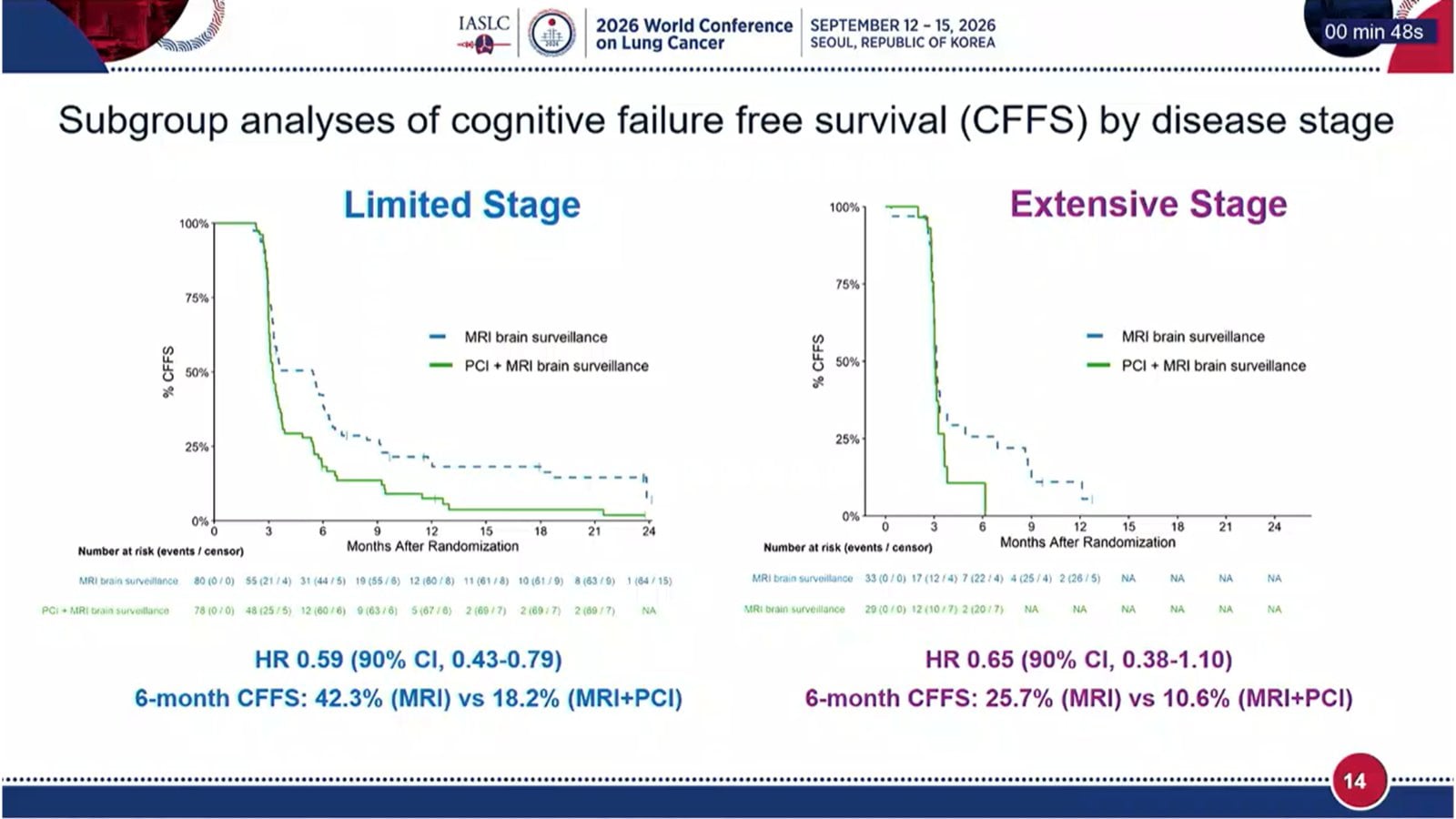
🧠 MAVERICK — beyond the headline • SWOG S1827 MAVERICK asked whether routine PCI can be omitted with MRI brain surveillance in SCLC. • CFFS = cognitive failure-free survival → alive + no cognitive failure. • LS vs ES-SCLC: no evidence of different CFFS effect (interaction P=0.92). • Prior IO vs no IO: again, no clear difference (interaction P=0.25). • Remember: no significant interaction ≠ proof of identical benefit. #MVOnco #SCLC #MAVERICK #SWOGS1827 #WCLC2026 #LungCancer #Oncology
Great Work! MRI Surveillance carried less risks of cognitive impairment without difference in OS in patients with SCLC! Congratulations! #S1827 @SWOG @IASLC #WCLC26 https://t.co/MWZjBZbOTC

6. #MAVERICK: Ph3, MRI vs. MRI + PCI in limited or extensive stage small cell lung cancer: - Prelim OS with no difference in two arms - Better Cognitive failure free survival with MRI alone - This rests the case for PCI in SCLC. 7/8 https://t.co/ms6v1zkuYH https://t.co/hLbXD7uhAn
🧠 #WCLC26 MAVERICK (SWOG S1827) finally answers a long-standing question: PCI vs brain MRI surveillance in SCLC. Study included majority limited stage (68%) SCLC. 🧠PCI reduced brain metastases, but PFS was not significantly different, while Grade ≥3 toxicity was higher with PCI. 🧠MRI surveillance resulted in lower cognitive failure–free survival (CFFS) than PCI, but no difference in PFS (although overall survival analysis pending) 👉🏽 A potential practice-changing shift toward MRI surveillance and treatment of CNS disease when it emerges. 🧠 @IASLC @LUNGevity @SclcSMASHERS #lcsm
🧠 MAVERICK asks a simple question: Do all patients with SCLC still need PCI — or can we watch closely with MRI and treat when needed? 👉 MRI surveillance: better preserved cognition without compromising survival. Perhaps sometimes, protecting the brain means watching before irradiating. #MAVERICK #SWOGS1827 #SCLC #WCLC2026 #LungCancer #RadiationOncology #MedicalOncology #MVOnco
🧠 #WCLC26 #MAVERICK (SWOG S1827) finally answers a long-standing question: PCI vs brain MRI surveillance in SCLC. Study included majority limited stage (68%) SCLC. 🧠PCI reduced brain metastases, but PFS was not significantly different, while Grade ≥3 toxicity was higher with PCI. 🧠MRI surveillance resulted in lower cognitive failure–free survival (CFFS) than PCI, but no difference in PFS (although overall survival analysis pending) 👉🏽 A potential practice-changing shift toward MRI surveillance and treatment of CNS disease when it emerges. 🧠 @IASLC @LUNGevity @SclcSMASHERS #lcsm
MAVERICK (SWOG S1827) FAQ
What is the MAVERICK trial?
MAVERICK (SWOG S1827, NCT04155034) is a phase III cooperative-group trial testing whether MRI brain surveillance alone is non-inferior to prophylactic cranial irradiation (PCI) plus MRI surveillance in patients with small-cell lung cancer who responded to initial therapy, with radiotherapy delivered only if brain metastases actually develop.
What did MAVERICK show at WCLC 2026?
In the preliminary analysis at 128 events, the primary endpoint of cognitive-failure-free survival was met — MRI surveillance alone reduced the risk of cognitive failure or death, HR 0.60 (90% CI 0.46–0.78, one-sided p=0.0005) — and overall survival (a secondary, non-inferiority question after a protocol amendment) was not significantly different: median 29.8 months with MRI alone versus 31.4 with PCI plus MRI, HR 0.90 with a 90% CI (0.67–1.20) whose upper bound sits below the 1.25 non-inferiority margin. PCI reduced brain metastases (about 15% vs 30% cumulative incidence at 12 months) but did not improve PFS or preliminary OS, and Grade ≥3 toxicity was 0.8% versus 7.9%. The final OS analysis comes at 190 events.
Does this end PCI in SCLC?
The presented data support MRI surveillance as the preferred strategy — physicians on the ground called the study 'landmark, practice changing' — but the final OS analysis at 190 events is pending, and individual decisions remain clinical judgments.
Who ran and presented the study?
MAVERICK is a SWOG cooperative-group trial (S1827) with NCI funding, presented at the WCLC 2026 Presidential Symposium by Chad G. Rusthoven, with Paul D. Brown as co-principal investigator.
Why is this different from older PCI trials?
Older trials supporting PCI predated routine MRI surveillance, so undetected brain metastases inflated PCI's apparent benefit. MAVERICK is the modern-era test: with every patient followed by regular MRI and treated with SRS/WBRT only on actual metastasis development, the survival rationale for irradiating every responding patient prophylactically did not hold up at the preliminary analysis.
Key KOL Sentiments
Track oncology’s top KOLs in your specialty
Create a free account, pick the tumor types you cover, and go beyond the tweet — the intelligence pharma teams use to map influence and prepare for engagement:
- ✓Enhanced KOL profiles
- ✓Pharma influence & potential advisory-board patterns
- ✓2025 Open Payments financial analysis
- ✓Social-media sentiment & trend signals
Compiled and reviewed by the KOL Pulse research team, led by Brian Shields, Founder, KOL Pulse. Last updated September 13, 2026. Every statistic carries its source label in place; every quote is verbatim from the physician's own post.