LIVE #WCLC26 — live KOL coverage of the World Conference on Lung Cancer View Full Coverage →
KOL Pulse - Trial Profile

MDT-BRIDGE Trial

MDT-BRIDGE (NCT05925530) is AstraZeneca's phase II adaptive study in resectable and borderline-resectable stage IIB–IIIB NSCLC: 1–2 cycles of neoadjuvant durvalumab plus chemotherapy, then multidisciplinary reassessment routes each patient to surgery or definitive chemoradiotherapy, followed by adjuvant or consolidation durvalumab. Presented at WCLC 2026 (OA04.02, Martin Reck): 74.6% overall resection rate, 96.2% R0, pCR 27.3%, and 12-month EFS of 90.1% in the resectable cohort.

Phase II · NCT05925530 Sponsor: AstraZeneca ⚠️ Neoadjuvant strategy — investigational WCLC 2026 · OA04.02 · Martin Reck Resectable + borderline-resectable IIB–IIIB

MDT-BRIDGE at a Glance

Design

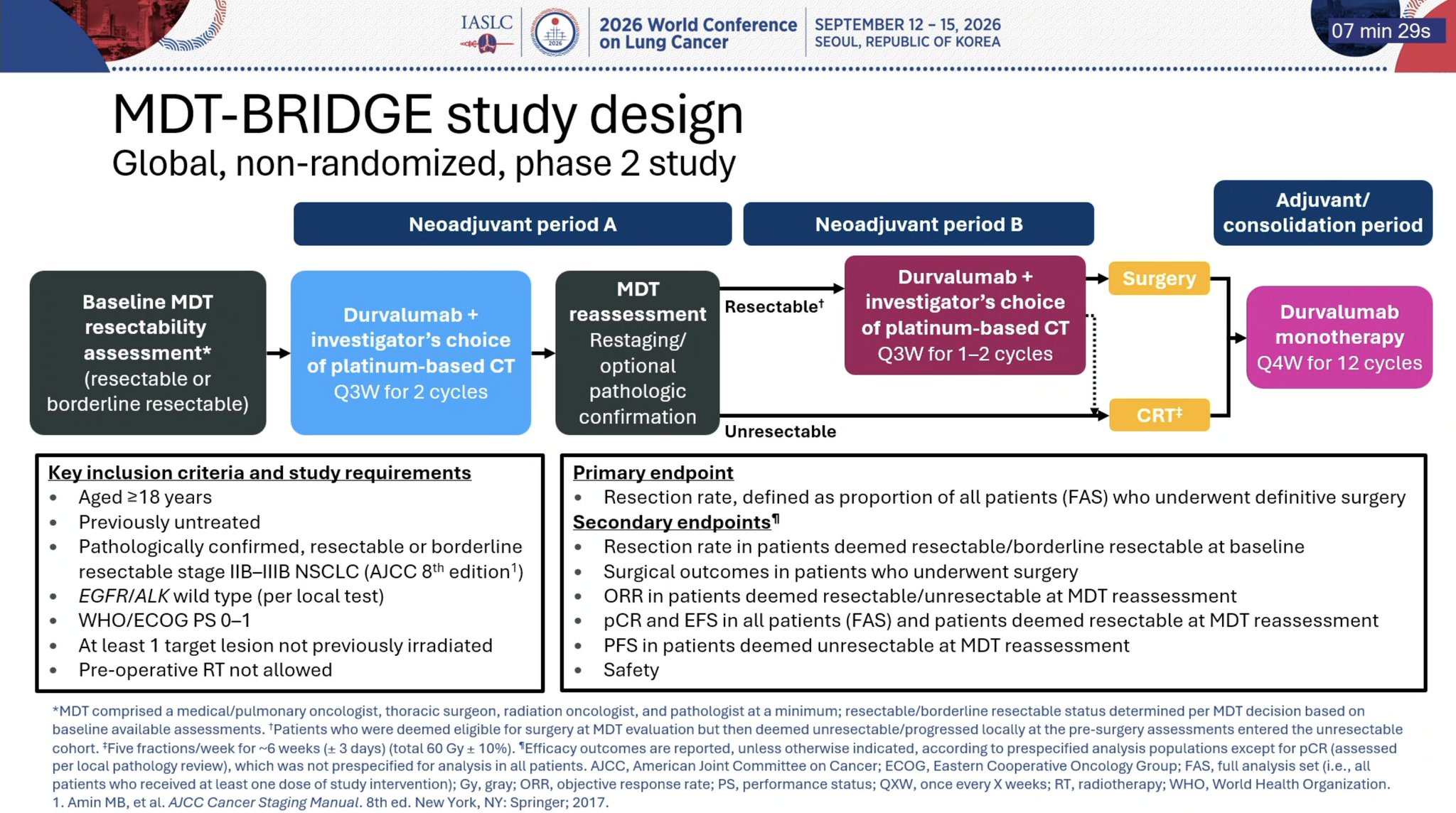
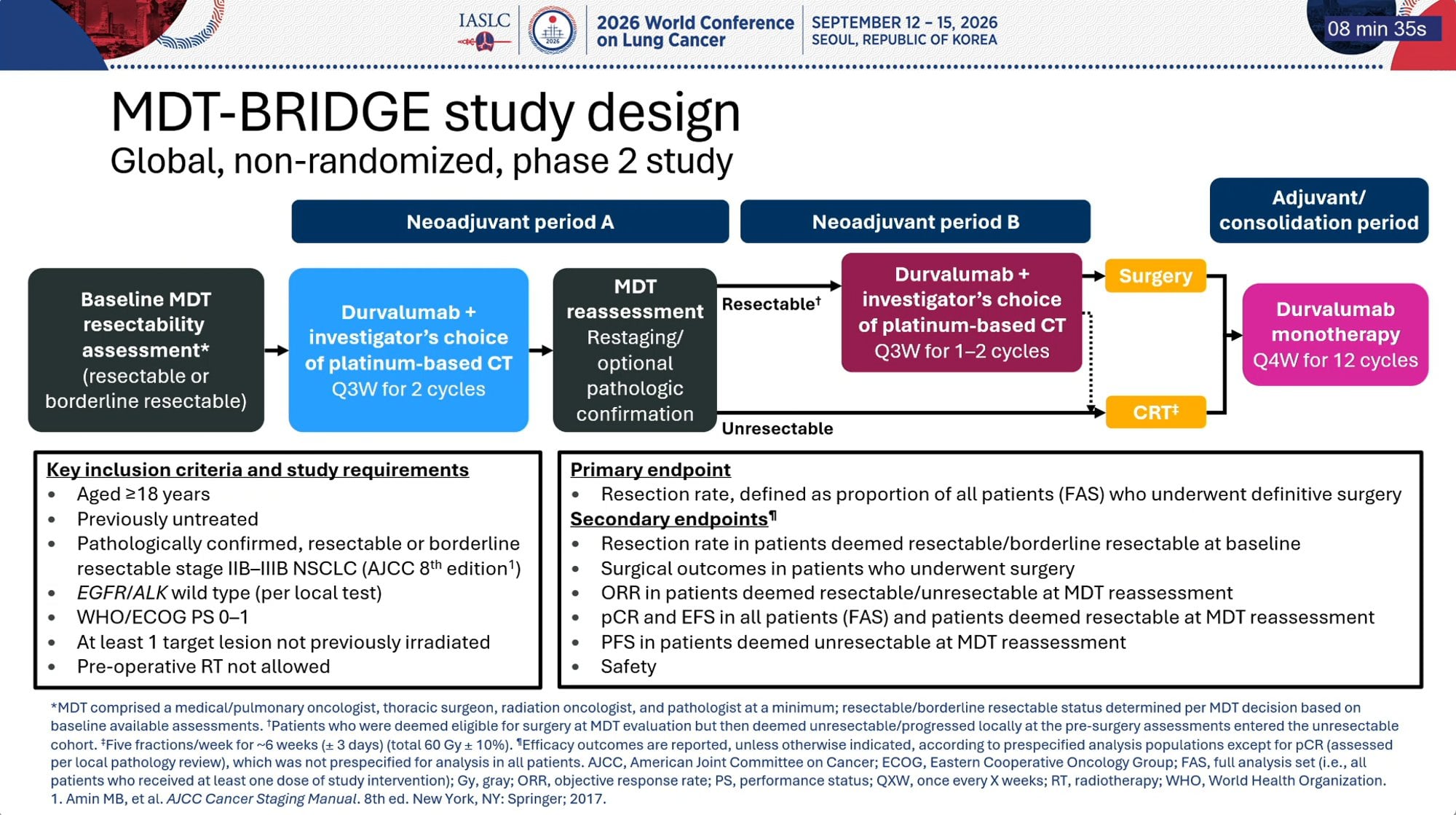
Adaptive phase II: 1–2 cycles of neoadjuvant durvalumab + platinum chemotherapy, then MDT reassessment — surgery if resectable, definitive chemoradiotherapy if not — followed by adjuvant durvalumab (post-surgery) or consolidation durvalumab (post-CRT). (Presented WCLC 2026 OA04.02; verbatim KOL captures)

Results — with denominators

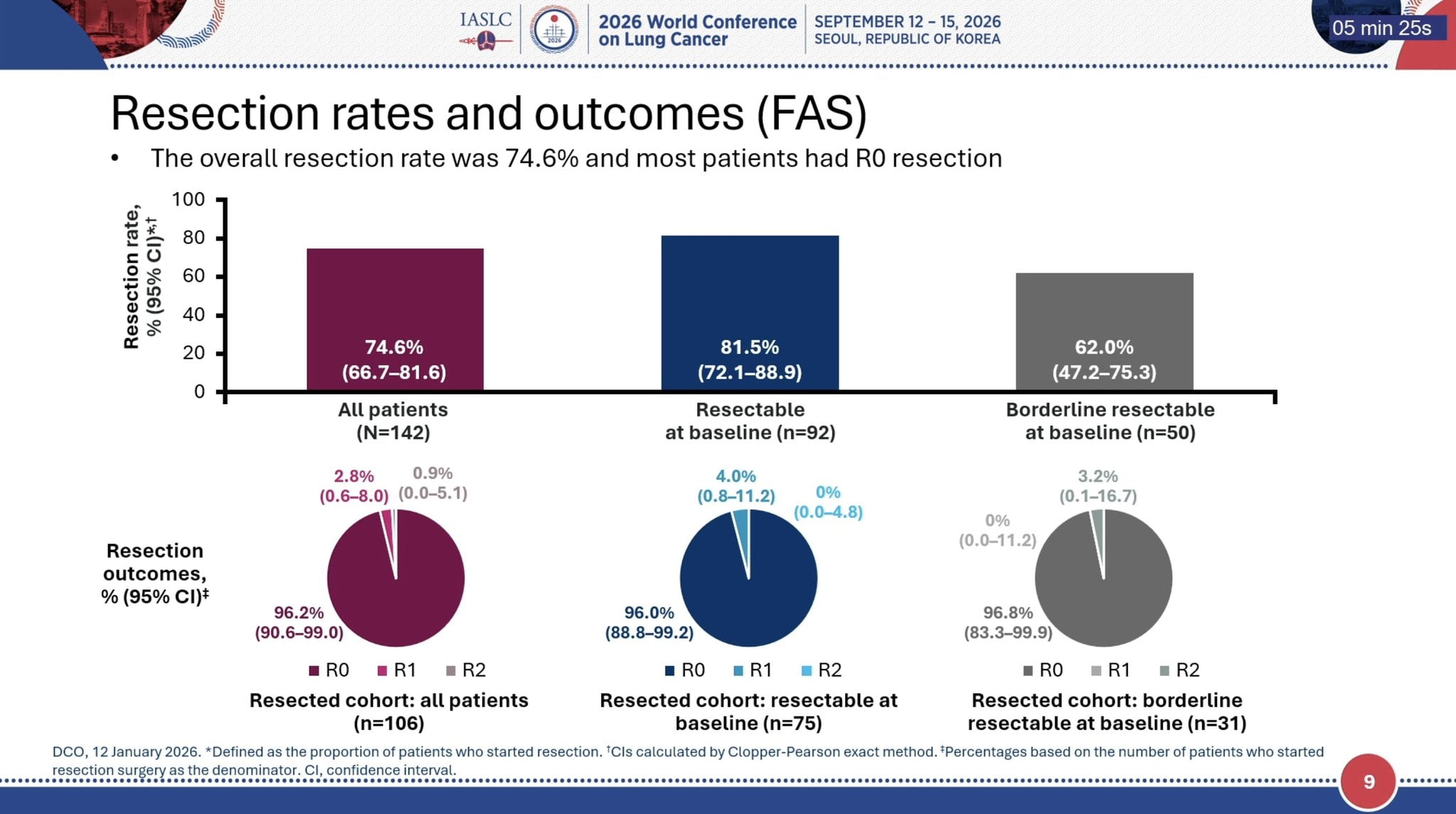
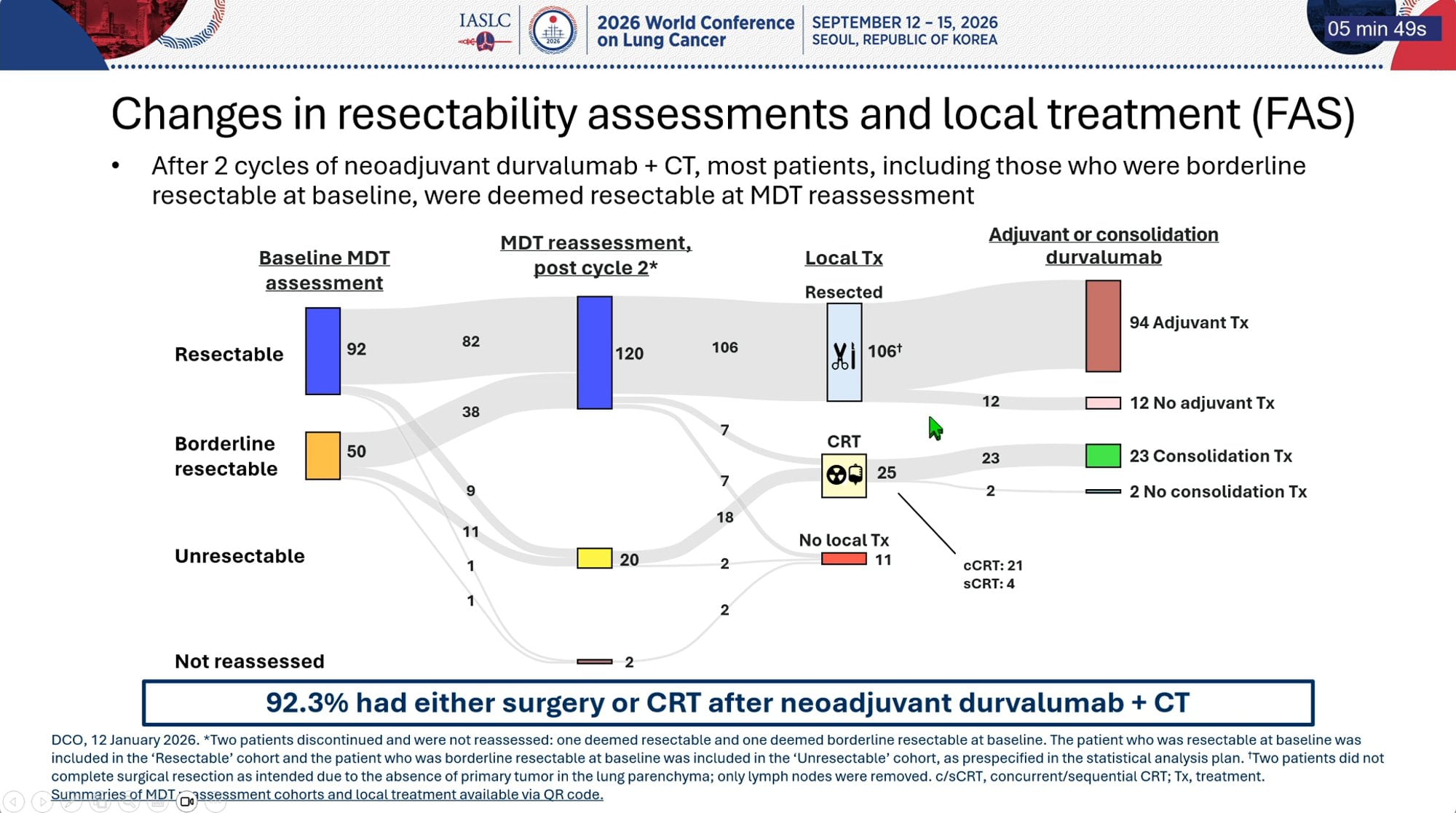
Of 142 treated patients (full analysis set): 74.6% underwent resection, and 96.2% OF THOSE RESECTED achieved R0; pCR 27.3% (full analysis set); 12-month EFS 90.1% among patients deemed resectable at MDT reassessment; 92.3% of all patients received curative-intent surgery or CRT; 76% of borderline-resectable patients converted to resectable. (Presented data via the verbatim physician captures on this page: Patil, Özkerim, Horinouchi, Díaz-García)

Why it matters

Resectability becomes a treatment-modifiable state assessed after induction rather than a fixed baseline call — the study's core concept per the physicians discussing it. (Verbatim KOL posts)

Regulatory status

⚠️ The MDT-BRIDGE strategy is investigational. Durvalumab (Imfinzi) is approved in other NSCLC settings (unresectable stage III consolidation per PACIFIC; perioperative per AEGEAN); this bridging paradigm is not an approved regimen. (FDA labeling context)

Safety

Perioperative morbidity and treatment-related adverse-event data from OA04.02 are NOT reproduced on this page — our coverage reports the presented efficacy and surgical outcomes only. Consult the primary presentation for the safety tables before drawing risk-benefit conclusions. (Editorial disclosure)

KOL pulse

Urs Weber: “I really like the adaptive design of MDT-Bridge.” Yago Garitaonaindía: “Compelling results” — “Stop calling full resectability upfront: assess it after neoadjuvant chemo-IO.”

KOLs Discussing MDT-BRIDGE

Stephen V Liu, MD
Stephen V Liu, MD
@StephenVLiu
5,588 impressions
Hidehito HORINOUCHI
Hidehito HORINOUCHI
@HHorinouchi
2,604 impressions
Uğur Özkerim
Uğur Özkerim
@UOzkerim
1,453 impressions
MV Chandrakanth
MV Chandrakanth
@ChandrakanthMv
1,287 impressions
Diego A. Díaz-García
@diegoadiazg
718 impressions
Tejas Patil
Tejas Patil
@TejasPatilMD
671 impressions

Key Slides & Data

Slides shared by global KOLs, mirrored to our CDN; slide text panels are verbatim Textract OCR.

Stephen V Liu, MD
Stephen V Liu, MD@StephenVLiu
MDT-BRIDGE — shared slides
WCLC 2026 · 2026-09-13
View on X
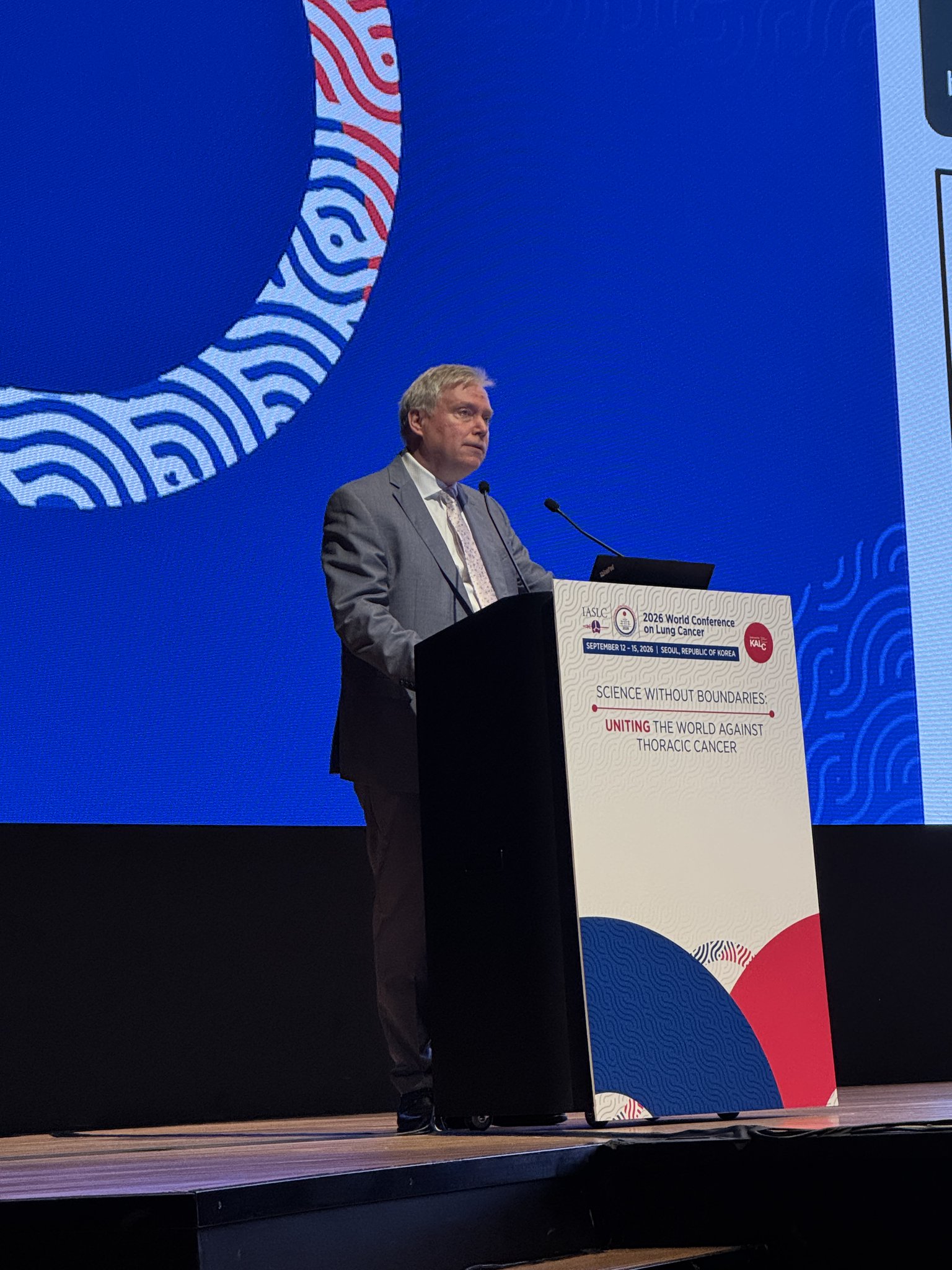
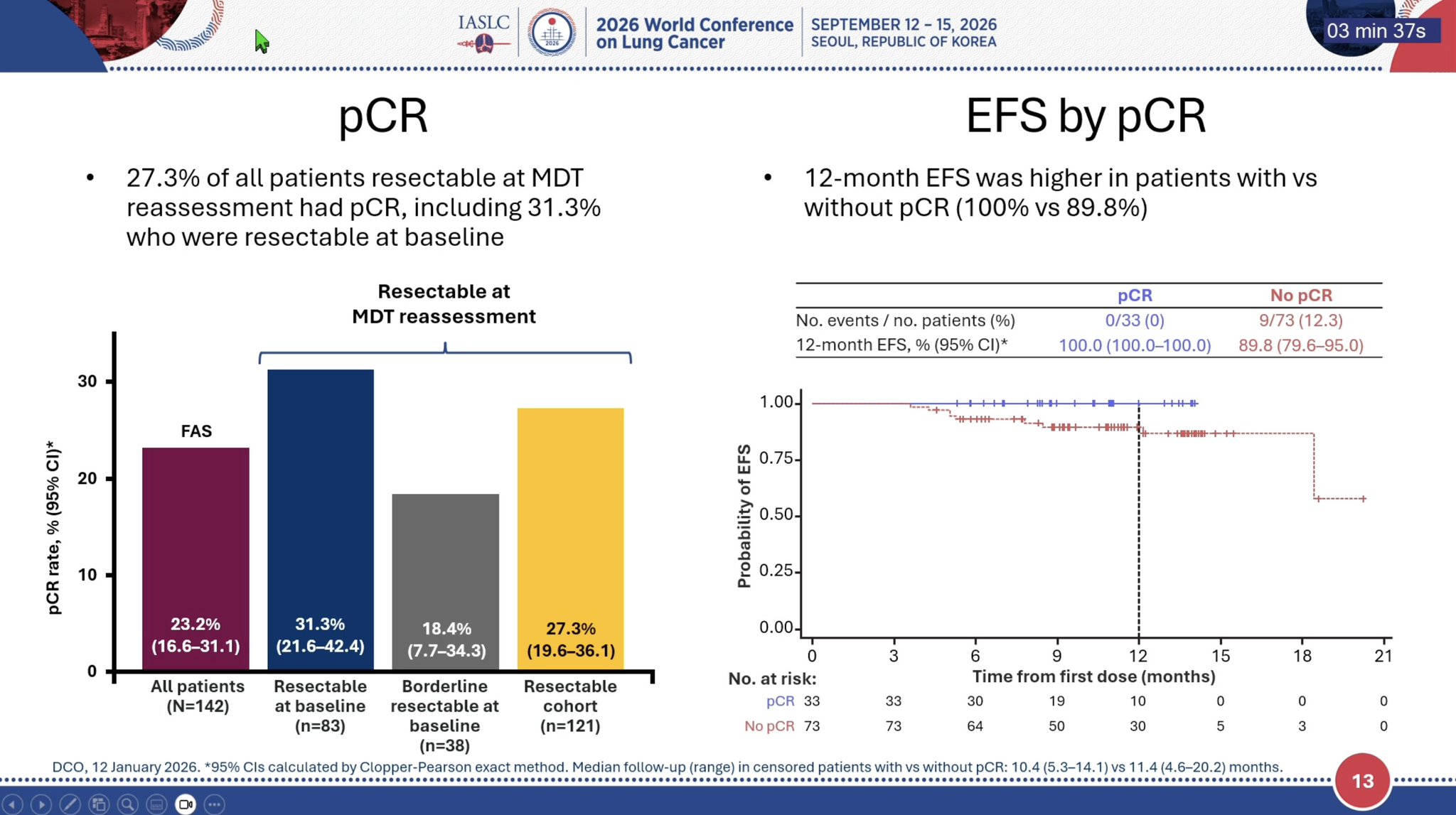
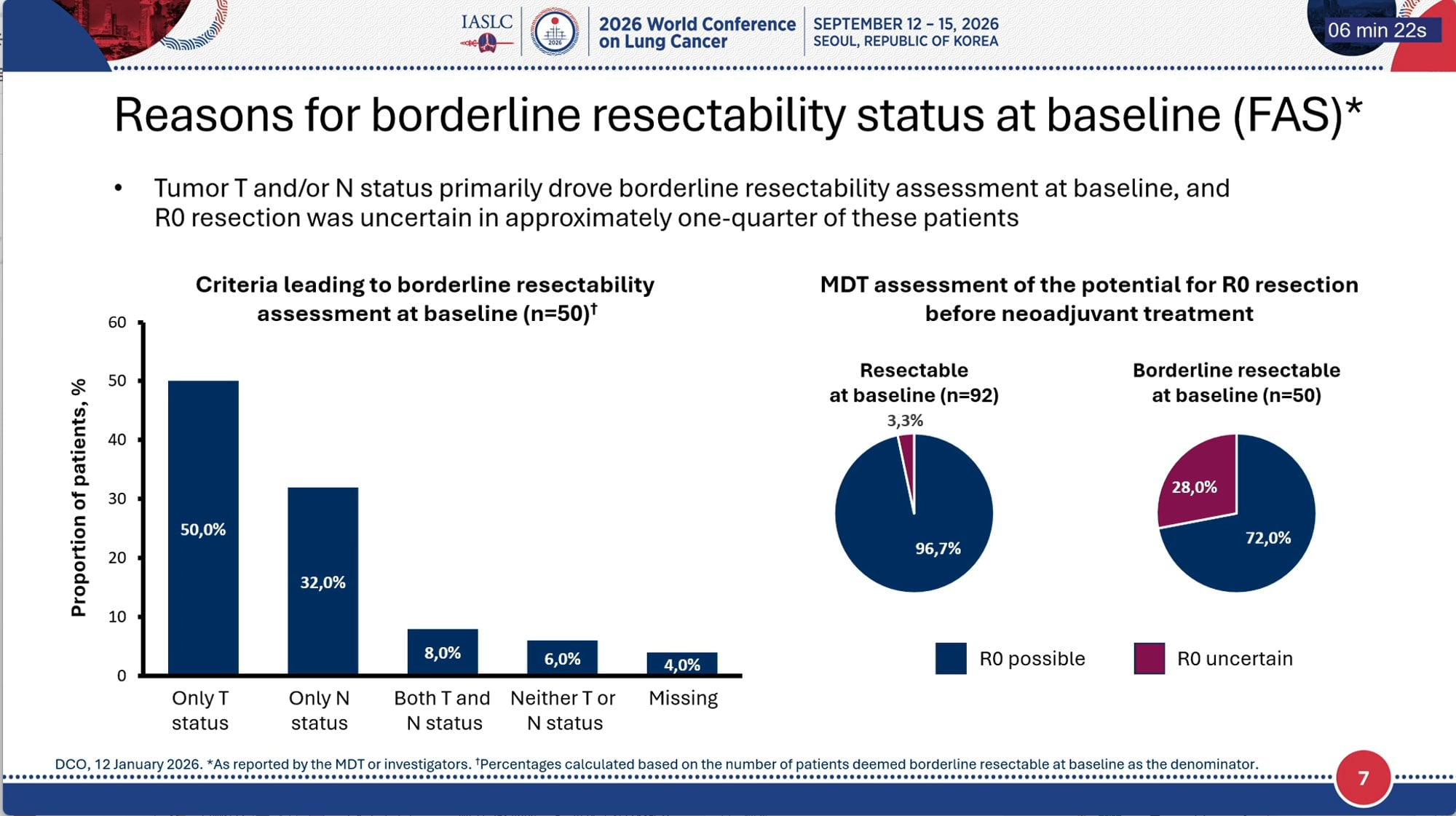
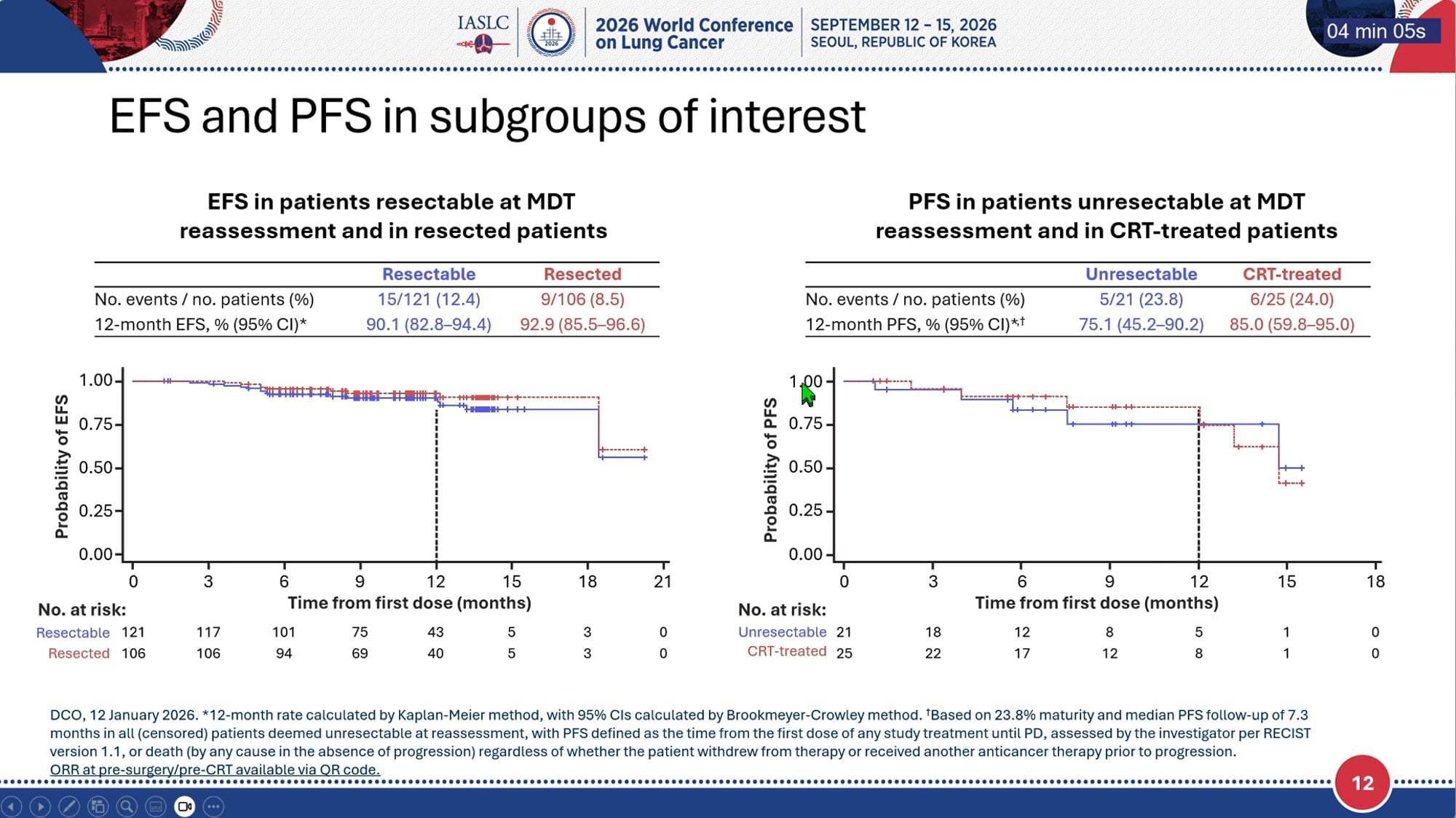
[Slide 1] IASLC 2026 World Conference on Lung Cancer I F SEPTEMBER 12 - 15, 2026 I SEOUL, REPUBLIC OF KOREA KALC SCIENCE WITHOUT BOUNDARIES: UNITING THE WORLD AGAINST THORACIC CANCER --- [Slide 2] IASLC 2026 World Conference SEPTEMBER 12 - 15, 2026 07 min 29s on Lung Cancer SEOUL, REPUBLIC OF KOREA MDT-BRIDGE study design Global, non-randomized, phase 2 study Adjuvant/ Neoadjuvant period A Neoadjuvant period B consolidation period Durvalumab + MDT Surgery Baseline MDT Resectable⁺ investigator's choice Durvalumab + reassessment Durvalumab resectability of platinum-based CT investigator's choice Restaging/ monotherapy assessment* Q3W for 1-2 cycles of platinum-based CT optional Q4W for 12 cycles (resectable or Q3W for 2 cycles pathologic borderline resectable) confirmation CRT Unresectable Key inclusion criteria and study requirements Primary endpoint Aged ≥18 years Resection rate, defined as proportion of all patients (FAS) who underwent definitive surgery Previously untreated Secondary endpoints Pathologically confirmed, resectable or borderline Resection rate in patients deemed resectable/borderline resectable at baseline resectable stage IIB-IIIB NSCLC (AJCC 8th edition¹) Surgical outcomes in patients who underwent surgery EGFR/ALK wild type (per local test) ORR in patients deemed resectable/unresectable at MDT reassessment WHO/ECOG PS 0-1 pCR and EFS in all patients (FAS) and patients deemed resectable at MDT reassessment At least 1 target lesion not previously irradiated PFS in patients deemed unresectable at MDT reassessment Pre-operative RT not allowed Safety *MDT comprised a medical/pulmonary oncologist, thoracic surgeon, radiation oncologist, and pathologist at a minimum; resectable/borderline resectable status determined per MDT decision based on baseline available assessments. Patients who were deemed eligible for surgery at MDT evaluation but then deemed unresectable/progressed locally at the pre-surgery assessments entered the unresectable cohort. Five fractions/week for ~6 weeks (± 3 days) (total 60 Gy + 10%). Efficacy outcomes are reported, unless otherwise indicated, according to prespecified analysis populations except for pCR (assessed per local pathology review), which was not prespecified for analysis in all patients. AJCC, American Joint Committee on Cancer; ECOG, Eastern Cooperative Oncology Group; FAS, full analysis set (i.e., all patients who received at least one dose of study intervention); Gy, gray; ORR, objective response rate; PS, performance status; QXW, once every X weeks; RT, radiotherapy; WHO, World Health Organization. 1. Amin MB, et al. AJCC Cancer Staging Manual. 8th ed. New York, NY: Springer; 2017. --- [Slide 3] IASLC 2026 World Conference SEPTEMBER 12 - 15, 2026 05 min 25s 2026 on Lung Cancer SEOUL, REPUBLIC OF KOREA Resection rates and outcomes (FAS) The overall resection rate was 74.6% and most patients had R0 resection 100 Resection rate, 80 % (95% CI)*,⁺ 60 40 20 74.6% 81.5% 62.0% (66.7-81.6) (72.1-88.9) (47.2-75.3) 0 All patients Resectable Borderline resectable (N=142) at baseline (n=92) at baseline (n=50) 2.8% 0.9% 4.0% 3.2% (0.6-8.0) (0.0-5.1) (0.8-11.2) 0% (0.1-16.7) (0.0-4.8) 0% Resection (0.0-11.2) outcomes, % (95% CI)* 96.2% 96.0% 96.8% (90.6-99.0) (88.8-99.2) (83.3-99.9) R0 R1 R2 R0 R1 R2 R0 R1 R2 Resected cohort: all patients Resected cohort: resectable at Resected cohort: borderline (n=106) baseline (n=75) resectable at baseline (n=31) DCO, 12 January 2026. *Defined as the proportion of patients who started resection. Cls calculated by Clopper-Pearson exact method. Percentages based on the number of patients who started resection surgery as the denominator. CI, confidence interval. 9 --- [Slide 4] IASLC 2026 World Conference SEPTEMBER 12 - 15, 2026 03 min 37s on Lung Cancer SEOUL, REPUBLIC OF KOREA pCR EFS by pCR 27.3% of all patients resectable at MDT 12-month EFS was higher in patients with vs reassessment had pCR, including 31.3% without pCR (100% VS 89.8%) who were resectable at baseline Resectable at pCR No pCR MDT reassessment No. events / no. patients (%) 0/33 (0) 9/73 (12.3) 12-month EFS, % (95% CI)* 100.0 (100.0-100.0) 89.8 (79.6-95.0) 30 1.00 FAS 0.75 pCR rate, % (95% CI)* 20 Probability of EFS 0.50 10 0.25 23.2% 31.3% 18.4% 27.3% 0.00 (16.6-31.1) (21.6-42.4) (7.7-34.3) (19.6-36.1) 0 3 6 9 12 15 18 21 0 All patients Resectable Borderline Resectable No. at risk: Time from first dose (months) (N=142) at baseline resectable at cohort pCR 33 33 30 19 10 0 0 0 (n=83) baseline (n=121) No pCR 73 73 64 50 30 5 3 0 (n=38) DCO, 12 January 2026. *95% Cls calculated by Clopper-Pearson exact method. Median follow-up (range) in censored patients with VS without pCR: 10.4 (5.3-14.1) VS 11.4 (4.6-20.2) months. 13 ***
Hidehito HORINOUCHI
MDT-BRIDGE — shared slides
WCLC 2026 · 2026-09-13
View on X
[Slide 1] IASLC 2026 World Conference SEPTEMBER 12 - 15, 2026 08 min 35s on Lung Cancer SEOUL, REPUBLIC OF KOREA MDT-BRIDGE study design Global, non-randomized, phase 2 study Adjuvant/ Neoadjuvant period A Neoadjuvant period B consolidation period Durvalumab + MDT Surgery Baseline MDT Resectable+ investigator's choice Durvalumab + reassessment Durvalumab resectability of platinum-based CT investigator's choice Restaging/ monotherapy assessment* Q3W for 1-2 cycles of platinum-based CT optional Q4W for 12 cycles (resectable or Q3W for 2 cycles pathologic borderline resectable) confirmation CRT Unresectable Key inclusion criteria and study requirements Primary endpoint Aged ≥18 years Resection rate, defined as proportion of all patients (FAS) who underwent definitive surgery Previously untreated Secondary endpoints Pathologically confirmed, resectable or borderline Resection rate in patients deemed resectable/borderline resectable at baseline resectable stage IIB-IIIB NSCLC (AJCC 8th edition¹) Surgical outcomes in patients who underwent surgery EGFR/ALK wild type (per local test) ORR in patients deemed resectable/unresectable at MDT reassessment WHO/ECOG PS 0-1 pCR and EFS in all patients (FAS) and patients deemed resectable at MDT reassessment At least 1 target lesion not previously irradiated PFS in patients deemed unresectable at MDT reassessment Pre-operative RT not allowed Safety *MDT comprised a medical/pulmonary oncologist, thoracic surgeon, radiation oncologist, and pathologist at a minimum; resectable/borderline resectable status determined per MDT decision based on baseline available assessments. Patients who were deemed eligible for surgery at MDT evaluation but then deemed unresectable/progressed locally at the pre-surgery assessments entered the unresectable cohort. Five fractions/week for ~6 weeks (± 3 days) (total 60 Gy ± 10%). Efficacy outcomes are reported, unless otherwise indicated, according to prespecified analysis populations except for pCR (assessed per local pathology review), which was not prespecified for analysis in all patients. AJCC, American Joint Committee on Cancer; ECOG, Eastern Cooperative Oncology Group; FAS, full analysis set (i.e., all patients who received at least one dose of study intervention); Gy, gray; ORR, objective response rate; PS, performance status; QXW, once every X weeks; RT, radiotherapy; WHO, World Health Organization. 1. Amin MB, et al. AJCC Cancer Staging Manual. 8th ed. New York, NY: Springer; 2017. --- [Slide 2] IASLC 2026 World Conference SEPTEMBER 12 - 15, 2026 05 min 49s 2026 on Lung Cancer SEOUL, REPUBLIC OF KOREA Changes in resectability assessments and local treatment (FAS) After 2 cycles of neoadjuvant durvalumab + CT, most patients, including those who were borderline resectable at baseline, were deemed resectable at MDT reassessment MDT reassessment, Adjuvant or consolidation Baseline MDT Local Tx durvalumab post cycle 2* assessment Resected 94 Adjuvant Tx 82 Resectable 92 120 106 Yi 106+ 12 38 12 No adjuvant Tx 7 Borderline CRT 50 23 23 Consolidation Tx resectable 25 7 9 2 2 No consolidation Tx 18 11 No local Tx Unresectable 1 20 2 11 cCRT: 21 sCRT: 4 1 2 Not reassessed 2 92.3% had either surgery or CRT after neoadjuvant durvalumab + CT DCO, 12 January 2026. *Two patients discontinued and were not reassessed: one deemed resectable and one deemed borderline resectable at baseline. The patient who was resectable at baseline was included in the 'Resectable' cohort and the patient who was borderline resectable at baseline was included in the 'Unresectable' cohort, as prespecified in the statistical analysis plan. Two patients did not complete surgical resection as intended due to the absence of primary tumor in the lung parenchyma; only lymph nodes were removed. c/sCRT, concurrent/sequential CRT; Tx, treatment. Summaries of MDT assessment cohorts and local treatment available via OR code. --- [Slide 3] IASLC 2026 World Conference SEPTEMBER 12 - 15, 2026 06 min 22s 2026 on Lung Cancer SEOUL, REPUBLIC OF KOREA Reasons for borderline resectability status at baseline (FAS) Tumor T and/or N status primarily drove borderline resectability assessment at baseline, and R0 resection was uncertain in approximately one-quarter of these patients Criteria leading to borderline resectability MDT assessment of the potential for R0 resection 60 assessment at baseline (n=50)⁺ before neoadjuvant treatment Resectable Borderline resectable 50 at baseline (n=92) at baseline (n=50) 3,3% Proportion of patients, % 40 28,0% 30 50,0% 72,0% 96,7% 20 32,0% 10 8,0% 6,0% 4,0% R0 possible R0 uncertain 0 Only T Only N Both T and Neither T or Missing status status N status N status DCO, 12 January 2026. *As reported by the MDT or investigators. Percentages calculated based on the number of patients deemed borderline resectable at baseline as the denominator. 7 --- [Slide 4] IASLC 2026 World Conference SEPTEMBER 12 - 15, 2026 04 min 05s 2026 on Lung Cancer SEOUL, REPUBLIC OF KOREA EFS and PFS in subgroups of interest EFS in patients resectable at MDT PFS in patients unresectable at MDT reassessment and in resected patients reassessment and in CRT-treated patients Resectable Resected Unresectable CRT-treated No. events / no. patients (%) 15/121 (12.4) 9/106 (8.5) No. events / no. patients (%) 5/21 (23.8) 6/25 (24.0) 12-month EFS, % (95% CI)* 90.1 (82.8-94.4) 92.9 (85.5-96.6) 12-month PFS, % (95% CI)** 75.1 (45.2-90.2) 85.0 (59.8-95.0) 1.00 1.00 Probability of EFS 0.75 0.75 0.50 Probability of PFS 0.50 0.25 0.25 0.00 0.00 0 3 6 9 12 15 18 21 0 3 6 9 12 15 18 No. at risk: Time from first dose (months) No. at risk: Time from first dose (months) Resectable 121 117 101 75 43 5 3 0 Unresectable 21 18 12 8 5 1 0 Resected 106 106 94 69 40 5 3 0 CRT-treated 25 22 17 12 8 1 0 DCO, 12 January 2026. *12-month rate calculated by Kaplan-Meier method, with 95% Cls calculated by Brookmeyer-Crowley method. Based on 23.8% maturity and median PFS follow-up of 7.3 months in all (censored) patients deemed unresectable at reassessment, with PFS defined as the time from the first dose of any study treatment until PD, assessed by the investigator per RECIST version 1.1, or death (by any cause in the absence of progression) regardless of whether the patient withdrew from therapy or received another anticancer therapy prior to progression. ORR at pre-surgery/pre-CRT available via OR code. 12 00 ...

What Physicians Said

Stephen V Liu, MD
Stephen V Liu, MD@StephenVLiu

Dr. @MartinReck2 presents MDT-Bridge at #WCLC26: pts with resectable or borderline resectable NSCLC received 1-2 cycles of durvalumab + chemotherapy then surgery if resectable or CRT if not, followed by adjuvant/consolidation durvalumab. Of those with borderline resectable NSCLC, 62% underwent resection (97% R0). Overall resection rate 75% and 27% pCR rate.

👀 5,5882026-09-13
Hidehito HORINOUCHI
Hidehito HORINOUCHI@HHorinouchi

🆙#WCLC26 #LCSM Oral Session 🔥MDT-BRIDGE: Neoadjuvant Durvalumab + Chemotherapy for Resectable/Borderline Resectable Stage IIB-IIIB NSCLC 🎙️ @MartinReck2 🔢OA04.02 🎯Resection Rate 74.6%; pCR 27.3% and 12-Mo EFS 90.1% in Resectable Cohort ☑️NCT05925530 🔗 https://t.co/rN1vqVmvgD @OncoAlert @Larvol @IASLC

👀 2,6042026-09-13
Uğur Özkerim
Uğur Özkerim@UOzkerim

#WCLC26 | MDT-BRIDGE Neoadjuvant durvalumab + platinum-based chemotherapy in resectable/borderline resectable stage IIB–IIIB NSCLC: • Resection rate: 74.6% • pCR: 27.3% • 12-month EFS: 90.1% in the resectable cohort • 92.3% of patients underwent either surgery or CRT after neoadjuvant treatment. An interesting MDT-based approach integrating surgery and CRT according to reassessment @OncoAlert @ManuelDomine @weoncologists @OpenMedKate

👀 1,4532026-09-13
MV Chandrakanth
MV Chandrakanth@ChandrakanthMv

MDT-BRIDGE: Treat First. Decide Surgery Later? A simple but interesting concept in locally advanced NSCLC: • Start with chemo-immunotherapy rather than locking in the local treatment upfront. • Then reassess in the MDT. • If resectable → surgery. • If not resectable → definitive chemoradiotherapy. • Continue durvalumab after either pathway. The idea: Treat → Reassess → Choose the best curative-intent path. Reference: Reck M et al. MDT-BRIDGE Primary Analysis. WCLC 2026; OA04.02. #MVOnco #WCLC2026 #MDTBRIDGE #NSCLC #LungCancer

👀 1,2872026-09-12
Diego A. Díaz-García
Diego A. Díaz-García@diegoadiazg

🫁 MDT-BRIDGE: a perioperative-to-definitive strategy for stage IIB-IIIB NSCLC. @MartinReck2 Neoadjuvant durvalumab + chemotherapy followed by surgery or CRT achieved: • Resection rate: 74.6% • R0 resection: 96.2% • pCR: 27.3% • 12-month EFS: 90.1% in resectable patients • 12-month PFS: 75.1% in patients becoming unresectable Overall, 92.3% received surgery or CRT, supporting multidisciplinary reassessment to maintain curative-intent treatment. #CánCare #NSCLC #ThoracicOncology #Immunotherapy #Durvalumab #WCLC26 @IASLC

👀 7182026-09-13
Tejas Patil
Tejas Patil@TejasPatilMD

8. MDT-BRIDGE ⭐️Neoadjuvant durvalumab + chemo --> followed by serial MDT reassessment allowed 92.3% of patients to receive to curative-intent surgery or CRT, even with nearly a third of pts having borderline resectable disease 🗝️ KEY INSIGHTS: - 74.6% overall resection rate (n = 142) - 96.2% R0 resection - 27.3% pCR among patients remaining resectable - 90.1% 12-mo EFS in the resectable cohort - 75.1% 12-mo PFS in those converted to CRT ⚡️The interesting concept here isn't prior neoadjuvant exposure. Rather it’s the dynamic treatment strategy, allowing patients to transition from surgery to definitive CRT rather than abandoning curative intent when resectability changes. This will be a heavily debated study. @lcsmchat @OncoAlert @OncLive @LungCancerEu @Lung_Cancers @MedwatchHQ

👀 6712026-09-11

About the MDT-BRIDGE Trial

Locally advanced NSCLC forces an upfront call — operable or not — that determines a patient's entire pathway. MDT-BRIDGE inverts that: give 1–2 cycles of durvalumab plus chemotherapy first, then let the multidisciplinary team decide with response information in hand. At WCLC 2026 Martin Reck presented the primary analysis: nearly three-quarters of all patients were resected (96.2% R0), three-quarters of the borderline group converted to resectable, and 92.3% reached curative-intent local therapy of one kind or the other.

Physicians called out the pragmatism: the design mirrors how tumor boards actually think, and offers a protocolized route for the borderline group that trials usually exclude. Patient selection and longer follow-up remain the open questions KOLs flagged.

Trial Methodology & Results

Study Design

Phase II adaptive: neoadjuvant durvalumab + chemo (1–2 cycles) → MDT reassessment → surgery or definitive CRT → adjuvant/consolidation durvalumab. (WCLC 2026 OA04.02 via verbatim captures)

Population

Resectable and borderline-resectable stage IIB–IIIB NSCLC; n=142 in the presented analysis. (Verbatim KOL captures)

Endpoints

Resection rate, R0 rate, pCR, EFS; 12-month EFS 90.1% in the resectable cohort. (Verbatim KOL captures)

Presenter

Martin Reck, MD — WCLC 2026 oral OA04.02. (Verbatim KOL captures)

Surgical and pathological outcomes

Of the 142 treated patients (full analysis set), 74.6% underwent resection; the R0 rate of 96.2% is among those resected, and pCR of 27.3% is in the full analysis set. Among borderline-resectable patients, 76% converted to resectable after induction, and 92.3% of all patients received curative-intent surgery or chemoradiotherapy. Safety and perioperative-morbidity tables are in the primary presentation and are not reproduced here. (WCLC 2026 OA04.02, via verbatim physician captures: Patil, Özkerim, Díaz-García)

Resection 74.6% · R0 96.2% · pCR 27.3%
Source: WCLC 2026 OA04.02 (verbatim KOL captures) ↗

Event-free survival

12-month EFS was 90.1% in the resectable cohort (12-month PFS 75.1% reported for the definitive-CRT pathway per physician capture) — early but supportive of the bridging strategy; longer follow-up pending. (WCLC 2026 OA04.02 via verbatim captures: Horinouchi, Díaz-García)

12-mo EFS 90.1% (resectable cohort)
Source: WCLC 2026 OA04.02 (verbatim KOL captures) ↗

MDT-BRIDGE FAQ

What is the MDT-BRIDGE trial?

MDT-BRIDGE (NCT05925530) is an AstraZeneca phase II study in resectable and borderline-resectable stage IIB–IIIB NSCLC. Patients receive 1–2 cycles of neoadjuvant durvalumab plus chemotherapy, then a multidisciplinary team reassesses resectability: resectable patients go to surgery, others to definitive chemoradiotherapy, with adjuvant or consolidation durvalumab afterward.

What did MDT-BRIDGE show at WCLC 2026?

In the primary analysis presented by Martin Reck (OA04.02, 142 treated patients): a resection rate of 74.6% of all treated patients, R0 in 96.2% of those resected, pathological complete response in 27.3%, 12-month event-free survival of 90.1% among patients deemed resectable at MDT reassessment, and 92.3% of all patients reaching curative-intent surgery or CRT. About 76% of borderline-resectable patients became resectable after induction. Safety and perioperative-morbidity data are in the primary presentation and not reproduced on this page.

Why do physicians find the design notable?

It treats resectability as a dynamic, treatment-modifiable state judged after induction therapy rather than a fixed baseline label — matching how multidisciplinary tumor boards actually work and creating a protocolized pathway for borderline patients whom conventional trials exclude.

Is this an approved treatment approach?

No. The MDT-BRIDGE strategy is investigational. Durvalumab (Imfinzi, AstraZeneca) is approved in other NSCLC settings — consolidation after chemoradiotherapy in unresectable stage III (PACIFIC) and perioperative use (AEGEAN) — but the adaptive bridging paradigm itself is not an approved regimen.

What are the caveats?

Phase II size, no randomized comparator, and the patient-selection question physicians raised — plus the need for longer event-free and overall survival follow-up before the strategy can claim practice-changing status.

Key KOL Sentiments

KOLComment (verbatim)SentimentDate
Stephen V Liu, MD
@StephenVLiu
Dr. @MartinReck2 presents MDT-Bridge at #WCLC26: pts with resectable or borderline resectable NSCLC received 1-2 cycles of durvalumab + chemotherapy then surgery if resectable or CRT if not, followed by adjuvant/consolidation durvalumab. Of those with borderline resectable NSCLC, 62% underwent resection (97% R0). Overall resection rate 75% and 27% pCR rate.Neutral2026-09-13
Hidehito HORINOUCHI
@HHorinouchi
🆙#WCLC26 #LCSM Oral Session 🔥MDT-BRIDGE: Neoadjuvant Durvalumab + Chemotherapy for Resectable/Borderline Resectable Stage IIB-IIIB NSCLC 🎙️ @MartinReck2 🔢OA04.02 🎯Resection Rate 74.6%; pCR 27.3% and 12-Mo EFS 90.1% in Resectable Cohort ☑️NCT05925530 🔗 https://t.co/rN1vqVmvgD @OncoAlert @Larvol @IASLCNeutral2026-09-13
Uğur Özkerim
@UOzkerim
#WCLC26 | MDT-BRIDGE Neoadjuvant durvalumab + platinum-based chemotherapy in resectable/borderline resectable stage IIB–IIIB NSCLC: • Resection rate: 74.6% • pCR: 27.3% • 12-month EFS: 90.1% in the resectable cohort • 92.3% of patients underwent either surgery or CRT after neoadjuvant treatment. An interesting MDT-based approach integrating surgery and CRT according to reassessment @OncoAlert @ManuelDomine @weoncologists @OpenMedKateNeutral2026-09-13
MV Chandrakanth
@ChandrakanthMv
MDT-BRIDGE: Treat First. Decide Surgery Later? A simple but interesting concept in locally advanced NSCLC: • Start with chemo-immunotherapy rather than locking in the local treatment upfront. • Then reassess in the MDT. • If resectable → surgery. • If not resectable → definitive chemoradiotherapy. • Continue durvalumab after either pathway. The idea: Treat → Reassess → Choose the best curative-intent path. Reference: Reck M et al. MDT-BRIDGE Primary Analysis. WCLC 2026; OA04.02. #MVOnco #WCLC2026 #MDTBRIDGE #NSCLC #LungCancerNeutral2026-09-12
Diego A. Díaz-García
@diegoadiazg
🫁 MDT-BRIDGE: a perioperative-to-definitive strategy for stage IIB-IIIB NSCLC. @MartinReck2 Neoadjuvant durvalumab + chemotherapy followed by surgery or CRT achieved: • Resection rate: 74.6% • R0 resection: 96.2% • pCR: 27.3% • 12-month EFS: 90.1% in resectable patients • 12-month PFS: 75.1% in patients becoming unresectable Overall, 92.3% received surgery or CRT, supporting multidisciplinary reassessment to maintain curative-intent treatment. #CánCare #NSCLC #ThoracicOncology #Immunotherapy #Durvalumab #WCLC26 @IASLCNeutral2026-09-13
Tejas Patil
@TejasPatilMD
8. MDT-BRIDGE ⭐️Neoadjuvant durvalumab + chemo --> followed by serial MDT reassessment allowed 92.3% of patients to receive to curative-intent surgery or CRT, even with nearly a third of pts having borderline resectable disease 🗝️ KEY INSIGHTS: - 74.6% overall resection rate (n = 142) - 96.2% R0 resection - 27.3% pCR among patients remaining resectable - 90.1% 12-mo EFS in the resectable cohort - 75.1% 12-mo PFS in those converted to CRT ⚡️The interesting concept here isn't prior neoadjuvant exposure. Rather it’s the dynamic treatment strategy, allowing patients to transition from surgery to definitive CRT rather than abandoning curative intent when resectability changes. This will be a heavily debated study. @lcsmchat @OncoAlert @OncLive @LungCancerEu @Lung_Cancers @MedwatchHQNeutral2026-09-11
Free Access · KOL Pulse Intelligence

Track oncology’s top KOLs in your specialty

Create a free account, pick the tumor types you cover, and go beyond the tweet — the intelligence pharma teams use to map influence and prepare for engagement:

  • Enhanced KOL profiles
  • Pharma influence & potential advisory-board patterns
  • 2025 Open Payments financial analysis
  • Social-media sentiment & trend signals
Get free access — pick your specialty
Choose the tumor types you follow. No cost, unsubscribe anytime.

Compiled and reviewed by the KOL Pulse research team, led by Brian Shields, Founder, KOL Pulse. Last updated September 13, 2026. Every statistic carries its source label in place; every quote is verbatim from the physician's own post.