Top KOLs Discussing MIDAS

@PlasmaCellPete @NoopurRajeMD @TomBmt133 @YiLinMDPhD @DMadduri @bhemato @BerdejaJesus Re: MIDAS trial As with other recent trials of transplant vs no transplant trials— these are all essentially early vs delayed transplant comparisons for OS. Transplant remains an important option for transplant eligible patients. And these trials only point out that the timing
— Vincent Rajkumar (@VincentRK) 2025-06-01
MIDAS Key Slides & Visuals






MIDAS Top Tweets
 𝕏
𝕏@PlasmaCellPete @NoopurRajeMD @TomBmt133 @YiLinMDPhD @DMadduri @bhemato @BerdejaJesus Re: MIDAS trial As with other recent trials of transplant vs no transplant trials— these are all essentially early vs delayed transplant comparisons for OS. Transplant remains an important option for transplant eligible patients. And these trials only point out that the timing
 𝕏
𝕏7500 – MIDAS Trial: MRD-Guided Therapy Post-IsaKRd 718 NDMM pts. After Isa-KRd x6, 67% were MRD− at 10⁻⁵. Randomized to continue Isa-KRd x 6 or go to ASCT prior to maintenance. No difference in MRD<10⁻6 (84% vs 86%) thus far! And as for MRD(+) post-induction: no difference https://t.co/W4NZuUVsIP
𝕏Main take aways from recent trials on MRD directed therapy for newly diagnosed myeloma presented by @PerrotAurore #IMWG25 @IMFmyeloma https://t.co/ahJN1s0PrT
𝕏MIDAS Trial: MRD-Guided Therapy Post-IsaKRd - The study was designed to understand the role of MRD negativity to guide decision-making around transplant in frontline myeloma. - After Isa-KRd x6, 67% were MRD− at 10⁻⁵. IThese patients were randomized to continue Isa-KRd x 6 https://t.co/OWOHqeFtJH
 𝕏
𝕏Dr. @PerrotAurore presenting MIDAS trial. Incorporates MRD testing for the various pathways. MRD adapted consolidation and maintenance. Induction IsaKRD. Med age 59 yrs. #IMS24RF #mmsm https://t.co/uATk9CYhna
 𝕏
𝕏🚨 #ASCO25 MIDAS is out! If #MMsm MRD- at 10^-5 after quad, ASCT does not deepen responses. If MRD+, tandem ASCT doesn’t help / refused by 15% of pts. We await PFS of course, but this is very helpful! PS I love that @NEJM is now calling MRD measurable (not minimal 👎) as well https://t.co/ws0f7KClpE https://t.co/J1ANjBLtsm
 𝕏
𝕏#mmsm #ASCO25 Oral myeloma session MIDAS study: very important study Isa-KRD Study design 👇Great randomizations for future questions Imp to note that pts with t(11,14) has higher MRD +ve and this was described before in the Arkansas group and usually associated with good https://t.co/s8MCWsJKBX
 𝕏
𝕏Isa-KRd x 6 cycles Induction in NDMM: MIDAS Trial. N=791, VGPR 91%, MRD- 10-5 63%, MRD 10-6 47%, median CD34 collection: 7 x 10e6/kg @PerrotAurore https://t.co/sIjyIMEaYs #mmsm #bmtsm @BloodJournal
𝕏The MIDAS touch (isa-KRD) Sets the stage for optimal induction Rx of myeloma. KEY POINTS 1) Carfilzomib should a preferred drug for frontline treatment 2) Who says it should always be 3 cycles before SCT 3) Much safer regarding neuropathy #mmsm https://t.co/w8cktWWvQw https://t.co/zEshJA6ebt
𝕏#IMS24 MIDAS! No PFS data here yet, but the MRD data clearly shine with Isa-KRd à la IsKia, GMMG-CONCEPT, Skylark, etc. Concept so compelling! Get rid of “ASCT-eligible” versus not, focus on the quad and then use response depth and HR cytogenetics to tailor your approach! https://t.co/4Qt7zP3Tyq
About the MIDAS Trial
Autologous stem-cell transplant has been the backbone of first-line myeloma therapy for younger, fitter patients for three decades. But induction has become dramatically more effective: anti-CD38 quadruplets now drive a majority of patients to undetectable disease before transplant is even considered. MIDAS asked the obvious follow-on question — if a patient is already MRD-negative after induction, does transplant still add anything? And if a patient is still MRD-positive, does doubling down with a tandem transplant rescue them?
The design answers both at once. All 791 patients received six 28-day cycles of Isa-KRd, with stem cells harvested after cycle 3 so every patient kept the transplant option open. Post-induction MRD status at 10⁻⁵ by next-generation sequencing then routed them into one of two randomizations: MRD-negative patients to ASCT plus two Isa-KRd cycles versus six further Isa-KRd cycles, and MRD-positive patients to single versus tandem ASCT. The primary endpoint was MRD negativity at the deeper 10⁻⁶ threshold measured before maintenance began.
Both comparisons were negative. Transplant did not deepen response in patients who were already MRD-negative, and tandem transplant did not help those who were not. Aurore Perrot, MD PhD presented the results at ASCO 2025 (abstract 7500) with simultaneous publication in the New England Journal of Medicine. The physician reaction has been notably disciplined: enthusiasm for what may be the end of tandem transplant, paired with repeated insistence that a depth-of-response endpoint at 17 months of follow-up cannot yet license omitting transplant, because progression-free and overall survival are still immature.
🚨 #ASCO25 MIDAS is out! If #MMsm MRD- at 10^-5 after quad, ASCT does not deepen responses. If MRD+, tandem ASCT doesn’t help / refused by 15% of pts. We await PFS of course, but this is very helpful! PS I love that @NEJM is now calling MRD measurable (not minimal 👎) as well https://t.co/ws0f7KClpE https://t.co/J1ANjBLtsm
— Rahul Banerjee, MD, FACP (@RahulBanerjeeMD) 2025-06-03
Trial Methodology & Results
Study Design
Phase 3, randomized, open-label, multicentre. Two parallel 1:1 randomizations stratified by post-induction MRD status. Primary endpoint assessed before maintenance began. (NEJM 2025 / CT.gov)
Population
791 adults with newly diagnosed multiple myeloma, aged 18 to under 66, eligible for high-dose therapy and autologous stem-cell transplant. Median age 59; ISS stage III 13%; R-ISS stage III 5%; high-risk cytogenetics 8%. (Blood 2025, induction analysis)
Induction
Six 28-day cycles of isatuximab, carfilzomib, lenalidomide and dexamethasone (Isa-KRd) — 24 weeks total. Peripheral blood stem cells harvested after cycle 3 with G-CSF with or without plerixafor. (IMS 2024 design slide / Blood 2025)
Randomized Arms
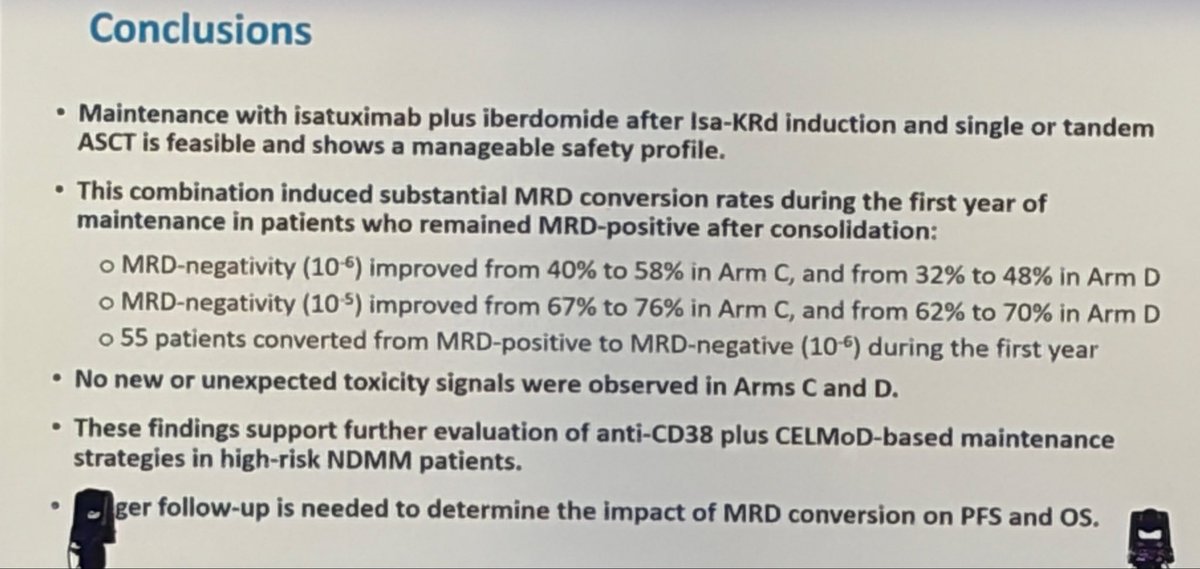
MRD-negative at 10⁻⁵: Arm A six further Isa-KRd cycles vs Arm B ASCT + two Isa-KRd cycles, both to lenalidomide maintenance for 3 years. MRD-positive: Arm C ASCT + two Isa-KRd cycles vs Arm D tandem ASCT, both to isatuximab-iberdomide maintenance for 3 years. (IMS 2024 design slide / CT.gov)
Endpoints
Primary: MRD-negative rate at 10⁻⁶ by next-generation sequencing, measured at completion of consolidation before maintenance. Progression-free and overall survival are secondary and not yet mature. (NEJM 2025 / CT.gov)
Lead Investigator & Sponsor
Aurore Perrot, MD PhD — first author of the NEJM paper and presenter at IMS 2024, ASCO 2025 and EHA 2025. Sponsor: Intergroupe Francophone du Myelome; collaborators Amgen, Sanofi and Bristol-Myers Squibb. (NEJM / CT.gov)
Isa-KRd induction — the deepest pre-transplant responses reported
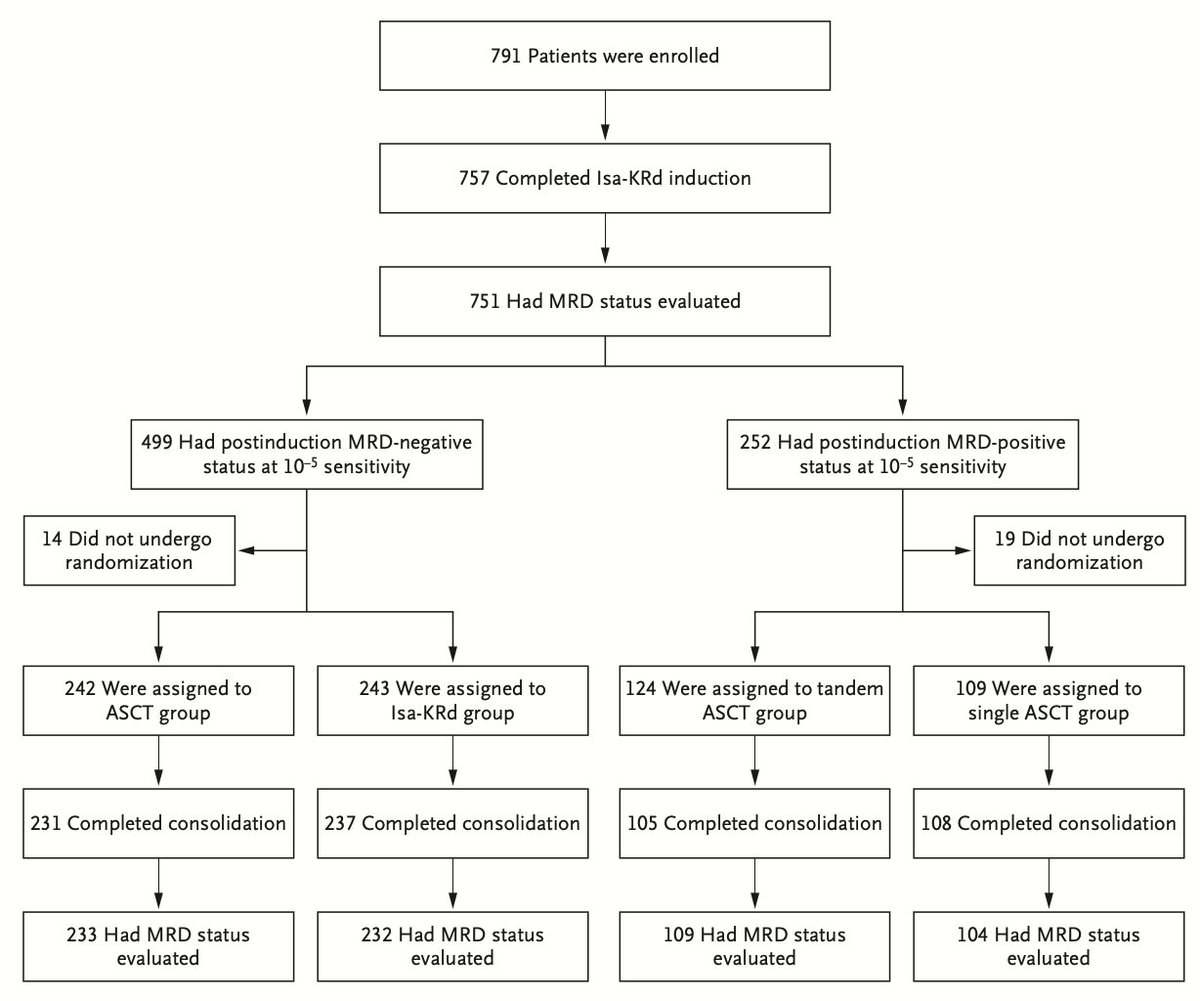
Of 791 patients enrolled, 757 completed induction and 751 had MRD status evaluated. Best overall response was 95%, with 91% reaching at least a very good partial response. MRD negativity was 63% at 10⁻⁵ and 47% at 10⁻⁶ across the full population. Stem-cell collection was not compromised: median CD34+ yield was 7×10⁶/kg and 94% of patients collected enough for a potential tandem transplant. On the 751 patients with an evaluable post-induction sample, 499 (66%) were MRD-negative at 10⁻⁵ — the figure quoted as “67%” in cross-trial comparisons. Both denominators are correct; they are simply different populations.
7500 – MIDAS Trial: MRD-Guided Therapy Post-IsaKRd 718 NDMM pts. After Isa-KRd x6, 67% were MRD− at 10⁻⁵. Randomized to continue Isa-KRd x 6 or go to ASCT prior to maintenance. No difference in MRD<10⁻6 (84% vs 86%) thus far! And as for MRD(+) post-induction: no difference https://t.co/W4NZuUVsIP
— Ben Derman (@bdermanmd) 2025-05-30
Primary endpoint — transplant added nothing in MRD-negative patients
499 patients were MRD-negative at 10⁻⁵ after induction; 485 underwent randomization (242 to ASCT plus two Isa-KRd cycles, 243 to six further Isa-KRd cycles). MRD negativity at 10⁻⁶ before maintenance was reached by 208 of 242 (86%) with transplant and 205 of 243 (84%) without — adjusted relative risk 1.02 (95% CI 0.95–1.10), P=0.64. The NEJM figure also shows how patients moved: in the transplant arm, 53 of the 63 patients (84%) who were not yet at 10⁻⁶ after induction converted during consolidation; in the Isa-KRd arm, 42 of 55 (76%) did. Both routes deepened response; neither did so better than the other.
Main take aways from recent trials on MRD directed therapy for newly diagnosed myeloma presented by @PerrotAurore #IMWG25 @IMFmyeloma https://t.co/ahJN1s0PrT
— Vincent Rajkumar (@VincentRK) 2025-06-10
Primary endpoint — tandem transplant did not rescue MRD-positive patients
252 patients were MRD-positive at 10⁻⁵ after induction; 233 underwent randomization (124 to tandem ASCT, 109 to a single ASCT). MRD negativity at 10⁻⁶ before maintenance was 40 of 124 (32%) with tandem and 44 of 109 (40%) with single transplant — adjusted relative risk 0.82 (95% CI 0.58–1.15), P=0.31. The confidence interval spans 1, so this is a null result rather than a demonstration that tandem is worse; what it does not show is any benefit.
Safety and follow-up
No new safety signals were reported. Median follow-up was 16.8 months in the MRD-negative randomization and 16.3 months in the MRD-positive randomization. Disease progression had occurred in 5 patients and 2 unrelated deaths had been recorded at the time of the primary analysis. Because follow-up is this short, neither progression-free nor overall survival can be interpreted yet.
We've seen about 25% MRD<10^-6 after 16 weeks of quad induction. Probably too low to make a decision about ASCT. But 6-8 cycles? That appears to be a different story! Hard to know if Isa and/or K-based induction influencing these higher rates as well. Adding results from https://t.co/jho8u9c8Vf
— Ben Derman (@bdermanmd) 2025-06-03
Clinical implications
⚠ Investigational throughout. Isa-KRd is not FDA approved in any indication, and MIDAS tested a treatment strategy — using post-induction MRD to decide who gets a transplant — that is not an approved algorithm. What the trial establishes is narrow and real: at the depth-of-response level, transplant adds nothing for patients already MRD-negative after Isa-KRd, and tandem transplant adds nothing for those who are not. What it does not establish is that transplant can be omitted, because progression-free and overall survival are immature at roughly 17 months and sustained MRD-negativity data are not yet available. Several myeloma physicians have made exactly this distinction publicly — treating “tandem transplant can probably be abandoned” as a stronger conclusion than “transplant can be deferred in MRD-negative patients”, which they regard as still awaiting the survival readout. ✅ Separately, isatuximab (Sarclisa) is FDA approved with bortezomib, lenalidomide and dexamethasone in transplant-ineligible newly diagnosed myeloma — a different regimen in the opposite population, and not a basis for using Isa-KRd off-trial.
Source: NEJM 2025 + ClinicalTrials.gov →MIDAS in the News
MIDAS Trial FAQ
What is the MIDAS trial?
MIDAS (IFM2020-02, NCT04934475) is a Phase 3 trial run by the Intergroupe Francophone du Myelome that tested a measurable-residual-disease-adapted treatment strategy in 791 adults under 66 with newly diagnosed multiple myeloma who were ELIGIBLE for autologous stem-cell transplant. All patients received six 28-day cycles of isatuximab, carfilzomib, lenalidomide and dexamethasone (Isa-KRd), then were randomized according to their post-induction MRD status. The primary endpoint was MRD negativity at 10^-6 before maintenance.
Did transplant improve outcomes in MRD-negative patients?
No, not on this endpoint. Among the 485 patients who were MRD-negative at 10^-5 after induction, MRD negativity at 10^-6 before maintenance was reached by 208 of 242 (86%) with ASCT plus two Isa-KRd cycles versus 205 of 243 (84%) with six further Isa-KRd cycles - adjusted relative risk 1.02 (95% CI 0.95-1.10), P=0.64. Adding transplant did not deepen response in this group. Progression-free and overall survival are not yet mature, so this does not by itself establish that transplant can be safely omitted.
Did tandem transplant help MRD-positive patients?
No. Among the 233 patients still MRD-positive at 10^-5 after induction, MRD negativity at 10^-6 before maintenance was 40 of 124 (32%) with tandem ASCT versus 44 of 109 (40%) with a single ASCT - adjusted relative risk 0.82 (95% CI 0.58-1.15), P=0.31. Tandem transplant did not improve the primary endpoint.
Is the Isa-KRd regimen FDA approved?
No. Isatuximab plus carfilzomib, lenalidomide and dexamethasone (Isa-KRd) is not FDA approved in any indication, and the MRD-adapted strategy MIDAS tested is investigational. Isatuximab (Sarclisa, Sanofi) is separately FDA approved with bortezomib, lenalidomide and dexamethasone for transplant-INELIGIBLE newly diagnosed myeloma - a different regimen in a different population - and in relapsed/refractory combinations.
How deep were the responses to Isa-KRd induction?
In the induction analysis published in Blood, best overall response was 95% with 91% achieving a very good partial response or better; MRD negativity was 63% at 10^-5 and 47% at 10^-6 on the full 791-patient population. 96% of patients completed induction, median CD34+ cell yield was 7 x 10^6/kg, and 94% had enough stem cells collected to proceed to a potential tandem transplant. The investigators described these as the highest pre-transplant MRD-negativity rates reported in myeloma.
Key KOL Sentiments - MIDAS
Compiled and reviewed by the KOL Pulse research team, led by Brian Shields, Founder, KOL Pulse. Last updated 2026-09-24. Every numeric claim on this page is traceable to the MIDAS primary publication (N Engl J Med 2025;393(5):425-437), the Isa-KRd induction analysis (Blood 2025;146(1):52), ASCO 2025 abstract 7500, or the ClinicalTrials.gov record for NCT04934475, and is labelled with its source. Physician commentary is quoted verbatim.