Top KOLs Discussing REFOCUS


REFOCUS Key Slides & Visuals




REFOCUS Top Tweets
 𝕏
𝕏📣Super thrilled to share our paper on RLY-4008, the First Highly Selective FGFR2 Inhibitor with Activity across FGFR2 Alterations & Resistance Mutations, published in @CD_AACR ! 👉🏼Huge thanks to team at Cancer Discovery & @AACR for making the front page & the entire paper so visually appealing 👏🏼#PrecisionMedicine 🧬🎯#cancerresearch @OncoAlert @ElizSMcKenna @Relay_Tx @TaliLev123 👉🏼Free Link: https://t.co/DmMttMep3o
𝕏⭐️@AliSchram @MSKCancerCenter just after a phenomenal presentation of the tumor agnostic data from the lirafugratinib (RLY-4008), a highly selective FGFR2 inhibitor in FGFR2-altered tumors. Dr. Schram nailed it at the Q &A session. 👉🏼So amazing to watch the @Relay_Tx drug go from bench to first in human to a tissue agnostic #PrecisionMedicine drug. https://t.co/HeME5d8mRZ
 𝕏
𝕏@AliSchram presenting results of lirafugratinib (RLY-4008), a highly selective FGFR2 inhibitor in pts with broad range of nonCCS FGFR2-altered tumors - ORR highest with fusions 35%🌟 🧬 @AACR #Targets23 Proud to be PI @SVHSydney @kinghorncancer - trial still open/recruiting. https://t.co/KfXU2SfKyW
 𝕏
𝕏🔥RLY-4008, the first highly selective FGFR2 inhibitor with activity across FGFR2 alterations & resistance mutations @CD_AACR https://t.co/1Dm6Llslow ✅Great preclinical data! Now we need to know: 🧐Translates ORR into sig. longer PFS? 🧐Mechanisms of resistance? 👉PFS/OS data from ReFocus phs-2 awaited @myESMO @curecc @EASLnews @ILCAnews #livertwitter
 𝕏
𝕏Today we announced initial clinical data for RLY-4008 in FGFR2-altered solid tumors. Read more: https://t.co/I1e1ca6g68 https://t.co/d62PZNzpnx
𝕏⭐️Pleased to share the updated tissue-agnostic data 👉Tumor-agnostic efficacy and safety of lirafugratinib, a highly selective FGFR2 inhibitor, in patients with advanced solid tumors with FGFR2 fusions or rearrangements: the ReFocus study presented at the triple meeting. 👉Knew this was an active drug right from the 1st ever patient enrolled. The initial translational data was published in @AACR journal @CD_AACR @Relay_Tx 👉RLY-4008, the First Highly Selective FGFR2 Inhibitor with Activity across FGFR2 Alterations and Resistance Mutations Paper --> https://t.co/HeME5d8mRZ 👉Commentary by @montypal + --> https://t.co/ttwXOW1zn4
 𝕏
𝕏🔥ReFocus ph1/2 lirafugratinib adv CCA ➡️ n=114 FGFR2 fusions& RE ➡️ORR 47%, mPFS 11.3 & mDoR 11.8mths ➡️mOS 22.8mths, ≥G3 TRAEs 58% ➡️FGFR2 ass AEs - PPE, stomatitis, nail tox ➡️ ORR in n=53 prior FGFRi 26% @ASCO @myESMO @OncoAlert @ILCAnews #GI26 https://t.co/mWncv0Rixi
 𝕏
𝕏🆕article in press: Mechanisms of clinical resistance to selective FGFR2 inhibition by lirafugratinib https://t.co/JWdy8vK7dR https://t.co/CppOdHz2nl
 𝕏
𝕏Biliary tract cancer is arguably the GI primary site par excellence for NGS surfacing actionable mutations Lirafugratinib adds another arrow to our FGFR2-targeting quiver (but different toxicity profile -- ⬆️stomatitis, HFS -- for selective inhibition vs. pan-FGFRi) #GI26
 𝕏
𝕏📢RLY-4008, a highly selective FGFR2 inhibitor, overcomes limitations of pan-FGFRi, inducing tumor regression and avoiding off-isoform toxicities. Promising early results published by @VivekSubbiah and colleagues in @CD_AACR #CancerResearch #PrecisionMedicine @OncoAlert 🚨 https://t.co/joQyZ57SaE
FDA Approval — September 23, 2026
About the REFOCUS Trial
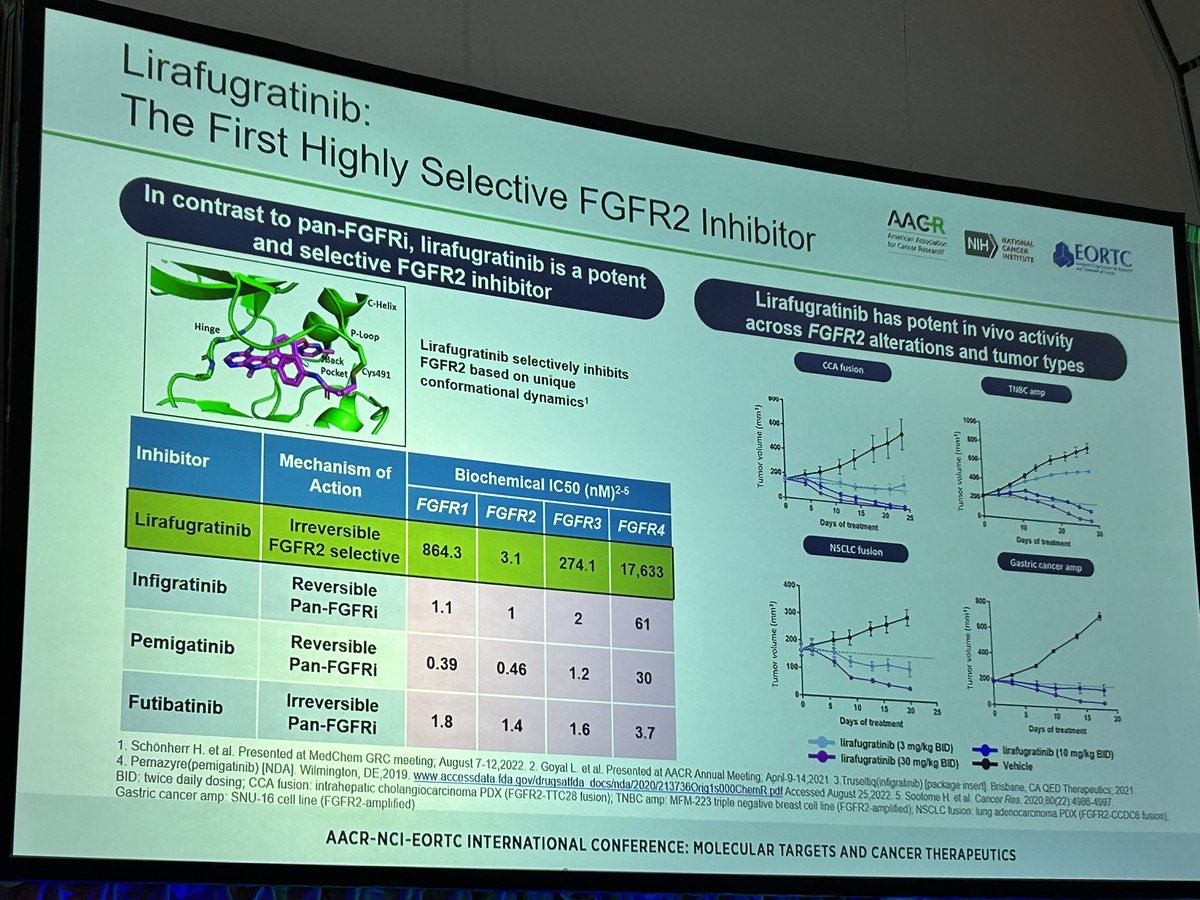
FGFR2 fusions and rearrangements are found predominantly in intrahepatic cholangiocarcinoma, where earlier pan-FGFR inhibitors validated the target but carried off-isoform toxicities (hyperphosphatemia from FGFR1, diarrhea from FGFR4) that limited dosing. Lirafugratinib (RLY-4008) was designed - using conformational dynamics modeling - as the first highly selective FGFR2 inhibitor, sparing FGFR1 and FGFR4 (Subbiah et al., Cancer Discovery 2023). REFOCUS is its first-in-human Phase 1/2 study: dose escalation across FGFR2-altered solid tumors, expansion cohorts in cholangiocarcinoma and other FGFR2-altered tumors, and a pivotal single-arm cholangiocarcinoma cohort dosed at the recommended Phase 2 dose of 70 mg once daily.
The pivotal data were presented at ASCO GI 2026 by Antoine Hollebecque, MD, and supported the September 23, 2026 FDA approval. Lirafugratinib was originated by Relay Therapeutics and licensed globally to Elevar Therapeutics in December 2024; tumor-agnostic development beyond cholangiocarcinoma remains investigational. Physician discussion of REFOCUS spans the 2023 Cancer Discovery first report, the Targets 2023 tumor-agnostic readout, the ASCO GI 2026 pivotal presentation, and today's approval.
Trial Methodology & Results
Study Design
Multicenter, open-label, single-arm Phase 1/2 (dose escalation + expansion + extension). Pivotal cohort N=116 = Part 1 Cohort 2 + Part 2 Group 2A + Part 3 Group 2A Extension (ASCO GI 2026 slide).
Population
Adults with previously treated unresectable, locally advanced or metastatic cholangiocarcinoma harboring an FGFR2 gene fusion or other rearrangement; FGFR-inhibitor-naive; prior chemotherapy or chemoimmunotherapy; ECOG PS 0–1. Median 1 prior line (range 1–5).
Intervention
Lirafugratinib 70 mg orally once daily (RP2D defined in dose escalation).
Endpoints
Primary: confirmed ORR per RECIST v1.1 by IRC. Key secondary: DOR, DCR, PFS, OS, safety, QoL (EORTC QLQ-C30).
Biomarker
Documented FGFR2 genomic alteration per local assessment of blood and/or tumor tissue (trial eligibility; ASCO GI 2026 slide). No companion diagnostic co-approval stated in the FDA announcement.
Presenter & Sponsor
Pivotal data presented by Antoine Hollebecque, MD (ASCO GI 2026). Sponsor: Elevar Therapeutics (originated by Relay Therapeutics as RLY-4008).
Primary Efficacy — pivotal cholangiocarcinoma cohort
ORR 46% (95% CI: 36, 55) with median DOR 11.8 months (95% CI: 7.5, 13.0) by IRC per RECIST v1.1 in the 116-patient single-arm pivotal cohort (FDA_PR, Sept 23, 2026). In the ASCO GI 2026 primary efficacy analysis (N=114; DCO 27-Sep-2024), IRC-assessed ORR was 46.5% (95% CI: 37.1, 56.1) with the same median DOR (ASCO GI 2026 slide). As a single-arm study, REFOCUS supports no comparative efficacy or survival-benefit conclusions.
ORR 46% · median DOR 11.8 months (single-arm, IRC-assessed)Source: FDA press release, Sept 23, 2026
Supportive cohorts — ASCO GI 2026 (DCO 27-Sep-2024)
Outside the pivotal cohort, IRC-assessed supportive populations showed: prior-FGFR-inhibitor cholangiocarcinoma (Group 1A, N=53) ORR 22.6% (95% CI: 12.3, 36.2) with median DOR 5.6 months; chemotherapy-naive cholangiocarcinoma (Group 6, N=11) ORR 63.6% (95% CI: 30.8, 89.1) (ASCO GI 2026 slide). These settings are outside the approved indication and remain investigational.
Source: ASCO GI 2026 slides (via KOL posts on this page) · ClinicalTrials.govTumor-agnostic activity — Targets 2023 (preliminary, DCO 23-Aug-2023)
⚠ Investigational: in non-cholangiocarcinoma FGFR2-fusion/rearrangement solid tumors, preliminary ORR was 35% (9/26) with DCR 69% (18/26) across endometrial, breast, pancreatic, gastric, and other tumor types; responses were lower with FGFR2 amplification (ORR 24%) and mutation (ORR 13%) (AACR-NCI-EORTC Targets 2023 slide, presented by Alison Schram, MD). Lirafugratinib is not approved in any indication other than FGFR2 fusion/rearrangement cholangiocarcinoma.
Source: Targets 2023 slides (via KOL posts on this page) · Cancer Discovery 2023Safety
FDA warnings and precautions: ocular toxicity; hyperphosphatemia and soft tissue mineralization; embryo-fetal toxicity (FDA_PR, Sept 23, 2026). The ASCO GI 2026 presentation described the safety profile as consistent with FGFR2 inhibition, predictable and manageable, with the most common adverse events (eg, stomatitis, palmar-plantar erythrodysesthesia syndrome) on-target and reversible (ASCO GI 2026 slide). Physicians noted the toxicity profile differs from pan-FGFR inhibitors (more stomatitis and hand-foot skin reaction).
Source: FDA press release, Sept 23, 2026Clinical Implications
✅ FDA-approved: lirafugratinib for previously treated unresectable, locally advanced or metastatic FGFR2 fusion/rearrangement cholangiocarcinoma (Sept 23, 2026). ⚠ Investigational: all other FGFR2-altered tumor types and treatment settings (chemo-naive, post-FGFRi). Selective FGFR2 inhibition adds a new option to the FGFR2-altered cholangiocarcinoma armamentarium alongside earlier pan-FGFR inhibitors, with a distinct on-target toxicity profile; resistance mechanisms to selective FGFR2 inhibition have been characterized in Annals of Oncology (2026).
Source: Annals of Oncology (2026), resistance mechanismsREFOCUS in the News
REFOCUS FAQ
What is the REFOCUS trial?
REFOCUS (NCT04526106) is a multicenter, open-label, single-arm Phase 1/2 trial of lirafugratinib (RLY-4008), a highly selective FGFR2 inhibitor, in patients with FGFR2-altered advanced solid tumors. The pivotal cohort enrolled 116 adults with previously treated, unresectable, locally advanced or metastatic cholangiocarcinoma harboring an FGFR2 gene fusion or other rearrangement who were FGFR-inhibitor-naive and had received prior chemotherapy or chemoimmunotherapy. Patients received lirafugratinib 70 mg orally once daily; the primary endpoint was confirmed objective response rate per RECIST v1.1 by independent review committee.
What did the FDA approve lirafugratinib (Lyrfigtu) for?
On September 23, 2026, the FDA approved lirafugratinib (Lyrfigtu, Elevar Therapeutics), a kinase inhibitor, for adults with previously treated unresectable, locally advanced or metastatic cholangiocarcinoma harboring an FGFR2 gene fusion or other rearrangement. The application received priority review and used the Real-Time Oncology Review (RTOR) program and the Assessment Aid; lirafugratinib had received breakthrough therapy and orphan drug designations. Use in other FGFR2-altered tumor types remains investigational.
How effective was lirafugratinib in REFOCUS?
In the single-arm pivotal cohort (N=116), the objective response rate was 46% (95% CI: 36, 55) with a median duration of response of 11.8 months (95% CI: 7.5, 13.0), assessed by independent review committee per RECIST v1.1 (FDA press release, September 23, 2026). Because REFOCUS is a single-arm study, no comparative or survival-benefit conclusions can be drawn.
What are the key safety considerations with lirafugratinib?
The FDA lists warnings and precautions for ocular toxicity, hyperphosphatemia and soft tissue mineralization, and embryo-fetal toxicity. In the ASCO GI 2026 presentation of the pivotal data, the most common adverse events - such as stomatitis and palmar-plantar erythrodysesthesia syndrome - were described as on-target and reversible, with a safety profile consistent with FGFR2 inhibition.
How is lirafugratinib different from earlier FGFR inhibitors?
Lirafugratinib was designed as the first highly selective FGFR2 inhibitor (Subbiah et al., Cancer Discovery 2023): its biochemical IC50 for FGFR2 is 3.1 nM versus 864.3 nM for FGFR1, whereas earlier pan-FGFR inhibitors inhibit FGFR1-4 at similar potency. By sparing FGFR1 and FGFR4, selective FGFR2 inhibition is intended to reduce off-isoform toxicities and allow more complete FGFR2 blockade; physicians discussing the trial noted a different toxicity profile (more stomatitis and hand-foot skin reaction) than pan-FGFR inhibitors. Originated by Relay Therapeutics as RLY-4008, lirafugratinib was licensed globally to Elevar Therapeutics in December 2024.