Top KOLs Discussing SOHO-01



SOHO-01 Key Slides & Visuals





KOL Discussion Threads — Which HER2 Option First?
Sevabirtinib is now @FDA ✅ in 1L HER2/ERBB2 TKD mutated mNSCLC based off SOHO-01: - ORR: 75% - 73% of responding pts had DOR ≥ 6 months and 38% had ≥ 12 months - AEs: Diarrhea, LFTs, and Pneumonitis #Lcsm #WCLC26 #OncTwitter @OncUpdates

Zongertinib is super well tolerated, hope this will be the same and the price will come down some ( cough, cough)

Sevabertinib should be taken with meal. However under 12.3 Pharmacokinetics (effect on Food) high fat meal should be avoided. Not sure why it must be taken with meal since the solubility is almost zero above PH 4.5. Interesting

Now we have 3 options with zongertinib, TDXd and sevabirtinib, which one to choose first?
Zong better tolerated than Enhertu . No experience with Seva .
But enhertu has phase III daya behind it
Agreed, we now have 3 available options. My preference for TKD mutation is going to be towards Zongertinib (oral, high ORR 👇👇 @GlopesMd, AE profile). TDXd is still going to be used a good amount but for Her2 positive or over expressing tumors (rather than “TKD mutated”)

🚨🔥@OncoAlert Hot off the press. @US_FDA approves: ⭐️#Sevabertinib ❇️For #FirstLine Tx in patients with advanced #HER2 (#TKD) mutant Non-Small Cell #LungCancer. This is an #Expansion of existing indication/approval in 2nd line. Approval based on #SOHO-01 trial’s results: ✅#ORR (in 1st line): 75% ✅73% of responding pts with DOR ≥ 6 months

I'm curious, Rami. Would you ever use it instead of zongertinib?

Due to toxicity it will be hard to do
Thx for the question Ben. I think I would still favor Zongertinib.
Agreed- excited to have multiple frontline options now! But currently, very few biologic reasons to preferentially choose sevabertinib frontline over zongertinib. Maybe potential reasons: access/formulary, some unusual patient-specific toxicity, DDI circumstances etc.

Accelerated approval is a risk and so the big thing will be whether a confirmatory trial will support the preliminary data.

And let me guess they are going to have the same price? Competition clearly means nothing in oncology
That’s exactly the point I made in this Wall Street Journal commentary last year (on checkpoint inhibitors all having similar prices) https://t.co/kJdqjXsGjk
SOHO-01 Top Tweets
 𝕏
𝕏Original Article: Sevabertinib in Advanced HER2-Mutant Non–Small-Cell Lung Cancer (SOHO-01 phase 1–2 study) https://t.co/j9U1z5qZAS #ESMO25 | @myESMO https://t.co/2ARAQUTjOd
 𝕏
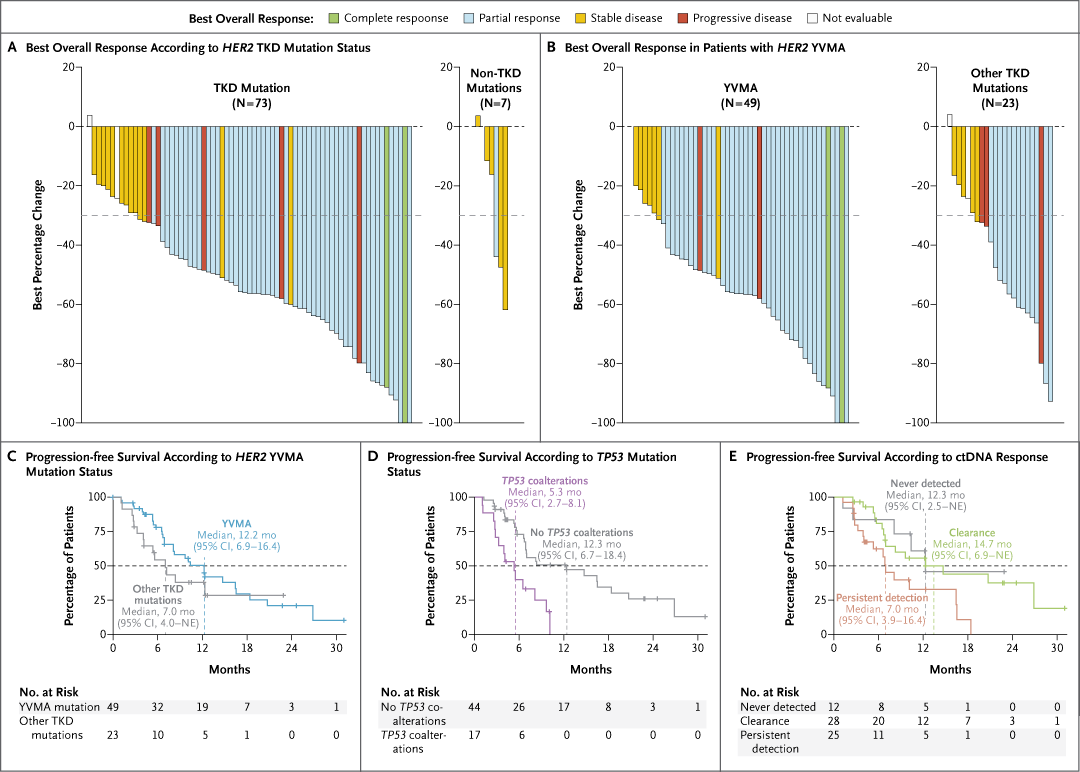
𝕏PL04.03 - Safety and Efficacy of BAY 2927088 In HER2-Mutant NSCLC: Expansion Cohort from the Phase I/II SOHO-01 Study ORR=72.1% (90.0% among HER2 Y772_A775dup insertion) DOR=8.7 months Most common AE: Dirrhea (no report of ILD/pneumonitis) Impressive results! #WCLC24 https://t.co/DBwmNDBrdC
 𝕏
𝕏Our Dr. @LeXiuning presents a key update for patients with HER2 positive NSCLC from the phase 1/2 SOHO-01 study. BAY 2927088 -Oral reversible TKI -ORR 72% (90% in YMVA) -mDOR 8.7 mos -mPFS 7.5 mos -AE: 25% grade 3+ diarrhea #WCLC24 #LCSM @OncoAlert https://t.co/o2gyDIuuzo
 𝕏
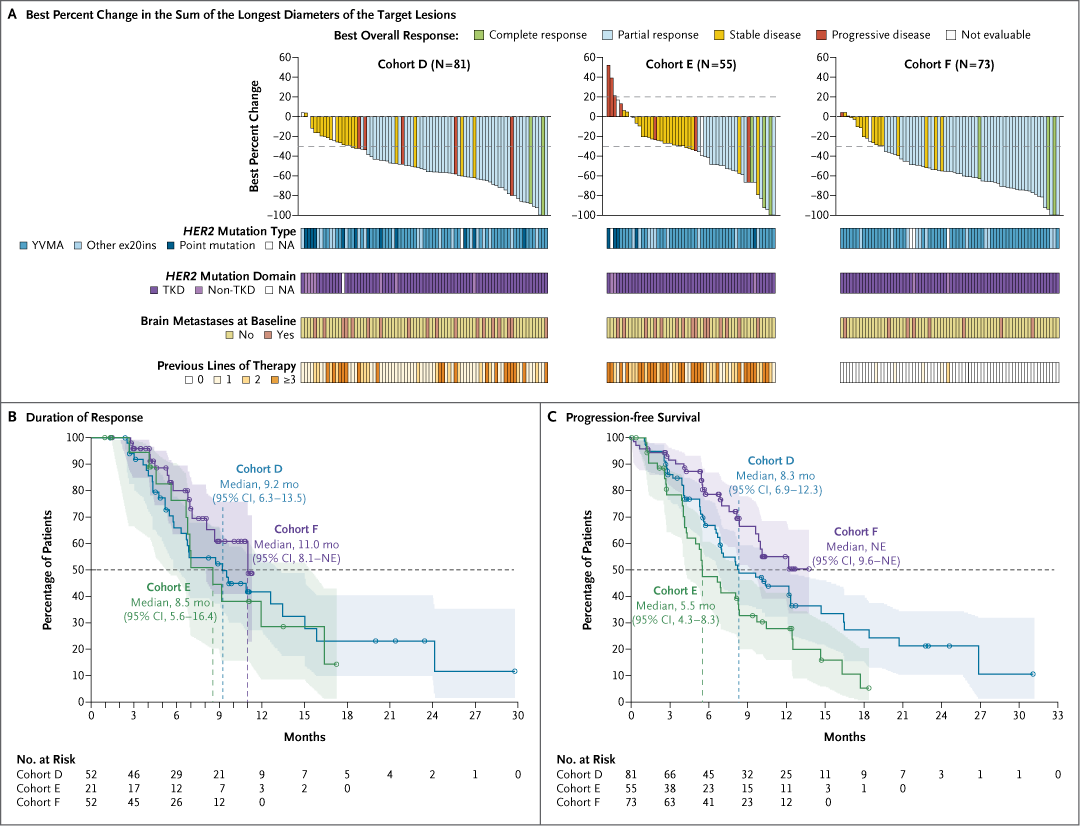
𝕏SOHO-01 update on HER2 TKI sevabertinib in NSCLC presented by @LeXiuning ORR: - Pretreated 64% - Previous ADC 38% - Treatment naive 71% - Activity in 🧠 - Grade 3 diarrhea 28%; No ILD/pneumonitis. 👉 Phase III trial SOHO-02 in first-line now recruiting #ESMO25 #LCSM https://t.co/m3eh2t8N67
 𝕏
𝕏#lcsm friends Looks like between zongertinib and sevabertinib we got delivered twins at #ESMO25! Both look super cute, are very effective… at drawing attention and seem mild-mannered. One just poops a little more than the other😉 https://t.co/UIUsuy7WQI
 𝕏
𝕏#ESMO25 Update on SOHO-01 with sevabertinib (BAY 2927088) in #HER2 mutant NSCLC from Dr. @LeXiuning. In previously treated, HER2 mutant NSCLC, sevabertinib had RR 64%, DCR 81%, DOR 9.2m, PFS 8.3m. #ESMOAmbassadors https://t.co/XA24aiqCWb
 𝕏
𝕏Another brick in the wall of HER2 mut NSCLC. Promising efficacy of BAY in HER2 naive pts (ORR 70.5%) but also in pts treated with TDxD (ORR 35.3%). Diarrhea as the most frequent AE (almost all pts but no tt discontinuation). #ELCC25 @OncoAlert @nicogirardcurie https://t.co/Fc0KOS4Wvy
 𝕏
𝕏Sevabirtinib is now @FDA ✅ in 1L HER2/ERBB2 TKD mutated mNSCLC based off SOHO-01: - ORR: 75% - 73% of responding pts had DOR ≥ 6 months and 38% had ≥ 12 months - AEs: Diarrhea, LFTs, and Pneumonitis #Lcsm #WCLC26 #OncTwitter @OncUpdates https://t.co/Uj9jlKnE20
 𝕏
𝕏🆙 #WCLC26 #LCSM Mini Oral Session 🔥 SOHO-01: Molecular Landscape of Acquired Resistance to Sevabertinib in HER2-mutant NSCLC 🎯85 pts with paired BL-PD plasma NGS 🎯Resistance-associated events in 30.1% 🎯Secondary HER2 T862A 16.4%, HER2 amplification 2.7%; C805S not detected 🎯Bypass/downstream alterations less frequent (PIK3CA/PTEN, MAPK pathway, 12.3%) 🎙️ @LeXiuning 🔢 MO12.04 ☑️ NCT05099172 🔗 https://t.co/8SXWyqrxiE @OncoAlert @Larvol @IASLC
𝕏🔥#WCLC24 Presidential 2✴️ 🎙️@LeXiuning 🎯Safety and Efficacy of BAY 2927088 In Patients with HER2-Mutant NSCLC: Expansion Cohort from the Phase I/II SOHO-01 Study #LCSM @IASLC @OncoAlert https://t.co/Q5L0yj5oBa https://t.co/fMenyzAIia
FDA Approval — September 9, 2026
Trial Methodology & Results
Study Design
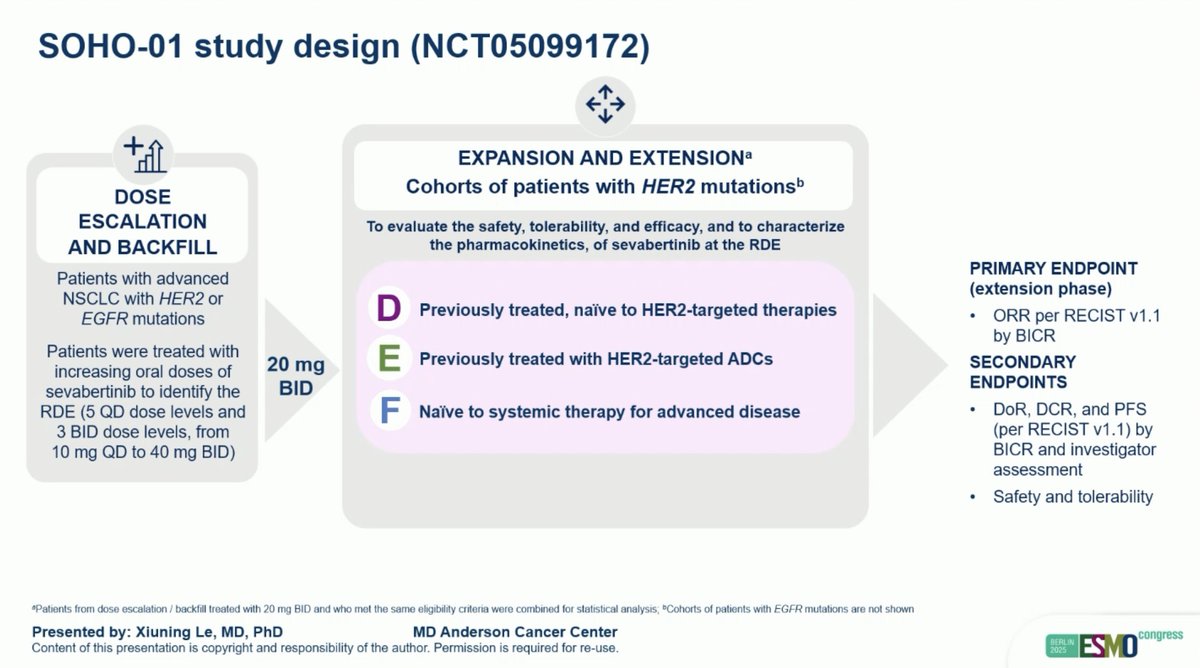
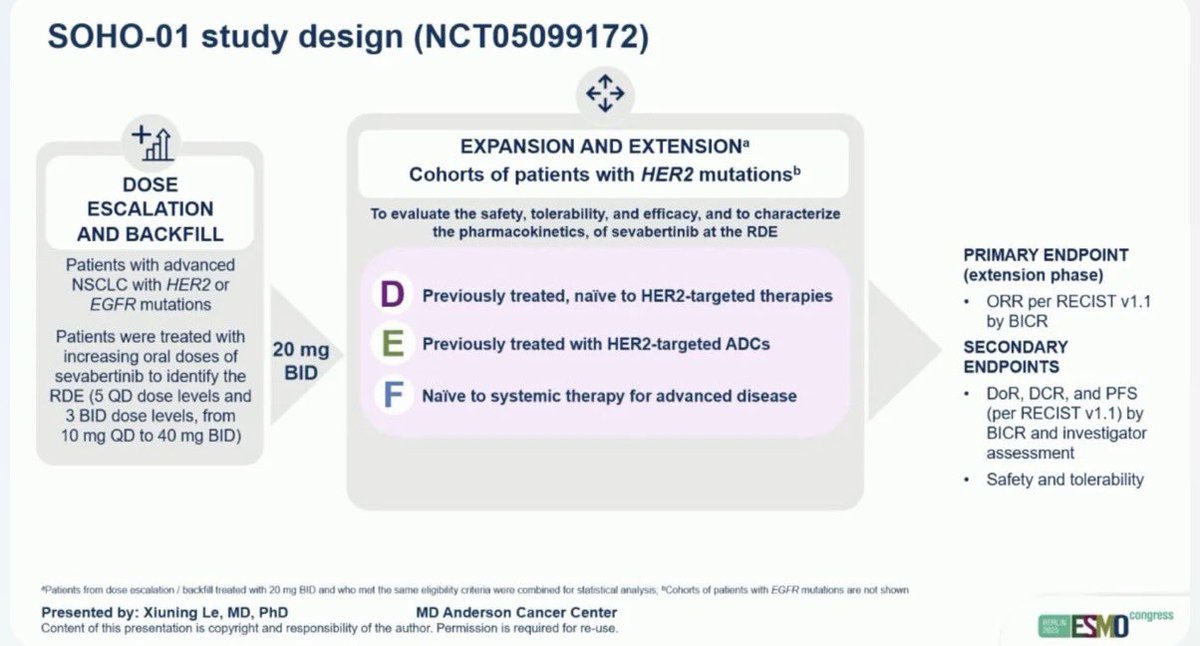
Phase 1/2, open-label, single-arm, multicenter, multi-cohort; dose escalation (10 mg QD to 40 mg BID) established 20 mg BID as the recommended dose for expansion.
Population
Advanced NSCLC with HER2 (ERBB2) activating mutations, identified in tumor tissue or plasma. Approval populations: HER2 TKD-mutant non-squamous NSCLC (1L: treatment-naive cohort N=69; 2L+: cohorts D/E).
Intervention
Sevabertinib 20 mg orally twice daily — an oral, reversible, potent and selective HER2 TKI — until progression or unacceptable toxicity.
Endpoints
Primary (extension phase): confirmed ORR per RECIST v1.1 by BICR. Secondary: DoR, DCR, PFS (BICR and investigator), safety and tolerability.
Biomarker & Companion Diagnostic
HER2 (ERBB2) TKD activating mutations by FDA-authorized test; the Oncomine Dx Target Test (Life Technologies) was co-approved as companion diagnostic with the Nov 2025 approval. Local tissue or plasma identification at enrollment.
Sponsor
Bayer. Confirmatory Phase 3: SOHO-02 (NCT06452277) — sevabertinib vs pembrolizumab + platinum + pemetrexed in untreated HER2 TKD-mutant non-squamous advanced NSCLC.
Efficacy
First-line (treatment-naive cohort, N=69, Sept 2026 approval): ORR 75% (CR 6%, PR 70%); DoR ≥6 months in 73% of responders and ≥12 months in 38%. Previously treated (Nov 2025 approval, FDA efficacy populations): n=70 (prior systemic therapy, HER2-therapy naive) ORR 71% (95% CI 59–82), median DoR 9.2 months; n=52 (post-HER2-ADC) ORR 38% (95% CI 25–53), median DoR 7.0 months. Each value is labeled to its dataset — the FDA efficacy populations are subsets that differ from full trial cohorts (cohort D, n=81: BICR ORR 64%, ESMO 2025).
ORR 75% first-line — accelerated approval in both 1L and 2L+ settingsSource: Bayer PR (1L) · OncLive (2L)
Safety
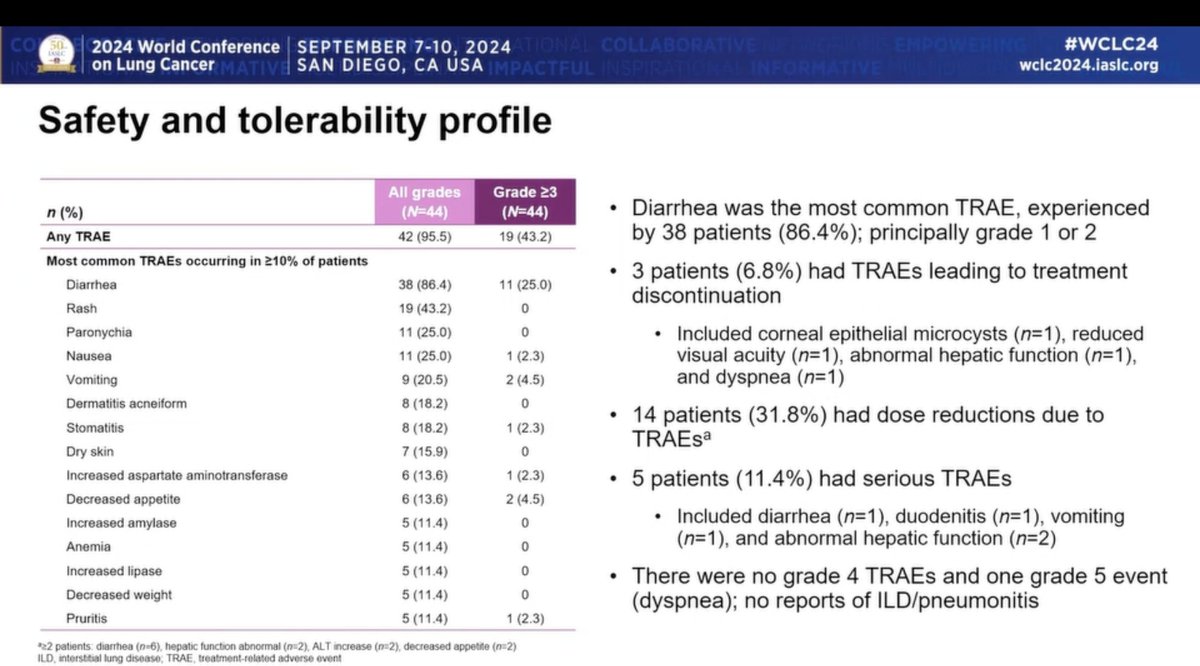
Label Warnings & Precautions (HYRNUO prescribing information, Sept 2026): diarrhea, hepatotoxicity, interstitial lung disease (ILD)/pneumonitis, left ventricular dysfunction, ocular toxicity, pancreatic enzyme elevation, and embryo-fetal toxicity. ILD/pneumonitis occurred in 0.7% of the pooled safety population (0.4% grade 3), and the label directs permanent discontinuation at any grade of confirmed ILD/pneumonitis — "no ILD" statements in KOL posts on this page reflect the earlier WCLC 2024 cohort D cut (n=44), not the current pooled label data. The most common treatment-related adverse events in that WCLC 2024 cohort D set (n=44) were diarrhea (86.4%; grade ≥3 25%), rash and paronychia, with grade ≥3 TRAEs in 43.2%, dose reductions in 31.8%, discontinuations in 6.8%, serious TRAEs in 11.4% and one grade 5 event (dyspnea). Treatment-naive patients tolerate sevabertinib better: in the ASCO 2026 update (DCO Nov 17, 2025), grade ≥3 TRAEs occurred in 24.7% of cohort F vs 39.5% of cohort D, and grade 3 diarrhea in 5.5% (F) vs 23.5% (D), with no ILD cases observed within the trial. Bayer reports the 1L safety profile was consistent with previous findings.
Source: HYRNUO Prescribing Information · FDA notice, Sept 9, 2026 · Bayer PRResistance — WCLC 2026 exploratory analysis (abstract; presentation Sept 15, 2026)
MO12.04 (Le et al., accepted WCLC 2026 abstract, released Aug 19, 2026; to be presented Sept 15): among 73 evaluable patients with paired plasma NGS, putative resistance-associated genomic events emerged in 30.1%; secondary HER2 T862A was the predominant mechanism (16.4%), with bypass PIK3CA/PTEN and MAPK-pathway alterations in 12.3%. Most progressing patients lacked an identifiable genomic driver — and T862A carriers had comparable duration of response. Full abstract in the slide OCR above.
Source: WCLC 2026 (MO12.04) — via KOL Pulse conference coverageClinical Implications
✅ HER2 TKD-mutant NSCLC now has an FDA-approved oral TKI in both the first-line and previously treated settings — a subset (2–4% of NSCLC, often younger, predominantly female, never-smokers) that until 2025 had only ADC options. The approvals sharpen the case for comprehensive molecular testing (including HER2) at diagnosis, as lead investigator Xiuning Le emphasized in Bayer’s release. Accelerated-approval caveats apply: confirmation rests on Phase 3 SOHO-02.
Source: Bayer press release, Sept 9, 2026SOHO-01 in the News
WCLC 2026: Live KOL Reaction
Physician posts about this trial captured live during the IASLC 2026 World Conference on Lung Cancer (Seoul, September 12–15). Quotes are verbatim; each card links to the original post. Last updated 2026-09-15.
Dr. @mollylisc at #BTGLung2026 highlights a burning question for HER2 mutant NSCLC - what is the optimal first line therapy? We now have zongertinib and sevabertinib approved as 1L TKIs and trastuzumab deruxtecan 1L study was positive, to be seen at #WCLC26. How do we select? https://t.co/N3K0fZWb0a
FDA grants accelerated approval to sevabertinib as first-line HER2 mutant (TKD) NSCLC. Based on SOHO-01 with RR 75% and 38% of those lasting ≥ 12m. Joins zongertinib here, with trastuzumab deruxtecan presumably joining soon based on DESTINY Lung-04. https://t.co/W90xpc8g55

The FDA has expanded the accelerated approval of sevabertinib to first-line HER2 TKD–mutant advanced NSCLC. SOHO-01 data showed a 75% objective response rate among treatment-naive patients. Learn more: https://t.co/HbLsReIEXs

🚨 #FDAApproval: The @FDA granted accelerated approval to sevabertinib (Hyrnuo) for treatment-naive adults with HER2 TKD–mutated locally advanced or metastatic nonsquamous #NSCLC. Approval supported by SOHO-01 study findings. 🔗 https://t.co/nXJ3RMOusU https://t.co/dStyB81oMH

A rare lung cancer mutation just got a frontline option. FDA expanded accelerated approval for sevabertinib (Hyrnuo) to adults with HER2 tyrosine kinase domain–mutated nonsquamous NSCLC — including people who haven’t had systemic therapy yet. In the SOHO-01 cohort of 69 previously untreated patients, about 3 in 4 had a confirmed response. Most responders were still responding at 6 months. Here’s the patient lesson I keep coming back to: the drug only helps if the mutation is found. Ask whether tumor or blood testing covered HER2 (ERBB2) TKD changes — not just the more familiar EGFR/ALK panel. Accelerated approval still means confirmatory evidence has to catch up. Options matter. Testing decides who gets offered them. https://t.co/FYnmoD9ODO #LungCancer #PrecisionMedicine

@Bayer 's sevabertinib is a new first-line oral option for advanced HER2-mutant non-squamous NSCLC. #FDA accelerated approval is based on a 75% response rate among 69 patients in single-arm SOHO-01—not yet proof of survival benefit or superiority. #LungCancer #HER2 https://t.co/OlUhDZaK4s

🚨Regulatory Update | A new targeted approach for #HER2-mutant #NSCLC The #FDA has granted accelerated approval to #sevabertinib (#HYRNUO, Bayer) for adults with locally advanced or metastatic non-squamous non-small cell lung cancer harboring activating HER2 (#ERBB2) tyrosine kinase domain mutations. 📊In the SOHO-01 trial, sevabertinib demonstrated an objective response rate of 75% in patients who had not received prior systemic therapy and 46% in previously treated patients. 🔬The approval highlights the growing role of biomarker-driven strategies in #LungCancer research. #FDAApproval #CancerResearch #Oncology #BiomedicalResearch

Bayer's HYRNUO first-line expansion rests on SOHO-01, a single-arm study. Its 75% response rate is evidence of activity. It cannot establish superiority over another treatment without a comparator. Keep the approval and the comparative claim separate.

𝘏𝘌𝘙2-mutant #NSCLC highlights from #ASCO26 Expert insights on the latest data 📺From thoracic oncologists Dr @herbloong & Dr @ipreeshagul They review data from: ➡️ 𝗦𝗢𝗛𝗢-𝟬𝟭: Updated safety and efficacy of sevabertinib in patients with advanced HER2-mutant NSCLC. Loong H, et al. Abstract 8622, ASCO 2026 ➡️ 𝗕𝗲𝗮𝗺𝗶𝗼𝗻 𝗟𝗨𝗡𝗚-𝟯: Zongertinib in resectable HER2-mutant NSCLC. Cummings A, et al. Abstract TPS8129, ASCO 2026 ➡️ 𝗔𝗱𝘃𝗮𝗻𝗰𝗶𝗻𝗴 𝗛𝗘𝗥𝟮 𝘁𝗲𝘀𝘁𝗶𝗻𝗴 and evidence-based treatment in NSCLC: A quality improvement initiative across academic and community settings. McKinnon K.E, et al. Abstract e23309, ASCO 2026 ➡️ 𝗣𝗥𝗢 𝗿𝗲𝘀𝘂𝗹𝘁𝘀 𝗳𝗿𝗼𝗺 𝘁𝗵𝗲 𝗕𝗲𝗮𝗺𝗶𝗼𝗻 𝗟𝗨𝗡𝗚-𝟭 trial in treatment-naïve patients with HER2-mutant advanced NSCLC. Sabari J.K, et al. Abstract 8616, ASCO 2026 Get the slides & see more updates from ASCO >> https://t.co/mO8hJOOoUr 🤝 Programme endorsed by @WarOnCancer, @BiomarkerCo, @Exon20Group & @isliquidbiopsy Supported by an Independent Educational Grant from Bayer #MedEd #ThoracicOncology #LungCancer

@dronkoloji Sevabertinib (Hyrnuo) received accelerated approval, with 75% ORR in the SOHO-01 treatment-naïve cohort. Full data: https://t.co/JNYXbK6oZQ

💊 FDA expands Bayer Hyrnuo (sevabertinib) to first-line HER2 TKD-mutant non-squamous NSCLC. SOHO-01 ORR 75% in untreated patients. FDA https://t.co/JFxNYMDktZ

FDA (Sept 9) expanded sevabertinib (Hyrnuo, Bayer) into first-line HER2 TKD-mutant non-squamous NSCLC, dropping the prior-therapy requirement. SOHO-01, 69 untreated patients: ORR 75%, 73% of responses lasting 6+ months. #LungCancer #HER2 #FDA #NSCLC https://t.co/EHosZWFbgp

In an expanded regulatory move, the U.S. FDA has granted accelerated approval to Bayer’s Hyrnuo (sevabertinib) as a first-line treatment for adult patients with locally advanced or metastatic non-squamous non-small cell lung cancer (NSCLC) harboring HER2 tyrosine kinase domain activating mutations. Driven by high objective response rates from the Phase 1/2 SOHO-01 trial, this decision elevates Hyrnuo from its previous post-chemotherapy status directly into treatment-naïve settings. The approval intensifies high-stakes competition with Boehringer Ingelheim’s Hernexeos (zongertinib), which achieved first-line clearance earlier in 2026. As both targeted TKIs aim to redefine precision oncology for HER2-mutated NSCLC, commercial rivalry will center on real-world tolerability, brain metastasis efficacy, and rapid biomarker adoption.
T-DXd trying to catch up in the frontline setting with zongertinib and sevabertinib Results from #DESTINYLung04…. #WCLC26 https://t.co/wb9BkFV7dg

Dr. Julia Rotow @JuliaRotow presents the DESTINY-Lung-04 data of trastuzumab deruxtecan vs pembro+chemo in 1L HER2 NSCLC at @IASLC #WCLC26. T-DXd improved PFS and ORR, yet OS benefit is limited with this regimen, likely confounded by access to 2L HER2-directed therapies. AEs notable with ILD 20.8% (>4% G3+). Difficult to know how T-DXd will fit in the sequencing of an evolving HER2 landscape with available TKIs zongertinib & sevabertinib. @lungoncdoc @LUNGevity @LungCancerEu @YoungLungCancer @GO2forLungCancr @StephenVLiu

#WCLC26 HER2-mutant NSCLC: ADC vs TKI 👀 1L T-DXd: ORR 70%, mPFS 14.3 mo, but no OS signal yet. 1L sevabertinib: ORR 71%, mDoR 11 mo. No head-to-head comparison, but HER2 TKIs are becoming a serious frontline contender. @OncoAlert @Larvol https://t.co/AdtQzqP2fp
🆙 #WCLC26 #LCSM Mini Oral Session 🔥 SOHO-01: Molecular Landscape of Acquired Resistance to Sevabertinib in HER2-mutant NSCLC 🎯85 pts with paired BL-PD plasma NGS 🎯Resistance-associated events in 30.1% 🎯Secondary HER2 T862A 16.4%, HER2 amplification 2.7%; C805S not detected 🎯Bypass/downstream alterations less frequent (PIK3CA/PTEN, MAPK pathway, 12.3%) 🎙️ @LeXiuning 🔢 MO12.04 ☑️ NCT05099172 🔗 https://t.co/8SXWyqrxiE @OncoAlert @Larvol @IASLC
SOHO-01 FAQ
What is the SOHO-01 trial?
SOHO-01 (NCT05099172) is an ongoing Phase 1/2, open-label, single-arm, multicenter, multi-cohort trial of sevabertinib (Hyrnuo, Bayer), an oral, reversible HER2 tyrosine kinase inhibitor, in advanced NSCLC with HER2 or EGFR mutations. After dose escalation established 20 mg twice daily, expansion cohorts enrolled HER2-mutant patients: cohort D (previously treated, HER2-therapy naive), cohort E (prior HER2-targeted ADCs), and cohort F (treatment-naive). Primary endpoint: objective response rate per RECIST v1.1 by blinded independent central review.
What did the FDA approve on September 9, 2026?
The FDA granted accelerated approval to sevabertinib for adults with locally advanced or metastatic non-squamous NSCLC whose tumors have HER2 (ERBB2) tyrosine kinase domain activating mutations, as detected by an FDA-authorized test - expanding the November 2025 approval in previously treated patients to include first-line, treatment-naive patients. The 1L approval is based on SOHO-01's treatment-naive cohort (N=69): ORR 75% (complete responses in 6%, partial in 70%), with 73% of responders maintaining response at least 6 months and 38% at least 12 months.
What supported the earlier November 2025 approval?
The November 19, 2025 accelerated approval covered previously treated HER2 TKD-mutant non-squamous NSCLC, drawing on SOHO-01's previously treated cohorts. In the FDA's efficacy populations: among 70 patients with prior systemic therapy who were HER2-therapy naive, ORR was 71% (95% CI 59-82) with median duration of response 9.2 months; among 52 patients with prior HER2-targeted ADCs, ORR was 38% (95% CI 25-53) with median DoR 7.0 months. (The FDA defines these populations by N rather than cohort letter; full trial cohort D, n=81, reported BICR ORR 64% at ESMO 2025.) Sevabertinib is also approved in China (NMPA) for previously treated HER2-mutant NSCLC.
Is the approval conditional?
Yes - both indications are accelerated approvals based on response rate and duration of response. Continued approval may be contingent on confirmatory evidence from the ongoing Phase 3 SOHO-02 trial (NCT06452277), which compares sevabertinib against pembrolizumab plus platinum-pemetrexed in untreated advanced HER2 TKD-mutant non-squamous NSCLC. The label's Warnings and Precautions cover diarrhea, hepatotoxicity, interstitial lung disease (ILD)/pneumonitis, left ventricular dysfunction, ocular toxicity, pancreatic enzyme elevation and embryo-fetal toxicity - ILD/pneumonitis occurred in 0.7% of the pooled safety population and requires permanent discontinuation at any grade. The most common adverse events include diarrhea, rash and paronychia; physicians on this page also flagged hepatotoxicity and LV dysfunction monitoring.
How does resistance to sevabertinib develop?
Per the exploratory biomarker analysis in accepted WCLC 2026 abstract MO12.04 (Le et al.; abstract released Aug 19, 2026, presentation scheduled Sept 15, 2026), paired plasma NGS in 73 evaluable patients found putative resistance-associated genomic events in 30.1%, with secondary HER2 T862A substitutions the most common (16.4%), followed by HER2 amplification; bypass alterations (PIK3CA/PTEN, MAPK pathway) occurred in 12.3%. Most progressing patients lacked an identifiable genomic driver, suggesting non-genetic mechanisms - and patients with T862A had comparable duration of response to those without.