REZILIENT3 Key Takeaways
Design
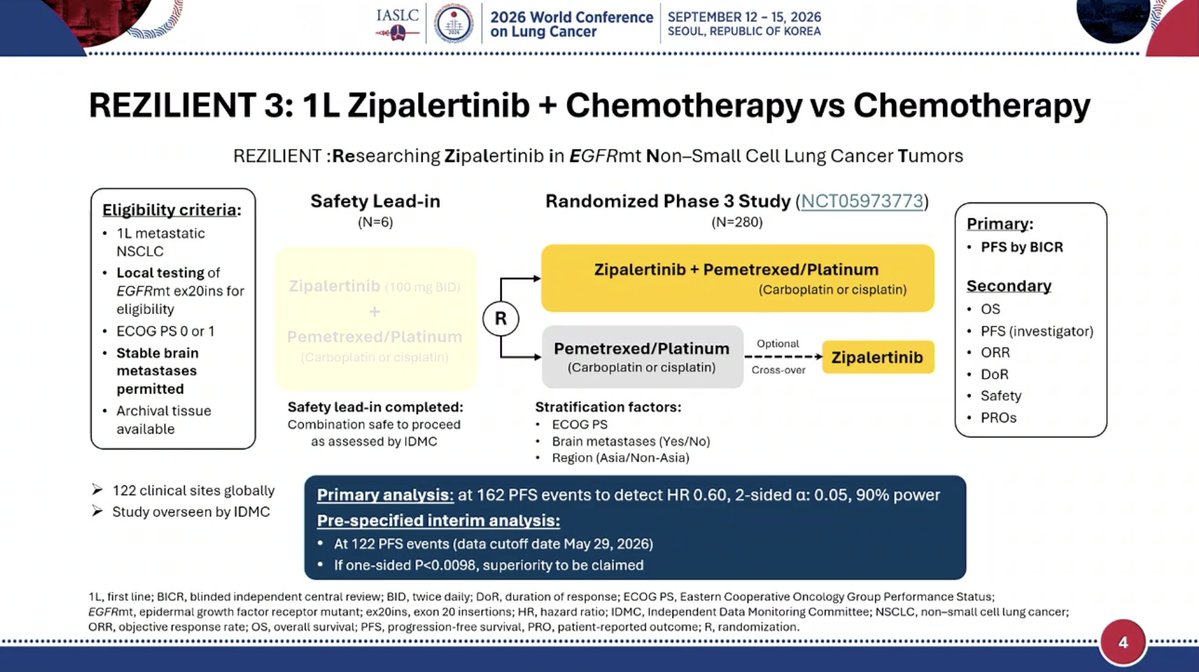
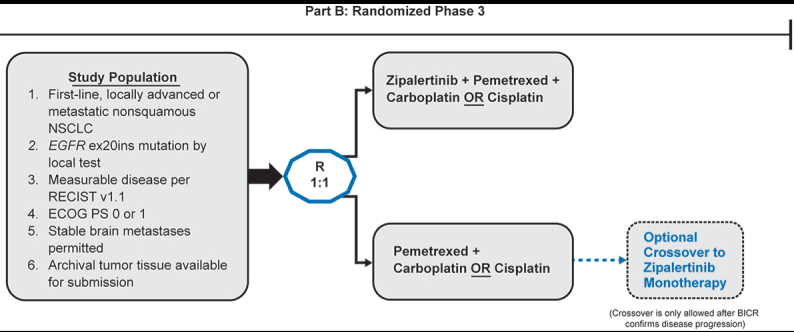
Randomized, open-label Phase 3: zipalertinib (oral EGFR TKI) plus platinum-pemetrexed versus platinum-pemetrexed alone, 1:1, in previously untreated non-squamous EGFR exon 20 insertion NSCLC. 285 enrolled including a 6-patient safety lead-in; 279 randomized (140 vs 139). Primary endpoint PFS by blinded independent central review; chemotherapy-arm patients could cross over to zipalertinib at progression. (Design slide, WCLC 2026 plenary; ClinicalTrials.gov NCT05973773)
PFS — primary endpoint
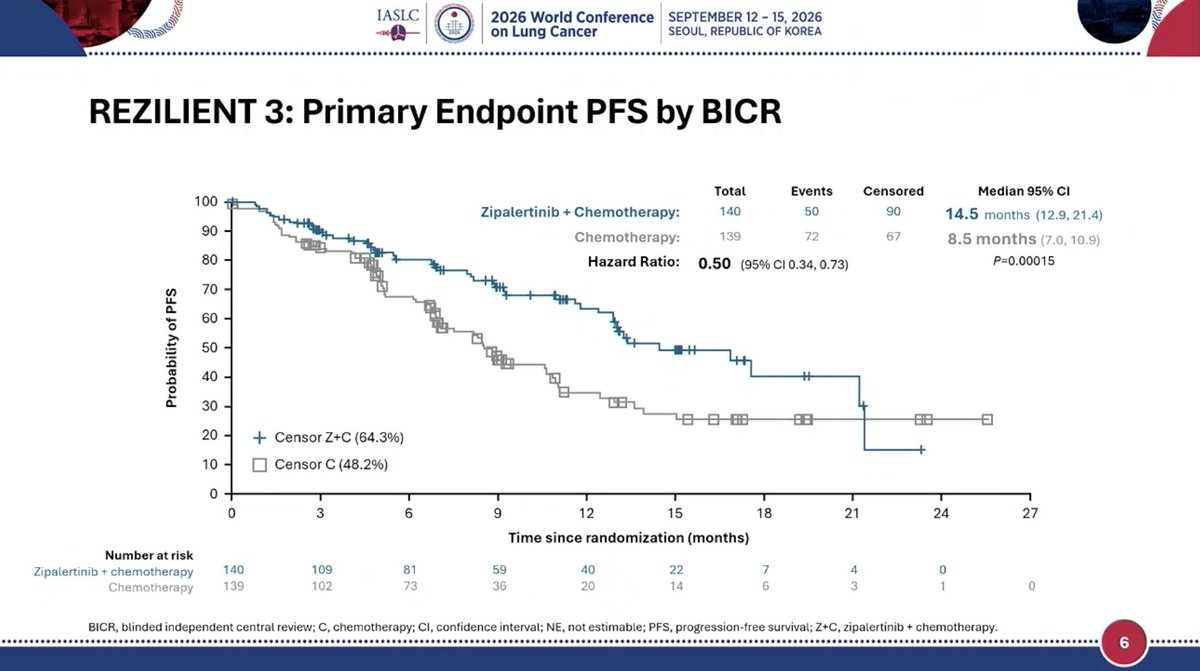
Median PFS 14.5 vs 8.5 months; HR 0.50 (95% CI 0.34–0.73), P=0.00015, at the pre-specified interim analysis (122 PFS events, data cutoff 29 May 2026). (WCLC 2026 plenary, interim DCO 29-May-2026)6-month median PFS gain · risk of progression or death halved
Response
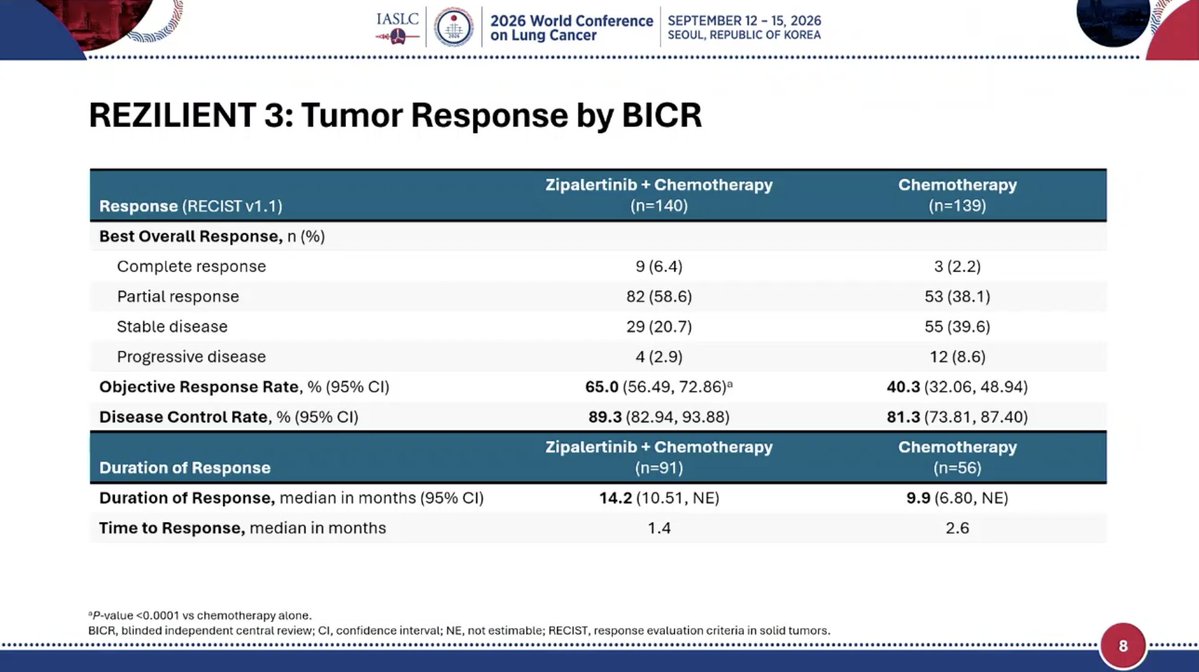
Confirmed ORR 65.0% vs 40.3% (P<0.0001); median duration of response 14.2 vs 9.9 months. In patients with baseline brain metastases (~31% of each arm), PFS HR was 0.38 (95% CI 0.21–0.67). (WCLC 2026 plenary response table + discussant subgroup slide, interim DCO 29-May-2026)
Overall survival — immature
Interim OS HR 0.72 (95% CI 0.42–1.23) at ~30% maturity — not statistically significant, with 64.2% of eligible chemotherapy-arm patients crossing over to zipalertinib at progression. (WCLC 2026 plenary, interim DCO 29-May-2026)
Safety
Grade ≥3 adverse events 87.1% vs 54.4% (all-cause), driven largely by hematologic toxicity during platinum-doublet therapy (Grade ≥3 hematologic 58.6% vs 28.7%). Grade ≥3 EGFR-related toxicities in the combination arm were infrequent: rash 10.7%, diarrhea 1.4%. Dose reductions and interruptions of zipalertinib were common, and several KOLs flagged the toxicity trade-off and treatment-related deaths as the key caveat — see the physician sentiment table. (Taiho/Cullinan press release, 13 Sep 2026)
Regulatory status
Zipalertinib is investigational and has not been approved by any health authority. It is an oral, irreversible, mutant-selective EGFR tyrosine kinase inhibitor (formerly CLN-081 / TAS6417) developed by Taiho Pharmaceutical with Cullinan Therapeutics. On the strength of this interim analysis the sponsors plan to pursue US regulatory approval for the first-line combination, pending FDA discussions — a stated intention, not a submission or an approval.
Source: Tan DSW et al., WCLC 2026 plenary PL03.04 · Taiho Oncology / Taiho Pharmaceutical / Cullinan Therapeutics press release, 13 Sep 2026Track oncology’s top KOLs in your specialty
Create a free account, pick the tumor types you cover, and go beyond the tweet — the intelligence pharma teams use to map influence and prepare for engagement:
- ✓Enhanced KOL profiles
- ✓Pharma influence & potential advisory-board patterns
- ✓2025 Open Payments financial analysis
- ✓Social-media sentiment & trend signals
The WCLC 2026 Readout: What Was Presented
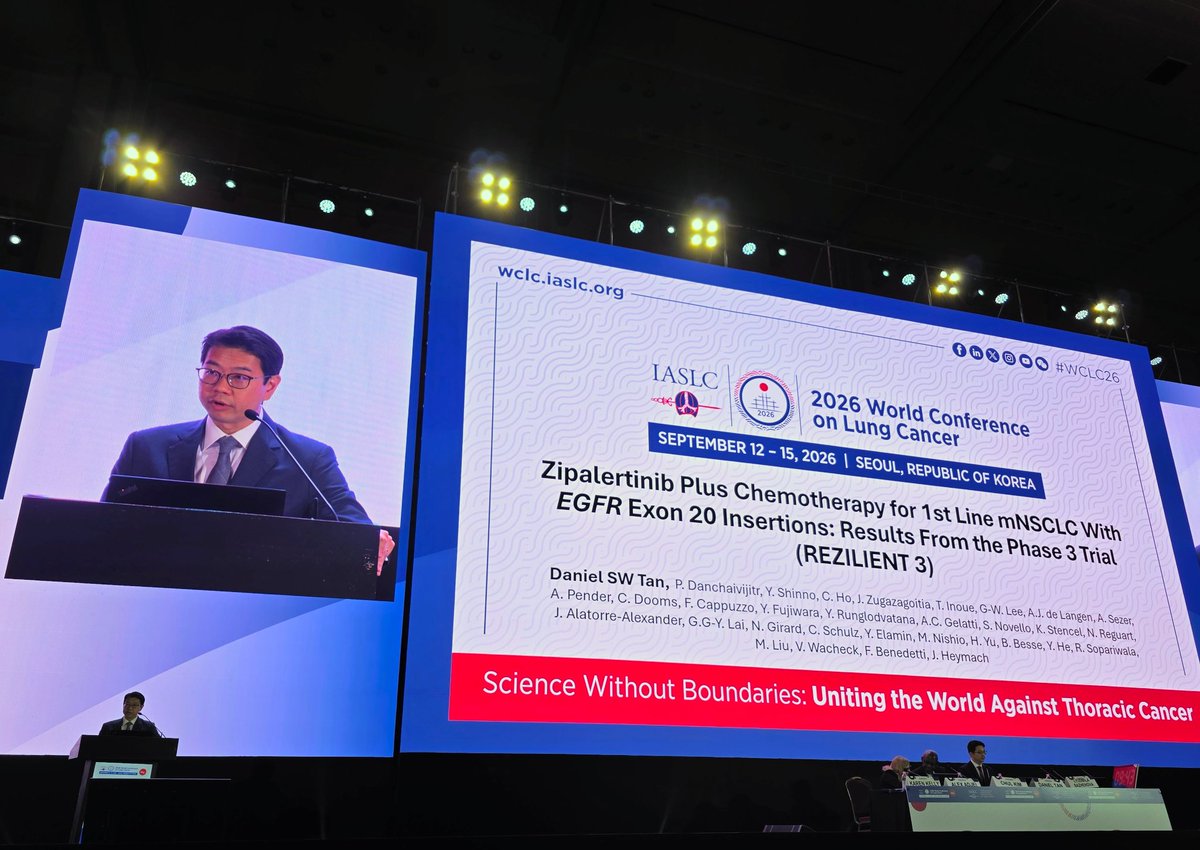
Dr. Daniel SW Tan (National Cancer Centre Singapore) presented the planned interim analysis of REZILIENT3 in plenary session PL03.04 on September 14, 2026 (data cutoff 29 May 2026, 122 PFS events). Dr. Lyudmila Bazhenova discussed the abstract alongside PAPILLON and WU-KONG 28. Physician reaction was captured live; every quote below is verbatim.
Progression-free survival (BICR) — primary endpoint MET
Zipalertinib + chemotherapy: median PFS 14.5 months (95% CI 12.9–21.4; 50 events/140 patients). Chemotherapy: 8.5 months (95% CI 7.0–10.9; 72 events/139). HR 0.50 (95% CI 0.34–0.73), P=0.00015. Superiority was claimed at the pre-specified interim (one-sided P<0.0098 boundary). (Plenary PFS slide, interim DCO 29-May-2026)
Source: Tan DSW et al., WCLC 2026 plenary PL03.04 · Taiho Oncology / Taiho Pharmaceutical / Cullinan Therapeutics press release, 13 Sep 2026Dr. @danieltanmd presents REZILIENT 3 at #WCLC26: 1L zipalertinib + chemo vs chemo in EGFR exon 20 insertion NSCLC. Superior PFS 14.5 vs 8.5m (HR 0.50) with RR 65% vs 40%. https://t.co/s3yfHfyZF8
— Stephen V Liu, MD (@StephenVLiu) 2026-09-14
Tumor response (BICR, RECIST v1.1)
ORR 65.0% (CR 6.4% + PR 58.6%; 95% CI 56.5–72.9; P<0.0001) vs 40.3% (CR 2.2% + PR 38.1%; 95% CI 32.1–48.9). Disease control 89.3% vs 81.3%; median DoR 14.2 vs 9.9 months; median time to response 1.4 vs 2.6 months. (Plenary response table, interim DCO 29-May-2026)
OS, crossover and CNS subgroup
Interim OS HR 0.72 (95% CI 0.42–1.23), ~30% mature — no significant separation to date, with 64.2% of eligible chemotherapy-arm patients crossing over to zipalertinib after BICR-confirmed progression. In patients with baseline brain metastases, PFS HR was 0.38 (95% CI 0.21–0.67) — several discussants called CNS activity the potential differentiator for this brain-penetrant TKI. (Plenary + Bazhenova discussant slides, interim DCO 29-May-2026)
#WCLC26 | REZILIENT-3 🧬 Ph3: 1L zipalertinib + platinum/pemetrexed vs chemo in metastatic NSCLC with EGFR exon20ins (n=279) 📉 PFS: 14.5 vs 8.5 mo; HR 0.50 (95% CI 0.34–0.73; p=0.00015) 🎯 ORR: 65.0% vs 40.3% (p<0.0001) ⏳ DoR: 14.2 vs 9.9 mo 🧠 Strong benefit in baseline brain mets: PFS HR 0.38 (95% CI 0.21–0.67) 📊 OS remains immature: HR 0.72 (95% CI 0.42–1.23) ↪️ 64% of eligible patients progressing on chemo crossed over to zipalertinib ⚠️ Higher toxicity with the combination: • G≥3 TRAEs: 80.7% vs 40.4% • mainly cytopenias during platinum-doublet therapy • pneumonitis: 5.7% (G≥3 2.1%)
— Masahiro TORASAWA, MD. PhD. (@M_Torasawa) 2026-09-14
Safety and the toxicity debate
Grade ≥3 adverse events occurred in 87.1% vs 54.4% of patients (all-cause), mainly cytopenias during platinum-doublet therapy (Grade ≥3 hematologic 58.6% vs 28.7%); Grade ≥3 EGFR-related toxicities in the combination arm were rash 10.7% and diarrhea 1.4%. KOLs immediately weighed the efficacy against the toxicity burden — treatment-related deaths in the combination arm and the chemotherapy-alone control arm (now a superseded standard in this setting) were the two most-cited caveats. (Taiho/Cullinan PR 13-Sep-2026; physician posts verbatim below)
Source: Taiho Oncology / Cullinan Therapeutics press release, 13 Sep 2026Dr. @danieltanmd presents ph3 REZILIENT3 zipalertinib+chemo vs chemo #WCLC26. ✅️ PFS 14.5mo vs 8.5mo (HR 0.50) ❔️ OS data remains immature ☢️ 9.3% deaths in combo arm CANNOT be overlooked An emerging frontline Rx for EGFR exon20 but aggressive toxicity mgmt will be critical https://t.co/2MHVcQyzMA
— Joshua Reuss (@Joshua_Reuss) 2026-09-14
Top KOLs Discussing REZILIENT3 and Zipalertinib


REZILIENT3 Key Slides & Visuals






Gilberto Lopes: The 1L Readout in Four Posts
Dr. Gilberto Lopes’s thread on the REZILIENT3 first-line results — the efficacy numbers, the brain-metastases subgroup, the immature OS with 64.2% crossover, and the toxicity trade-off. Verbatim, in thread order (two trailing tag-only posts omitted).
#WCLC26: REZILIENT 3 in 1L EGFR exon20+ NSCLC. Zipalertinib + chemo vs chemo: • PFS 14.5 vs 8.5 mo • HR 0.50 (95% CI 0.34–0.73) • P=0.00015 • ORR 65.0% vs 40.3% • DoR 14.2 vs 9.9 mo https://t.co/R8mphMmV0c
Baseline brain mets subgroup: PFS HR 0.38. Worth watching, but descriptive—not definitive.
OS remains immature: • HR 0.72 (95% CI 0.42–1.23) • medians not reached • follow-up 10.9 mo • 64.2% crossover to zipalertinib
Trade-off: grade ≥3 TRAEs 80.7% vs 40.4%, largely cytopenias during platinum. Bottom line: highly active 1L option, but with a substantial hematologic toxicity burden.
First-Line EGFR Exon 20 Insertion NSCLC: the Randomized Phase 3 Landscape
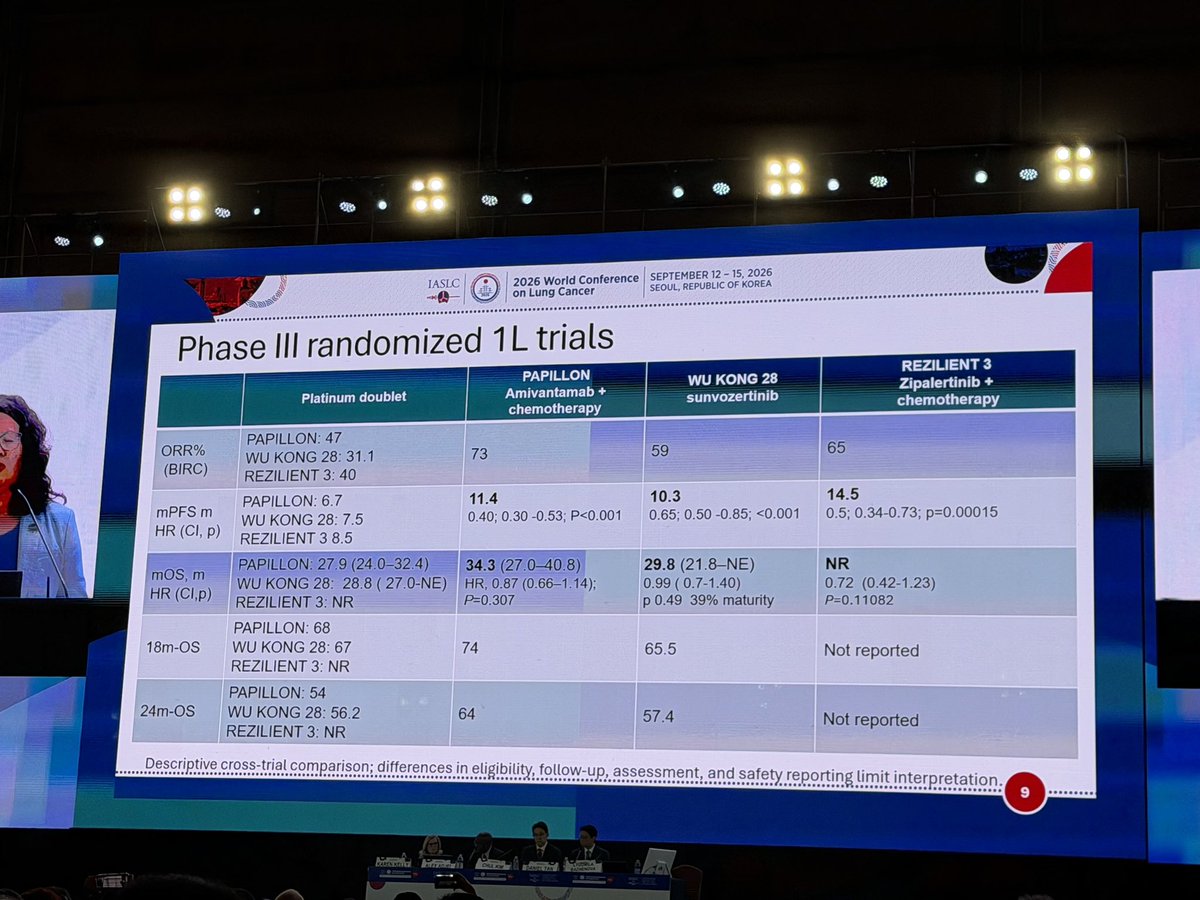
Three positive randomized Phase 3 trials now compete in first-line EGFR exon 20 insertion NSCLC. Figures are reported per trial from its primary publication or presentation — cross-trial comparison is descriptive only: the trials differ in eligibility, control-arm delivery, follow-up and assessment (the caveat carried on Dr. Bazhenova's own WCLC 2026 discussant slides).
| Trial | Regimen vs control | Median PFS | HR (95% CI) | ORR | Source |
|---|---|---|---|---|---|
| REZILIENT3 | Zipalertinib + chemo vs chemo | 14.5 vs 8.5 mo | 0.50 (0.34-0.73), P=0.00015 | 65.0% vs 40.3% (BICR) | Tan et al, WCLC 2026 plenary (interim DCO 29-May-2026) |
| PAPILLON | Amivantamab + chemo vs chemo | 11.4 vs 6.7 mo | 0.395 (0.30-0.53), P<0.001 | 73% vs 47% (BICR) | NEJM 2023;389:2039-51 |
| WU-KONG28 | Sunvozertinib vs chemo | 10.3 vs 7.5 mo | 0.65 (0.50-0.85), P=0.0008 | 58.9% vs 31.1% (confirmed, BICR) | NEJM 2026 / ASCO 2026 LBA8500 |
| EXCLAIM-2 | Mobocertinib vs chemo | 9.6 vs 9.6 mo | Did not demonstrate superiority | — | JCO 2025;43:1553-63 |
$CGEM $AVBP benchmarks in 1st-line EGFR ex20ins lung cancer https://t.co/IpSRuhfJle
— Jacob Plieth (@JacobPlieth) 2026-08-13
Top Posts on REZILIENT3 and Zipalertinib

Three positive first-line phase III trials now shape EGFR exon 20 insertion NSCLC: • PAPILLON: amivantamab + chemo • WU-KONG 28: sunvozertinib • REZILIENT 3: zipalertinib + chemo No head-to-head winner. No clear OS winner yet. https://t.co/0jo6u0aVJa
🆙#WCLC26 #LCSM Plenary Session 🔥REZILIENT3: Zipalertinib Plus Chemotherapy for 1st Line NSCLC With EGFR Exon 20 Insertions: Results From the Phase 3 Trial 🎙️ @danieltanmd 🔢PL03.04 ☑️NCT05973773 🔗 https://t.co/mYsNwaWQUZ @OncoAlert @Larvol @IASLC @EGFRResisters @Exon20Group https://t.co/y5CL5e57jr https://t.co/HbqEivMATW
🚨 Phase 3 REZILIENT3 met its primary endpoint Zipalertinib plus platinum-based chemo significantly improved PFS versus chemo alone in NSCLC with EGFR exon 20 ins mutations. 🔗 https://t.co/K5Nm8ucDjZ https://t.co/uJe1BlC0UV

$CGEM $AVBP benchmarks in 1st-line EGFR ex20ins lung cancer https://t.co/IpSRuhfJle
Press release: Phase III REZILIENT3 trial meets its primary endpoint. Adding zipalertinib to first line chemotherapy for advanced NSCLC with an EGFR exon 20 insertion mutation significantly improved PFS over chemo alone. https://t.co/057qHTZCEz https://t.co/HrcZfmeQ1B
Looking forward to updated EGFR datasets selected for plenaries at #WCLC26. 8yOS from ADAURA; OS in PAPILLON and REZILIENT 3; The EGFR ex20ins trials will be fascinating.....TKI+chemo vs bi-sp+MAb chemo https://t.co/xIa3Jaeuin
🫁 EGFR at #WCLC26: 5 trials to watch 👇 1️⃣ ADAURA | PL03.01 8-year update of adjuvant osimertinib in resected EGFR-mutant NSCLC. 🔥 How durable is the survival benefit at 8 years? 2️⃣ PAPILLON | PL03.03 Amivantamab + chemotherapy vs chemotherapy in 1L EGFR exon 20 insertion NSCLC. 🔥 Does the PFS advantage translate into an OS benefit? 3️⃣ REZILIENT 3 | PL03.04 Zipalertinib + chemotherapy vs chemotherapy in 1L EGFR exon 20 insertion NSCLC. 🔥 Could this establish another frontline standard for exon 20 disease? 4️⃣ ORIC-114 Next-generation, brain-penetrant EGFR/HER2 exon 20 inhibitor. 🔥 Can an oral TKI improve CNS control and reshape sequencing? 5️⃣ BLU-945 combinations Next-generation EGFR inhibition after progression on osimertinib. 🔥 Can we target resistant EGFR clones while sparing wild-type EGFR? Which one are you watching most closely? #LungCancer #EGFR #NSCLC #WCLC26 @IASLC @OncoAlert

🤔The myelosuppression in REZILIENT3 is strange. This is the same platinum pemetrexed chemotherapy used in PAPILLION and FLAURA-2, but with way higher adverse event profile. 1⃣ There is a high rate of Gr≥3 cytopenias in first 4 cycles within the experimental arm. This is unusual and not what I would have predicted about the zipalertinib + platinum combo. I still don't have a great theory for why this is the case. 2⃣ The most common reason drug discontinued in experimental arm was still pemetrexed (31.4%), though common reasons for discontinuation in my practice (fatigue, renal toxicity) were not listed as common AEs. 3⃣ Zipalertinib had an 80% dose reduction rate and a 17% discontinuation rate, likely related to EGFR mediated side effects (rash, paronychia). I suspect these were chronic Gr2 AEs, which is important as we think about how long term use of zipalertinib affects patient's QoL. @EGFRResisters @EgfrUk @Exon20Group @YoungLungCancer
#WCLC26 | REZILIENT-3 🧬 Ph3: 1L zipalertinib + platinum/pemetrexed vs chemo in metastatic NSCLC with EGFR exon20ins (n=279) 📉 PFS: 14.5 vs 8.5 mo; HR 0.50 (95% CI 0.34–0.73; p=0.00015) 🎯 ORR: 65.0% vs 40.3% (p<0.0001) ⏳ DoR: 14.2 vs 9.9 mo 🧠 Strong benefit in baseline brain mets: PFS HR 0.38 (95% CI 0.21–0.67) 📊 OS remains immature: HR 0.72 (95% CI 0.42–1.23) ↪️ 64% of eligible patients progressing on chemo crossed over to zipalertinib ⚠️ Higher toxicity with the combination: • G≥3 TRAEs: 80.7% vs 40.4% • mainly cytopenias during platinum-doublet therapy • pneumonitis: 5.7% (G≥3 2.1%)
4/6 ⚡ REZILIENT3 And immediately after PAPILLON comes a potential challenger: zipalertinib + chemotherapy in first-line EGFR exon20ins NSCLC. We already know from the public topline announcement: ✅ REZILIENT3 met its primary PFS endpoint. But we don’t know the numbers. At

Top 10 for #WCLC26 All interesting, esp. REZILIENT-3 At ASCO26 we saw 1L Sunvozertinib /WU-KONG 28) data, perhaps similar in activity to chemo+amivantamab (PAPILLON), different side effects Will Zipalertinib be better, equivalent or worse? We’ll find out next Monday https://t.co/ZRelC4I6ju
Key KOL Sentiments — the REZILIENT3 Readout
WCLC 2026: Live KOL Reaction
Physician posts about this trial captured live during the IASLC 2026 World Conference on Lung Cancer (Seoul, September 12–15). Quotes are verbatim; each card links to the original post. Last updated 2026-09-15.
😈To play devils advocate, I think FLAURA2 (for sensitizing EGFR mutations), PAPILLION, and REZILIENT3 all point towards the importance of upfront chemotherapy with EGFR inhibition. 💭My thought is that #EGFR lung cancers (esp Exon 20) really do need intensification upfront. @EGFRResisters @EgfrUk

#WCLC26 Presidential Symposium Day 2 🎯REZILIENT 3: First line #Zipalertinib + platinum/pemetrexed vs chemo for #EGFR20 ins NSCLC 🎙️dukenus 💊 100mg bid ▶️ PFS: 14.5 vs 8.5 mo (HR 0.50 ) ▶️ ORR: 65% vs 40.3% ▶️ DoR: 14.2 vs 9.9 mo 🧠Brain mets: PFS HR 0.38 - but limited cohort 📈Interim OS: HR 0.72 (30% maturity) ⚠️chemo toxicity , rash, GI 👉🏽👉🏽toxicity of adding chemo may not be warranted w this active drug, competes w amivantamab and sunvozertinib #LungCancer #NSCLC #EGFRex20ins @Exon20Group
🆙#WCLC26 #LCSM Plenary Session 🔥REZILIENT3: Zipalertinib Plus Chemotherapy for 1st Line NSCLC With EGFR Exon 20 Insertions: Results From the Phase 3 Trial 🎙️ @danieltanmd 🔢PL03.04 ☑️NCT05973773 🔗 https://t.co/mYsNwaWQUZ @OncoAlert @Larvol @IASLC @EGFRResisters @Exon20Group https://t.co/HbqEivMATW

EGFR exon 20 insertion lung cancer has historically been difficult to treat. Phase III REZILIENT3 shows meaningful progress with zipalertinib plus chemotherapy, significantly extending PFS versus chemotherapy alone. The lesson is simple EGFR positive is not enough. The exact mutation matters. Find the mutation. Understand the biology. Target the vulnerability. Precision oncology keeps getting more precise. Educational information only.
#WCLC26 Presidential Symposium Day 2 🎯REZILIENT 3: First line #Zipalertinib + platinum/pemetrexed vs chemo for #EGFR20 ins NSCLC 🎙️dukenus 💊 100mg bid ▶️ PFS: 14.5 vs 8.5 mo (HR 0.50 ) ▶️ ORR: 65% vs 40.3% ▶️ DoR: 14.2 vs 9.9 mo 🧠Brain mets: PFS HR 0.38 - but limited cohort 📈Interim OS: HR 0.72 (30% maturity) ⚠️chemo toxicity , rash, GI 👉🏽👉🏽toxicity of adding chemo may not be warranted w this active drug, competes w amivantamab and sunbozertinib #LungCancer #NSCLC #EGFRex20ins @Exon20Group
REZILIENT3 FAQ
What were the REZILIENT3 results at WCLC 2026?
At the planned interim analysis (data cutoff May 29, 2026; 122 PFS events), first-line zipalertinib plus platinum-pemetrexed improved median progression-free survival to 14.5 months versus 8.5 months with chemotherapy alone (HR 0.50; 95% CI 0.34-0.73; P=0.00015). Confirmed objective response rate was 65.0% versus 40.3% (P<0.0001) and median duration of response 14.2 versus 9.9 months. Results were presented by Dr. Daniel SW Tan in the WCLC 2026 plenary (PL03.04) in Seoul on September 14, 2026.
Did REZILIENT3 improve overall survival?
Overall survival is immature. The interim OS hazard ratio was 0.72 (95% CI 0.42-1.23) at approximately 30% maturity - not statistically significant - and 64.2% of eligible chemotherapy-arm patients crossed over to zipalertinib at progression, which will dilute any future OS separation. Longer follow-up is required.
Is zipalertinib FDA approved?
No. Zipalertinib is investigational and has not been approved by any health authority. It is an oral, irreversible, mutant-selective EGFR tyrosine kinase inhibitor (formerly CLN-081 / TAS6417) developed by Taiho Pharmaceutical with Cullinan Therapeutics. Following the WCLC 2026 interim analysis, the sponsors said they plan to pursue US regulatory approval for the first-line combination pending FDA discussions - a stated intention, not a submission or an approval.
How does REZILIENT3 compare with PAPILLON and WU-KONG28?
All three are positive randomized Phase 3 trials in first-line EGFR exon 20 insertion NSCLC, but cross-trial comparison is descriptive only. REZILIENT3 reported median PFS 14.5 vs 8.5 months (HR 0.50); PAPILLON (amivantamab + chemotherapy, FDA-approved in this setting) reported 11.4 vs 6.7 months (HR 0.395); WU-KONG28 (sunvozertinib) reported 10.3 vs 7.5 months (HR 0.65). In the WCLC 2026 discussant analysis, CNS metastases subgroups differed: REZILIENT3 PFS HR 0.38 in patients with brain metastases versus PAPILLON HR 0.63 and WU-KONG 28 HR 0.96 - exploratory data only.
How toxic is the zipalertinib-chemotherapy combination?
Grade >=3 adverse events occurred in 87.1% of combination-arm patients versus 54.4% with chemotherapy alone (all-cause), driven largely by hematologic toxicity during platinum-doublet therapy (Grade >=3 hematologic 58.6% vs 28.7%). Grade >=3 EGFR-related toxicities in the combination arm were infrequent (rash 10.7%, diarrhea 1.4%). Physicians reacting at WCLC 2026 flagged dose reductions, treatment-related deaths and overall toxicity burden as the key trade-off against the PFS benefit.
REZILIENT3 and Zipalertinib in the News
About the REZILIENT3 Trial
EGFR exon 20 insertion mutations account for a small minority of EGFR-mutant non-small cell lung cancer and have historically been insensitive to the classical EGFR tyrosine kinase inhibitors used for exon 19 deletions and L858R. Until amivantamab plus chemotherapy was established in the first-line setting by PAPILLON, platinum-doublet chemotherapy alone was the standard of care.
Zipalertinib (formerly CLN-081 / TAS6417) is an oral, irreversible, mutant-selective EGFR tyrosine kinase inhibitor built on a pyrrolopyrimidine scaffold designed to hit exon 20 insertion variants while relatively sparing wild-type EGFR. REZILIENT3 is the confirmatory Phase 3 study that moves it into the first-line setting, layered onto platinum-pemetrexed chemotherapy rather than replacing it.
The trial announced a positive topline on August 12, 2026 (endpoint met, no figures), and the full interim analysis was presented one month later in the WCLC 2026 presidential plenary in Seoul — the numbers on this page come from that presentation and the sponsors' September 13, 2026 data release.
REZILIENT3 Methodology
Study Design
Randomized, controlled, open-label, global multi-centre Phase 3 with a 6-patient safety lead-in (Part A) and a randomized Part B across 122 clinical sites. (WCLC 2026 design slide; ClinicalTrials.gov)
Population
Previously untreated locally advanced or metastatic non-squamous NSCLC with locally tested EGFR exon 20 insertion; ECOG PS 0–1; stable brain metastases permitted (~31% per arm at baseline). 285 enrolled; 279 randomized. (WCLC 2026 plenary; ClinicalTrials.gov)
Interventions
Zipalertinib 100 mg orally twice daily plus pemetrexed and carboplatin or cisplatin (21-day cycles, platinum up to 4 cycles) versus pemetrexed and platinum alone, randomized 1:1. (WCLC 2026 design slide)
Endpoints
Primary: PFS by blinded independent central review per RECIST v1.1. Secondary: OS, investigator PFS, ORR, DoR, safety and PROs. (WCLC 2026 design slide; ClinicalTrials.gov)
Statistics & interim
Primary analysis planned at 162 PFS events to detect HR 0.60 (2-sided α 0.05, 90% power); pre-specified interim at 122 PFS events (data cutoff May 29, 2026) with superiority claimed at one-sided P<0.0098 — the boundary this readout crossed. (WCLC 2026 design slide)
Crossover & sponsors
Chemotherapy-arm patients with BICR-confirmed progression could cross over to zipalertinib (64.2% of eligible patients did). Sponsor: Taiho Oncology / Taiho Pharmaceutical, developing zipalertinib with Cullinan Therapeutics. (WCLC 2026 plenary; ClinicalTrials.gov)