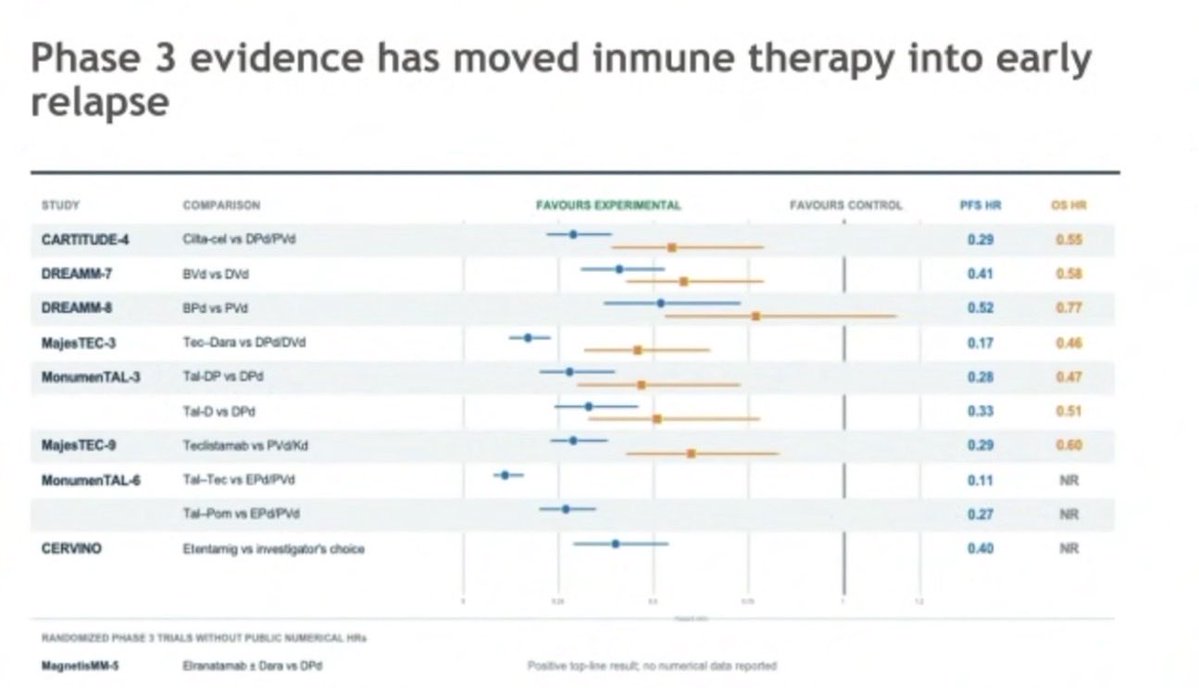
CERVINO Key Takeaways
Design
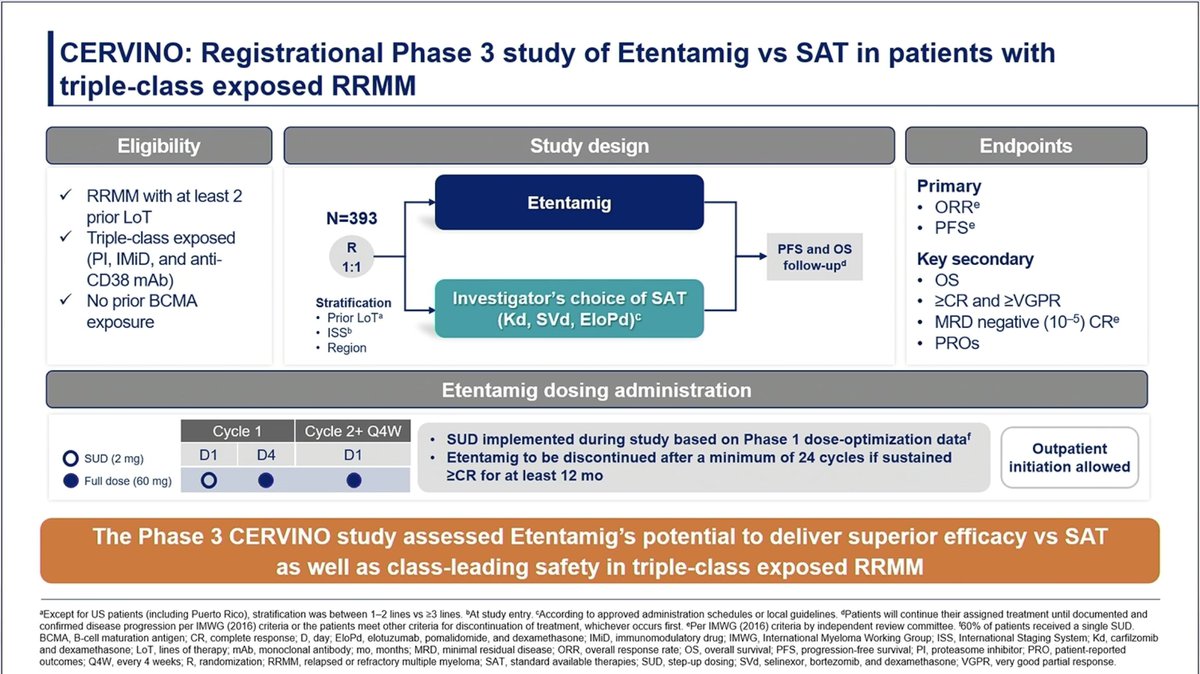
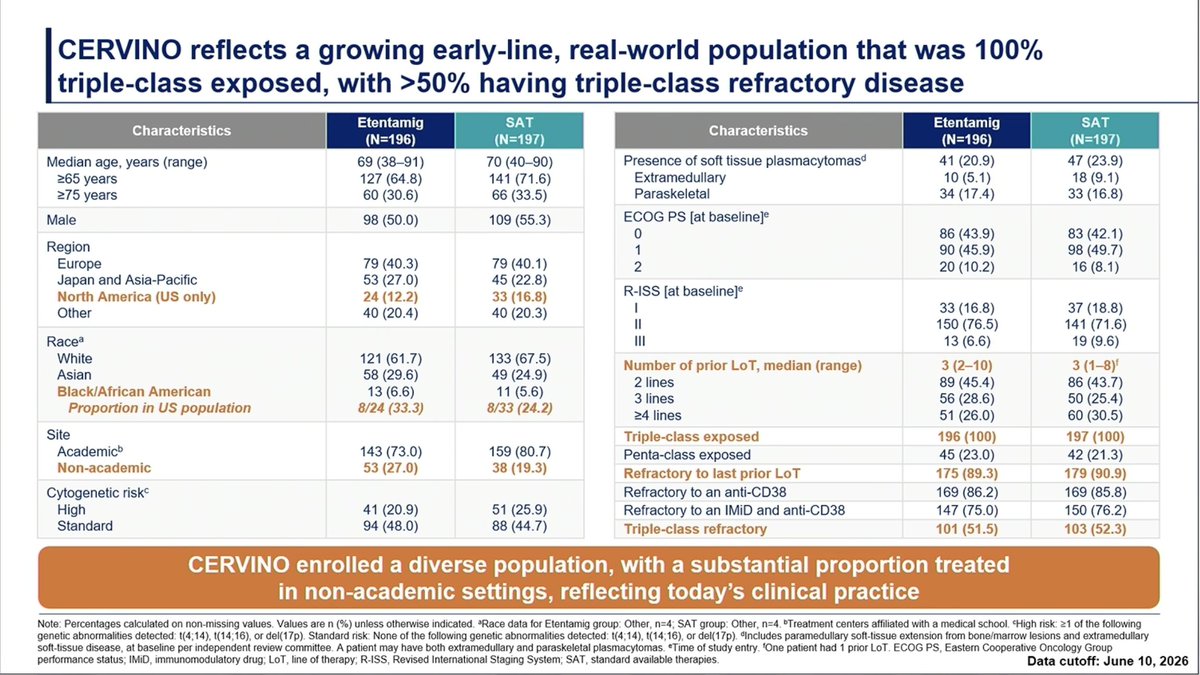
Global, Phase 3, multicenter, randomized, open-label: etentamig monotherapy (IV every 4 weeks from initiation, after a single step-up dose) versus investigator’s choice of standard available therapies, in adults with relapsed/refractory multiple myeloma after ≥2 prior lines including a proteasome inhibitor, an immunomodulatory drug, and an anti-CD38 antibody. Prior BCMA-targeted therapy excluded; ECOG ≤2. 393 patients at data cutoff; median 3 prior lines. ClinicalTrials.gov NCT06158841
Result — topline Sept 3, full data at IMS26 plenary Sept 25, 2026
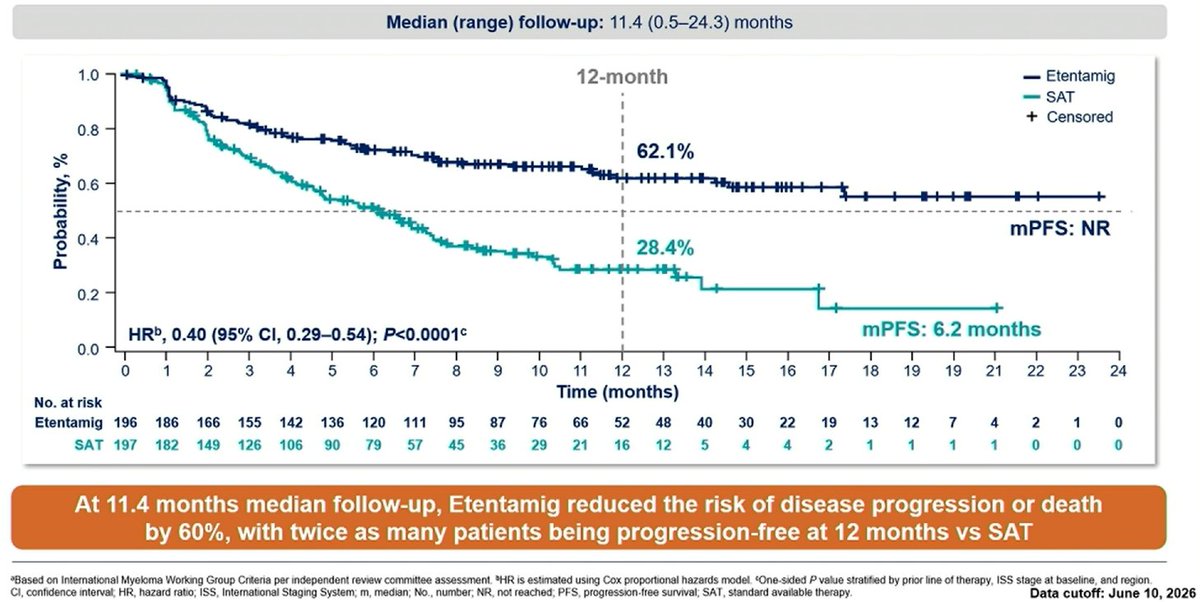
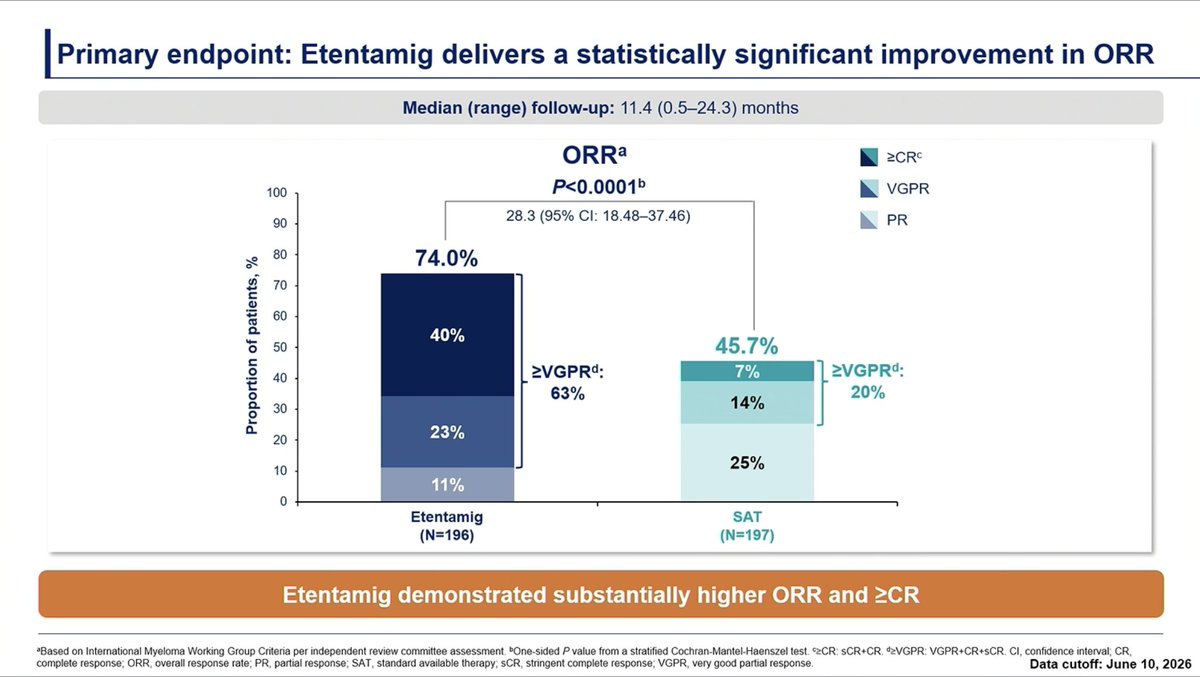
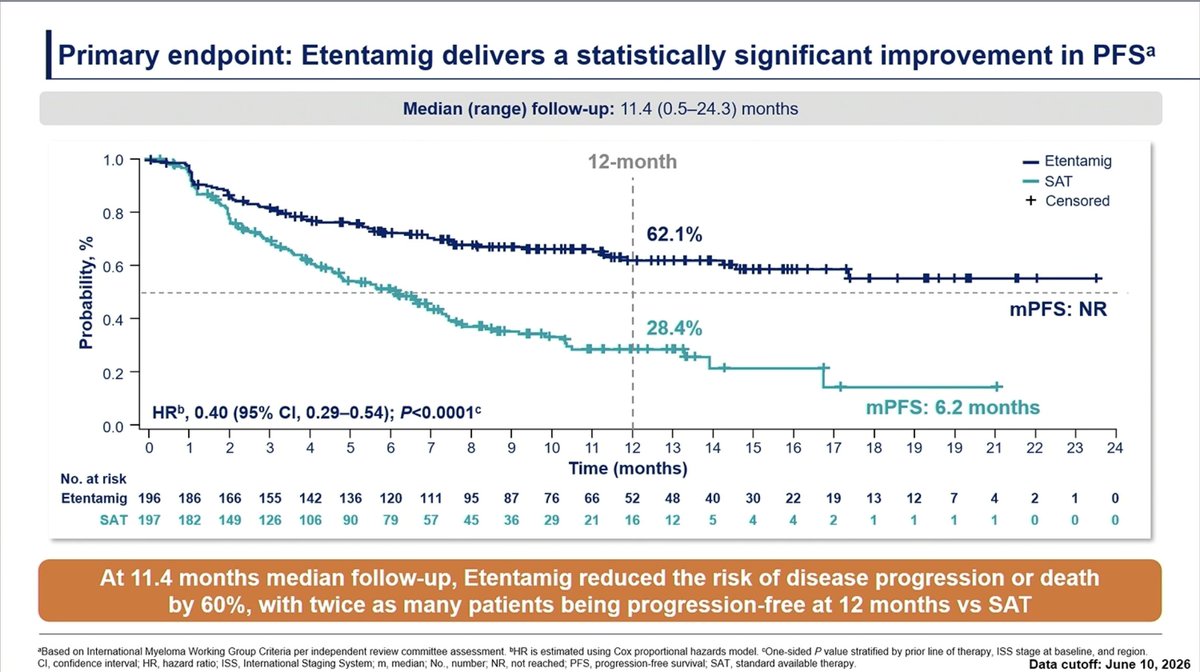
Dual primary endpoints met at the first planned efficacy interim analysis (median follow-up 11.4 months, data cutoff June 10, 2026); the Independent Data Monitoring Committee recommended unblinding. ORR 74.0% (95% CI 67.25–79.97) vs 45.7% (38.59–52.91), p<0.0001. PFS HR 0.40 (95% CI 0.29–0.54), p<0.0001, consistent across pre-specified subgroups — median PFS not reached vs 6.2 months. AbbVie topline announcement · Full plenary data →
Overall survival — immature
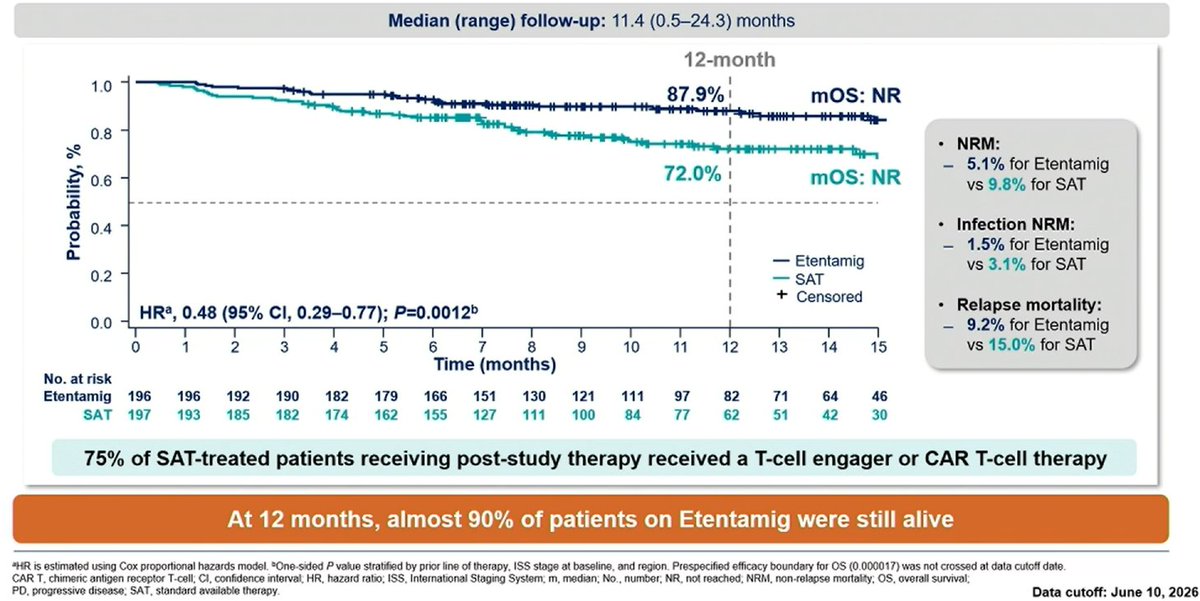
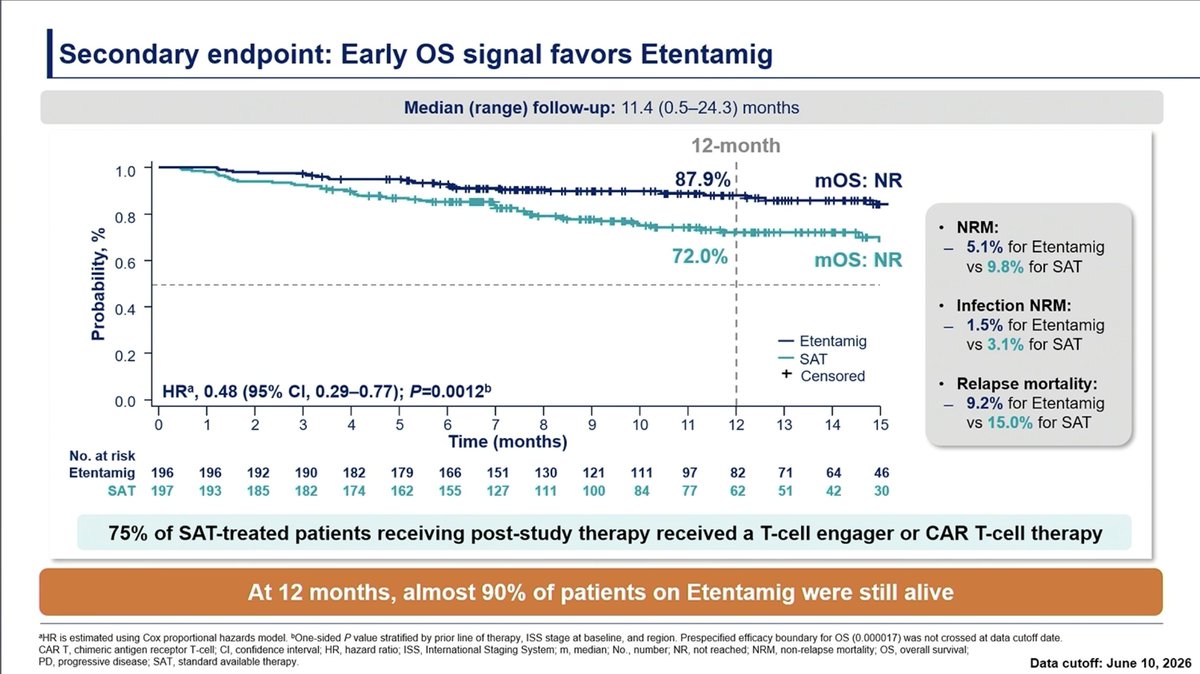
12-month OS 87.9% vs 72.0% (HR 0.48; 95% CI 0.29–0.77; nominal p=0.0012) — the pre-specified efficacy boundary for OS was not crossed at this data cutoff. (AbbVie press release, Sept 3, 2026.)
Regulatory
⚠ Etentamig is investigational and not approved by any regulatory authority. Presented at the plenary session, 23rd International Myeloma Society Annual Meeting, Sept 25, 2026, Glasgow.
IMS26 Plenary — September 25, 2026
Primary endpoints, presented
ORR 74.0% vs 45.7% (difference 28.3%, 95% CI 18.48–37.46; P<0.0001); ≥CR 40% vs 7%, ≥VGPR 63% vs 20%. Median PFS not reached with etentamig vs 6.2 months with SAT (HR 0.40, 95% CI 0.29–0.54; P<0.0001); 12-month PFS 62.1% vs 28.4%. Median follow-up 11.4 months (data cutoff June 10, 2026).
Source: Dr. Samer Al Hadidi, live from the IMS26 plenary, Sept 25, 2026
Duration of response, MRD & overall survival
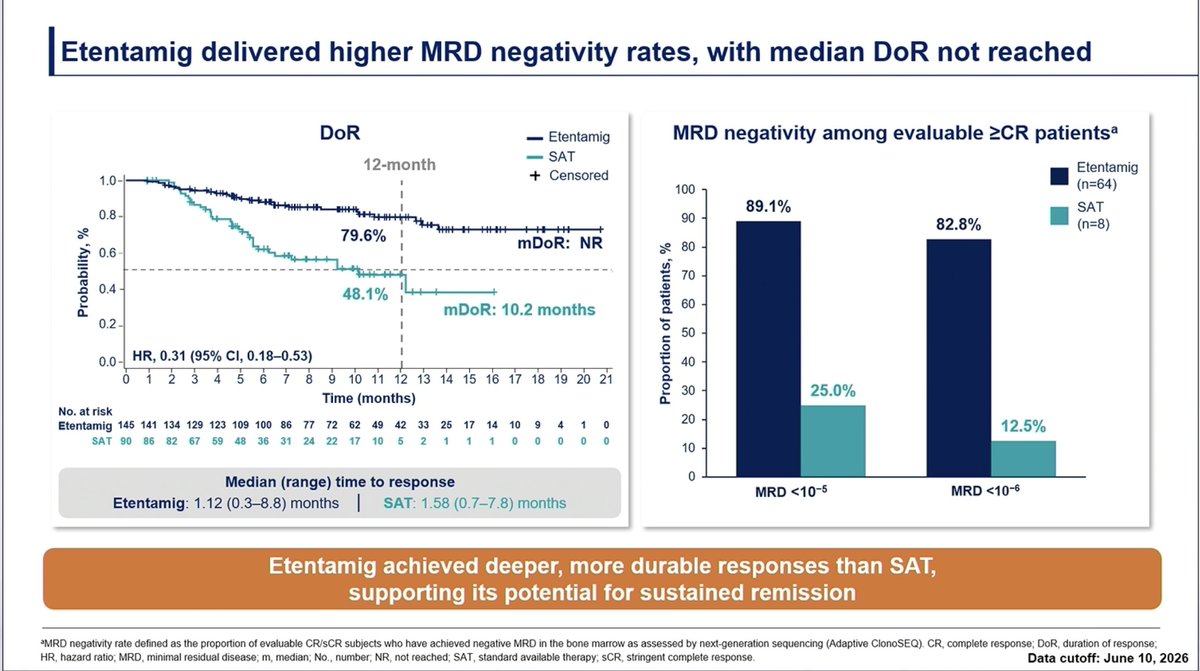
Median DoR not reached with etentamig vs 10.2 months with SAT (HR 0.31); 12-month DoR 79.6% vs 48.1%. MRD negativity among ≥CR patients: 89.1% vs 25.0% at 10-5, 82.8% vs 12.5% at 10-6. Early OS signal: 12-month OS 87.9% vs 72.0% (HR 0.48, 95% CI 0.29–0.77; nominal P=0.0012) — the pre-specified OS efficacy boundary (P=0.000017) was not crossed, so OS remains immature. Non-relapse mortality 5.1% vs 9.8%.
Safety, in full
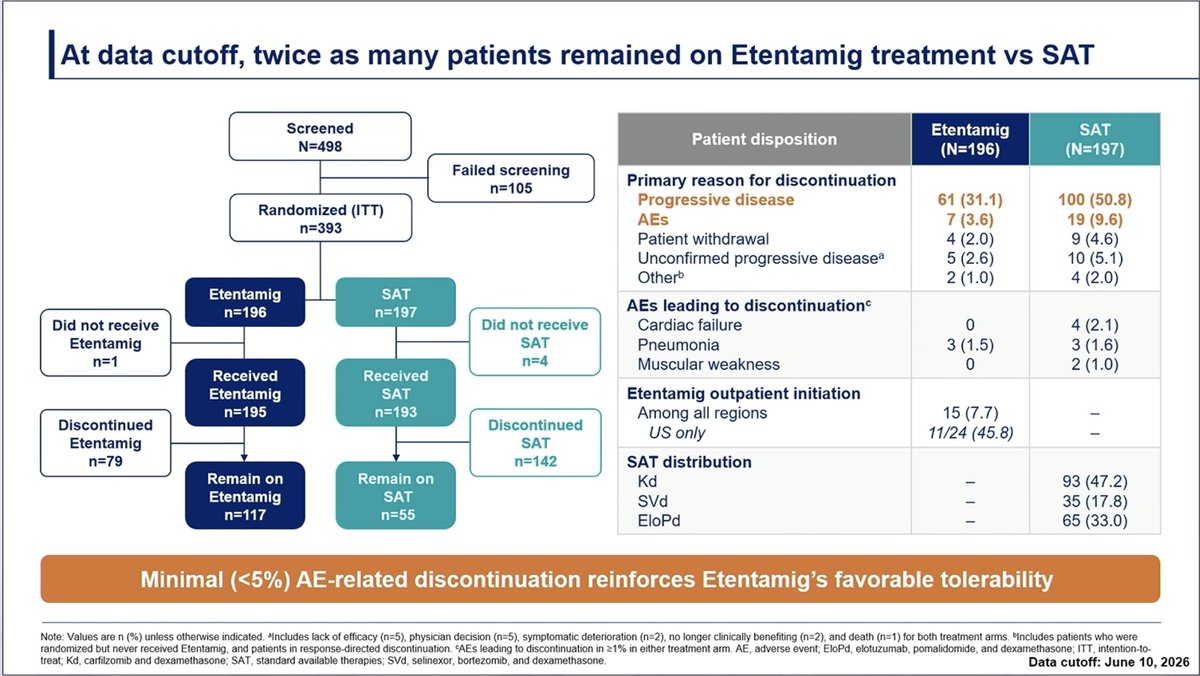
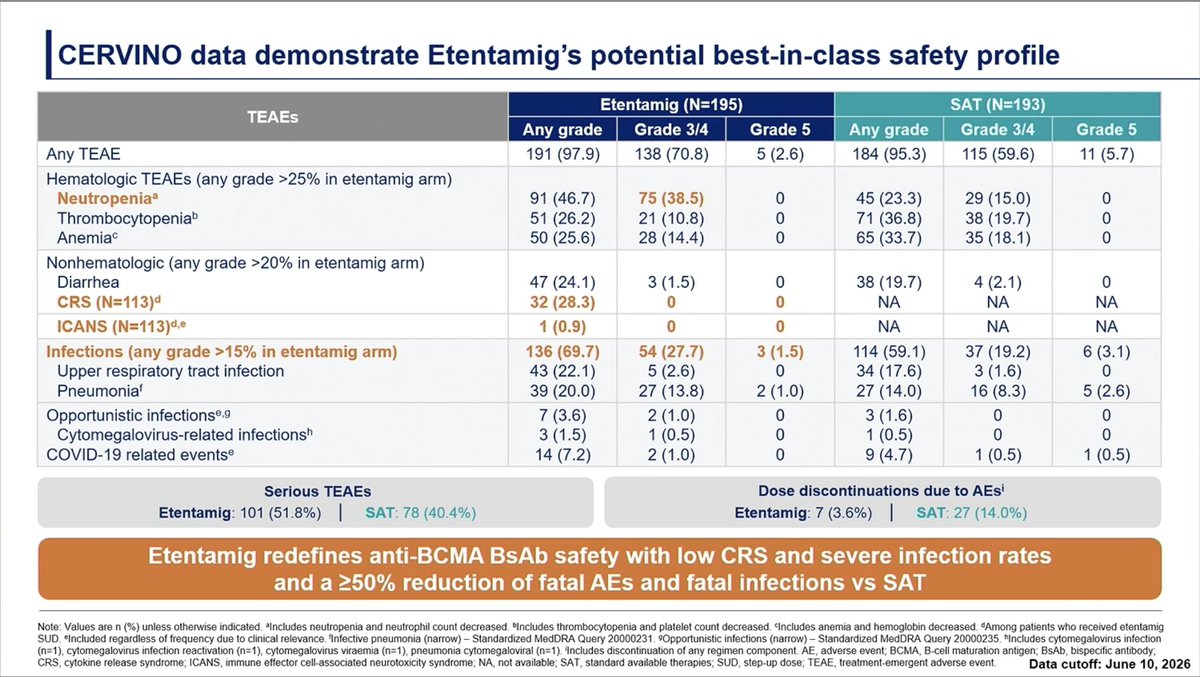
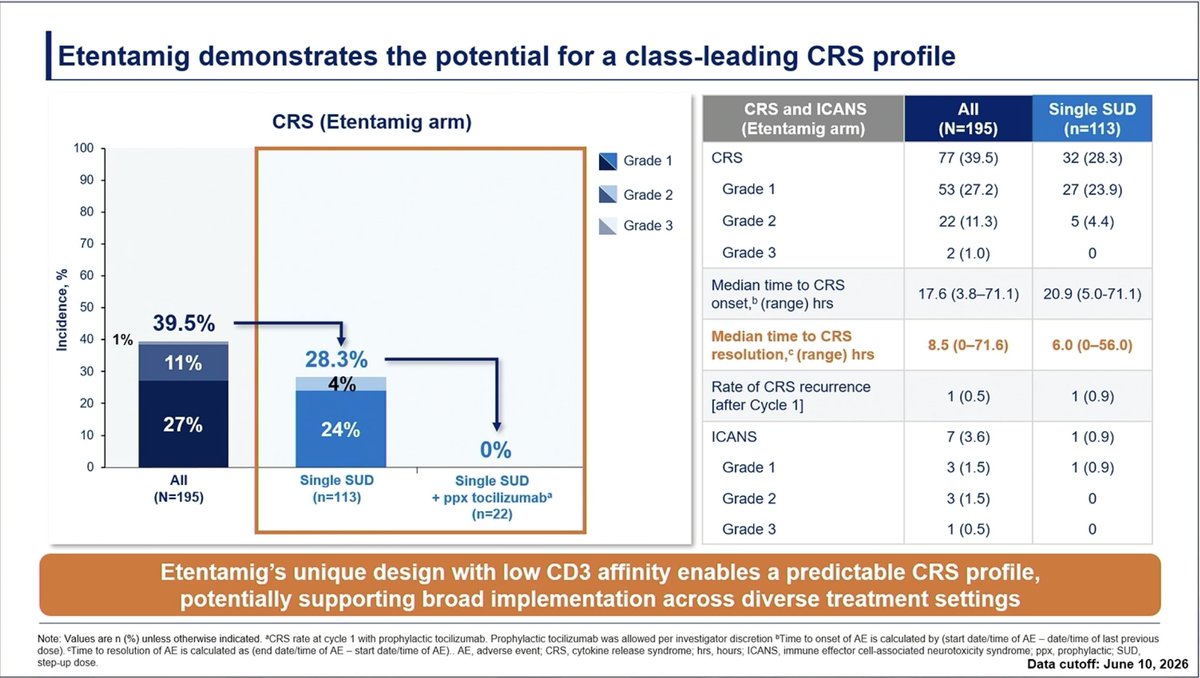
Grade 5 (fatal) TEAEs 2.6% vs 5.7%. CRS was 39.5% across all etentamig-treated patients, 28.3% among single-step-up-dose recipients (n=113, no grade ≥3), and 0% among the subset who also received prophylactic tocilizumab (n=22). ICANS 3.6% (0.9% with single step-up dose). Infections (any grade) 69.7% vs 59.1%; dose discontinuation for AEs 3.6% vs 14.0%.
From the sponsor
AbbVie Oncology Medical Affairs: “Happening now at #IMS26 plenary session, Dr. Peter Voorhees presents the first efficacy and safety
results from phase 3 CERVINO study in relapsed or refractory multiple myeloma (RRMM).
#MultipleMyeloma #RRMM
View the IMS program here: https://t.co/bnTtnqlXZz https://t.co/cu6sjRvH1A”
@AbbVieUSOncMed, IMS26, Sept 25, 2026
Plenary slide deck — live-tweeted by Dr. Samer Al Hadidi (@HadidiSamer)





How KOLs reacted, live from the plenary floor

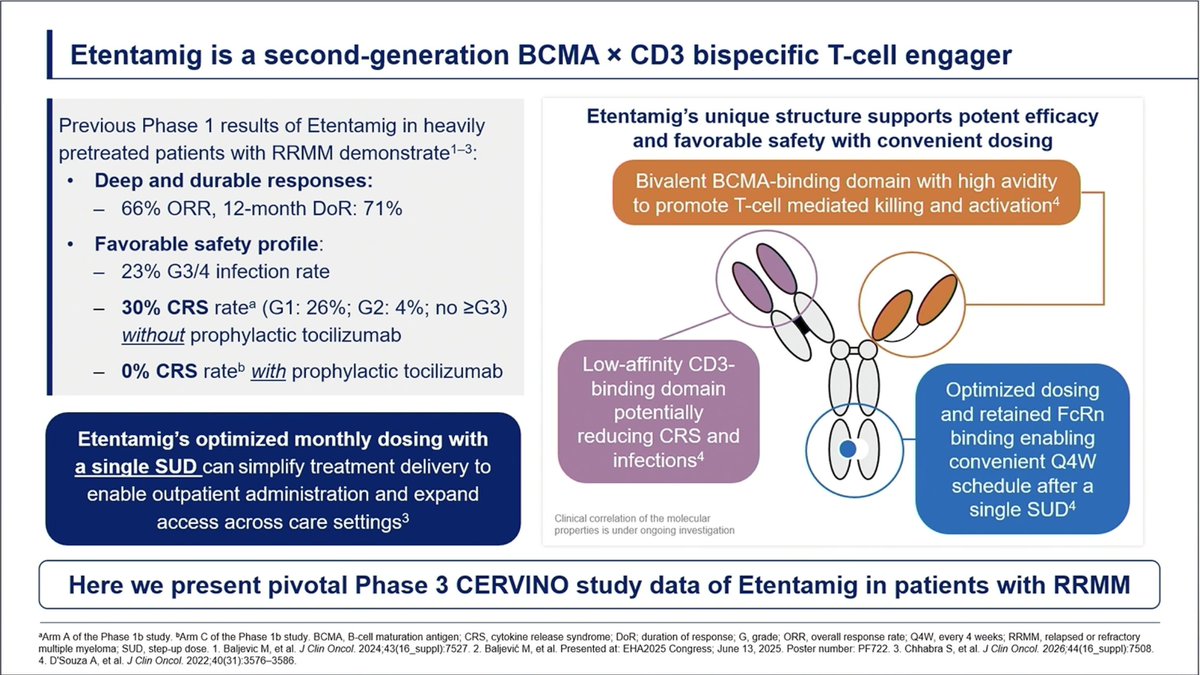
First RCT results of Etentamig (BCMA bispecifc antibody) presented at Plenary Session #IMS26 @Myeloma_Society @PlasmaCellPete @myelomaMD 60 mg fixed dose every 4 weeks makes this the easiest bispecific to administer. Impressive PFS benefit in relapsed refractory myeloma with at least 2 prior lines of therapy. See thread for more details.

#IMS26 CERVINO plenary (pronounced 🪑 + 🇪🇸 🍷) by @PlasmaCellPete - Part 2. PPx toci is very clearly the way to go with any BsAb, and here it works quite well. Etentamig has low CD3 affinity like Velcro for T cells (credit @myelomatips ), which may explain part of this. https://t.co/cwkTM8opZO
#IMS26 CERVINO plenary (pronounced 🪑 + 🇪🇸 🍷) by @PlasmaCellPete Excellent results for BCMA BsAb therapy in early lines of R/R myeloma, this time with etentamig. It turns out we may be able to get to Q4W BsAb dosing as soon as C2D1! https://t.co/iUdr4jmZTn

Impressive safety; tolerability while maintaining efficacy for BCMA directed bispecifics. Congratulations @PlasmaCellPete and the CERVINO team ! https://t.co/qKgIj04y92

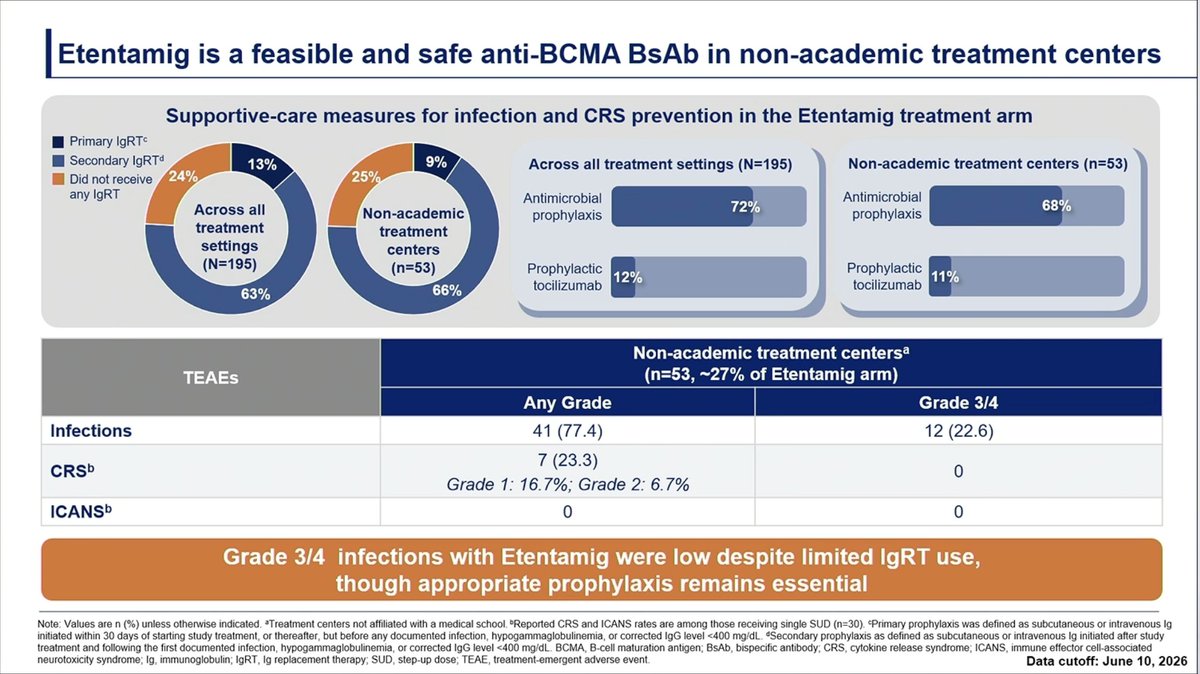
#IMS26 Plenary presentation for CERVINO demonstrates clear superiority of TCEs over SOC! 👏👏@PlasmaCellPete @myelomaMD et al. 12-mo PFS of 62.1% with Etentamig vs. 28.4% with control (Kd, SVd, EloPd) OS showing encouraging trend as well! Surely no more non TCE control arms in this setting going forward! What’s different with Etentamig vs. other BCMA bispecifics: Etentamig with its silenced fc tail offers longer administration intervals and lower CRS rates from lower CD3-binding affinity Prophylactic toci is the way to go! Key for community uptake

Dr Peter Voorhees presenting phase 3 CERVINO at #IMS26: etentamig, a monthly BCMA×CD3 bispecific, versus investigator’s choice of Kd, SVd or EloPd (n= 393) with triple-class-exposed, BCMA-naïve RRMM. Median 3 prior lines; over half triple-class refractory. 🧵 @Myeloma_Society https://t.co/Ww2j52yuCK

Congratulations to the CERVINO team! Great agents with lower toxicity and more convenient for pts. Also great trial design with an ability to stop after 24 months if sustained cr > 12 months #IMS26

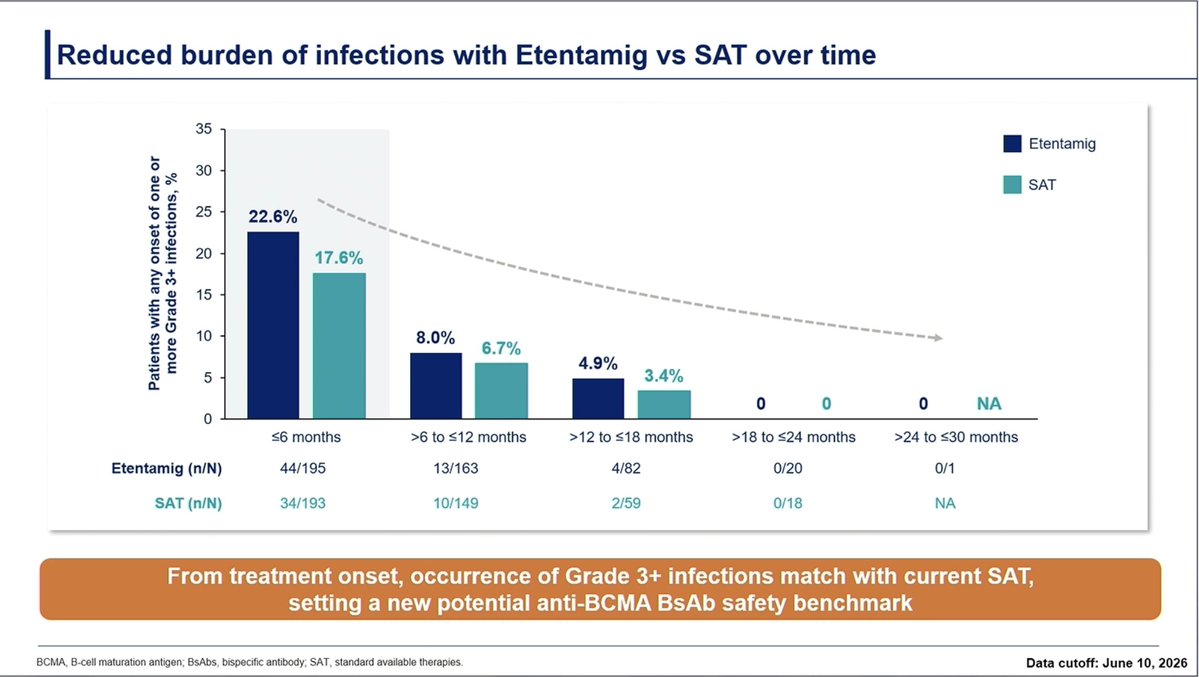
CERVINO (Etentamig Phase 3) @PlasmaCellPete on 🎯#IMS26: CERVINO Ph3: Etentamig superior to SAT (EPD, SVD, KD) in heavily pre-treated triple-class exposed RRMM 💡ORR 74% vs 45%, PFS at 12m NR (60%) vs 6m, OS benefit signal despite many SAT pts receiving TCRT at relapse 💡CRS 28% with SUD, 0% rates with ppx toci!! 💡Severe Infections were 28% despite many pts not receiving IVIG #MultipleMyeloma #MMsm #BCMA @Myeloma_Society
The CERVINO trial met all primary endpoints: - ORR: 74.0% vs 45.7% - ≥CR: 40% vs 7% - PFS: HR 0.40 - 12-month PFS: 62.1% vs 28.4% The PFS benefit was consistent across prespecified subgroups. Impressive efficacy in a heavily pretreated population! 👏 @Myeloma_Society #IMS26 https://t.co/czBBgYIEhH

#LBA-01 CERVINO (Ph3): Etentamig vs investigator-choice SAT in triple-class exposed, BCMA-naive RRMM (n=393). ORR 74% vs 46% (P<0.0001). PFS HR 0.40, median NR vs 6.2mo. 12-mo OS 87.9% vs 72% (early signal). CRS 39.5%, mostly low-grade. #mmsm #IMS2026
Responses also appeared deeper and more durable: - 12-month DoR was 79.6% vs 48.1%, while median DoR was not reached with etentamig. - Among evaluable patients achieving ≥CR, MRD negativity reached 89.1% at 10-5 and 82.8% at 10-5. - Early OS signal also favoured etentamig. #IMS26 @Myeloma_Society
Of note, I think it such a practical and modern design is most appropriate: - Monthly dosing from the start - Outpatient initiation allowed - Inclusion of non-academic centres from inception - Option to stop after 24 cycles for patients sustaining ≥CR for at least 12 months Definitely one to follow! ⚡️ #IMS26 @Myeloma_Society
@Myeloma_Society Safety and TEAEs profile are also reassuring: - Single step-up dose: 28.3% CRS, mostly grade 1; no grade ≥3 - ICANS: 0.9% - Grade 3/4 infections: 27.7% vs 19.2% - Grade 5 infections: 1.5% vs 3.1% - AE-related discontinuation: 3.6% vs 9.6% https://t.co/FI1smEdiEa