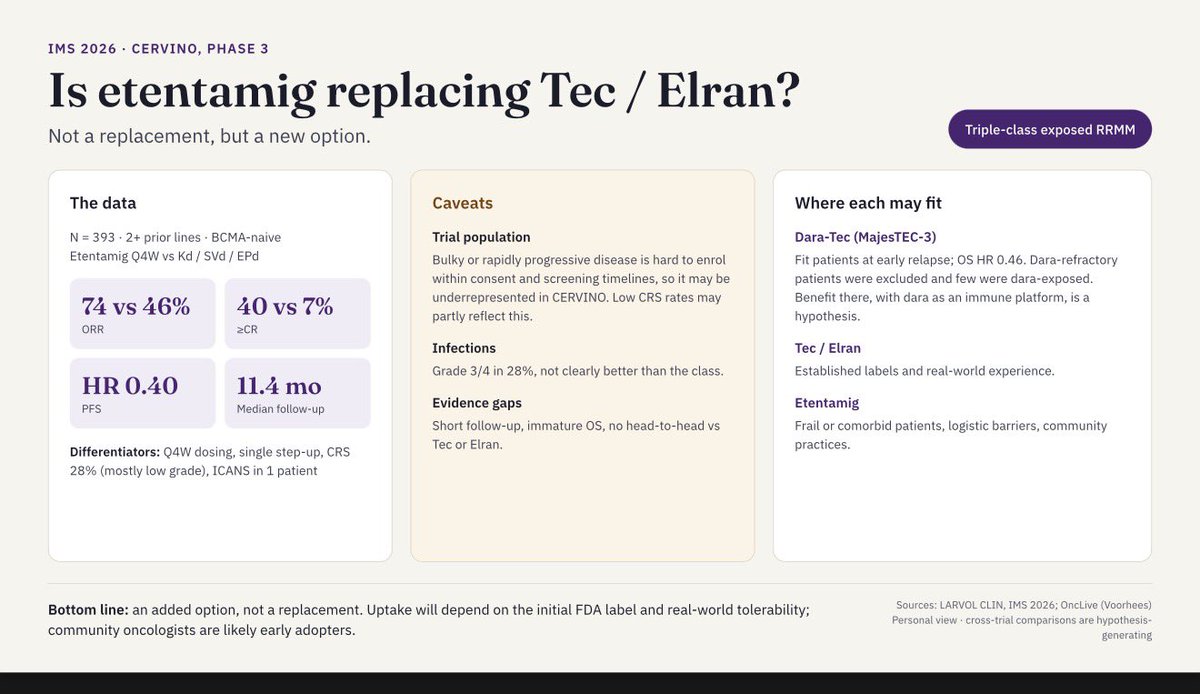



 Sep 25
CERVINO
#IMS26 #mmsm Plenary
CERVINO
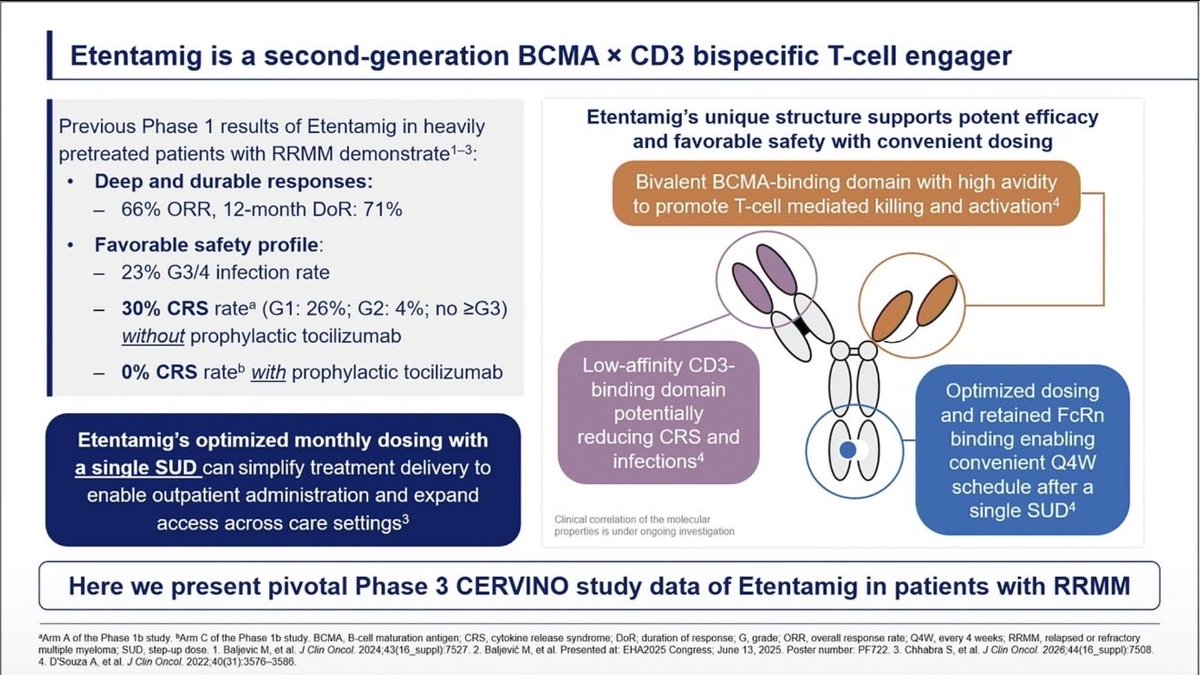
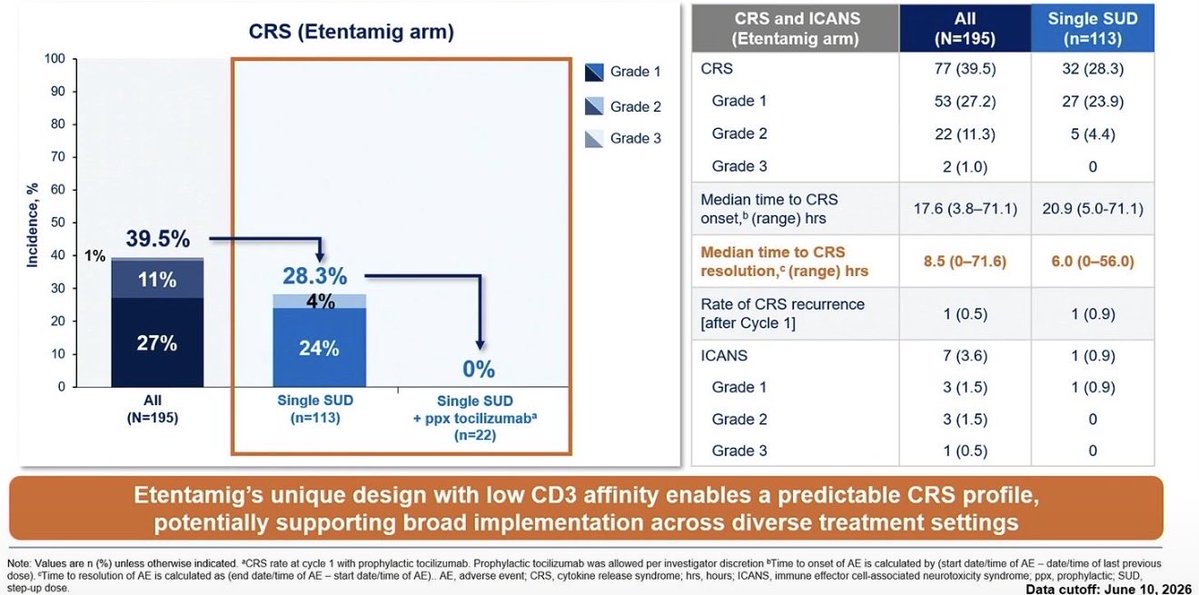
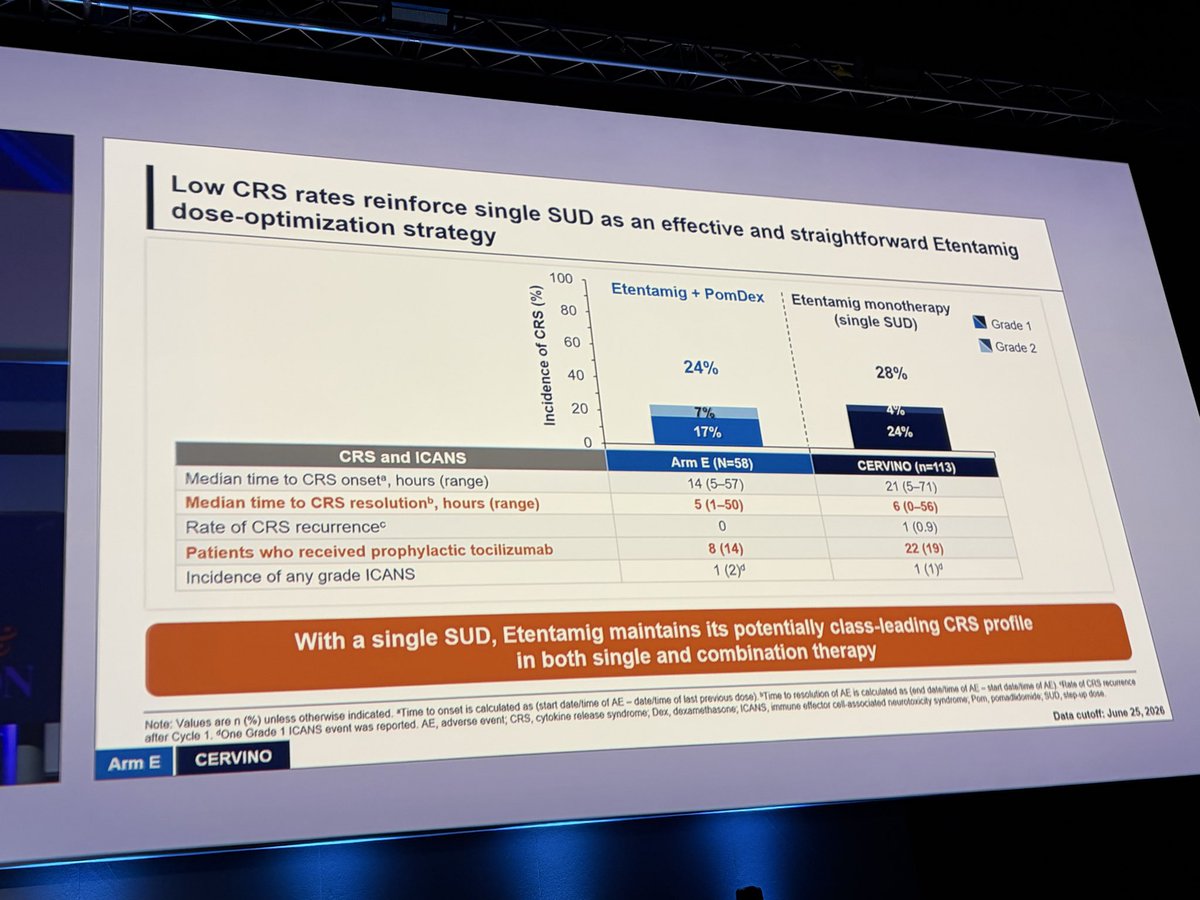
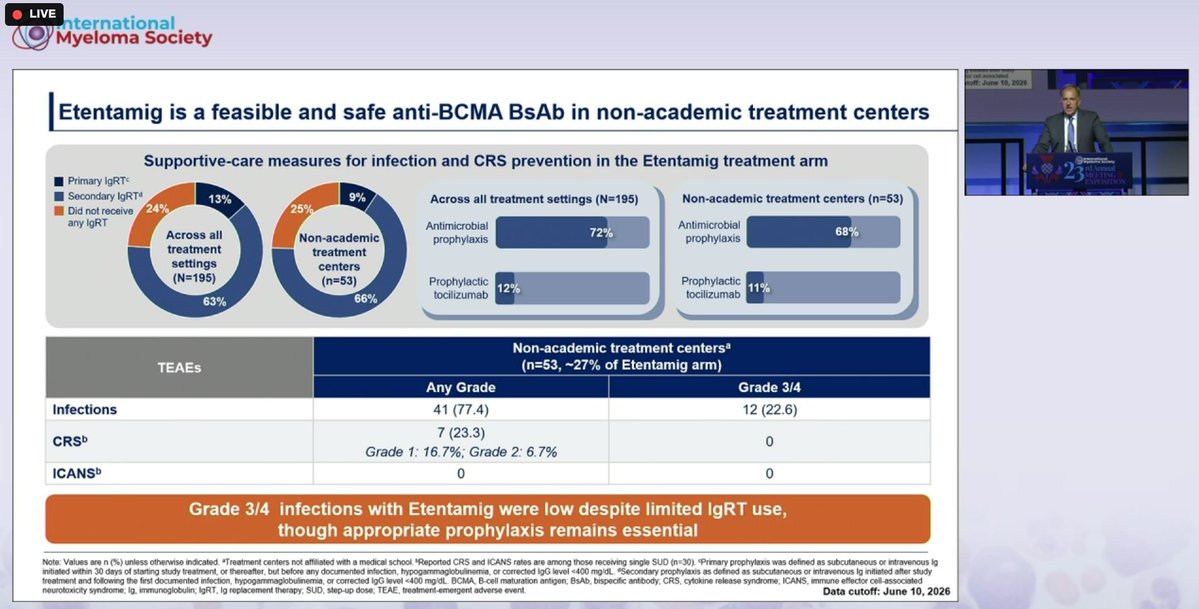
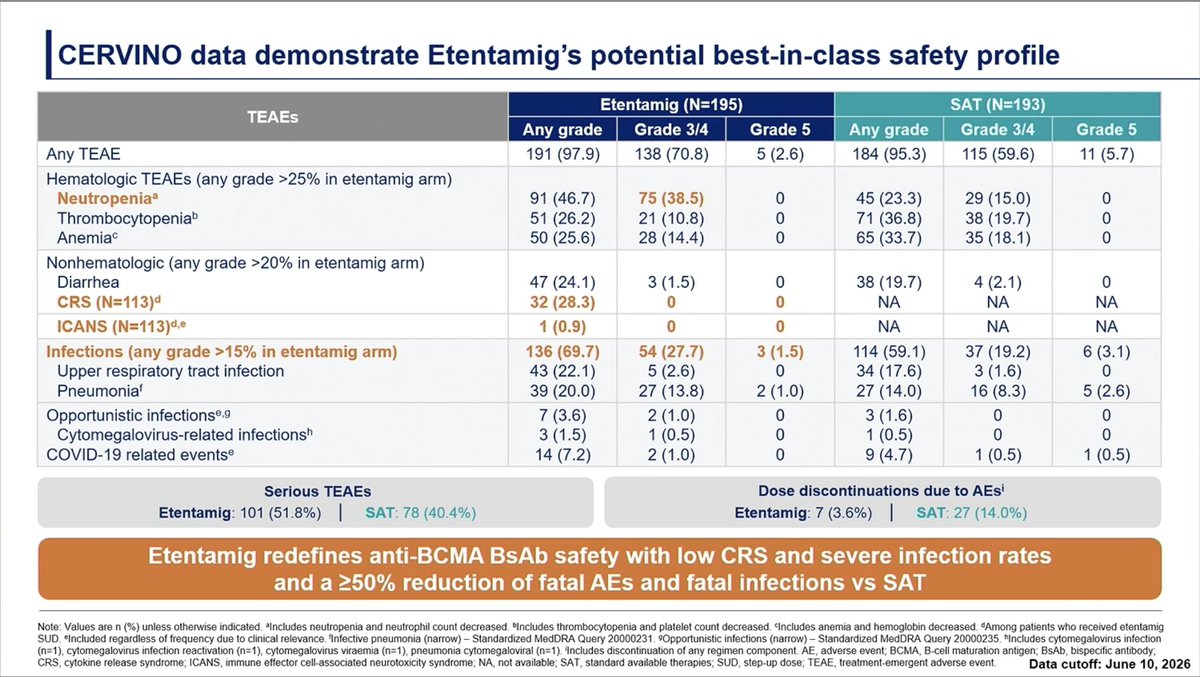
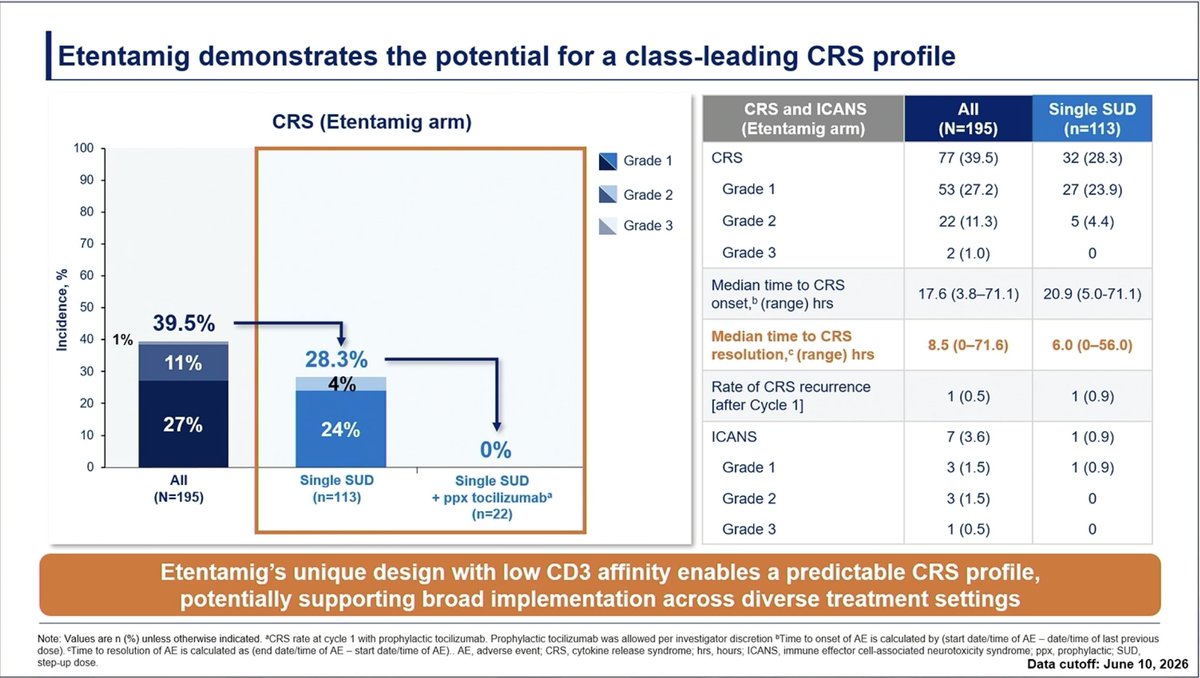
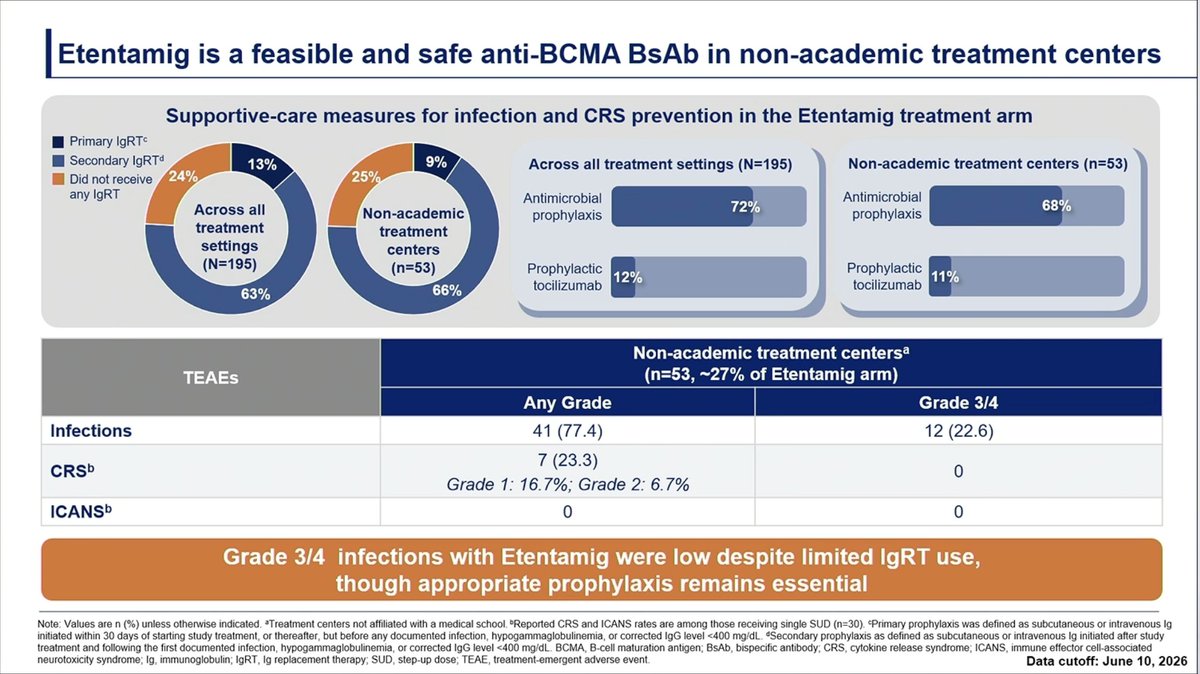
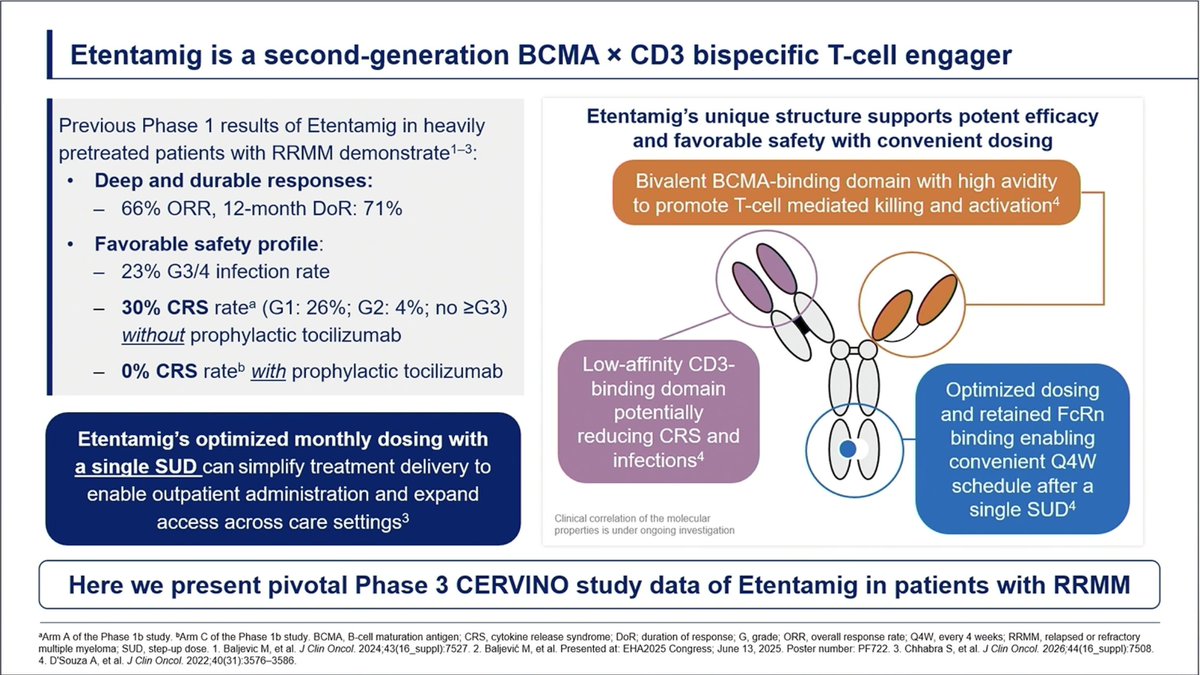
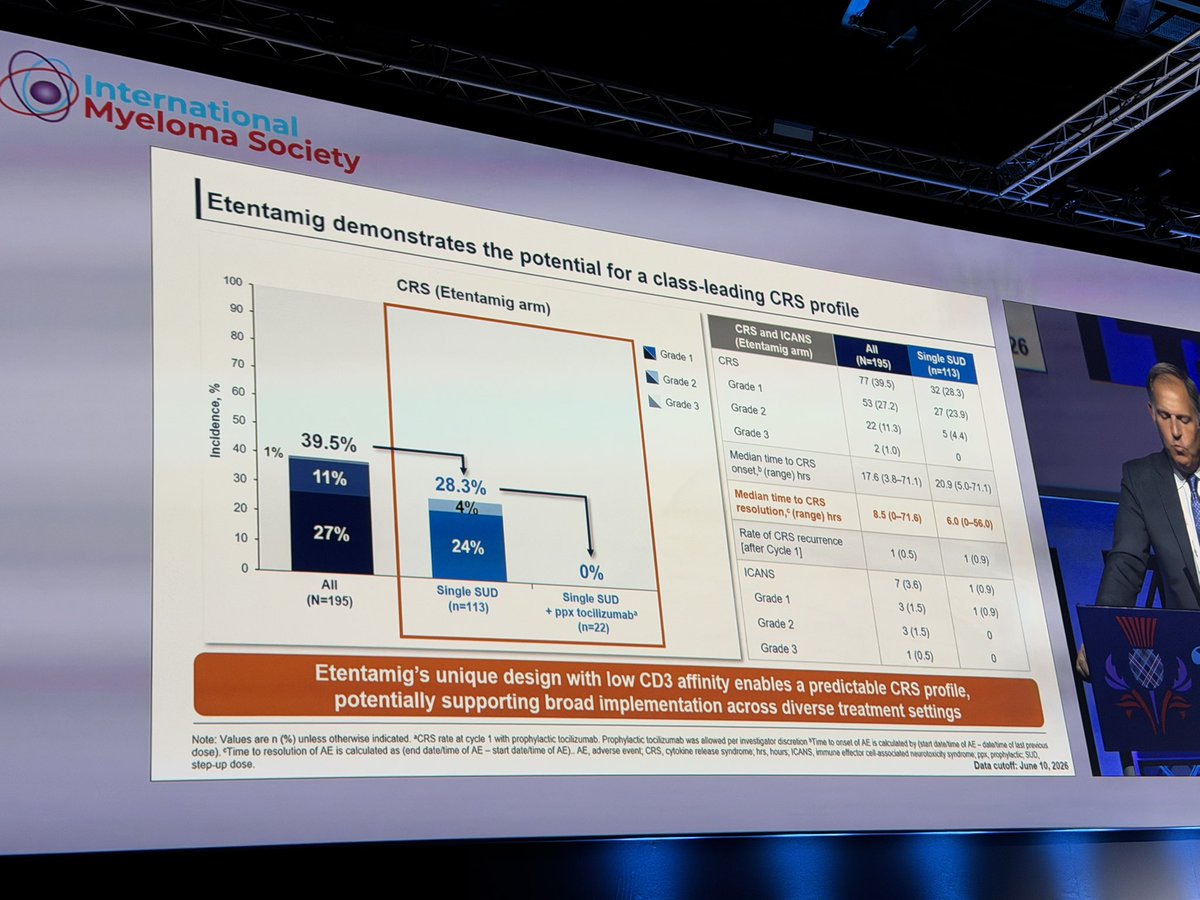
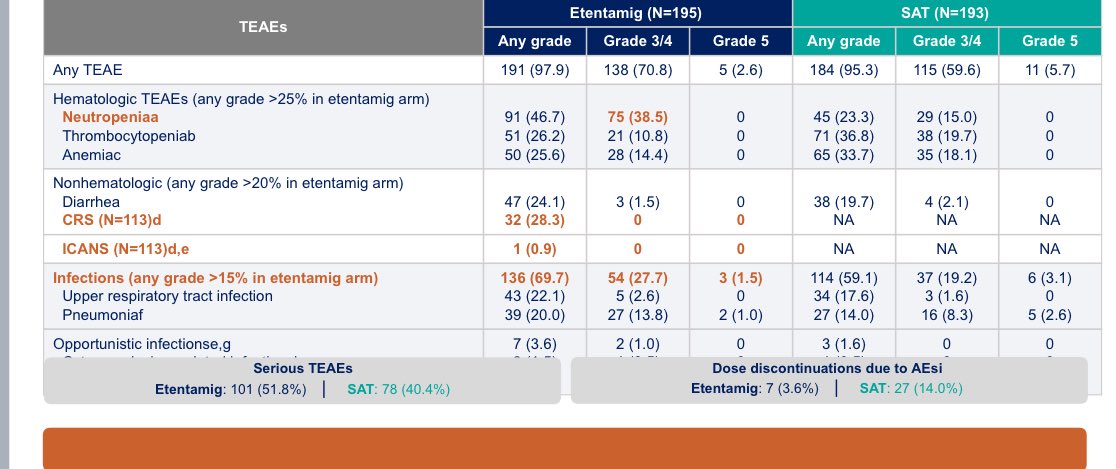
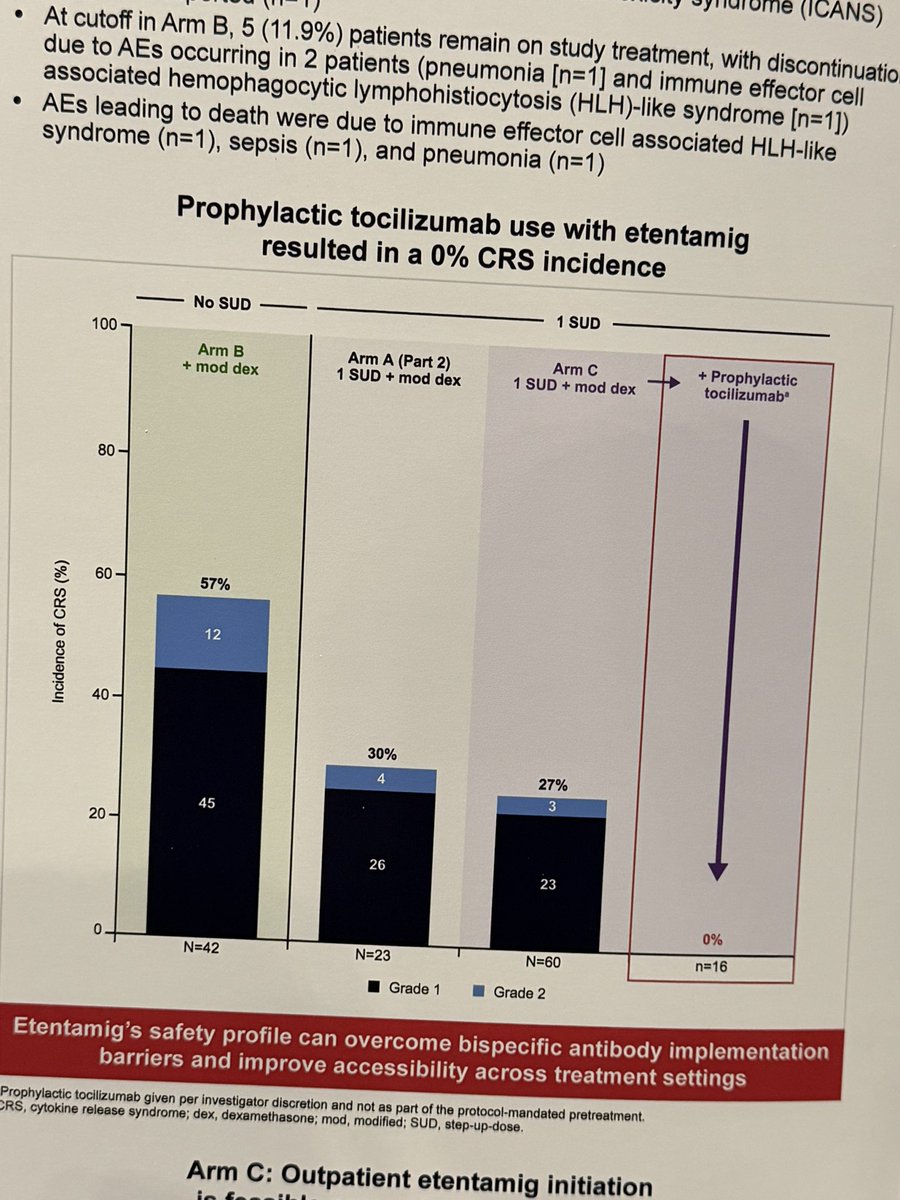
Adverse events seems favorable with lower incidence of CRS (0% with Toci)
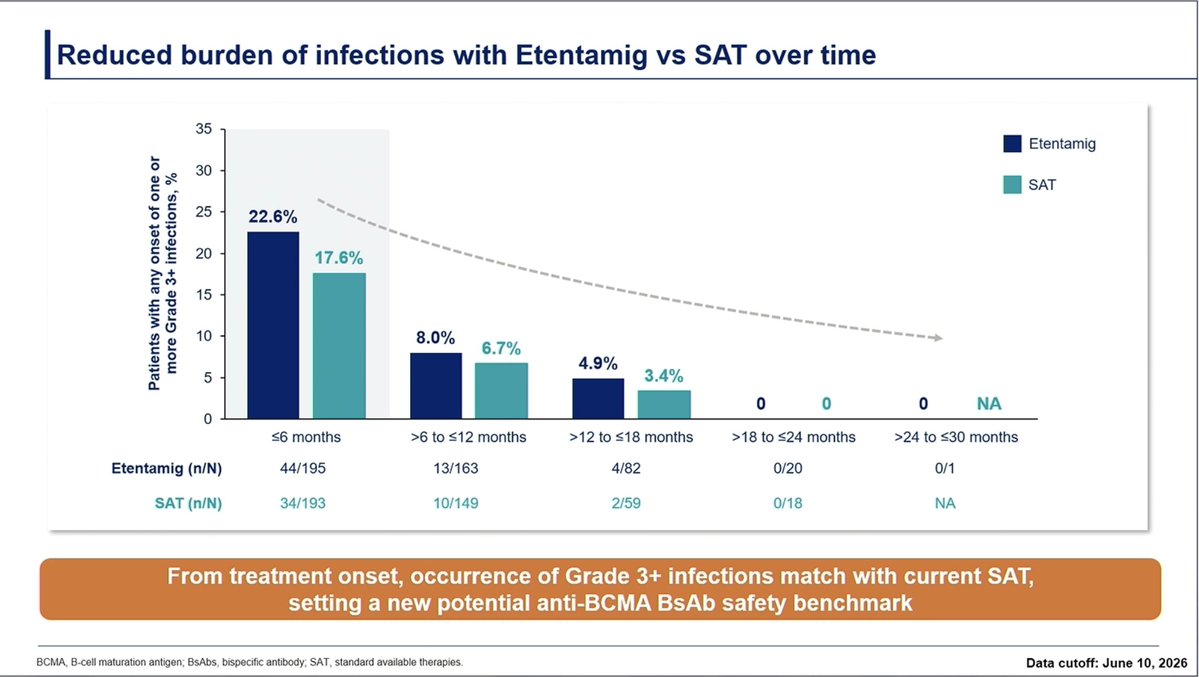
Lower risk of infection (less dosing is a plus)
Overall there will be SC option available in the future
More studies will be done with other comparative arms and in AL https://t.co/dy3qiONAKE
CERVINO treatment-emergent adverse events (TEAEs), Etentamig (N=195) vs SAT (N=193). Any TEAE 97.9% vs 95.3%; Grade 3/4 70.8% vs 59.6%; Grade 5 (fatal) 2.6% vs 5.7% - roughly half the fatal AE rate with Etentamig. Neutropenia 46.7% vs 23.3%. CRS (among SUD recipients, N=113): 28.3%, no grade 3 or higher. ICANS 0.9%, no grade 2+. Infections any grade 69.7% (grade 3/4 27.7%, grade 5 1.5%) vs 59.1% (grade 3/4 19.2%, grade 5 3.1%). Serious TEAEs 51.8% vs 40.4%. Dose discontinuation due to AEs 3.6% vs 14.0%. Etentamig redefines anti-BCMA BsAb safety with low CRS and severe infection rates and a >=50% reduction of fatal AEs and fatal infections vs SAT.
CERVINO CRS incidence and management by step-up dosing strategy. All patients (N=195): CRS 39.5% (Grade 1 27%, Grade 2 11%, Grade 3 1%). Single step-up dose (SUD) subgroup (n=113): CRS 28.3% (Grade 1 24%, Grade 2 4%, Grade 3 0%). Single SUD plus prophylactic tocilizumab (n=22): CRS 0%. Median time to CRS onset 17.6 hours (single SUD 20.9 hrs); median time to CRS resolution 8.5 hours (single SUD 6.0 hrs). CRS recurrence after Cycle 1: 0.5%. ICANS 3.6% overall (single SUD 0.9%). Etentamig's unique design with low CD3 affinity enables a predictable CRS profile, potentially supporting broad implementation across diverse treatment settings.
Sep 25

CERVINO
#IMS26 #mmsm Plenary
CERVINO
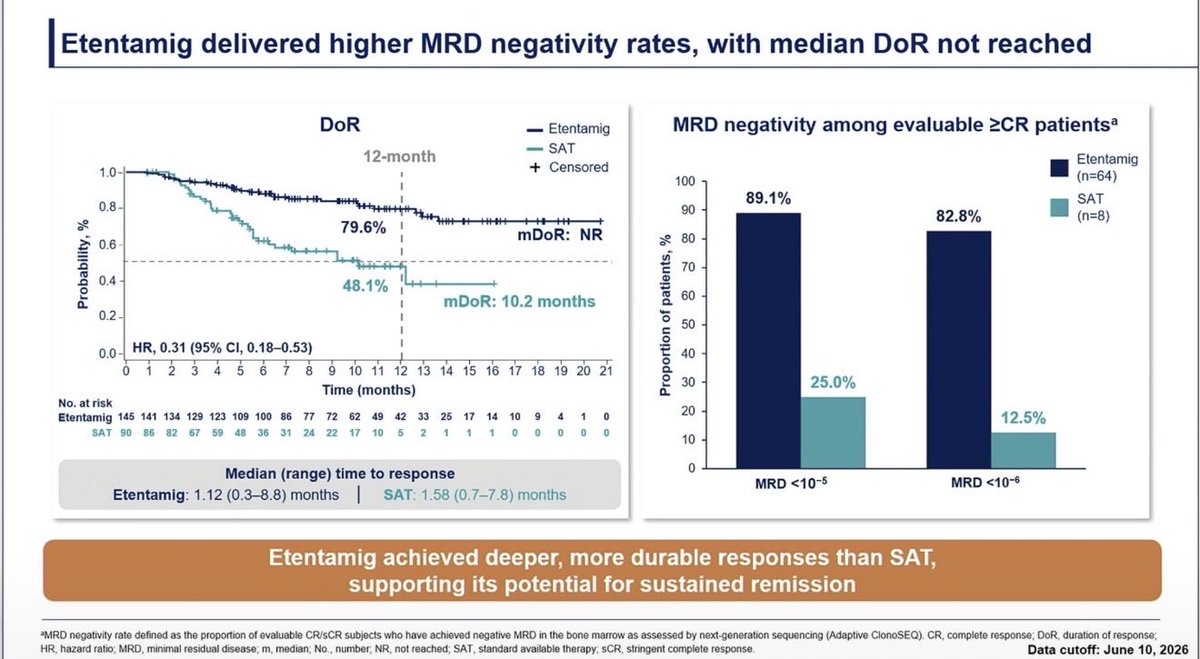
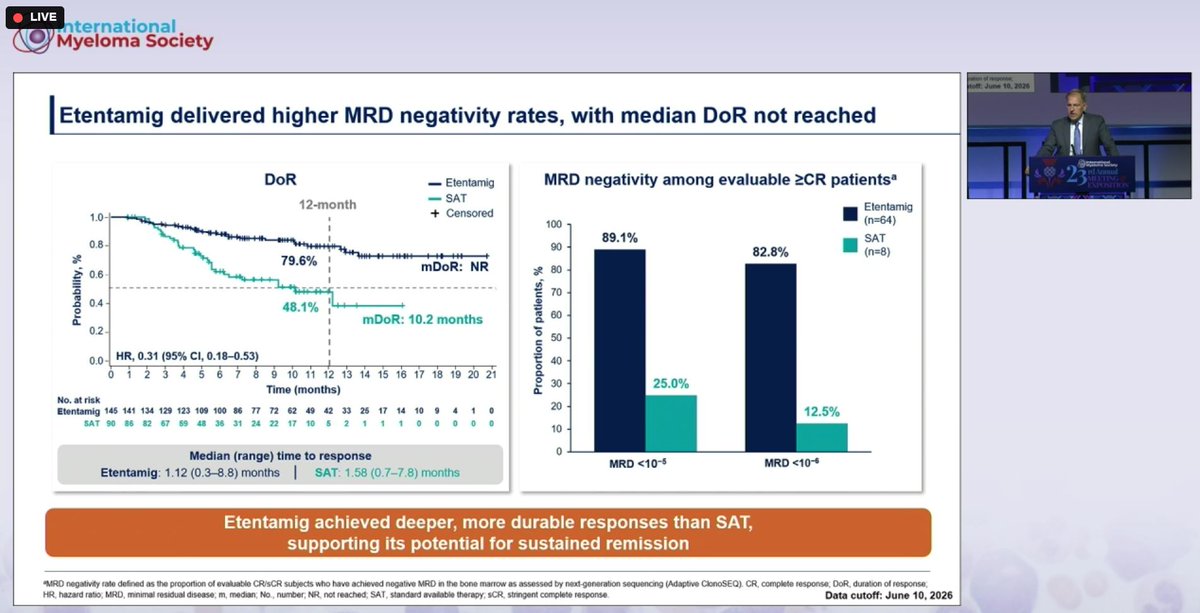
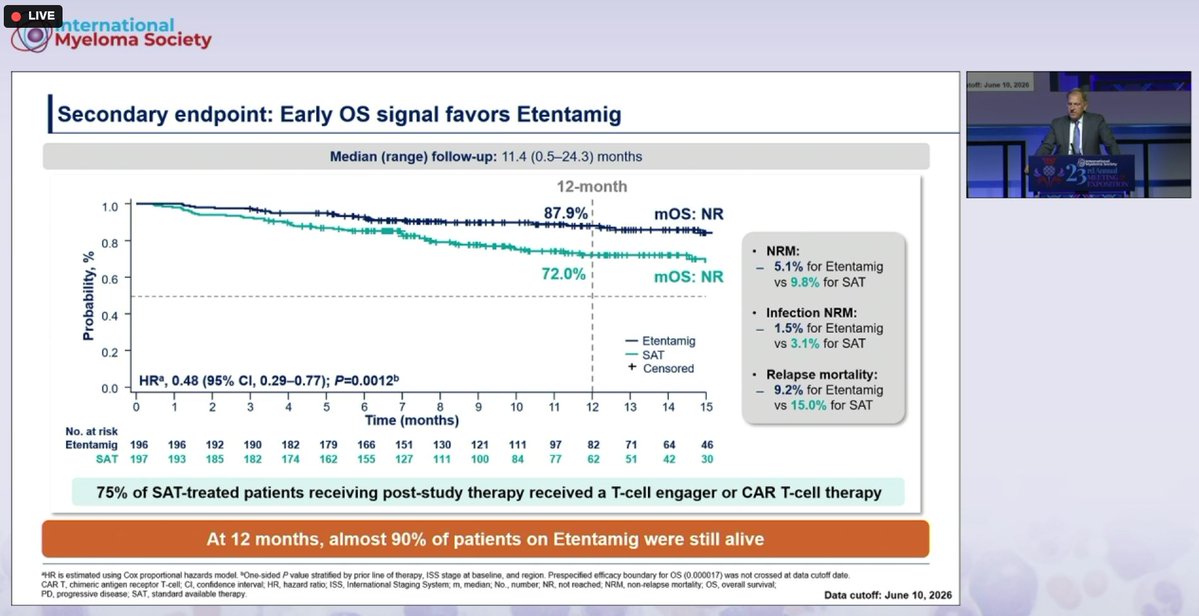
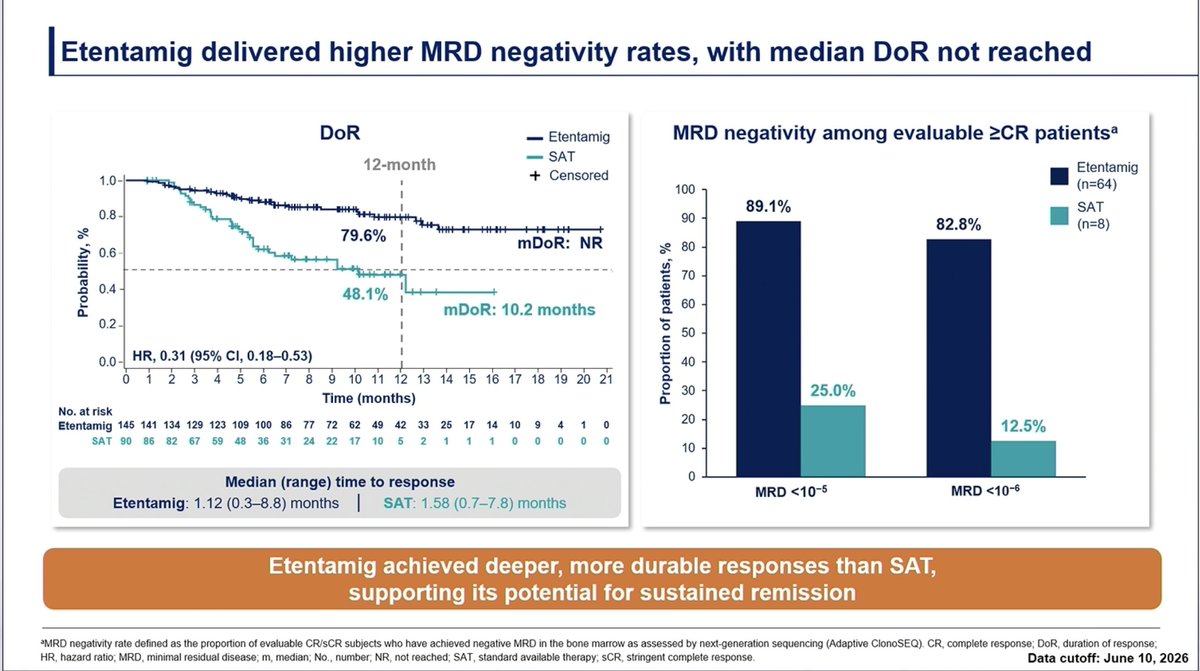
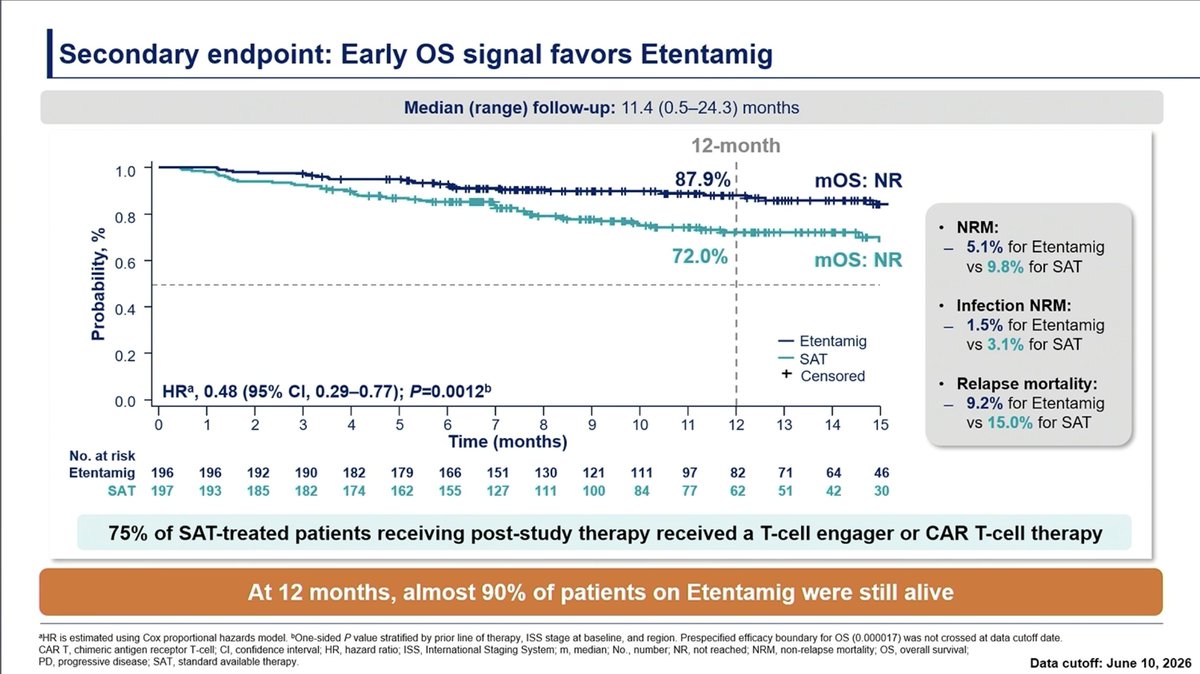
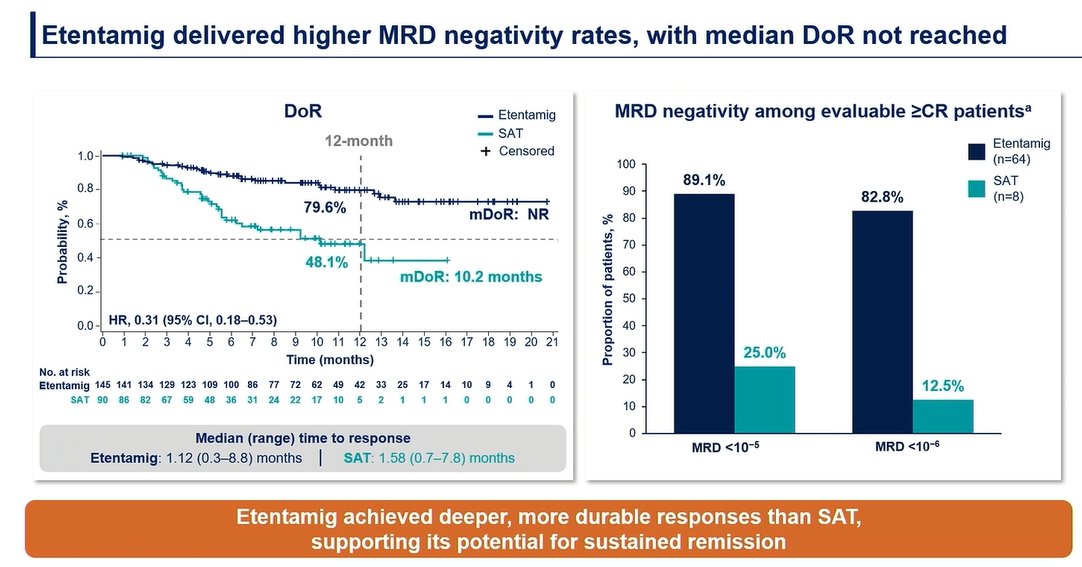
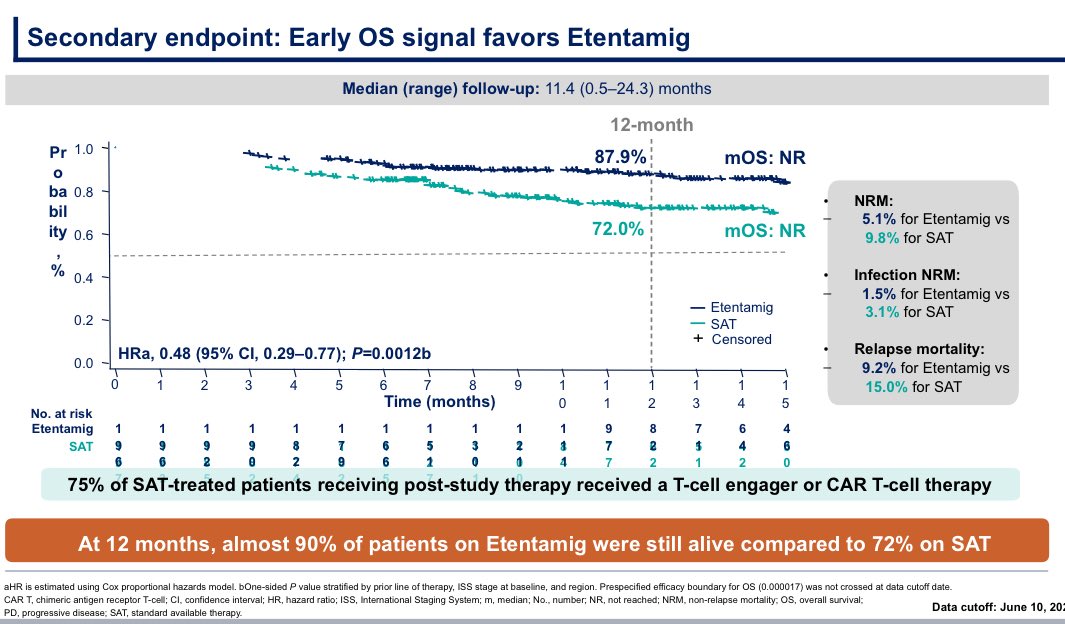
Further data on efficacy also including better MRD negativity and OS
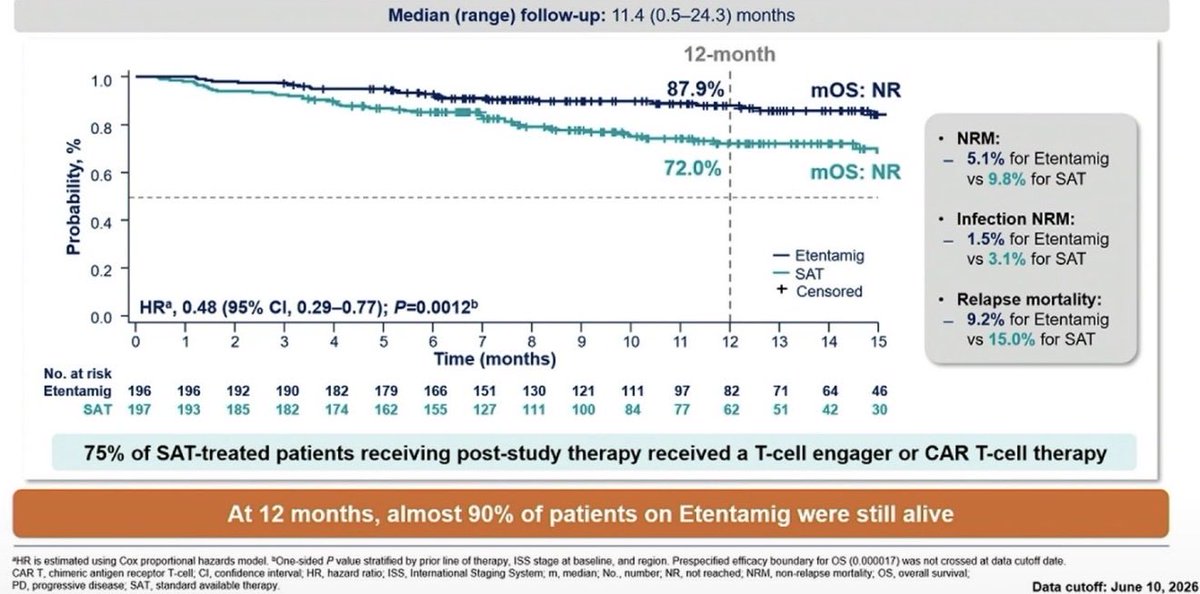
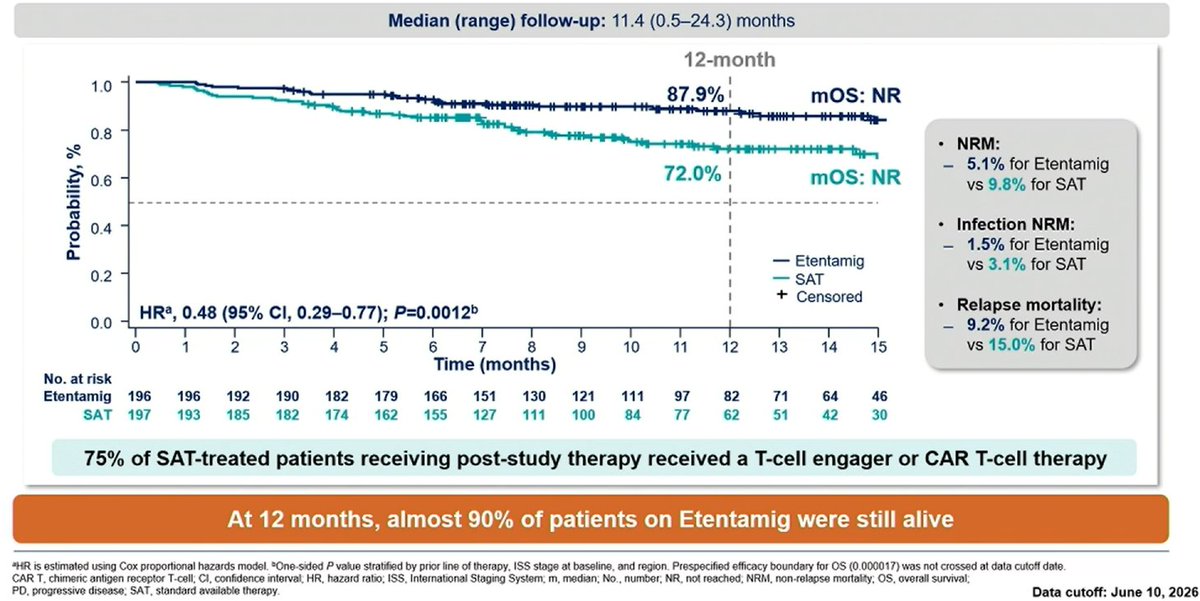
75% of patients who progressed got BCMA based BsAb or CAR-T https://t.co/u69HrJWJxV
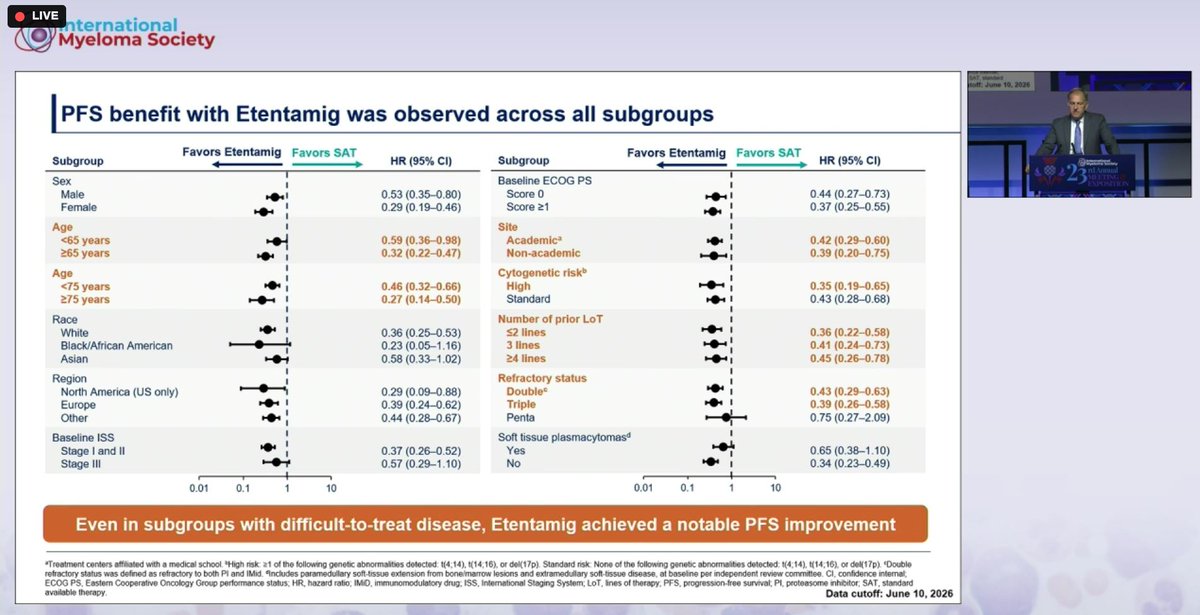
CERVINO PFS forest plot by subgroup - benefit favors Etentamig across all subgroups evaluated: sex (male HR 0.53, female HR 0.29), age <65y HR 0.59 / >=65y HR 0.32, age <75y HR 0.46 / >=75y HR 0.27, race (White HR 0.36, Black/African American HR 0.23, Asian HR 0.58), region (North America US-only HR 0.29, Europe HR 0.39), baseline ISS I/II HR 0.37 vs III HR 0.57, ECOG PS 0 HR 0.44 / >=1 HR 0.37, academic HR 0.42 / non-academic site HR 0.39, high cytogenetic risk HR 0.35 / standard risk HR 0.43, prior lines <=2 HR 0.36 / 3 lines HR 0.41 / >=4 lines HR 0.45, double-refractory HR 0.43 / triple-refractory HR 0.39.
CERVINO duration of response (DoR) and MRD negativity. DoR: HR 0.31 (95% CI 0.18-0.53); median DoR not reached with Etentamig vs 10.2 months with SAT; 12-month DoR rate 79.6% vs 48.1%. Median time to response: 1.12 months Etentamig vs 1.58 months SAT. MRD negativity among evaluable >=CR patients: at MRD<10^-5, 89.1% (Etentamig, n=64) vs 25.0% (SAT, n=8); at MRD<10^-6, 82.8% vs 12.5%. Etentamig achieved deeper, more durable responses than SAT, supporting its potential for sustained remission.
CERVINO secondary endpoint overall survival (early signal, immature). HR 0.48 (95% CI 0.29-0.77), P=0.0012 (prespecified efficacy boundary for OS, P=0.000017, was NOT crossed at this data cutoff). 12-month OS 87.9% Etentamig vs 72.0% SAT; median OS not reached in either arm. Non-relapse mortality 5.1% vs 9.8%; infection-related non-relapse mortality 1.5% vs 3.1%; relapse mortality 9.2% vs 15.0%. 75% of SAT-treated patients who received post-study therapy went on to a T-cell engager or CAR-T therapy. At 12 months, almost 90% of patients on Etentamig were still alive.
Sep 25
CERVINO
#IMS26 #mmsm Plenary
CERVINO
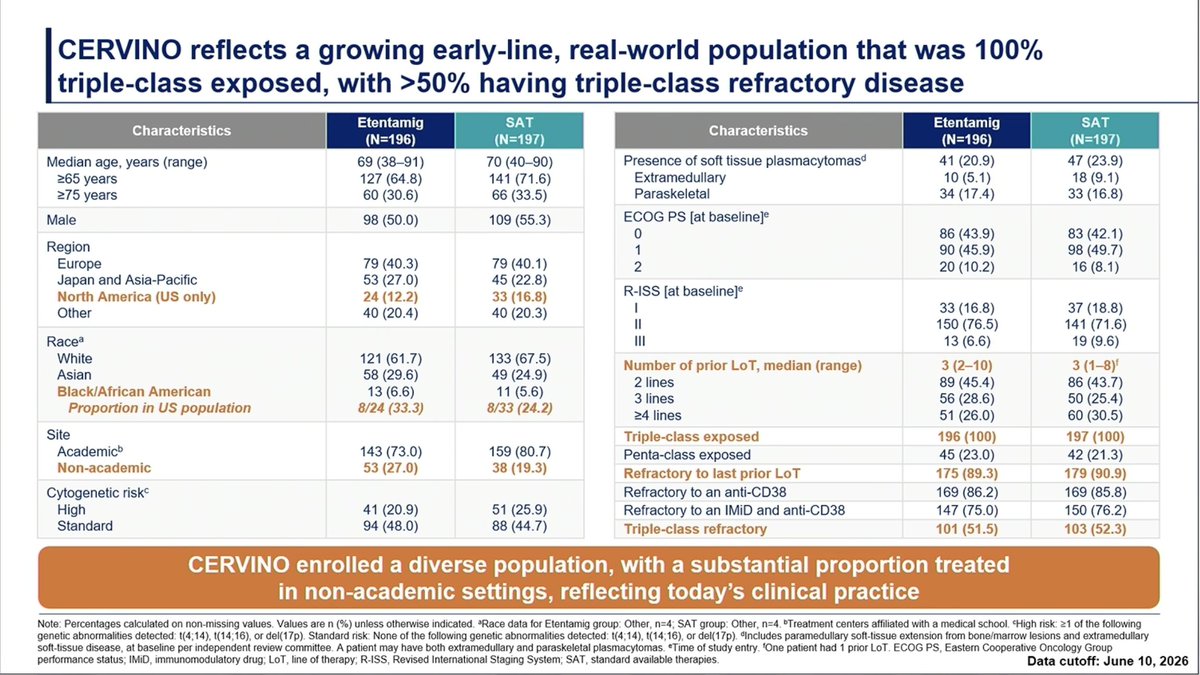
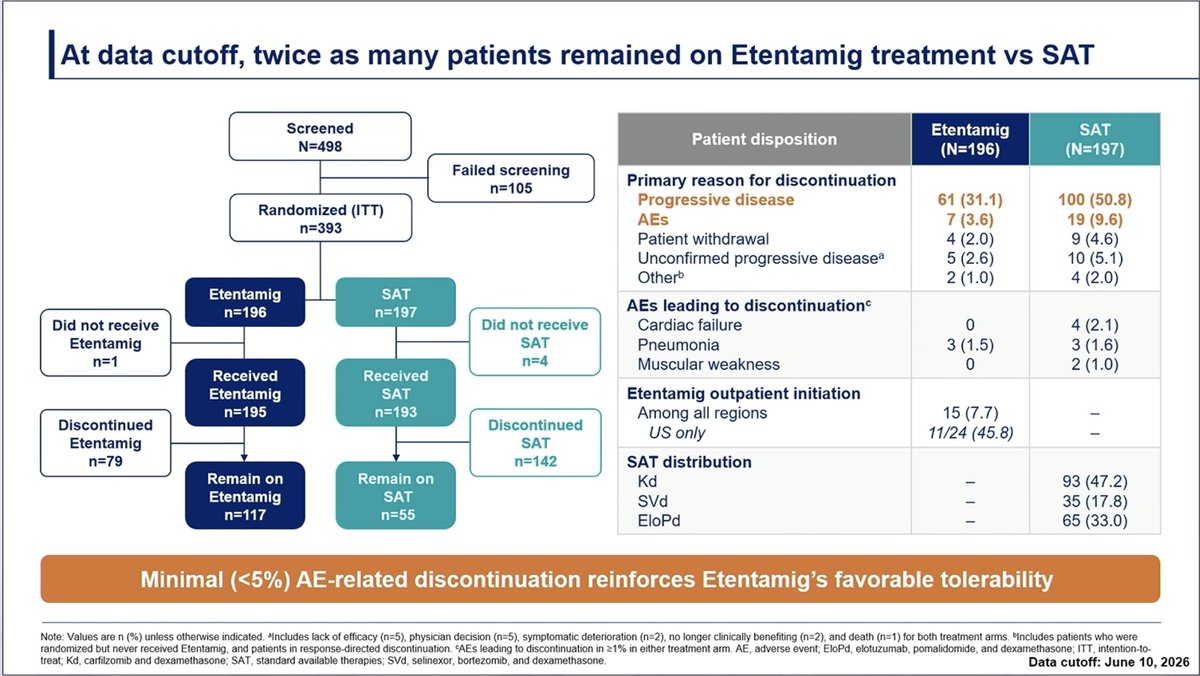
Patient characteristics summarized as well as disposition
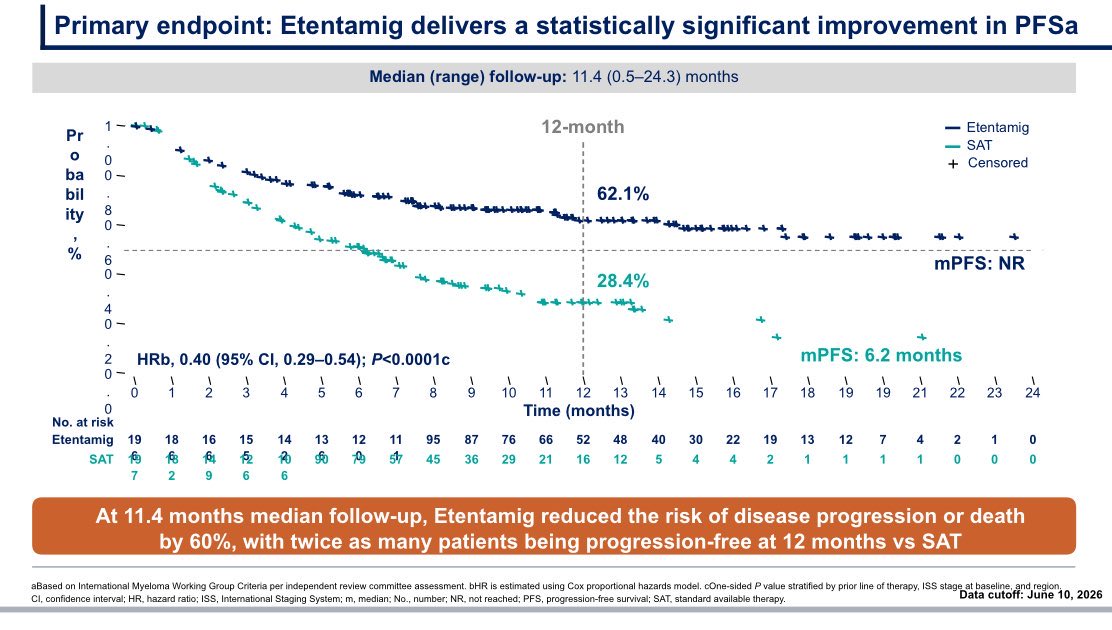
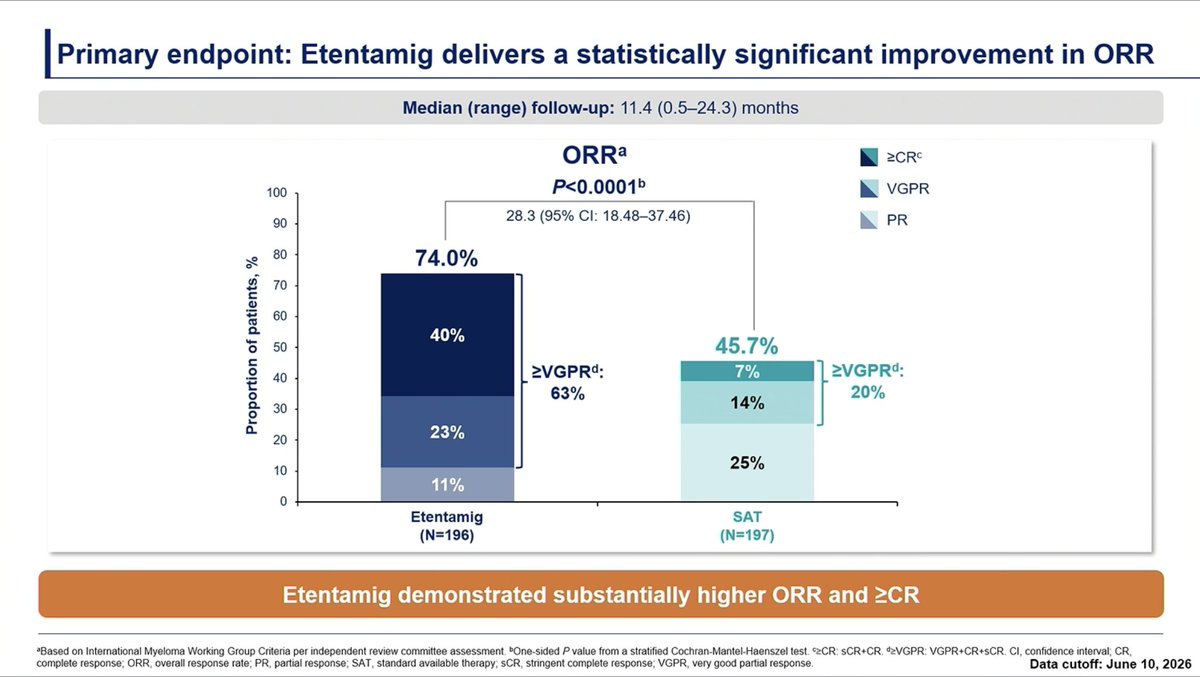
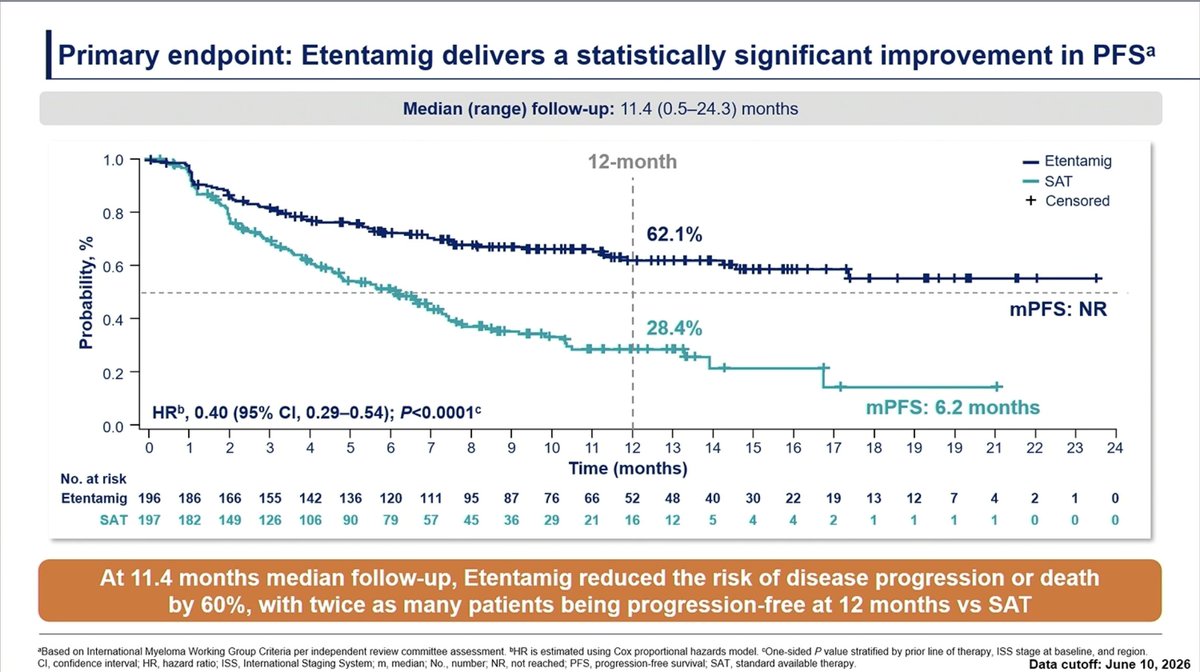
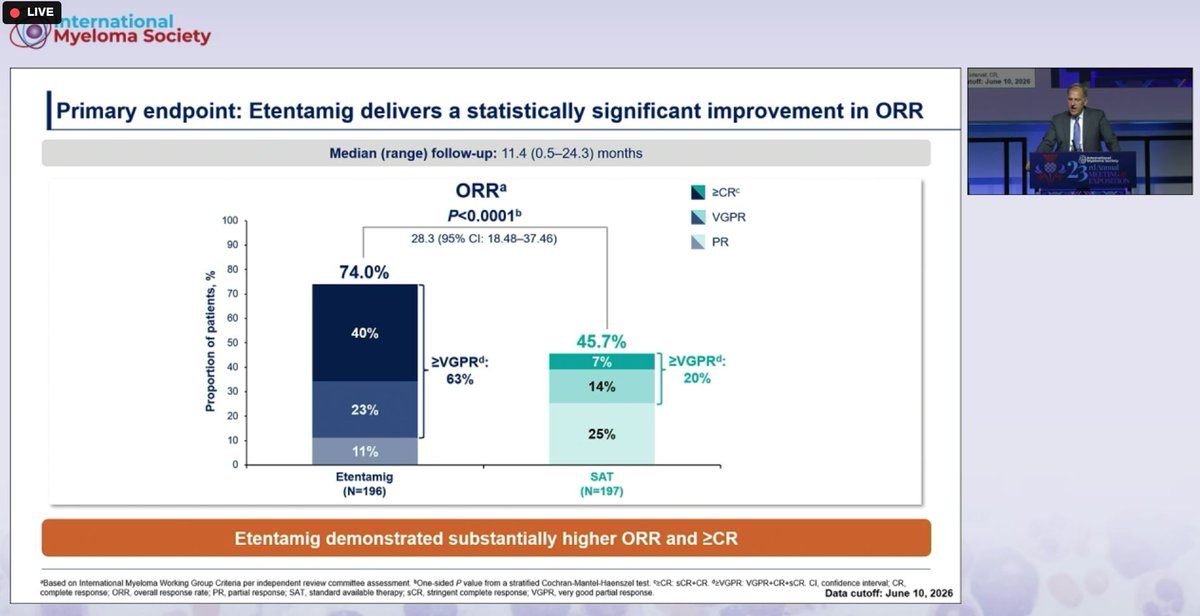
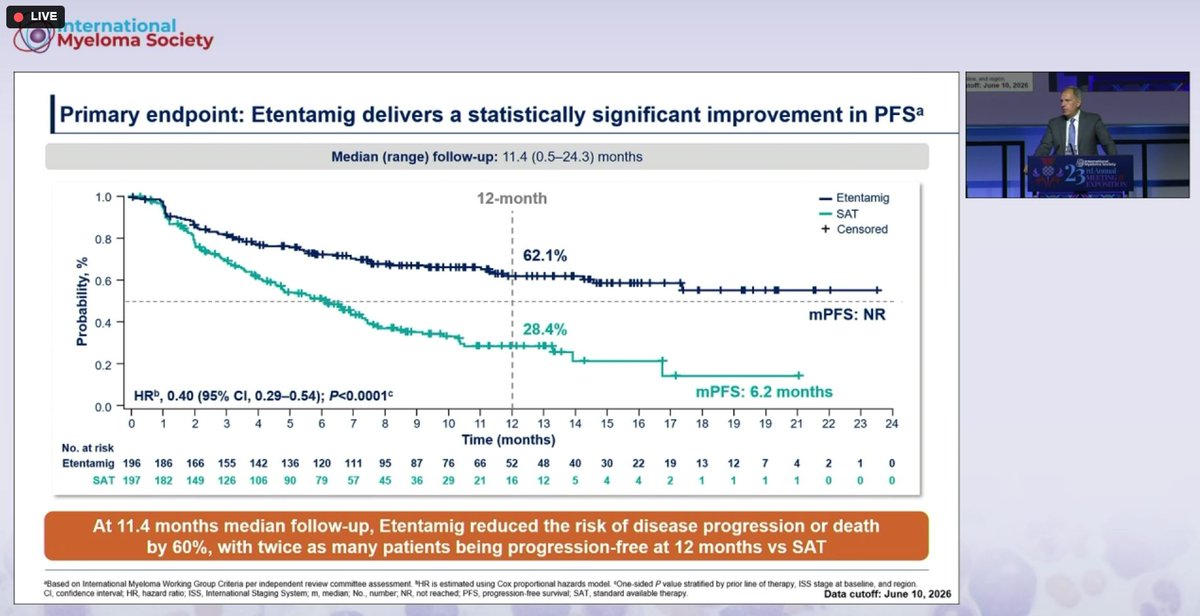
Better ORR and better PFS with ~ 1 year follow up https://t.co/xzWg1Mgl5s
CERVINO patient disposition (CONSORT). Screened N=498, failed screening n=105, randomized (ITT) n=393. Etentamig n=196 (received 195); SAT n=197 (received 193). Discontinued Etentamig n=79; remain on Etentamig n=117. Discontinued SAT n=142; remain on SAT n=55 - twice as many patients remained on Etentamig vs SAT. Primary reason for discontinuation: progressive disease 61 (31.1%) Etentamig vs 100 (50.8%) SAT; AEs 7 (3.6%) vs 19 (9.6%). AE-related discontinuation under 5% reinforces Etentamig's favorable tolerability. Data cutoff: June 10, 2026.
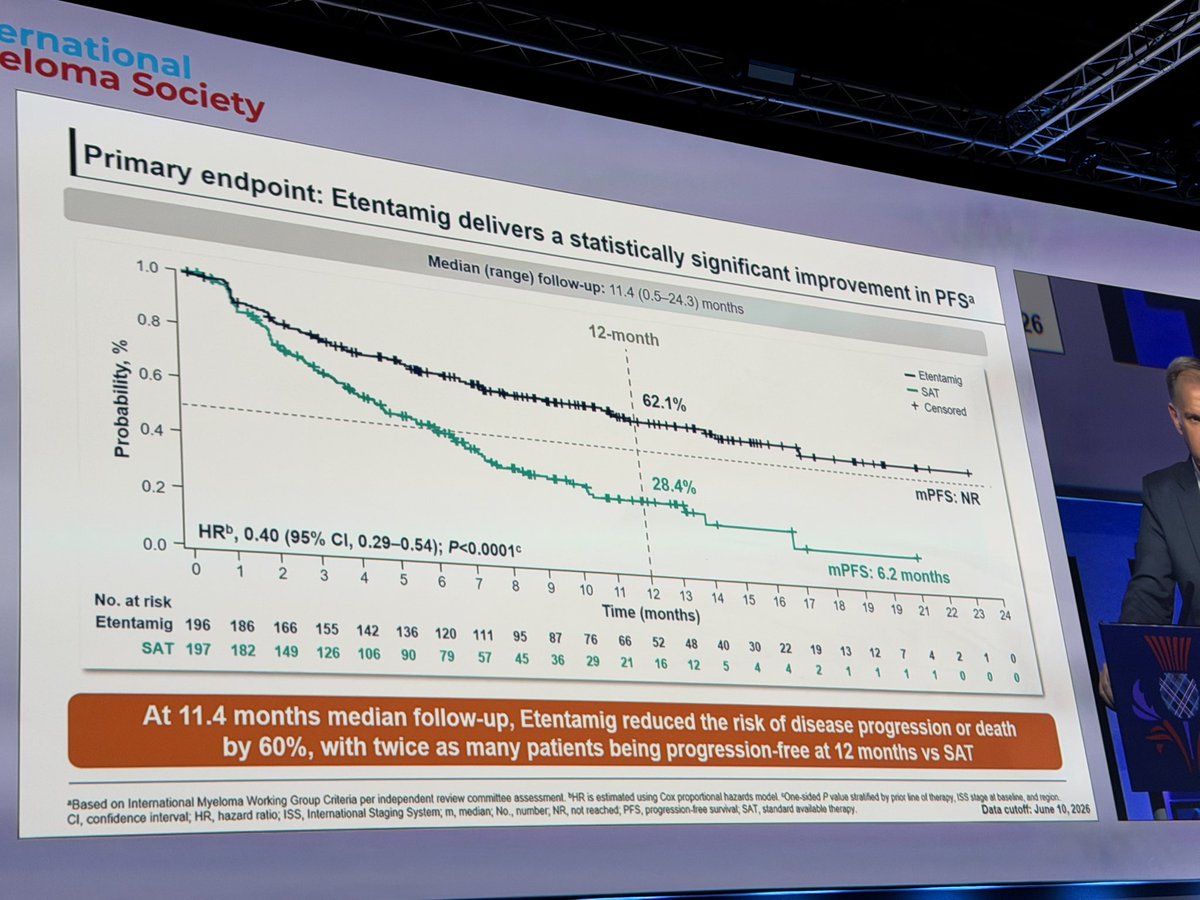
CERVINO primary endpoint ORR (International Myeloma Working Group criteria, independent review). Etentamig ORR 74.0% (>=CR 40%, VGPR 23%, PR 11%; >=VGPR 63%) vs SAT 45.7% (>=CR 7%, VGPR 14%, PR 25%; >=VGPR 20%). Difference 28.3% (95% CI 18.48-37.46), P<0.0001. Median follow-up 11.4 (0.5-24.3) months. Etentamig demonstrated substantially higher ORR and >=CR.
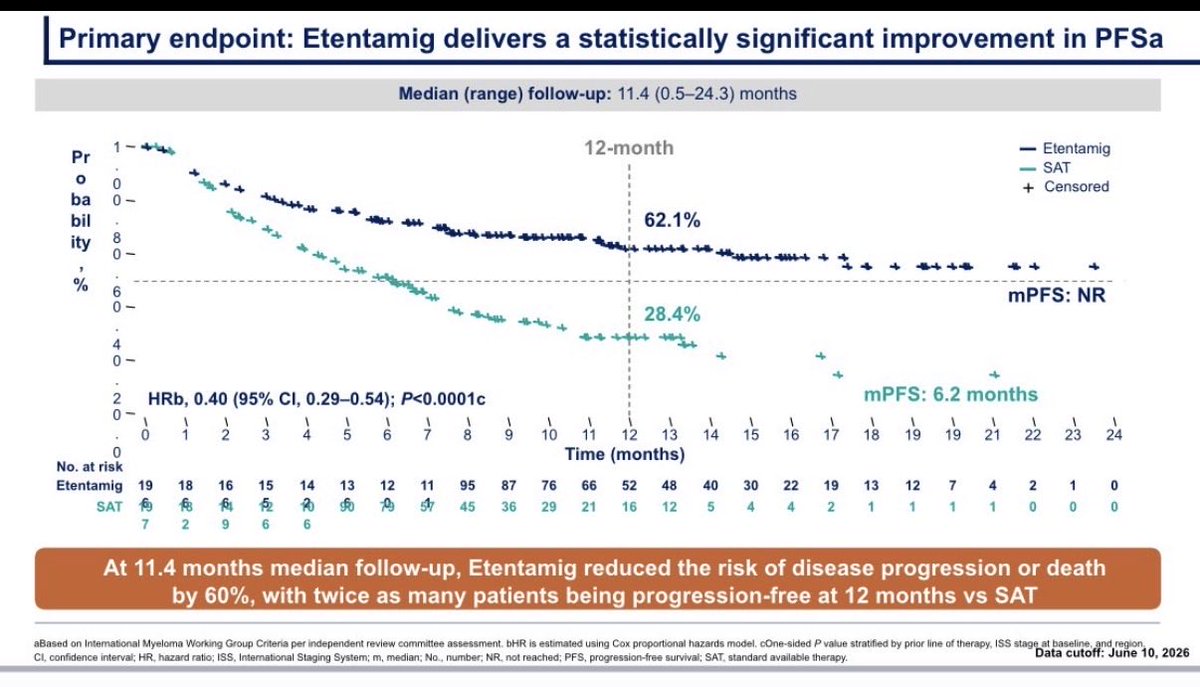
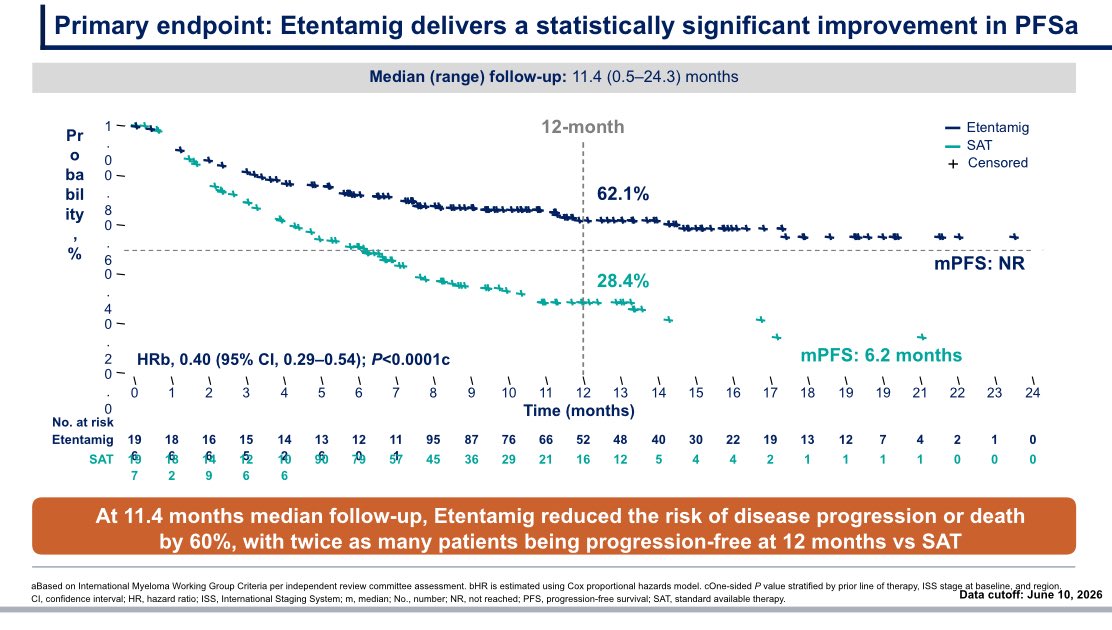
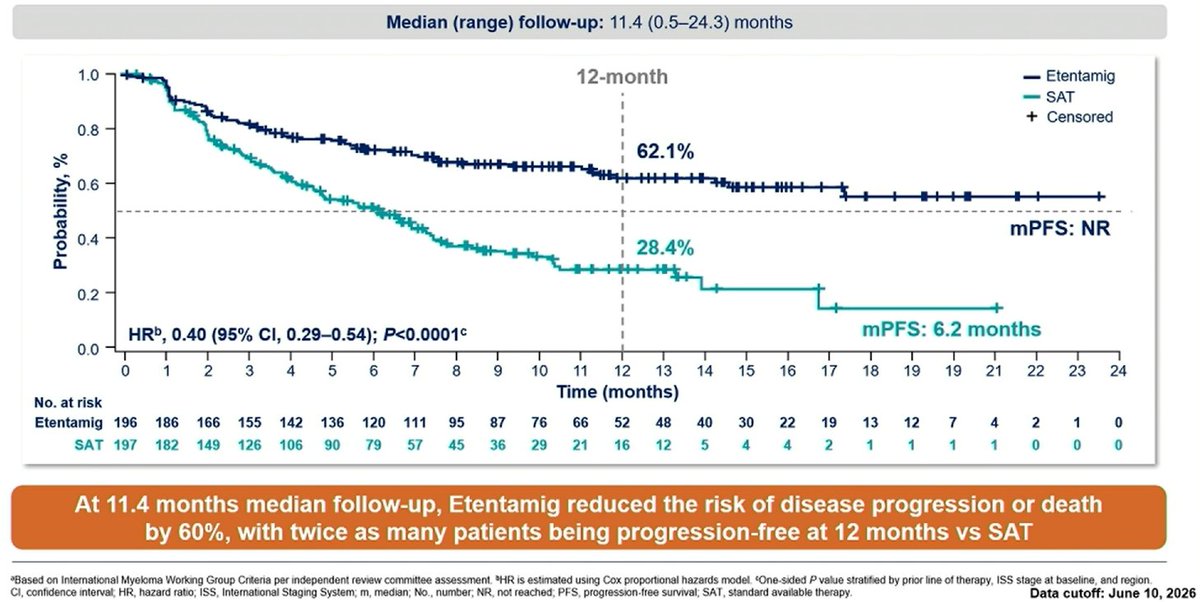
CERVINO primary endpoint PFS (Kaplan-Meier). HR 0.40 (95% CI 0.29-0.54), P<0.0001. Median PFS: Etentamig not reached (NR); SAT 6.2 months. 12-month PFS rate: 62.1% Etentamig vs 28.4% SAT. At 11.4 months median follow-up, Etentamig reduced the risk of disease progression or death by 60%, with twice as many patients progression-free at 12 months vs SAT. Data cutoff: June 10, 2026.
Sep 25
CERVINO
#IMS26 #mmsm Plenary
CERVINO
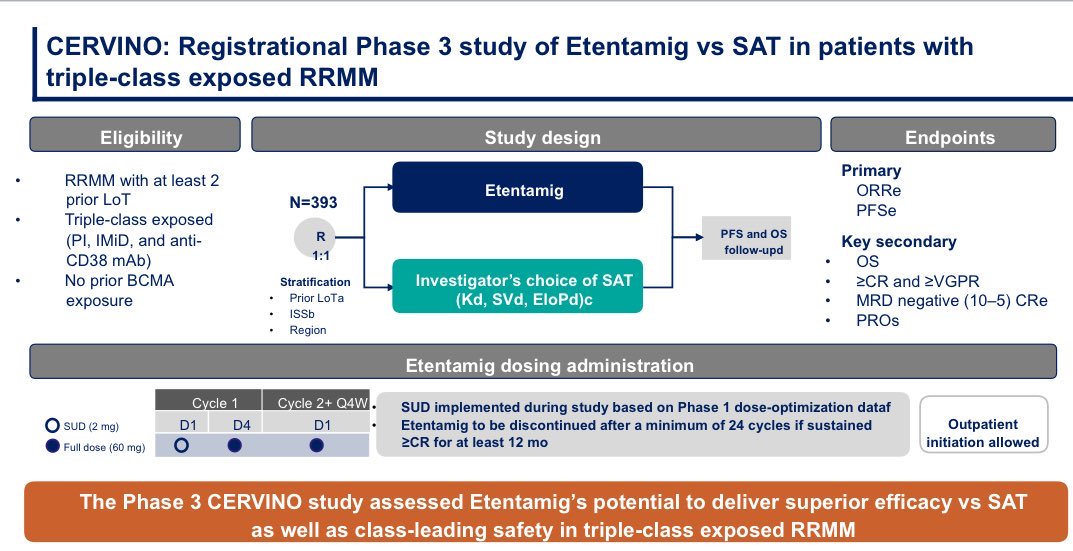
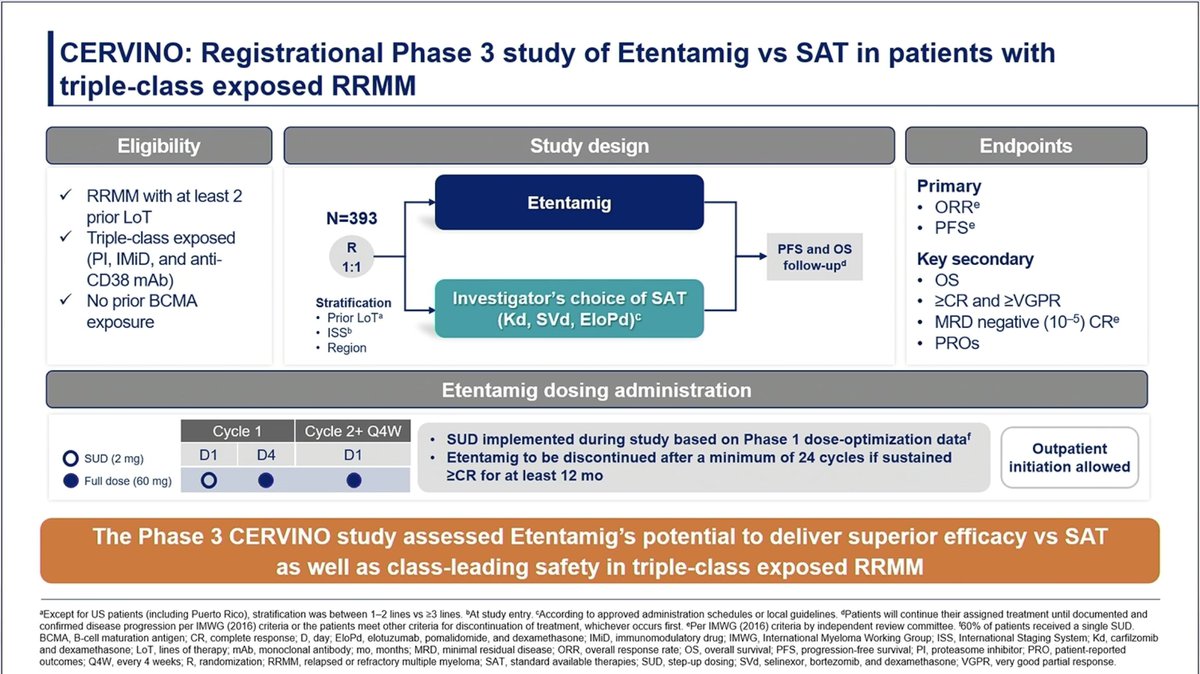
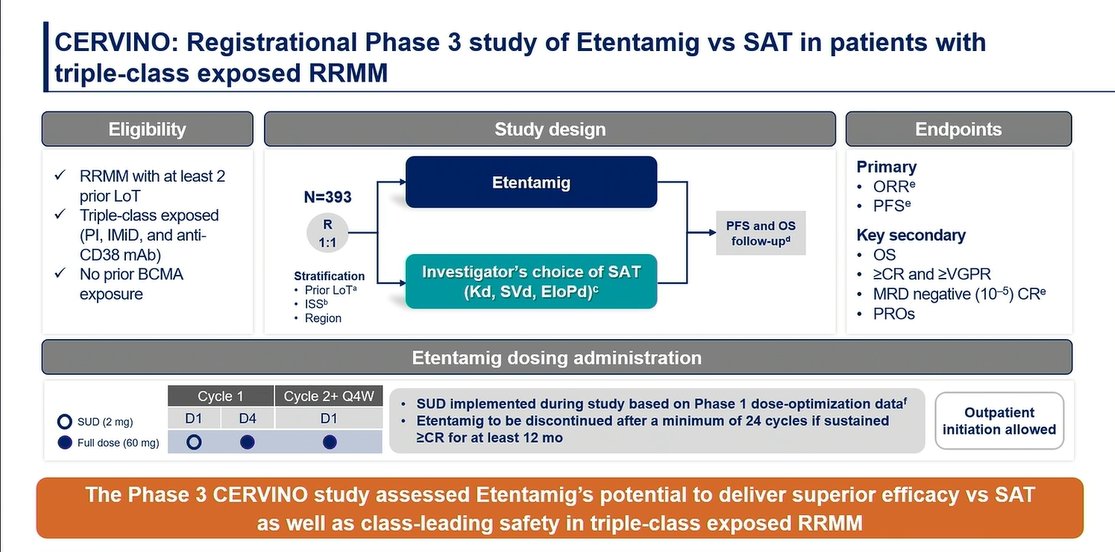
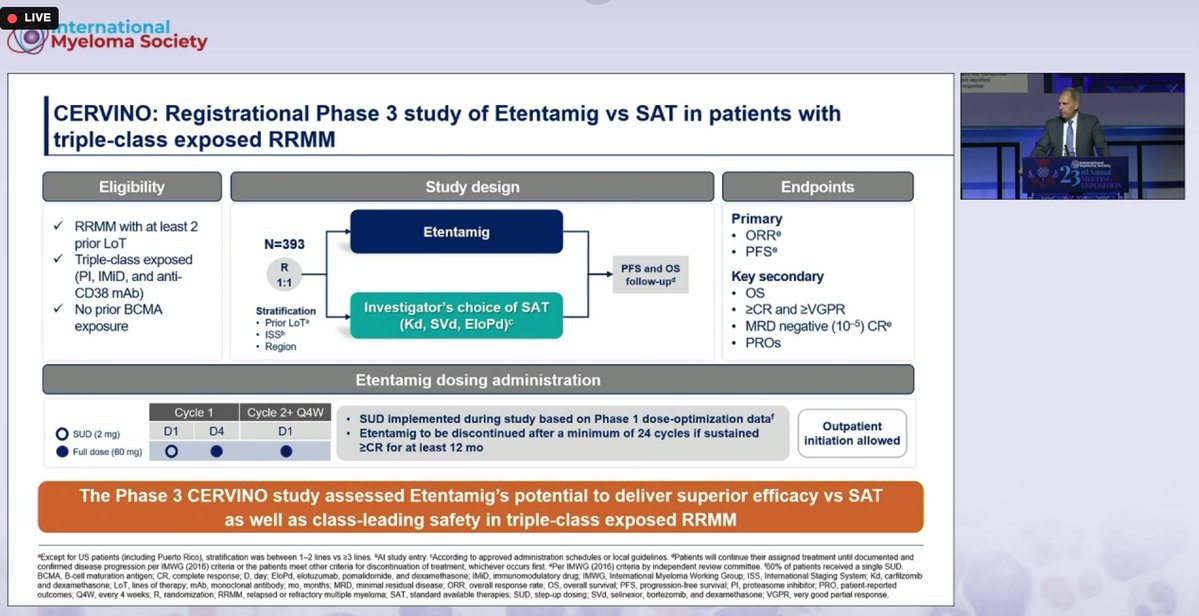
Etentamig: IV, given less often and with one SUD given prior to full dose
Patients can stop therapy after 2 years
The comparator arm is: Kd, SVd and EloPd (not used in the US nowadays) https://t.co/myXWsG2nnI
CERVINO study design summary. Etentamig: IV, given less often, with one single step-up dose (SUD) given prior to full dose. Patients can stop therapy after 2 years. Comparator arm (SAT, standard available therapy): Kd (carfilzomib + dexamethasone), SVd (selinexor + bortezomib + dexamethasone), and EloPd (elotuzumab + pomalidomide + dexamethasone) - EloPd not commonly used in the US currently. Data cutoff: June 10, 2026.
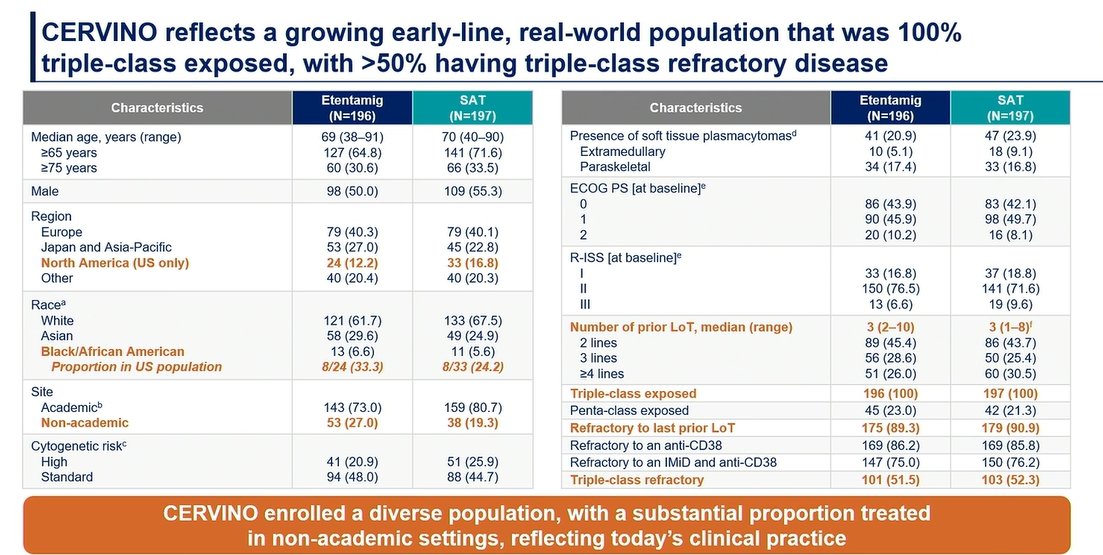
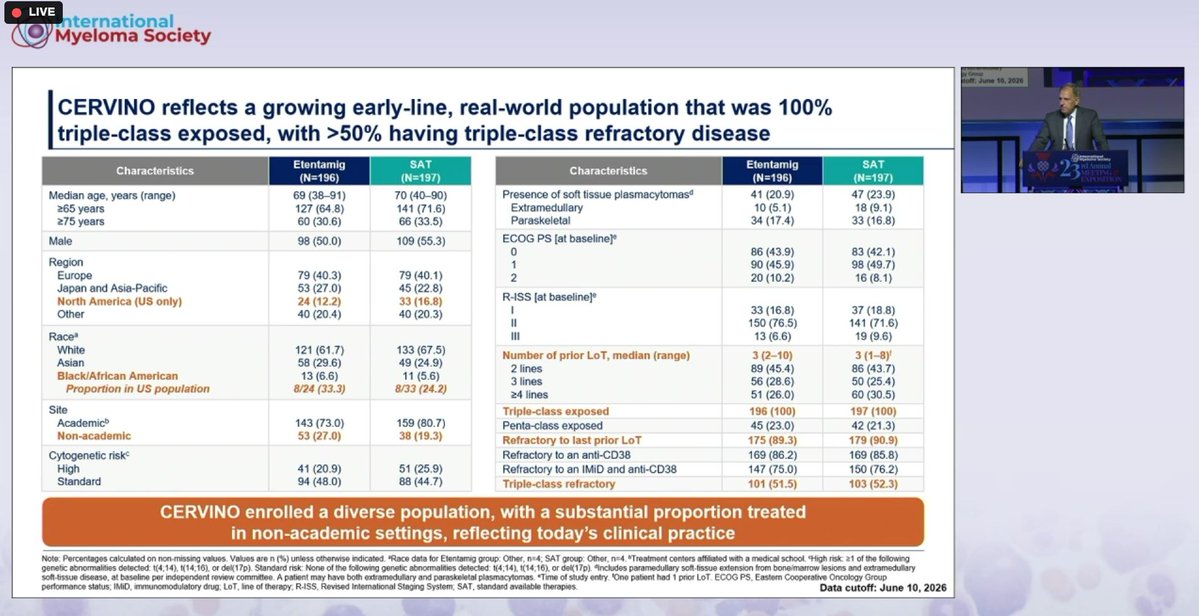
CERVINO baseline characteristics table. Etentamig (N=196) vs SAT (N=197): median age 69 vs 70 years; Triple-class exposed 196 (100%) vs 197 (100%); Triple-class refractory 101 (51.5%) vs 103 (52.3%); median prior lines of therapy 3 (range 2-10) vs 3 (range 1-8); North America (US only) 24 (12.2%) vs 33 (16.8%); high cytogenetic risk 41 (20.9%) vs 51 (25.9%). CERVINO enrolled a diverse population with a substantial proportion treated in non-academic settings, reflecting today's clinical practice.

 Sep 23


CERVINO
#IMS26: Unmet needs and unanswered questions at 1st relapse in #myeloma
by @mvmateos
❓When to start: biochemical vs clinical PD? MRD-neg relapse?
❓Fixed or MRD-adapted duration for bispecifics?
❓Maintenance after CAR-T?
❓Longer dosing intervals for safety?
❓Sequencing BCMA/GPRC5D without losing targets
#MMSM #IMS26 @Myeloma_Society
Other challenges
When to start treatment?
- The earlier the use of these therapies -> The better
- Should we use them at biochemical PD or clinical PD -> Biochemical PD is better but...
- Would it be possible to start in case of relapse from MRD-ve?
Schedule of treatment
- Should we move to treatments of fixed duration, especially with Bispecific mAbs?
- Fixed duration or duration adapted to the MRD?
- Would it be possible to implement maintenance after CAR-T for maintaining the MRD-ve
- Is it possible to extend the interval between doses to improve the safety profile?
Summary: A future decision framework
01 RIGHT PATIENT — Disease tempo; Frailty and immune fitness; Prior exposure and refractoriness
02 RIGHT PLATFORM — CAR-T - bispecific - ADC; CELMoD-based combination; Conventional therapy
03 RIGHT BIOLOGY AND TARGET — BCMA - GPRC5D - CD38; Cereblon-driven activity; Preserve alternative targets
04 RIGHT TIME AND SEQUENCE — Treat before attrition; Match therapy to disease biology; Preserve the next effective option
CELMoDs expand the choice beyond immune targeting and create new sequencing opportunities in early relapse
The future of early relapse will rely on individualized sequencing across immune therapies and CELMoD-based combinations, maximizing survival and quality of life while preserving effective options for later relapse
Will the future resolve these challenges?
2nd line
BCMA as target:
CAR-T cells: Cilta-cel; Anito-cel; BCMA-CD19 CAR-T cells
BsAbs: Teclistamab-Dara; Teclistamab; Etentamig/Elranatamab/Linvo
ADCs: Bela-Vd; Bela-Pd
GPRC5D as target:
CAR-T cells: Arlo-cel
BsAbs: Talquetamab-Dara; Talquetamab-Dara-Pom
BCMA-GPRC5D:
CAR-T cells: BCMA-GPRC5d-CART
BsAbs: Talquetamab-Teclistamab
CelMoD's will help to restore the immune system and to sequence T-cell redirecting therapies or they will have a role instead of and their use may preserve BCMA or GPRC5D targeting for later relapse
Other options in the future will include: in vivo CAR-T cells, trispecific monoclonal antibodies, CELMoD's-based combos
 Sep 23
CARTITUDE-4CERVINODREAMM-7DREAMM-8MajesTEC-3MajesTEC-9MonumenTAL-3MonumenTAL-6
Never a good time to be a myeloma patient but this is the best it has ever been!
Remarkable results in early relapse setting!
@mvmateos #IMS26 https://t.co/rNUviKkXc5
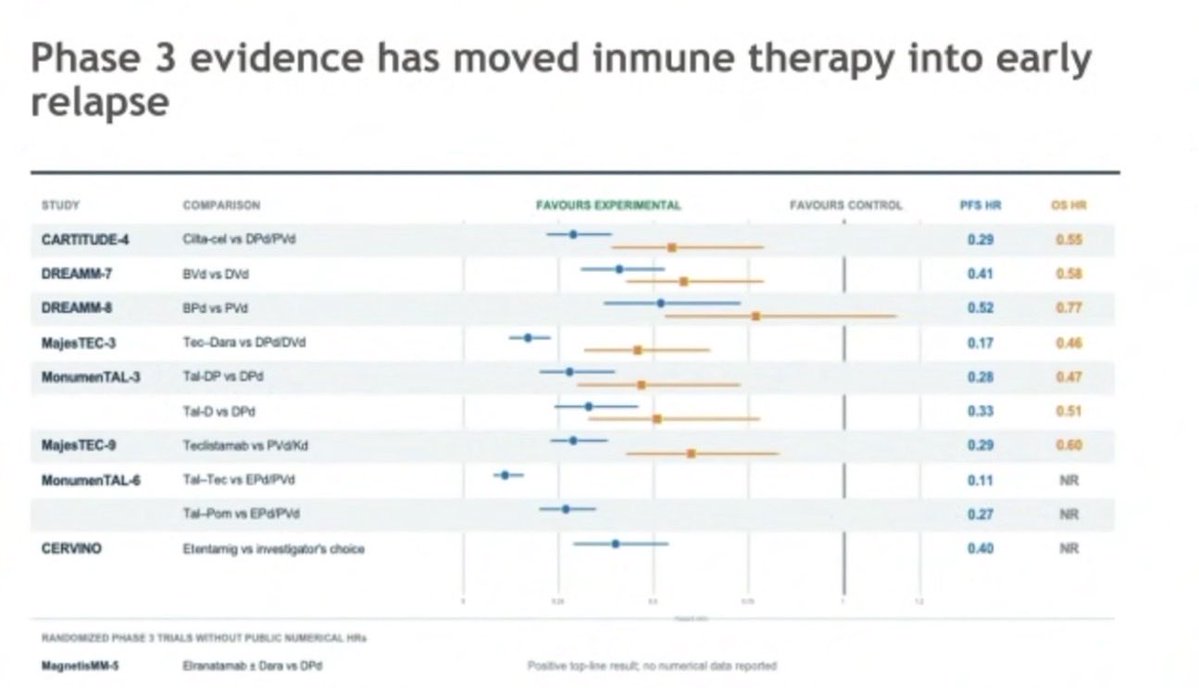
Phase 3 evidence has moved inmune therapy into early relapse
[Table: STUDY | COMPARISON | forest plot (FAVOURS EXPERIMENTAL / FAVOURS CONTROL) | PFS HR | OS HR]
CARTITUDE-4 | Cilta-cel vs DPd/PVd | PFS HR 0.29 | OS HR 0.55
DREAMM-7 | BVd vs DVd | PFS HR 0.41 | OS HR 0.58
DREAMM-8 | BPd vs PVd | PFS HR 0.52 | OS HR 0.77
MajesTEC-3 | Tec-Dara vs DPd/DVd | PFS HR 0.17 | OS HR 0.46
MonumenTAL-3 | Tal-DP vs DPd | PFS HR 0.28 | OS HR 0.47
(MonumenTAL-3) | Tal-D vs DPd | PFS HR 0.33 | OS HR 0.51
MajesTEC-9 | Teclistamab vs PVd/Kd | PFS HR 0.29 | OS HR 0.60
MonumenTAL-6 | Tal-Tec vs EPd/PVd | PFS HR 0.11 | OS HR NR
(MonumenTAL-6) | Tal-Pom vs EPd/PVd | PFS HR 0.27 | OS HR NR
CERVINO | Etentamig vs investigator's choice | PFS HR 0.40 | OS HR NR
RANDOMIZED PHASE 3 TRIALS WITHOUT PUBLIC NUMERICAL HRs
MagnetisMM-5 | Elranatamab +/- Dara vs DPd | Positive top-line result; no numerical data reported
[Forest plot x-axis tick labels largely illegible]
 Sep 21

CEPHEUSCERVINOEXCALIBER-RRMMGEM2014MAINIBEXMIDAS
Have fun in Glasgow! 🇬🇧🏴
Don’t get lost at #IMS2026—too much great science, too many simultaneous sessions!
Follow the roadmap. Don’t miss the practice-changing data.
And don’t forget your single malt…after the final session! 🥃😆
#MultipleMyeloma #mmsm #Medtwitter https://t.co/eCVPDMHoDu
DON'T GET LOST AT IMS 2026
GLASGOW - SEPTEMBER 23-26
THE MUST-SEE ROADMAP
PEOPLE SCIENCE PROGRESS TOGETHER | BIGGER SCIENCE A BRIGHTER TOMORROW | GLASGOW WELCOMES A BRIGHTER TOMORROW
THURSDAY - SEPT 24 5:00-6:00 PM - HALL 5
MRD & MAINTENANCE (MRD: DEEPER ANSWERS BRIGHTER TOMORROWS)
- MIDAS: Isa-iberdomide
- CASSIOPEIA: 5-year sustained MRD
- GEM2014MAIN: MRD-guided stopping
- IBEX: Iber-Dara post-ASCT
FRIDAY - SEPT 25 3:00-5:00 PM - HALL 5 DO NOT MISS
THE PLENARY - DO NOT MISS (BOLD SCIENCE CHANGES LIVES)
- CERVINO: Etentamig vs standard therapy
- PERSEUS: Does long-term PFS become OS?
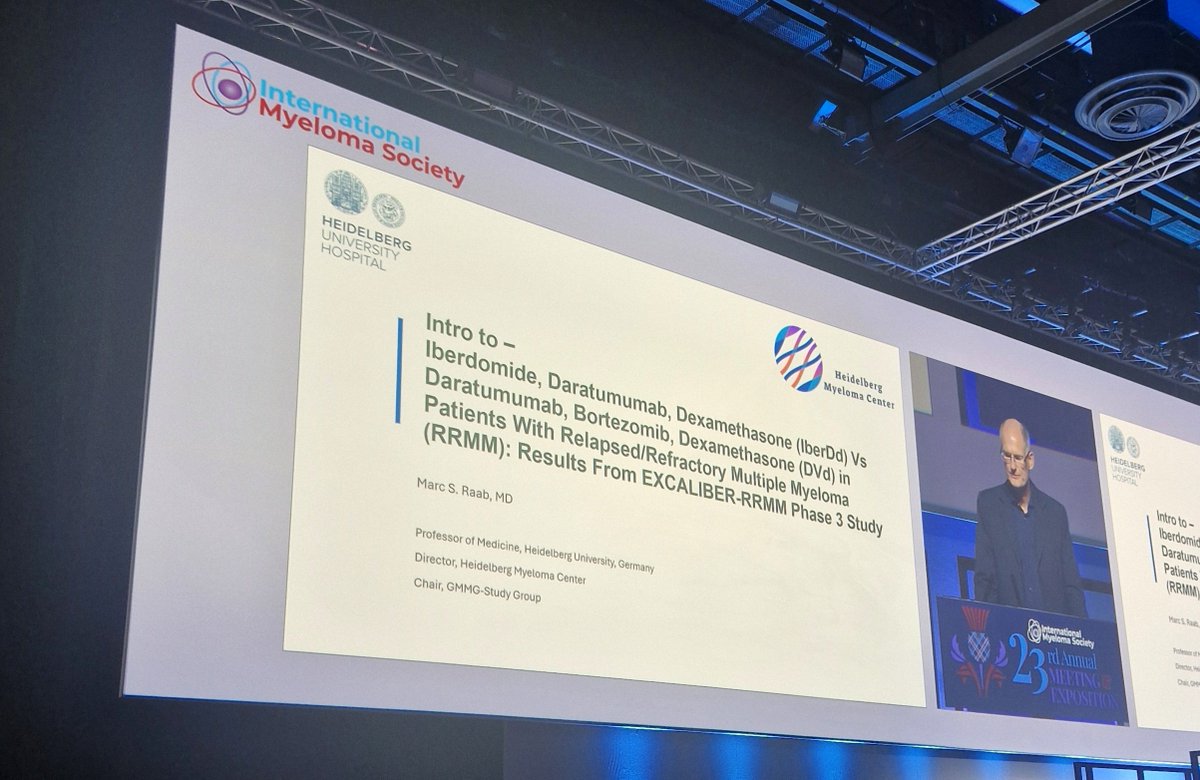
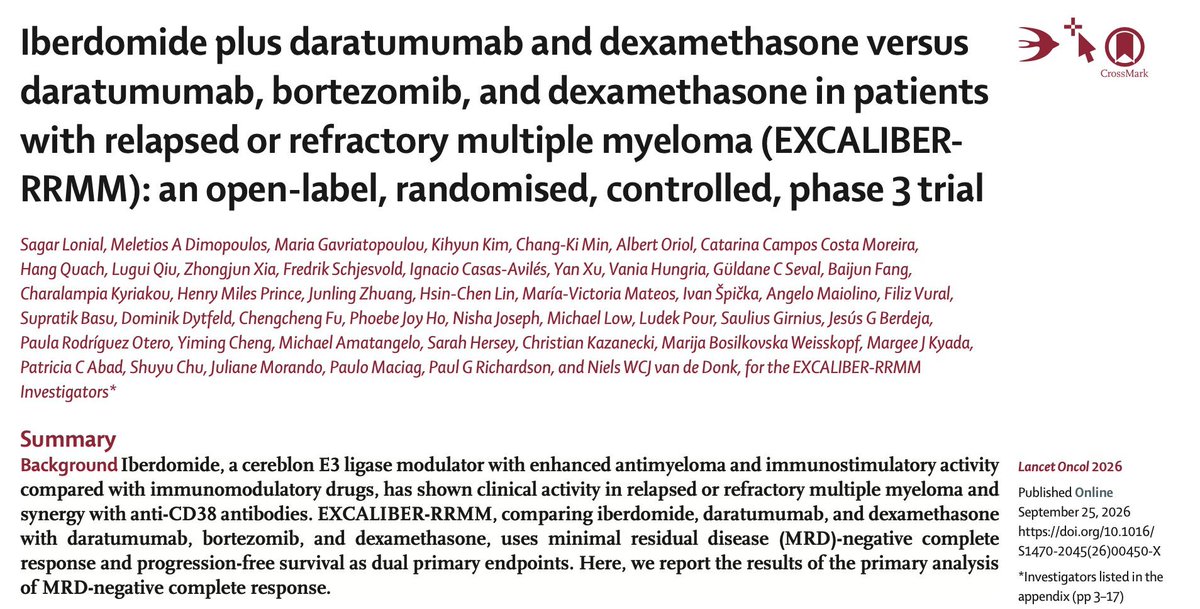
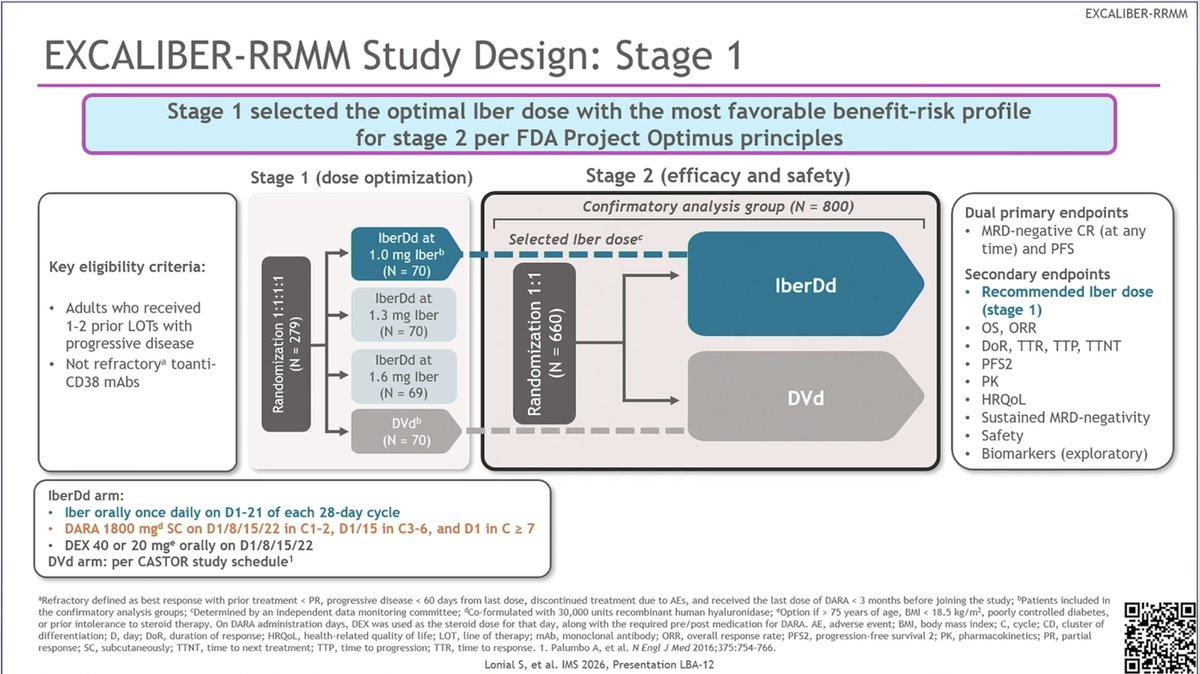
- EXCALIBER-RRMM: IberDd vs DVd
- First-in-human CD19/BCMA in-vivo CAR-T
SAME QUESTIONS. A BRIGHTER TOMORROW.
SATURDAY - SEPT 26
8:30-9:30 AM - HALL 5
THE NEXT CELLULAR-THERAPY ERA (CELLULAR THERAPIES: REAL POTENTIAL FOR REAL PEOPLE)
- Updated CEPHEUS MRD
- BCMAxGPRC5D dual-target CAR-T
- IASO206: IV in-vivo BCMA CAR-T
11:00 AM-12:00 PM - HALL 5
- Post-CAR-T elranatamab
- Delayed cilta-cel neurotoxicity
- MRD-guided T-cell redirection
11:00 AM-12:00 PM - LOMOND
- CAR-T enterocolitis biology
1:00-2:00 PM - LOMOND
- LV169: lentiviral in-vivo BCMA CAR delivery
Same goal. Brighter lives.
WHAT TO WATCH (DIFFERENT PERSPECTIVES A CLEARER FUTURE)
- Durability - OS - sustained MRD - infection burden
- Access - treatment-free time - late toxicity
- In-vivo CAR-T: insertion sites, off-target transduction, vector shedding & persistence
Go for the randomized data and the biology--not every new response rate.
Single malt only AFTER the final session.
SAME CURIOSITY FURTHER TOGETHER | GREAT SCIENCE DESERVES A DRAM



 Sep 25
CARTITUDE-4ImmunoPRISMMajesTEC-3MajesTEC-9MonumenTAL-3RedirecTT-1
#IMS26 #mmsm
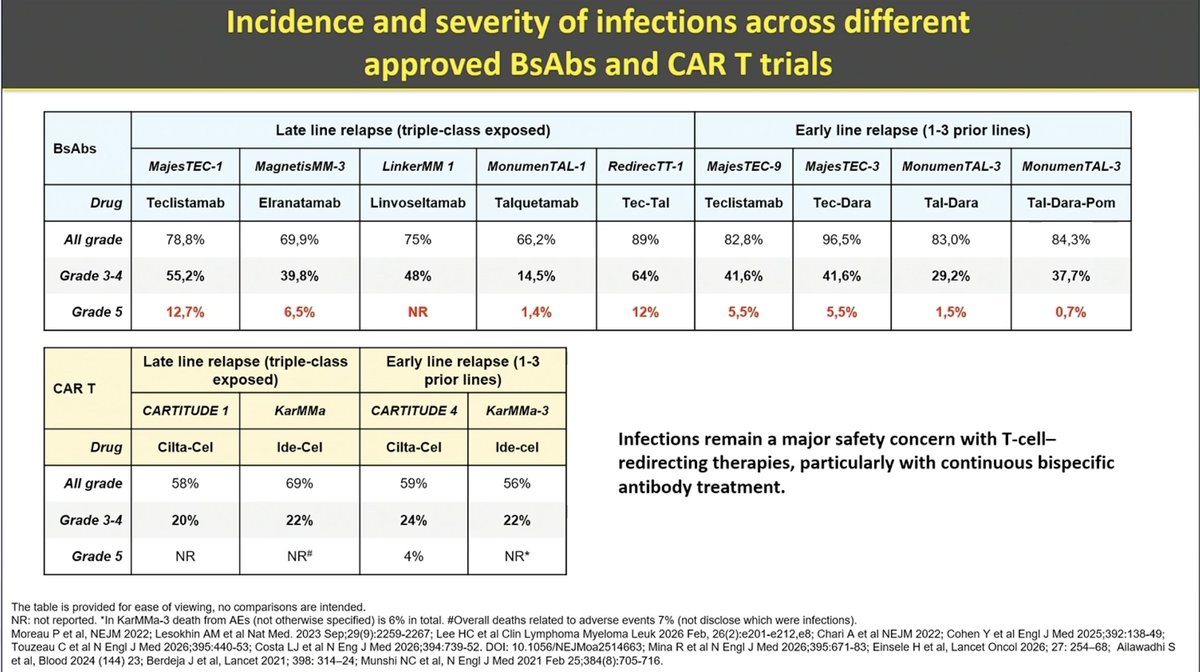
Infections with BsAn and CAR-T therapies https://t.co/nGIR6yJM9B
[Slide 1 - Incidence and severity of infections across different approved BsAbs and CAR T trials, cross-trial compilation table]
BsAbs late-line relapse (triple-class exposed) - trial/drug/All grade/Grade 3-4/Grade 5:
MajesTEC-1/Teclistamab: 78.8% / 55.2% / 12.7%. MagnetisMM-3/Elranatamab: 69.9% / 39.8% / 6.5%. LinkerMM-1/Linvoseltamab: 75% / 48% / NR. MonumenTAL-1/Talquetamab: 66.2% / 14.5% / 1.4%. RedirecTT-1/Tec-Tal: 89% / 64% / 12%.
BsAbs early-line relapse (1-3 prior lines): MajesTEC-9/Teclistamab: 82.8% / 41.6% / 5.5%. MajesTEC-3/Tec-Dara: 96.5% / 41.6% / 5.5%. MonumenTAL-3/Tal-Dara: 83.0% / 29.2% / 1.5%. MonumenTAL-3/Tal-Dara-Pom: 84.3% / 37.7% / 0.7%.
CAR T late-line relapse: CARTITUDE-1/Cilta-Cel: All grade 58%, Gr3-4 20%, Gr5 NR. KarMMa/Ide-Cel: 69%, 22%, NR (#, deaths from AEs not otherwise specified 7% total). CAR T early-line relapse: CARTITUDE-4/Cilta-Cel: 59%, 24%, 4%. KarMMa-3/Ide-Cel: 56%, 22%, NR (*, death from AEs 6% total).
"Infections remain a major safety concern with T-cell-redirecting therapies, particularly with continuous bispecific antibody treatment." Table provided for ease of viewing, no comparisons intended.
Sources: Moreau P et al NEJM 2022; Lesokhin AM et al Nat Med 2023;29(9):2259-2267; Lee HC et al Clin Lymphoma Myeloma Leuk 2026 Feb, 26(2):e201-e212,e8; Chari A et al NEJM 2022; Cohen Y et al Engl J Med 2025;392:138-49; Touzeau C et al N Engl J Med 2026;395:440-53; Costa LJ et al N Eng J Med 2026;394:739-52; Mina R et al N Engl J Med 2026;395:671-83; Einsele H et al, Lancet Oncol 2026;27:254-68; Ailawadhi S et al, Blood 2024 (144)23; Berdeja J et al, Lancet 2021;398:314-24; Munshi NC et al, N Engl J Med 2021 Feb 25;384(8):705-716.
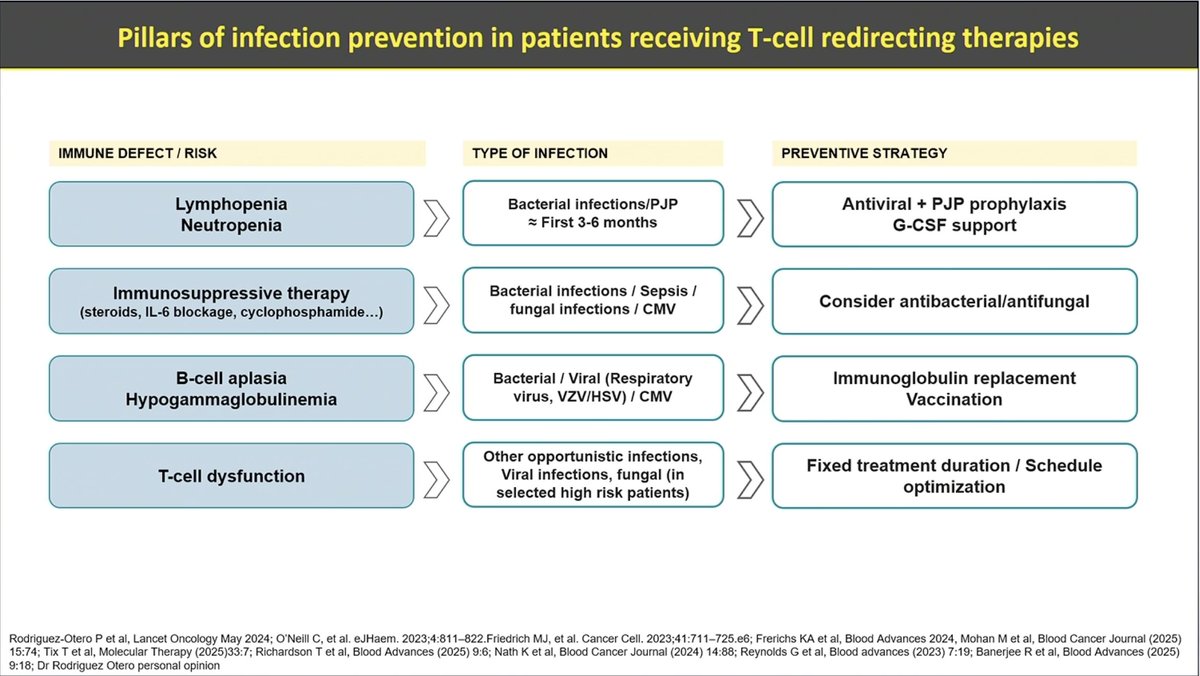
[Slide 2 - Pillars of infection prevention in patients receiving T-cell redirecting therapies]
Table: Immune defect/risk -> Type of infection -> Preventive strategy.
Lymphopenia/Neutropenia -> Bacterial infections/PJP, approx first 3-6 months -> Antiviral + PJP prophylaxis, G-CSF support.
Immunosuppressive therapy (steroids, IL-6 blockage, cyclophosphamide) -> Bacterial infections/Sepsis/fungal infections/CMV -> Consider antibacterial/antifungal.
B-cell aplasia/Hypogammaglobulinemia -> Bacterial/Viral (Respiratory virus, VZV/HSV)/CMV -> Immunoglobulin replacement, Vaccination.
T-cell dysfunction -> Other opportunistic infections, Viral infections, fungal (in selected high risk patients) -> Fixed treatment duration/Schedule optimization.
Sources: Rodriguez-Otero P et al, Lancet Oncology May 2024; O'Neill C, et al. eJHaem. 2023;4:811-822; Friedrich MJ, et al. Cancer Cell. 2023;41:711-725.e6; Frerichs KA et al, Blood Advances 2024; Mohan M et al, Blood Cancer Journal (2025) 15:74; Tix T et al, Molecular Therapy (2025)33:7; Richardson T et al, Blood Advances (2025) 9:6; Nath K et al, Blood Cancer Journal (2024) 14:88; Reynolds G et al, Blood advances (2023) 7:19; Banerjee R et al, Blood Advances (2025) 9:18; Dr Rodriguez Otero personal opinion.

 Sep 24

MajesTEC-3
#IMS26 Elegant (post hoc) MajesTEC-3 analysis by @End_myeloma
Unlike other myeloma drugs, I bet real-world tec-dara OS will look *better* than MajesTEC-3 did.
Why? Because we now know PPx toci, PPx IVIG, etc - early BsAb deaths can be prevented, vs fatal PD with Dara-Pd can't. https://t.co/PjU0eGrzSQ
MajesTEC-3: Time-Stratified Cox Analysis of OS
Curve (Surviving %, Tec-Dara vs DPd/DVd, 0-45 months):
>10 months: HR, 0.22 (95% CI, 0.13-0.38)
≤10 months: HR, 1.08 (95% CI, 0.64-1.81)
Deaths within first 10 months were comparable: 29 Tec-Dara vs 29 DPd/DVd
Overall HR, 0.46 (95% CI, 0.32-0.65); P<0.0001
Cause of death within first 10 months (curve cross):
Tec-Dara: AEs (n=18), PD (n=5), 'Other' (n=6)
DPd/DVd: AEs (n=8), PD (n=20), 'Other' (n=1)
Tec-Dara substantially reduced the risk of death by 78% versus DPd/DVd after 10 months
Of 18 AE deaths, 12 were infections. 3 patients died due to unknown reasons; 3 occurred outside the TEAE reporting window (n=1, unrelated to study treatment [COVID-19 occurring >30 days after last dose]; n=1, death occurred after initiation of subsequent therapy [septic shock]; n=1, death following diagnosis of secondary amyloidosis). 1 patient died due to unknown reasons.
TEAE, treatment-emergent adverse event.
Presented by LJ Costa at the 23rd International Myeloma Society (IMS) Annual Meeting and Exposition; September 23-26, 2026; Glasgow, Scotland (slide 13)
 Sep 24


MajesTEC-3
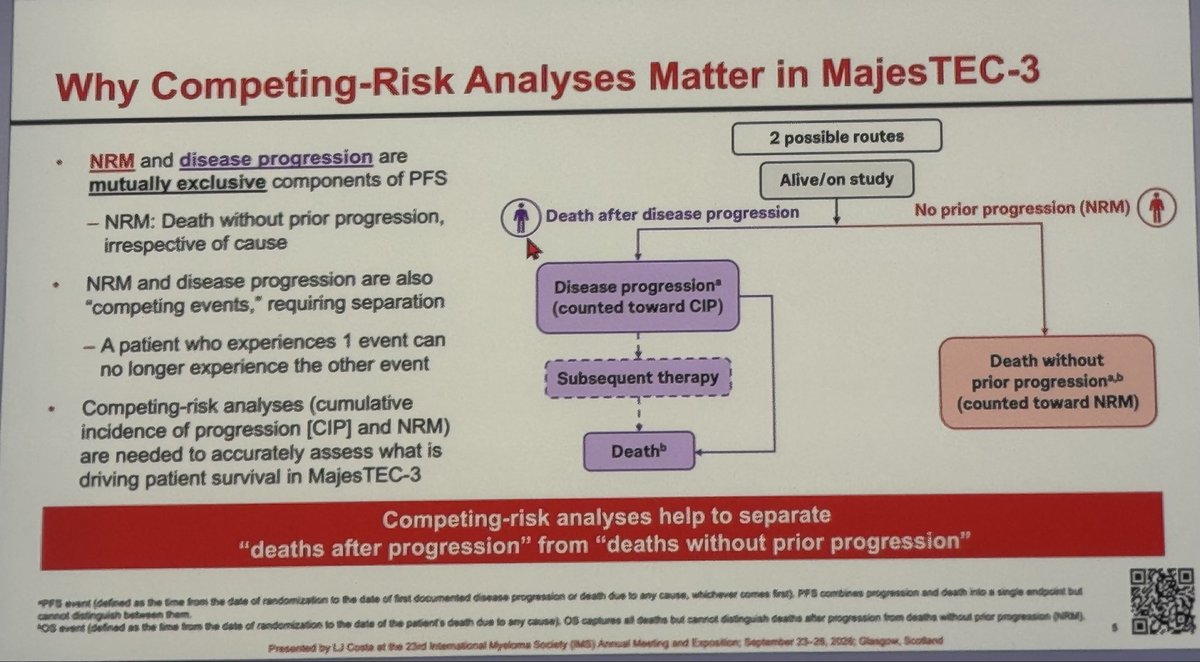
Very interesting Competing-Risk analysis of MajesTEC-3 presented by @End_myeloma at #IMS26 . Tec-Dara OS benefit driven by suppression of disease progression while NRM remains comparable over time. https://t.co/nxIZ0GDYk6
Why Competing-Risk Analyses Matter in MajesTEC-3
- NRM and disease progression are mutually exclusive components of PFS
- NRM: Death without prior progression, irrespective of cause
- NRM and disease progression are also "competing events," requiring separation
- A patient who experiences 1 event can no longer experience the other event
- Competing-risk analyses (cumulative incidence of progression [CIP] and NRM) are needed to accurately assess what is driving patient survival in MajesTEC-3
Flowchart: "2 possible routes" -> "Alive/on study" splits into:
(left) Death after disease progression -> Disease progression (counted toward CIP) -> Subsequent therapy -> Death
(right) No prior progression (NRM) -> Death without prior progression (counted toward NRM)
Banner: Competing-risk analyses help to separate "deaths after progression" from "deaths without prior progression"
Footnotes: aPFS event (defined as the time from the date of randomization to the date of first documented disease progression or death due to any cause, whichever comes first). PFS combines progression and death into a single endpoint but cannot distinguish between them. bOS event (defined as the time from the date of randomization to the date of the patient's death due to any cause). OS captures all deaths but cannot distinguish deaths after progression from deaths without prior progression (NRM).
Presented by LJ Costa at the 23rd International Myeloma Society (IMS) Annual Meeting and Exposition; September 23-26, 2026; Glasgow, Scotland 5
MajesTEC-3: Causes of Non-Relapse Mortality
NRM was primarily due to AEs in both treatment groups
- AEs were primarily infections and infestations, occurring most commonly within 6 months of treatment initiation
- Tec-Dara: 12; 11 ≤6 months(a)
- DPd/DVd: 4; 2 ≤6 months
- Infection prophylaxis was recommended per protocol,(1) with IgRT and antimicrobial use reinforced as experience and guidelines evolved
- Supportive RWE and IMWG guidelines recommend IgRT prophylaxis for the reduction of high-grade infections with BCMA-targeting BsAbs(2-5)
Table - NRM, n | Tec-Dara (n=28) | DPd/DVd (n=26):
AE-related(b): 19 | 16
Infections and infestations: 12 | 4
General disorders and administration-site conditions: 2 | 4
Respiratory, thoracic, and mediastinal disorders: 2 | 3
Nervous system disorders: 1 | 2
Hepatobiliary disorders: 1 | 1
Cardiac disorders: 1 | 0
Immune system disorders: 1 | 0
Neoplasms benign, malignant, and unspecified (including cysts and polyps): 0 | 1
Gastrointestinal disorders: 0 | 1
PD without IRC-determined progression: 2 | 8
Other: 7 | 2
Banner: Infection-related NRM may be reduced through diligent use of established IgRT and antimicrobial prophylaxis protocols
Footnotes: aOnly 3 out of 11 Tec-Dara patients received ≥1 dose of IgRT. bListed per System Organ Class. Of note, patients may have been listed as having more than 1 cause of death, which may have been due to 1 or more system organ class.
AE, adverse event; BsAb, bispecific antibody; IgRT, immunoglobulin replacement therapy; PD, progressive disease; RWE, real-world evidence.
1. Costa LJ, et al. N Engl J Med. 2026;394(8):739-752. 2. Smits F, et al. Blood Cancer J. 2026;16(1):26. 3. Lancman G, et al. Blood Cancer Discov. 2023;4(6):440-451. 4. Cheruvalath H, et al. Blood. 2024;144(Supp 1):256. 5. Rodriguez-Otero P, et al. Lancet Oncol. 2024;25(5):e205-e216.
Presented by LJ Costa at the 23rd International Myeloma Society (IMS) Annual Meeting and Exposition; September 23-26, 2026; Glasgow, Scotland 9
MajesTEC-3: Time-Stratified Cox Analysis of OS
Kaplan-Meier style survival curve (Surviving, % vs Time, months 0-45), two arms: Tec-Dara (red) and DPd/DVd (black)
>10 months: HR, 0.22 (95% CI, 0.13-0.38)
≤10 months: HR, 1.08 (95% CI, 0.64-1.81)
Deaths within first 10 months were comparable: 29 Tec-Dara vs 29 DPd/DVd
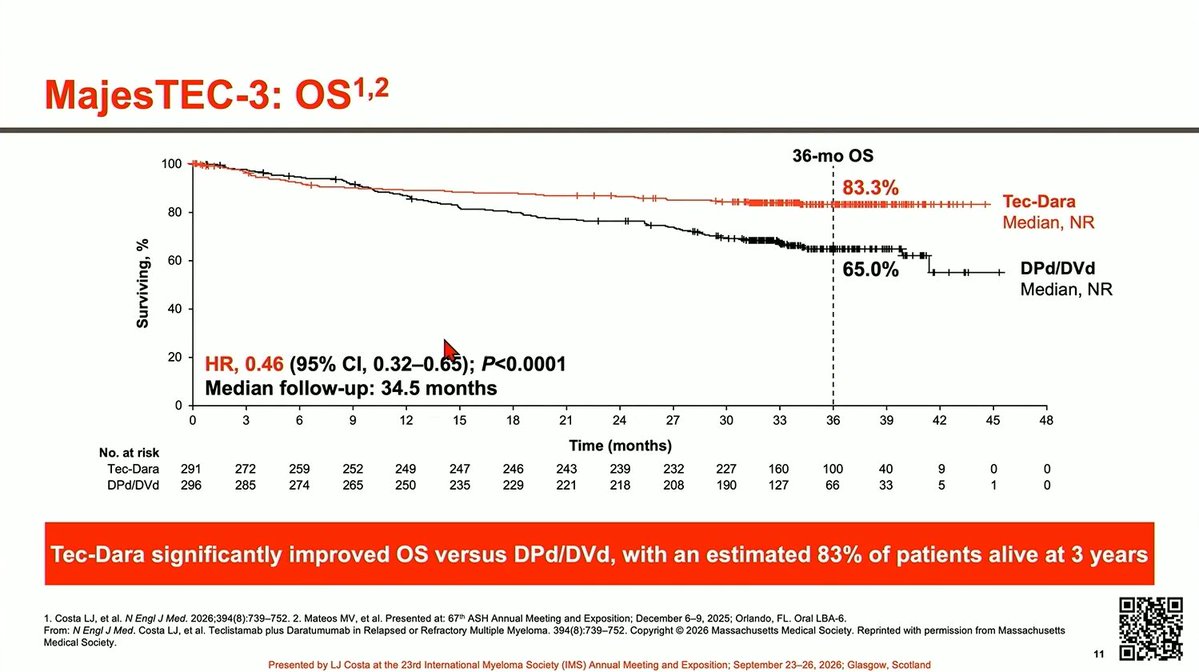
Overall: HR, 0.46 (95% CI, 0.32-0.65); P<0.0001
Cause of death within first 10 months (curve cross):
- Tec-Dara: AEs (n=18),(a) PD (n=5), "Other" (n=6)(b)
- DPd/DVd: AEs (n=8), PD (n=20), "Other" (n=1)(c)
Banner: Tec-Dara substantially reduced the risk of death by 78% versus DPd/DVd after 10 months
Footnotes: aOf 18 AE deaths, 12 were infections. b3 patients died due to unknown reasons; 3 occurred outside the TEAE reporting window (n=1, unrelated to study treatment [COVID-19 occurring >30 days after last dose]; n=1, death occurred after initiation of subsequent therapy [septic shock]; n=1, death following diagnosis of secondary amyloidosis). c1 patient died due to unknown reasons.
TEAE, treatment-emergent adverse event.
Presented by LJ Costa at the 23rd International Myeloma Society (IMS) Annual Meeting and Exposition; September 23-26, 2026; Glasgow, Scotland 13
Conclusions
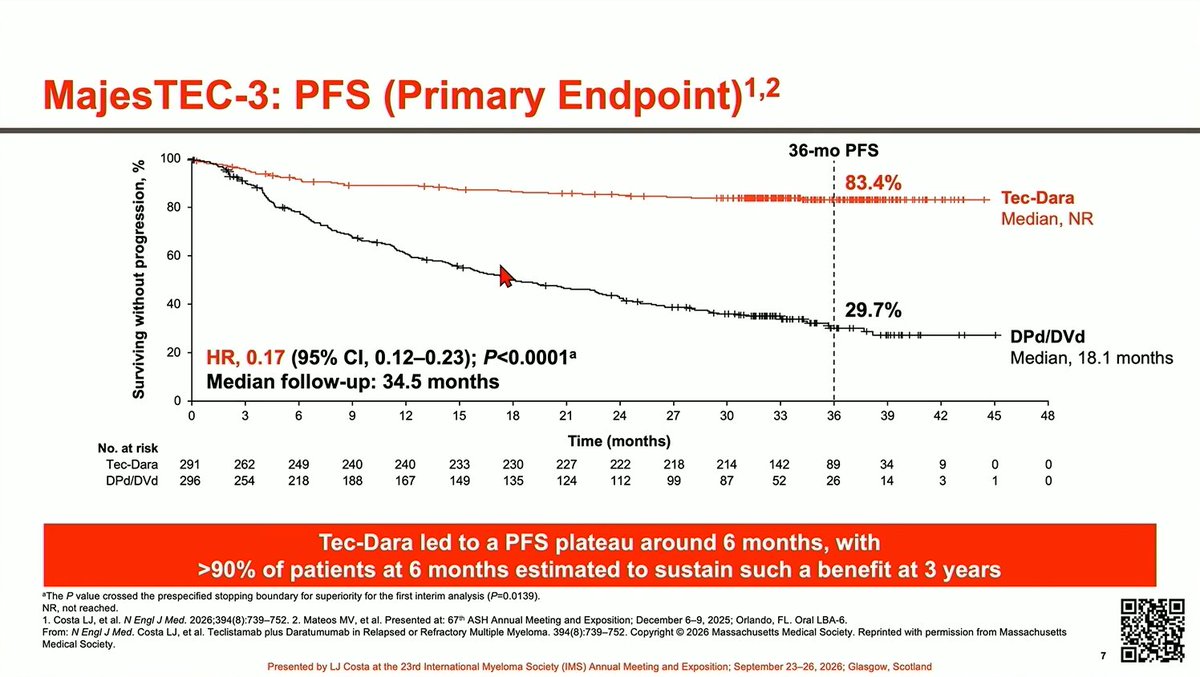
- Tec-Dara significantly improved PFS (HR, 0.17) and OS (HR, 0.46) over DPd/DVd in patients with RRMM and 1-3 prior LOTs,(1,2) with a sustained plateau in survival curves
- With Tec-Dara, progressions became uncommon after 6 months, with an unparalleled reduction in disease progression (sHR, 0.10), which is the leading cause of mortality in RRMM(3)
- There was no meaningful difference in NRM between treatments over time; infection-related NRM occurred with both treatments
- Infections can be better managed now with guideline-based IgRT and antimicrobial prophylaxis(4)
- OS benefit with Tec-Dara versus DPd/DVd was driven by durable disease control without an increase in NRM
- Superior OS with Tec-Dara was supported by RMST(1) and time-stratified Cox analysis (>10 months)
Banner: Tec-Dara's OS benefit is driven by profound suppression of disease progression, while NRM remains comparable over time
1. Costa LJ, et al. N Engl J Med. 2026;394(8):739-752. 2. Mateos MV, et al. Presented at: 67th ASH Annual Meeting and Exposition; December 6-9, 2025; Orlando, FL. Oral LBA-6. 3. Tan CR, et al. Blood Adv. 2026;10(9):2937-2946. 4. Rodriguez-Otero P, et al. Lancet Oncol. 2024;25(5):e205-e216.
Presented by LJ Costa at the 23rd International Myeloma Society (IMS) Annual Meeting and Exposition; September 23-26, 2026; Glasgow, Scotland 14
Sep 24

MajesTEC-3
#IMS26 Worth highlighting since pts with MM often aged 70+. We don't need OS plateau if myeloma remains in remission & no excess long-term mortality versus general population.
Excellent 'functional cure' MajesTEC-3 data for tec-dara - I hope time-limited BsAb can replicate! https://t.co/uXn3UHkYPd
Model Estimates of Mortality Risk With Tec-Dara
Bullet: Across tested models,[a] estimated statistical cure fractions were consistently high with Tec-Dara,[b] and low with DPd/DVd
Table - Statistical cure fraction, % | Tec-Dara | DPd/DVd
Best-fit model (95% CI)[c,d] | 86.6 (81-91) | 0 (0-53)
Range across tested models | 84.4 to 86.8 | 0 to 51.3
Right chart "Relative survival[e]": line chart, y-axis "Relative survival, %" 0-100, x-axis "Time (years)" 0-25. Tec-Dara line (blue) plateaus near 87% out to 25 years, annotated "Statistical cure fraction 86.6%" (green triangle marker ~86.6%). DPd/DVd line (gray) declines steadily from 100% to about 5% by 25 years.
Black banner: ~87% of patients treated with Tec-Dara are estimated to have no excess long-term mortality risk on top of the general population by best-fit models
Footnote: aTested models analyzed survival related to excess risk in the uncured fraction using 7 classical parametric models including exponential, Weibull, lognormal, loglogistic, Gompertz, gamma, and generalized gamma. bResults from the Gompertz function were excluded for Tec-Dara because it resulted in a non-zero ceiling in excess mortality due to the shape parameter being negative. cBest-fit models were selected according to statistical goodness of fit criteria; MCMs applied the exponential function for Tec-Dara OS and DPd/DVd OS. dProfile-likelihood 95% CIs shown here; these replace the Wald CIs reported in the abstract and typically provide more accurate coverage. eFrom best-fit model.
Presented by NWCJ van de Donk at the 23rd International Myeloma Society (IMS) Annual Meeting and Exposition; September 23-26, 2026; Glasgow, Scotland [Slide 11]
Sep 24


MajesTEC-3
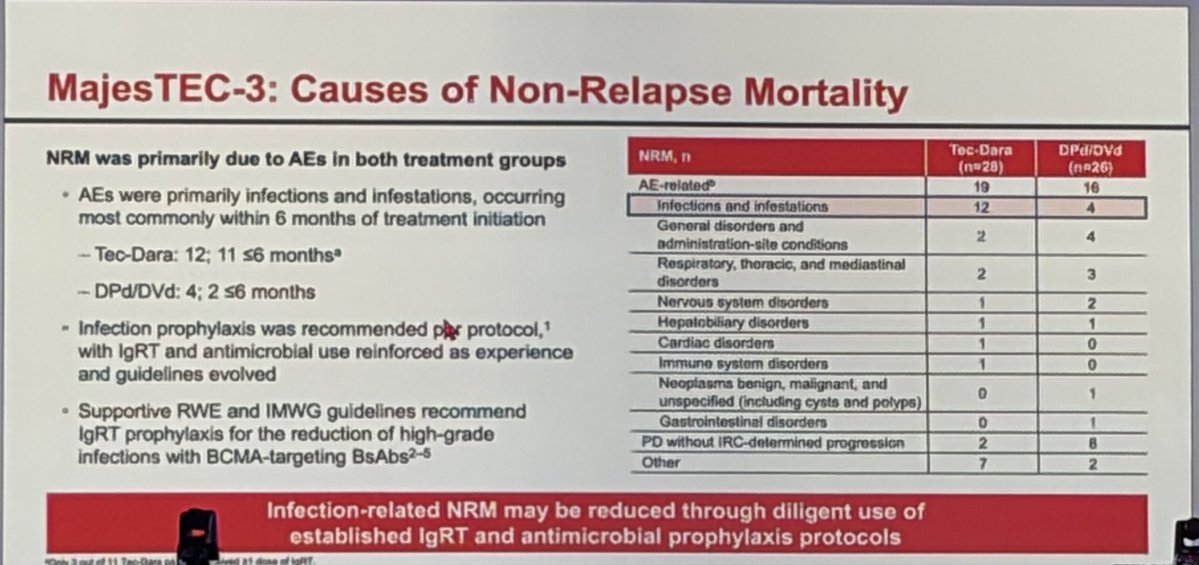
@End_myeloma on MajesTEC-3 competing-risk analysis at #IMS26: Tec-Dara vs DPd/DVd in RRMM, 1–3 prior LOTs
• Progression sHR 0.10
• NRM similar (28 vs 26)
• OS HR 0.22 after 10 mo
Early infection deaths → IgRT + antimicrobial prophylaxis is a must. #mmsm @Myeloma_Society https://t.co/J9QwgmmdCZ
Why Competing-Risk Analyses Matter in MajesTEC-3
- NRM and disease progression are mutually exclusive components of PFS
- NRM: Death without prior progression, irrespective of cause
- NRM and disease progression are also 'competing events,' requiring separation
- A patient who experiences 1 event can no longer experience the other event
- Competing-risk analyses (cumulative incidence of progression [CIP] and NRM) are needed to accurately assess what is driving patient survival in MajesTEC-3
Flow diagram: '2 possible routes' -> Alive/on study -> [left] Death after disease progression -> Disease progression (counted toward CIP) -> Subsequent therapy -> Death; [right] No prior progression (NRM) -> Death without prior progression (counted toward NRM)
Banner: 'Competing-risk analyses help to separate "deaths after progression" from "deaths without prior progression"'
MajesTEC-3: Causes of Non-Relapse Mortality
NRM was primarily due to AEs in both treatment groups
- AEs were primarily infections and infestations, occurring most commonly within 6 months of treatment initiation
- Tec-Dara: 12; 11 <=6 months(a)
- DPd/DVd: 4; 2 <=6 months
- Infection prophylaxis was recommended per protocol, with IgRT and antimicrobial use reinforced as experience and guidelines evolved
- Supportive RWE and IMWG guidelines recommend IgRT prophylaxis for the reduction of high-grade infections with BCMA-targeting BsAbs
Table - NRM, n | Tec-Dara (n=28) | DPd/DVd (n=26):
AE-related(b): 19 | 16
Infections and infestations: 12 | 4
General disorders and administration-site conditions: 2 | 4
Respiratory, thoracic, and mediastinal disorders: 2 | 3
Nervous system disorders: 1 | 2
Hepatobiliary disorders: 1 | 1
Cardiac disorders: 1 | 0
Immune system disorders: 1 | 0
Neoplasms benign, malignant, and unspecified (including cysts and polyps): 0 | 1
Gastrointestinal disorders: 0 | 1
PD without IRC-determined progression: 2 | 8
Other: 7 | 2
Banner: 'Infection-related NRM may be reduced through diligent use of established IgRT and antimicrobial prophylaxis protocols'
Conclusions
- Tec-Dara significantly improved PFS (HR, 0.17) and OS (HR, 0.46) over DPd/DVd in patients with RRMM and 1-3 prior LOTs, with a sustained plateau in survival curves
- With Tec-Dara, progressions became uncommon after 6 months, with an unparalleled reduction in disease progression (sHR, 0.10), which is the leading cause of mortality in RRMM
- There was no meaningful difference in NRM between treatments over time; infection-related NRM occurred [text cut off at right edge of photo]
- Infections can be better managed now with guideline-based IgRT and antimicrobial prophylaxis
- OS benefit with Tec-Dara versus DPd/DVd was driven by durable disease control without an increase in N[RM, cut off]
- Superior OS with Tec-Dara was supported by RMST and time-stratified Cox analysis (>10 months)
Banner: 'Tec-Dara's OS benefit is driven by profound suppression of disease progression, while NRM remains comparable over time'
Citations (partially legible): 1. Costa LJ, et al. N Engl J Med...394(8):739-752. 2. Mateos MV, et al. Presented at 67th ASH Annual Meeting and Exposition; December 6-9, 2025; Orlando, FL. Oral LBA-6. 3. Tan CR, et al. Blood Adv. 2026;10(5):2937-2946. 4. Rodriguez-Otero P, et al. ... 2026;25(5):e255-e218
Presented by LJ Costa at the 23rd International Myeloma Society (IMS) Annual Meeting and Exposition; September 23-26, 2025; Glasgow, Scotland [year on footer reads 2025, likely a typo for 2026]
Sep 24



MajesTEC-3
#IMS26 #mmsm Oral MajesTEC-3 post hoc analysis @End_myeloma
➡️Tec-Dara reduced the risk of death by 78% versus DPd/DVd after 10 months with similar early deaths
Better AEs management will help further mitigate higher risk of infection early on
Moving forward this should change to time limited therapy given excellent results and depth of response
MajesTEC-3: Causes of Non-Relapse Mortality
NRM was primarily due to AEs in both treatment groups
AEs were primarily infections and infestations, occurring most commonly within 6 months of treatment initiation
- Tec-Dara: 12; 11 ≤6 months
- DPd/DVd: 4; 2 ≤6 months
Infection prophylaxis was recommended per protocol, with IgRT and antimicrobial use reinforced as experience and guidelines evolved
Supportive RWE and IMWG guidelines recommend IgRT prophylaxis for the reduction of high-grade infections with BCMA-targeting BsAbs
Table - NRM, n | Tec-Dara (n=28) | DPd/DVd (n=26)
AE-related: 19 | 16
Infections and infestations: 12 | 4
General disorders and administration-site conditions: 2 | 4
Respiratory, thoracic, and mediastinal disorders: 2 | 3
Nervous system disorders: 1 | 2
Hepatobiliary disorders: 1 | 1
Cardiac disorders: 1 | 0
Immune system disorders: 1 | 0
Neoplasms benign, malignant, and unspecified (including cysts and polyps): 0 | 1
Gastrointestinal disorders: 0 | 1
PD without IRC-determined progression: 2 | 8
Other: 7 | 2
Infection-related NRM may be reduced through diligent use of established IgRT and antimicrobial prophylaxis protocols
Only 3 out of 11 Tec-Dara patients received ≥1 dose of IgRT. Listed per System Organ Class. Of note, patients may have been listed as having more than 1 cause of death, which may have been due to 1 or more system organ class.
AE, adverse event; BsAb, bispecific antibody; IgRT, immunoglobulin replacement therapy; PD, progressive disease; RWE, real-world evidence.
1. Costa LJ, et al. N Engl J Med. 2026;394(8):739-752. 2. Smits F, et al. Blood Cancer J. 2026;16(1):26. 3. Lancman G, et al. Blood Cancer Discov. 2023;4(6):440-451. 4. Cheruvalath H, et al. Blood. 2024;144(Supp 1):256. 5. Rodriguez-Otero P, et al. Lancet Oncol. 2024;25(5):e205-e216.
Presented by LJ Costa at the 23rd International Myeloma Society (IMS) Annual Meeting and Exposition; September 23-26, 2026; Glasgow, Scotland (slide 9)
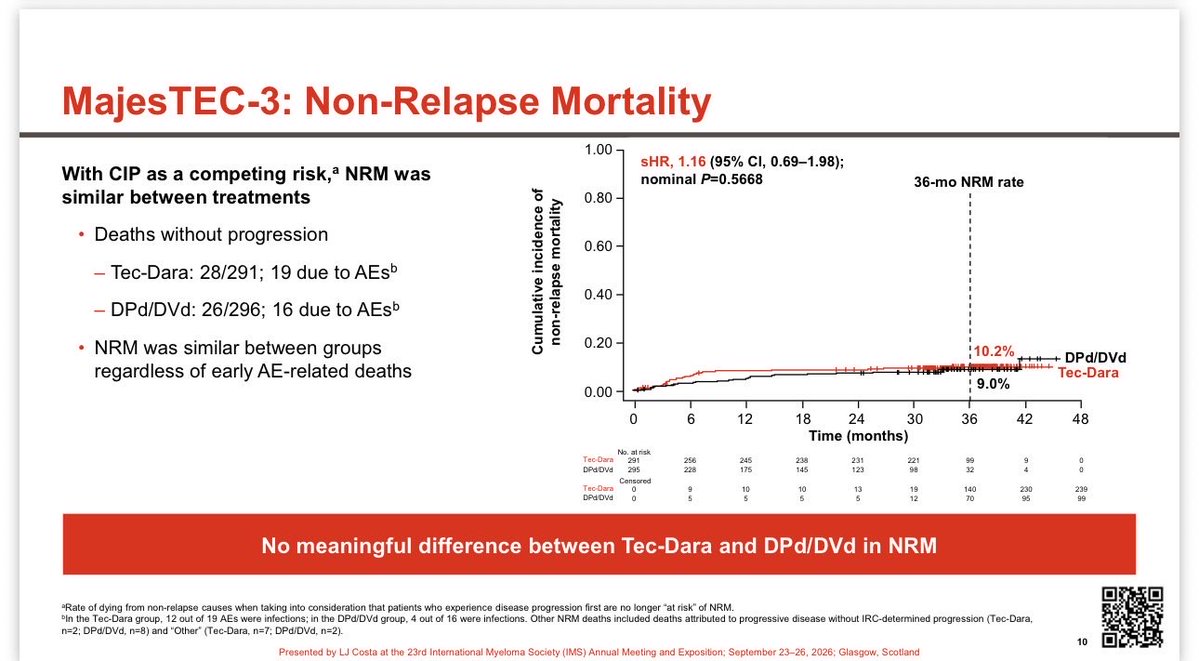
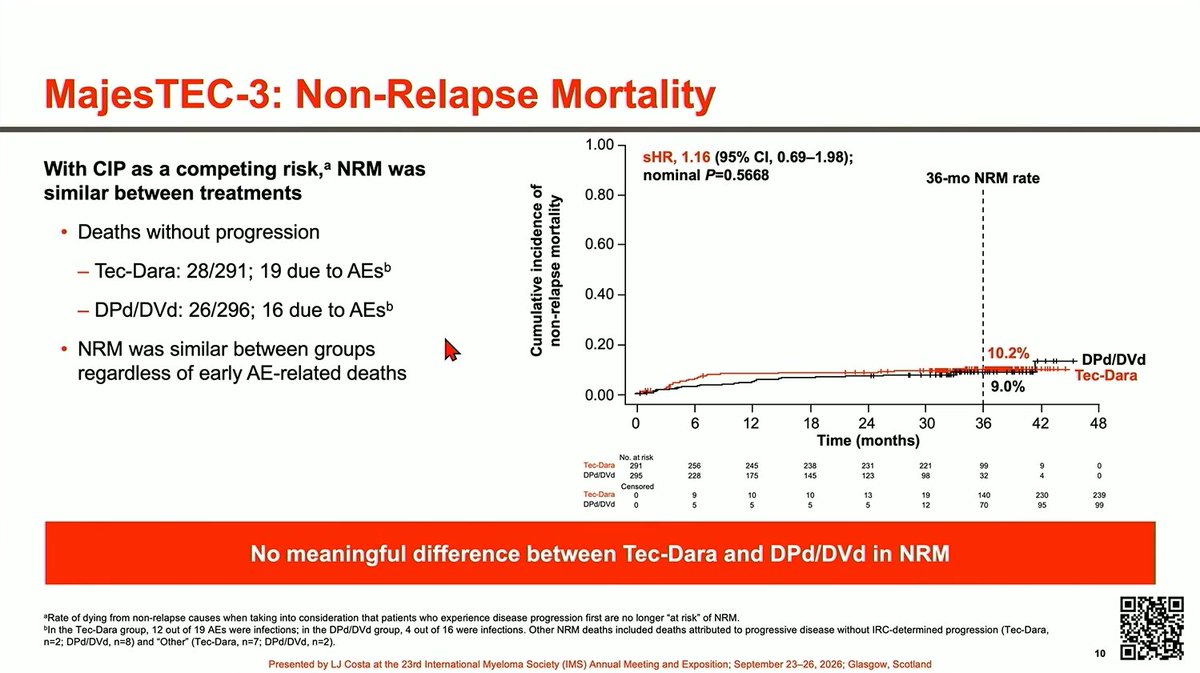
MajesTEC-3: Non-Relapse Mortality
With CIP as a competing risk, NRM was similar between treatments
Deaths without progression
- Tec-Dara: 28/291; 19 due to AEs
- DPd/DVd: 26/296; 16 due to AEs
NRM was similar between groups regardless of early AE-related deaths
Cumulative incidence of non-relapse mortality curve (Tec-Dara vs DPd/DVd, 0-48 months):
sHR, 1.16 (95% CI, 0.69-1.98); nominal P=0.5668
36-mo NRM rate: DPd/DVd 10.2%, Tec-Dara 9.0%
No. at risk - Tec-Dara: 291 256 245 238 231 221 99 9 0 (at 0,6,12,18,24,30,36,42,48 months); DPd/DVd: 295 228 175 145 123 98 32 4 0
Censored - Tec-Dara: 0 9 10 10 13 19 140 230 239; DPd/DVd: 0 5 5 5 5 12 70 95 99
No meaningful difference between Tec-Dara and DPd/DVd in NRM
Rate of dying from non-relapse causes when taking into consideration that patients who experience disease progression first are no longer 'at risk' of NRM. In the Tec-Dara group, 12 out of 19 AEs were infections; in the DPd/DVd group, 4 out of 16 were infections. Other NRM deaths included deaths attributed to progressive disease without IRC-determined progression (Tec-Dara, n=2; DPd/DVd, n=8) and 'Other' (Tec-Dara, n=7; DPd/DVd, n=2).
Presented by LJ Costa at the 23rd International Myeloma Society (IMS) Annual Meeting and Exposition; September 23-26, 2026; Glasgow, Scotland (slide 10)
MajesTEC-3: Restricted Mean Survival Time (RMST) OS
Pre-planned RMST analysis supported an OS benefit with Tec-Dara versus DPd/DVd
Tec-Dara increased average survival time through 34.1 months post-randomization (nominal P=0.0088)
RMST is an alternative, clinically interpretable measure of treatment effect, particularly when proportional hazards are not met
Calculated as area under the KM curve up to a prespecified time point (tau)
Curve (Probability of patients being alive, 0-48 months): tau= 34.1 mo; Tec-Dara additional average survival time with Tec-Dara vs DPd/DVd
HR, 0.46 (95% CI, 0.32-0.65); P<0.0001
RMST: P=0.0088
RMST demonstrated consistent OS benefit with Tec-Dara versus DPd/DVd
34.1 months represents the smaller value of the longest OS event time observed from either arm at the time of clinical cut-off (Tec-Dara, 34.1 months; DPd/DVd, 41.4 months). The estimated average survival time through 34.1 months was 30.3 months for Tec-Dara and 28.2 months for DPd/DVd; RMST difference was 2.15 months, thus favoring Tec-Dara.
KM, Kaplan-Meier.
1. Costa LJ, et al. N Engl J Med. 2026;394(8):739-752. 2. Mateos MV, et al. Presented at: 67th ASH Annual Meeting and Exposition; December 6-9, 2025; Orlando, FL. Oral LBA-6.
Presented by LJ Costa at the 23rd International Myeloma Society (IMS) Annual Meeting and Exposition; September 23-26, 2026; Glasgow, Scotland (slide 12)
MajesTEC-3: Time-Stratified Cox Analysis of OS
Curve (Surviving %, Tec-Dara vs DPd/DVd, 0-45 months):
>10 months: HR, 0.22 (95% CI, 0.13-0.38)
≤10 months: HR, 1.08 (95% CI, 0.64-1.81)
Deaths within first 10 months were comparable: 29 Tec-Dara vs 29 DPd/DVd
Overall HR, 0.46 (95% CI, 0.32-0.65); P<0.0001
Cause of death within first 10 months (curve cross):
Tec-Dara: AEs (n=18), PD (n=5), 'Other' (n=6)
DPd/DVd: AEs (n=8), PD (n=20), 'Other' (n=1)
Tec-Dara substantially reduced the risk of death by 78% versus DPd/DVd after 10 months
Of 18 AE deaths, 12 were infections. 3 patients died due to unknown reasons; 3 occurred outside the TEAE reporting window (n=1, unrelated to study treatment [COVID-19 occurring >30 days after last dose]; n=1, death occurred after initiation of subsequent therapy [septic shock]; n=1, death following diagnosis of secondary amyloidosis). 1 patient died due to unknown reasons.
TEAE, treatment-emergent adverse event.
Presented by LJ Costa at the 23rd International Myeloma Society (IMS) Annual Meeting and Exposition; September 23-26, 2026; Glasgow, Scotland (slide 13)
Sep 24


MajesTEC-3
#IMS26 #mmsm Oral MajesTEC-3 post hoc analysis @End_myeloma
➡️ In Tec-Dara, progressions became uncommon after 6 months, with an reduction in disease progression (sHR, 0.10), which is the leading cause of mortality in RRMM https://t.co/jctyzj62b3
MajesTEC-3: Study Design
Phase 3, multicenter, open-label trial conducted in 150 sites across 20 countries.
Key inclusion criteria:
- RRMM
- 1-3 prior LOTs including a PI and lenalidomide
- Patients with only 1 prior LOT must have been lenalidomide refractory per IMWG criteria
- ECOG PS score of 0-2
Key exclusion criteria:
- Prior BCMA-directed therapy
- Refractory to anti-CD38 mAbs
1:1 randomization N=587 (22 Oct 2021 to 29 Sept 2023)
-> Tec-Dara N=291, SC dosing following Dara schedule
-> DPd/DVd N=296, by investigator's choice
Primary endpoint: PFS per IRC
Key secondary endpoints: >=CR and ORR; MRD negativity (10^-5); OS; MySIm-Q Total Symptom score
Other secondary endpoints: Safety; PK and immunogenicity
Fully immunotherapy-based Tec-Dara regimen with a steroid-sparing schedule after Cycle 1 Day 8 and monthly dosing after 6 cycles
Footnotes: Prior exposure to anti-CD38 mAbs was permitted. During the COVID-19 pandemic. DPd/DVd were administered per the approved schedules. Response and disease progression were assessed by a blinded IRC per IMWG criteria. Dexamethasone, acetaminophen, and diphenhydramine pre-medication was required for the first 2 weeks; subsequent dexamethasone was not required thereafter.
BCMA, B-cell maturation antigen; CR, complete response; ECOG PS, Eastern Cooperative Oncology Group performance status; IMWG, International Myeloma Working Group; IRC, independent review committee; mAbs, monoclonal antibodies; MRD, minimal residual disease; MySIm-Q, Multiple Myeloma Symptom and Impact Questionnaire; ORR, overall response rate; PI, proteasome inhibitor; PK, pharmacokinetics; SC, subcutaneous.
1. Costa LJ, et al. N Engl J Med. 2026;394(8):739-752.
Presented by LJ Costa at the 23rd International Myeloma Society (IMS) Annual Meeting and Exposition; September 23-26, 2026; Glasgow, Scotland 4
Why Competing-Risk Analyses Matter in MajesTEC-3
- NRM and disease progression are mutually exclusive components of PFS
- NRM: Death without prior progression, irrespective of cause
- NRM and disease progression are also "competing events," requiring separation
- A patient who experiences 1 event can no longer experience the other event
- Competing-risk analyses (cumulative incidence of progression [CIP] and NRM) are needed to accurately assess what is driving patient survival in MajesTEC-3
[Flow diagram] Alive/on study -> 2 possible routes: "Death after disease progression" (purple person icon) or "No prior progression (NRM)" (red person icon)
Death after disease progression -> Disease progression (counted toward CIP) -> Subsequent therapy -> Death
No prior progression (NRM) -> Death without prior progression (counted toward NRM)
Competing-risk analyses help to separate "deaths after progression" from "deaths without prior progression"
Footnotes: PFS event (defined as the time from the date of randomization to the date of first documented disease progression or death due to any cause, whichever comes first). PFS combines progression and death into a single endpoint but cannot distinguish between them. OS event (defined as the time from the date of randomization to the date of the patient's death due to any cause). OS captures all deaths but cannot distinguish deaths after progression from deaths without prior progression (NRM).
Presented by LJ Costa at the 23rd International Myeloma Society (IMS) Annual Meeting and Exposition; September 23-26, 2026; Glasgow, Scotland 5
Statistical Analysis
Table with 3 columns:
Primary analysis: PFS and OS
HR with 95% CIs from stratified Cox regression model
Stratified log-rank test
Competing-risk analyses: CIP and NRM
Cumulative incidence of progression (CIP): Progression with NRM as competing risk
Non-relapse mortality (NRM): Death with progression as competing risk
Fine-Gray sub-distribution HRs (sHR) and Gray's test
Expanded analyses: OS
Restricted mean survival time: Applied when proportional hazards were not met, per SAP
Piecewise analysis: Time-stratified Cox analysis (<=10 months vs >10 months)
Complementary competing-risk analyses allow for a more accurate interpretation of long-term survival
Footnotes: Per IRC. CI, confidence interval; HR, hazard ratio; SAP, statistical analysis plan.
Presented by LJ Costa at the 23rd International Myeloma Society (IMS) Annual Meeting and Exposition; September 23-26, 2026; Glasgow, Scotland 6
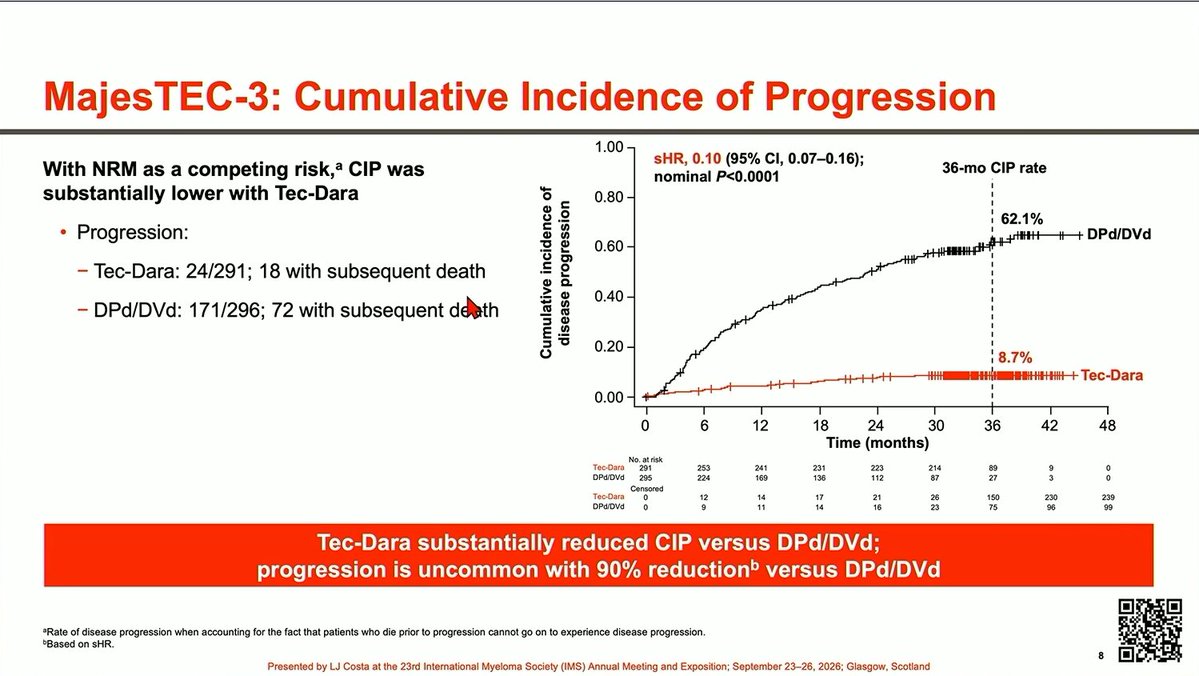
MajesTEC-3: Cumulative Incidence of Progression
With NRM as a competing risk, CIP was substantially lower with Tec-Dara
- Progression:
- Tec-Dara: 24/291; 18 with subsequent death
- DPd/DVd: 171/296; 72 with subsequent death
Cumulative Incidence of Progression curve, x-axis Time (months) 0-48, y-axis Cumulative incidence of disease progression 0.00-1.00:
sHR, 0.10 (95% CI, 0.07-0.16); nominal P<0.0001
36-mo CIP rate: DPd/DVd 62.1%; Tec-Dara 8.7%
Number at risk table:
Tec-Dara: 291, 253, 241, 231, 223, 214, 89, 9, 0 (months 0,6,12,18,24,30,36,42,48)
DPd/DVd: 295, 224, 169, 136, 112, 87, 27, 3, 0
Censored:
Tec-Dara: 0,12,14,17,21,26,150,230,239
DPd/DVd: 0,9,11,14,16,23,75,96,99
Tec-Dara substantially reduced CIP versus DPd/DVd; progression is uncommon with 90% reduction versus DPd/DVd
Footnotes: Rate of disease progression when accounting for the fact that patients who die prior to progression cannot go on to experience disease progression. Based on sHR.
Presented by LJ Costa at the 23rd International Myeloma Society (IMS) Annual Meeting and Exposition; September 23-26, 2026; Glasgow, Scotland 8
Sep 23
MajesTEC-3
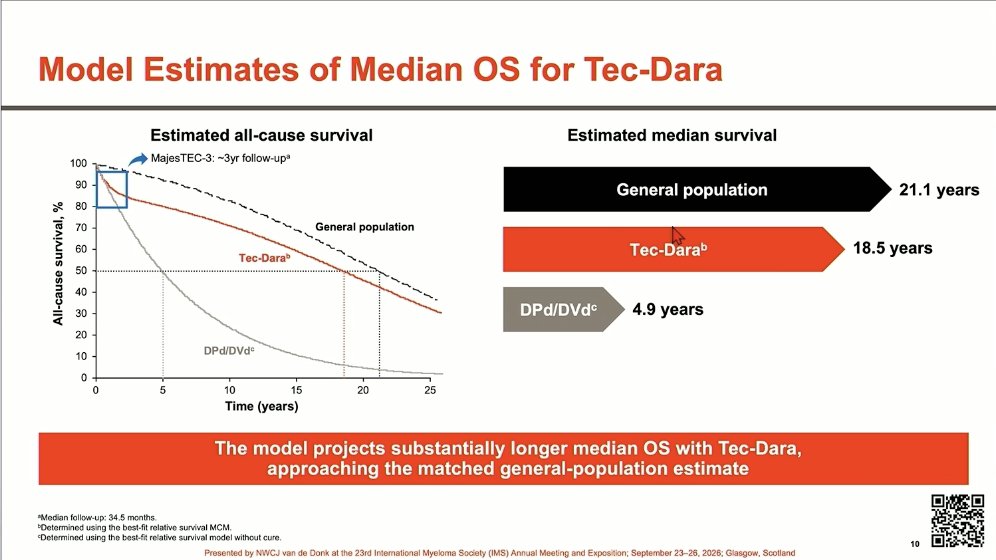
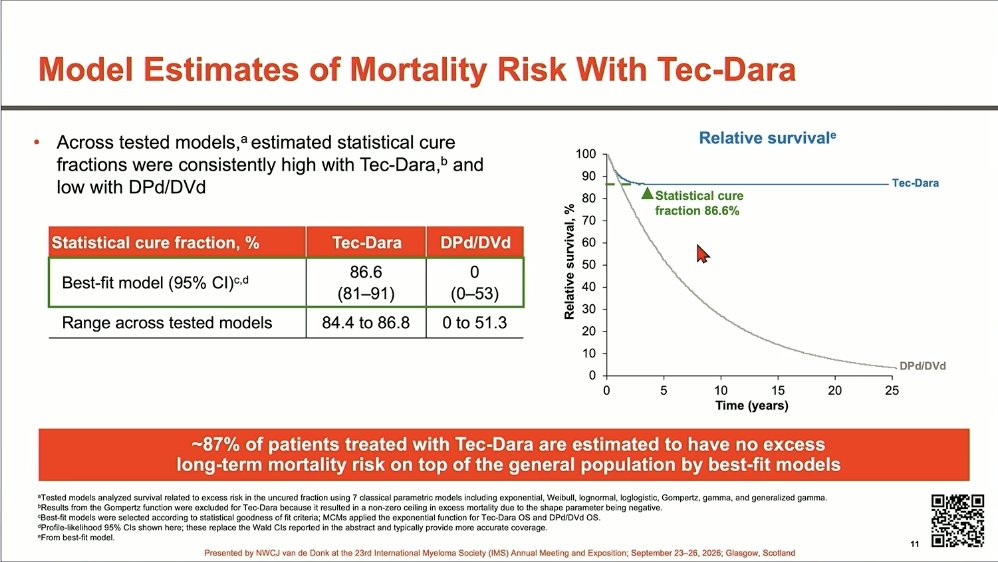
#IMS26 #mmsm Oral- % of functional cure with the use of Tec-Dara @Myeloma_Society
Estimated functional cure of 87% with Tec-Dara showing excellent promise of such therapy.
➡️Future will need time limited therapy (Stop and see what will happen)
➡️Assess cumulative toxicity https://t.co/A9wwWJ8UC4
Model Estimates of Median OS for Tec-Dara
Left: "Estimated all-cause survival" plot, x-axis Time (years) 0-25, y-axis All-cause survival % 0-100. Blue box annotation "MajesTEC-3: ~3yr follow-up" pointing to early portion of curves. Three curves: General population (black dashed), Tec-Dara (red/orange solid), DPd/DVd (grey solid, steepest decline).
Right: "Estimated median survival" bar/arrow chart:
General population: 21.1 years
Tec-Dara: 18.5 years
DPd/DVd: 4.9 years
The model projects substantially longer median OS with Tec-Dara, approaching the matched general-population estimate
Footnotes: Median follow-up: 34.5 months. Determined using the best-fit relative survival MCM. Determined using the best-fit relative survival model without cure.
Presented by NWCJ van de Donk at the 23rd International Myeloma Society (IMS) Annual Meeting and Exposition; September 23-26, 2026; Glasgow, Scotland 10
Model Estimates of Mortality Risk With Tec-Dara
- Across tested models, estimated statistical cure fractions were consistently high with Tec-Dara, and low with DPd/DVd
Table - Statistical cure fraction, %:
Tec-Dara DPd/DVd
Best-fit model (95% CI): 86.6 (81-91) 0 (0-53)
Range across tested models: 84.4 to 86.8 0 to 51.3
Right: "Relative survival" plot, x-axis Time (years) 0-25, y-axis Relative survival % 0-100. Two curves: Tec-Dara (blue, plateauing near 86-90%, annotated "Statistical cure fraction 86.6%"); DPd/DVd (grey, declining toward 0 by ~20-25 years).
~87% of patients treated with Tec-Dara are estimated to have no excess long-term mortality risk on top of the general population by best-fit models
Footnotes: Tested models analyzed survival related to excess risk in the uncured fraction using 7 classical parametric models including exponential, Weibull, lognormal, loglogistic, Gompertz, gamma, and generalized gamma. Results from the Gompertz function were excluded for Tec-Dara because it resulted in a non-zero ceiling in excess mortality due to the shape parameter being negative. Best-fit models were selected according to statistical goodness of fit criteria; MCMs applied the exponential function for Tec-Dara OS and DPd/DVd OS. Profile-likelihood 95% CIs shown here; these replace the Wald CIs reported in the abstract and typically provide more accurate coverage. From best-fit model.
Presented by NWCJ van de Donk at the 23rd International Myeloma Society (IMS) Annual Meeting and Exposition; September 23-26, 2026; Glasgow, Scotland 11

 Sep 23
CARTITUDE-4CERVINODREAMM-7DREAMM-8MajesTEC-3MajesTEC-9MonumenTAL-3MonumenTAL-6
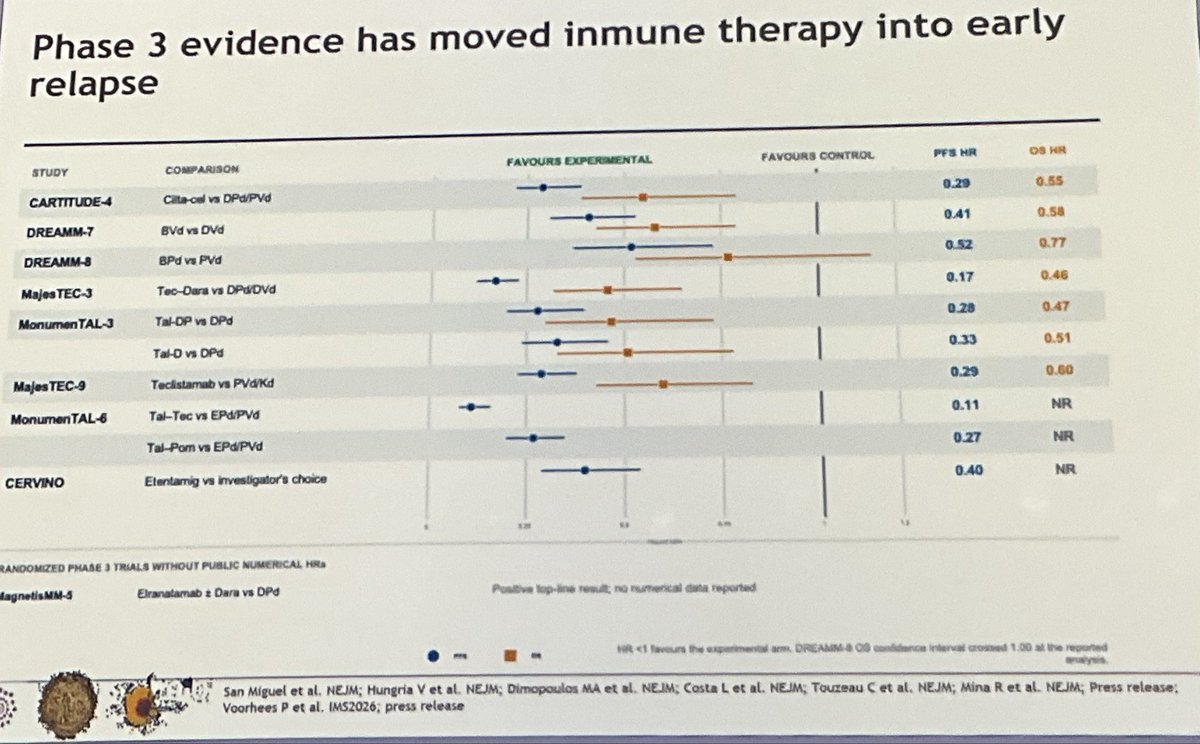
Never a good time to be a myeloma patient but this is the best it has ever been!
Remarkable results in early relapse setting!
@mvmateos #IMS26 https://t.co/rNUviKkXc5
Phase 3 evidence has moved inmune therapy into early relapse
[Table: STUDY | COMPARISON | forest plot (FAVOURS EXPERIMENTAL / FAVOURS CONTROL) | PFS HR | OS HR]
CARTITUDE-4 | Cilta-cel vs DPd/PVd | PFS HR 0.29 | OS HR 0.55
DREAMM-7 | BVd vs DVd | PFS HR 0.41 | OS HR 0.58
DREAMM-8 | BPd vs PVd | PFS HR 0.52 | OS HR 0.77
MajesTEC-3 | Tec-Dara vs DPd/DVd | PFS HR 0.17 | OS HR 0.46
MonumenTAL-3 | Tal-DP vs DPd | PFS HR 0.28 | OS HR 0.47
(MonumenTAL-3) | Tal-D vs DPd | PFS HR 0.33 | OS HR 0.51
MajesTEC-9 | Teclistamab vs PVd/Kd | PFS HR 0.29 | OS HR 0.60
MonumenTAL-6 | Tal-Tec vs EPd/PVd | PFS HR 0.11 | OS HR NR
(MonumenTAL-6) | Tal-Pom vs EPd/PVd | PFS HR 0.27 | OS HR NR
CERVINO | Etentamig vs investigator's choice | PFS HR 0.40 | OS HR NR
RANDOMIZED PHASE 3 TRIALS WITHOUT PUBLIC NUMERICAL HRs
MagnetisMM-5 | Elranatamab +/- Dara vs DPd | Positive top-line result; no numerical data reported
[Forest plot x-axis tick labels largely illegible]
 Sep 23
MajesTEC-3MajesTEC-9MELT-MMMonumenTAL-3MonumenTAL-6SUCCESSOR-2
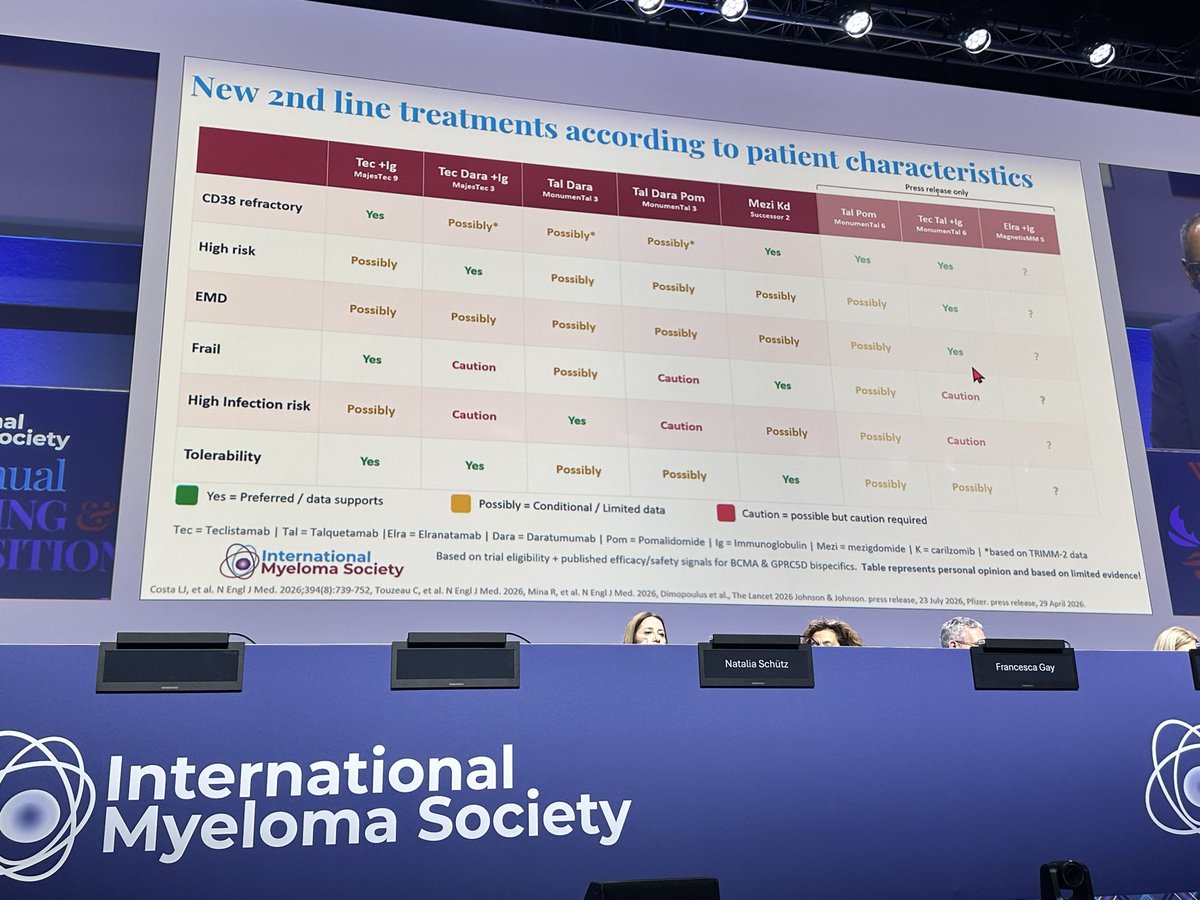
#IMS2026 How to approach first relapse by @DrRakeshPopat https://t.co/3uXrSIgjY7
International Myeloma Society
New 2nd line treatments according to patient characteristics
Columns: Tec +Ig (MajesTec 9) | Tec Dara +Ig (MajesTec 3) | Tal Dara (MonumenTal 3) | Tal Dara Pom (MonumenTal 3) | Mezi Kd (Successor 2) | [Press release only:] Tal Pom (MonumenTal 6) | Tec Tal +Ig (MonumenTal 6) | Elra +Ig (MagnetisMM 5)
CD38 refractory: Yes | Possibly* | Possibly* | Possibly* | Yes | Yes | Yes | ?
High risk: Possibly | Yes | Possibly | Possibly | Yes | Yes | Yes | ?
EMD: Possibly | Possibly | Possibly | Possibly | Possibly | Possibly | Yes | ?
Frail: Yes | Caution | Possibly | Caution | Yes | Possibly | Yes | ?
High Infection risk: Possibly | Caution | Yes | Caution | Possibly | Possibly | Caution | ?
Tolerability: Yes | Yes | Possibly | Possibly | Yes | Possibly | Caution | ?
[Note: row-to-cell alignment approximate due to photo angle]
Yes = Preferred / data supports; Possibly = Conditional / Limited data; Caution = possible but caution required
Tec = Teclistamab | Tal = Talquetamab | Elra = Elranatamab | Dara = Daratumumab | Pom = Pomalidomide | Ig = Immunoglobulin | Mezi = mezigdomide | K = carilzomib | *based on TRIMM-2 data
Based on trial eligibility + published efficacy/safety signals for BCMA & GPRC5D bispecifics. Table represents personal opinion and based on limited evidence!
Costa LJ, et al. N Engl J Med. 2026;394(8):739-752, Touzeau C, et al. N Engl J Med. 2026, Mina R, et al. N Engl J Med. 2026, Dimopoulos et al., The Lancet 2026, Johnson & Johnson. press release, 23 July 2026, Pfizer. press release, 29 April 2026.

 Sep 24


CAMMA 1DREAMM-9MajesTEC-3UKMRA RADAR
Abstract Sessions begin at 11:00 AM. Join us in Hall 5 for Abstract Session 3 or Lomond Auditorium for Abstract Session 4. #IMS26 https://t.co/HPzirIbOLS
23rd Annual MEETING & EXPOSITION - International Myeloma Society
THURSDAY, SEPTEMBER 24, 2026 | 11:00-12:00
Abstract Session 3
Co-chairs: Meral Beksac and Martin Kortum
- Double hit ultra-high risk myeloma treated with Isa-VRD plus cyclophosphamide induction and Isa-VRD consolidation: QoL analysis of the UKMRA RADAR trial in newly diagnosed transplant eligible patients - Karthik Ramasamy
- Updated safety and efficacy of ramantamig (Ram; JNJ-5322) at the recommended phase 2 dose (RP2D), demonstrating feasibility of outpatient dosing (OPD) in relapsed/refractory multiple myeloma (RRMM) - Jeffrey Matous
- DREAMM-9 Patient-Reported Vision-Related Function with Extended Belantamab Mafodotin Dosing Intervals with Bortezomib, Lenalidomide, Dexamethasone (BVRd) in Transplant Ineligible Multiple Myeloma - Hang Quach
- A fixed-duration, modified cevostamab dosing regimen induces durable remissions that continue after completion in BCMA-naive pts with relapsed/refractory multiple myeloma (RRMM): CAMMA 1 Arm A results - Amrita Krishnan
- Overall Survival, Progression and Non-Relapse Mortality With Teclistamab Plus Daratumumab (Tec-Dara) vs Dara-Based Triplets in Relapsed/Refractory Multiple Myeloma (RRMM): MajesTEC-3 Post Hoc Analysis - Luciano Costa
Panelist photos shown: Dr. Beksac, Dr. Kortum, Dr. Matous, Dr. Ramasamy, Dr. Costa, Dr. Krishnan, Dr. Quach
23rd Annual MEETING & EXPOSITION - International Myeloma Society
THURSDAY, SEPTEMBER 24, 2026 | 11:00-12:00
Abstract Session 4
Co-chairs: Lugui Qiu and Niels van de Donk
- Augmenting TRAIL-dependent apoptosis enables BCMA CAR-T cells to overcome resistance in multiple myeloma - Mansour Poorebrahim
- First-in-human phase Ia/Ib study of QLS32015 (GPRC5DxCD3) in patients (pts) with relapsed/refractory multiple myeloma (RRMM): updated safety and efficacy data - Jian Cui
- An AI-Designed BCMA/FcRL5 Targeting TriTE Overcomes Antigen Escape and Outperforms BCMA-Directed Therapy in Multiple Myeloma - Jessica Encinas Mayoral
- A CD4-Dominant, T-Helper-Skewed T Cell State Underlies Movement and Neurocognitive Toxicity After BCMA-Directed CAR-T Therapy in Multiple Myeloma - Theresia Akhlaghi
- Single-cell antigen:TCR mapping reveals tumor-specific effector T-cell responses in multiple myeloma - David Avigan
Panelist photos shown: Dr. Akhlaghi, Dr. Avigan, Dr. Cui, Dr. Encinas Mayoral, Dr. Poorebrahim, Dr. Qiu, Dr. van de Donk







 Sep 21
CEPHEUSCERVINOEXCALIBER-RRMMGEM2014MAINIBEXMIDAS
Have fun in Glasgow! 🇬🇧🏴
Don’t get lost at #IMS2026—too much great science, too many simultaneous sessions!
Follow the roadmap. Don’t miss the practice-changing data.
And don’t forget your single malt…after the final session! 🥃😆
#MultipleMyeloma #mmsm #Medtwitter https://t.co/eCVPDMHoDu
DON'T GET LOST AT IMS 2026
GLASGOW - SEPTEMBER 23-26
THE MUST-SEE ROADMAP
PEOPLE SCIENCE PROGRESS TOGETHER | BIGGER SCIENCE A BRIGHTER TOMORROW | GLASGOW WELCOMES A BRIGHTER TOMORROW
THURSDAY - SEPT 24 5:00-6:00 PM - HALL 5
MRD & MAINTENANCE (MRD: DEEPER ANSWERS BRIGHTER TOMORROWS)
- MIDAS: Isa-iberdomide
- CASSIOPEIA: 5-year sustained MRD
- GEM2014MAIN: MRD-guided stopping
- IBEX: Iber-Dara post-ASCT
FRIDAY - SEPT 25 3:00-5:00 PM - HALL 5 DO NOT MISS
THE PLENARY - DO NOT MISS (BOLD SCIENCE CHANGES LIVES)
- CERVINO: Etentamig vs standard therapy
- PERSEUS: Does long-term PFS become OS?
- EXCALIBER-RRMM: IberDd vs DVd
- First-in-human CD19/BCMA in-vivo CAR-T
SAME QUESTIONS. A BRIGHTER TOMORROW.
SATURDAY - SEPT 26
8:30-9:30 AM - HALL 5
THE NEXT CELLULAR-THERAPY ERA (CELLULAR THERAPIES: REAL POTENTIAL FOR REAL PEOPLE)
- Updated CEPHEUS MRD
- BCMAxGPRC5D dual-target CAR-T
- IASO206: IV in-vivo BCMA CAR-T
11:00 AM-12:00 PM - HALL 5
- Post-CAR-T elranatamab
- Delayed cilta-cel neurotoxicity
- MRD-guided T-cell redirection
11:00 AM-12:00 PM - LOMOND
- CAR-T enterocolitis biology
1:00-2:00 PM - LOMOND
- LV169: lentiviral in-vivo BCMA CAR delivery
Same goal. Brighter lives.
WHAT TO WATCH (DIFFERENT PERSPECTIVES A CLEARER FUTURE)
- Durability - OS - sustained MRD - infection burden
- Access - treatment-free time - late toxicity
- In-vivo CAR-T: insertion sites, off-target transduction, vector shedding & persistence
Go for the randomized data and the biology--not every new response rate.
Single malt only AFTER the final session.
SAME CURIOSITY FURTHER TOGETHER | GREAT SCIENCE DESERVES A DRAM


TRIlogy-1
10 slides
Sep 24

TRIlogy-1
Phenomenal results with TRIlogy-1 presented at #IMS26 by @MileHighMyeloma
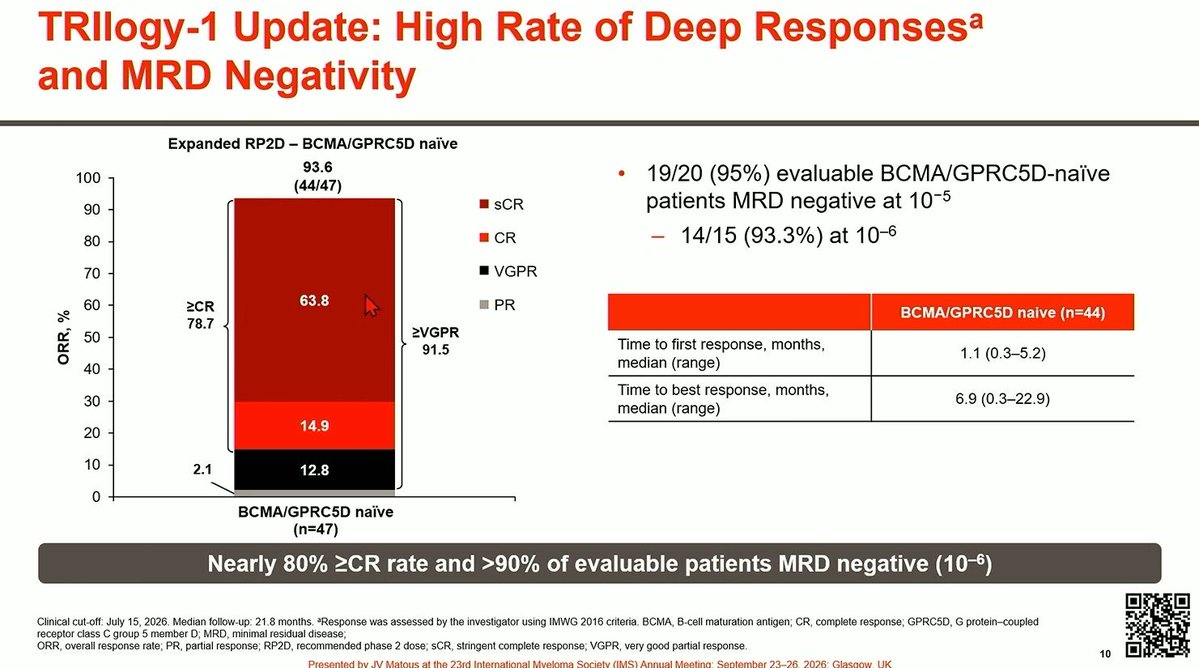
93% MRD neg at 10(-6), CR rates of 79%, VGPR rates ≥ 90% and 2-year PFS rates of 81.3%!!
Favorable dosing schedule, skin/nail toxicities seem much more manageable than the GPRC5D and minimal treatment https://t.co/S9btK3kenP
[Slide 1 - TRIlogy-1 Update: Durable PFS in the Expanded RP2D Cohort, presented by JV Matous]
Expanded RP2D cohort - BCMA/GPRC5D naive (n=47), median follow-up 21.8 months. KM curve of PFS: 18-month PFS (95% CI) 85.5 (70.0-93.4); 24-month PFS (95% CI) 81.3 (63.3-91.0). Patients at risk: 47/44/37/23/16/6/0 at months 0/6/12/18/24/30/36. "Majority of patients progression free and alive at 2 years." Clinical cut-off: July 15, 2026.
[Slide 2 - TRIlogy-1 Update: High Rate of Deep Responses and MRD Negativity]
Expanded RP2D - BCMA/GPRC5D naive (n=47): ORR 93.6% (44/47) - sCR 63.8%, CR 14.9%, VGPR 12.8%, PR 2.1% (>=CR 78.7%, >=VGPR 91.5%). 19/20 (95%) evaluable BCMA/GPRC5D-naive patients MRD negative at 10^-5; 14/15 (93.3%) at 10^-6. Time to first response median 1.1 months (0.3-5.2); time to best response median 6.9 months (0.3-22.9). "Nearly 80% >=CR rate and >90% of evaluable patients MRD negative (10^-6)." Clinical cut-off July 15 2026, median follow-up 21.8 months.
 Sep 24

TRIlogy-1
#OA-70 Ramantamig (BCMA×GPRC5D×CD3 trispecific) at RP2D: 2-yr PFS >80% in TCE-naïve RRMM, ~79% ≥CR, >90% MRD-neg. New outpatient cohort showed safe, feasible SUD + first-dose outpatient administration with prophylactic tocilizumab — no ICANS, low-grade CRS. #mmsm #IMS2026 https://t.co/oHGAboWXQ1
[Footer from prior slide, partially visible at top: ...reached; PD, progressive disease; PR, partial response; Q8W, every 8 weeks; RP2D, recommended phase 2 dose; sCR, stringent complete response; SD, stable disease; VGPR, very good partial response; Q8W, every 8 weeks. Presented by JV Matous at the 23rd International Myeloma Society (IMS) Annual Meeting; September 23-26, 2026; Glasgow, UK (slide 11)]
TRIlogy-1 Update: Durable PFS in the Expanded RP2D Cohort
Expanded RP2D cohort - BCMA/GPRC5D naive (n=47)
Median follow-up: 21.8 months
PFS curve (Patients progression free and alive %, 0-36 months):
18-month PFS (95% CI): 85.5 (70.0-93.4)
24-month PFS (95% CI): 81.3 (63.3-91.0)
Patients at risk: 47 44 37 23 16 6 0 (at 0,6,12,18,24,30,36 months)
Majority of patients progression free and alive at 2 years
Sep 24

TRIlogy-1
When it comes to BsAbs (and now trispecific) T-cell engagers in myeloma, less is often more once response is obtained!
Excellent to see ramantimig holding the #IMS26 line with Q8W dosing, i.e. only ~6x 💉 per year. Probably lower IVIG needs at this dose frequency as well! https://t.co/hgyuifFewt https://t.co/N2gIqocSyb
TRIlogy-1 Update: Durable PFS in the Expanded RP2D Cohort
Kaplan-Meier curve: Expanded RP2D cohort - BCMA/GPRC5D naive (n=47), Median follow-up: 21.8 months
Y-axis: Patients progression free and alive, %, 0-100
X-axis: PFS, months, 0-36
18-month PFS (95% CI): 85.5 (70.0-93.4)
24-month PFS (95% CI): 81.3 (63.3-91.0)
Patients at risk (by month 0,6,12,18,24,30,36): 47, 44, 37, 23, 16, 6, 0
Banner: Majority of patients progression free and alive at 2 years
Sep 24


TRIlogy-1
#IMS26 #mmsm Oral - TRIlogy-1 safety and efficacy with focus on SUD outpatient
Outcomes
Outcomes are really good with 2-yr PFS>80%
3 patients didn't respond but ORR is 94%
Less frequent dosing Q 8 weeks still associated with deep prolonged responses https://t.co/PIQJA3W3PU
TRIlogy-1 Update: High Rate of Deep Responses and MRD Negativity
Expanded RP2D - BCMA/GPRC5D naive
Bar chart, y-axis ORR % 0-100. Single bar (n=47): total 93.6% (44/47), sCR 63.8%, CR 14.9%, VGPR 12.8%, PR 2.1%. Bracketed sub-totals: >=CR 78.7%, >=VGPR 91.5%.
19/20 (95%) evaluable BCMA/GPRC5D-naive patients MRD negative at 10^-5
- 14/15 (93.3%) at 10^-6
Table - BCMA/GPRC5D naive (n=44):
Time to first response, months, median (range): 1.1 (0.3-5.2)
Time to best response, months, median (range): 6.9 (0.3-22.9)
Nearly 80% >=CR rate and >90% of evaluable patients MRD negative (10^-6)
Footnotes: Clinical cut-off: July 15, 2026. Median follow-up: 21.8 months. Response was assessed by the investigator using IMWG 2016 criteria. BCMA, B-cell maturation antigen; CR, complete response; GPRC5D, G protein-coupled receptor class C group 5 member D; MRD, minimal residual disease; ORR, overall response rate; PR, partial response; RP2D, recommended phase 2 dose; sCR, stringent complete response; VGPR, very good partial response.
Presented by JV Matous at the 23rd International Myeloma Society (IMS) Annual Meeting; September 23-26, 2026; Glasgow, UK 10
TRIlogy-1 Update: Durable, Deepening Responses Over Time Even With Switch to Q8W dosing
Swimmer plot, Expanded RP2D BCMA/GPRC5D naive, x-axis Months 0-36. Each horizontal bar = one patient, colored by response depth over time (sCR dark red, CR red, VGPR light blue, PR grey/tan, MR blue, SD green, PD purple). Symbols: arrow = On Treatment as of July 15, 2026; diamond colors = D/C-PD (orange), D/C-AE (dark red), D/C-Patient withdrawal (navy), Death (red), D/C-Physician decision (grey); yellow circle = Switch to Q8W dosing; star = MRD negative (10^-5).
Median DOR: NR (not reached)
61.4% of responders switched to Q8W dosing, with responses sustained or deepening post switch
Footnotes: Clinical cut-off: July 15, 2026. Median follow-up: 21.8 months. Response was assessed by the investigator using IMWG 2016 criteria. AE, adverse event; BCMA, B-cell maturation antigen; CR, complete response; D/C, discontinued; GPRC5D, G protein-coupled receptor class C group 5 member D; MR, minimal response; MRD, minimal residual disease; NR, not reached; PD, progressive disease; PR, partial response; Q8W, every 8 weeks; RP2D, recommended phase 2 dose; sCR, stringent complete response; SD, stable disease; VGPR, very good partial response.
Presented by JV Matous at the 23rd International Myeloma Society (IMS) Annual Meeting; September 23-26, 2026; Glasgow, UK 11
TRIlogy-1 Update: >80% 2-year PFS in the Initial RP2D Cohort (median 26.5 months follow-up)
Initial RP2D cohort - BCMA/GPRC5D naive (n=27)
Median follow up: 26.5 months
Kaplan-Meier PFS curve, x-axis PFS months 0-36, y-axis Patients progression free and alive % 0-100.
18-month PFS (95% CI): 88.9 (69.4-96.3)
24-month PFS (95% CI): 84.4 (63.5-93.9)
Patients at risk: 27, 27, 25, 23, 16, 6, 0 (at months 0,6,12,18,24,30,36)
Majority of patients progression free and alive at 2 years
Footnotes: Clinical cut-off: July 15, 2026. BCMA, B-cell maturation antigen; GPRC5D, G protein-coupled receptor class C group 5 member D; PFS, progression-free survival; RP2D, recommended phase 2 dose.
1. Krishnan A, et al. Blood 2025;146(Supplement 1):4042.
Presented by JV Matous at the 23rd International Myeloma Society (IMS) Annual Meeting; September 23-26, 2026; Glasgow, UK 13
Sep 24

TRIlogy-1
#IMS26 #mmsm Oral - TRIlogy-1 safety and efficacy with focus on SUD outpatient
Safety
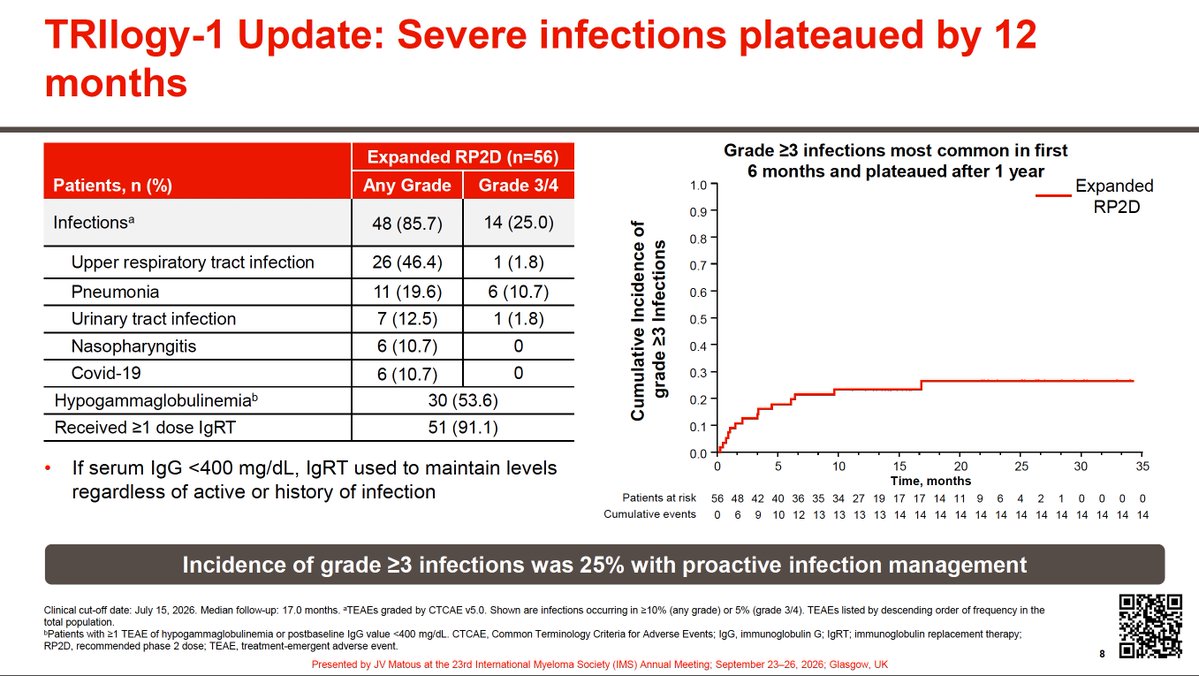
G3 or higher infections plateau later on
There is still taste changes reported as well as skin AE though seems numerically lower than Talq https://t.co/CGTRf1QSAY
TRIlogy-1 Update: Severe infections plateaued by 12 months
Table - Patients, n (%) | Expanded RP2D (n=56) Any Grade | Grade 3/4
Infections: 48 (85.7) | 14 (25.0)
Upper respiratory tract infection: 26 (46.4) | 1 (1.8)
Pneumonia: 11 (19.6) | 6 (10.7)
Urinary tract infection: 7 (12.5) | 1 (1.8)
Nasopharyngitis: 6 (10.7) | 0
Covid-19: 6 (10.7) | 0
Hypogammaglobulinemia: 30 (53.6)
Received ≥1 dose IgRT: 51 (91.1)
If serum IgG <400 mg/dL, IgRT used to maintain levels regardless of active or history of infection
Grade ≥3 infections most common in first 6 months and plateaued after 1 year (cumulative incidence curve, 0-35 months, Expanded RP2D):
Patients at risk: 56 48 42 40 36 35 34 27 19 17 17 14 11 9 6 4 2 1 0 0 0 (across 0-35 months)
Cumulative events: 0 6 9 10 12 13 13 13 13 14 14 14 14 14 14 14 14 14 14 14 14
Incidence of grade ≥3 infections was 25% with proactive infection management
Clinical cut-off date: July 15, 2026. Median follow-up: 17.0 months. TEAEs graded by CTCAE v5.0. Shown are infections occurring in ≥10% (any grade) or 5% (grade 3/4). TEAEs listed by descending order of frequency in the total population. Patients with ≥1 TEAE of hypogammaglobulinemia or postbaseline IgG value <400 mg/dL. CTCAE, Common Terminology Criteria for Adverse Events; IgG, immunoglobulin G; IgRT, immunoglobulin replacement therapy; RP2D, recommended phase 2 dose; TEAE, treatment-emergent adverse event.
Presented by JV Matous at the 23rd International Myeloma Society (IMS) Annual Meeting; September 23-26, 2026; Glasgow, UK (slide 8)
TRIlogy-1 Update: Taste Changes, Skin AEs, Nail AEs, and Weight Loss Were Low Grade
Table - AE, n (%) | Expanded RP2D (n=56)
Taste changes: 37 (66.1); Grade 1/2, %: 42.9 / 23.2; Leading to discontinuation of treatment: 0; Leading to dose modification: 2 (3.6)
Non-rash skin: 38 (67.9); Grade 1/2, %: 50.0 / 17.9; Leading to discontinuation of treatment: 1 (1.8); Leading to dose modification: 1 (1.8)
Nail related: 36 (64.3); Grade 1/2, %: 62.5 / 1.8; Leading to discontinuation of treatment: 0; Leading to dose modification: 0
Rash related: 15 (26.8); Grade 1/2, %: 16.1 / 8.9; Grade ≥3: 1 (1.8); Leading to discontinuation of treatment: 1 (1.8); Leading to dose modification: 0
Mean weight loss from baseline was <5%, independent of taste changes (line chart, Mean change in weight from baseline % (SE) by Dose SUD-21)
Number of patients - Patients with taste changes: 0 37 31 34 34 34 34 31 29 30 27 26 22 18 16 18 16 15 15 14 11 12 11 (by dose SUD through 21); Patients with no taste changes: 19 16 18 16 13 13 13 11 11 9 9 10 7 7 7 6 6 6 6 6 6 5
Majority of taste changes, skin, and nail AEs were grade 1, with only 1 patient discontinuing treatment; mean weight loss from baseline was <5%
Clinical cut-off: July 15, 2026. Median follow-up: 17.0 (0.4-34.1) months. Taste changes included dysgeusia, ageusia, hypogeusia, and taste disorder. Per the Common Terminology Criteria for Adverse Events, the maximum severity for taste changes is grade 2. Includes dose delays, skips, and reductions. Non-rash skin adverse events included skin exfoliation, dry skin, palmar plantar erythrodysesthesia syndrome, and pruritus. There were no grade ≥3 events. These events occurred in the same patient. Nail-related adverse events included nail discoloration, nail disorder, onycholysis, onychomadesis, onychoclasis, and nail ridging. Rash adverse events included rash, maculopapular rash, erythematous rash, and erythema. AE, adverse event; RP2D, recommended phase 2 dose; SE, standard error.
Presented by JV Matous at the 23rd International Myeloma Society (IMS) Annual Meeting; September 23-26, 2026; Glasgow, UK (slide 9)
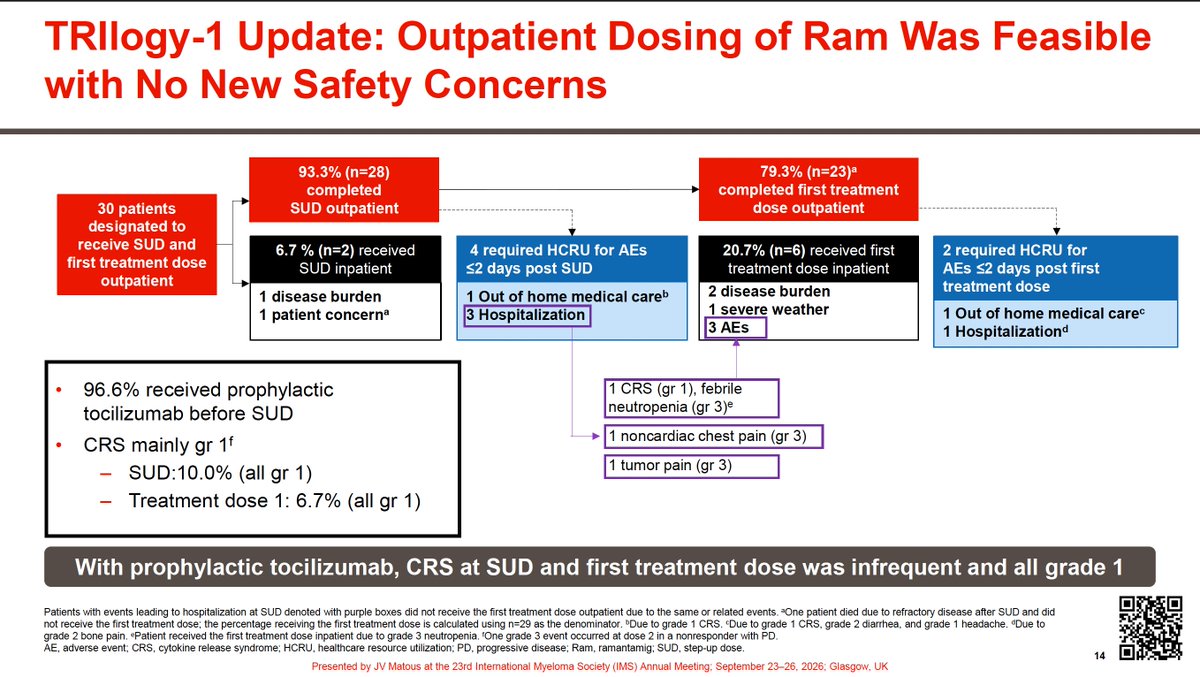
TRIlogy-1 Update: Outpatient Dosing of Ram Was Feasible with No New Safety Concerns
Flow diagram:
30 patients designated to receive SUD and first treatment dose outpatient
-> 93.3% (n=28) completed SUD outpatient
-> 6.7% (n=2) received SUD inpatient: 1 disease burden, 1 patient concern
-> 4 required HCRU for AEs ≤2 days post SUD: 1 Out of home medical care, 3 Hospitalization
-> 1 CRS (gr 1), febrile neutropenia (gr 3)
-> 1 noncardiac chest pain (gr 3)
-> 1 tumor pain (gr 3)
-> 79.3% (n=23) completed first treatment dose outpatient
-> 20.7% (n=6) received first treatment dose inpatient: 2 disease burden, 1 severe weather, 3 AEs
-> 2 required HCRU for AEs ≤2 days post first treatment dose: 1 Out of home medical care, 1 Hospitalization
96.6% received prophylactic tocilizumab before SUD
CRS mainly gr 1
- SUD: 10.0% (all gr 1)
- Treatment dose 1: 6.7% (all gr 1)
With prophylactic tocilizumab, CRS at SUD and first treatment dose was infrequent and all grade 1
Patients with events leading to hospitalization at SUD denoted with purple boxes did not receive the first treatment dose outpatient due to the same or related events. One patient died due to refractory disease after SUD and did not receive the first treatment dose; the percentage receiving the first treatment dose is calculated using n=29 as the denominator. Due to grade 1 CRS. Due to grade 1 CRS, grade 2 diarrhea, and grade 1 headache. Due to grade 2 bone pain. Patient received the first treatment dose inpatient due to grade 3 neutropenia. One grade 3 event occurred at dose 2 in a nonresponder with PD.
AE, adverse event; CRS, cytokine release syndrome; HCRU, healthcare resource utilization; PD, progressive disease; Ram, ramantamig; SUD, step-up dose.
Presented by JV Matous at the 23rd International Myeloma Society (IMS) Annual Meeting; September 23-26, 2026; Glasgow, UK (slide 14)
Sep 24


TRIlogy-1
#IMS26 #mmsm Oral - TRIlogy-1 safety and efficacy with focus on SUD outpatient
Patient characteristics and study schema
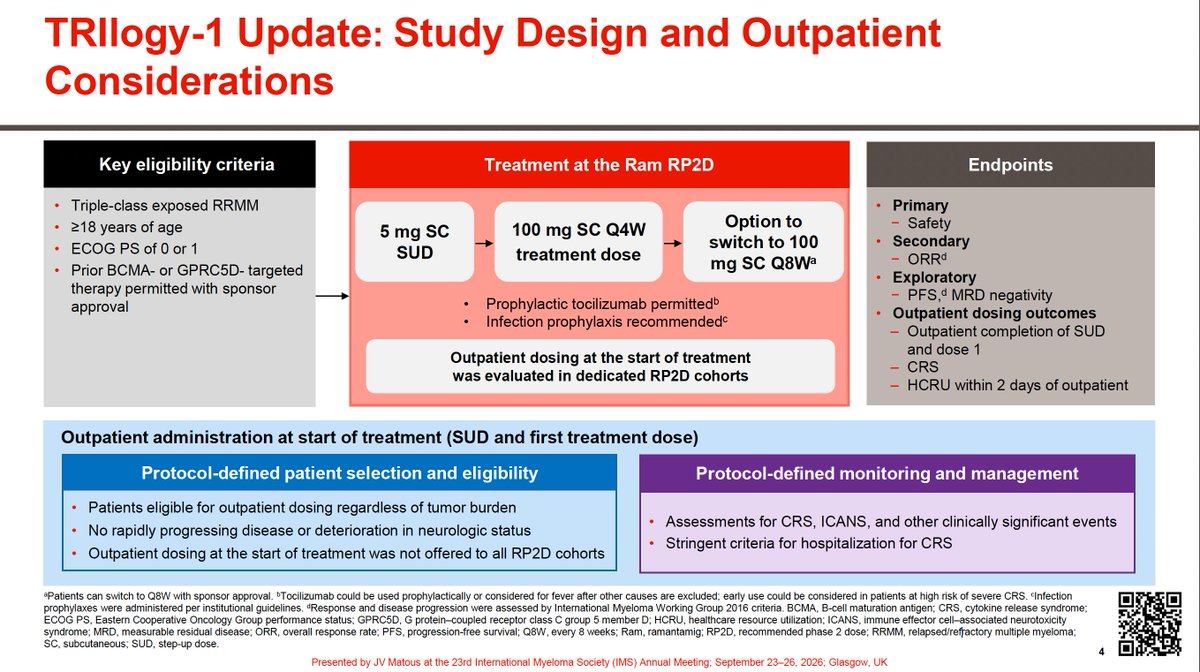
Nice dosing schema with Q4 then Q 8 weeks dosing schema https://t.co/L9E3TADb5C
TRIlogy-1 Update: Study Design and Outpatient Considerations
Key eligibility criteria:
- Triple-class exposed RRMM
- ≥18 years of age
- ECOG PS of 0 or 1
- Prior BCMA- or GPRC5D-targeted therapy permitted with sponsor approval
Treatment at the Ram RP2D:
5 mg SC SUD -> 100 mg SC Q4W treatment dose -> Option to switch to 100 mg SC Q8W(a)
- Prophylactic tocilizumab permitted(b)
- Infection prophylaxis recommended(c)
Outpatient dosing at the start of treatment was evaluated in dedicated RP2D cohorts
Endpoints:
Primary: Safety
Secondary: ORR(d)
Exploratory: PFS,(d) MRD negativity
Outpatient dosing outcomes: Outpatient completion of SUD and dose 1, CRS, HCRU within 2 days of outpatient
Outpatient administration at start of treatment (SUD and first treatment dose):
Protocol-defined patient selection and eligibility:
- Patients eligible for outpatient dosing regardless of tumor burden
- No rapidly progressing disease or deterioration in neurologic status
- Outpatient dosing at the start of treatment was not offered to all RP2D cohorts
Protocol-defined monitoring and management:
- Assessments for CRS, ICANS, and other clinically significant events
- Stringent criteria for hospitalization for CRS
Footnotes: aPatients can switch to Q8W with sponsor approval. bTocilizumab could be used prophylactically or considered for fever after other causes are excluded; early use could be considered in patients at high risk of severe CRS. cInfection prophylaxes were administered per institutional guidelines. dResponse and disease progression were assessed by International Myeloma Working Group 2016 criteria. BCMA, B-cell maturation antigen; CRS, cytokine release syndrome; ECOG PS, Eastern Cooperative Oncology Group performance status; GPRC5D, G protein-coupled receptor class C group 5 member D; HCRU, healthcare resource utilization; ICANS, immune effector cell-associated neurotoxicity syndrome; MRD, measurable residual disease; ORR, overall response rate; PFS, progression-free survival; Q8W, every 8 weeks; Ram, ramantamig; RP2D, recommended phase 2 dose; RRMM, relapsed/refractory multiple myeloma; SC, subcutaneous; SUD, step-up dose.
Presented by JV Matous at the 23rd International Myeloma Society (IMS) Annual Meeting; September 23-26, 2026; Glasgow, UK 4
TRIlogy-1 Update: Expanded RP2D Cohort Disposition
56 patients received Ram at the RP2D (Expanded RP2D)
-> 30 patients at RP2D designated to receive SUD and 1st treatment dose in outpatient setting
14 (25.0%) patients discontinued treatment:
- 9 (16.1%) progressive disease
- 1 (1.8%) physician decision(a)
- 1 (1.8%) adverse event
- 3 (5.4%) death (all deemed unrelated to Ram by the investigator)(b)
42 (75.0%) patients remained on treatment
Median (range) follow-up: 17.0 (0.4-34.1) months
20 additional patients (all BCMA/GPRC5D-naive) at the RP2D vs prior reports(1)
Clinical cut-off date: July 15, 2026.
aPatient had grade 3 myelomatous meningitis, which did not meet IMWG 2016 criteria for disease progression and discontinued treatment due to physician decision. bCauses of death leading to treatment discontinuation included AEs of pneumonia in 2 patients (these deaths occurred 89 and 55 days after the last dose of Ram, were not considered treatment-emergent, and adjudicated as unrelated to Ram by the investigator) and other (refractory disease; this patient had prior BCMA-direct therapy exposure and received teclistamab as the immediate prior line of therapy). AE, adverse event; BCMA, B-cell maturation antigen; GPRC5D, G protein-coupled receptor class C group 5 member D; IMWG, International Myeloma Working Group; Ram, ramantamig; RP2D, recommended phase 2 dose; SUD, step-up dose.
1. Krishnan A, et al. Blood 2025;146(Supplement 1):4042.
Presented by JV Matous at the 23rd International Myeloma Society (IMS) Annual Meeting; September 23-26, 2026; Glasgow, UK 5
TRIlogy-1 Update: Baseline Characteristics Consistent With Triple-Class Exposed RRMM
Table 1 (left):
Characteristic | RP2D Expanded (n=56) | RP2D Outpatient (n=30)
Age, years, median (range): 68 (43-87) | 69 (47-87)
Male, n (%): 34 (60.7) | 21 (70.0)
Race, n (%):
White: 40 (71.4) | 21 (70.0)
Black/African American: 2 (3.6) | 2 (6.7)
Asian: 1 (1.8) | 0
Multiple: 2 (3.6) | 0
Unknown/not reported: 11 (19.6) | 8 (26.7)
Extramedullary plasmacytomas ≥1,(a) n (%): 4 (7.1) | 2 (6.7)
High-risk cytogenetics,(b) n (%): 18 (41.9) | 12 (57.1)
ISS stage,(c) n (%):
I: 27 (48.2) | 15 (50.0)
II: 22 (39.3) | 11 (36.7)
III: 7 (12.5) | 4 (13.3)
Years since diagnosis, median (range)(d): 7.0 (0.1-18.7) | 7.0 (0.1-11.3)
Median prior LOT, n (range): 3 (1-11) | 3 (1-11)
Table 2 (right):
Characteristic | RP2D Expanded (n=56) | RP2D Outpatient (n=30)
Exposure status, n (%):
Triple-class(e): 56 (100.0) | 30 (100.0)
Penta-drug(f): 22 (39.3) | 12 (40.0)
BCMA/GPRC5D exposed: 9 (16.1) | 4 (13.3)
Prior BCMA: 8 (14.3) | 4 (13.3)
Prior GPRC5D: 1 (1.8) | 0
Antibody-drug conjugate: 2 (3.6) | 1 (3.3)
CAR-T therapy: 4 (7.1) | 3 (10.0)
Bispecific antibody: 6 (10.7) | 2 (6.7)
Refractory status, n (%):
PI: 30 (53.6) | 16 (53.3)
IMiD: 52 (92.9) | 26 (86.7)
Anti-CD38 mAb: 54 (96.4) | 27 (90.0)
Triple-class(e): 29 (51.8) | 15 (50.0)
Penta-drug(f): 3 (5.4) | 1 (3.3)
To last LOT: 51 (91.1) | 25 (83.3)
Patient characteristics generally similar among all patients and those in the outpatient dosing cohort
Clinical cut-off date: July 15, 2026. aGe1 nonradiated, bone-independent lesion ≥2 cm. bCytogenetic risk is based on FISH or karyotype testing. Defined as del(17p), t(4;14), or t(14;16). Percentages are based on patients with available data (n=46 in the expanded RP2D cohort and n=21 in the outpatient cohort). cISS staging is derived based on serum β2-microglobulin and albumin. dBased on n=55 patients at the RP2D and n=29 patients in the outpatient dosing cohort. ePI, IMiD, and anti-CD38 mAb. f≥2 PIs, ≥2 IMiDs, and anti-CD38 mAb.
BCMA, B-cell maturation antigen; CAR, chimeric antigen receptor; FISH, fluorescence in situ hybridization; GPRC5D, G protein-coupled receptor class C group 5 member D; IMiD, immunomodulatory drug; ISS, International Staging System; LOT, line of therapy; mAb, monoclonal antibody; PI, proteasome inhibitor; RP2D, recommended phase 2 dose.
Presented by JV Matous at the 23rd International Myeloma Society (IMS) Annual Meeting; September 23-26, 2026; Glasgow, UK 6
Sep 24


TRIlogy-1
TRIlogy trial presented at #IMS26 by @MileHighMyeloma . Continued impressive results for ramantamig with good safety profile with low rate of CRS and severe infections, 2 year PFS > 80%, high MRD negativity rate. Outpatient dosing implemented. Few subjects previously exposed to https://t.co/Qe1T0Zqbha
TRIlogy-1 Update: Safety Consistent with Prior Reports [ref 1]
Table - Common TEAEs, >=30% (any Grade) or 10% (Grade 3/4), n (%) | Expanded RP2D (n=56): Any Grade | Grade 3/4
Hematologic TEAEs
Neutropenia | 27 (48.2) | 23 (41.8)
Lymphopenia | 21 (37.5) | 20 (35.7)
Nonhematologic TEAEs
Infections | 48 (85.7) | 14 (25.0)
Non-rash skin[b] | 38 (67.9) | 0
Taste changes[c] | 37 (66.1) | --
Nail related[d] | 36 (64.3) | 0
CRS | 22 (39.3) | 1 (1.8)
Fatigue | 22 (39.3) | 4 (7.1)
Cough | 21 (37.5) | 0
Diarrhea | 21 (37.5) | 2 (3.6)
Injection site erythema | 19 (33.9) | 0
Hypertension | 10 (17.9) | 7 (12.5)
Right-side bullets:
- 1 DLT (grade 4 neutropenia)
- CRS mostly low grade (grade 1, 30.4%; grade 2, 7.1%)
- All at SUD or treatment dose 1, except for 1 grade 3 event at dose 2 in a nonresponder with PD
- 52% received prophylactic tocilizumab at SUD
- No ICANS
- 1 treatment discontinuation due to AEs[e]
- No treatment-related deaths
Black banner: CRS remains predominantly low grade and confined to SUD and first treatment dose
Footnote: Clinical cut-off date: July 15, 2026. Median follow-up: 17.0 (0.4-34.1) months. aTEAEs graded by CTCAE v5.0; CRS per ASTCT criteria. bSkin exfoliation, dry skin, pruritus, and palmar-plantar erythrodysesthesia syndrome. cTaste changes included dysgeusia, ageusia, hypogeusia, and taste disorder. Per the CTCAE, the maximum severity for taste changes is grade 2. dNail-related adverse events included nail discoloration, nail disorder, onycholysis, onychomadesis, onychoclasis, and nail ridging. ePruritus and maculopapular rash.
AE, adverse event; ASTCT, American Society for Transplantation and Cellular Therapy; CRS, cytokine release syndrome; CTCAE, Common Terminology Criteria for Adverse Events; DLT, dose limiting toxicity; ICANS, immune effector cell-associated neurotoxicity syndrome; PD, progressive disease; RP2D, recommended phase 2 dose; SUD, step-up dose; TEAE, treatment-emergent adverse event.
1. Krishnan A, et al. Blood 2025;146(Supplement 1):4042.
Presented by JV Matous at the 23rd International Myeloma Society (IMS) Annual Meeting; September 23-26, 2026; Glasgow, UK. [Slide 7]
TRIlogy-1 Update: Taste Changes, Skin AEs, Nail AEs, and Weight Loss Were Low Grade
Table - AE, n (%) | Expanded RP2D (n=56)
Taste changes[a] | 37 (66.1)
Grade 1/2, % | 42.9 / 23.2
Leading to discontinuation of treatment | 0
Leading to dose modification[b] | 2 (3.6)
Non-rash skin[c] | 38 (67.9)
Grade 1/2,[d] % | 50.0 / 17.9
Leading to discontinuation of treatment | 1 (1.8)[e]
Leading to dose modification[b] | 1 (1.8)
Nail related[f] | 36 (64.3)
Grade 1/2,[d] % | 62.5 / 1.8
Leading to discontinuation of treatment | 0
Leading to dose modification[b] | 0
Rash related[g] | 15 (26.8)
Grade 1/2, % | 16.1 / 8.9
Grade >=3 | 1 (1.8)
Leading to discontinuation of treatment | 1 (1.8)[e]
Leading to dose modification[b] | 0
Right chart: "Mean weight loss from baseline was <5%, independent of taste changes" - line chart, y-axis "Mean change in weight from baseline, % (SE)" from -8 to 8, x-axis "Dose" (SUD, 1-21). Two series: Patients with taste changes (red circles) and Patients with no taste changes (black triangles), both hovering near 0 declining slightly to about -3 to -5% by dose 20-21, with error bars.
Number of patients at each dose point (partial, from table under chart):
Patients with taste changes: 0, 37, 31, 34, 34, 31, 30, 33, 30, 27, 22, 18, 15, 14, 12, 11, 11
Patients with no taste changes: 19, 16, 18, 16, 13, 16, 13, 11, 7, 9, 10, 7, 7, 7, 6, 5, 6, 6, 5
Black banner: Majority of taste changes, skin, and nail AEs were grade 1, with only 1 patient discontinuing treatment; mean weight loss from baseline was <5%
Footnote: Clincal cut-off: July 15, 2026. Median follow-up: 17.0 (0.4-34.1) months. aTaste changes included dysgeusia, ageusia, hypogeusia, and taste disorder. Per the Common Terminology Criteria for Adverse Events, the maximum severity for taste changes is grade 2. bIncludes dose delays, skips, and reductions. cNon-rash skin adverse events included skin exfoliation, dry skin, palmar plantar erythrodysesthesia syndrome, and pruritus. dThere were no grade >=3 events. eThese events occurred in the same patient. fNail-related adverse events included nail discoloration, nail disorder, onycholysis, onychomadesis, onychoclasis, and nail ridging. gRash adverse events included rash, maculopapular rash, erythematous rash, and erythema. AE, adverse event; RP2D, recommended phase 2 dose; SE, standard error.
Presented by JV Matous at the 23rd International Myeloma Society (IMS) Annual Meeting; September 23-26, 2026; Glasgow, UK. [Slide 9]
TRIlogy-1 Update: Durable, Deepening Responses[a] Over Time Even With Switch to Q8W dosing
Swimmer-plot chart: y-axis "Expanded RP2D BCMA/GPRC5D naive" (individual patient rows), x-axis "Months" 0-36. Bars colored by response category per legend: sCR (dark red), CR (red), VGPR (blue), PR (light blue), MR (dark blue), SD (green), PD (dark purple). Arrow (->) = On Treatment as of July 15, 2026. Symbols: diamond D/C-PD, diamond D/C-AE, diamond D/C-Patient withdrawal, diamond Death, diamond D/C-Physician decision, yellow circle = Switch to Q8W dosing, star = MRD negative (10^-6).
Label on right: "Median DOR: NR"
Black banner: 61.4% of responders switched to Q8W dosing, with responses sustained or deepening post switch
Footnote: Clinical cut-off: July 15, 2026. Median follow-up: 21.8 months. aResponse was assessed by the investigator using IMWG 2016 criteria.
AE, adverse event; BCMA, B-cell maturation antigen; CR, complete response; D/C, discontinued; GPRC5D, G protein-coupled receptor class C group 5 member D; MR, minimal response; MRD, minimal residual disease; NR, not reached; PD, progressive disease; PR, partial response; Q8W, every 8 weeks; RP2D, recommended phase 2 dose; sCR, stringent complete response; SD, stable disease; VGPR, very good partial response.
Presented by JV Matous at the 23rd International Myeloma Society (IMS) Annual Meeting; September 23-26, 2026; Glasgow, UK. [Slide 11]
TRIlogy-1 Update: High Rate of Deep Responses[a] and MRD Negativity
Bar chart: "Expanded RP2D - BCMA/GPRC5D naive", y-axis "ORR, %" 0-100. Single stacked bar "BCMA/GPRC5D naive (n=47)": PR 2.1, VGPR 12.8, CR 14.9, sCR 63.8. Bracket labels: >=CR 78.7, >=VGPR 91.5. Header value above bar: 93.6 (44/47).
Right bullets:
- 19/20 (95%) evaluable BCMA/GPRC5D-naive patients MRD negative at 10^-5
- 14/15 (93.3%) at 10^-6
Table:
| BCMA/GPRC5D naive (n=44)
Time to first response, months, median (range) | 1.1 (0.3-5.2)
Time to best response, months, median (range) | 6.9 (0.3-22.9)
Black banner: Nearly 80% >=CR rate and >90% of evaluable patients MRD negative (10^-6)
Footnote: Clinical cut-off: July 15, 2026. Median follow-up: 21.8 months. aResponse was assessed by the investigator using IMWG 2016 criteria. BCMA, B-cell maturation antigen; CR, complete response; GPRC5D, G protein-coupled receptor class C group 5 member D; MRD, minimal residual disease; ORR, overall response rate; PR, partial response; RP2D, recommended phase 2 dose; sCR, stringent complete response; VGPR, very good partial response.
Presented by JV Matous at the 23rd International Myeloma Society (IMS) Annual Meeting; September 23-26, 2026; Glasgow, UK. [Slide 10]


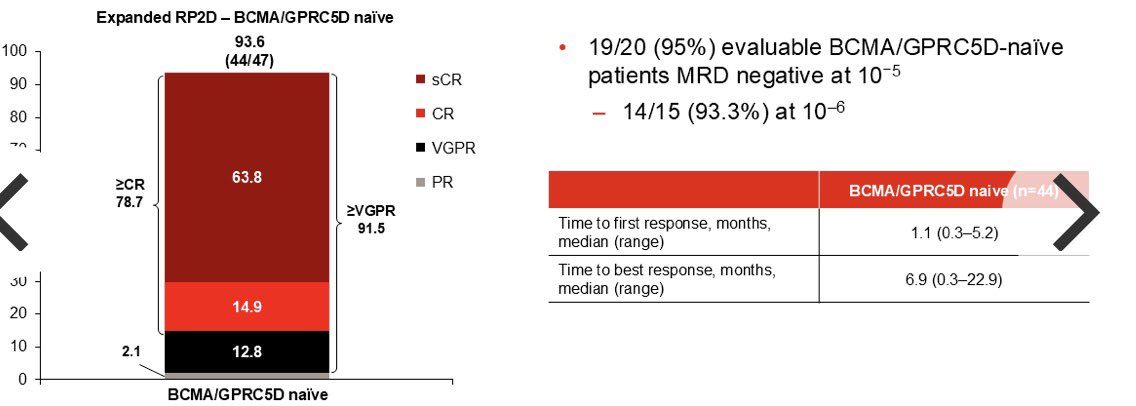


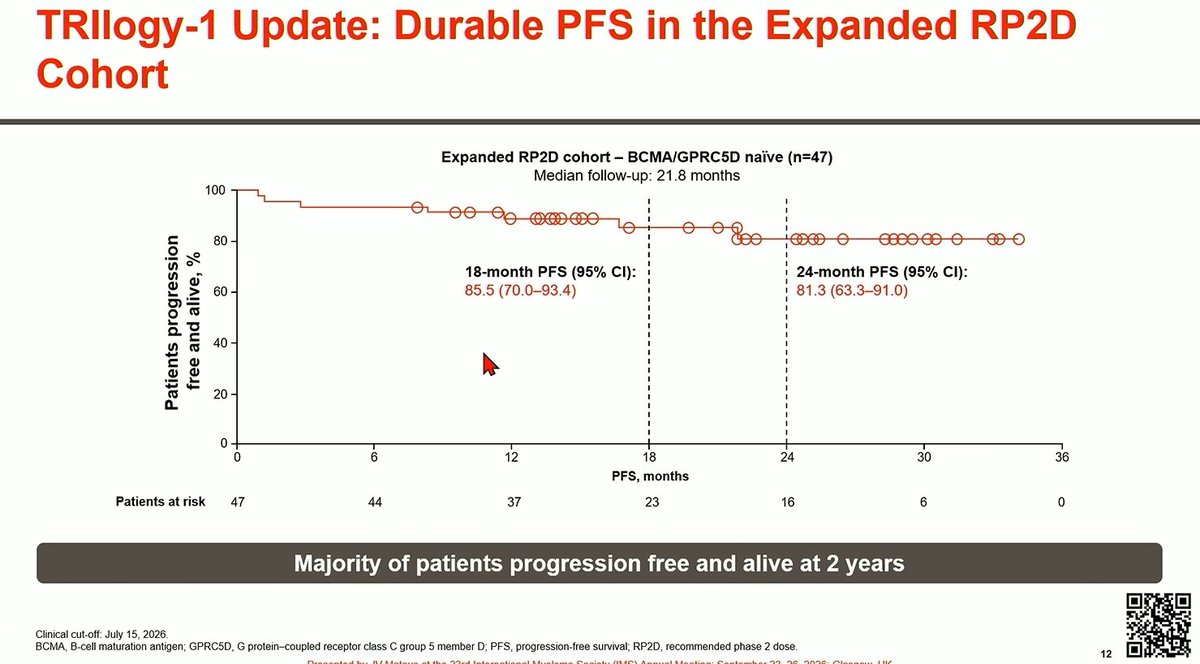



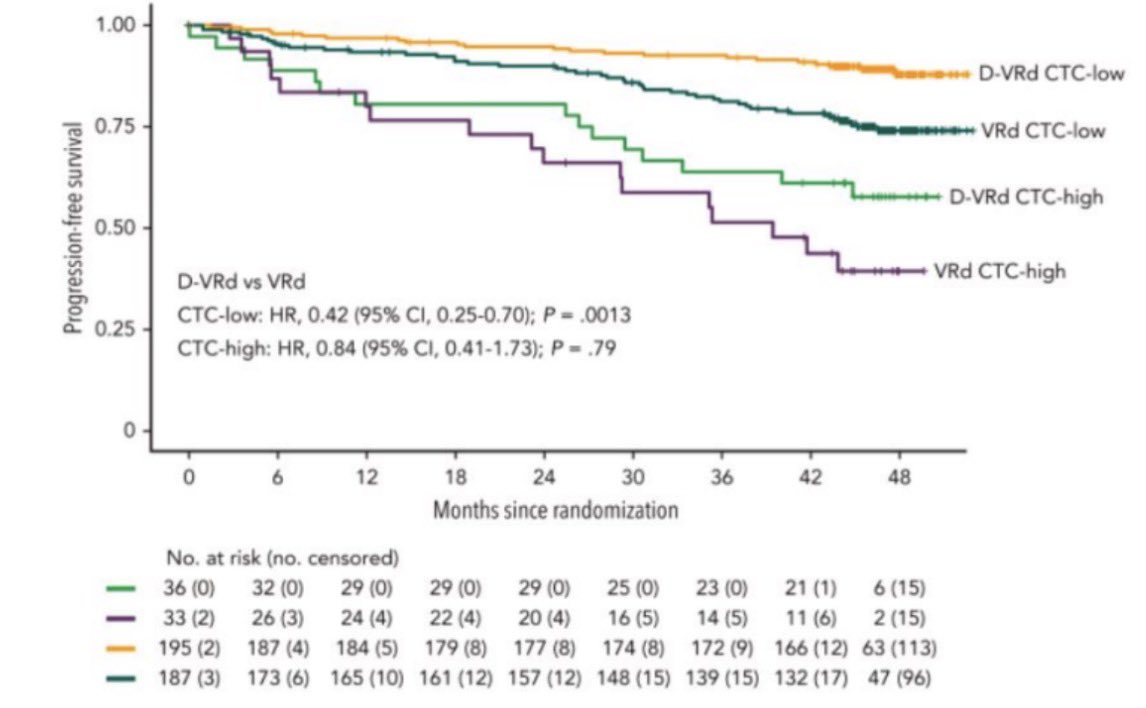


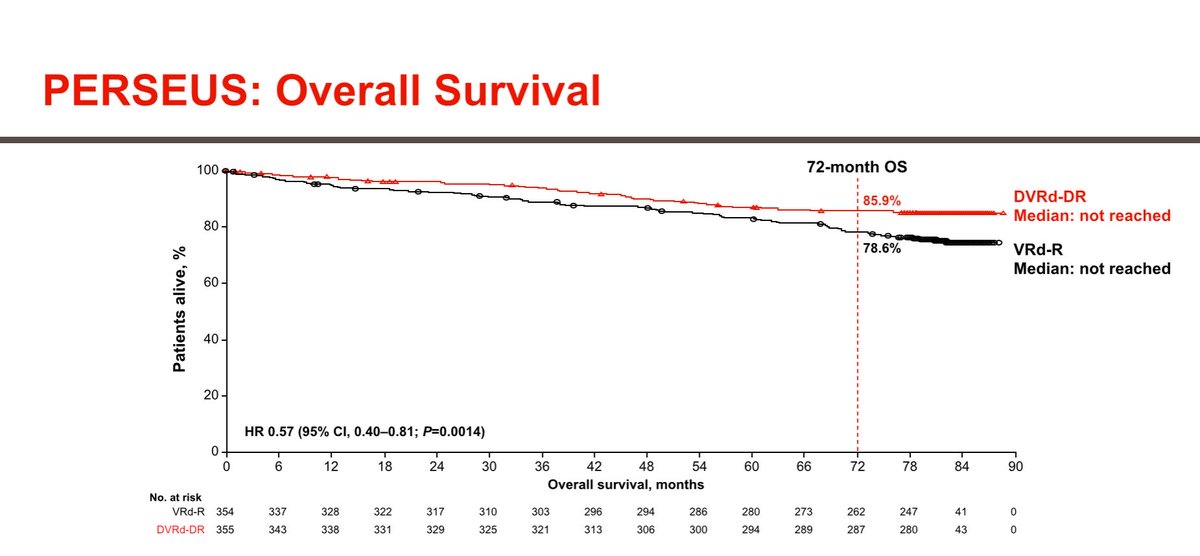
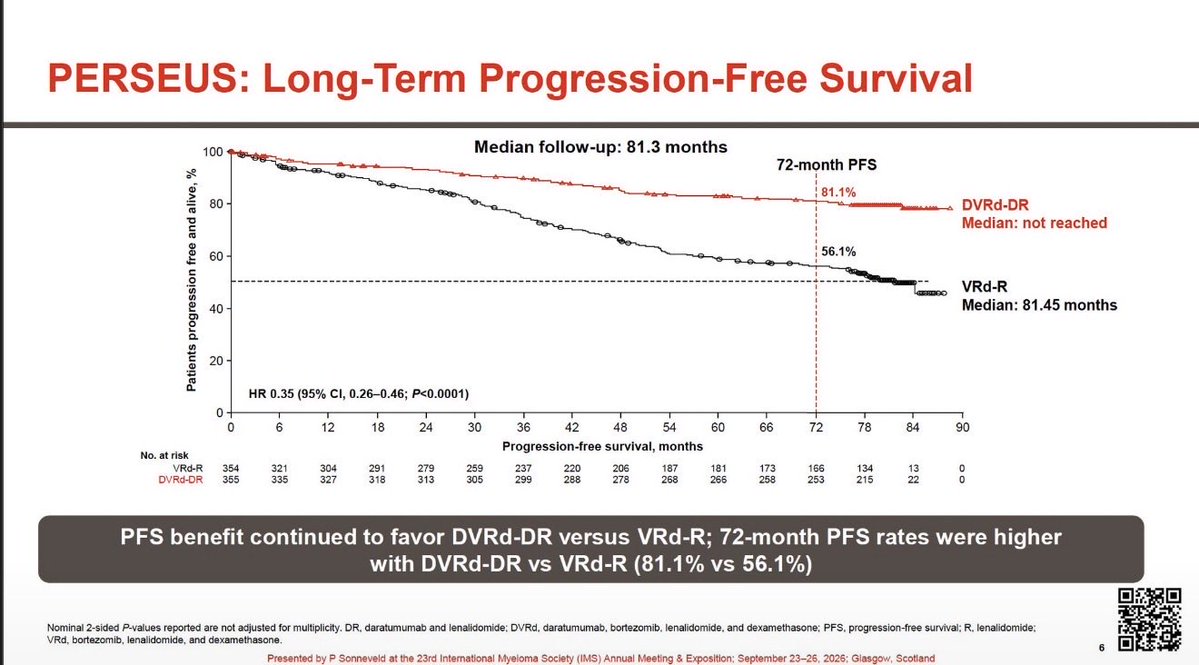
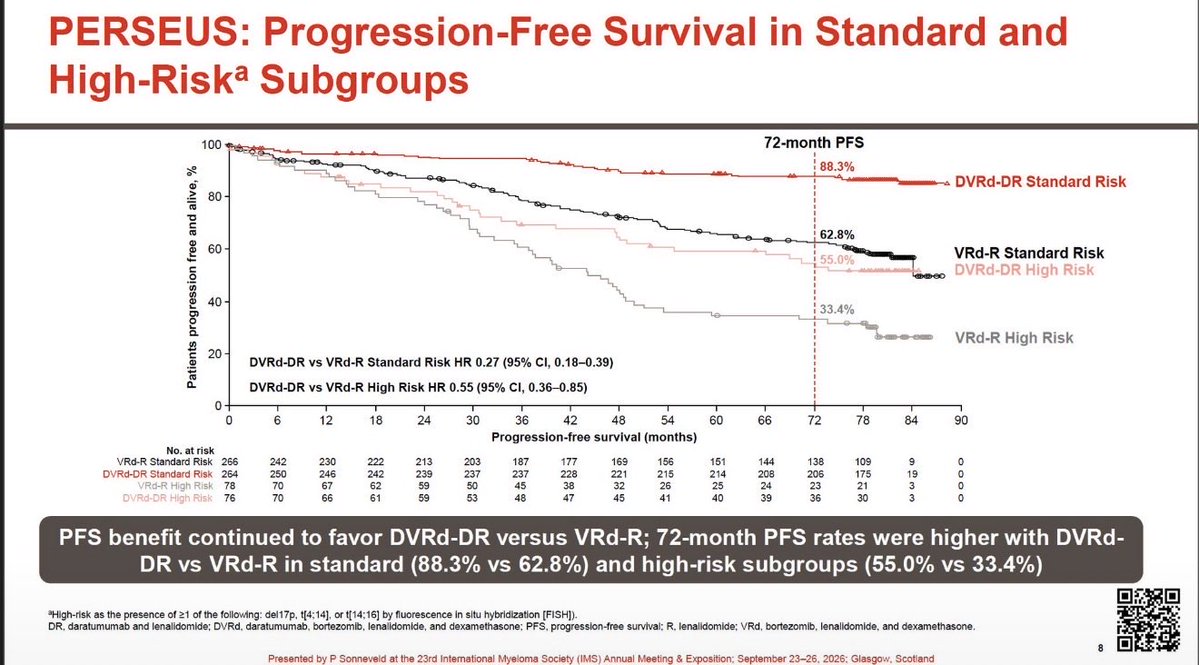
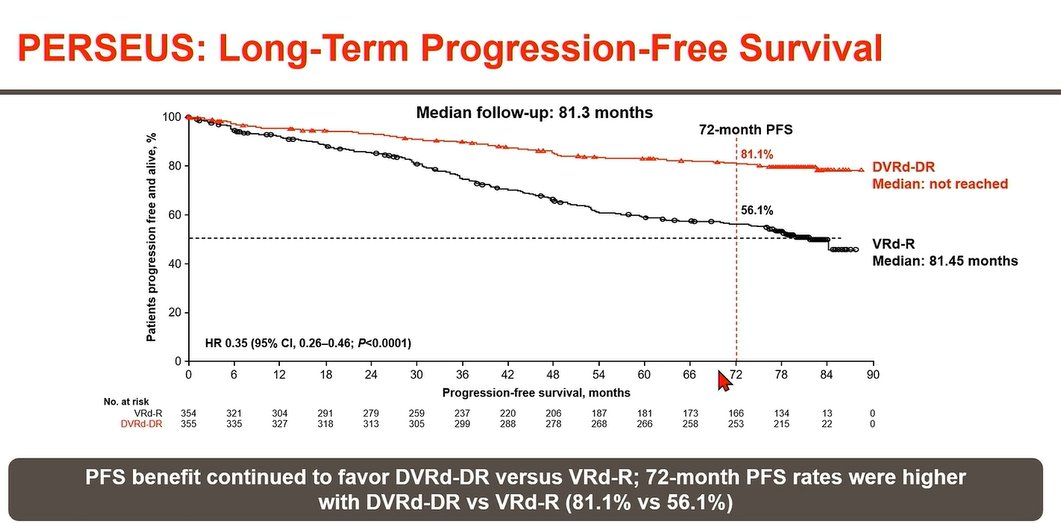
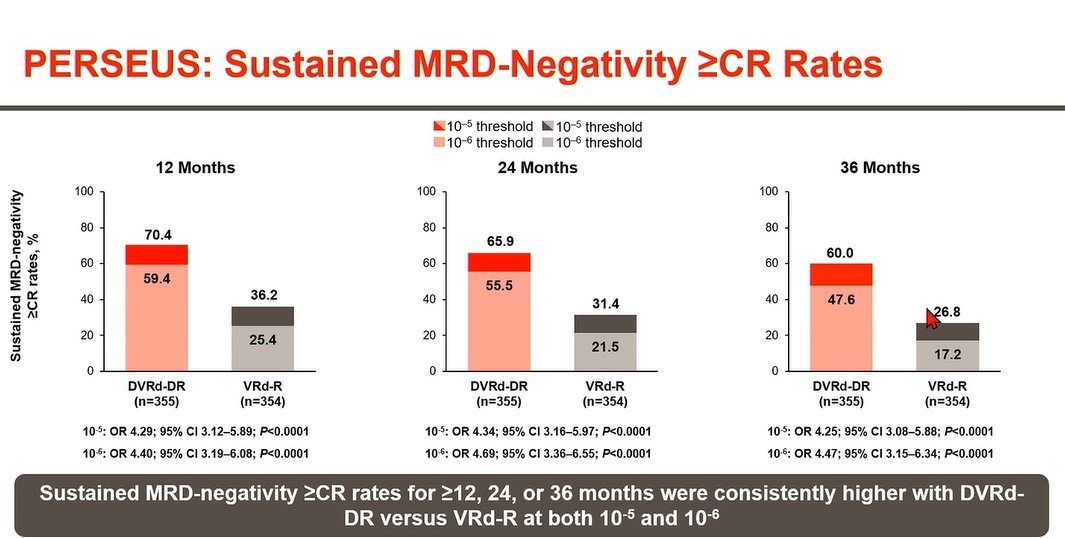
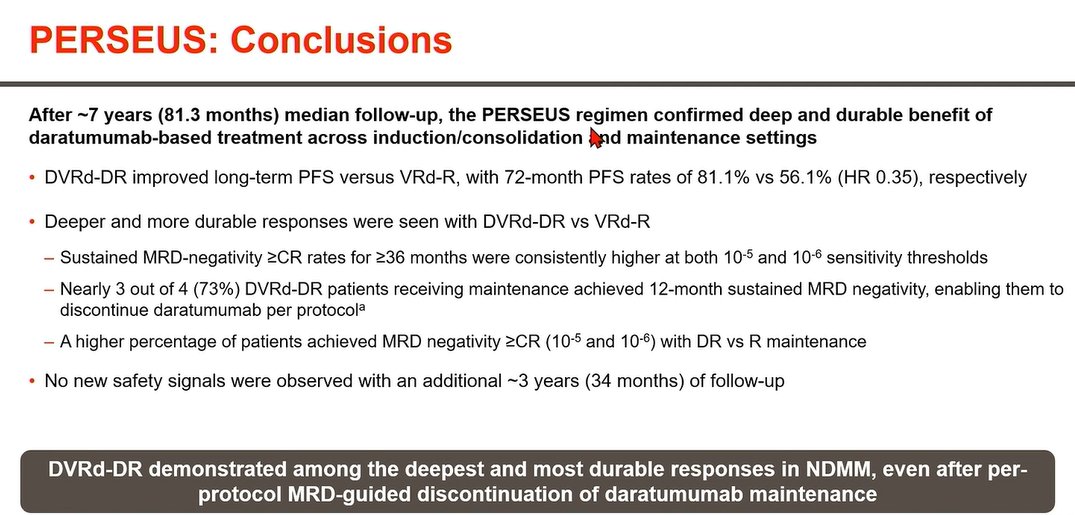
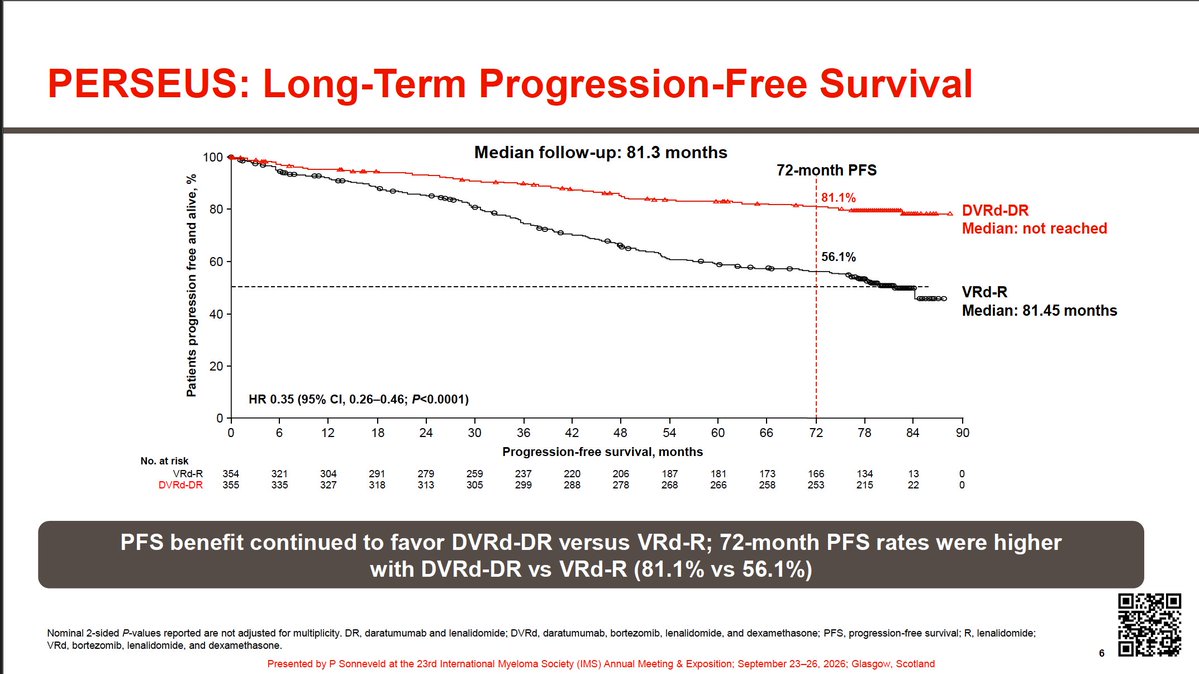
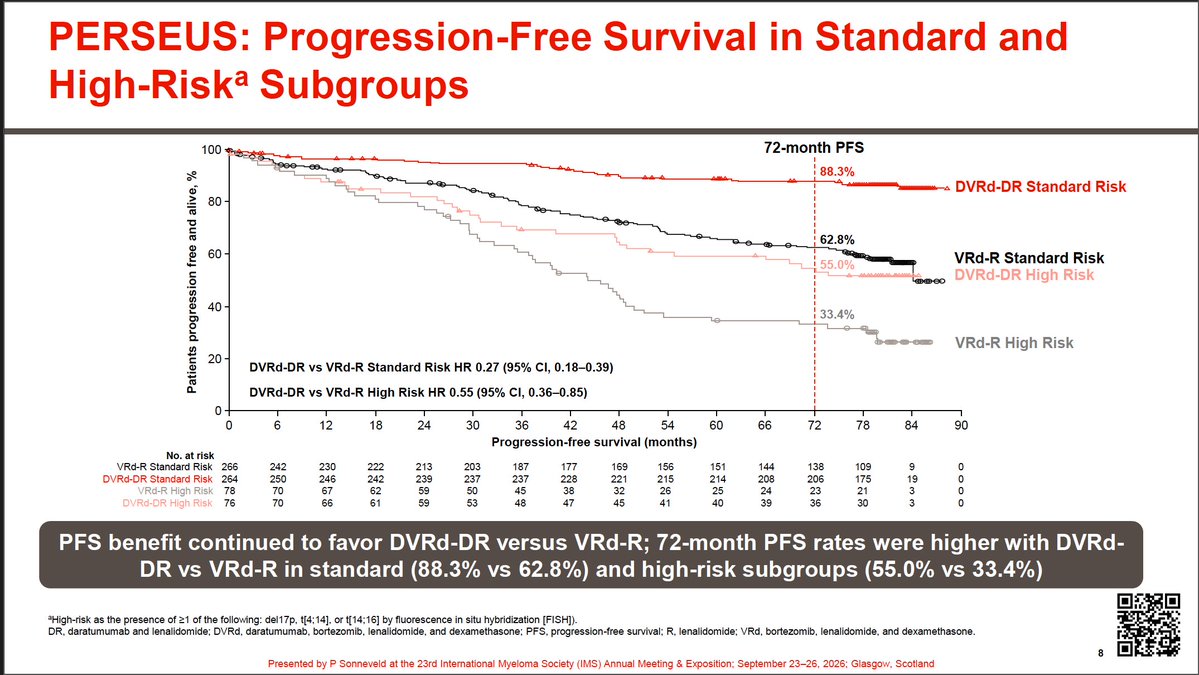
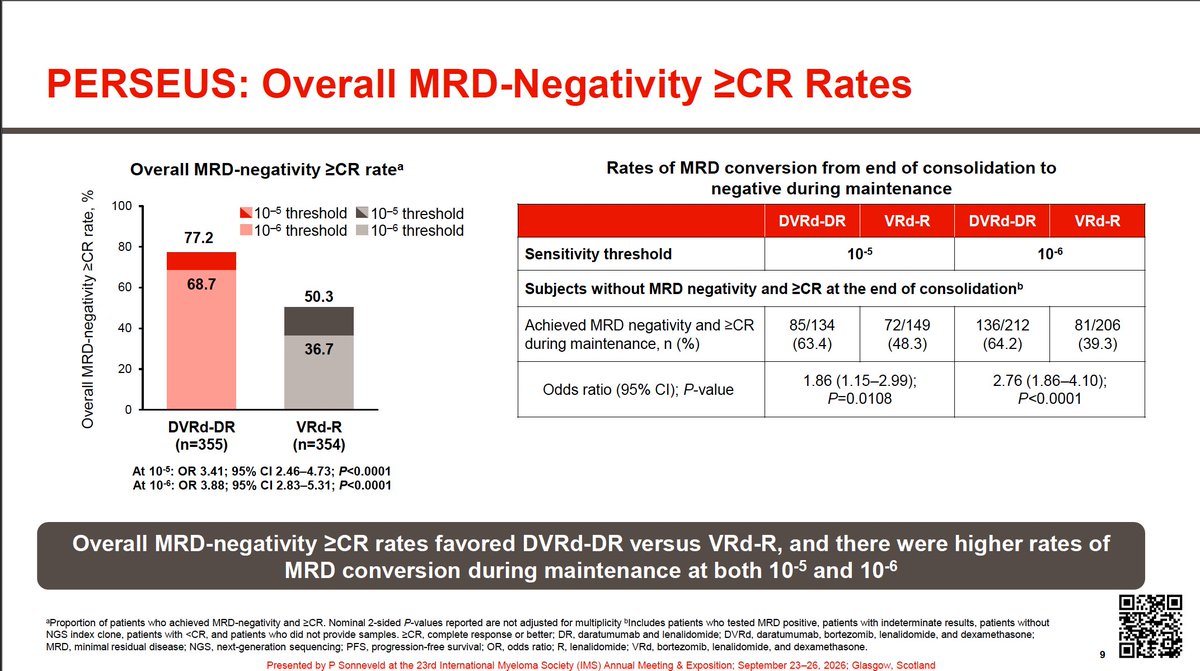
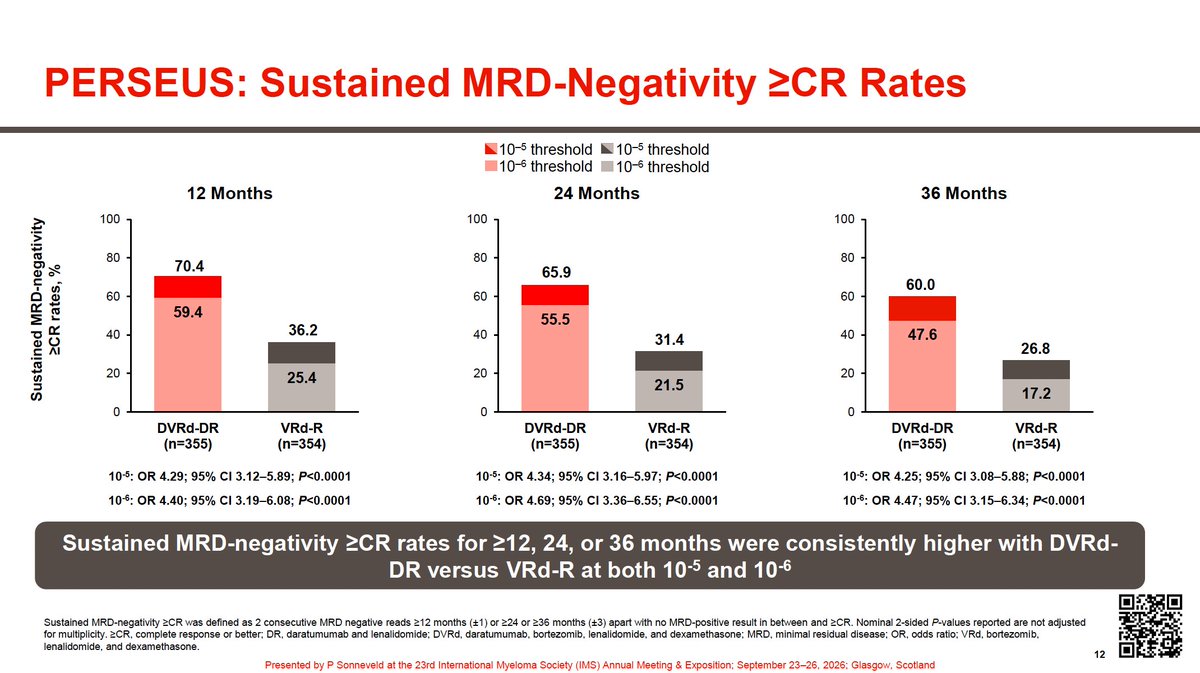
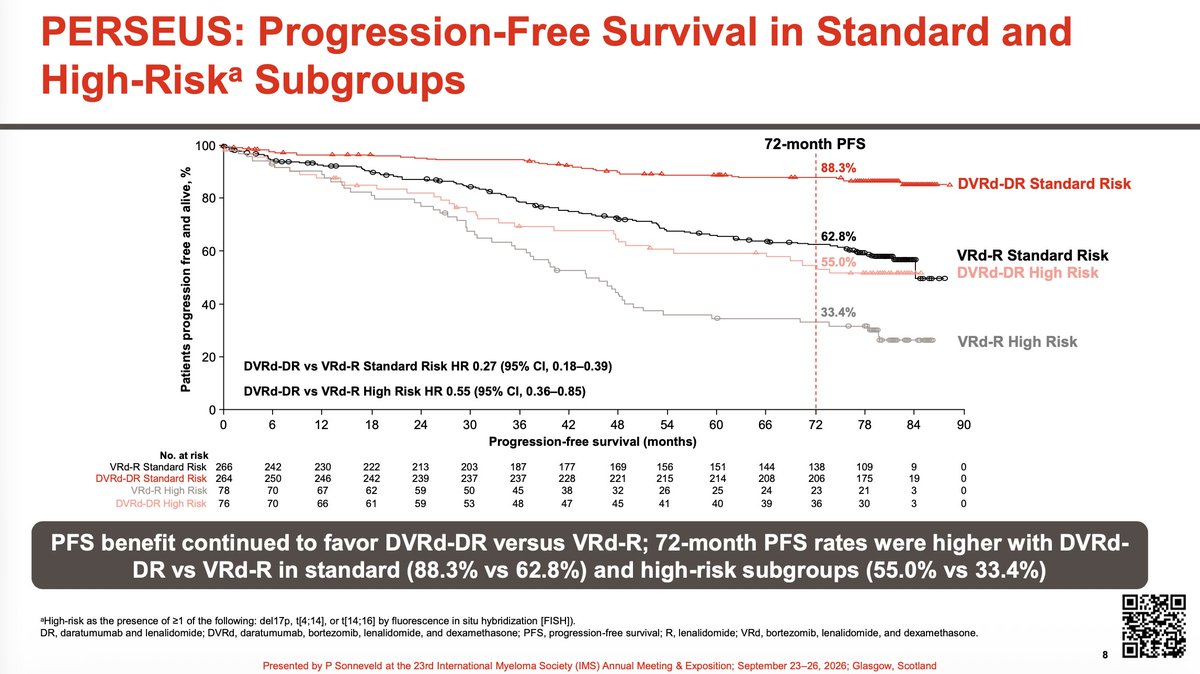
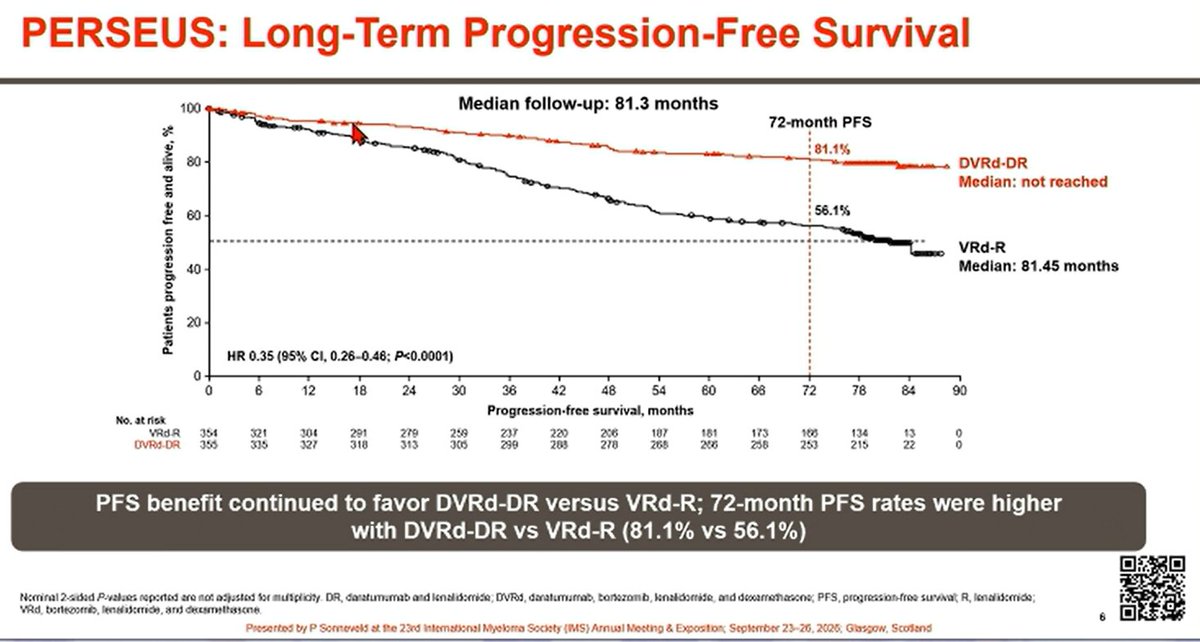
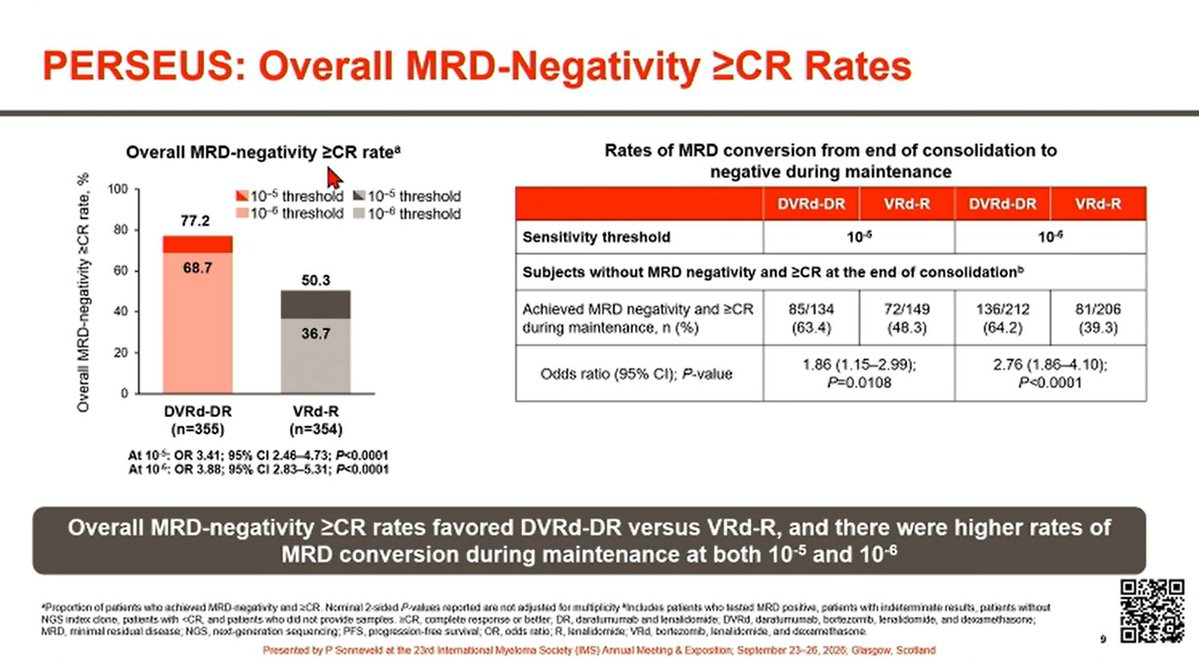

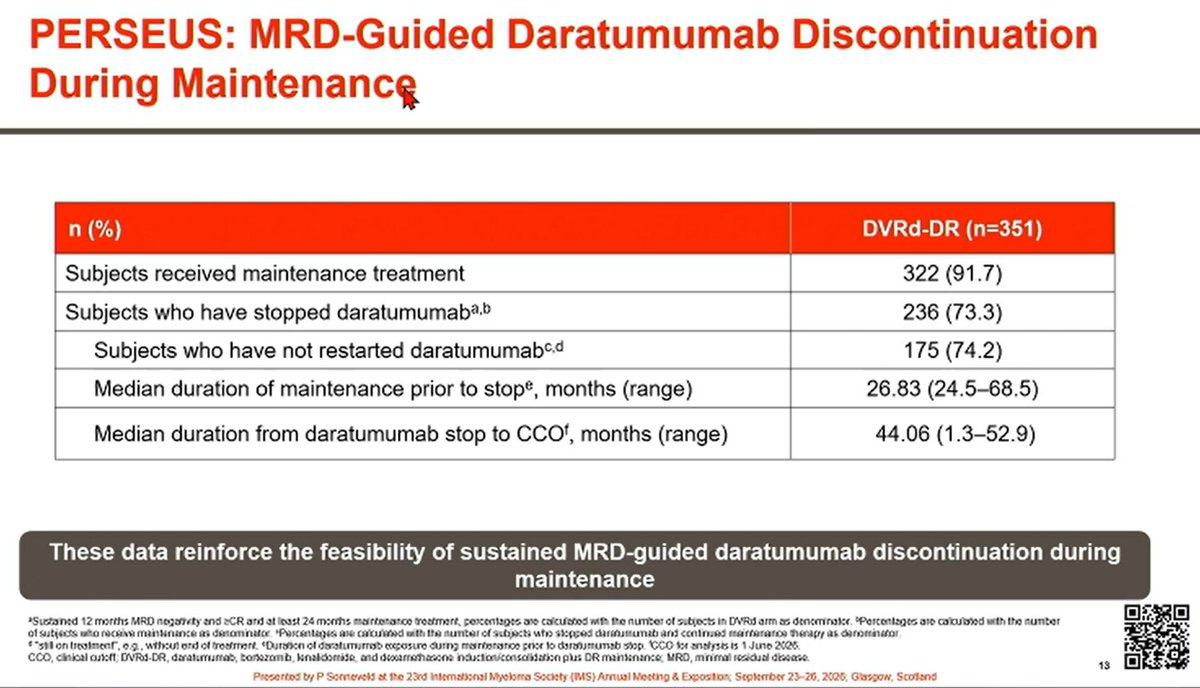
 Sep 21
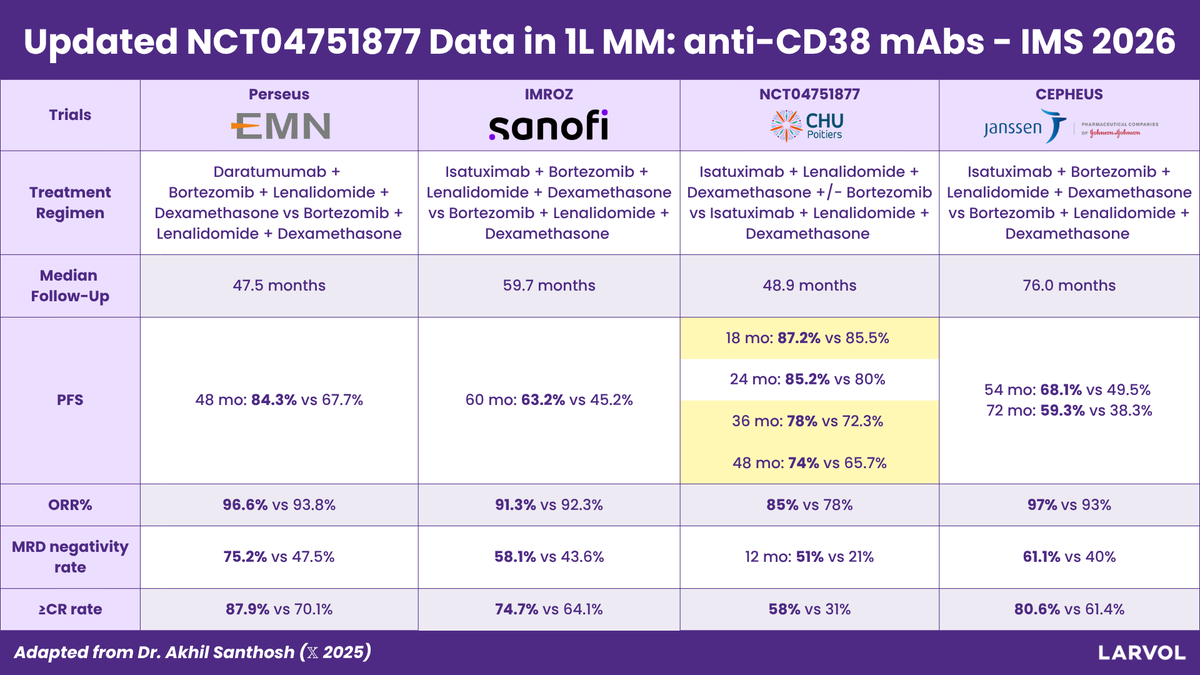
CEPHEUSIMROZPERSEUS
NCT04751877 trial: Updated data from IMS 2026 (@Myeloma_Society) in 1L MM: anti-CD38 mAbs landscape, adapted from Dr. Akhil Santhosh (@tuttsakhil) 👉 https://t.co/V8wOYggpnM
Updated landscape 👉 https://t.co/fUETXB1mH1
Learn more about NCT04751877: https://t.co/YYmevH13Fd
#LARVOL #IMS2026 #InternationalMyelomaSociety #Myeloma #MMSM #HematologicOncology #Hematology #BloodCancers #CancerResearch #CancerData #Oncology #OncologyInsights #ClinicalTrials | @mtmdphd | @szusmani | @RahulBanerjeeMD |
| @End_myeloma | @VincentRK
Updated NCT04751877 Data in 1L MM: anti-CD38 mAbs - IMS 2026
Trials: Perseus (EMN) | IMROZ (sanofi) | NCT04751877 (CHU Poitiers) | CEPHEUS (Janssen, Pharmaceutical Companies of Johnson & Johnson)
Treatment Regimen:
Perseus: Daratumumab + Bortezomib + Lenalidomide + Dexamethasone vs Bortezomib + Lenalidomide + Dexamethasone
IMROZ: Isatuximab + Bortezomib + Lenalidomide + Dexamethasone vs Bortezomib + Lenalidomide + Dexamethasone
NCT04751877: Isatuximab + Lenalidomide + Dexamethasone +/- Bortezomib vs Isatuximab + Lenalidomide + Dexamethasone
CEPHEUS: Isatuximab + Bortezomib + Lenalidomide + Dexamethasone vs Bortezomib + Lenalidomide + Dexamethasone
Median Follow-Up:
Perseus: 47.5 months | IMROZ: 59.7 months | NCT04751877: 48.9 months | CEPHEUS: 76.0 months
PFS:
Perseus: 48 mo: 84.3% vs 67.7%
IMROZ: 60 mo: 63.2% vs 45.2%
NCT04751877: 18 mo: 87.2% vs 85.5%; 24 mo: 85.2% vs 80%; 36 mo: 78% vs 72.3%; 48 mo: 74% vs 65.7%
CEPHEUS: 54 mo: 68.1% vs 49.5%; 72 mo: 59.3% vs 38.3%
ORR%:
Perseus: 96.6% vs 93.8% | IMROZ: 91.3% vs 92.3% | NCT04751877: 85% vs 78% | CEPHEUS: 97% vs 93%
MRD negativity rate:
Perseus: 75.2% vs 47.5% | IMROZ: 58.1% vs 43.6% | NCT04751877: 12 mo: 51% vs 21% | CEPHEUS: 61.1% vs 40%
≥CR rate:
Perseus: 87.9% vs 70.1% | IMROZ: 74.7% vs 64.1% | NCT04751877: 58% vs 31% | CEPHEUS: 80.6% vs 61.4%
Adapted from Dr. Akhil Santhosh (X 2025)
LARVOL
CARTITUDE-2 Cohort A
8 slides
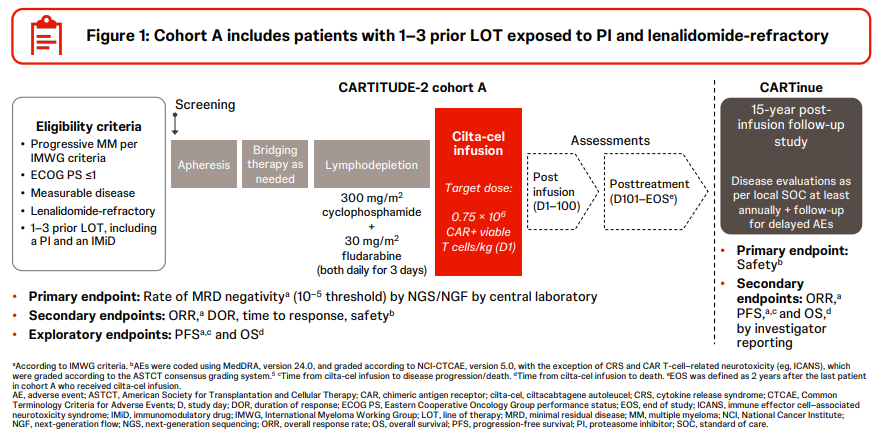
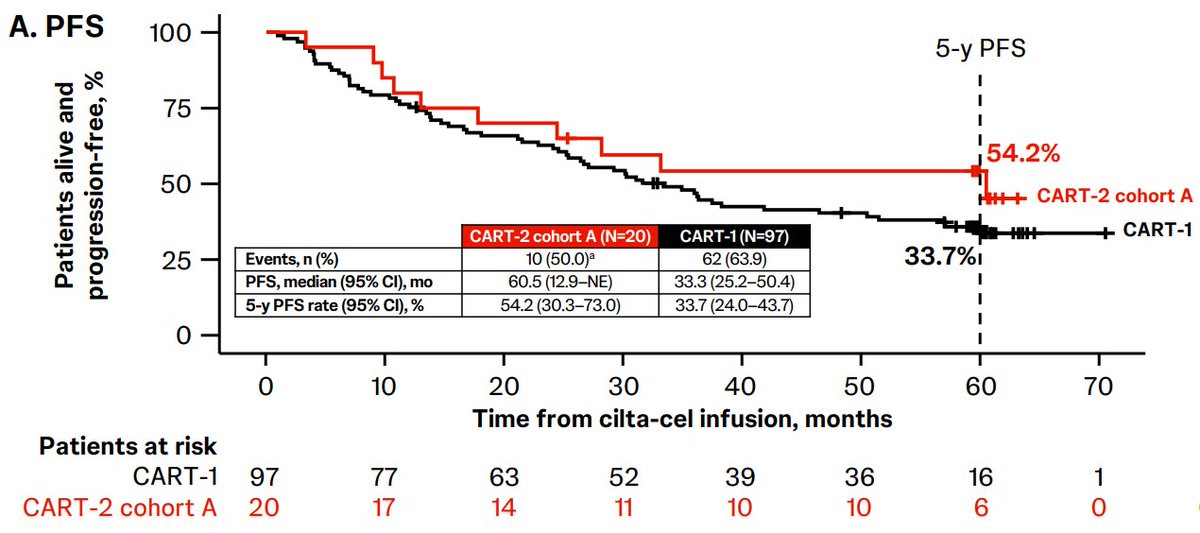
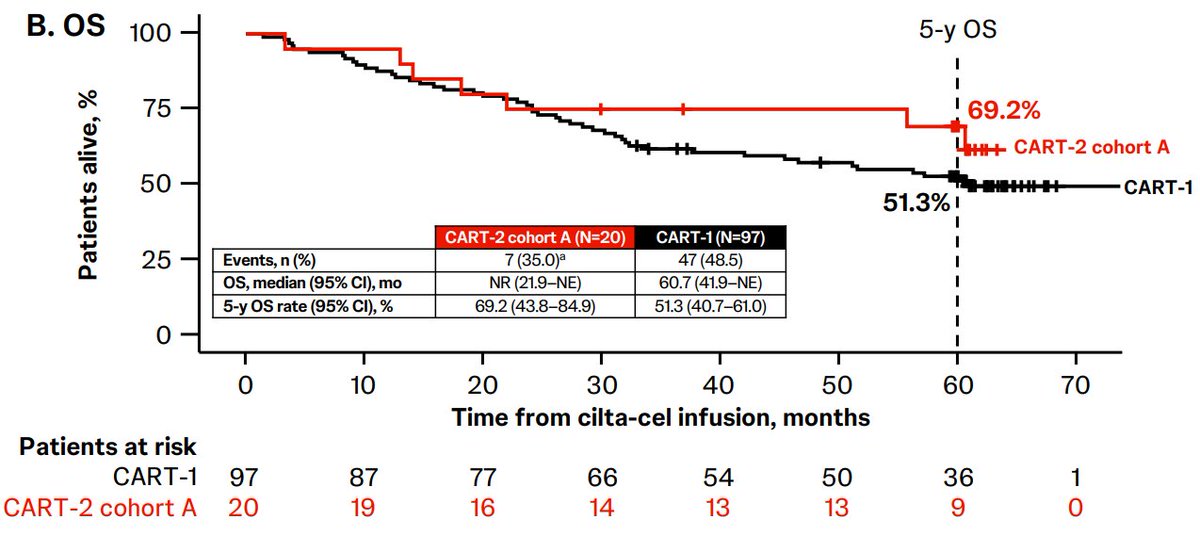
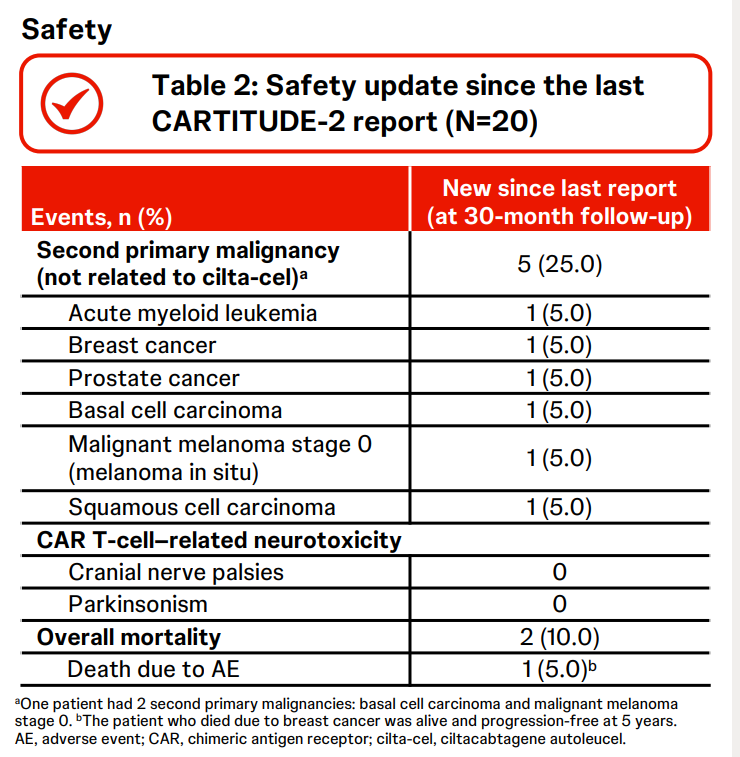 Sep 25

CARTITUDE-2 Cohort A
CARTITUDE-2 Cohort A, PA-288)
5-year data from CARTITUDE-2 Cohort A at #IMS26 🧵 poster session
A single cilta-cel infusion in RRMM with 1–3 prior lines (PI-exposed, len-refractory
💡50% of patients alive and progression-free at 5+ years with no further therapy.
💡5-yr PFS https://t.co/1JC5YO8h0F
[Poster PA-288, IMS 23rd Annual Meeting - Long-Term (>=5-Year) Remission and Survival With Ciltacabtagene Autoleucel in Relapsed/Refractory Multiple Myeloma With 1-3 Prior Lines of Therapy: CARTITUDE-2 Cohort A. Adam D. Cohen et al.]
CARTITUDE-2 (NCT04133636) Cohort A: patients with 1-3 prior LOT, exposed to a PI and lenalidomide-refractory. Median follow-up 60.7 months, all patients >=5 years from cilta-cel infusion. Target dose 0.75x10^6 CAR+ viable T cells/kg.
Key takeaway: Long-term phase 2 data suggest earlier use of cilta-cel in patients with 1-3 prior LOT may be associated with higher likelihood of durable 5-year remissions vs later-line use (1 in 2 patients in earlier lines vs 1 in 3 in later lines).
Results: With median follow-up 60.7 months (range 3.3-63.1), 10 of 20 patients (50%) remained alive and progression-free without further anti-myeloma treatment >=5 years after cilta-cel infusion. 18/20 patients (90%) received cilta-cel infusion (per correlative analysis note). Deaths due to AE <5yr n=2; withdrawal without PD <5yr n=1.
Baseline characteristics by durable response group (>=5yr alive/PFS n=10 vs PD/death by yr5 n=7): trend toward lower baseline tumor burden in durable responders; 60% of durable responders had decrease in tumor burden from screening to infusion (vs 42.9% in PD/death group); 5/7(71.4%) durable responders had >=1 high-risk cytogenetic feature at baseline (4/7 had >=2) vs 3/7(42.9%)/3/7(42.9%) in PD/death group; 5/10(50%) durable responders were refractory to daratumumab; median time from start of last LOT to progression numerically higher in durable responders (12.8 vs 5.7 months).
Efficacy: PFS median 60.5 months (95% CI 12.9-NE), 5-yr PFS rate 54.2% (CART-2 cohort A n=20) vs CARTITUDE-1 33.3% (5-yr PFS 33.7%). OS median NR (19-NE), 5-yr OS rate 69.2% (CART-2) vs CARTITUDE-1 51.3%. 95% (19/20) achieved CR/sCR as best response; one patient had minimal response, died due to COVID-19 pneumonia. Three patients alive/PFS at >=5yr assessed by bone marrow at 5yr, all MRD-negative (10^-6 threshold).
Biomarker correlates of durable response: patients alive/PFS at >=5yr had significantly higher CD4+ naive T-cell levels at apheresis (P=0.036) and higher CAR+CD4+ central memory T cells at Tmax post-infusion (P=0.019) vs those who died/progressed <5yr.
Safety update since last CARTITUDE-2 report (N=20), new since 30-month report: second primary malignancy (not related to cilta-cel) 5(25.0%) - AML 1, breast cancer 1, prostate cancer 1, basal cell carcinoma 1, melanoma in situ 1, squamous cell carcinoma 1. CAR T-related neurotoxicity: cranial nerve palsies 2, parkinsonism 2(10.0%). Overall mortality 7(35.0%). Death due to AE 1(5.0%).
Conclusions: 10/20 patients (50%) in CARTITUDE-2 cohort A remained alive/PFS at >=5 years without further treatment. Median PFS 60.5 months, 5-year OS rate 69.2%. No new cases of neurotoxicity reported in long-term follow-up.
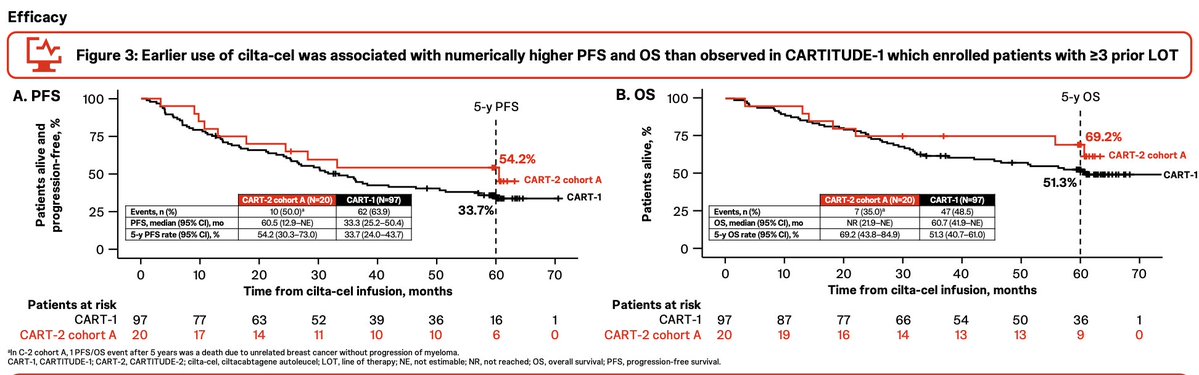

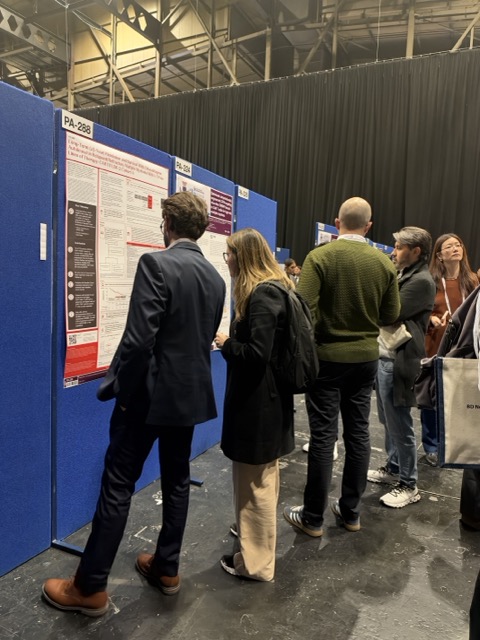
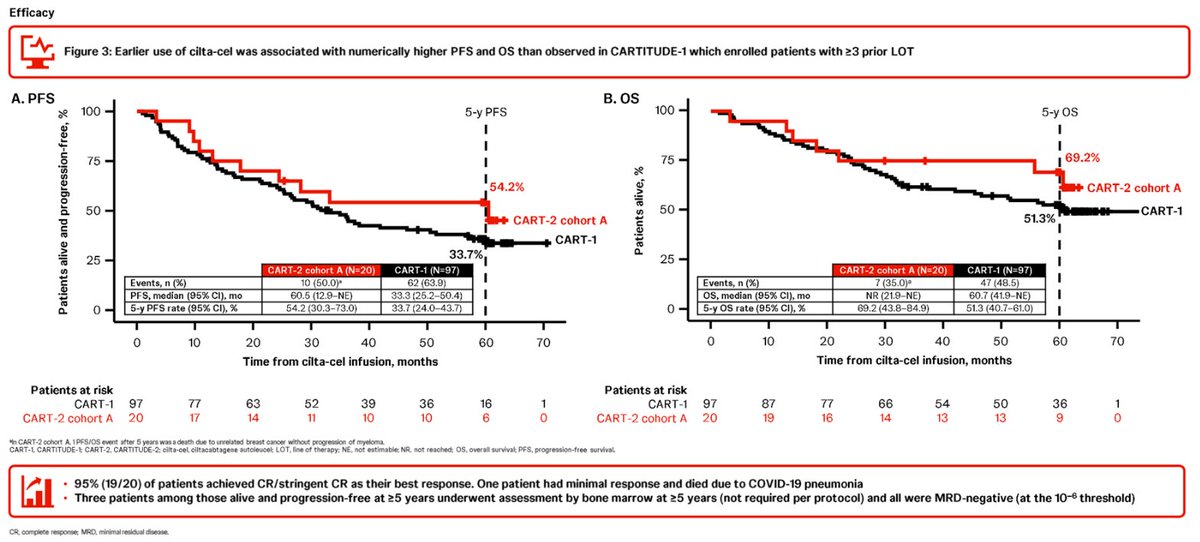
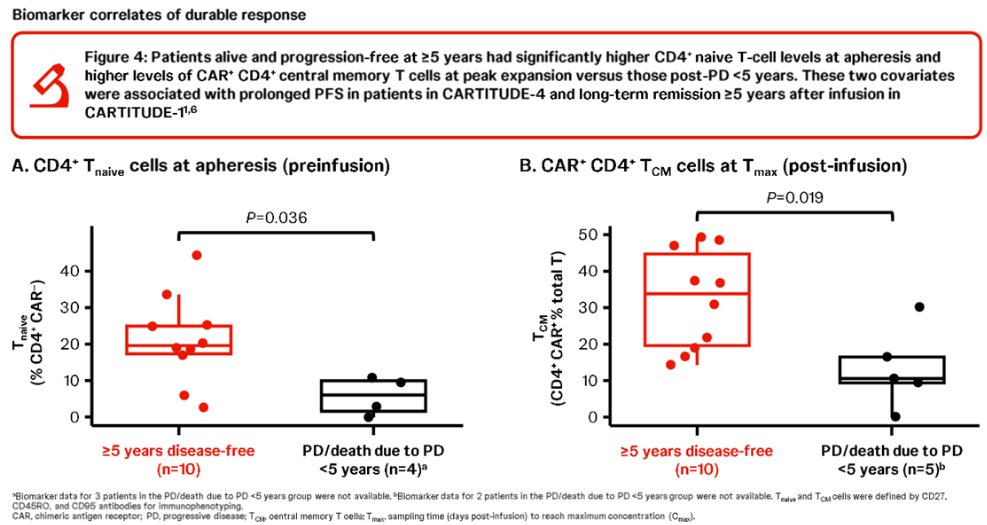
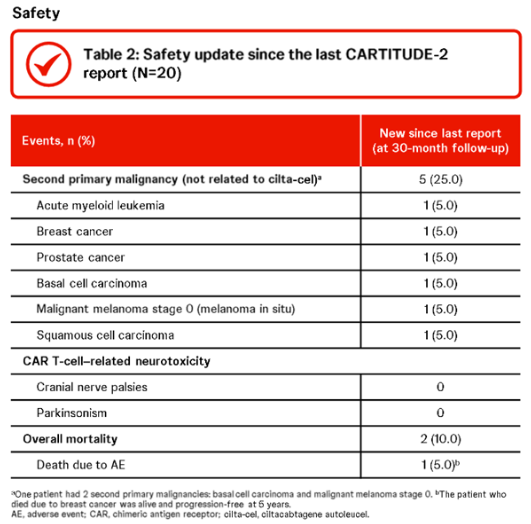
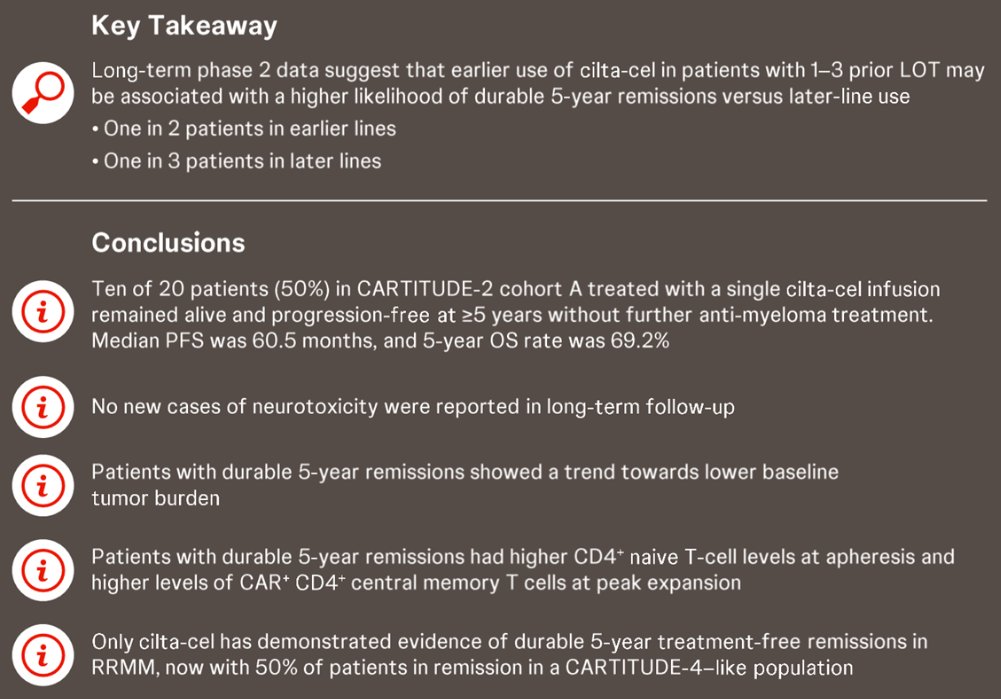

CAMMA 1
7 slides
Sep 24


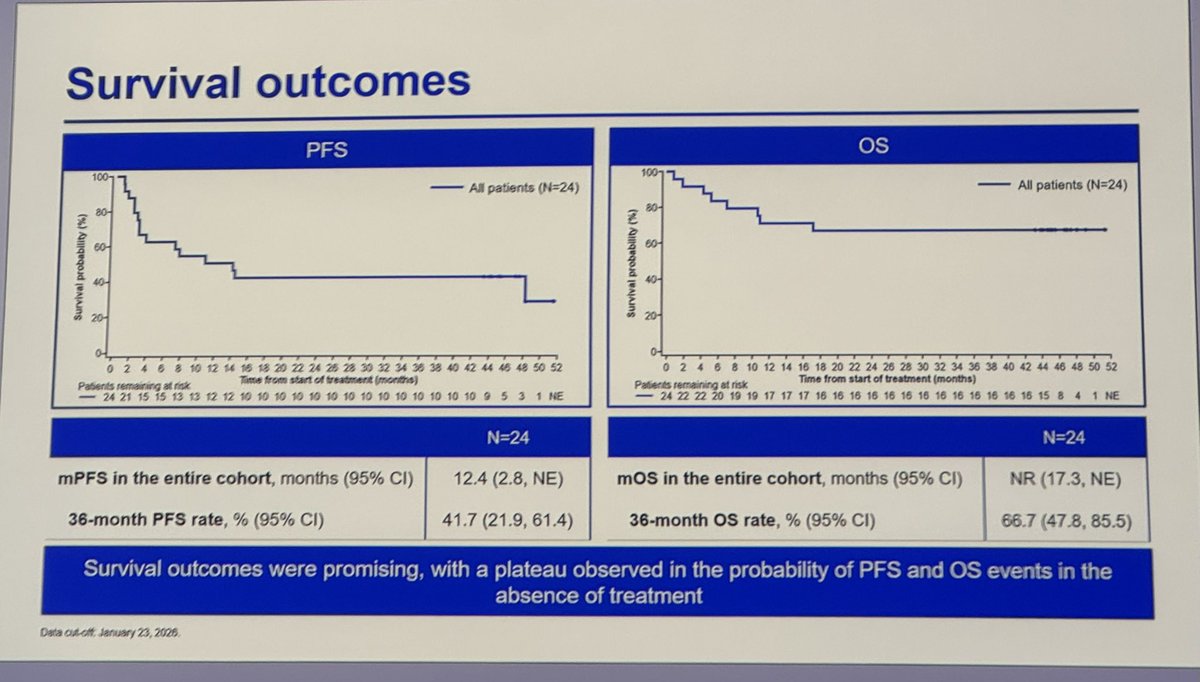
CAMMA 1
@ravivij presenting Arm A of CAMMA-1 evaluating a fixed-duration, cevostamab modified regimen QW/Q2W. Encouraging safety and response data with this regimen #IMS26 #mmsm https://t.co/Rj6jDIQMkZ
Safety summary
n (%) unless stated | N=24
Median follow-up, months (range) | 47.5 (0.8-53.3)
AE of any Gr | 24 (100)
Gr 3-4 AE | 17 (70.8)
Serious AE | 15 (66.7)
Gr 5 AE excluding PD | 2 (8.3) - Sepsis* and cardiovascular event (not treatment related)
AE leading to cevostamab discontinuation | 2 (8.3) - Pneumonia (treatment related) and HLH and AML (not treatment related)
n (%) of patients with AEs of interest by Grade (bar chart, Gr1-5):
Neutropenia: 54.2%
Anemia: 33.4%
Thrombocytopenia: 20.9%
CRS: 75.0%
Infections: 75.0%
Rash: 29.1%
With the exception of rash, no substantial skin conditions, hair and nail changes or mucosal toxicities were observed
One Gr 1 AE of ICANS was reported
The fixed-duration, modified regimen, with a QW/Q2W dosing intensity in C1-6, had a manageable overall safety profile
Data cut-off: January 23, 2026. *Histopathological assessment suggested event occurred in the setting of PD. Group term neutropenia, neutrophil count decreased and febrile neutropenia. Group term thrombocytopenia and platelet count decreased. MedDRA System Organ Class Infections and Infestations. MedDRA high-level terms rashes, eruptions and exanthems NEC, exfoliative conditions, dermatitis ascribed to specific agent, acnes, dermatitis and eczema, and bullous conditions. HLH, hemophagocytic lymphohistiocytosis.
Response rates
Response rates (%) bar chart - PR, VGPR, CR, sCR
ORR: 70.8% (95% CI: 53.8, 94.0)
sCR: 20.8%
CR: 12.5%
VGPR: 25.0%
PR: 12.5%
VGPR+: 58.3%
N=24
MRD-negative CR+ rates at the 10^-6 level
8 patients achieved CR+ (33.3%)
4 were MRD evaluable
All were MRD negative at the 10^-6 level
The fixed-duration, modified regimen was highly active (ORR: 70.8%; VGPR+ rate: 58.3%). All MRD-evaluable CR+ patients were MRD negative at the 10^-6 level.
Data cut-off: January 23, 2026.
Evolution of response over time
Evolution of response over time among responders (swimmer plot, up to 17 responders, duration of follow-up in months)
Legend: Overall response = sCR, CR, VGPR, PR, MR, SD, PD, No response reported
End of treatment or study status/reason: Death, Completed, AE, PD, Physician decision, Ongoing
Responses deepened over time
- Median time to first PR was 1.0 month, VGPR was 3.3 months and CR+ was 9.7 months
11 of 17 responders completed 13 cycles of treatment in PR+
- 7 in CR+
- 3 in VGPR, including 1 who subsequently achieved CR+
- 1 in PR
9 of 11 responders who completed 13 cycles in PR+ had responses >40 months, including all 7 CR+ patients
The fixed-duration, modified regimen induced prolonged responses that continued after treatment completion. All 7 patients who completed 13 cycles in CR+ had responses >40 months.
Data cut-off: January 23, 2026.
Survival outcomes
PFS (KM curve, All patients N=24):
Patients remaining at risk: 24 21 15 15 13 13 12 12 10 10 10 10 10 10 10 10 10 10 9 5 3 1 NE (months 0-52)
mPFS in the entire cohort, months (95% CI): 12.4 (2.8, NE)
36-month PFS rate, % (95% CI): 41.7 (21.9, 61.4)
OS (KM curve, All patients N=24):
Patients remaining at risk: 24 22 22 20 19 19 17 17 17 16 16 16 16 16 16 16 16 16 16 16 15 8 4 1 NE
mOS in the entire cohort, months (95% CI): NR (17.3, NE)
36-month OS rate, % (95% CI): 66.7 (47.8, 85.5)
Survival outcomes were promising, with a plateau observed in the probability of PFS and OS events in the absence of treatment
Data cut-off: January 23, 2026.
Sep 23
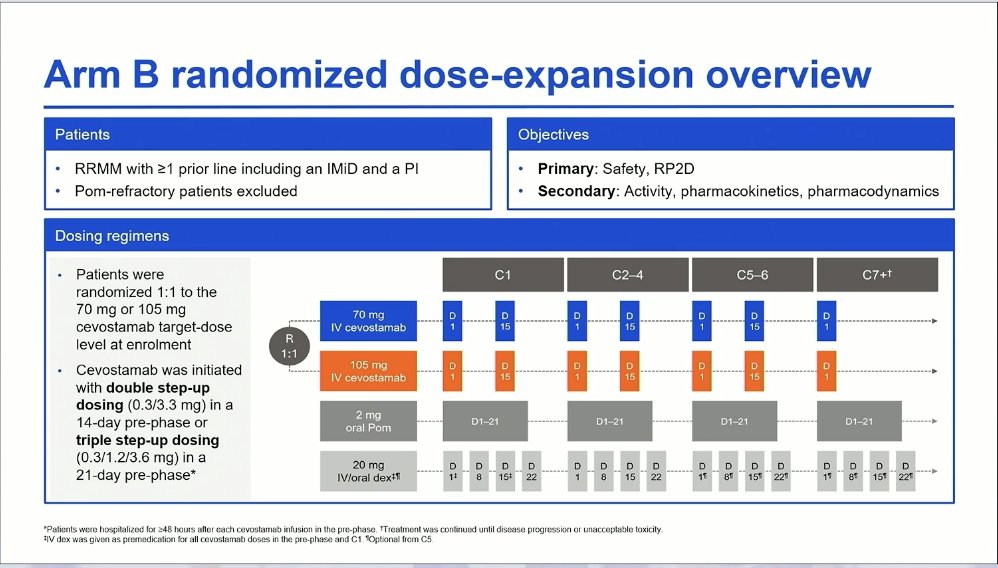

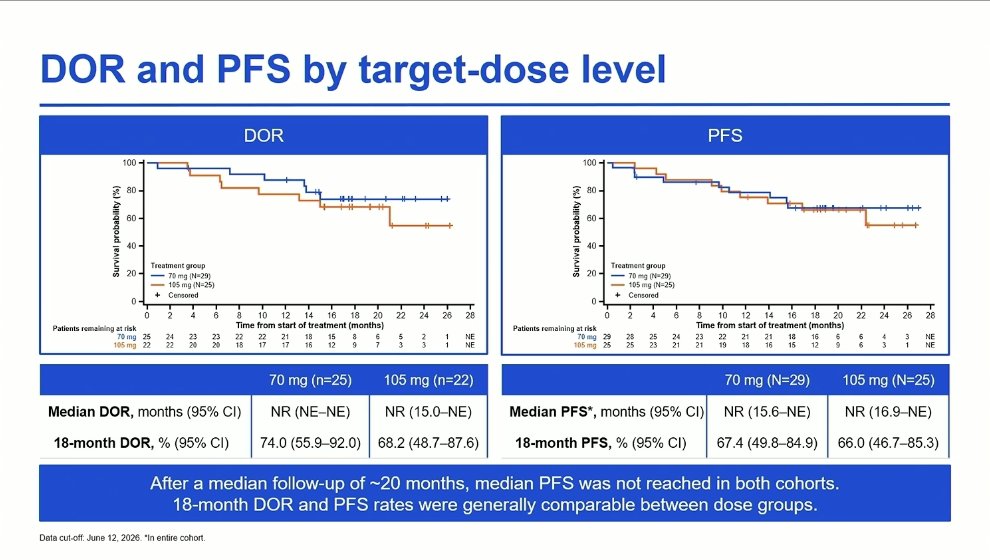

CAMMA 1
#IMS26 #mmsm Oral - cevostamab pom dex
➡️ median F/ ~20 mo with PFS and DOR NR
➡️ Other mechanism of action to look for https://t.co/0PxCOhtvMo
Arm B randomized dose-expansion overview
Patients: RRMM with ≥1 prior line including an IMiD and a PI; Pom-refractory patients excluded
Objectives: Primary: Safety, RP2D; Secondary: Activity, pharmacokinetics, pharmacodynamics
Dosing regimens:
Patients were randomized 1:1 to the 70 mg or 105 mg cevostamab target-dose level at enrolment
Cevostamab was initiated with double step-up dosing (0.3/3.3 mg) in a 14-day pre-phase or triple step-up dosing (0.3/1.2/3.6 mg) in a 21-day pre-phase*
Schema across C1, C2-4, C5-6, C7+:
70 mg IV cevostamab: D1, D15 dosing in C1, C2-4, C5-6; D1 only in C7+
105 mg IV cevostamab: D1, D15 dosing in C1, C2-4, C5-6; D1 only in C7+
2 mg oral Pom: D1-21 continuous across cycles
20 mg IV/oral dex: D1, D8, D15, D22 across cycles
*Patients were hospitalized for ≥48 hours after each cevostamab infusion in the pre-phase. Treatment was continued until disease progression or unacceptable toxicity. IV dex was given as premedication for all cevostamab doses in the pre-phase and C1. Optional from C5.
Baseline characteristics by target-dose level
n (%) unless stated | 70 mg (N=29) | 105 mg (N=25)
Median age, years (range): 65 (40-76) | 65 (48-80)
Male: 14 (48.3) | 14 (56.0)
ECOG PS 0: 14 (48.3) | 14 (56.0); PS 1: 15 (51.7) | 11 (44.0)
ISS stage I: 17 (60.7)* | 15 (62.5); II: 8 (28.6)* | 8 (33.3); III: 3 (10.7)* | 1 (4.2)
HR cytogenetics, n (%) of patients with a conclusive assay result: 3/20 (15.0) | 8/22 (36.4)
Extramedullary disease: 4 (13.8) | 3 (12.0)
Median time from diagnosis, years (range): 6.6 (0.4-16.5) | 4.0 (1.1-26.0)
n (%) unless stated | 70 mg (N=29) | 105 mg (N=25)
Median number of prior lines of therapy, n (range): 2 (1-6) | 2 (1-6)
Triple-class exposed: 21 (72.4) | 14 (56.0)
Triple-class refractory: 9 (31.0) | 6 (24.0)
Penta-drug refractory: 5 (17.9) | 3 (12.0)
Refractory to last prior therapy: 21 (72.4) | 17 (68.0)
The median number of prior lines of therapy was 2
Most patients were triple-class exposed and refractory to their last prior therapy
Characteristics were comparable between groups, except for a higher rate of HR cytogenetics in the 105 mg cohort and triple-class exposure in the 70 mg cohort
Data cut-off: June 12, 2026. Includes t(4;14), t(14;16) and del(17p). ≥1 IMiD, ≥1 PI and ≥1 anti-CD38 antibody. ≥2 IMiDs, ≥2 PIs and ≥1 anti-CD38 antibody.
DOR and PFS by target-dose level
DOR (KM curve, treatment group 70 mg N=29 vs 105 mg N=25, censored marks):
Patients remaining at risk 70mg: 25 22 20 20 18 17 17 16 12 8 5 3 1 NE; 105mg: 22 20 20 17 16 15 12 9 7 3 1 NE
70 mg (n=25) | 105 mg (n=22)
Median DOR, months (95% CI): NR (NE-NE) | NR (15.0-NE)
18-month DOR, % (95% CI): 74.0 (55.9-92.0) | 68.2 (48.7-87.6)
PFS (KM curve, treatment group 70 mg N=29 vs 105 mg N=25):
Patients remaining at risk 70mg: 29 28 25 23 21 19 18 17 13 9 6 3 1 NE; 105mg: 25 23 21 19 18 15 11 9 7 3 1 NE
70 mg (N=29) | 105 mg (N=25)
Median PFS*, months (95% CI): NR (15.6-NE) | NR (16.9-NE)
18-month PFS, % (95% CI): 67.4 (49.8-84.9) | 66.0 (46.7-85.3)
After a median follow-up of ~20 months, median PFS was not reached in both cohorts. 18-month DOR and PFS rates were generally comparable between dose groups.
Data cut-off: June 12, 2026. *In entire cohort.
Safety summary by target-dose level
n (%) unless stated | 70 mg (N=29) | 105 mg (N=25)
Median follow-up, months (range): 20.2 (12.7-27.5) | 20.4 (3.3-27.3)
Any Gr AE: 29 (100) | 25 (100)
Gr 3-4 AE: 24 (82.8) | 24 (96.0)
Serious AE: 17 (58.6) | 15 (60.0)
Gr 5 AE excluding PD: 1 (3.4)* | 1 (4.0)
AE leading to discontinuation - Cevostamab: 2 (6.9) | 2 (8.0); Pom: 8 (27.6) | 8 (32.0); Dex: 0 | 2 (8.0)
n (%) with AEs of interest by Grade (mirrored bar chart 70mg vs 105mg, Gr1-5):
Neutropenia: 79.3% (70mg) | 84.0% (105mg)
Anemia: 34.5% | 40.0%
Thrombocytopenia: 24.1% | 32.0%
CRS: 72.4% | 68.0%
Infections: 75.9% | 80.0%
Rash: 34.5% | 56.0%
With the exception of rash, no substantial skin conditions, hair and nail changes or mucosal toxicities were observed
Low ICANS incidence: Single cases of Gr 1 and Gr 2 only (n=1 each in 105 mg cohort)
Overall rates of AEs were generally comparable between dose groups, with a lower incidence of Gr 3-4 events and rash in the 70 mg cohort
Data cut-off: June 12, 2026. *Septic shock (treatment related). Intracranial haemorrhage (not treatment related) and weight increased (treatment related) (n=1 each). Clear cell renal cell carcinoma (not treatment related) and diffuse large B-cell lymphoma (treatment related) (n=1 each). Infective exacerbation of chronic obstructive airways disease (not treatment related) (n=1).
Sep 23


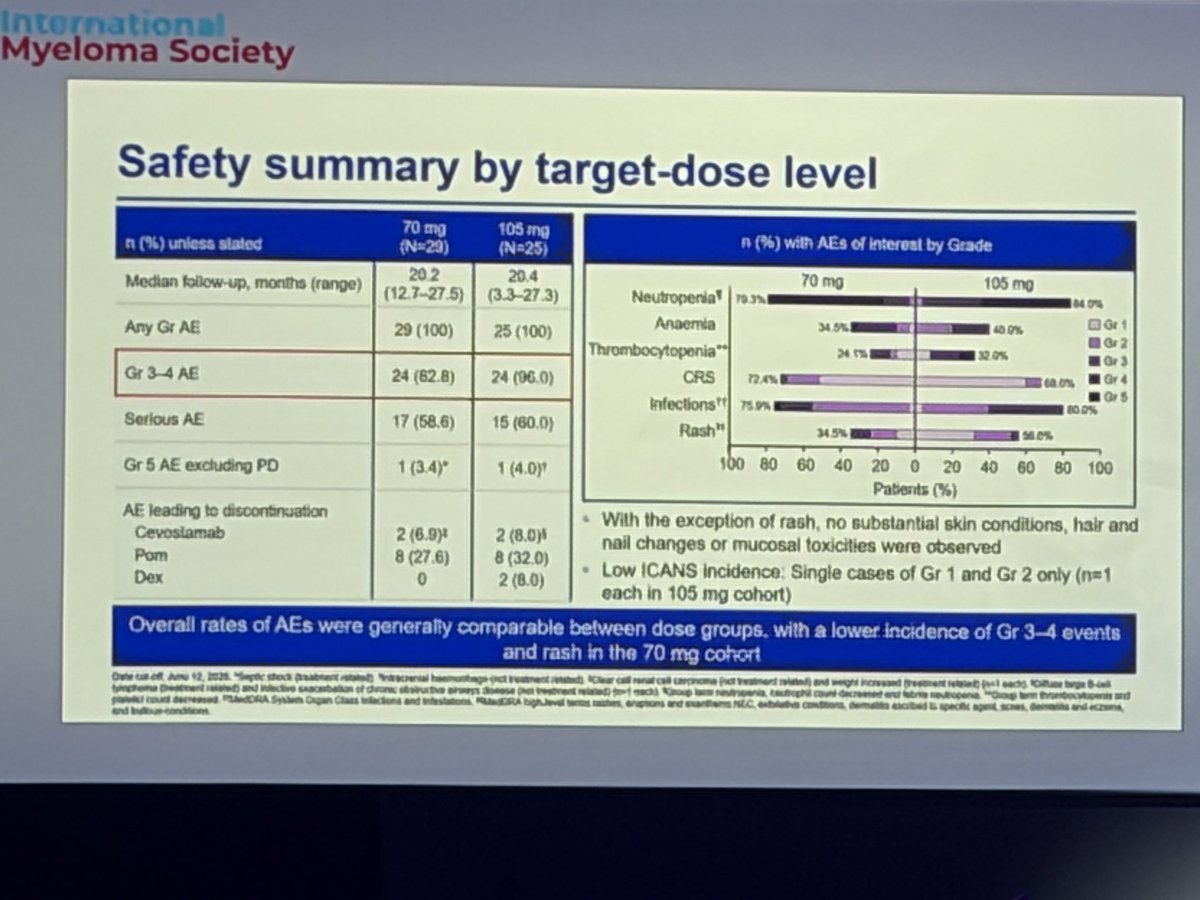
CAMMA 1
CAMMA 1 (Cevostamab + Pom-Dex)
💊 #IMS26: Cevostamab + pom-dex in BCMA-naïve RRMM with 2 different dose levels 70 mg and 105 mg
💡ORR 86-88%, durable responses
💡Gr3-4 AEs in up to 96% (105mg) and Gr3-4 infections up to 40%
💡Is the higher dose's efficacy gain worth the added toxicity burden? #MultipleMyeloma #MMsm #FcRH5 #LessIsMore @Myeloma_Society
International Myeloma Society
Arm B randomized dose-expansion overview
Patients
- RRMM with >=1 prior line including an IMiD and a PI
- Pom-refractory patients excluded
Objectives
- Primary: Safety, RP2D
- Secondary: Activity, pharmacokinetics, pharmacodynamics
Dosing regimens
- Patients were randomized 1:1 to the 70 mg or 105 mg cevostamab target-dose level at enrolment
- Cevostamab was initiated with double step-up dosing (0.3/3.3 mg) in a 14-day pre-phase or triple step-up dosing (0.3/1.2/3.6 mg) in a 21-day pre-phase*
[Schema] R 1:1 -> 70 mg IV cevostamab / 105 mg IV cevostamab (D1, D15 across cycles C1, C2-4, C5-6, C7+); 2 mg oral Pom D1-21 each cycle; 20 mg IV/oral dex [dosing days small print, not fully legible]
*Patients were hospitalized for >=48 hours after each cevostamab infusion in the pre-phase. [footnote small print partially illegible] Treatment was continued until disease progression or unacceptable toxicity. IV dex was given as premedication for all cevostamab doses in the pre-phase and C1. Optional from C5.
International Myeloma Society
Response rates by target-dose level
Response rates (%) by target-dose level — PR | VGPR | CR | sCR
70 mg (N=29): ORR: 86.2% (95% CI: 71.9-100); CR+: 62.1%; VGPR+: 75.9%; stacked bar: 44.8% (CR/sCR block) + 17.2% + 13.8% (VGPR) + 10.3% (PR)
105 mg (N=25): ORR: 88.0% (95% CI: 73.3-100); CR+: 64.0%; VGPR+: 76.0%; stacked bar: 44.0% + 20.0% + 12.0% (VGPR) + 12.0% (PR)
Median time on study, months (range): 70 mg (N=29): 20.2 (12.7-27.5); 105 mg (N=25): 20.4 (3.3-27.3)
Cevostamab plus pom-dex induced high ORR, VGPR+ and CR+ rates at both target doses
Response rates were comparable between dose groups
Data cut-off: June 12, 2026 [date partially legible]
International Myeloma Society
Safety summary by target-dose level
[Left table]
n (%) unless stated | 70 mg (N=29) | 105 mg (N=25)
Median follow-up, months (range) | 20.2 (12.7-27.5) | 20.4 (3.3-27.3)
Any Gr AE | 29 (100) | 25 (100)
Gr 3-4 AE | 24 (82.8) | 24 (96.0)
Serious AE | 17 (58.6) | 15 (60.0)
Gr 5 AE excluding PD | 1 (3.4)* | 1 (4.0)†
AE leading to discontinuation
Cevostamab | 2 (6.9)‡ | 2 (8.0)§
Pom | 8 (27.6) | 8 (32.0)
Dex | 0 | 2 (8.0)
[Right chart] n (%) with AEs of interest by Grade — 70 mg vs 105 mg (Gr 1 / Gr 2 / Gr 3 / Gr 4 / Gr 5)
Neutropenia¶ 79.3% | 84.0%
Anaemia 34.5% | 40.0%
Thrombocytopenia** 24.1% | 32.0%
CRS 72.4% | 68.0%
Infections†† 75.9% | 80.0%
Rash‡‡ 34.5% | 56.0%
Patients (%)
• With the exception of rash, no substantial skin conditions, hair and nail changes or mucosal toxicities were observed
• Low ICANS incidence: Single cases of Gr 1 and Gr 2 only (n=1 each in 105 mg cohort)
Overall rates of AEs were generally comparable between dose groups, with a lower incidence of Gr 3-4 events and rash in the 70 mg cohort
Data cut-off: June 12, 2025 [remainder of footnote largely illegible]: *Septic shock (treatment related). †Intracranial haemorrhage (not treatment related). ‡Clear cell renal cell carcinoma (not treatment related) and weight increased (treatment related) (n=1 each). §Diffuse large B-cell lymphoma (treatment related) and infective exacerbation of chronic obstructive airways disease (not treatment related) (n=1 each). ¶Group term neutropenia, neutrophil count decreased and febrile neutropenia. **Group term thrombocytopenia and platelet count decreased. ††MedDRA System Organ Class Infections and Infestations. ‡‡MedDRA high-level terms rashes, eruptions and exanthems NEC, exfoliative conditions, dermatitis ascribed to specific agent, acnes, dermatitis and eczema, and bullous conditions.
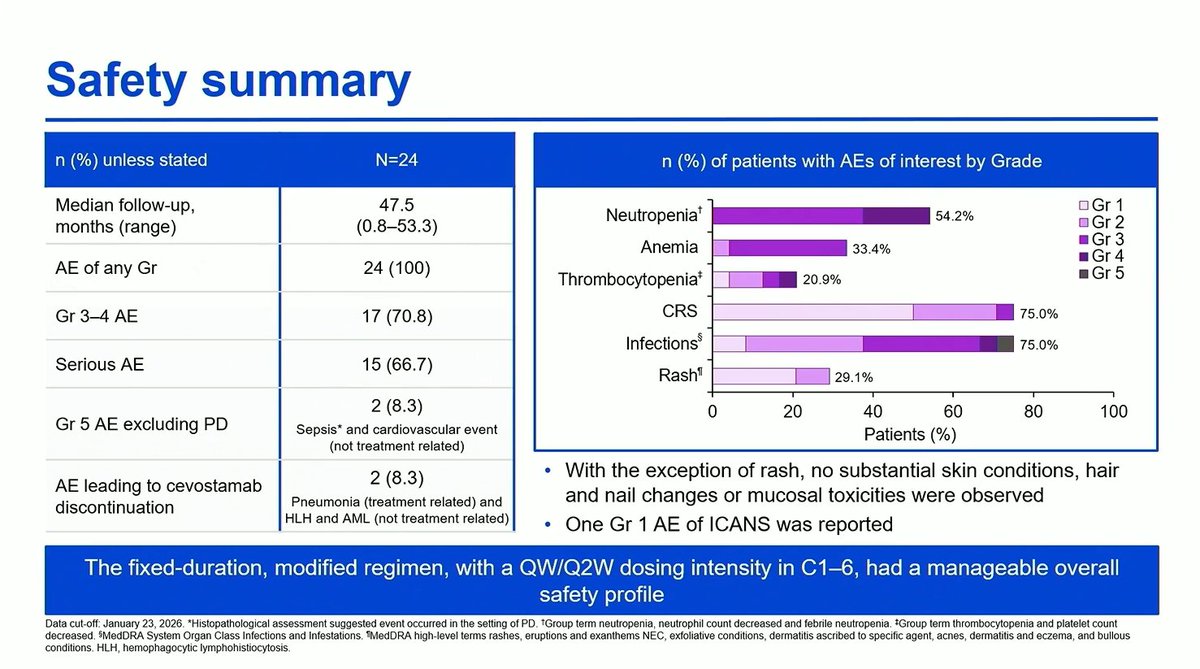

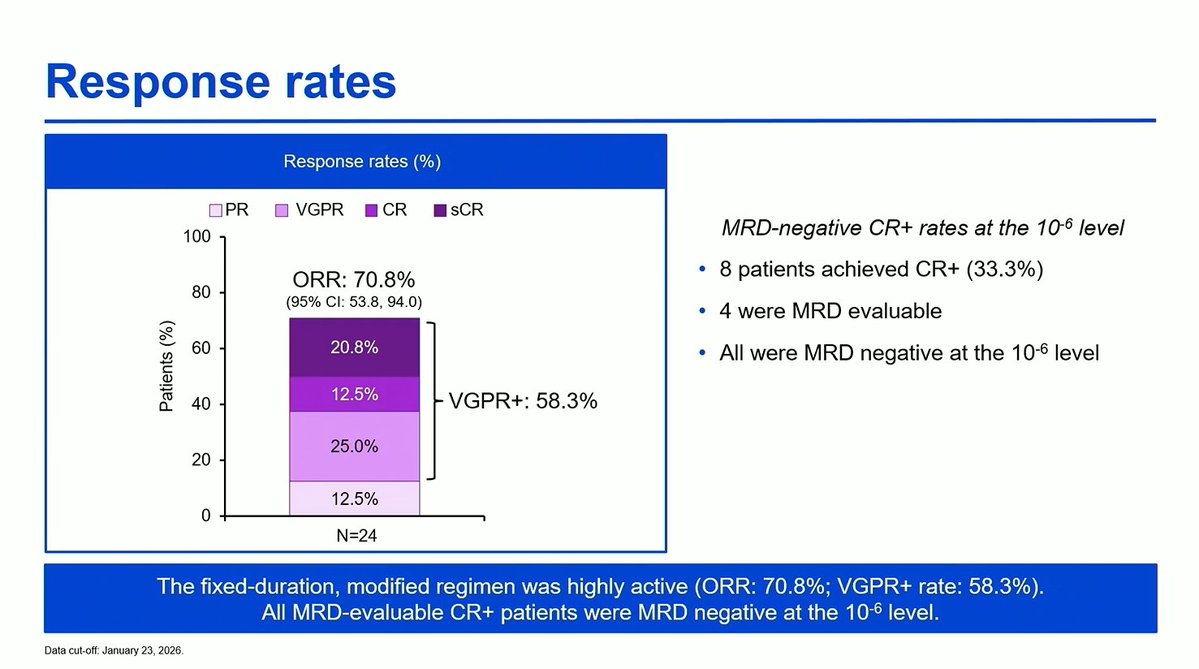
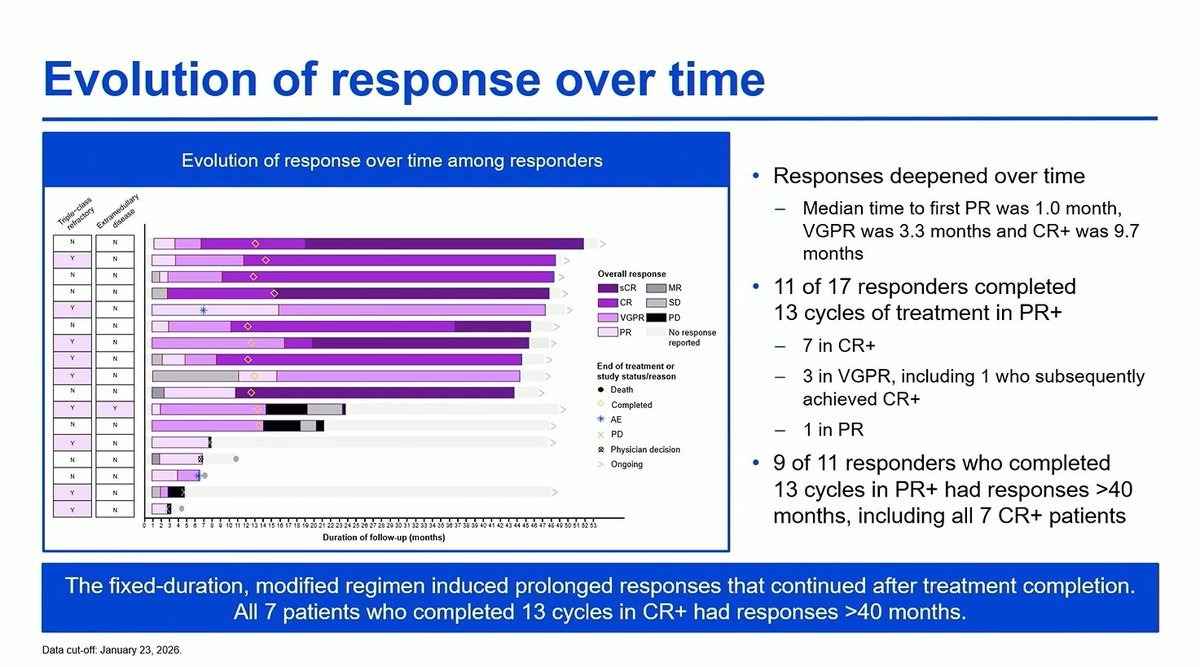
 Sep 24
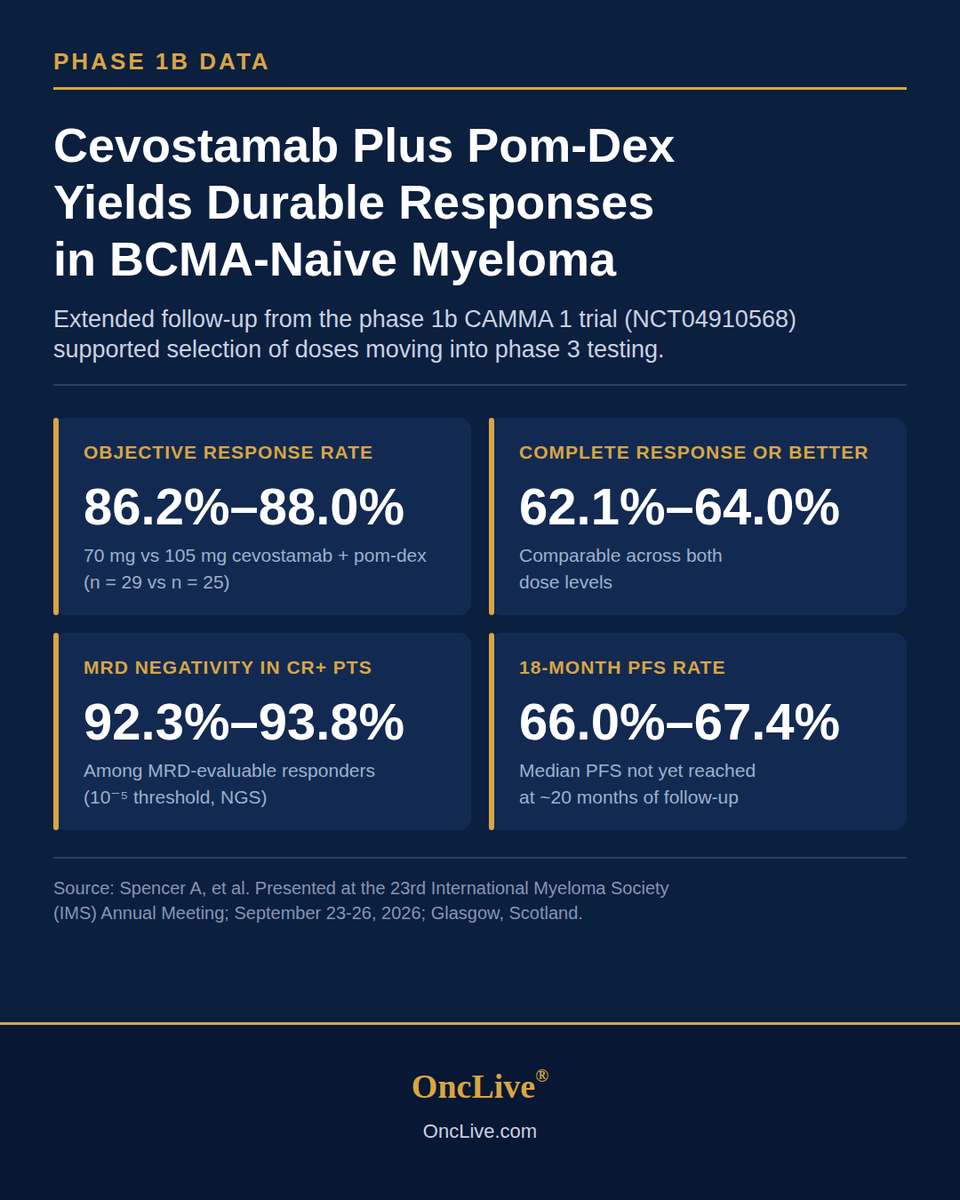
CAMMA 1
🧬 ORR of 86%-88% and >90% MRD negativity among complete responders, with median PFS and DOR not yet reached at ~20 months. New CAMMA 1 Arm B data on cevostamab and pomalidomide/dexamethasone in BCMA-naive R/R #mmsm from #IMS26 👇 @Myeloma_Society https://t.co/Jt4RSvP46D https://t.co/slW58VDeiA
PHASE 1B DATA
Cevostamab Plus Pom-Dex Yields Durable Responses in BCMA-Naive Myeloma
Extended follow-up from the phase 1b CAMMA 1 trial (NCT04910568) supported selection of doses moving into phase 3 testing.
OBJECTIVE RESPONSE RATE: 86.2%-88.0% (70 mg vs 105 mg cevostamab + pom-dex, n=29 vs n=25)
COMPLETE RESPONSE OR BETTER: 62.1%-64.0% (Comparable across both dose levels)
MRD NEGATIVITY IN CR+ PTS: 92.3%-93.8% (Among MRD-evaluable responders, 10^-5 threshold, NGS)
18-MONTH PFS RATE: 66.0%-67.4% (Median PFS not yet reached at ~20 months of follow-up)
Source: Spencer A, et al. Presented at the 23rd International Myeloma Society (IMS) Annual Meeting; September 23-26, 2026; Glasgow, Scotland.
OncLive / OncLive.com
Sep 24
CAMMA 1DREAMM-9MajesTEC-3UKMRA RADAR
Abstract Sessions begin at 11:00 AM. Join us in Hall 5 for Abstract Session 3 or Lomond Auditorium for Abstract Session 4. #IMS26 https://t.co/HPzirIbOLS
23rd Annual MEETING & EXPOSITION - International Myeloma Society
THURSDAY, SEPTEMBER 24, 2026 | 11:00-12:00
Abstract Session 3
Co-chairs: Meral Beksac and Martin Kortum
- Double hit ultra-high risk myeloma treated with Isa-VRD plus cyclophosphamide induction and Isa-VRD consolidation: QoL analysis of the UKMRA RADAR trial in newly diagnosed transplant eligible patients - Karthik Ramasamy
- Updated safety and efficacy of ramantamig (Ram; JNJ-5322) at the recommended phase 2 dose (RP2D), demonstrating feasibility of outpatient dosing (OPD) in relapsed/refractory multiple myeloma (RRMM) - Jeffrey Matous
- DREAMM-9 Patient-Reported Vision-Related Function with Extended Belantamab Mafodotin Dosing Intervals with Bortezomib, Lenalidomide, Dexamethasone (BVRd) in Transplant Ineligible Multiple Myeloma - Hang Quach
- A fixed-duration, modified cevostamab dosing regimen induces durable remissions that continue after completion in BCMA-naive pts with relapsed/refractory multiple myeloma (RRMM): CAMMA 1 Arm A results - Amrita Krishnan
- Overall Survival, Progression and Non-Relapse Mortality With Teclistamab Plus Daratumumab (Tec-Dara) vs Dara-Based Triplets in Relapsed/Refractory Multiple Myeloma (RRMM): MajesTEC-3 Post Hoc Analysis - Luciano Costa
Panelist photos shown: Dr. Beksac, Dr. Kortum, Dr. Matous, Dr. Ramasamy, Dr. Costa, Dr. Krishnan, Dr. Quach
23rd Annual MEETING & EXPOSITION - International Myeloma Society
THURSDAY, SEPTEMBER 24, 2026 | 11:00-12:00
Abstract Session 4
Co-chairs: Lugui Qiu and Niels van de Donk
- Augmenting TRAIL-dependent apoptosis enables BCMA CAR-T cells to overcome resistance in multiple myeloma - Mansour Poorebrahim
- First-in-human phase Ia/Ib study of QLS32015 (GPRC5DxCD3) in patients (pts) with relapsed/refractory multiple myeloma (RRMM): updated safety and efficacy data - Jian Cui
- An AI-Designed BCMA/FcRL5 Targeting TriTE Overcomes Antigen Escape and Outperforms BCMA-Directed Therapy in Multiple Myeloma - Jessica Encinas Mayoral
- A CD4-Dominant, T-Helper-Skewed T Cell State Underlies Movement and Neurocognitive Toxicity After BCMA-Directed CAR-T Therapy in Multiple Myeloma - Theresia Akhlaghi
- Single-cell antigen:TCR mapping reveals tumor-specific effector T-cell responses in multiple myeloma - David Avigan
Panelist photos shown: Dr. Akhlaghi, Dr. Avigan, Dr. Cui, Dr. Encinas Mayoral, Dr. Poorebrahim, Dr. Qiu, Dr. van de Donk
 Sep 23


CAMMA 1
CONGRESS | #IMS26 | PRESENTATION
Andrew Spencer presents extended follow-up data from Arm B of the CAMMA 1 trial evaluating cevostamab + pom-dex in BCMA-naïve patients with RRMM (n = 54; 70 mg, n = 29; 105 mg, n = 25).
ORR was 86.2% with cevostamab 70 mg and 88.0% with 105 mg, with ≥CR rates of 62.1% and 64.0%, respectively. At a median FU of ~20 months, median DOR and PFS were not reached in either cohort; 18-month PFS rates were 67.4% and 66.0%. Grade 3/4 AEs occurred in 82.8% and 96.0%, and Grade 3/4 infections in 17.2% and 40.0%, respectively. Triple step-up dosing was associated with fewer CRS events. The 70 mg cevostamab + pom-dex regimen with triple step-up dosing were identified as RP2Ds.
Follow our live feed for more updates: https://t.co/OZWuHVlO9d
Intended for HCPs. This congress coverage is independently supported through funding from pharmaceutical companies. A full list of our funders can be found on our website. Funders are allowed no influence.
#MultipleMyeloma #myeloma #mmsm #MedEd #MedicalCongress @MonashUni
Response rates by target-dose level
Bar chart, y-axis "Patients (%)" 0-100:
70 mg (N=29): ORR 86.2% (95% CI: 71.9-100). Stacked: PR 10.3%, VGPR 13.8%, CR 17.2%, sCR 44.8%. Brackets: CR+: 62.1%, VGPR+: 75.9%
105 mg (N=25): ORR 88.0% (95% CI: 73.3-100). Stacked: PR 12.0%, VGPR 12.0%, CR 20.0%, sCR 44.0%. Brackets: CR+: 64.0%, VGPR+: 76.0%
Right table:
| 70 mg (N=29) | 105 mg (N=25)
Median time on study, months (range) | 20.2 (12.7-27.5) | 20.4 (3.3-27.3)
Right box: Cevostamab plus pom-dex induced high ORR, VGPR+ and CR+ rates at both target doses. Response rates were comparable between dose groups.
Data cut-off: June 12, 2026. [no slide number visible]
DOR and PFS by target-dose level
Left panel "DOR": Kaplan-Meier curve, y-axis "Survival probability (%)" 0-100, x-axis "Time from start of treatment (months)" 0-28. Two lines: 70 mg (N=29, blue), 105 mg (N=25, orange), with censored marks (+). Legend: Treatment group 70 mg (N=29), 105 mg (N=25), Censored.
"Patients remaining at risk" table:
70 mg: 25, 24, 23, 23, 22, 22, 21, 18, 15, 8, 6, 7, 5, 3, 1, NE (at months 0,2,4,6,8,10,12,14,16,18,20,22,24,26,28... approx)
105 mg: 22, 22, 20, 20, 18, 17, 17, 16, 12, 6, 3, 5, 3, 1, NE
Right panel "PFS": Kaplan-Meier curve, same axes, two lines 70 mg (N=29, blue), 105 mg (N=25, orange), censored marks.
"Patients remaining at risk" table:
70 mg: 29, 28, 25, 24, 23, 22, 21, 21, 18, 16, 10, 6, 4, 3, 1, NE
105 mg: 25, 25, 23, 21, 21, 19, 18, 16, 9, 6, 6, 4, 3, 1, NE
Summary table:
| 70 mg (n=25) | 105 mg (n=22) [DOR columns]
Median DOR, months (95% CI) | NR (NE-NE) | NR (15.0-NE)
18-month DOR, % (95% CI) | 74.0 (55.9-92.0) | 68.2 (48.7-87.6)
| 70 mg (N=29) | 105 mg (N=25) [PFS columns]
Median PFS*, months (95% CI) | NR (15.6-NE) | NR (16.9-NE)
18-month PFS, % (95% CI) | 67.4 (49.8-84.9) | 66.0 (46.7-85.3)
Bottom banner: After a median follow-up of ~20 months, median PFS was not reached in both cohorts. 18-month DOR and PFS rates were generally comparable between dose groups.
Data cut-off: June 12, 2026. *In entire cohort.
Safety summary by target-dose level
Left table:
n (%) unless stated | 70 mg (N=29) | 105 mg (N=25)
Median follow-up, months (range) | 20.2 (12.7-27.5) | 20.4 (3.3-27.3)
Any Gr AE | 29 (100) | 25 (100)
Gr 3-4 AE [highlighted] | 24 (82.8) | 24 (96.0)
Serious AE | 17 (58.6) | 15 (60.0)
Gr 5 AE excluding PD | 1 (3.4)* | 1 (4.0)dagger
AE leading to discontinuation:
Cevostamab | 2 (6.9)Dagger | 2 (8.0)section
Pom | 8 (27.6) | 8 (32.0)
Dex | 0 | 2 (8.0)
Right chart "n (%) with AEs of interest by Grade" - horizontal tornado/butterfly bar chart, 70 mg (left, 100-0%) vs 105 mg (right, 0-100%), graded Gr1-Gr5 (color scale):
Neutropenia[para]: 79.3% (70mg) vs 84.0% (105mg)
Anaemia: 34.5% vs 40.0%
Thrombocytopenia**: 24.1% vs 32.0%
CRS: 72.4% vs 68.0%
Infections[dagger dagger]: 75.9% vs 80.0%
Rash[Dagger Dagger]: 34.5% vs 56.0%
Bullets: With the exception of rash, no substantial skin conditions, hair and nail changes or mucosal toxicities were observed. Low ICANS incidence: Single cases of Gr 1 and Gr 2 only (n=1 each in 105 mg cohort).
Bottom banner: Overall rates of AEs were generally comparable between dose groups, with a lower incidence of Gr 3-4 events and rash in the 70 mg cohort.
Footnote: Data cut-off: June 12, 2026. *Septic shock (treatment related). daggerIntracranial haemorrhage (not treatment related). DaggerClear cell renal cell carcinoma (not treatment related) and weight increased (treatment related) (n=1 each). sectionDiffuse large B-cell lymphoma (treatment related) and infective exacerbation of chronic obstructive airways disease (not treatment related) (n=1 each). paragraphGroup term neutropenia, neutrophil count decreased and febrile neutropenia. **Group term thrombocytopenia and platelet count decreased. dagger daggerMedDRA System Organ Class Infections and Infestations. Dagger DaggerMedDRA high-level terms rashes, eruptions and exanthems NEC, exfoliative conditions, dermatitis ascribed to specific agent, acnes, dermatitis and eczema, and bullous conditions.
CRS by step-up dosing regimen
Left chart "Double step-up dosing (N=28)": Any Gr CRS: 22 (78.6); Gr 2+ CRS: 6 (21.4); Gr 3+ CRS: 1 (3.6)
Bar chart, y-axis "Patients (%)" 0-100, x-axis categories: D1 0.3mg (Pre-phase), D2-4 3.3mg (Pre-phase), D8 70/105mg (Pre-phase), D1 70/105mg (C1+). Grade 1/2/3 stacked bars (approx values: D1 0.3mg ~25% mostly Gr1; D2-4 3.3mg ~53% mixed Gr1/2; D8 70/105mg ~50% mixed Gr1/2; D1 70/105mg (C1+) ~28% mixed Gr1/2/3).
Right chart "Triple step-up dosing (N=26)": Any Gr CRS: 16 (61.5); Gr 2+ CRS: 2 (7.7); Gr 3+ CRS: 0
Bar chart, same axes, categories: D1 0.3mg, D2-4 1.2mg, D8 3.6mg, D9-11 70/105mg (Pre-phase), D1 70/105mg (C1+). (approx values: D1 0.3mg ~20%; D2-4 1.2mg ~42%; D8 3.6mg ~11%; D9-11 70/105mg ~33%; D1 70/105mg (C1+) ~18%).
Legend: Gr 1, Gr 2, Gr 3 (shaded purple scale)
Right table "n (%) with CRS who received tocilizumab or corticosteroids for CRS treatment":
| Double step-up dosing (N=28) | Triple step-up dosing (N=26)
Tocilizumab | 10 (35.7) | 2 (7.7)
Corticosteroids | 12 (42.9) | 1 (3.8)
Tocilizumab and corticosteroids | 6 (21.4) | 1 (3.8)
Bottom banner: CRS was less common, with <10% Gr 2+ events and no Gr 3 events, in the triple step-up cohort compared with the double step-up cohort. Tocilizumab use was <10% in the triple step-up cohort.
Data cut-off: June 12, 2026.
Sep 25
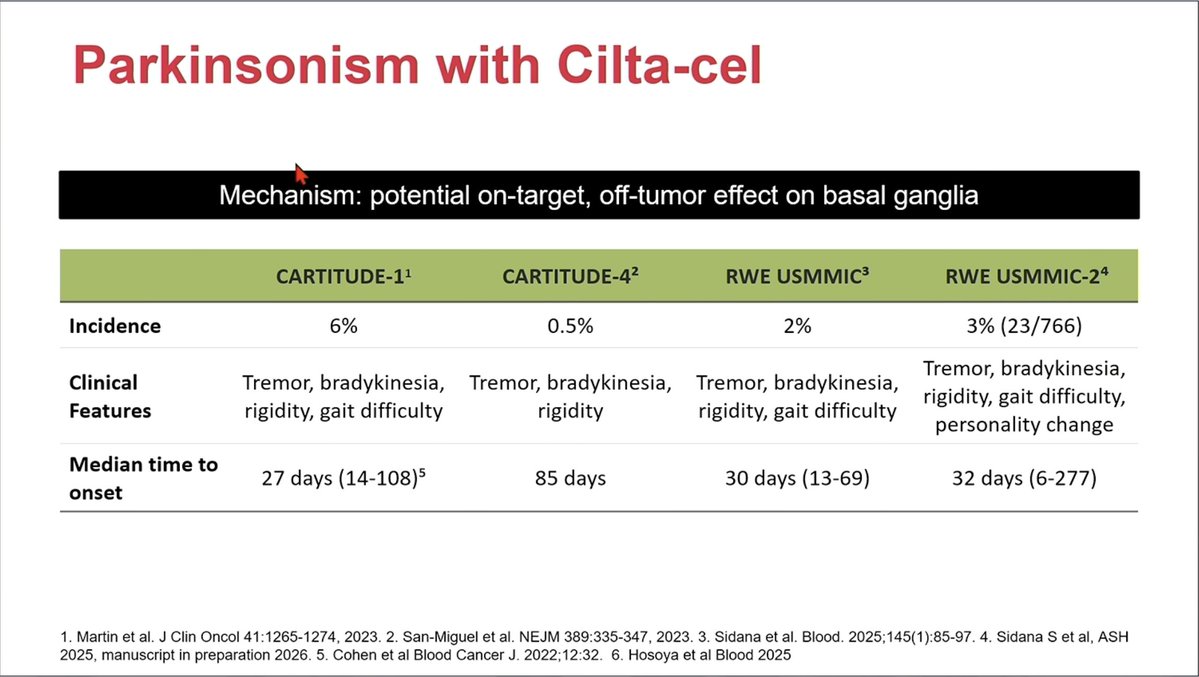
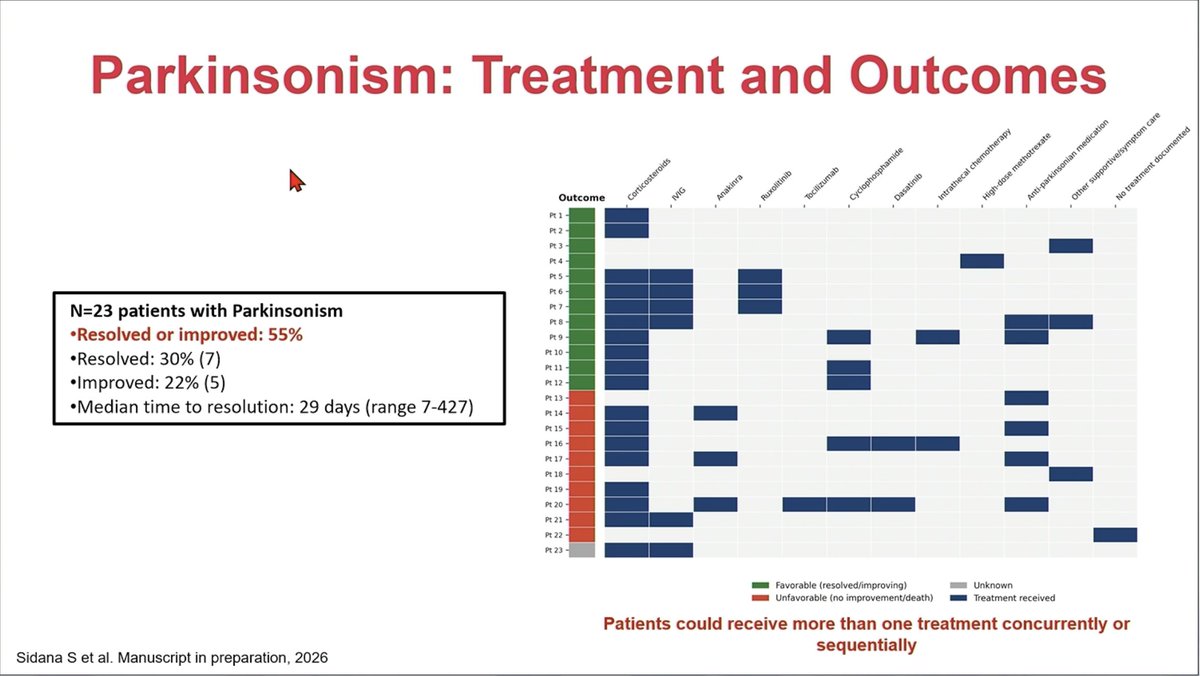
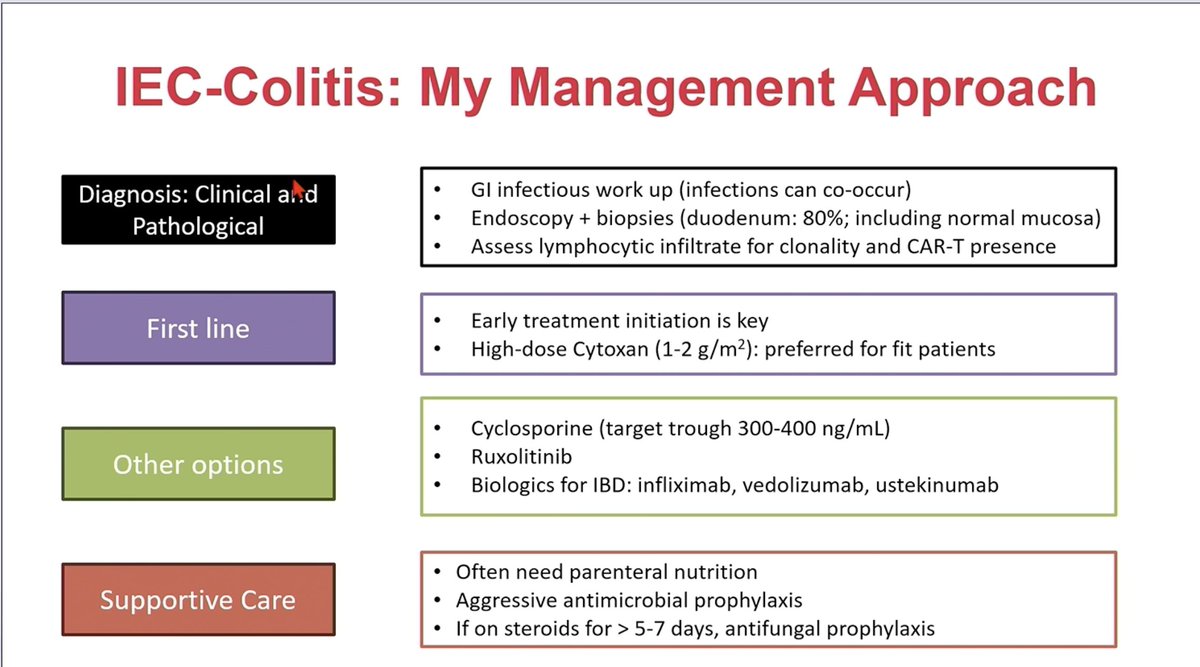
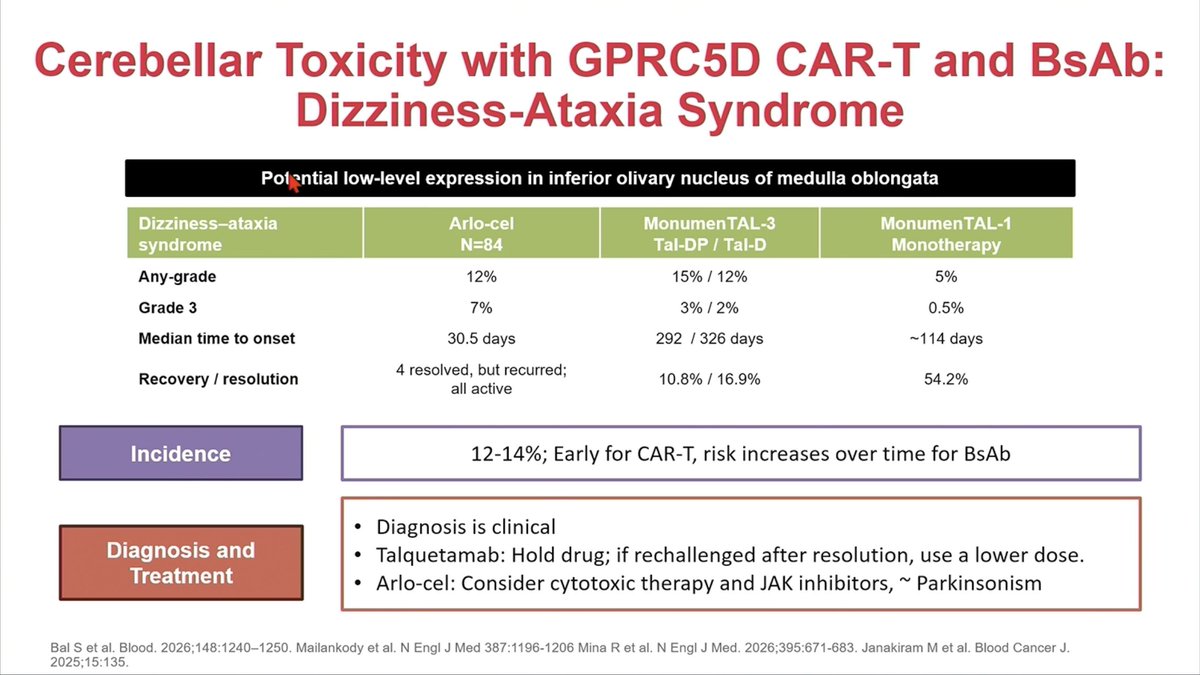
CARTITUDE-4MonumenTAL-3
#IMS26 #mmsm @SurbhiSidanaMD
Management of rare AE associated with CAR-T in myeloma https://t.co/VAiw0VwE2Q
[Slide 1 - Parkinsonism with Cilta-cel, mechanism: potential on-target, off-tumor effect on basal ganglia]
Cross-trial table (CARTITUDE-1 / CARTITUDE-4 / RWE USMMIC / RWE USMMIC-2):
Incidence: 6% / 0.5% / 2% / 3% (23/766). Clinical features: tremor/bradykinesia/rigidity/gait difficulty (CARTITUDE-1, USMMIC, USMMIC-2), tremor/bradykinesia/rigidity (CARTITUDE-4), USMMIC-2 adds personality change. Median time to onset: 27 days (14-108) / 85 days / 30 days (13-69) / 32 days (6-277).
Sources: Martin et al. J Clin Oncol 41:1265-1274, 2023. San-Miguel et al. NEJM 389:335-347, 2023. Sidana et al. Blood. 2025;145(1):85-97. Sidana S et al, ASH 2025, manuscript in preparation 2026. Cohen et al Blood Cancer J. 2022;12:32. Hosoya et al Blood 2025.
[Slide 2 - Parkinsonism: Treatment and Outcomes]
N=23 patients with Parkinsonism. Resolved or improved: 55%. Resolved: 30% (7). Improved: 22% (5). Median time to resolution: 29 days (range 7-427).
Patient-level treatment/outcome grid (23 patients) showing treatments received (corticosteroids, IVIG, anakinra, ruxolitinib, tocilizumab, cyclophosphamide, dasatinib, intrathecal chemotherapy, high-dose methotrexate, anti-parkinsonian medication, other supportive/symptom care, no treatment documented) mapped against Favorable/Unfavorable/Unknown outcome.
Source: Sidana S et al. Manuscript in preparation, 2026.
[Slide 3 - IEC-Colitis: My Management Approach]
Diagnosis: Clinical and Pathological - GI infectious work up (infections can co-occur); Endoscopy + biopsies (duodenum: 80%; including normal mucosa); Assess lymphocytic infiltrate for clonality and CAR-T presence.
First line: Early treatment initiation is key; High-dose Cytoxan (1-2 g/m2): preferred for fit patients.
Other options: Cyclosporine (target trough 300-400 ng/mL); Ruxolitinib; Biologics for IBD: infliximab, vedolizumab, ustekinumab.
Supportive Care: Often need parenteral nutrition; Aggressive antimicrobial prophylaxis; If on steroids for >5-7 days, antifungal prophylaxis.
[Slide 4 - Cerebellar Toxicity with GPRC5D CAR-T and BsAb: Dizziness-Ataxia Syndrome]
Potential low-level expression in inferior olivary nucleus of medulla oblongata.
Cross-trial table (Arlo-cel N=84 / MonumenTAL-3 Tal-DP/Tal-D / MonumenTAL-1 Monotherapy): Any-grade 12% / 15%/12% / 5%. Grade 3: 7% / 3%/2% / 0.5%. Median time to onset: 30.5 days / 292/326 days / ~114 days. Recovery/resolution: "4 resolved, but recurred; all active" / 10.8%/16.9% / 54.2%.
Incidence: 12-14%; Early for CAR-T, risk increases over time for BsAb.
Diagnosis and Treatment: Diagnosis is clinical; Talquetamab: Hold drug, if rechallenged after resolution use a lower dose; Arlo-cel: Consider cytotoxic therapy and JAK inhibitors, ~Parkinsonism.
Sources: Bal S et al. Blood. 2026;148:1240-1250. Mailankody et al. N Engl J Med 387:1196-1206. Mina R et al. N Engl J Med. 2026;395:671-683. Janakiram M et al. Blood Cancer J. 2025;15:135.
Sep 25
CARTITUDE-4ImmunoPRISMMajesTEC-3MajesTEC-9MonumenTAL-3RedirecTT-1
#IMS26 #mmsm
Infections with BsAn and CAR-T therapies https://t.co/nGIR6yJM9B
[Slide 1 - Incidence and severity of infections across different approved BsAbs and CAR T trials, cross-trial compilation table]
BsAbs late-line relapse (triple-class exposed) - trial/drug/All grade/Grade 3-4/Grade 5:
MajesTEC-1/Teclistamab: 78.8% / 55.2% / 12.7%. MagnetisMM-3/Elranatamab: 69.9% / 39.8% / 6.5%. LinkerMM-1/Linvoseltamab: 75% / 48% / NR. MonumenTAL-1/Talquetamab: 66.2% / 14.5% / 1.4%. RedirecTT-1/Tec-Tal: 89% / 64% / 12%.
BsAbs early-line relapse (1-3 prior lines): MajesTEC-9/Teclistamab: 82.8% / 41.6% / 5.5%. MajesTEC-3/Tec-Dara: 96.5% / 41.6% / 5.5%. MonumenTAL-3/Tal-Dara: 83.0% / 29.2% / 1.5%. MonumenTAL-3/Tal-Dara-Pom: 84.3% / 37.7% / 0.7%.
CAR T late-line relapse: CARTITUDE-1/Cilta-Cel: All grade 58%, Gr3-4 20%, Gr5 NR. KarMMa/Ide-Cel: 69%, 22%, NR (#, deaths from AEs not otherwise specified 7% total). CAR T early-line relapse: CARTITUDE-4/Cilta-Cel: 59%, 24%, 4%. KarMMa-3/Ide-Cel: 56%, 22%, NR (*, death from AEs 6% total).
"Infections remain a major safety concern with T-cell-redirecting therapies, particularly with continuous bispecific antibody treatment." Table provided for ease of viewing, no comparisons intended.
Sources: Moreau P et al NEJM 2022; Lesokhin AM et al Nat Med 2023;29(9):2259-2267; Lee HC et al Clin Lymphoma Myeloma Leuk 2026 Feb, 26(2):e201-e212,e8; Chari A et al NEJM 2022; Cohen Y et al Engl J Med 2025;392:138-49; Touzeau C et al N Engl J Med 2026;395:440-53; Costa LJ et al N Eng J Med 2026;394:739-52; Mina R et al N Engl J Med 2026;395:671-83; Einsele H et al, Lancet Oncol 2026;27:254-68; Ailawadhi S et al, Blood 2024 (144)23; Berdeja J et al, Lancet 2021;398:314-24; Munshi NC et al, N Engl J Med 2021 Feb 25;384(8):705-716.
[Slide 2 - Pillars of infection prevention in patients receiving T-cell redirecting therapies]
Table: Immune defect/risk -> Type of infection -> Preventive strategy.
Lymphopenia/Neutropenia -> Bacterial infections/PJP, approx first 3-6 months -> Antiviral + PJP prophylaxis, G-CSF support.
Immunosuppressive therapy (steroids, IL-6 blockage, cyclophosphamide) -> Bacterial infections/Sepsis/fungal infections/CMV -> Consider antibacterial/antifungal.
B-cell aplasia/Hypogammaglobulinemia -> Bacterial/Viral (Respiratory virus, VZV/HSV)/CMV -> Immunoglobulin replacement, Vaccination.
T-cell dysfunction -> Other opportunistic infections, Viral infections, fungal (in selected high risk patients) -> Fixed treatment duration/Schedule optimization.
Sources: Rodriguez-Otero P et al, Lancet Oncology May 2024; O'Neill C, et al. eJHaem. 2023;4:811-822; Friedrich MJ, et al. Cancer Cell. 2023;41:711-725.e6; Frerichs KA et al, Blood Advances 2024; Mohan M et al, Blood Cancer Journal (2025) 15:74; Tix T et al, Molecular Therapy (2025)33:7; Richardson T et al, Blood Advances (2025) 9:6; Nath K et al, Blood Cancer Journal (2024) 14:88; Reynolds G et al, Blood advances (2023) 7:19; Banerjee R et al, Blood Advances (2025) 9:18; Dr Rodriguez Otero personal opinion.
Sep 23
CARTITUDE-4CERVINODREAMM-7DREAMM-8MajesTEC-3MajesTEC-9MonumenTAL-3MonumenTAL-6
Never a good time to be a myeloma patient but this is the best it has ever been!
Remarkable results in early relapse setting!
@mvmateos #IMS26 https://t.co/rNUviKkXc5
Phase 3 evidence has moved inmune therapy into early relapse
[Table: STUDY | COMPARISON | forest plot (FAVOURS EXPERIMENTAL / FAVOURS CONTROL) | PFS HR | OS HR]
CARTITUDE-4 | Cilta-cel vs DPd/PVd | PFS HR 0.29 | OS HR 0.55
DREAMM-7 | BVd vs DVd | PFS HR 0.41 | OS HR 0.58
DREAMM-8 | BPd vs PVd | PFS HR 0.52 | OS HR 0.77
MajesTEC-3 | Tec-Dara vs DPd/DVd | PFS HR 0.17 | OS HR 0.46
MonumenTAL-3 | Tal-DP vs DPd | PFS HR 0.28 | OS HR 0.47
(MonumenTAL-3) | Tal-D vs DPd | PFS HR 0.33 | OS HR 0.51
MajesTEC-9 | Teclistamab vs PVd/Kd | PFS HR 0.29 | OS HR 0.60
MonumenTAL-6 | Tal-Tec vs EPd/PVd | PFS HR 0.11 | OS HR NR
(MonumenTAL-6) | Tal-Pom vs EPd/PVd | PFS HR 0.27 | OS HR NR
CERVINO | Etentamig vs investigator's choice | PFS HR 0.40 | OS HR NR
RANDOMIZED PHASE 3 TRIALS WITHOUT PUBLIC NUMERICAL HRs
MagnetisMM-5 | Elranatamab +/- Dara vs DPd | Positive top-line result; no numerical data reported
[Forest plot x-axis tick labels largely illegible]
Sep 23


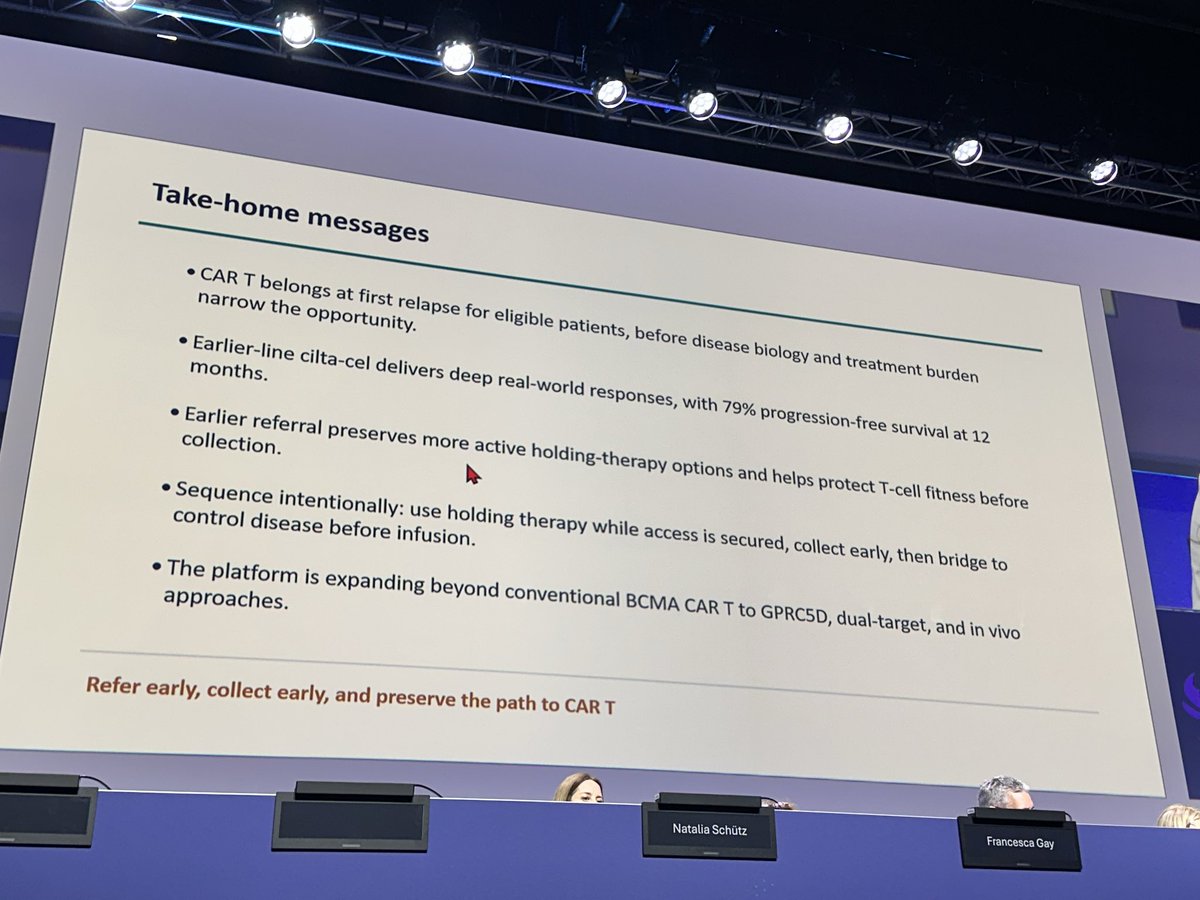
CARTITUDE-4IMMAGINE-1
#IMS2026 how to approach at first relapse by @DrKrinaPatel https://t.co/2v1m6XsspR
FIRST RELAPSE
Why CAR T belongs earlier
Maximize early kill, then return time to the patient
48% MRD-negative by day 56
62% vs 18% overall MRD negativity at 10⁻⁵
Deepest early cytoreduction
ENGINEERED IMMUNE RESET
Lymphodepletion reduces suppressive immune cells; one infusion delivers a large, activated population that expands in vivo.
A fundamentally different biologic attack than continuous antibody exposure
+11.6 point QoL advantage at month 12
Global health status: +10.1 with cilta-cel vs −1.5 with SOC
Treatment-free runway, less ongoing supportive care, and a PFS2/OS advantage
SURVIVORSHIP IS PART OF THE STRATEGY
Track immune reconstitution, IVIG and infection needs, revaccination, late effects and return to life.
CARTITUDE-4; Mina et al, Lancet Haematol 2025; Popat et al, Blood 2024; updated OS analysis, Lancet 2026
Emerging CAR T platforms show deep early responses
Latest publicly reported datasets; populations and follow-up differ
Dataset | Anito-cel iMMagine-1 | Arlo-cel early-line phase 1 | AZD0120 DURGA-1 | KLN-1010 inMMyCAR
Platform / target | Ex vivo BCMA | Ex vivo GPRC5D | Ex vivo BCMA + CD19 | In vivo BCMA
Patients | 117 evaluable | 24 evaluable, 31 treated | 23 evaluable | 18 dosed
Prior lines | Median 5 | Median 2, 1-3 allowed | Median 4 | Not reported
Follow-up | Median 12.6 mo | Median 18.3 mo | Median 3.9 mo | 6 pts ≥4 mo, first pt >10 mo
ORR | 97% | 96% | 96% | 100% all evaluable
CR / sCR | 68% | 67% | 78.3% | 4 sCR / 6 pts with ≥4 mo
MRD negative at 10⁻⁵ | 93% (70/75 evaluable) | 56.3% MRD-negative CR | 94% (16/17 evaluable) | 100% all evaluable
12-month PFS | 79% | 74% | Not reported | Not reported
Deep responses now extend from ex vivo platforms to first-in-human in vivo CAR T
Patel K, ASH 2025 #256. Bal S, Haematologica 2026. Richard S, Blood 2025 #269. Ho J, ASCO 2026.
Cross-trial comparisons are descriptive. MRD denominators and follow-up maturity differ.
Take-home messages
• CAR T belongs at first relapse for eligible patients, before disease biology and treatment burden narrow the opportunity.
• Earlier-line cilta-cel delivers deep real-world responses, with 79% progression-free survival at 12 months.
• Earlier referral preserves more active holding-therapy options and helps protect T-cell fitness before collection.
• Sequence intentionally: use holding therapy while access is secured, collect early, then bridge to control disease before infusion.
• The platform is expanding beyond conventional BCMA CAR T to GPRC5D, dual-target, and in vivo approaches.
Refer early, collect early, and preserve the path to CAR T
Sep 23


CARTITUDE-4
How to treat myeloma at 1st relapse (#IMS26):
💡move BCMA CAR-T early
💡CARTITUDE-4: cilta-cel PFS 37.1 vs 10mo with SOC in high risk
💡German RWE: better PFS/CR, less neurotox at 1–3 vs >3 lines.
💡Earlier = more immune-fit marrow. 💡Goal: MRD-neg, off therapy → cure. #mmsm @Myeloma_Society
International Myeloma Society
CARTITUDE-4 subgroup analysis: High risk vs Standard risk
[PFS Kaplan-Meier plot] Patients progression free and alive, % vs Progression-free survival, months (0-45). Curves: High risk, Cilta-cel; Standard risk, Cilta-cel; High risk, SOC; Standard risk, SOC. Patients at risk rows shown [small print, not fully legible].
[OS Kaplan-Meier plot] Patients alive, % vs Overall survival, months (0-45). Curves: High risk, Cilta-cel; Standard risk, Cilta-cel; High risk, SOC; Standard risk, SOC. Patients at risk rows shown [small print, not fully legible].
PFS table:
Cilta-cel SOC
High risk, months (95% CI) 37.1 (26.7-NE) 10.3 (7.6-12.6)
Standard risk, months (95% CI) NR (NE-NE) 20.6 (11.2-33.6)
OS table:
Cilta-cel SOC
High risk, months (95% CI) NR (NE-NE) 38.0 (34.0-NE)
Standard risk, months (95% CI) NR (NE-NE) NR (34.7-NE)
The median follow-up was 33.6 months (range, 0.1-45.0).
NR, not reached; SOC, standard of care.
Sidana S, et al. ASCO 2025
International Myeloma Society
RWE: Cilta-cel outcomes in earlier versus later lines
German nationwide registry of standard-of-care cilta-cel, 2022-2025
OUTCOME EARLIER LINE (1-3 prior lines, n = 177) LATER LINE (>3 prior lines, n = 429)
12-month PFS 79% (95% CI, 71-87%) 70% (95% CI, 65-76%)
Overall response rate 91% 88%
Complete response 63% 54%
Non-ICANS neurotoxicity 3% 8%
Maintained CR was associated with 100% PFS at 12 months in both cohorts
Gagelmann N, et al. J Hematol Oncol. 2026;19:46. doi:10.1186/s13045-026-01806-6
Nonrandomized registry analysis. The investigators did not perform formal comparisons between cohorts.
International Myeloma Society
CARTITUDE-4 TME: Patients With 1 or 2 pLOT vs 3 pLOT had a More Immunocompetent TME at Baseline
- Patients with 1 or 2 vs 3 pLOT had a more immunocompetent TME at baseline, as suggested by higher levels of costimulatory molecules, CD4+ T-cell antigen-presenting machinery (MHCII), and TCRA pathway
- Higher levels of these gene signatures in TME at baseline trended with longer PFS (data not shown)
Earlier use of cilta-cel may support longer PFS by leveraging a more immunocompetent TME at baseline
Baseline TME gene set enrichment scores grouped by pLOT
[Box plots: Coactivation molecules (P<0.05, P<0.05, ns), Costimulatory receptors (P.adj<0.05, P<0.05, ns), MHCII pathway (P<0.05, ns, ns), TCRA pathway (P<0.05, P<0.05, ns); Enrichment score -1.0 to 0.8; groups 1 pLOT (n=49), 2 pLOT (n=57), 3 pLOT (n=36)]
Cilta-cel, ciltacabtagene autoleucel; MHC, major histocompatibility complex; pLOT, prior line of therapy; TCRA, T-cell receptor activation; TME, tumor microenvironment.
Presented by S Parekh at the 67th American Society of Hematology (ASH) Annual Meeting; December 6-9, 2025; Orlando, FL, USA
IBEX
6 slides
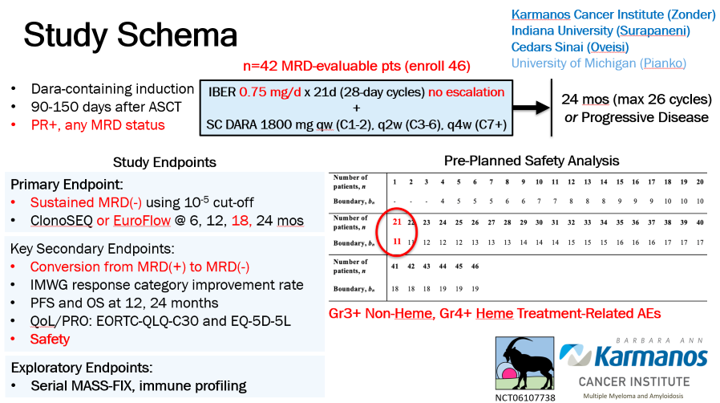

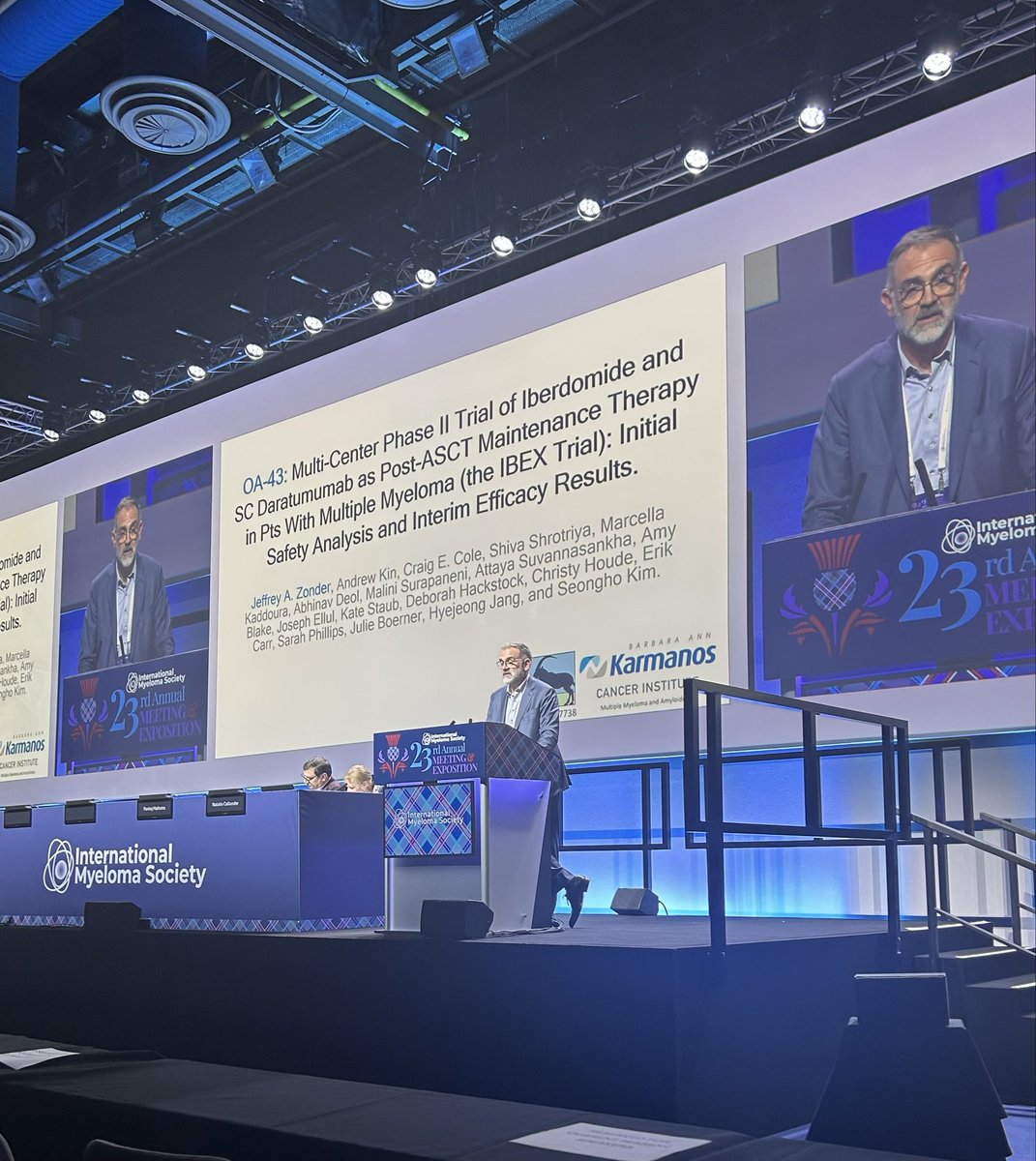 Sep 24


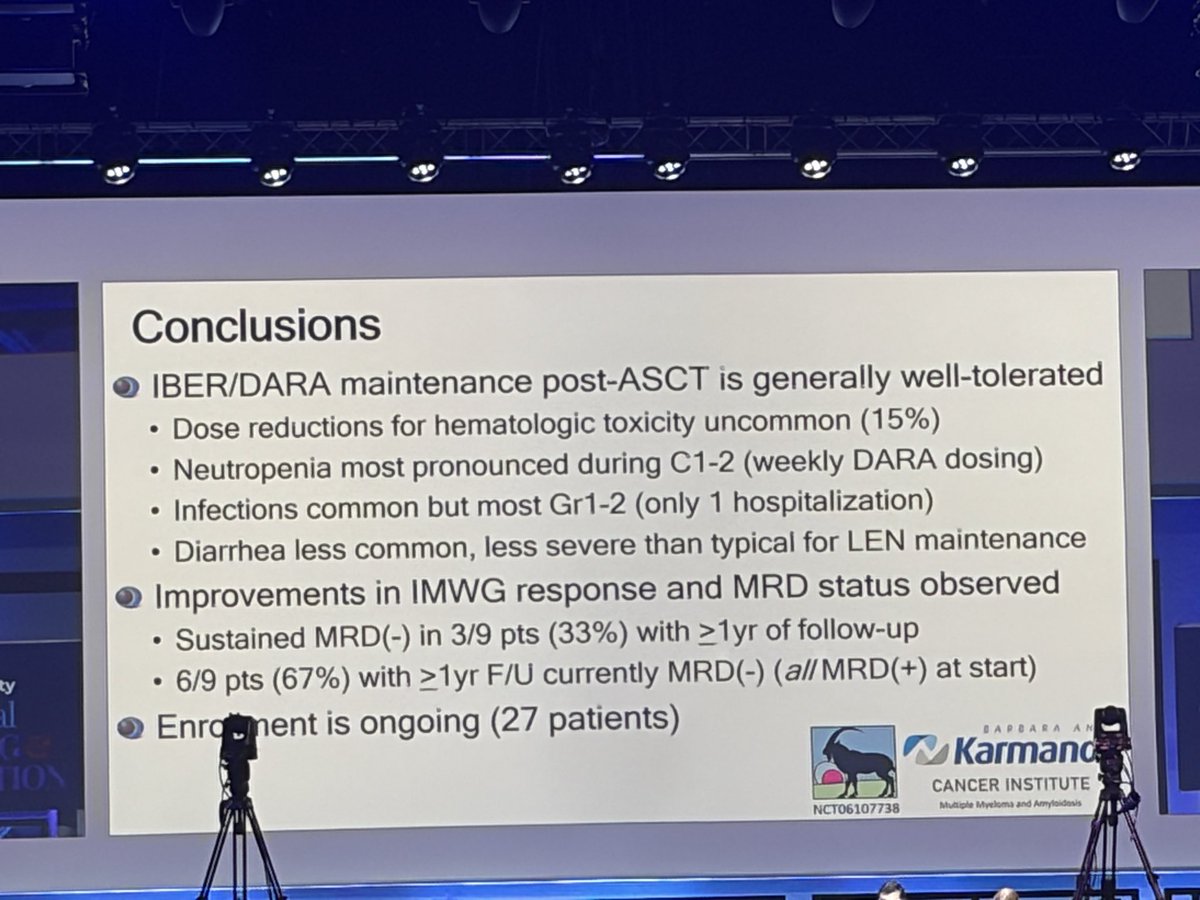
IBEX
IBEX (Iberdomide + Daratumumab post-ASCT maintenance) @Amyloid_Planet
🔬 #IMS26: IBEX: Iberdomide + daratumumab post-ASCT maintenance feasible
💡manageable neutropenia and MRD conversion in 6/9 evaluable pts at 12mo.
💡Early data (n=21), dose was amended mid-study https://t.co/rHudMgzNDl
[Slide 1 - IBEX study schema, NCT06107738, Karmanos Cancer Institute + Indiana University + Cedars Sinai + University of Michigan]
n=42 MRD-evaluable patients (enrolled 46). Dara-containing induction, 90-150 days after ASCT, PR+ any MRD status. Iberdomide 0.75mg/d x21d (28-day cycles, no escalation) + SC Dara 1800mg QW(C1-2), Q2W(C3-6), Q4W(C7+), for 24 months (max 26 cycles) or progressive disease.
Primary endpoint: sustained MRD(-) using 10^-5 cutoff, ClonoSEQ or EuroFlow @ 6,12,18,24 months. Key secondary: conversion MRD(+) to MRD(-), IMWG response category improvement rate, PFS/OS at 12/24 months, QoL/PRO (EORTC-QLQ-C30, EQ-5D-5L), safety. Exploratory: serial MRD-FIX, immune profiling.
[Slide 2 - Safety: Kinetics of Neutropenia]
Per-patient grid tracking neutropenia grade (1/2/3) by cycle (baseline-C6) at both 0.75mg and 1.0mg dose levels, with IBER dose reduction markers (n=3, 14%), dose increase (n=1, 5%), and G-CSF added (n=2, 10%). 2 additional patients had IBER dose reductions after cycle 6.
[Slide 3 - Efficacy]
Baseline to on-study response shift (Unknown/CR/VGPR/PR/PD categories) showing improvement, with 5/21 improved IMWG response category.
Serial MRD measurements (n=13) tracked by patient (KCI-02 through KCI-17) at Baseline/6mo/12mo/18mo/24mo, color-coded by MRD depth (<10^-4 red, >=10^-4-<10^-3 orange, >=10^-3-<10^-6 light green, >=10^-6 dark green). 8/11 baseline MRD(+) patients became MRD(-) (>=10^-6 threshold implied); 3/9 patients achieved sustained MRD(-) status (marked with asterisk: KCI-02, KCI-06, KCI-09).
[Slide 4 - Conclusions]
IBER/DARA maintenance post-ASCT is generally well-tolerated: dose reductions for hematologic toxicity uncommon (15%); neutropenia most pronounced during C1-2 (weekly DARA dosing); infections common but most Gr1-2 (only 1 hospitalization); diarrhea less common, less severe than typical for LEN maintenance.
Improvements in IMWG response and MRD status observed: sustained MRD(-) in 3/9 pts (33%) with >=1yr follow-up; 6/9 pts (67%) with >=1yr F/U currently MRD(-) (all MRD(+) at start).
Enrollment is ongoing (27 patients). NCT06107738.
Sep 21
CEPHEUSCERVINOEXCALIBER-RRMMGEM2014MAINIBEXMIDAS
Have fun in Glasgow! 🇬🇧🏴
Don’t get lost at #IMS2026—too much great science, too many simultaneous sessions!
Follow the roadmap. Don’t miss the practice-changing data.
And don’t forget your single malt…after the final session! 🥃😆
#MultipleMyeloma #mmsm #Medtwitter https://t.co/eCVPDMHoDu
DON'T GET LOST AT IMS 2026
GLASGOW - SEPTEMBER 23-26
THE MUST-SEE ROADMAP
PEOPLE SCIENCE PROGRESS TOGETHER | BIGGER SCIENCE A BRIGHTER TOMORROW | GLASGOW WELCOMES A BRIGHTER TOMORROW
THURSDAY - SEPT 24 5:00-6:00 PM - HALL 5
MRD & MAINTENANCE (MRD: DEEPER ANSWERS BRIGHTER TOMORROWS)
- MIDAS: Isa-iberdomide
- CASSIOPEIA: 5-year sustained MRD
- GEM2014MAIN: MRD-guided stopping
- IBEX: Iber-Dara post-ASCT
FRIDAY - SEPT 25 3:00-5:00 PM - HALL 5 DO NOT MISS
THE PLENARY - DO NOT MISS (BOLD SCIENCE CHANGES LIVES)
- CERVINO: Etentamig vs standard therapy
- PERSEUS: Does long-term PFS become OS?
- EXCALIBER-RRMM: IberDd vs DVd
- First-in-human CD19/BCMA in-vivo CAR-T
SAME QUESTIONS. A BRIGHTER TOMORROW.
SATURDAY - SEPT 26
8:30-9:30 AM - HALL 5
THE NEXT CELLULAR-THERAPY ERA (CELLULAR THERAPIES: REAL POTENTIAL FOR REAL PEOPLE)
- Updated CEPHEUS MRD
- BCMAxGPRC5D dual-target CAR-T
- IASO206: IV in-vivo BCMA CAR-T
11:00 AM-12:00 PM - HALL 5
- Post-CAR-T elranatamab
- Delayed cilta-cel neurotoxicity
- MRD-guided T-cell redirection
11:00 AM-12:00 PM - LOMOND
- CAR-T enterocolitis biology
1:00-2:00 PM - LOMOND
- LV169: lentiviral in-vivo BCMA CAR delivery
Same goal. Brighter lives.
WHAT TO WATCH (DIFFERENT PERSPECTIVES A CLEARER FUTURE)
- Durability - OS - sustained MRD - infection burden
- Access - treatment-free time - late toxicity
- In-vivo CAR-T: insertion sites, off-target transduction, vector shedding & persistence
Go for the randomized data and the biology--not every new response rate.
Single malt only AFTER the final session.
SAME CURIOSITY FURTHER TOGETHER | GREAT SCIENCE DESERVES A DRAM
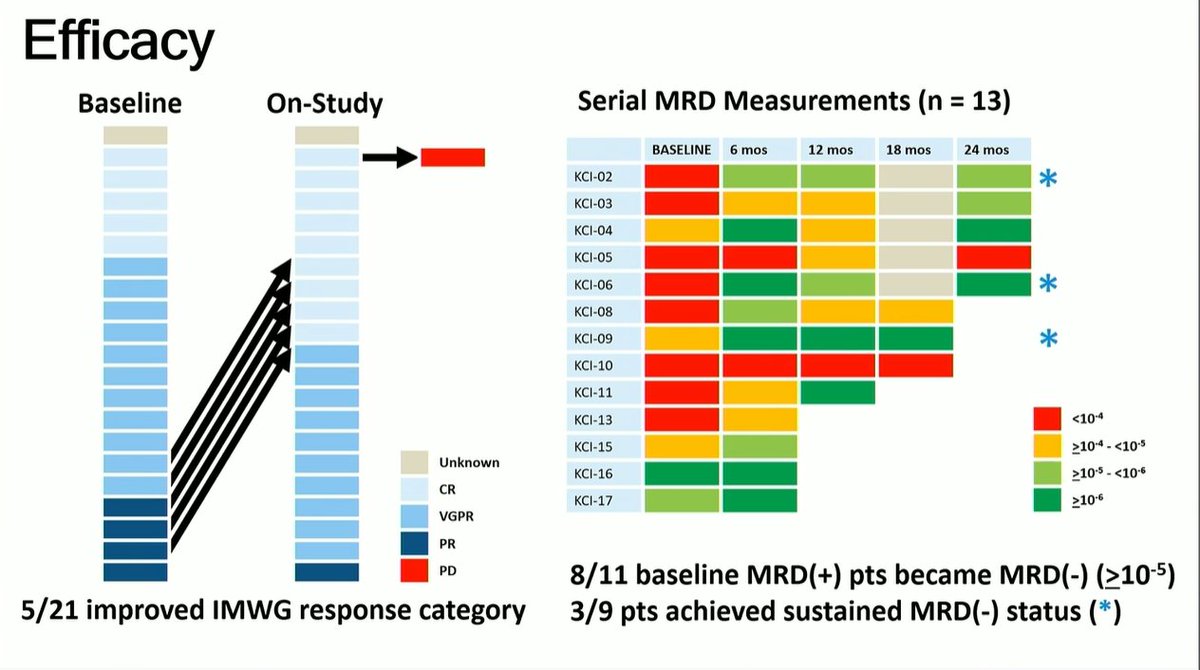
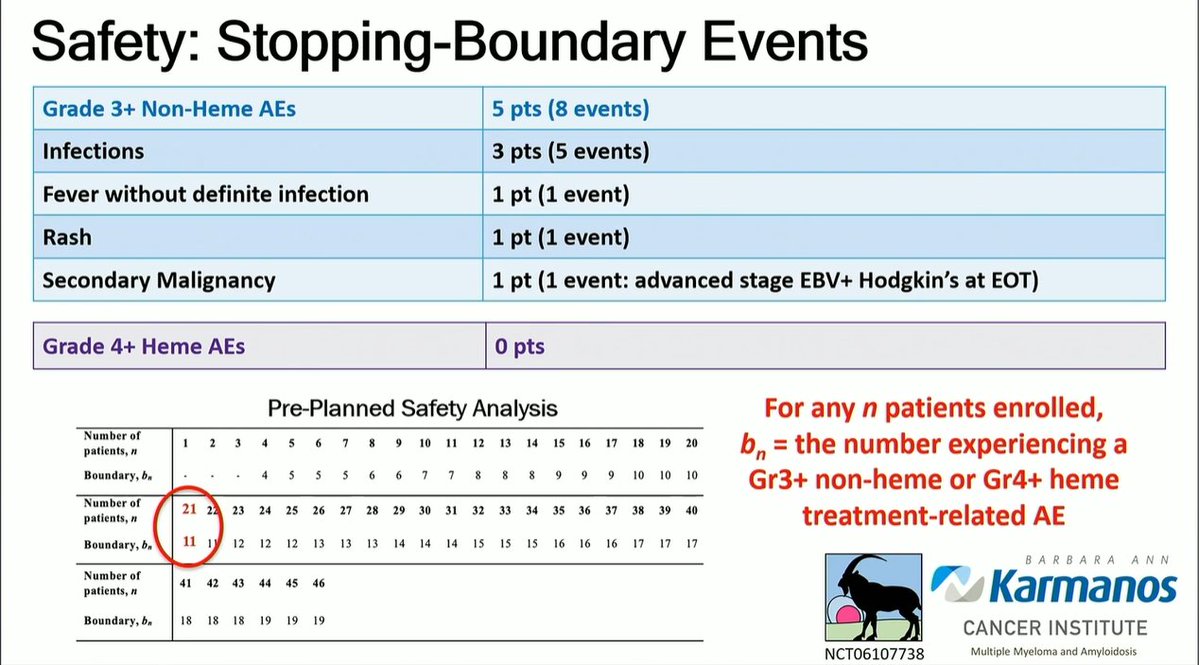
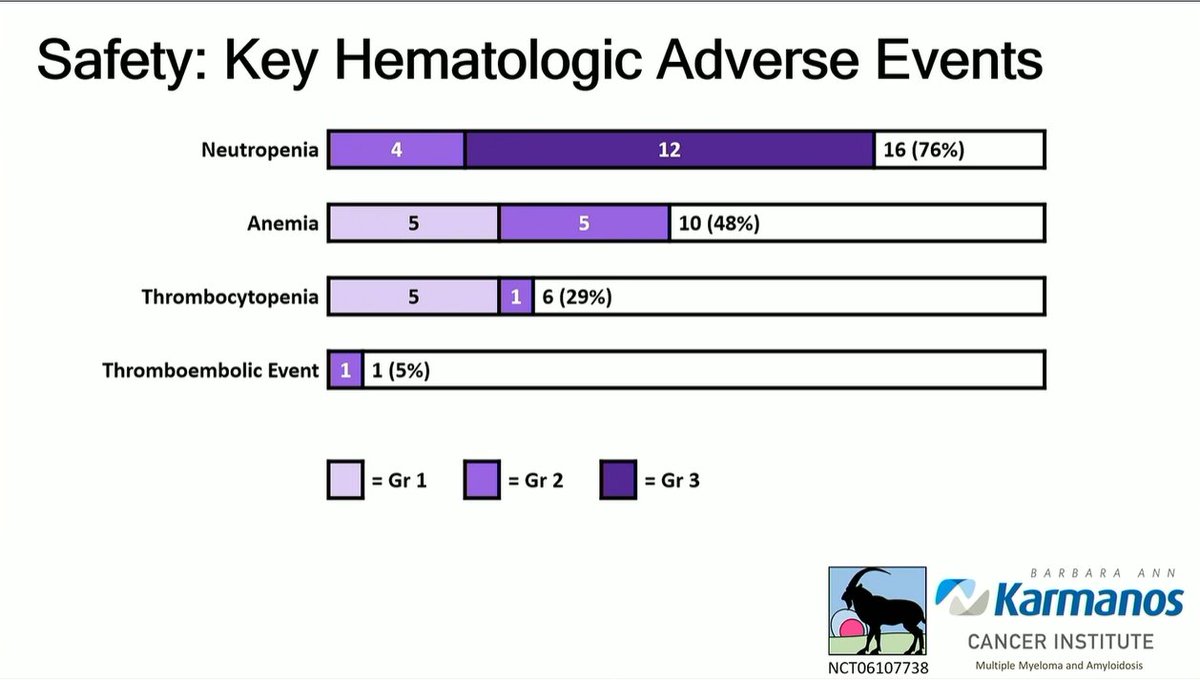
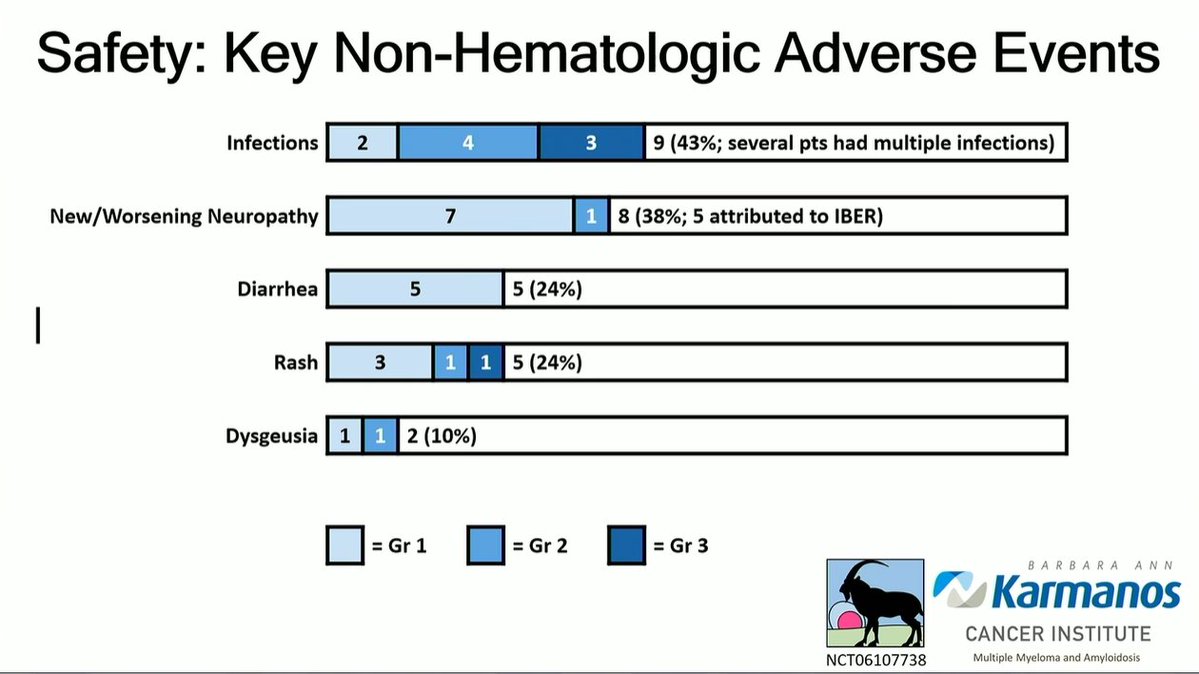

MELT-MM
5 slides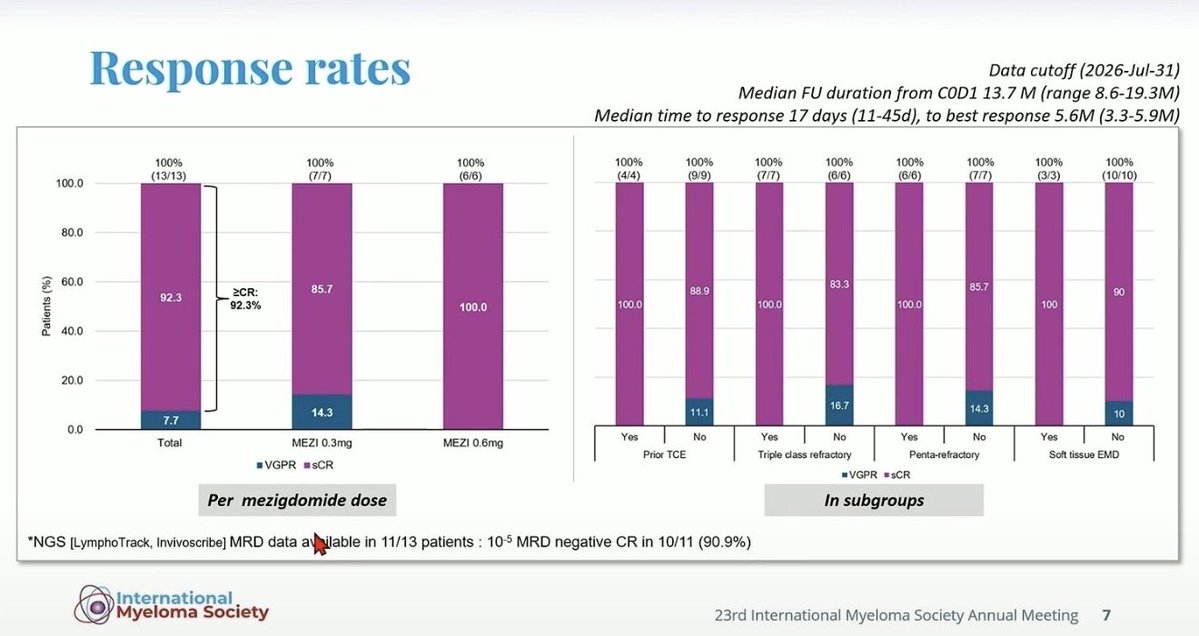 Sep 23
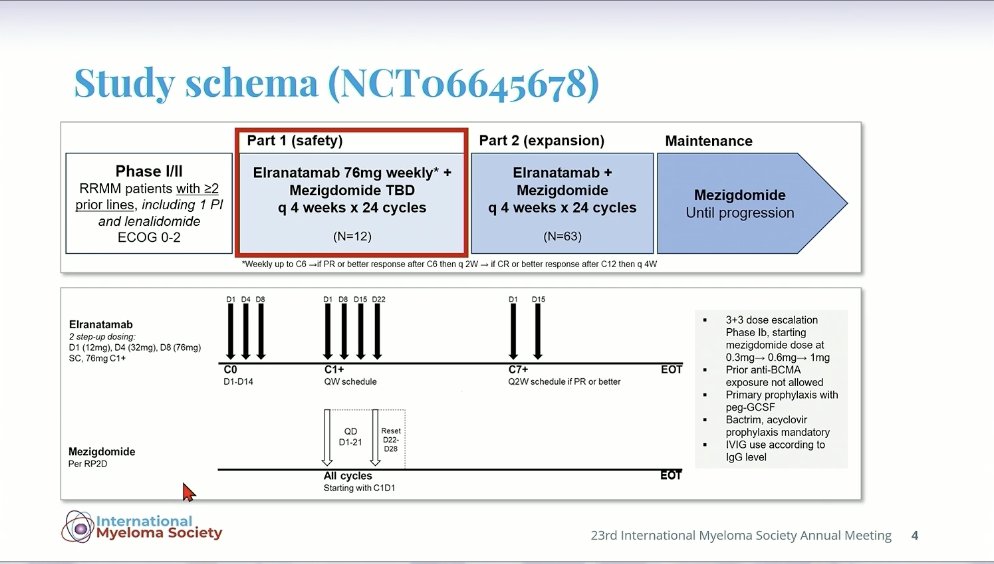
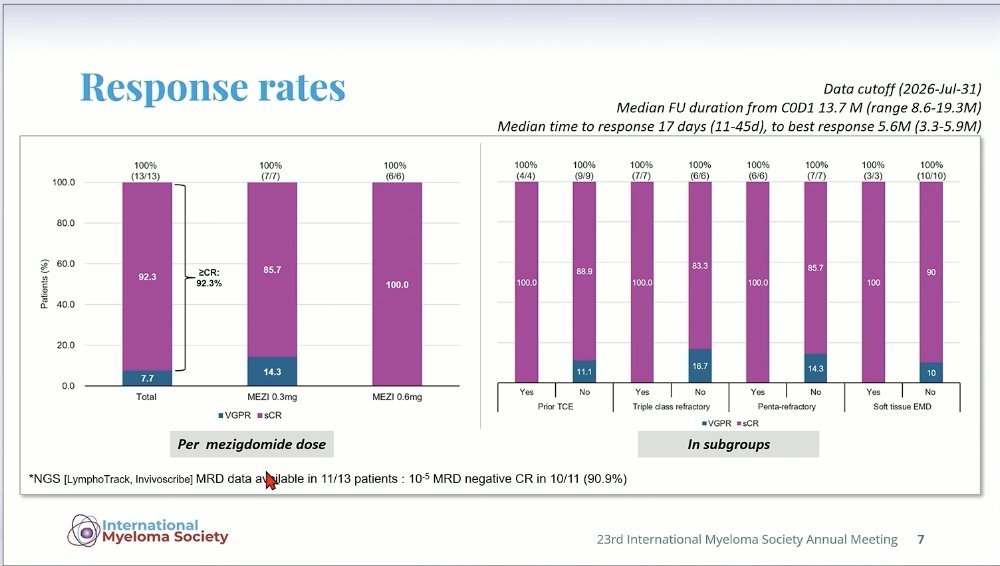


MELT-MM
#IMS26 #mmsm Oral- Elra+Mezi data -part 1 safety data
➡️Small n of pts
➡️very limited data on safety presented
~ 25% with G3/4 transaminitis
4/13 pts with G3 or higher infection
Early efficacy looks good https://t.co/vCRYFW2A6s
Study schema (NCT06645678)
Phase I/II RRMM patients with >=2 prior lines, including 1 PI and lenalidomide, ECOG 0-2
Part 1 (safety, boxed): Elranatamab 76mg weekly* + Mezigdomide TBD, q4 weeks x24 cycles (N=12)
Part 2 (expansion): Elranatamab + Mezigdomide q4 weeks x24 cycles (N=63)
Maintenance: Mezigdomide until progression
*Weekly up to C6 -> if PR or better response after C6 then Q2W -> if CR or better response after C12 then Q4W
Dosing timeline: Elranatamab 2 step-up dosing D1(12mg), D4(32mg), D8(76mg) SC 76mg C1+; D1,D4,D8 then D1,D8,D15,D22 (C1+ QW schedule) then D1,D15 (C7+ Q2W schedule if PR or better) through EOT
Mezigdomide: QD D1-21, Reset D22-D28, per RP2D, all cycles starting with C1D1, through EOT
Side notes: 3+3 dose escalation Phase 1b, starting mezigdomide dose at 0.3mg -> 0.6mg -> 1mg; Prior anti-BCMA exposure not allowed; Primary prophylaxis with peg-GCSF; Bactrim, acyclovir prophylaxis mandatory; IVIG use according to IgG level
23rd International Myeloma Society Annual Meeting, slide 4
Response rates
Data cutoff (2026-Jul-31); Median FU duration from C0D1 13.7M (range 8.6-19.3M); Median time to response 17 days (11-45d), to best response 5.6M (3.3-5.9M)
Per mezigdomide dose (VGPR/sCR stacked bars, % of patients):
Total (13/13): 100% - VGPR 7.7%, sCR 92.3% (>=CR: 92.3%)
MEZI 0.3mg (7/7): 100% - VGPR 14.3%, sCR 85.7%
MEZI 0.6mg (6/6): 100% - VGPR 0%, sCR 100.0%
In subgroups (VGPR/sCR stacked bars):
Prior TCE - Yes (4/4): 100%, VGPR 0, sCR 100.0; No (9/9): 100%, VGPR 11.1, sCR 88.9
Triple class refractory - Yes (7/7): 100%, VGPR 0, sCR 100.0; No (6/6): 100%, VGPR 16.7, sCR 83.3
Penta-refractory - Yes (6/6): 100%, VGPR 0, sCR 100.0; No (7/7): 100%, VGPR 14.3, sCR 85.7
Soft tissue EMD - Yes (3/3): 100%, VGPR 0, sCR 100; No (10/10): 100%, VGPR 10, sCR 90
*NGS [LymphoTrack, Invivoscribe] MRD data available in 11/13 patients: 10^-5 MRD negative CR in 10/11 (90.9%)
23rd International Myeloma Society Annual Meeting, slide 7
Baseline characteristics
Characteristics | Total (N=13) | Elra + Mezi 0.3mg (N=7) | Elra + Mezi 0.6mg (N=6)
Median age, years (range) | 69 (51-76) | 69 (54-74) | 70 (51-76)
Male, n (%) | 9 (69.2) | 6 (85.7) | 3 (50.0)
Soft tissue EMD, n (%) | 3 (23.1) | 2 (28.6) | 1 (16.7)
High cytogenetic risk, n (%) | 5 (38.5) | 2 (28.6) | 3 (50.0)
R-ISS, I/II/III, n (%) | 7(53.8)/6(46.2)/0 | 4(57.1)/3(42.9)/0 | 3(50.0)/3(50.0)/0
ECOG PS, 0/1/2, n (%) | 4(30.8)/8(61.5)/1(7.7) | 3(42.9)/4(57.1)/0 | 1(16.7)/4(66.7)/1(16.7)
IMWG frailty score, frail, n(%) | 2 (15.4) | 0 | 2 (33.3)
Prior lines of tx, median (range) | 4 (2-7) | 4 (2-6) | 4 (2-7)
Prior ASCT | 8 (61.5) | 5 (71.4) | 3 (50.0)
Prior anti-CD38 mAb exposure | 7 (53.8) | 3 (42.9) | 4 (66.7)
Prior TCE exposure | 4 (30.8) | 2 (28.6) | 2 (33.3)
GPRC5D/CD3 | 3 | 1 | 2
FcRH5/CD3 | 1 | 1 | 0
Abbreviations: EMD, extramedullary disease; R-ISS, revised International Staging System; ECOG PS, Eastern Cooperative Oncology Group Performance Status; IMWG, International Myeloma Working Group; tx, treatment; ASCT, autologous stem cell transplantation; mAb, monoclonal antibody; TCE, T-cell engager
23rd International Myeloma Society Annual Meeting, slide 6
Treatment related adverse events
Data cutoff (2026-Jul-31)
Event, n (%) | Total (N=13) Any grade/Gr3-4 | Elra+Mezi 0.3mg (N=7) Any grade/Gr3-4 | Elra+Mezi 0.6mg (N=6) Any grade/Gr3-4
Any AE | 13(100)/13(100) | 7(100)/7(100) | 6(100)/6(100)
Hematologic:
Thrombocytopenia | 7(53.8)/7(53.8) | 3(42.9)/3(42.9) | 4(66.7)/4(66.7)
Neutropenia | 11(84.6)/11(84.6) | 6(85.7)/6(85.7) | 5(83.3)/5(83.3)
Febrile neutropenia | 0/0 | 0/0 | 0/0
Non-hematologic:
CRS | 10(76.9)/0 | 5(71.4)/0 | 5(83.3)/0
ICANS | 0/0 | 0/0 | 0/0
Fatigue/weakness | 11(84.6)/1(7.7) | 5(71.4)/1(14.3) | 6(100)/0
Decreased appetite | 7(53.8)/0 | 4(57.1)/0 | 3(50.0)/0
Infection | 6(46.2)/4(30.8) | 4(57.1)/3(42.9) | 2(33.3)/1(16.7)
Nausea | 5(38.5)/0 | 4(57.1)/0 | 1(16.7)/0
Liver enzyme elevation | 5(38.5)/3(23.1) | 1(14.3)/0 | 4(66.7)/3(50.0)
Pyrexia | 5(38.5)/0 | 2(28.6)/0 | 3(50.0)/0
Skin rash | 4(30.8)/0 | 1(14.3)/0 | 3(50)/0
Arthralgia/bone pain | 4(30.8)/0 | 2(28.6)/0 | 2(33.3)/0
23rd International Myeloma Society Annual Meeting, slide 9
Sep 23
MajesTEC-3MajesTEC-9MELT-MMMonumenTAL-3MonumenTAL-6SUCCESSOR-2
#IMS2026 How to approach first relapse by @DrRakeshPopat https://t.co/3uXrSIgjY7
International Myeloma Society
New 2nd line treatments according to patient characteristics
Columns: Tec +Ig (MajesTec 9) | Tec Dara +Ig (MajesTec 3) | Tal Dara (MonumenTal 3) | Tal Dara Pom (MonumenTal 3) | Mezi Kd (Successor 2) | [Press release only:] Tal Pom (MonumenTal 6) | Tec Tal +Ig (MonumenTal 6) | Elra +Ig (MagnetisMM 5)
CD38 refractory: Yes | Possibly* | Possibly* | Possibly* | Yes | Yes | Yes | ?
High risk: Possibly | Yes | Possibly | Possibly | Yes | Yes | Yes | ?
EMD: Possibly | Possibly | Possibly | Possibly | Possibly | Possibly | Yes | ?
Frail: Yes | Caution | Possibly | Caution | Yes | Possibly | Yes | ?
High Infection risk: Possibly | Caution | Yes | Caution | Possibly | Possibly | Caution | ?
Tolerability: Yes | Yes | Possibly | Possibly | Yes | Possibly | Caution | ?
[Note: row-to-cell alignment approximate due to photo angle]
Yes = Preferred / data supports; Possibly = Conditional / Limited data; Caution = possible but caution required
Tec = Teclistamab | Tal = Talquetamab | Elra = Elranatamab | Dara = Daratumumab | Pom = Pomalidomide | Ig = Immunoglobulin | Mezi = mezigdomide | K = carilzomib | *based on TRIMM-2 data
Based on trial eligibility + published efficacy/safety signals for BCMA & GPRC5D bispecifics. Table represents personal opinion and based on limited evidence!
Costa LJ, et al. N Engl J Med. 2026;394(8):739-752, Touzeau C, et al. N Engl J Med. 2026, Mina R, et al. N Engl J Med. 2026, Dimopoulos et al., The Lancet 2026, Johnson & Johnson. press release, 23 July 2026, Pfizer. press release, 29 April 2026.
Sep 23


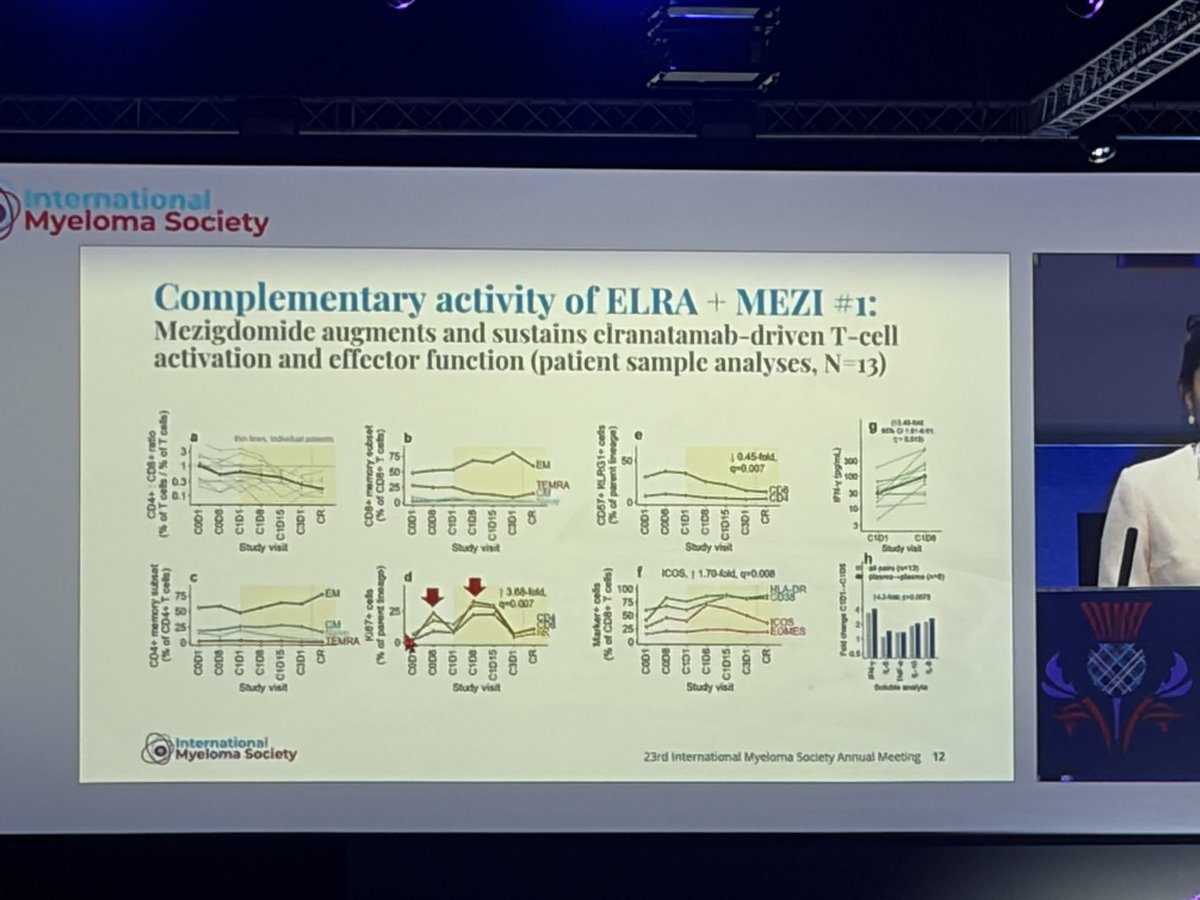
MELT-MM
MELT-MM (Mezigdomide + Elranatamab)
🚀 #IMS26: Mezigdomide + elranatamab (MELT-MM):
💡100% ORR, 90% ≥CR! Striking numbers, but
💡n=13 evaluable pts and 10mo follow up-early days.
💡CRS in 77% (all low-grade) and CMV reactivation in 2/13, infection in 45% w IVIG use
💡worth watching as this combo augments responses in T-cell exhausted RRMM. #MultipleMyeloma #MMsm #Bispecific @Myeloma_Society
International Myeloma Society
Response rates
Data cutoff (2026-Jul-31)
Median FU duration from C0D1 13.7 M (range 8.6-19.3M)
Median time to response 17 days (11-45d), to best response 5.6M (3.3-5.9M)
Per mezigdomide dose (Patients (%), VGPR / >=CR stacked bars):
Total: 100% (13/13) — VGPR 7.7, >=CR 92.3 (bracket: >=CR: 92.3%)
MEZI 0.3mg: 100% (7/7) — VGPR 14.3, >=CR 85.7
MEZI 0.6mg: 100% (6/6) — >=CR 100.0
In subgroups (all bars 100%):
Prior TCE — Yes 100% (4/4) [bar split illegible]; No 100% (9/9) — 88.9 / 11.1
Triple class refractory — Yes 100% (7/7) [bar split illegible]; No 100% (6/6) — 83.3 / 16.7
Penta-refractory — Yes 100% (6/6) [bar split illegible]; No 100% (7/7) — 85.7 / 14.3
Soft tissue EMD — Yes 100% (3/3) — 100; No 100% (10/10) — 90 / 10
Legend: VGPR / >=CR [wording partially illegible]
*NGS (LymphoTrack, Invivoscribe) MRD data available in 11/13 patients : 10^-5 MRD negative CR in 10/11 (90.9%)
23rd International Myeloma Society Annual Meeting — 7
International Myeloma Society
Treatment related adverse events
Data cutoff (2026-Jul-31)
Event, n (%) | Total (N=13) Any grade / Gr 3/4 | Elra + Mezi 0.3mg (N=7) Any grade / Gr 3/4 | Elra + Mezi 0.6mg (N=6) Any grade / Gr 3/4
Any AE | 13 (100) / 13 (100) | 7 (100) / 7 (100) | 6 (100) / 6 (100)
Hematologic
Thrombocytopenia | 7 (53.8) / 7 (53.8) | 3 (42.9) / 3 (42.9) | 4 (66.7) / 4 (66.7)
Neutropenia | 11 (84.6) / 11 (84.6) | 6 (85.7) / 6 (85.7) | 5 (83.3) / 5 (83.3)
Febrile neutropenia | 0 / 0 | 0 / 0 | 0 / 0
Non-hematologic
CRS | 10 (76.9) / 0 | 5 (71.4) / 0 | 5 (83.3) / 0
ICANS | 0 / 0 | 0 / 0 | 0 / 0
Fatigue/ weakness | 11 (84.6) / 1 (7.7) | 5 (71.4) / 1 (14.3) | 6 (100) / 0
Decreased appetite | 7 (53.8) / 0 | 4 (57.1) / 0 | 3 (50.0) / 0
Infection | 6 (46.2) / 4 (30.8) | 4 (57.1) / 3 (42.9) | 2 (33.3) / 1 (16.7)
Nausea | 5 (38.5) / 0 | 4 (57.1) / 0 | 1 (16.7) / 0
Liver enzyme elevation | 5 (38.5) / 3 (23.1) | 1 (14.3) / 0 | 4 (66.7) / 3 (50.0)
Pyrexia | 5 (38.5) / 0 | 2 (28.6) / 0 | 3 (50.0) / 0
Skin rash | 4 (30.8) / 0 | 1 (14.3) / 0 | 3 (50) / 0
Arrthralgia /bone pain | 4 (30.8) / 0 | 2 (28.6) / 0 | 2 (33.3) / 0
23rd International Myeloma Society Annual Meeting — 9
International Myeloma Society
Complementary activity of ELRA + MEZI #1:
Mezigdomide augments and sustains elranatamab-driven T-cell activation and effector function (patient sample analyses, N=13)
Panel a: CD4+ : CD8+ ratio (% of T cells / % of T cells) across study visits C0D1, C0D8, C1D1, C1D8, C1D15, C3D1, CR (thin lines, individual patients)
Panel b: CD8+ memory subset (% of CD8+ T cells) — EM, TEMRA, CM curves across study visits
Panel c: CD4+ memory subset (% of CD4+ T cells) — EM, CM, Naive, TEMRA curves across study visits
Panel d: Ki67+ cells (% of parent lineage) — up 3.68-fold, q=0.007 (red arrows at C0D8 and C1D8)
Panel e: CD57+ KLRG1+ cells (% of parent lineage) — down 0.45-fold, q=0.007 (CD8, CD4)
Panel f: Marker+ cells (% of CD8+ T cells) — HLA-DR, CD38, ICOS (ICOS up 1.70-fold, q=0.008), EOMES
Panel g: IFN-gamma (pg/mL), C1D1 to C1D8 — [13.48-fold, 95% CI [illegible], q=0.013] [partially illegible]
Panel h: Fold change C1D1->C1D8 by soluble analyte — all pairs (n=13), plasma->plasma (n=6) [partially illegible]; [4.3-fold, p=0.007] [partially illegible]
23rd International Myeloma Society Annual Meeting — 12
Sep 23


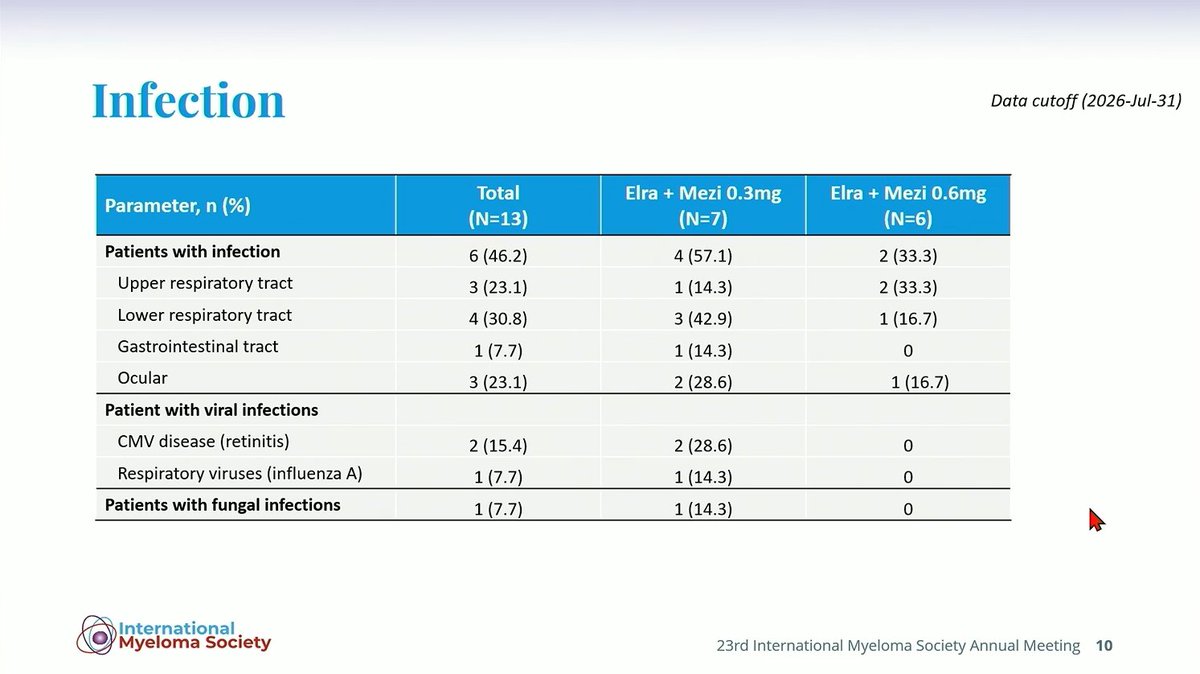
MELT-MM
CONGRESS | #IMS26 | PRESENTATION
Ja Min Byun presents updated Part 1 results from the phase I/II MELT-MM study evaluating elranatamab + mezigdomide in patients with RRMM. The evaluable population included patients receiving mezigdomide 0.3 mg (n = 7) or 0.6 mg (n = 6).
In the https://t.co/OFaZw28eTZ
Response rates
Data cutoff (2026-Jul-31)
Median FU duration from C0D1 13.7 M (range 8.6-19.3M)
Median time to response 17 days (11-45d), to best response 5.6M (3.3-5.9M)
Left bar chart "Per mezigdomide dose" (VGPR/sCR stacked, % Patients):
Total: 100% (13/13) - VGPR 7.7, sCR 92.3 (bracket: >=CR: 92.3%)
MEZI 0.3mg: 100% (7/7) - VGPR 14.3, sCR 85.7
MEZI 0.6mg: 100% (6/6) - VGPR 0, sCR 100.0
Right bar chart "In subgroups" (VGPR/sCR stacked, % Patients), by prior TCE / triple class refractory / penta-refractory / soft tissue EMD, Yes vs No:
Prior TCE: Yes 100% (4/4) - VGPR 0, sCR 100.0 | No 100% (9/9) - VGPR 11.1, sCR 88.9
Triple class refractory: Yes 100% (7/7) - VGPR 0, sCR 100.0 | No 100% (6/6) - VGPR 16.7, sCR 83.3
Penta-refractory: Yes 100% (6/6) - VGPR 0, sCR 100.0 | No 100% (7/7) - VGPR 14.3, sCR 85.7
Soft tissue EMD: Yes 100% (3/3) - VGPR 0, sCR 100 | No 100% (10/10) - VGPR 10, sCR 90
Footnote: *NGS [LymphoTrack, Invivoscribe] MRD data available in 11/13 patients: 10^-5 MRD negative CR in 10/11 (90.9%)
International Myeloma Society - 23rd International Myeloma Society Annual Meeting [Slide 7]
Duration of response
Data cutoff (2026-Jul-31)
10/13 patients remain on study: 1 discontinued d/t patient's decision; 2 d/t physician's decision
Swimmer plot, y-axis: Mezi dose | Patient (SNU-S01 through SNU-S15, 13 rows), x-axis: Months from first infusion (COD1) 0-21.
Rows (dose, patient, status):
0.3, SNU-S01, blue bar ending ~9mo with Death (X) marker, best response sCR (star)
0.3, SNU-S03, blue bar extending to ~19mo, ongoing (arrow), best response sCR
0.3, SNU-S02, blue bar extending to ~19mo, ongoing (arrow), best response sCR
0.3, SNU-S04, blue bar to ~10mo (End of treatment tick) then gray "survival follow-up after EOT" to ~17.5mo, ongoing (arrow)
0.6, SNU-S05, orange bar extending to ~14mo, ongoing (arrow), sCR
0.6, SNU-S06, orange bar extending to ~15.5mo, ongoing (arrow), sCR
0.6, SNU-S07, orange bar extending to ~15.5mo, ongoing (arrow), sCR
0.3, SNU-S09, blue bar to ~11mo then gray survival follow-up to ~12.5mo, Death (X) marker, sCR
0.3, SNU-S10, blue bar extending to ~14mo, ongoing (arrow), sCR
0.3, SNU-S11, blue bar extending to ~12.5mo, ongoing (arrow), sCR
0.6, SNU-S12, orange bar to ~9.5mo, ongoing (arrow), sCR
0.6, SNU-S14, orange bar to ~7.5mo, ongoing (arrow), sCR
0.6, SNU-S15, orange bar to ~9mo, ongoing (arrow), sCR
Each row also marks First response (PR, triangle) and VGPR (diamond) and Best response (star).
Legend: On study treatment - 0.3 mg (blue), On study treatment - 0.6 mg (orange), Survival follow-up after EOT (gray), VGPR (diamond), First response (PR, triangle), Best response (star), End of treatment (vertical tick), Follow-up ongoing (arrow), Death (X)
International Myeloma Society Annual Meeting [Slide 8]
Treatment related adverse events
Data cutoff (2026-Jul-31)
Table - Event, n (%) | Total (N=13): Any grade / Gr 3/4 | Elra + Mezi 0.3mg (N=7): Any grade / Gr 3/4 | Elra + Mezi 0.6mg (N=6): Any grade / Gr 3/4
Any AE | 13 (100) / 13 (100) | 7 (100) / 7 (100) | 6 (100) / 6 (100)
Hematologic:
Thrombocytopenia | 7 (53.8) / 7 (53.8) | 3 (42.9) / 3 (42.9) | 4 (66.7) / 4 (66.7)
Neutropenia | 11 (84.6) / 11 (84.6) | 6 (85.7) / 6 (85.7) | 5 (83.3) / 5 (83.3)
Febrile neutropenia | 0 / 0 | 0 / 0 | 0 / 0
Non-hematologic:
CRS | 10 (76.9) / 0 | 5 (71.4) / 0 | 5 (83.3) / 0
ICANS | 0 / 0 | 0 / 0 | 0 / 0
Fatigue/weakness | 11 (84.6) / 1 (7.7) | 5 (71.4) / 1 (14.3) | 6 (100) / 0
Decreased appetite | 7 (53.8) / 0 | 4 (57.1) / 0 | 3 (50.0) / 0
Infection | 6 (46.2) / 4 (30.8) | 4 (57.1) / 3 (42.9) | 2 (33.3) / 1 (16.7)
Nausea | 5 (38.5) / 0 | 4 (57.1) / 0 | 1 (16.7) / 0
Liver enzyme elevation | 5 (38.5) / 3 (23.1) | 1 (14.3) / 0 | 4 (66.7) / 3 (50.0)
Pyrexia | 5 (38.5) / 0 | 2 (28.6) / 0 | 3 (50.0) / 0
Skin rash | 4 (30.8) / 0 | 1 (14.3) / 0 | 3 (50) / 0
Arrthralgia /bone pain | 4 (30.8) / 0 | 2 (28.6) / 0 | 2 (33.3) / 0
International Myeloma Society Annual Meeting [Slide 9]
Infection
Data cutoff (2026-Jul-31)
Table - Parameter, n (%) | Total (N=13) | Elra + Mezi 0.3mg (N=7) | Elra + Mezi 0.6mg (N=6)
Patients with infection | 6 (46.2) | 4 (57.1) | 2 (33.3)
Upper respiratory tract | 3 (23.1) | 1 (14.3) | 2 (33.3)
Lower respiratory tract | 4 (30.8) | 3 (42.9) | 1 (16.7)
Gastrointestinal tract | 1 (7.7) | 1 (14.3) | 0
Ocular | 3 (23.1) | 2 (28.6) | 1 (16.7)
Patient with viral infections
CMV disease (retinitis) | 2 (15.4) | 2 (28.6) | 0
Respiratory viruses (influenza A) | 1 (7.7) | 1 (14.3) | 0
Patients with fungal infections | 1 (7.7) | 1 (14.3) | 0
International Myeloma Society Annual Meeting [Slide 10]
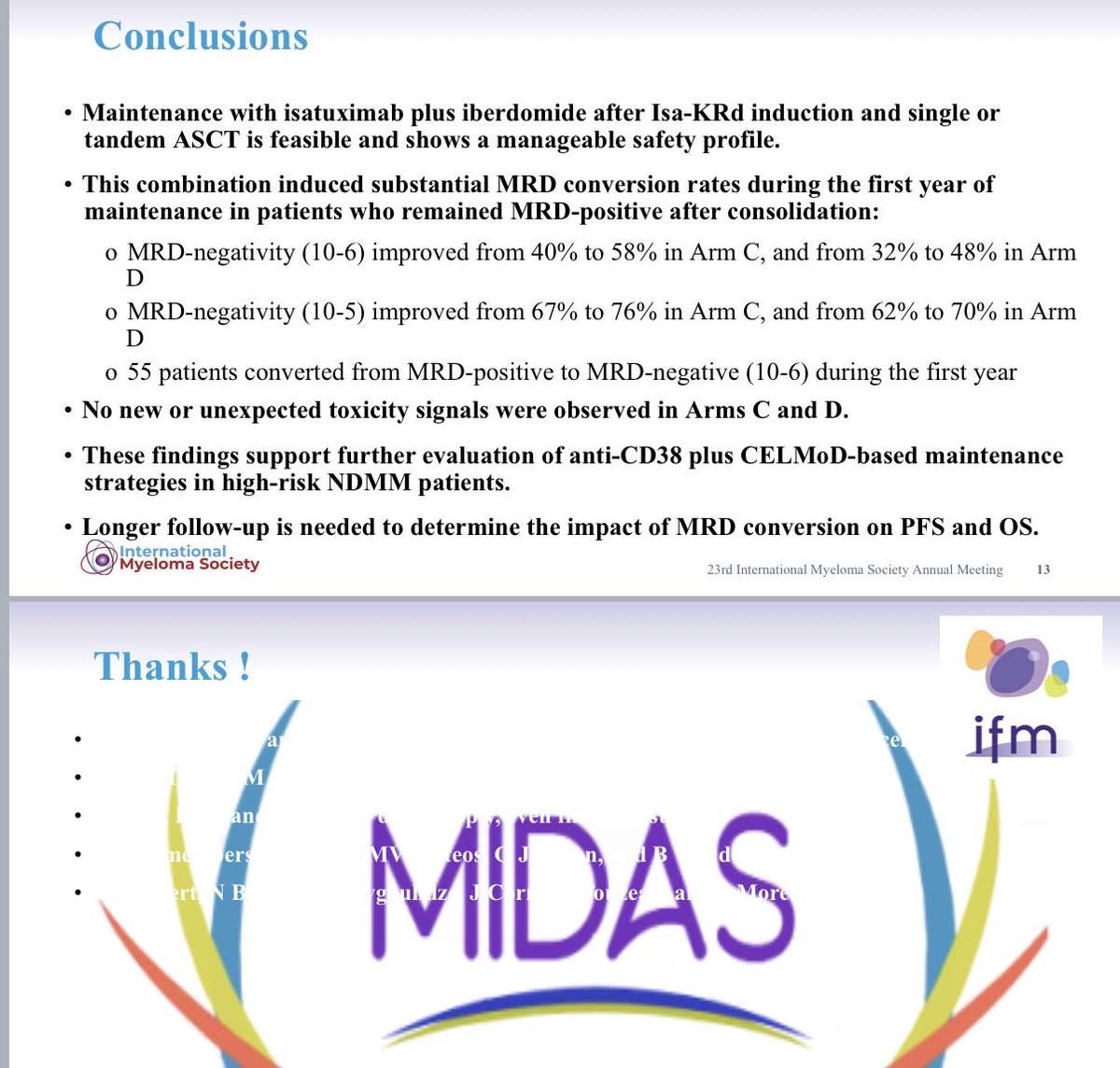


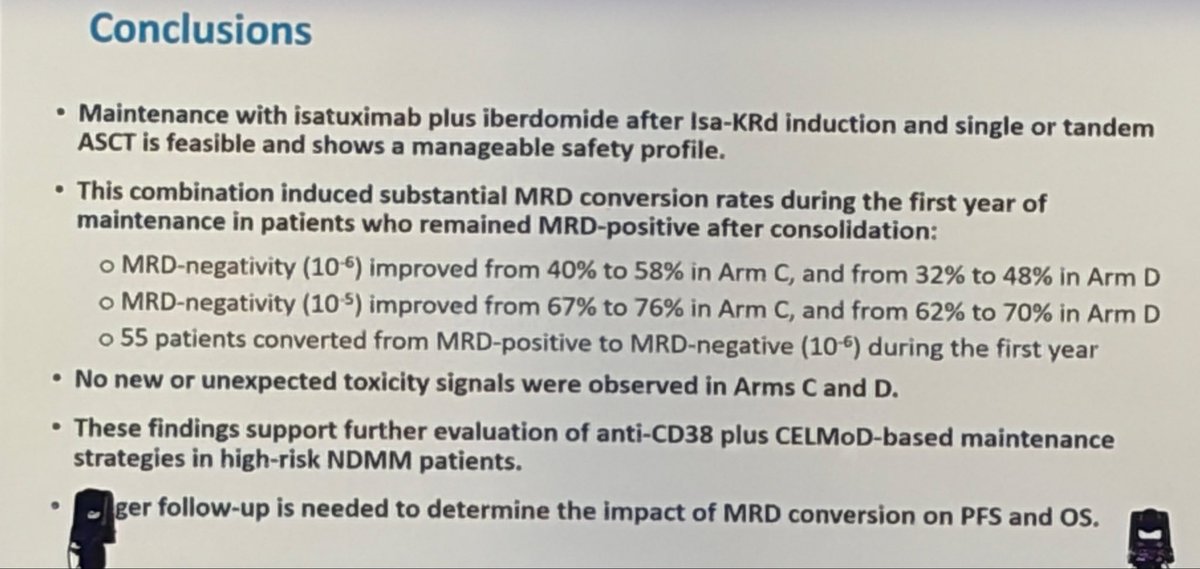 Sep 21
CEPHEUSCERVINOEXCALIBER-RRMMGEM2014MAINIBEXMIDAS
Have fun in Glasgow! 🇬🇧🏴
Don’t get lost at #IMS2026—too much great science, too many simultaneous sessions!
Follow the roadmap. Don’t miss the practice-changing data.
And don’t forget your single malt…after the final session! 🥃😆
#MultipleMyeloma #mmsm #Medtwitter https://t.co/eCVPDMHoDu
DON'T GET LOST AT IMS 2026
GLASGOW - SEPTEMBER 23-26
THE MUST-SEE ROADMAP
PEOPLE SCIENCE PROGRESS TOGETHER | BIGGER SCIENCE A BRIGHTER TOMORROW | GLASGOW WELCOMES A BRIGHTER TOMORROW
THURSDAY - SEPT 24 5:00-6:00 PM - HALL 5
MRD & MAINTENANCE (MRD: DEEPER ANSWERS BRIGHTER TOMORROWS)
- MIDAS: Isa-iberdomide
- CASSIOPEIA: 5-year sustained MRD
- GEM2014MAIN: MRD-guided stopping
- IBEX: Iber-Dara post-ASCT
FRIDAY - SEPT 25 3:00-5:00 PM - HALL 5 DO NOT MISS
THE PLENARY - DO NOT MISS (BOLD SCIENCE CHANGES LIVES)
- CERVINO: Etentamig vs standard therapy
- PERSEUS: Does long-term PFS become OS?
- EXCALIBER-RRMM: IberDd vs DVd
- First-in-human CD19/BCMA in-vivo CAR-T
SAME QUESTIONS. A BRIGHTER TOMORROW.
SATURDAY - SEPT 26
8:30-9:30 AM - HALL 5
THE NEXT CELLULAR-THERAPY ERA (CELLULAR THERAPIES: REAL POTENTIAL FOR REAL PEOPLE)
- Updated CEPHEUS MRD
- BCMAxGPRC5D dual-target CAR-T
- IASO206: IV in-vivo BCMA CAR-T
11:00 AM-12:00 PM - HALL 5
- Post-CAR-T elranatamab
- Delayed cilta-cel neurotoxicity
- MRD-guided T-cell redirection
11:00 AM-12:00 PM - LOMOND
- CAR-T enterocolitis biology
1:00-2:00 PM - LOMOND
- LV169: lentiviral in-vivo BCMA CAR delivery
Same goal. Brighter lives.
WHAT TO WATCH (DIFFERENT PERSPECTIVES A CLEARER FUTURE)
- Durability - OS - sustained MRD - infection burden
- Access - treatment-free time - late toxicity
- In-vivo CAR-T: insertion sites, off-target transduction, vector shedding & persistence
Go for the randomized data and the biology--not every new response rate.
Single malt only AFTER the final session.
SAME CURIOSITY FURTHER TOGETHER | GREAT SCIENCE DESERVES A DRAM
 Sep 25
CARTITUDE-4MonumenTAL-3
#IMS26 #mmsm @SurbhiSidanaMD
Management of rare AE associated with CAR-T in myeloma https://t.co/VAiw0VwE2Q
[Slide 1 - Parkinsonism with Cilta-cel, mechanism: potential on-target, off-tumor effect on basal ganglia]
Cross-trial table (CARTITUDE-1 / CARTITUDE-4 / RWE USMMIC / RWE USMMIC-2):
Incidence: 6% / 0.5% / 2% / 3% (23/766). Clinical features: tremor/bradykinesia/rigidity/gait difficulty (CARTITUDE-1, USMMIC, USMMIC-2), tremor/bradykinesia/rigidity (CARTITUDE-4), USMMIC-2 adds personality change. Median time to onset: 27 days (14-108) / 85 days / 30 days (13-69) / 32 days (6-277).
Sources: Martin et al. J Clin Oncol 41:1265-1274, 2023. San-Miguel et al. NEJM 389:335-347, 2023. Sidana et al. Blood. 2025;145(1):85-97. Sidana S et al, ASH 2025, manuscript in preparation 2026. Cohen et al Blood Cancer J. 2022;12:32. Hosoya et al Blood 2025.
[Slide 2 - Parkinsonism: Treatment and Outcomes]
N=23 patients with Parkinsonism. Resolved or improved: 55%. Resolved: 30% (7). Improved: 22% (5). Median time to resolution: 29 days (range 7-427).
Patient-level treatment/outcome grid (23 patients) showing treatments received (corticosteroids, IVIG, anakinra, ruxolitinib, tocilizumab, cyclophosphamide, dasatinib, intrathecal chemotherapy, high-dose methotrexate, anti-parkinsonian medication, other supportive/symptom care, no treatment documented) mapped against Favorable/Unfavorable/Unknown outcome.
Source: Sidana S et al. Manuscript in preparation, 2026.
[Slide 3 - IEC-Colitis: My Management Approach]
Diagnosis: Clinical and Pathological - GI infectious work up (infections can co-occur); Endoscopy + biopsies (duodenum: 80%; including normal mucosa); Assess lymphocytic infiltrate for clonality and CAR-T presence.
First line: Early treatment initiation is key; High-dose Cytoxan (1-2 g/m2): preferred for fit patients.
Other options: Cyclosporine (target trough 300-400 ng/mL); Ruxolitinib; Biologics for IBD: infliximab, vedolizumab, ustekinumab.
Supportive Care: Often need parenteral nutrition; Aggressive antimicrobial prophylaxis; If on steroids for >5-7 days, antifungal prophylaxis.
[Slide 4 - Cerebellar Toxicity with GPRC5D CAR-T and BsAb: Dizziness-Ataxia Syndrome]
Potential low-level expression in inferior olivary nucleus of medulla oblongata.
Cross-trial table (Arlo-cel N=84 / MonumenTAL-3 Tal-DP/Tal-D / MonumenTAL-1 Monotherapy): Any-grade 12% / 15%/12% / 5%. Grade 3: 7% / 3%/2% / 0.5%. Median time to onset: 30.5 days / 292/326 days / ~114 days. Recovery/resolution: "4 resolved, but recurred; all active" / 10.8%/16.9% / 54.2%.
Incidence: 12-14%; Early for CAR-T, risk increases over time for BsAb.
Diagnosis and Treatment: Diagnosis is clinical; Talquetamab: Hold drug, if rechallenged after resolution use a lower dose; Arlo-cel: Consider cytotoxic therapy and JAK inhibitors, ~Parkinsonism.
Sources: Bal S et al. Blood. 2026;148:1240-1250. Mailankody et al. N Engl J Med 387:1196-1206. Mina R et al. N Engl J Med. 2026;395:671-683. Janakiram M et al. Blood Cancer J. 2025;15:135.
Sep 25
CARTITUDE-4ImmunoPRISMMajesTEC-3MajesTEC-9MonumenTAL-3RedirecTT-1
#IMS26 #mmsm
Infections with BsAn and CAR-T therapies https://t.co/nGIR6yJM9B
[Slide 1 - Incidence and severity of infections across different approved BsAbs and CAR T trials, cross-trial compilation table]
BsAbs late-line relapse (triple-class exposed) - trial/drug/All grade/Grade 3-4/Grade 5:
MajesTEC-1/Teclistamab: 78.8% / 55.2% / 12.7%. MagnetisMM-3/Elranatamab: 69.9% / 39.8% / 6.5%. LinkerMM-1/Linvoseltamab: 75% / 48% / NR. MonumenTAL-1/Talquetamab: 66.2% / 14.5% / 1.4%. RedirecTT-1/Tec-Tal: 89% / 64% / 12%.
BsAbs early-line relapse (1-3 prior lines): MajesTEC-9/Teclistamab: 82.8% / 41.6% / 5.5%. MajesTEC-3/Tec-Dara: 96.5% / 41.6% / 5.5%. MonumenTAL-3/Tal-Dara: 83.0% / 29.2% / 1.5%. MonumenTAL-3/Tal-Dara-Pom: 84.3% / 37.7% / 0.7%.
CAR T late-line relapse: CARTITUDE-1/Cilta-Cel: All grade 58%, Gr3-4 20%, Gr5 NR. KarMMa/Ide-Cel: 69%, 22%, NR (#, deaths from AEs not otherwise specified 7% total). CAR T early-line relapse: CARTITUDE-4/Cilta-Cel: 59%, 24%, 4%. KarMMa-3/Ide-Cel: 56%, 22%, NR (*, death from AEs 6% total).
"Infections remain a major safety concern with T-cell-redirecting therapies, particularly with continuous bispecific antibody treatment." Table provided for ease of viewing, no comparisons intended.
Sources: Moreau P et al NEJM 2022; Lesokhin AM et al Nat Med 2023;29(9):2259-2267; Lee HC et al Clin Lymphoma Myeloma Leuk 2026 Feb, 26(2):e201-e212,e8; Chari A et al NEJM 2022; Cohen Y et al Engl J Med 2025;392:138-49; Touzeau C et al N Engl J Med 2026;395:440-53; Costa LJ et al N Eng J Med 2026;394:739-52; Mina R et al N Engl J Med 2026;395:671-83; Einsele H et al, Lancet Oncol 2026;27:254-68; Ailawadhi S et al, Blood 2024 (144)23; Berdeja J et al, Lancet 2021;398:314-24; Munshi NC et al, N Engl J Med 2021 Feb 25;384(8):705-716.
[Slide 2 - Pillars of infection prevention in patients receiving T-cell redirecting therapies]
Table: Immune defect/risk -> Type of infection -> Preventive strategy.
Lymphopenia/Neutropenia -> Bacterial infections/PJP, approx first 3-6 months -> Antiviral + PJP prophylaxis, G-CSF support.
Immunosuppressive therapy (steroids, IL-6 blockage, cyclophosphamide) -> Bacterial infections/Sepsis/fungal infections/CMV -> Consider antibacterial/antifungal.
B-cell aplasia/Hypogammaglobulinemia -> Bacterial/Viral (Respiratory virus, VZV/HSV)/CMV -> Immunoglobulin replacement, Vaccination.
T-cell dysfunction -> Other opportunistic infections, Viral infections, fungal (in selected high risk patients) -> Fixed treatment duration/Schedule optimization.
Sources: Rodriguez-Otero P et al, Lancet Oncology May 2024; O'Neill C, et al. eJHaem. 2023;4:811-822; Friedrich MJ, et al. Cancer Cell. 2023;41:711-725.e6; Frerichs KA et al, Blood Advances 2024; Mohan M et al, Blood Cancer Journal (2025) 15:74; Tix T et al, Molecular Therapy (2025)33:7; Richardson T et al, Blood Advances (2025) 9:6; Nath K et al, Blood Cancer Journal (2024) 14:88; Reynolds G et al, Blood advances (2023) 7:19; Banerjee R et al, Blood Advances (2025) 9:18; Dr Rodriguez Otero personal opinion.
Sep 23
CARTITUDE-4CERVINODREAMM-7DREAMM-8MajesTEC-3MajesTEC-9MonumenTAL-3MonumenTAL-6
Never a good time to be a myeloma patient but this is the best it has ever been!
Remarkable results in early relapse setting!
@mvmateos #IMS26 https://t.co/rNUviKkXc5
Phase 3 evidence has moved inmune therapy into early relapse
[Table: STUDY | COMPARISON | forest plot (FAVOURS EXPERIMENTAL / FAVOURS CONTROL) | PFS HR | OS HR]
CARTITUDE-4 | Cilta-cel vs DPd/PVd | PFS HR 0.29 | OS HR 0.55
DREAMM-7 | BVd vs DVd | PFS HR 0.41 | OS HR 0.58
DREAMM-8 | BPd vs PVd | PFS HR 0.52 | OS HR 0.77
MajesTEC-3 | Tec-Dara vs DPd/DVd | PFS HR 0.17 | OS HR 0.46
MonumenTAL-3 | Tal-DP vs DPd | PFS HR 0.28 | OS HR 0.47
(MonumenTAL-3) | Tal-D vs DPd | PFS HR 0.33 | OS HR 0.51
MajesTEC-9 | Teclistamab vs PVd/Kd | PFS HR 0.29 | OS HR 0.60
MonumenTAL-6 | Tal-Tec vs EPd/PVd | PFS HR 0.11 | OS HR NR
(MonumenTAL-6) | Tal-Pom vs EPd/PVd | PFS HR 0.27 | OS HR NR
CERVINO | Etentamig vs investigator's choice | PFS HR 0.40 | OS HR NR
RANDOMIZED PHASE 3 TRIALS WITHOUT PUBLIC NUMERICAL HRs
MagnetisMM-5 | Elranatamab +/- Dara vs DPd | Positive top-line result; no numerical data reported
[Forest plot x-axis tick labels largely illegible]
Sep 23
MajesTEC-3MajesTEC-9MELT-MMMonumenTAL-3MonumenTAL-6SUCCESSOR-2
#IMS2026 How to approach first relapse by @DrRakeshPopat https://t.co/3uXrSIgjY7
International Myeloma Society
New 2nd line treatments according to patient characteristics
Columns: Tec +Ig (MajesTec 9) | Tec Dara +Ig (MajesTec 3) | Tal Dara (MonumenTal 3) | Tal Dara Pom (MonumenTal 3) | Mezi Kd (Successor 2) | [Press release only:] Tal Pom (MonumenTal 6) | Tec Tal +Ig (MonumenTal 6) | Elra +Ig (MagnetisMM 5)
CD38 refractory: Yes | Possibly* | Possibly* | Possibly* | Yes | Yes | Yes | ?
High risk: Possibly | Yes | Possibly | Possibly | Yes | Yes | Yes | ?
EMD: Possibly | Possibly | Possibly | Possibly | Possibly | Possibly | Yes | ?
Frail: Yes | Caution | Possibly | Caution | Yes | Possibly | Yes | ?
High Infection risk: Possibly | Caution | Yes | Caution | Possibly | Possibly | Caution | ?
Tolerability: Yes | Yes | Possibly | Possibly | Yes | Possibly | Caution | ?
[Note: row-to-cell alignment approximate due to photo angle]
Yes = Preferred / data supports; Possibly = Conditional / Limited data; Caution = possible but caution required
Tec = Teclistamab | Tal = Talquetamab | Elra = Elranatamab | Dara = Daratumumab | Pom = Pomalidomide | Ig = Immunoglobulin | Mezi = mezigdomide | K = carilzomib | *based on TRIMM-2 data
Based on trial eligibility + published efficacy/safety signals for BCMA & GPRC5D bispecifics. Table represents personal opinion and based on limited evidence!
Costa LJ, et al. N Engl J Med. 2026;394(8):739-752, Touzeau C, et al. N Engl J Med. 2026, Mina R, et al. N Engl J Med. 2026, Dimopoulos et al., The Lancet 2026, Johnson & Johnson. press release, 23 July 2026, Pfizer. press release, 29 April 2026.
Sep 25
CARTITUDE-4ImmunoPRISMMajesTEC-3MajesTEC-9MonumenTAL-3RedirecTT-1
#IMS26 #mmsm
Infections with BsAn and CAR-T therapies https://t.co/nGIR6yJM9B
[Slide 1 - Incidence and severity of infections across different approved BsAbs and CAR T trials, cross-trial compilation table]
BsAbs late-line relapse (triple-class exposed) - trial/drug/All grade/Grade 3-4/Grade 5:
MajesTEC-1/Teclistamab: 78.8% / 55.2% / 12.7%. MagnetisMM-3/Elranatamab: 69.9% / 39.8% / 6.5%. LinkerMM-1/Linvoseltamab: 75% / 48% / NR. MonumenTAL-1/Talquetamab: 66.2% / 14.5% / 1.4%. RedirecTT-1/Tec-Tal: 89% / 64% / 12%.
BsAbs early-line relapse (1-3 prior lines): MajesTEC-9/Teclistamab: 82.8% / 41.6% / 5.5%. MajesTEC-3/Tec-Dara: 96.5% / 41.6% / 5.5%. MonumenTAL-3/Tal-Dara: 83.0% / 29.2% / 1.5%. MonumenTAL-3/Tal-Dara-Pom: 84.3% / 37.7% / 0.7%.
CAR T late-line relapse: CARTITUDE-1/Cilta-Cel: All grade 58%, Gr3-4 20%, Gr5 NR. KarMMa/Ide-Cel: 69%, 22%, NR (#, deaths from AEs not otherwise specified 7% total). CAR T early-line relapse: CARTITUDE-4/Cilta-Cel: 59%, 24%, 4%. KarMMa-3/Ide-Cel: 56%, 22%, NR (*, death from AEs 6% total).
"Infections remain a major safety concern with T-cell-redirecting therapies, particularly with continuous bispecific antibody treatment." Table provided for ease of viewing, no comparisons intended.
Sources: Moreau P et al NEJM 2022; Lesokhin AM et al Nat Med 2023;29(9):2259-2267; Lee HC et al Clin Lymphoma Myeloma Leuk 2026 Feb, 26(2):e201-e212,e8; Chari A et al NEJM 2022; Cohen Y et al Engl J Med 2025;392:138-49; Touzeau C et al N Engl J Med 2026;395:440-53; Costa LJ et al N Eng J Med 2026;394:739-52; Mina R et al N Engl J Med 2026;395:671-83; Einsele H et al, Lancet Oncol 2026;27:254-68; Ailawadhi S et al, Blood 2024 (144)23; Berdeja J et al, Lancet 2021;398:314-24; Munshi NC et al, N Engl J Med 2021 Feb 25;384(8):705-716.
[Slide 2 - Pillars of infection prevention in patients receiving T-cell redirecting therapies]
Table: Immune defect/risk -> Type of infection -> Preventive strategy.
Lymphopenia/Neutropenia -> Bacterial infections/PJP, approx first 3-6 months -> Antiviral + PJP prophylaxis, G-CSF support.
Immunosuppressive therapy (steroids, IL-6 blockage, cyclophosphamide) -> Bacterial infections/Sepsis/fungal infections/CMV -> Consider antibacterial/antifungal.
B-cell aplasia/Hypogammaglobulinemia -> Bacterial/Viral (Respiratory virus, VZV/HSV)/CMV -> Immunoglobulin replacement, Vaccination.
T-cell dysfunction -> Other opportunistic infections, Viral infections, fungal (in selected high risk patients) -> Fixed treatment duration/Schedule optimization.
Sources: Rodriguez-Otero P et al, Lancet Oncology May 2024; O'Neill C, et al. eJHaem. 2023;4:811-822; Friedrich MJ, et al. Cancer Cell. 2023;41:711-725.e6; Frerichs KA et al, Blood Advances 2024; Mohan M et al, Blood Cancer Journal (2025) 15:74; Tix T et al, Molecular Therapy (2025)33:7; Richardson T et al, Blood Advances (2025) 9:6; Nath K et al, Blood Cancer Journal (2024) 14:88; Reynolds G et al, Blood advances (2023) 7:19; Banerjee R et al, Blood Advances (2025) 9:18; Dr Rodriguez Otero personal opinion.
Sep 23
CARTITUDE-4CERVINODREAMM-7DREAMM-8MajesTEC-3MajesTEC-9MonumenTAL-3MonumenTAL-6
Never a good time to be a myeloma patient but this is the best it has ever been!
Remarkable results in early relapse setting!
@mvmateos #IMS26 https://t.co/rNUviKkXc5
Phase 3 evidence has moved inmune therapy into early relapse
[Table: STUDY | COMPARISON | forest plot (FAVOURS EXPERIMENTAL / FAVOURS CONTROL) | PFS HR | OS HR]
CARTITUDE-4 | Cilta-cel vs DPd/PVd | PFS HR 0.29 | OS HR 0.55
DREAMM-7 | BVd vs DVd | PFS HR 0.41 | OS HR 0.58
DREAMM-8 | BPd vs PVd | PFS HR 0.52 | OS HR 0.77
MajesTEC-3 | Tec-Dara vs DPd/DVd | PFS HR 0.17 | OS HR 0.46
MonumenTAL-3 | Tal-DP vs DPd | PFS HR 0.28 | OS HR 0.47
(MonumenTAL-3) | Tal-D vs DPd | PFS HR 0.33 | OS HR 0.51
MajesTEC-9 | Teclistamab vs PVd/Kd | PFS HR 0.29 | OS HR 0.60
MonumenTAL-6 | Tal-Tec vs EPd/PVd | PFS HR 0.11 | OS HR NR
(MonumenTAL-6) | Tal-Pom vs EPd/PVd | PFS HR 0.27 | OS HR NR
CERVINO | Etentamig vs investigator's choice | PFS HR 0.40 | OS HR NR
RANDOMIZED PHASE 3 TRIALS WITHOUT PUBLIC NUMERICAL HRs
MagnetisMM-5 | Elranatamab +/- Dara vs DPd | Positive top-line result; no numerical data reported
[Forest plot x-axis tick labels largely illegible]
Sep 23
MajesTEC-3MajesTEC-9MELT-MMMonumenTAL-3MonumenTAL-6SUCCESSOR-2
#IMS2026 How to approach first relapse by @DrRakeshPopat https://t.co/3uXrSIgjY7
International Myeloma Society
New 2nd line treatments according to patient characteristics
Columns: Tec +Ig (MajesTec 9) | Tec Dara +Ig (MajesTec 3) | Tal Dara (MonumenTal 3) | Tal Dara Pom (MonumenTal 3) | Mezi Kd (Successor 2) | [Press release only:] Tal Pom (MonumenTal 6) | Tec Tal +Ig (MonumenTal 6) | Elra +Ig (MagnetisMM 5)
CD38 refractory: Yes | Possibly* | Possibly* | Possibly* | Yes | Yes | Yes | ?
High risk: Possibly | Yes | Possibly | Possibly | Yes | Yes | Yes | ?
EMD: Possibly | Possibly | Possibly | Possibly | Possibly | Possibly | Yes | ?
Frail: Yes | Caution | Possibly | Caution | Yes | Possibly | Yes | ?
High Infection risk: Possibly | Caution | Yes | Caution | Possibly | Possibly | Caution | ?
Tolerability: Yes | Yes | Possibly | Possibly | Yes | Possibly | Caution | ?
[Note: row-to-cell alignment approximate due to photo angle]
Yes = Preferred / data supports; Possibly = Conditional / Limited data; Caution = possible but caution required
Tec = Teclistamab | Tal = Talquetamab | Elra = Elranatamab | Dara = Daratumumab | Pom = Pomalidomide | Ig = Immunoglobulin | Mezi = mezigdomide | K = carilzomib | *based on TRIMM-2 data
Based on trial eligibility + published efficacy/safety signals for BCMA & GPRC5D bispecifics. Table represents personal opinion and based on limited evidence!
Costa LJ, et al. N Engl J Med. 2026;394(8):739-752, Touzeau C, et al. N Engl J Med. 2026, Mina R, et al. N Engl J Med. 2026, Dimopoulos et al., The Lancet 2026, Johnson & Johnson. press release, 23 July 2026, Pfizer. press release, 29 April 2026.
GEM2014MAIN
4 slides
Sep 24


GEM2014MAIN
GEM2014MAIN (MRD-guided maintenance discontinuation)
🎯 #IMS26: GEM2014MAIN: MRD-neg pts who stopped maintenance at 2yrs had median PFS not reached vs 3.5yrs for MRD-positive pts who continued. 💡50% remained progression-free at 7yrs.
💡Early MRD neg > late MRD neg
💡sustained https://t.co/TJI1PPYAf1
[Slide 1 - GEM2014MAIN: Discontinuation of Rd or IRd - patients who were MRD- at second year of maintenance (N=271), median follow-up 7.5 years]
KM curves for PFS by MRD status at 2yr (T5), comparing Continue Lenalidomide vs Stop Lenalidomide within MRD- and MRD+ groups. Median PFS: Stop Lenalidomide (Not reached) vs Continue Lenalidomide (3.5 years), p<0.0001. At-risk table shown through year 9.
[Slide 2 - MRD negativity achievement is an independent prognostic factor for prolonged PFS]
Subgroup KM curves by ISS stage and cytogenetic risk, continue vs stop lenalidomide maintenance. Median PFS by ISS: Continue Maintenance ISS1 5.7yr, ISS2 5.9yr, ISS3 2.9yr (Stop Maintenance not reached). By cytogenetic risk: Continue Maintenance-HR CG 2.8yr, Continue Maintenance-SR CG 4.2yr (Stop Maintenance not reached).
[Slide 3 - Half of patients who were MRD- at 2 years and discontinued maintenance remained alive and progression-free after 7 years, N=84]
After 7 years of maintenance discontinuation: 3 patients had disease progression, 1 died without progression. PFS KM curve (Sustained MRDneg n=64 vs Variable MRD status n=20) shows Sustained MRDneg group staying near 95-100% through 1.5 years vs Variable MRD status group dropping to ~88%.
Sep 21
CEPHEUSCERVINOEXCALIBER-RRMMGEM2014MAINIBEXMIDAS
Have fun in Glasgow! 🇬🇧🏴
Don’t get lost at #IMS2026—too much great science, too many simultaneous sessions!
Follow the roadmap. Don’t miss the practice-changing data.
And don’t forget your single malt…after the final session! 🥃😆
#MultipleMyeloma #mmsm #Medtwitter https://t.co/eCVPDMHoDu
DON'T GET LOST AT IMS 2026
GLASGOW - SEPTEMBER 23-26
THE MUST-SEE ROADMAP
PEOPLE SCIENCE PROGRESS TOGETHER | BIGGER SCIENCE A BRIGHTER TOMORROW | GLASGOW WELCOMES A BRIGHTER TOMORROW
THURSDAY - SEPT 24 5:00-6:00 PM - HALL 5
MRD & MAINTENANCE (MRD: DEEPER ANSWERS BRIGHTER TOMORROWS)
- MIDAS: Isa-iberdomide
- CASSIOPEIA: 5-year sustained MRD
- GEM2014MAIN: MRD-guided stopping
- IBEX: Iber-Dara post-ASCT
FRIDAY - SEPT 25 3:00-5:00 PM - HALL 5 DO NOT MISS
THE PLENARY - DO NOT MISS (BOLD SCIENCE CHANGES LIVES)
- CERVINO: Etentamig vs standard therapy
- PERSEUS: Does long-term PFS become OS?
- EXCALIBER-RRMM: IberDd vs DVd
- First-in-human CD19/BCMA in-vivo CAR-T
SAME QUESTIONS. A BRIGHTER TOMORROW.
SATURDAY - SEPT 26
8:30-9:30 AM - HALL 5
THE NEXT CELLULAR-THERAPY ERA (CELLULAR THERAPIES: REAL POTENTIAL FOR REAL PEOPLE)
- Updated CEPHEUS MRD
- BCMAxGPRC5D dual-target CAR-T
- IASO206: IV in-vivo BCMA CAR-T
11:00 AM-12:00 PM - HALL 5
- Post-CAR-T elranatamab
- Delayed cilta-cel neurotoxicity
- MRD-guided T-cell redirection
11:00 AM-12:00 PM - LOMOND
- CAR-T enterocolitis biology
1:00-2:00 PM - LOMOND
- LV169: lentiviral in-vivo BCMA CAR delivery
Same goal. Brighter lives.
WHAT TO WATCH (DIFFERENT PERSPECTIVES A CLEARER FUTURE)
- Durability - OS - sustained MRD - infection burden
- Access - treatment-free time - late toxicity
- In-vivo CAR-T: insertion sites, off-target transduction, vector shedding & persistence
Go for the randomized data and the biology--not every new response rate.
Single malt only AFTER the final session.
SAME CURIOSITY FURTHER TOGETHER | GREAT SCIENCE DESERVES A DRAM
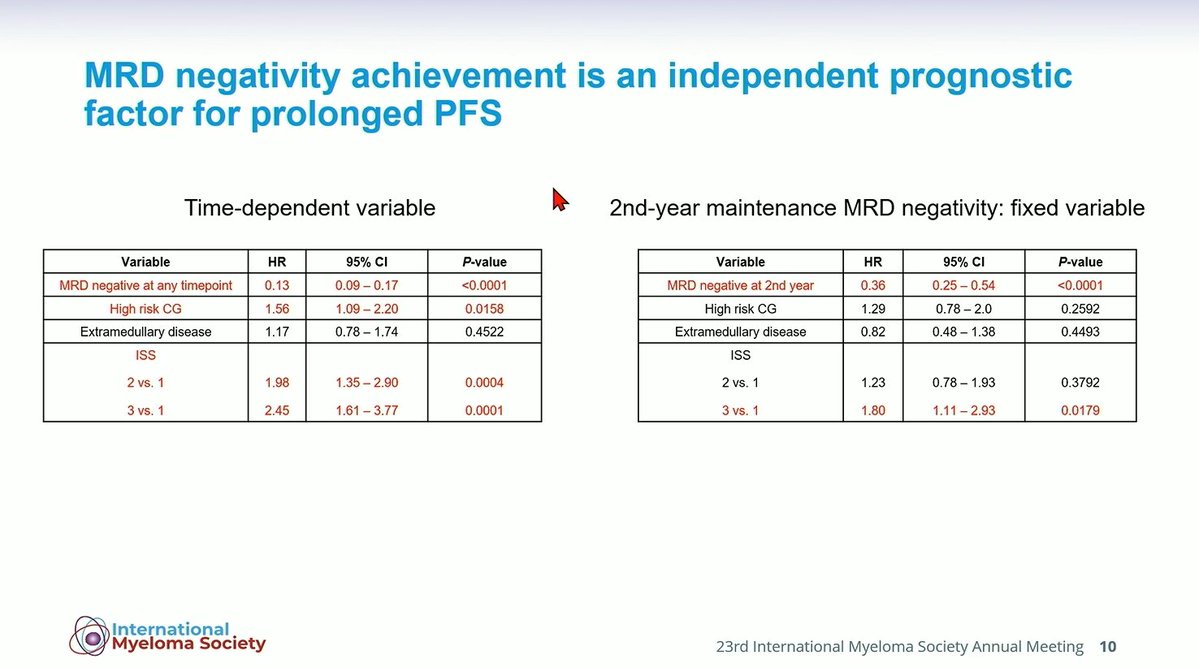
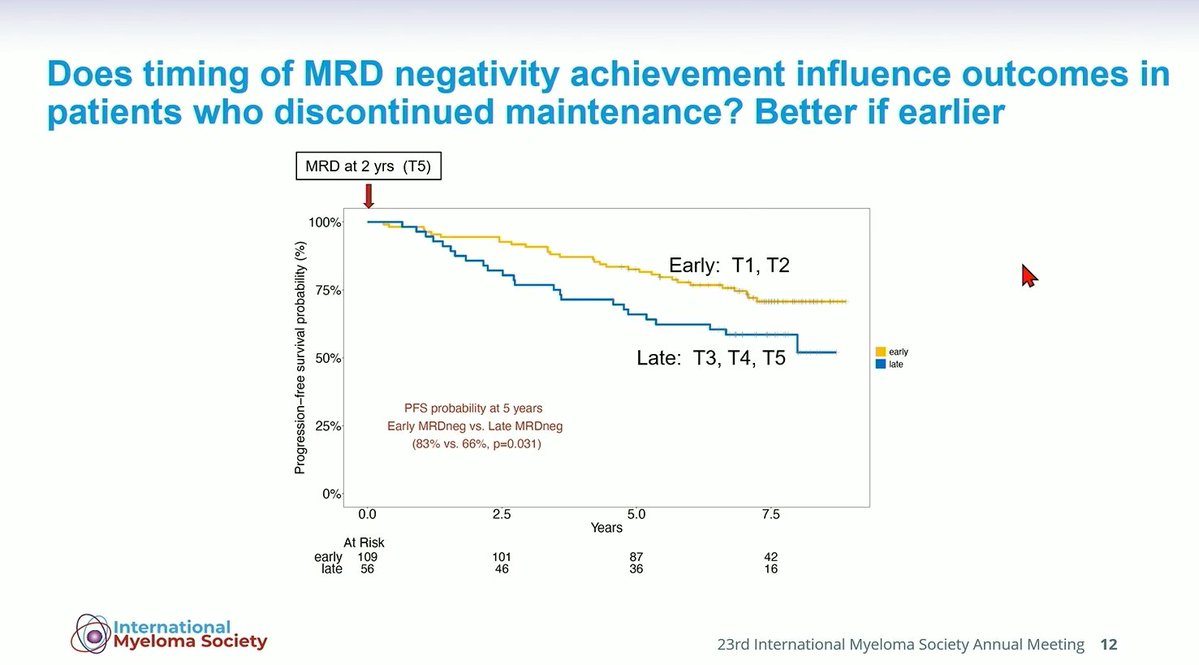
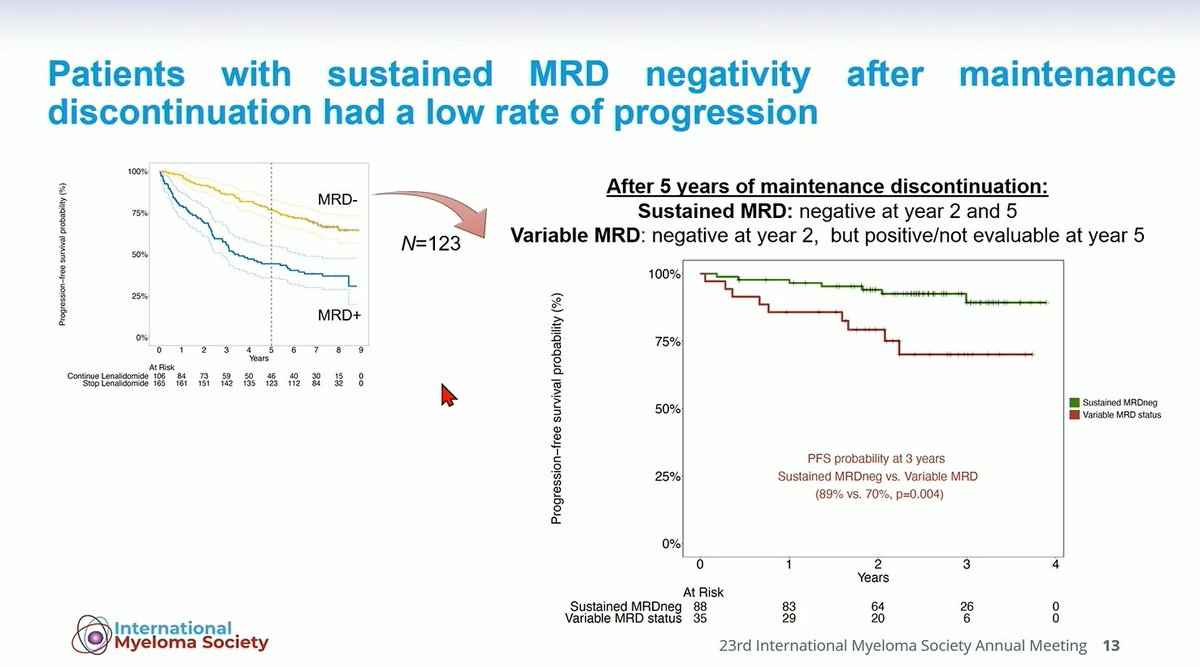
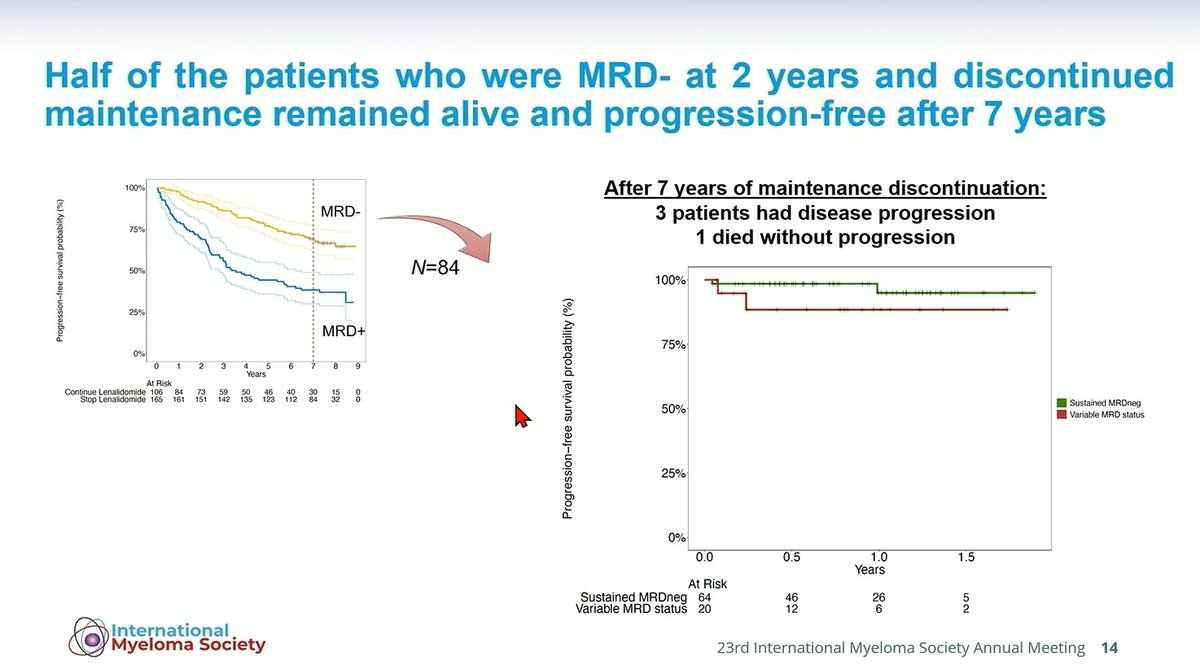
Anito-cel-Phase1
4 slides

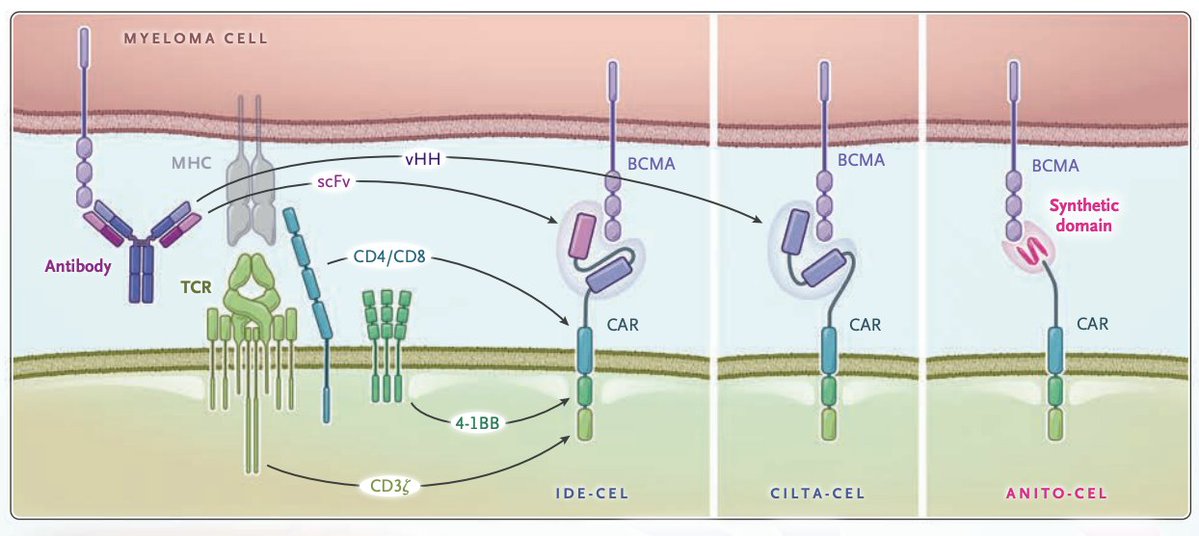 Sep 24


Anito-cel-Phase1
At time of #IMS26 #mmsm Anito cel phase I study published in @NEJM
➡️n=38 pts, median F/U : ~ 3yrs, 2 patients (5%) removed from analysis post enrollment even after successful manufacturing👇
➡️ 2-yr PFS: 57%, median PFS: 2.5 yrs, 3-yrs OS: 65%
🛑Unfortunately no data on G2 https://t.co/U4LSBAlnDF
Table 1. Characteristics of the Patients at Baseline.*
Characteristic | Dose Level 1 (N=32) | Dose Level 2 (N=6) | Total (N=38)
Age
Median (range) - yr | 66 (44-76) | 60 (52-65) | 66 (44-76)
>=65 yr - no. (%) | 19 (59) | 1 (17) | 20 (53)
Sex - no. (%)
Male | 18 (56) | 5 (83) | 23 (61)
Female | 14 (44) | 1 (17) | 15 (39)
Race - no. (%) [dagger]
White | 28 (88) | 4 (67) | 32 (84)
Black | 3 (9) | 1 (17) | 4 (11)
Asian | 1 (3) | 0 | 1 (3)
Other | 0 | 1 (17) | 1 (3)
ECOG performance-status score - no. (%) [double dagger]
0 | 9 (28) | 3 (50) | 12 (32)
1 | 23 (72) | 3 (50) | 26 (68)
High-risk prognostic features - no. (%)
Extramedullary disease [section] | 9 (28) | 3 (50) | 12 (32)
Bone marrow plasma cells >=60% [paragraph] | 8 (25) | 4 (67) | 12 (32)
Beta2-microglobulin level >=5.5 mg/liter [paragraph] | 5 (16) | 2 (33) | 7 (18)
High-risk cytogenetic abnormality [double vertical bar] | 9 (28) | 2 (33) | 11 (29)
High-risk cytogenetic abnormality inclusive of 1q gain | 21 (66) | 5 (83) | 26 (68)
Median no. of previous lines of therapy (range) | 5 (3-7) | 4 (3-14) | 4 (3-14)
Triple-class-refractory disease - no. (%)** | 32 (100) | 6 (100) | 38 (100)
Penta-drug-refractory disease - no. (%) [dagger dagger] | 21 (66) | 5 (83) | 26 (68)
Previous autologous stem-cell transplantation - no. (%) | 24 (75) | 4 (67) | 28 (74)
Previous BCMA-directed therapy - no. (%) [double dagger double dagger] | 1 (3) | 0 | 1 (3)
Median time since diagnosis (range) - yr | 6.5 (1.5-14.9) | 6.9 (1.7-11.0) | 6.5 (1.5-14.9)
Bridging therapy - no. (%) | 22 (69) | 6 (100) | 28 (74)
Footnotes:
* Patients in the dose level 1 cohort received 100x10^6 chimeric antigen receptor (CAR) T cells, and those in the dose level 2 cohort received 300x10^6 CAR T cells. Percentages may not total 100 because of rounding.
dagger Race was reported by the patient.
double dagger Eastern Cooperative Oncology Group (ECOG) performance-status scores are assessed on a scale from 0 to 5, with higher scores indicating greater disability.
section Extramedullary disease was defined as the presence of a non-bone-based plasmacytoma at the screening or baseline visit.
paragraph Data are according to the worse value observed at the screening or baseline visit.
double vertical bar High-risk cytogenetic abnormality was defined as the presence of del 17p, t(14;16), or t(4;14).
** Triple-class-refractory disease was defined as disease refractory to an immunomodulatory agent, a proteasome inhibitor, and an anti-CD38 monoclonal antibody.
dagger dagger Penta-drug-refractory disease was defined as disease refractory to at least two unique immunomodulatory drugs, two unique proteasome inhibitors, and one anti-CD38 therapy.
double dagger double dagger B-cell maturation antigen (BCMA)-directed therapy was defined as a BCMA-directed antibody-drug conjugate.
Figure S1. Patient Disposition.
Flow diagram:
Enrolled & Leukapheresed n=40
-> Successful Manufacture of Anito-cel n=40
-> [Discontinued: Infection, n=1]
-> Lymphodepletion n=39
-> [Discontinued: Hypoxia/Heart Failure, n=1]
-> Total Dosed n=38
-> Dose level 1: 100 x 10^6 CAR+ T cells, n=32; Dose Escalation, n=6; Expansion Cohort, n=26
-> Dose level 2: 300 x 10^6 CAR+ T cells, n=6; Dose Escalation, n=6
4-panel NEJM Kaplan-Meier figure.
Panel A - Progression-free Survival among All Patients: KM curve, y-axis "Percentage of Patients" 0-100, x-axis "Months" 0-60. Table: No. of Patients | Median Progression-free Survival (95% CI), mo: All Patients 38 | 30.2 (16.6-36.2). No. at Risk: 38, 34, 28, 24, 19, 13, 7, 3, 2, 0, 0 (at 0,6,12,18,24,30,36,42,48,54,60 mo approx).
Panel B - Overall Survival among All Patients: KM curve, same x-axis. Table: No. of Patients | Median Overall Survival (95% CI), mo: All Patients 38 | NR (33.3-NE). No. at Risk: 38, 37, 36, 31, 30, 23, 17, 8, 5, 2, 0.
Panel C - Progression-free Survival According to Presence or Absence of Extramedullary Disease: KM curves for All patients (black), EMD (red), No EMD (blue), x-axis Months 0-51. Table: No. of Patients | Median PFS (95% CI), mo: All Patients 38 | 30.2 (16.6-36.2); EMD 12 | 36.2 (10.2-NE); No EMD 26 | 27.9 (16.0-34.3). No. at Risk: All patients 38,38,34,28,26,24,23,19,18,13,12,7,5,3,2,2,0; EMD 12,12,10,10,7,7,7,5,5,5,5,3,2,2,0; No EMD 26,26,24,21,19,17,16,14,13,8,7,4,3,0,0,0,0 (approx per time points shown).
Panel D - Progression-free Survival According to Beta2-Microglobulin Level: KM curves for All patients (black), Beta2M <5.5 mg/liter (purple), Beta2M >=5.5 mg/liter (green), x-axis Months 0-51. Table: No. of Patients | Median PFS (95% CI), mo: All Patients 38 | 30.2 (16.6-36.2); Beta2M >=5.5 mg/liter 7 | 30.2 (11.0-NE); Beta2M <5.5 mg/liter 31 | 27.9 (16.0-39.9). No. at Risk: All patients 38,38,34,28,26,24,23,19,18,13,12,7,5,3,2,2,0; Beta2M >=5.5 mg/liter 7,7,7,7,6,5,4,4,4,2,1,0,0,0,0,0,0; Beta2M <5.5 mg/liter 31,31,27,21,20,19,19,15,14,11,11,7,5,3,2,2,0.
LINKER-SMM1
4 slides
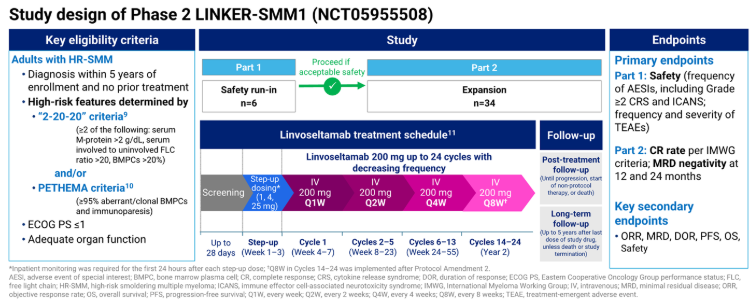
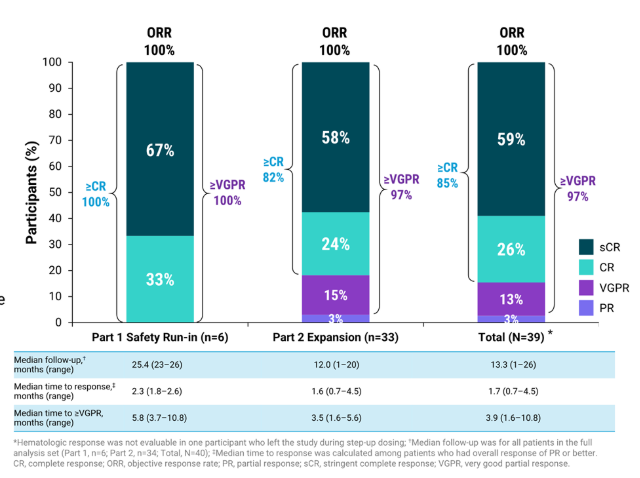
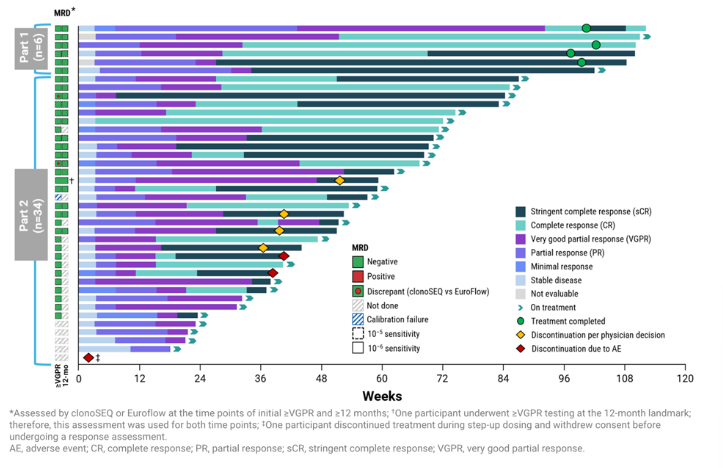
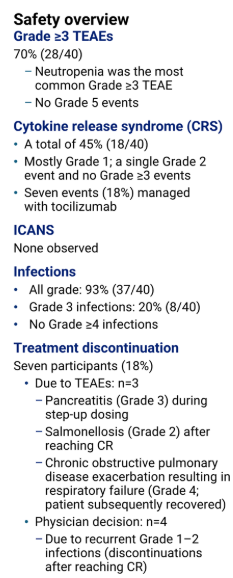 Sep 24
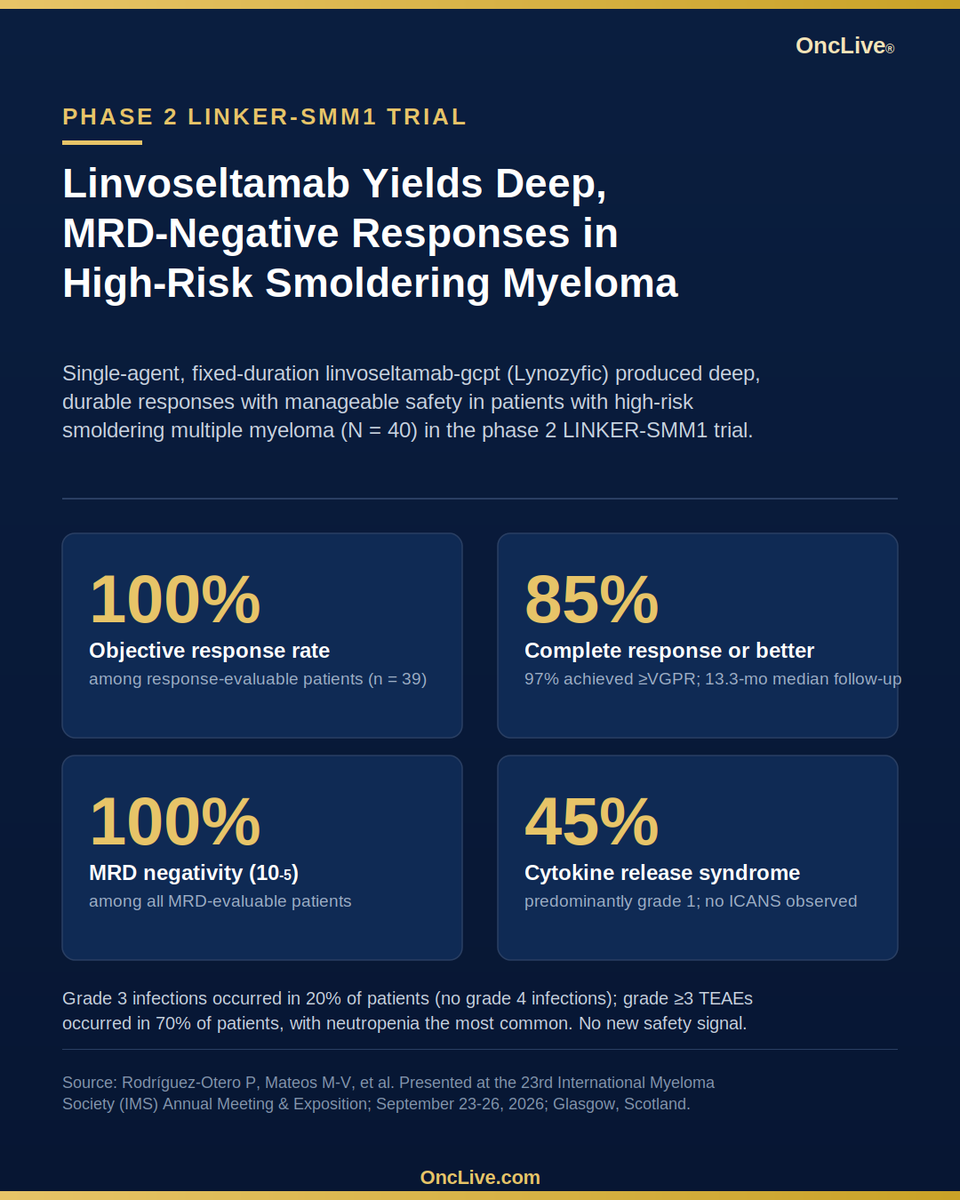
LINKER-SMM1
A 100% MRD negativity rate and an 85% complete response rate: linvoseltamab just showed what early intervention in high-risk smoldering myeloma could look like @mvmateos @Myeloma_Society #IMS26 #mmsm https://t.co/XmKoX0G6Eg https://t.co/lP7KFCvVCp
OncLive
PHASE 2 LINKER-SMM1 TRIAL
Linvoseltamab Yields Deep, MRD-Negative Responses in High-Risk Smoldering Myeloma
Single-agent, fixed-duration linvoseltamab-gcpt (Lynozyfic) produced deep, durable responses with manageable safety in patients with high-risk smoldering multiple myeloma (N = 40) in the phase 2 LINKER-SMM1 trial.
100% Objective response rate among response-evaluable patients (n = 39)
85% Complete response or better - 97% achieved ≥VGPR; 13.3-mo median follow-up
100% MRD negativity (10-5) among all MRD-evaluable patients
45% Cytokine release syndrome - predominantly grade 1; no ICANS observed
Grade 3 infections occurred in 20% of patients (no grade 4 infections); grade ≥3 TEAEs occurred in 70% of patients, with neutropenia the most common. No new safety signal.
Source: Rodriguez-Otero P, Mateos M-V, et al. Presented at the 23rd International Myeloma Society (IMS) Annual Meeting & Exposition; September 23-26, 2026; Glasgow, Scotland.
OncLive.com
Sep 23
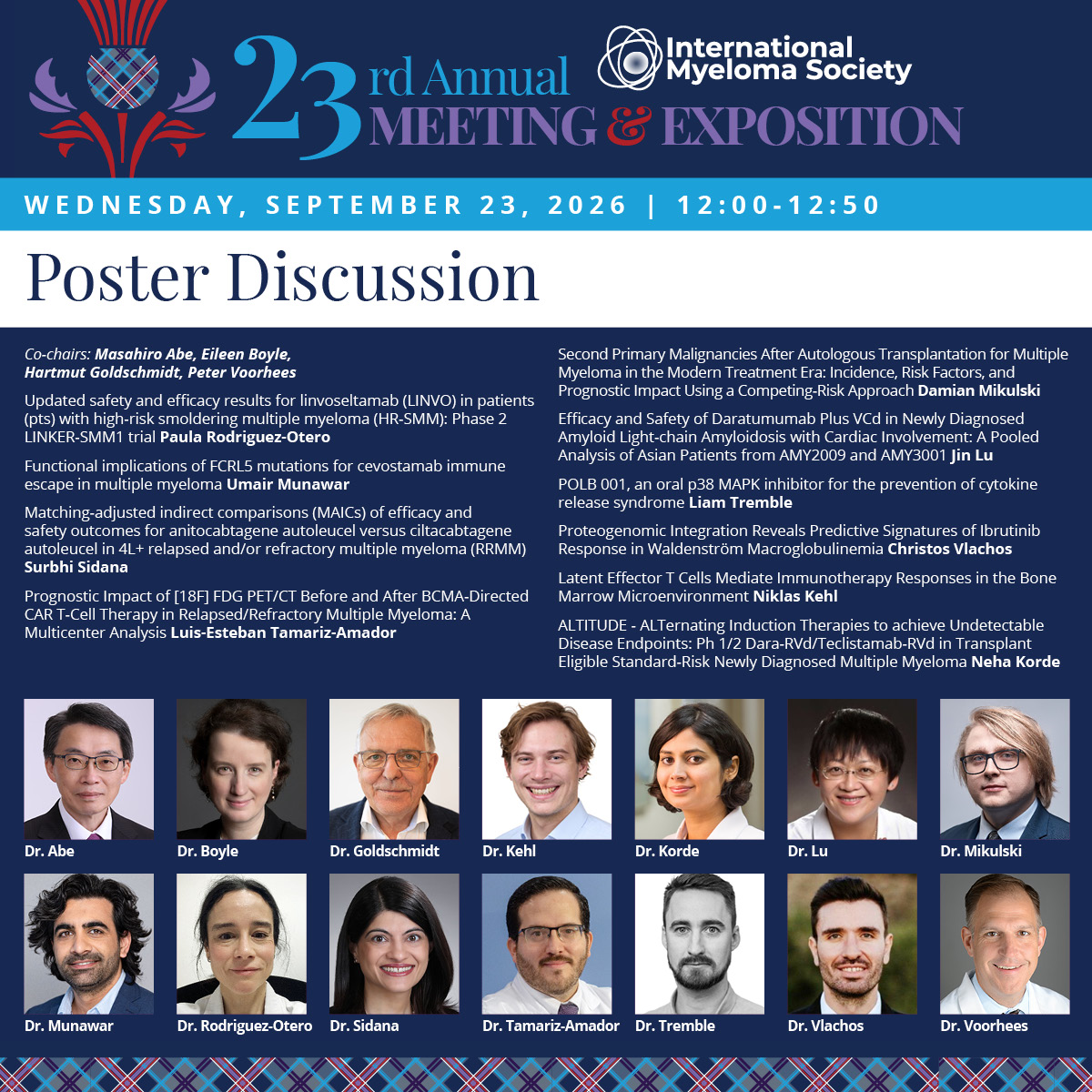
LINKER-SMM1
At 12:00 PM in Alsh: Poster Discussion. #IMS26 https://t.co/e3rEkDMfit
International Myeloma Society
23rd Annual MEETING & EXPOSITION
September 23-26, 2026 . Glasgow, Scotland
WEDNESDAY, SEPTEMBER 23, 2026 | 12:00-12:50
Poster Discussion
Co-chairs: Masahiro Abe, Eileen Boyle, Hartmut Goldschmidt, Peter Voorhees
Updated safety and efficacy results for linvoseltamab (LINVO) in patients (pts) with high-risk smoldering multiple myeloma (HR-SMM): Phase 2 LINKER-SMM1 trial Paula Rodriguez-Otero
Functional implications of FCRL5 mutations for cevostamab immune escape in multiple myeloma Umair Munawar
Matching-adjusted indirect comparisons (MAICs) of efficacy and safety outcomes for anitocabtagene autoleucel versus ciltacabtagene autoleucel in 4L+ relapsed and/or refractory multiple myeloma (RRMM) Surbhi Sidana
Prognostic Impact of [18F] FDG PET/CT Before and After BCMA-Directed CAR T-Cell Therapy in Relapsed/Refractory Multiple Myeloma: A Multicenter Analysis Luis-Esteban Tamariz-Amador
Second Primary Malignancies After Autologous Transplantation for Multiple Myeloma in the Modern Treatment Era: Incidence, Risk Factors, and Prognostic Impact Using a Competing-Risk Approach Damian Mikulski
Efficacy and Safety of Daratumumab Plus VCd in Newly Diagnosed Amyloid Light-chain Amyloidosis with Cardiac Involvement: A Pooled Analysis of Asian Patients from AMY2009 and AMY3001 Jin Lu
POLB 001, an oral p38 MAPK inhibitor for the prevention of cytokine release syndrome Liam Tremble
Proteogenomic Integration Reveals Predictive Signatures of Ibrutinib Response in Waldenstrom Macroglobulinemia Christos Vlachos
Latent Effector T Cells Mediate Immunotherapy Responses in the Bone Marrow Microenvironment Niklas Kehl
ALTITUDE - ALTernating Induction Therapies to achieve Undetectable Disease Endpoints: Ph 1/2 Dara-RVd/Teclistamab-RVd in Transplant Eligible Standard-Risk Newly Diagnosed Multiple Myeloma Neha Korde
[Photo captions] Dr. Abe / Dr. Boyle / Dr. Goldschmidt / Dr. Kehl / Dr. Korde / Dr. Lu / Dr. Mikulski / Dr. Munawar / Dr. Rodriguez-Otero / Dr. Sidana / Dr. Tamariz-Amador / Dr. Tremble / Dr. Vlachos / Dr. Voorhees
Sep 21
CEPHEUSCERVINOEXCALIBER-RRMMGEM2014MAINIBEXMIDAS
Have fun in Glasgow! 🇬🇧🏴
Don’t get lost at #IMS2026—too much great science, too many simultaneous sessions!
Follow the roadmap. Don’t miss the practice-changing data.
And don’t forget your single malt…after the final session! 🥃😆
#MultipleMyeloma #mmsm #Medtwitter https://t.co/eCVPDMHoDu
DON'T GET LOST AT IMS 2026
GLASGOW - SEPTEMBER 23-26
THE MUST-SEE ROADMAP
PEOPLE SCIENCE PROGRESS TOGETHER | BIGGER SCIENCE A BRIGHTER TOMORROW | GLASGOW WELCOMES A BRIGHTER TOMORROW
THURSDAY - SEPT 24 5:00-6:00 PM - HALL 5
MRD & MAINTENANCE (MRD: DEEPER ANSWERS BRIGHTER TOMORROWS)
- MIDAS: Isa-iberdomide
- CASSIOPEIA: 5-year sustained MRD
- GEM2014MAIN: MRD-guided stopping
- IBEX: Iber-Dara post-ASCT
FRIDAY - SEPT 25 3:00-5:00 PM - HALL 5 DO NOT MISS
THE PLENARY - DO NOT MISS (BOLD SCIENCE CHANGES LIVES)
- CERVINO: Etentamig vs standard therapy
- PERSEUS: Does long-term PFS become OS?
- EXCALIBER-RRMM: IberDd vs DVd
- First-in-human CD19/BCMA in-vivo CAR-T
SAME QUESTIONS. A BRIGHTER TOMORROW.
SATURDAY - SEPT 26
8:30-9:30 AM - HALL 5
THE NEXT CELLULAR-THERAPY ERA (CELLULAR THERAPIES: REAL POTENTIAL FOR REAL PEOPLE)
- Updated CEPHEUS MRD
- BCMAxGPRC5D dual-target CAR-T
- IASO206: IV in-vivo BCMA CAR-T
11:00 AM-12:00 PM - HALL 5
- Post-CAR-T elranatamab
- Delayed cilta-cel neurotoxicity
- MRD-guided T-cell redirection
11:00 AM-12:00 PM - LOMOND
- CAR-T enterocolitis biology
1:00-2:00 PM - LOMOND
- LV169: lentiviral in-vivo BCMA CAR delivery
Same goal. Brighter lives.
WHAT TO WATCH (DIFFERENT PERSPECTIVES A CLEARER FUTURE)
- Durability - OS - sustained MRD - infection burden
- Access - treatment-free time - late toxicity
- In-vivo CAR-T: insertion sites, off-target transduction, vector shedding & persistence
Go for the randomized data and the biology--not every new response rate.
Single malt only AFTER the final session.
SAME CURIOSITY FURTHER TOGETHER | GREAT SCIENCE DESERVES A DRAM
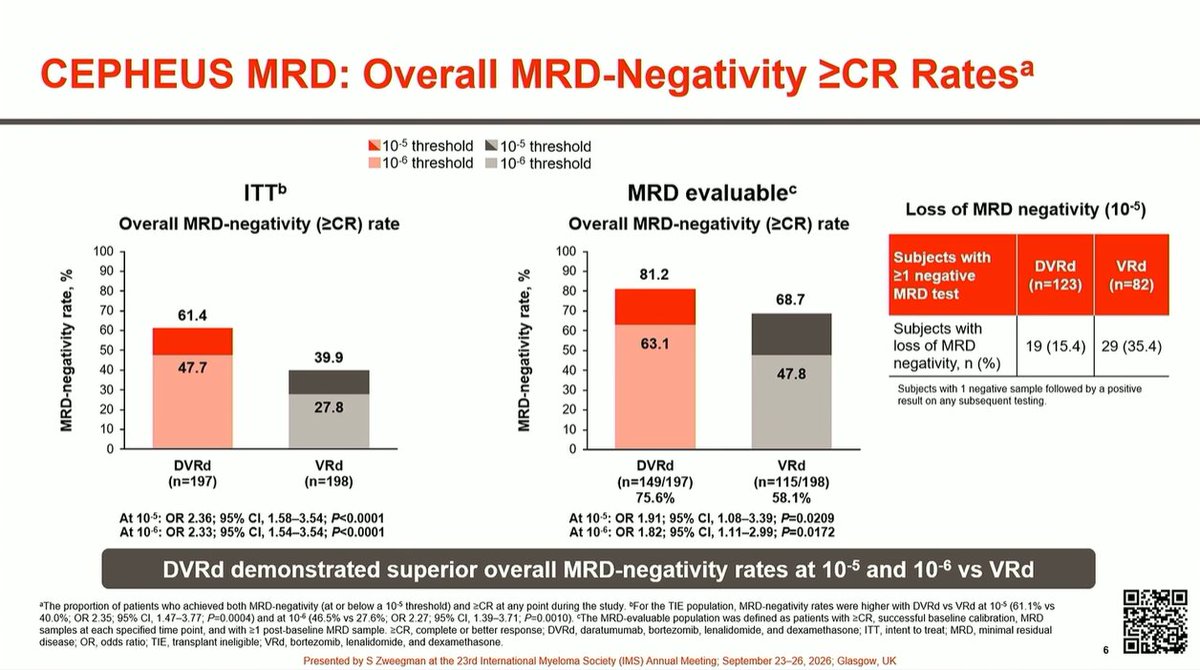
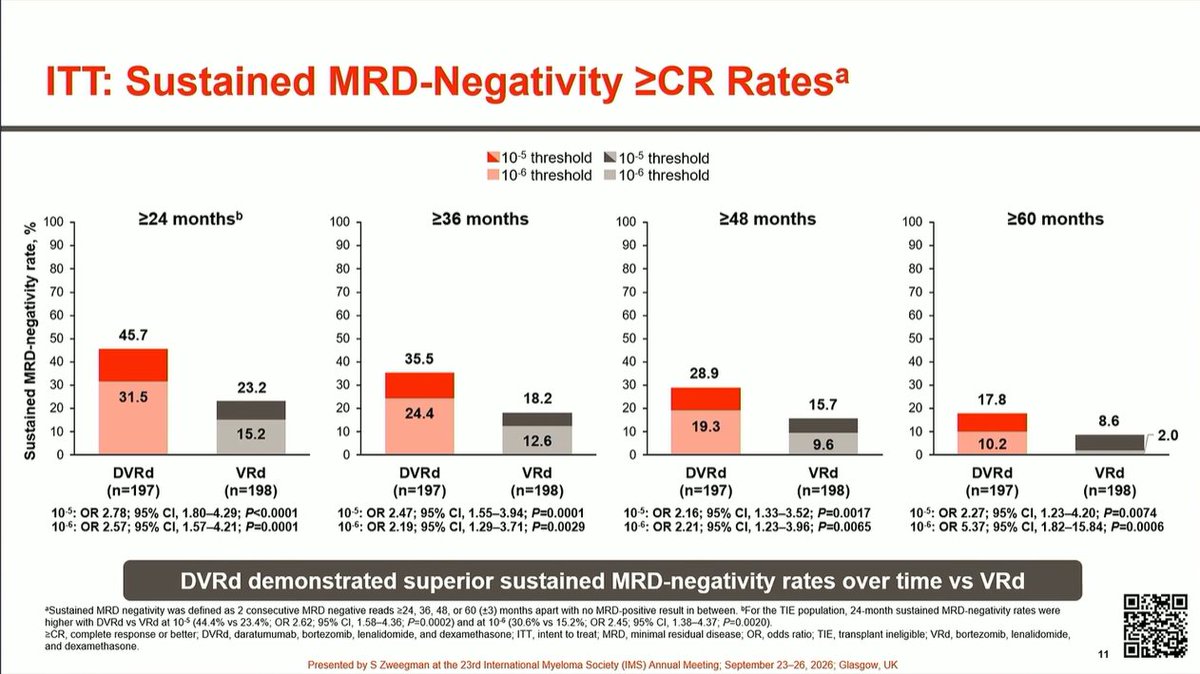
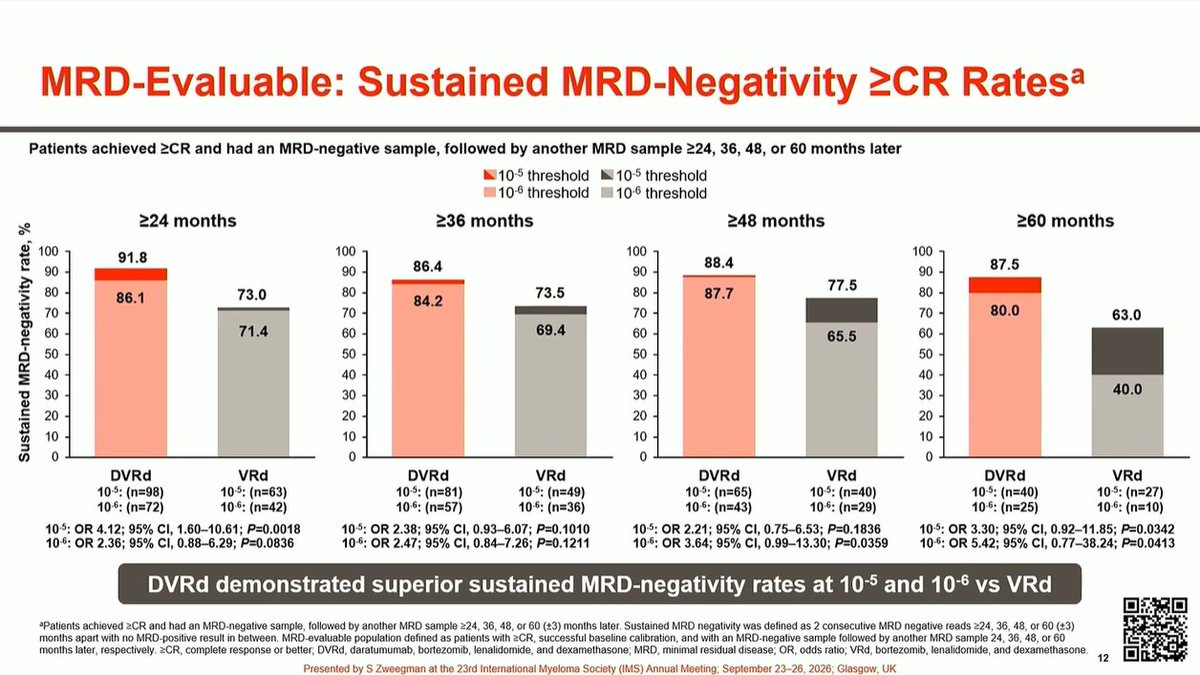
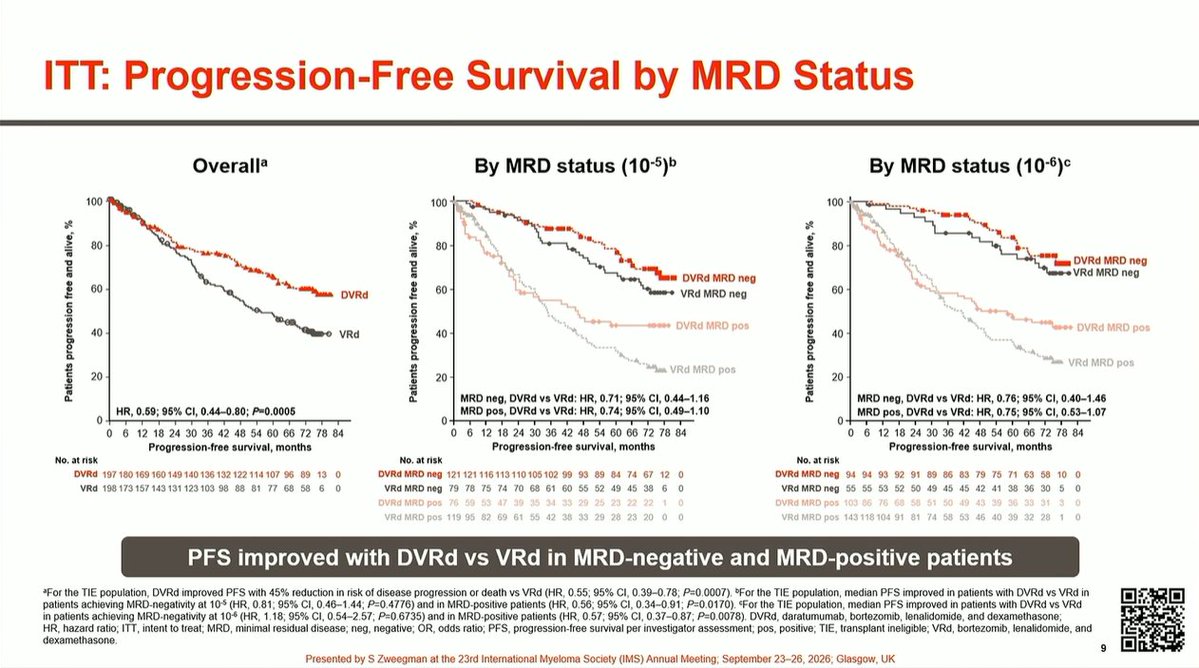
 Sep 21
CEPHEUSIMROZPERSEUS
NCT04751877 trial: Updated data from IMS 2026 (@Myeloma_Society) in 1L MM: anti-CD38 mAbs landscape, adapted from Dr. Akhil Santhosh (@tuttsakhil) 👉 https://t.co/V8wOYggpnM
Updated landscape 👉 https://t.co/fUETXB1mH1
Learn more about NCT04751877: https://t.co/YYmevH13Fd
#LARVOL #IMS2026 #InternationalMyelomaSociety #Myeloma #MMSM #HematologicOncology #Hematology #BloodCancers #CancerResearch #CancerData #Oncology #OncologyInsights #ClinicalTrials | @mtmdphd | @szusmani | @RahulBanerjeeMD |
| @End_myeloma | @VincentRK
Updated NCT04751877 Data in 1L MM: anti-CD38 mAbs - IMS 2026
Trials: Perseus (EMN) | IMROZ (sanofi) | NCT04751877 (CHU Poitiers) | CEPHEUS (Janssen, Pharmaceutical Companies of Johnson & Johnson)
Treatment Regimen:
Perseus: Daratumumab + Bortezomib + Lenalidomide + Dexamethasone vs Bortezomib + Lenalidomide + Dexamethasone
IMROZ: Isatuximab + Bortezomib + Lenalidomide + Dexamethasone vs Bortezomib + Lenalidomide + Dexamethasone
NCT04751877: Isatuximab + Lenalidomide + Dexamethasone +/- Bortezomib vs Isatuximab + Lenalidomide + Dexamethasone
CEPHEUS: Isatuximab + Bortezomib + Lenalidomide + Dexamethasone vs Bortezomib + Lenalidomide + Dexamethasone
Median Follow-Up:
Perseus: 47.5 months | IMROZ: 59.7 months | NCT04751877: 48.9 months | CEPHEUS: 76.0 months
PFS:
Perseus: 48 mo: 84.3% vs 67.7%
IMROZ: 60 mo: 63.2% vs 45.2%
NCT04751877: 18 mo: 87.2% vs 85.5%; 24 mo: 85.2% vs 80%; 36 mo: 78% vs 72.3%; 48 mo: 74% vs 65.7%
CEPHEUS: 54 mo: 68.1% vs 49.5%; 72 mo: 59.3% vs 38.3%
ORR%:
Perseus: 96.6% vs 93.8% | IMROZ: 91.3% vs 92.3% | NCT04751877: 85% vs 78% | CEPHEUS: 97% vs 93%
MRD negativity rate:
Perseus: 75.2% vs 47.5% | IMROZ: 58.1% vs 43.6% | NCT04751877: 12 mo: 51% vs 21% | CEPHEUS: 61.1% vs 40%
≥CR rate:
Perseus: 87.9% vs 70.1% | IMROZ: 74.7% vs 64.1% | NCT04751877: 58% vs 31% | CEPHEUS: 80.6% vs 61.4%
Adapted from Dr. Akhil Santhosh (X 2025)
LARVOL
ProMMise
3 slides Sep 23

ProMMise
Can belantamab monitoring become simpler?
Prof. Rakesh Popat (@DrRakeshPopat) presenting the ProMMise D trial at #IMS2026: the symptom-based VRAT showed a 98.2% negative predictive value for significant ocular toxicity, while reduced-frequency BVd (Q8W → Q12W) was well https://t.co/AQ9qpZm5bz
Photo of auditorium screen, slide "Conclusions" (UKMRA - UK Myeloma Research Alliance):
- The VRAT demonstrated a high negative predictive value (98.2%) for detecting significant ocular adverse events with BVd
- This may be an effective method of detecting significant keratopathy and visual acuity changes without the need for ocular examination
- A lower positive predictive value suggests a conservative approach
- There may be dose holds in the absence of significant keratopathy
- The VRAT may be subjective to patient/HCP interpretation
- Training is required of the questionnaire to ensure accuracy and reproducibility
- Confirmatory data will be provided by the ongoing Stage 2
- Assessment of VRAT safety in the absence of ocular examinations
- Reduced frequency BVd schedule was well tolerated
- Belamaf Q8W followed by Q12W maintenance with weekly bortezomib associated with few dose modifications and interruptions
HCP: Health Care Professional
Sep 23

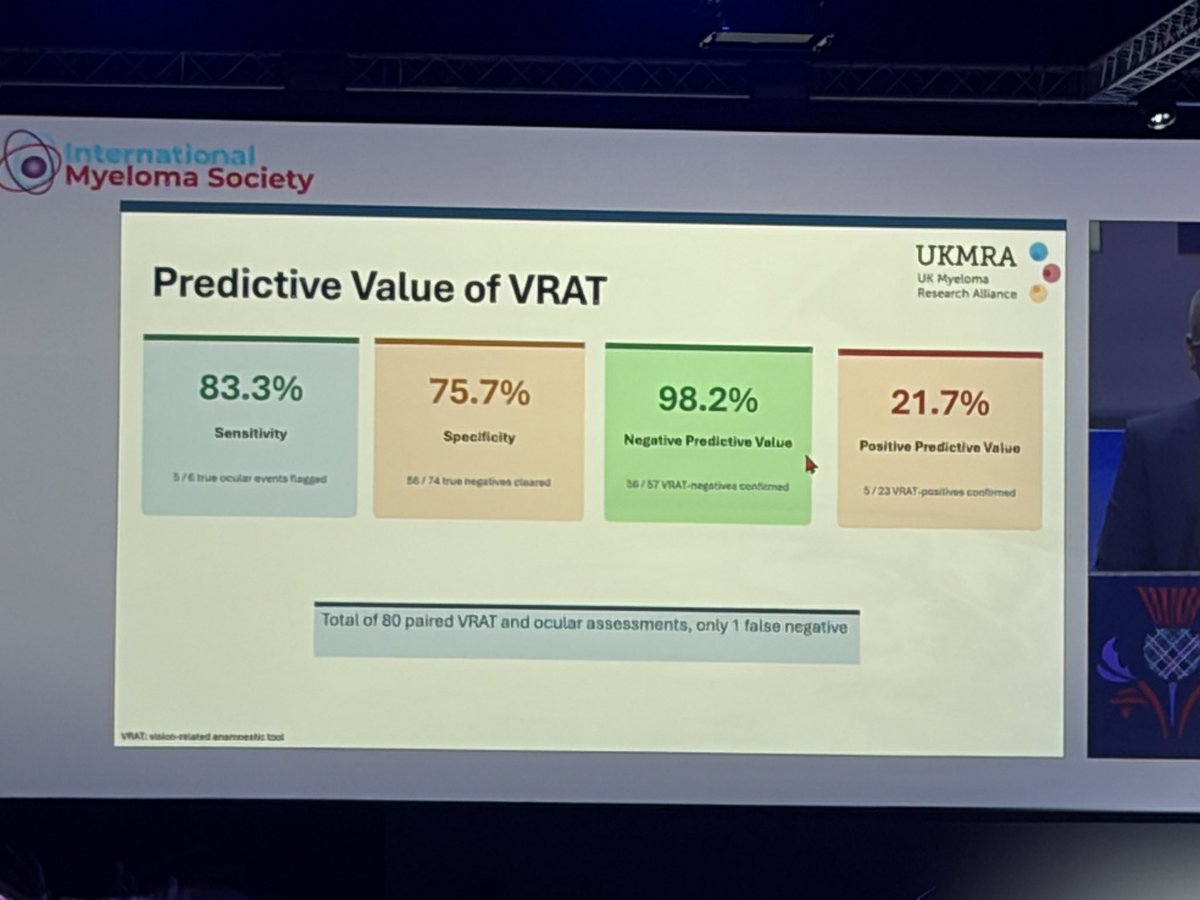

ProMMise
ProMMise: VRAT-guided Belamaf dosing
👁️ #IMS2026: ProMMise shows the patient-reported VRAT tool flags ocular AEs in pts on belamaf
💡Q8W dosing well tolerated (8.6% dose reductions).
💡Small Stage 1 cohort (n=40)
💡high NPV 98%, low PPV 20%
💡Will be interesting to see if VRAT-only dosing in Stage 2 hold up without any mandated eye exams as a safety net?
#MultipleMyeloma #MMsm #Belamaf @Myeloma_Society @DrRakeshPopat
International Myeloma Society
ProMMise: Study Schema
UKMRA UK Myeloma Research Alliance
Relapsed myeloma 1-3 prior lines of therapy ->
Stage 1: BelaMaf* + bortezomib + dexamethasone, N=40
- Eye symptom questionnaire (VRAT)
- Ocular Examination
Stop/go — Endpoint: Toxicity
Stage 2: BelaMaf* + bortezomib + dexamethasone, N=60
- Eye symptom questionnaire (VRAT)
X Ocular Examination
Endpoints:
Primary: Safety
Secondary: Response rate (>=VGPR), PFS, OS
Dosing Schedule: Cycles 1-6 | Cycle 7+; Belamaf Q8W [then] Belamaf Q12W; Weekly Bortezomib (x4) + Dexamethasone (x8); Observation and response assessment only
Reduced intensity schedule:
- Belamaf Q8 for 6 months then Q12
- Bortezomib weekly for 6 months
BelaMaf: Belantamab Mafodotin; VRAT: vision-related anamnestic tool
International Myeloma Society
Predictive Value of VRAT
UKMRA UK Myeloma Research Alliance
83.3% Sensitivity — 5 / 6 true ocular events flagged
75.7% Specificity — 56 / 74 true negatives cleared
98.2% Negative Predictive Value — 56 / 57 VRAT-negatives confirmed
21.7% Positive Predictive Value — 5 / 23 VRAT-positives confirmed
Total of 80 paired VRAT and ocular assessments, only 1 false negative
VRAT: vision-related anamnestic tool
International Myeloma Society
Conclusions
UKMRA UK Myeloma Research Alliance
- The VRAT demonstrated a high negative predictive value (98.2%) for detecting significant ocular adverse events with BVd
- This may be an effective method of detecting significant keratopathy and visual acuity changes without the need for ocular examination
- A lower positive predictive value suggests a conservative approach
- There may be dose holds in the absence of significant keratopathy
- The VRAT may be subjective to patient/ HCP interpretation
- Training is required of the questionnaire to ensure accuracy and reproducibility
- Confirmatory data will be provided by the ongoing Stage 2
- Assessment of VRAT safety in the absence of ocular examinations
- Reduced frequency BVd schedule was well tolerated
- Belamaf Q8W followed by Q12W maintenance with weekly bortezomib was associated with few dose modifications and interruptions
HCP: Health Care Professional
Sep 23
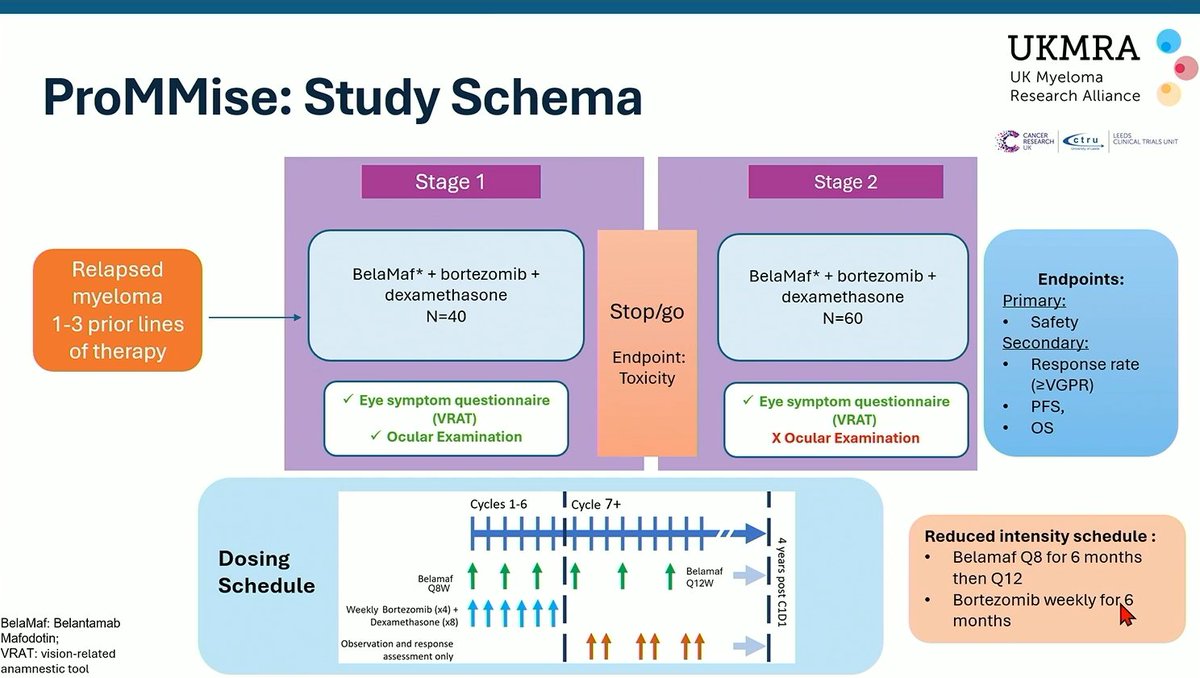
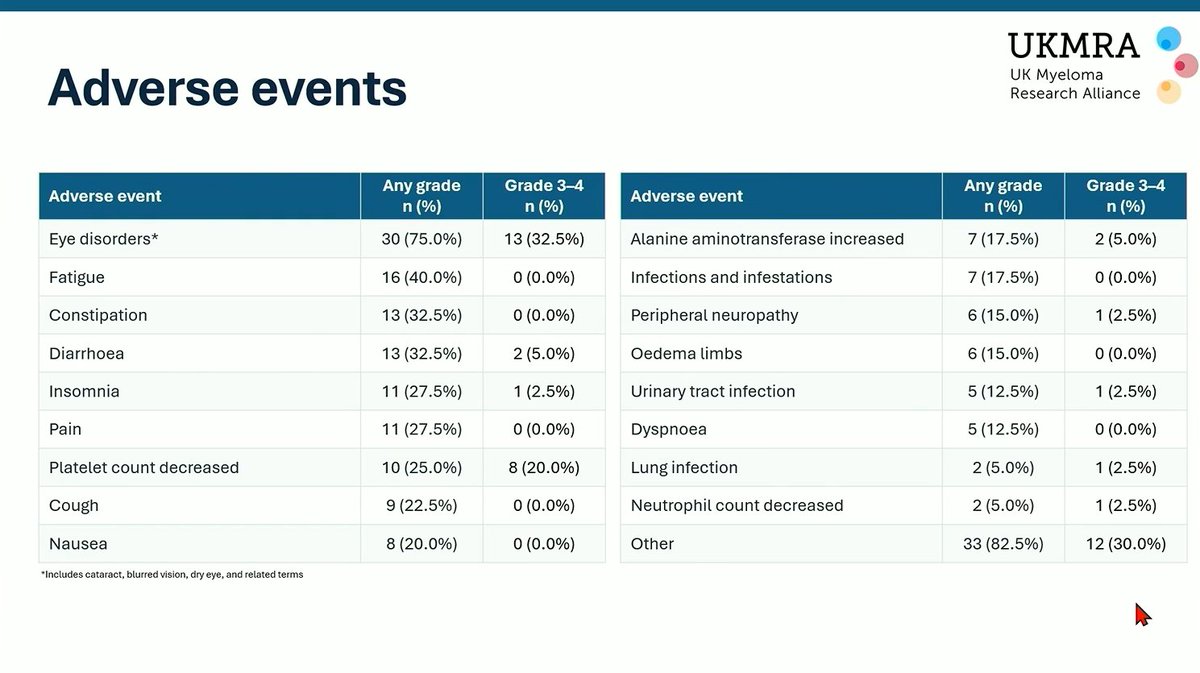
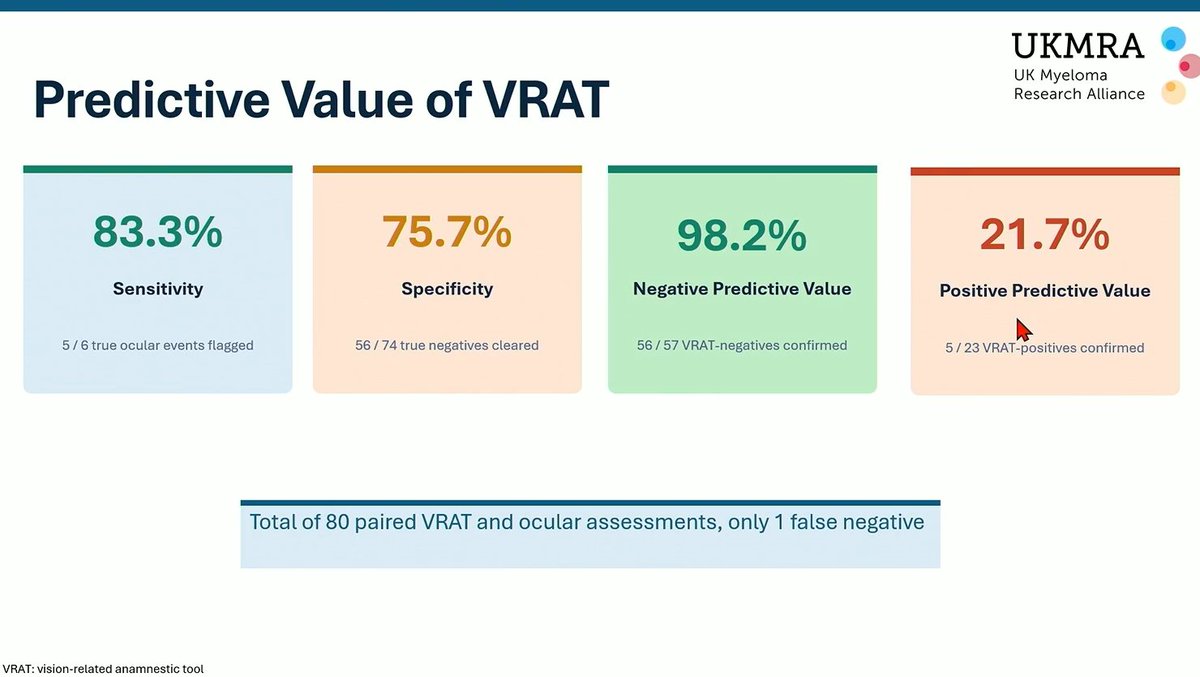

ProMMise
CONGRESS | #IMS26 | PRESENTATION
Rakesh Popat presents interim Stage 1 results from Arm D of the UKMRA ProMMise trial, evaluating a vision-related anamnestic tool (VRAT) to guide belantamab mafodotin (belamaf) dosing without routine ocular examinations in patients with RRMM https://t.co/bRNa3g1NJs
ProMMise: Study Schema
(UKMRA - UK Myeloma Research Alliance)
Relapsed myeloma, 1-3 prior lines of therapy ->
Stage 1: BelaMaf* + bortezomib + dexamethasone, N=40
- Eye symptom questionnaire (VRAT): check
- Ocular Examination: check
Stop/go, Endpoint: Toxicity
Stage 2: BelaMaf* + bortezomib + dexamethasone, N=60
- Eye symptom questionnaire (VRAT): check
- Ocular Examination: X (not performed)
Endpoints:
Primary: Safety
Secondary: Response rate (≥VGPR), PFS, OS
Dosing Schedule diagram:
Cycles 1-6 | Cycle 7+
Belamaf: Q8W (cycles 1-6) then Q12W (cycle 7+, 4 years post C1D1)
Weekly Bortezomib (x4) + Dexamethasone (x8) during cycles 1-6; Observation and response assessment only in cycle 7+
Reduced intensity schedule:
- Belamaf Q8 for 6 months then Q12
- Bortezomib weekly for 6 months
BelaMaf: Belantamab Mafodotin; VRAT: vision-related anamnestic tool
Adverse events
Table (left):
Adverse event | Any grade n (%) | Grade 3-4 n (%)
Eye disorders*: 30 (75.0%) | 13 (32.5%)
Fatigue: 16 (40.0%) | 0 (0.0%)
Constipation: 13 (32.5%) | 0 (0.0%)
Diarrhoea: 13 (32.5%) | 2 (5.0%)
Insomnia: 11 (27.5%) | 1 (2.5%)
Pain: 11 (27.5%) | 0 (0.0%)
Platelet count decreased: 10 (25.0%) | 8 (20.0%)
Cough: 9 (22.5%) | 0 (0.0%)
Nausea: 8 (20.0%) | 0 (0.0%)
Table (right):
Adverse event | Any grade n (%) | Grade 3-4 n (%)
Alanine aminotransferase increased: 7 (17.5%) | 2 (5.0%)
Infections and infestations: 7 (17.5%) | 0 (0.0%)
Peripheral neuropathy: 6 (15.0%) | 1 (2.5%)
Oedema limbs: 6 (15.0%) | 0 (0.0%)
Urinary tract infection: 5 (12.5%) | 1 (2.5%)
Dyspnoea: 5 (12.5%) | 0 (0.0%)
Lung infection: 2 (5.0%) | 1 (2.5%)
Neutrophil count decreased: 2 (5.0%) | 1 (2.5%)
Other: 33 (82.5%) | 12 (30.0%)
*Includes cataract, blurred vision, dry eye, and related terms
Predictive Value of VRAT
83.3% - Sensitivity - 5/6 true ocular events flagged
75.7% - Specificity - 56/74 true negatives cleared
98.2% - Negative Predictive Value - 56/57 VRAT-negatives confirmed
21.7% - Positive Predictive Value - 5/23 VRAT-positives confirmed
Total of 80 paired VRAT and ocular assessments, only 1 false negative
VRAT: vision-related anamnestic tool
Treatment Compliance: Belantamab Mafodotin
Dose reductions:
Cycles per participant with modification
Mean (SD): 0.1 (0.27)
Median (IQR): 0.0 (0.0, 0.0)
Range: 0 - 1
N: 40
Reason for dose modification: Toxicity 1 (33.3%), Other 2 (66.7%), Total 3 (100.0%)
3 (8%) patients required dose reduction
Dose interruptions:
Cycles per participant with modification
Mean (SD): 0.6 (1.24)
Median (IQR): 0.0 (0.0, 1.0)
Range: 0 - 7
N: 40
Reason for dose modification: Toxicity 19 (79.2%), Other 5 (20.8%), Total 24 (100.0%)
14 (35%) patients had a dose interruption
Low rates of dose reductions and interruptions with Q8W followed by Q12W Belamaf dosing
UKMRA RADAR
3 slides
Sep 24

UKMRA RADAR
#mmsm #IMS26 oral data on UKMRA RADAR trial of Isa-VRD and QoL
Slide speaks volume about the issue with such data which is very limited with way lower number of patients completing surveys : for example at 1 year 2 out of 3 patients didn’t complete responses
Really hard to make any conclusions based on the very high % of lack of data
QoL Completion
- 68/70 participants consented to QoL data collection
- Data is immature for 12 and 24 months as follow-up is ongoing
(Complete case set analysis; Descriptive analysis)
Table, columns: Baseline | End of Induction | 100 days Post-ASCT | 6 Months | 12 Months | 24 Months | Total
Questionnaire completed?
Yes: 64 (94.1%) | 54 (79.4%) | 44 (64.7%) | 36 (52.9%) | 25 (36.8%) | 1 (1.5%) | 224 (54.9%)
No: 4 (5.9%) | 14 (20.6%) | 24 (35.3%) | 32 (47.1%) | 43 (63.2%) | 67 (98.5%) | 184 (45.1%)
Total: 68 (100%) | 68 (100%) | 68 (100%) | 68 (100%) | 68 (100%) | 68 (100%) | 408 (100%)
Reason not completed:
Reason Unknown: 2 (50.0%) | 7 (50.0%) | 14 (58.3%) | 24 (75.0%) | 26 (60.5%) | 0 (0.0%) | 73 (39.7%)
Timepoint not yet reached: 0 (0.0%) | 0 (0.0%) | 0 (0.0%) | 0 (0.0%) | 8 (18.6%) | 56 (83.6%) | 64 (34.8%)
Participant Death: 0 (0.0%) | 0 (0.0%) | 3 (12.5%) | 4 (12.5%) | 6 (14.0%) | 7 (10.4%) | 20 (10.9%)
Participant Withdrawal: 0 (0.0%) | 1 (7.1%) | 1 (4.2%) | 3 (9.4%) | 3 (7.0%) | 4 (6.0%) | 12 (6.5%)
Either not completed or misplaced by site: 1 (25.0%) | 1 (7.1%) | 3 (12.5%) | 0 (0.0%) | 0 (0.0%) | 0 (0.0%) | 5 (2.7%)
Admin error: 0 (0.0%) | 3 (21.4%) | 0 (0.0%) | 0 (0.0%) | 0 (0.0%) | 0 (0.0%) | 3 (1.6%)
Lost in post: 0 (0.0%) | 2 (14.3%) | 1 (4.2%) | 0 (0.0%) | 0 (0.0%) | 0 (0.0%) | 3 (1.6%)
Other: 1 (25.0%) | 0 (0.0%) | 0 (0.0%) | 1 (3.1%) | 0 (0.0%) | 0 (0.0%) | 2 (1.1%)
Participant refused: 0 (0.0%) | 0 (0.0%) | 1 (4.2%) | 0 (0.0%) | 0 (0.0%) | 0 (0.0%) | 1 (0.5%)
Site missed in error: 0 (0.0%) | 0 (0.0%) | 1 (4.2%) | 0 (0.0%) | 0 (0.0%) | 0 (0.0%) | 1 (0.5%)
Total: 4 (100%) | 14 (100%) | 24 (100%) | 32 (100%) | 43 (100%) | 67 (100%) | 184 (100%)
(Note: percentages for "Timepoint not yet reached" 24-month value shown on slide as 56 (63.6%) though row total math suggests possible slide rounding; transcribed exactly as displayed: 56 (63.6%).)
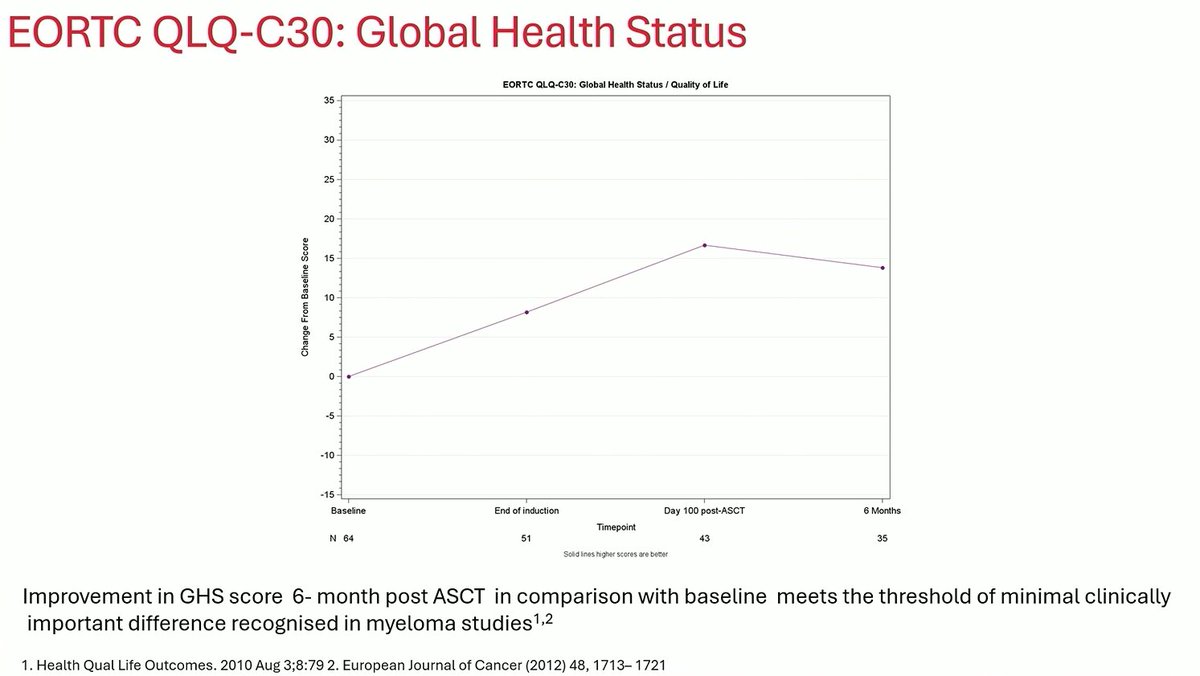


 Sep 24
CAMMA 1DREAMM-9MajesTEC-3UKMRA RADAR
Abstract Sessions begin at 11:00 AM. Join us in Hall 5 for Abstract Session 3 or Lomond Auditorium for Abstract Session 4. #IMS26 https://t.co/HPzirIbOLS
23rd Annual MEETING & EXPOSITION - International Myeloma Society
THURSDAY, SEPTEMBER 24, 2026 | 11:00-12:00
Abstract Session 3
Co-chairs: Meral Beksac and Martin Kortum
- Double hit ultra-high risk myeloma treated with Isa-VRD plus cyclophosphamide induction and Isa-VRD consolidation: QoL analysis of the UKMRA RADAR trial in newly diagnosed transplant eligible patients - Karthik Ramasamy
- Updated safety and efficacy of ramantamig (Ram; JNJ-5322) at the recommended phase 2 dose (RP2D), demonstrating feasibility of outpatient dosing (OPD) in relapsed/refractory multiple myeloma (RRMM) - Jeffrey Matous
- DREAMM-9 Patient-Reported Vision-Related Function with Extended Belantamab Mafodotin Dosing Intervals with Bortezomib, Lenalidomide, Dexamethasone (BVRd) in Transplant Ineligible Multiple Myeloma - Hang Quach
- A fixed-duration, modified cevostamab dosing regimen induces durable remissions that continue after completion in BCMA-naive pts with relapsed/refractory multiple myeloma (RRMM): CAMMA 1 Arm A results - Amrita Krishnan
- Overall Survival, Progression and Non-Relapse Mortality With Teclistamab Plus Daratumumab (Tec-Dara) vs Dara-Based Triplets in Relapsed/Refractory Multiple Myeloma (RRMM): MajesTEC-3 Post Hoc Analysis - Luciano Costa
Panelist photos shown: Dr. Beksac, Dr. Kortum, Dr. Matous, Dr. Ramasamy, Dr. Costa, Dr. Krishnan, Dr. Quach
23rd Annual MEETING & EXPOSITION - International Myeloma Society
THURSDAY, SEPTEMBER 24, 2026 | 11:00-12:00
Abstract Session 4
Co-chairs: Lugui Qiu and Niels van de Donk
- Augmenting TRAIL-dependent apoptosis enables BCMA CAR-T cells to overcome resistance in multiple myeloma - Mansour Poorebrahim
- First-in-human phase Ia/Ib study of QLS32015 (GPRC5DxCD3) in patients (pts) with relapsed/refractory multiple myeloma (RRMM): updated safety and efficacy data - Jian Cui
- An AI-Designed BCMA/FcRL5 Targeting TriTE Overcomes Antigen Escape and Outperforms BCMA-Directed Therapy in Multiple Myeloma - Jessica Encinas Mayoral
- A CD4-Dominant, T-Helper-Skewed T Cell State Underlies Movement and Neurocognitive Toxicity After BCMA-Directed CAR-T Therapy in Multiple Myeloma - Theresia Akhlaghi
- Single-cell antigen:TCR mapping reveals tumor-specific effector T-cell responses in multiple myeloma - David Avigan
Panelist photos shown: Dr. Akhlaghi, Dr. Avigan, Dr. Cui, Dr. Encinas Mayoral, Dr. Poorebrahim, Dr. Qiu, Dr. van de Donk
Sep 23
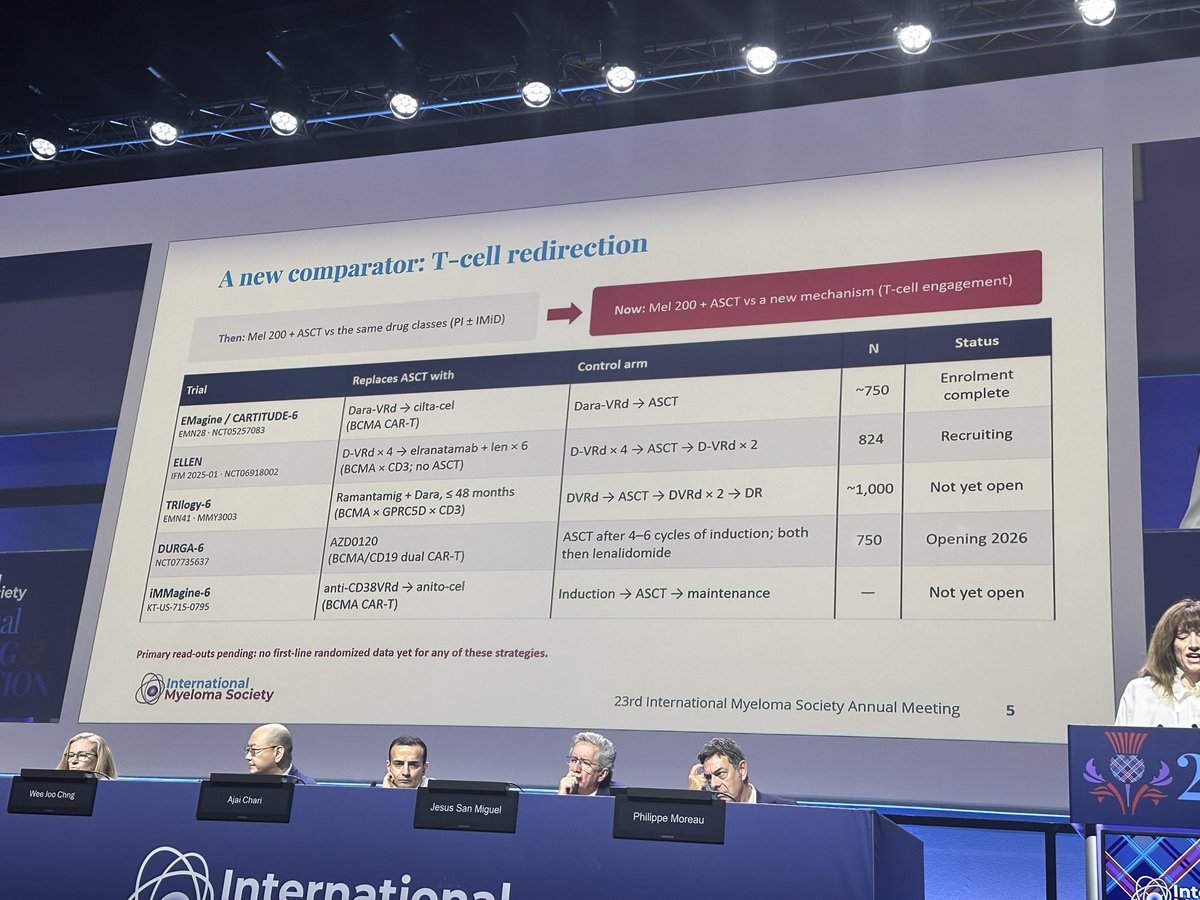
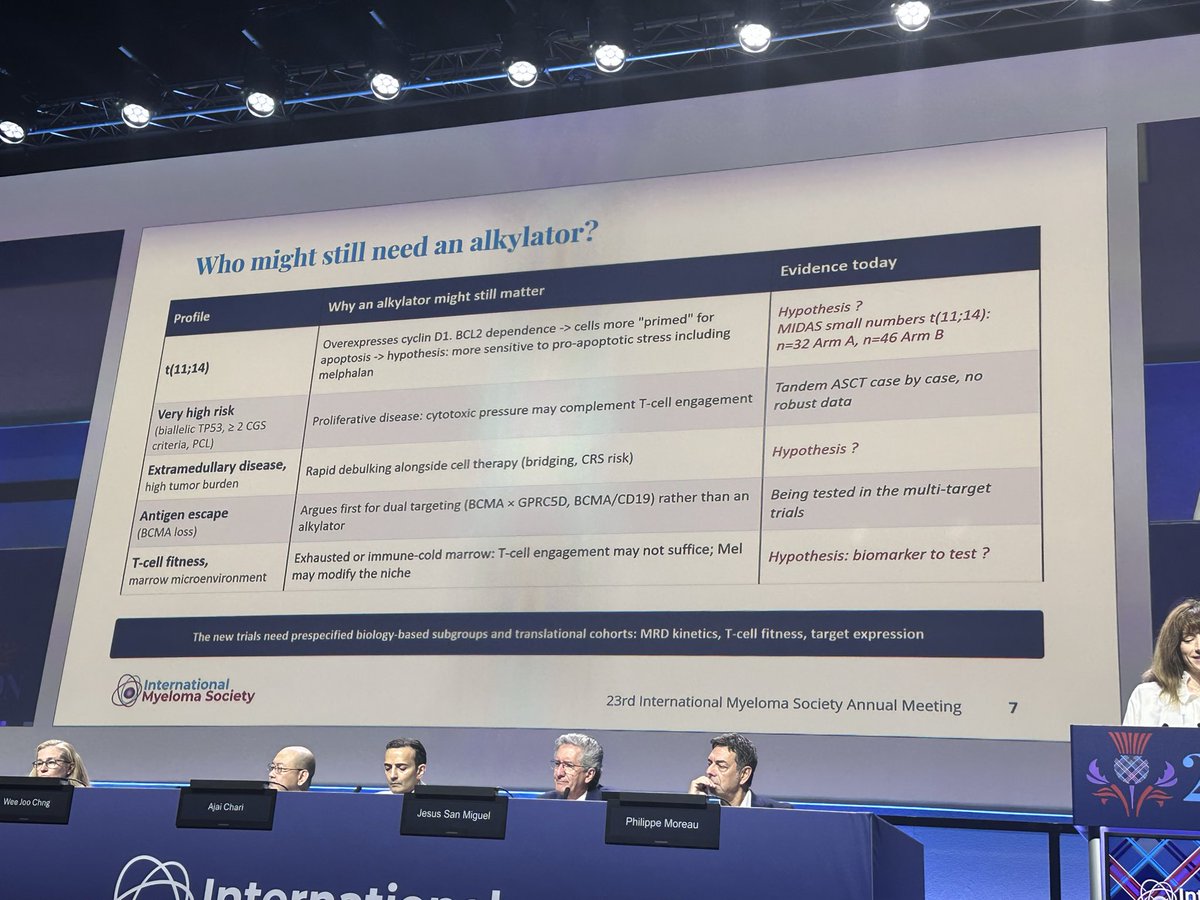
EMagine/CARTITUDE-6DURGA-6ELLENiMMagine-6TRIlogy-6
#IMS2026 the million usd question: do we need ASCT? @Myeloma_Society Aurore Perrot gave a great summary on current past & ongoing RCTs https://t.co/ava8wp4Ksi
A new comparator: T-cell redirection
Then: Mel 200 + ASCT vs the same drug classes (PI ± IMiD) → Now: Mel 200 + ASCT vs a new mechanism (T-cell engagement)
Trial | Replaces ASCT with | Control arm | N | Status
EMagine / CARTITUDE-6 (EMN28 · NCT05257083) | Dara-VRd → cilta-cel (BCMA CAR-T) | Dara-VRd → ASCT | ~750 | Enrolment complete
ELLEN (IFM 2025-01 · NCT06918002) | D-VRd × 4 → elranatamab + len × 6 (BCMA × CD3; no ASCT) | D-VRd × 4 → ASCT → D-VRd × 2 | 824 | Recruiting
TRIlogy-6 (EMN41 · MMY3003) | Ramantamig + Dara, ≤ 48 months (BCMA × GPRC5D × CD3) | DVRd → ASCT → DVRd × 2 → DR | ~1,000 | Not yet open
DURGA-6 (NCT07735637) | AZD0120 (BCMA/CD19 dual CAR-T) | ASCT after 4-6 cycles of induction; both then lenalidomide | 750 | Opening 2026
iMMagine-6 (KT-US-715-0795) | anti-CD38VRd → anito-cel (BCMA CAR-T) | Induction → ASCT → maintenance | — | Not yet open
Primary read-outs pending: no first-line randomized data yet for any of these strategies.
International Myeloma Society — 23rd International Myeloma Society Annual Meeting — 5
Who might still need an alkylator?
Profile | Why an alkylator might still matter | Evidence today
t(11;14) | Overexpresses cyclin D1. BCL2 dependence -> cells more "primed" for apoptosis -> hypothesis: more sensitive to pro-apoptotic stress including melphalan | Hypothesis? MIDAS small numbers t(11;14): n=32 Arm A, n=46 Arm B
Very high risk (biallelic TP53, ≥ 2 CGS criteria, PCL) | Proliferative disease: cytotoxic pressure may complement T-cell engagement | Tandem ASCT case by case, no robust data
Extramedullary disease, high tumor burden | Rapid debulking alongside cell therapy (bridging, CRS risk) | Hypothesis?
Antigen escape (BCMA loss) | Argues first for dual targeting (BCMA × GPRC5D, BCMA/CD19) rather than an alkylator | Being tested in the multi-target trials
T-cell fitness, marrow microenvironment | Exhausted or immune-cold marrow: T-cell engagement may not suffice; Mel may modify the niche | Hypothesis: biomarker to test?
The new trials need prespecified biology-based subgroups and translational cohorts: MRD kinetics, T-cell fitness, target expression
International Myeloma Society — 23rd International Myeloma Society Annual Meeting — 7
 Sep 23

EMagine/CARTITUDE-6DURGA-6ELLENiMMagine-6TRIlogy-6
Now, CAR-T cells and bispecific antibodies are entering head-to-head trials against transplant-based strategies in newly diagnosed myeloma.
The destination is not yet known, but the journey could redefine the standard of care. Exciting times at #IMS2026 in Glasgow! @TheIACH @COMyCongress
A new comparator: T-cell redirection
Then: Mel 200 + ASCT vs the same drug classes (PI ± IMiD) → Now: Mel 200 + ASCT vs a new mechanism (T-cell engagement)
Trial | Replaces ASCT with | Control arm | N | Status
EMagine / CARTITUDE-6
EMN28 · NCT05257083 | Dara-VRd → cilta-cel (BCMA CAR-T) | Dara-VRd → ASCT | ~750 | Enrolment complete
ELLEN
IFM 2025-01 · NCT06918002 | D-VRd × 4 → elranatamab + len × 6 (BCMA × CD3; no ASCT) | D-VRd × 4 → ASCT → D-VRd × 2 | 824 | Recruiting
TRIlogy-6
EMN41 · MMY3003 | Ramantamig + Dara, ≤ 48 months (BCMA × GPRC5D × CD3) | DVRd → ASCT → DVRd × 2 → DR | ~1,000 | Not yet open
DURGA-6
NCT07735637 | AZD0120 (BCMA/CD19 dual CAR-T) | ASCT after 4–6 cycles of induction; both then lenalidomide | 750 | Opening 2026
iMMagine-6
KT-US-715-0795 | anti-CD38VRd → anito-cel (BCMA CAR-T) | Induction → ASCT → maintenance | — | Not yet open
Primary read-outs pending: no first-line randomized data yet for any of these strategies.
International Myeloma Society | 23rd International Myeloma Society Annual Meeting
ELLEN
2 slides
Sep 23
EMagine/CARTITUDE-6DURGA-6ELLENiMMagine-6TRIlogy-6
#IMS2026 the million usd question: do we need ASCT? @Myeloma_Society Aurore Perrot gave a great summary on current past & ongoing RCTs https://t.co/ava8wp4Ksi
A new comparator: T-cell redirection
Then: Mel 200 + ASCT vs the same drug classes (PI ± IMiD) → Now: Mel 200 + ASCT vs a new mechanism (T-cell engagement)
Trial | Replaces ASCT with | Control arm | N | Status
EMagine / CARTITUDE-6 (EMN28 · NCT05257083) | Dara-VRd → cilta-cel (BCMA CAR-T) | Dara-VRd → ASCT | ~750 | Enrolment complete
ELLEN (IFM 2025-01 · NCT06918002) | D-VRd × 4 → elranatamab + len × 6 (BCMA × CD3; no ASCT) | D-VRd × 4 → ASCT → D-VRd × 2 | 824 | Recruiting
TRIlogy-6 (EMN41 · MMY3003) | Ramantamig + Dara, ≤ 48 months (BCMA × GPRC5D × CD3) | DVRd → ASCT → DVRd × 2 → DR | ~1,000 | Not yet open
DURGA-6 (NCT07735637) | AZD0120 (BCMA/CD19 dual CAR-T) | ASCT after 4-6 cycles of induction; both then lenalidomide | 750 | Opening 2026
iMMagine-6 (KT-US-715-0795) | anti-CD38VRd → anito-cel (BCMA CAR-T) | Induction → ASCT → maintenance | — | Not yet open
Primary read-outs pending: no first-line randomized data yet for any of these strategies.
International Myeloma Society — 23rd International Myeloma Society Annual Meeting — 5
Who might still need an alkylator?
Profile | Why an alkylator might still matter | Evidence today
t(11;14) | Overexpresses cyclin D1. BCL2 dependence -> cells more "primed" for apoptosis -> hypothesis: more sensitive to pro-apoptotic stress including melphalan | Hypothesis? MIDAS small numbers t(11;14): n=32 Arm A, n=46 Arm B
Very high risk (biallelic TP53, ≥ 2 CGS criteria, PCL) | Proliferative disease: cytotoxic pressure may complement T-cell engagement | Tandem ASCT case by case, no robust data
Extramedullary disease, high tumor burden | Rapid debulking alongside cell therapy (bridging, CRS risk) | Hypothesis?
Antigen escape (BCMA loss) | Argues first for dual targeting (BCMA × GPRC5D, BCMA/CD19) rather than an alkylator | Being tested in the multi-target trials
T-cell fitness, marrow microenvironment | Exhausted or immune-cold marrow: T-cell engagement may not suffice; Mel may modify the niche | Hypothesis: biomarker to test?
The new trials need prespecified biology-based subgroups and translational cohorts: MRD kinetics, T-cell fitness, target expression
International Myeloma Society — 23rd International Myeloma Society Annual Meeting — 7
Sep 23
EMagine/CARTITUDE-6DURGA-6ELLENiMMagine-6TRIlogy-6
Now, CAR-T cells and bispecific antibodies are entering head-to-head trials against transplant-based strategies in newly diagnosed myeloma.
The destination is not yet known, but the journey could redefine the standard of care. Exciting times at #IMS2026 in Glasgow! @TheIACH @COMyCongress
A new comparator: T-cell redirection
Then: Mel 200 + ASCT vs the same drug classes (PI ± IMiD) → Now: Mel 200 + ASCT vs a new mechanism (T-cell engagement)
Trial | Replaces ASCT with | Control arm | N | Status
EMagine / CARTITUDE-6
EMN28 · NCT05257083 | Dara-VRd → cilta-cel (BCMA CAR-T) | Dara-VRd → ASCT | ~750 | Enrolment complete
ELLEN
IFM 2025-01 · NCT06918002 | D-VRd × 4 → elranatamab + len × 6 (BCMA × CD3; no ASCT) | D-VRd × 4 → ASCT → D-VRd × 2 | 824 | Recruiting
TRIlogy-6
EMN41 · MMY3003 | Ramantamig + Dara, ≤ 48 months (BCMA × GPRC5D × CD3) | DVRd → ASCT → DVRd × 2 → DR | ~1,000 | Not yet open
DURGA-6
NCT07735637 | AZD0120 (BCMA/CD19 dual CAR-T) | ASCT after 4–6 cycles of induction; both then lenalidomide | 750 | Opening 2026
iMMagine-6
KT-US-715-0795 | anti-CD38VRd → anito-cel (BCMA CAR-T) | Induction → ASCT → maintenance | — | Not yet open
Primary read-outs pending: no first-line randomized data yet for any of these strategies.
International Myeloma Society | 23rd International Myeloma Society Annual Meeting
TRIlogy-6
2 slides
Sep 23
EMagine/CARTITUDE-6DURGA-6ELLENiMMagine-6TRIlogy-6
#IMS2026 the million usd question: do we need ASCT? @Myeloma_Society Aurore Perrot gave a great summary on current past & ongoing RCTs https://t.co/ava8wp4Ksi
A new comparator: T-cell redirection
Then: Mel 200 + ASCT vs the same drug classes (PI ± IMiD) → Now: Mel 200 + ASCT vs a new mechanism (T-cell engagement)
Trial | Replaces ASCT with | Control arm | N | Status
EMagine / CARTITUDE-6 (EMN28 · NCT05257083) | Dara-VRd → cilta-cel (BCMA CAR-T) | Dara-VRd → ASCT | ~750 | Enrolment complete
ELLEN (IFM 2025-01 · NCT06918002) | D-VRd × 4 → elranatamab + len × 6 (BCMA × CD3; no ASCT) | D-VRd × 4 → ASCT → D-VRd × 2 | 824 | Recruiting
TRIlogy-6 (EMN41 · MMY3003) | Ramantamig + Dara, ≤ 48 months (BCMA × GPRC5D × CD3) | DVRd → ASCT → DVRd × 2 → DR | ~1,000 | Not yet open
DURGA-6 (NCT07735637) | AZD0120 (BCMA/CD19 dual CAR-T) | ASCT after 4-6 cycles of induction; both then lenalidomide | 750 | Opening 2026
iMMagine-6 (KT-US-715-0795) | anti-CD38VRd → anito-cel (BCMA CAR-T) | Induction → ASCT → maintenance | — | Not yet open
Primary read-outs pending: no first-line randomized data yet for any of these strategies.
International Myeloma Society — 23rd International Myeloma Society Annual Meeting — 5
Who might still need an alkylator?
Profile | Why an alkylator might still matter | Evidence today
t(11;14) | Overexpresses cyclin D1. BCL2 dependence -> cells more "primed" for apoptosis -> hypothesis: more sensitive to pro-apoptotic stress including melphalan | Hypothesis? MIDAS small numbers t(11;14): n=32 Arm A, n=46 Arm B
Very high risk (biallelic TP53, ≥ 2 CGS criteria, PCL) | Proliferative disease: cytotoxic pressure may complement T-cell engagement | Tandem ASCT case by case, no robust data
Extramedullary disease, high tumor burden | Rapid debulking alongside cell therapy (bridging, CRS risk) | Hypothesis?
Antigen escape (BCMA loss) | Argues first for dual targeting (BCMA × GPRC5D, BCMA/CD19) rather than an alkylator | Being tested in the multi-target trials
T-cell fitness, marrow microenvironment | Exhausted or immune-cold marrow: T-cell engagement may not suffice; Mel may modify the niche | Hypothesis: biomarker to test?
The new trials need prespecified biology-based subgroups and translational cohorts: MRD kinetics, T-cell fitness, target expression
International Myeloma Society — 23rd International Myeloma Society Annual Meeting — 7
Sep 23
EMagine/CARTITUDE-6DURGA-6ELLENiMMagine-6TRIlogy-6
Now, CAR-T cells and bispecific antibodies are entering head-to-head trials against transplant-based strategies in newly diagnosed myeloma.
The destination is not yet known, but the journey could redefine the standard of care. Exciting times at #IMS2026 in Glasgow! @TheIACH @COMyCongress
A new comparator: T-cell redirection
Then: Mel 200 + ASCT vs the same drug classes (PI ± IMiD) → Now: Mel 200 + ASCT vs a new mechanism (T-cell engagement)
Trial | Replaces ASCT with | Control arm | N | Status
EMagine / CARTITUDE-6
EMN28 · NCT05257083 | Dara-VRd → cilta-cel (BCMA CAR-T) | Dara-VRd → ASCT | ~750 | Enrolment complete
ELLEN
IFM 2025-01 · NCT06918002 | D-VRd × 4 → elranatamab + len × 6 (BCMA × CD3; no ASCT) | D-VRd × 4 → ASCT → D-VRd × 2 | 824 | Recruiting
TRIlogy-6
EMN41 · MMY3003 | Ramantamig + Dara, ≤ 48 months (BCMA × GPRC5D × CD3) | DVRd → ASCT → DVRd × 2 → DR | ~1,000 | Not yet open
DURGA-6
NCT07735637 | AZD0120 (BCMA/CD19 dual CAR-T) | ASCT after 4–6 cycles of induction; both then lenalidomide | 750 | Opening 2026
iMMagine-6
KT-US-715-0795 | anti-CD38VRd → anito-cel (BCMA CAR-T) | Induction → ASCT → maintenance | — | Not yet open
Primary read-outs pending: no first-line randomized data yet for any of these strategies.
International Myeloma Society | 23rd International Myeloma Society Annual Meeting
DURGA-6
2 slides
Sep 23
EMagine/CARTITUDE-6DURGA-6ELLENiMMagine-6TRIlogy-6
#IMS2026 the million usd question: do we need ASCT? @Myeloma_Society Aurore Perrot gave a great summary on current past & ongoing RCTs https://t.co/ava8wp4Ksi
A new comparator: T-cell redirection
Then: Mel 200 + ASCT vs the same drug classes (PI ± IMiD) → Now: Mel 200 + ASCT vs a new mechanism (T-cell engagement)
Trial | Replaces ASCT with | Control arm | N | Status
EMagine / CARTITUDE-6 (EMN28 · NCT05257083) | Dara-VRd → cilta-cel (BCMA CAR-T) | Dara-VRd → ASCT | ~750 | Enrolment complete
ELLEN (IFM 2025-01 · NCT06918002) | D-VRd × 4 → elranatamab + len × 6 (BCMA × CD3; no ASCT) | D-VRd × 4 → ASCT → D-VRd × 2 | 824 | Recruiting
TRIlogy-6 (EMN41 · MMY3003) | Ramantamig + Dara, ≤ 48 months (BCMA × GPRC5D × CD3) | DVRd → ASCT → DVRd × 2 → DR | ~1,000 | Not yet open
DURGA-6 (NCT07735637) | AZD0120 (BCMA/CD19 dual CAR-T) | ASCT after 4-6 cycles of induction; both then lenalidomide | 750 | Opening 2026
iMMagine-6 (KT-US-715-0795) | anti-CD38VRd → anito-cel (BCMA CAR-T) | Induction → ASCT → maintenance | — | Not yet open
Primary read-outs pending: no first-line randomized data yet for any of these strategies.
International Myeloma Society — 23rd International Myeloma Society Annual Meeting — 5
Who might still need an alkylator?
Profile | Why an alkylator might still matter | Evidence today
t(11;14) | Overexpresses cyclin D1. BCL2 dependence -> cells more "primed" for apoptosis -> hypothesis: more sensitive to pro-apoptotic stress including melphalan | Hypothesis? MIDAS small numbers t(11;14): n=32 Arm A, n=46 Arm B
Very high risk (biallelic TP53, ≥ 2 CGS criteria, PCL) | Proliferative disease: cytotoxic pressure may complement T-cell engagement | Tandem ASCT case by case, no robust data
Extramedullary disease, high tumor burden | Rapid debulking alongside cell therapy (bridging, CRS risk) | Hypothesis?
Antigen escape (BCMA loss) | Argues first for dual targeting (BCMA × GPRC5D, BCMA/CD19) rather than an alkylator | Being tested in the multi-target trials
T-cell fitness, marrow microenvironment | Exhausted or immune-cold marrow: T-cell engagement may not suffice; Mel may modify the niche | Hypothesis: biomarker to test?
The new trials need prespecified biology-based subgroups and translational cohorts: MRD kinetics, T-cell fitness, target expression
International Myeloma Society — 23rd International Myeloma Society Annual Meeting — 7
Sep 23
EMagine/CARTITUDE-6DURGA-6ELLENiMMagine-6TRIlogy-6
Now, CAR-T cells and bispecific antibodies are entering head-to-head trials against transplant-based strategies in newly diagnosed myeloma.
The destination is not yet known, but the journey could redefine the standard of care. Exciting times at #IMS2026 in Glasgow! @TheIACH @COMyCongress
A new comparator: T-cell redirection
Then: Mel 200 + ASCT vs the same drug classes (PI ± IMiD) → Now: Mel 200 + ASCT vs a new mechanism (T-cell engagement)
Trial | Replaces ASCT with | Control arm | N | Status
EMagine / CARTITUDE-6
EMN28 · NCT05257083 | Dara-VRd → cilta-cel (BCMA CAR-T) | Dara-VRd → ASCT | ~750 | Enrolment complete
ELLEN
IFM 2025-01 · NCT06918002 | D-VRd × 4 → elranatamab + len × 6 (BCMA × CD3; no ASCT) | D-VRd × 4 → ASCT → D-VRd × 2 | 824 | Recruiting
TRIlogy-6
EMN41 · MMY3003 | Ramantamig + Dara, ≤ 48 months (BCMA × GPRC5D × CD3) | DVRd → ASCT → DVRd × 2 → DR | ~1,000 | Not yet open
DURGA-6
NCT07735637 | AZD0120 (BCMA/CD19 dual CAR-T) | ASCT after 4–6 cycles of induction; both then lenalidomide | 750 | Opening 2026
iMMagine-6
KT-US-715-0795 | anti-CD38VRd → anito-cel (BCMA CAR-T) | Induction → ASCT → maintenance | — | Not yet open
Primary read-outs pending: no first-line randomized data yet for any of these strategies.
International Myeloma Society | 23rd International Myeloma Society Annual Meeting
iMMagine-6
2 slides
Sep 23
EMagine/CARTITUDE-6DURGA-6ELLENiMMagine-6TRIlogy-6
#IMS2026 the million usd question: do we need ASCT? @Myeloma_Society Aurore Perrot gave a great summary on current past & ongoing RCTs https://t.co/ava8wp4Ksi
A new comparator: T-cell redirection
Then: Mel 200 + ASCT vs the same drug classes (PI ± IMiD) → Now: Mel 200 + ASCT vs a new mechanism (T-cell engagement)
Trial | Replaces ASCT with | Control arm | N | Status
EMagine / CARTITUDE-6 (EMN28 · NCT05257083) | Dara-VRd → cilta-cel (BCMA CAR-T) | Dara-VRd → ASCT | ~750 | Enrolment complete
ELLEN (IFM 2025-01 · NCT06918002) | D-VRd × 4 → elranatamab + len × 6 (BCMA × CD3; no ASCT) | D-VRd × 4 → ASCT → D-VRd × 2 | 824 | Recruiting
TRIlogy-6 (EMN41 · MMY3003) | Ramantamig + Dara, ≤ 48 months (BCMA × GPRC5D × CD3) | DVRd → ASCT → DVRd × 2 → DR | ~1,000 | Not yet open
DURGA-6 (NCT07735637) | AZD0120 (BCMA/CD19 dual CAR-T) | ASCT after 4-6 cycles of induction; both then lenalidomide | 750 | Opening 2026
iMMagine-6 (KT-US-715-0795) | anti-CD38VRd → anito-cel (BCMA CAR-T) | Induction → ASCT → maintenance | — | Not yet open
Primary read-outs pending: no first-line randomized data yet for any of these strategies.
International Myeloma Society — 23rd International Myeloma Society Annual Meeting — 5
Who might still need an alkylator?
Profile | Why an alkylator might still matter | Evidence today
t(11;14) | Overexpresses cyclin D1. BCL2 dependence -> cells more "primed" for apoptosis -> hypothesis: more sensitive to pro-apoptotic stress including melphalan | Hypothesis? MIDAS small numbers t(11;14): n=32 Arm A, n=46 Arm B
Very high risk (biallelic TP53, ≥ 2 CGS criteria, PCL) | Proliferative disease: cytotoxic pressure may complement T-cell engagement | Tandem ASCT case by case, no robust data
Extramedullary disease, high tumor burden | Rapid debulking alongside cell therapy (bridging, CRS risk) | Hypothesis?
Antigen escape (BCMA loss) | Argues first for dual targeting (BCMA × GPRC5D, BCMA/CD19) rather than an alkylator | Being tested in the multi-target trials
T-cell fitness, marrow microenvironment | Exhausted or immune-cold marrow: T-cell engagement may not suffice; Mel may modify the niche | Hypothesis: biomarker to test?
The new trials need prespecified biology-based subgroups and translational cohorts: MRD kinetics, T-cell fitness, target expression
International Myeloma Society — 23rd International Myeloma Society Annual Meeting — 7
Sep 23
EMagine/CARTITUDE-6DURGA-6ELLENiMMagine-6TRIlogy-6
Now, CAR-T cells and bispecific antibodies are entering head-to-head trials against transplant-based strategies in newly diagnosed myeloma.
The destination is not yet known, but the journey could redefine the standard of care. Exciting times at #IMS2026 in Glasgow! @TheIACH @COMyCongress
A new comparator: T-cell redirection
Then: Mel 200 + ASCT vs the same drug classes (PI ± IMiD) → Now: Mel 200 + ASCT vs a new mechanism (T-cell engagement)
Trial | Replaces ASCT with | Control arm | N | Status
EMagine / CARTITUDE-6
EMN28 · NCT05257083 | Dara-VRd → cilta-cel (BCMA CAR-T) | Dara-VRd → ASCT | ~750 | Enrolment complete
ELLEN
IFM 2025-01 · NCT06918002 | D-VRd × 4 → elranatamab + len × 6 (BCMA × CD3; no ASCT) | D-VRd × 4 → ASCT → D-VRd × 2 | 824 | Recruiting
TRIlogy-6
EMN41 · MMY3003 | Ramantamig + Dara, ≤ 48 months (BCMA × GPRC5D × CD3) | DVRd → ASCT → DVRd × 2 → DR | ~1,000 | Not yet open
DURGA-6
NCT07735637 | AZD0120 (BCMA/CD19 dual CAR-T) | ASCT after 4–6 cycles of induction; both then lenalidomide | 750 | Opening 2026
iMMagine-6
KT-US-715-0795 | anti-CD38VRd → anito-cel (BCMA CAR-T) | Induction → ASCT → maintenance | — | Not yet open
Primary read-outs pending: no first-line randomized data yet for any of these strategies.
International Myeloma Society | 23rd International Myeloma Society Annual Meeting
Sep 23
CARTITUDE-4CERVINODREAMM-7DREAMM-8MajesTEC-3MajesTEC-9MonumenTAL-3MonumenTAL-6
Never a good time to be a myeloma patient but this is the best it has ever been!
Remarkable results in early relapse setting!
@mvmateos #IMS26 https://t.co/rNUviKkXc5
Phase 3 evidence has moved inmune therapy into early relapse
[Table: STUDY | COMPARISON | forest plot (FAVOURS EXPERIMENTAL / FAVOURS CONTROL) | PFS HR | OS HR]
CARTITUDE-4 | Cilta-cel vs DPd/PVd | PFS HR 0.29 | OS HR 0.55
DREAMM-7 | BVd vs DVd | PFS HR 0.41 | OS HR 0.58
DREAMM-8 | BPd vs PVd | PFS HR 0.52 | OS HR 0.77
MajesTEC-3 | Tec-Dara vs DPd/DVd | PFS HR 0.17 | OS HR 0.46
MonumenTAL-3 | Tal-DP vs DPd | PFS HR 0.28 | OS HR 0.47
(MonumenTAL-3) | Tal-D vs DPd | PFS HR 0.33 | OS HR 0.51
MajesTEC-9 | Teclistamab vs PVd/Kd | PFS HR 0.29 | OS HR 0.60
MonumenTAL-6 | Tal-Tec vs EPd/PVd | PFS HR 0.11 | OS HR NR
(MonumenTAL-6) | Tal-Pom vs EPd/PVd | PFS HR 0.27 | OS HR NR
CERVINO | Etentamig vs investigator's choice | PFS HR 0.40 | OS HR NR
RANDOMIZED PHASE 3 TRIALS WITHOUT PUBLIC NUMERICAL HRs
MagnetisMM-5 | Elranatamab +/- Dara vs DPd | Positive top-line result; no numerical data reported
[Forest plot x-axis tick labels largely illegible]
Sep 23
MajesTEC-3MajesTEC-9MELT-MMMonumenTAL-3MonumenTAL-6SUCCESSOR-2
#IMS2026 How to approach first relapse by @DrRakeshPopat https://t.co/3uXrSIgjY7
International Myeloma Society
New 2nd line treatments according to patient characteristics
Columns: Tec +Ig (MajesTec 9) | Tec Dara +Ig (MajesTec 3) | Tal Dara (MonumenTal 3) | Tal Dara Pom (MonumenTal 3) | Mezi Kd (Successor 2) | [Press release only:] Tal Pom (MonumenTal 6) | Tec Tal +Ig (MonumenTal 6) | Elra +Ig (MagnetisMM 5)
CD38 refractory: Yes | Possibly* | Possibly* | Possibly* | Yes | Yes | Yes | ?
High risk: Possibly | Yes | Possibly | Possibly | Yes | Yes | Yes | ?
EMD: Possibly | Possibly | Possibly | Possibly | Possibly | Possibly | Yes | ?
Frail: Yes | Caution | Possibly | Caution | Yes | Possibly | Yes | ?
High Infection risk: Possibly | Caution | Yes | Caution | Possibly | Possibly | Caution | ?
Tolerability: Yes | Yes | Possibly | Possibly | Yes | Possibly | Caution | ?
[Note: row-to-cell alignment approximate due to photo angle]
Yes = Preferred / data supports; Possibly = Conditional / Limited data; Caution = possible but caution required
Tec = Teclistamab | Tal = Talquetamab | Elra = Elranatamab | Dara = Daratumumab | Pom = Pomalidomide | Ig = Immunoglobulin | Mezi = mezigdomide | K = carilzomib | *based on TRIMM-2 data
Based on trial eligibility + published efficacy/safety signals for BCMA & GPRC5D bispecifics. Table represents personal opinion and based on limited evidence!
Costa LJ, et al. N Engl J Med. 2026;394(8):739-752, Touzeau C, et al. N Engl J Med. 2026, Mina R, et al. N Engl J Med. 2026, Dimopoulos et al., The Lancet 2026, Johnson & Johnson. press release, 23 July 2026, Pfizer. press release, 29 April 2026.
Sep 23
CARTITUDE-4IMMAGINE-1
#IMS2026 how to approach at first relapse by @DrKrinaPatel https://t.co/2v1m6XsspR
FIRST RELAPSE
Why CAR T belongs earlier
Maximize early kill, then return time to the patient
48% MRD-negative by day 56
62% vs 18% overall MRD negativity at 10⁻⁵
Deepest early cytoreduction
ENGINEERED IMMUNE RESET
Lymphodepletion reduces suppressive immune cells; one infusion delivers a large, activated population that expands in vivo.
A fundamentally different biologic attack than continuous antibody exposure
+11.6 point QoL advantage at month 12
Global health status: +10.1 with cilta-cel vs −1.5 with SOC
Treatment-free runway, less ongoing supportive care, and a PFS2/OS advantage
SURVIVORSHIP IS PART OF THE STRATEGY
Track immune reconstitution, IVIG and infection needs, revaccination, late effects and return to life.
CARTITUDE-4; Mina et al, Lancet Haematol 2025; Popat et al, Blood 2024; updated OS analysis, Lancet 2026
Emerging CAR T platforms show deep early responses
Latest publicly reported datasets; populations and follow-up differ
Dataset | Anito-cel iMMagine-1 | Arlo-cel early-line phase 1 | AZD0120 DURGA-1 | KLN-1010 inMMyCAR
Platform / target | Ex vivo BCMA | Ex vivo GPRC5D | Ex vivo BCMA + CD19 | In vivo BCMA
Patients | 117 evaluable | 24 evaluable, 31 treated | 23 evaluable | 18 dosed
Prior lines | Median 5 | Median 2, 1-3 allowed | Median 4 | Not reported
Follow-up | Median 12.6 mo | Median 18.3 mo | Median 3.9 mo | 6 pts ≥4 mo, first pt >10 mo
ORR | 97% | 96% | 96% | 100% all evaluable
CR / sCR | 68% | 67% | 78.3% | 4 sCR / 6 pts with ≥4 mo
MRD negative at 10⁻⁵ | 93% (70/75 evaluable) | 56.3% MRD-negative CR | 94% (16/17 evaluable) | 100% all evaluable
12-month PFS | 79% | 74% | Not reported | Not reported
Deep responses now extend from ex vivo platforms to first-in-human in vivo CAR T
Patel K, ASH 2025 #256. Bal S, Haematologica 2026. Richard S, Blood 2025 #269. Ho J, ASCO 2026.
Cross-trial comparisons are descriptive. MRD denominators and follow-up maturity differ.
Take-home messages
• CAR T belongs at first relapse for eligible patients, before disease biology and treatment burden narrow the opportunity.
• Earlier-line cilta-cel delivers deep real-world responses, with 79% progression-free survival at 12 months.
• Earlier referral preserves more active holding-therapy options and helps protect T-cell fitness before collection.
• Sequence intentionally: use holding therapy while access is secured, collect early, then bridge to control disease before infusion.
• The platform is expanding beyond conventional BCMA CAR T to GPRC5D, dual-target, and in vivo approaches.
Refer early, collect early, and preserve the path to CAR T
IZALCO
2 slides
Sep 24

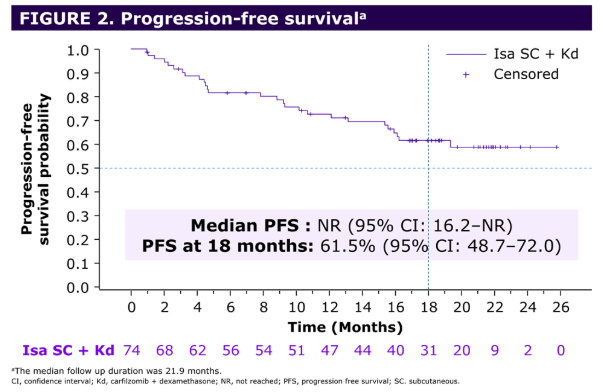


IZALCO
CONGRESS | #IMS26 | POSTER
Marcelo Capra, Centro Integrado de Hematologia e Oncologia, presented updated efficacy and safety results from the phase II IZALCO trial, evaluating Isa SC+ Kd delivered SC by manual injection vs on-body injection (OBI) in patients with RRMM who had received 1–3 prior LOT (N = 74).
At a median follow-up of 21.9 months, median PFS was NR; PFS at 18 months was 61.5% (95% CI, 48.7–72.0). Median OS was NR; OS at 18 months was 80.8% (95% CI, 69.8–88.2). Patient satisfaction with Isa SC OBI remained consistently high through C25D15 following patient selection of their preferred injection method at C7D1.
Follow our live feed for more updates: https://t.co/OZWuHVlO9d
Intended for HCPs. This congress coverage is independently supported through funding from pharmaceutical companies. A full list of our funders can be found on our website. Funders are allowed no influence.
#MultipleMyeloma #myeloma #mmsm #MedEd #MedicalCongress
FIGURE 1. Study design
Isatuximab SC + Kd: 28-day cycles (Parts 1 & 2)
- Isatuximab SC: 1400 mg weekly in C1, then biweekly
- Carfilzomib: 20 mg/m2 D1-2, then 56 mg/m2 D8-9, D15-16 in C1, then 56 mg/m2 D1-2, D8-9, D15-16 of further cycles
- Dexamethasone: 20 mg D1-2, D8-9, D15-16, D22-23
Part 1: N=8
- Manual administration ~8 mins at C1D1 and afterwards ~6 mins
- Manual administration ~6 mins from C1D1 on
Part 2: N=66, Randomization 1:3
- n=24: OBI C1-C3 -> Manual C4-C6
- n=42: Manual C1-C3 -> OBI C4-C6
OBI or Manual per patient choice at C7+
C, cycle; D, day; Kd, carfilzomib + dexamethasone; OBI, on-body injector; SC, subcutaneous.
FIGURE 2. Progression-free survivala
Kaplan-Meier curve, Y axis "Progression-free survival probability" (0-1.0), X axis "Time (Months)" (0-26)
Legend: Isa SC + Kd, + Censored
Median PFS: NR (95% CI: 16.2-NR)
PFS at 18 months: 61.5% (95% CI: 48.7-72.0)
Patients at risk (Isa SC + Kd): 74, 68, 62, 56, 54, 51, 47, 44, 40, 31, 20, 9, 2, 0
aThe median follow up duration was 21.9 months.
CI, confidence interval; Kd, carfilzomib + dexamethasone; NR, not reached; PFS, progression free survival; SC, subcutaneous.
FIGURE 3. Patient experience and satisfaction
Line chart, Y axis "Patients satisfied with injection method (%)" (0-100), X axis "Cycle" (C1D8 through C25D15)
Legend: Isa SC Manual, Isa SC OBI - both lines generally 80-100% with some dips (e.g. one point drops to ~50% labeled "Very small sample size")
Isa SC Manual - Total number of patients who completed the questionnaire (by cycle): 48 41 42 46 40 43 39 29 26 27 24 9 5 7 6 6 8 8 8 7 7 6 6 6 6 5 4 4 2 2 2
Isa SC OBI - Total number of patients who completed the questionnaire (by cycle): 23 23 24 24 20 23 22 35 32 35 31 33 27 48 40 48 44 40 38 37 37 40 31 35 34 30 33 29 22 18 17 15 14 9
C, cycle; D, day; OBI, on-body injector; SC, subcutaneous.
Key Conclusions
- Updated results of the IZALCO study continue to show the efficacy and safety of Isa SC delivered either by manual injection or OBI, plus Kd.
- Patient satisfaction with Isa SC OBI remained consistently high after patient choice of injection method at C7D1.
- These safety and efficacy findings are consistent with those reported in the Phase 3 IKEMA study (Isa IV plus Kd).5
- Overall, these results support the efficacy, safety and feasibility of Isa delivered subcutaneously via OBI in patients with RRMM.
Sep 24
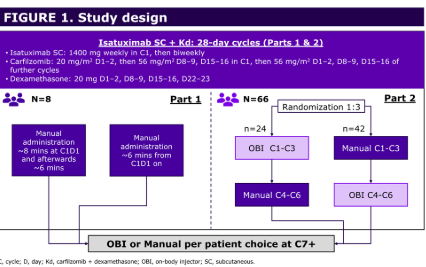

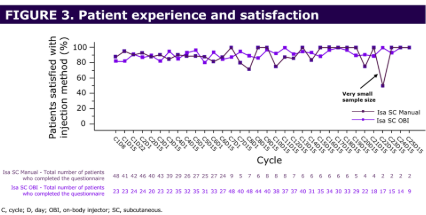

IZALCO
CONGRESS | #IMS26 | POSTER
Marcelo Capra, Centro Integrado de Hematologia e Oncologia, presented updated efficacy and safety results from the phase II IZALCO trial, evaluating Isa SC+ Kd delivered SC by manual injection vs on-body injection (OBI) in patients with RRMM who had received 1–3 prior LOT (N = 74).
At a median follow-up of 21.9 months, median PFS was NR; PFS at 18 months was 61.5% (95% CI, 48.7–72.0). Median OS was NR; OS at 18 months was 80.8% (95% CI, 69.8–88.2). Patient satisfaction with Isa SC OBI remained consistently high through C25D15 following patient selection of their preferred injection method at C7D1.
Follow our live feed for more updates: https://t.co/OZWuHVlO9d
Intended for HCPs. This congress coverage is independently supported through funding from pharmaceutical companies. A full list of our funders can be found on our website. Funders are allowed no influence.
FIGURE 1. Study design
Isatuximab SC + Kd: 28-day cycles (Parts 1 & 2)
- Isatuximab SC: 1400 mg weekly in C1, then biweekly
- Carfilzomib: 20 mg/m2 D1-2, then 56 mg/m2 D8-9, D15-16 in C1, then 56 mg/m2 D1-2, D8-9, D15-16 of further cycles
- Dexamethasone: 20 mg D1-2, D8-9, D15-16, D22-23
N=8 (Part 1):
Manual administration ~8 mins at C1D1 and afterwards ~6 mins
Manual administration ~6 mins from C1D1 on
N=66 (Part 2), Randomization 1:3:
n=24 -> OBI C1-C3 -> Manual C4-C6
n=42 -> Manual C1-C3 -> OBI C4-C6
OBI or Manual per patient choice at C7+
C, cycle; D, day; Kd, carfilzomib + dexamethasone; OBI, on-body injector; SC, subcutaneous.
FIGURE 2. Progression-free survival(a)
Kaplan-Meier curve, Isa SC + Kd (purple line), Censored (+ marks)
Y-axis: Progression-free survival probability 0-1.0
X-axis: Time (Months) 0-26
Median PFS: NR (95% CI: 16.2-NR)
PFS at 18 months: 61.5% (95% CI: 48.7-72.0)
Number at risk row (Isa SC + Kd): 74 68 62 56 54 51 47 44 40 31 20 9 2 0 (at months 0,2,4,6,8,10,12,14,16,18,20,22,24,26)
(a)The median follow up duration was 21.9 months.
CI, confidence interval; carfilzomib + dexamethasone; NR, not reached; PFS, progression-free survival; SC, subcutaneous.
FIGURE 3. Patient experience and satisfaction
Line chart: Patients satisfied with injection method (%), Y-axis 0-100%, X-axis Cycle 1-25(D15)
Two lines: Isa SC Manual and Isa SC OBI, both fluctuating mostly in 80-100% range across cycles
Annotation arrow pointing to a dip around cycle 20 area: "Very small sample size"
Below chart, two rows showing "Total number of patients who completed the questionnaire" per cycle for Isa SC Manual and Isa SC OBI, values decreasing over cycles (starting around 48-49 at cycle 1, declining to single digits by cycle 25)
C, cycle; D, day; OBI, on-body injector; SC, subcutaneous.
Key Conclusions
- Updated results of the IZALCO study continue to show the efficacy and safety of Isa SC delivered either by manual injection or OBI, plus Kd.
- Patient satisfaction with Isa SC OBI remained consistently high after patient choice of injection method at C7D1.
- These safety and efficacy findings are consistent with those reported in the Phase 3 IKEMA study (Isa IV plus Kd).5
- Overall, these results support the efficacy, safety and feasibility of Isa delivered subcutaneously via OBI in patients with RRMM.
Sep 25
CARTITUDE-4ImmunoPRISMMajesTEC-3MajesTEC-9MonumenTAL-3RedirecTT-1
#IMS26 #mmsm
Infections with BsAn and CAR-T therapies https://t.co/nGIR6yJM9B
[Slide 1 - Incidence and severity of infections across different approved BsAbs and CAR T trials, cross-trial compilation table]
BsAbs late-line relapse (triple-class exposed) - trial/drug/All grade/Grade 3-4/Grade 5:
MajesTEC-1/Teclistamab: 78.8% / 55.2% / 12.7%. MagnetisMM-3/Elranatamab: 69.9% / 39.8% / 6.5%. LinkerMM-1/Linvoseltamab: 75% / 48% / NR. MonumenTAL-1/Talquetamab: 66.2% / 14.5% / 1.4%. RedirecTT-1/Tec-Tal: 89% / 64% / 12%.
BsAbs early-line relapse (1-3 prior lines): MajesTEC-9/Teclistamab: 82.8% / 41.6% / 5.5%. MajesTEC-3/Tec-Dara: 96.5% / 41.6% / 5.5%. MonumenTAL-3/Tal-Dara: 83.0% / 29.2% / 1.5%. MonumenTAL-3/Tal-Dara-Pom: 84.3% / 37.7% / 0.7%.
CAR T late-line relapse: CARTITUDE-1/Cilta-Cel: All grade 58%, Gr3-4 20%, Gr5 NR. KarMMa/Ide-Cel: 69%, 22%, NR (#, deaths from AEs not otherwise specified 7% total). CAR T early-line relapse: CARTITUDE-4/Cilta-Cel: 59%, 24%, 4%. KarMMa-3/Ide-Cel: 56%, 22%, NR (*, death from AEs 6% total).
"Infections remain a major safety concern with T-cell-redirecting therapies, particularly with continuous bispecific antibody treatment." Table provided for ease of viewing, no comparisons intended.
Sources: Moreau P et al NEJM 2022; Lesokhin AM et al Nat Med 2023;29(9):2259-2267; Lee HC et al Clin Lymphoma Myeloma Leuk 2026 Feb, 26(2):e201-e212,e8; Chari A et al NEJM 2022; Cohen Y et al Engl J Med 2025;392:138-49; Touzeau C et al N Engl J Med 2026;395:440-53; Costa LJ et al N Eng J Med 2026;394:739-52; Mina R et al N Engl J Med 2026;395:671-83; Einsele H et al, Lancet Oncol 2026;27:254-68; Ailawadhi S et al, Blood 2024 (144)23; Berdeja J et al, Lancet 2021;398:314-24; Munshi NC et al, N Engl J Med 2021 Feb 25;384(8):705-716.
[Slide 2 - Pillars of infection prevention in patients receiving T-cell redirecting therapies]
Table: Immune defect/risk -> Type of infection -> Preventive strategy.
Lymphopenia/Neutropenia -> Bacterial infections/PJP, approx first 3-6 months -> Antiviral + PJP prophylaxis, G-CSF support.
Immunosuppressive therapy (steroids, IL-6 blockage, cyclophosphamide) -> Bacterial infections/Sepsis/fungal infections/CMV -> Consider antibacterial/antifungal.
B-cell aplasia/Hypogammaglobulinemia -> Bacterial/Viral (Respiratory virus, VZV/HSV)/CMV -> Immunoglobulin replacement, Vaccination.
T-cell dysfunction -> Other opportunistic infections, Viral infections, fungal (in selected high risk patients) -> Fixed treatment duration/Schedule optimization.
Sources: Rodriguez-Otero P et al, Lancet Oncology May 2024; O'Neill C, et al. eJHaem. 2023;4:811-822; Friedrich MJ, et al. Cancer Cell. 2023;41:711-725.e6; Frerichs KA et al, Blood Advances 2024; Mohan M et al, Blood Cancer Journal (2025) 15:74; Tix T et al, Molecular Therapy (2025)33:7; Richardson T et al, Blood Advances (2025) 9:6; Nath K et al, Blood Cancer Journal (2024) 14:88; Reynolds G et al, Blood advances (2023) 7:19; Banerjee R et al, Blood Advances (2025) 9:18; Dr Rodriguez Otero personal opinion.
Sep 22
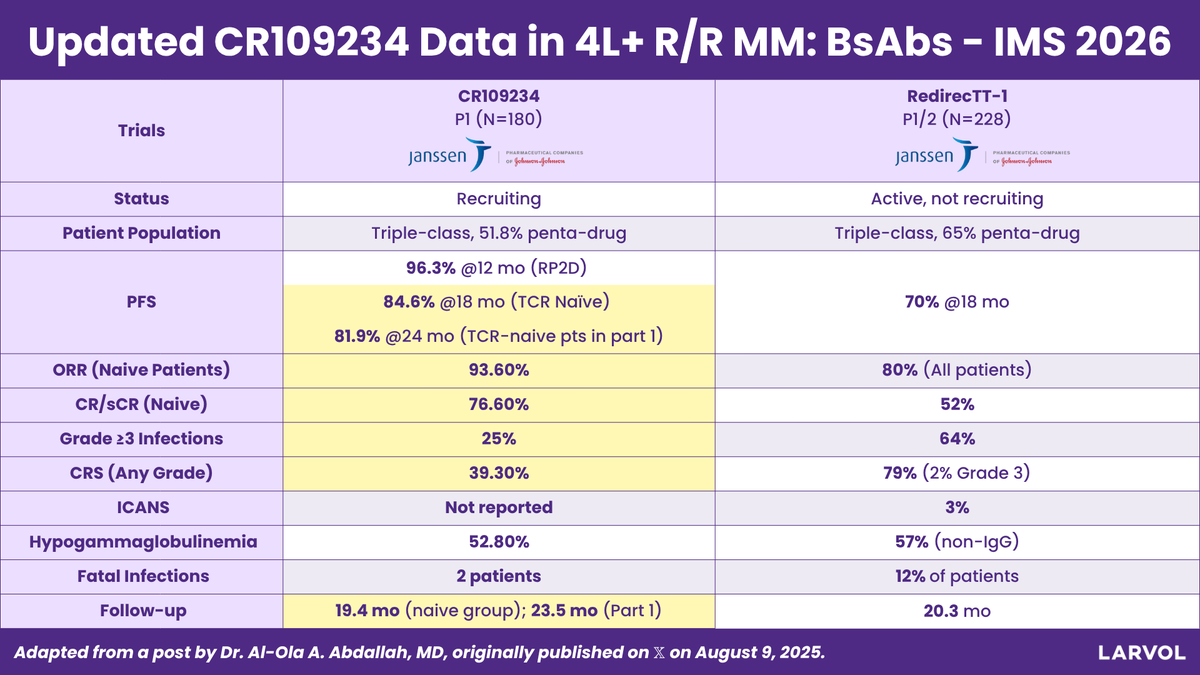
RedirecTT-1
CR109234 trial: Updated data from IMS 2026 2026 in 4L+ R/R MM: BsAbs landscape, adapted from Dr. Al-Ola Abdallah (@Abdallah81MD) 👉 https://t.co/yQ2JMo3LSK
Updated landscape 👉 https://t.co/maj64kPE3X
Learn more about CR109234 👉 https://t.co/E8JQPlwNdm
#LARVOL #IMS2026 https://t.co/U0Uvv6IQJx
Updated CR109234 Data in 4L+ R/R MM: BsAbs - IMS 2026
Trials: CR109234, P1 (N=180), Janssen (Pharmaceutical Companies of Johnson & Johnson) | RedirecTT-1, P1/2 (N=228), Janssen (Pharmaceutical Companies of Johnson & Johnson)
Status: CR109234: Recruiting | RedirecTT-1: Active, not recruiting
Patient Population: CR109234: Triple-class, 51.8% penta-drug | RedirecTT-1: Triple-class, 65% penta-drug
PFS:
CR109234: 96.3% @12 mo (RP2D); 84.6% @18 mo (TCR Naïve); 81.9% @24 mo (TCR-naive pts in part 1)
RedirecTT-1: 70% @18 mo
ORR (Naive Patients): CR109234: 93.60% | RedirecTT-1: 80% (All patients)
CR/sCR (Naive): CR109234: 76.60% | RedirecTT-1: 52%
Grade ≥3 Infections: CR109234: 25% | RedirecTT-1: 64%
CRS (Any Grade): CR109234: 39.30% | RedirecTT-1: 79% (2% Grade 3)
ICANS: CR109234: Not reported | RedirecTT-1: 3%
Hypogammaglobulinemia: CR109234: 52.80% | RedirecTT-1: 57% (non-IgG)
Fatal Infections: CR109234: 2 patients | RedirecTT-1: 12% of patients
Follow-up: CR109234: 19.4 mo (naive group); 23.5 mo (Part 1) | RedirecTT-1: 20.3 mo
Adapted from a post by Dr. Al-Ola A. Abdallah, MD, originally published on X on August 9, 2025.
LARVOL
Sep 23
CARTITUDE-4CERVINODREAMM-7DREAMM-8MajesTEC-3MajesTEC-9MonumenTAL-3MonumenTAL-6
Never a good time to be a myeloma patient but this is the best it has ever been!
Remarkable results in early relapse setting!
@mvmateos #IMS26 https://t.co/rNUviKkXc5
Phase 3 evidence has moved inmune therapy into early relapse
[Table: STUDY | COMPARISON | forest plot (FAVOURS EXPERIMENTAL / FAVOURS CONTROL) | PFS HR | OS HR]
CARTITUDE-4 | Cilta-cel vs DPd/PVd | PFS HR 0.29 | OS HR 0.55
DREAMM-7 | BVd vs DVd | PFS HR 0.41 | OS HR 0.58
DREAMM-8 | BPd vs PVd | PFS HR 0.52 | OS HR 0.77
MajesTEC-3 | Tec-Dara vs DPd/DVd | PFS HR 0.17 | OS HR 0.46
MonumenTAL-3 | Tal-DP vs DPd | PFS HR 0.28 | OS HR 0.47
(MonumenTAL-3) | Tal-D vs DPd | PFS HR 0.33 | OS HR 0.51
MajesTEC-9 | Teclistamab vs PVd/Kd | PFS HR 0.29 | OS HR 0.60
MonumenTAL-6 | Tal-Tec vs EPd/PVd | PFS HR 0.11 | OS HR NR
(MonumenTAL-6) | Tal-Pom vs EPd/PVd | PFS HR 0.27 | OS HR NR
CERVINO | Etentamig vs investigator's choice | PFS HR 0.40 | OS HR NR
RANDOMIZED PHASE 3 TRIALS WITHOUT PUBLIC NUMERICAL HRs
MagnetisMM-5 | Elranatamab +/- Dara vs DPd | Positive top-line result; no numerical data reported
[Forest plot x-axis tick labels largely illegible]
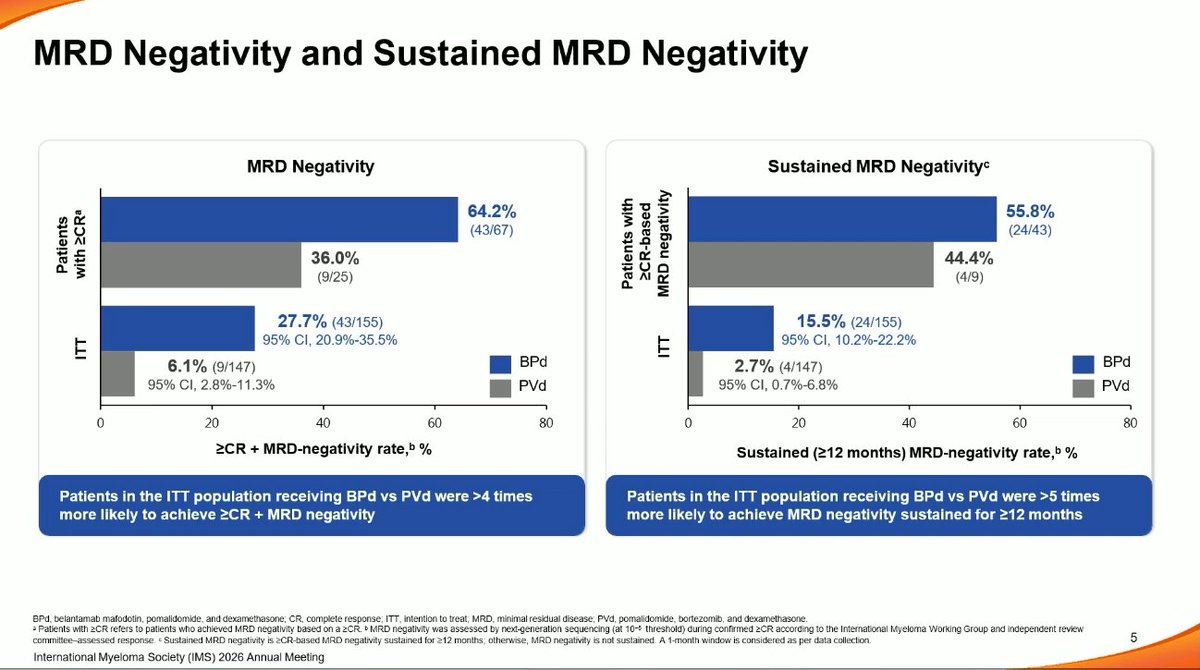
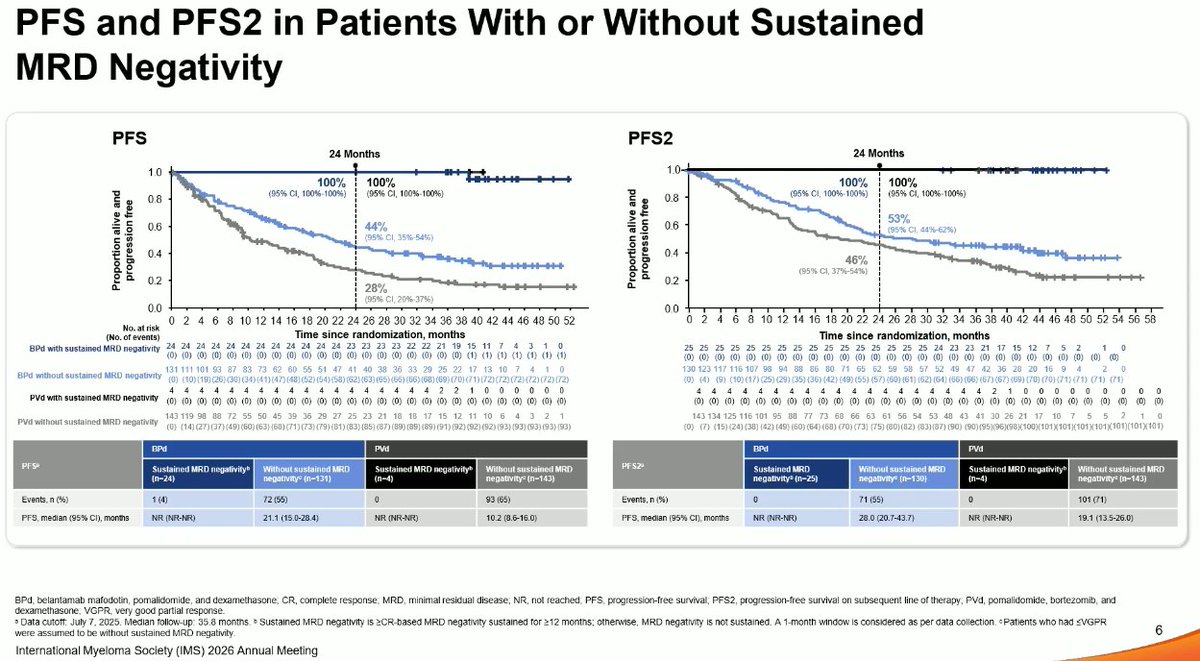
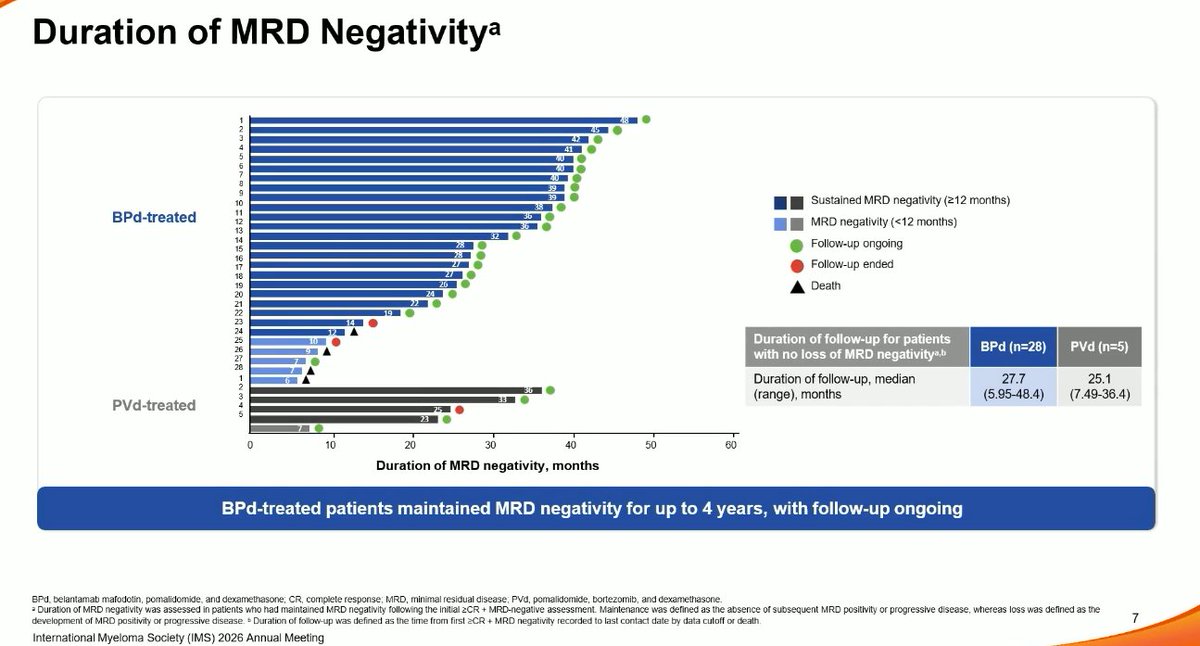
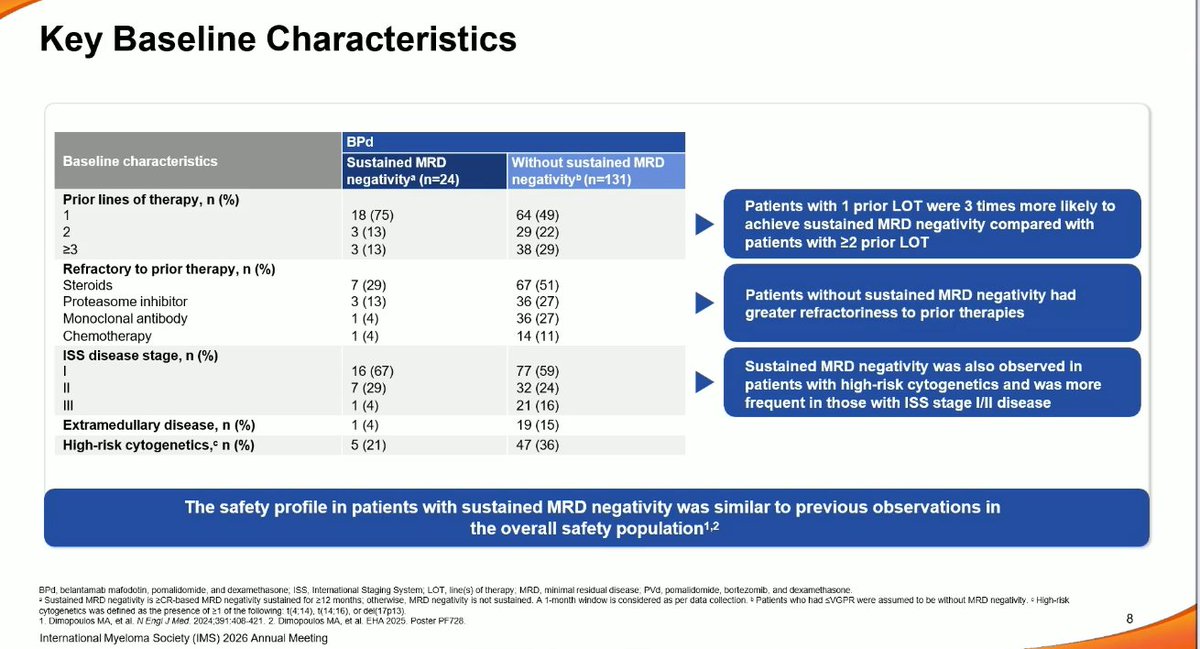
DREAMM-9
2 slides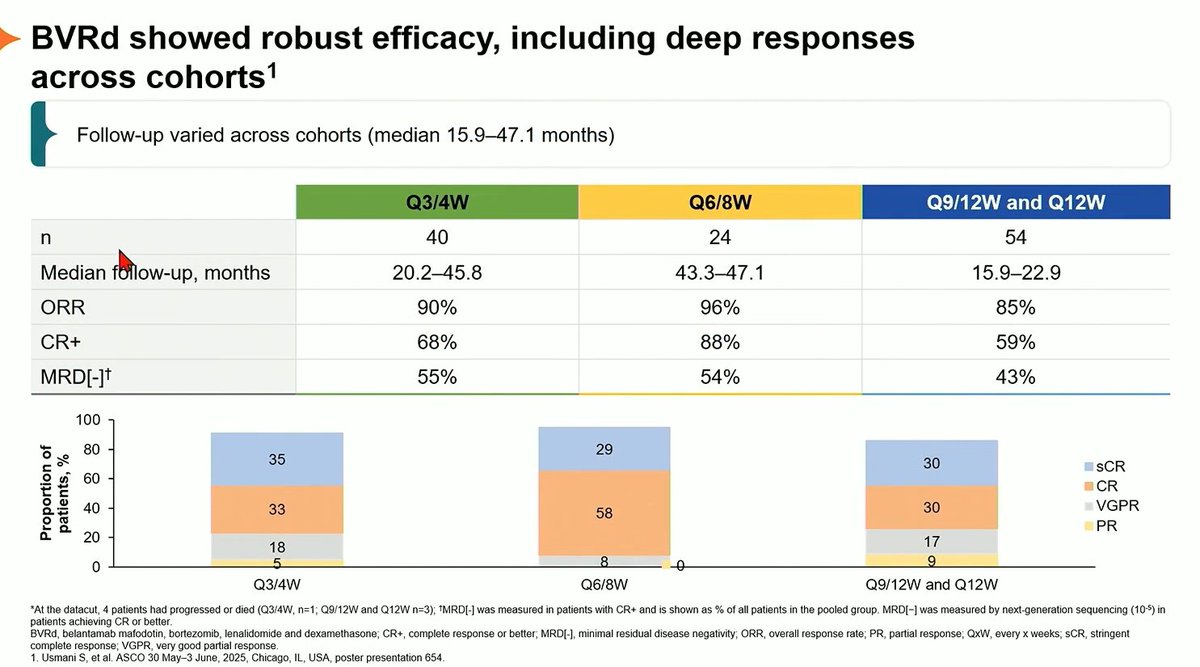
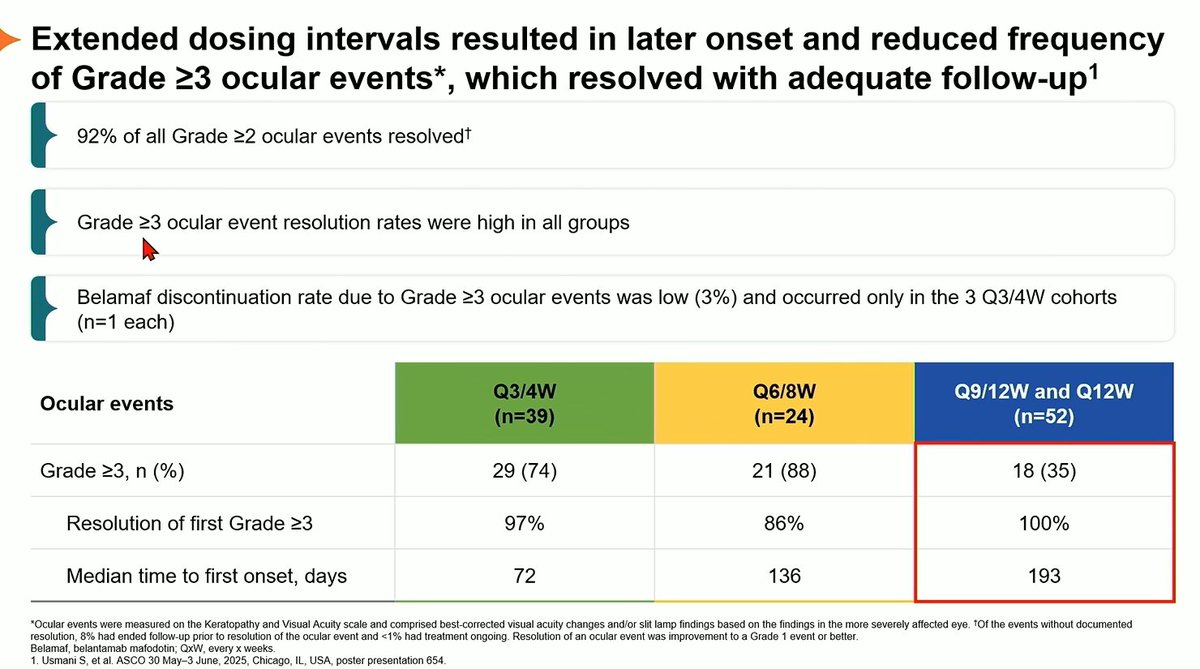
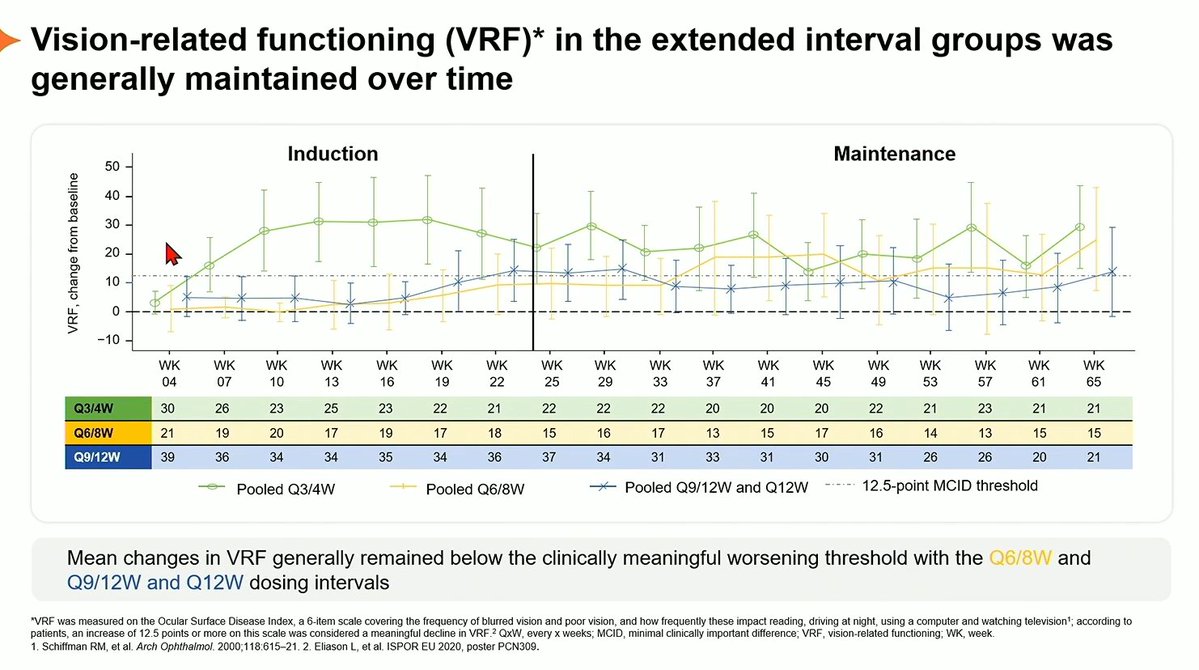
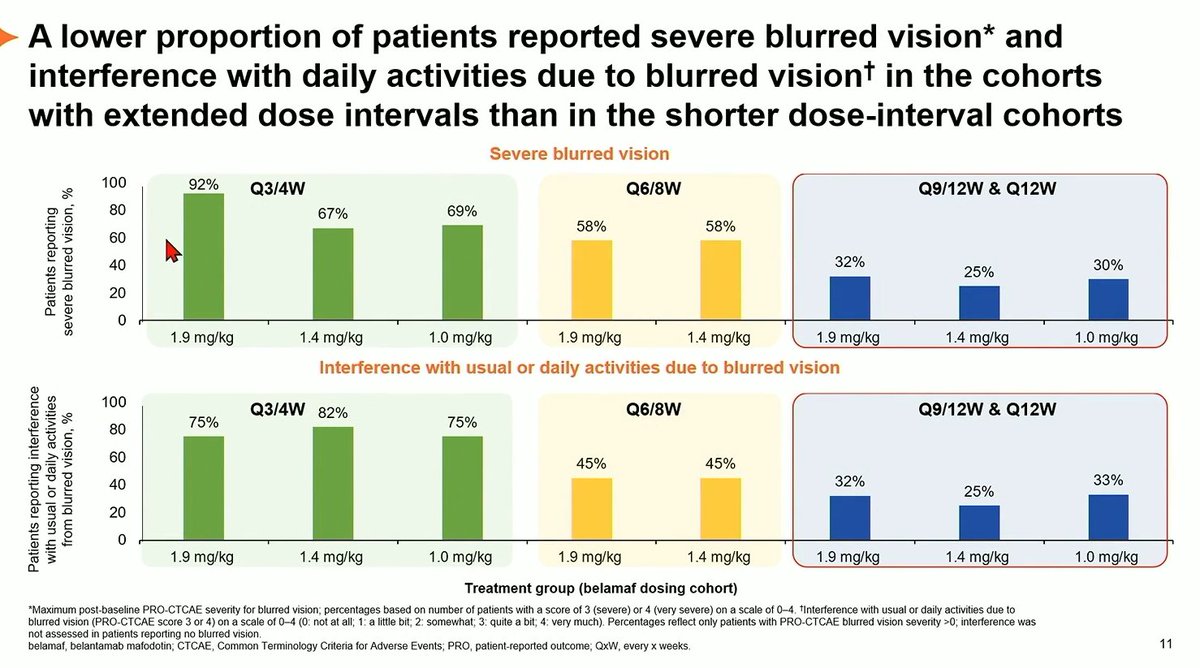 Sep 24
CAMMA 1DREAMM-9MajesTEC-3UKMRA RADAR
Abstract Sessions begin at 11:00 AM. Join us in Hall 5 for Abstract Session 3 or Lomond Auditorium for Abstract Session 4. #IMS26 https://t.co/HPzirIbOLS
23rd Annual MEETING & EXPOSITION - International Myeloma Society
THURSDAY, SEPTEMBER 24, 2026 | 11:00-12:00
Abstract Session 3
Co-chairs: Meral Beksac and Martin Kortum
- Double hit ultra-high risk myeloma treated with Isa-VRD plus cyclophosphamide induction and Isa-VRD consolidation: QoL analysis of the UKMRA RADAR trial in newly diagnosed transplant eligible patients - Karthik Ramasamy
- Updated safety and efficacy of ramantamig (Ram; JNJ-5322) at the recommended phase 2 dose (RP2D), demonstrating feasibility of outpatient dosing (OPD) in relapsed/refractory multiple myeloma (RRMM) - Jeffrey Matous
- DREAMM-9 Patient-Reported Vision-Related Function with Extended Belantamab Mafodotin Dosing Intervals with Bortezomib, Lenalidomide, Dexamethasone (BVRd) in Transplant Ineligible Multiple Myeloma - Hang Quach
- A fixed-duration, modified cevostamab dosing regimen induces durable remissions that continue after completion in BCMA-naive pts with relapsed/refractory multiple myeloma (RRMM): CAMMA 1 Arm A results - Amrita Krishnan
- Overall Survival, Progression and Non-Relapse Mortality With Teclistamab Plus Daratumumab (Tec-Dara) vs Dara-Based Triplets in Relapsed/Refractory Multiple Myeloma (RRMM): MajesTEC-3 Post Hoc Analysis - Luciano Costa
Panelist photos shown: Dr. Beksac, Dr. Kortum, Dr. Matous, Dr. Ramasamy, Dr. Costa, Dr. Krishnan, Dr. Quach
23rd Annual MEETING & EXPOSITION - International Myeloma Society
THURSDAY, SEPTEMBER 24, 2026 | 11:00-12:00
Abstract Session 4
Co-chairs: Lugui Qiu and Niels van de Donk
- Augmenting TRAIL-dependent apoptosis enables BCMA CAR-T cells to overcome resistance in multiple myeloma - Mansour Poorebrahim
- First-in-human phase Ia/Ib study of QLS32015 (GPRC5DxCD3) in patients (pts) with relapsed/refractory multiple myeloma (RRMM): updated safety and efficacy data - Jian Cui
- An AI-Designed BCMA/FcRL5 Targeting TriTE Overcomes Antigen Escape and Outperforms BCMA-Directed Therapy in Multiple Myeloma - Jessica Encinas Mayoral
- A CD4-Dominant, T-Helper-Skewed T Cell State Underlies Movement and Neurocognitive Toxicity After BCMA-Directed CAR-T Therapy in Multiple Myeloma - Theresia Akhlaghi
- Single-cell antigen:TCR mapping reveals tumor-specific effector T-cell responses in multiple myeloma - David Avigan
Panelist photos shown: Dr. Akhlaghi, Dr. Avigan, Dr. Cui, Dr. Encinas Mayoral, Dr. Poorebrahim, Dr. Qiu, Dr. van de Donk
 Sep 24

IMROZ
Happy to share the data from our comparative analysis of IMROZ and ISASOCUT at #IMS26 in Glasgow https://t.co/mTyJ0CByJI
Photo of a person standing in front of poster PA-104 (partially occluding it), with poster PA-105 partially visible to the right.
PA-104 title: "Comparative Analysis of Isa SC VRd (ISASOCUT, Once-Weekly Bortezomib) and Isa IV VRd (IMROZ, Twice-Weekly Bortezomib): 20-Month Follow-Up in Transplant-Ineligible Newly Diagnosed Multiple Myeloma Patients"
Authors (partial): Arthur Bobin, Mohamad Mohty, Philippe Moreau, Hartmut Goldschmidt, Meletios Athanasios Dimopoulos, Robert Z. Orlowski, Cyrille Touzeau, Aurore Perrot, Thomas Chalopin, Mamoun Dib, Lydia Montes, Lionel Karlin, Umer Khan, Julien Bonnet, Rick Zhang, Ercem Kodas, Florence Suzan, Thierry Facon, Xavier Leleu
Legible bullet points (partially visible under poster header): isatuximab (Isa) plus bortezomib (V), lenalidomide/dexamethasone (d) is approved for transplant-ineligible newly diagnosed multiple myeloma based on the phase 3 IMROZ trial; subcutaneous (SC) Isa delivered via the novel on-body injector (OBI) has been previously tested in other therapies; a study (ISASOCUT) demonstrated Isa SC delivered via the OBI; major differences between the IMROZ and ISASOCUT protocols; Isa delivered once weekly (QW) for 12 months from cycle 2 in ISASOCUT vs twice weekly (BIW) for 6 months in IMROZ; both switch to monthly administration of Isa (12 months in ISASOCUT, 18 months in IMROZ); peripheral neuropathy (PN), a key dose-limiting toxicity, dose reduction/discontinuation; an updated comparative analysis on the safety and efficacy of Isa SC (ISASOCUT; QW V) vs Isa IV (IMROZ; BIW V) at 20 months of follow-up.
FIGURE 3 "Efficacy in the Isa SC OBI (QW V) and Isa IV (BIW V) cohorts" - bar chart comparing Isa SC OBI + VRd vs Isa IV + VRd across categories including >=VGPR, MRD-, and sustained MRD- (>=12 months); approximate percentage labels visible (roughly 80-90% range for >=VGPR, 30-50% range for MRD- categories) but exact values not confidently legible due to image resolution/blur.
FIGURE 4 "Progression-free survival in Isa SC OBI (QW V) and Isa IV (BIW V) cohorts" - Kaplan-Meier curve with a small inset table showing "PFS per investigator at 24 months" comparing the two cohorts (percentages not legibly readable).
Safety summary bullets (partially legible): Grade >=3 non-hematologic TEAEs occurred at a lower rate with Isa SC OBI (62.2%, QW V) than with Isa IV (73.8%, BIW V) (Table 2); the incidence of serious TEAEs was similar with Isa SC OBI (51.4%, QW V) and Isa IV (52.5%, BIW V); infusion-related reactions (IRRs) were less common in Isa SC OBI (5.4%, QW V) patients vs Isa IV (22.4%, BIW V); a lower incidence of grade >=2 peripheral neuropathy was observed with Isa SC OBI (29.7%, QW V) compared with Isa IV (40.7%, BIW V), but the incidence of grade >=3 peripheral neuropathy was similar; Isa SC OBI (21.6%, QW V) patients exhibited a lower incidence of peripheral neuropathy leading to V dose reduction vs Isa IV (33.5%, BIW V) patients, and a lower incidence of peripheral neuropathy leading to V discontinuation (Isa SC OBI: 5.4%; Isa IV: 9.5%).
TABLE 2 "Safety summary" - comparing Isa SC OBI x VRd (N=74) vs Isa IV x VRd (N=265), row labels visible including "Treatment emergent adverse events, TEAEs", "Any TEAE", "Grade >=3 TEAEs", "Serious TEAEs", "Fatal (Grade 5) TEAEs during the treatment period", "Any TEAE leading to definitive discontinuation of all treatments", "Any TEAE leading to peripheral neuropathy", "Any TEAE leading to bortezomib dose reduction" - the numeric values in the table cells are too small/blurry to read confidently.
Key Conclusions (partially legible): This comparative analysis at 20 months of follow-up found greater tolerability with Isa SC OBI plus VRd (QW V) compared with Isa IV plus VRd (BIW V) in patients with TI-NDMM; there was a lower incidence of peripheral neuropathy (including events leading to V dose reduction and discontinuation) and infusion-related reactions.
Neighboring poster PA-105 (partially visible, different study): Authors "Gulibadanmu Aizezi, Jianli Xu, Gang Chen, Chun xia Han..." - Department of Hematology, the First Affiliated Hospital of Xinjiang Medical [University, cut off]. Legible text fragments: INTRODUCTION - "Multiple myeloma (MM) is a malignant hematologic tumor characterized by clonal abnormal proliferation of bone marrow plasma cells, accounting for 10%-15% of all hematologic malignancies. Standard first-line therapies-including proteasome inhibitors, immunomodulators, and novel CAR-T cell therapies-have significantly improved treatment efficacy; however, MM remains incurable. Enhancing remission rates and improving patient PFS and OS remain critical clinical challenges. Compared to traditional chemotherapy and newer drug regimens, patients receiving autologous stem cell transplantation (ASCT) exhibit superior PFS and OS outcomes." AIM (partially cut off): "To evaluate the imp[act of] cell transplantation [on] outcomes by compar[ing] characteristics and [...] eligible multiple my[eloma] who underwent ASC[T] did not during the [...] thereby informing [...] decision-making." RESULTS: "All 73 ASCT recipients achieved successful engraftment without transplant-related mortality. After a median follow-up of 37.3 months, ASCT was associated with significantly prolonged PFS compared with non-ASCT treatment (72.6 vs 43.9 months, P<0.041), while OS showed a numerical but non-significant improvement (89.7% vs 54.8%, P=0.637). In high-risk patients, ASCT improved PFS (76.7 vs 53.1 months) and yielded higher OS rates (93.3% vs 48.9%), although differences were not statistically significant. A separate subgroup analysis demonstrated significantly longer PFS with ASCT [...]"
IMS 2026 conference banner also visible: "23rd Annual Meeting & Exposition, September 23-26, 2026, Glasgow, Scotland."
Sep 21
CEPHEUSIMROZPERSEUS
NCT04751877 trial: Updated data from IMS 2026 (@Myeloma_Society) in 1L MM: anti-CD38 mAbs landscape, adapted from Dr. Akhil Santhosh (@tuttsakhil) 👉 https://t.co/V8wOYggpnM
Updated landscape 👉 https://t.co/fUETXB1mH1
Learn more about NCT04751877: https://t.co/YYmevH13Fd
#LARVOL #IMS2026 #InternationalMyelomaSociety #Myeloma #MMSM #HematologicOncology #Hematology #BloodCancers #CancerResearch #CancerData #Oncology #OncologyInsights #ClinicalTrials | @mtmdphd | @szusmani | @RahulBanerjeeMD |
| @End_myeloma | @VincentRK
Updated NCT04751877 Data in 1L MM: anti-CD38 mAbs - IMS 2026
Trials: Perseus (EMN) | IMROZ (sanofi) | NCT04751877 (CHU Poitiers) | CEPHEUS (Janssen, Pharmaceutical Companies of Johnson & Johnson)
Treatment Regimen:
Perseus: Daratumumab + Bortezomib + Lenalidomide + Dexamethasone vs Bortezomib + Lenalidomide + Dexamethasone
IMROZ: Isatuximab + Bortezomib + Lenalidomide + Dexamethasone vs Bortezomib + Lenalidomide + Dexamethasone
NCT04751877: Isatuximab + Lenalidomide + Dexamethasone +/- Bortezomib vs Isatuximab + Lenalidomide + Dexamethasone
CEPHEUS: Isatuximab + Bortezomib + Lenalidomide + Dexamethasone vs Bortezomib + Lenalidomide + Dexamethasone
Median Follow-Up:
Perseus: 47.5 months | IMROZ: 59.7 months | NCT04751877: 48.9 months | CEPHEUS: 76.0 months
PFS:
Perseus: 48 mo: 84.3% vs 67.7%
IMROZ: 60 mo: 63.2% vs 45.2%
NCT04751877: 18 mo: 87.2% vs 85.5%; 24 mo: 85.2% vs 80%; 36 mo: 78% vs 72.3%; 48 mo: 74% vs 65.7%
CEPHEUS: 54 mo: 68.1% vs 49.5%; 72 mo: 59.3% vs 38.3%
ORR%:
Perseus: 96.6% vs 93.8% | IMROZ: 91.3% vs 92.3% | NCT04751877: 85% vs 78% | CEPHEUS: 97% vs 93%
MRD negativity rate:
Perseus: 75.2% vs 47.5% | IMROZ: 58.1% vs 43.6% | NCT04751877: 12 mo: 51% vs 21% | CEPHEUS: 61.1% vs 40%
≥CR rate:
Perseus: 87.9% vs 70.1% | IMROZ: 74.7% vs 64.1% | NCT04751877: 58% vs 31% | CEPHEUS: 80.6% vs 61.4%
Adapted from Dr. Akhil Santhosh (X 2025)
LARVOL
SPARK
2 slides Sep 23
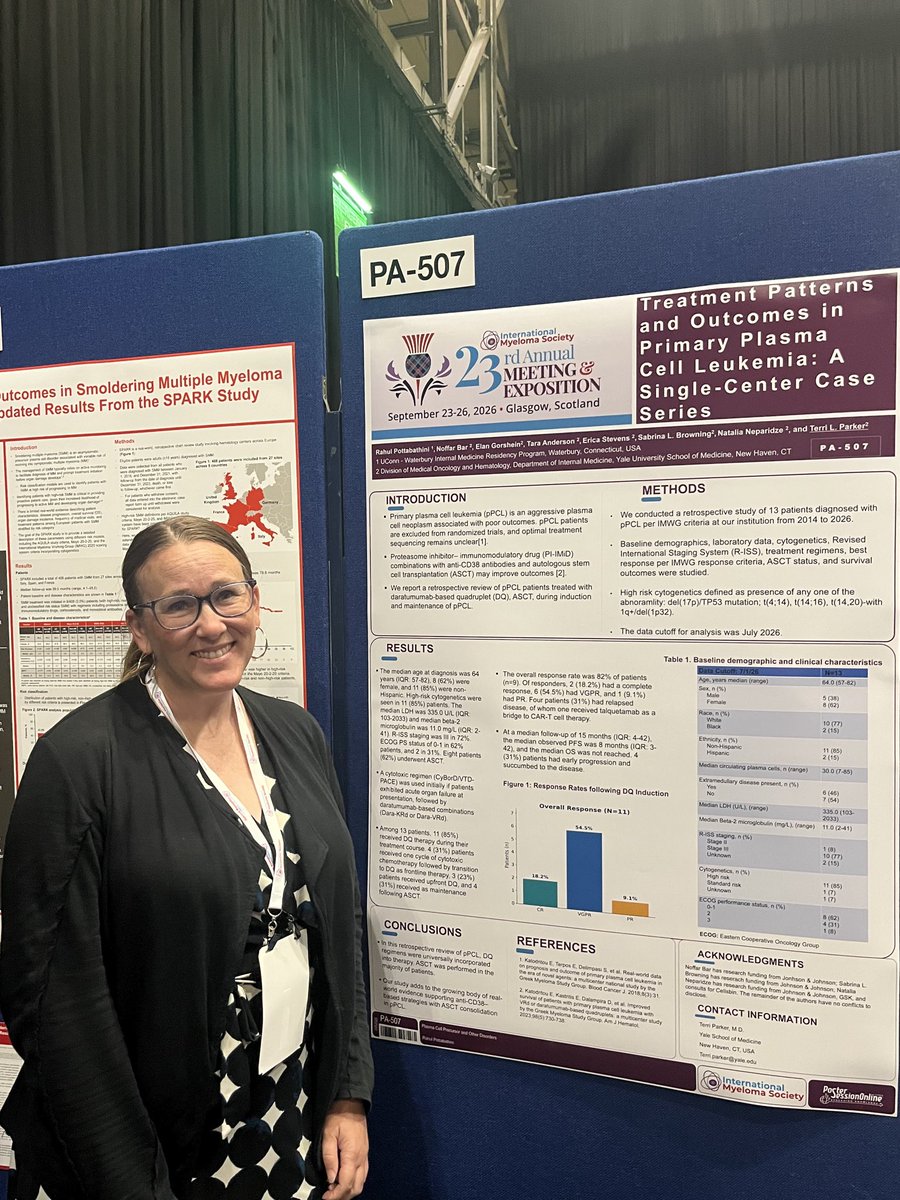
SPARK
Congratulations to Dr Parker on her poster presentation at International Myeloma Society Meeting in Glasgow!@Terri_ParkerMD @Yale @YaleHematology https://t.co/7gCTtQE7aB
[Main poster, PA-507]
International Myeloma Society - 23rd Annual MEETING & EXPOSITION - September 23-26, 2026 . Glasgow, Scotland
Treatment Patterns and Outcomes in Primary Plasma Cell Leukemia: A Single-Center Case Series
Rahul Pottabathini 1, Noffar Bar 2, Elan Gorshein 2, Tara Anderson 2, Erica Stevens 2, Sabrina L. Browning 2, Natalia Neparidze 2, and Terri L. Parker 2
1 UConn - Waterbury Internal Medicine Residency Program, Waterbury, Connecticut, USA
2 Division of Medical Oncology and Hematology, Department of Internal Medicine, Yale University School of Medicine, New Haven, CT
PA-507
INTRODUCTION
- Primary plasma cell leukemia (pPCL) is an aggressive plasma cell neoplasm associated with poor outcomes. pPCL patients are excluded from randomized trials, and optimal treatment sequencing remains unclear[1].
- Proteasome inhibitor - immunomodulatory drug (PI-IMiD) combinations with anti-CD38 antibodies and autologous stem cell transplantation (ASCT) may improve outcomes [2].
- We report a retrospective review of pPCL patients treated with daratumumab-based quadruplet (DQ), ASCT, during induction and maintenance of pPCL.
METHODS
- We conducted a retrospective study of 13 patients diagnosed with pPCL per IMWG criteria at our institution from 2014 to 2026.
- Baseline demographics, laboratory data, cytogenetics, Revised International Staging System (R-ISS), treatment regimens, best response per IMWG response criteria, ASCT status, and survival outcomes were studied.
- High risk cytogenetics defined as presence of any one of the abnormality: del(17p)/TP53 mutation; t(4;14), t(14;16), t(14,20)-with 1q+/del(1p32).
- The data cutoff for analysis was July 2026.
RESULTS
- The median age at diagnosis was 64 years (IQR: 57-82), 8 (62%) were female, and 11 (85%) were non-Hispanic. High-risk cytogenetics were seen in 11 (85%) patients. The median LDH was 335.0 U/L (IQR: 103-2033) and median beta-2 microglobulin was 11.0 mg/L (IQR: 2-41). R-ISS staging was III in 72%. ECOG PS status of 0-1 in 62% patients, and 2 in 31%. Eight patients (62%) underwent ASCT.
- A cytotoxic regimen (CyBorD/VTD-PACE) was used initially if patients exhibited acute organ failure at presentation, followed by daratumumab-based combinations (Dara-KRd or Dara-VRd).
- Among 13 patients, 11 (85%) received DQ therapy during their treatment course. 4 (31%) patients received one cycle of cytotoxic chemotherapy followed by transition to DQ as frontline therapy, 3 (23%) patients received upfront DQ, and 4 (31%) received as maintenance following ASCT.
- The overall response rate was 82% of patients (n=9). Of responders, 2 (18.2%) had a complete response, 6 (54.5%) had VGPR, and 1 (9.1%) had PR. Four patients (31%) had relapsed disease, of whom one received talquetamab as a bridge to CAR-T cell therapy.
- At a median follow-up of 15 months (IQR: 4-42), the median observed PFS was 8 months (IQR: 3-42), and the median OS was not reached. 4 (31%) patients had early progression and succumbed to the disease.
Figure 1: Response Rates following DQ Induction - Overall Response (N=11): CR 18.2%, VGPR 54.5%, PR 9.1%
Table 1. Baseline demographic and clinical characteristics (Data Cutoff: 7/1/26, N=13)
Age, years median (range): 64.0 (57-82)
Sex, n (%): Male 5 (38), Female 8 (62)
Race, n (%): White 10 (77), Black 2 (15)
Ethnicity, n (%): Non-Hispanic 11 (85), Hispanic 2 (15)
Median circulating plasma cells, n (range): 30.0 (7-85)
Extramedullary disease present, n (%): Yes 6 (46), No 7 (54)
Median LDH (U/L), (range): 335.0 (103-2033)
Median Beta-2 microglobulin (mg/L), (range): 11.0 (2-41)
R-ISS staging, n (%): Stage II 1 (8), Stage III 10 (77), Unknown 2 (15)
Cytogenetics, n (%): High risk 11 (85), Standard risk 1 (7), Unknown 1 (7)
ECOG performance status, n (%): 0-1 8 (62), 2 4 (31), 3 1 (8)
ECOG: Eastern Cooperative Oncology Group
CONCLUSIONS
- In this retrospective review of pPCL, DQ regimens were universally incorporated into therapy. ASCT was performed in the majority of patients.
- Our study adds to the growing body of real-world evidence supporting anti-CD38-based strategies with ASCT consolidation in pPCL.
REFERENCES
1. Katodritou E, Terpos E, Delimpasi S, et al. Real-world data on prognosis and outcome of primary plasma cell leukemia in the era of novel agents: a multicenter national study by the Greek Myeloma Study Group. Blood Cancer J. 2018;8(3):31.
2. Katodritou E, Kastritis E, Dalampira D, et al. Improved survival of patients with primary plasma cell leukemia with VRd or daratumumab-based quadruplets: a multicenter study by the Greek Myeloma Study Group. Am J Hematol. 2023;98(5):730-738.
ACKNOWLEDGMENTS
Noffar Bar has research funding from Johnson & Johnson; Sabrina L. Browning has research funding from Johnson & Johnson; Natalia Neparidze has research funding from Johnson & Johnson, GSK, and consults for Cel[illegible]. The remainder of the authors have no conflicts to disclose.
CONTACT INFORMATION
Terri Parker, M.D., Yale School of Medicine, New Haven, CT, USA, terri.parker@yale.edu
Footer: PA-507 - Plasma Cell Precursor and Other Disorders - Rahul Pottabathini - International Myeloma Society - PosterSessionOnline
[Adjacent poster, left, partially visible]
[Ou]tcomes in Smoldering Multiple Myeloma - [Up]dated Results From the SPARK Study
Body text mostly too small/angled to read: SPARK is a real-world, retrospective chart review study involving hematology centers across Europe ... 408 patients were included from 27 sites across 5 countries (Italy, Spain, and France mentioned) ... median follow-up was 59.5 months ... risk classification per AQUILA study criteria, Mayo 20-2-20, and IMWG 2020 ... [illegible]
Sep 24

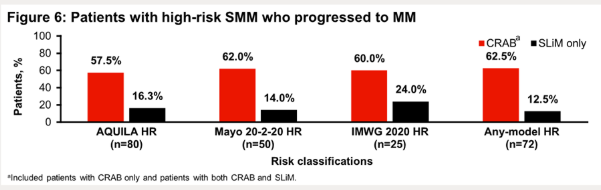

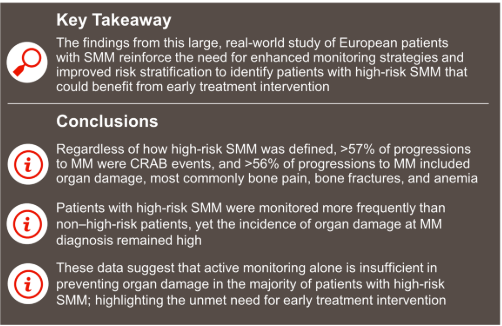
SPARK
CONGRESS | #IMS26 | POSTER
Francesca Gay, University of Torino, presented updated results from the retrospective SPARK study evaluating real-world outcomes in patients with SMM (N = 408) across European hematology centers.
Regardless of how high-risk SMM was defined, >57% of https://t.co/HY0wzo4dAN
Methods
- SPARK is a real-world, retrospective chart review study involving hematology centers across Europe (Figure 1)
- Eligible patients were adults (>=18 years) diagnosed with SMM
- Data were collected from all patients who were diagnosed with SMM between January 1, 2016, and December 31, 2021, with follow-up from the date of diagnosis until December 31, 2023, death, or loss to follow-up, whichever came first
- For patients who withdrew consent, all data entered into the electronic case report form up until withdrawal were considered for analysis
- High-risk SMM definitions per AQUILA study criteria, Mayo 20-2-20, and IMWG scoring system have been presented previously for SPARK5
- Here, we present updated results with extended follow-up, including all available data collected up to the cut-off date of March 2026
Figure 6: Patients with high-risk SMM who progressed to MM
Bar chart, Y axis "Patients, %" (0-100), grouped by risk classification, bars = CRAB (red) vs SLiM only (black):
AQUILA HR (n=80): CRAB 57.5%, SLiM only 16.3%
Mayo 20-2-20 HR (n=50): CRAB 62.0%, SLiM only 14.0%
IMWG 2020 HR (n=25): CRAB 60.0%, SLiM only 24.0%
Any-model HR (n=72): CRAB 62.5%, SLiM only 12.5%
aIncluded patients with CRAB only and patients with both CRAB and SLiM.
Table 3: Incidence of organ damage in patients who progressed to MM
Columns: AQUILA (HR n=194, Non-HR n=25, UC n=189), Mayo 20-2-20 (HR n=86, Non-HR n=216, UC n=106), IMWG 2020 (HR n=43, Non-HR n=217, UC n=148), Any model (HR n=173, Non-HR n=168, UC n=67), Total N=408
Progressed to MM, n: AQUILA 80/3/62; Mayo 50/55/40; IMWG 25/55/65; Any model 72/45/27; Total 145
Progressed to MM and had organ damage at the time of MM, n (%):
AQUILA: HR 52(65.0), Non-HR 1(33.3), UC 33(53.2)
Mayo 20-2-20: HR 32(64.0), Non-HR 32(58.2), UC 22(55.0)
IMWG 2020: HR 14(56.0), Non-HR 35(63.6), UC 36(56.9)
Any model: HR 46(63.9), Non-HR 27(60.0), UC 13(46.4)
Total: 86(59.3)
Type of organ damage, %:
Bone pain - AQUILA: 38.5/100/24.2; Mayo: 28.1/37.5/36.4; IMWG: 35.7/37.1/29.7; Any model: 32.6/37.0/30.8; Total: 33.7
Bone fracture - AQUILA: 25.0/0/27.3; Mayo: 25.0/27.3/27.3; IMWG: 21.4/22.9/29.7; Any model: 21.7/22.2/46.2; Total: 25.6
Renal failure - AQUILA: 5.8/0/6.1; Mayo: 6.3/3.1/9.1; IMWG: 0/2.9/10.8; Any model: 8.7/0/7.7; Total: 5.8
Hypercalcemia - AQUILA: 5.8/0/3.0; Mayo: 3.1/0/13.6; IMWG: 0/0/10.8; Any model: 4.3/0/15.4; Total: 4.7
Anemia - AQUILA: 36.5/0/51.5; Mayo: 40.6/37.5/50.0; IMWG: 50.0/37.1/43.2; Any model: 43.5/53.8/41.9; Total: 41.9
Other - AQUILA: 28.8/0/21.2; Mayo: 21.9/25.0/27.3; IMWG: 21.4/25.7/22.0; Any model: 23.9/33.3/15.4; Total: 25.6
Key Takeaway
The findings from this large, real-world study of European patients with SMM reinforce the need for enhanced monitoring strategies and improved risk stratification to identify patients with high-risk SMM that could benefit from early treatment intervention
Conclusions
- Regardless of how high-risk SMM was defined, >57% of progressions to MM were CRAB events, and >56% of progressions to MM included organ damage, most commonly bone pain, bone fractures, and anemia
- Patients with high-risk SMM were monitored more frequently than non-high-risk patients, yet the incidence of organ damage at MM diagnosis remained high
- These data suggest that active monitoring alone is insufficient in preventing organ damage in the majority of patients with high-risk SMM; highlighting the unmet need for early treatment intervention
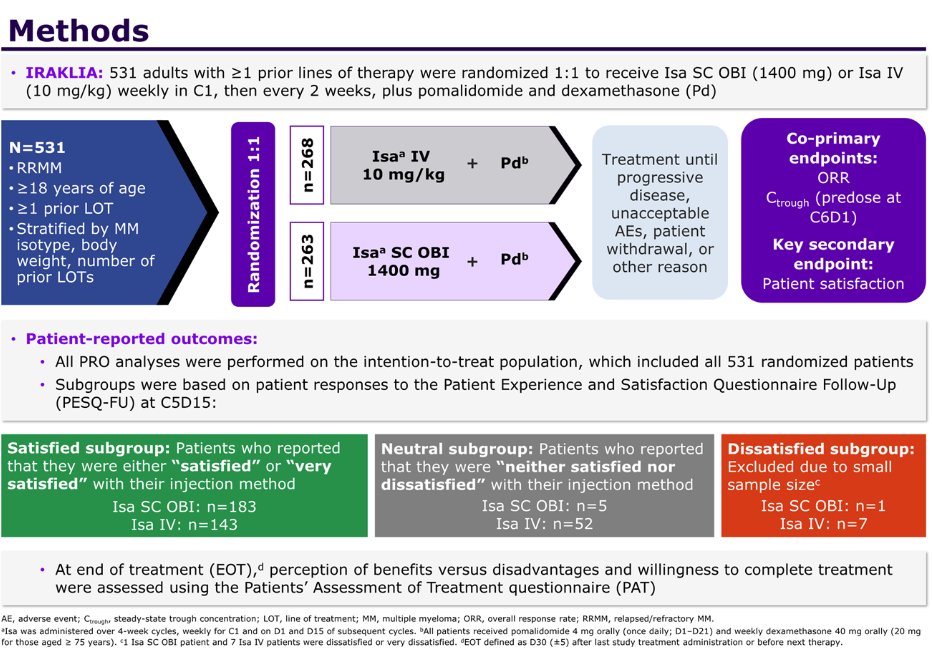
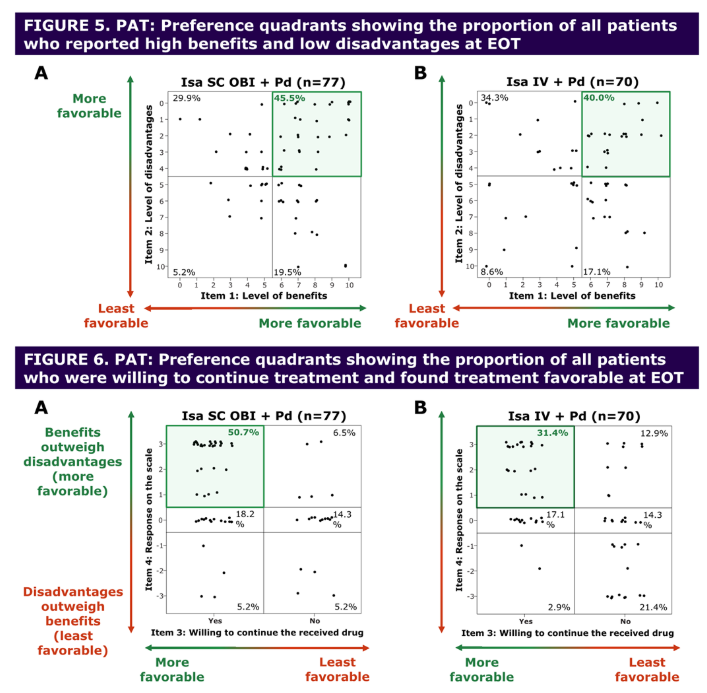
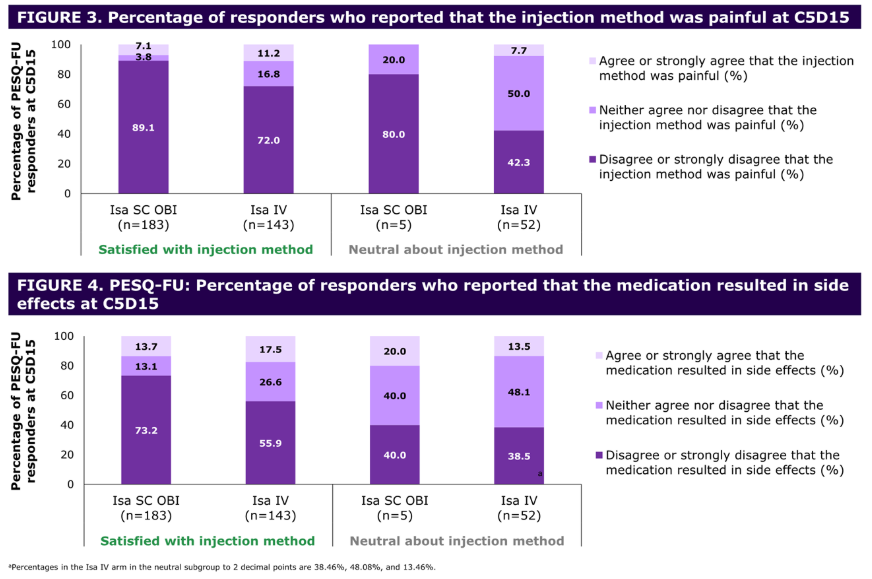
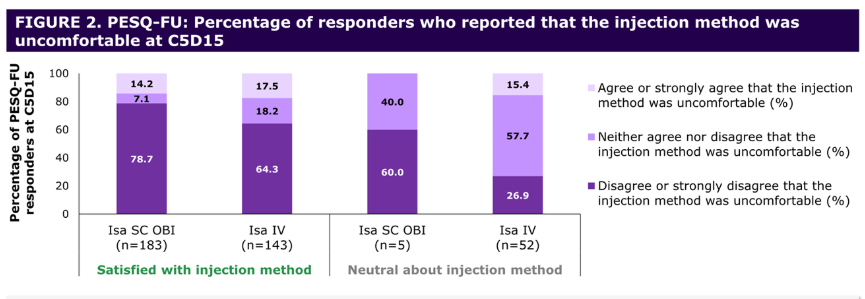

SeaLAND
1 slide
Sep 24
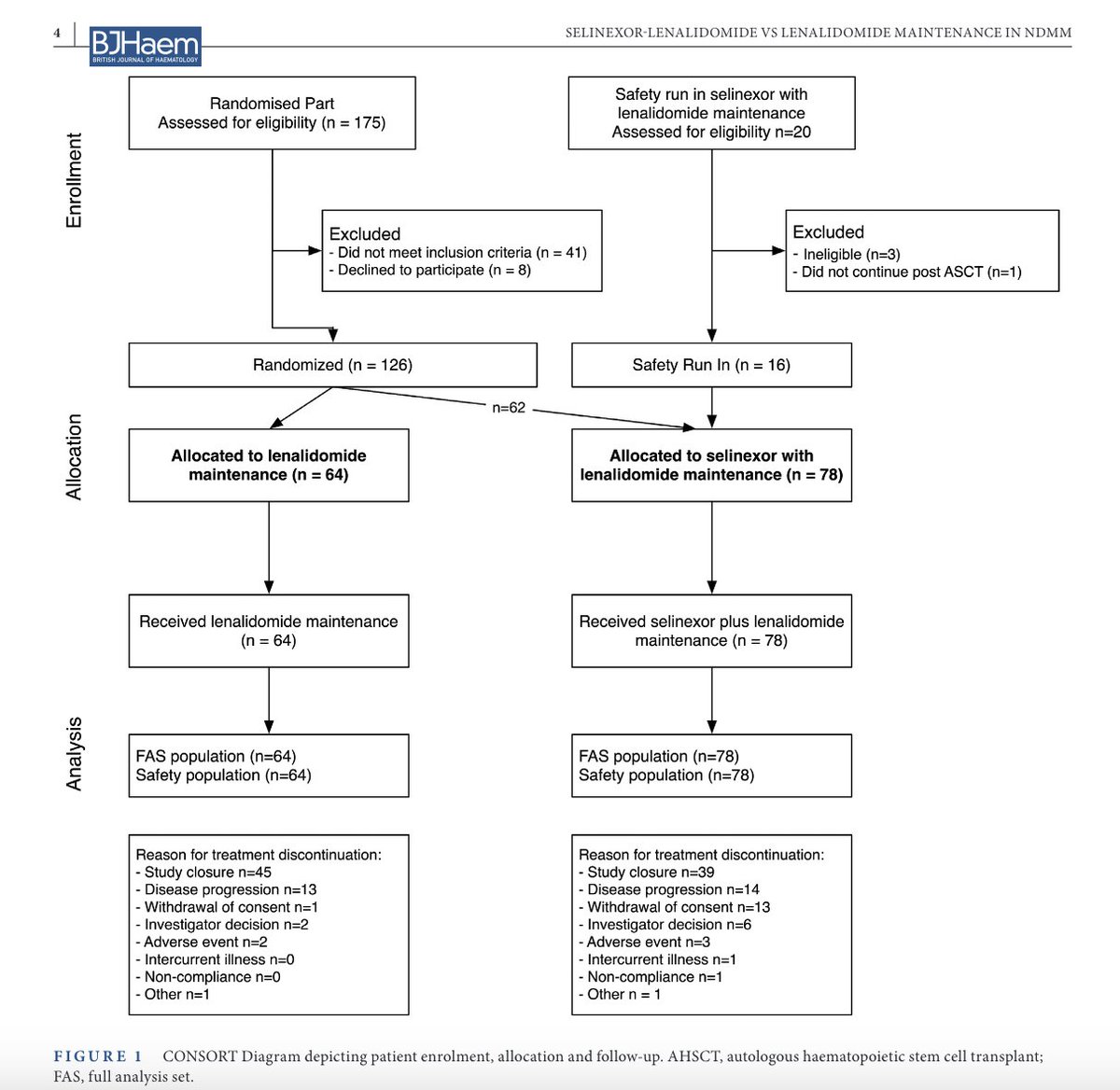

SeaLAND
#IMS26 #mmsm SeaLAND trial :Selinexor plus lenalidomide versus lenalidomide
Adding selinexor gave no PFS or OS benefit, including in high risk patients, and it added substantial toxicity that reduced how much lenalidomide patients actually received
➡️142 patients enrolled (R = https://t.co/hXfKrww4KW
[Slide 1 - CONSORT diagram, SeaLAND trial (Selinexor-Lenalidomide vs Lenalidomide maintenance in NDMM), BJHaem]
Randomised part: assessed n=175, excluded 41 (inclusion)/8 (declined), randomized n=126.
Safety run-in: assessed n=20, excluded 3 (ineligible)/1 (no ASCT), n=16.
Allocated to lenalidomide maintenance n=64; allocated to selinexor+lenalidomide maintenance n=78 (62 randomized + 16 safety run-in).
Reasons for discontinuation - Lenalidomide arm (n=64): study closure 45, disease progression 13, withdrawal of consent 1, investigator decision 2, adverse event 2, other 1.
Sel+Len arm (n=78): study closure 39, disease progression 14, withdrawal of consent 13, investigator decision 6, adverse event 3, intercurrent illness 1, non-compliance 1, other 1.
[Slide 2 - Figure 2: Progression-free survival, BJHaem]
Panel A - KM curves: Len alone vs Sel+Len as maintenance post-ASCT.
Number at risk at months 0/6/12/18/24/30/36/42/48: Len 64/57/44/35/26/19/9/2/0; Sel+Len 78/64/54/43/29/21/13/9/5.
Panel B - subgroup forest plot (HR, 95% CI), Sel+Len vs Len alone:
Overall 21/78 (26.9%) vs 14/64 (21.9%), HR 1.22 (0.62-2.41).
Age <65: 12/52 (23.1%) vs 10/40 (25.0%), HR 0.84 (0.36-1.95). Age >=65: 9/26 (34.6%) vs 4/24 (16.7%), HR 2.33 (0.71-7.68).
R-ISS Stage I: 4/24 (16.7%) vs 4/24 (16.7%), HR 1.16 (0.29-4.64). Stage II: 6/33 (18.2%) vs 10/37 (27.0%), HR 0.77 (0.28-2.11).
Risk Low: 18/62 (29.0%) vs 9/49 (18.4%), HR 1.67 (0.75-3.71). High: 3/16 (18.8%) vs 5/15 (33.3%), HR 0.47 (0.11-2.01).
del17p None: 19/65 (29.2%) vs 13/58 (22.4%), HR 1.22 (0.60-2.46). del17p present: 2/13 (15.4%) vs 1/6 (16.7%), HR 1.07 (0.10-11.89).
Sep 23
MajesTEC-3MajesTEC-9MELT-MMMonumenTAL-3MonumenTAL-6SUCCESSOR-2
#IMS2026 How to approach first relapse by @DrRakeshPopat https://t.co/3uXrSIgjY7
International Myeloma Society
New 2nd line treatments according to patient characteristics
Columns: Tec +Ig (MajesTec 9) | Tec Dara +Ig (MajesTec 3) | Tal Dara (MonumenTal 3) | Tal Dara Pom (MonumenTal 3) | Mezi Kd (Successor 2) | [Press release only:] Tal Pom (MonumenTal 6) | Tec Tal +Ig (MonumenTal 6) | Elra +Ig (MagnetisMM 5)
CD38 refractory: Yes | Possibly* | Possibly* | Possibly* | Yes | Yes | Yes | ?
High risk: Possibly | Yes | Possibly | Possibly | Yes | Yes | Yes | ?
EMD: Possibly | Possibly | Possibly | Possibly | Possibly | Possibly | Yes | ?
Frail: Yes | Caution | Possibly | Caution | Yes | Possibly | Yes | ?
High Infection risk: Possibly | Caution | Yes | Caution | Possibly | Possibly | Caution | ?
Tolerability: Yes | Yes | Possibly | Possibly | Yes | Possibly | Caution | ?
[Note: row-to-cell alignment approximate due to photo angle]
Yes = Preferred / data supports; Possibly = Conditional / Limited data; Caution = possible but caution required
Tec = Teclistamab | Tal = Talquetamab | Elra = Elranatamab | Dara = Daratumumab | Pom = Pomalidomide | Ig = Immunoglobulin | Mezi = mezigdomide | K = carilzomib | *based on TRIMM-2 data
Based on trial eligibility + published efficacy/safety signals for BCMA & GPRC5D bispecifics. Table represents personal opinion and based on limited evidence!
Costa LJ, et al. N Engl J Med. 2026;394(8):739-752, Touzeau C, et al. N Engl J Med. 2026, Mina R, et al. N Engl J Med. 2026, Dimopoulos et al., The Lancet 2026, Johnson & Johnson. press release, 23 July 2026, Pfizer. press release, 29 April 2026.
Sep 23
CARTITUDE-4CERVINODREAMM-7DREAMM-8MajesTEC-3MajesTEC-9MonumenTAL-3MonumenTAL-6
Never a good time to be a myeloma patient but this is the best it has ever been!
Remarkable results in early relapse setting!
@mvmateos #IMS26 https://t.co/rNUviKkXc5
Phase 3 evidence has moved inmune therapy into early relapse
[Table: STUDY | COMPARISON | forest plot (FAVOURS EXPERIMENTAL / FAVOURS CONTROL) | PFS HR | OS HR]
CARTITUDE-4 | Cilta-cel vs DPd/PVd | PFS HR 0.29 | OS HR 0.55
DREAMM-7 | BVd vs DVd | PFS HR 0.41 | OS HR 0.58
DREAMM-8 | BPd vs PVd | PFS HR 0.52 | OS HR 0.77
MajesTEC-3 | Tec-Dara vs DPd/DVd | PFS HR 0.17 | OS HR 0.46
MonumenTAL-3 | Tal-DP vs DPd | PFS HR 0.28 | OS HR 0.47
(MonumenTAL-3) | Tal-D vs DPd | PFS HR 0.33 | OS HR 0.51
MajesTEC-9 | Teclistamab vs PVd/Kd | PFS HR 0.29 | OS HR 0.60
MonumenTAL-6 | Tal-Tec vs EPd/PVd | PFS HR 0.11 | OS HR NR
(MonumenTAL-6) | Tal-Pom vs EPd/PVd | PFS HR 0.27 | OS HR NR
CERVINO | Etentamig vs investigator's choice | PFS HR 0.40 | OS HR NR
RANDOMIZED PHASE 3 TRIALS WITHOUT PUBLIC NUMERICAL HRs
MagnetisMM-5 | Elranatamab +/- Dara vs DPd | Positive top-line result; no numerical data reported
[Forest plot x-axis tick labels largely illegible]


DART
1 slide Sep 24

DART
Happening soon! Grab lunch & come to Alsh room to hear @christoscha presents first report on senolytics to improve #mmsm CAR-T outcome. #IMS26 DART study funded by #NCI @MayoCancerCare Myeloma SPORE @MegVoda @nadineabdal @Leif_Bergsagel @Myeloma_mSMART https://t.co/z9zMCKKRq8
Mayo Clinic / 23rd International Myeloma Society Annual Meeting, Glasgow, Scotland. September 2026. [Poster Discussion badge]
Christoph Schaefers, MD
Presents: PA-130 Dasatinib and quercetin in patients with relapsed, refractory multiple myeloma receiving CAR-T therapy: First report from the safety run-in cohort of the phase II DART trial
Session: Poster discussion. Room: Alsh, SEC.
Thursday, September 24, 12:00-12:50 PM
General Conference Content
402 slides





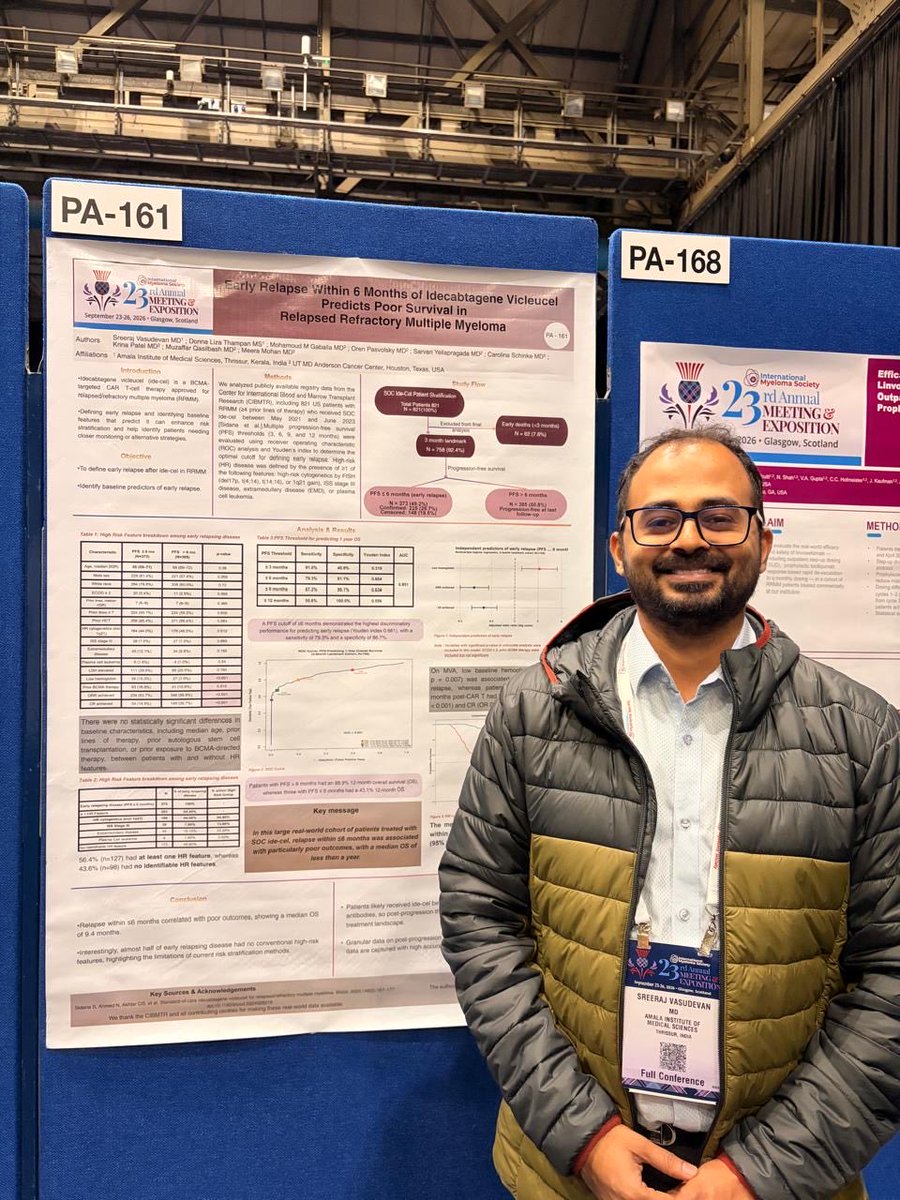











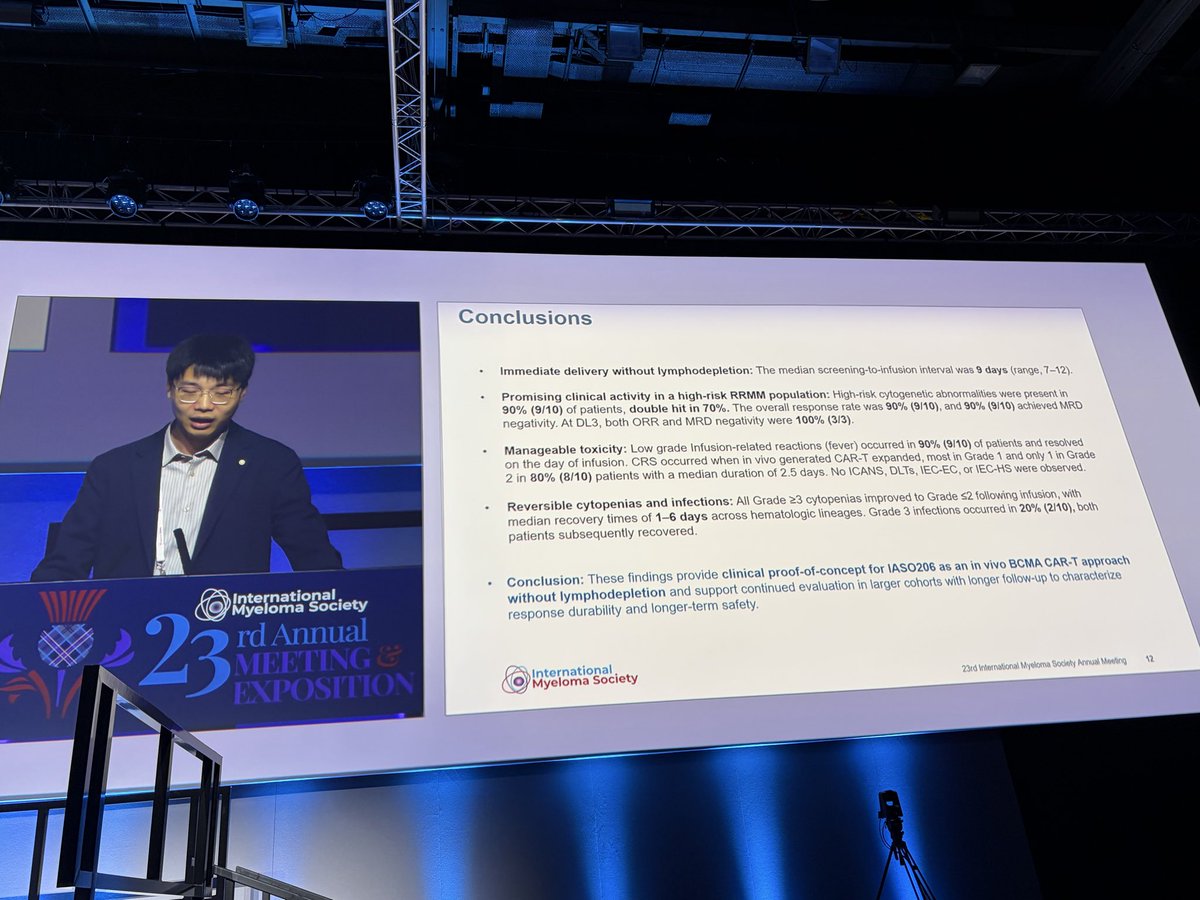
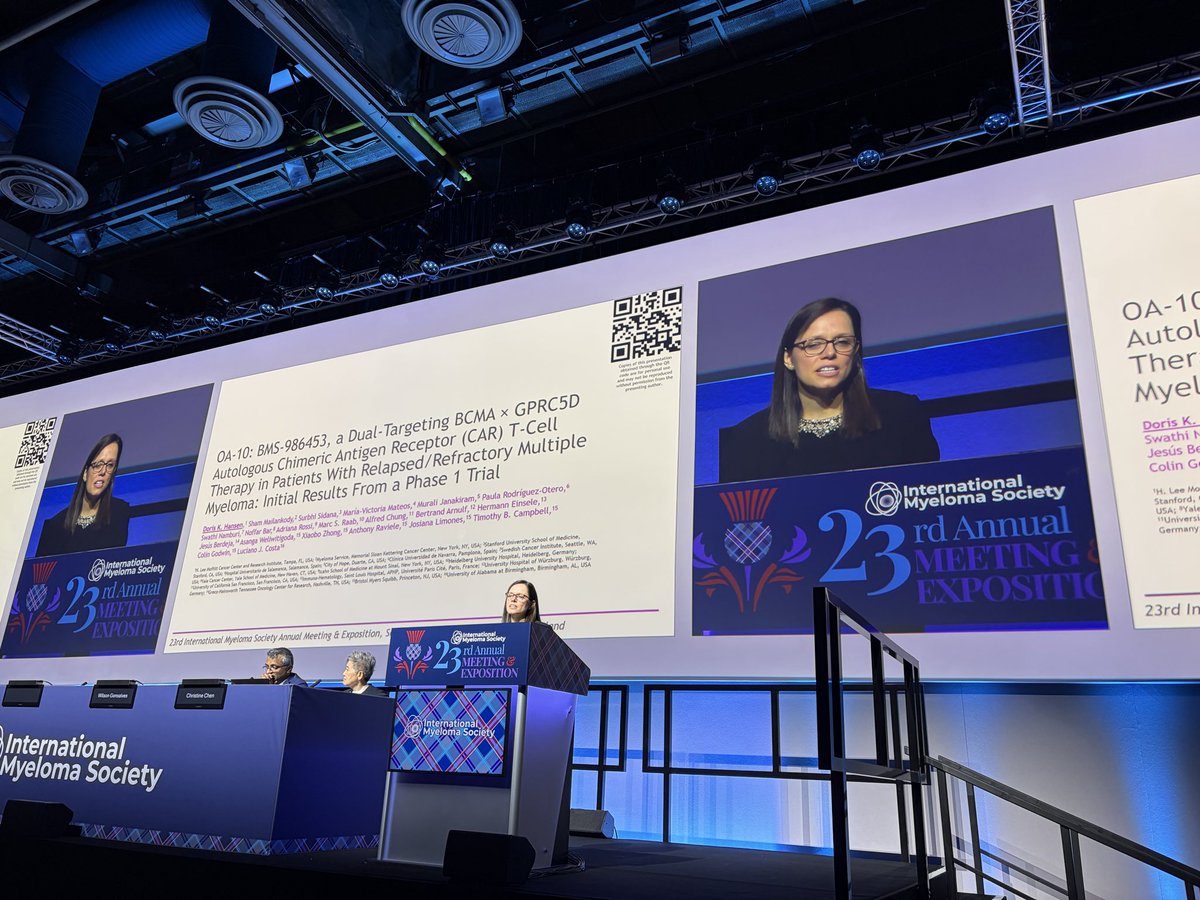


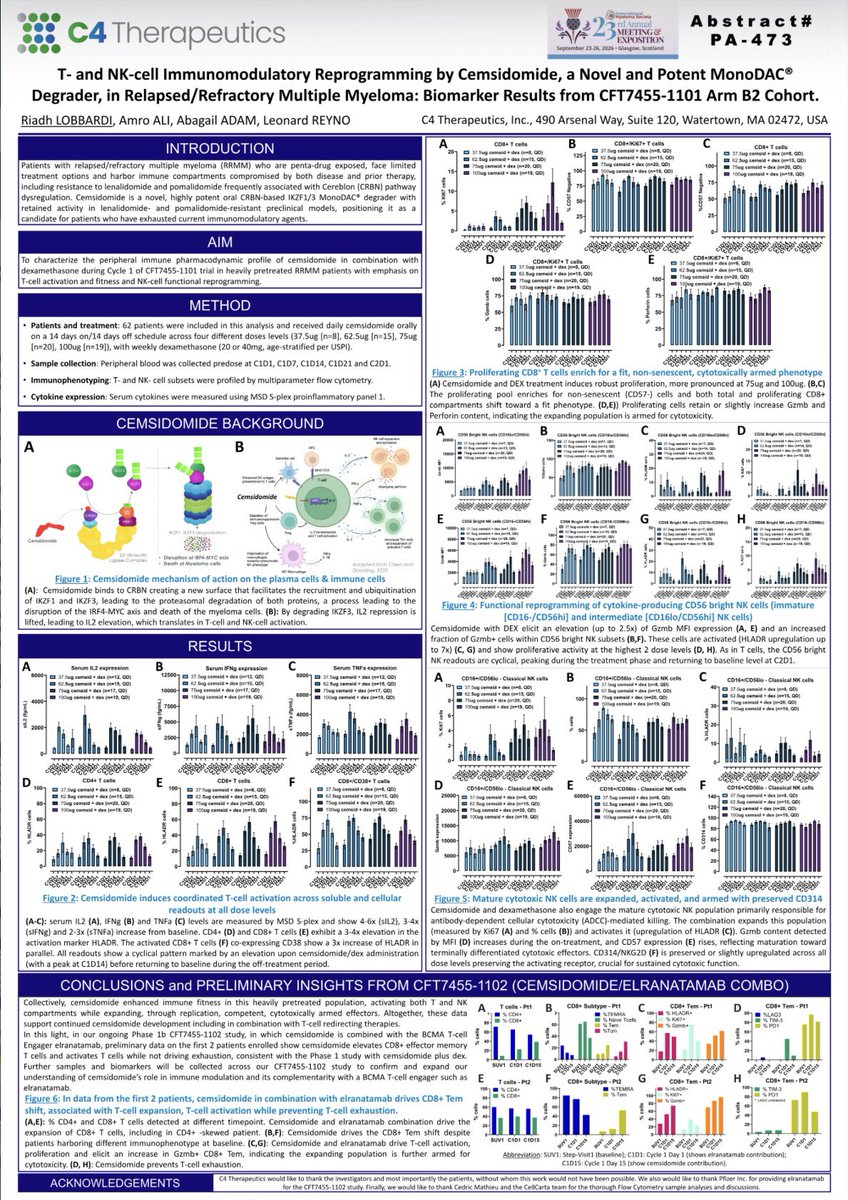
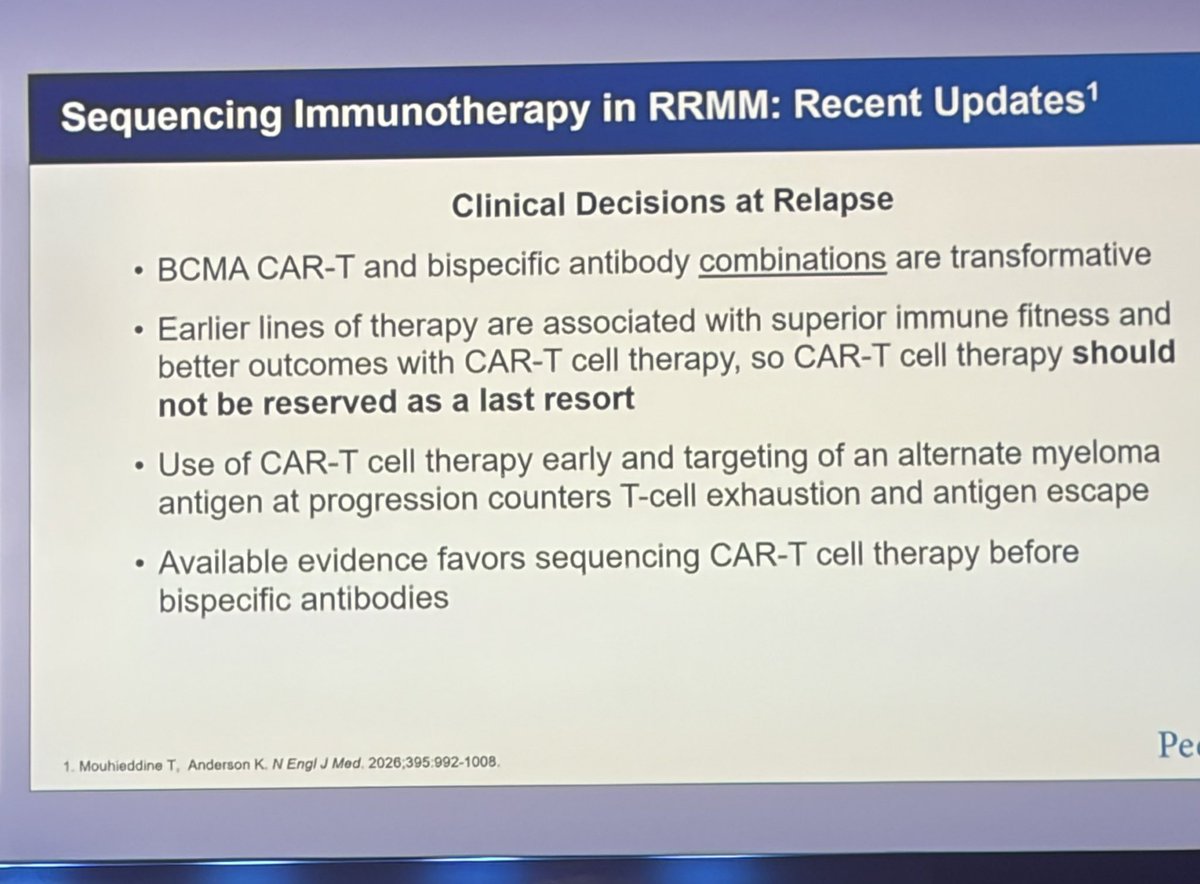
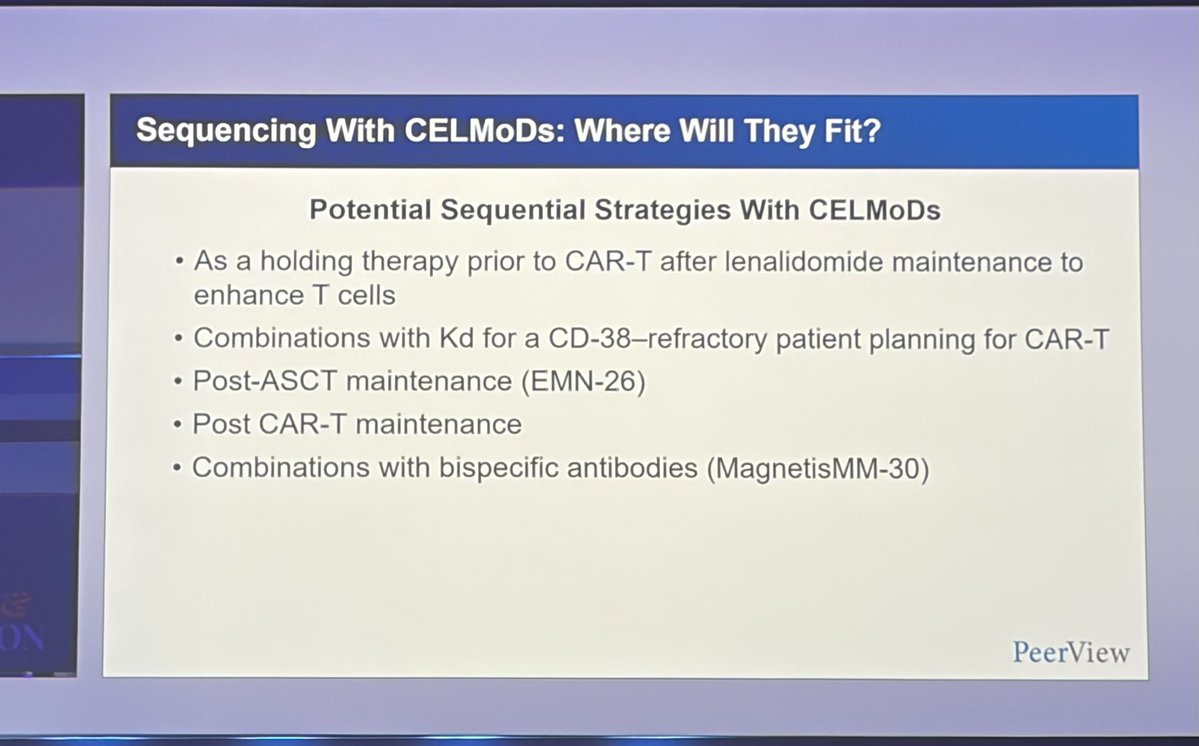
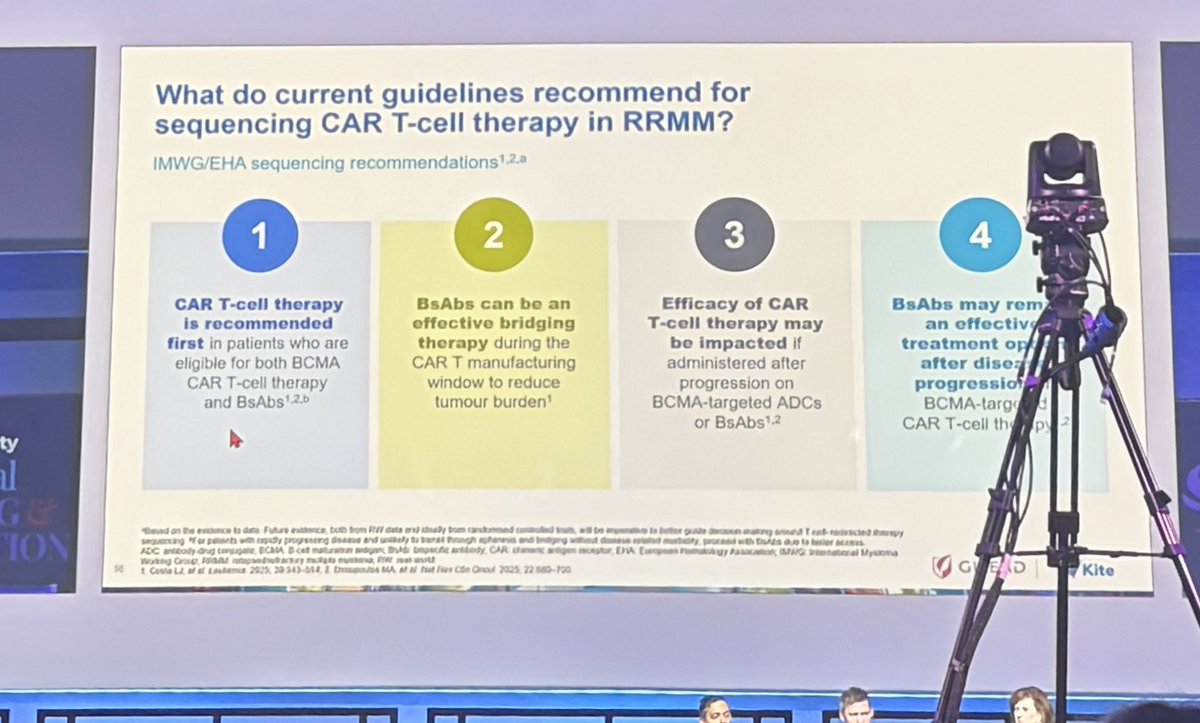

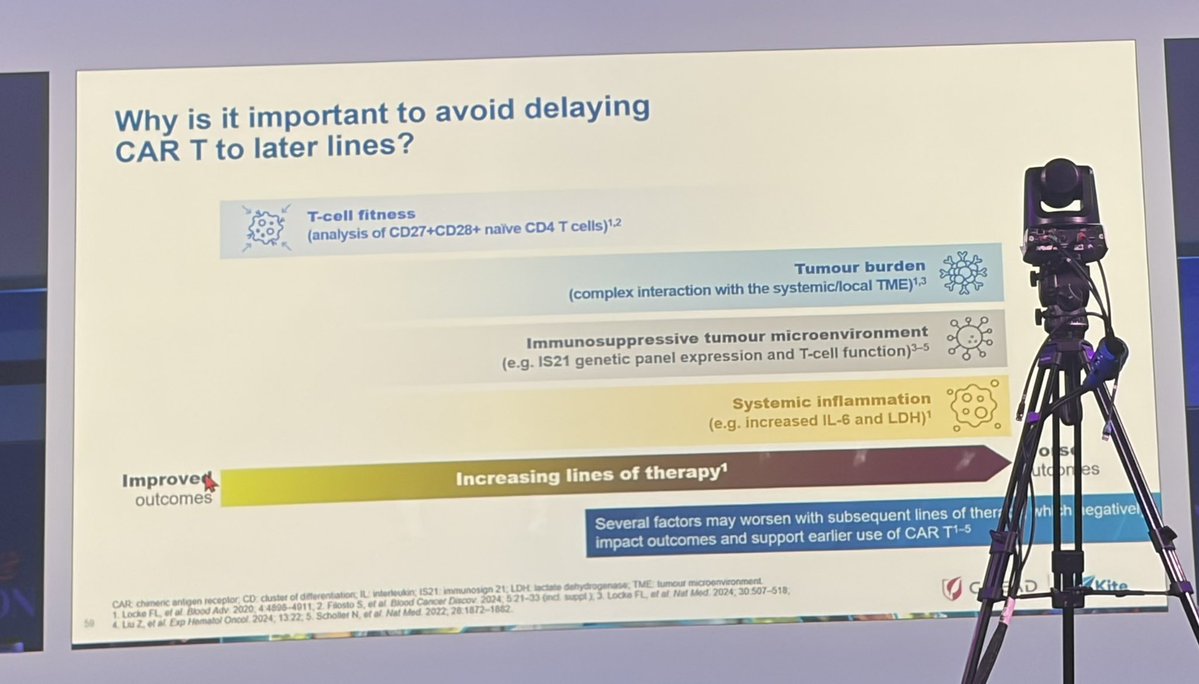
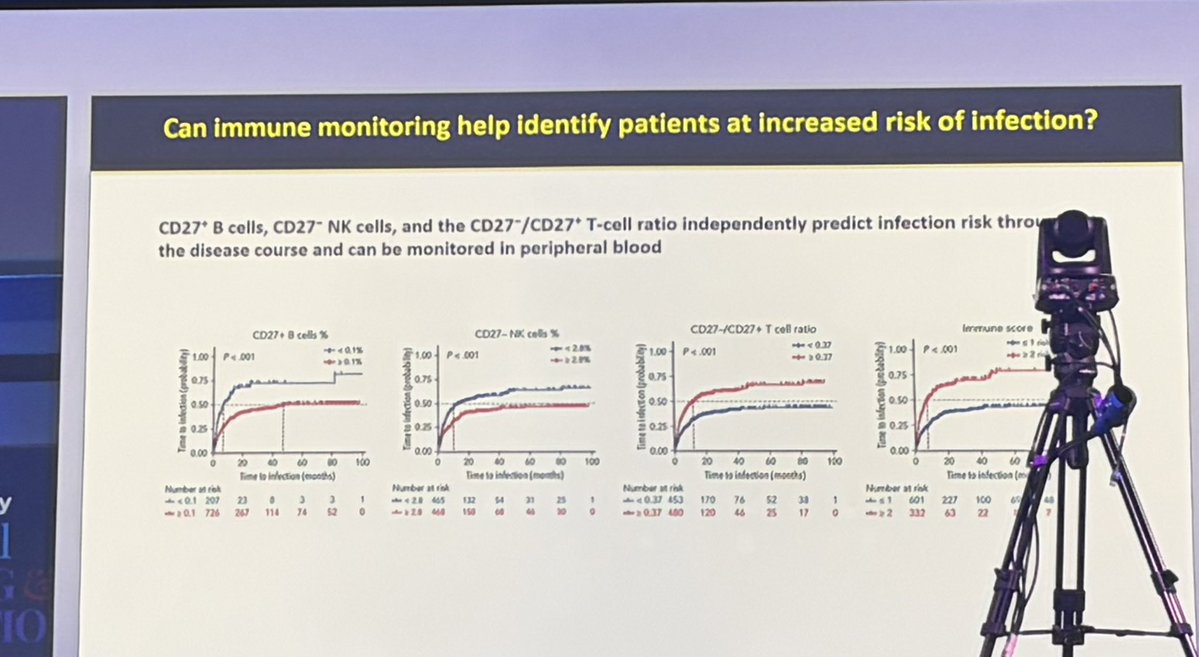
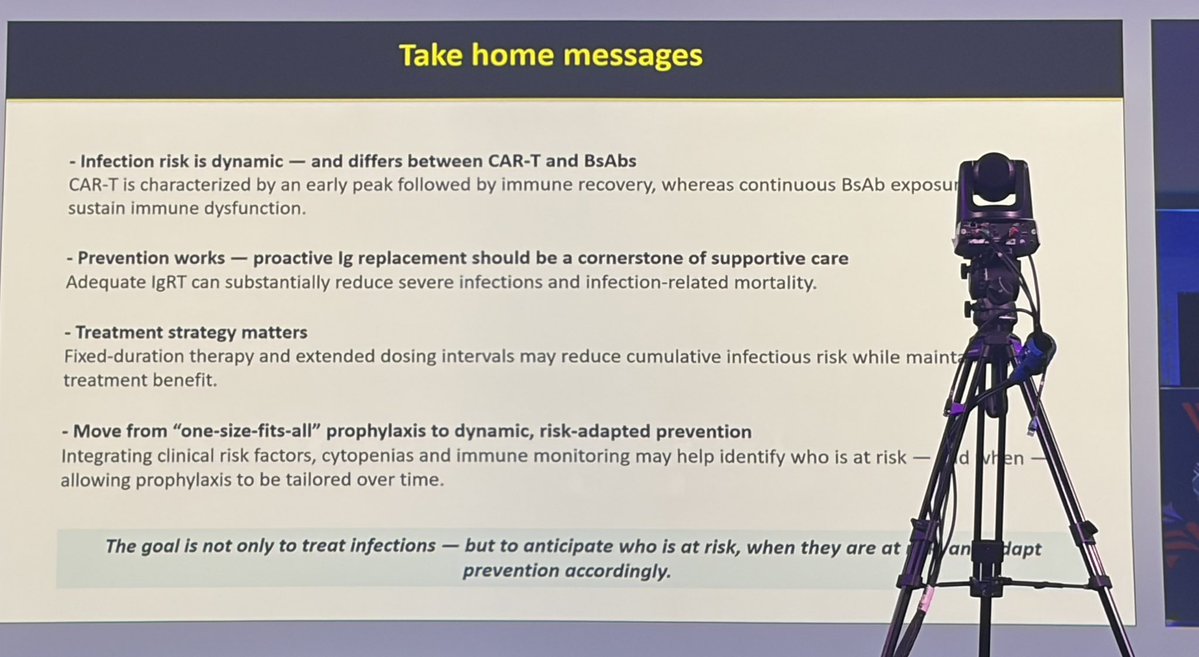
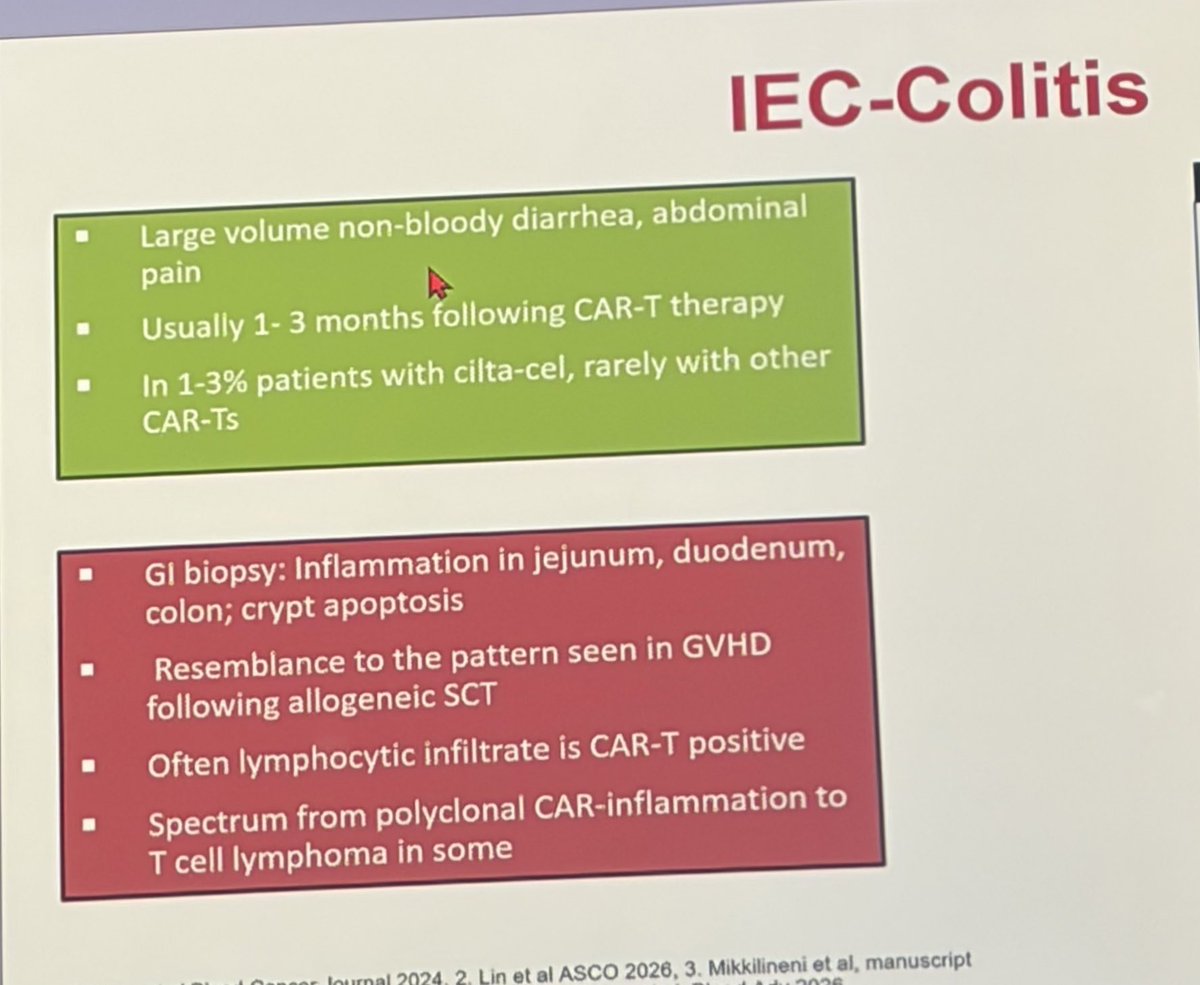
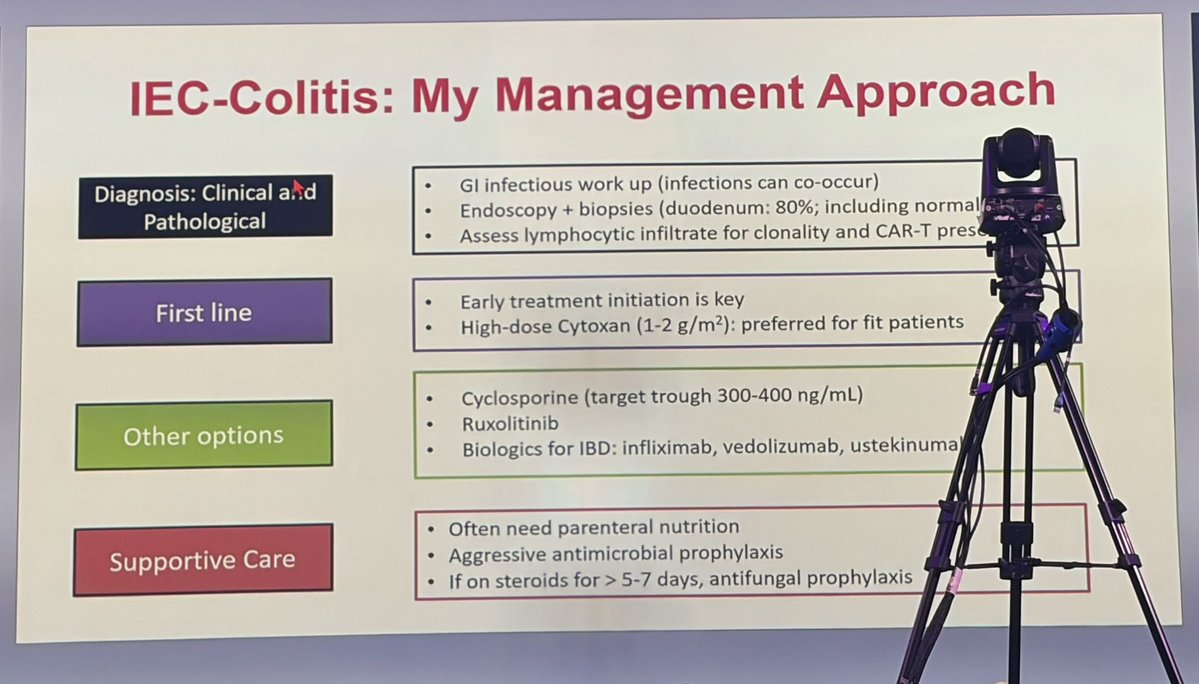
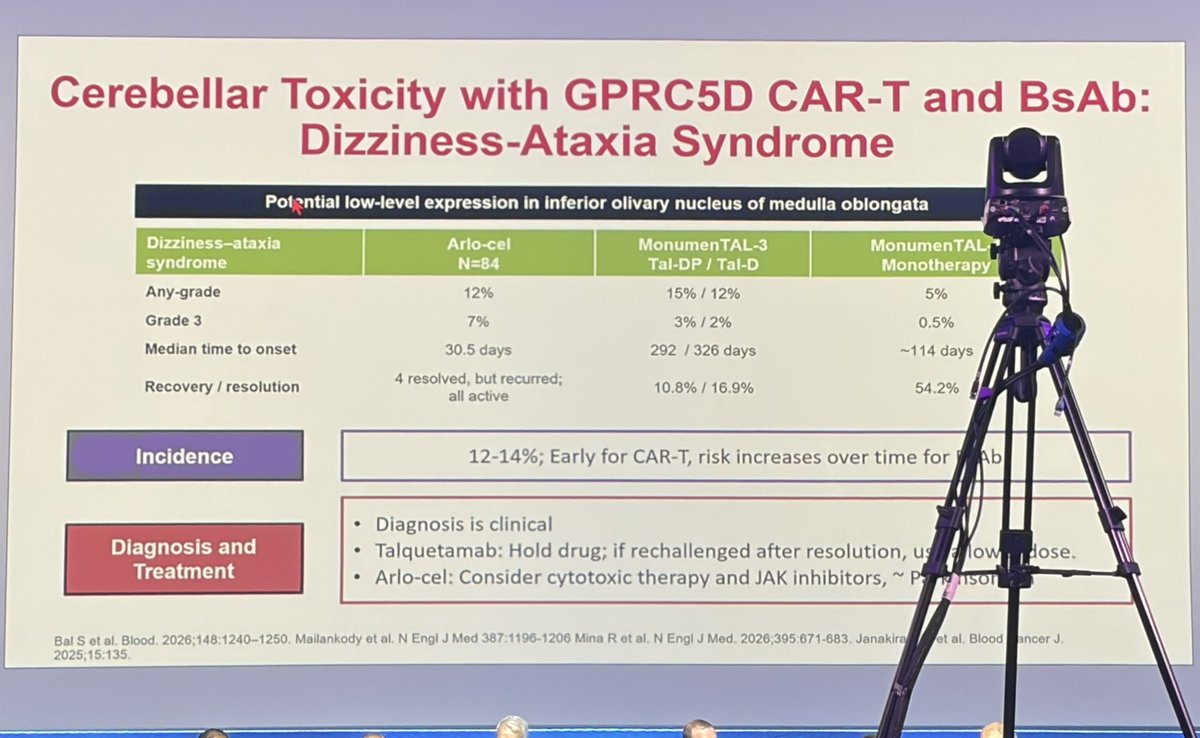
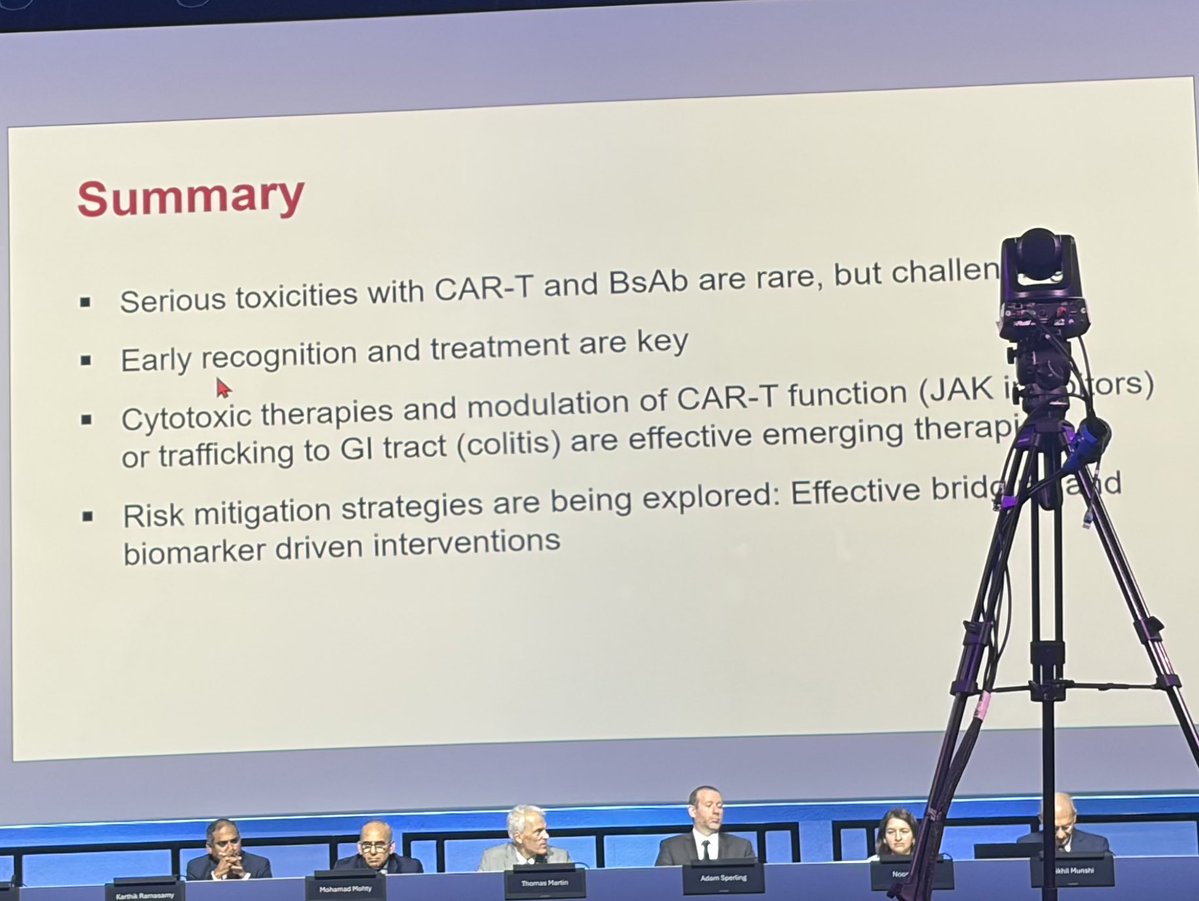
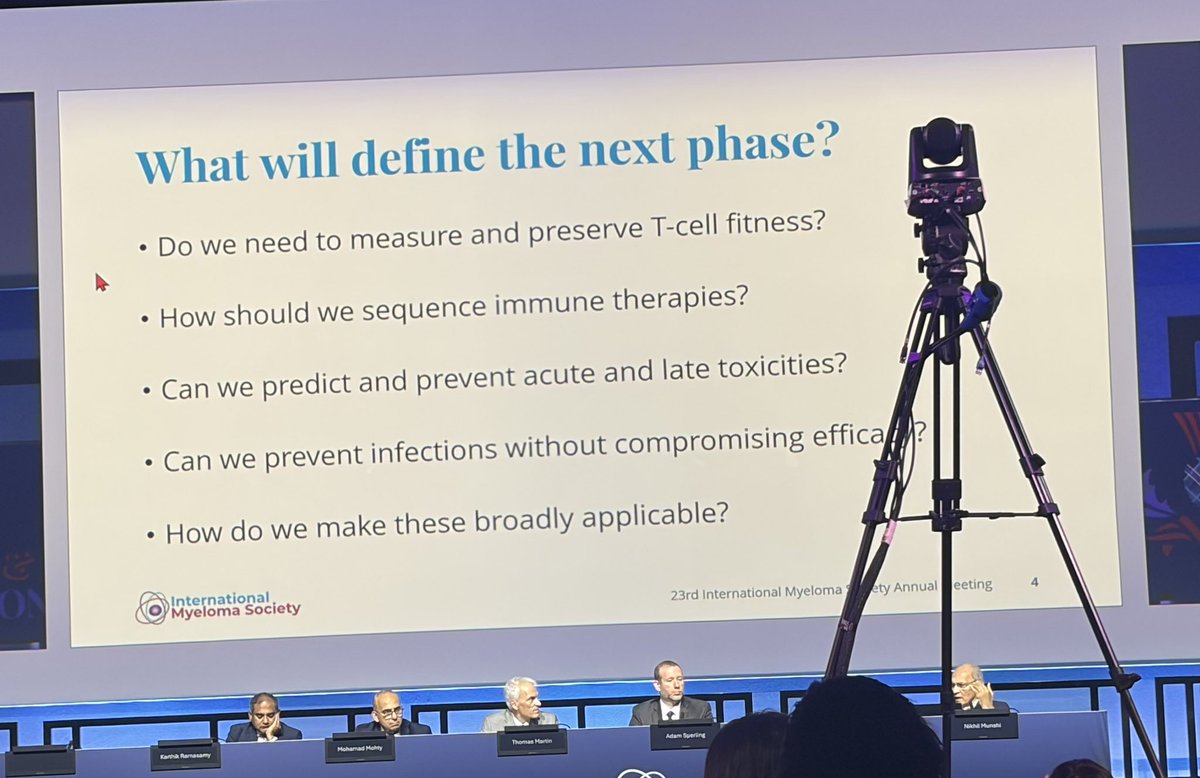
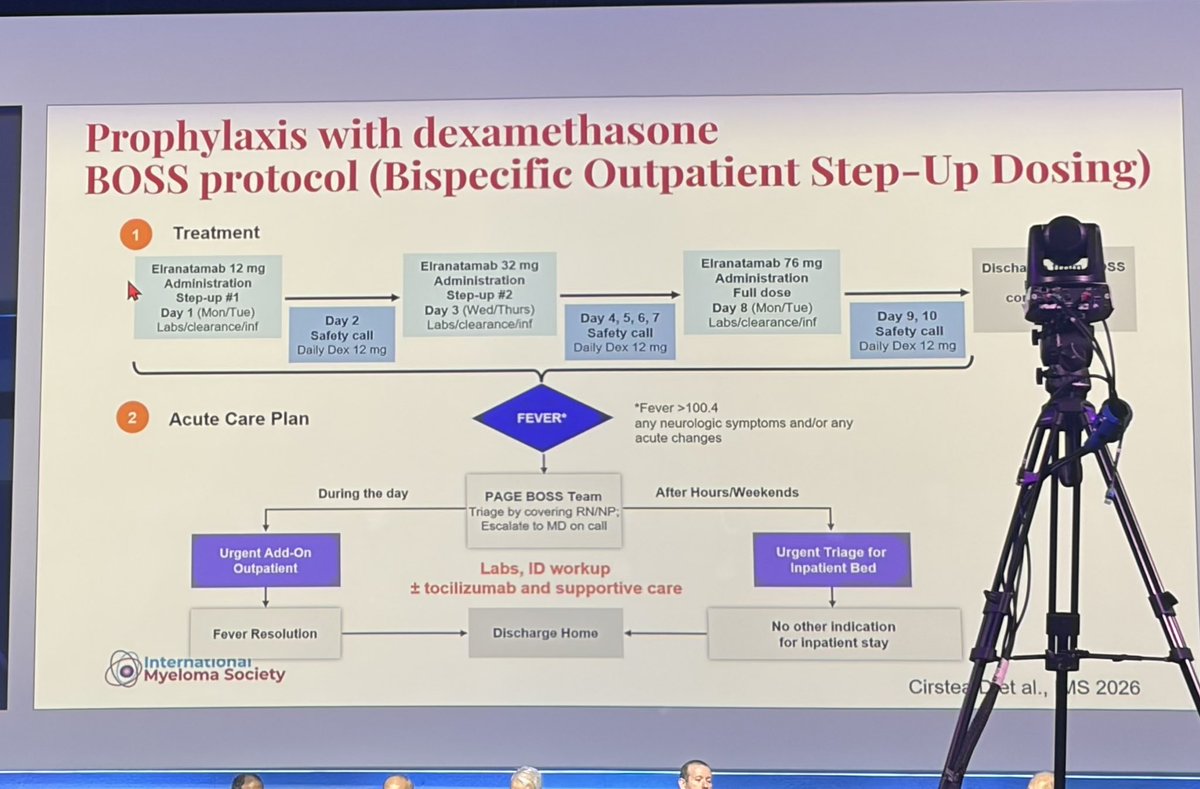
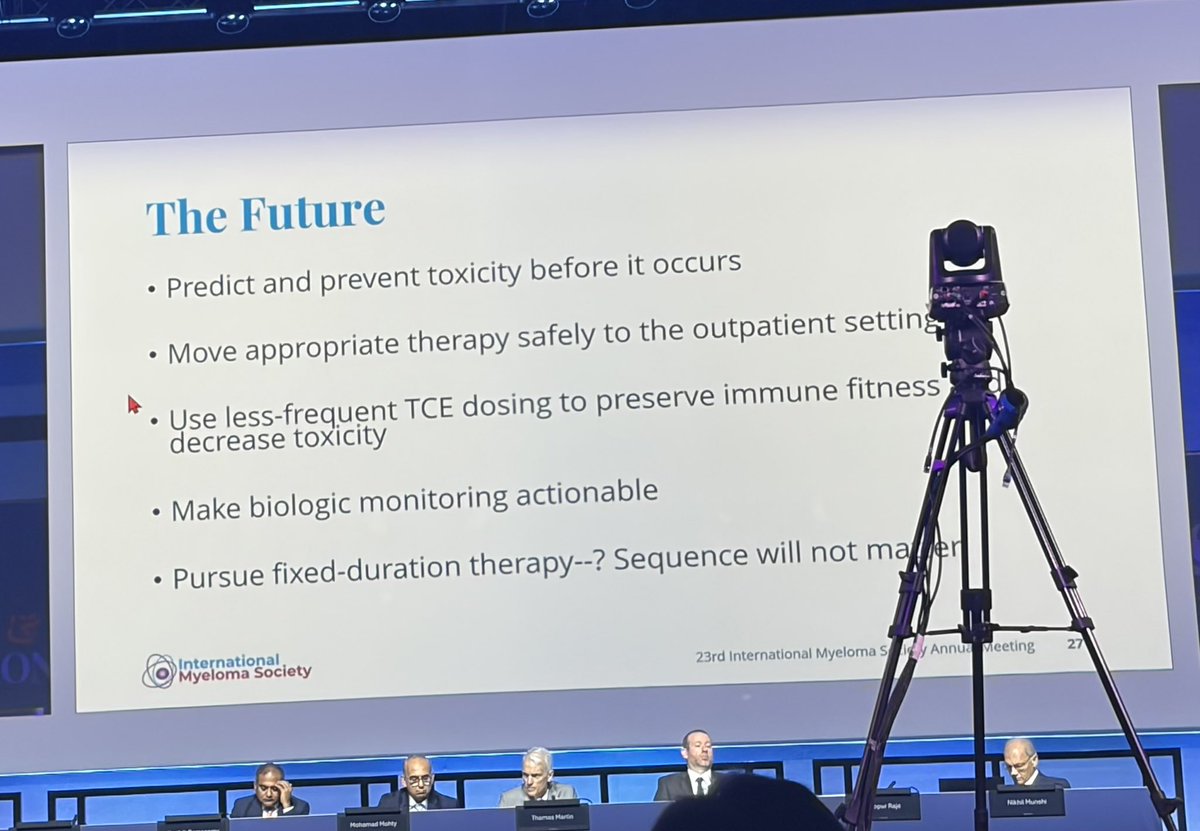
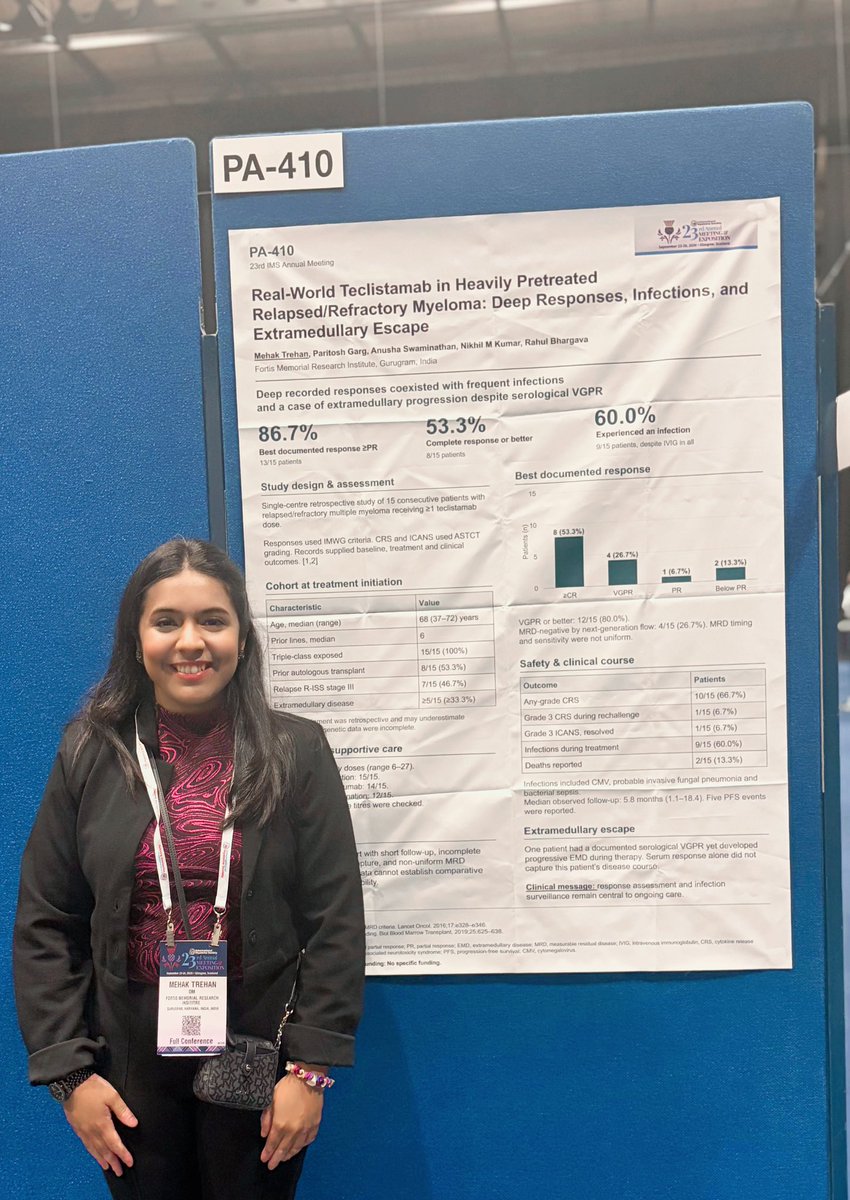

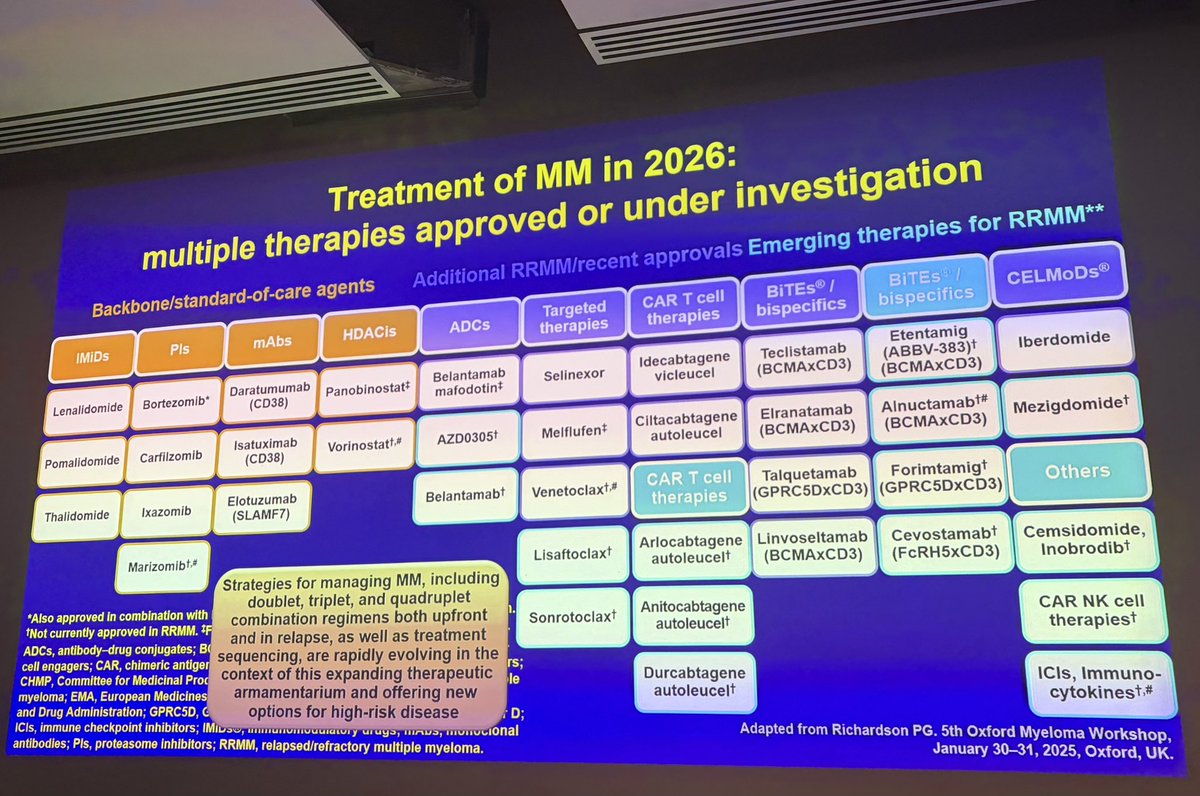
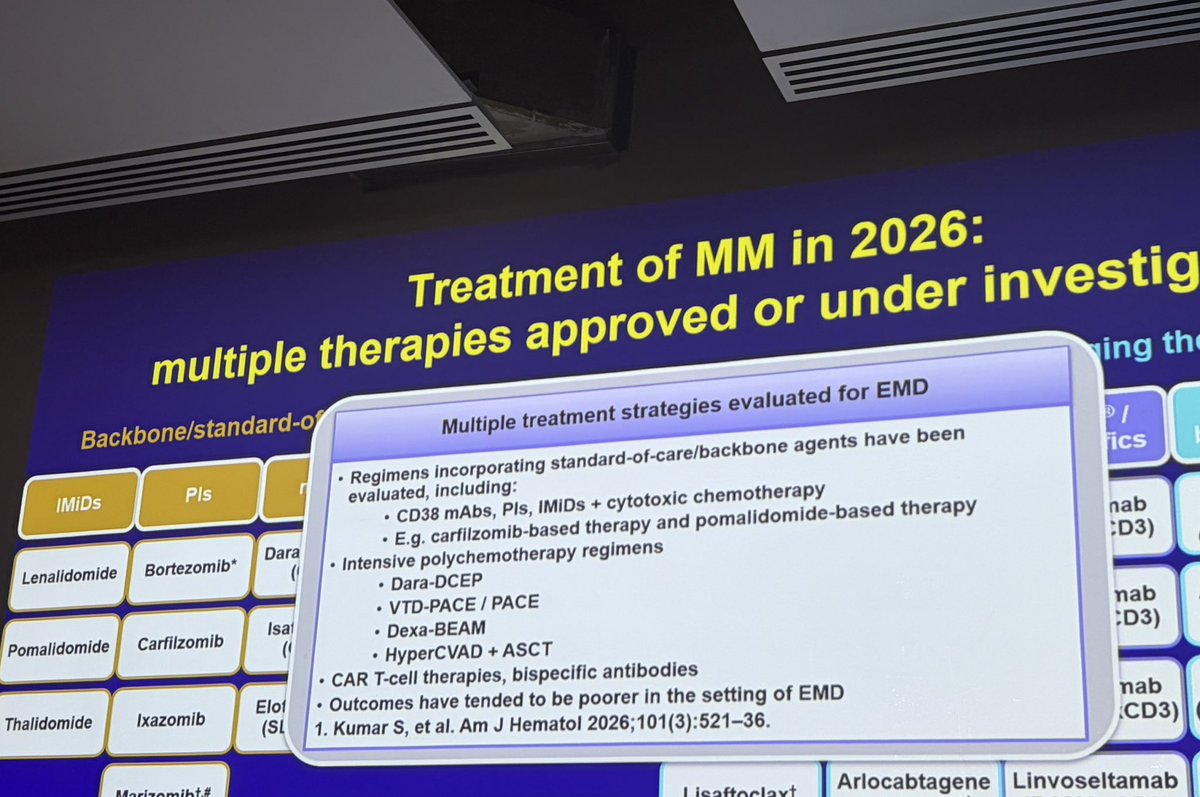
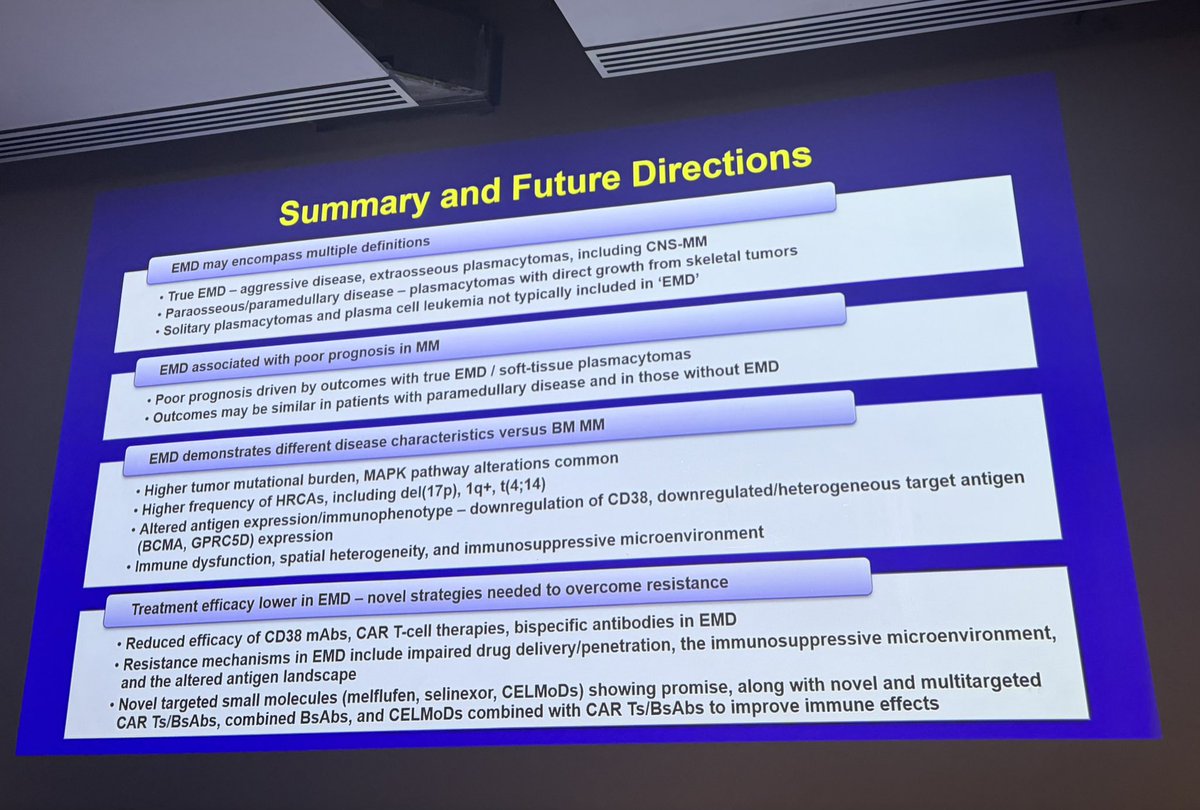


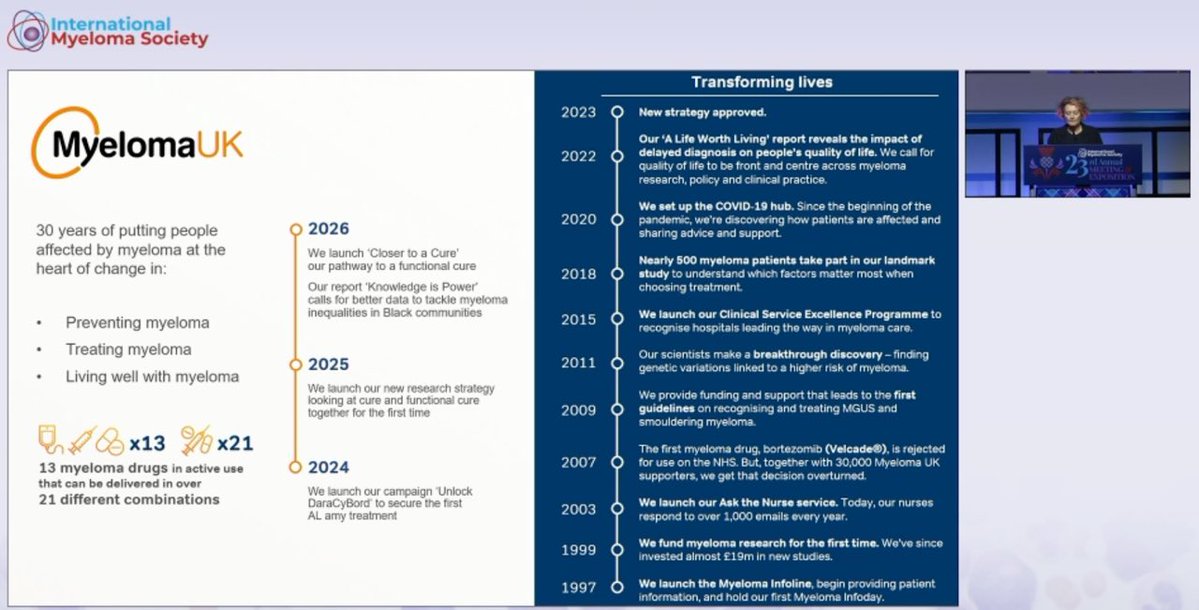
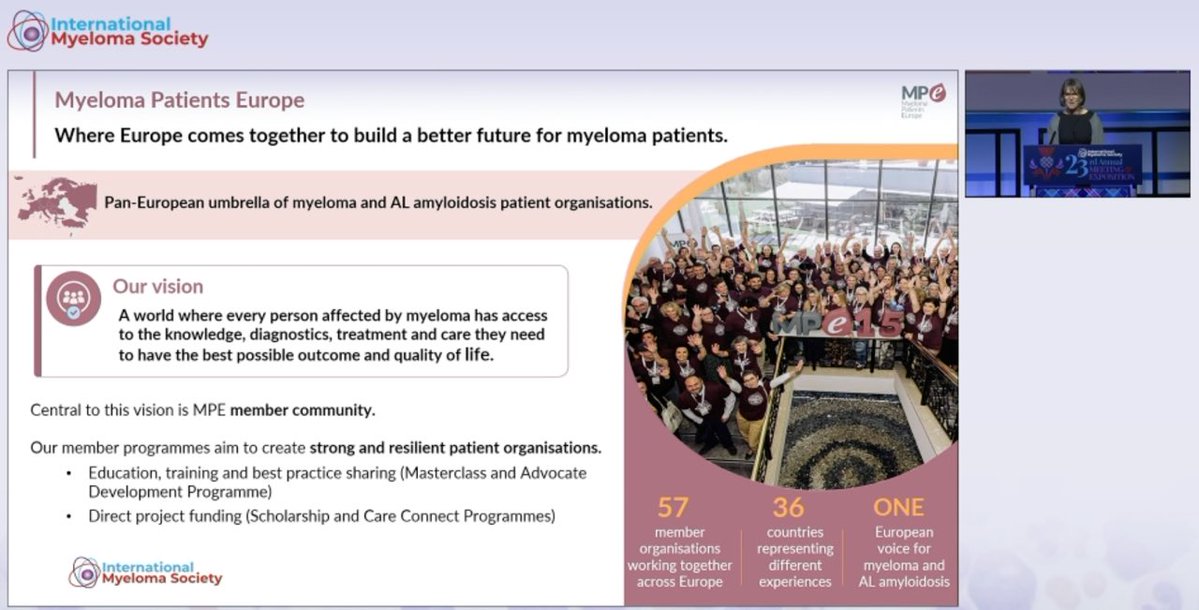

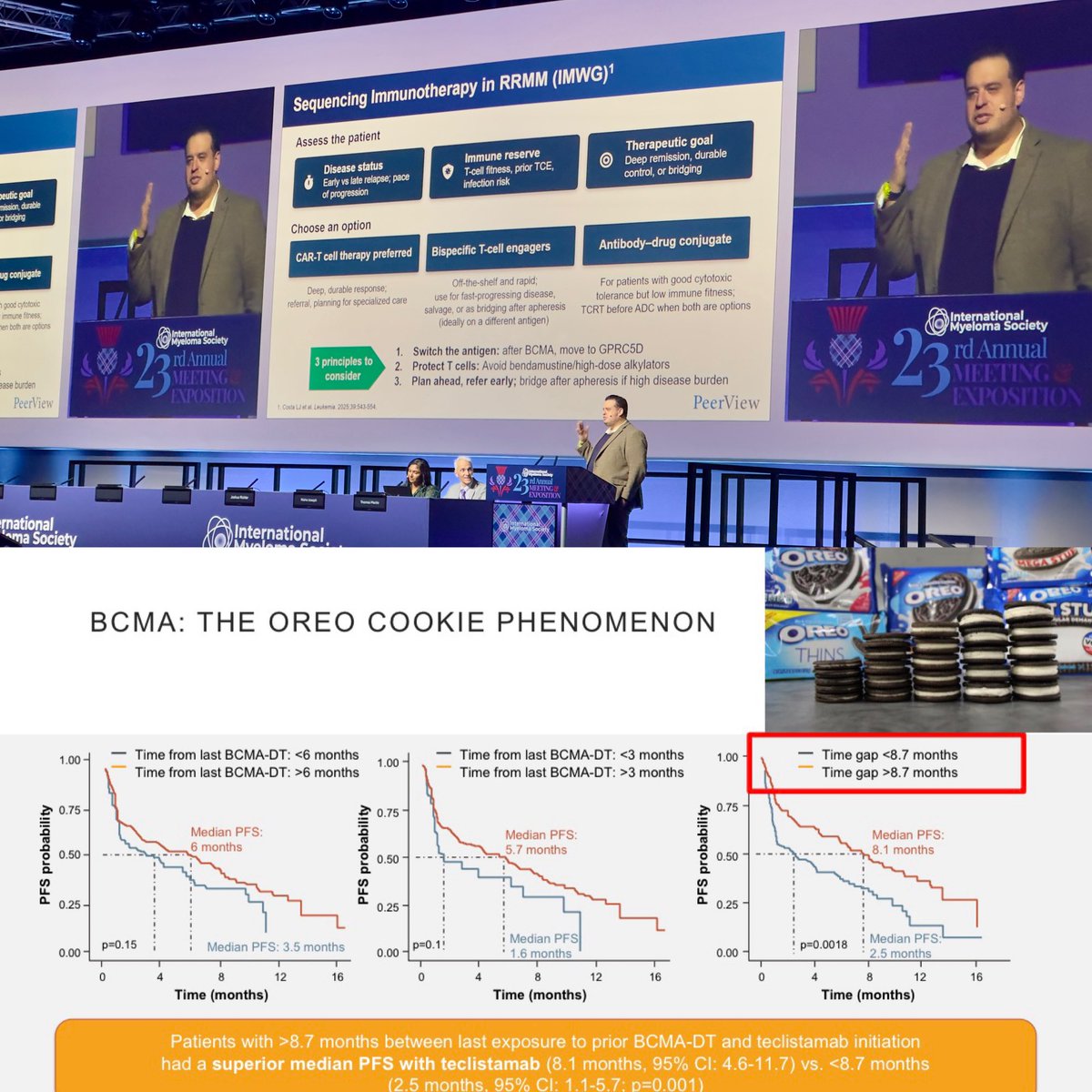

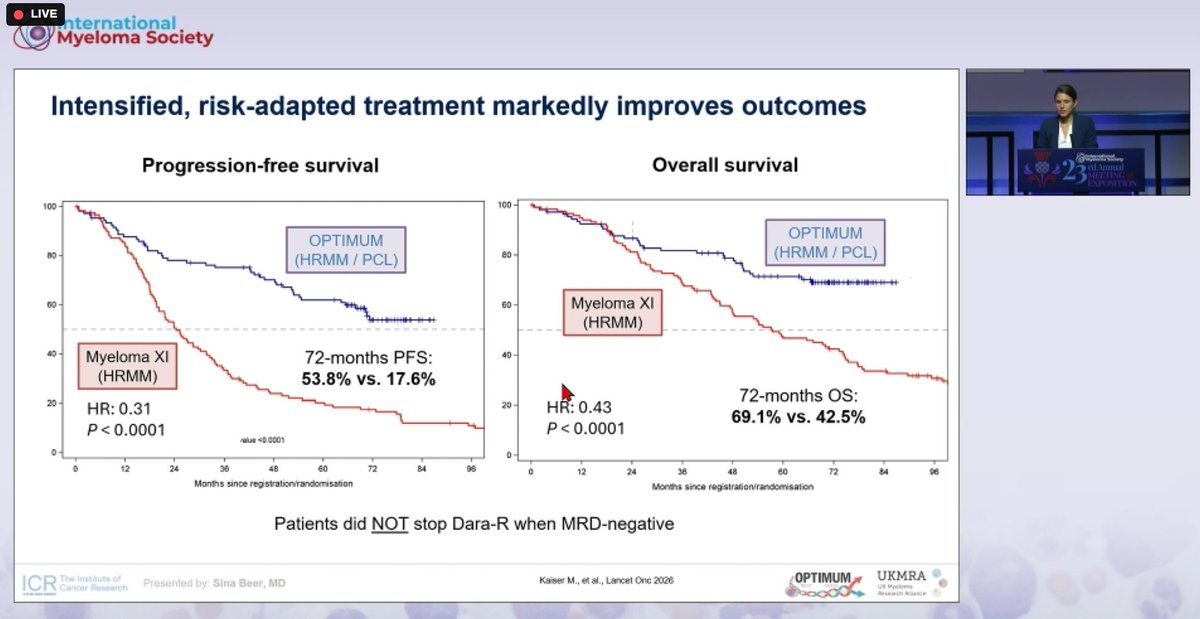
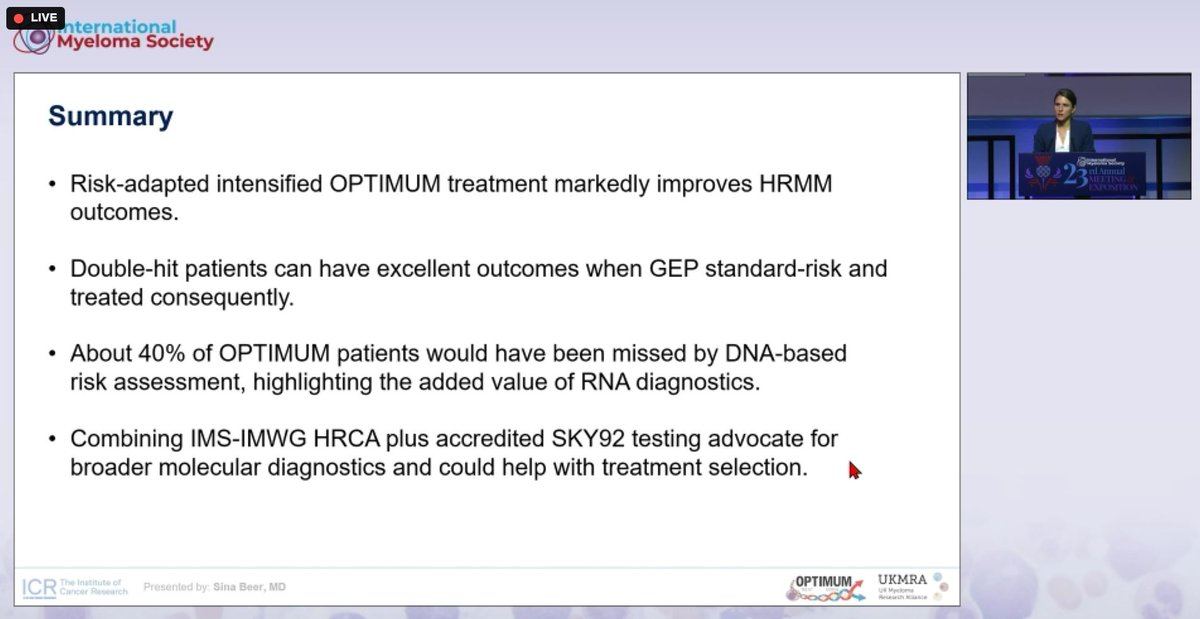
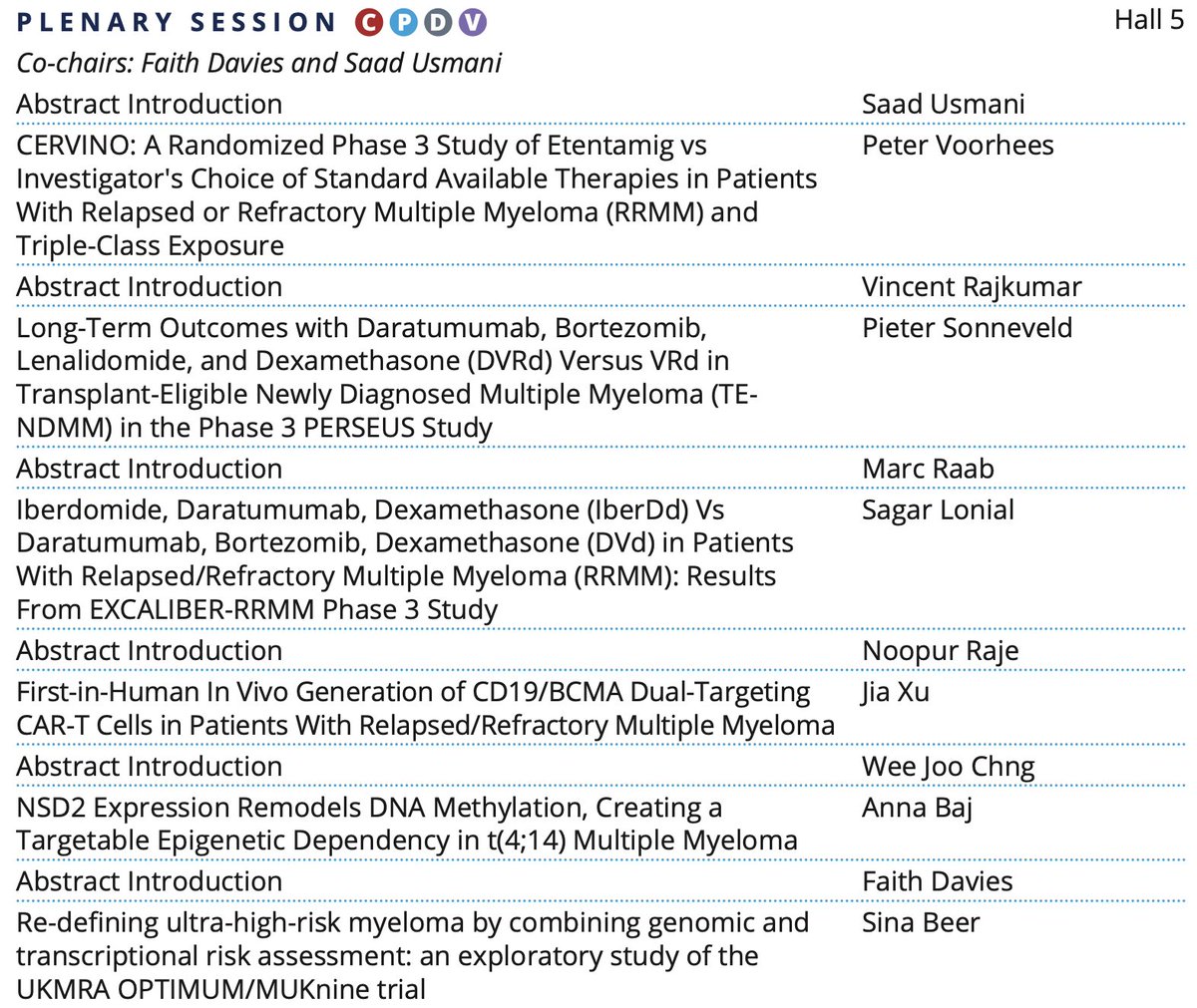
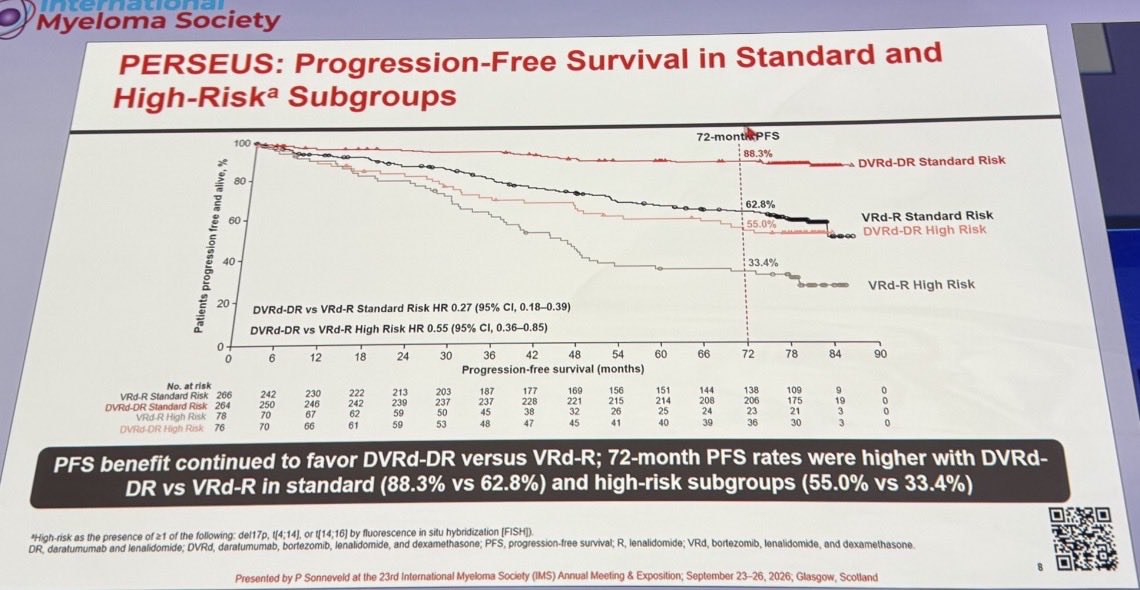
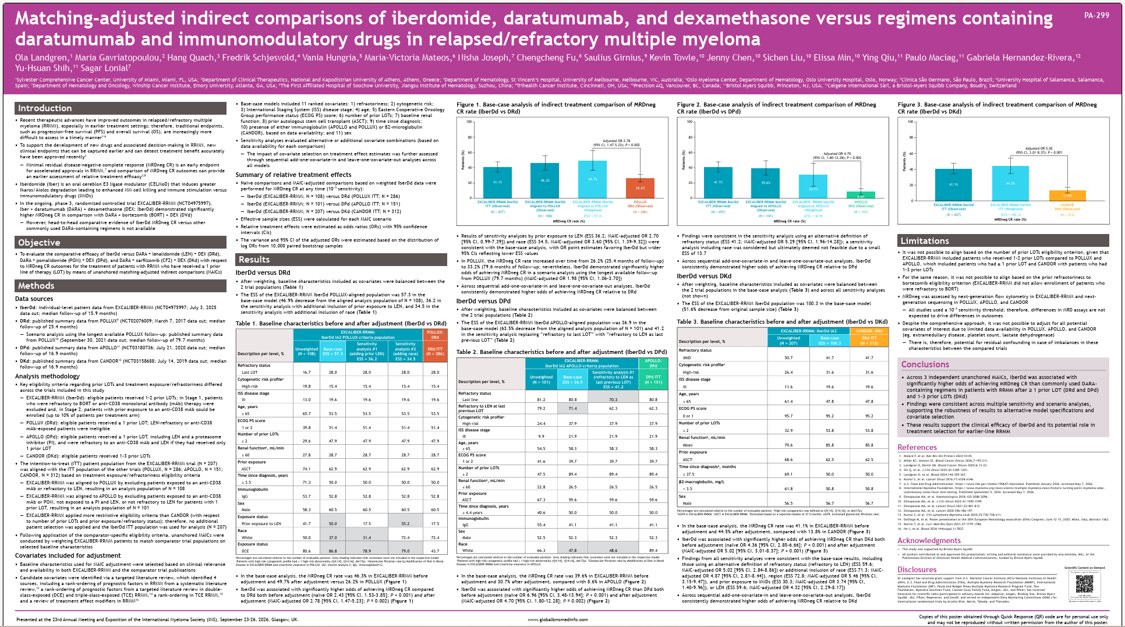

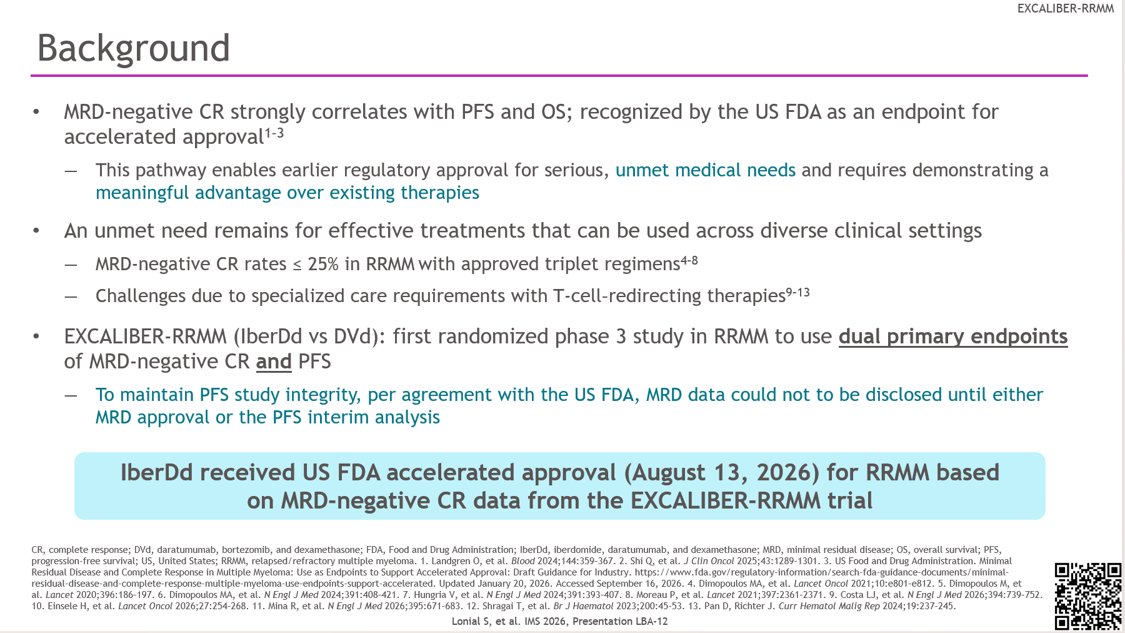


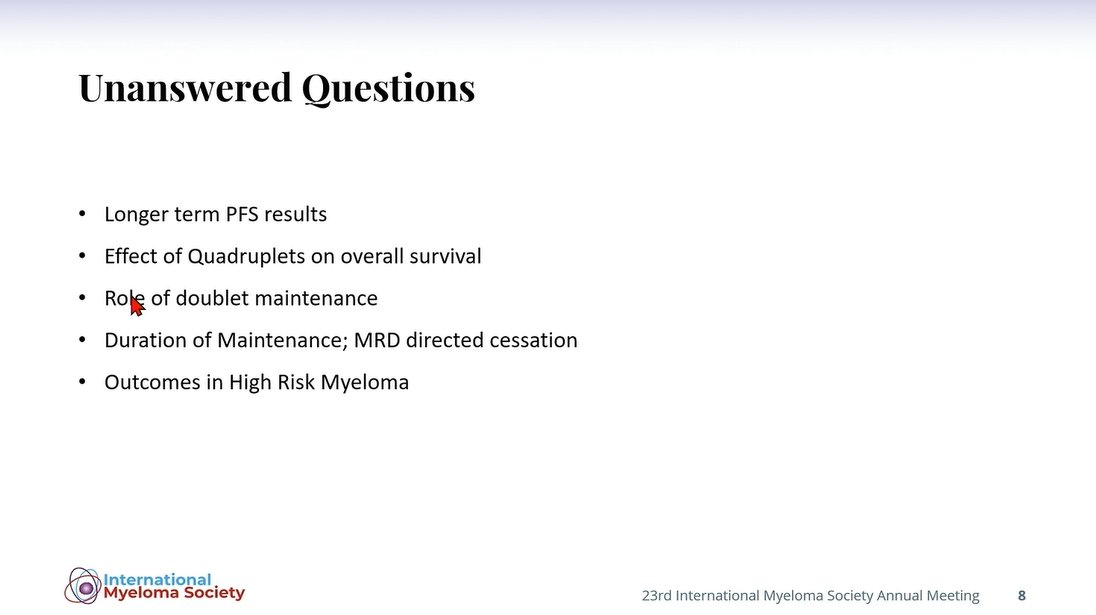
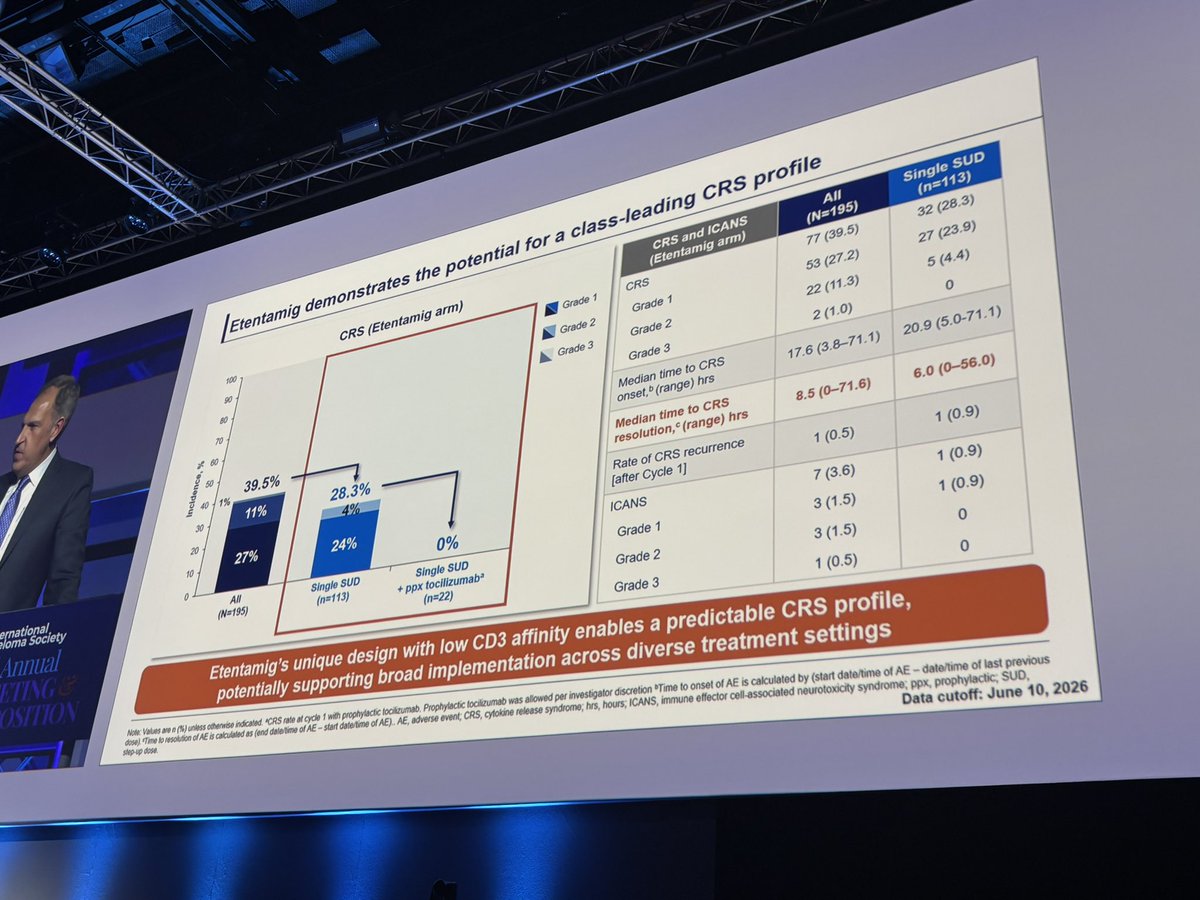
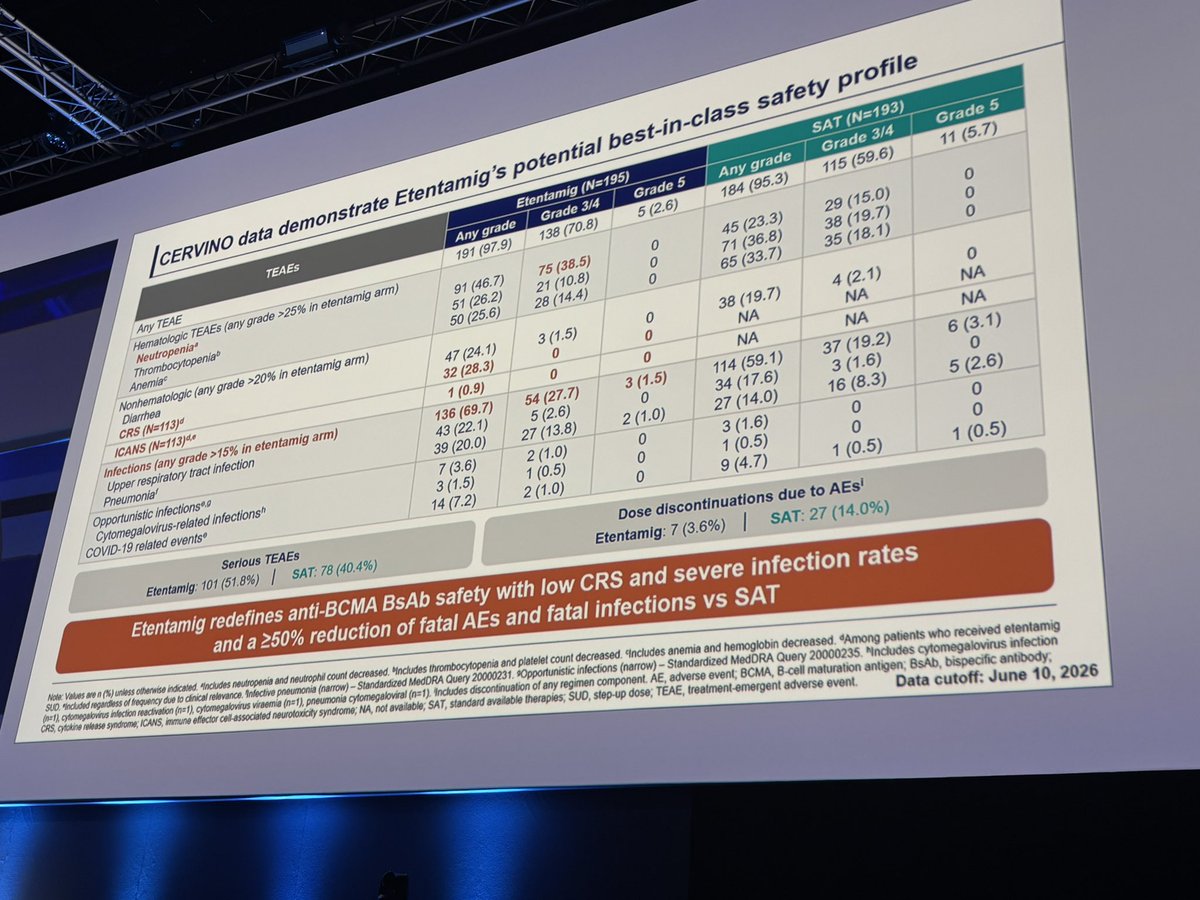
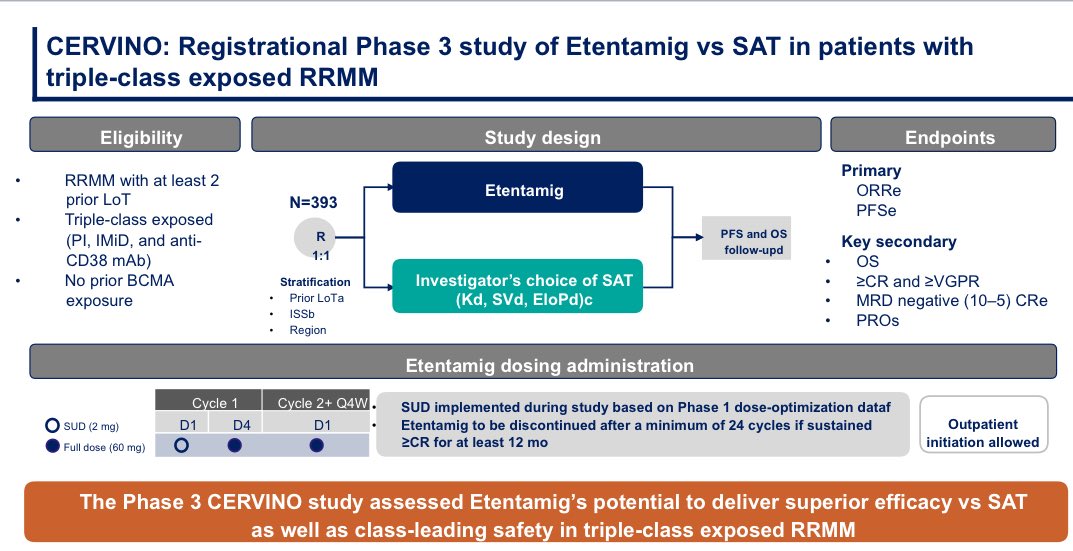

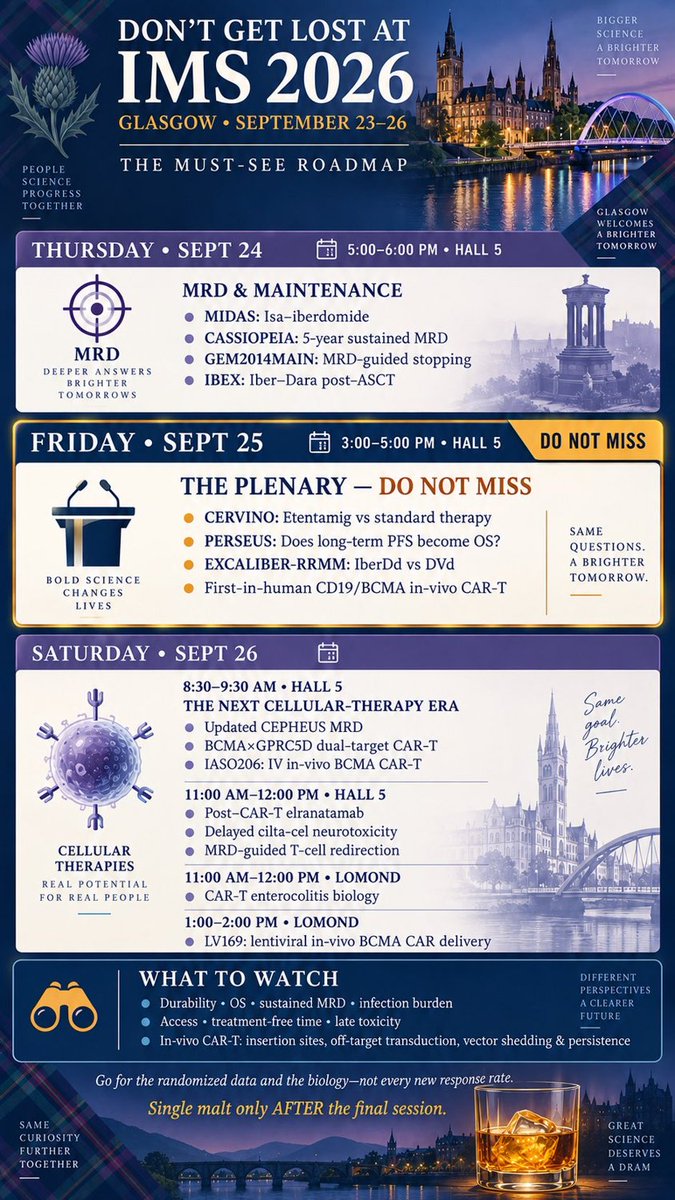


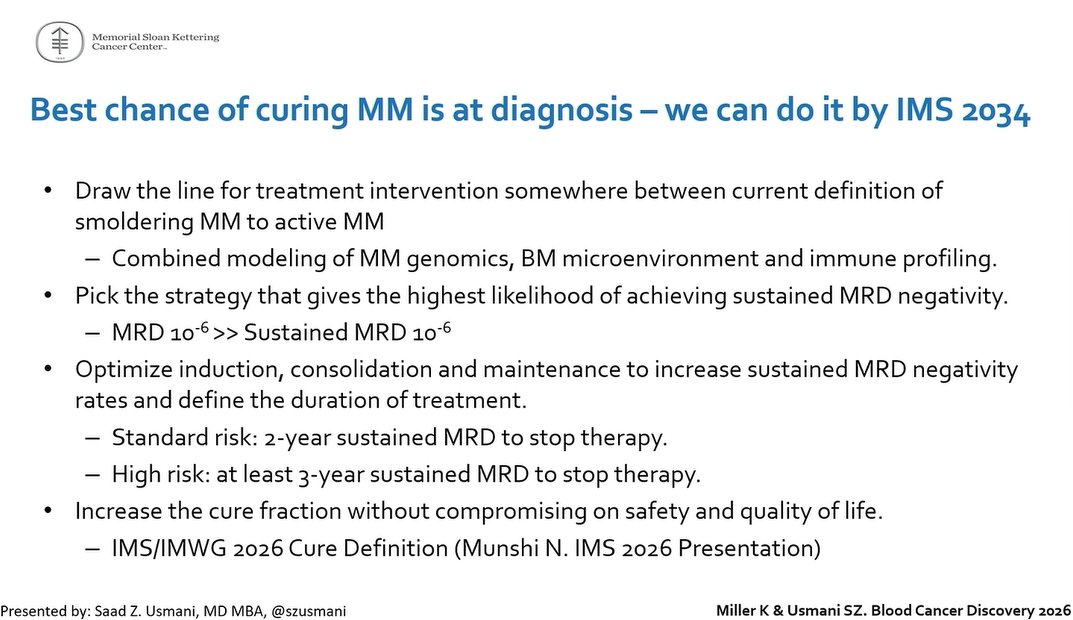
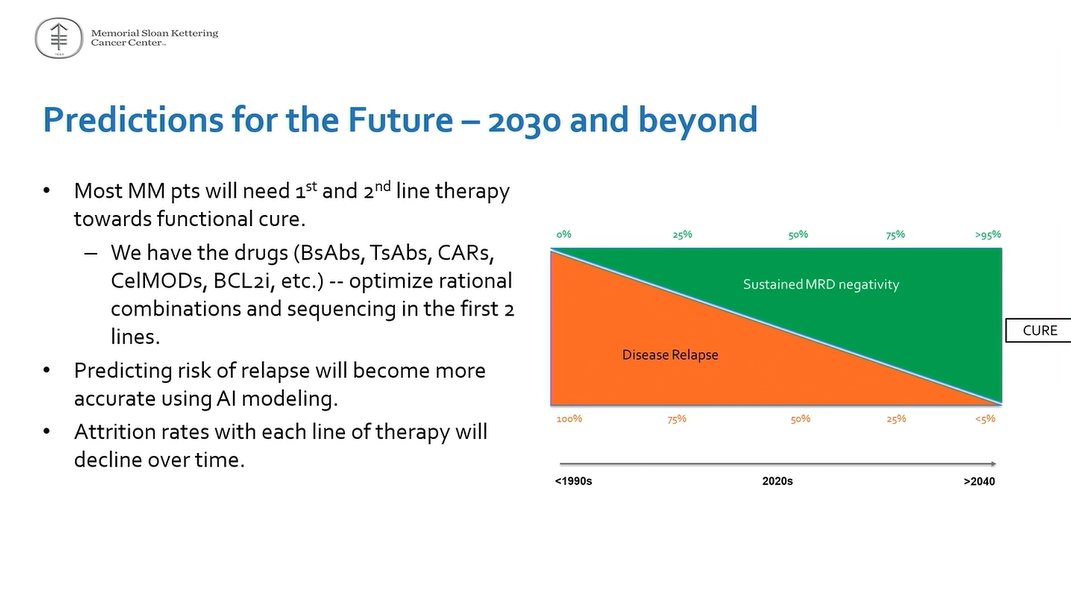
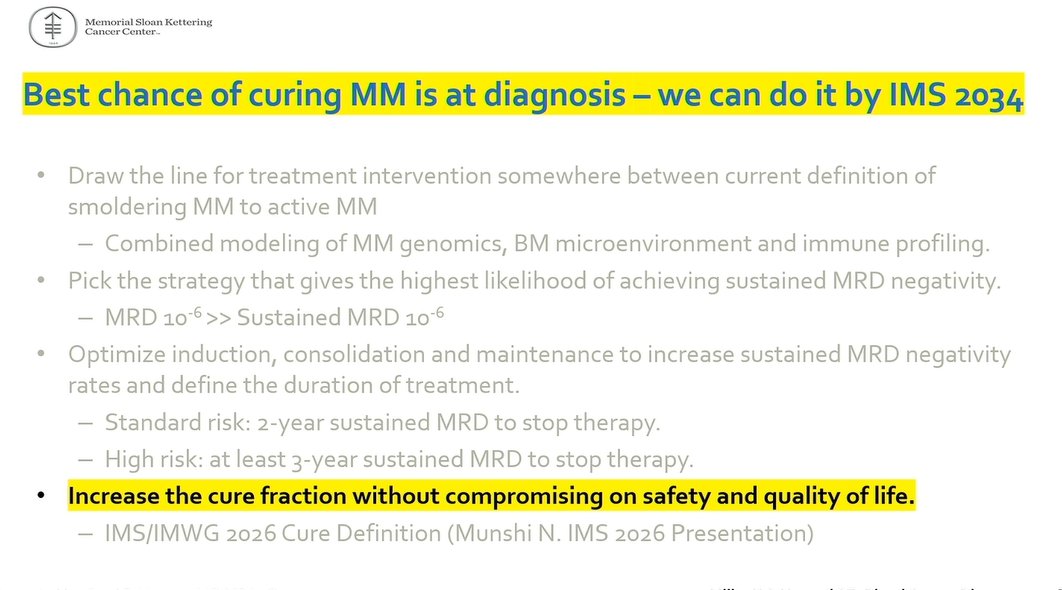

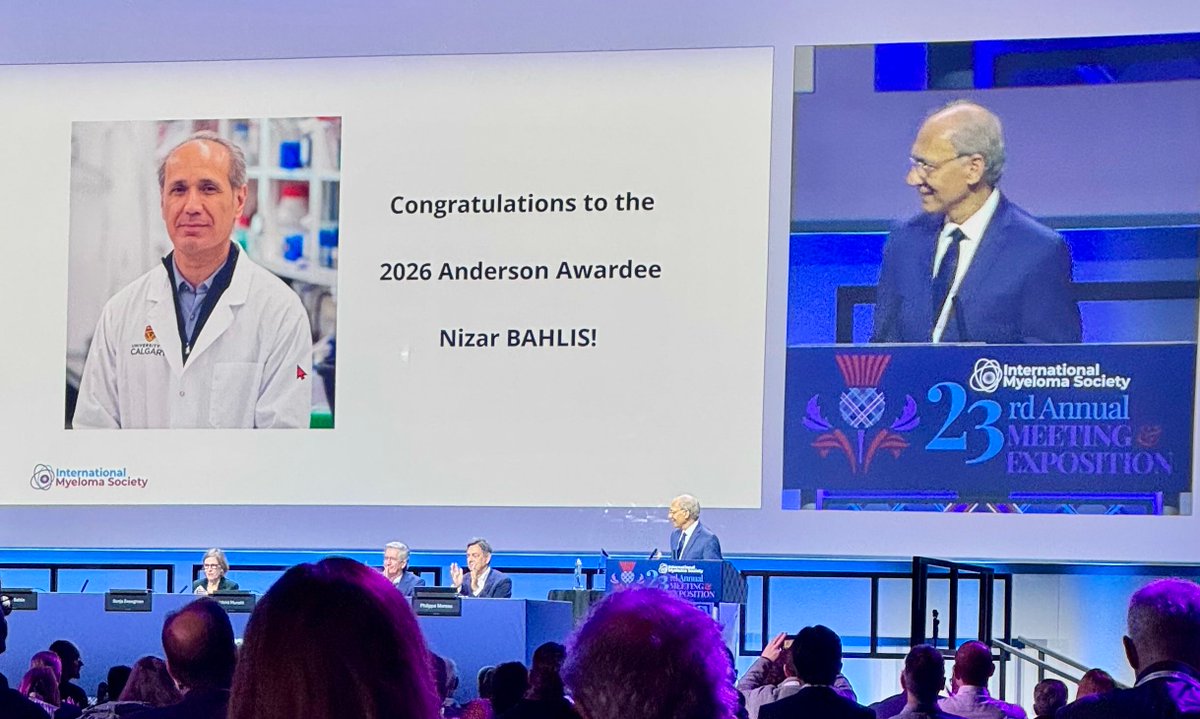
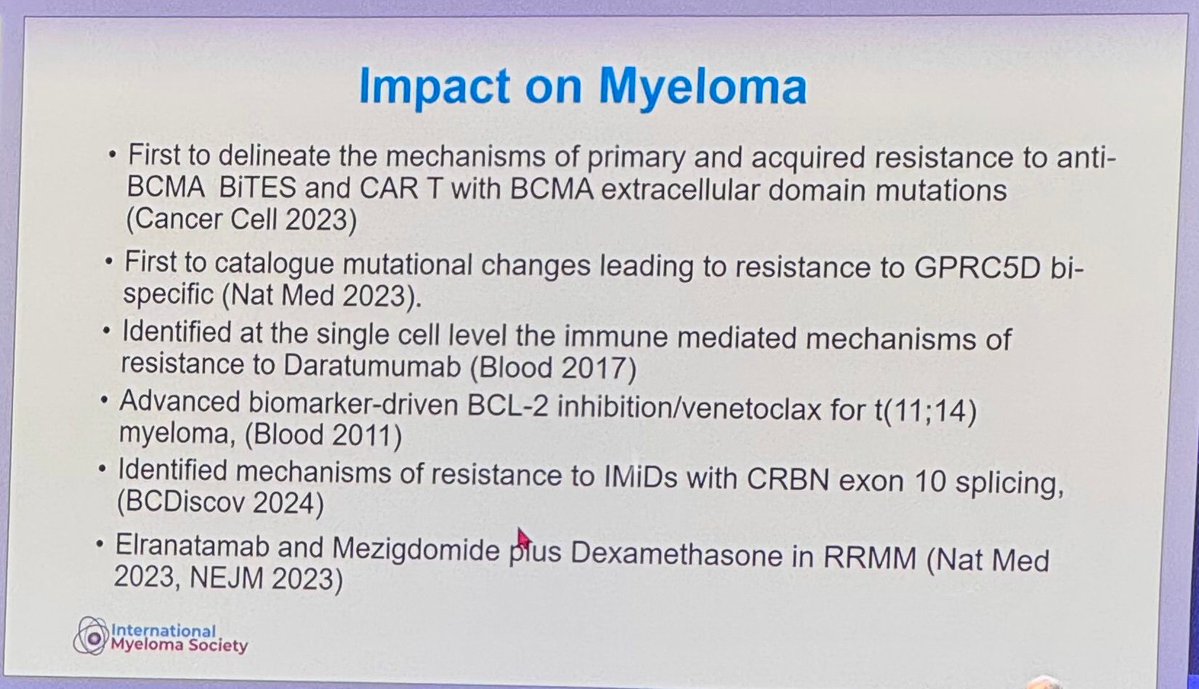

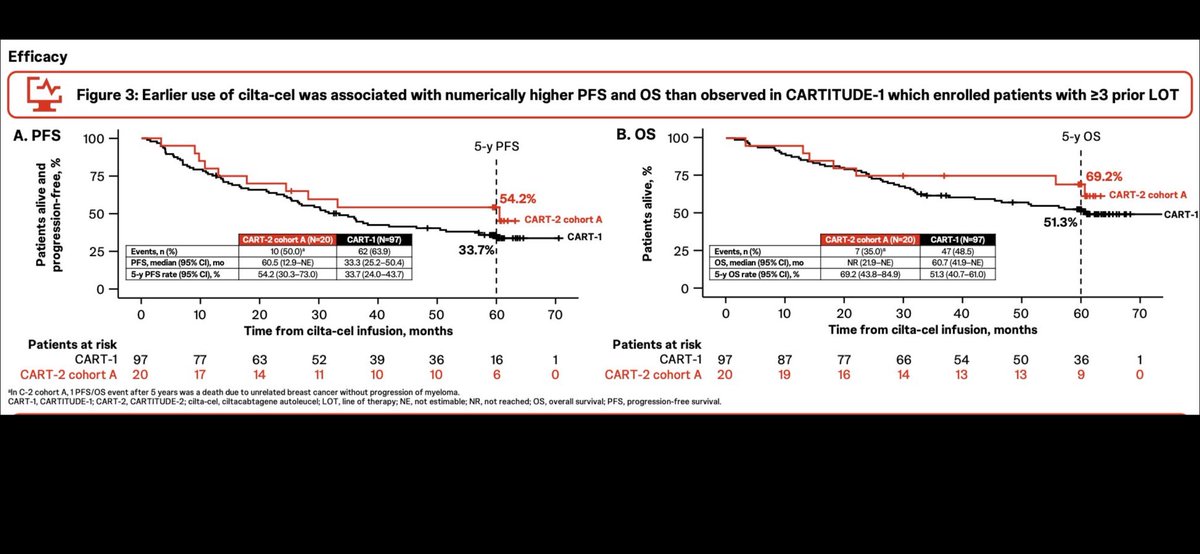


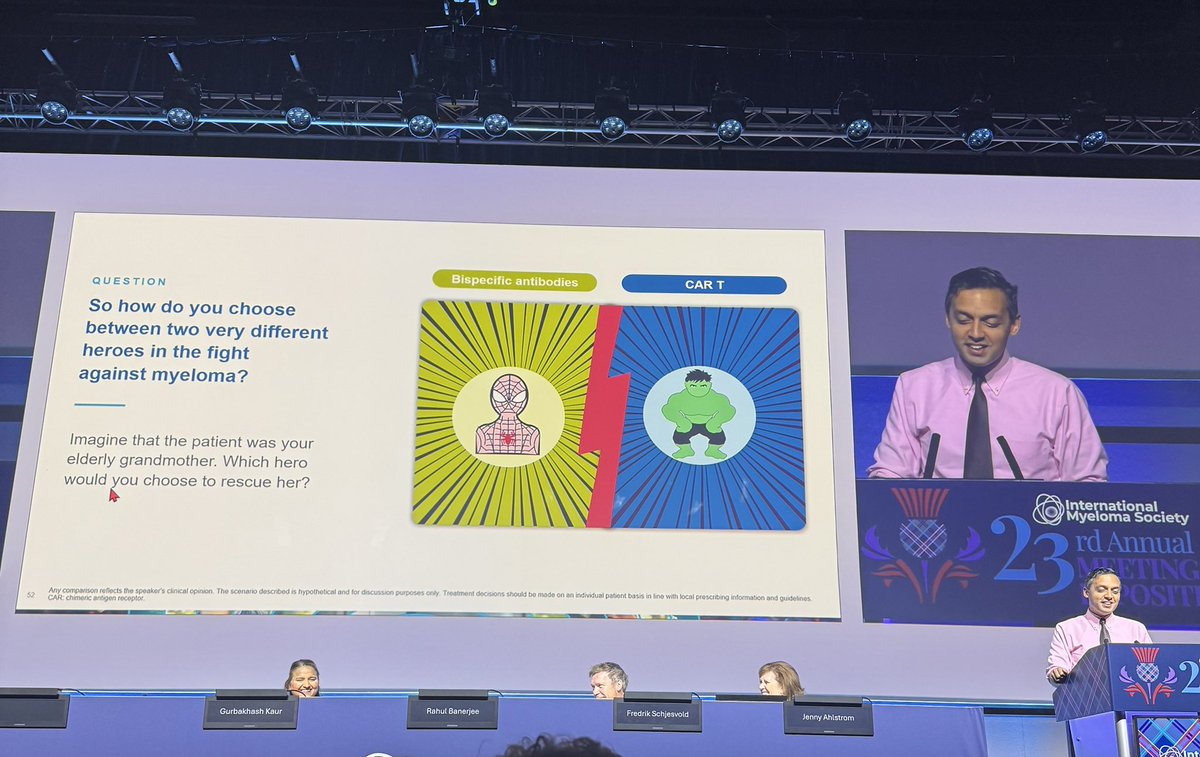
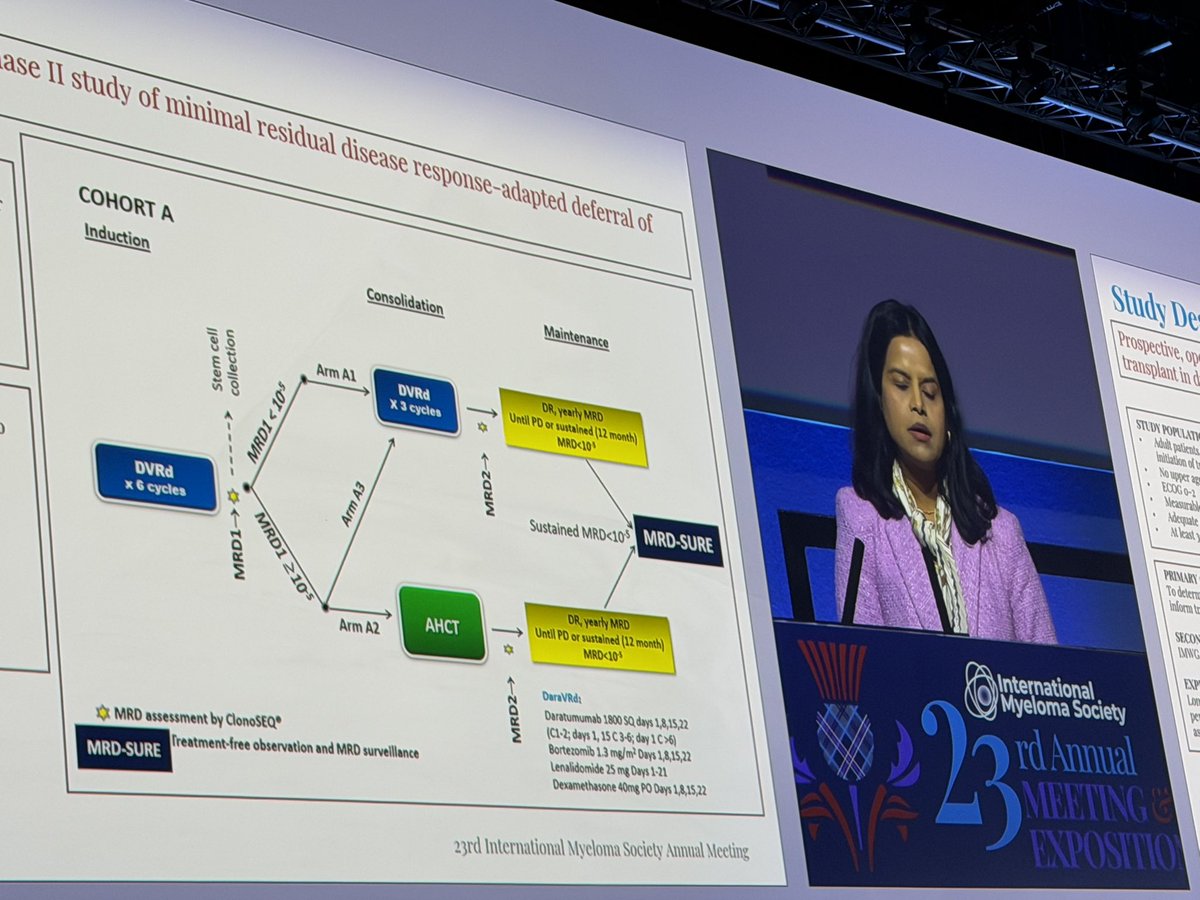 Sep 25
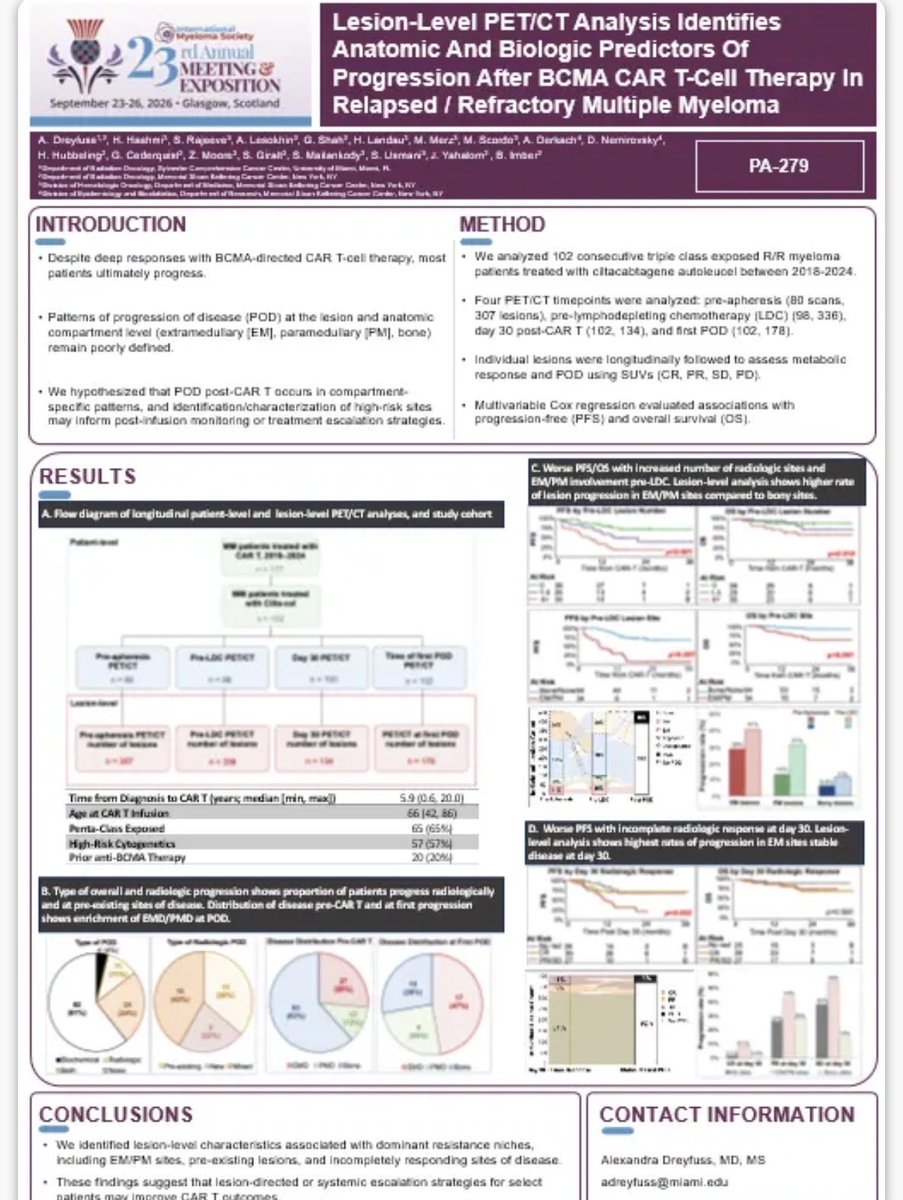
📍 Poster PA-279 at #IMS26 🧵
#mmsm #CARTcell @myeloma_society
💡Where does myeloma come back after BCMA CAR T? 🔍
💡Individual MM lesions were tracked on PET/CT in 102 cilta-cel patients at 4 timepoints: pre-apheresis, pre-LDC, day 30, and first progression.
💡Key findings: https://t.co/1OPPkLRLU4
[Poster PA-279, IMS 23rd Annual Meeting - Lesion-Level PET/CT Analysis Identifies Anatomic and Biologic Predictors of Progression After BCMA CAR T-Cell Therapy in Relapsed/Refractory Multiple Myeloma. A. Dreyfuss et al.]
Analyzed 102 consecutive triple-class-exposed R/R myeloma patients treated with cilta-cel 2018-2024. Four PET/CT timepoints: pre-apheresis (80 scans, 307 lesions), pre-LDC (98, 336), day 30 post-CAR T (102, 134), first POD (102, 178). Individual lesions longitudinally followed for metabolic response and POD (CR/PR/SD/PD by SUV). Multivariable Cox regression evaluated associations with PFS and OS.
Time from diagnosis to CAR T median 5.9yr (0.6-20.0); age at infusion median 66 (42-86); penta-class exposed 65(65%); high-risk cytogenetics 57(57%); prior anti-BCMA therapy 20(20%).
Results: Worse PFS/OS with increased number of radiologic sites and EM/PM involvement pre-LDC. Lesion-level analysis shows higher rate of lesion progression in EM/PM sites vs bony sites. Worse PFS with incomplete radiologic response at day 30; lesion-level analysis shows highest rates of progression in EM sites with stable disease at day 30.
Conclusions: Identified lesion-level characteristics associated with dominant resistance niches, including EM/PM sites, pre-existing lesions, and incompletely responding sites of disease. Findings suggest lesion-directed or systemic escalation strategies for select patients may improve CAR T outcomes.
Sep 25
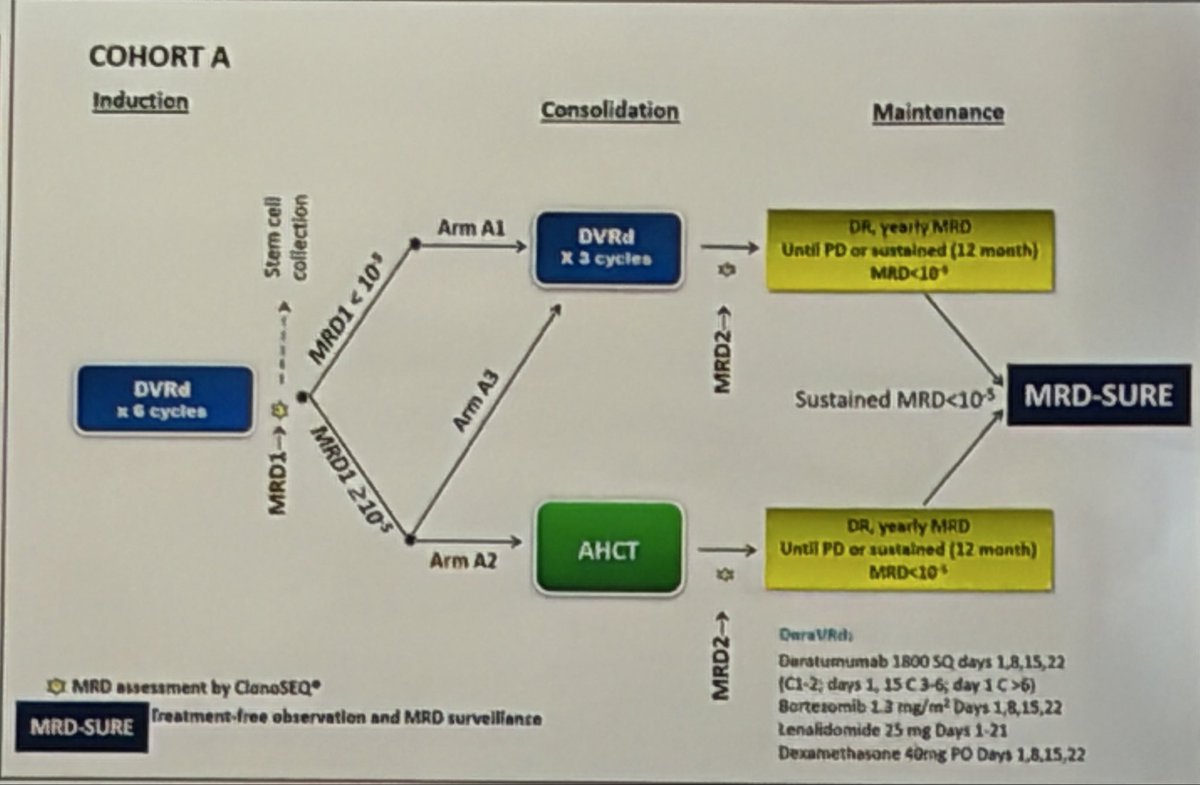
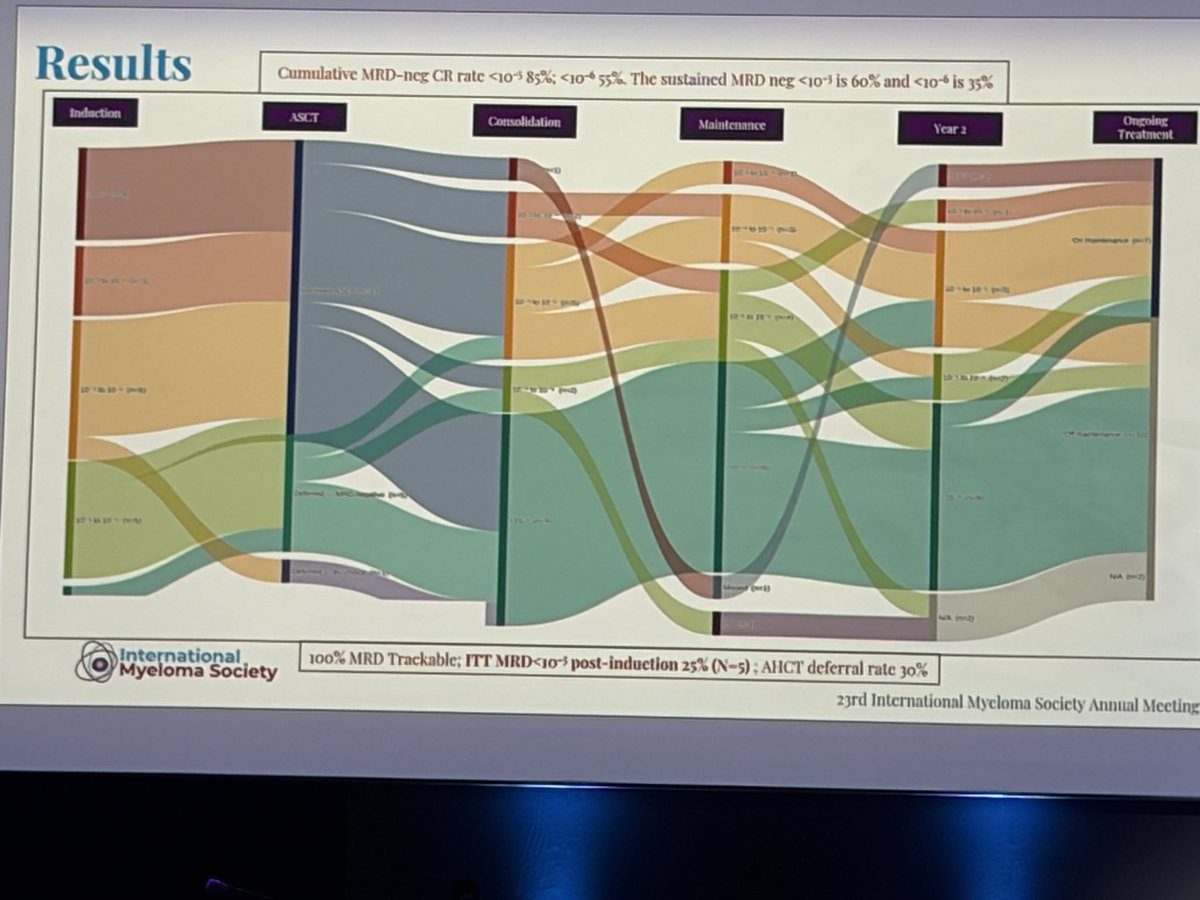

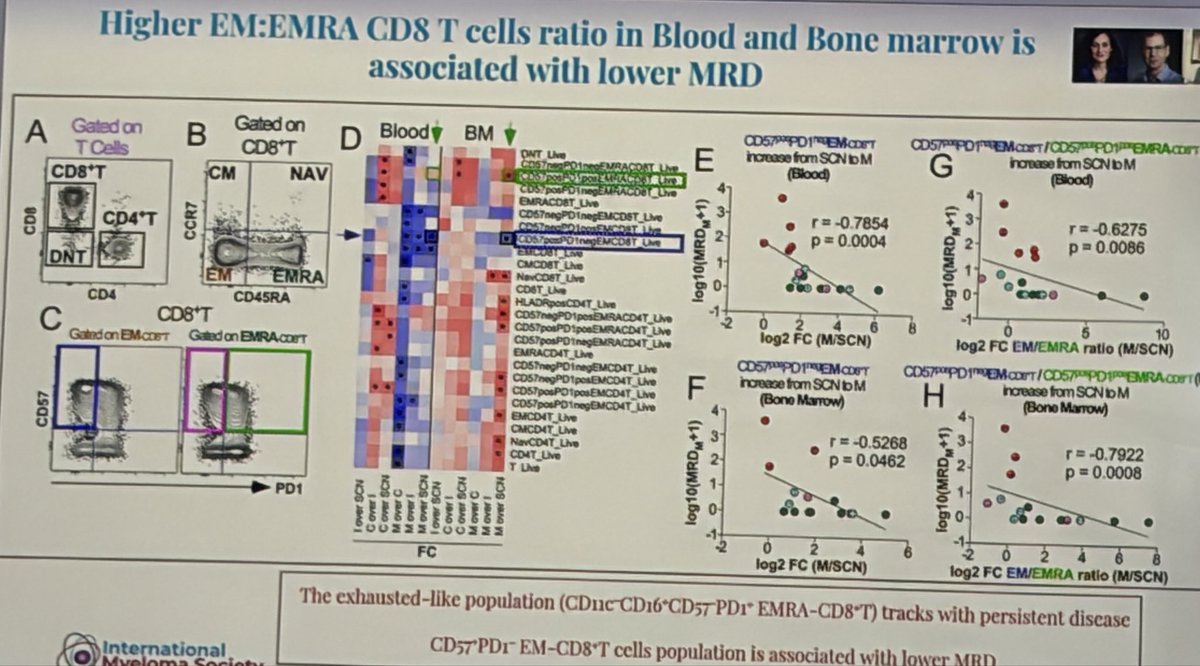
@SusanBal9 on MILESTONE (MRD-guided ASCT deferral)
🔬 #IMS26: MILESTONE shows MRD-guided ASCT deferral is feasible (n=20, 35% deferred),
💡immune profiling linking T-cell/monocyte/NK signatures to MRD depth.
💡Hypothesis generating given the small sample
💡randomized MASTER-2 https://t.co/tCApcBrrx0
[MILESTONE (MRD-guided ASCT deferral trial) - Cohort A study schema]
Induction (DVRd x6 cycles) -> MRD1 assessment -> if MRD1<10^-5: Arm A1 (DVRd x3 cycles consolidation) or Arm A3 -> MRD2 -> Maintenance (DR, yearly MRD, until PD or sustained 12mo MRD<10^-5) -> Sustained MRD<10^-5 leads to MRD-SURE (treatment-free observation and MRD surveillance). If MRD1>=10^-5: Arm A2 (AHCT consolidation) -> MRD2 -> Maintenance -> MRD-SURE. DaraVRd regimen: Daratumumab 1800 SQ days 1,8,15,22 (C1-2; days 1,15 C3-6; day 1 C>6); Bortezomib 1.3mg/m2 Days 1,8,15,22; Lenalidomide 25mg Days 1-21; Dexamethasone 40mg PO Days 1,8,15,22.
[Results - MRD flow through treatment phases]
Cumulative MRD-neg CR rate <10^-3 85%; <10^-6 55%. Sustained MRD neg <10^-3 is 60% and <10^-6 is 35%. Sankey flow diagram tracking MRD depth categories (Induction -> ASCT -> Consolidation -> Maintenance -> Year 2 -> Ongoing Treatment). 100% MRD trackable; ITT MRD<10^-3 post-induction 25% (N=5); AHCT deferral rate 30%.
[35 patients (n=20 deferred ASCT, 35% deferral rate per tweet), IFM 2020/MILESTONE trial]
[Immune profiling slide - Higher EM:EMRA CD8 T cells ratio in Blood and Bone marrow is associated with lower MRD]
Flow cytometry gating (CD8+T/CD4+T/DNT from T cells; CM/NAV from CD8+T via CCR7/CD45RA; EM/EMRA subsets via CD57/PD1). Heatmap of fold-change (SCN->M, C->M) across immune subsets in Blood and BM. Correlation plots: CD57negPD1negEM CD8T increase from SCN to M (Blood) vs log10(MRD_M+1): r=-0.7854, p=0.0004. Same metric Bone Marrow: r=-0.5268, p=0.0462. CD57negPD1negEM/EMRA CD8T ratio increase (Blood): r=-0.6275, p=0.0086. Same ratio (Bone Marrow): r=-0.7922, p=0.0008.
"The exhausted-like population (CD11c-CD16+CD57-PD1+ EMRA-CD8+T) tracks with persistent disease. CD57+PD1- EM-CD8+T cells population is associated with lower MRD."
MILESTONE trial N=20, 35% ASCT deferral rate. Immune profiling linking T-cell/monocyte/NK signatures to MRD depth.
Sep 25

📍 Poster PA-380 at #IMS26 in Glasgow 🧵
#mmsm #CARTcell @myeloma_society
💡Does radiographic response to bridging predict CAR T outcomes? 🎯
💡102 triple-class exposed RRMM patients treated with cilta-cel (2018–2024) had serial FDG PET/CT before apheresis, before LDC, and at https://t.co/8tNeN6gJUq
[Poster PA-380, IMS 23rd Annual Meeting - Radiographic Response to Bridging Therapy is Predictive of Efficacy Post BCMA CAR T-cell Therapy in Relapsed/Refractory Multiple Myeloma. A. Dreyfuss et al.]
Analyzed 102 RRMM triple-class-exposed patients treated with cilta-cel (2018-2024) with serial FDG PET/CT at 3 timepoints: pre-apheresis (80 scans, 307 lesions), pre-lymphodepleting chemo (98, 336 lesions), first progression of disease (102, 178 lesions).
Time from diagnosis to CAR T median 5.9yr (0.6-20.0); age at infusion median 66 (42-86); penta-class exposed 65(65%); high-risk cytogenetics 57(57%). Bridging therapy: 50(49%) chemotherapy, 25(25%) debulking alkylator, 4(3.9%) bispecific antibody, 4(3.9%) radiotherapy. Bridging therapy type NOT associated with PFS/OS on Cox regression (p=0.200).
PFS/OS by radiologic bridging response (CR/PR vs SD vs PD): significant association with PFS, not with biochemical bridging response alone.
Table: Radiologic bridging response, N, Event N, HR (95% CI), p-value: CR/PR N=15 Event=4 (reference); SD N=10 Event=4, HR 2.46 (0.61-9.87); PD N=22 Event=18, HR 4.87 (1.62-14.7), p=0.006 overall.
Extramedullary/paramedullary (EM/PM) sites less likely to respond to bridging; poor response to bridging associated with individual site POD.
Conclusions: Radiographic bridging response significantly predicted CAR T efficacy, and pre-CAR T PET/CT provided prognostic stratification beyond biochemical response or bridging type. Routine PET/CT during bridging may identify high-risk patients and inform post-infusion salvage/consolidation strategies.


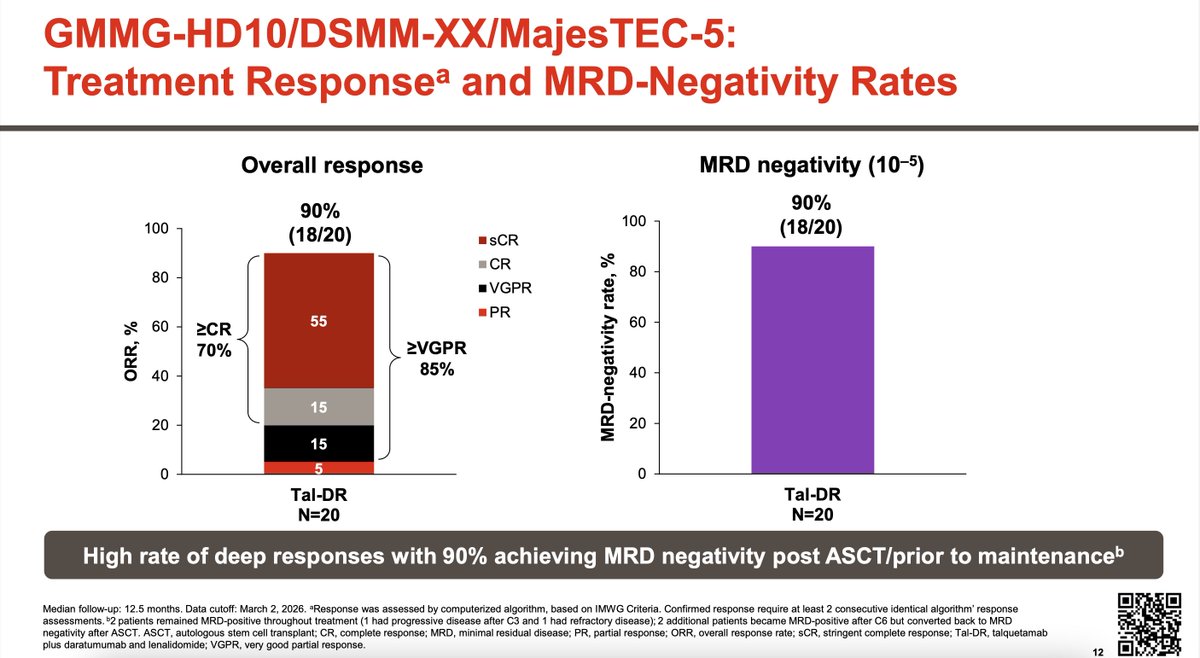
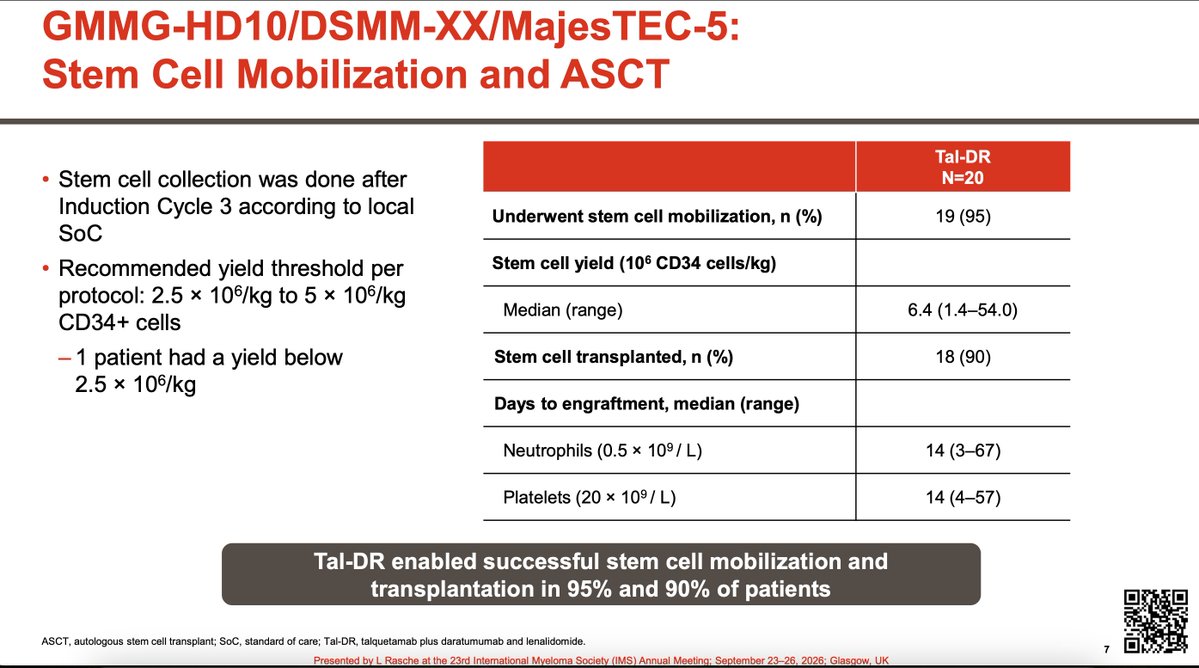
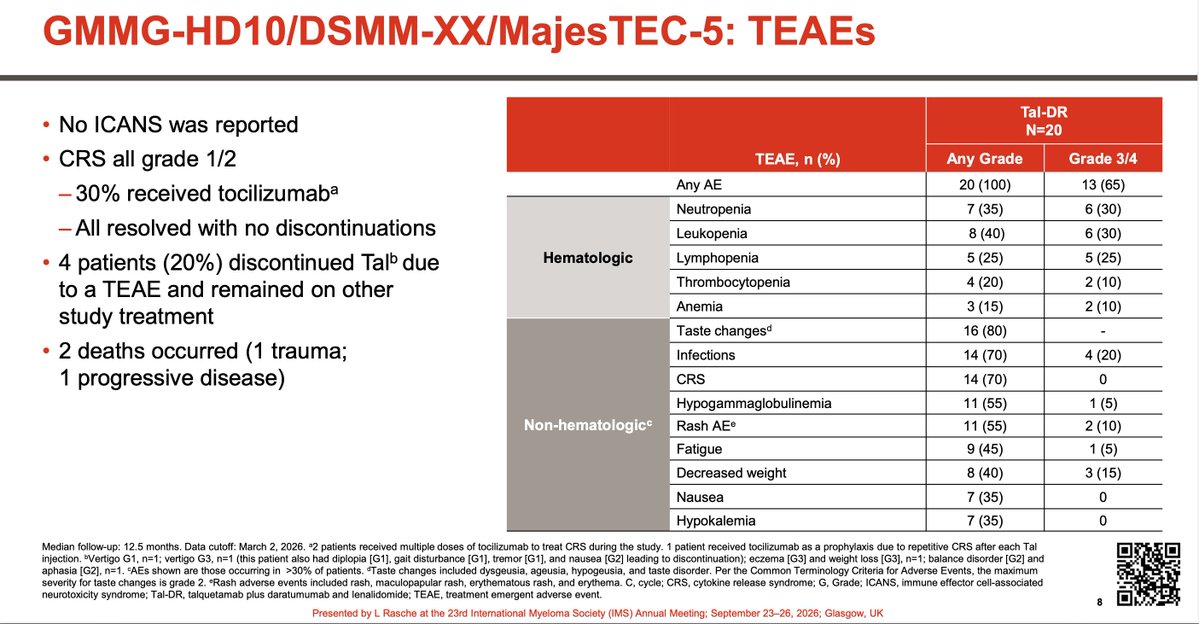
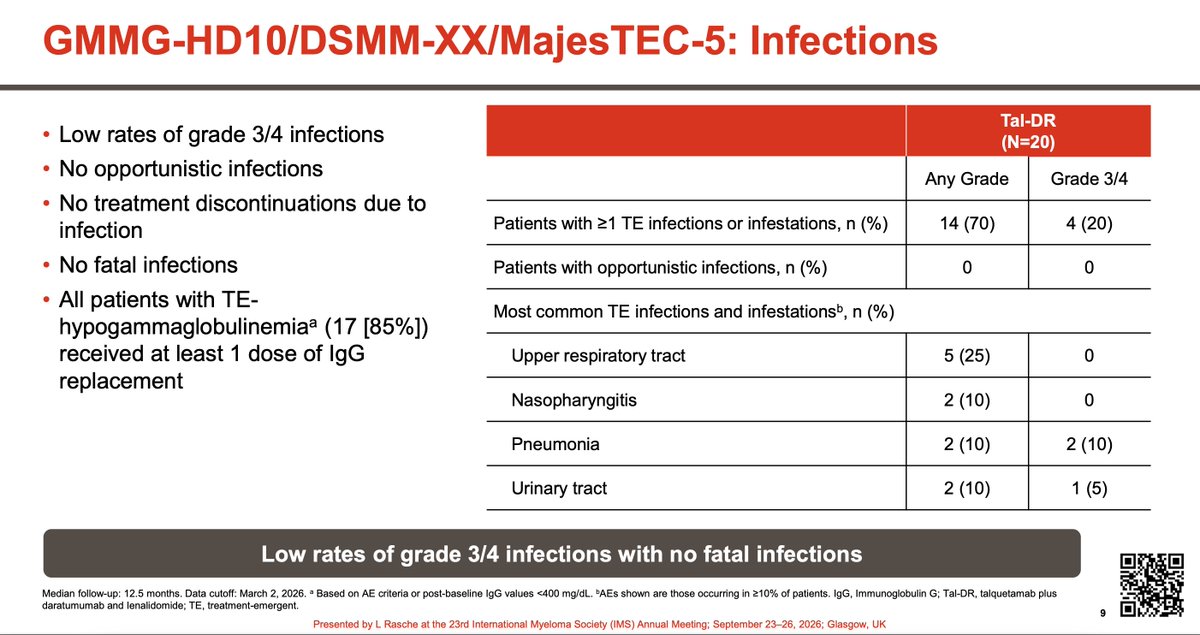
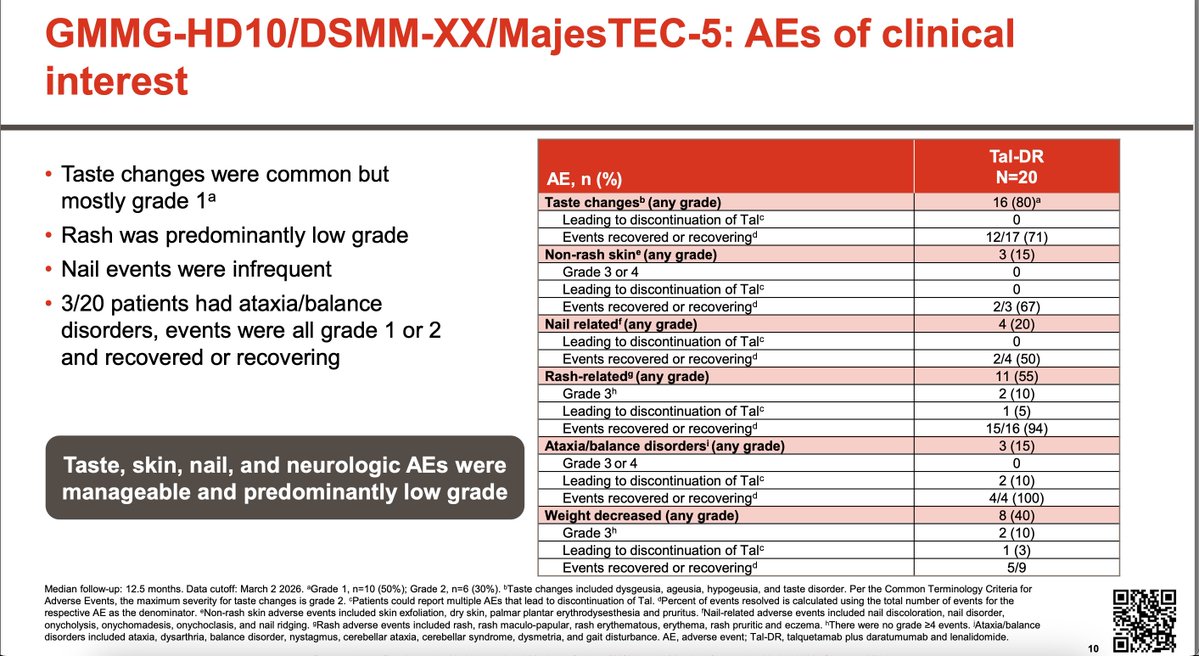 Sep 25
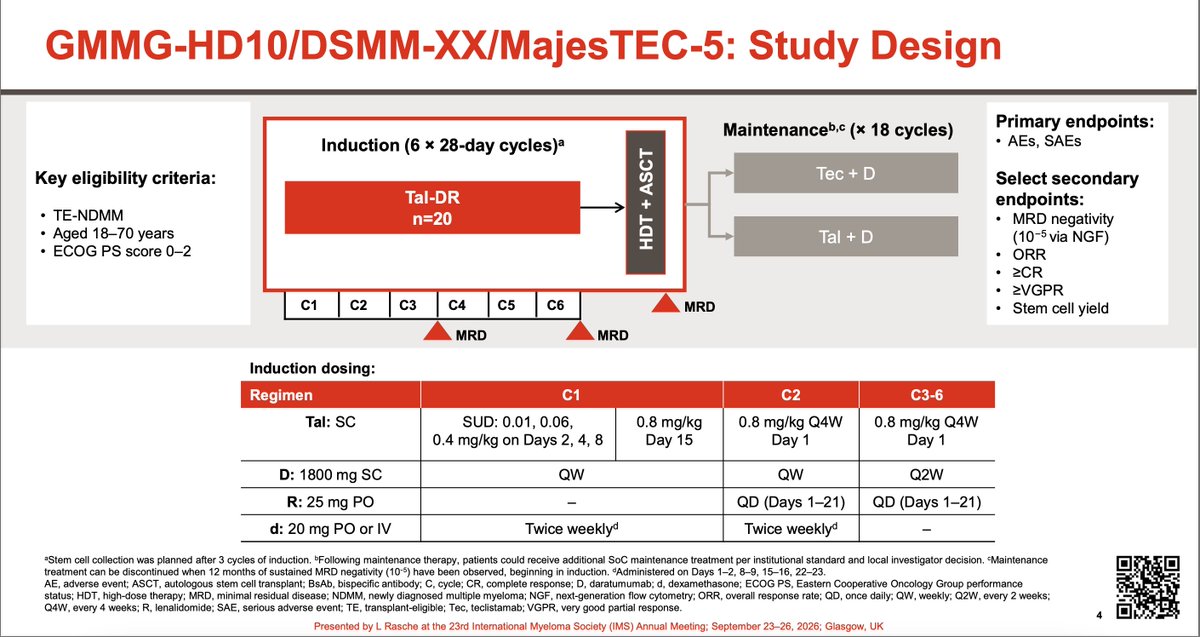
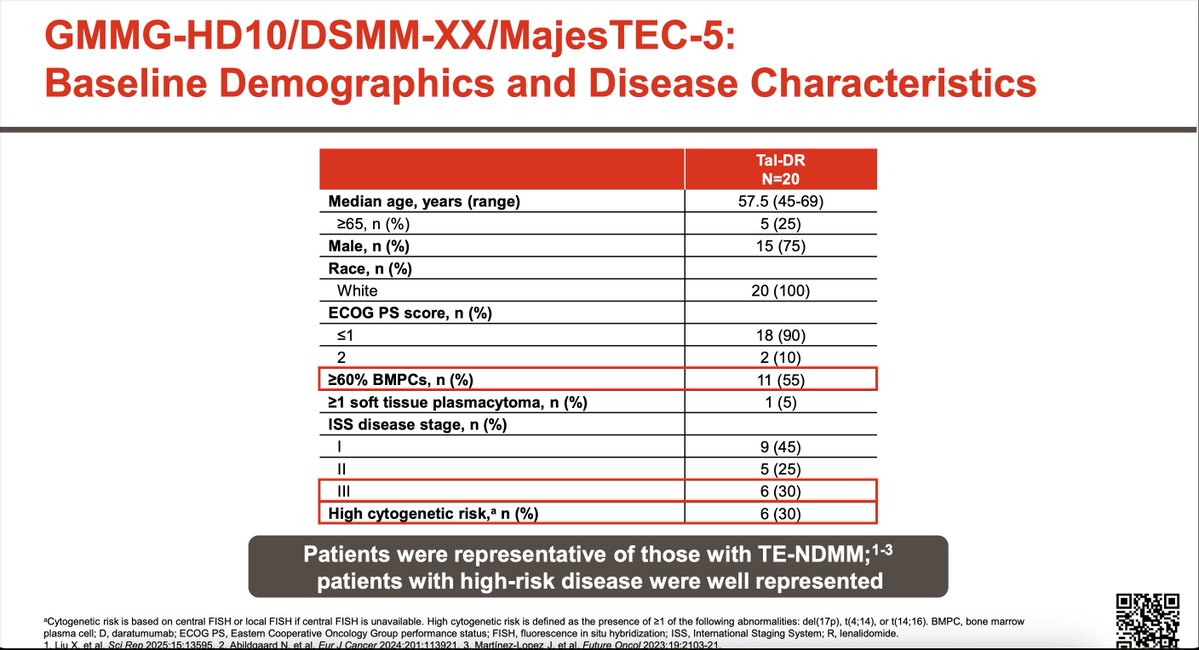
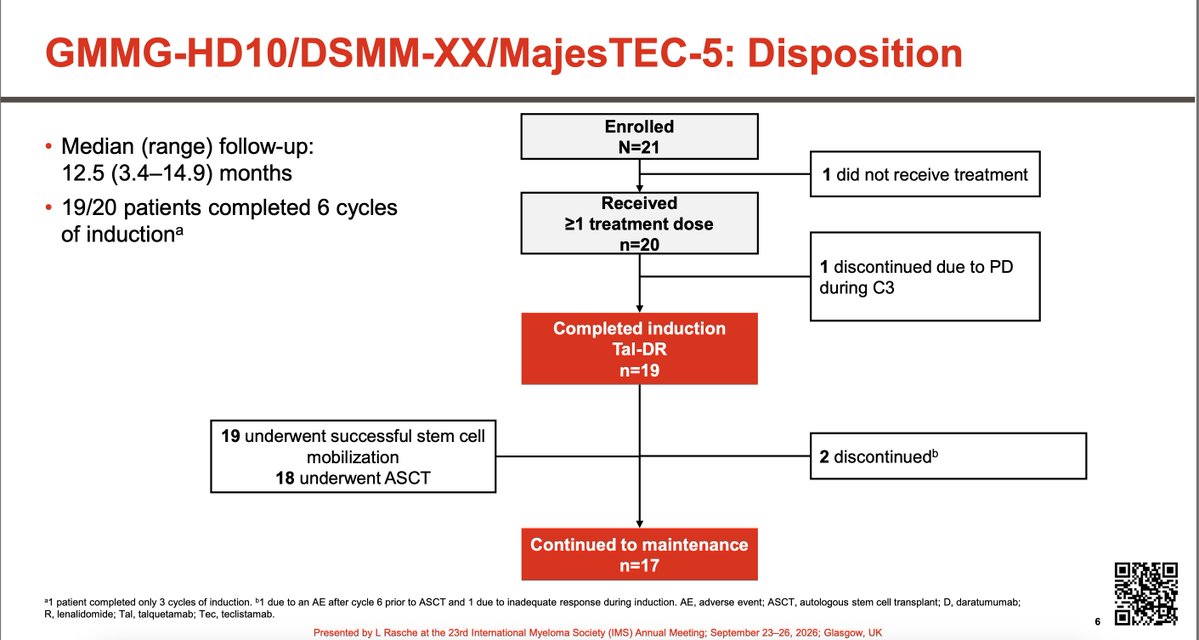
#IMS26 #mmsm oral @RascheLeo
MajestTEC-5 : upfront use of Talq-Dara-R followed by transplant and maintenance
n=20 patients https://t.co/dm6S0XvpoE
[GMMG-HD10/DSMM-XX/MajesTEC-5, presented by L Rasche at 23rd IMS Annual Meeting]
Study design: TE-NDMM patients, aged 18-70, ECOG PS 0-2. Induction (6x28-day cycles): Tal-DR n=20 -> HDT+ASCT -> Maintenance (x18 cycles): Tec+D or Tal+D. Primary endpoints: AEs, SAEs. Secondary: MRD negativity (10^-5 via NGF), ORR, >=CR, >=VGPR, Stem cell yield.
Induction dosing table: Tal SC (C1: SUD 0.01/0.06/0.4mg/kg Days 2,4,8 then 0.8mg/kg Day 15; C2: 0.8mg/kg Q4W Day1; C3-6: 0.8mg/kg Q4W Day1). D: 1800mg SC QW(C1)/QW(C2)/Q2W(C3-6). R: 25mg PO QD Days1-21 (C2-6). d: 20mg PO/IV twice weekly (C1-2).
Baseline demographics (N=20): Median age 57.5 (45-69), >=65 5(25%), Male 15(75%), White 20(100%), ECOG<=1 18(90%)/2 2(10%), >=60% BMPCs 11(55%), >=1 soft tissue plasmacytoma 1(5%), ISS I 9(45%)/II 5(25%)/III 6(30%), High cytogenetic risk 6(30%).
Disposition: Enrolled N=21, 1 did not receive treatment, received >=1 dose n=20, 1 discontinued due to PD during C3, completed induction n=19 (median follow-up 12.5mo, range 3.4-14.9), 19 underwent stem cell mobilization (18 underwent ASCT), 2 discontinued, continued to maintenance n=17.
Stem cell mobilization/ASCT: underwent mobilization 19(95%), yield median 6.4 (1.4-54.0) x10^6 CD34/kg, transplanted 18(90%), engraftment neutrophils median 14d (3-67), platelets 14d (4-57).
TEAEs (N=20): Any AE 20(100%)/Gr3-4 13(65%). Neutropenia 7(35%)/6(30%). Leukopenia 8(40%)/6(30%). Lymphopenia 5(25%)/5(25%). Thrombocytopenia 4(20%)/2(10%). Anemia 3(15%)/2(10%). Taste changes 16(80%)/-. Infections 14(70%)/4(20%). CRS 14(70%)/0. Hypogammaglobulinemia 11(55%)/1(5%). Rash AE 11(55%)/2(10%). Fatigue 9(45%)/1(5%). Decreased weight 8(40%)/3(15%). Nausea 7(35%)/0. Hypokalemia 7(35%)/0. No ICANS reported. 4 patients (20%) discontinued Tal due to TEAE. 2 deaths (1 trauma, 1 progressive disease).
Infections: patients with >=1 TE infection 14(70%)/Gr3-4 4(20%). No opportunistic infections, no fatal infections, no discontinuations due to infection. 17(85%) received >=1 dose of IgG replacement.
AEs of clinical interest: Taste changes 16(80%, mostly Gr1); Rash predominantly low grade; 4(20%) nail-related events; 3/20 patients had ataxia/balance disorders, all Gr1-2, all recovered/recovering.
Disease burden: 95% of treated patients achieved 100% reduction in paraprotein production by post-ASCT/pre-maintenance visit.
Response and MRD: Overall response 90% (18/20) - sCR 55%, CR 15%, VGPR 15%, PR 5% (>=CR 70%, >=VGPR 85%). MRD negativity (10^-5): 90% (18/20). "High rate of deep responses with 90% achieving MRD negativity post ASCT/prior to maintenance." Median follow-up 12.5 months, data cutoff March 2, 2026.
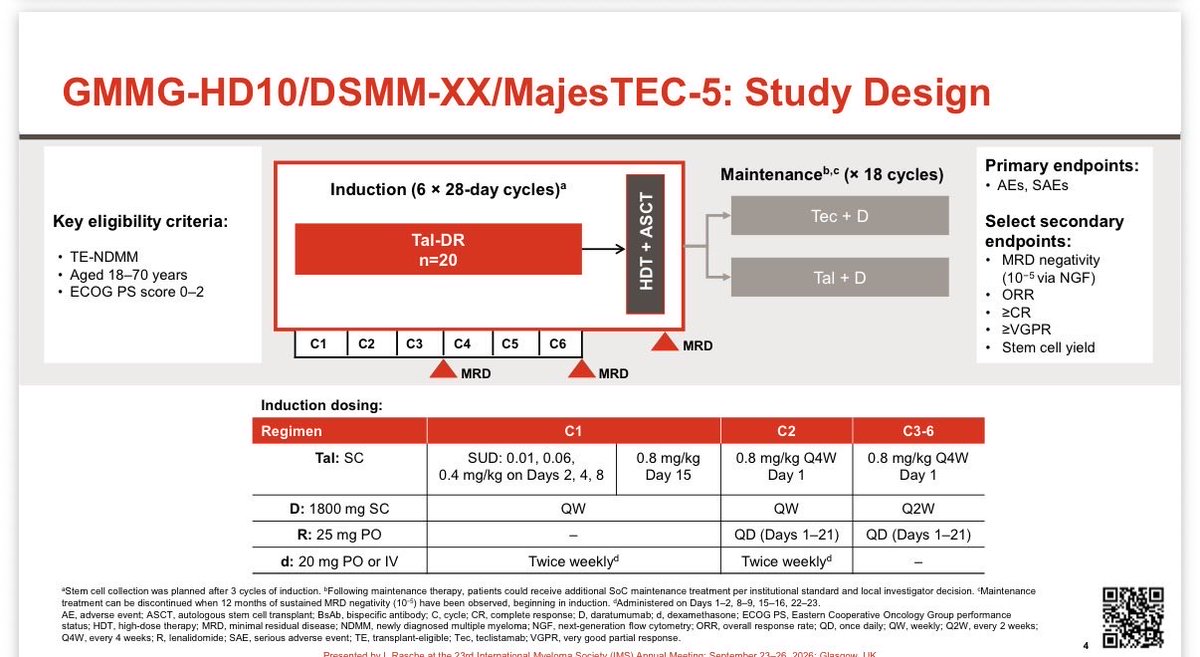
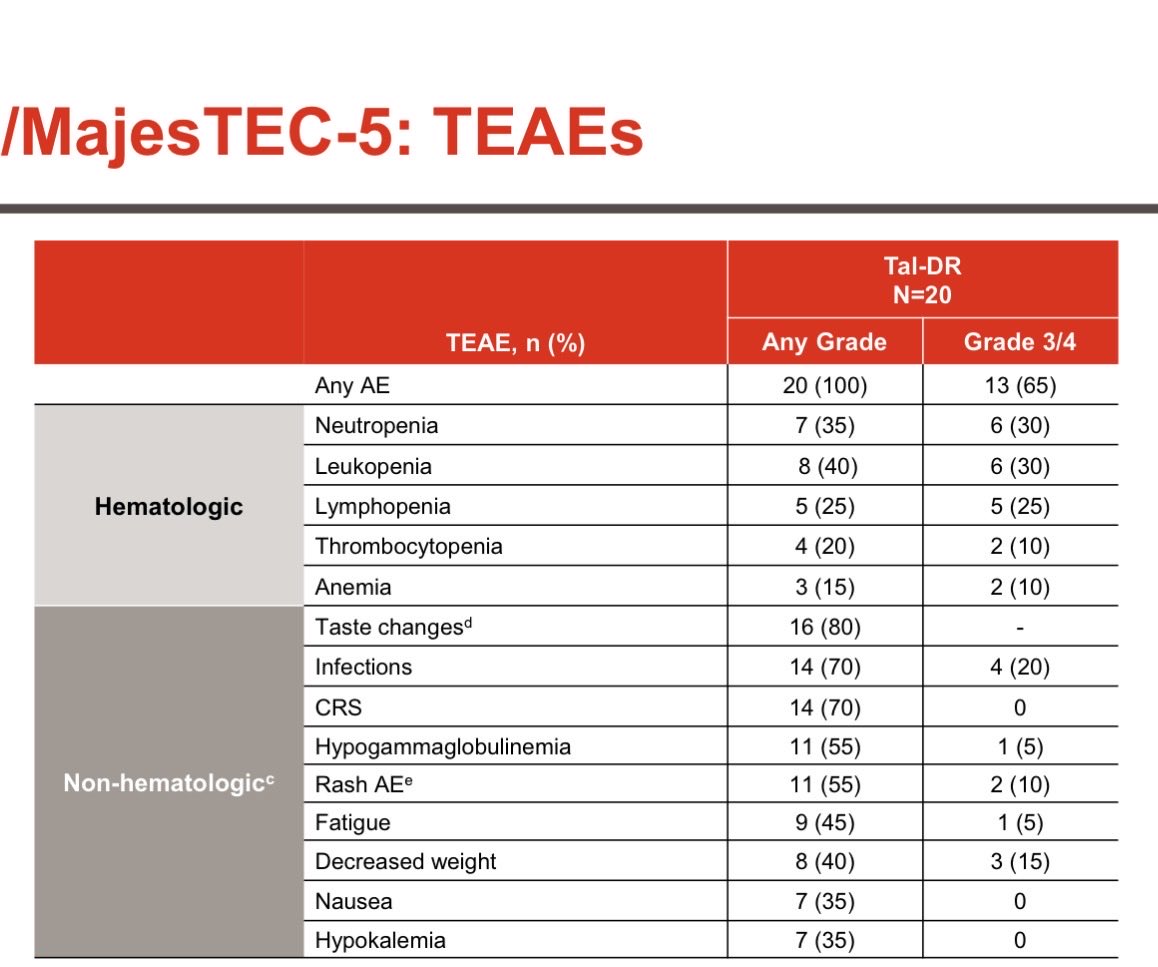
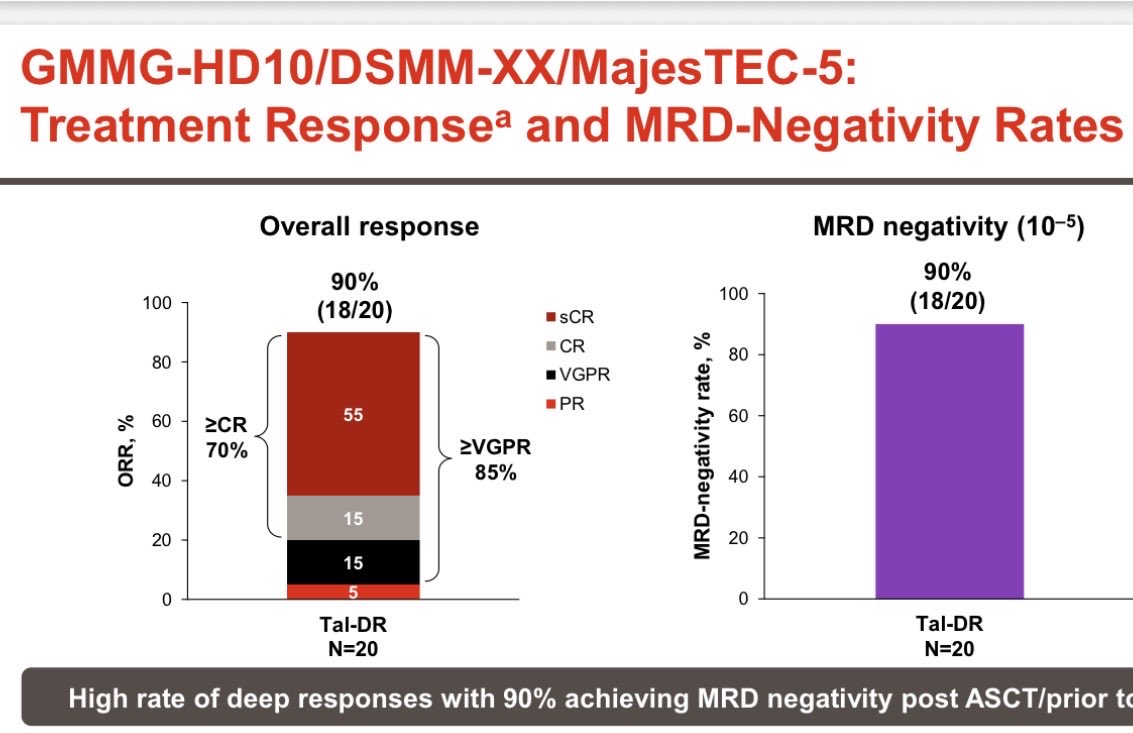
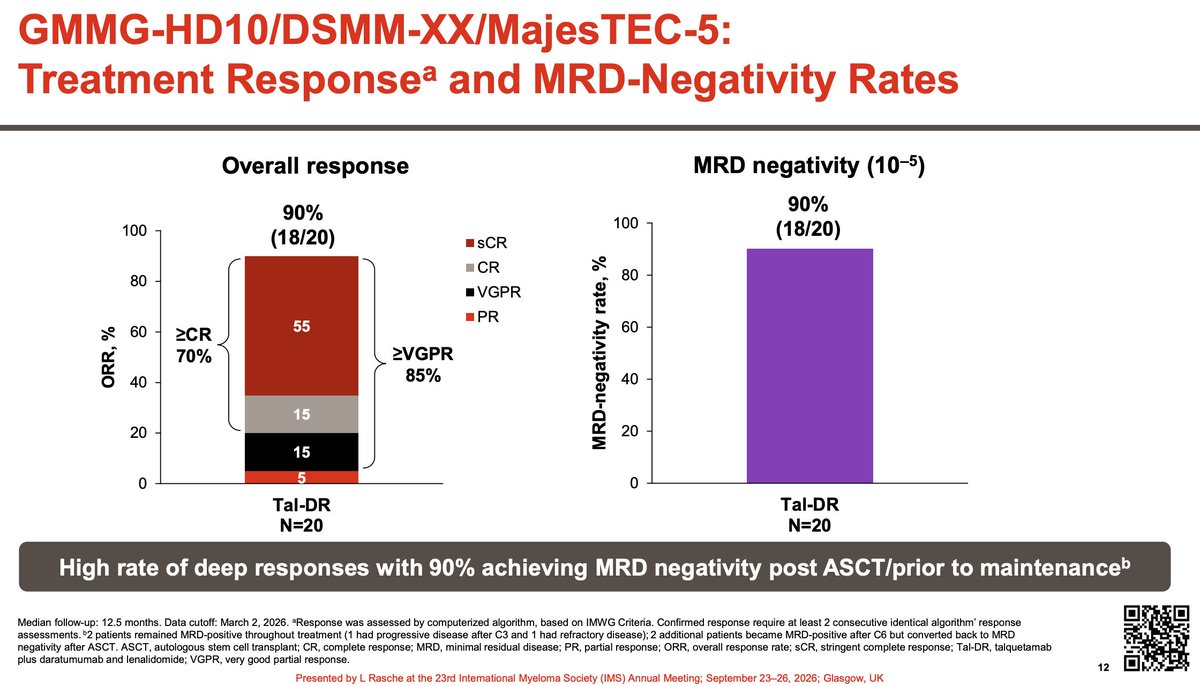
 Sep 25
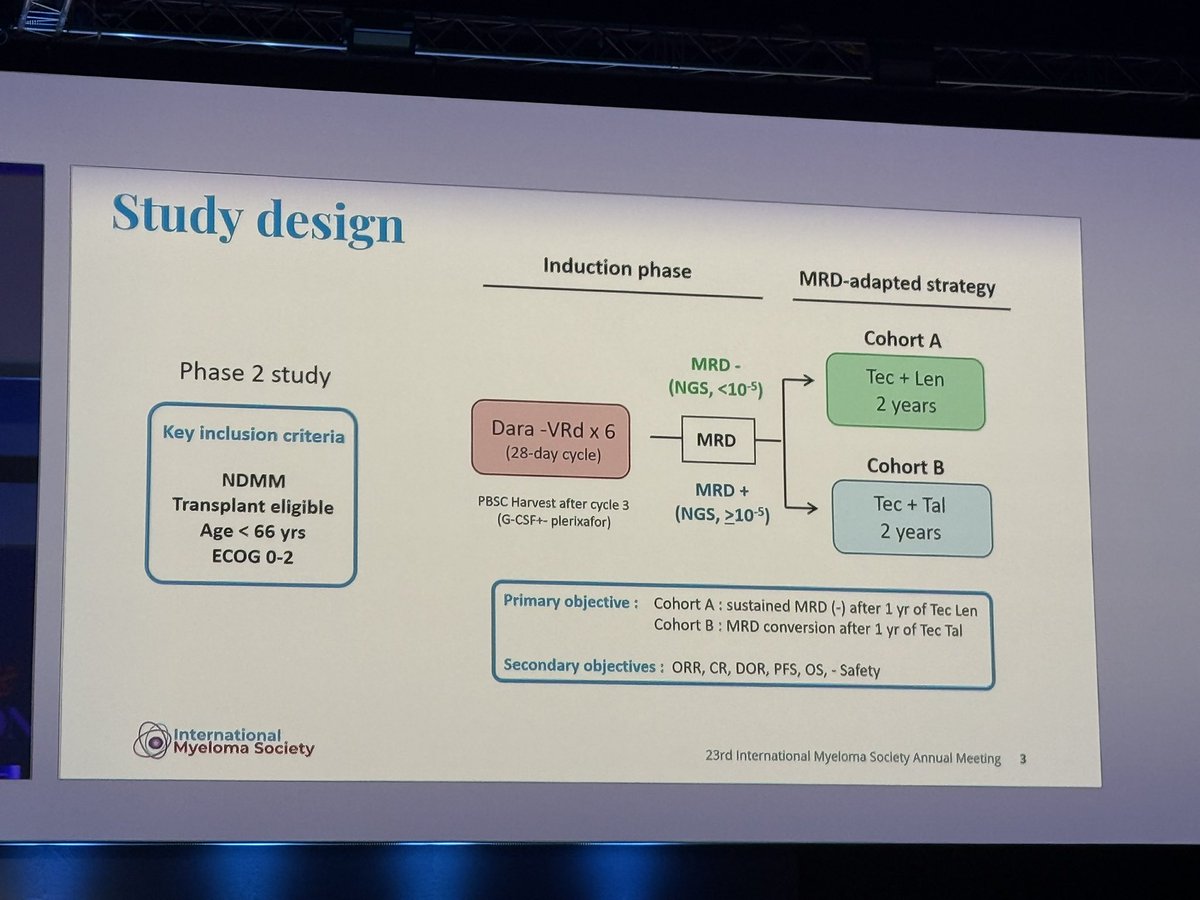
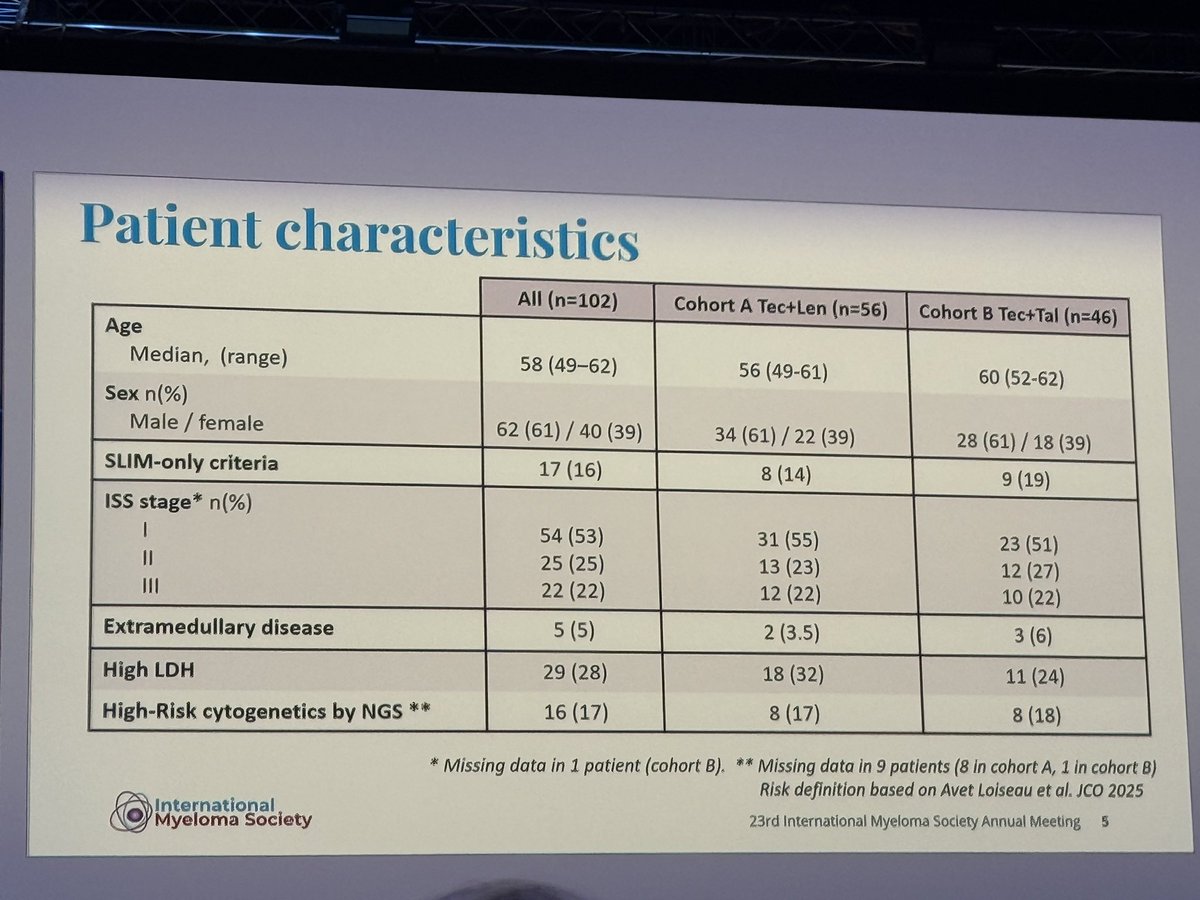
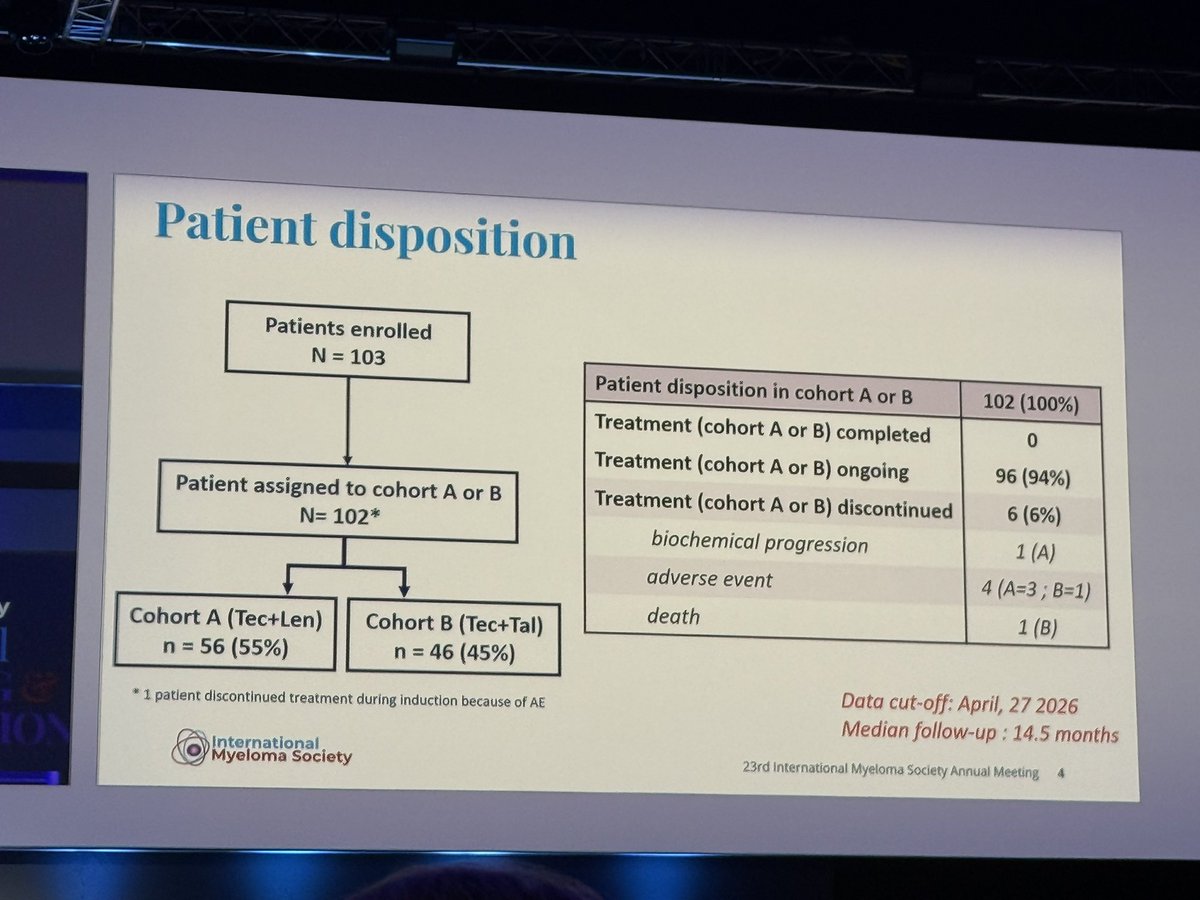
IFM2022 - Teclistamab + Talquetamab in MRD +ve pts after DVRd indication x 6 cycles
ALL patients converted to MRD-ve after 3 cycles of Tec-Tal. This is the next frontier of MRD guided therapy.
#mmsm #ims26
@Myeloma_Society https://t.co/FzQkOP7G0C
[Title slide - IFM 2022-01, NCT06353022, presented by Cyrille Touzeau]
"Teclistamab plus Talquetamab consolidation in newly diagnosed myeloma patients with positive measurable residual disease after DVRd induction: interim analysis of the phase 2 study IFM 2022-01 (NCT06353022)." Authors: Cyrille Touzeau, Aurore Perrot, Gedeon Agbetsivi, Thomas Chalopin, Cyrille Hulin, et al., Philippe Moreau.

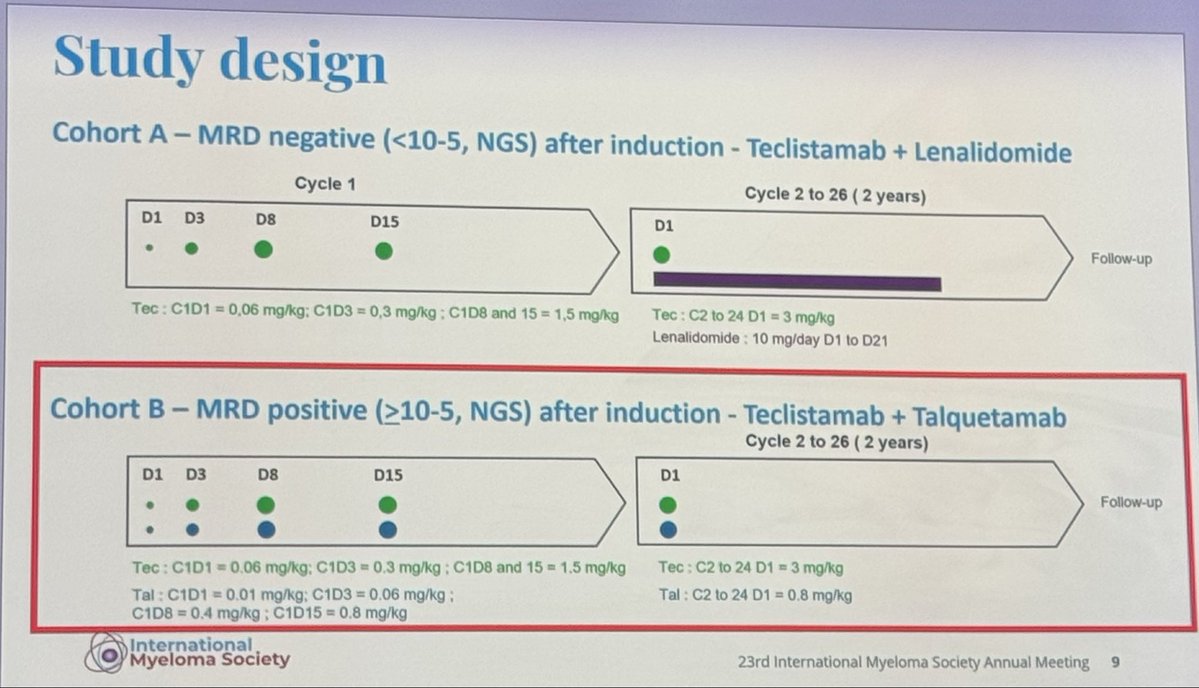
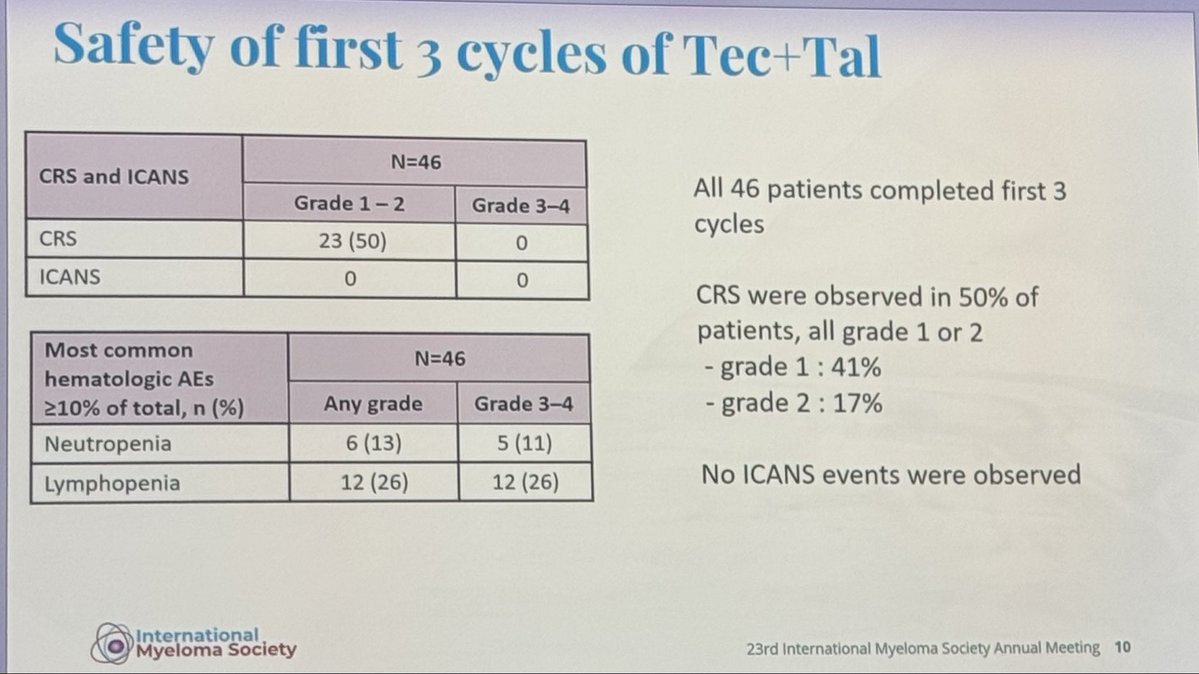

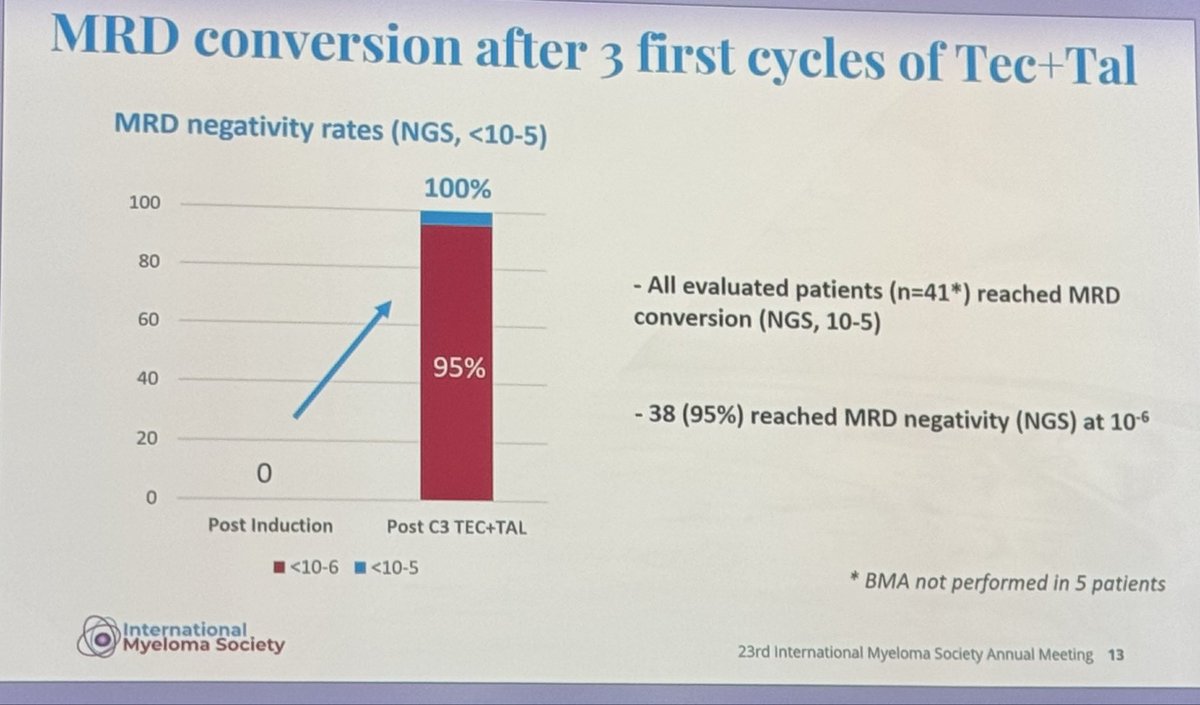

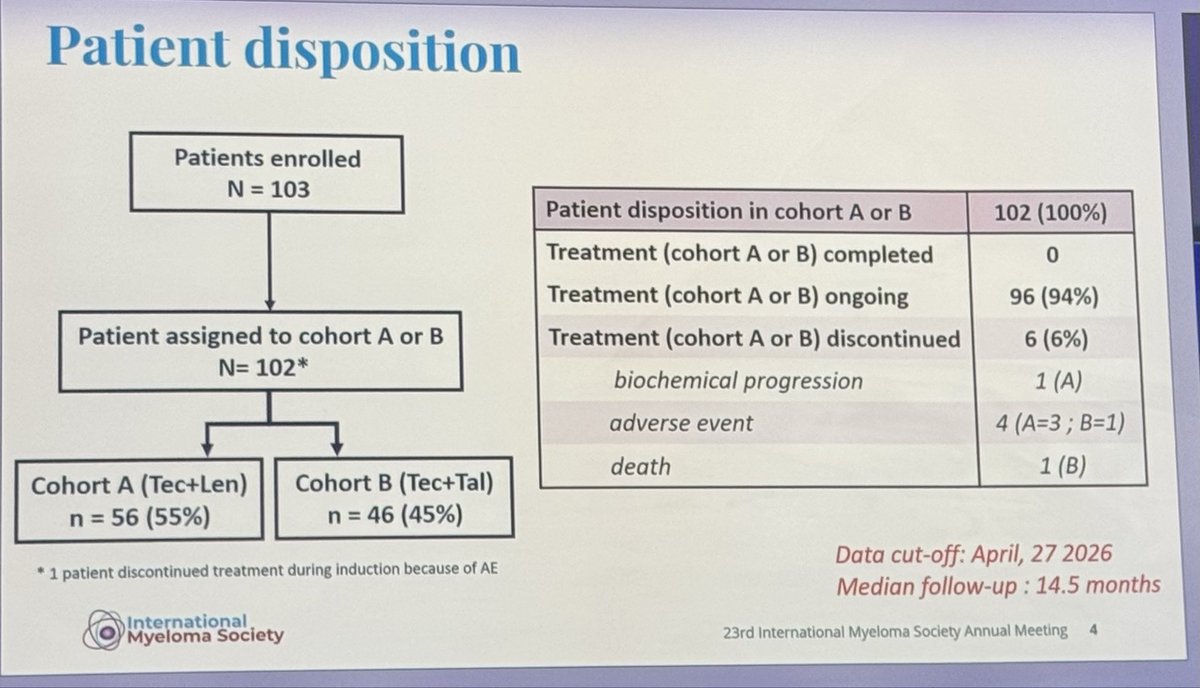
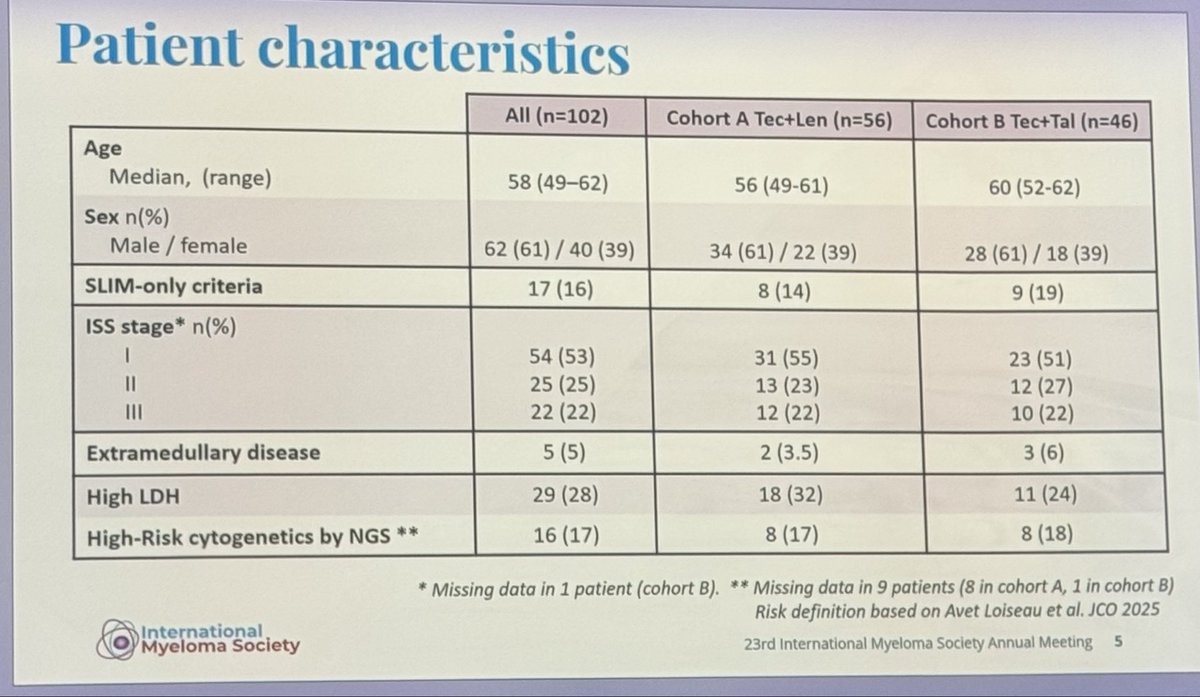


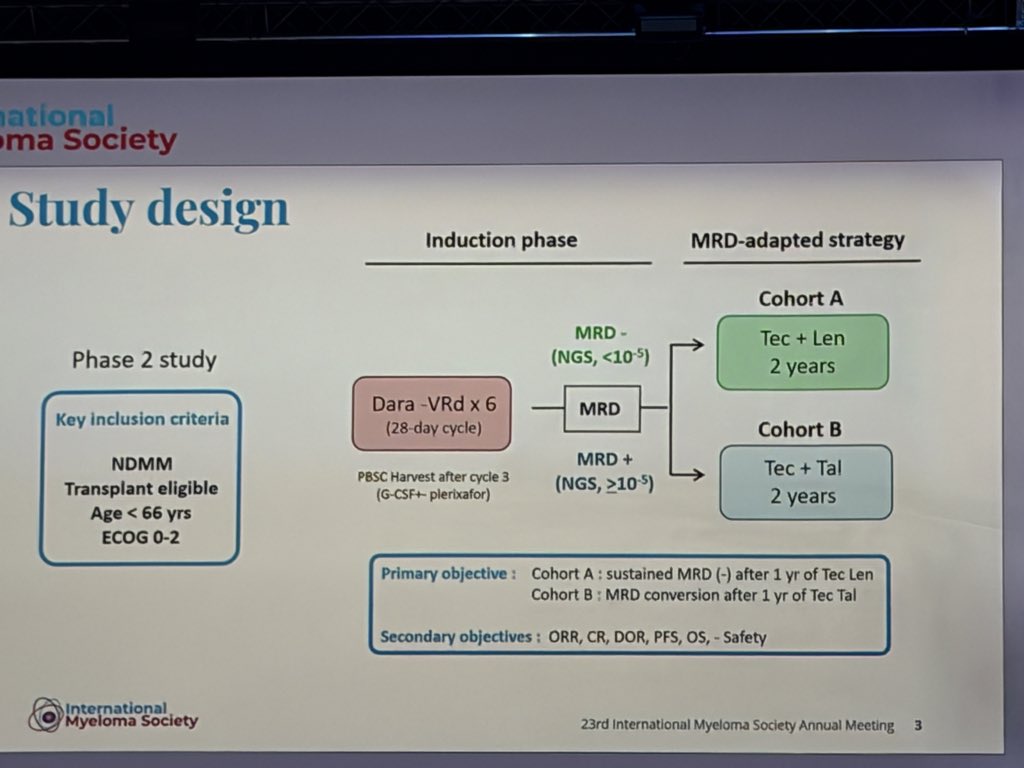
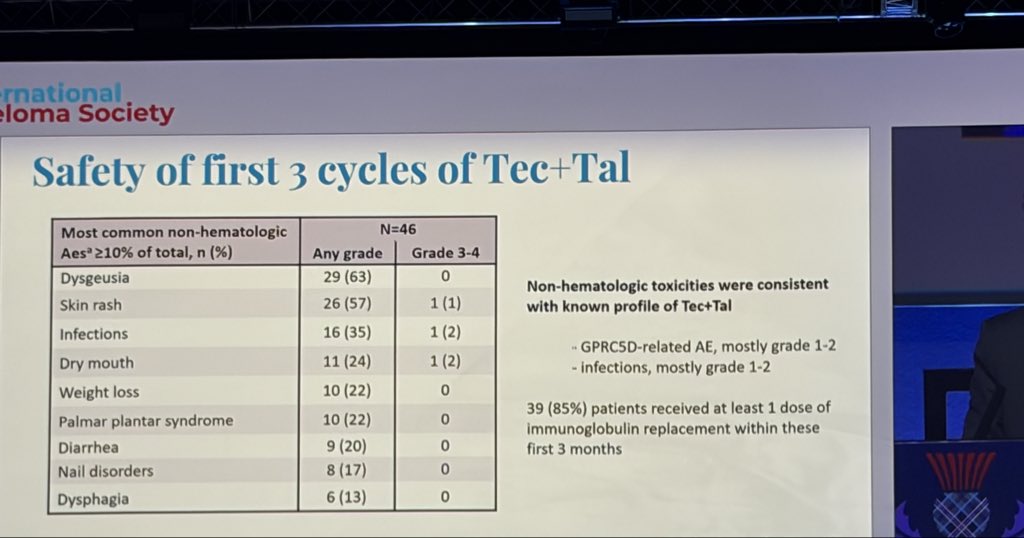
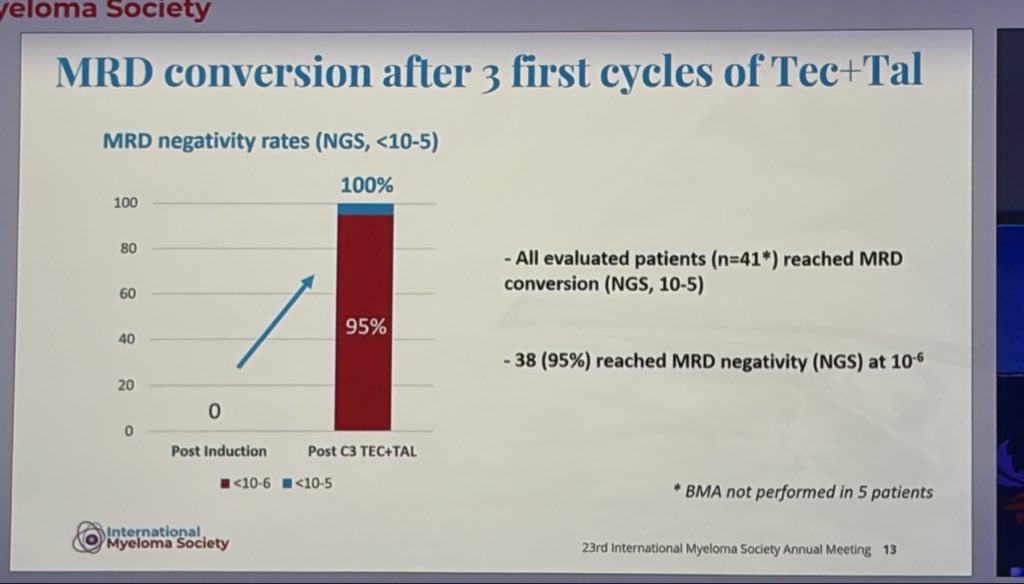 Sep 25
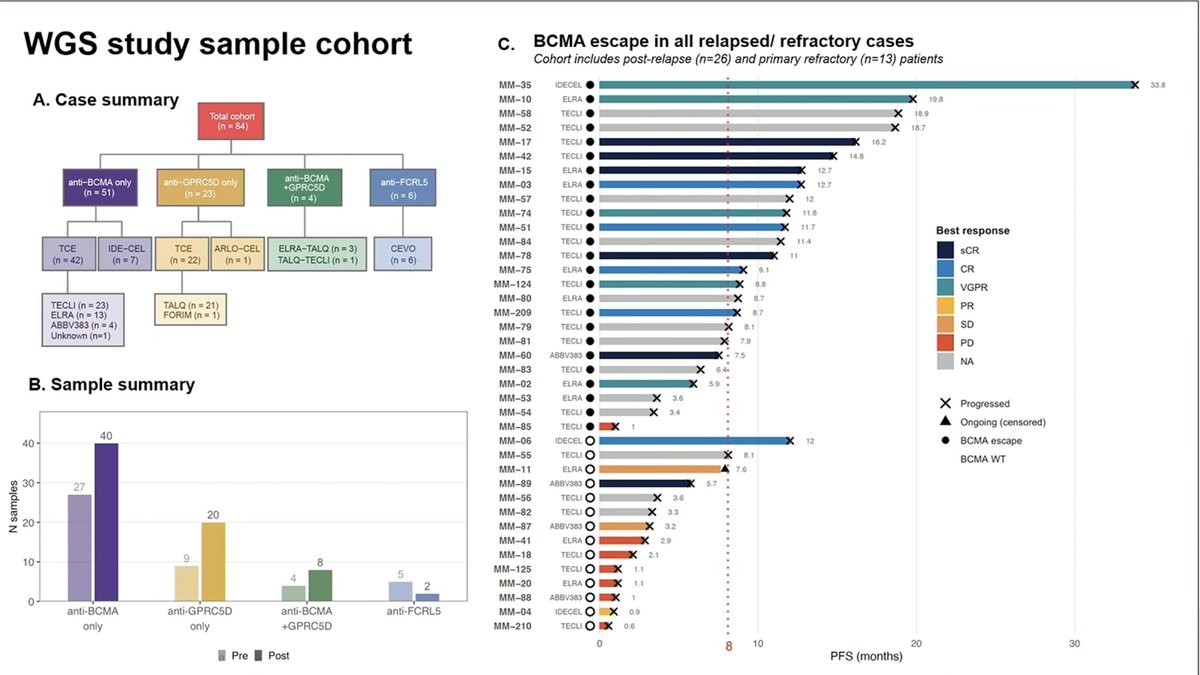
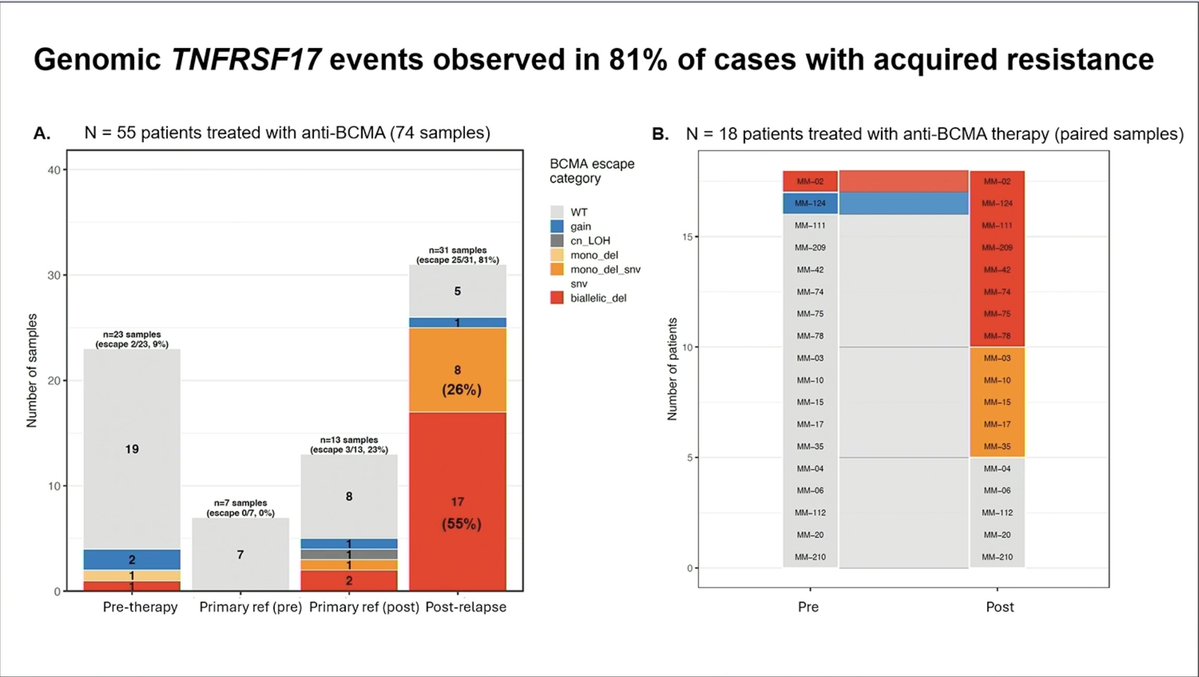
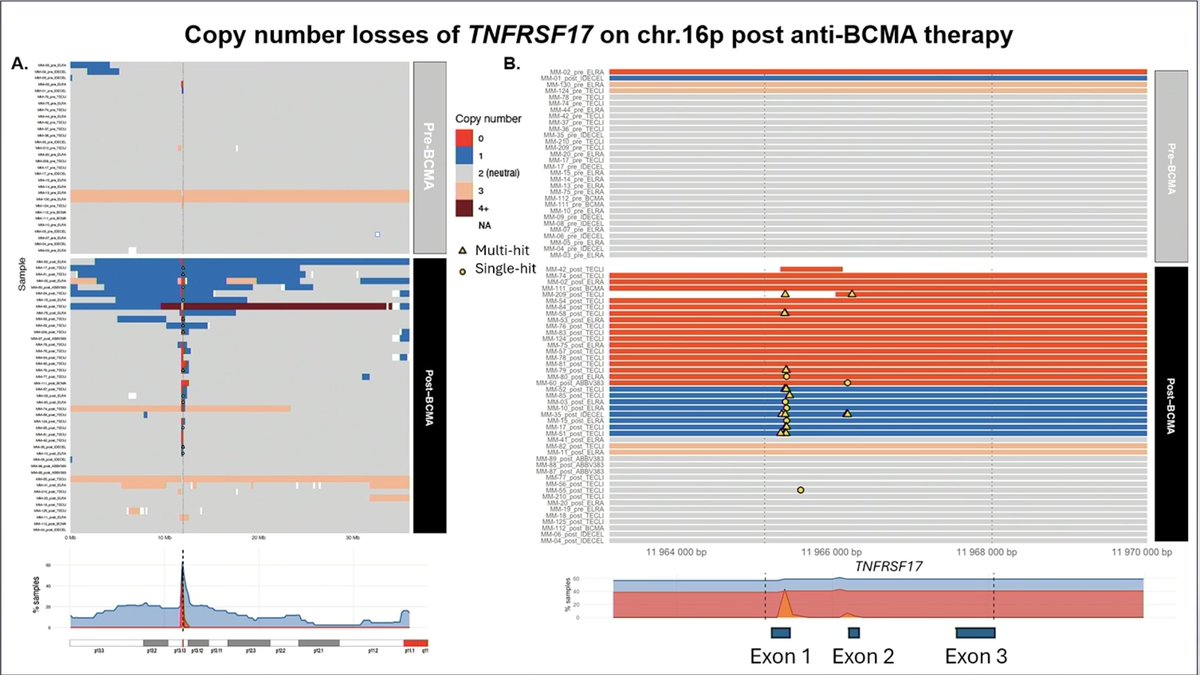
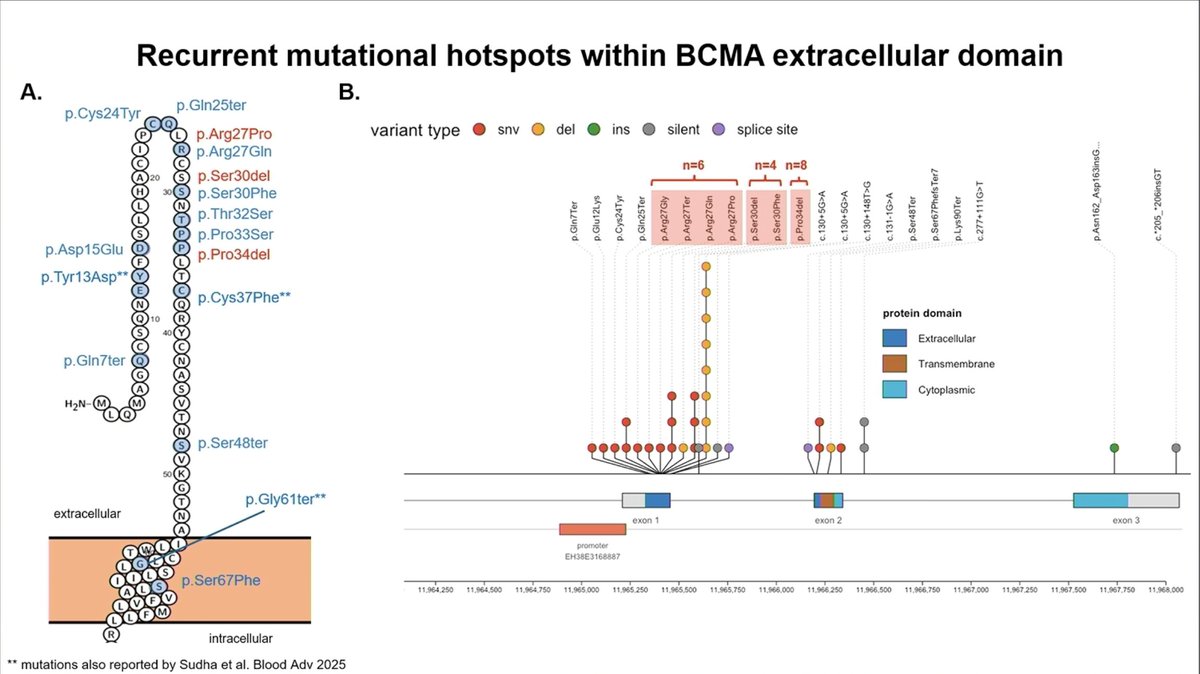
#IMS26 #mmsm Work by Holly Lee @NBahlis
Some data evolving (not posted per request)
➡️BCMA antigen escape is present in over 80% of acquired resistance cases (predominantly biallelic TNFRSF17 deletion and monoallelic deletion +SNV/indel)
➡️Escape converges on functionally https://t.co/RotfnYIqNZ
[Slide 1 - WGS study sample cohort, Holly Lee/Nizar Bahlis]
A. Case summary: Total cohort n=84, split into anti-BCMA only (n=51: TCE n=42 [TECLI n=23, ELRA n=13, ABBV383 n=4, Unknown n=1], IDE-CEL n=7), anti-GPRC5D only (n=23: TCE n=22 [TALQ n=21, FORIM n=1], ARLO-CEL n=1), anti-BCMA+GPRC5D (n=4: ELRA-TALQ n=3, TALQ-TECLI n=1), anti-FCRL5 (n=6: CEVO n=6).
B. Sample summary bar chart, pre/post samples by category: anti-BCMA only 27 pre/40 post; anti-GPRC5D only 9 pre/20 post; anti-BCMA+GPRC5D 4 pre/8 post; anti-FCRL5 5 pre/2 post.
C. BCMA escape in all relapsed/refractory cases (cohort includes post-relapse n=26 and primary refractory n=13 patients) - per-patient PFS bar chart (months) colored by best response (sCR/CR/VGPR/PR/SD/PD/NA), with BCMA escape (filled circle) vs BCMA WT (open circle) markers; range from MM-35 (IDECEL, 33.8mo, VGPR) down to MM-210 (TECLI, 0.6mo, PD). Red dotted line at 8 months.
[Slide 2 - Genomic TNFRSF17 events observed in 81% of cases with acquired resistance]
A. N=55 patients treated with anti-BCMA (74 samples): Pre-therapy n=23 samples, escape 2/23 (9%): WT 19, gain 2, mono_del 1, biallelic_del 1. Primary ref (pre) n=7, escape 0/7 (0%): WT 7. Primary ref (post) n=13, escape 3/13 (23%): WT 8, gain 1, cn_LOH 1, mono_del 1, biallelic_del 2. Post-relapse n=31 samples, escape 25/31 (81%): WT 5, gain 1, mono_del_snv 8 (26%), biallelic_del 17 (55%).
B. N=18 patients with paired samples (Pre vs Post), tracked by patient ID (MM-02, MM-124, MM-111, MM-209, MM-42, MM-74, MM-75, MM-78, MM-03, MM-10, MM-15, MM-17, MM-35, MM-04, MM-06, MM-112, MM-20, MM-210) - most WT pre-therapy convert to biallelic_del or mono_del_snv post-therapy.
[Slide 3 - Copy number losses of TNFRSF17 on chr.16p post anti-BCMA therapy]
A. Sample-level copy number heatmap (Pre-BCMA vs Post-BCMA) across chr16p region (0-36Mb), showing widespread copy-number loss (blue=CN1, dark red=CN0, maroon=CN4+) concentrated near the TNFRSF17 locus in Post-BCMA samples vs mostly neutral (grey=CN2) in Pre-BCMA samples. Bottom track: % samples with CN loss (blue) or biallelic loss (red) peaking sharply at ~55-60% right at the TNFRSF17 locus (chr16p13.13).
B. Higher-resolution view (11,964,000-11,970,000 bp) across TNFRSF17 exons 1-3, showing single-hit (circle) and multi-hit (triangle) mutation events concentrated in Exon 1 and Exon 2 regions in Post-BCMA samples.
[Slide 4 - Recurrent mutational hotspots within BCMA extracellular domain]
A. BCMA protein sequence diagram (extracellular/transmembrane/intracellular domains) annotated with recurrent point mutations: p.Cys24Tyr, p.Gln25ter, p.Arg27Pro, p.Arg27Gln, p.Ser30del, p.Ser30Phe, p.Thr32Ser, p.Pro33Ser, p.Pro34del, p.Cys37Phe**, p.Asp15Glu, p.Tyr13Asp**, p.Gln7ter, p.Ser48ter, p.Gly61ter**, p.Ser67Phe (** = mutations also reported by Sudha et al. Blood Adv 2025).
B. Lollipop plot of variant type (snv/del/ins/silent/splice site) by position across exon 1 (extracellular), exon 2 (transmembrane), exon 3 (cytoplasmic) domains, with variant clusters at p.Arg27Gly/Ter/Gln/Pro (n=6), p.Ser30del/Phe (n=4), p.Pro34del (n=8).
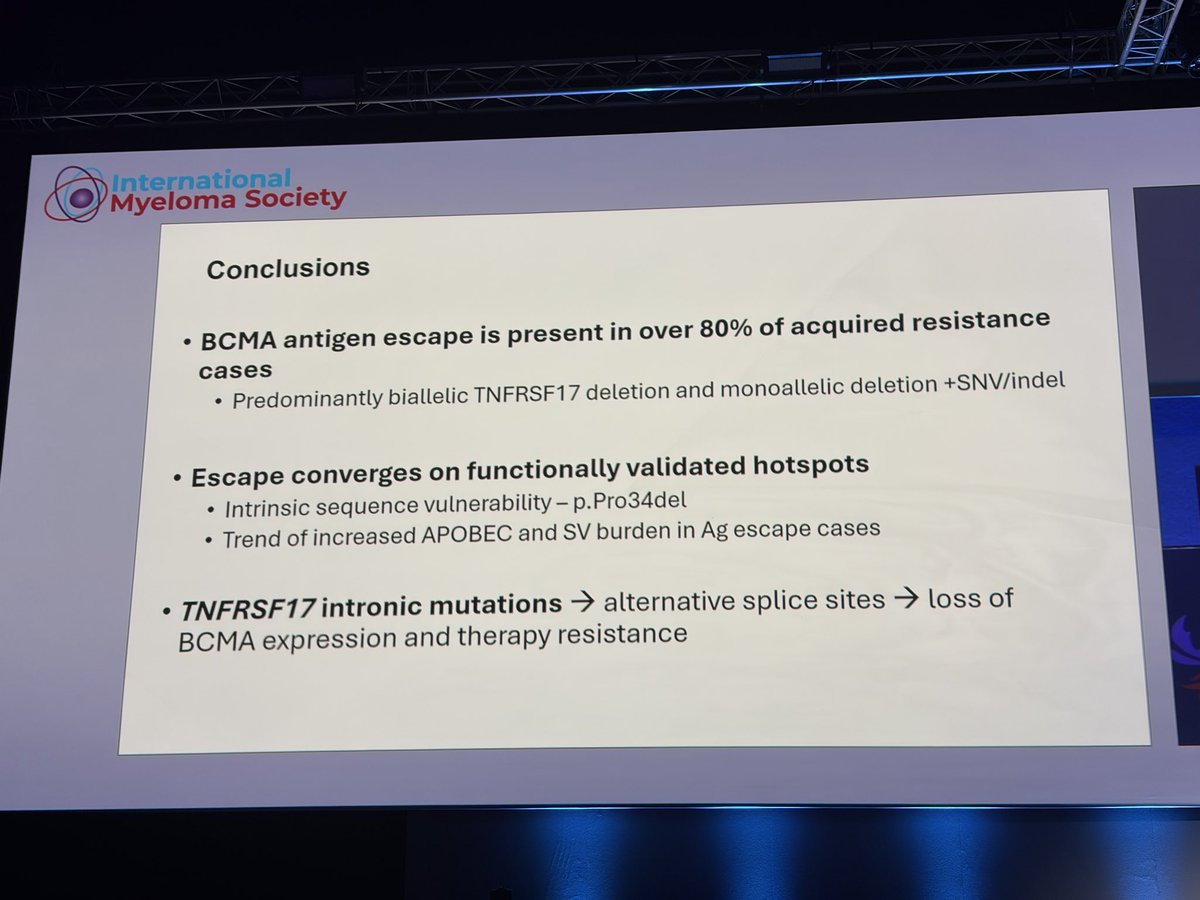

 Sep 25
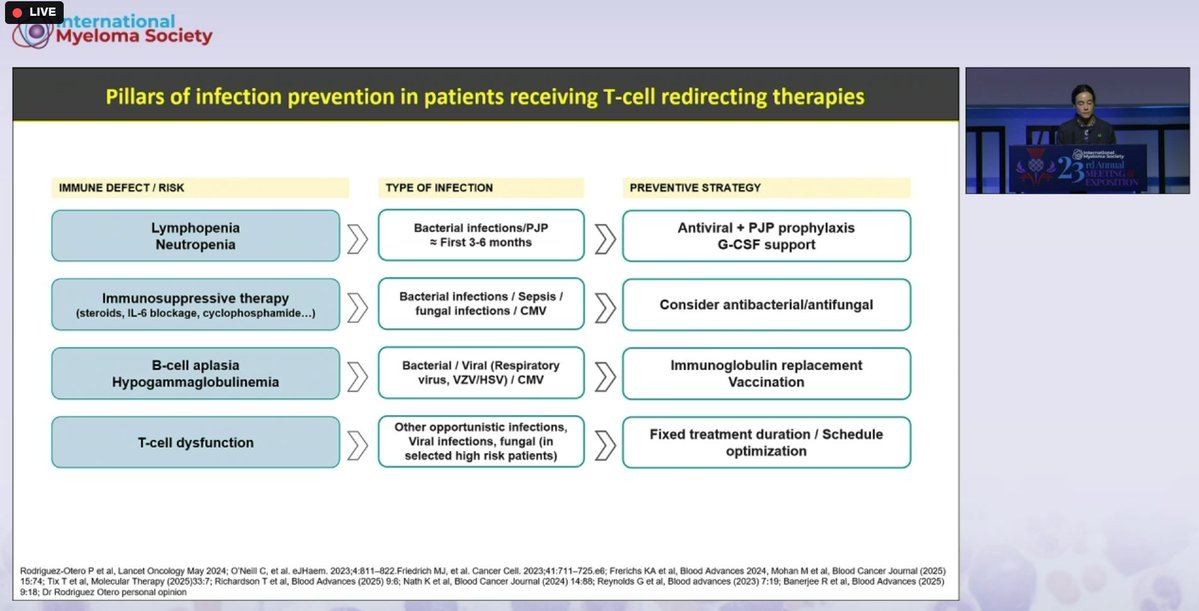
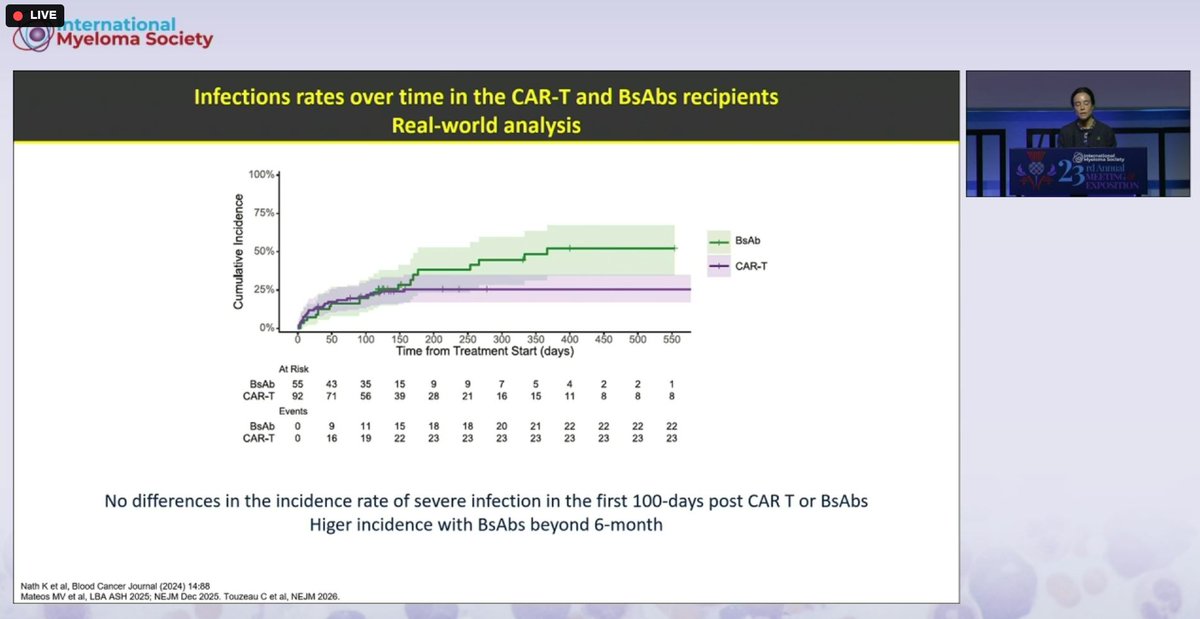
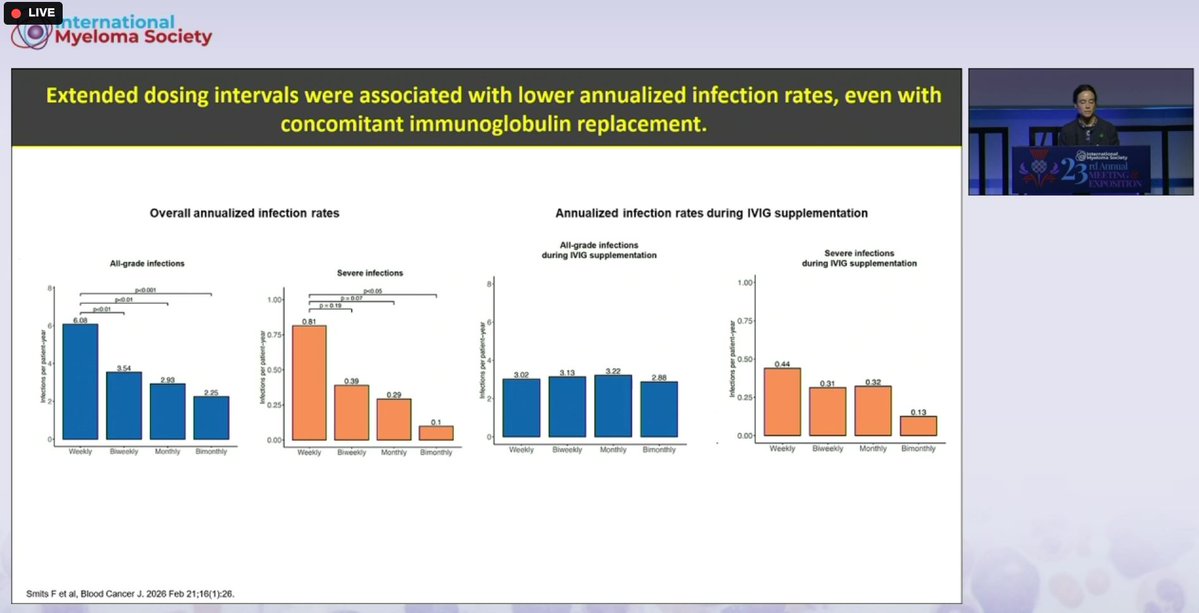

Great talk by @paurotero from @ClinicaNavarra at #IMS26 on a recurrent challenge: infections after T-cell-redirecting therapies.
Infection risk is not static. CAR-T has an early peak followed by immune recovery, while continuous bispecific therapy may cause more sustained immune https://t.co/yeFuWBOWdR
[Infection management with BsAbs and CAR-T, @paurotero, ClinicaNavarra]
[Slide 2 - Infections rates over time in the CAR-T and BsAbs recipients, Real-world analysis]: Cumulative incidence of infection over time (days from treatment start) for BsAb vs CAR-T. At-risk/events tables through day 550+. "No differences in the incidence rate of severe infection in the first 100-days post CAR T or BsAbs. Higher incidence with BsAbs beyond 6-month." Sources: Nath K et al, Blood Cancer Journal (2024) 14:88; Mateos MV et al, LBA ASH 2025; NEJM Dec 2025; Touzeau C et al, NEJM 2026.
[Slide 3 - Extended dosing intervals were associated with lower annualized infection rates, even with concomitant immunoglobulin replacement]: Overall annualized infection rates by dosing interval (Weekly/Biweekly/Monthly/Bimonthly) - All-grade: 6.08/3.54/2.93/2.25 infections per patient-year (p<0.001 weekly vs others). Severe: 0.81/0.39/0.29/0.10 (p<0.05). During IVIG supplementation - All-grade: 3.02/3.13/3.22/2.88. Severe: 0.44/0.31/0.32/0.13. Source: Smits F et al, Blood Cancer J. 2026 Feb 21;16(1):26.
[Slide 4 - Can immune monitoring help identify patients at increased risk of infection?]: CD27+ B cells, CD27- NK cells, and the CD27-/CD27+ T-cell ratio independently predict infection risk throughout the disease course and can be monitored in peripheral blood. Four KM curves (time to infection probability vs months) each with P<.001: CD27+ B cells % (<0.1% vs >=0.1%), CD27- NK cells % (<2.8% vs >=2.8%), CD27-/CD27+ T cell ratio (<0.37 vs >=0.37), Immune score (<=1 vs >=2 risk factors) - all show higher-risk group reaching ~65-85% infection probability vs lower-risk group plateauing ~45-50%. Source: Zabaleta A et al, Blood April 2026;147(18).
Sep 25
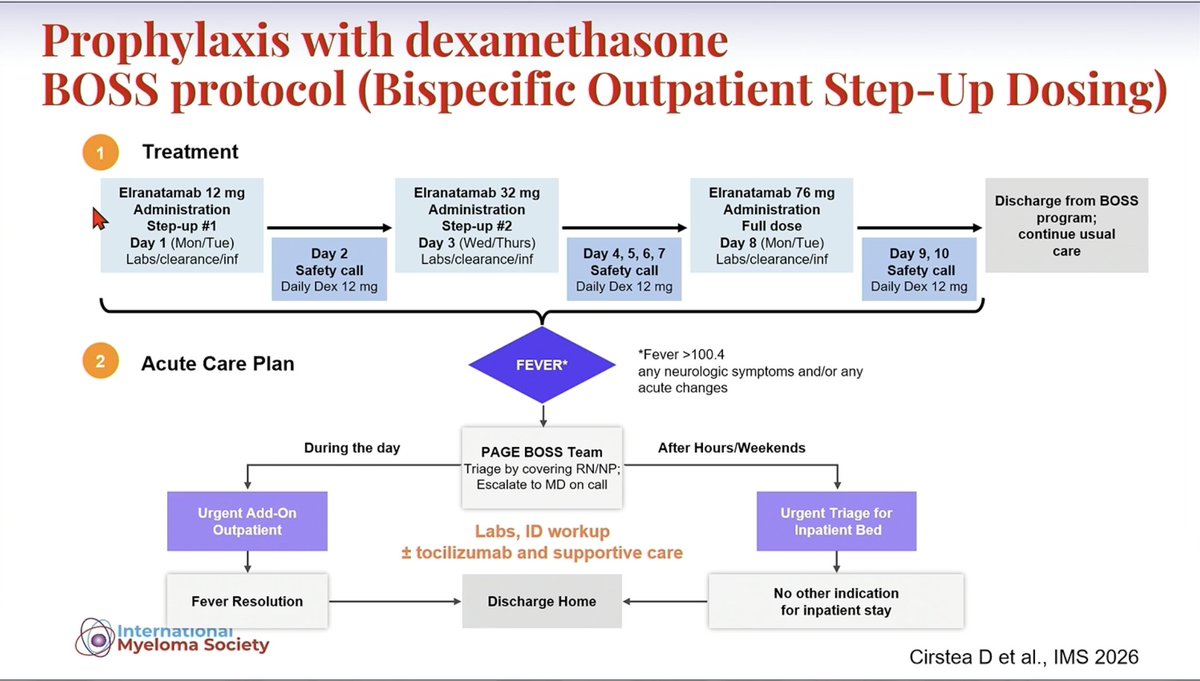
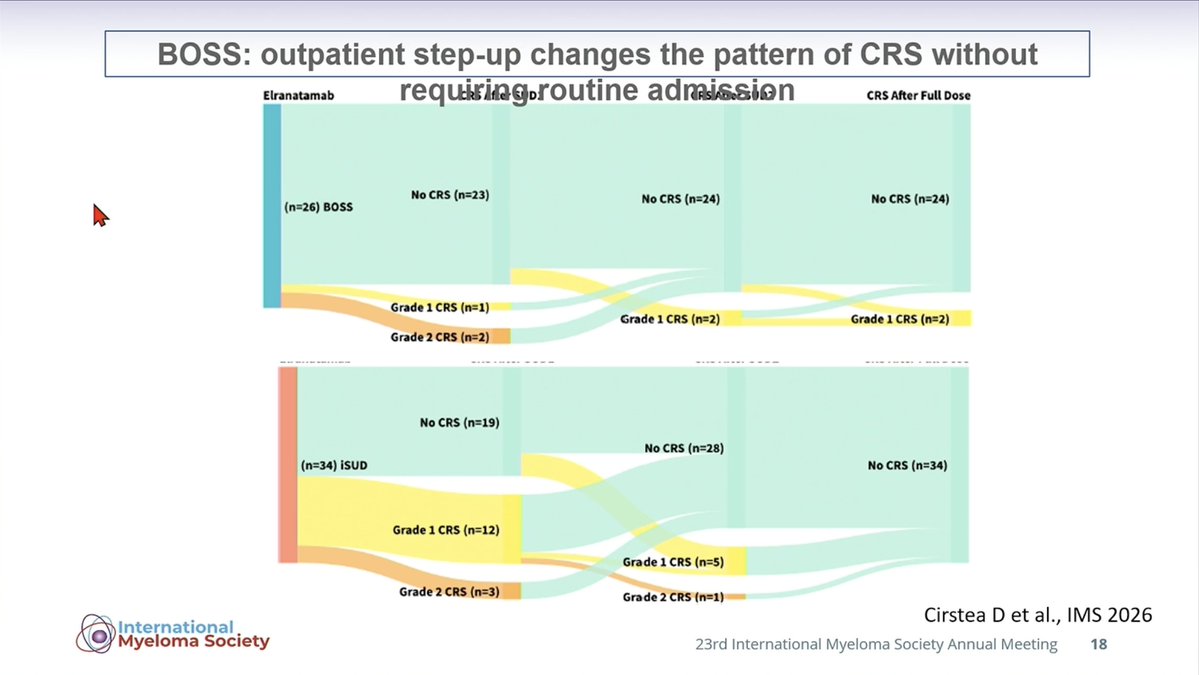
#IMS26 #mmsm
Use of Dex to help with outpatient dosing of BsAb
@NoopurRajeMD https://t.co/3YYm83NxDX
[Slide 1 - Prophylaxis with dexamethasone, BOSS protocol (Bispecific Outpatient Step-Up Dosing)]
Treatment: Elranatamab 12mg admin Step-up #1 Day 1 (Mon/Tue), Labs/clearance -> Day 2 Safety call, Daily Dex 12mg -> Elranatamab 32mg Step-up #2 Day 3 (Wed/Thurs) -> Day 4,5,6,7 Safety call Daily Dex 12mg -> Elranatamab 76mg Full dose Day 8 (Mon/Tue) -> Day 9,10 Safety call Daily Dex 12mg -> Discharge from BOSS program, continue usual care.
Acute Care Plan: Fever>100.4 (any neurologic symptoms and/or any acute changes) -> PAGE BOSS Team (triage by covering RN/NP, escalate to MD on call) -> During the day: Urgent Add-On Outpatient -> Fever Resolution -> Discharge Home. After Hours/Weekends: Urgent Triage for Inpatient Bed -> No other indication for inpatient stay -> Discharge Home. Labs, ID workup +/- tocilizumab and supportive care.
Source: Cirstea D et al., IMS 2026.
[Slide 2 - BOSS: outpatient step-up changes the pattern of CRS without requiring routine admission]
Sankey diagrams tracking CRS grade through Elranatamab step-up dosing for two BOSS cohorts: (n=26) BOSS cohort and (n=34) iSUD cohort, tracking No CRS / Grade 1 CRS / Grade 2 CRS counts across dosing stages (after SUD2, after SUD3, after Full Dose).
BOSS n=26: No CRS(n=23), Grade 1 CRS(n=1), Grade 2 CRS(n=2), converging to No CRS(n=24) and Grade 1 CRS(n=2) after full dose.
iSUD n=34: No CRS(n=19), Grade 1 CRS(n=12), Grade 2 CRS(n=3), converging to No CRS(n=34) after full dose.
Source: Cirstea D et al., IMS 2026. 23rd International Myeloma Society Annual Meeting.
 Sep 25
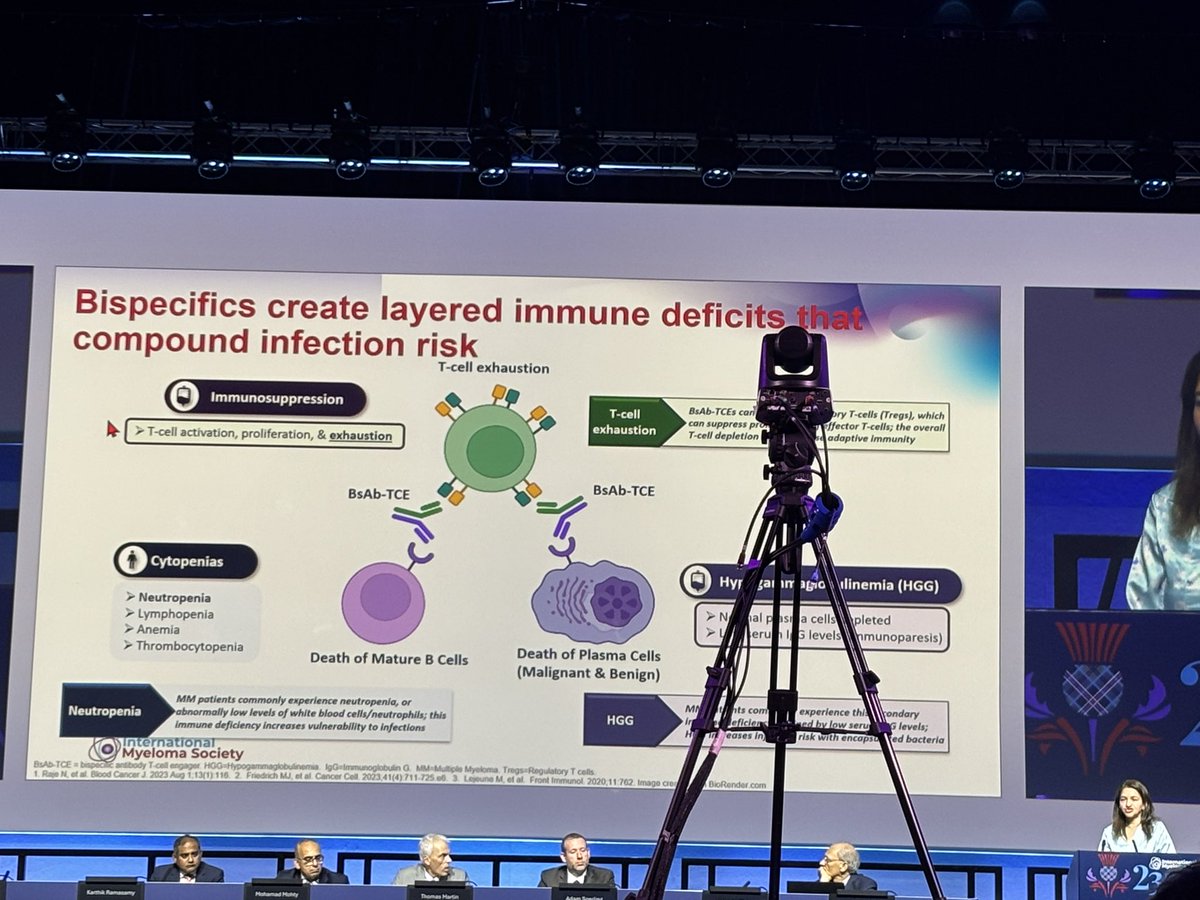
.@NoopurRajeMD pointing out the mecanisms of immunodeficiency secondary to bi-specific Abs #mmsm #IMS26 @Myeloma_Society https://t.co/M8gquUXrns
[Bispecifics create layered immune deficits that compound infection risk - Dr. Noopur Raje]
Immunosuppression: T-cell activation, proliferation, & exhaustion. T-cell exhaustion: BsAb-TCEs can [expand regulatory T-cells] (Tregs), which can suppress pro[liferation of] effector T-cells; overall T-cell depletion [impairs] adaptive immunity.
Cytopenias: Neutropenia, Lymphopenia, Anemia, Thrombocytopenia. Neutropenia note: MM patients commonly experience neutropenia, or abnormally low levels of white blood cells/neutrophils; this immune deficiency increases vulnerability to infections.
Death of Mature B Cells (via BsAb-TCE) and Death of Plasma Cells (Malignant & Benign, via BsAb-TCE) shown as mechanism diagram.
Hypogammaglobulinemia (HGG): Normal plasma cells depleted; Low serum IgG levels (immunoparesis). HGG note: MM patients commonly experience this secondary immunodeficiency caused by low serum IgG levels; HGG increases infection risk with encapsulated bacteria.
BsAb-TCE = bispecific antibody T-cell engager. Sources: Raje N, et al. Blood Cancer J. 2023 Aug 1;13(1):116. Friedrich MJ, et al. Cancer Cell. 2023;41(4):711-725.e6. Lejeune M, et al. Front Immunol. 2020;11:762.
Sep 25
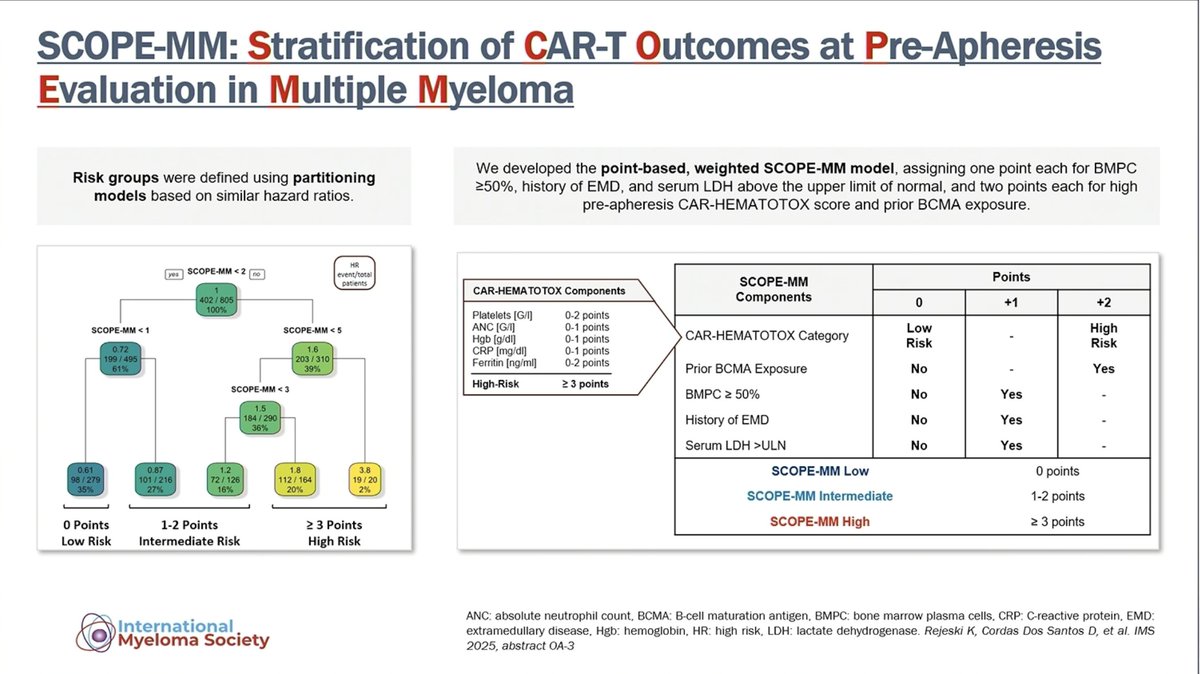
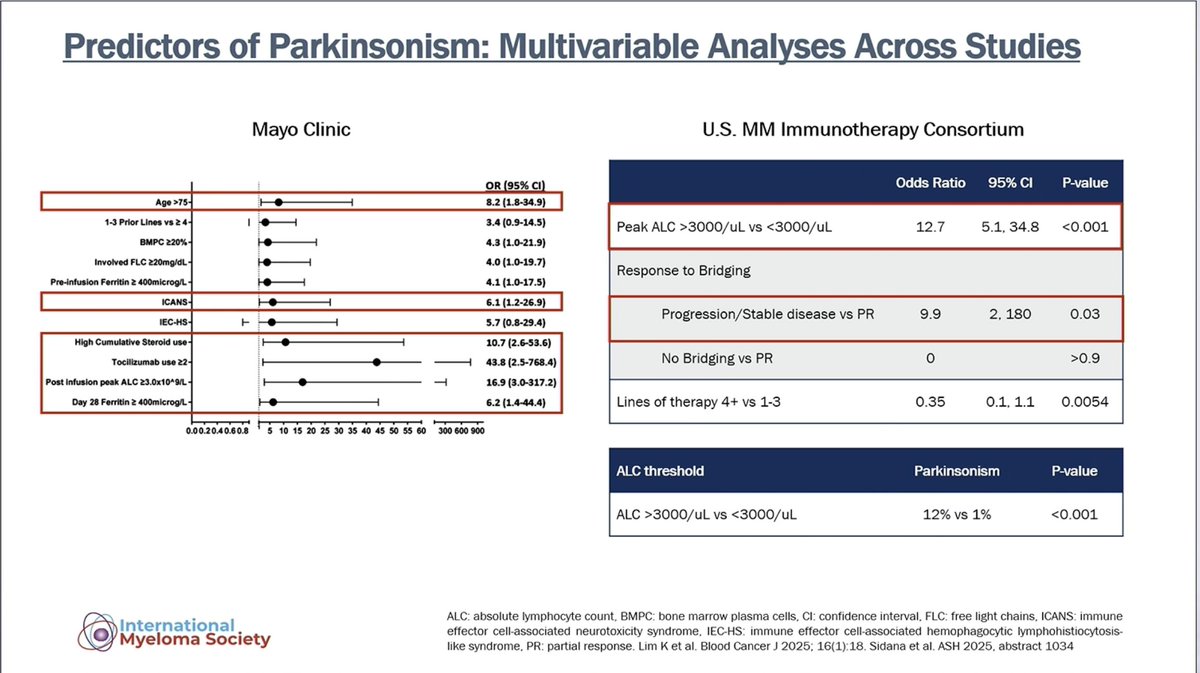
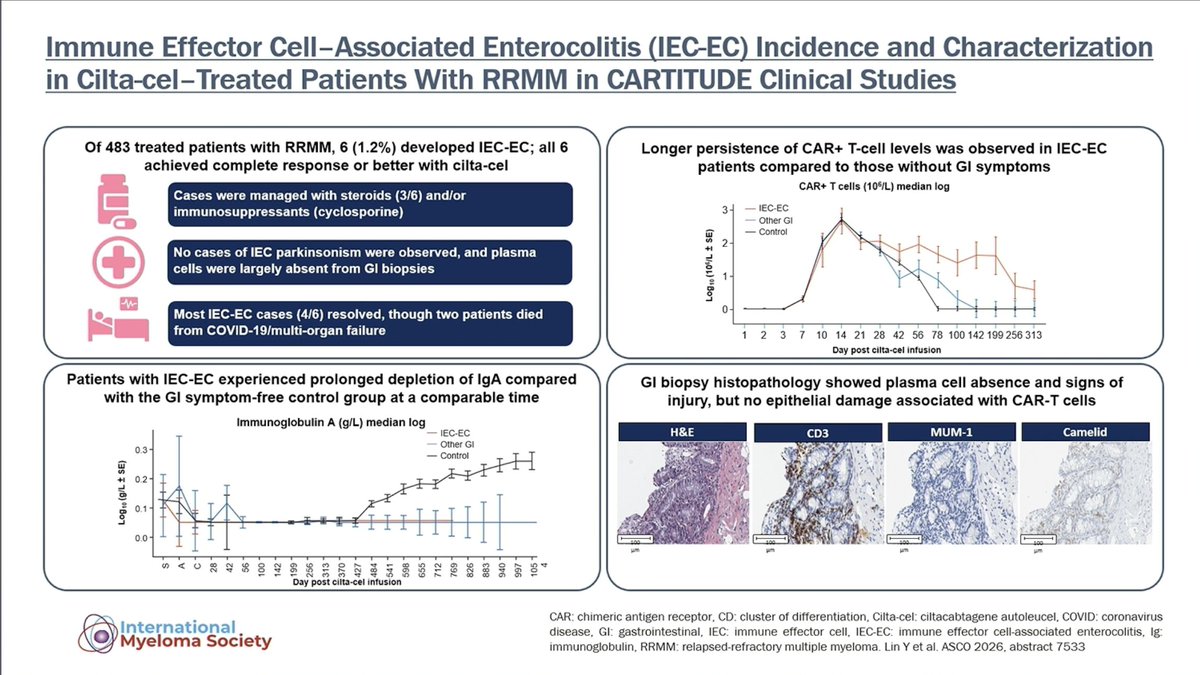
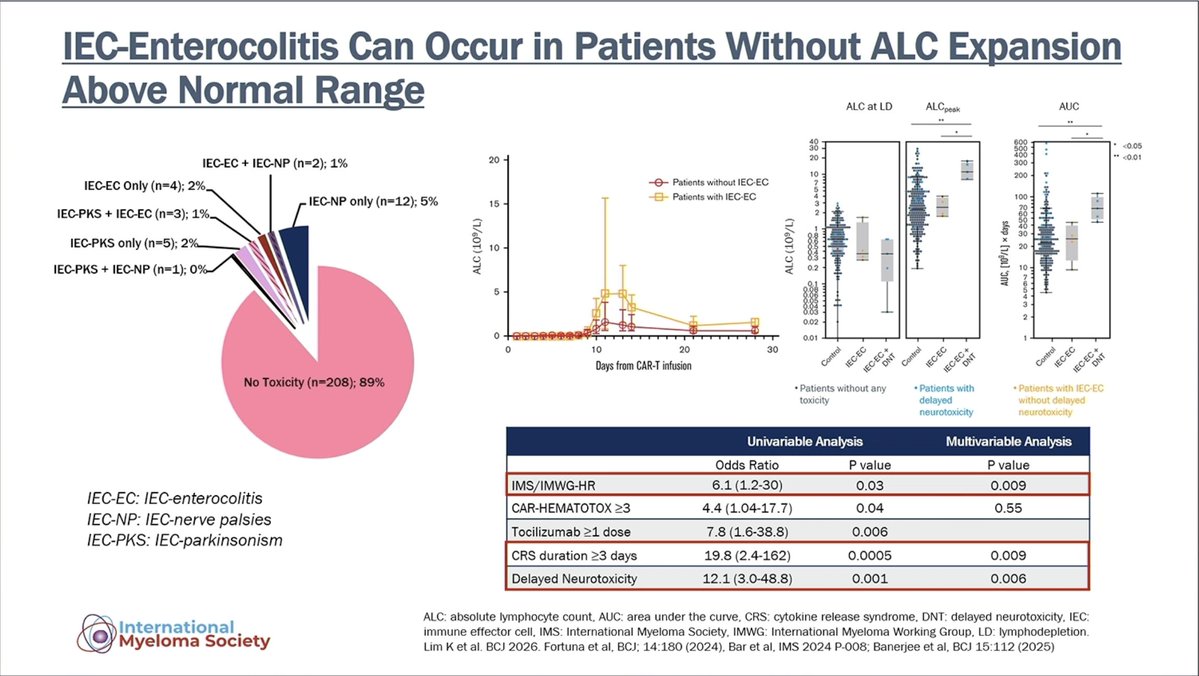
#IMS26 #mmsm
Biomarkers to predict toxicity with some associations with serious toxicities https://t.co/MQcZiXstUc
[Slide 1 - SCOPE-MM: Stratification of CAR-T Outcomes at Pre-Apheresis Evaluation in Multiple Myeloma, IMS26]
Point-based weighted SCOPE-MM model: 1 point each for BMPC >=50%, history of EMD, serum LDH above ULN; 2 points each for high pre-apheresis CAR-HEMATOTOX score and prior BCMA exposure.
Risk groups (partitioning model, HR/event/total pts): 0 points=low risk (0.61, 98/279, 35%); 1-2 points=intermediate risk (0.87 101/216 27%, 1.2 72/126 16%); >=3 points=high risk (1.8 112/164 20%, 3.8 19/20 2%).
SCOPE-MM Low = 0 points, Intermediate = 1-2 points, High = >=3 points. High-Risk CAR-HEMATOTOX >=3 points.
Source: Rejeski K, Cordas Dos Santos D, et al. IMS 2025, abstract OA-3.
[Slide 2 - Predictors of Parkinsonism: Multivariable Analyses Across Studies]
Mayo Clinic cohort (OR, 95% CI): Age >75 8.2 (1.8-34.9); 1-3 prior lines vs >=4 3.4 (0.9-14.5); BMPC >=20% 4.3 (1.0-21.9); Involved FLC >=20mg/dL 4.0 (1.0-19.7); Pre-infusion ferritin >=400microg/L 4.1 (1.0-17.5); ICANS 6.1 (1.2-26.9); IEC-HS 5.7 (0.8-29.4); High cumulative steroid use 10.7 (2.6-53.6); Tocilizumab use >=2 43.8 (2.5-768.4); Post-infusion peak ALC >=3.0x10^9/L 16.9 (3.0-317.2); Day 28 ferritin >=400microg/L 6.2 (1.4-44.4).
U.S. MM Immunotherapy Consortium (Odds Ratio, 95% CI, P-value): Peak ALC >3000/uL vs <3000/uL 12.7 (5.1-34.8) P<0.001; Progression/Stable disease vs PR (response to bridging) 9.9 (2-180) P=0.03; No Bridging vs PR 0 (P>0.9); Lines of therapy 4+ vs 1-3 0.35 (0.1-1.1) P=0.0054.
ALC threshold table: ALC >3000/uL vs <3000/uL - Parkinsonism 12% vs 1%, P<0.001.
Sources: Lim K et al. Blood Cancer J 2026;16(1):18. Sidana et al. ASH 2025, abstract 1034.
[Slide 3 - Immune Effector Cell-Associated Enterocolitis (IEC-EC) Incidence and Characterization in Cilta-cel-Treated Patients With RRMM in CARTITUDE Clinical Studies]
Of 483 treated patients with RRMM, 6 (1.2%) developed IEC-EC; all 6 achieved complete response or better with cilta-cel. Cases managed with steroids (3/6) and/or immunosuppressants (cyclosporine). No cases of IEC parkinsonism observed; plasma cells largely absent from GI biopsies. Most IEC-EC cases (4/6) resolved, though two patients died from COVID-19/multi-organ failure.
Longer persistence of CAR+ T-cell levels observed in IEC-EC patients vs those without GI symptoms (log10 CAR+ T cells 10^6/L, peak ~day 14-21 then IEC-EC group stays elevated through day 313 vs control returning near 0 by day 78-100).
Patients with IEC-EC experienced prolonged depletion of IgA vs GI-symptom-free control group at comparable time (IEC-EC/Other GI stay near 0.05 g/L through day 1054, Control group recovers to ~0.27 g/L by day 997).
GI biopsy histopathology (H&E, CD3, MUM-1, Camelid stains) showed plasma cell absence and signs of injury, but no epithelial damage associated with CAR-T cells.
Source: Lin Y et al. ASCO 2026, abstract 7533.
[Slide 4 - IEC-Enterocolitis Can Occur in Patients Without ALC Expansion Above Normal Range]
Pie chart of toxicity categories (N=233 total): No Toxicity n=208 (89%); IEC-NP only n=12 (5%); IEC-EC only n=4 (2%); IEC-PKS only n=5 (2%); IEC-PKS+IEC-EC n=3 (1%); IEC-EC+IEC-NP n=2 (1%); IEC-PKS+IEC-NP n=1 (0%).
ALC dynamics by group (days from CAR-T infusion) and biomarker box plots (ALC at LD, ALC-peak, AUC) comparing Control / IEC-EC / IEC-EC+DNT groups, with significance markers (*P<0.05, **P<0.01).
Univariable/Multivariable analysis (Odds Ratio, P value univariable/multivariable): IMS/IMWG-HR 6.1 (1.2-30) P=0.03 / P=0.009; CAR-HEMATOTOX >=3 4.4 (1.04-17.7) P=0.04 / P=0.55; Tocilizumab >=1 dose 7.8 (1.6-38.8) P=0.006; CRS duration >=3 days 19.8 (2.4-162) P=0.0005 / P=0.009; Delayed Neurotoxicity 12.1 (3.0-48.8) P=0.001 / P=0.006.
IEC-EC = IEC-enterocolitis, IEC-NP = IEC-nerve palsies, IEC-PKS = IEC-parkinsonism.
Sources: Lim K et al. BCJ 2026. Fortuna et al, BCJ 14:180 (2024). Bar et al, IMS 2024 P-008. Banerjee et al, BCJ 15:112 (2025).
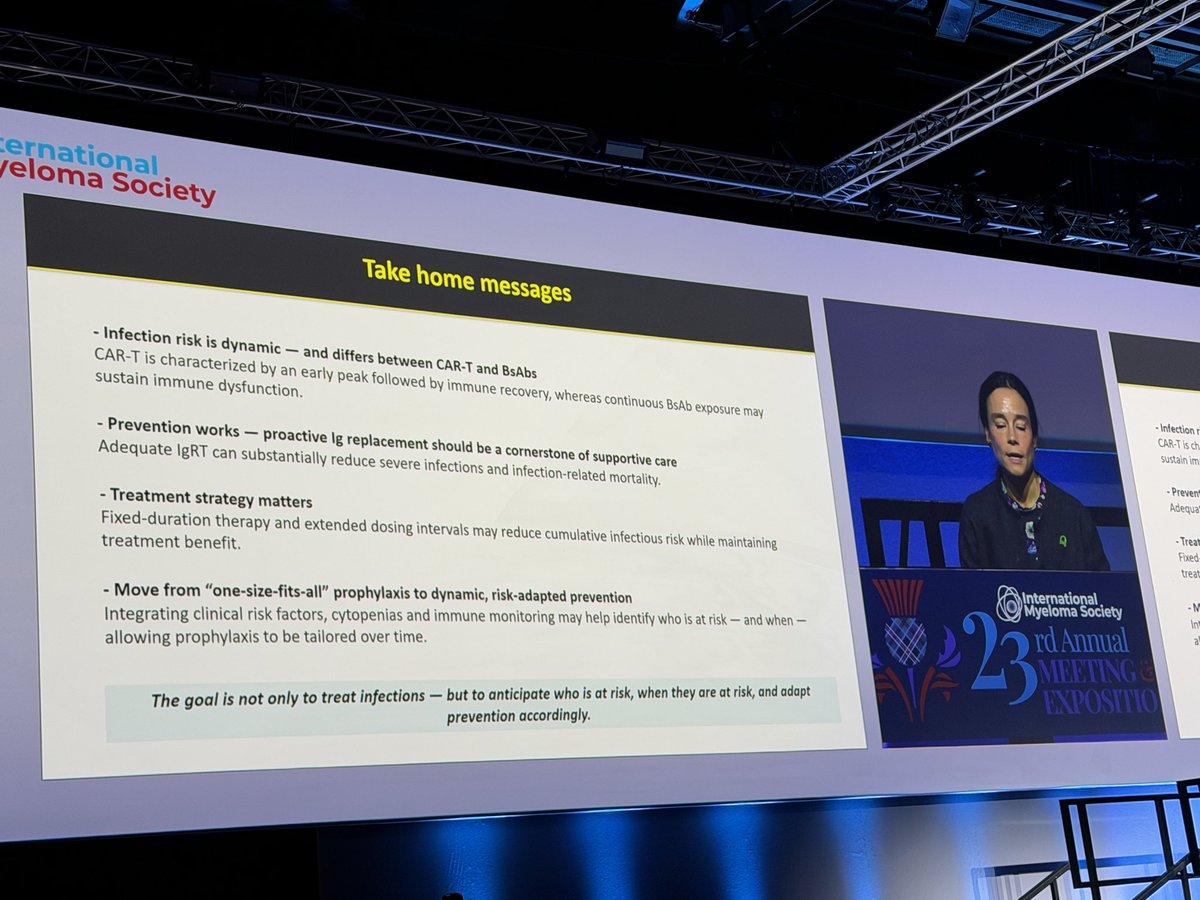

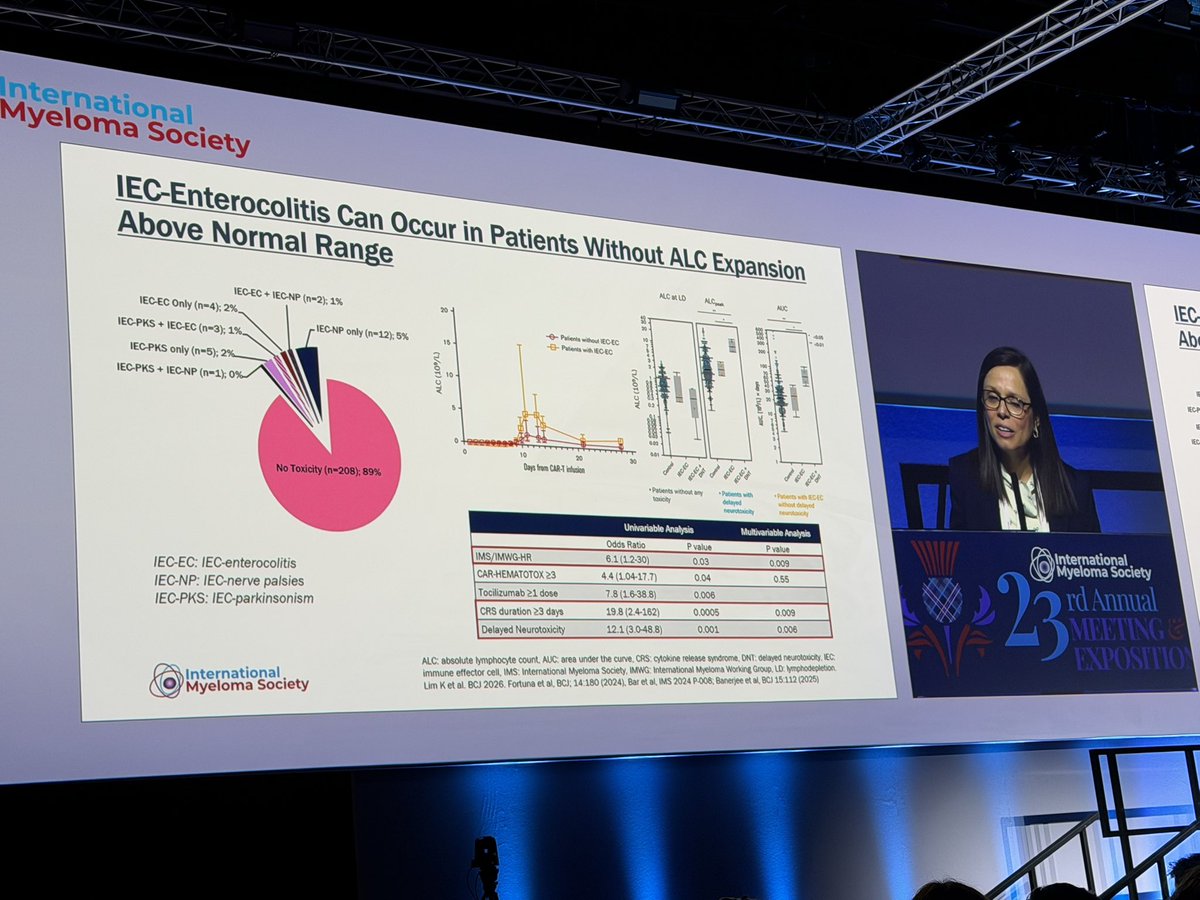


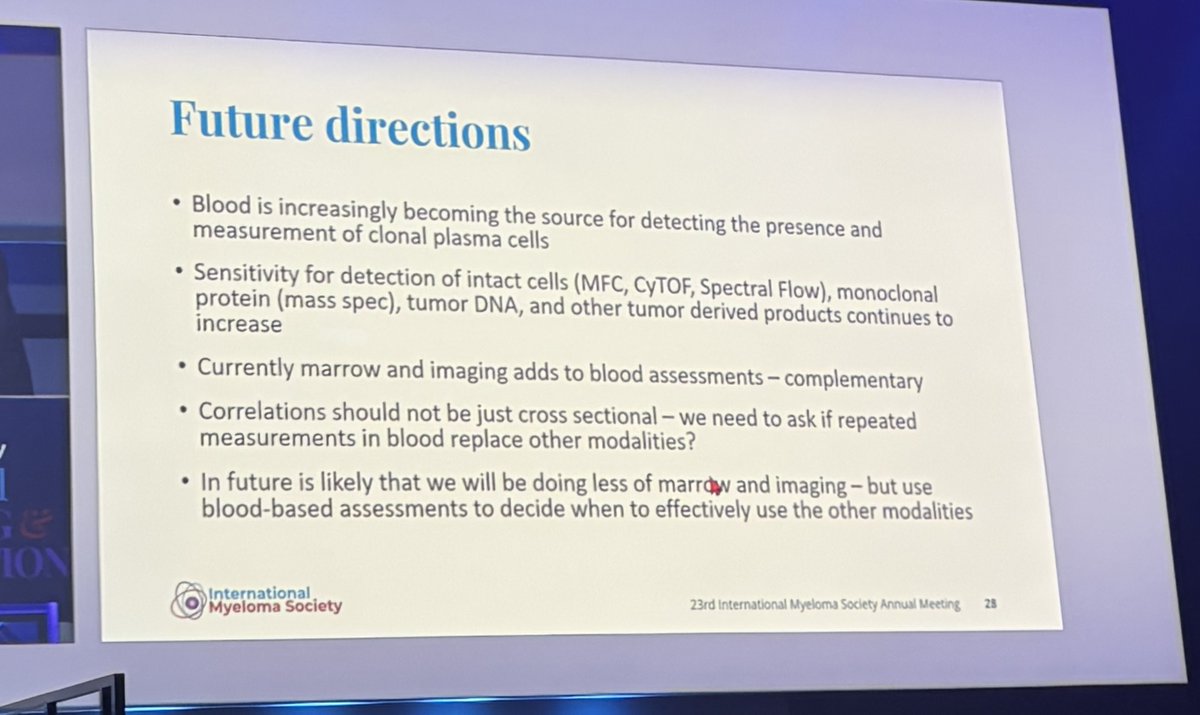 Sep 24


Mass spectrometry in myeloma by Dr Noemí Puig at #IMS2026.
MS can extend M-protein detection from low-level disease to deeper response and earlier re-emergence, but it should complement NOT REPLACE BM MRD for now.
India relevance: a blood-based longitudinal tool could be especially valuable where repeated marrow MRD is difficult, but only after assay standardisation, validation and wider access.
#MMsm
[Mass spectrometry in myeloma - Dr. Noemi Puig, IMS26]
[Slide 1 - Serum MS and BM MRD]: 2x2 concordance framework: BM MRD- / Serum MS- = "Concordant deep response". BM MRD- / Serum MS+ = "Residual serum disease" (delayed clearance, especially early/IgG; patchy or extramedullary disease; BM sampling or analytical attribution). BM MRD+ / Serum MS- = "Residual marrow disease" (low- or non-secretory residual clone; serum below detection; trackability or sensitivity limitations). BM MRD+ / Serum MS+ = "Concordant residual disease." Interpretive framework based on paired serum MS/BM NGF datasets, Puig et al., Blood 2024.
[Slide 2 - Harmonizing MS with the Current Response Framework]: Current response framework (Baseline -> PR >=50% down -> VGPR >=90% down or SPEP-/IFE+ -> CR IFE-) mapped against MS measurement range (Quantitative MS spanning PR through harmonization zone, then Detectable/non-quantifiable, then MS-). >=90% -> >=99% -> >=99.9% -> deeper response -> MS-. PR deemed "likely transferable"; VGPR/CR zone deemed the "Harmonization Zone" requiring defined clinically meaningful response thresholds.
[Slide 3 - Conclusions]: 1) MS extends the measurable M-protein range: from low-level disease to deeper response and earlier re-emergence. 2) Clinical interpretation requires consideration of timing, isotype and longitudinal kinetics. 3) MS and BM MRD are often hierarchical rather than complementary, with BM MRD usually being more informative. 4) Integration into current response assessment requires harmonization and clinical validation.

 Sep 24
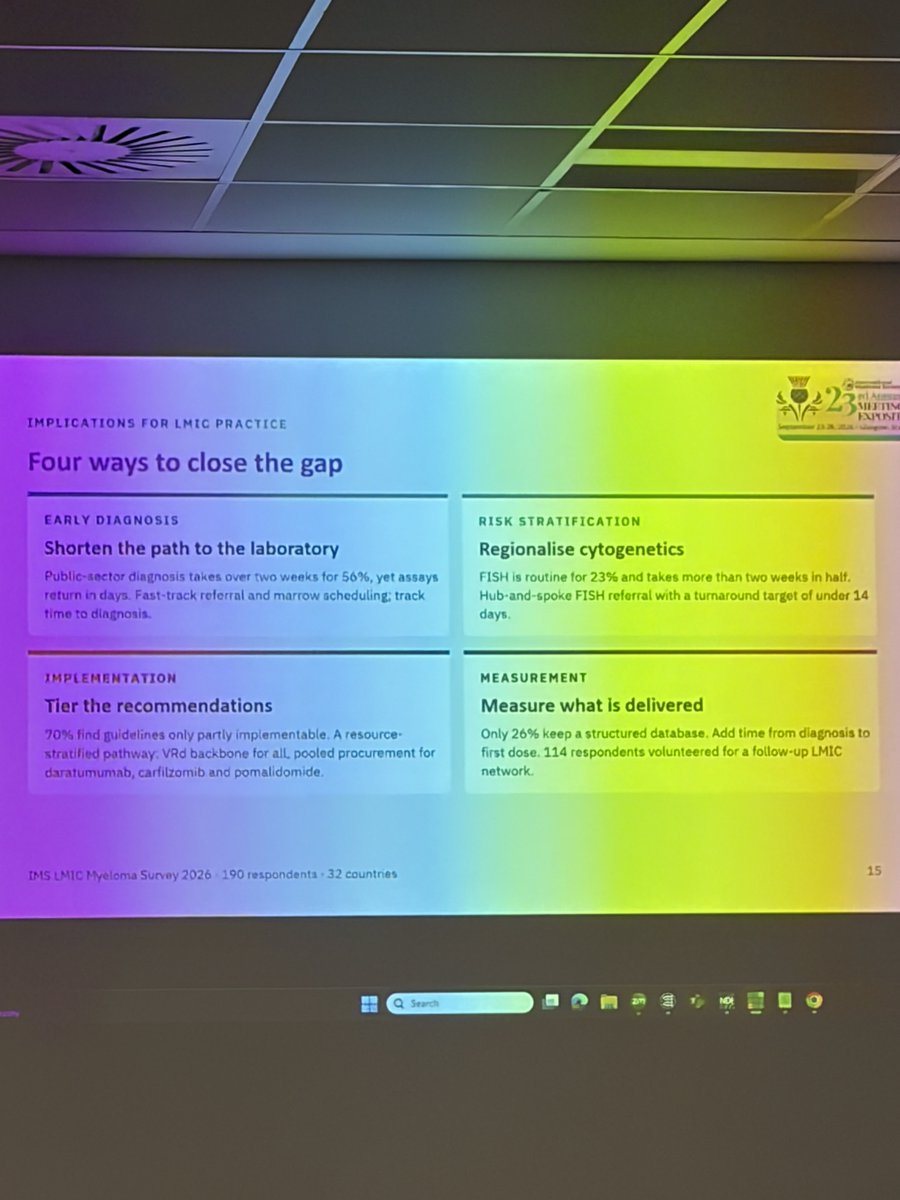
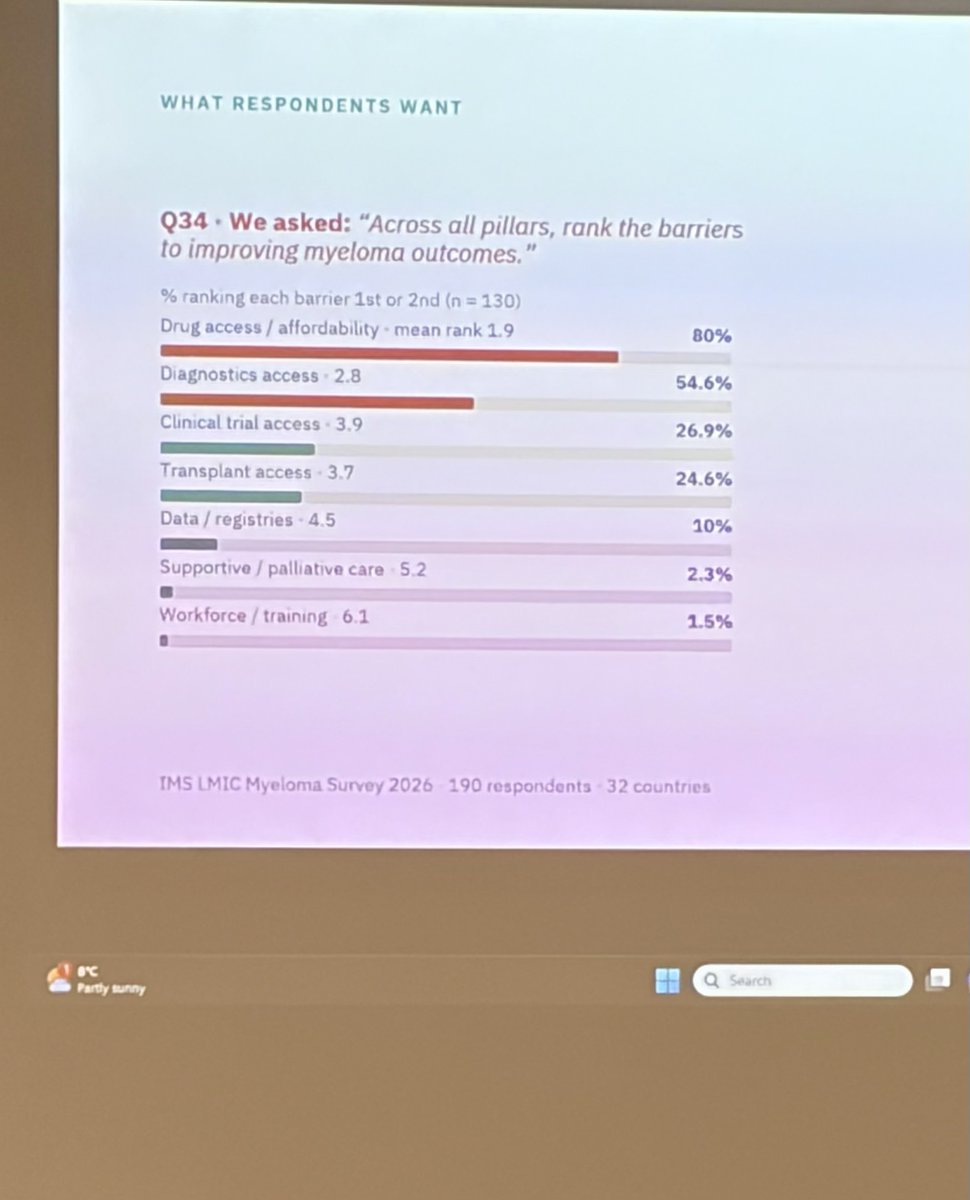
A very relevant LMIC Breakfast Meeting at #IMS2026
Excellent moderation by Dr Shaji Kumar (@myelomaMD), with Dr Jelena Bila (@BilaJelena) presenting the Balkan experience particularly well.
Dr Uday Yanamandra (@UdayYanamandra) and @IndMyAcGp highlighted the LMIC survey: drug https://t.co/P2WyuF3lUM
[LMIC Breakfast Meeting - IMS LMIC Myeloma Survey 2026, 190 respondents, 32 countries]
Q34 - "Across all pillars, rank the barriers to improving myeloma outcomes." % ranking each barrier 1st or 2nd (n=130): Drug access/affordability (mean rank 1.9) 80%; Diagnostics access (2.8) 54.6%; Clinical trial access (3.9) 26.9%; Transplant access (3.7) 24.6%; Data/registries (4.5) 10%; Supportive/palliative care (5.2) 2.3%; Workforce/training (6.1) 1.5%.
Four ways to close the gap: Early Diagnosis - Shorten the path to the laboratory (public-sector diagnosis takes over two weeks for 56%, yet assays return in days; fast-track referral and marrow scheduling, track time to diagnosis). Risk Stratification - Regionalise cytogenetics (FISH routine for 23%, takes more than two weeks in half; hub-and-spoke FISH referral, turnaround target under 14 days). Implementation - Tier the recommendations (70% find guidelines only partly implementable; resource-stratified pathway, VRd backbone for all, pooled procurement for daratumumab/carfilzomib/pomalidomide). Measurement - Measure what is delivered (only 26% keep a structured database; add time from diagnosis to first dose; 114 respondents volunteered for follow-up LMIC network).



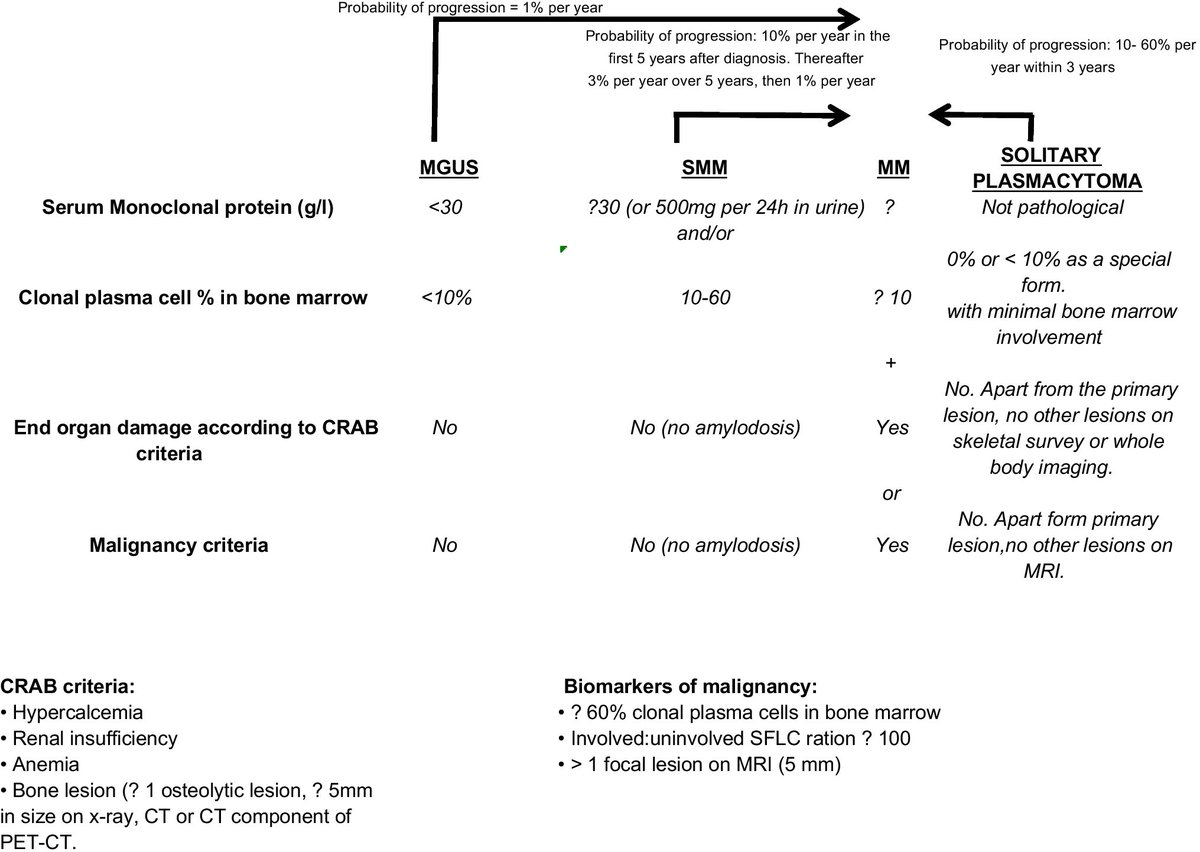

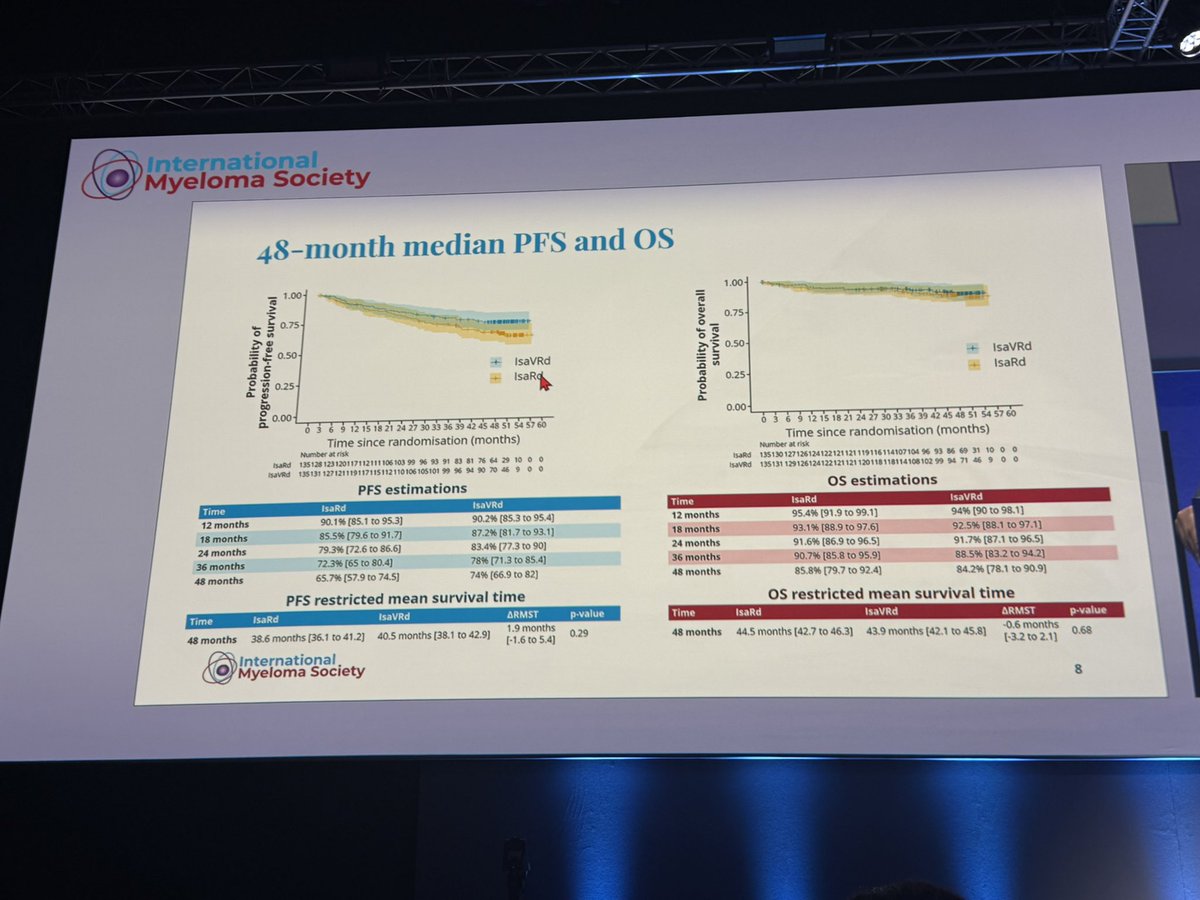


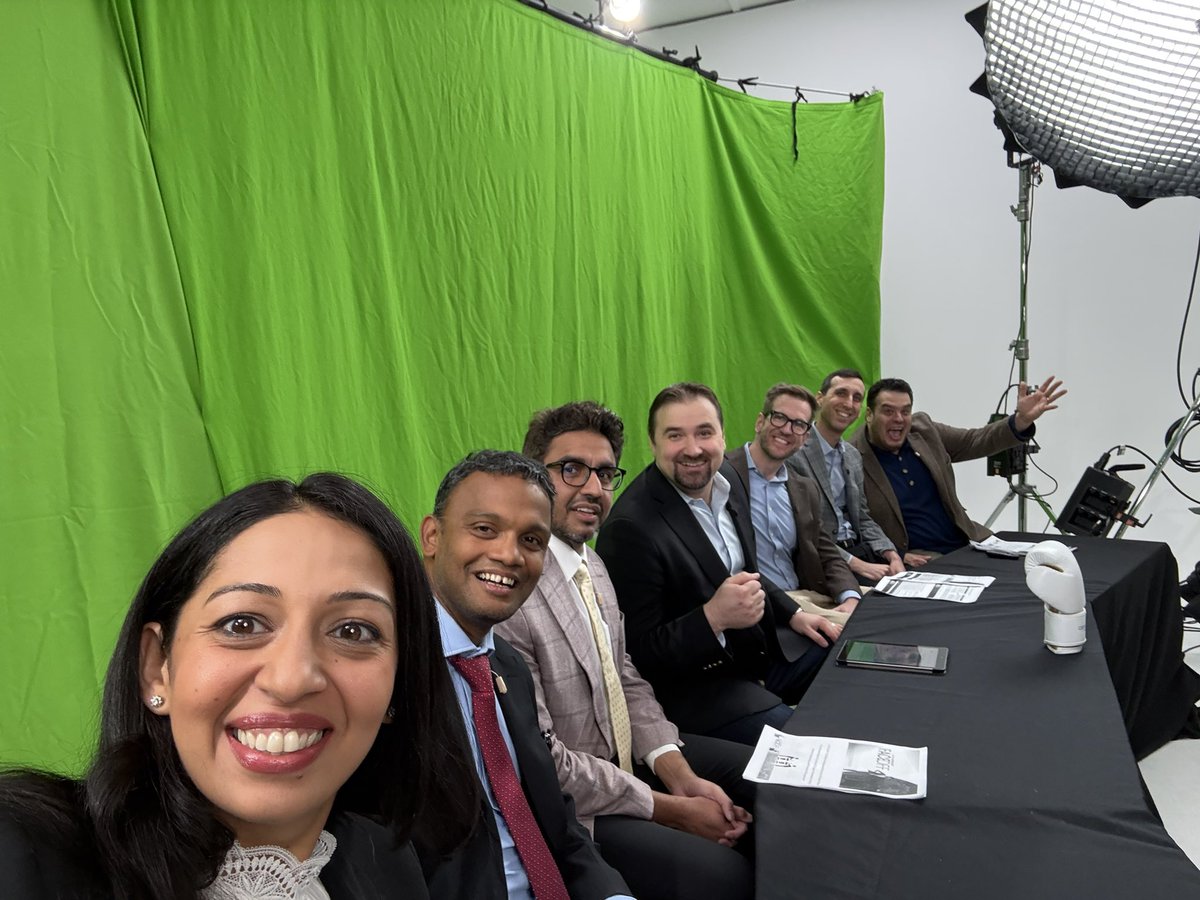

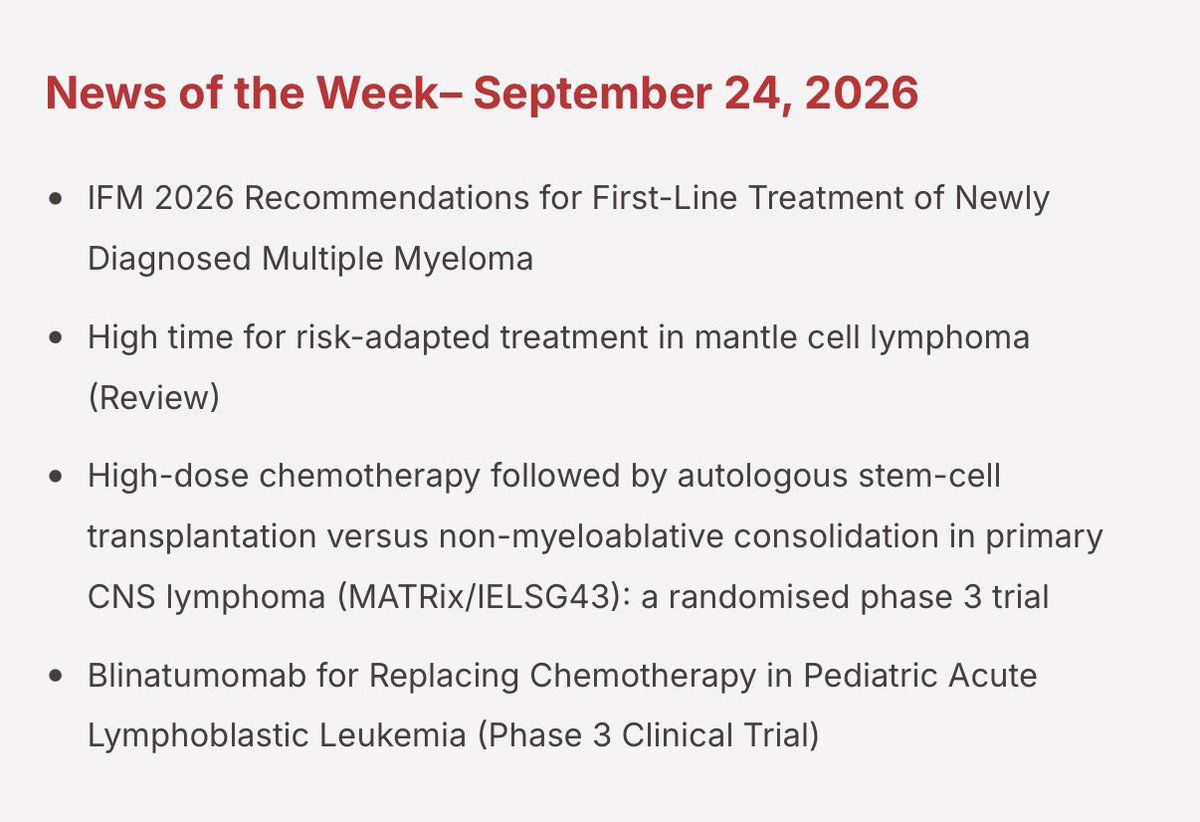


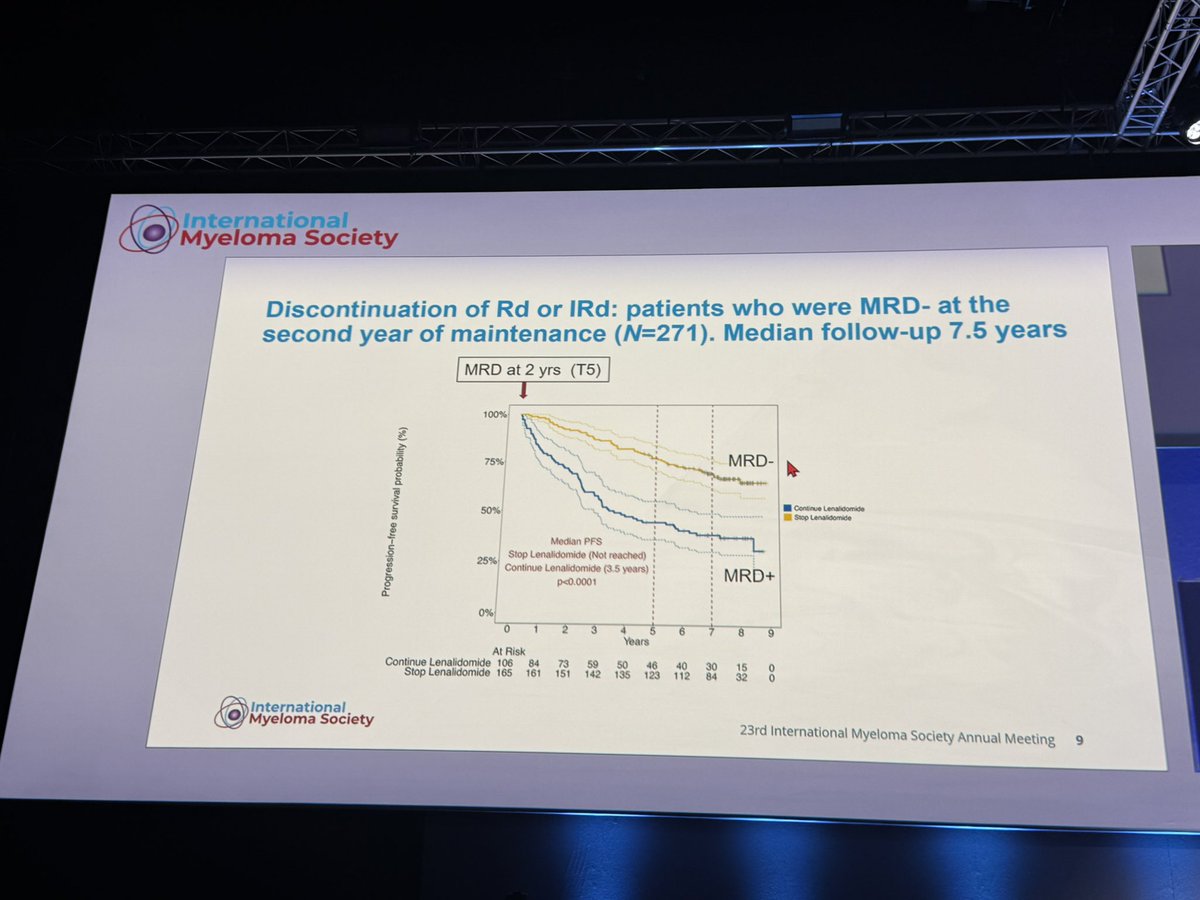
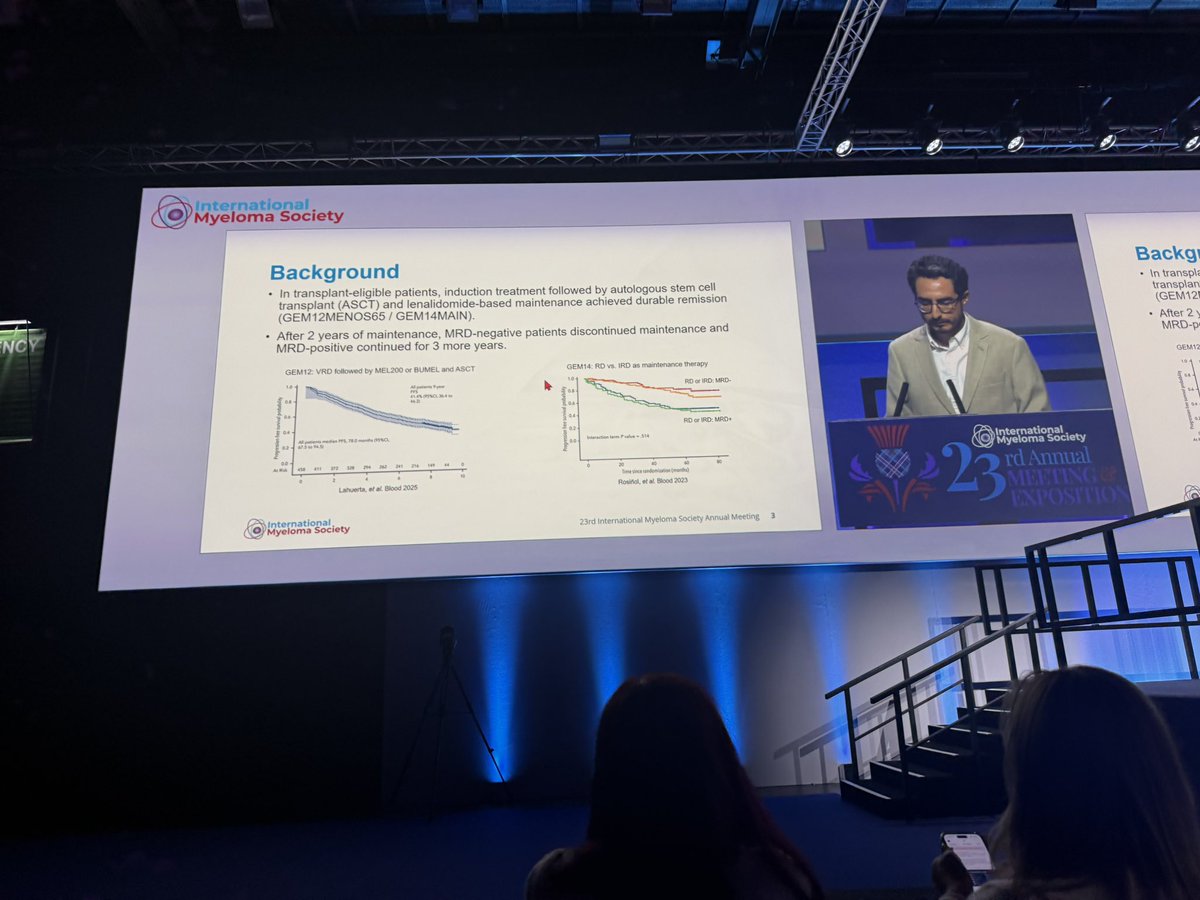
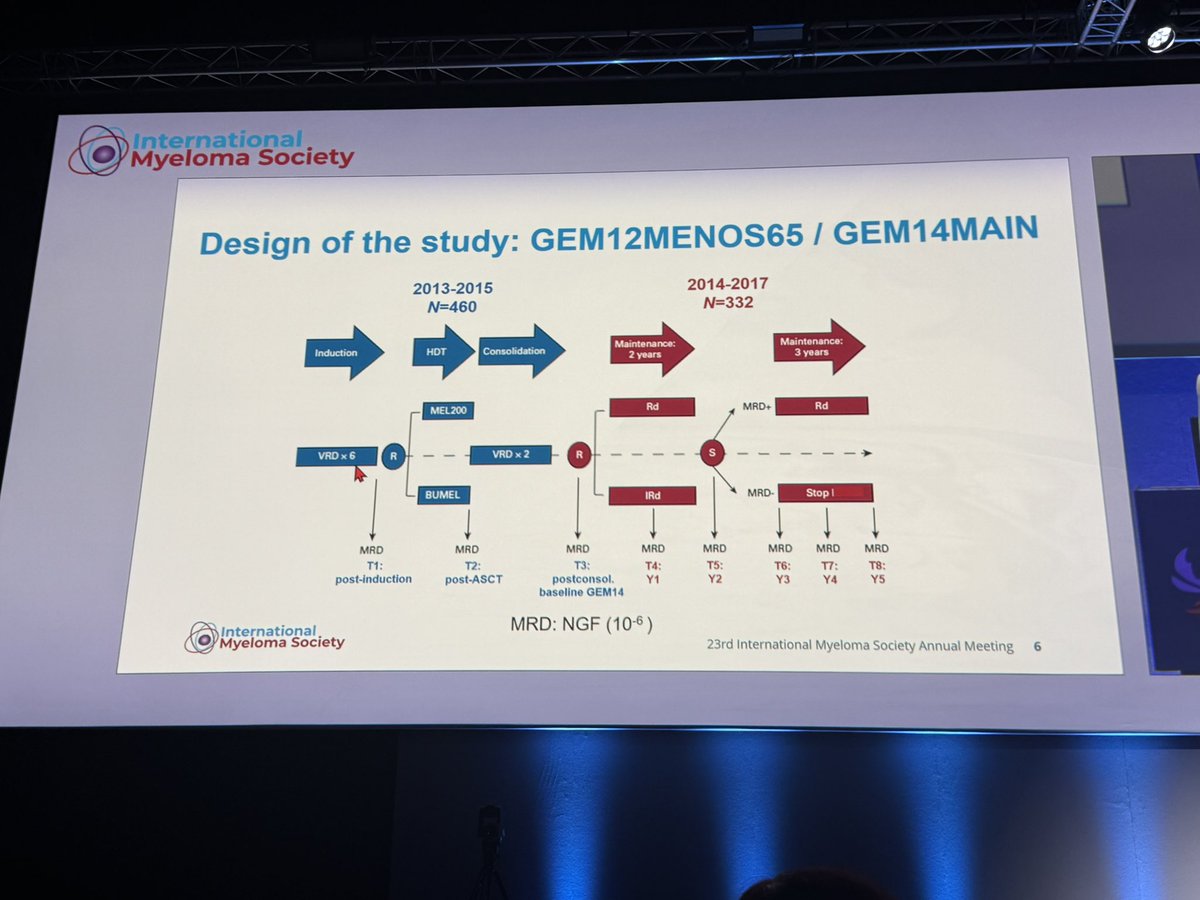






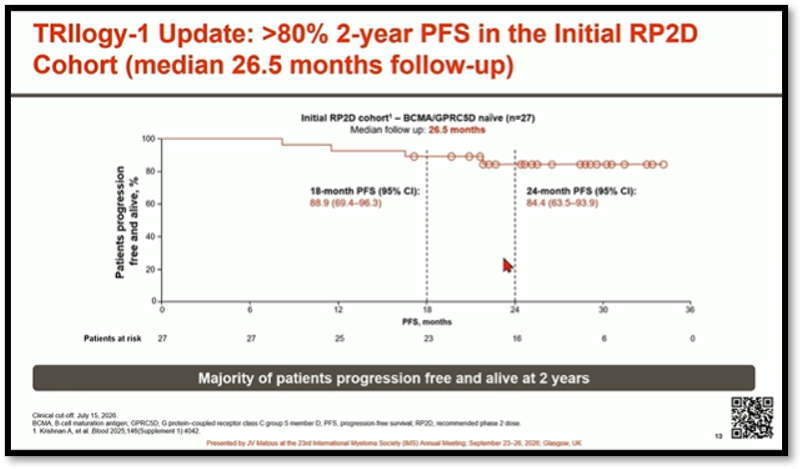 Sep 24
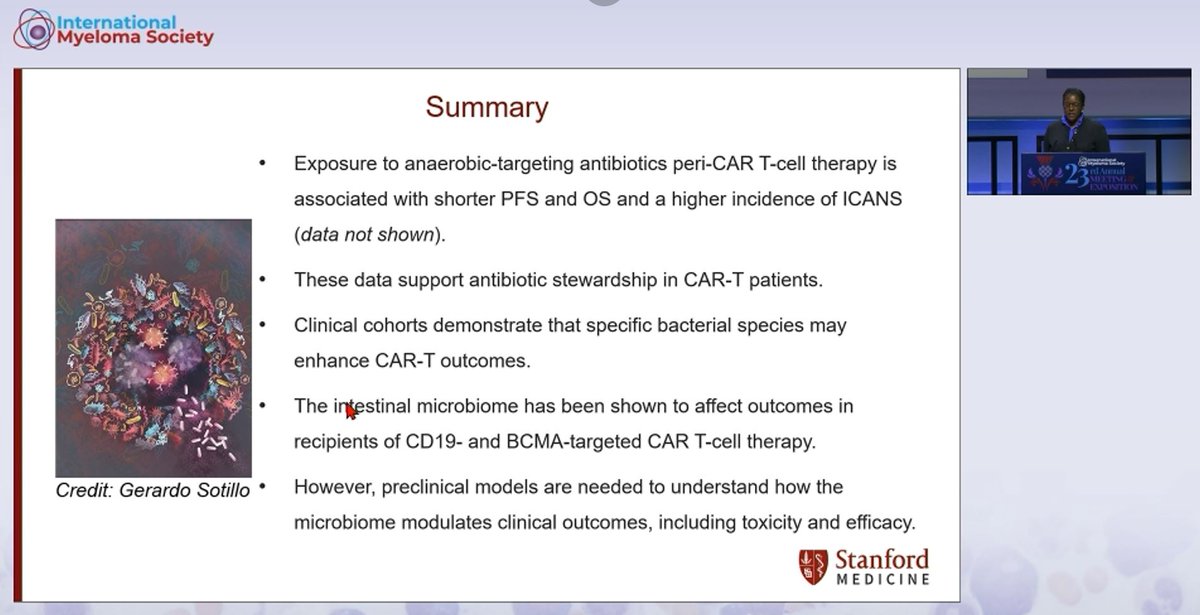
@MelodySmithMD at #IMS26, reviewing the role of the gut microbiome in CAR-T outcomes:
- Exposure to anaerobe-targeting antibiotics is associated with shorter PFS/OS.
- Thoughtful antibiotic stewardship - not undertreatment of infection!
A challenging topic, but it looks as https://t.co/GHUl7ce0Y1
[Gut microbiome and CAR-T outcomes - Melody Smith, Stanford Medicine, Summary]
Exposure to anaerobic-targeting antibiotics peri-CAR T-cell therapy is associated with shorter PFS and OS and a higher incidence of ICANS (data not shown). These data support antibiotic stewardship in CAR-T patients. Clinical cohorts demonstrate that specific bacterial species may enhance CAR-T outcomes. The intestinal microbiome has been shown to affect outcomes in recipients of CD19- and BCMA-targeted CAR T-cell therapy. However, preclinical models are needed to understand how the microbiome modulates clinical outcomes, including toxicity and efficacy.



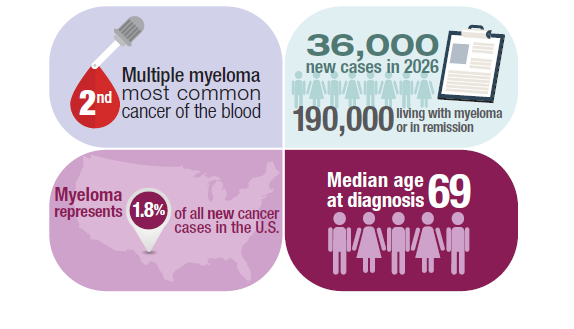


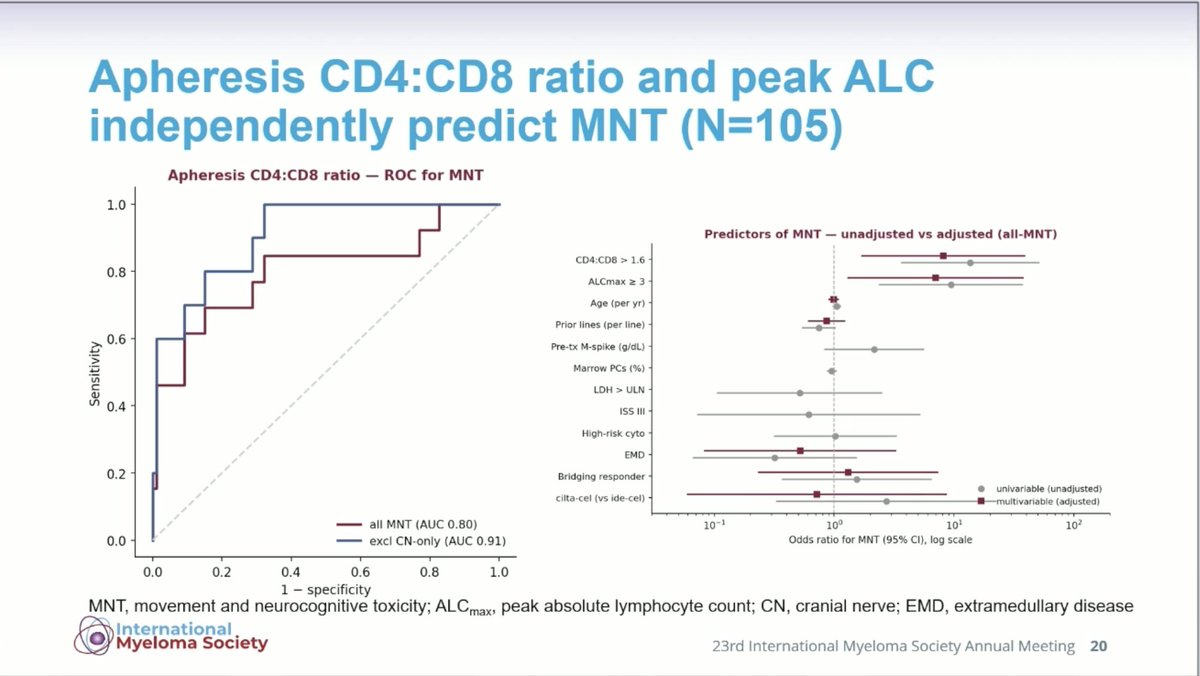
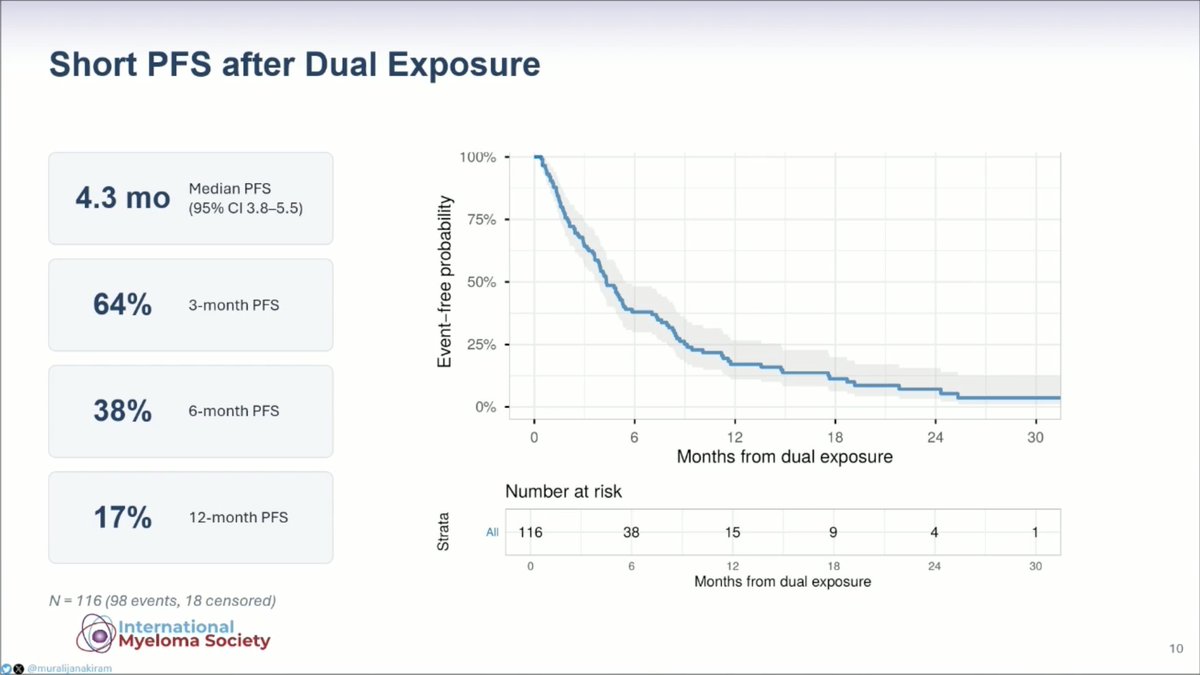

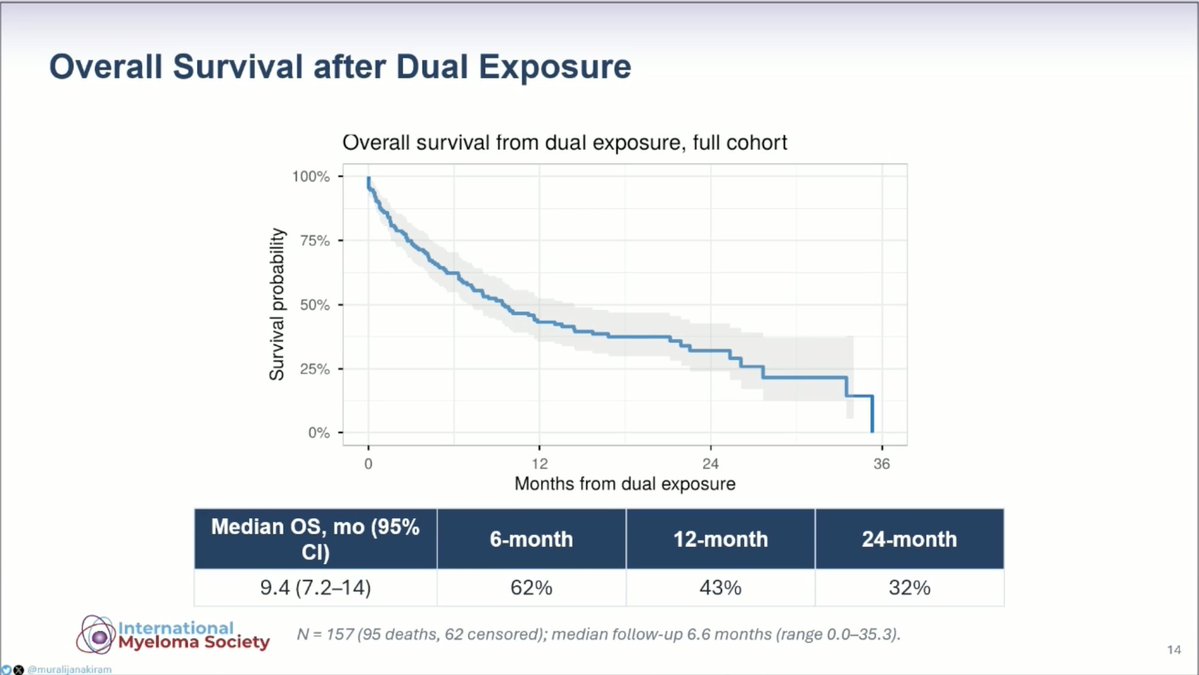

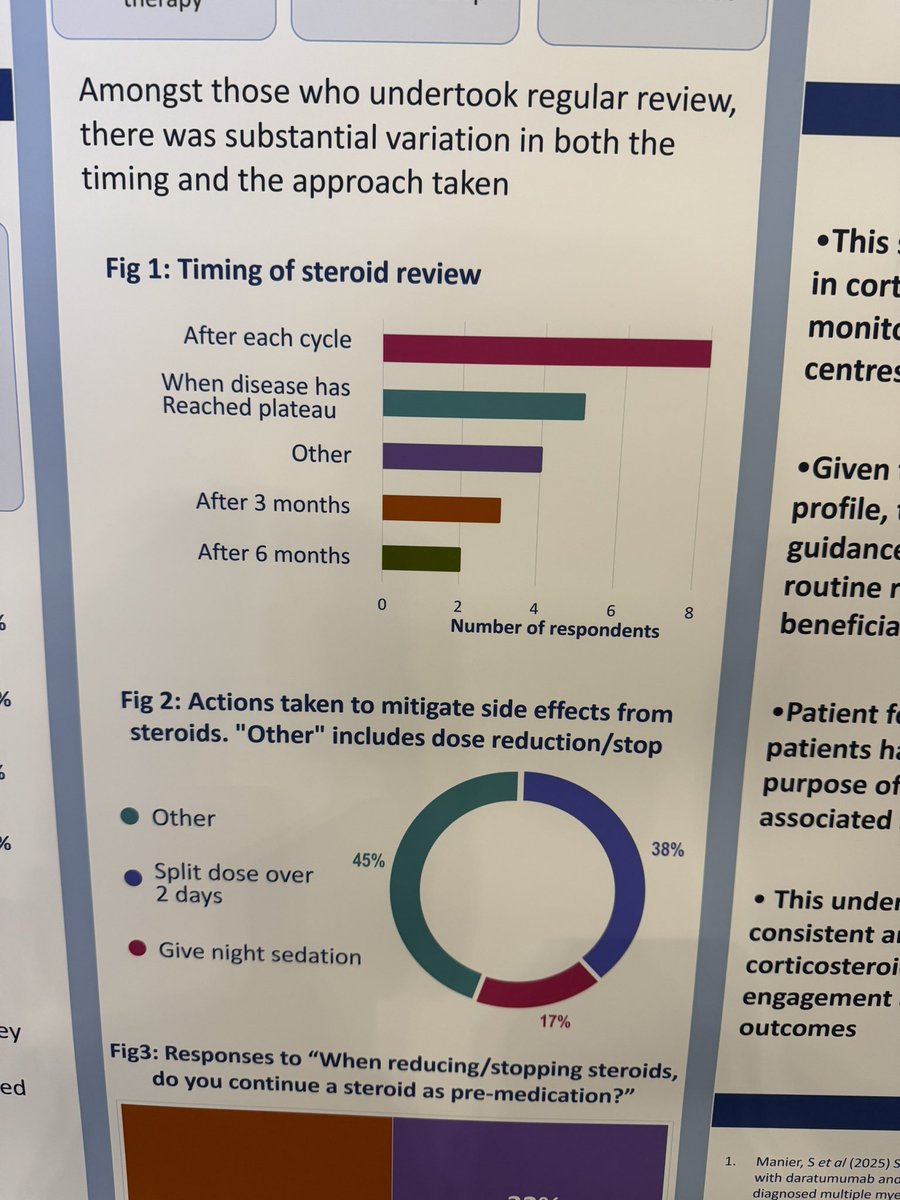


 Sep 24

#IMS2026 Stop by our poster (PA365) today! We describe the utility of PET/CT before and after BCMA-targeting CAR-T cell therapy in RRMM patients.
We describe the key prognostic features to look for and the optimal time for reassessment after therapy. @ClinicaNavarra https://t.co/IDEfUnblfo
Poster PA-365, IMS 23rd Annual Meeting & Exposition, September 23-26, 2026, Glasgow, Scotland
Title: PROGNOSTIC IMPACT OF [18F] FDG PET/CT BEFORE AND AFTER BCMA-DIRECTED CAR T-CELL THERAPY IN RELAPSED/REFRACTORY MULTIPLE MYELOMA: A MULTICENTER ANALYSIS
Authors: L-E. Tamariz-Amador; M. Talarico; M. Romera; A. Alfonso Pierola; ML. Fuente-Iglesias; JC. Ponce-Jarquin; M-T. San Miguel-Arregui; A. Urrutia; A. Valcarcel; C. Martin; S. Morales; M. Panizo-Inoges; M. Marcos-Jubilar; S. Huerga; S. Villar-Fernandez; J. Rifon; R. Lecumberri; F. Prosper; J. San-Miguel; J. Arbizu; L. Garcia-Belaustegui; C. Nanni; M-J. Garcia-Velloso; E. Zamagni; P. Rodriguez-Otero
Affiliations: 1) Cancer Center Clinica Universidad de Navarra, Pamplona, Spain; 2) IRCCS Azienda Ospedaliero-Universitaria di Bologna, Istituto di Ematologia 'Seragnoli,' Bologna, Italy; 3) Dipartimento di Scienze Mediche e Chirurgiche, Universita di Bologna, Bologna, Italy; 4) Nuclear Medicine, IRCCS Azienda Ospedaliero-Universitaria di Bologna, Bologna, Italy; 5) Hospital Universitario de Navarra, Pamplona, Spain
INTRODUCTION: Depth of response is one of the most relevant prognostic markers in multiple myeloma (MM), as highlighted by minimal residual disease (MRD) data. Functional imaging such as [18F] FDG PET/CT has gained importance for assessing disease burden and response. However, its prognostic value in relapsed/refractory MM (RRMM) treated with BCMA-directed CAR T-cell therapy remains unclear.
AIM: Evaluate the prognostic utility of baseline and post-treatment [18F] FDG-PET/CT in relapsed/refractory MM (RRMM) treated with BCMA-directed CAR T-cell therapy.
METHOD: We analyzed patients treated with BCMA-targeted CAR T-cell therapy (April 2018-January 2024) at Clinica Universidad de Navarra (Spain) and IRCCS Azienda Ospedaliero-Universitaria di Bologna (Italy). PET/CT scans at baseline, month 1, and month 3 post-infusion were assessed for focal lesions (FLs), paramedullary (PMD) and extramedullary disease (EMD), alongside metabolic tumor volume (MTV) and total lesion glycolysis (TLG). Response was evaluated using Deauville criteria. Optimal cut-off values with the highest discriminative prognostic value for baseline and month 1 MTV and TLG were determined using the maxstat algorithm (categorized as high vs. low b-MTV, b-TLG, MTV-1, and TLG-1).
RESULTS: In total 75 patients received BCMA-targeted CAR T-cell therapy (61 Spanish & 14 Italian). ORR was 85%, with 45% achieving >=CR, and 57% MRD negativity. Median PFS and OS for the entire cohort was 12 (95% CI, 8.8-15.2) and 24 months (95% CI, 15.9-32.3), respectively.
A positive baseline scan was associated with inferior PFS (11.5 months [95% CI, 7.8-15.3]) compared to having a negative study (18.9 months [95% CI, 12.5-25.4]) (p=0.03). Baseline EMD predicted shorter PFS (4.6 vs. 14.1 [95% CI, 10.4-17.7]; p=0.014). Baseline high MTV (>=810 mL) and TLG (>=1640 g) predicted inferior PFS (5.6 vs 15.6 months; HR 1.9; p=0.03) and OS (11.4 months vs. not reached; HR 3.0; p=0.002).
At month 1, persistent hypermetabolic PMD trended toward shorter PFS (7.1 vs 16.0 months; HR 1.8; p=0.058), and significantly shorter OS: 11.7 vs 42.3 months (HR 2.4; p=0.02). Positive FLs in the absence of PMD and EMD had no significant impact on PFS (p=0.32).
At month 3, persistent hypermetabolic PMD was associated with shorter PFS (6.9 months [95% CI, 0.0-14.9] vs 16 [95% CI, 10.8-21.2]; HR 3.6; p=0.006) and OS (7.8 months [95% CI, 6.8-8.8] vs 34.2 [95% CI, 10.9-57.1]; HR 3.7; p=0.01). Deauville score 4 FLs trended toward shorter PFS (8 vs 17 months) compared to Deauville score <4
Table: Total CAR T-cell infusions (n=75) - Age, median(range),years: 58(40-79). Number of previous lines: 1-3: 47(62.7%); >3: 28(37.3%). Triple-class refractory: Yes 51(68.0%); No 24(32.0%). Cytogenetics: Standard-risk 33(44.0%); High-risk 33(44.0%); Not available 9(12.0%). Paramedullary disease: Positive 41(54.6%); Negative 34(45.4%). Extramedullary disease: Positive 66(88.0%); Negative 9(12.0%)
Figure 1 caption: Flow of patients according to PET scan results and clinical outcomes over time (Sankey diagram: Positive baseline PET 63 / Negative baseline PET 12 -> Positive month1 PET 41 / Negative month1 PET 24 -> Positive month3 PET 21 / Negative month3 PET 37, plus No PET at month3 assessment 10 and Death or progression during first 3 months)
Figure 2 caption: Kaplan-Meier curves for PFS and OS by Baseline EMD, stratified MTV (>=810 mL) and stratified TLG (>=1640 g). Panels illustrate survival outcomes as follows: (A) PFS for patients with baseline EMD, (B) OS for patients with baseline EMD, (C) PFS stratified by MTV at baseline, (D) OS stratified by baseline MTV, (E) PFS stratified according to TLG at baseline, and (F) OS stratified by baseline TLG.
Figure 3 caption: Kaplan-Meier curves for PFS and OS by PMD 3 months after therapy. Panels illustrate survival outcomes as follows: (A) PFS for patients with PMD 3 months after therapy and (B) OS for patients with PMD 3 months after therapy.
CONCLUSIONS: Baseline tumor burden by PET/CT, including high MTV/TLG and EMD, was associated with inferior outcomes after BCMA-directed CAR T-cell therapy. Early assessment at month 1 appeared suboptimal, as persistent FLs uptake without concurrent EMD/PMD was not associated with worse survival. In contrast, month 3 PET/CT provided the strongest prognostic discrimination, supporting this timepoint as the preferred assessment for post-CAR T response evaluation.
ACKNOWLEDGEMENT: To all the patients and their families.
CONTACT INFORMATION: Luis-Esteban Tamariz-Amador, LTAMARIZ@UNAV.ES, Cancer Center Clinica Universidad de Navarra, Pamplona, Spain. @EstebanTamariz
Footer: PA-365 | MRD and Biomarkers | Luis-Esteban Tamariz-Amador



 Sep 24

#mmsm #IMS26 Poster on using 2nd CAR-T in myeloma from China @Myeloma_Society
20 pts with good responses (ORR) but relatively low PFS. Need more data on details and timing with in between therapies to better understand utility of 2nd CAR-T as well as safety https://t.co/J1SfikyKnu
LBA-20
23rd Annual Meeting & Exposition, September 23-26, 2026, Glasgow, Scotland
Second CAR T-cell infusion after prior CAR T-cell failure in multiple myeloma
Jianlin HU1, Ning AN1, Yuhan BAO1, Qiuxia YU1, Xinran WANG1, Yuying WANG1, Yang GAO1, Shangyun SUN1, Peiling ZHANG1, Di WANG1 and Chunrui LI1*
1 Department of Hematology, Tongji Hospital, Tongji Medical College, Huazhong University of Science and Technology, Wuhan, China
INTRODUCTION: Relapse after CAR T-cell therapy remains a major challenge in relapsed/refractory multiple myeloma (RRMM). Evidence guiding a second CAR T-cell infusion is limited, particularly regarding target selection and the clinical relevance of in vivo expansion.
AIM: To evaluate outcomes after a second CAR T-cell infusion and explore associations of target strategy and CAR T-cell expansion kinetics with efficacy and toxicity.
METHOD: This retrospective single-center study included 23 patients with RRMM who received a second CAR T-cell infusion after prior CAR T-cell failure between January 2018 and April 2026. CAR T-cell products targeted BCMA, GPRC5D, or both. Responses were assessed according to IMWG criteria. PFS2, OS, and DOR were estimated using Kaplan-Meier methods. Expansion was characterized by Cmax, Tmax, and AUC0-28. Comparative analyses were exploratory.
RESULTS:
Among 20 response-evaluable patients, the ORR was 80.0%, including CR/sCR in 30.0%. Median DOR was 9.3 months, median PFS2 7.2 months, and median OS 32.5 months.
Among 16 patients evaluable after both infusions, 7 (43.8%) achieved an equal or deeper response with the second infusion. CR/sCR occurred in 5 of 12 patients receiving same-target retreatment and none of the 8 who switched targets (P = 0.029), although target strategy was not associated with PFS2 or OS.
Cmax and AUC0-28 were higher in responders than in nonresponders (P = 0.037 and 0.046). Higher Cmax was also associated with early grade >=3 thrombocytopenia and anemia (P = 0.024 for both). Later Tmax was associated with a lower risk of progression or death (HR per day, 0.893; P = 0.028).
CRS occurred in 91.3%, including grade >=3 CRS in 13.0%. No ICANS or treatment-related deaths were observed.
Figure panels:
A: Median PFS2: 7.2; 95% CI, 3.4-24.6 (KM curve, Overall 23, at-risk: 23, 8, 5, 2, 1)
B: Median OS: 32.5; 95% CI, 12.4-NR (KM curve, Overall 23, at-risk: 23, 10, 6, 4, 1)
C: Peak CAR-T expansion (Cmax, copies/ug DNA) >=PR vs <PR, P = 0.037
D: CAR-T exposure (AUC0-28, copies-day/ug DNA) >=PR vs <PR, P = 0.046
E: CAR-T expansion (copies/ug DNA) over time (days 0,7,14,21,28) by >=PR vs <PR
F: Treatment-related toxicities (%): Cardiotoxicity 4/23 (17.4%), Hepatotoxicity 6/23 (26.1%), Early grade >=3 thrombocytopenia 19/23 (82.6%), Early grade >=3 neutropenia 22/23 (95.7%), Early grade >=3 anemia 19/23 (82.6%), Grade >=3 CRS 3/23 (13.0%), Infection 17/23 (73.9%)
G: Peak CAR-T expansion (Cmax) by early grade >=3 thrombocytopenia/anemia (Yes vs No), P = 0.024
Figure caption: Clinical outcomes, CAR T-cell expansion, and safety after the second infusion. (A-B) PFS2 and OS. (C-E) CAR T-cell expansion according to response (Cmax, n = 19; AUC0-28, n = 18). (F) Treatment-related toxicities. (G) Cmax according to early grade >=3 thrombocytopenia or anemia. Boxes show the median and interquartile range (IQR), whiskers show the range, and dots represent individual patients. Panel E shows median and IQR.
CONCLUSIONS: A second CAR T-cell infusion produced meaningful responses in selected patients after prior CAR T-cell failure. Same-target retreatment was associated with a higher CR/sCR rate, but not longer PFS2 or OS. Greater early expansion was associated with both response and severe cytopenias, whereas later Tmax was associated with a lower risk of progression or death. These findings warrant validation in larger prospective studies.
ACKNOWLEDGEMENT: Funding: NSFC 82170223 and Hubei NSF 2024AFD421 (Chunrui Li).
DISCLOSURES: Nothing to disclose.
Corresponding author: cunrui5650@hust.edu.cn


 Sep 24

This will hopefully change in the near future... #sequencing is key to understand how each target is represented in each #mmsm patient and chose the best treatment available
#ims2026 https://t.co/s4oBPcASm7
Live audience poll slide: "Which of these tests do you currently perform prior to initiating treatment in candidates for BCMA-targeted CAR-T or T-cell engager therapy?"
A. Targeted sequencing of TNFRSF17 - 0%
B. Soluble BCMA analysis in peripheral blood - 21%
C. Next-generation sequencing (NGS) using a panel that includes TNFRSF17 and GPRC5D - 13%
D. Only sequencing - 4%
E. None of the above - 62%
Sep 24

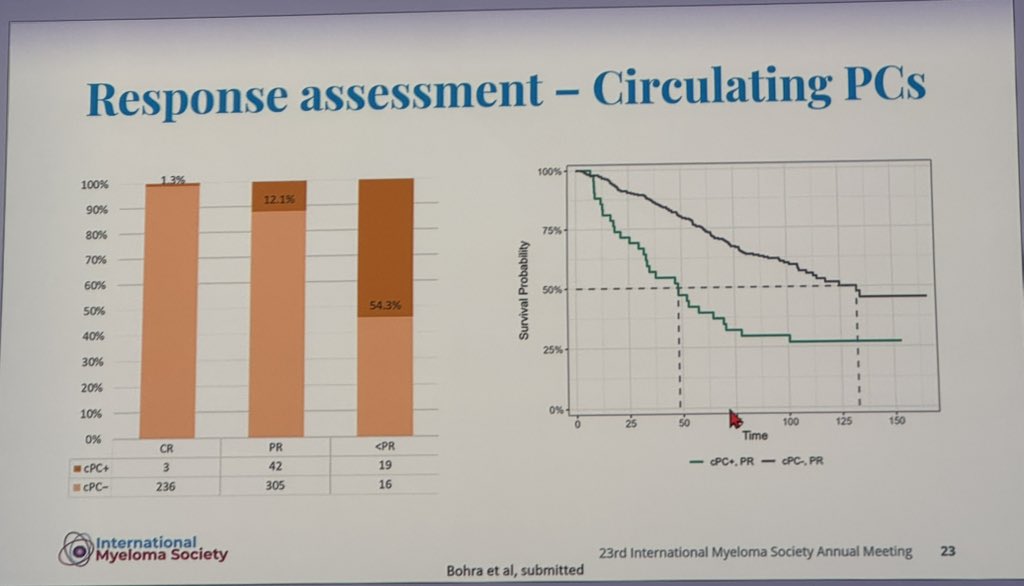

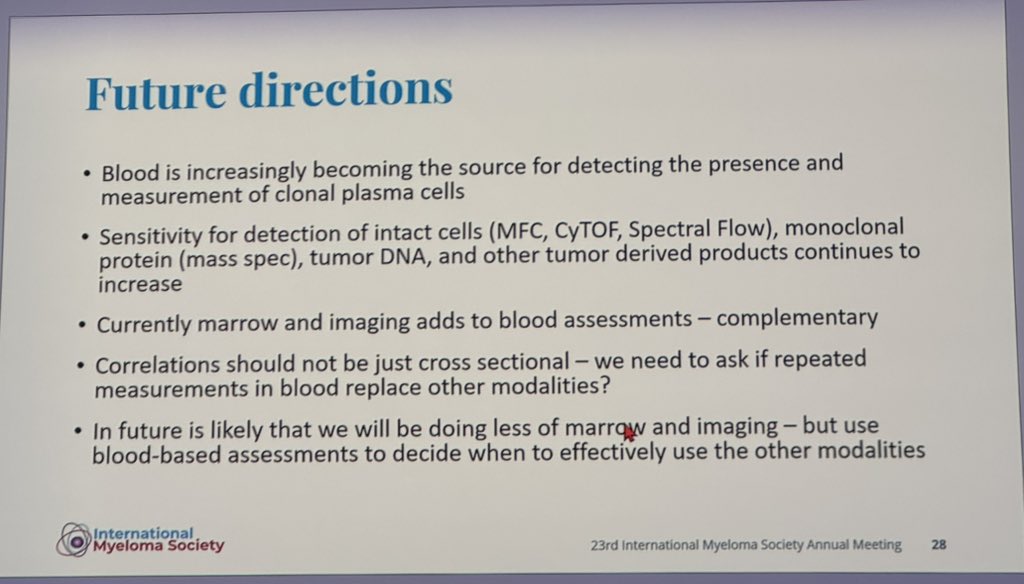
@myelomaMD reviewing data and presenting a hopeful vision of blood replacing marrow for MM management in a not so distant future. @Myeloma_Society #IMS26 #mmsm https://t.co/ATB185gngQ
Tumor assessment approaches
Blood (Peripheral blood tests)
- Measures tumor products (e.g., M-protein, free light chains)
- Widely available
Advantages:
- Less invasive
- Cheaper
- Can be repeated multiple times
- Easily accessible
Disadvantages:
- Indirect measure of tumor burden (rather than the tumor itself)
Bone Marrow (Aspiration and biopsy)
- Direct assessment of plasma cells
- Common site of myeloma involvement
Advantages:
- Gets directly to the tumor at its common site
Disadvantages:
- Invasive
- Painful
- Can be patchy (disease may be missed due to focal involvement)
- Expensive
Imaging (e.g., whole-body CT, MRI, PET-CT)
- Detects bone lesions and extramedullary disease
- Provides whole-body assessment
Advantages:
- Less invasive than bone marrow biopsy
- Can assess disease outside the marrow (e.g., focal bone lesions, extramedullary sites)
Disadvantages:
- Often expensive
- May not fully characterize active tumor (e.g., difficulty distinguishing active vs. inactive lesions or treatment-related changes)
- Less sensitive for diffuse marrow involvement compared with marrow biopsy
International Myeloma Society
23rd International Myeloma Society Annual Meeting 6
Response assessment - Circulating PCs
Bar chart (% with cPC+/cPC- by response category):
CR: cPC+ 1.3%, cPC- remainder (n cPC+ = 3, n cPC- = 236)
PR: cPC+ 12.1%, cPC- remainder (n cPC+ = 42, n cPC- = 305)
<PR: cPC+ 54.3%, cPC- remainder (n cPC+ = 19, n cPC- = 16)
Survival curve (Survival Probability % vs Time, two lines: cPC+,PR and cPC-,PR):
- cPC-,PR (black line): starts ~100%, declines gradually, crosses 50% around ~130 on time axis, ends ~48%
- cPC+,PR (green line): starts ~100%, declines faster, crosses 50% around ~50 on time axis, plateaus near ~30% after ~130
X-axis: Time 0-150; Y-axis: Survival Probability 0-100%
International Myeloma Society
23rd International Myeloma Society Annual Meeting 23
Bohra et al, submitted
Monitoring EMD
A. SNVs = 935
Venn diagram of three circles: BM-T, EM-S, and 315 (labeled region)
- BM-T only: 60
- EM-S only: 190
- BM-T ∩ EM-S: 186
- BM-T ∩ EM-S ∩ 315 (center): 255
- BM-T ∩ 315: 13
- EM-S ∩ 315: 92
- 315 only: 139
Imaging thumbnail with arrows labeled EM-S -315 and BM-T
Right panel: "Fractional abundance of NRAS Q61H in PL, BM and EM-tissue" - line/scatter chart, dual y-axis (Fractional abundance 0-60 left; Serum-Free Light Chains 0-1500 right), x-axis dated Nov 2016 - Oct 2017
Legend: ctDNA (red circle), EM-tissue (blue square), BM-trephine (triangle), SFLC (kappa) (dashed line)
Treatment timeline annotations along top: Rd, PAN-Vd, PCd, DLI, DLI, P, KPd-Dara
"EM progression" bracket shown across March-October 2017 region
Data points show ctDNA and SFLC(kappa) rising over the observation period, with EM-tissue point plotted near end (~October 2017) at high fractional abundance (~48-50)
International Myeloma Society
23rd International Myeloma Society Annual Meeting 24
Int. J. Mol. Sci. 2018, 19(7), 1858
Future directions
- Blood is increasingly becoming the source for detecting the presence and measurement of clonal plasma cells
- Sensitivity for detection of intact cells (MFC, CyTOF, Spectral Flow), monoclonal protein (mass spec), tumor DNA, and other tumor derived products continues to increase
- Currently marrow and imaging adds to blood assessments - complementary
- Correlations should not be just cross sectional - we need to ask if repeated measurements in blood replace other modalities?
- In future is likely that we will be doing less of marrow and imaging - but use blood-based assessments to decide when to effectively use the other modalities
International Myeloma Society
23rd International Myeloma Society Annual Meeting 28
Sep 24

Reducing bone marrow testing is a dream, especially for patients. Not there yet, but great advances have been done.
Mass spectometry and circulating tumor cell detection help us to better decide when to analyze the bone marrow. #IMS2026 https://t.co/CGBKBGxZ8N
Photo of an auditorium screen showing slide "Future directions":
- Blood is increasingly becoming the source for detecting the presence and measurement of clonal plasma cells
- Sensitivity for detection of intact cells (MFC, CyTOF, Spectral Flow), monoclonal protein (mass spec), tumor DNA, and other tumor derived products continues to increase
- Currently marrow and imaging adds to blood assessments - complementary
- Correlations should not be just cross sectional - we need to ask if repeated measurements in blood replace other modalities?
- In future is likely that we will be doing less of marrow and imaging - but use blood-based assessments to decide when to effectively use the other modalities
International Myeloma Society
23rd International Myeloma Society Annual Meeting 28
Sep 24

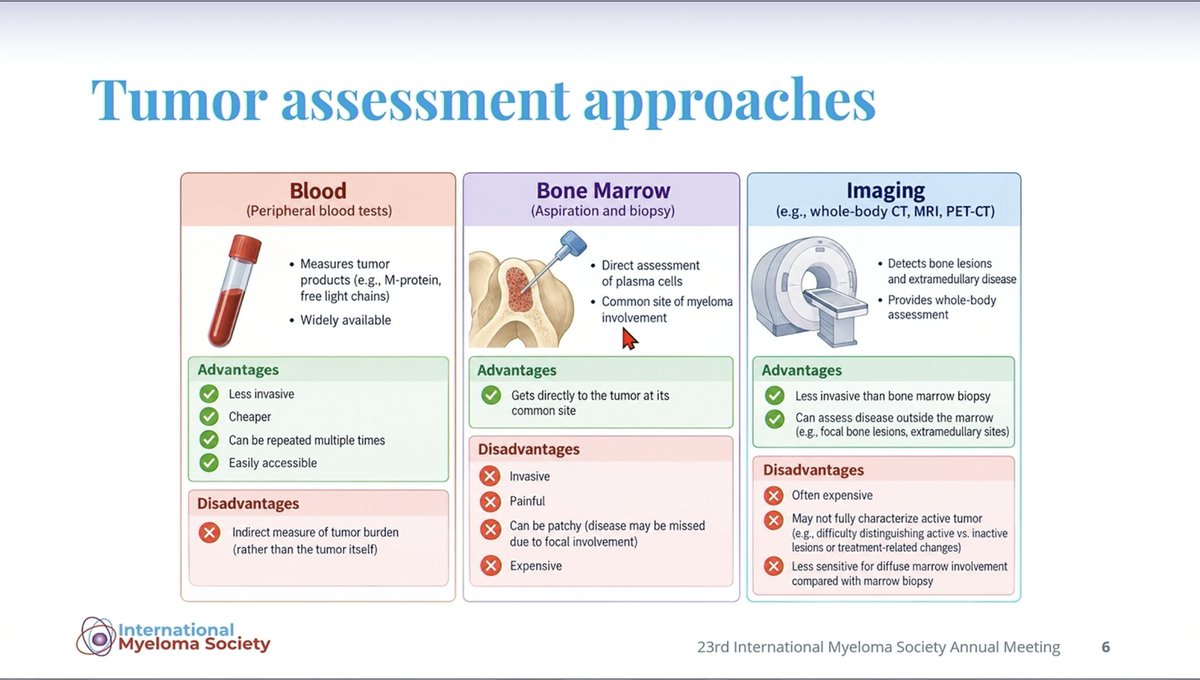

#IMS26 #mmsm Future of disease monitoring @myelomaMD @Myeloma_Society
Blood based assessments may continue to improve to decrease the need of bone marrow assessments and imaging studies https://t.co/hFmsGnrzC7
Detecting/measuring the monoclonal process
Central plasma cells branch to: Intact Plasma Cells (Bone Marrow; Plasmacytoma; Peripheral Blood [Flow Cytometry] CD138 vs CD38 plot showing Plasma cells CD38++CD138+ gate); Secreted by PC (Immunoglobulins [Ig]: IgG,IgA,IgM,IgD,IgE; Immunoglobulin Free Light Chains [FLC]: Kappa, Lambda; Lactate Dehydrogenase [LDH]; Cytokines: IL-6,IL-1b,TNF-a,IL-10; Chemokines: CXCL12[SDF-1a], CCL4[MIP-1b], CCL3[MIP-1a], CCL5[RANTES]); Shed by PC (Beta 2 Microglobulin [b2M]; Syndecan-1[CD138] shed ectodomain, shed CD138/syndecan-1 ectodomain with glycosaminoglycan chains; BCMA shed ectodomain, BCMA ectodomain [soluble]); Plasma cell components (Circulating Tumor DNA [ctDNA]; Extracellular Vesicles [EVs])
23rd International Myeloma Society Annual Meeting, slide 5
Tumor assessment approaches
Blood (Peripheral blood tests): Measures tumor products (e.g., M-protein, free light chains); Widely available. Advantages: Less invasive, Cheaper, Can be repeated multiple times, Easily accessible. Disadvantages: Indirect measure of tumor burden (rather than the tumor itself).
Bone Marrow (Aspiration and biopsy): Direct assessment of plasma cells; Common site of myeloma involvement. Advantages: Gets directly to the tumor at its common site. Disadvantages: Invasive, Painful, Can be patchy (disease may be missed due to focal involvement), Expensive.
Imaging (e.g., whole-body CT, MRI, PET-CT): Detects bone lesions and extramedullary disease; Provides whole-body assessment. Advantages: Less invasive than bone marrow biopsy, Can assess disease outside the marrow (e.g., focal bone lesions, extramedullary sites). Disadvantages: Often expensive, May not fully characterize active tumor (e.g., difficulty distinguishing active vs. inactive lesions or treatment-related changes), Less sensitive for diffuse marrow involvement compared with marrow biopsy.
23rd International Myeloma Society Annual Meeting, slide 6
Response assessment - Circulating PCs
Left bar chart (% with cPC+/cPC- by response category):
CR: cPC+ 3 (1.3%), cPC- 236
PR: cPC+ 42 (12.1%), cPC- 305
<PR: cPC+ 19 (54.3%), cPC- 16
Right Kaplan-Meier survival curve (Survival Probability vs Time), groups cPC+,PR (green) and cPC-,PR (gray): cPC+,PR line crosses 50% survival around Time~48; cPC-,PR line crosses 50% survival around Time~132; both curves plateau near end (cPC+,PR ~27%; cPC-,PR ~46%)
Citation: Bohra et al, submitted
23rd International Myeloma Society Annual Meeting, slide 23
 Sep 24

Samir Parekh giving a master class on: Immune markers of disease activity At #IMS26 #mmsm @TischCancer @Myeloma_Society https://t.co/MH86jNyiuh
Photo collage of a masterclass talk titled 'Immune Markers of Disease Activity' (presenter Samir Parekh, MD) at the IMS 23rd Annual Meeting, with an audience shot and 5 content panels:
Panel 1 - 'SHAJAM: AI Myeloma platform' - workflow diagram: Fragmented clinical data (Clinical notes, Pathology, FISH, Genomics, Imaging, Labs, Transcriptomics) -> SHAJAM (source-linked analysis layer) -> Cohort/Structured patient table -> source-linked, analysis-ready output. Right-side text steps: Open each clinical note by hand -> Semantic search across 9.21M note chunks -> Email the bioinformatics team and wait -> Run real statistics on live rows in chat -> FISH & MRD in PDFs -> Extracted with evidence from notes & pathology -> A cohort question takes weeks -> Built, verified & exported in minutes. (23rd International Myeloma Society Annual Meeting, slide 5)
Panel 2 - 'Independent validation by Shajam' - Kaplan-Meier plot: Composite event-free survival by baseline sBCMA threshold (471.75 ng/mL); >471.75 ng/mL (blue) vs <=471.75 ng/mL (red); P<0.01; n=201 teclistamab patients; adjusted hazard ratio of 3.92 with 95% CI; 12-month event-free survival of 69.8% vs [value cut off] threshold. Citation: Lagana and Sh[cut off]
Panel 3 - 'aS100A8/A9 mAb salvages CAR-T cytotoxicity' - two box plots (% Cytotoxicity) for HD derived CAR-T Cells and MM PT derived CAR-T Cells, each comparing CAR-T Cells alone vs +S100A8/A9 vs +S100A8/A9+aS100A8/A9 mAb, with ** (p<0.01) significance brackets. HD derived: ~73% vs ~46% vs ~83%. MM PT derived: ~78% vs ~61% vs ~81%.
Panel 4 - 'sBCMA guides therapeutic selection' - diagram: High detectable sBCMA -> sBCMA >=400ng/mL -> Target alternate antigen (anti-GPRC5D TCE, anti-BCMA TCE); No detectable sBCMA -> (Copy number loss / Extracellular domain mutation, TNFRSF17 mutation, BCMA antigen escape) -> Target alternate antigen; Detectable sBCMA -> sBCMA <=400ng/mL -> Treat with anti-BCMA bispecific -> T cell immunomodulation -> Tumor lysis. Caption: 'Measuring biomarker for treatment selection'. Small citation text (partially legible): Lee H, Durante et al... soluble BCMA and ... cell factors ... BCMA-targeting T ... myeloma. Blood 202...; PMID ...
Panel 5 - 'Conclusions' (with speaker photo): Soluble BCMA <500ng/L is associated with better outcomes. High S100A8/9 (Calprotectin) is associated with inferior outcomes. Higher baseline ALC >0.9k/uL associated with improved outcomes with TCEs. Prospective studies testing a composite index to help select patients are necessary.
Sep 24
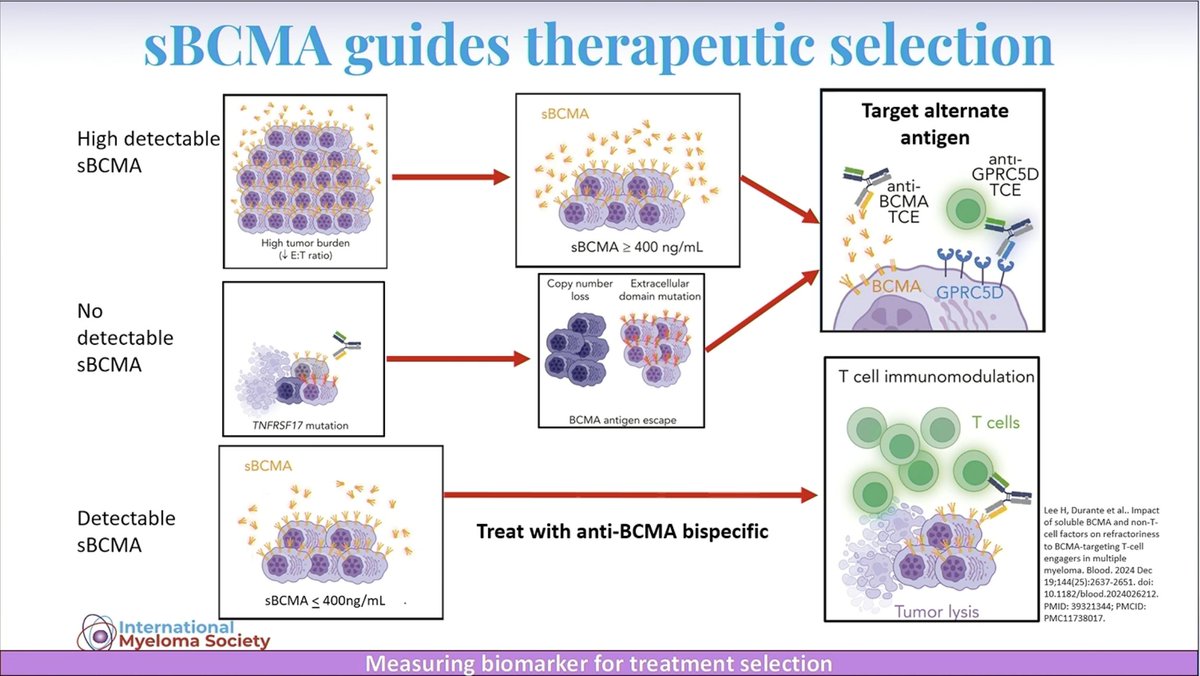

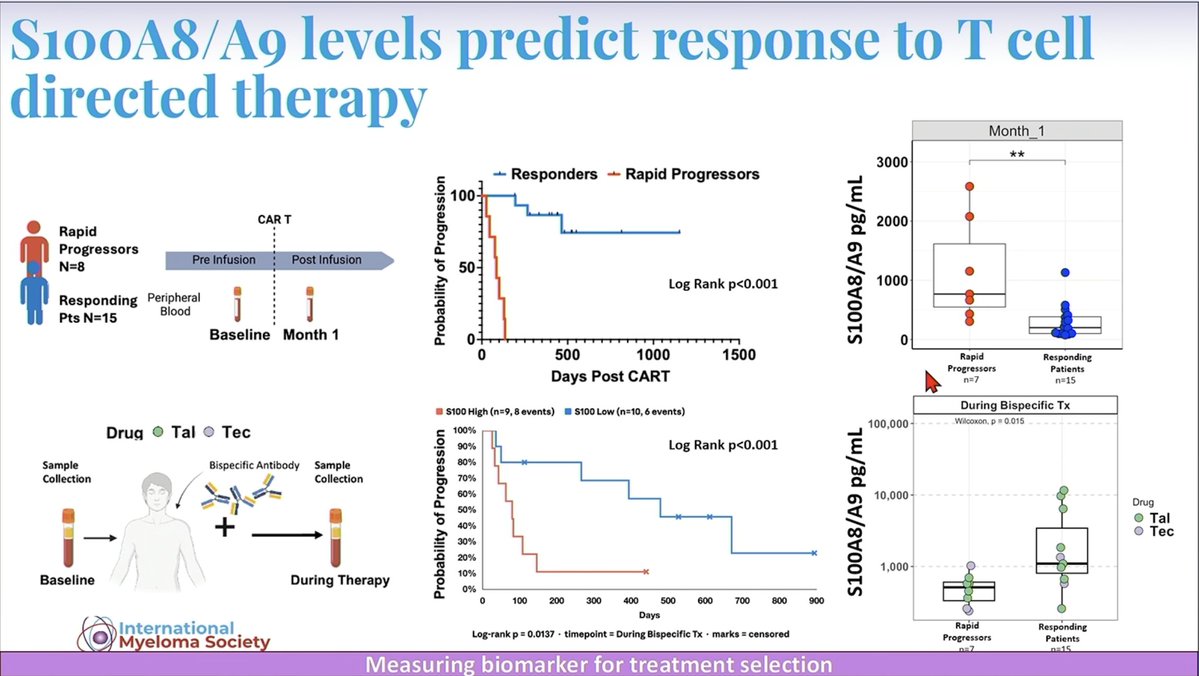

#IMS26 #mmsm Immune markers of disease activity @Myeloma_Society
➡️Soluble BCMA <500ng/L is associated with better outcomes
➡️High S100A8/9 (Calprotectin) is associated with inferior outcomes
➡️Higher baseline ALC >0.9k/ul associated with improved outcomes with TCEs https://t.co/RWlRymBnMc
sBCMA guides therapeutic selection
Three pathway rows, each with illustrated cell diagrams and arrows leading to treatment decision boxes:
Row 1 - High detectable sBCMA: High tumor burden (down E:T ratio) -> sBCMA >= 400 ng/mL -> [feeds into] Target alternate antigen box: anti-BCMA TCE and anti-GPRC5D TCE illustration showing BCMA and GPRC5D receptors on tumor cell surface.
Row 2 - No detectable sBCMA: TNFRSF17 mutation illustration -> Copy number loss / Extracellular domain mutation box (labeled "BCMA antigen escape") -> [feeds into] Target alternate antigen box (same as above).
Row 3 - Detectable sBCMA: sBCMA <= 400ng/mL illustration -> "Treat with anti-BCMA bispecific" -> T cell immunomodulation box: T cells illustration, anti-BCMA TCE, leading to Tumor lysis.
Reference (right margin): Lee H, Durante et al.. Impact of soluble BCMA and non-T-cell factors on refractoriness to BCMA-targeting T-cell engagers in multiple myeloma. Blood. 2024 Dec 19;144(25):2637-2651. doi: 10.1182/blood.2024026212. PMID: 39321344; PMCID: PMC11738017.
International Myeloma Society
Bottom banner: Measuring biomarker for treatment selection
S100A8/A9 (Alarmins) effect myeloid derived immune suppression
1. Alarmins are part of the DAMP (Damage Associated Molecular Pattern) family released in response to tissue injury.
2. Secreted by Myeloid cells, mesenchymal cells, Neutrophils in inflammatory states.
3. Tumor cells (HSCs, AML, MM) can also secrete S100A8/A9
4. Transgenic Mouse models of high S100A8/A9 induce MDS (List, JCI 2013)
[Diagram]: Bone marrow -> BMC with "Chronically elevated S100A8/A9" arrow into Lymph node -> MDSCs (myeloid-derived suppressor cells) -> branch to T cell responses (inhibited, shown with blocked arrow) and to T helper cell balance: Treg, Treg, TH17 (seesaw balance icon)
Abbreviations implied: DAMP, MDS, MDSCs, HSCs, AML, MM
Reference: Von Wulffen, et al. Cell Rep 2023
International Myeloma Society
S100A8/A9 levels predict response to T cell directed therapy
Left: Rapid Progressors N=8, Responding Pts N=15. Timeline: Pre Infusion -> CAR T -> Post Infusion; Peripheral Blood sample collection at Baseline and Month 1.
Kaplan-Meier "Probability of Progression" curve (x-axis Days Post CART 0-1500, y-axis 0-100): Responders (blue) vs Rapid Progressors (red). Log Rank p<0.001.
Right top: box plot Month_1, y-axis S100A8/A9 pg/mL 0-3000: Rapid Progressors n=7 (median ~750-800, dots up to ~2600) vs Responding Patients n=15 (median ~200-300, mostly under 600, one dot ~1100). Significance marker ** shown between groups.
Bottom-left: Drug key Tal (green dot) Tec (purple dot). Diagram: Sample Collection (Baseline) -> Bispecific Antibody -> Sample Collection (During Therapy).
Kaplan-Meier "Probability of Progression" curve, x-axis Days 0-900, y-axis 0%-100%: S100 High (n=9, 8 events, red) vs S100 Low (n=10, 6 events, blue). Log Rank p<0.001. Below, same-style curve labeled Log-rank p=0.0137, timepoint = During Bispecific Tx, marks = censored.
Bottom-right: box plot "During Bispecific Tx", y-axis S100A8/A9 pg/mL log scale 1,000-100,000, Wilcoxon p=0.015: Rapid Progressors n=7 (lower, mostly 300-1000, Tal=green dots, Tec=purple dots) vs Responding Patients n=15 (higher, up to ~10,000+).
International Myeloma Society
Bottom banner: Measuring biomarker for treatment selection
ALC trajectories after starting BiAb
Left: "Class-Specific ALC Trajectories" plot, y-axis Log-Transformed ALC Value -3 to 1, x-axis Days From Start of BsAb Treatment 0-150+. Three classes: A1 (n=46) red, A2 (n=106) blue, A3 (n=170) green, each with predicted (dotted) and observed (solid) lines and confidence intervals.
Middle: PFS Kaplan-Meier curves, x-axis Months from Start of BsAb 0-50, y-axis Proportion Progression Free and Alive 0.00-1.00: A2 (blue), A1 (red), A3 (green). p<0.0001.
Number at risk table: A2(blue) 106,39,25,16,10,3; A1(red) 46,3,2,1,0,0; A3(green) 168,85,45,24,18,8 at months 0,10,20,30,40,50.
Right: OS Kaplan-Meier curves, x-axis Months from Start of BsAb 0-50, y-axis Survival Probability 0.00-1.00: A1(blue in legend order shown as A1,A2,A3 - blue/red/green), p<0.0001.
Number at risk table: 106,69,44,33,19,11; 46,18,6,4,1,1; 169,122,79,48,37,21 at months 0,10,20,30,40,50.
Summary text:
A1 (persistent lymphopenia, PFS 1.1 mos, OS 4.6 mos, ORR 32%)
A2 (stable ALC, PFS 6.47 mos, OS 38.1 mos, ORR 67%)
A3 (rising ALC, PFS 22.87 mos, OS N/A, ORR 83%)
International Myeloma Society
 Sep 24
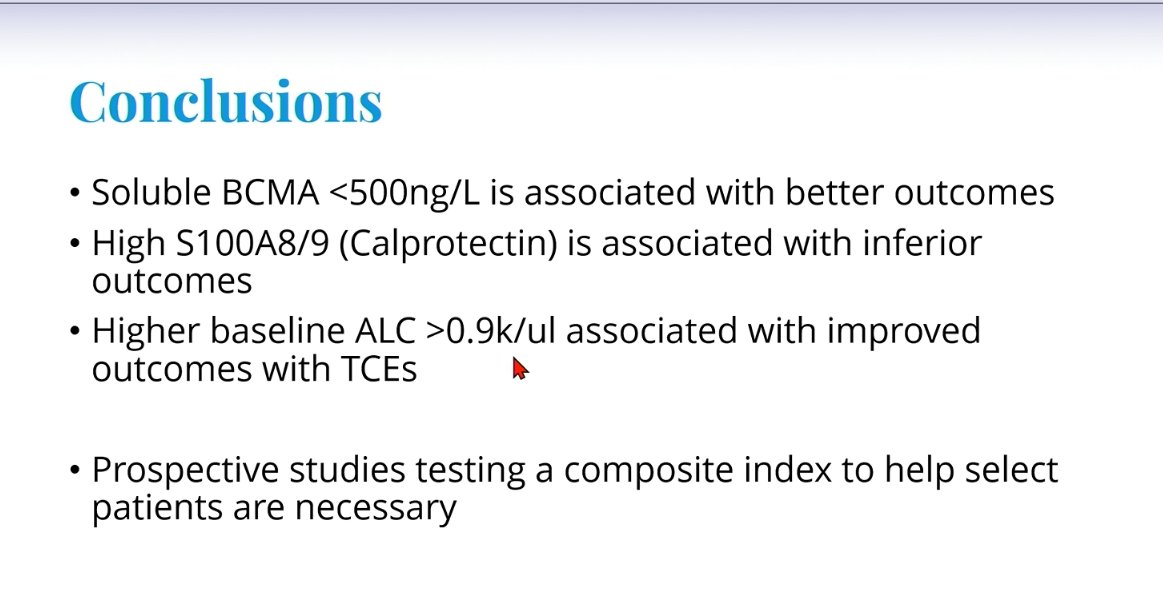
great talk from Dr Sameer Parekh at three excellent markers that impact outcomes in TCE/CAR-T #IMS2026 https://t.co/FLoEG3e3Cw
Conclusions
Soluble BCMA <500ng/L is associated with better outcomes
High S100A8/9 (Calprotectin) is associated with inferior outcomes
Higher baseline ALC >0.9k/ul associated with improved outcomes with TCEs
Prospective studies testing a composite index to help select patients are necessary
Sep 24


#IMS26 #mmsm Circulating tumor cells @Myeloma_Society
➡️Another prognostic way to measure disease activity
➡️Yet to be determined if this can be as good as bone marrow MRD testing https://t.co/C4lNkBm95c
Cell-free DNA (cfDNA)
Diagram: blood vessel showing circulating tumour cell, healthy tissue, inflamed tissue, phagocyte, red blood cells, endothelial cells, chromosomes/mutations (XXX), apoptosis/necrosis insets, blood plasma or serum sample containing ctDNA (test tube)
Legend: Healthy cell, Phagocyte, Tumour cell, Mutation, Red blood cell, Endothelial cell, Chromosome
Advantages:
- Allows for molecular profiling where BM samples are sub-optimal
- Has the potential to overcome spatial limitations and longitudinally barriers of tumor biopsies
Crowley et al., Nature Reviews Clinical Oncology, 2013
Millions of myeloma needles in the cell-free DNA haystack
[Image] Haystack labeled with magnet "Cell-free DNA sequencing" pointing to a pile of needles
How do we identify them?
Cancer features that be detected from cfDNA
1. Somatic Mutations - Detect point mutations, small insertions/deletions, and other sequence variants. [Sanger trace: A G C T T G C T G]
Applications: Diagnosis, prognostication, treatment selection, monitoring
2. Copy Number Alterations - Identify gene amplifications and deletions across the genome. [copy number plot, 0-4, showing gain (green) and loss (red) segments]
Applications: Prognosis, therapy selection, resistance mechanisms
3. Methylation Patterns - Detect aberrant DNA methylation changes at specific regions. [Unmethylated CG CG CG CG vs Methylated CG CG CG CG diagram]
Applications: Early detection, tissue of origin, prognosis
4. Fragmentomics - Analyze cfDNA fragment size profiles and genomic positioning. [Fragment count vs Fragment size (bp) 50-250 curve, peak ~150bp]
Applications: Early detection, tissue of origin, prognosis
5. Structural Variants & Rearrangements - Detect gene fusions, translocations, and other structural alterations. [Gene A - Gene B - Gene A-B Fusion diagram]
Applications: Therapy selection, resistance mechanisms
Center diagram: "cfDNA in Blood - Contains tumor-derived DNA fragments" with tumor shedding DNA into bloodstream
Clinical Utility: Early Detection | Prognosis & Risk Stratification | Therapy Selection & Resistance | Monitoring & Response Assessment | Minimal Residual Disease (MRD) | Surveillance & Recurrence Detection
Image generated by ChatGPT
Summary
- Longitudinal cfWGS guided by personalized mutation catalogs from high disease burden BM detects residual tumor DNA at ultra-low levels
- This approach tracked disease dynamics
- Achieved strong concordance with clinical BM MRD assays
- Predicted PFS
- Contributes orthogonal information including genome-wide mutations, CNAs, fragmentomic features and subclonal evolution that protein and flow-based assays cannot
- 30X cell-free DNA WGS is emerging as a tool for MRD surveillance, complementing BM MRD and can be followed by "upgrading" to 150X to profile relapsing subclones (inform resistance & treat early?)
[Bottom right chart] Circulating tumour DNA frequency (0.001% to 100%) vs disease stage: MGUS -> SMM -> MM -> Treatment -> MRD -> Relapse
Labels: "Multiple cancer early detection assays", "150X WGS to pin-point cancer drivers and generate mutation list for tumour-informed MRD", "30X monitoring molecular residual disease", ">150X 'upgrade' to pin-point cancer drivers", "Cure" (green dashed line), "MRD" (blue dashed line), "Relapse/Refractory" (red line up)
Pugh TJ. Seminars in Hematology 55 (2018) 38-40
 Sep 24


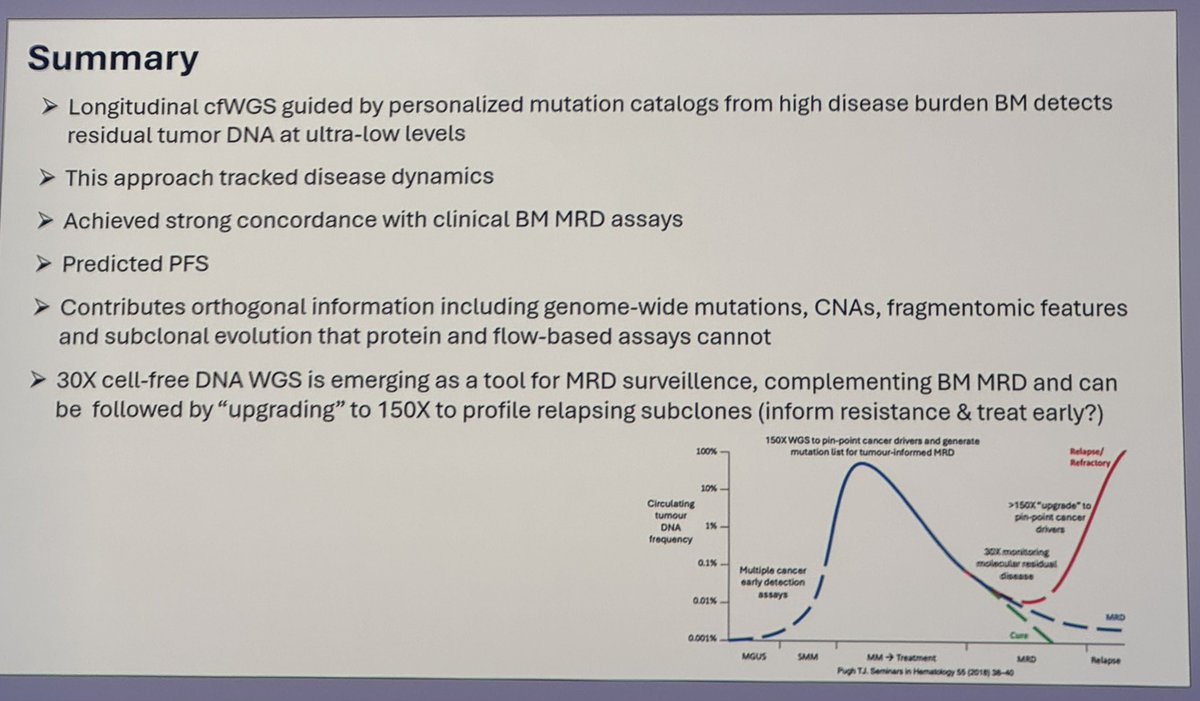
Suzanne Trudel discussing the power of WGS from blood cfDNA as a monitoring and MRD tool in MM @Myeloma_Society #IMS26 #mmsm https://t.co/9f3mcIR3GL
But plasma NGS approaches thus far have shown poor sensitivity
[Left chart] Tumour Data table comparing cfDNA Data vs Tumour Data:
Tumour Data: 51 | 195
cfDNA Data 53: 49 (teal) | 4 (yellow) -> 92%
cfDNA Data 193: 2 (orange) | 191 -> 99%
Column totals: 96% | 98%
(Kis et al., Nature Communications 2017)
[Bottom left chart] "Distribution of mutations in new-diagnosed and relapsed/refractory patients" - bar chart, Y axis "Number of mutations" 0-20, legend: Mutations (PL), Mutations (BM), Mutations (BM + PL)
(Mithraprabhu et al., Leukemia 2017)
[Middle chart] Gene alteration heatmap across samples/timepoints (2017, 2021, 2025, 2019) for genes: KRAS, NRAS, ATM, ACTG1, BRAF, ERBB4, FGFR3, HIST1H1E, IDH1, IRF4, LTB, B1, TP53, ZFHX4, ABL1 (9p34.12), CDK6 (7q21.2), E2F3 (6p22.3), IL6R (1q21.3), NOTCH1 (9p34.12), SOX4 (6p22.3), ARID1B (6p25.3), CDKN1B (12p13.1), CDKN2C (1p32.3), FAM46C (1p12), RPL5 (1p21.1), TP53 (17p13.1), TRAF3 (14q32.32), RB1 (13q14.2)
Legend: Hotspot mutation (black), Missense mutation (green), Nonsense mutation (purple), Not detected but powered (grey), Not powered (white/blank), Gain (red), Loss (blue)
(Manier et al., Nature Communications 2018)
[Right box] Poor sensitivity when compared to BM MRD3
Plasma cfDNA VDJ NGS (clonoseq)
Specificity 90.1%
94.9% PPV
Sensitivity 33.9%
NPV 21.7%
3Wiedmeier-Nutor et al, Blood Cancer J. 2026;16(1):66
30-50X cell-free DNA whole genome sequencing enables sensitive detection of cancer by testing 1,000s of mutations simultaneously
Three 3D surface plots (Detection probability vs Tumor fraction vs Unique genomic equivalents):
Single-mutation capture: 0.1% at 10,000X
10-mutation capture: 0.01% at 10,000X
10,000-mutation capture: 0.001% at 30X
Below: fingerprint icon progression: Small gene panels -> Bespoke targeted assays -> Whole genome
Zviran et al. Nat Med. 2020 Jul;26(7):1114-1124
[Slide number 8]
Tumour-informed mutation detection rates decrease after initial treatment, stay down in non-relapsed patients & increase before relapse
Two panel scatter/line plot, Y axis "Cumulative VAF (Z)" (0 to >1500), X axis "Weeks Since Baseline" (0 to >250):
Left panel: "Relapse within 180 days of blood draw (n = 11 patients; 41 samples)" - red lines/dots trending upward before relapse ("within 180 days of relapse"), black lines trending down
Right panel: "No relapse within 180 days of blood draw (n = 33 patients; 105 samples)" - lines trending down and staying near 0 (">180 days to relapse")
Abelman et al. medRxiv 2025.10.24.25338566
Summary
- Longitudinal cfWGS guided by personalized mutation catalogs from high disease burden BM detects residual tumor DNA at ultra-low levels
- This approach tracked disease dynamics
- Achieved strong concordance with clinical BM MRD assays
- Predicted PFS
- Contributes orthogonal information including genome-wide mutations, CNAs, fragmentomic features and subclonal evolution that protein and flow-based assays cannot
- 30X cell-free DNA WGS is emerging as a tool for MRD surveillance, complementing BM MRD and can be followed by "upgrading" to 150X to profile relapsing subclones (inform resistance & treat early?)
[Bottom right chart] Circulating tumour DNA frequency (0.001% to 100%) vs disease stage: MGUS -> SMM -> MM -> Treatment -> MRD -> Relapse
Labels: "Multiple cancer early detection assays" (low %), "150X WGS to pin-point cancer drivers and generate mutation list for tumour-informed MRD" (peak ~10-100%), "30X monitoring molecular residual disease", ">150X 'upgrade' to pin-point cancer drivers", "Cure" (green dashed line down), "MRD" (blue dashed line), "Relapse/Refractory" (red line up)
Pugh TJ. Seminars in Hematology 55 (2018) 38-40
Sep 24
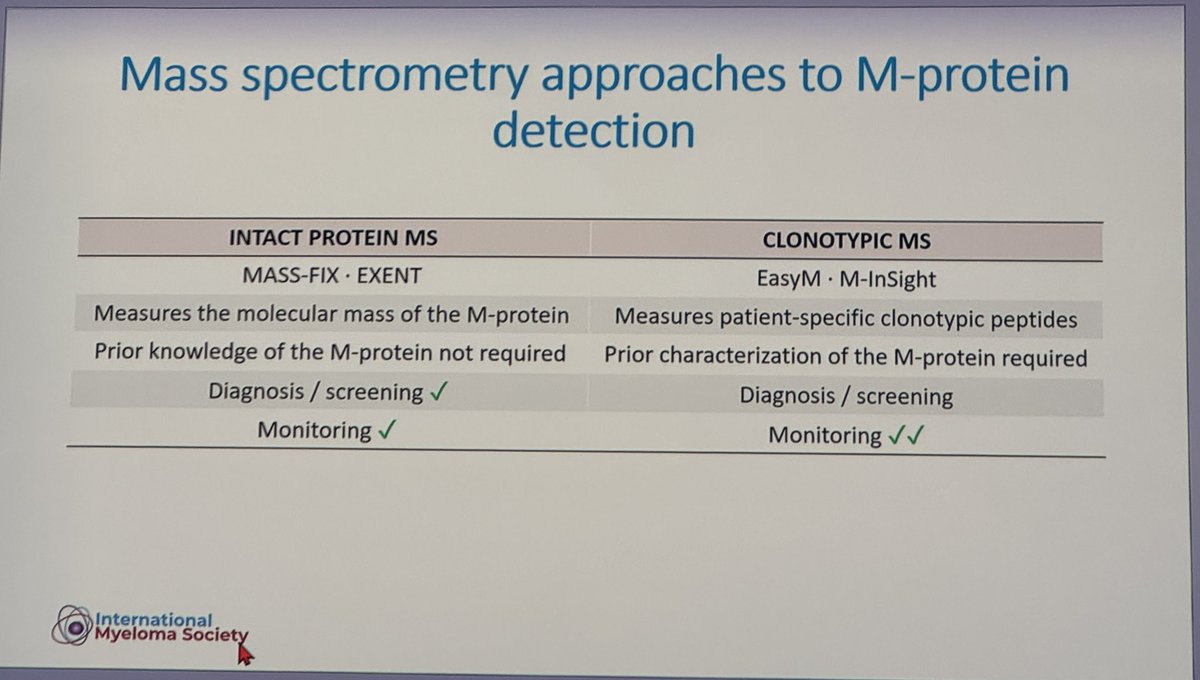

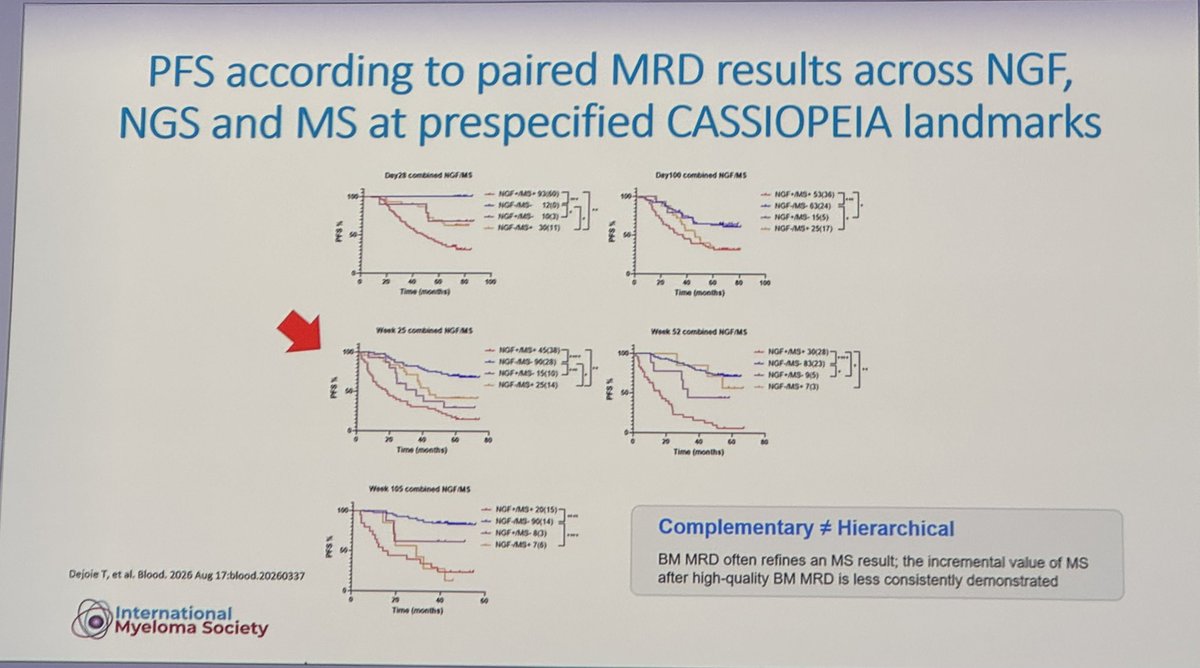
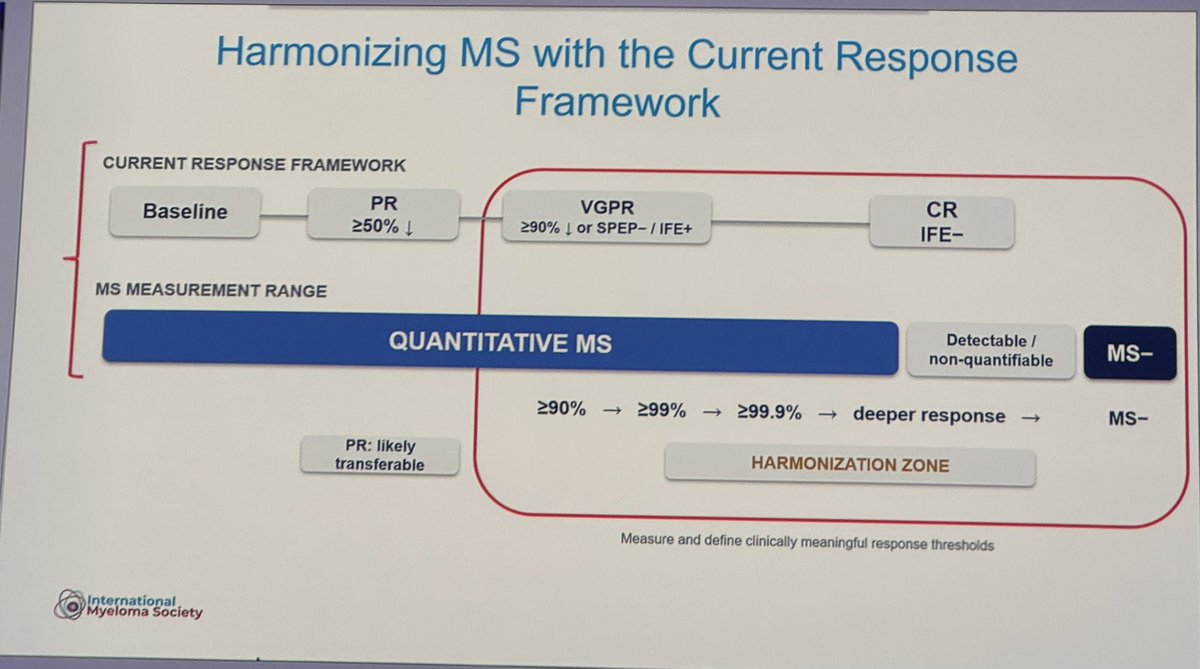
Neomi Puig discussing this morning progress in blood-based MS approaches @Myeloma_Society #IMS26 #mmsm https://t.co/QhEONuviSg
Mass spectrometry approaches to M-protein detection
Table:
INTACT PROTEIN MS | CLONOTYPIC MS
MASS-FIX . EXENT | EasyM . M-InSight
Measures the molecular mass of the M-protein | Measures patient-specific clonotypic peptides
Prior knowledge of the M-protein not required | Prior characterization of the M-protein required
Diagnosis / screening [check] | Diagnosis / screening
Monitoring [check] | Monitoring [check][check]
(International Myeloma Society logo)
Serum MS and BM MRD
SERUM MS- SERUM MS+
BM MRD- Concordant deep response | Residual serum disease: Delayed clearance-especially early/IgG . patchy or extramedullary disease . BM sampling or analytical attribution
BM MRD+ Residual marrow disease: Low- or non-secretory residual clone . serum below detection . trackability or sensitivity limitations | Concordant residual disease
Interchangeable, complementary, hierarchical or independent?
Footnote: Interpretive framework based on paired serum MS / BM NGF datasets. Puig et al., Blood 2024.
(International Myeloma Society logo)
PFS according to paired MRD results across NGF, NGS and MS at prespecified CASSIOPEIA landmarks
5 Kaplan-Meier PFS curves (Y axis PFS %, X axis Time in months), each with 4 groups NGF+/MS+, NGF-/MS-, NGF+/MS-, NGF-/MS+ with n(events) counts and significance brackets:
Day28 combined NGF/MS: NGF+/MS+ 93(59); NGF-/MS- 12(0); NGF+/MS- 10(3); NGF-/MS+ 30(11)
Day100 combined NGF/MS: NGF+/MS+ 53(36); NGF-/MS- 63(24); NGF+/MS- 15(5); NGF-/MS+ 25(17)
Week 25 combined NGF/MS (arrow-highlighted): NGF+/MS+ 45(38); NGF-/MS- 90(28); NGF+/MS- 15(10); NGF-/MS+ 25(14)
Week 52 combined NGF/MS: NGF+/MS+ 30(28); NGF-/MS- 83(23); NGF+/MS- 9(5); NGF-/MS+ 7(3)
Week 105 combined NGF/MS: NGF+/MS+ 20(15); NGF-/MS- 90(14); NGF+/MS- 8(3); NGF-/MS+ 7(6)
Box: 'Complementary [not equal] Hierarchical - BM MRD often refines an MS result; the incremental value of MS after high-quality BM MRD is less consistently demonstrated'
Citation: Dejoie T, et al. Blood. 2026 Aug 17:blood.20260337
(International Myeloma Society logo)
Harmonizing MS with the Current Response Framework
CURRENT RESPONSE FRAMEWORK: Baseline -> PR >=50% down -> VGPR >=90% down or SPEP-/IFE+ -> CR IFE-
MS MEASUREMENT RANGE: QUANTITATIVE MS (spans PR through into VGPR/CR range) -> Detectable/non-quantifiable -> MS-
>=90% -> >=99% -> >=99.9% -> deeper response -> MS-
PR: likely transferable | HARMONIZATION ZONE
Measure and define clinically meaningful response thresholds
(International Myeloma Society logo)
Sep 24
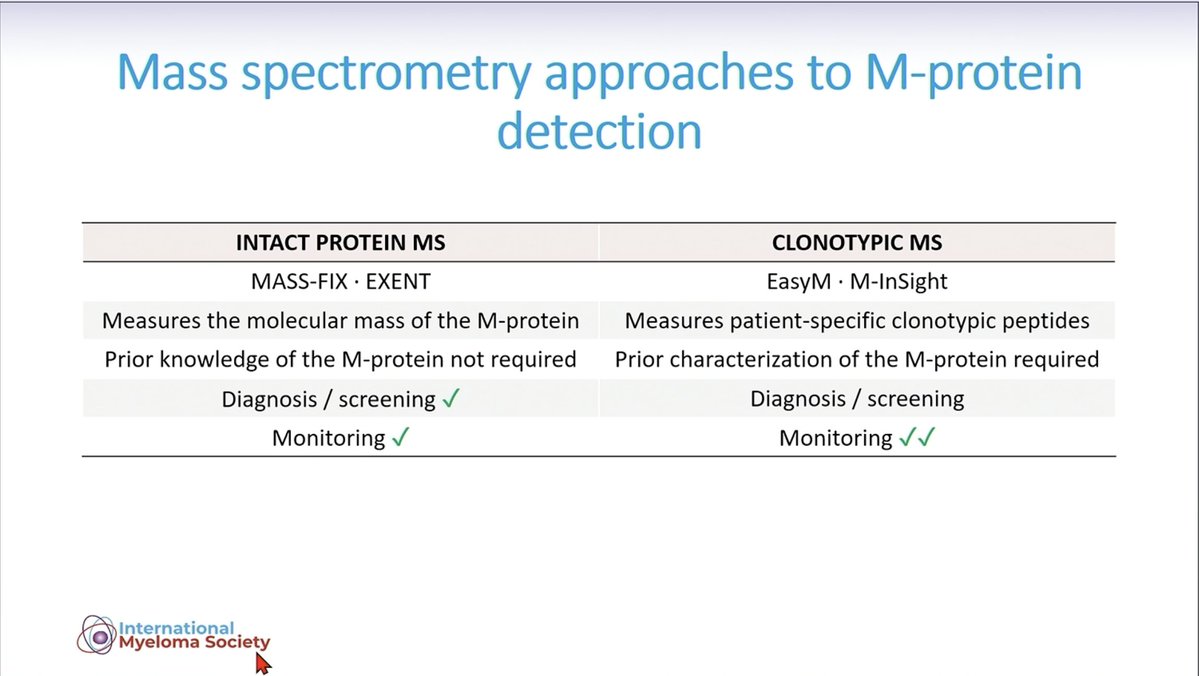


#IMS26 #mmsm Mass spectrometry
➡️More sensitive techniques to check for M protein are available and likely prognostic though use to modify treatment is still an area of uncertainty https://t.co/pqaCxwAuSP
Mass spectrometry approaches to M-protein detection
Table:
| INTACT PROTEIN MS | CLONOTYPIC MS
Assay names | MASS-FIX · EXENT | EasyM · M-InSight
Measures | Measures the molecular mass of the M-protein | Measures patient-specific clonotypic peptides
Prior knowledge | Prior knowledge of the M-protein not required | Prior characterization of the M-protein required
Diagnosis / screening | Yes (check) | Diagnosis / screening (no checkmark shown)
Monitoring | Yes (single check) | Monitoring (double check)
International Myeloma Society
MS Extends the Observable Disease Trajectory in Both Directions
SCREENING / EARLY DETECTION:
- Low-level clone, Small M-protein, Earlier detection
- Additional diagnostic window
DEEPENING RESPONSE:
- VGPR, ≥99% ↓, ≥99.9% ↓
- Additional depth of response
NADIR / MS- (center box)
DISEASE RE-EMERGENCE:
- Reappearance, Quantifiable rise, Rising clone
- Additional pre-progression window
- CONVENTIONAL PD (below, right side)
International Myeloma Society
Higher sensitivity for M-protein detection
PROMISE (Population screening, n=7,622):
6% → 13% MGUS detected, SPEP/IFE → MS
43% of MS-detected clones were very low level (<0.2 g/L; MGIP)
OLMSTED COUNTY (Previously screening-negative, n=226):
10.6% → 50.0% → 65.9%
IFE → MALDI-TOF → miRAMM
Monoclonal proteins detectable ~10 years before clinical diagnosis
miRAMM: LC and high-resolution MS (LC)
El-Khoury et al. Lancet Haematol 2022 · Murray et al. Blood Cancer J 2019
International Myeloma Society
Serum MS and BM MRD
2x2 grid:
| SERUM MS- | SERUM MS+
BM MRD- | Concordant deep response | Residual serum disease - Delayed clearance-especially early/IgG · patchy or extramedullary disease · BM sampling or analytical attribution
BM MRD+ | Residual marrow disease - Low- or non-secretory residual clone · serum below detection · trackability or sensitivity limitations | Concordant residual disease
Interpretive framework based on paired serum MS / BM NGF datasets. Puig et al., Blood 2024.
International Myeloma Society
Sep 24
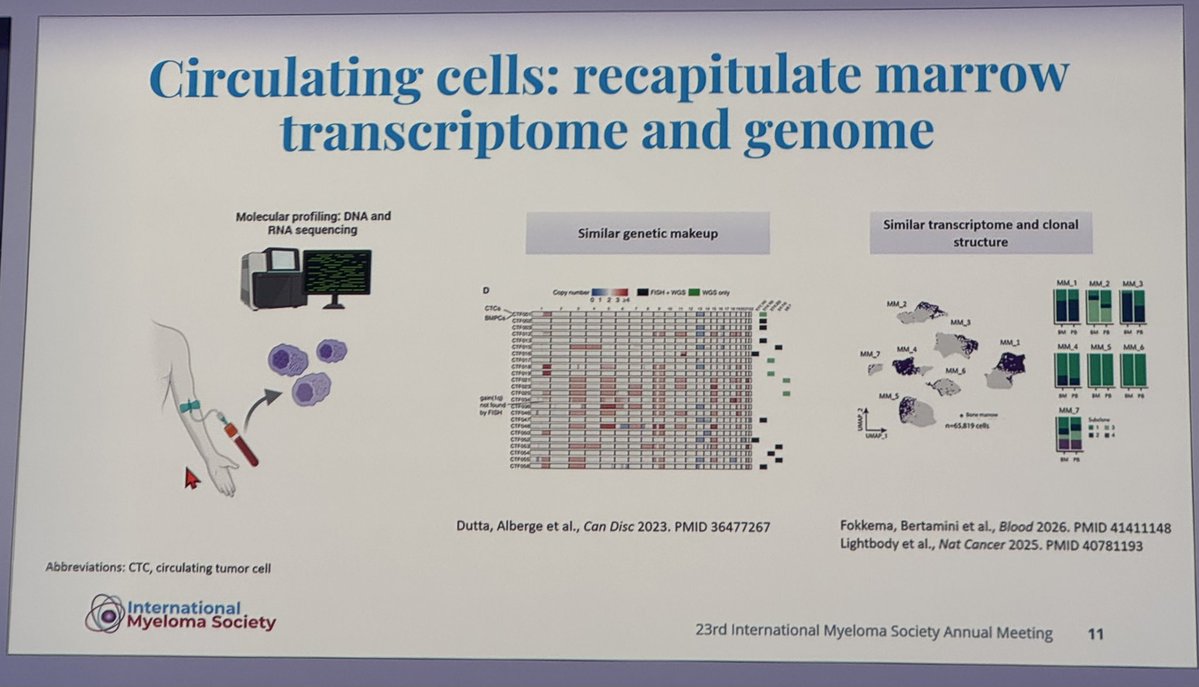
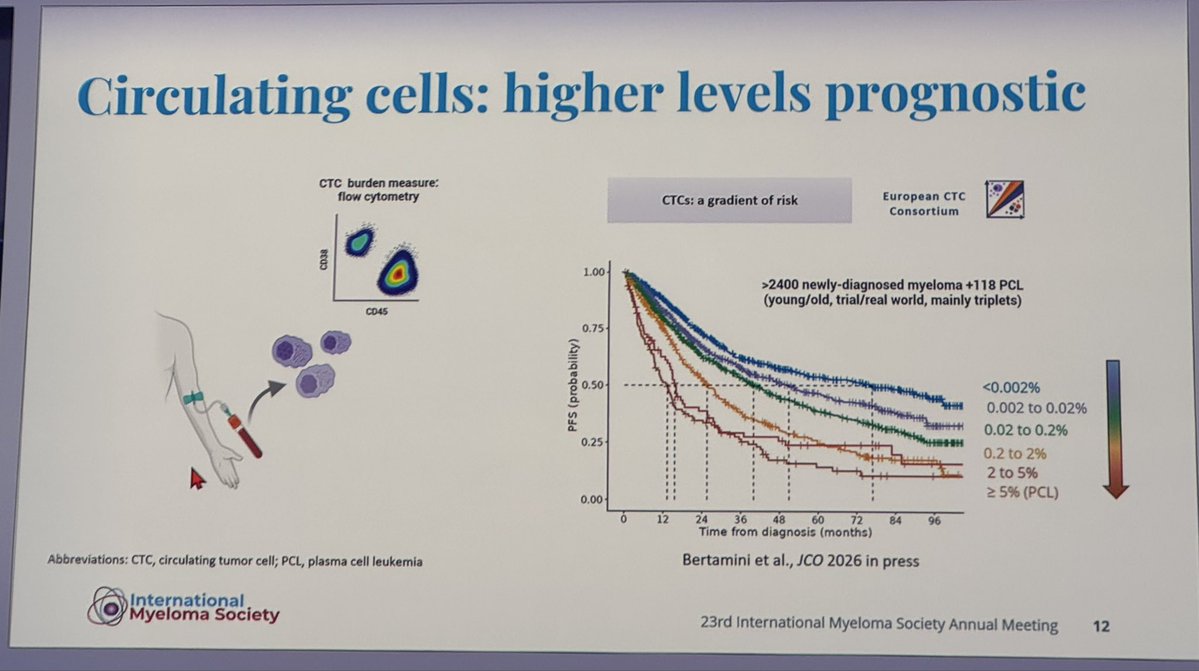
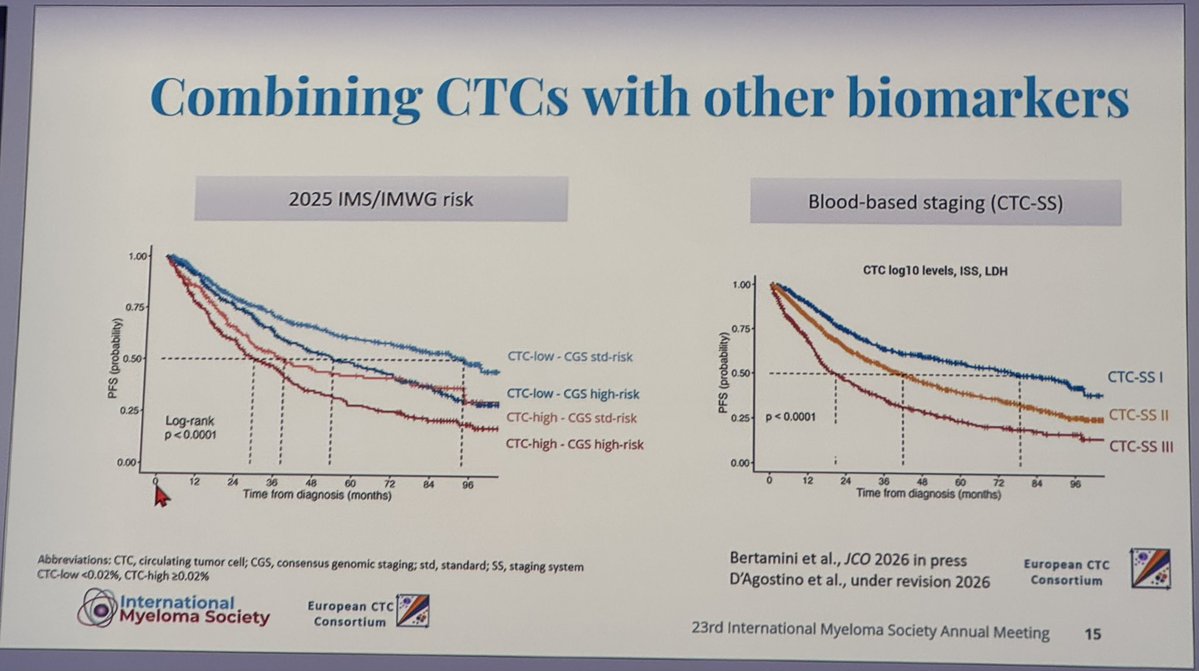
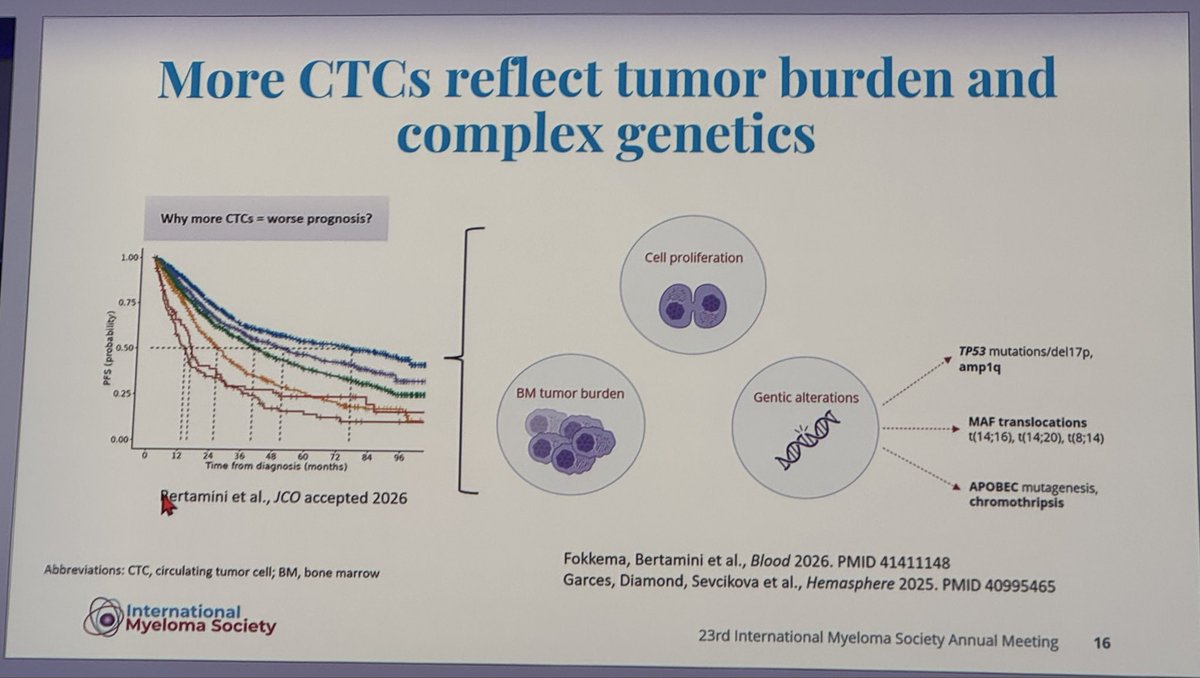
Great presentation by @LucaBertamini this morning at @Myeloma_Society #IMS26 on the power of Circulating Tumor Cells (CTCs) to complement the marrow, provide additional prognostication and an easily accessible source for molecular characterization #mmsm https://t.co/3DdOANnxgF
Circulating cells: recapitulate marrow transcriptome and genome
Molecular profiling: DNA and RNA sequencing [illustration: blood draw -> circulating tumor cells]
Similar genetic makeup [panel D heatmap]: Copy number scale 0 1 2 3 >=4; markers FISH + WGS (black) and WGS only (green). Rows labeled CTCs / BMPCs and patient IDs CTF001-CTF056 (approx.) across columns 1-19+ representing genomic regions; row annotation "gain(1q) not found by FISH" pointing to relevant rows.
Reference: Dutta, Alberge et al., Can Disc 2023. PMID 36477267
Similar transcriptome and clonal structure [UMAP plots]: individual patient UMAPs labeled MM_1 through MM_7 (Bone marrow vs Peripheral blood dots), n=65,819 cells. Bar charts to the right for MM_1-MM_7 showing subclone proportions (Subclone 1, 2, 3, 4) split by BM and PB for each patient.
References: Fokkema, Bertamini et al., Blood 2026. PMID 41411148; Lightbody et al., Nat Cancer 2025. PMID 40781193
Abbreviations: CTC, circulating tumor cell
International Myeloma Society
23rd International Myeloma Society Annual Meeting 11
Circulating cells: higher levels prognostic
CTC burden measure: flow cytometry [scatter plot CD38 vs CD45 showing two populations]
CTCs: a gradient of risk (European CTC Consortium)
Kaplan-Meier PFS curves by CTC burden category, x-axis Time from diagnosis (months) 0-96+, y-axis PFS (probability) 0.00-1.00:
>2400 newly-diagnosed myeloma + 118 PCL (young/old, trial/real world, mainly triplets)
Categories (best to worst prognosis, colored lines):
<0.002% (blue)
0.002 to 0.02% (blue/purple)
0.02 to 0.2% (green)
0.2 to 2% (orange)
2 to 5% (dark red/maroon)
>=5% (PCL) (dark red, steepest decline)
Abbreviations: CTC, circulating tumor cell; PCL, plasma cell leukemia
Reference: Bertamini et al., JCO 2026 in press
International Myeloma Society
23rd International Myeloma Society Annual Meeting 12
Combining CTCs with other biomarkers
Left panel: 2025 IMS/IMWG risk
Kaplan-Meier PFS curves (x-axis Time from diagnosis, months, 0-96+; y-axis PFS probability 0.00-1.00), four groups:
CTC-low - CGS std-risk (light blue, best outcome)
CTC-low - CGS high-risk (dark blue)
CTC-high - CGS std-risk (pink/salmon)
CTC-high - CGS high-risk (dark red, worst outcome)
Log-rank p<0.0001
Abbreviations: CTC, circulating tumor cell; CGS, consensus genomic staging; std, standard; SS, staging system. CTC-low <0.02%, CTC-high >=0.02%
Right panel: Blood-based staging (CTC-SS)
CTC log10 levels, ISS, LDH
Kaplan-Meier PFS curves, three groups:
CTC-SS I (blue, best)
CTC-SS II (orange)
CTC-SS III (dark red, worst)
p<0.0001
References: Bertamini et al., JCO 2026 in press; D'Agostino et al., under revision 2026
European CTC Consortium
International Myeloma Society
23rd International Myeloma Society Annual Meeting 15
More CTCs reflect tumor burden and complex genetics
Left: "Why more CTCs = worse prognosis?" Kaplan-Meier PFS curve (same multi-tier CTC-burden curve as prior slide, x-axis Time from diagnosis months 0-96+, y-axis PFS probability 0.00-1.00).
Reference: Bertamini et al., JCO accepted 2026
Right: three linked concept circles feeding into "Genetic alterations" box:
Cell proliferation (dividing cell icon)
BM tumor burden (clustered plasma cell icon)
Genetic alterations (DNA icon) -> leads to:
- TP53 mutations/del17p, amp1q
- MAF translocations t(14;16), t(14;20), t(8;14)
- APOBEC mutagenesis, chromothripsis
Abbreviations: CTC, circulating tumor cell; BM, bone marrow
References: Fokkema, Bertamini et al., Blood 2026. PMID 41411148; Garces, Diamond, Sevcikova et al., Hemasphere 2025. PMID 40995465
International Myeloma Society
23rd International Myeloma Society Annual Meeting 16
Sep 24


#IMS26 #mmsm Circulating tumor cells
➡️Prognostic test overall that may add to other prognostic tests
➡️The issue is not being a replacement of bone marrow biopsy as of yet https://t.co/6HqcoYNNh0
Circulating cells in myeloma
Diagram: blood draw -> circulating tumor cells -> two detection method branches: Microscopy (H&E morphology, Slide-based immunofluorescence) and Flow cytometry (2-4 colors flow cytometry, 6-8 colors flow cytometry; small CD38 vs CD45 flow plot shown).
Bar chart "Detection rate (% patients with CTCs)" vs "Sensitivity":
H&E morphology[1-2]: 4% | Sensitivity 10^-3
Slide-based immunofluorescence[3]: 35% | Sensitivity 10^-4
2-4 colors flow cytometry[4]: 60% | Sensitivity 10^-5
6-8 colors flow cytometry[5-8]: 90% | Sensitivity 10^-6
Abbreviations: CTC, circulating tumor cell; MM, multiple myeloma; NGF, next-generation flow cytometry; H&E, hematoxylin and eosin staining; FC, flow cytometry
1. Gluzinski and Reicheinstein, Wiener Klinische Wochenschrift 1906. 2. Granell et al., Haematologica 2017. 3. Witzig et al., Blood 1996. 4. Nowakowski et al., Blood 2005. 5. Dingli et al., Blood 2006. 6. Bertamini et al., JCO 2022. 7.Garces et al., JCO 2022. 8. Jelinek et al., JCO 2022. 9. Kostopoulos et al., JCO 2023.
International Myeloma Society - 23rd International Myeloma Society Annual Meeting [Slide 9]
Circulating cells: higher levels prognostic
Left: "CTC burden measure: flow cytometry" - small CD38 vs CD45 flow plot; blood draw diagram. Abbreviations: CTC, circulating tumor cell; PCL, plasma cell leukemia
Right, labeled "CTCs: a gradient of risk" with "European CTC Consortium" logo:
Kaplan-Meier chart, y-axis "PFS (probability)" 0.00-1.00, x-axis "Time from diagnosis (months)" 0-96+.
Annotation: ">2400 newly-diagnosed myeloma +118 PCL (young/old, trial/real world, mainly triplets)"
Risk-stratum legend (color gradient, best to worst PFS): <0.002%, 0.002 to 0.02%, 0.02 to 0.2%, 0.2 to 2%, 2 to 5%, >=5% (PCL) [arrow indicates decreasing PFS with increasing CTC%]
Citation: Bertamini et al., JCO 2026 in press
International Myeloma Society Annual Meeting [Slide 12]
More CTCs reflect tumor burden and complex genetics
Left box: "Why more CTCs = worse prognosis?" with the same Kaplan-Meier PFS-by-CTC-burden curve as prior slide (y-axis PFS probability 0-1.00, x-axis Time from diagnosis (months) 0-96+). Citation: Bertamini et al., JCO accepted 2026.
Abbreviations: CTC, circulating tumor cell; BM, bone marrow
Right: three-circle schematic linked to the CTC concept - "Cell proliferation", "BM tumor burden", "Genetic alterations" -> arrows to: TP53 mutations/del17p, amp1q; MAF translocations t(14;16), t(14;20), t(8;14); APOBEC mutagenesis, chromothripsis
References: Fokkema, Bertamini et al., Blood 2026. PMID 41411148
Garces, Diamond, Sevcikova et al., Hemasphere 2025. PMID 40995465
International Myeloma Society Annual Meeting [Slide 16]
Future myeloma treatment
"Risk adapted" schematic: patient population split into three risk groups (blue/orange/red figures):
- Low-risk: less intensive, fixed duration, response adapted (icon: toy dart gun)
- Intermediate-risk: multidrug, intermediate intensity, response adapted (icon: question mark)
- High-risk: intensive multidrug, long duration, MRD neg sustained (icon: explosion/bomb)
Arrows point to a schematic survival curve (y-axis "Survival" 0-100, x-axis "Time") showing three lines labeled Low risk (top), Intermediate risk (middle), High risk (bottom) - illustrative/conceptual curve, not showing specific numeric data points.
Black banner: Better diagnostics for better treatment and outcome
Abbreviations: MRD, minimal residual disease
International Myeloma Society Annual Meeting [Slide 18]
 Sep 24

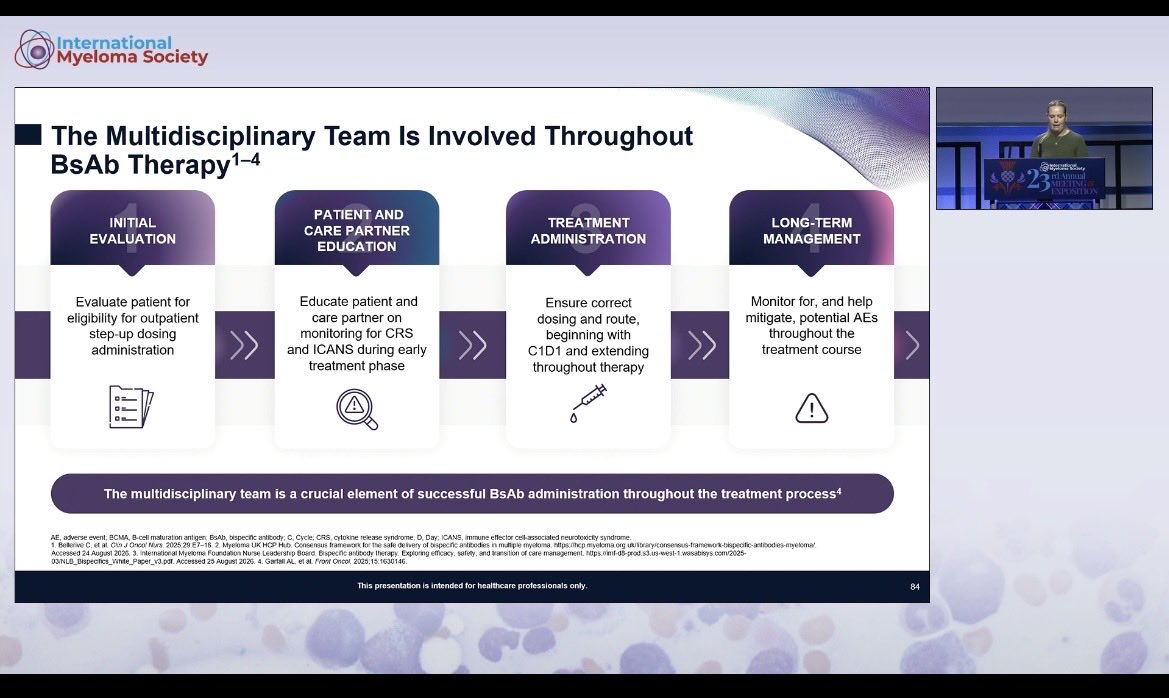
BsAB in OP setting supported by careful pt selection, CRS mitigation and immune surveillance/prophylaxis. Thanks Landgren/Seymour/Kowalski/Hankey for session #IMS26
See poster NSP-06 today @hsanz_org_au for 🇦🇺🦘consensus @marymyeloma @Bethfaiman https://t.co/km5svMcYg8
MagnetisMM-3: Infections in Patients on Elranatamab With or Without Ig Replacement Therapy
RRMM refractory to ≥1 of each of the following: PI, IMiD and anti-CD38 mAb
Any grade (N=187) bar chart - Monthly exposure-adjusted infection rate (95% CI) by category:
All infections: rate with 0.22, without 0.36; cases with 96, without 402
Bacterial: rate with 0.04, without 0.09; cases with 19, without 106
Fungal: rate with 0.02, without 0.03; cases with 8, without 31
Viral: rate with 0.07, without 0.10; cases with 31, without 115
Pathogen unspecified: rate with 0.09, without 0.13; cases with 38, without 150
Grade ≥3 (N=187) bar chart:
All infections: rate with 0.05, without 0.14; cases with 22, without 152
Bacterial: rate with 0.02, without 0.05; cases with 9, without 56
Fungal: rate with 0.00, without 0.01; cases with 2, without 7
Viral: rate with 0.02, without 0.05; cases with 9, without 59
Pathogen unspecified: rate with 0.00, without 0.03; cases with 2, without 30
In MagnetisMM-3, prophylactic administration of SCIg or IVIg was recommended for patients with an IgG ≤400 mg/dL
Lower monthly exposure-adjusted infection rates were observed in patients with vs without Ig replacement (0.22 vs 0.36)
Similar trends were observed across infection types
Data cutoff was 16 April 2023. Median follow-up not reported. CI, confidence interval; Ig, immunoglobulin; IMiD, immunomodulatory drug; IV, intravenous; mAb, monoclonal antibody; PI, proteasome inhibitor; RRMM, relapsed and/or refractory multiple myeloma; SC, subcutaneous.
1. Lelue X, et al. Abstract P-286. Poster presented at: 2023 IMS Annual Meeting; Athens, Greece. 2. Lesokhin AM, et al. Nat Med. 2023;29:2259-67. Figures reproduced from Lelue X, et al. Abstract P-286. Poster presented at 2023 IMS Annual Meeting; Athens, Greece.
3. ClinicalTrials.gov. MagnetisMM-3 Study Protocol. Accessed 21 September 2026.
This presentation is intended for healthcare professionals only. (slide 89)
The Multidisciplinary Team Is Involved Throughout BsAb Therapy
1. INITIAL EVALUATION: Evaluate patient for eligibility for outpatient step-up dosing administration
2. PATIENT AND CARE PARTNER EDUCATION: Educate patient and care partner on monitoring for CRS and ICANS during early treatment phase
3. TREATMENT ADMINISTRATION: Ensure correct dosing and route, beginning with C1D1 and extending throughout therapy
4. LONG-TERM MANAGEMENT: Monitor for, and help mitigate, potential AEs throughout the treatment course
The multidisciplinary team is a crucial element of successful BsAb administration throughout the treatment process
AE, adverse event; BCMA, B-cell maturation antigen; BsAb, bispecific antibody; C, Cycle; CRS, cytokine release syndrome; D, Day; ICANS, immune effector cell-associated neurotoxicity syndrome.
1. Bellevier C, et al. Clin J Oncol Nurs. 2025;29:E7-15. 2. Myeloma UK HCP Hub. Consensus framework for the safe delivery of bispecific antibodies in multiple myeloma. Accessed 24 August 2026. 3. International Myeloma Foundation Nurse Leadership Board. Bispecific antibody therapy: Exploring efficacy, safety, and transition of care management. Accessed 25 August 2026. 4. Garfall AL, et al. Front Oncol. 2025;15:1630146.
This presentation is intended for healthcare professionals only. (slide 84)
 Sep 24

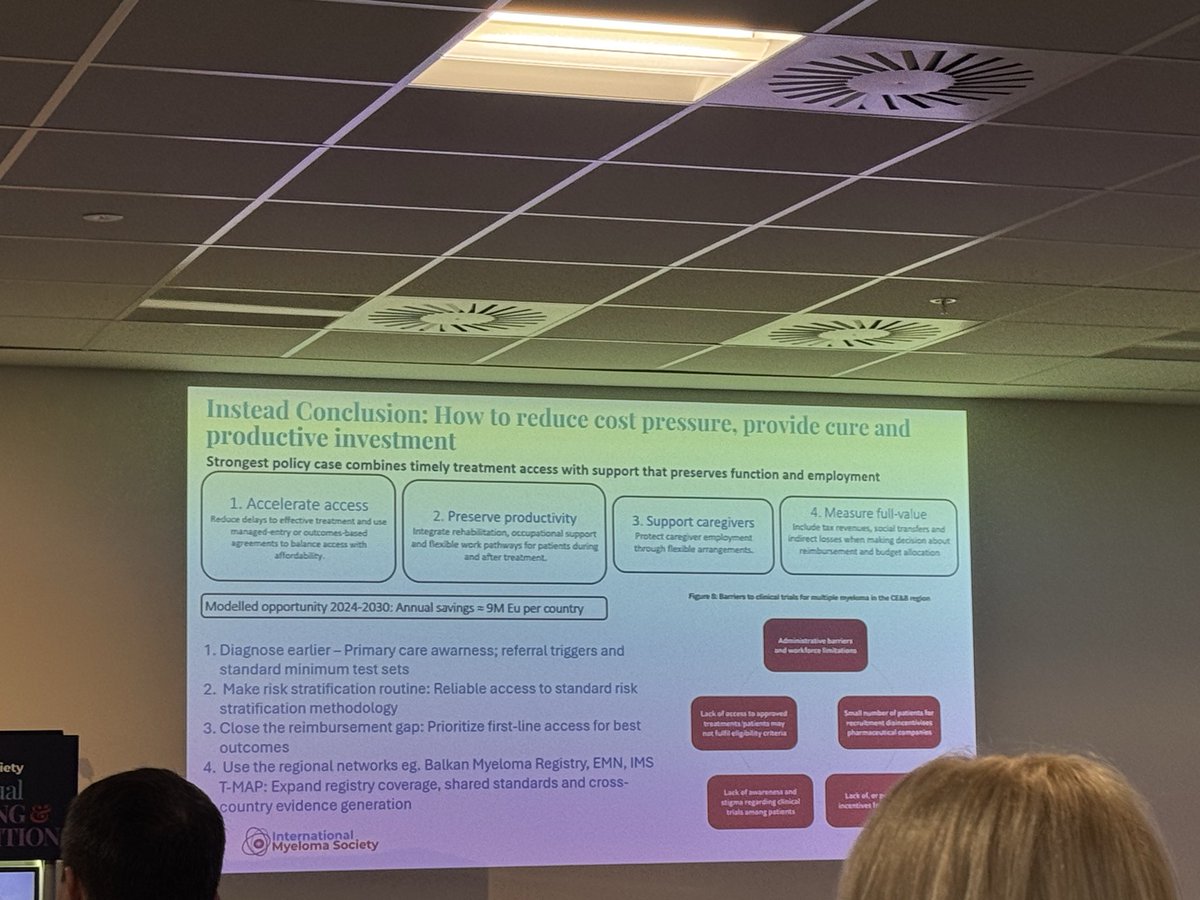
A thorough analysis in access in Myeloma in LMIC-Gaps and more important solutions by @UdayYanamandra and others at #IMS26
#LMIC Thanks to IMS leadership for this initiative 🙏 https://t.co/CNt7H5f0cZ
Instead Conclusion: How to reduce cost pressure, provide cure and productive investment
Strongest policy case combines timely treatment access with support that preserves function and employment
1. Accelerate access: Reduce delays to effective treatment and use managed-entry or outcomes-based agreements to balance access with affordability.
2. Preserve productivity: Integrate rehabilitation, occupational support and flexible work pathways for patients during and after treatment.
3. Support caregivers: Protect caregiver employment through flexible arrangements.
4. Measure full-value: Include tax revenues, social transfers and indirect losses when making decision about reimbursement and budget allocation
Modelled opportunity 2024-2030: Annual savings ≈ 9M Eu per country
1. Diagnose earlier - Primary care awarness; referral triggers and standard minimum test sets
2. Make risk stratification routine: Reliable access to standard risk stratification methodology
3. Close the reimbursement gap: Prioritize first-line access for best outcomes
4. Use the regional networks eg. Balkan Myeloma Registry, EMN, IMS T-MAP: Expand registry coverage, shared standards and cross-country evidence generation
Figure 8: Barriers to clinical trials for multiple myeloma in the CE&B region
- Administrative barriers and workforce limitations
- Lack of access to approved treatments/patients may not fulfil eligibility criteria
- Small number of patients for recruitment disincentivises pharmaceutical companies
- Lack of awareness and stigma regarding clinical trials among patients
- Lack of, or perverse, incentives for physicians
International Myeloma Society
Sep 24

Solutions to overcome the barriers to access to improve myeloma care and reduce cost burden #IMS26 https://t.co/fsHV2FKAiP
Instead Conclusion: How to reduce cost pressure, provide cure and productive investment
Strongest policy case combines timely treatment access with support that preserves function and employment
1. Accelerate access: Reduce delays to effective treatment and use managed-entry or outcomes-based agreements to balance access with affordability.
2. Preserve productivity: Integrate rehabilitation, occupational support and flexible work pathways for patients during and after treatment.
3. Support caregivers: Protect caregiver employment through flexible arrangements.
4. Measure full-value: Include tax revenues, social transfers and indirect losses when making decision about reimbursement and budget allocation
Modelled opportunity 2024-2030: Annual savings ≈ 9M Eu per country
1. Diagnose earlier - Primary care awarness; referral triggers and standard minimum test sets
2. Make risk stratification routine: Reliable access to standard risk stratification methodology
3. Close the reimbursement gap: Prioritize first-line access for best outcomes
4. Use the regional networks eg. Balkan Myeloma Registry, EMN, IMS T-MAP: Expand registry coverage, shared standards and cross-country evidence generation
Figure 8: Barriers to clinical trials for multiple myeloma in the CE&B region
- Administrative barriers and workforce limitations
- Lack of access to approved treatments/patients may not fulfil eligibility criteria
- Small number of patients for recruitment disincentivises pharmaceutical companies
- Lack of awareness and stigma regarding clinical trials among patients
- Lack of, or perverse, incentives for physicians
International Myeloma Society
Sep 24

The issues are globally the same in LMIC countries #IMS26 https://t.co/gwYaaYlJqn
Clinical Trials: Unequal Access to Innovation
Research infrastructure is concentrated on a few countries and major urban centers
Table (Pais/Country | Total | CAR-T Cells | Biespecificos/Belantamab | CELMoDs | Anti-CD38 | Otros):
Brasil | 43 | 4 | 21 | 4 | 5 | 9
Argentina | 19 | 2 | 9 | 4 | 2 | 1
Mexico | 12 | 0 | 7 | 2 | 1 | 0
Chile | 7 | 0 | 3 | 2 | 2 | 0
Colombia | 2 | 0 | 0 | 2 | 0 | 0
- Clinical trials can provide access to innovative therapies.
- Sustainable research infrastructure and referral networks are essential, not optional
- Brazil has the highest number of MM clinical trials in LATAM, (40+), reflecting its most advanced research infrastructure and high enrollment rate.
- Mexico and Argentina: also have a significant number of trials, benefiting from strong healthcare systems and collaboration with international pharmaceutical companies. Generally, 10-20 trials.
- Chile, Colombia, Peru, etc.: Have smaller numbers of trials, often focused on urban centers with advanced medical facilities. Fewer than 10 trials per country, with some having only 1-5 trials.
International Myeloma Society
ClinicalTrials.gov
Sep 24

Kickoff of the LMIC Breakfast session of the @Myeloma_Society #IMS26 #mmsm https://t.co/84VBZwpvOd
23rd Annual MEETING & EXPOSITION - International Myeloma Society
Current (GMT+1) 07:03 AM
LMIC Breakfast Session 7:00 AM - 8:00 AM
Angelo Maiolino, Shaji Kumar, Uday Yanam... (Moderator)
Shaji Kumar - Welcome and objectives - 7:00 AM - 7:05 AM
Jelena Bila - The real-world burden of multiple myeloma in... - 7:05 AM - 7:20 AM
Dorotea Fantl - The real-world burden of multiple myeloma in... - 7:05 AM - 7:20 AM
Uday Yanamandra - IMS LMIC Survey: identifying the major gaps in... - 7:20 AM - 7:40 AM
Angelo Maiolino - IMS LMIC Survey: identifying the major gaps in... - 7:20 AM - 7:40 AM
Sep 23
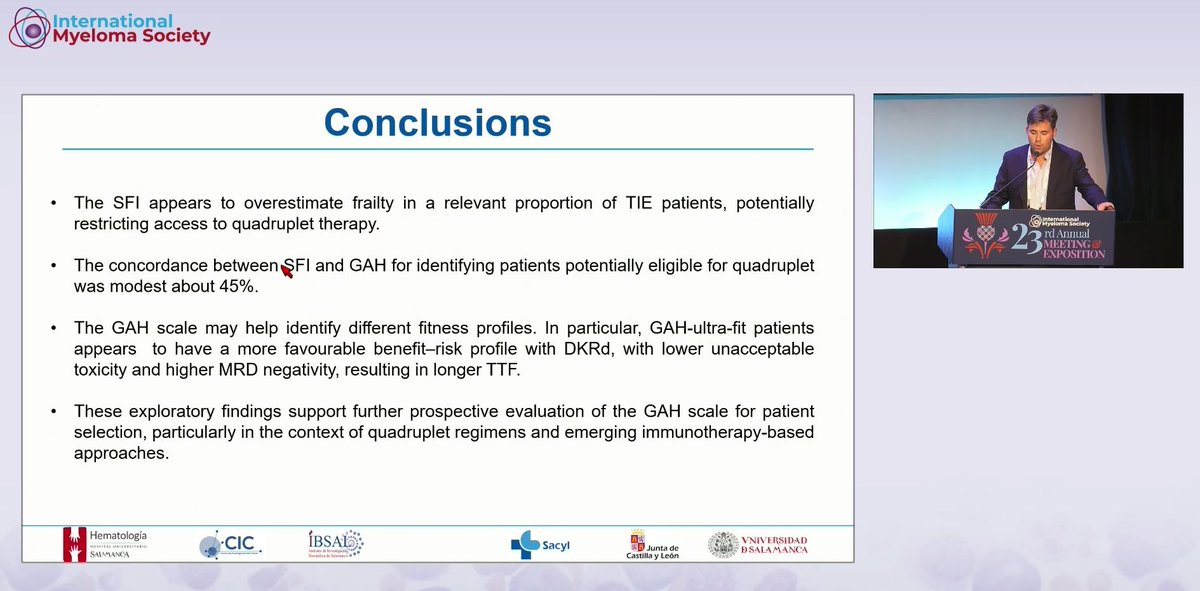
Frailty has long been a concern for treatment selection and sequencing in myeloma.
Congratulations to Borja Puertas, @HematoCAUSA and the GEM for their #IMS26 presentation! GAH is a very promising tool to redefine frailty and further individualise therapies.
@Myeloma_Society https://t.co/AftisMHz8k
[Slide: Conclusions - GEM Frailty/GAH Study, IMS 2026]
Conclusions
- The SFI appears to overestimate frailty in a relevant proportion of TIE patients, potentially restricting access to quadruplet therapy.
- The concordance between SFI and GAH for identifying patients potentially eligible for quadruplet was modest about 45%.
- The GAH scale may help identify different fitness profiles. In particular, GAH-ultra-fit patients appears to have a more favourable benefit-risk profile with DKRd, with lower unacceptable toxicity and higher MRD negativity, resulting in longer TTF.
- These exploratory findings support further prospective evaluation of the GAH scale for patient selection, particularly in the context of quadruplet regimens and emerging immunotherapy-based approaches.
Presented at International Myeloma Society 23rd Annual Meeting & Exposition. Affiliations: Hospital Universitario de Salamanca (Hematologia), CIC, IBSAL, Sacyl, Junta de Castilla y Leon, Universidad de Salamanca.
 Sep 23

Maintenance in myeloma: what, how long, and for whom? -Prof. Charlotte Pawlyn at #IMS2026 (@_DrCP)
Dara-len today; increasingly MRD- and risk-adapted tomorrow.
Also, her clarity and confidence on stage were remarkable.
#MMsm https://t.co/pOUJQuqHNF
Conclusion
Three-column layout:
1. Which therapy?
2026: Lenalidomide + daratumumab
[arrow down]
2030: Immunotherapy approaches?
2. How long for?
2026: To progression but.....
- low threshold for stopping after 2-3 years in event of toxicity if no high risk lesions and MRD -ve
- higher threshold for stopping/try to continue if any high risk lesions or MRD +ve
[arrow down / clock icon]
2030: Immunotherapy approaches likely to be time limited
3. Personalisation?
2026: Double hit / IMWG-IMS high risk patients need intensive consolidation and multi-agent maintenance approaches
[arrow down]
2030: More information on older patients and time limited therapy
Footer: ICR - Images created using BioRender. The ROYAL MARSDEN NHS Foundation Trust
Sep 23
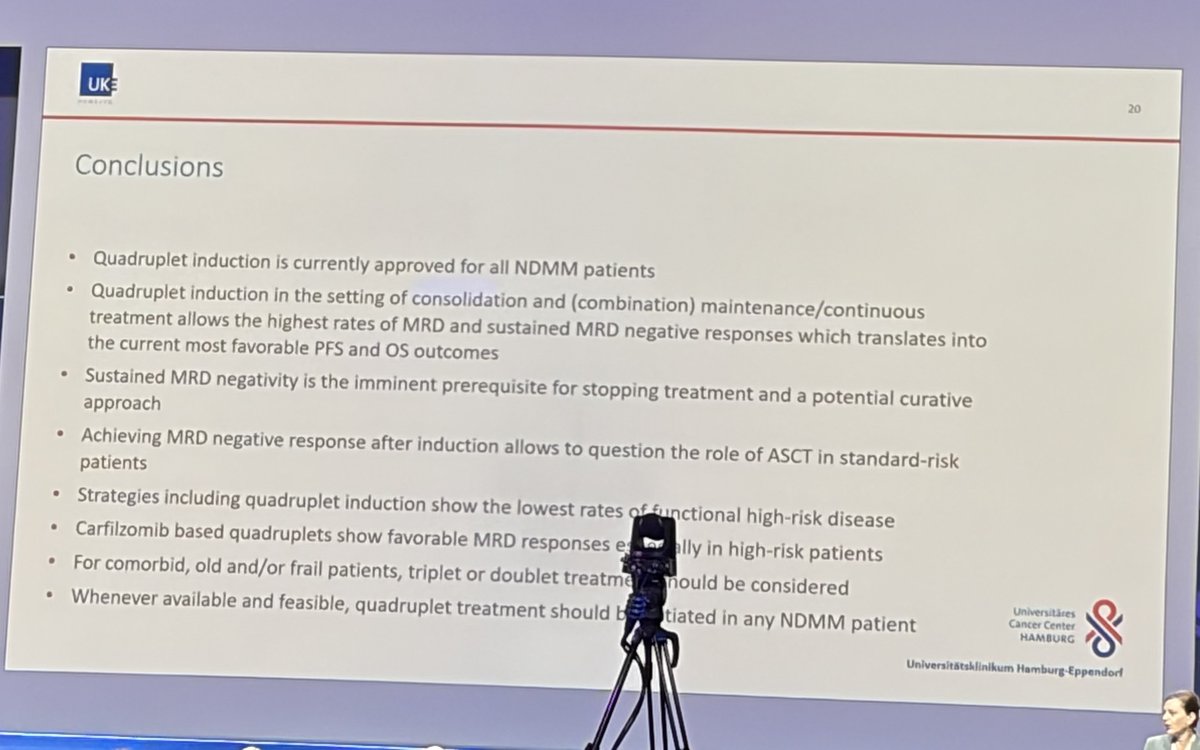
“Quadruplets for all?” - Prof. Katja Weisel (@KatjaWeisel) at #IMS2026.
Frontline NDMM is moving toward quadruplet induction → deeper and more sustained MRD negativity, with treatment still tailored for frailty and comorbidity.
For India, the key question remains: can access keep pace with the evidence?
#mmsm
Conclusions (UKE Hamburg / Universitatsklinikum Hamburg-Eppendorf, slide 20)
- Quadruplet induction is currently approved for all NDMM patients
- Quadruplet induction in the setting of consolidation and (combination) maintenance/continuous treatment allows the highest rates of MRD and sustained MRD negative responses which translates into the current most favorable PFS and OS outcomes
- Sustained MRD negativity is the imminent prerequisite for stopping treatment and a potential curative approach
- Achieving MRD negative response after induction allows to question the role of ASCT in standard-risk patients
- Strategies including quadruplet induction show the lowest rates of functional high-risk disease
- Carfilzomib based quadruplets show favorable MRD responses especially in high-risk patients
- For comorbid, old and/or frail patients, triplet or doublet treatment should be considered
- Whenever available and feasible, quadruplet treatment should be initiated in any NDMM patient
Sep 23
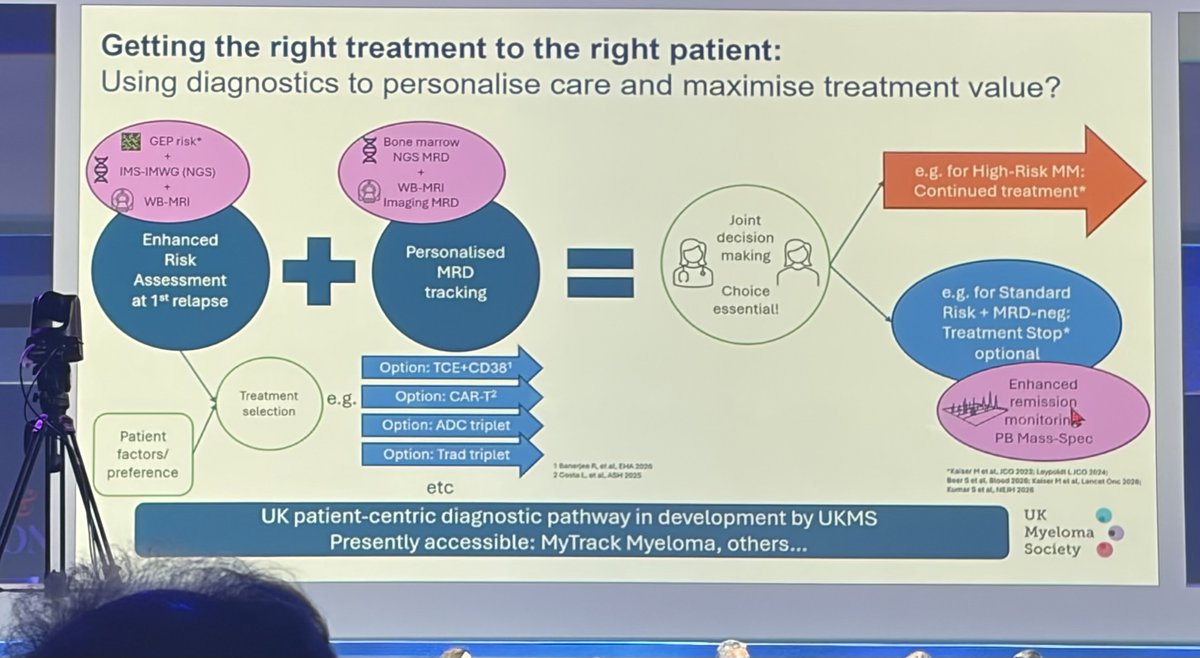
“Getting the right treatment to the right patient” by Prof. Martin Kaiser (@MyMKaiser) at #IMS2026.
Precision myeloma care is not only about having more drugs: it is about using risk, MRD and patient factors to extract maximum value from what is available.
Very relatable to our https://t.co/ElU5nHhRW9
Getting the right treatment to the right patient: Using diagnostics to personalise care and maximise treatment value?
Enhanced Risk Assessment at 1st relapse (GEP risk* + IMS-IMWG (NGS) + WB-MRI) + Personalised MRD tracking (Bone marrow NGS MRD + WB-MRI Imaging MRD) = Joint decision making / Choice essential! ->
-> e.g. for High-Risk MM: Continued treatment*
-> e.g. for Standard Risk + MRD-neg: Treatment Stop* optional, supported by Enhanced remission monitoring (PB Mass-Spec)
Treatment selection e.g. options (from Enhanced Risk Assessment + Personalised MRD tracking, plus Patient factors/preference): Option TCE+CD38(1); Option CAR-T(2); Option ADC triplet; Option Trad triplet, etc.
Footnote citations: 1 Banerjee R, et al, EHA 2026. 2 Costa L, et al, ASH 2025. *Kaiser M et al, JCO 2023; Leypoldt L JCO 2024; Beer S et al, Blood 2026; Kaiser M et al, Lancet Onc 2026; Kumar S et al, NEJM 2026
Bottom banner: 'UK patient-centric diagnostic pathway in development by UKMS. Presently accessible: MyTrack Myeloma, others...' (UK Myeloma Society logo)
Sep 23
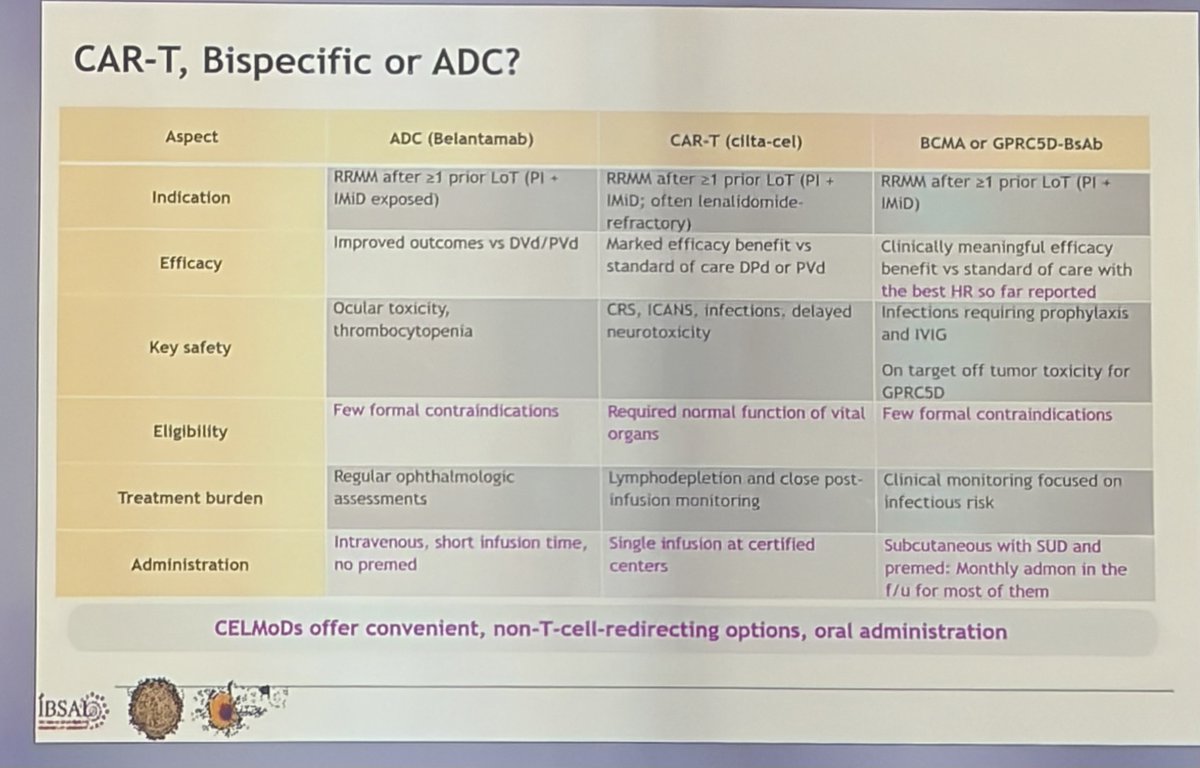

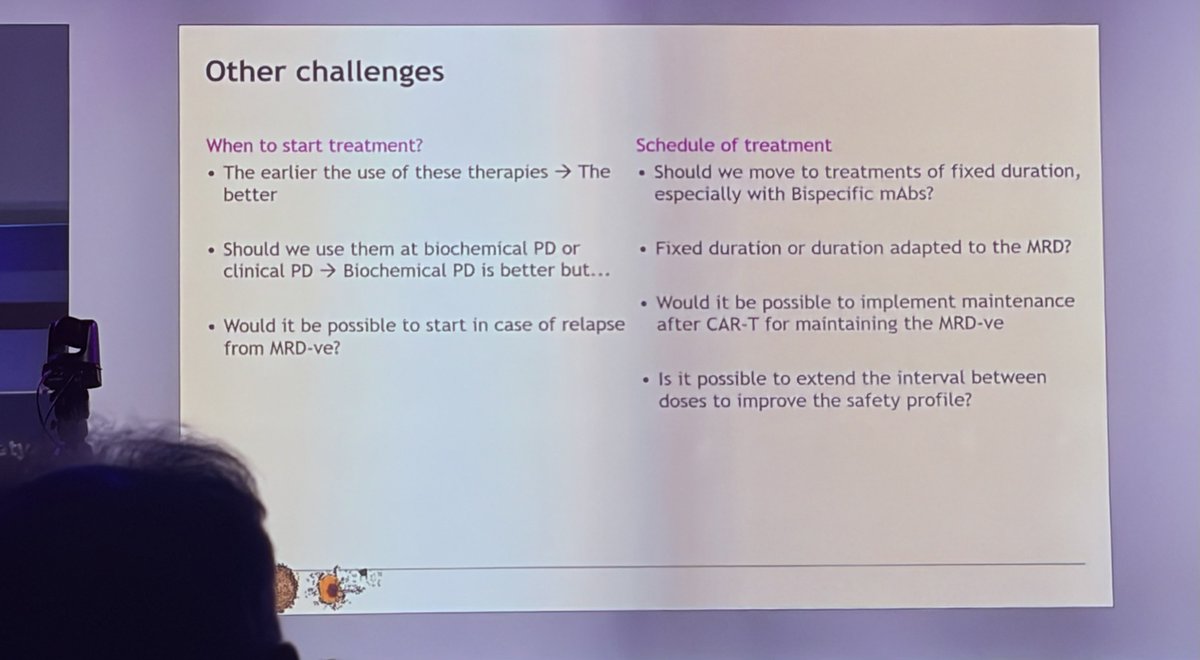
CAR-T, Bispecific or ADC? - excellent practical session by Dr María-Victoria Mateos (@mvmateos) at #IMS2026 on future directions and challenges!
The key challenge is no longer what works, but what to use, when, and in what sequence.
For India, the algorithm also has to include https://t.co/YgQQMukNse
CAR-T, Bispecific or ADC?
Table:
Aspect | ADC (Belantamab) | CAR-T (cilta-cel) | BCMA or GPRC5D-BsAb
Indication | RRMM after >=1 prior LoT (PI + IMiD exposed) | RRMM after >=1 prior LoT (PI + IMiD; often lenalidomide-refractory) | RRMM after >=1 prior LoT (PI + IMiD)
Efficacy | Improved outcomes vs DVd/PVd | Marked efficacy benefit vs standard of care DPd or PVd | Clinically meaningful efficacy benefit vs standard of care with the best HR so far reported
Key safety | Ocular toxicity, thrombocytopenia | CRS, ICANS, infections, delayed neurotoxicity | Infections requiring prophylaxis and IVIG; On target off tumor toxicity for GPRC5D
Eligibility | Few formal contraindications | Required normal function of vital organs | Few formal contraindications
Treatment burden | Regular ophthalmologic assessments | Lymphodepletion and close post-infusion monitoring | Clinical monitoring focused on infectious risk
Administration | Intravenous, short infusion time, no premed | Single infusion at certified centers | Subcutaneous with SUD and premed: Monthly admon in the f/u for most of them
CELMoDs offer convenient, non-T-cell-redirecting options, oral administration
[IBSA logo]
What about sequencing: Crucial challenge
What does the sequencing evidence support?
BCMA CAR-T -> GPRC5D
Best prospective evidence
- MonumenTAL-1 prior T-cell redirection cohort
- After prior CAR-T: ORR 72.9%; median PFS 12.3 months
- After prior BCMA bispecific: ORR 52.2%; median PFS 4.1 months
GPRC5D -> BCMA
Feasible, but mainly retrospective
Small published series and registries
- support activity of BCMA CAR-T or bispecific therapy
- A 10-patient series reported median PFS of 5.5 months
Could belamaf rescue BCMA-TT or viceversa?
- Different mechanism: ADC activity does not depend on T-cell fitness
- Potentially useful after BCMA CAR-T or bispecific failure if BCMA remains expressed or viceversa
Practical sequencing principles
- Switch target after early or refractory failure: GPRC5D after BCMA has the clearest clinical support
- Avoid immediate T-cell redirection when possible: Real-world series associate intervals >=6 months with better outcomes
- Identify the mechanism of resistance involved in the relapse/progression of the disease: Consider antigen retention, T-cell fitness, disease tempo and infection burden
Evidence remains incomplete
Other challenges
When to start treatment?
- The earlier the use of these therapies -> The better
- Should we use them at biochemical PD or clinical PD -> Biochemical PD is better but...
- Would it be possible to start in case of relapse from MRD-ve?
Schedule of treatment
- Should we move to treatments of fixed duration, especially with Bispecific mAbs?
- Fixed duration or duration adapted to the MRD?
- Would it be possible to implement maintenance after CAR-T for maintaining the MRD-ve
- Is it possible to extend the interval between doses to improve the safety profile?
Sep 23

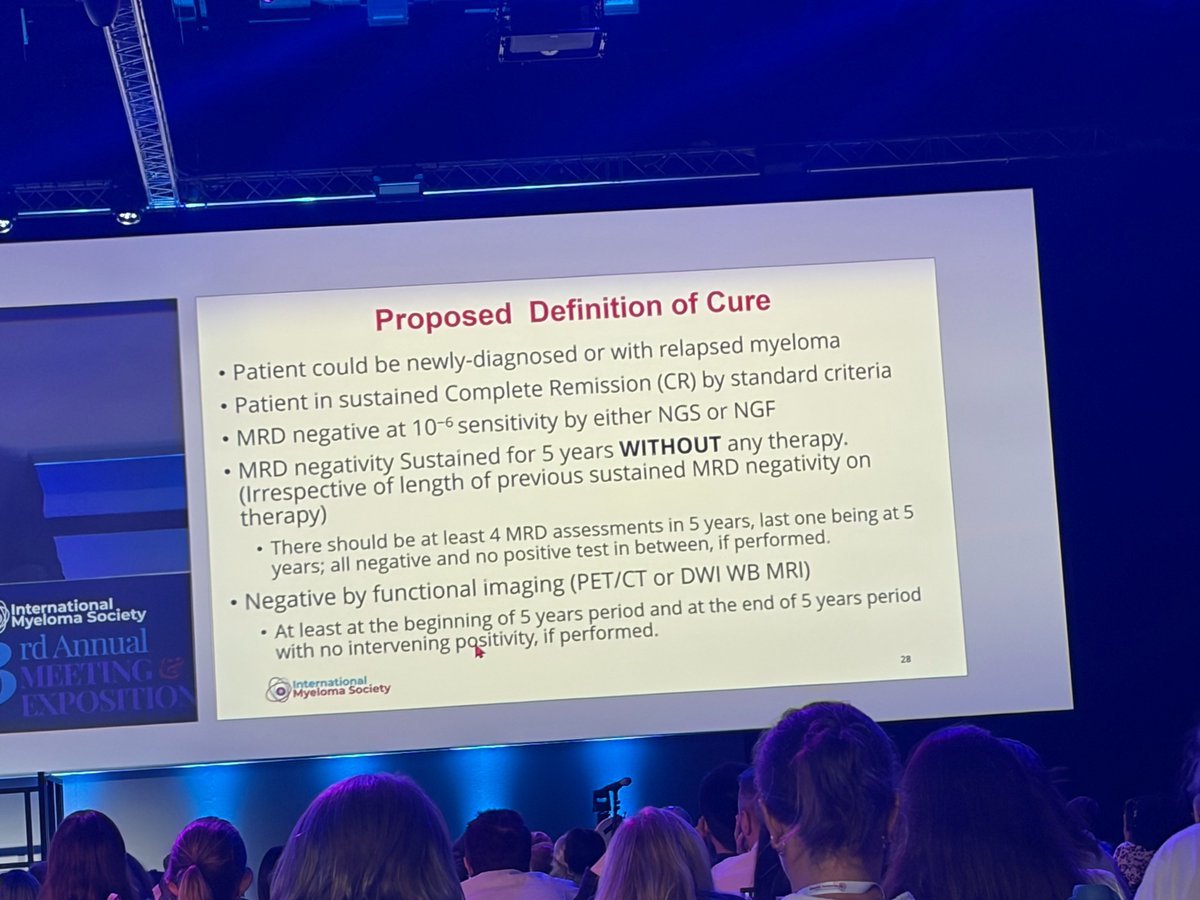
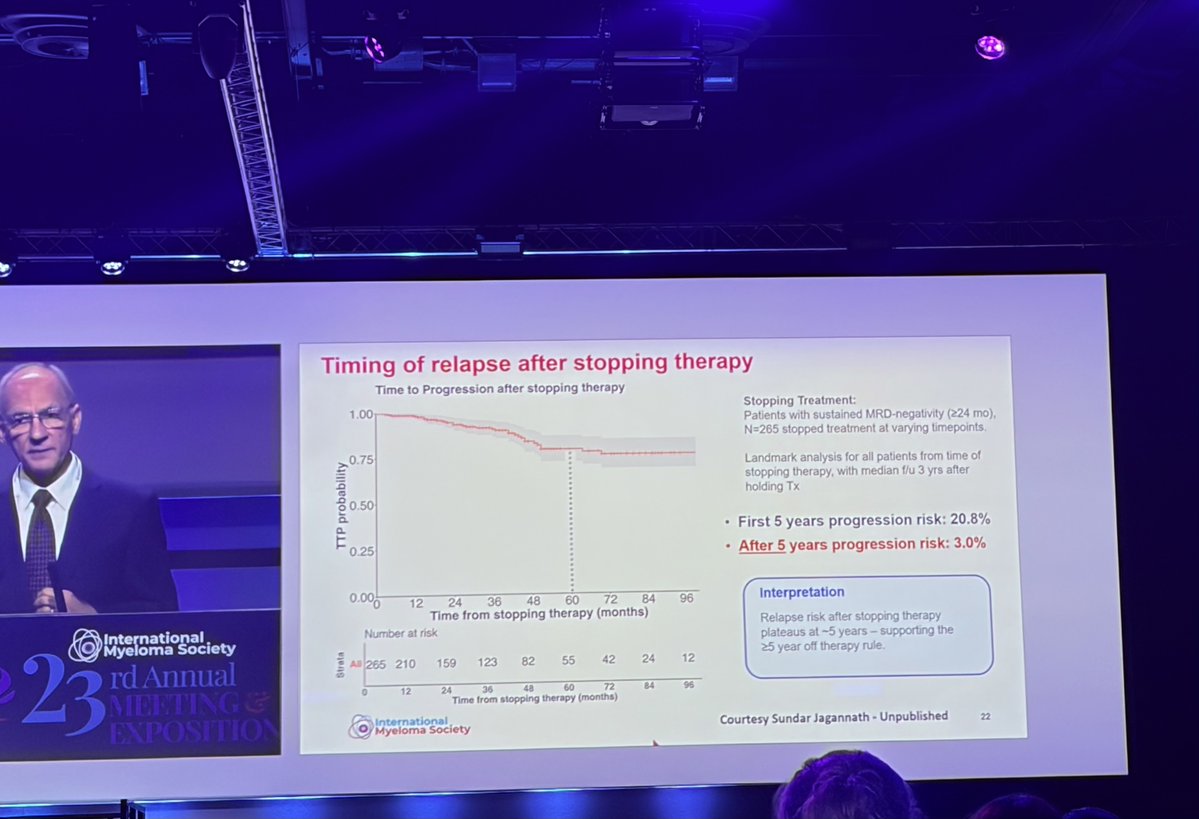
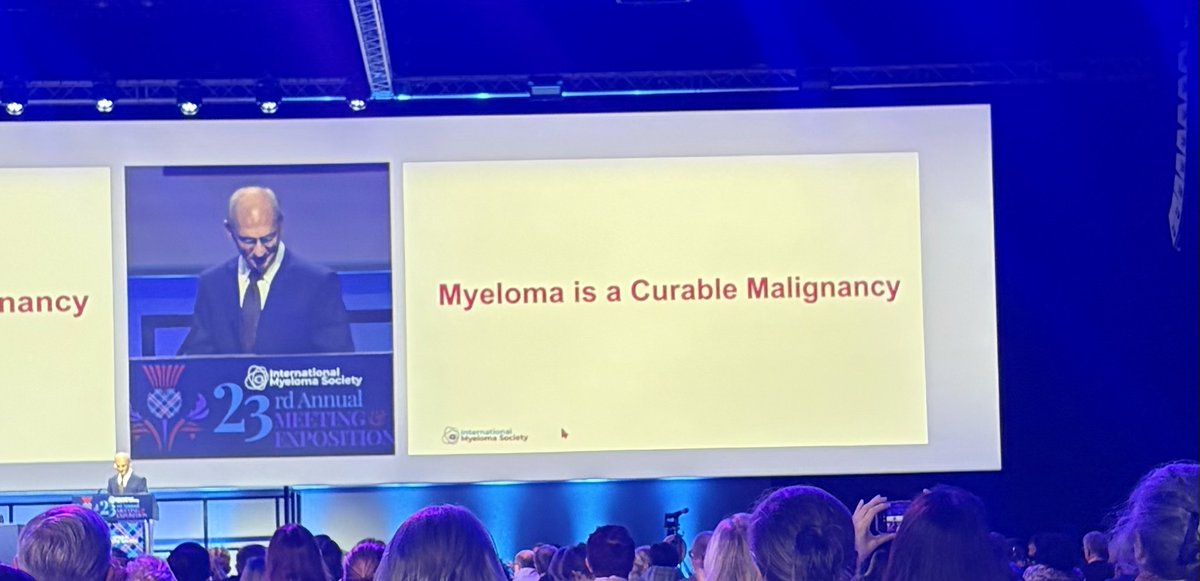
A thought-provoking session by Dr Nikhil Munshi @NikhilMunshiMD at #IMS2026: Can myeloma truly be cured
Proposed benchmark: sustained CR + MRD negativity at 10⁻⁶ + negative imaging, maintained for 5 years off therapy.
For India, an added challenge is practical: reliable MRD https://t.co/8NY8gwgBEo
To Declare Cure Requires convergence of three domains
When All Three Align -> Credible Declaration of Cure.
Domain | Requirement
Statistical | No excess mortality
Clinical | Long-term Treatment-free Disease-free survival
Biological | No detectable malignant clone
International Myeloma Society
Proposed Definition of Cure
Patient could be newly-diagnosed or with relapsed myeloma
Patient in sustained Complete Remission (CR) by standard criteria
MRD negative at 10^-6 sensitivity by either NGS or NGF
MRD negativity Sustained for 5 years WITHOUT any therapy. (Irrespective of length of previous sustained MRD negativity on therapy)
- There should be at least 4 MRD assessments in 5 years, last one being at 5 years; all negative and no positive test in between, if performed.
Negative by functional imaging (PET/CT or DWI WB MRI)
- At least at the beginning of 5 years period and at the end of 5 years period with no intervening positivity, if performed.
(slide 28, International Myeloma Society)
Timing of relapse after stopping therapy
Time to Progression after stopping therapy (KM curve, TTP probability, 0-96 months)
Stopping Treatment: Patients with sustained MRD-negativity (≥24 mo), N=265 stopped treatment at varying timepoints.
Landmark analysis for all patients from time of stopping therapy, with median f/u 3 yrs after holding Tx
Number at risk (All): 265 210 159 123 82 55 42 24 12 (at 0,12,24,36,48,60,72,84,96 months)
First 5 years progression risk: 20.8%
After 5 years progression risk: 3.0%
Interpretation: Relapse risk after stopping therapy plateaus at ~5 years - supporting the ≥5 year off therapy rule.
Courtesy Sundar Jagannath - Unpublished (slide 22)

 Sep 23
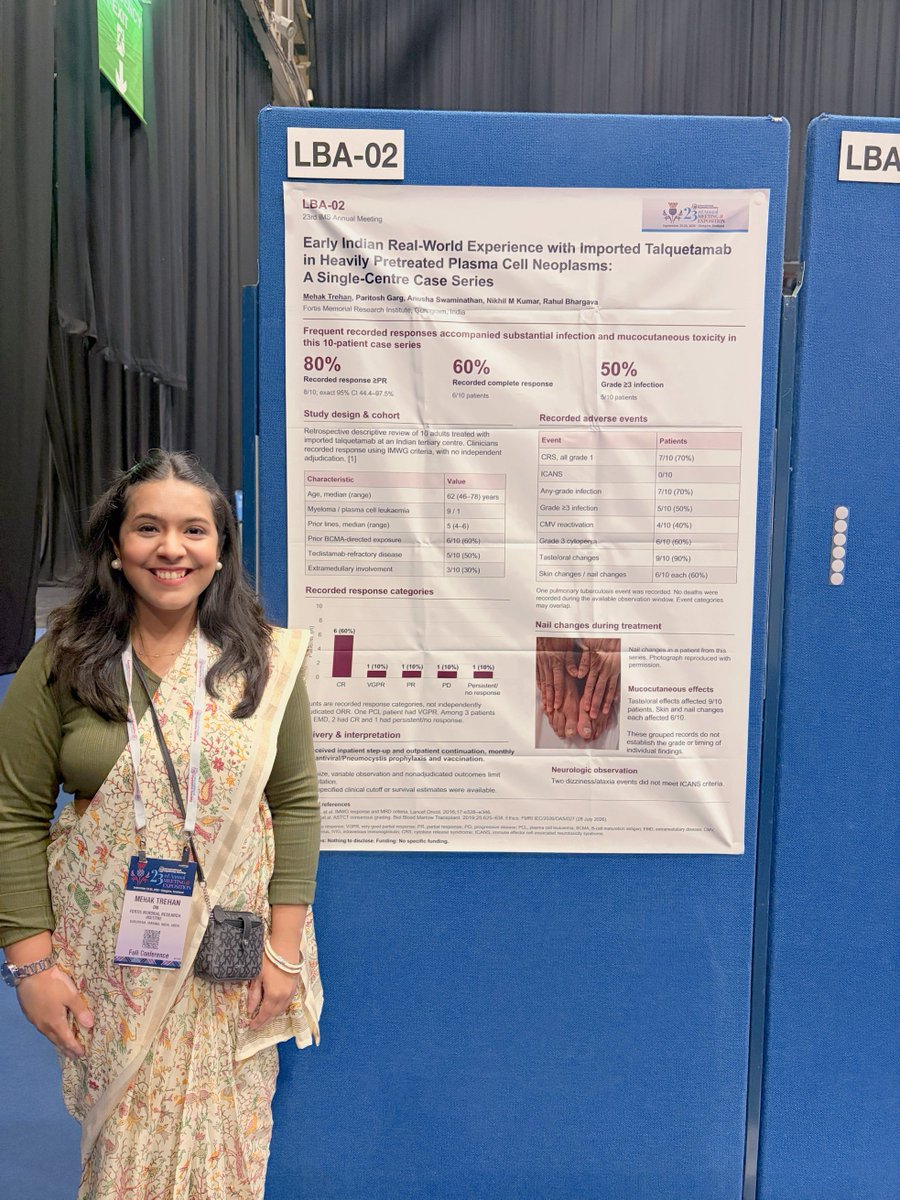

Late-Breaking Abstract at #IMS2026.
Proud to share our Fortis real-world talquetamab (Which is still not available commercially in the country) data on the global myeloma stage.
Grateful to @RahulDoc2 for the encouragement to turn clinical experience into meaningful data.
#MMsm https://t.co/ZbnAxH579F
Photo of poster board "LBA-02", 23rd IMS Annual Meeting:
LBA-02
Early Indian Real-World Experience with Imported Talquetamab in Heavily Pretreated Plasma Cell Neoplasms: A Single-Centre Case Series
Mehak Trehan, Paritosh Garg, Anusha Swaminathan, Nikhil M Kumar, Rahul Bhargava
Fortis Memorial Research Institute, Gurugram, India
Frequent recorded responses accompanied substantial infection and mucocutaneous toxicity in this 10-patient case series
80% Recorded response ≥PR (8/10; exact 95% CI 44.4-97.5%)
60% Recorded complete response (6/10 patients)
50% Grade ≥3 infection (5/10 patients)
Study design & cohort:
Retrospective descriptive review of 10 adults treated with imported talquetamab at an Indian tertiary centre. Clinicians recorded response using IMWG criteria, with no independent adjudication. [1]
Table - Characteristic | Value:
Age, median (range): 62 (46-78) years
Myeloma / plasma cell leukaemia: 9 / 1
Prior lines, median (range): 5 (4-6)
Prior BCMA-directed exposure: 6/10 (60%)
Teclistamab-refractory disease: 5/10 (50%)
Extramedullary involvement: 3/10 (30%)
Recorded adverse events (table):
Event | Patients
CRS, all grade 1: 7/10 (70%)
ICANS: 0/10
Any-grade infection: 7/10 (70%)
Grade ≥3 infection: 5/10 (50%)
CMV reactivation: 4/10 (40%)
Grade 3 cytopenia: 6/10 (60%)
Taste/oral changes: 9/10 (90%)
Skin changes / nail changes: 6/10 each (60%)
One pulmonary tuberculosis event was recorded. No deaths were recorded during the available observation window. Event categories may overlap.
Recorded response categories (bar chart, counts out of 10): CR 6 (60%), VGPR 1 (10%), PR 1 (10%), PD 1 (10%), Persistent/no response 1 (10%)
Counts are recorded response categories, not independently adjudicated ORR. One PCL patient had VGPR. Among 3 patients [with] EMD, 2 had CR and 1 had persistent/no response.
Delivery & interpretation: [text partially obscured by presenter] received inpatient step-up and outpatient continuation, monthly antiviral/Pneumocystis prophylaxis and vaccination. [Small sample] size, variable observation and nonadjudicated outcomes limit [interpret]ation. [No pre]specified clinical cutoff or survival estimates were available.
Nail changes during treatment: photo of hands showing nail changes in a patient from this series. Photograph reproduced with permission.
Mucocutaneous effects: Taste/oral effects affected 9/10 patients. Skin and nail changes each affected 6/10.
These grouped records do not establish the grade or timing of individual findings.
Neurologic observation: Two dizziness/ataxia events did not meet ICANS criteria.
[Footnote references partially cut off]: IMWG response and MRD criteria. Lancet Oncol. 2016;17:e328-e346. [...] ASTCT consensus grading. Biol Blood Marrow Transplant. 2019;25:625-638. Ethics: FMRI IEC/2026/OAS/027 (28 July 2026).
Response; VGPR, very good partial response; PR, partial response; PD, progressive disease; PCL, plasma cell leukaemia; BCMA, B-cell maturation antigen; EMD, extramedullary disease; CMV, cytomegalovirus; IVIG, intravenous immunoglobulin; CRS, cytokine release syndrome; ICANS, immune effector cell-associated neurotoxicity syndrome.
Disclosures: Nothing to disclose. Funding: No specific funding.



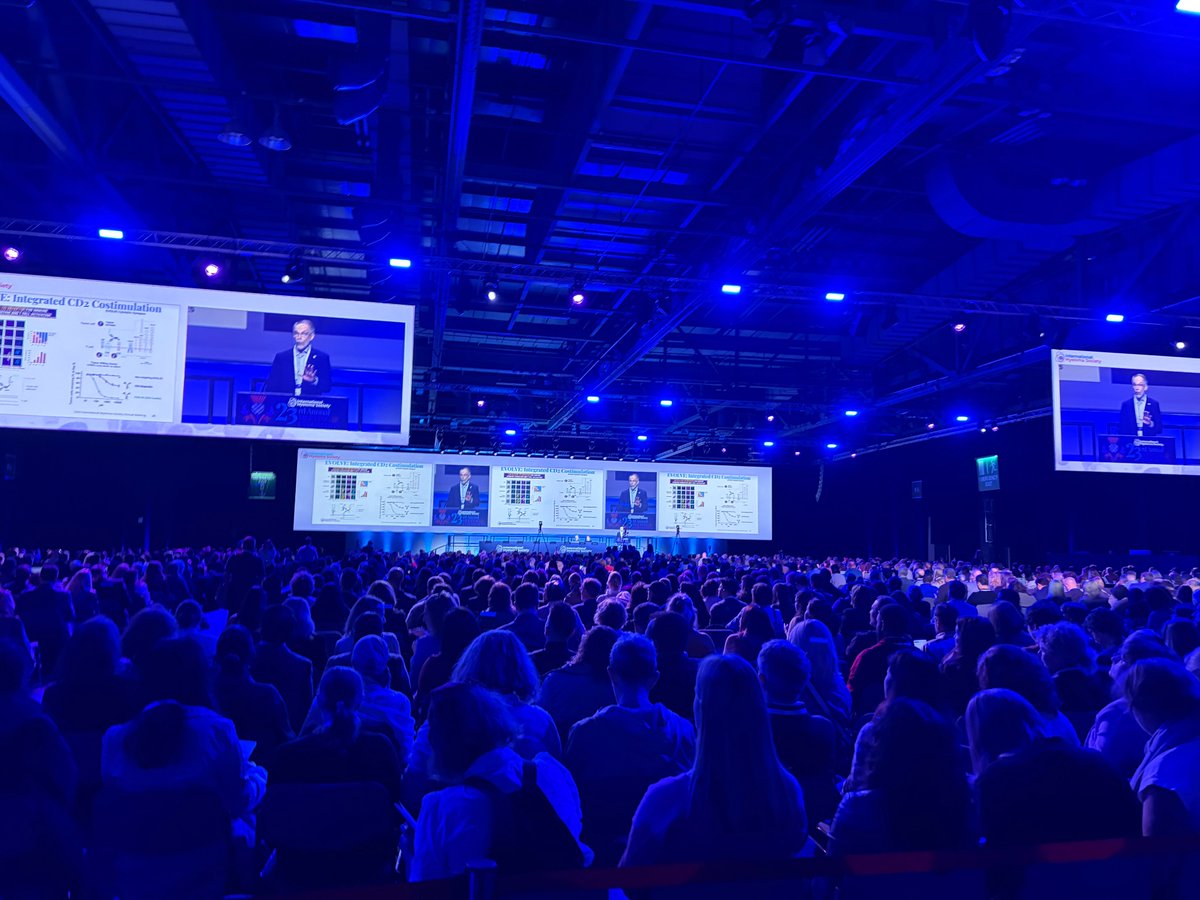
 Sep 23


Interesting questions raised by @PerrotAurore at #IMS26.
After many ASCT trials using similar control backbones, the question is evolving from “ASCT or no ASCT?” to “who needs what?” with a smart sneak peek of what the future might look like.
#MultipleMyeloma @Myeloma_Society https://t.co/8BTprgdpnP
Where we come from: ASCT vs the same drugs
Bar chart - Absolute median PFS gain with ASCT (months):
IFM 90 (27 vs 18): +9
EMN02 (56.7 vs 41.9): +14.8
IFM 2009 (47 vs 35): +12
DETERMINATION (67 vs 46): +21
FORTE (99 vs 70): +29
Labels: median PFS with ASCT vs without (months); FORTE = KRd-ASCT vs KRd12, no transplant
Attal 1996; Cavo 2020; Richardson 2022; Gay 2021; FORTE 8-y update, EHA 2025 (median PFS 99 vs 70 mo, HR 0.69); Chakraborty, Cancer 2022
The control arm never changed:
Chemotherapy -> VMP -> VRd -> KRd: always proteasome inhibitor ± IMiD
No anti-CD38, no immunotherapy in any no-ASCT arm
Benefit grows with induction depth: +9 months (IFM 90) to +29 months (FORTE, 8-year follow-up)
OS gain mostly in high-risk cytogenetics: HR 0.66 vs 0.90 in standard risk (4 RCTs, n = 2,959)
Banner: ASCT was tested against the same mechanisms of action, never against a new one
International Myeloma Society
23rd International Myeloma Society Annual Meeting 2
Who might still need an alkylator?
Table:
Profile | Why an alkylator might still matter | Evidence today
t(11;14) | Overexpresses cyclin D1. BCL2 dependence -> cells more "primed" for apoptosis -> hypothesis: more sensitive to pro-apoptotic stress including melphalan | Hypothesis? MIDAS small numbers t(11;14): n=32 Arm A, n=46 Arm B
Very high risk (biallelic TP53, ≥2 CGS criteria, PCL) | Proliferative disease: cytotoxic pressure may complement T-cell engagement | Tandem ASCT case by case, no robust data
Extramedullary disease, high tumor burden | Rapid debulking alongside cell therapy (bridging, CRS risk) | Hypothesis?
Antigen escape (BCMA loss) | Argues first for dual targeting (BCMA × GPRC5D, BCMA/CD19) rather than an alkylator | Being tested in the multi-target trials
T-cell fitness, marrow microenvironment | Exhausted or immune-cold marrow: T-cell engagement may not suffice; Mel may modify the niche | Hypothesis: biomarker to test?
The new trials need prespecified biology-based subgroups and translational cohorts: MRD kinetics, T-cell fitness, target expression
International Myeloma Society
23rd International Myeloma Society Annual Meeting 7
Perspectives: which patient needs what?
Three columns: Standard risk, MRD-negative | Grey zone (e.g., t(11;14), MRD-positive) | High / very high risk
Today (all three columns): Anti-CD38-VRd -> Mel 200 + ASCT -> Dara-R
Tomorrow (if the trials are positive):
- Standard risk, MRD-negative: Anti-CD38-VRd -> T-cell redirection (bispecific or CAR-T), no Mel 200
- Grey zone: Open question: is an alkylator still needed? Biomarker-driven trials
- High / very high risk: ASCT + T-cell redirection (e.g., ASCT -> anti-BCMA CAR-T)
Banner: Today: ASCT for all eligible patients. Tomorrow: not "ASCT or not", but which patient needs which.
International Myeloma Society
23rd International Myeloma Society Annual Meeting 8
Sep 23


#IMS26 #mmsm Cure in myeloma @NikhilMunshiMD @VincentRK @Myeloma_Society
Focus on the great cure summit we had earlier this year
Definition of cure
We will have some data on late relapse and its characteristics in the near future
Myeloma is a curable malignancy https://t.co/dacvhMofNm
Proposed Definition of Cure
- Patient could be newly-diagnosed or with relapsed myeloma
- Patient in sustained Complete Remission (CR) by standard criteria
- MRD negative at 10^-6 sensitivity by either NGS or NGF
- MRD negativity Sustained for 5 years WITHOUT any therapy. (Irrespective of length of previous sustained MRD negativity on therapy)
- There should be at least 4 MRD assessments in 5 years, last one being at 5 years; all negative and no positive test in between, if performed.
- Negative by functional imaging (PET/CT or DWI WB MRI)
- At least at the beginning of 5 years period and at the end of 5 years period with no intervening positivity, if performed.
International Myeloma Society
[Slide number 28]
Cure Fraction
- Accumulated data suggests that a cure fraction is observed following various therapies and long-term follow up
- Average calculated cure ranges between 5-30%
- These numbers are with therapies utilized 10 years ago. We would predict a higher number with the current modern therapies
- The cure fraction varies based on
- Type of therapy
- Age
- Myeloma Risk categories
International Myeloma Society
[Slide number 29]
Sep 23

Catching up with #IMS26 online, I was struck by this reminder: clinical-trial participation remains disproportionately concentrated.
We definitely need broader, more diverse participation to confidently extrapolate trial findings to real-world patients.
@Myeloma_Society https://t.co/Nywan6z0I5
Table: Clinical trial participation by country (columns: Country | Number of Trials | Total Enrollment | Population 2025), with red arrows highlighting select rows (United States, Canada, France, Germany, China):
United States: 337 | 17,962.0 | 341,814,000 [arrow highlighted]
Israel: 6 | 400.0 | 9,932,000
Norway: 3 | 215.0 | 5,550,000
Denmark: 3 | 60.0 | 5,973,000
Greece: 5 | 219.0 | 10,246,000
Switzerland: 4 | 411.0 | 8,968,000
Canada: 17 | 1498.0 | 41,288,000 [arrow highlighted]
Netherlands: 6 | 878.0 | 17,942,000
France: 19 | 3001.0 | 68,374,000 [arrow highlighted]
Sweden: 3 | 83.0 | 10,658,000
Ireland: 1 | 16.0 | 5,281,000
Spain: 9 | 884.0 | 48,592,000
Japan: 20 | 484.0 | 123,753,000
Australia: 4 | 363.0 | 27,184,000
Germany: 11 | 2239.0 | 84,593,000 [arrow highlighted]
United Kingdom: 8 | 1005.0 | 68,598,000
Austria: 1 | 200.0 | 9,159,000
Belgium: 1 | 23.0 | 11,738,000
China: 102 | 6282.0 | 1,408,112,000 [arrow highlighted]
Italy: 4 | 199.0 | 58,784,000
Slide number 64. Small inset video/photo of a speaker at a podium (International Myeloma Society branding) in the top-right corner.
International Myeloma Society
 Sep 23


@DrKrinaPatel shining at #IMS26 in making a case for CART at first relaps.
1. Outcomes are better when CART is done earlier
2. Better Tumor Microenvironment and T cell
Health
3. treatment free time, one and done approach
#mmsm https://t.co/aoTYuFZILx
International Myeloma Society
RWE: Cilta-cel outcomes in earlier versus later lines
German nationwide registry of standard-of-care cilta-cel, 2022-2025
OUTCOME | EARLIER LINE (1-3 prior lines, n = 177) | LATER LINE (>3 prior lines, n = 429)
12-month PFS: 79% (95% CI, 71-87) | 70% (95% CI, 65-76)
Overall response rate: 91% | 88%
Complete response: 63% | 54%
Non-ICANS neurotoxicity: 3% | 8%
Maintained CR was associated with 100% PFS at 12 months in both cohorts
Gagelmann N, et al. J Hematol Oncol. 2026;19:46. doi:10.1186/s13045-026-01806-6
Nonrandomized registry analysis. The investigators did not perform formal comparisons between cohorts.
Sep 23
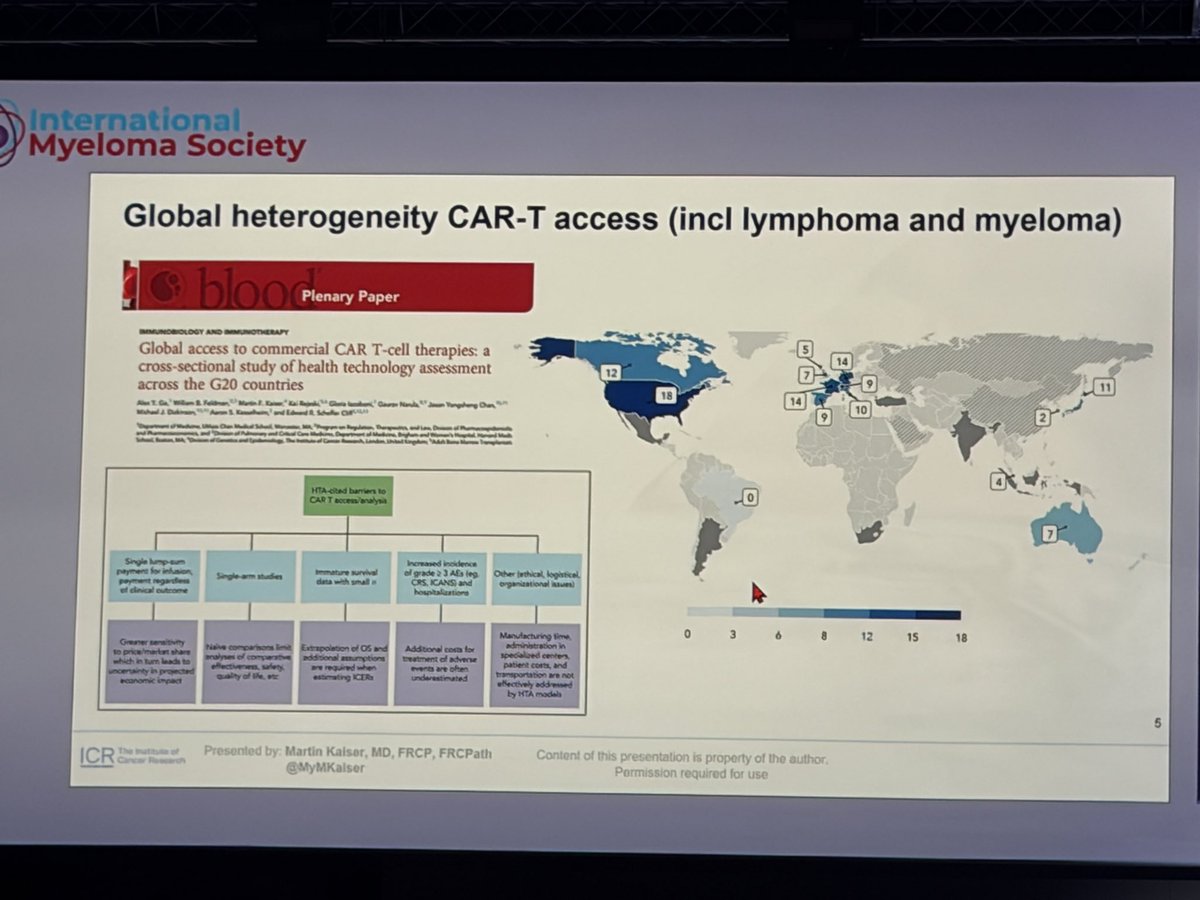


#IMS26 Great talk by @MyMKaiser on How to treat myeloma at 1st relapse when resources are limited:
• Access varies widely: 18 commercial CAR-Ts in the US vs 0 in Brazil
• Risk-stratify + MRD-track to target the right patient
• Options: TCE+CD38, CAR-T, ADC or traditional triplet
• Standard-risk MRD-neg → consider stopping
#mmsm @Myeloma_Society
International Myeloma Society
Global heterogeneity CAR-T access (incl lymphoma and myeloma)
blood — Plenary Paper
IMMUNOBIOLOGY AND IMMUNOTHERAPY
Global access to commercial CAR T-cell therapies: a cross-sectional study of health technology assessment across the G20 countries
Alex T. Ga, William B. Feldman, Martin F. Kaiser, Kai Rejeski, Gloria Iacoboni, Gaurav Narula, Jason Yongsheng Chan, Michael J. Dickinson, Aaron S. Kesselheim, and Edward R. Scheffer Cliff
[affiliations partially illegible: Department of Medicine, UMass Chan Medical School, Worcester, MA; Program on Regulation, Therapeutics, and Law, Division of Pharmacoepidemiology and Pharmacoeconomics, ... Brigham and Women's Hospital, Harvard Medical School, Boston, MA; Division of Genetics and Epidemiology, The Institute of Cancer Research, London, United Kingdom; Adult Bone Marrow Transplant ...]
[Diagram] HTA-cited barriers to CAR T access/analysis:
• Single lump-sum payment for infusion; payment regardless of clinical outcome → Greater sensitivity to price/market share which in turn leads to uncertainty in projected economic impact
• Single-arm studies → Naive comparisons limit analyses of comparative effectiveness, safety, quality of life, etc
• Immature survival data with small n → Extrapolation of OS and additional assumptions are required when estimating ICERs
• Increased incidence of grade ≥ 3 AEs (eg, CRS, ICANS) and hospitalizations → Additional costs for treatment of adverse events are often underestimated
• Other (ethical, logistical, organizational issues) → Manufacturing time, administration in specialized centers, patient costs, and transportation are not effectively addressed by HTA models
[World map with number of approved CAR T products per country: US 18, Canada 12, UK/EU region 5/14/7/9/14/9/10, Japan 11, China 2, Australia 7, Brazil 0, others shown 4; color scale 0-18]
ICR The Institute of Cancer Research — Presented by: Martin Kaiser, MD, FRCP, FRCPath @MyMKaiser
Content of this presentation is property of the author. Permission required for use
International Myeloma Society
Getting the right treatment to the right patient:
Using diagnostics to personalise care and maximise treatment value?
[Flow diagram]
GEP risk* + IMS-IMWG (NGS) + WB-MRI → Enhanced Risk Assessment at 1st relapse
Bone marrow NGS MRD + WB-MRI Imaging MRD → Personalised MRD tracking
Enhanced Risk Assessment + Personalised MRD tracking = Joint decision making — Choice essential!
Patient factors/preference → Treatment selection, e.g.: Option: TCE+CD38¹ | Option: CAR-T² | Option: ADC triplet | Option: Trad triplet — etc
→ e.g. for High-Risk MM: Continued treatment*
→ e.g. for Standard Risk + MRD-neg: Treatment Stop* optional
Enhanced remission monitoring PB Mass-Spec
1 Banerjee R, et al, EHA 2026
2 Costa L, et al, ASH 2025
*Kaiser M et al, JCO 2023; Leypoldt L JCO 2024; Beer S et al, Blood 2026; Kaiser M et al, Lancet Onc 2026; Kumar S et al, NEJM 2026
UK patient-centric diagnostic pathway in development by UKMS
Presently accessible: MyTrack Myeloma, others...
UK Myeloma Society
[International] Myeloma Society
Summary
• Limited access to new treatments can have multiple reasons
• In high-income countries, not all reasons are linked to treatment cost
• Practice-relevant data is increasingly important in context of HTA
• Diagnostics can play an important part in defining treatment value moving forward - 'right treatment for the right patient'
• Joint efforts and collaboration (academic trial groups and networks) can be valuable for access to best treatments


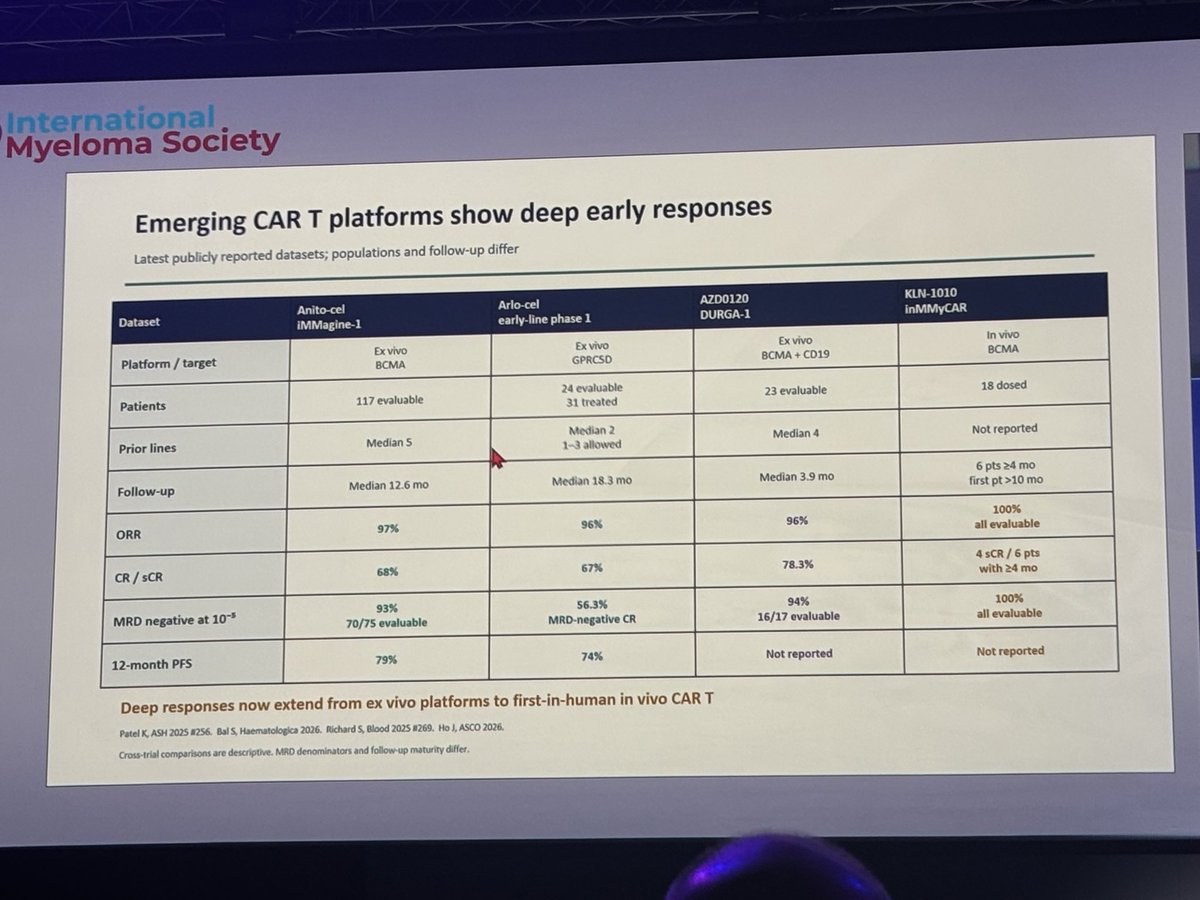 Sep 23

Zach Avigan with a groundbreaking presentation at #IMS26. #mmsm @TischCancer @Myeloma_Society : MRD depth by NGS and distinct clonotypic patterns below the
limit of detection predict divergent relapse risk after sustained
remission https://t.co/MEGoaF8Lg1
[Slide 1 of 2 in composite photo]
MRD state and relapse after sMRD24
Cumulative Incidence of Relapse by MRD State
Y-axis: Relapse probability (0.00–1.00); X-axis: Months from first MRD negativity (0–96)
NGS-neg or LOD0: aHR (95% CI) Reference
NGS-LOD+ or NGF-neg: 8.02 (4.25–15.10)
p < 0.0001
Callout: MRD confirmation as NGS-neg or LOD0 even once significantly decreases relapse risk after sMRD24
Number at risk (number censored):
Neg/LOD0: 280 (0) | 280 (0) | 280 (2) | 242 (41) | 189 (98) | 120 (153) | 74 (191) | 48 (214) | 21 (242)
LOD+/NGF: 150 (0) | 150 (0) | 150 (0) | 138 (4) | 116 (16) | 91 (32) | 57 (49) | 43 (63) | 17 (88)
16
---
[Slide 2 of 2 in composite photo]
Flow vs NGS sensitivity
Flow-neg samples with simultaneous NGS (N=232)
[Pie chart:] NGS-neg 47% | NGS-pos 16% | LOD+ 22% | LOD0 15%
[Table:] | Relapse | Relapse or MRD Resurg
NGS-neg or LOD0: 0.7% | 1.4%
NGS-pos or LOD+: 7% | 16%
23rd International Myeloma Society Annual Meeting | 12
International Myeloma Society
 Sep 23
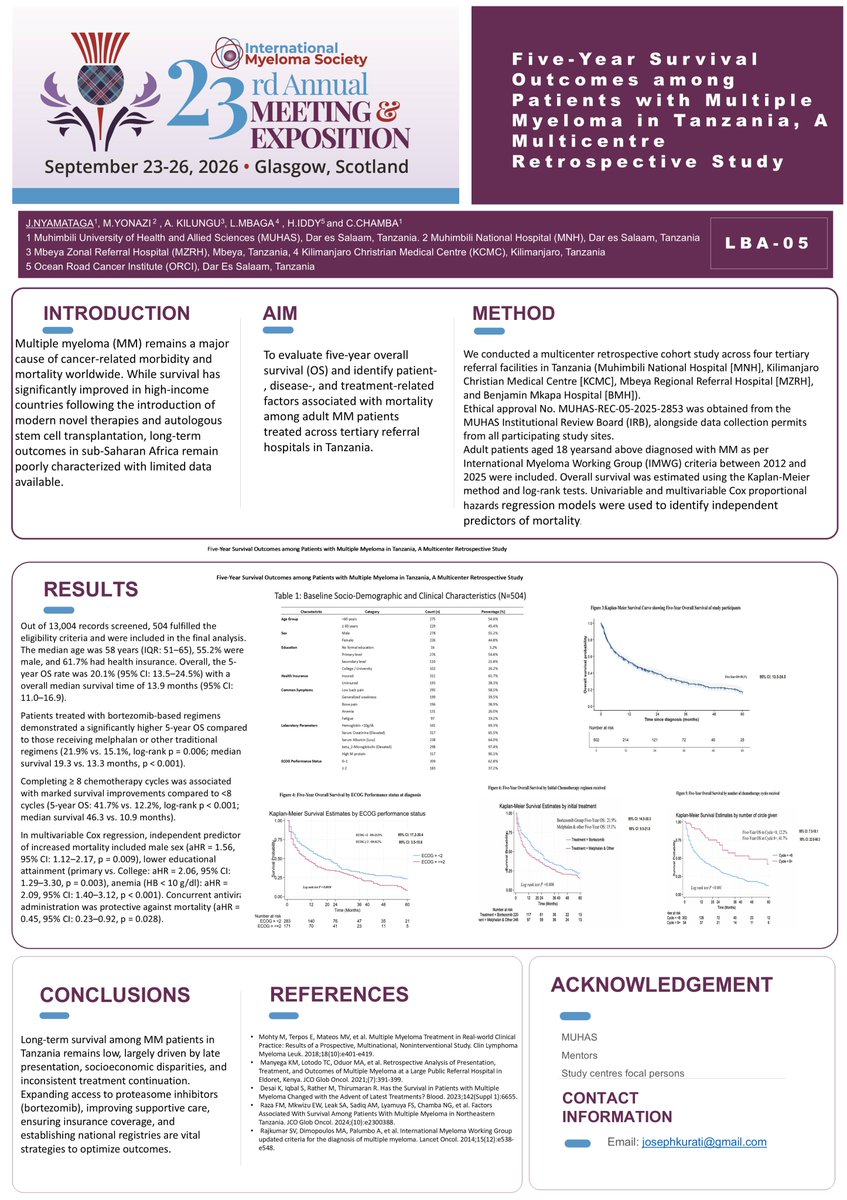
#IMS26 LBA -05 Five Year OS of Myeloma in Tanzania remain low despite Global advancements. A call for Integrated Clinical, Laboratory, Cytogenetic and Molecular
Risk Stratification of Multiple Myeloma in Tanzania, From Early Detection to
Personalized Myeloma care. https://t.co/qVQ5h4iFG4
International Myeloma Society 23rd Annual MEETING & EXPOSITION — September 23-26, 2026 · Glasgow, Scotland
Five-Year Survival Outcomes among Patients with Multiple Myeloma in Tanzania, A Multicentre Retrospective Study
LBA-05
J.NYAMATAGA¹, M.YONAZI², A. KILUNGU³, L.MBAGA⁴, H.IDDY⁵ and C.CHAMBA¹
1 Muhimbili University of Health and Allied Sciences (MUHAS), Dar es Salaam, Tanzania. 2 Muhimbili National Hospital (MNH), Dar es Salaam, Tanzania
3 Mbeya Zonal Referral Hospital (MZRH), Mbeya, Tanzania, 4 Kilimanjaro Christian Medical Centre (KCMC), Kilimanjaro, Tanzania
5 Ocean Road Cancer Institute (ORCI), Dar Es Salaam, Tanzania
INTRODUCTION
Multiple myeloma (MM) remains a major cause of cancer-related morbidity and mortality worldwide. While survival has significantly improved in high-income countries following the introduction of modern novel therapies and autologous stem cell transplantation, long-term outcomes in sub-Saharan Africa remain poorly characterized with limited data available.
AIM
To evaluate five-year overall survival (OS) and identify patient-, disease-, and treatment-related factors associated with mortality among adult MM patients treated across tertiary referral hospitals in Tanzania.
METHOD
We conducted a multicenter retrospective cohort study across four tertiary referral facilities in Tanzania (Muhimbili National Hospital [MNH], Kilimanjaro Christian Medical Centre [KCMC], Mbeya Regional Referral Hospital [MZRH], and Benjamin Mkapa Hospital [BMH]).
Ethical approval No. MUHAS-REC-05-2025-2853 was obtained from the MUHAS Institutional Review Board (IRB), alongside data collection permits from all participating study sites.
Adult patients aged 18 years and above diagnosed with MM as per International Myeloma Working Group (IMWG) criteria between 2012 and 2025 were included. Overall survival was estimated using the Kaplan-Meier method and log-rank tests. Univariable and multivariable Cox proportional hazards regression models were used to identify independent predictors of mortality.
RESULTS
Out of 13,004 records screened, 504 fulfilled the eligibility criteria and were included in the final analysis. The median age was 58 years (IQR: 51-65), 55.2% were male, and 61.7% had health insurance. Overall, the 5-year OS rate was 20.1% (95% CI: 13.5-24.5%) with a overall median survival time of 13.9 months (95% CI: 11.0-16.9).
Patients treated with bortezomib-based regimens demonstrated a significantly higher 5-year OS compared to those receiving melphalan or other traditional regimens (21.9% vs. 15.1%, log-rank p = 0.006; median survival 19.3 vs. 13.3 months, p < 0.001).
Completing ≥ 8 chemotherapy cycles was associated with marked survival improvements compared to <8 cycles (5-year OS: 41.7% vs. 12.2%, log-rank p < 0.001; median survival 46.3 vs. 10.9 months).
In multivariable Cox regression, independent predictors of increased mortality included male sex (aHR = 1.56, 95% CI: 1.12-2.17, p = 0.009), lower educational attainment (primary vs. College: aHR = 2.06, 95% CI: 1.29-3.30, p = 0.003), anemia (HB < 10 g/dl): aHR = 2.09, 95% CI: 1.40-3.12, p < 0.001). Concurrent antiviral administration was protective against mortality (aHR = 0.45, 95% CI: 0.23-0.92, p = 0.028).
Table 1: Baseline Socio-Demographic and Clinical Characteristics (N=504)
Age Group: <60 years 275 (54.6%), ≥ 60 years 229 (45.4%)
Sex: Male 278 (55.2%), Female 226 (44.8%)
Education: No formal education 16 (3.2%), Primary level 276 (54.8%), Secondary level 110 (21.8%), College / University 102 (20.2%)
Health Insurance: Insured 311 (61.7%), Uninsured 193 (38.3%)
Common Symptoms: Low back pain 295 (58.5%), Generalized weakness 199 (39.5%), Bone pain 196 (38.9%), Anemia 131 (26.0%), Fatigue 97 (19.2%)
Laboratory Parameters: Hemoglobin <10g/dL 341 (69.5%), Serum Creatinine (Elevated) 317 (65.5%), Serum Albumin (Low) 238 (64.0%), beta_2-Microglobulin (Elevated) 298 (97.4%), High M-protein 317 (90.1%)
ECOG Performance Status: 0-1 309 (62.8%), ≥ 2 183 (37.2%)
Figure 3: Kaplan-Meier Survival Curve showing Five-Year Overall Survival of study participants — Five-Year OS=20.1%, 95% CI: 13.5-24.5
Figure 4: Five-Year Overall Survival by ECOG Performance status at diagnosis — ECOG <2 OS=23.9% (95% CI: 17.2-30.4); ECOG ≥2 OS=8.3% (95% CI: 3.5-15.6); Log rank test P = 0.001
Figure 6: Five-Year Overall Survival by Initial Chemotherapy regimen received — Bortezomib Group Five-Year OS: 21.9% (95% CI: 14.5-30.3); Melphalan & other Five-Year OS: 15.1% (95% CI: 9.5-21.8); Log rank test P = 0.006
Figure 5: Five-Year Overall Survival by number of chemotherapy cycles received — Five-Year OS in Cycle <8: 12.2% (95% CI: 7.5-18.1); Five-Year OS in Cycle 8+: 41.7% (95% CI: 22.8-60.3); Log rank test P <0.001
CONCLUSIONS
Long-term survival among MM patients in Tanzania remains low, largely driven by late presentation, socioeconomic disparities, and inconsistent treatment continuation. Expanding access to proteasome inhibitors (bortezomib), improving supportive care, ensuring insurance coverage, and establishing national registries are vital strategies to optimize outcomes.
REFERENCES
• Mohty M, Terpos E, Mateos MV, et al. Multiple Myeloma Treatment in Real-world Clinical Practice: Results of a Prospective, Multinational, Noninterventional Study. Clin Lymphoma Myeloma Leuk. 2018;18(10):e401-e419.
• Manyega KM, Lotodo TC, Oduor MA, et al. Retrospective Analysis of Presentation, Treatment, and Outcomes of Multiple Myeloma at a Large Public Referral Hospital in Eldoret, Kenya. JCO Glob Oncol. 2021;(7):391-399.
• Desai K, Iqbal S, Rather M, Thirumaran R. Has the Survival in Patients with Multiple Myeloma Changed with the Advent of Latest Treatments? Blood. 2023;142(Suppl 1):6655.
• Raza FM, Mkwizu EW, Leak SA, Sadiq AM, Lyamuya FS, Chamba NG, et al. Factors Associated With Survival Among Patients With Multiple Myeloma in Northeastern Tanzania. JCO Glob Oncol. 2024;(10):e2300388.
• Rajkumar SV, Dimopoulos MA, Palumbo A, et al. International Myeloma Working Group updated criteria for the diagnosis of multiple myeloma. Lancet Oncol. 2014;15(12):e538-e548.
ACKNOWLEDGEMENT
MUHAS; Mentors; Study centres focal persons
CONTACT INFORMATION
Email: josephkurati@gmail.com

 Sep 23

@JanakiramMurali presenting : Poor outcomes post sequential BCMA and GPRC5D exposed
myeloma can be improved by subsequent targeted agents versus
conventional therapy: An IMWG Immunotherapy Registry Analysis
#IMS26 #mmsm @Myel_Society https://t.co/6iJOppB1Vk
[Slide 1 of 2 in composite photo]
Flow Between BCMA and GPRC5D directed therapy
Flow between BCMA-, GPRC5D-, and FcRH5-directed immunotherapy exposures across successive lines of immune-effector-cell (IEC) therapy
True Dual Exposure cohort (N = 151)
Columns: 1st IEC exposure | 2nd IEC exposure | 3rd IEC exposure | 4th+ IEC exposure
[Sankey diagram; legible node labels:] No further exposure 44 (29%) [after 3rd IEC]; No further exposure 117 (77%); 4th+ (has more) [count partially legible: 3]4 (23%)
Legend: BCMA | GPRC5D | FcRH5 | Combo (≥2 targets, same line) | No further exposure | 4th+ (has more)
Footnote: Each patient's immunotherapy exposures are ordered by the sequence in which they were administered (bridging/non-IEC chemotherapy regimens are excluded from the sequence). "Combo" denotes a single regimen/line targeting more than one of BCMA, GPRC5D, or FcRH5 simultaneously, counted regardless of whether exposures were sequential. Band width is proportional to patient count.
International Myeloma Society | 7
---
[Slide 2 of 2 in composite photo]
Short PFS after Dual Exposure
4.3 mo Median PFS (95% CI 3.8–5.5)
64% 3-month PFS
38% 6-month PFS
17% 12-month PFS
[Kaplan-Meier curve: Event-free probability (0–100%) vs Months from dual exposure (0–30)]
Number at risk: All 116 | 38 | 15 | 9 | 4 | 1


 Sep 23
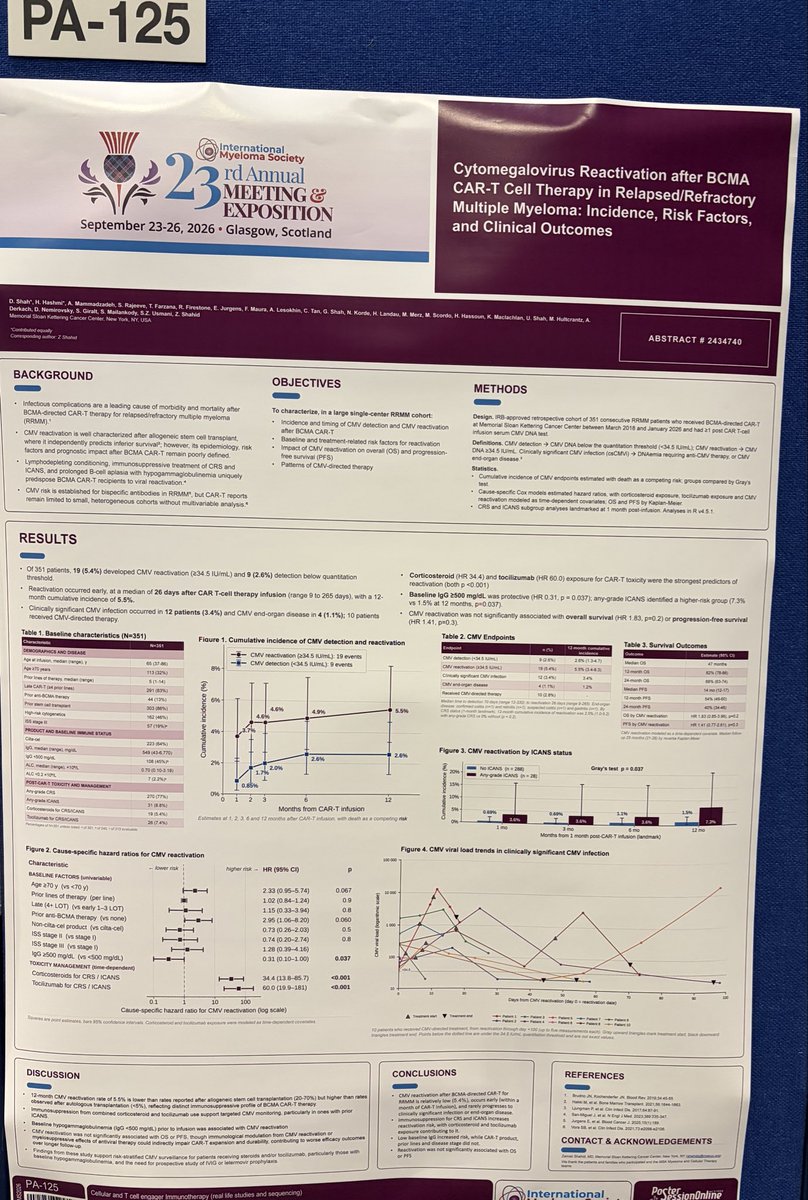
#IMS26: CMV after BCMA CAR-T: how common, and who's at risk?
MSKCC data (n=351) at #IMS2026 (PA-125):
🦠 12-mo reactivation 5.5%, median 26 days post-infusion
⚠️ Steroids (HR 34) & toci (HR 60) for CRS/ICANS drive risk
🛡️ IgG ≥500 protective (HR 0.31)
#mmsm #myeloma @Myeloma_Society @ZainabShd
PA-125
International Myeloma Society - 23rd Annual MEETING & EXPOSITION - September 23-26, 2026 . Glasgow, Scotland
Cytomegalovirus Reactivation after BCMA CAR-T Cell Therapy in Relapsed/Refractory Multiple Myeloma: Incidence, Risk Factors, and Clinical Outcomes
D. Shah*, H. Hashmi*, A. Mammadzadeh, S. Rajeeve, T. Farzana, R. Firestone, E. Jurgens, F. Maura, A. Lesokhin, C. Tan, G. Shah, N. Korde, H. Landau, M. Merz, M. Scordo, H. Hassoun, K. Maclachlan, U. Shah, M. Hultcrantz, A. Derkach, D. Nemirovsky, S. Giralt, S. Mailankody, S.Z. Usmani, Z. Shahid
Memorial Sloan Kettering Cancer Center, New York, NY, USA
*Contributed equally. Corresponding author: Z Shahid
ABSTRACT # 2434740
BACKGROUND
- Infectious complications are a leading cause of morbidity and mortality after BCMA-directed CAR-T therapy for relapsed/refractory multiple myeloma (RRMM).
- CMV reactivation is well characterized after allogeneic stem cell transplant, where it independently predicts inferior survival; however, its epidemiology, risk factors and prognostic impact after BCMA CAR-T remain poorly defined.
- Lymphodepleting conditioning, immunosuppressive treatment of CRS and ICANS, and prolonged B-cell aplasia with hypogammaglobulinemia uniquely predispose BCMA CAR-T recipients to viral reactivation.
- CMV risk is established for bispecific antibodies in RRMM, but CAR-T reports remain limited to small, heterogeneous cohorts without multivariable analysis.
OBJECTIVES
To characterize, in a large single-center RRMM cohort:
- Incidence and timing of CMV detection and CMV reactivation after BCMA CAR-T
- Baseline and treatment-related risk factors for reactivation
- Impact of CMV reactivation on overall (OS) and progression-free survival (PFS)
- Patterns of CMV-directed therapy
METHODS
Design. IRB-approved retrospective cohort of 351 consecutive RRMM patients who received BCMA-directed CAR-T at Memorial Sloan Kettering Cancer Center between March 2018 and January 2026 and had >=1 post CAR T-cell infusion serum CMV DNA test.
Definitions. CMV detection -> CMV DNA below the quantitation threshold (<34.5 IU/mL); CMV reactivation -> CMV DNA >=34.5 IU/mL. Clinically significant CMV infection (csCMVi) -> DNAemia requiring anti-CMV therapy, or CMV end-organ disease.
Statistics. Cumulative incidence of CMV endpoints estimated with death as a competing risk; groups compared by Gray's test. Cause-specific Cox models estimated hazard ratios, with corticosteroid exposure, tocilizumab exposure and CMV reactivation modeled as time-dependent covariates; OS and PFS by Kaplan-Meier. CRS and ICANS subgroup analyses landmarked at 1 month post-infusion. Analyses in R v4.5.1.
RESULTS
- Of 351 patients, 19 (5.4%) developed CMV reactivation (>=34.5 IU/mL) and 9 (2.6%) detection below quantitation threshold.
- Reactivation occurred early, at a median of 26 days after CAR T-cell therapy infusion (range 9 to 265 days), with a 12-month cumulative incidence of 5.5%.
- Clinically significant CMV infection occurred in 12 patients (3.4%) and CMV end-organ disease in 4 (1.1%); 10 patients received CMV-directed therapy.
- Corticosteroid (HR 34.4) and tocilizumab (HR 60.0) exposure for CAR-T toxicity were the strongest predictors of reactivation (both p <0.001)
- Baseline IgG >=500 mg/dL was protective (HR 0.31, p = 0.037); any-grade ICANS identified a higher-risk group (7.3% vs 1.5% at 12 months, p=0.037).
- CMV reactivation was not significantly associated with overall survival (HR 1.83, p=0.2) or progression-free survival (HR 1.41, p=0.3).
Table 1. Baseline characteristics (N=351)
Age at infusion, median (range), y: 65 (37-86)
Age >=70 years: 113 (32%)
Prior lines of therapy, median (range): 5 (1-14)
Late CAR-T (>=4 prior lines): 291 (83%)
Prior anti-BCMA therapy: 44 (13%)
Prior stem cell transplant: 303 (86%)
High-risk cytogenetics: 162 (46%)
ISS stage III: 57 (19%)
Cilta-cel: 223 (64%)
IgG, median (range), mg/dL: 549 (43-6,770)
IgG <500 mg/dL: 108 (45%)
ALC, median (range), x10^9/L: 0.70 (0.10-3.19)
ALC <0.2 x10^9/L: 7 (2.2%)
Any-grade CRS: 270 (77%)
Any-grade ICANS: 31 (8.8%)
Corticosteroids for CRS/ICANS: 19 (5.4%)
Tocilizumab for CRS/ICANS: 26 (7.4%)
Percentages of N=351 unless noted. [footnote partially illegible]
Figure 1. Cumulative incidence of CMV detection and reactivation
CMV reactivation (>=34.5 IU/mL): 19 events - 3.7% (1 mo), 4.6%, 4.6%, 4.9% (6 mo), 5.5% (12 mo)
CMV detection (<34.5 IU/mL): 9 events - 0.85%, 1.7%, 2.0%, 2.6% (6 mo), 2.6% (12 mo)
Estimates at 1, 2, 3, 6 and 12 months after CAR-T infusion, with death as a competing risk
Table 2. CMV Endpoints [Endpoint | n (%) | 12-month cumulative incidence]
CMV detection (<34.5 IU/mL): 9 (2.6%) | 2.6% (1.3-4.7)
CMV reactivation (>=34.5 IU/mL): 19 (5.4%) | 5.5% (3.4-8.3)
Clinically significant CMV infection: 12 (3.4%) | 3.4%
CMV end-organ disease: 4 (1.1%) | 1.2%
Received CMV-directed therapy: 10 (2.8%)
Median time to detection 70 days (range 12-330); to reactivation 26 days (range 9-265). End-organ disease: confirmed colitis (n=1) and retinitis (n=1), suspected colitis (n=1) and gastritis (n=1). [remainder of footnote illegible] 12-month cumulative incidence of reactivation was 2.5% (1.0-5.2) with any-grade CRS vs 0% without (p = 0.2) [partially illegible]
Table 3. Survival Outcomes [Outcome | Estimate (95% CI)]
Median OS: 47 months
12-month OS: 82% (78-86)
24-month OS: 68% (63-74)
Median PFS: 14 mo (12-17)
12-month PFS: 54% (49-60)
24-month PFS: 40% (34-46)
OS by CMV reactivation: HR 1.83 (0.85-3.96), p=0.2
PFS by CMV reactivation: HR 1.41 (0.77-2.61), p=0.3
CMV reactivation modeled as a time-dependent covariate. Median follow-up 25 months (21-26) by reverse Kaplan-Meier.
Figure 2. Cause-specific hazard ratios for CMV reactivation [Characteristic | HR (95% CI) | p]
BASELINE FACTORS (univariable)
Age >=70 y (vs <70 y): 2.33 (0.95-5.74) | 0.067
Prior lines of therapy (per line): 1.02 (0.84-1.24) | 0.9
Late (4+ LOT) (vs early 1-3 LOT): 1.15 (0.33-3.94) | 0.8
Prior anti-BCMA therapy (vs none): 2.95 (1.06-8.20) | 0.060
Non-cilta-cel product (vs cilta-cel): 0.73 (0.26-2.03) | 0.5
ISS stage II (vs stage I): 0.74 (0.20-2.74) | 0.8
ISS stage III (vs stage I): 1.28 (0.39-4.16) | 0.8
IgG >=500 mg/dL (vs <500 mg/dL): 0.31 (0.10-1.00) | 0.037
TOXICITY MANAGEMENT (time-dependent)
Corticosteroids for CRS / ICANS: 34.4 (13.8-85.7) | <0.001
Tocilizumab for CRS / ICANS: 60.0 (19.9-181) | <0.001
Squares are point estimates, bars 95% confidence intervals. Corticosteroid and tocilizumab exposure were modeled as time-dependent covariates.
Figure 3. CMV reactivation by ICANS status
No ICANS (n = 288) vs Any-grade ICANS (n = 28); Gray's test p = 0.037
1 mo: 0.69% vs 3.6%; 3 mo: 0.69% vs 3.6%; 6 mo: 1.1% vs 3.6%; 12 mo: 1.5% vs 7.3%
Months from 1 month post-CAR-T infusion (landmark)
Figure 4. CMV viral load trends in clinically significant CMV infection
10 patients who received CMV-directed treatment, from reactivation through day +100 (up to five measurements each). Gray upward triangles mark treatment start, black downward triangles treatment end. Points below the dotted line are under the 34.5 IU/mL quantitation threshold and are not exact values.
DISCUSSION
- 12-month CMV reactivation rate of 5.5% is lower than rates reported after allogeneic stem cell transplantation (20-70%) but higher than rates observed after autologous transplantation (<5%), reflecting distinct immunosuppressive profile of BCMA CAR-T therapy.
- Immunosuppression from combined corticosteroid and tocilizumab use support targeted CMV monitoring, particularly in ones with prior ICANS.
- Baseline hypogammaglobulinemia (IgG <500 mg/dL) prior to infusion was associated with CMV reactivation
- CMV reactivation was not significantly associated with OS or PFS, though immunological modulation from CMV reactivation or myelosuppressive effects of antiviral therapy could indirectly impair CAR-T expansion and durability, contributing to worse efficacy outcomes over longer follow-up.
- Findings from these study support risk-stratified CMV surveillance for patients receiving steroids and/or tocilizumab, particularly those with baseline hypogammaglobulinemia, and the need for prospective study of IVIG or letermovir prophylaxis.
CONCLUSIONS
- CMV reactivation after BCMA-directed CAR-T for RRMM is relatively low (5.4%), occurs early (within a month of CAR-T infusion), and rarely progresses to clinically significant infection or end-organ disease.
- Immunosuppression for CRS and ICANS increases reactivation risk, with corticosteroid and tocilizumab exposure contributing to it.
- Low baseline IgG increased risk, while CAR-T product, prior lines and disease stage did not.
- Reactivation was not significantly associated with OS or PFS.
REFERENCES
1. Brudno JN, Kochenderfer JN. Blood Rev. 2019;34:45-55.
2. Hakki M, et al. Bone Marrow Transplant. 2021;56:1644-1663.
3. Ljungman P, et al. Clin Infect Dis. 2017;64:87-91.
4. San-Miguel J, et al. N Engl J Med. 2023;389:335-347.
5. Jurgens E, et al. Blood Cancer J. 2025;15(1):189.
6. Vora SB, et al. Clin Infect Dis. 2021;73:e2098-e2106.
CONTACT & ACKNOWLEDGEMENTS
Zainab Shahid, MD, Memorial Sloan Kettering Cancer Center, New York, NY ([illegible]@mskcc.org). We thank the patients and families who participated and the MSK Myeloma and Cellular Therapy teams.
Footer: PA-125 - Cellular and T cell engager Immunotherapy (real life studies and sequencing)
Sep 23

Cilta-cel earlier vs later? Real-world MSKCC data (n=223) at #IMS26 (PA-079):
✅ ORR 98% (1–3 prior LOT) vs 94% (≥4)
📊 12-mo PFS 86% vs 68% (p=0.06); 12-mo OS 87% in both
⚠️ Prior BCMA exposure → shorter PFS & OS
💡Timing not independently prognostic on MVA
#mmsm #myeloma @Myeloma_Society
23rd Annual Meeting & Exposition — September 23-26, 2026 · Glasgow, Scotland
Ciltacabtagene Autoleucel as Early Versus Late Line of Therapy for Patients With Relapsed/Refractory Multiple Myeloma: A Real-World Analysis
A. Mammadzadeh, MD1 · H. Hashmi, MD1 · T. Sebastian, MD1 · S. Rajeeve, MD1 · T. Farzana, MPH1 · R. Firestone, MD, PhD1 · E. Jurgens, MD1 · K. C. Miller, MD1 · F. Maura, MD1 · A. Lesokhin, MD1 · C. Tan, MD1 · G. Shah, MD1 · N. Korde, MD1 · H. Landau, MD1 · M. Scordo, MD1 · H. Hassoun, MD1 · K. Maclachlan, MBBCh, PhD1 · U. A. Shah, MD, MS1 · M. Hultcrantz, MD, PhD1 · A. Derkach, PhD2 · D. Nemirovsky, MS2 · S. Giralt, MD1 · S. Mailankody, MBBS1 · S. Z. Usmani, MD, MBA, FACP, FASCO1 · M. Merz, MD1
1 Myeloma Service, Department of Medicine, Memorial Sloan Kettering Cancer Center, New York, NY · 2 Department of Epidemiology & Biostatistics, Memorial Sloan Kettering Cancer Center, New York, NY
Memorial Sloan Kettering Cancer Center — Abstract # 2436404
INTRODUCTION
Ciltacabtagene autoleucel (cilta-cel) produces deep and durable responses in relapsed/refractory multiple myeloma (RRMM). Real-world evidence on whether earlier administration improves survival remains limited.
AIM
Primary: Compare progression-free survival (PFS) and overall survival (OS) after early (1-3 prior LOT) versus late (>=4 prior LOT) cilta-cel.
Secondary: Compare efficacy and toxicity and identify independent baseline predictors of survival.
METHODS
Design: Single-center retrospective cohort of RRMM patients treated with commercial cilta-cel.
Groups: Early, 1-3 prior LOT (n=50); late, >=4 prior LOT (n=173).
Endpoints: PFS, OS, response, and Day +90 safety: CRS, ICANS, NINT, cytopenias, infections, and NRM.
Analysis: Cox models evaluated survival predictors. Inverse probability weighting addressed cytogenetics, EMD, functionally high-risk status, and disease burden.
CONCLUSIONS
• Timing alone was not independently associated with OS or PFS.
• Functionally high-risk disease predicted inferior OS.
• High-risk cytogenetics and EMD predicted inferior PFS.
• Prior BCMA exposure predicted shorter PFS and OS, supporting earlier cilta-cel use.
CONTACT
Aytaj Mammadzadeh, MD — mammada@mskcc.org
Abbreviations: BCMA, B-cell maturation antigen; CI, confidence interval; CR, complete response; CRS, cytokine release syndrome; EMD, extramedullary disease; FHR, functionally high-risk; HR, hazard ratio; ICANS, immune effector cell-associated neurotoxicity syndrome; LOT, lines of therapy; NRM, non-relapse mortality; NR, not reached; ORR, overall response rate.
RESULTS — Patient flow and outcomes
Identified in MSKCC REDCap (n=351) → Received other CAR T-cell products (n=128) / Treated with cilta-cel (n=223) → Early: 1-3 prior LOT (n=50) / Late: >=4 prior LOT (n=173) → BCMA-naive (n=143) / BCMA-exposed (n=30)
Table 1. Demographics and baseline disease characteristics
Characteristic | Overall N=223 | Early LOT N=50 | Late LOT N=173 | p-value
Age at infusion, median (range), y | 65 (38-86) | 65 (43-80) | 65 (38-86) | 0.5
Age >=70 y, n (%) | 72 (32%) | 16 (32%) | 56 (32%) | >0.9
Prior LOT, median (range) | 4 (1-12) | 3 (1-3) | 5 (4-12) | <0.001
Prior anti-BCMA, n (%) | 30 (13%) | 0 (0%) | 30 (17%) | 0.002
Functionally high-risk, n (%) | 121/208 (58%) | 25/45 (56%) | 96/163 (59%) | 0.7
High disease burden, n (%) | 26 (12%) | 4 (8%) | 22 (13%) | 0.4
High-risk cytogenetics, n (%) | 108/222 (49%) | 25/49 (51%) | 83/173 (48%) | 0.7
EMD: none | 162 (73%) | 37 (74%) | 125 (73%)
EMD: paraskeletal | 18 (8.1%) | 3 (6.0%) | 15 (8.7%)
EMD: extraosseous | 42 (19%) | 10 (20%) | 32 (19%) | >0.9
Key findings: • Earlier patients had fewer prior LOT • Prior BCMA exposure occurred only in the late group
Table 2. Efficacy by timing of cilta-cel
Outcome | Overall | Early LOT | Late LOT | p-value
ORR, n (%) | 211 (95%) | 49 (98%) | 162 (94%) | 0.3
CR or better, n (%) | 150 (67%) | 37 (74%) | 113 (65%) | 0.9
Median PFS, mo (95% CI) | 33 (25-NR) | NR | 31 (17-NR)
12-mo PFS, % (95% CI) | 71% (65-78) | 86% (75-97) | 68% (61-76) | 0.06
Median OS, mo (95% CI) | 51 (42-NR) | 51 (—) | NR (42-NR)
12-mo OS, % (95% CI) | 87% (83-92) | 87% (77-98) | 87% (82-93) | 0.7
12-mo NRM, % (95% CI) | 5.5% (2.9-9.3) | 7.3% (1.8-18) | 5.0% (2.3-9.2) | 0.7
Key findings: • Response rates and 12-month OS were similar • PFS favored earlier use numerically (p=0.06)
Table 3. Toxicity by timing of cilta-cel
Safety outcome through Day +90 | Overall | Early LOT | Late LOT | p-value
CRS, any grade, n (%) | 172 (77%) | 43 (86%) | 129 (75%) | 0.09
CRS, grade >=3, n (%) | 2 (0.9%) | 0 (0%) | 2 (1.2%) | >0.9
ICANS, any grade, n (%) | 14 (6.3%) | 3 (6.0%) | 11 (6.4%) | >0.9
ICANS, grade >=3, n (%) | 6 (2.7%) | 0 (0%) | 6 (3.5%) | 0.3
Non-ICANS neurotoxicity, n (%) | 22 (9.9%) | 5 (10%) | 17 (9.8%) | >0.9
D+90 cytopenia, any grade, n (%) | 126 (59%) | 29 (59%) | 97 (59%) | >0.9
D+90 cytopenia, grade >=3, n (%) | 36 (17%) | 10 (20%) | 26 (16%) | 0.4
D+90 infection, any grade, n (%) | 95 (43%) | 20 (40%) | 75 (43%) | 0.7
D+90 infection, grade >=3, n (%) | 35 (16%) | 5 (10%) | 30 (17%) | 0.2
Key findings: • No statistically significant toxicity differences • CRS was numerically higher in the early group (p=0.09)
SURVIVAL ANALYSES
A. PFS by timing: p=0.06 B. OS by timing: p=0.70
C. PFS by prior BCMA exposure: p<0.001 D. OS by prior BCMA exposure: p=0.005
Table 4. Multivariable models for OS and PFS
Characteristic | N | OS Events | OS HR | OS 95% CI | OS p | PFS Events | PFS HR | PFS 95% CI | PFS p
CAR-T timing: Early (1-3 LOT) | 44 | 5 | — | — | 0.8 | 8 | — | — | 0.14
Late (4+ LOT) | 134 | 21 | 1.17 | 0.43, 3.21 | | 49 | 1.71 | 0.80, 3.64
Age >=70 years: No | 122 | 17 | — | — | 0.5 | 41 | — | — | 0.7
Yes | 56 | 9 | 1.31 | 0.56, 3.09 | | 16 | 0.88 | 0.48, 1.61
Functionally high-risk disease: No | 77 | 6 | — | — | 0.001 | 20 | — | — | 0.2
Yes | 101 | 20 | 3.82 | 1.67, 8.74 | | 37 | 1.49 | 0.85, 2.61
High disease burden: No | 160 | 24 | — | — | 0.5 | 50 | — | — | 0.8
Yes | 18 | 2 | 0.63 | 0.15, 2.74 | | 7 | 1.13 | 0.50, 2.55
High-risk cytogenetics: No | 89 | 9 | — | — | 0.4 | 19 | — | — | 0.035
Yes | 89 | 17 | 1.47 | 0.64, 3.34 | | 38 | 1.98 | 1.04, 3.80
Extramedullary disease: No | 132 | 14 | — | — | 0.12 | 35 | — | — | 0.046
Paraskeletal only | 12 | 2 | 1.54 | 0.31, 7.63 | | 5 | 2.41 | 0.90, 6.46
Yes | 34 | 10 | 2.53 | 1.08, 5.96 | | 17 | 1.98 | 1.08, 3.63
Timing was not independently associated with OS or PFS. Functionally high-risk disease predicted inferior OS; high-risk cytogenetics and EMD predicted inferior PFS.
Sep 23

Tec or elra after prior BCMA therapy?
Real-world data from the IMWG Immunotherapy Database (n=451, 9 countries) at #IMS26 (PA-364):
📉 ORR 48% vs 71% in BCMA-naïve
📉 mPFS 2.7 vs 16.1 mo
📈 ≥9 mo since last BCMA agent → better PFS (HR 0.61)
#mmsm #myeloma @CarlynRTanMD @Myeloma_Society
International Myeloma Society — 23rd Annual Meeting & Exposition — September 23-26, 2026 · Glasgow, Scotland
Prior BCMA Exposure in Patients with Relapsed/Refractory Multiple Myeloma Treated with Teclistamab and Elranatamab from the IMWG Immunotherapy Database
CR. Tan1, H. Mian2, CY. Huang3, M. Dave4, H. Einsele5, T. Steinbrunn5, R. Hajek6, S.Z. Usmani1, R. Parrondo7, S. Chhabra8, E. Kastritis9, J. Martinez-Lopez10, L. Garderet11, C. Nagarajan12, WJ. Chng13, A. Tso14, M. Htut15, S. Bal16, J. Du17, K. Kim18, T. Martin3, Y. Lin19, R. Popat20
[affiliations fine print: 1. Myeloma Service, Department of Medicine, Memorial Sloan Kettering Cancer Center, New York, NY 2. Department of Oncology, McMaster University, Hamilton, ON, Canada 3. UCSF Helen Diller Family Comprehensive Cancer Center, San Francisco, CA 4. International Myeloma Foundation 5. Department of Internal Medicine II, University Hospital Wurzburg, Wurzburg, Germany 6. Department of Hematooncology, University of Ostrava, Ostrava, Czech Republic 7. Division of Hematology and Medical Oncology, Department of Medicine, Mayo Clinic, Jacksonville, FL 8. Division of Hematology and Medical Oncology, Department of Medicine, Mayo Clinic, Phoenix, AZ 9. Department of Clinical Therapeutics, National and Kapodistrian University of Athens, Athens, Greece 10. Departamento de Hematologia, Hospital 12 de Octubre, Complutense University, CNIO, Madrid, Spain 11. Service Hematologie, Hopital Universitaire Pitie-Salpetriere, Paris, France 12. Department of Haematology, Singapore General Hospital and National Cancer Centre Singapore 13. Department of Hematology and Oncology, Department of Medicine, University of Alabama at Birmingham [partially illegible] 14. [illegible] 15. City of Hope, Duarte, CA 16. [illegible] 17. Shanghai Changzheng Hospital, China 18. Samsung Medical Center, Seoul, South Korea / Sungkyunkwan University 19. Division of Hematology-Oncology and Blood and Marrow Transplantation Program, Mayo Clinic, Rochester, Minnesota 20. Department of Haematology, University College London Hospital, London, United Kingdom]
PA-364 — International Myeloma Foundation · International Myeloma Working Group
INTRODUCTION
• BCMA-targeted therapies, including CAR T-cell therapy (CART), bispecific antibodies (bsAb), and antibody drug conjugates (ADC) have changed the treatment landscape of RRMM.
• However, patients still relapse with limited subsequent treatment options.
• Data on outcomes with teclistamab (tec) and elranatamab (elra) after prior BCMA-directed therapy is limited due to small cohorts.
• In MajesTEC-1, 40 patients with prior BCMA-directed therapy (CART and ADC) subsequently received tec with ORR of 53%, median (m) duration of response (DOR) of 14.8 months, mPFS of 4.5 months, and mOS of 15.5 months.
AIM
• The International Myeloma Working Group (IMWG) Immunotherapy Working Group aimed to conduct a real-world analysis evaluating outcomes associated with teclistamab and elranatamab in a real-world cohort of patients treated with prior BCMA-directed agents.
• Data was analyzed from the International Myeloma Working Group (IMWG) Immunotherapy Database
METHOD
• This is an international multi-center retrospective study including patients with RRMM treated with teclistamab and elranatamab.
• Data was collected through the IMWG Immunotherapy Database from 9 countries (US, UK, Greece, Spain, Czech Republic, Germany, Singapore, Canada, and France).
• Data was collected until 4/24/2026.
• If patients received both teclistamab and elranatamab, outcome and safety data from the last bsAb received was included in the analysis.
• For the BCMA-exposed group, subgroups based on prior BCMA-directed agent(s) received include the following: CART, ADC, bsAb, ADC + CART, and >=2 BCMA agents with last agent being bsAb.
• Responses were determined by providers at the corresponding treatment centers according to the IMWG Uniform Response Criteria.
• Patient characteristics were summarized by proportion or median (interquartile range [IQR] or range), as appropriate.
• Kaplan-Meier methods and log-rank tests were used to summary and compare ORR, PFS, and OS.
RESULTS
• 451 patients (pts) with RRMM treated with tec or elra were included in this analysis.
• 353 pts were in the tec-treated group: 241 without prior BCMA (BCMA-naive) and 112 with prior BCMA exposure (BCMA-exposed).
• 98 pts were in the elra-treated group: 74 BCMA-naive and 24 BCMA-exposed.
• 53/126 (42%) BCMA-exposed pts received a BCMA-directed agent immediately prior to tec or elra.
• For 115 BCMA-exposed patients with available data, ORR for last prior BCMA-directed agent was 64% (>=VGPR 44%).
• Median time from last dose of prior BCMA-directed therapy to commencing tec or elra was 8.3 months (range, 0.5-77.1).
• Median follow-up was 11.8 months (range, 0.2-42.1).
• For the entire cohort, mPFS was 9.6 months (95%CI, 7.4-13.2), and mOS was 26.1 months (95%CI, 19.8-NR).
• ORR with tec or elra based on prior BCMA agent(s) received was as follows: ADC 58%, CART 41%, bsAb alone 33%, ADC + CART 56%, >=2 agents including bsAb 25%.
Table 1. Baseline Characteristics (Overall N=451 | BCMA-naive N=315 | BCMA-exposed N=136)
Median age, yr (range): 67 (32-95) | 68 (32-95) | 66 (33-88); Age >=75 yr, n (%): 99 (23) | 81 (27) | 18 (13)
Male, n (%): 233 (52) | 151 (48) | 82 (60)
Race, n (%): White 308 (83) | 209 (83.9) | 99 (81.8); Black 30 (8.1) | 20 (8.0) | 10 (8.3); Asian 27 (7.3) | 18 (7.2) | 9 (7.4); Other 5 (1.4) | 2 (0.8) | 3 (2.5); Unknown 81 | 66 | 15
ECOG — n/N (%): 0: 42/283 (14.8) | 28/202 (13.9) | 14/81 (17.3); 1: 144/283 (50.9) | 101/202 (50) | 43/81 (53.1); >=2: 97/283 (34.3) | 73/202 (36.1) | 24/81 (29.6)
EMD, n/N (%): 96/300 (32) | 58/203 (28.6) | 38/97 (39.2)
HRCA, n/N (%): 226/408 (55.4) | 150/280 (53.6) | 76/128 (59.4)
ISS stage, n/N (%): I 107/317 (33.8) | 75/230 (32.6) | 32/87 (36.8); II 107/317 (33.8) | 77/230 (33.5) | 30/87 (34.5); III 103/317 (32.5) | 78/230 (33.9) | 25/87 (33.9) [some cells partially illegible]
Median prior LOT (IQR): 6 (5-8) | 5 (5-6) | 8 (7-11)
Refractory status, n/N (%): Triple class refractory 299/366 (81.7) | 185/236 (78.4) | 114/130 (87.7); Penta drug refractory 166/364 (45.6) | 89/236 (37.7) | 77/128 (60.2)
Figure 1. Best Response to Bispecific Antibody Therapy: All patients (N=431) ORR 64% (PR 26.2%, VGPR 29.9%, CR/sCR 7.7%); BCMA-naive (N=301) ORR 71% (PR 27.2%, VGPR 35.3%, CR/sCR 8.3%); BCMA-exposed (N=130) ORR 48% (PR 23.8%, VGPR 17.7%, CR/sCR 6.2%)
Fig 2. PFS on tec or elra based on prior BCMA exposure: median PFS no prior BCMA 16.1 mo vs prior BCMA 2.7 mo; HR, 1.95 (95%CI, 1.52-2.49); P<0.001 [CI of medians partially illegible]
Fig 5. OS on tec or elra based on prior BCMA exposure: HR, 1.84 (95%CI, 1.39-2.45); P<0.001 [medians partially illegible]
Fig 3. PFS on tec or elra based on prior BCMA agent(s): P=0.49
Fig 6. OS on tec or elra based on prior BCMA agent(s): P=0.15
Fig 4. PFS by time from last BCMA agent to tec or elra (< 9 months vs 9+ months): HR, 0.61 (95%CI, 0.40-0.93); P=0.02
Fig 8. OS by time from last BCMA agent to tec or elra: HR, 0.66 (95%CI, 0.42-1.05); P=0.08 [partially illegible]
CONCLUSIONS
• Outcomes for patients receiving teclistamab or elranatamab after prior BCMA exposure is inferior compared to BCMA-naive patients, particularly in pts with prior BCMA bsAb although numbers are small.
• PFS was significantly better in patients with >=9-month interval between last BCMA agent and tec or elra.
• There was a trend toward improved OS in patients with >=9-month interval between last BCMA agent and tec or elra.
REFERENCES
1. Moreau P, Garfall AL, van de Donk NWCJ, Nahi H, San-Miguel JF, Oriol A, et al. Teclistamab in Relapsed or Refractory Multiple Myeloma. New England Journal of Medicine. 2022;387(6):495-505.
2. Lesokhin AM, Tomasson MH, Arnulf B, Bahlis NJ, Miles Prince H, Niesvizky R, et al. Elranatamab in relapsed or refractory multiple myeloma: phase 2 MagnetisMM-3 trial results. Nature Medicine. 2023.
3. San-Miguel J, Dhakal B, Yong K, Spencer A, Anguille S, Mateos M-V, et al. Cilta-cel or Standard Care in Lenalidomide-Refractory Multiple Myeloma. New England Journal of Medicine. 2023;389(4):335-47.
4. Rodriguez-Otero P, Ailawadhi S, Arnulf B, Patel K, Cavo M, Nooka AK, et al. Ide-cel or Standard Regimens in Relapsed and Refractory Multiple Myeloma. New England Journal of Medicine. 2023;388(11):1002-14.
5. Touzeau C, Mina R, Quach H, Hungria V, Bhutani D, Chen W, et al. Teclistamab in Multiple Myeloma with One to Three Previous Lines of Therapy. New England Journal of Medicine. [year illegible]
6. Kumar S, Paiva B, Anderson KC, Durie B, Landgren O, Moreau P, et al. International Myeloma Working Group consensus criteria for response and minimal residual disease assessment in multiple myeloma. Lancet Oncol. 2016;17(8):e328-e46.
ACKNOWLEDGEMENT
We would like to thank the patients and their family and caregivers. We would like to acknowledge the investigators of the IMWG Immunotherapy Working Group Committee and their clinical and research team. Additionally, we would like to acknowledge the International Myeloma Foundation for its support of this project and the IMWG Immunotherapy Database.
CONTACT INFORMATION
Carlyn Tan: tanc4@mskcc.org
Rakesh Popat: rakesh.popat@ucl.ac.uk


 Sep 23
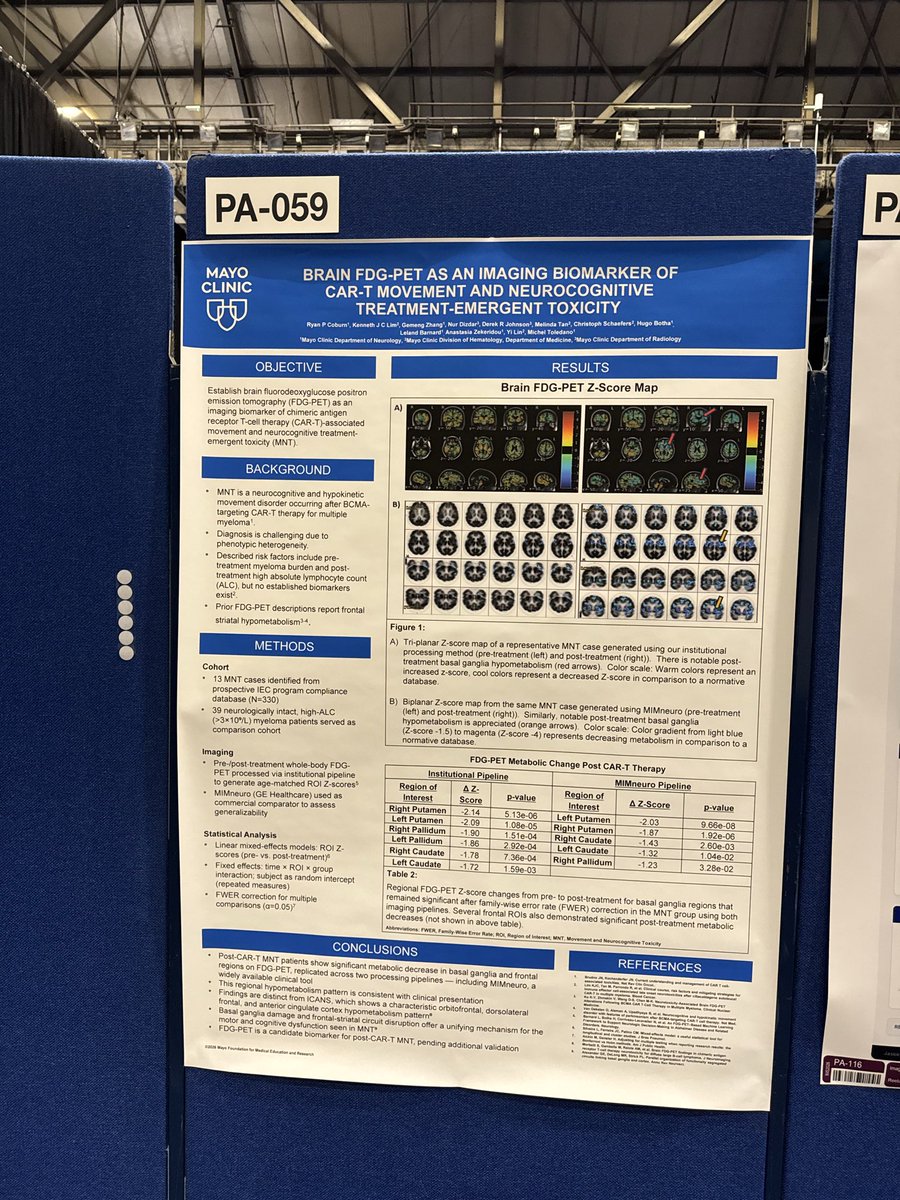
Can we use #AI interpretation of PET/CT images to identify early signs of #IEC-Parkinsonism after #CiltaCel #CART #mmsm come see the poster #IMS26 now @MayoCancerCare @ANASTASIA_ZEK https://t.co/E8PHUwiTqL
PA-059
MAYO CLINIC
BRAIN FDG-PET AS AN IMAGING BIOMARKER OF CAR-T MOVEMENT AND NEUROCOGNITIVE TREATMENT-EMERGENT TOXICITY
Ryan P Coburn1, Kenneth J C Lim2, Gemeng Zhang1, Nur Dizdar3, Derek R Johnson3, Melinda Tan2, Christoph Schaefers2, Hugo Botha1, Leland Barnard1, Anastasia Zekeridou1, Yi Lin2, Michel Toledano1
1Mayo Clinic Department of Neurology, 2Mayo Clinic Division of Hematology, Department of Medicine, 3Mayo Clinic Department of Radiology
OBJECTIVE
Establish brain fluorodeoxyglucose positron emission tomography (FDG-PET) as an imaging biomarker of chimeric antigen receptor T-cell therapy (CAR-T)-associated movement and neurocognitive treatment-emergent toxicity (MNT).
BACKGROUND
• MNT is a neurocognitive and hypokinetic movement disorder occurring after BCMA-targeting CAR-T therapy for multiple myeloma1.
• Diagnosis is challenging due to phenotypic heterogeneity.
• Described risk factors include pre-treatment myeloma burden and post-treatment high absolute lymphocyte count (ALC), but no established biomarkers exist2.
• Prior FDG-PET descriptions report frontal striatal hypometabolism3-4.
METHODS
Cohort
• 13 MNT cases identified from prospective IEC program compliance database (N=330)
• 39 neurologically intact, high-ALC (>3x10^9/L) myeloma patients served as comparison cohort
Imaging
• Pre-/post-treatment whole-body FDG-PET processed via institutional pipeline to generate age-matched ROI Z-scores5
• MIMneuro (GE Healthcare) used as commercial comparator to assess generalizability
Statistical Analysis
• Linear mixed-effects models: ROI Z-scores (pre- vs. post-treatment)6
• Fixed effects: time x ROI x group interaction; subject as random intercept (repeated measures)
• FWER correction for multiple comparisons (alpha=0.05)7
RESULTS
Brain FDG-PET Z-Score Map
Figure 1:
A) Tri-planar Z-score map of a representative MNT case generated using our institutional processing method (pre-treatment (left) and post-treatment (right)). There is notable post-treatment basal ganglia hypometabolism (red arrows). Color scale: Warm colors represent an increased z-score, cool colors represent a decreased Z-score in comparison to a normative database.
B) Biplanar Z-score map from the same MNT case generated using MIMneuro (pre-treatment (left) and post-treatment (right)). Similarly, notable post-treatment basal ganglia hypometabolism is appreciated (orange arrows). Color scale: Color gradient from light blue (Z-score -1.5) to magenta (Z-score -4) represents decreasing metabolism in comparison to a normative database.
FDG-PET Metabolic Change Post CAR-T Therapy
Institutional Pipeline — Region of Interest | Delta Z-Score | p-value: Right Putamen -2.14, 5.13e-06; Left Putamen -2.09, 1.08e-05; Right Pallidum -1.90, 1.51e-04; Left Pallidum -1.86, 2.92e-04; Right Caudate -1.78, 7.36e-04; Left Caudate -1.72, 1.59e-03
MIMneuro Pipeline — Region of Interest | Delta Z-Score | p-value: Left Putamen -2.03, 9.66e-08; Right Putamen -1.87, 1.92e-06; Right Caudate -1.43, 2.60e-03; Left Caudate -1.32, 1.04e-02; Right Pallidum -1.23, 3.28e-02
Table 2: Regional FDG-PET Z-score changes from pre- to post-treatment for basal ganglia regions that remained significant after family-wise error rate (FWER) correction in the MNT group using both imaging pipelines. Several frontal ROIs also demonstrated significant post-treatment metabolic decreases (not shown in above table).
Abbreviations: FWER, Family-Wise Error Rate; ROI, Region of Interest; MNT, Movement and Neurocognitive Toxicity
CONCLUSIONS
• Post-CAR-T MNT patients show significant metabolic decrease in basal ganglia and frontal regions on FDG-PET, replicated across two processing pipelines — including MIMneuro, a widely available clinical tool
• This regional hypometabolism pattern is consistent with clinical presentation
• Findings are distinct from ICANS, which shows a characteristic orbitofrontal, dorsolateral frontal, and anterior cingulate cortex hypometabolism pattern8
• Basal ganglia damage and motor and frontal-striatal circuit disruption offer a unifying mechanism for the motor and cognitive dysfunction seen in MNT9
• FDG-PET is a candidate biomarker for post-CAR-T MNT, pending additional validation
REFERENCES [fine print, largely illegible]
(c)2026 Mayo Foundation for Medical Education and Research
Sep 23


#IMS2026 @NikhilMunshiMD explaines the methodoligal approach to MRD and the proposed definition by @Myeloma_Society https://t.co/4SeuoDfnez
To Declare Cure Requires convergence of three domains
When All Three Align → Credible Declaration of Cure.
Domain | Requirement
Statistical | No excess mortality
Biological | No detectable malignant clone
Clinical | Long-term Treatment-free Disease-free survival
International Myeloma Society
Proposed Definition of Cure
• Patient could be newly-diagnosed or with relapsed myeloma
• Patient in sustained Complete Remission (CR) by standard criteria
• MRD negative at 10⁻⁶ sensitivity by either NGS or NGF
• MRD negativity Sustained for 5 years WITHOUT any therapy. (Irrespective of length of previous sustained MRD negativity on therapy)
• There should be at least 4 MRD assessments in 5 years, last one being at 5 years; all negative and no positive test in between, if performed.
• Negative by functional imaging (PET/CT or DWI WB MRI)
• At least at the beginning of 5 years period and at the end of 5 years period with no intervening positivity, if performed.
International Myeloma Society — 28
Sep 23

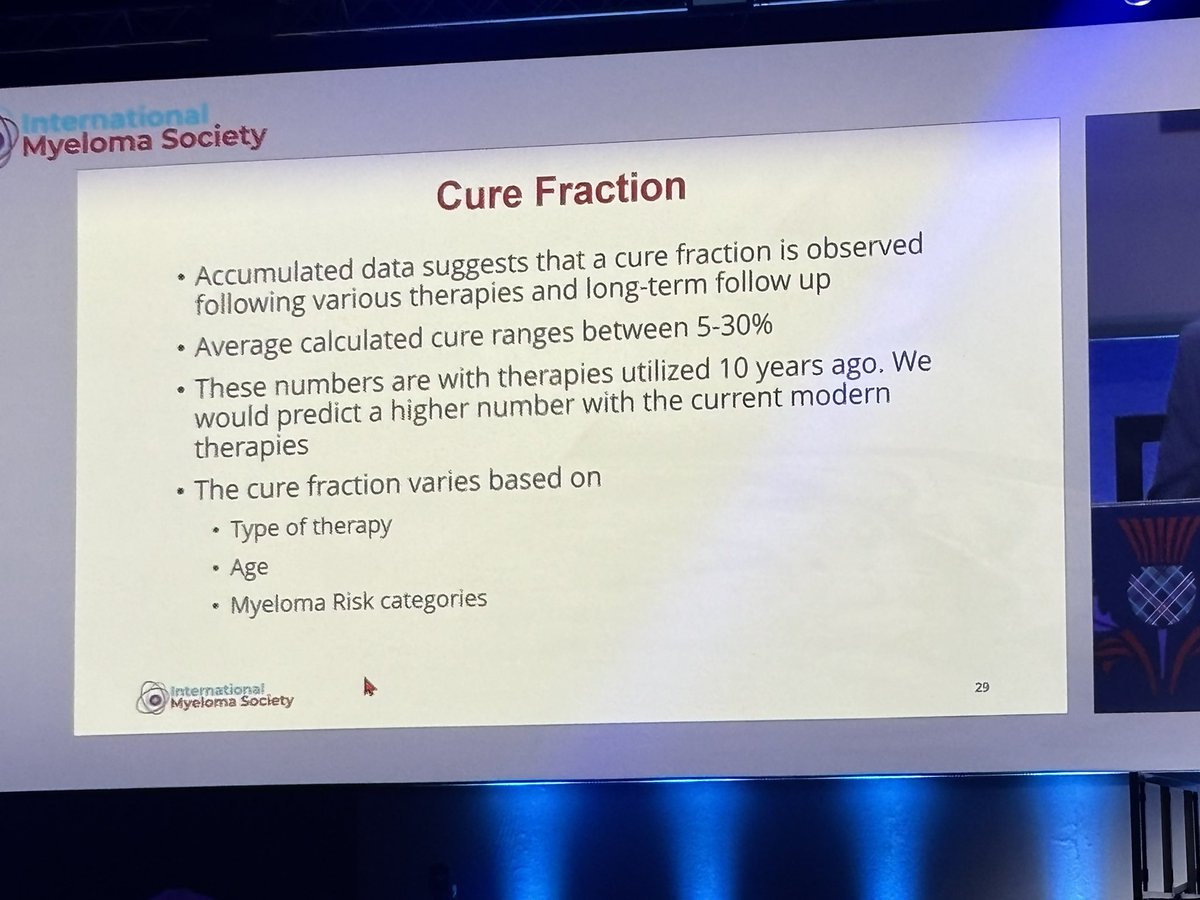
Proposed definition of cure by @NikhilMunshiMD for the @Myeloma_Society and IMWG #mmsm #IMS26 https://t.co/dHVHEST5b8
International Myeloma Society
Proposed Definition of Cure
- Patient could be newly-diagnosed or with relapsed myeloma
- Patient in sustained Complete Remission (CR) by standard criteria
- MRD negative at 10-6 sensitivity by either NGS or NGF
- MRD negativity Sustained for 5 years WITHOUT any therapy. (Irrespective of length of previous sustained MRD negativity on therapy)
- There should be at least 4 MRD assessments in 5 years, last one being at 5 years; all negative and no positive test in between, if performed.
- Negative by functional imaging (PET/CT or DWI WB MRI)
- At least at the beginning of 5 years period and at the end of 5 years period with no intervening positivity, if performed.
International Myeloma Society — slide 28
International Myeloma Society
Cure Fraction
- Accumulated data suggests that a cure fraction is observed following various therapies and long-term follow up
- Average calculated cure ranges between 5-30%
- These numbers are with therapies utilized 10 years ago. We would predict a higher number with the current modern therapies
- The cure fraction varies based on
- Type of therapy
- Age
- Myeloma Risk categories
International Myeloma Society — slide 29
 Sep 23
@_DrCP flying the flag for the UK on day 1 of #IMS2026 with an excellent overview of maintenance approaches in myeloma. https://t.co/lZKZ9KtoTu
International Myeloma Society
Outline
1. Which therapy?
- Single agent or more
- Novel approaches
2. How long for?
- Duration of therapy
- Toxicity management
3. Personalisation?
- Risk stratification
- Patient preferences and quality of life
ICR Images created using BioRender
The ROYAL MARSDEN NHS Foundation Trust
[Podium branding: International Myeloma Society 23rd Annual Meeting & Exposition]
 Sep 23


Thank you @DrRakeshPopat for dissemination of, “UK Expert Delphi Consensus on Managing Rakesh Popat
Talquetamab-Associated Oral Side Effects and Weight Loss
in Patients With Multiple Myeloma” #IMS26 @mmamynurse @MMKingT https://t.co/DuZx5xCTeU
Delphi Methods
A modified 2-round Delphi panel
Evidence review: HTA and literature inputs → Steering Committee: 4 UK experts; statement review → Round 1: 41 statements + 1 opened ended question → Controlled feedback: Aggregate results and comments → Round 2: 14 revised statements → Final synthesis: Consensus recommendations
Multidisciplinary UK Expert Panel
• The expert panel met pre-defined eligibility, participants were prioritised according to standardised expertise grading and geography
• 29 HCPs completed ≥1 round including:
10 Haematologists (34.5%), 8 Clinical Nurse Specialists (27.6%), 8 Specialist Dietitians (27.6%) and 3 Haematology Pharmacists (10.3%)
• All worked in teaching hospitals; most based in tertiary centres across the four UK nations
Consensus was pre-defined and graded
≥75% agreement or disagreement required for consensus
U 100% | A 91–99% | B 81–90% | C 75–80%
Presented by R. Popat at the International Myeloma Society (IMS) 2026 Congress; September 23–26, 2026; Glasgow, United Kingdom
 Sep 23


Very thoughtful sessions at @Myeloma_Society #IMS26 on quad regimens in NDMm, role of autologous stem cell transplant, and maintenance therapy. https://t.co/n766x9bukl
UKE Hamburg
Conclusions
- Quadruplet induction is currently approved for all NDMM patients
- Quadruplet induction in the setting of consolidation and (combination) maintenance/continuous treatment allows the highest rates of MRD and sustained MRD negative responses which translates into the current most favorable PFS and OS outcomes
- Sustained MRD negativity is the imminent prerequisite for stopping treatment and a potential curative approach
- Achieving MRD negative response after induction allows to question the role of ASCT in standard-risk patients
- Strategies including quadruplet induction show the lowest rates of functional high-risk disease
- Carfilzomib based quadruplets show favorable MRD responses especially in high-risk patients
- For comorbid, old and/or frail patients, triplet or doublet treatment should be considered
- Whenever available and feasible, quadruplet treatment should be initiated in any NDMM patient
Universitaeres Cancer Center HAMBURG
Universitaetsklinikum Hamburg-Eppend[orf]
[International] Myeloma Society
Perspectives: which patient needs what?
Columns: Standard risk, MRD-negative | Grey zone (e.g., t(11;14), MRD-positive) | High / very high risk
Today:
- Standard risk, MRD-negative: Anti-CD38-VRd -> Mel 200 + ASCT -> Dara-R
- Grey zone: Anti-CD38-VRd -> Mel 200 + ASCT -> Dara-R
- High / very high risk: Anti-CD38-VRd -> Mel 200 + ASCT -> Dara-R
Tomorrow (if the trials are positive):
- Standard risk, MRD-negative: Anti-CD38-VRd -> T-cell redirection (bispecific or CAR-T), no Mel 200
- Grey zone: Open question: is an alkylator still needed? Biomarker-driven trials
- High / very high risk: ASCT + T-cell redirection (e.g., ASCT -> anti-BCMA CAR-T)
Today: ASCT for all eligible patients.
Tomorrow: not "ASCT or not", but which patient needs which.
International Myeloma Society
23rd International Myeloma Society Annual Meeting 8
International Myeloma Society
Conclusion
1. Which therapy?
2026: Lenalidomide + daratumumab
2030: Immunotherapy approaches?
2. How long for?
2026: To progression but.....
- low threshold for stopping after 2-3 years in event of toxicity if no high risk lesions and MRD -ve
- higher threshold for stopping/ try to continue if any high risk lesions or MRD +ve
2030: Immunotherapy approaches likely to be time limited
3. Personalisation?
2026: Double hit / IMWG-IMS high risk patients need intensive consolidation and multi-agent maintenance approaches
2030: More information on older patients and time limited therapy
ICR Images created using BioRender
The ROYAL MARSDEN NHS Foundation Trust
 Sep 23

Thank you for highlighting our trial, let’s go Canada 🇨🇦 @HamiltonMyeloma @HamHealthSci #IMS2026 https://t.co/d9ZbvsJ9P5
International Myeloma Society
3. Frailty impact on maintenance
• Studies in transplant ineligible patients to date have continued treatment to progression
• Ongoing studies are asking key questions in the context of current standard of care:
Can we stop dara?
Canadian Cancer Trials Group MY.13 Study
NDMM TI, DRd x 18 cycles, >=PR → Rd to PD | DRd to PD
Can we stop if MRD neg?
iFIT UK-MRA Myeloma XVIII
NDMM TI, DRd x 6 cycles, MRD neg → DR to PD | DR x 18 cycles
Can we stop in all?
HOVON-174 FABULOUS
NDMM TI, DRd x 12 cycles, >=PR → DRd to PD | stop (restart before PD)
ICR | CIs: Hira Mian, Charlotte Pawlyn/Gordon Cook, Sonja Zweegman | The Royal Marsden NHS Foundation Trust
 Sep 23
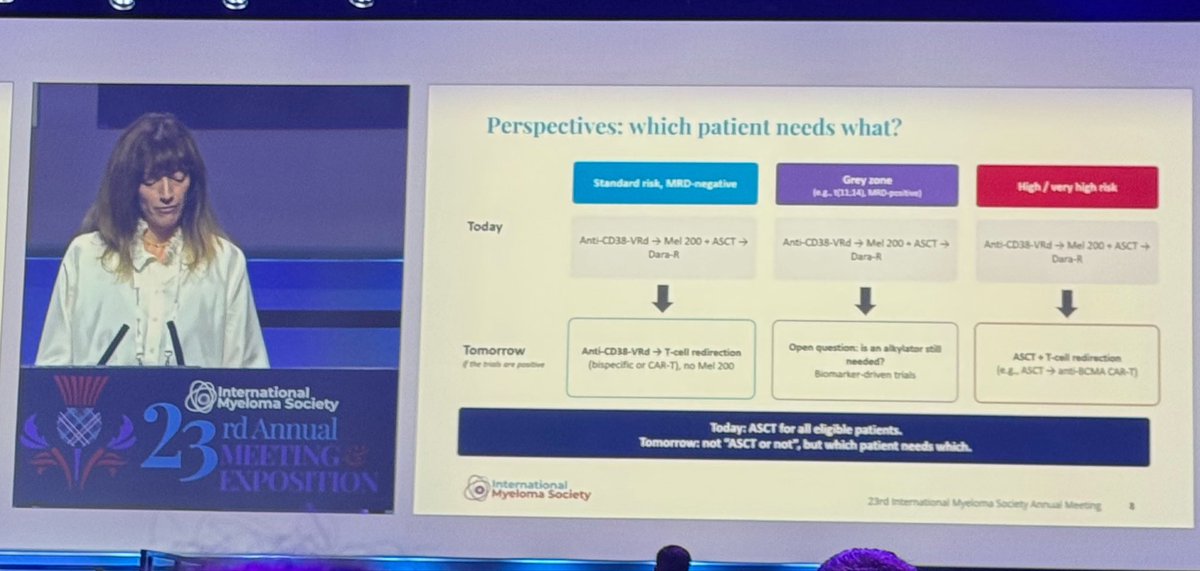

What’s status of ACST in MM today? Wonderful discussion by @PerrotAurore and intriguing take on subset likely to benefit most #IMS26 #mmsm https://t.co/oNvFyF4oxy
Perspectives: which patient needs what?
Columns: Standard risk, MRD-negative | Grey zone (e.g., t(11;14), MRD-positive) | High / very high risk
Today:
• Standard risk, MRD-negative: Anti-CD38-VRd → Mel 200 + ASCT → Dara-R
• Grey zone: Anti-CD38-VRd → Mel 200 + ASCT → Dara-R
• High / very high risk: Anti-CD38-VRd → Mel 200 + ASCT → Dara-R
Tomorrow (if the trials are positive):
• Standard risk, MRD-negative: Anti-CD38-VRd → T-cell redirection (bispecific or CAR-T), no Mel 200
• Grey zone: Open question: is an alkylator still needed? Biomarker-driven trials
• High / very high risk: ASCT + T-cell redirection (e.g., ASCT → anti-BCMA CAR-T)
Today: ASCT for all eligible patients.
Tomorrow: not "ASCT or not", but which patient needs which.
International Myeloma Society — 23rd International Myeloma Society Annual Meeting — 8
Who might still need an alkylator?
Profile | Why an alkylator might still matter | Evidence today
t(11;14) | Overexpresses cyclin D1. BCL2 dependence -> cells more "primed" for apoptosis -> hypothesis: more sensitive to pro-apoptotic stress including melphalan | Hypothesis ? MIDAS small numbers t(11;14): n=32 Arm A, n=46 Arm B
Very high risk (biallelic TP53, >= 2 CGS criteria, PCL) | Proliferative disease: cytotoxic pressure may complement T-cell engagement | Tandem ASCT case by case, no robust data
Extramedullary disease, high tumor burden | Rapid debulking alongside cell therapy (bridging, CRS risk) | Hypothesis ?
Antigen escape (BCMA loss) | Argues first for dual targeting (BCMA x GPRC5D, BCMA/CD19) rather than an alkylator | Being tested in the multi-target trials
T-cell fitness, marrow microenvironment | Exhausted or immune-cold marrow: T-cell engagement may not suffice; Mel may modify the niche | Hypothesis: biomarker to test ?
The new trials need prespecified biology-based subgroups and translational cohorts: MRD kinetics, T-cell fitness, target expression
International Myeloma Society — 23rd International Myeloma Society Annual Meeting — 7
 Sep 23
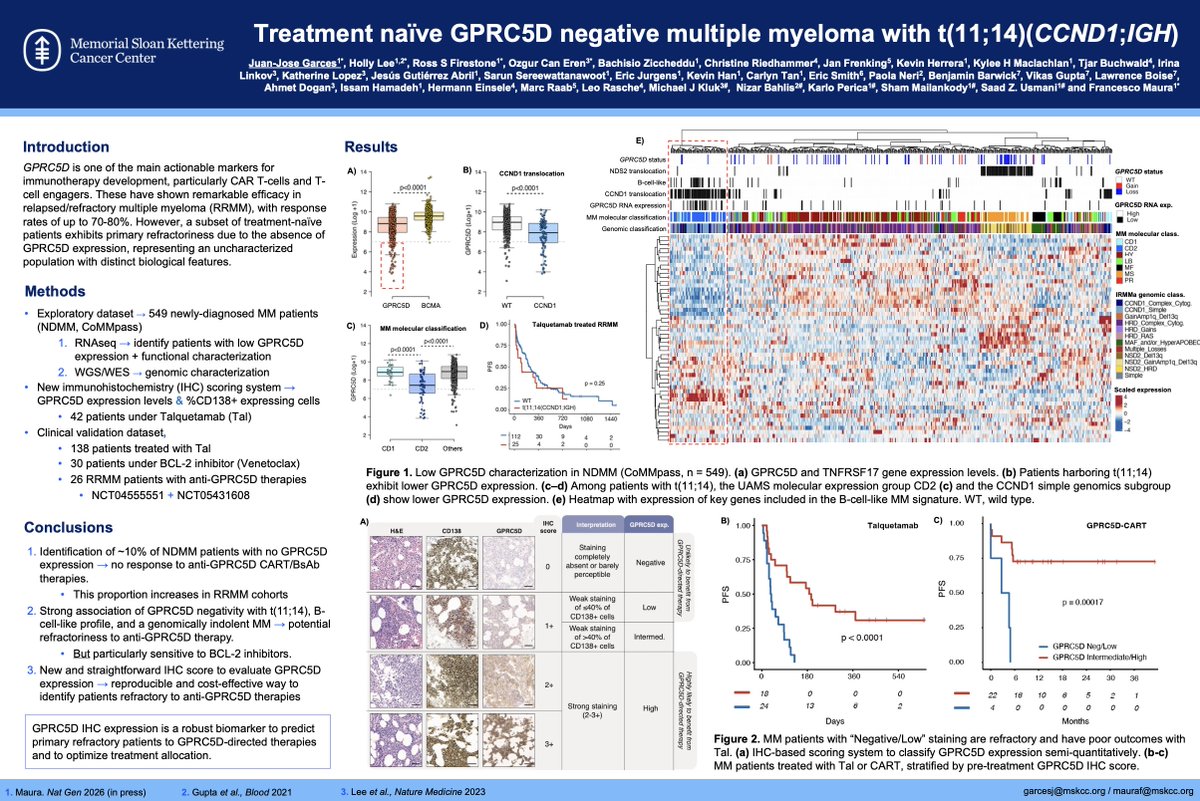
(TODAY) Stop by our poster to learn how to better treat patients with #GPRC5D-related therapies!
#mmsm #IMS2026 https://t.co/YuXrwTULNe
Memorial Sloan Kettering Cancer Center
Treatment naïve GPRC5D negative multiple myeloma with t(11;14)(CCND1;IGH)
Juan-Jose Garces1*, Holly Lee1,2*, Ross S Firestone1*, Ozgur Can Eren3*, Bachisio Zicchedu1, Christine Riedhammer4, Jan Frenking5, Kevin Herrera1, Kylee H Maclachlan1, Tjar Buchwald4, Irina Linkov3, Katherine Lopez3, Jesús Gutiérrez Abril1, Sarun Sereewattanawoot1, Eric Jurgens1, Kevin Han1, Carlyn Tan1, Eric Smith6, Paola Neri2, Benjamin Barwick7, Vikas Gupta7, Lawrence Boise7, Ahmet Dogan3, Issam Hamadeh1, Hermann Einsele4, Marc Raab5, Leo Rasche4, Michael J Kluk3#, Nizar Bahlis2#, Karlo Perica1#, Sham Mailankody1#, Saad Z. Usmani1# and Francesco Maura1*
Introduction
GPRC5D is one of the main actionable markers for immunotherapy development, particularly CAR T-cells and T-cell engagers. These have shown remarkable efficacy in relapsed/refractory multiple myeloma (RRMM), with response rates of up to 70-80%. However, a subset of treatment-naïve patients exhibits primary refractoriness due to the absence of GPRC5D expression, representing an uncharacterized population with distinct biological features.
Methods
- Exploratory dataset -> 549 newly-diagnosed MM patients (NDMM, CoMMpass)
1. RNAseq -> identify patients with low GPRC5D expression + functional characterization
2. WGS/WES -> genomic characterization
- New immunohistochemistry (IHC) scoring system -> GPRC5D expression levels & %CD138+ expressing cells
- 42 patients under Talquetamab (Tal)
- Clinical validation dataset,
- 138 patients treated with Tal
- 30 patients under BCL-2 inhibitor (Venetoclax)
- 26 RRMM patients with anti-GPRC5D therapies
- NCT04555551 + NCT05431608
Conclusions
1. Identification of ~10% of NDMM patients with no GPRC5D expression -> no response to anti-GPRC5D CART/BsAb therapies.
- This proportion increases in RRMM cohorts
2. Strong association of GPRC5D negativity with t(11;14), B-cell-like profile, and a genomically indolent MM -> potential refractoriness to anti-GPRC5D therapy.
- But particularly sensitive to BCL-2 inhibitors.
3. New and straightforward IHC score to evaluate GPRC5D expression -> reproducible and cost-effective way to identify patients refractory to anti-GPRC5D therapies
GPRC5D IHC expression is a robust biomarker to predict primary refractory patients to GPRC5D-directed therapies and to optimize treatment allocation.
Results
A) [box plots] Expression (Log +1), GPRC5D vs BCMA, p<0.0001
B) CCND1 translocation: GPRC5D (Log+1), WT vs CCND1, p<0.0001
C) MM molecular classification: GPRC5D (Log+1), CD1 vs CD2 vs Others, p<0.0001 / p<0.0001
D) Talquetamab treated RRMM: PFS, WT vs t(11;14)(CCND1;IGH), p = 0.25; at risk: 112 30 9 4 2 / 25 4 2 2 0
E) Heatmap rows: GPRC5D status, NDS2 translocation, B-cell-like, CCND1 translocation, GPRC5D RNA expression, MM molecular classification, Genomic classification. Legends: GPRC5D status (WT, Gain, Loss); GPRC5D RNA exp. (High, Low); MM molecular class. (CD1, CD2, HY, LB, MF, MS, PR); IRMMa genomic class. (CCND1_Complex_Cytog., CCND1_Simple, GainAmp1q_Del13q, HRD_Complex_Cytog., HRD_Gains, HRD_RAS, MAF_and/or_HyperAPOBEC, Multiple_Losses, NSD2_Del13q, NSD2_GainAmp1q_Del13q, NSD2_HRD, Simple); Scaled expression (4 to -4)
Figure 1. Low GPRC5D characterization in NDMM (CoMMpass, n = 549). (a) GPRC5D and TNFRSF17 gene expression levels. (b) Patients harboring t(11;14) exhibit lower GPRC5D expression. (c-d) Among patients with t(11;14), the UAMS molecular expression group CD2 (c) and the CCND1 simple genomics subgroup (d) show lower GPRC5D expression. (e) Heatmap with expression of key genes included in the B-cell-like MM signature. WT, wild type.
[Figure 2 IHC table] A) H&E / CD138 / GPRC5D; IHC score 0: Staining completely absent or barely perceptible = Negative; 1+: Weak staining of <=40% of CD138+ cells = Low; Weak staining of >40% of CD138+ cells = Intermed.; 2+ / 3+: Strong staining (2-3+) = High. Interpretation columns: Unlikely to benefit from GPRC5D-directed therapy / Highly likely to benefit from GPRC5D-directed therapy
B) Talquetamab: PFS, p < 0.0001; at risk (Days): 18 0 0 0 / 24 13 6 2
C) GPRC5D-CART: PFS, p = 0.00017; GPRC5D Neg/Low vs GPRC5D Intermediate/High; at risk (Months): 22 16 10 8 5 2 1 / 4 0 0 0 0 0 0
Figure 2. MM patients with "Negative/Low" staining are refractory and have poor outcomes with Tal. (a) IHC-based scoring system to classify GPRC5D expression semi-quantitatively. (b-c) MM patients treated with Tal or CART, stratified by pre-treatment GPRC5D IHC score.
1. Maura. Nat Gen 2026 (in press) 2. Gupta et al., Blood 2021 3. Lee et al., Nature Medicine 2023
garcesj@mskcc.org / mauraf@mskcc.org
Sep 23
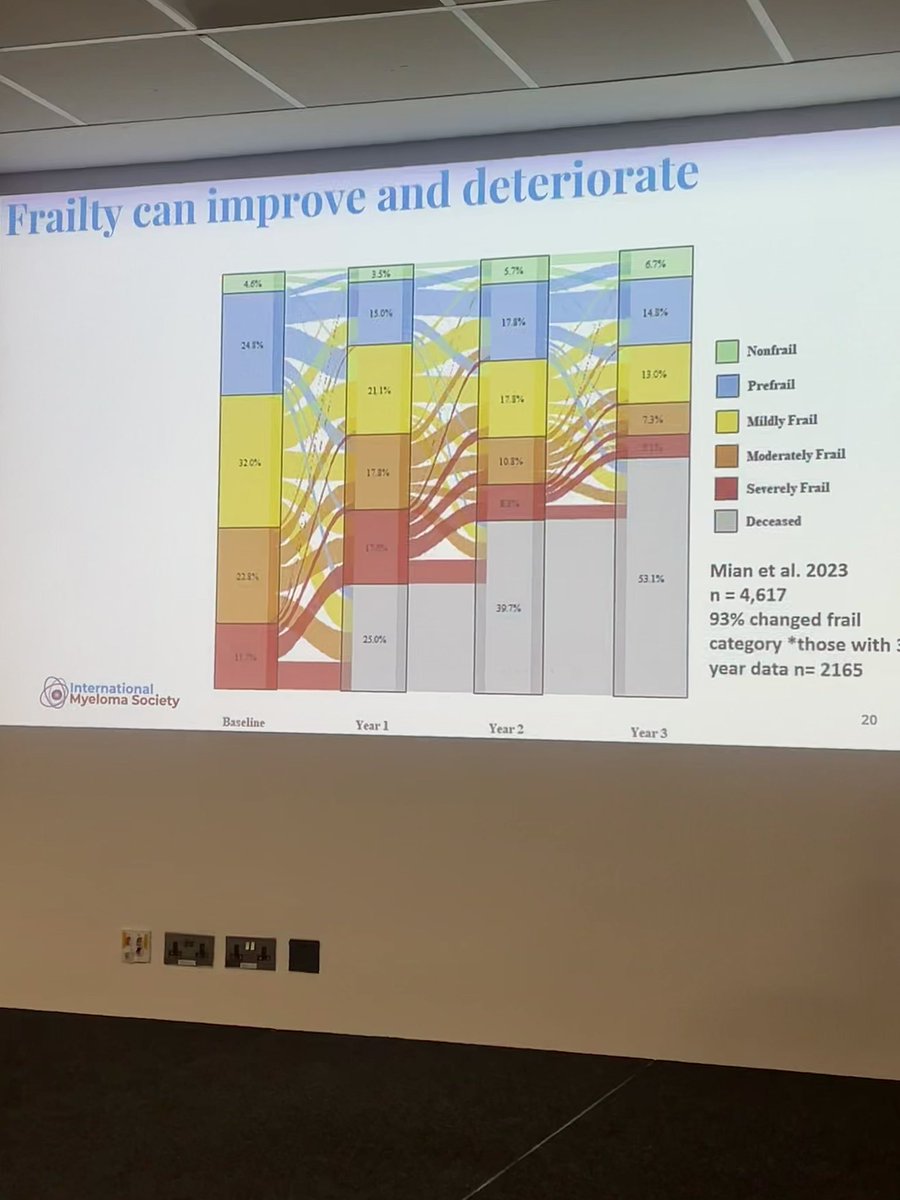

Excellent discussion by physio Dr Joanne Sowter on the importance of comprehensive assessments for frailty, #dynamicfrailty #IMS26 nice to see work by @HiraSMian, @profBigG highlighted especially in this era of #bispecific #antibodies, #CART https://t.co/2iiULFbXcy
Frailty can improve and deteriorate
[Sankey diagram of frailty category transitions across Baseline, Year 1, Year 2, Year 3]
Legend: Nonfrail | Prefrail | Mildly Frail | Moderately Frail | Severely Frail | Deceased
Baseline: Nonfrail 4.6% | Prefrail 24.8% | Mildly Frail 32.0% | Moderately Frail 22.8% | Severely Frail [illegible]
Year 1: Nonfrail 3.5% | Prefrail 15.0% | Mildly Frail 21.1% | Moderately Frail 17.8% | Severely Frail [illegible] | Deceased 25.0%
Year 2: Nonfrail 5.7% | Prefrail 17.8% | Mildly Frail 17.[illegible]% | Moderately Frail 10.8% | Severely Frail [illegible] | Deceased 39.7%
Year 3: Nonfrail 6.7% | Prefrail 14.8% | Mildly Frail 13.0% | Moderately Frail 7.3% | Severely Frail [illegible] | Deceased 53.1%
Mian et al. 2023
n = 4,617
93% changed frail category *those with 3[-]year data n= 2165
International Myeloma Society
20
[F]railty changed - but WHY?
HOVON
FITNESS
Mian et al
DYNAFIT
VULNERABILITY: Reduced physiological reserve and resilience to stressors
[Disease burden circle]
- Disease burden
- Anaemia
- Renal dysfunction
- Bone disease / pain
[Treatment circle]
- Toxicity
- Infection / hospitalisation
- Neuropathy
- Steroids
- Treatment intensity
[Co-morbidity]
- Cardiovascular disease
- Respiratory disease
- Diabetes
- Other chronic conditions
- Cumulative comorbidity burden
[Social support]
- Living situation
- Carer support
- Social isolation
- Financial concerns
- Access to care
[Physical function]
- Strength
- Mobility
- Balance
- Physical activity
- Sarcopenia
[Mental health]
- Cognitive impairment
- Delirium risk
- Depression / anxiety
- Psychological distress
[Polypharmacy]
- Polypharmacy
- Potentially inappropriate medications
- Drug interactions
- Treatment-related effects
[Nutrition]
- Weight loss
- Protein / energy intake
- Malnutrition
- Sarcopenia
Smits et al. 2023, Mian et al. 2023, Cook et al. 2023, Zhang et al. 2[cut off]
International Myeloma Societ[y]
 Sep 23

First session coming in hot with some T cell synapse schematics from a basic scientist (Michael Dustin). 👏 to the program organizers. #IMS26 https://t.co/25zehEbNbA
Helper and cytotoxic T cells cooperate to kill infected and cancerous cells through immunological synapses
[Schematic: Helper T cell — IL-2 → Cytotoxic T cell (Immune attack) — Regulatory T cell, each forming synapses with target cells]
International Myeloma Society — BioRender
Sep 23
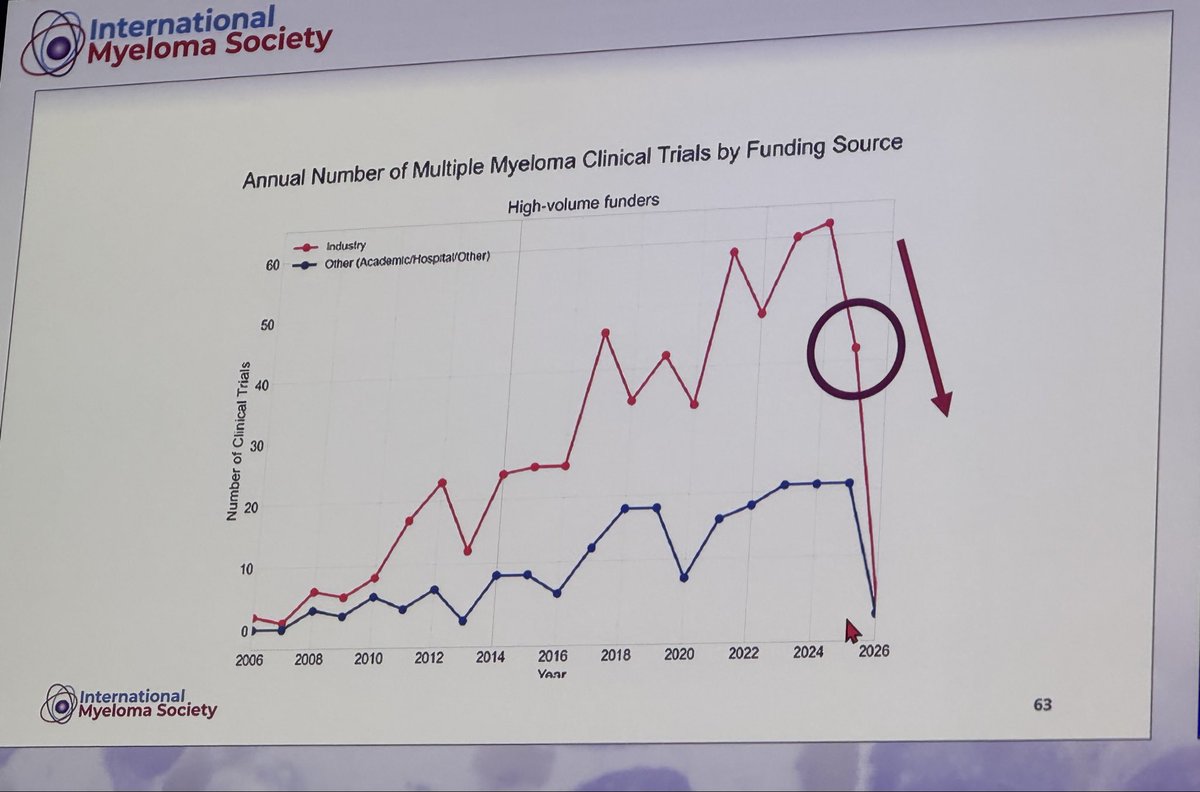
The perception that myeloma might be about to be cured seems to be impacting pharma R&D investments in MM. Now is not the time to lift the foot from the pedal! @Myeloma_Society #IMS26 #mmsm https://t.co/TVMVSCZjSl
International Myeloma Society
Annual Number of Multiple Myeloma Clinical Trials by Funding Source
High-volume funders
Legend: Industry (red) | Other (Academic/Hospital/Other) (blue)
Y-axis: Number of Clinical Trials (0 to 60)
X-axis: Year, 2006 to 2026
[Line chart: Industry line rises from ~2 in 2006 to a peak of ~63 around 2025, with a circled data point at ~46 and a sharp drop toward 2026 highlighted by a downward red arrow. Other (Academic/Hospital/Other) line rises from ~0 in 2006 to ~24 by 2024, then also drops sharply toward 2026. Exact per-year values not printed]
63

 Sep 23
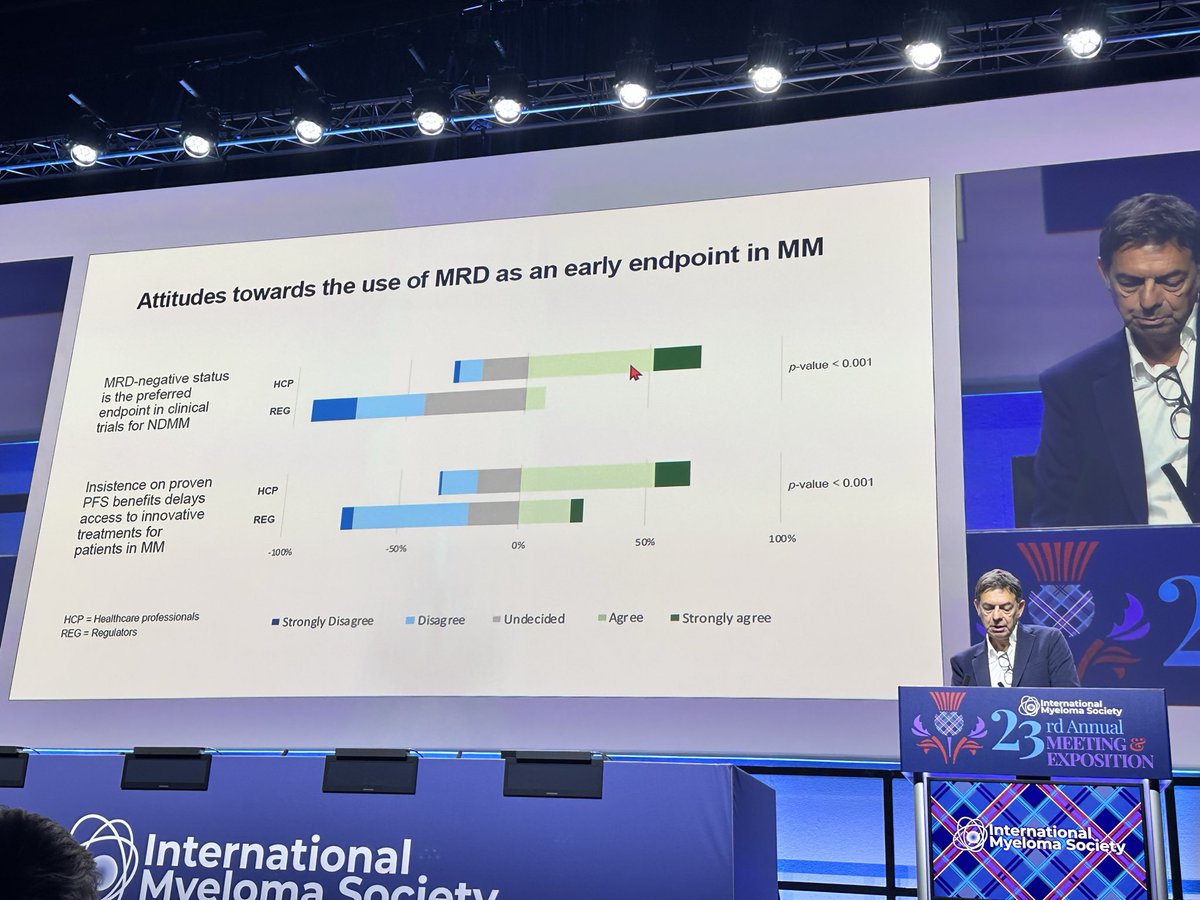
#IMS2026 @Myeloma_Society has a big mission to reverse this paradigm : a gap between HCP and health providers on value of MRD https://t.co/jdvqYbhXTx
Attitudes towards the use of MRD as an early endpoint in MM
MRD-negative status is the preferred endpoint in clinical trials for NDMM
HCP [stacked bar: majority Agree/Strongly agree]
REG [stacked bar: majority Strongly Disagree/Disagree/Undecided]
p-value < 0.001
Insistence on proven PFS benefits delays access to innovative treatments for patients in MM
HCP [stacked bar: majority Agree/Strongly agree]
REG [stacked bar: majority Disagree/Undecided]
p-value < 0.001
Axis: -100% to 100%
Legend: Strongly Disagree | Disagree | Undecided | Agree | Strongly agree
HCP = Healthcare professionals; REG = Regulators
Sep 23

@Myeloma_Society SWOT #IMS26 #mmsm https://t.co/IBkQUlezbO
International Myeloma Society
IMS - SWOT
STRENGTHS
- Dedicated leadership
- Clear mission
- Our results (consensus building, advocacy work, research and education activities
- Recognition form KOL, academic and cooperative groups, industry, patient advocacy groups, and regulatory agencies
WEAKNESSES
- Not yet enough activity in LMIC regions
- Clinical trial designs
- ASH, ASCO
- Team is understaffed
OPPORTUNITIES
- Strategically growing and developing the society
- LMIC
- Creating new avenues of communicating our messaging/fundraising
- Collaboration with IMWG : consensus meetings
- « Young blood », GLO
- Collaboration with EHA, AACR
THREATS
- Funding
- Golden age for MM
- Applicability of guidelines
- Political situation
51
Sep 23

Opening plenary @Myeloma_Society Work remains with regulators about the use of MRD as an early endpoint #IMS26 #mmsm https://t.co/m3Qzr5Y8i5
International Myeloma Society
Attitudes towards the use of MRD as an early endpoint in MM
MRD-negative status is the preferred endpoint in clinical trials for NDMM
HCP
REG
p-value < 0.001
Insistence on proven PFS benefits delays access to innovative treatments for patients in MM
HCP
REG
p-value < 0.001
[Diverging stacked bar chart; x-axis: -100% -50% 0% 50% 100%. For both statements the HCP bars skew toward Agree/Strongly agree and the REG bars skew toward Strongly Disagree/Disagree/Undecided; exact segment percentages not printed]
HCP = Healthcare professionals
REG = Regulators
Legend: Strongly Disagree | Disagree | Undecided | Agree | Strongly agree
Sep 23
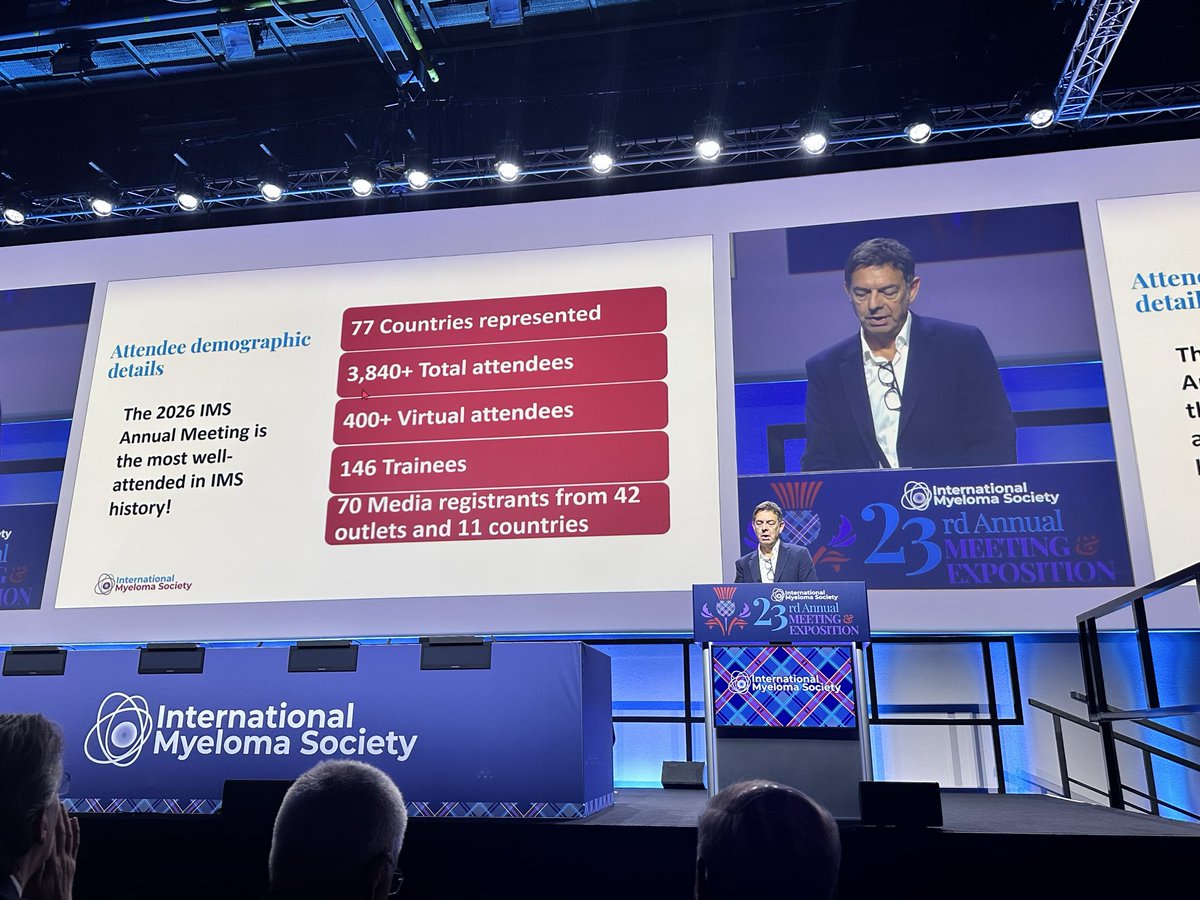
#IMS26 Following a wonderful tribute to the great Myeloma physician and pioneer Prof Bob Kyle and recognition of @MorieGertz & Prof Heinz Ludwig the president Prof Philippe Moreau is summarizing the achievments of @Myeloma_Society congrats to @NoopurRajeMD @myelomaMD and many https://t.co/EH0IuL6alw
Attendee demographic details
The 2026 IMS Annual Meeting is the most well-attended in IMS history!
77 Countries represented
3,840+ Total attendees
400+ Virtual attendees
146 Trainees
70 Media registrants from 42 outlets and 11 countries
International Myeloma Society — 23rd Annual Meeting & Exposition



 Sep 23
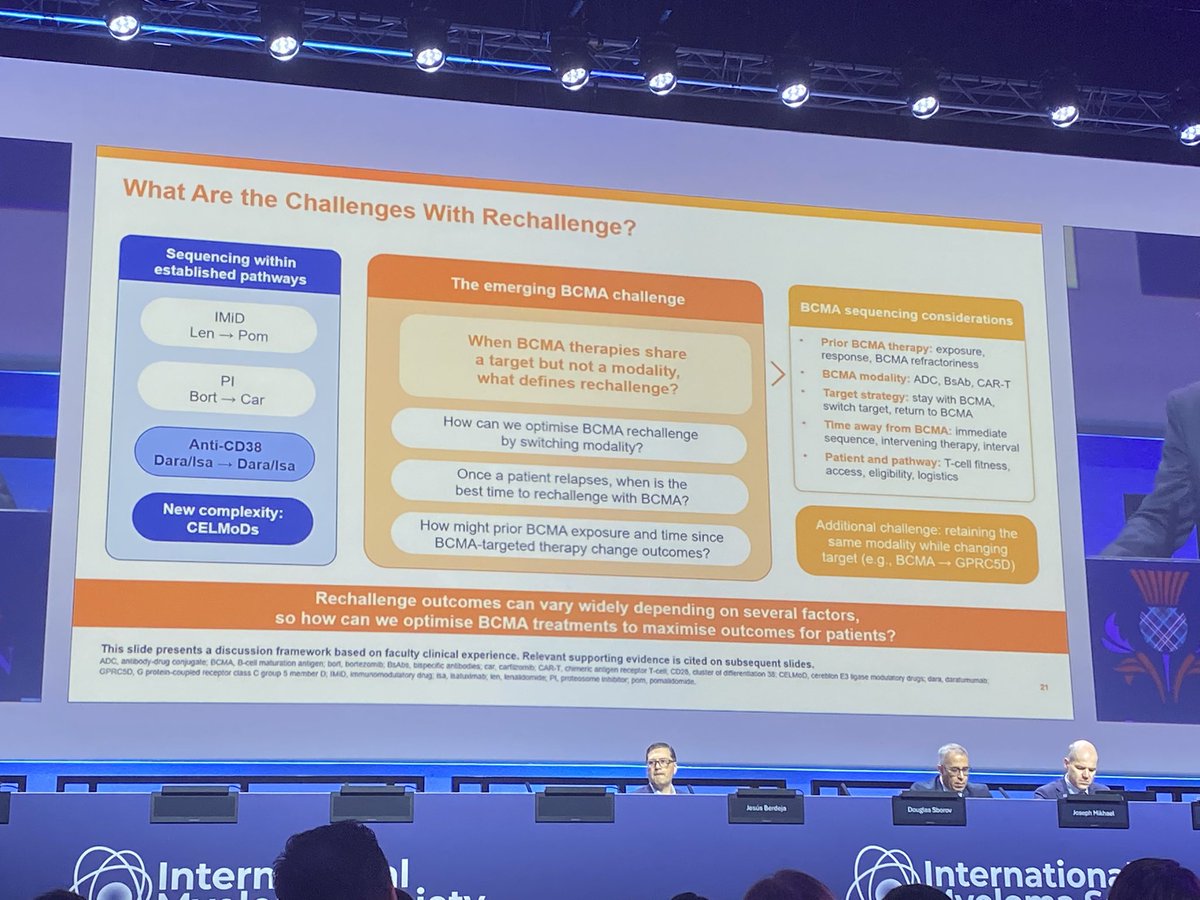
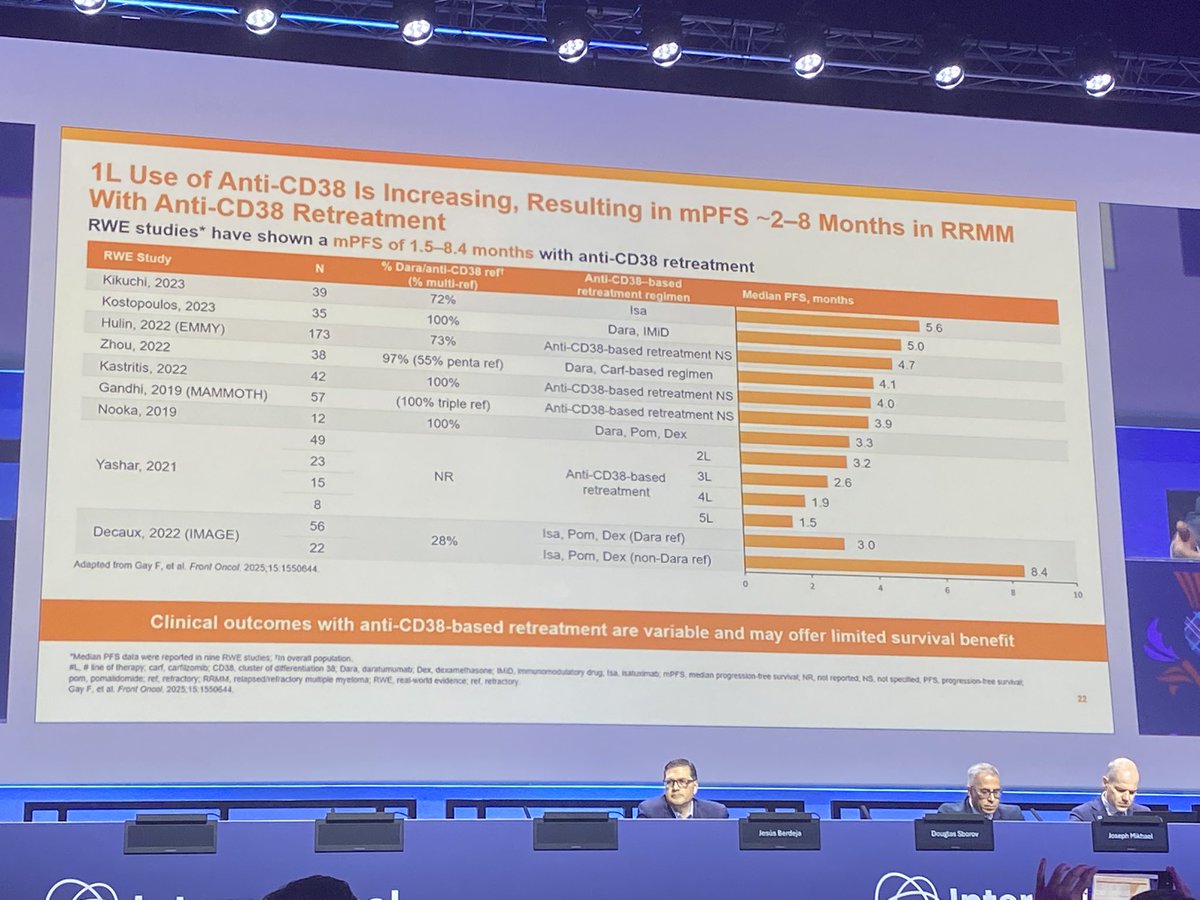
The challenge of the rechallenge. It is absolutely necessary to consider the target, previous duration of response, and drug-free interval. Anti-CD38 rechallenge is usually not effective, especially if last dose was less than 1 year ago. #IMS2026 https://t.co/S5hEgkIvTS
What Are the Challenges With Rechallenge?
Sequencing within established pathways:
- IMiD: Len -> Pom
- PI: Bort -> Car
- Anti-CD38: Dara/Isa -> Dara/Isa
- New complexity: CELMoDs
The emerging BCMA challenge:
- When BCMA therapies share a target but not a modality, what defines rechallenge?
- How can we optimise BCMA rechallenge by switching modality?
- Once a patient relapses, when is the best time to rechallenge with BCMA?
- How might prior BCMA exposure and time since BCMA-targeted therapy change outcomes?
BCMA sequencing considerations:
- Prior BCMA therapy: exposure, response, BCMA refractoriness
- BCMA modality: ADC, BsAb, CAR-T
- Target strategy: stay with BCMA, switch target, return to BCMA
- Time away from BCMA: immediate sequence, intervening therapy, interval
- Patient and pathway: T-cell fitness, access, eligibility, logistics
Additional challenge: retaining the same modality while changing target (e.g., BCMA -> GPRC5D)
Rechallenge outcomes can vary widely depending on several factors, so how can we optimise BCMA treatments to maximise outcomes for patients?
This slide presents a discussion framework based on faculty clinical experience. Relevant supporting evidence is cited on subsequent slides.
ADC, antibody-drug conjugate; BCMA, B-cell maturation antigen; bort, bortezomib; BsAbs, bispecific antibodies; car, carfilzomib; CAR-T, chimeric antigen receptor T-cell; CD38, cluster of differentiation 38; CELMoD, cereblon E3 ligase modulatory drugs; dara, daratumumab; GPRC5D, G protein-coupled receptor class C group 5 member D; IMiD, immunomodulatory drug; isa, isatuximab; len, lenalidomide; PI, proteosome inhibitor; pom, pomalidomide.
21
[Panel name plates visible: Jesus Berdeja, Douglas Sborov, Joseph Mikhael]
1L Use of Anti-CD38 Is Increasing, Resulting in mPFS ~2-8 Months in RRMM With Anti-CD38 Retreatment
RWE studies* have shown a mPFS of 1.5-8.4 months with anti-CD38 retreatment
RWE Study | N | % Dara/anti-CD38 ref† (% multi-ref) | Anti-CD38-based retreatment regimen | Median PFS, months
Kikuchi, 2023 | 39 | 72% | Isa | 5.6
Kostopoulos, 2023 | 35 | 100% | Dara, IMiD | 5.0
Hulin, 2022 (EMMY) | 173 | 73% | Anti-CD38-based retreatment NS | 4.7
Zhou, 2022 | 38 | 97% (55% penta ref) | Dara, Carf-based regimen | 4.1
Kastritis, 2022 | 42 | 100% | Anti-CD38-based retreatment NS | 4.0
Gandhi, 2019 (MAMMOTH) | 57 | (100% triple ref) | Anti-CD38-based retreatment NS | 3.9
Nooka, 2019 | 12 | 100% | Dara, Pom, Dex | 3.3
Yashar, 2021 | 49 / 23 / 15 / 8 | NR | Anti-CD38-based retreatment 2L / 3L / 4L / 5L | 3.2 / 2.6 / 1.9 / 1.5
Decaux, 2022 (IMAGE) | 56 | 28% | Isa, Pom, Dex (Dara ref) | 3.0
| 22 | | Isa, Pom, Dex (non-Dara ref) | 8.4
[Bar chart axis: 0 to 10 months]
Adapted from Gay F, et al. Front Oncol. 2025;15:1550644.
Clinical outcomes with anti-CD38-based retreatment are variable and may offer limited survival benefit
*Median PFS data were reported in nine RWE studies; †In overall population.
#L, # line of therapy; carf, carfilzomib; CD38, cluster of differentiation 38; Dara, daratumumab; Dex, dexamethasone; IMiD, immunomodulatory drug; Isa, isatuximab; mPFS, median progression-free survival; NR, not reported; NS, not specified; PFS, progression-free survival; pom, pomalidomide; ref, refractory; RRMM, relapsed/refractory multiple myeloma; RWE, real-world evidence.
Gay F, et al. Front Oncol. 2025;15:1550644.
22

 Sep 23
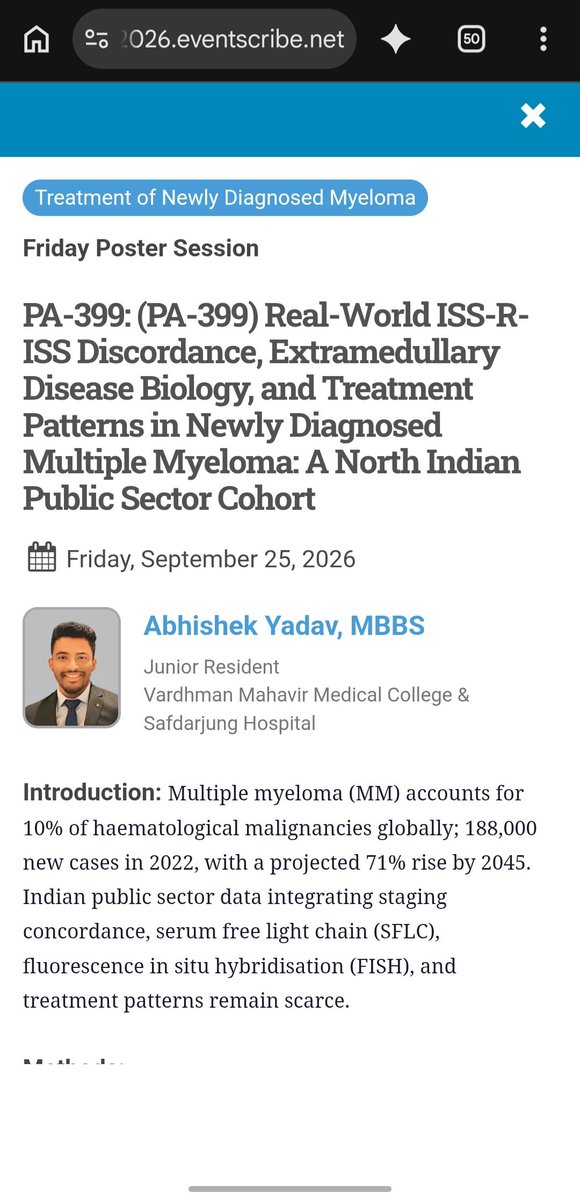
Work I started as a medical student ,manually analyzing years of paper-based medical records is finally as a poster at #IMS2026. https://t.co/sYznYyZllk
[2026.eventscribe.net]
Treatment of Newly Diagnosed Myeloma
Friday Poster Session
PA-399: (PA-399) Real-World ISS-R-ISS Discordance, Extramedullary Disease Biology, and Treatment Patterns in Newly Diagnosed Multiple Myeloma: A North Indian Public Sector Cohort
Friday, September 25, 2026
Abhishek Yadav, MBBS
Junior Resident
Vardhman Mahavir Medical College & Safdarjung Hospital
Introduction: Multiple myeloma (MM) accounts for 10% of haematological malignancies globally; 188,000 new cases in 2022, with a projected 71% rise by 2045. Indian public sector data integrating staging concordance, serum free light chain (SFLC), fluorescence in situ hybridisation (FISH), and treatment patterns remain scarce.
Methods: [cut off]




 Sep 22

We also present outcomes of MM post BCMA and GPRC5D exposure. Lots of work to be done in this area of need
Pls let us know of q and pleased to answer
#IMS26 https://t.co/W4N4pvTYtS
MRD and Biomarkers
OA-55: Poor Outcomes Post Sequential BCMA and GPRC5D Exposed Myeloma Can Be Improved by Subsequent Targeted Agents Versus Conventional Therapy: An IMWG Immunotherapy Registry Analysis
Wednesday, September 23, 2026
3:06pm - 3:18pm BST
Location: Lomond Auditorium
Abstract Presenter(s)
Murali Janakiram, MD, MS
Associate Professor, Department of Hematology & Hematopoietic Cell Transplantation
City of Hope
Duarte, California
[browser bar] 026.eventscribe.net
Sep 22

If you are in Glasgow #IMS26 stopby 12-1 pm poster- Mezigdomide post ide-cel in RRMM. We demonstrate in likited number that mezigdomide is safe as time limited maintenance for 1 yr at 0.6 mg.
https://t.co/6fsIu606BO https://t.co/gzRYtHRdIc
International Myeloma Society
23rd Annual MEETING & EXPOSITION
Sept. 23-26, 2026 - Glasgow, Scotland
Myeloma Novel Drug Targets and Agents
Wednesday Poster Session
PA-304: (PA-304) Mezigdomide (CC-92480) Following Idecabtagene Vicleucel (Ide-Cel) in Relapsed/Refractory Multiple Myeloma Is Safe and Leads to Deepening of Responses
Wednesday, September 23, 2026
Murali Janakiram, MD, MS
Associate Professor, Department of Hematology & Hematopoietic Cell Transplantation
City of Hope
Introduction:
Idecabtagene vicleucel (ide-cel), a BCMA-directed CAR T-cell therapy, achieves high response rates in relapsed/refractory multiple myeloma (RRMM), yet most patients relapse. Immune rec[obscured] infusion represents a window to de[obscured] responses. Mezigdomide (CC-92480) is an oral CELMoD with potent anti-myeloma activity that can stimulate anti-tumor immunity and synergize with residual CAR T-cells. Translational work from this study reported separately shows that mezigdomide use after [illegible] is associated with [illegible] immune remodeling, with a trend toward decrease in the [cut off]
[browser bar] imsannual2026.eventscribe.net







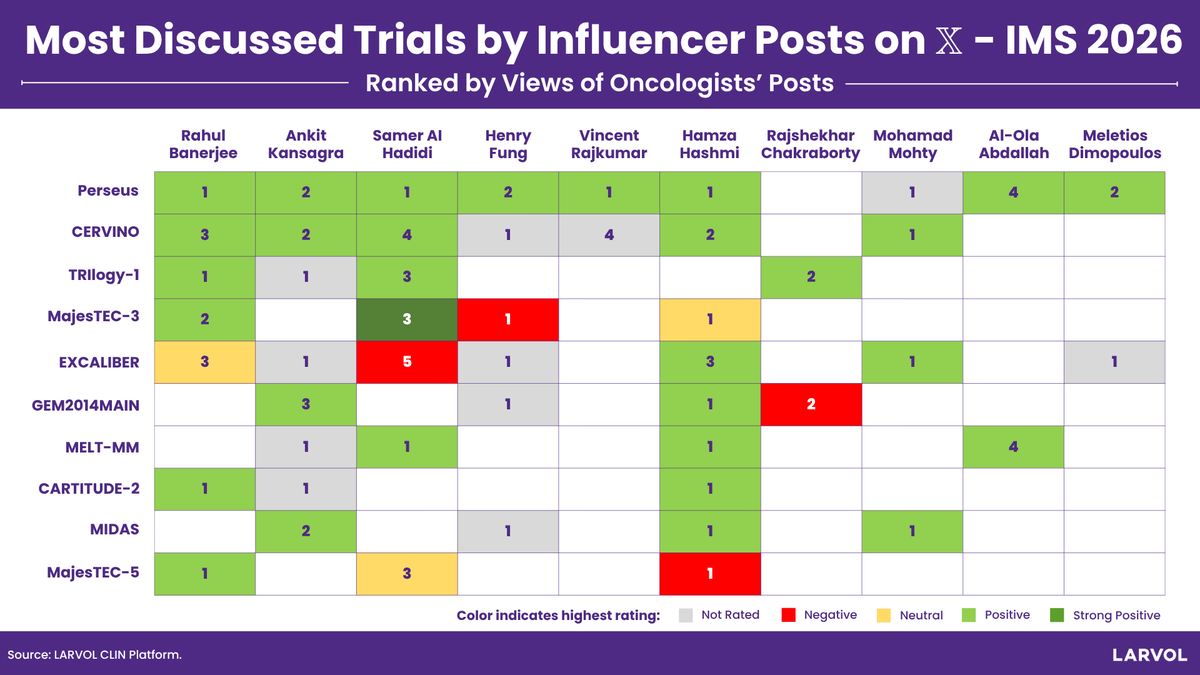
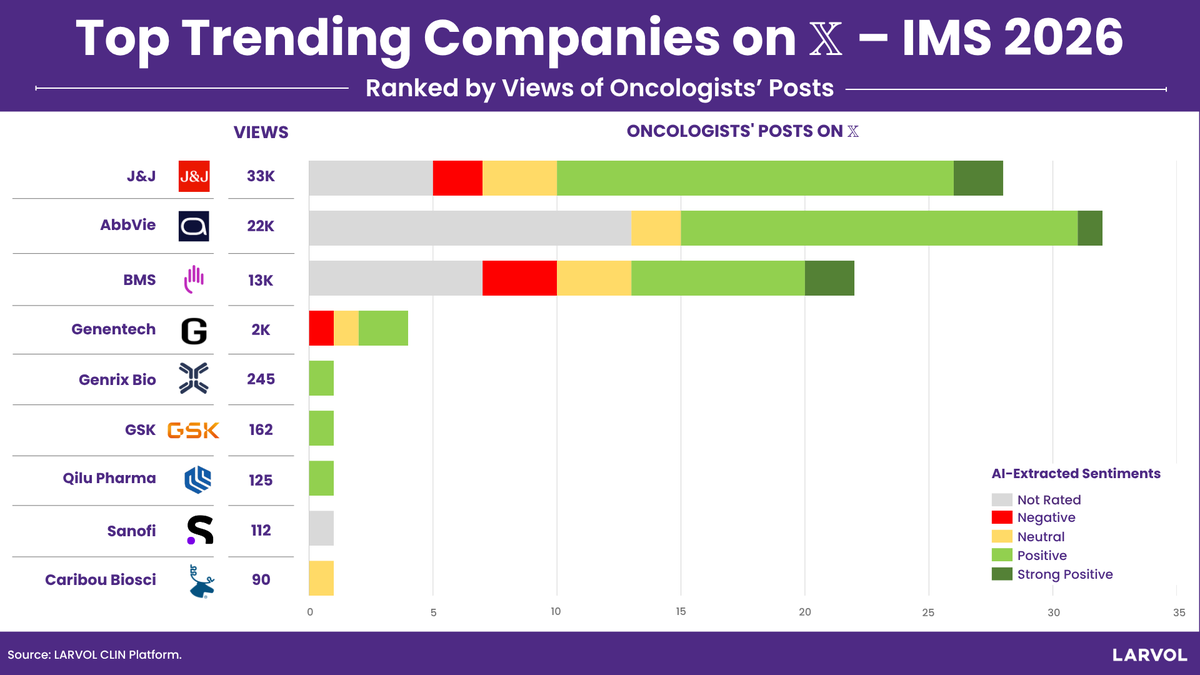
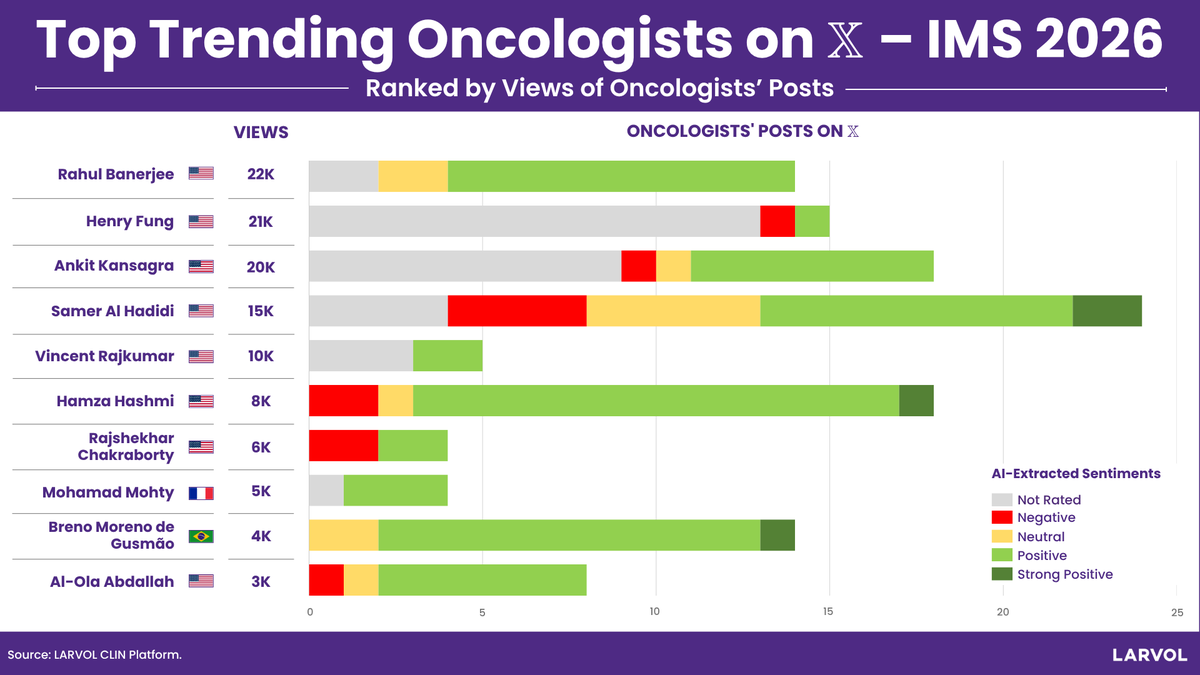
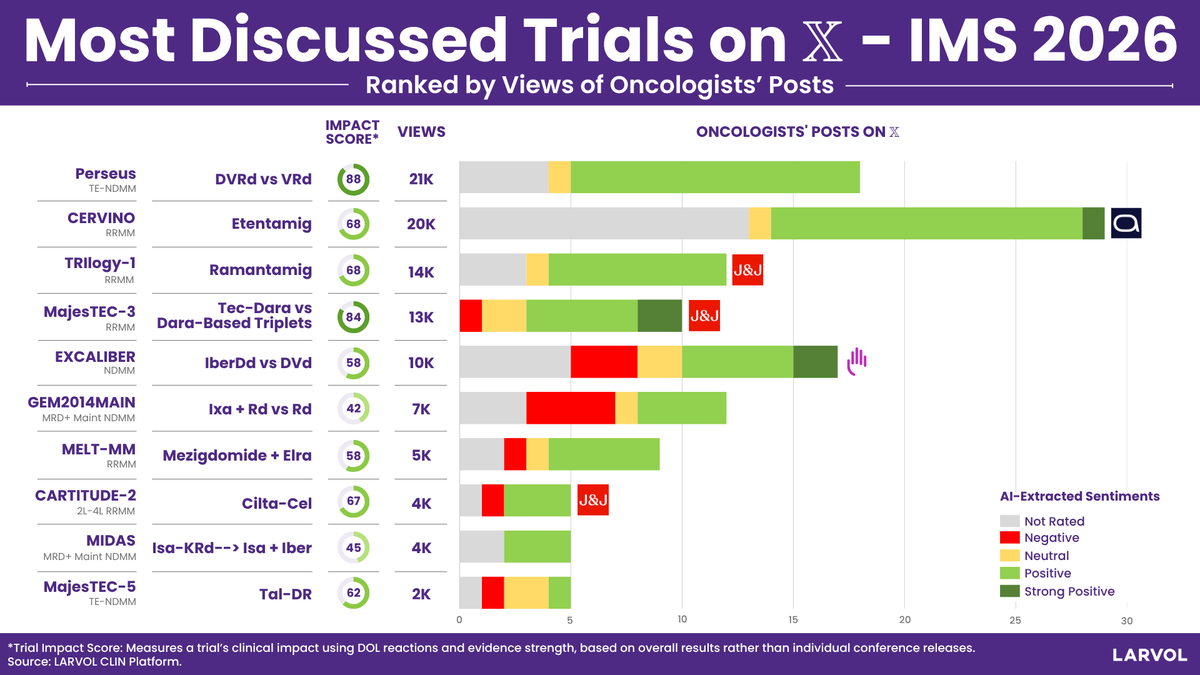
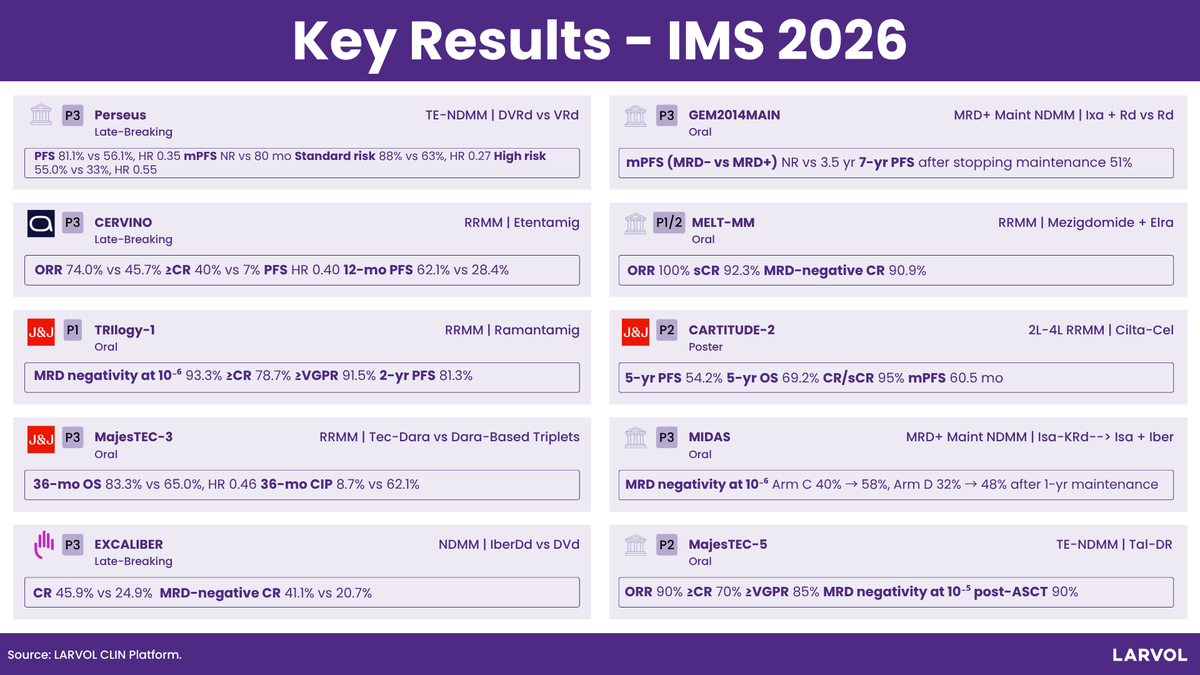
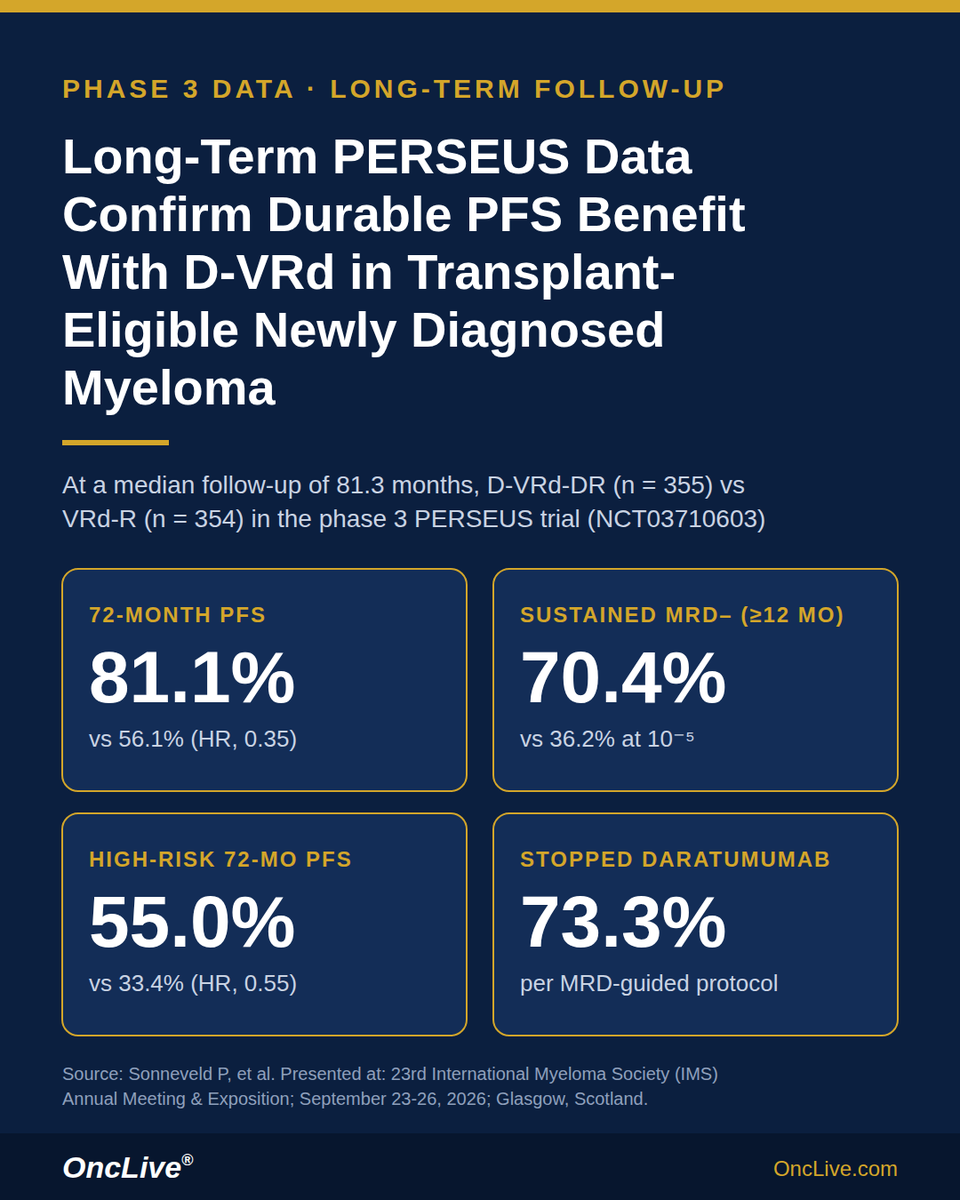
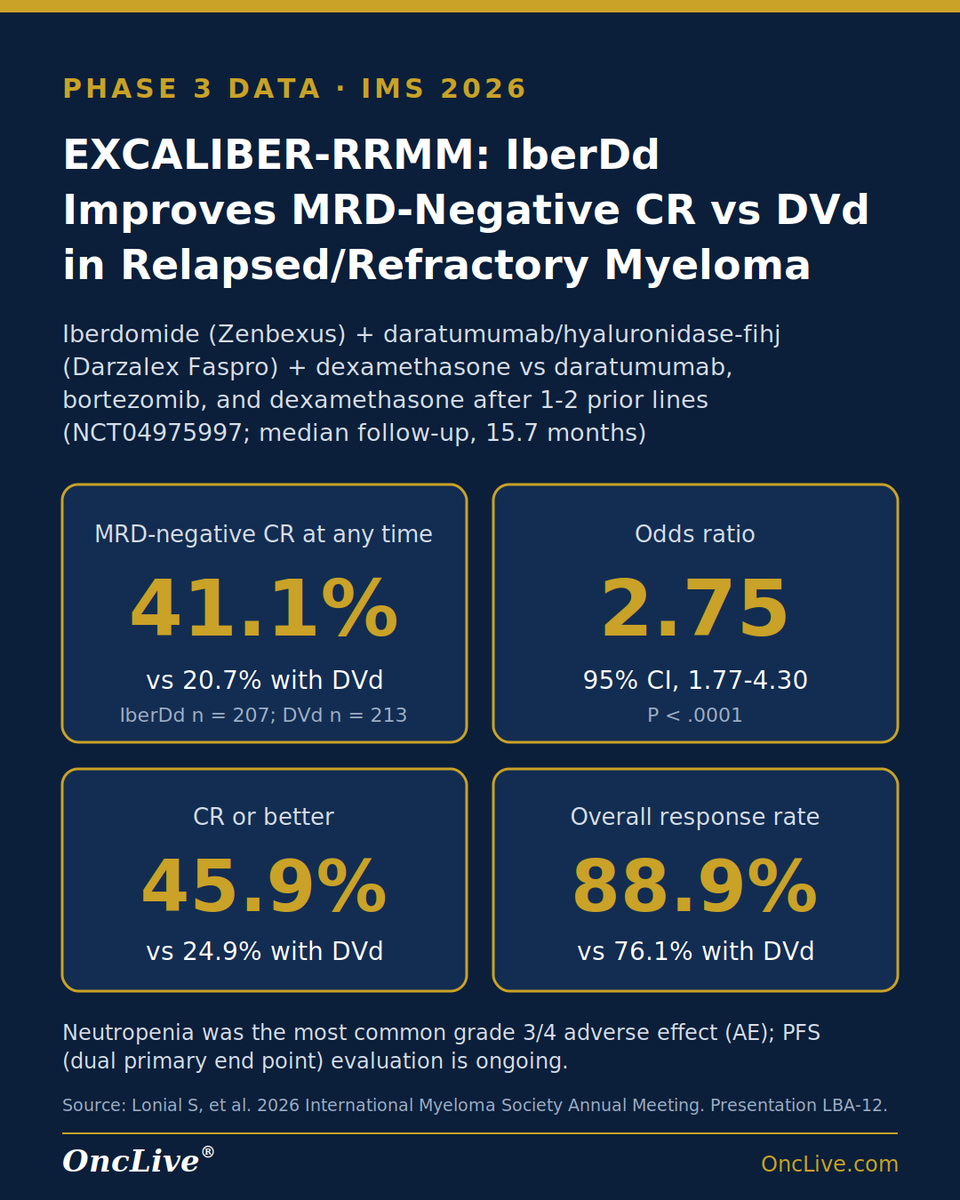
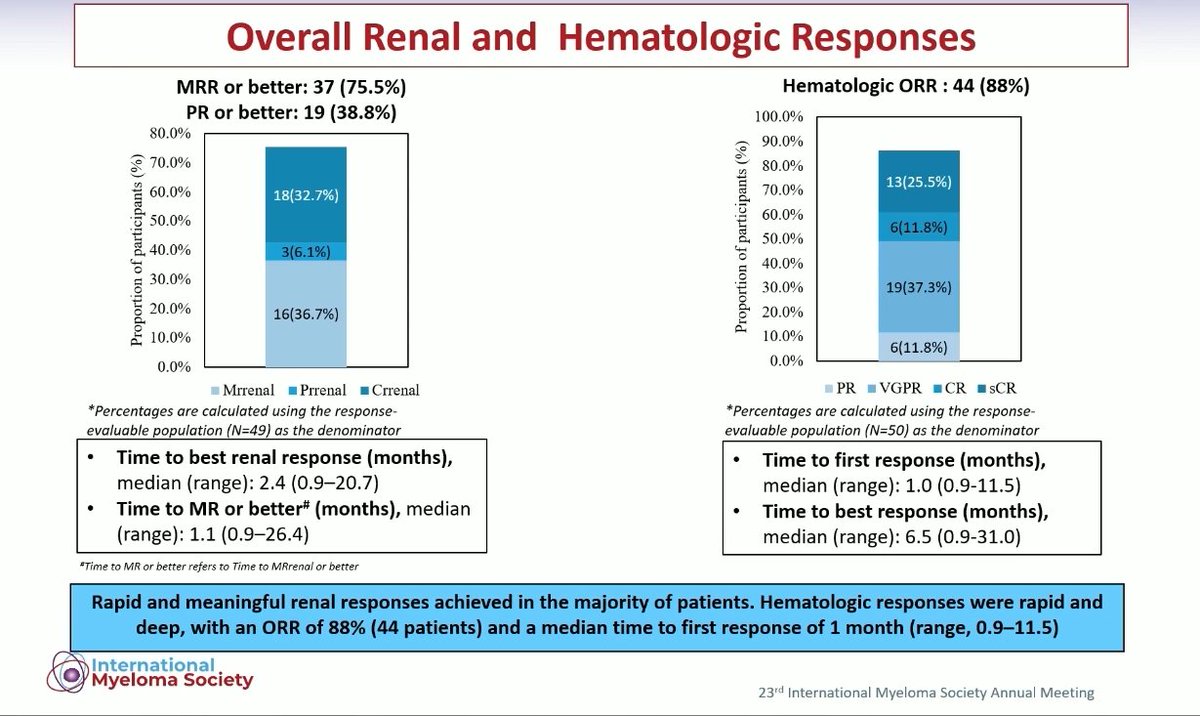
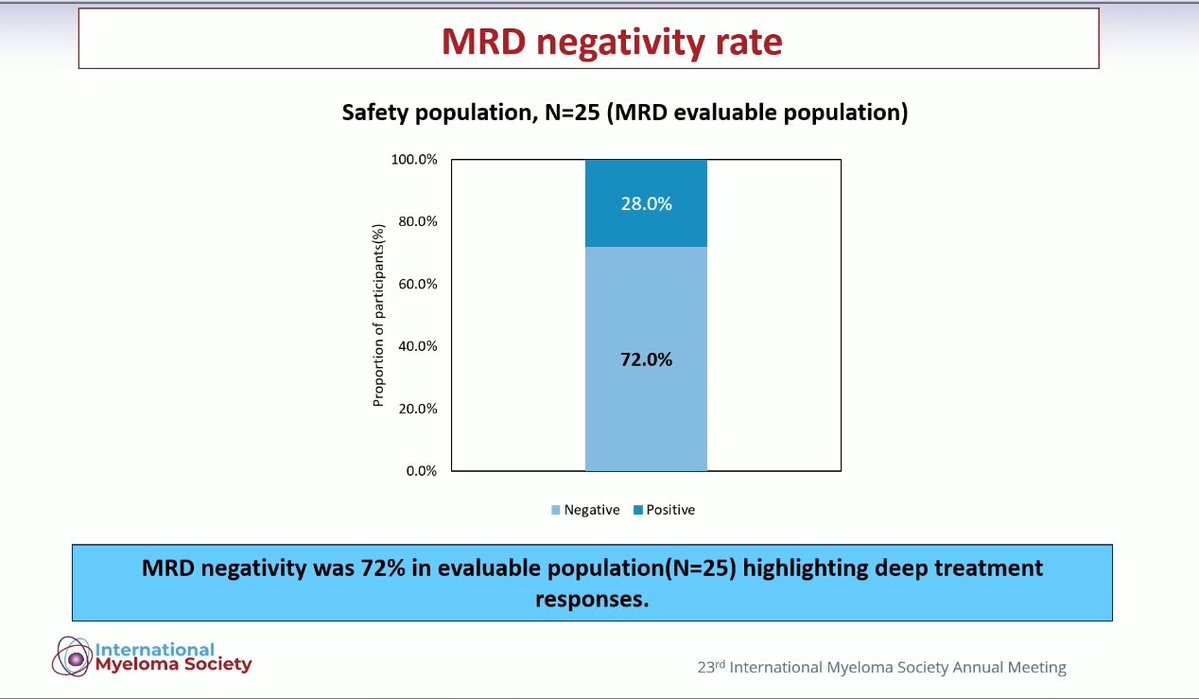


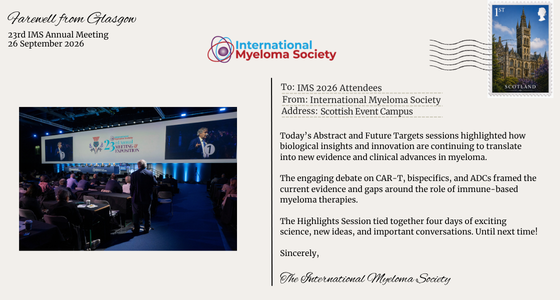
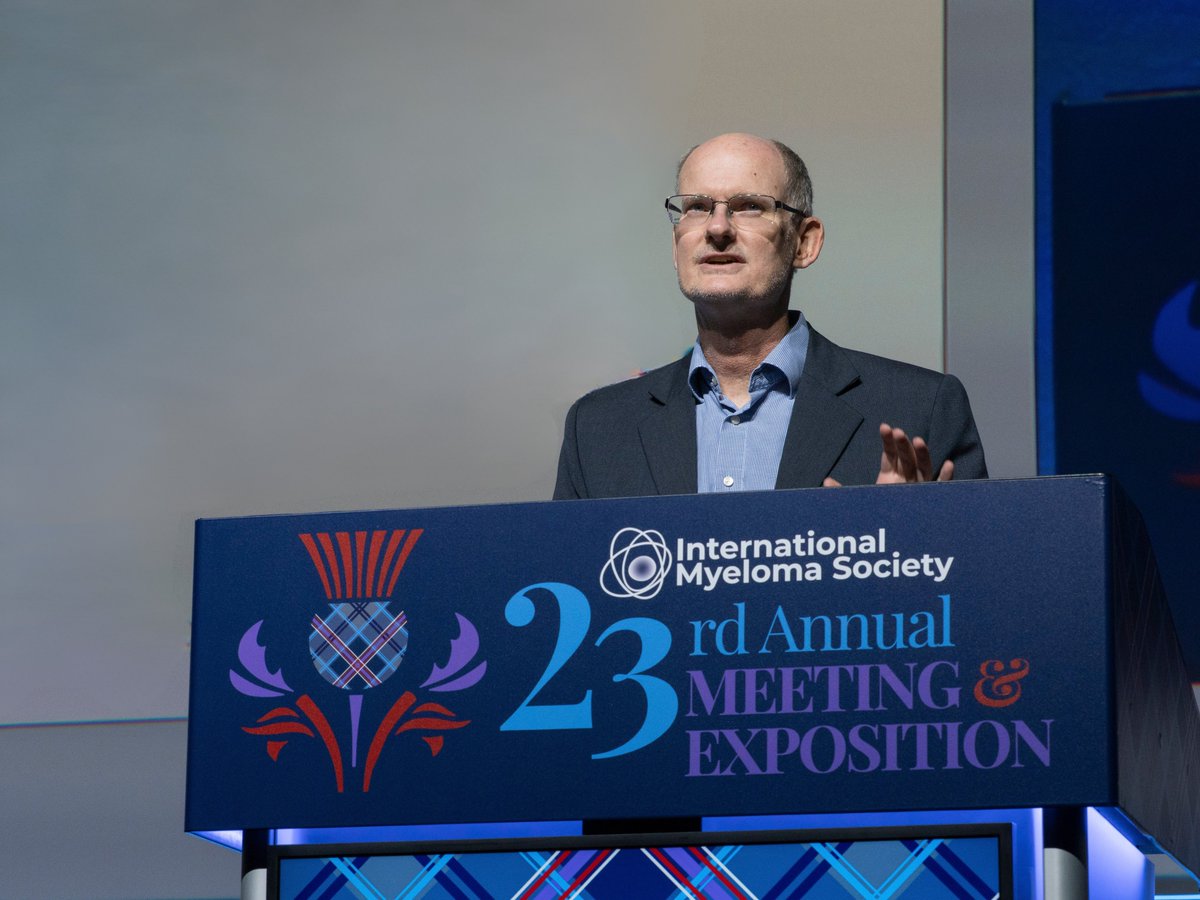

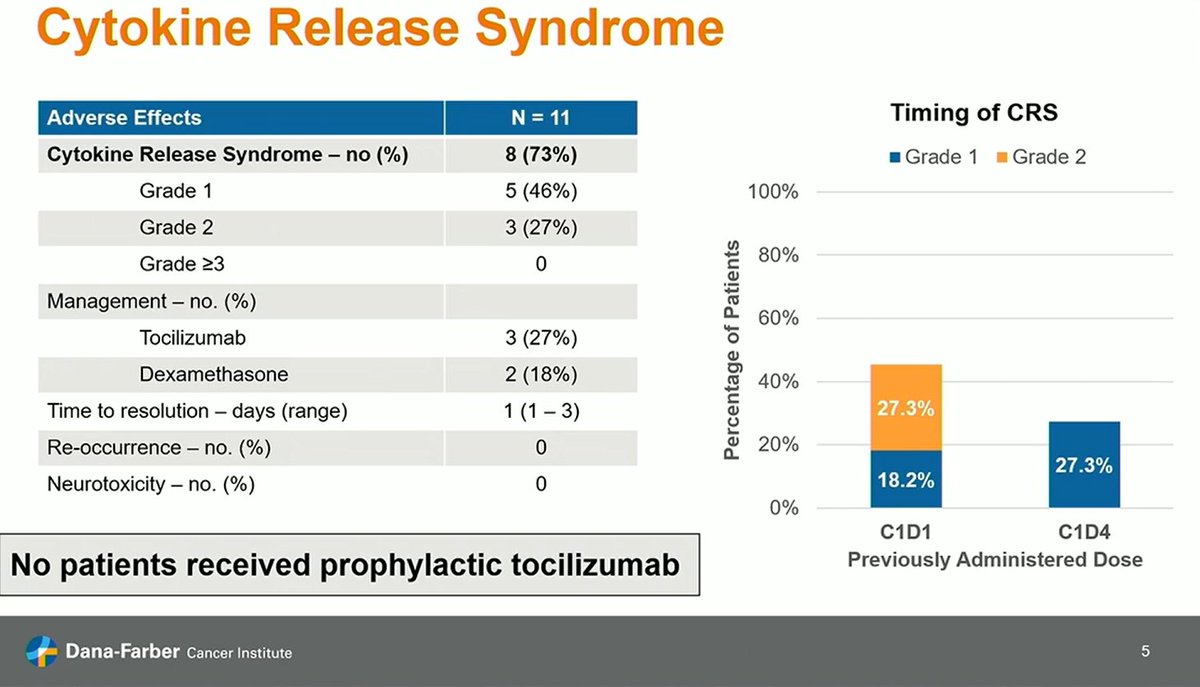

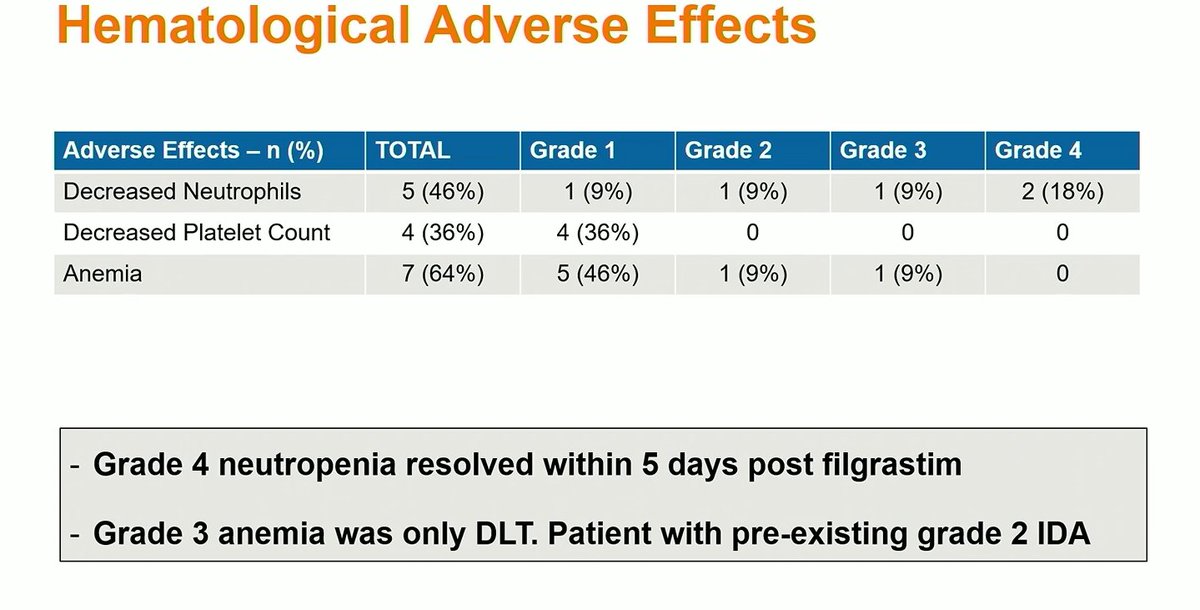
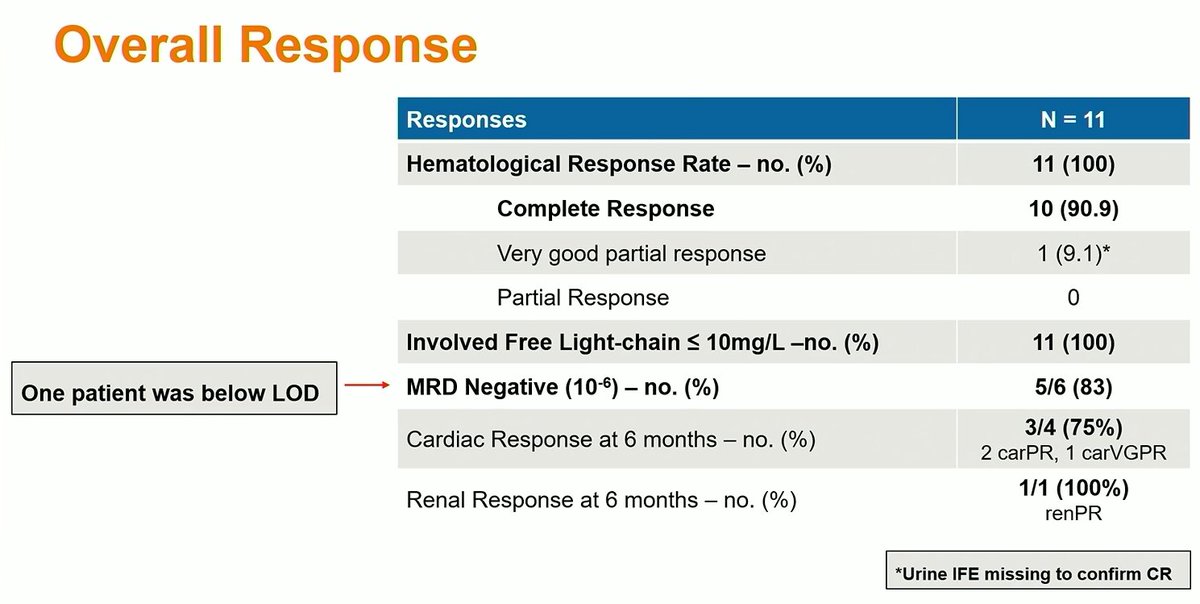
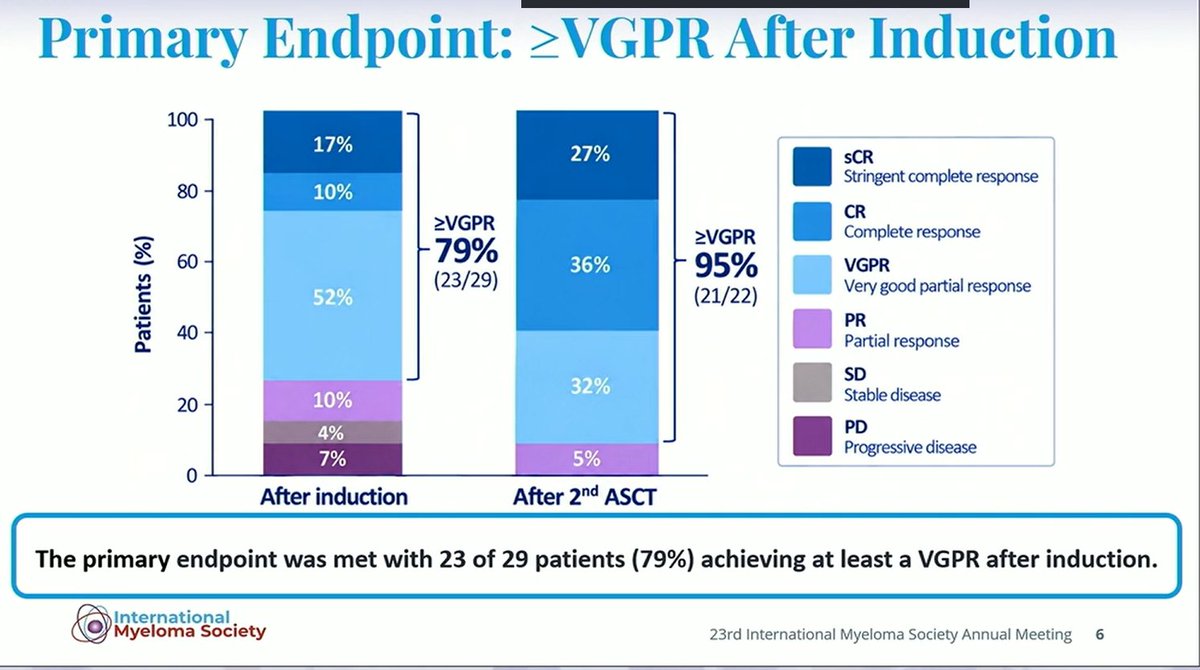
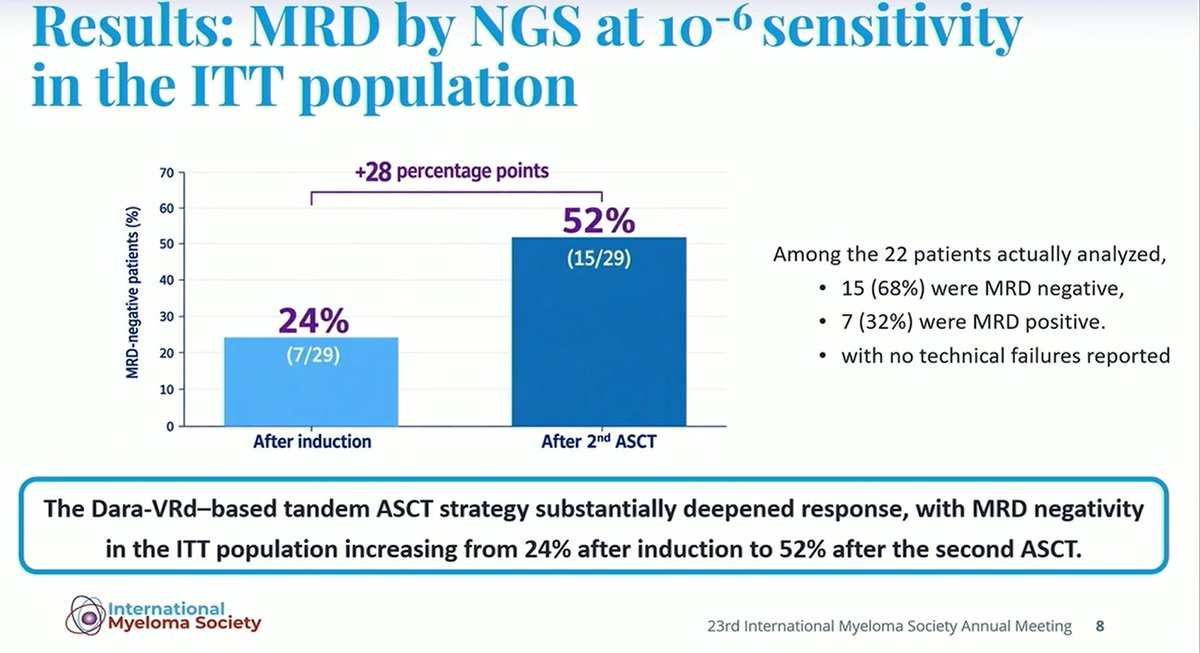
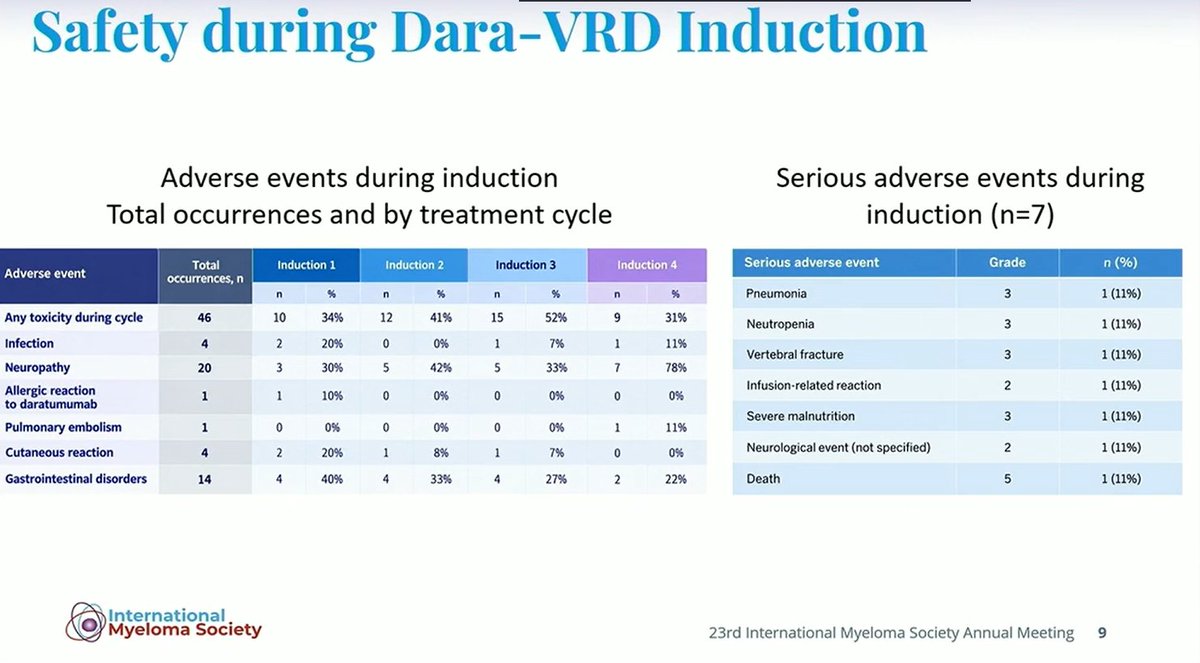
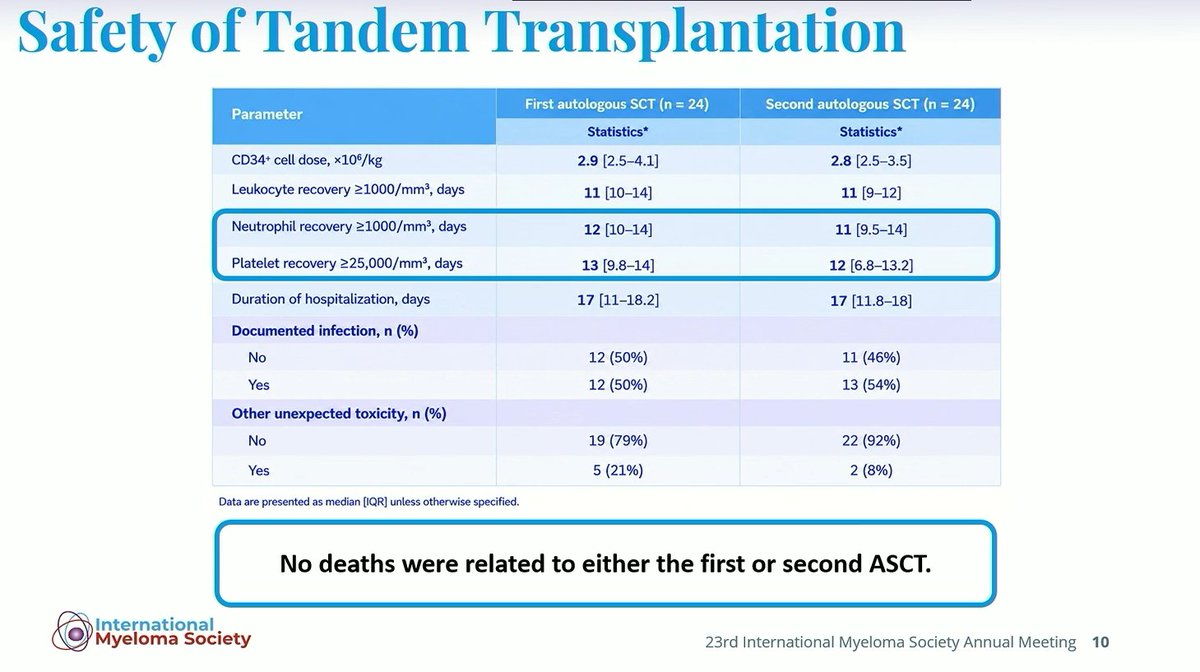


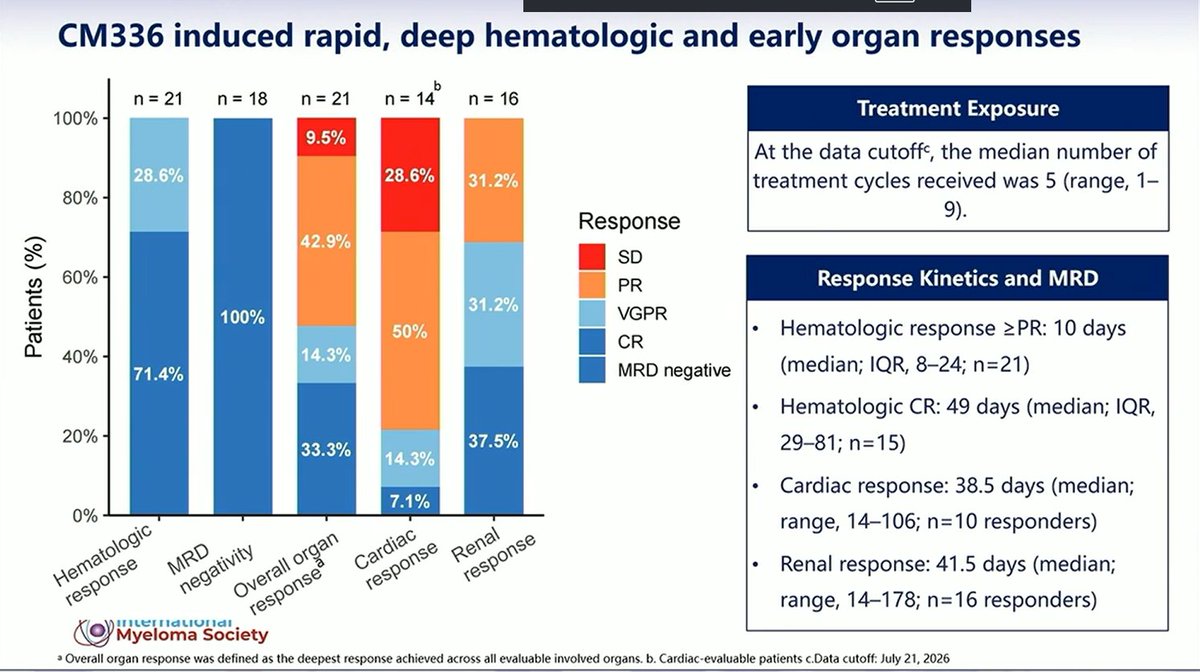








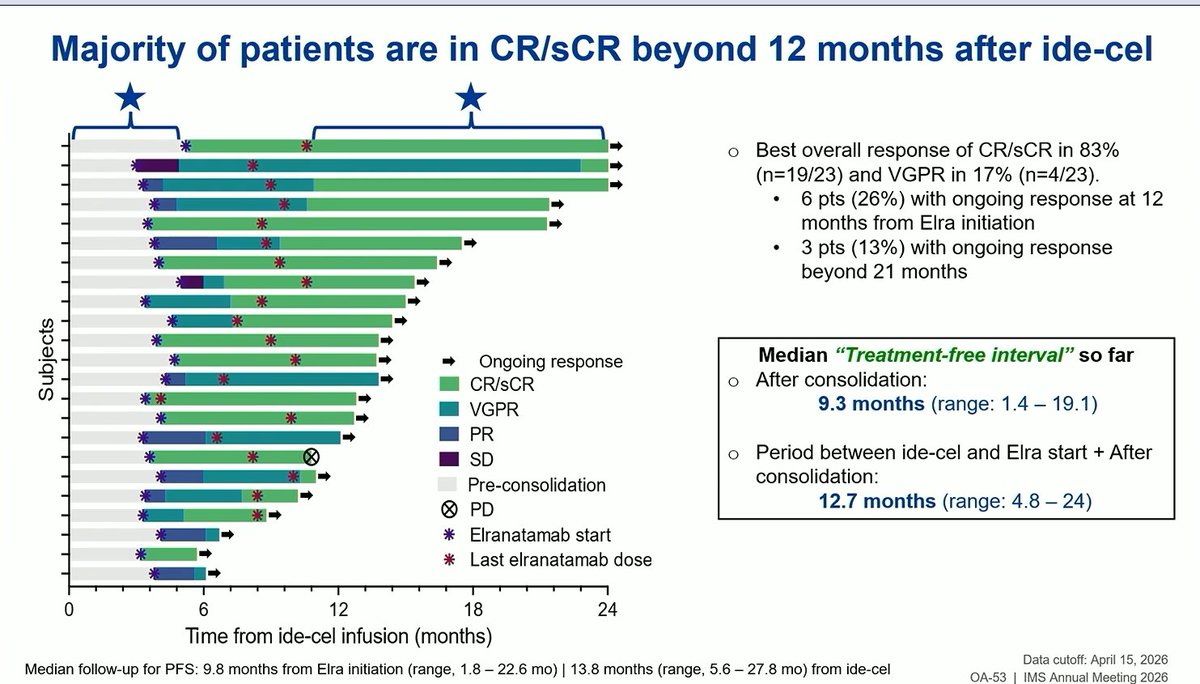
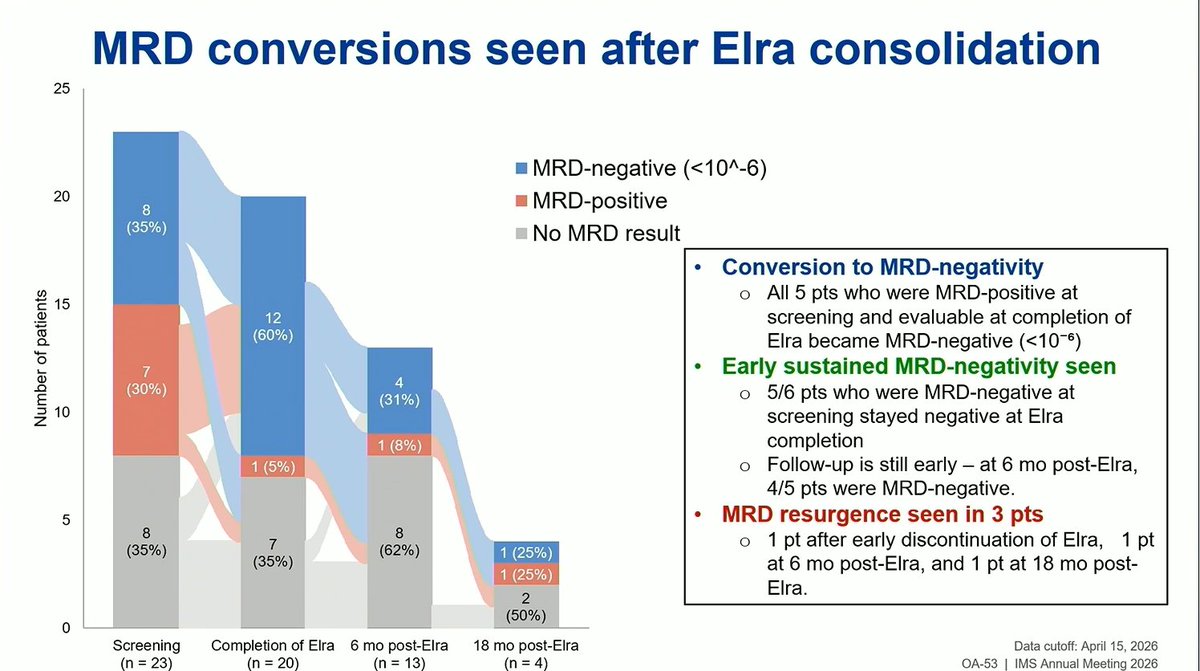
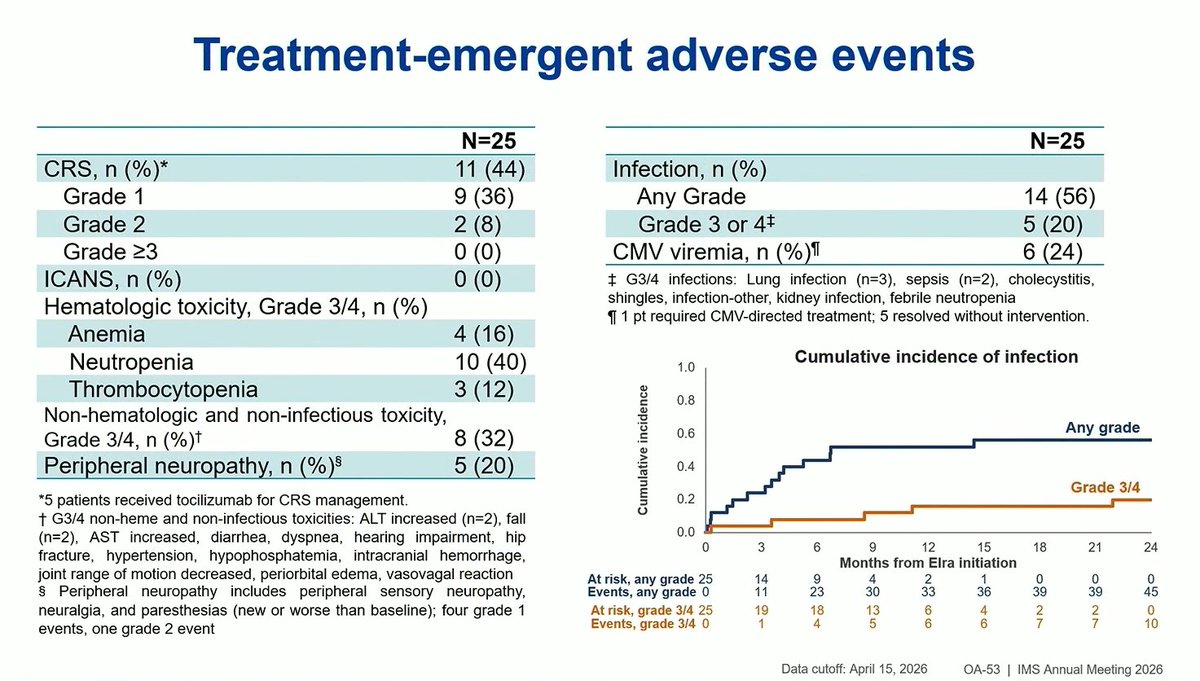

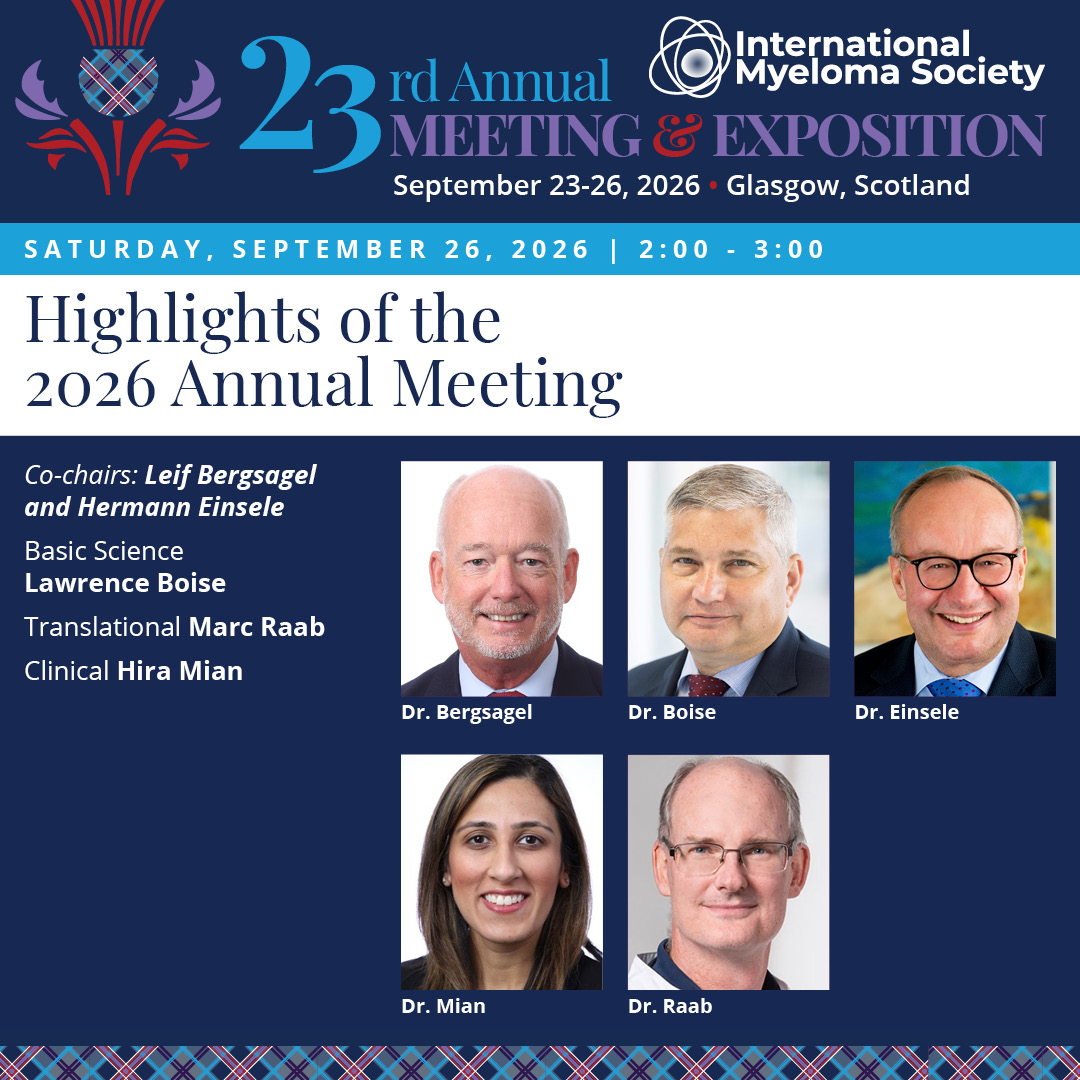

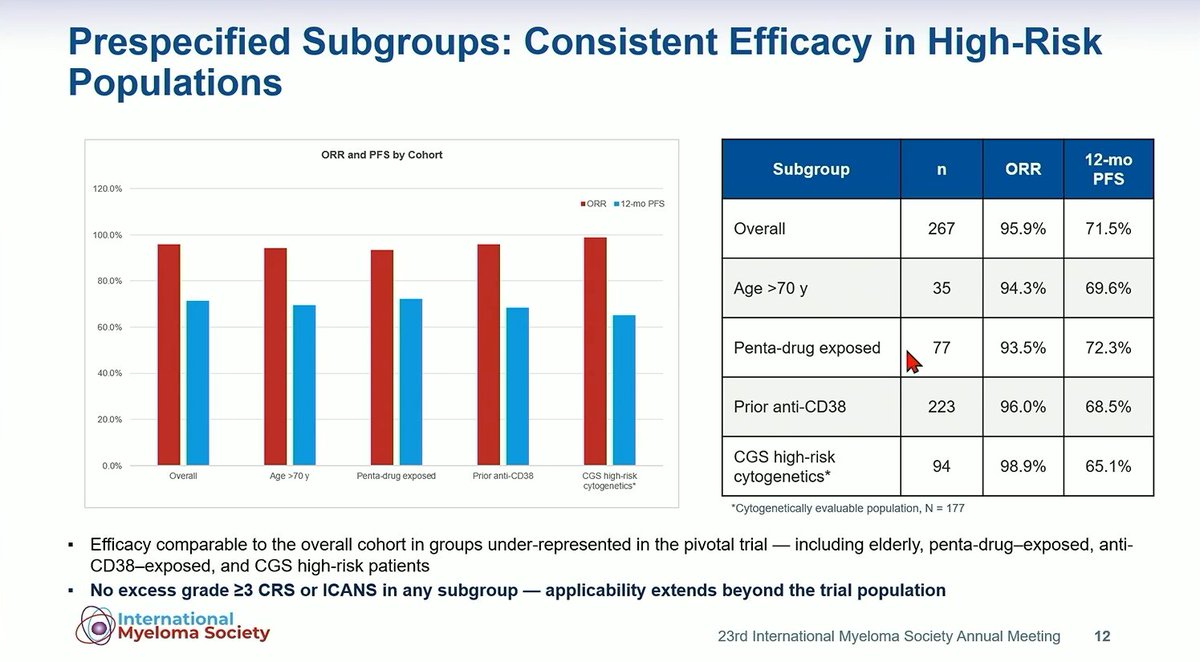
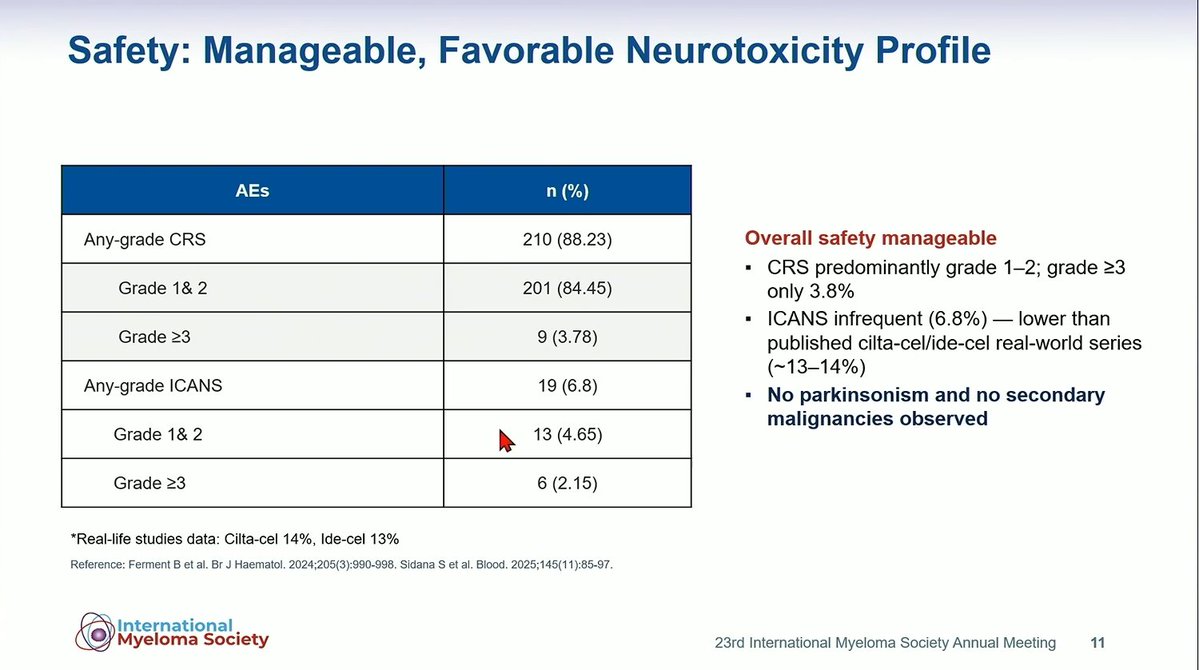
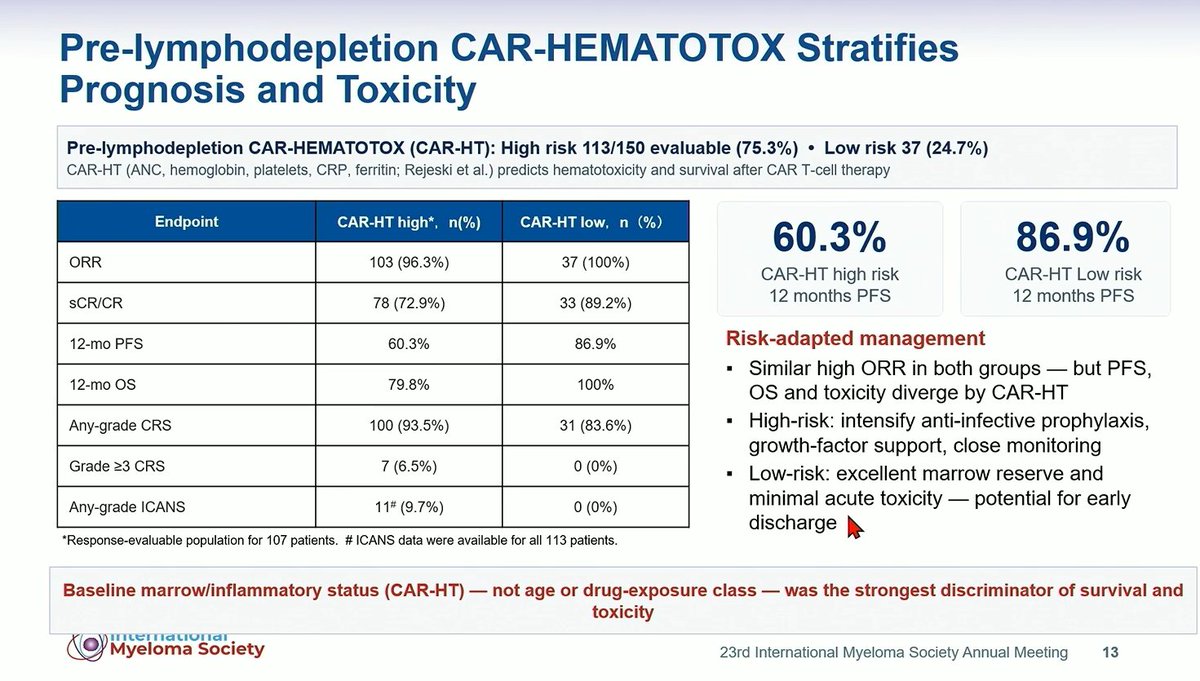

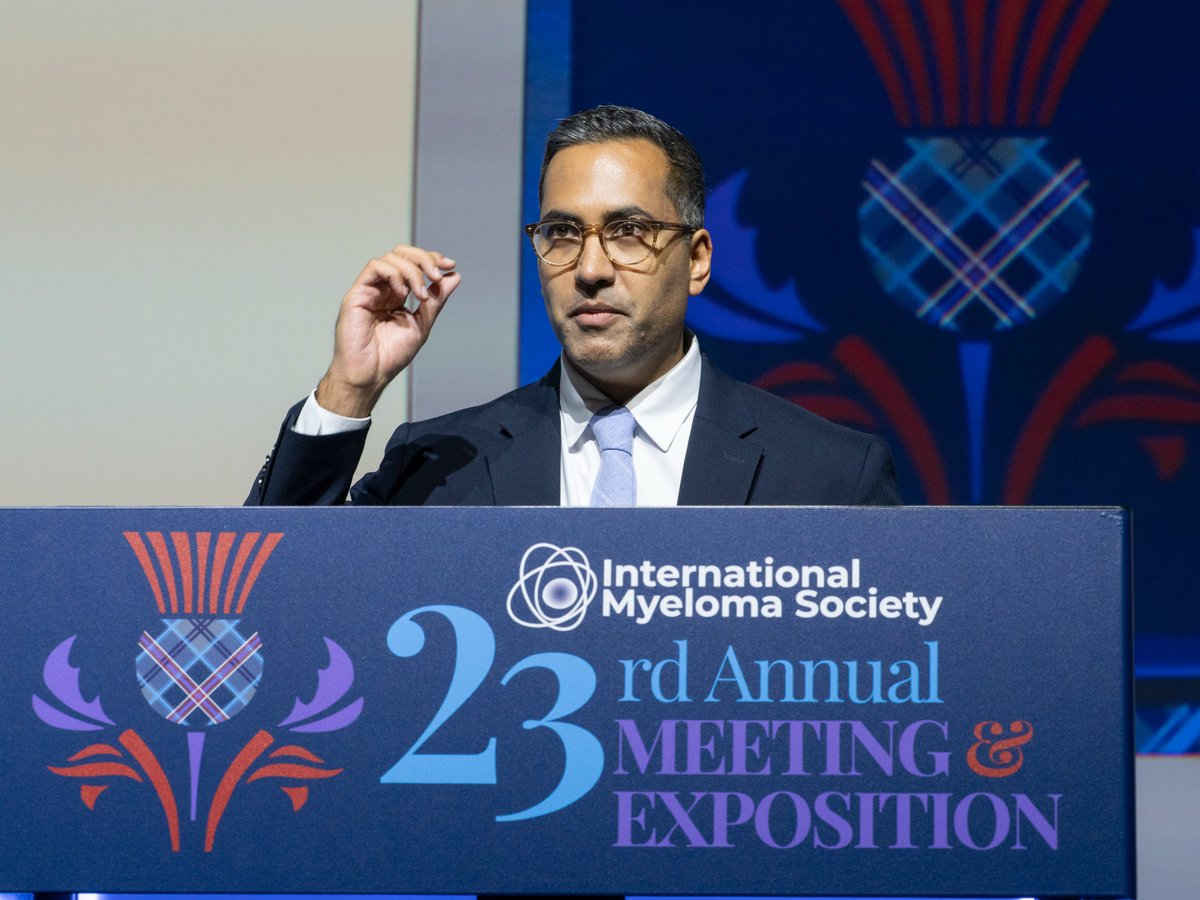


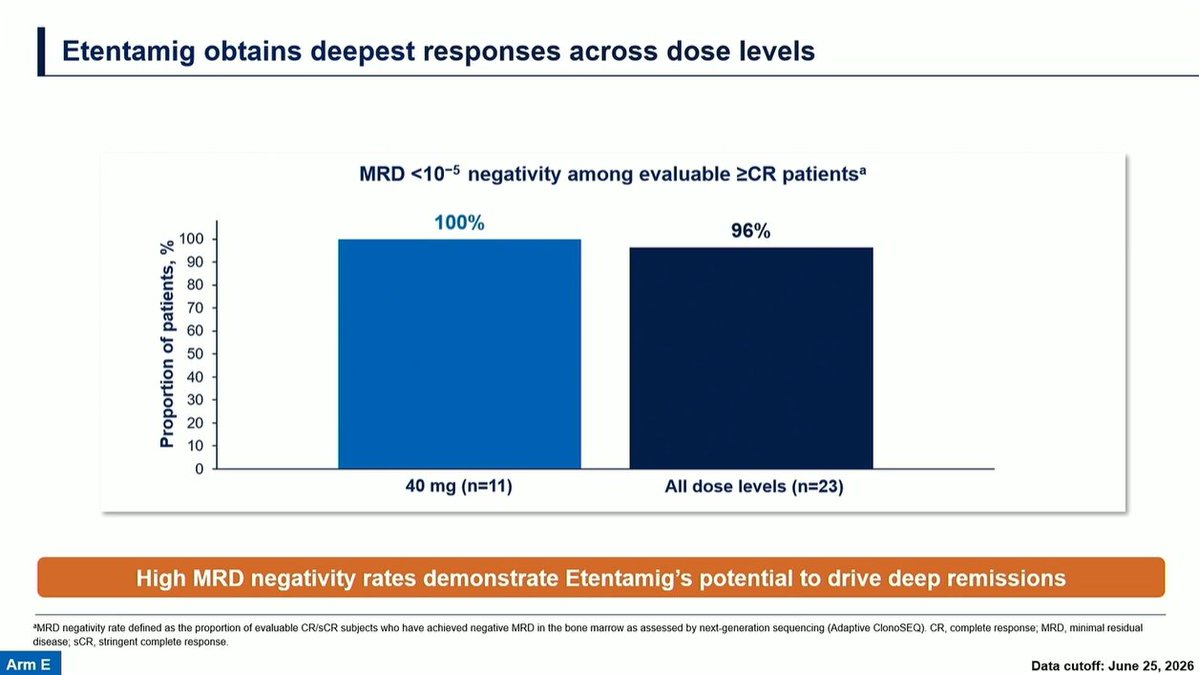
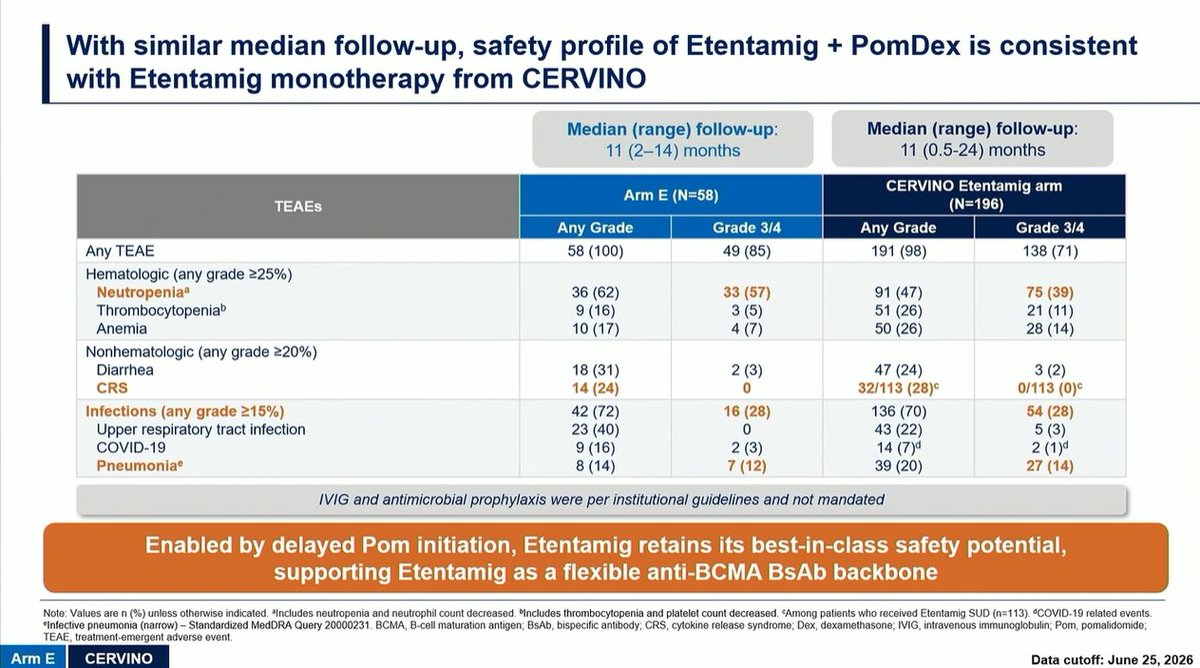
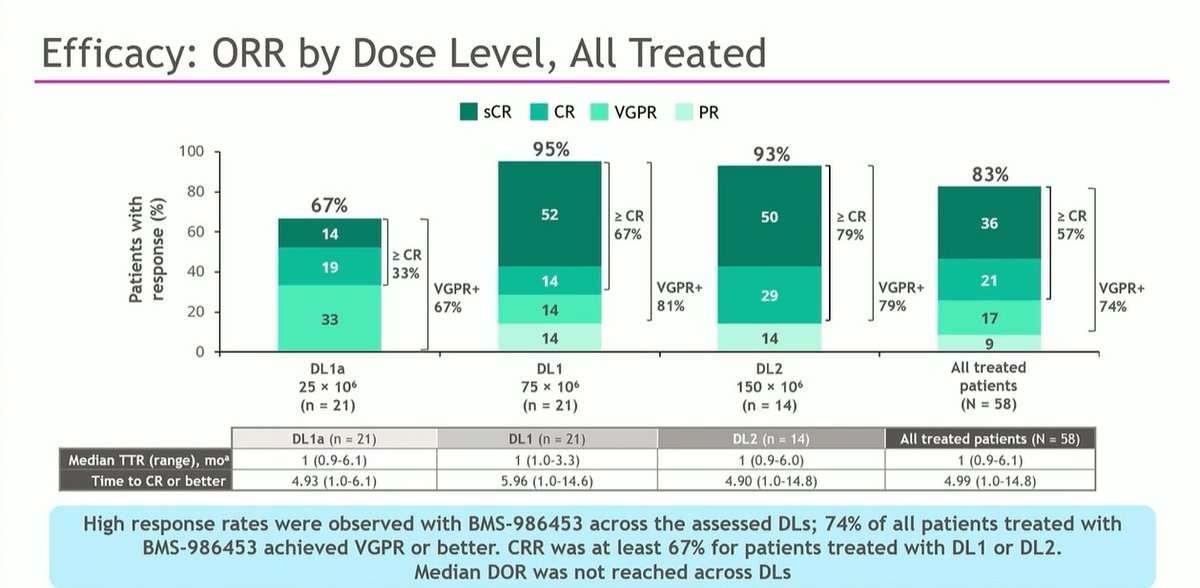


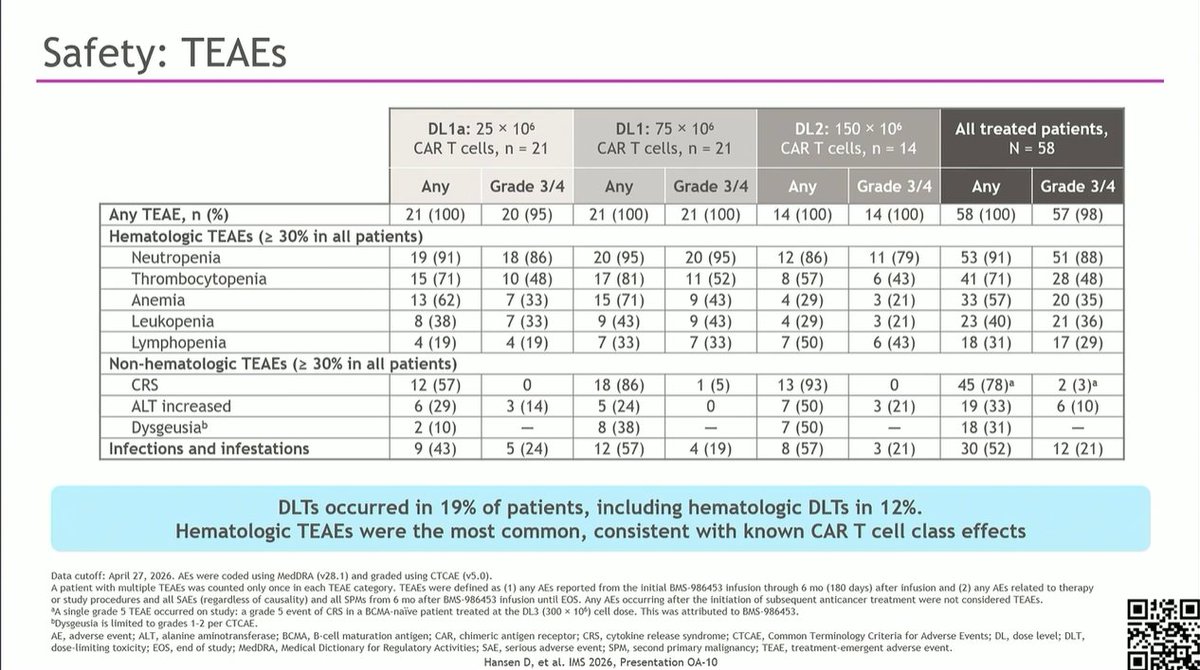
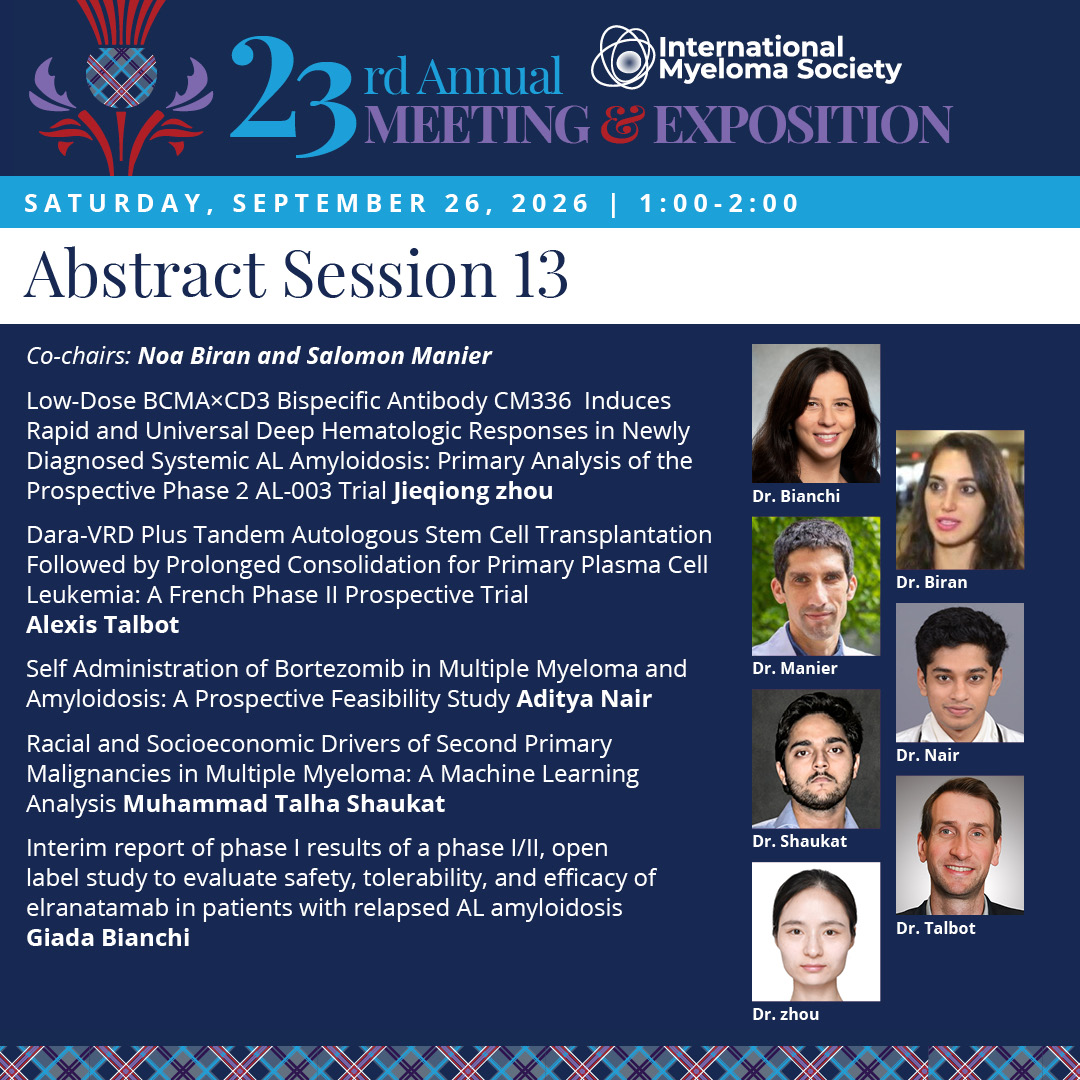
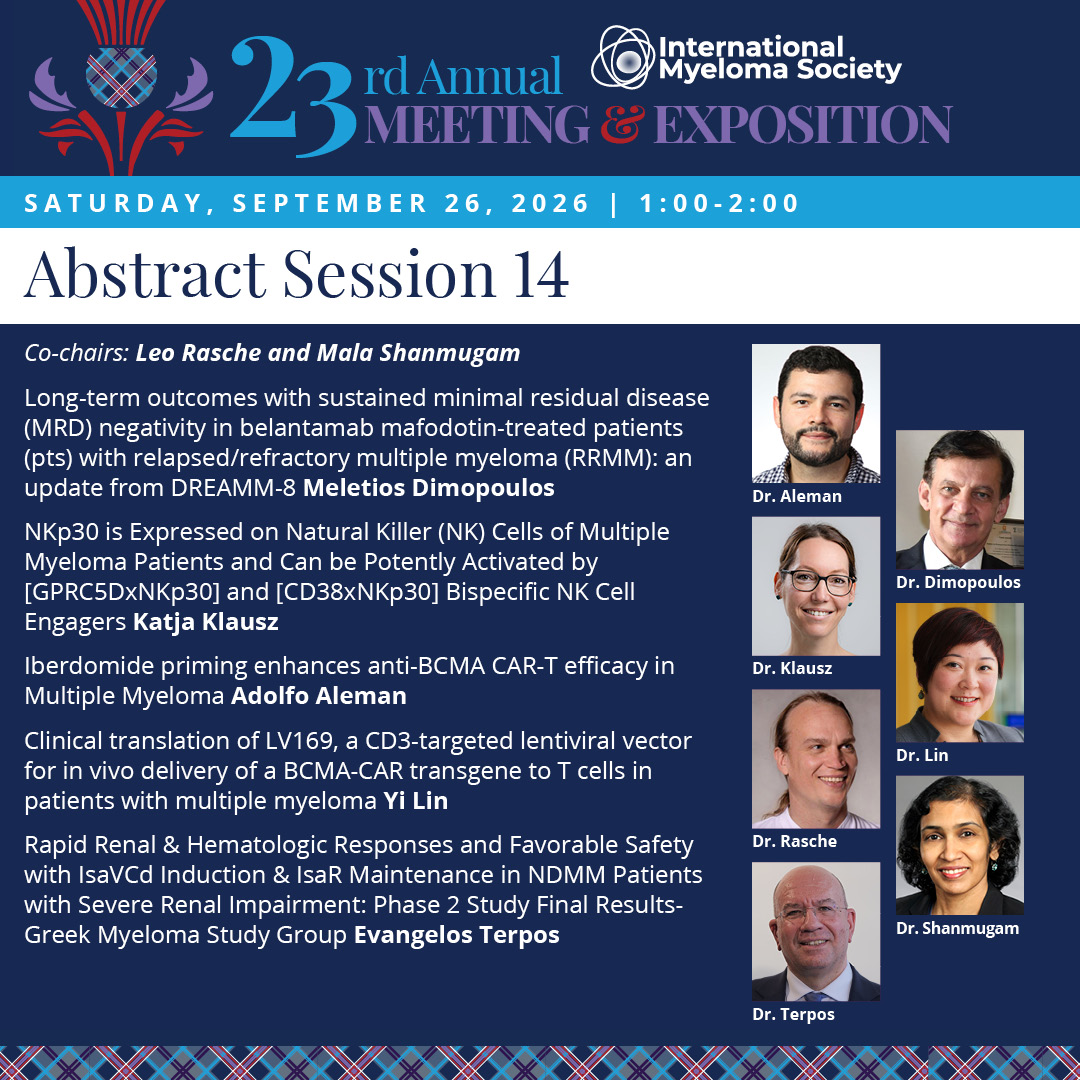

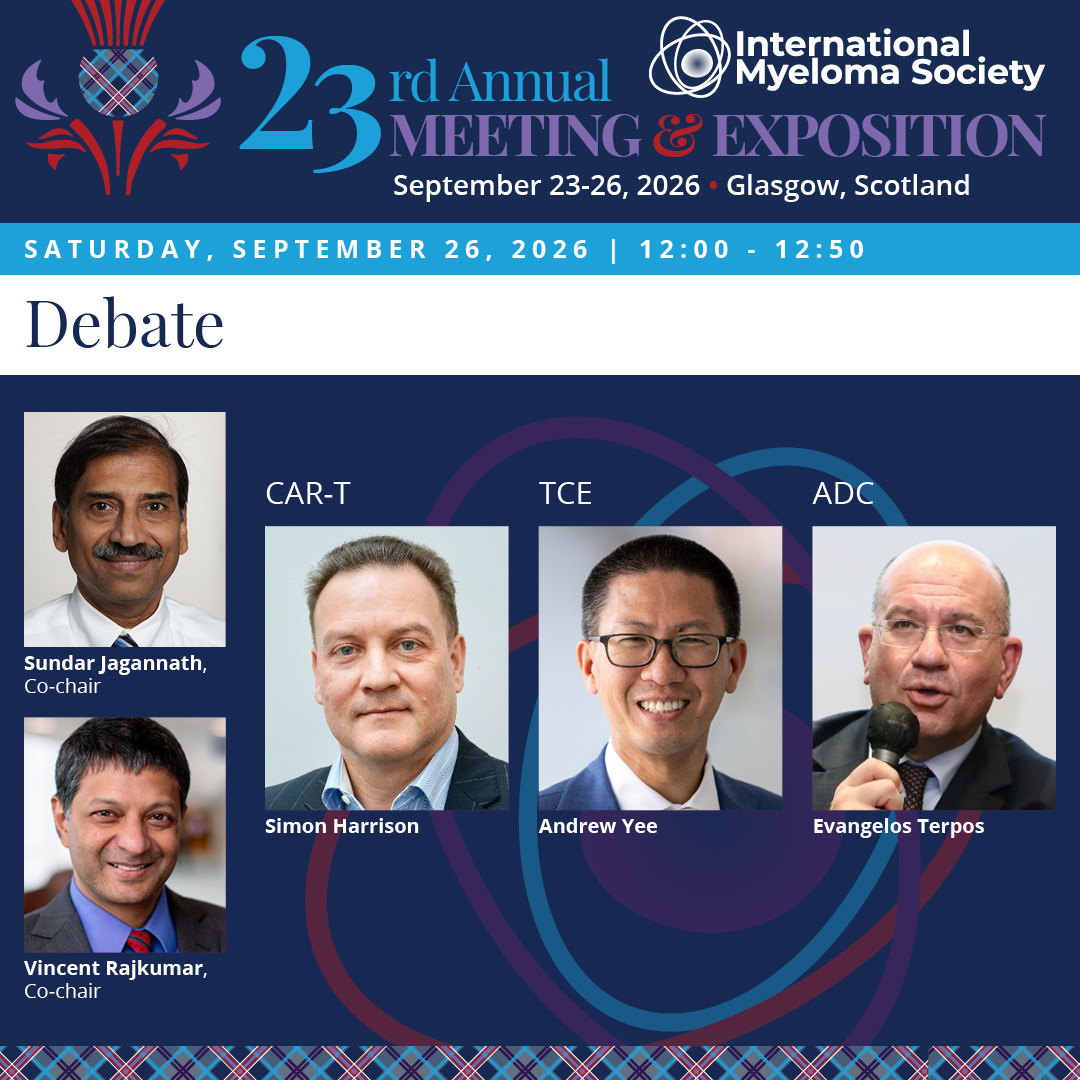
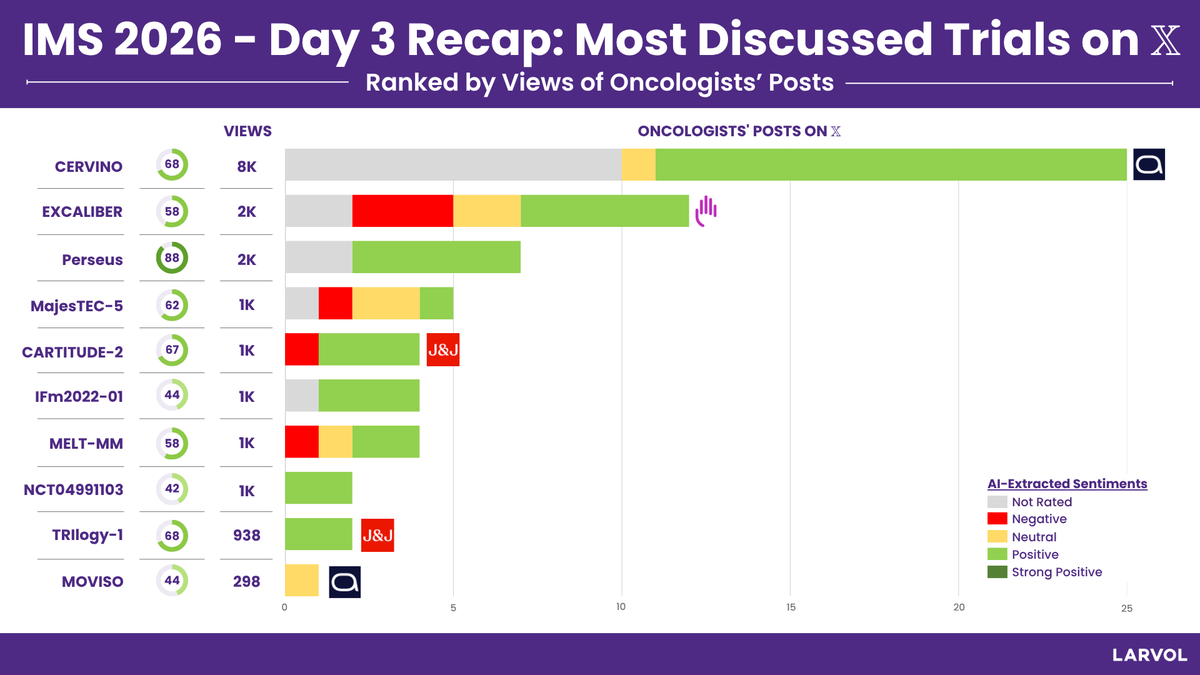
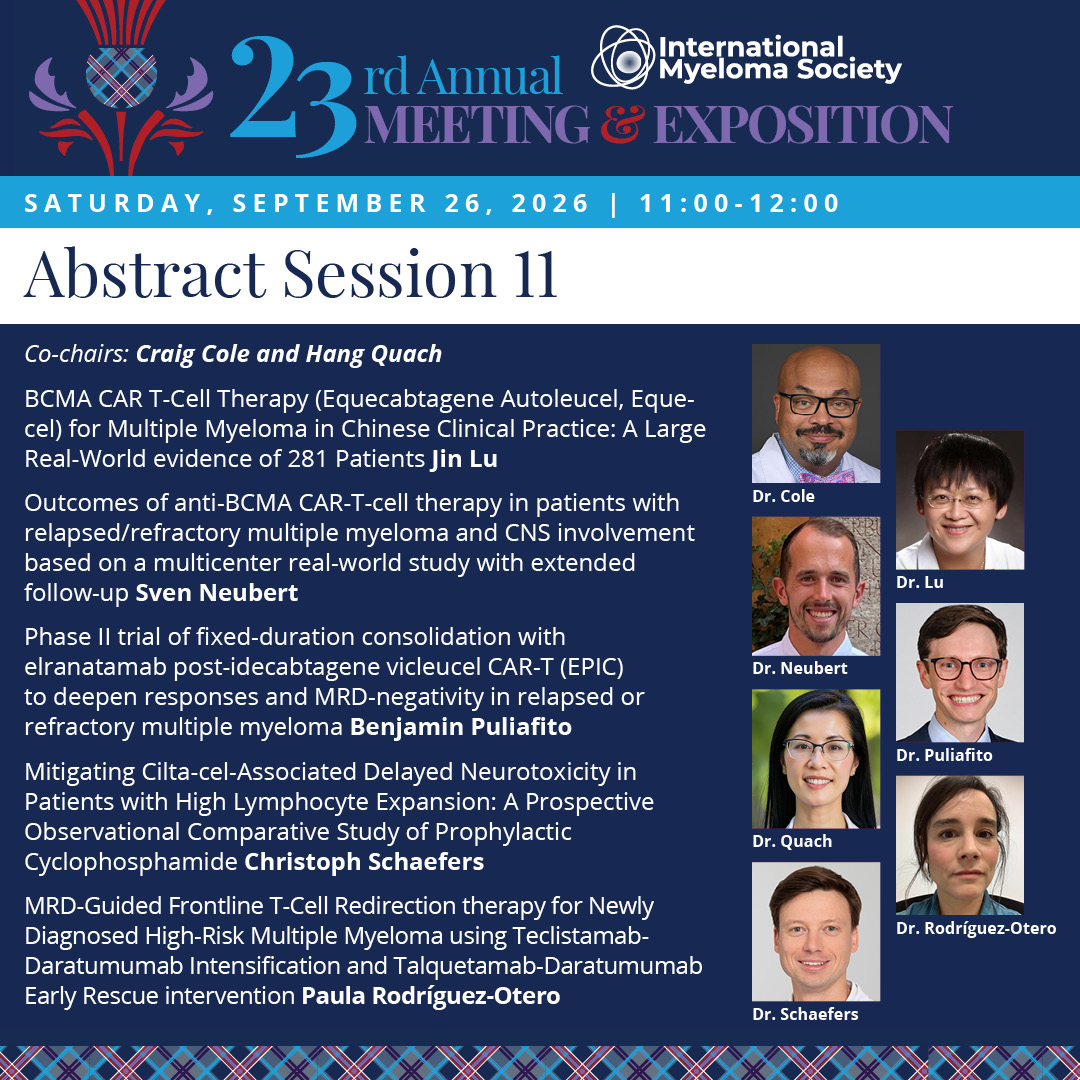
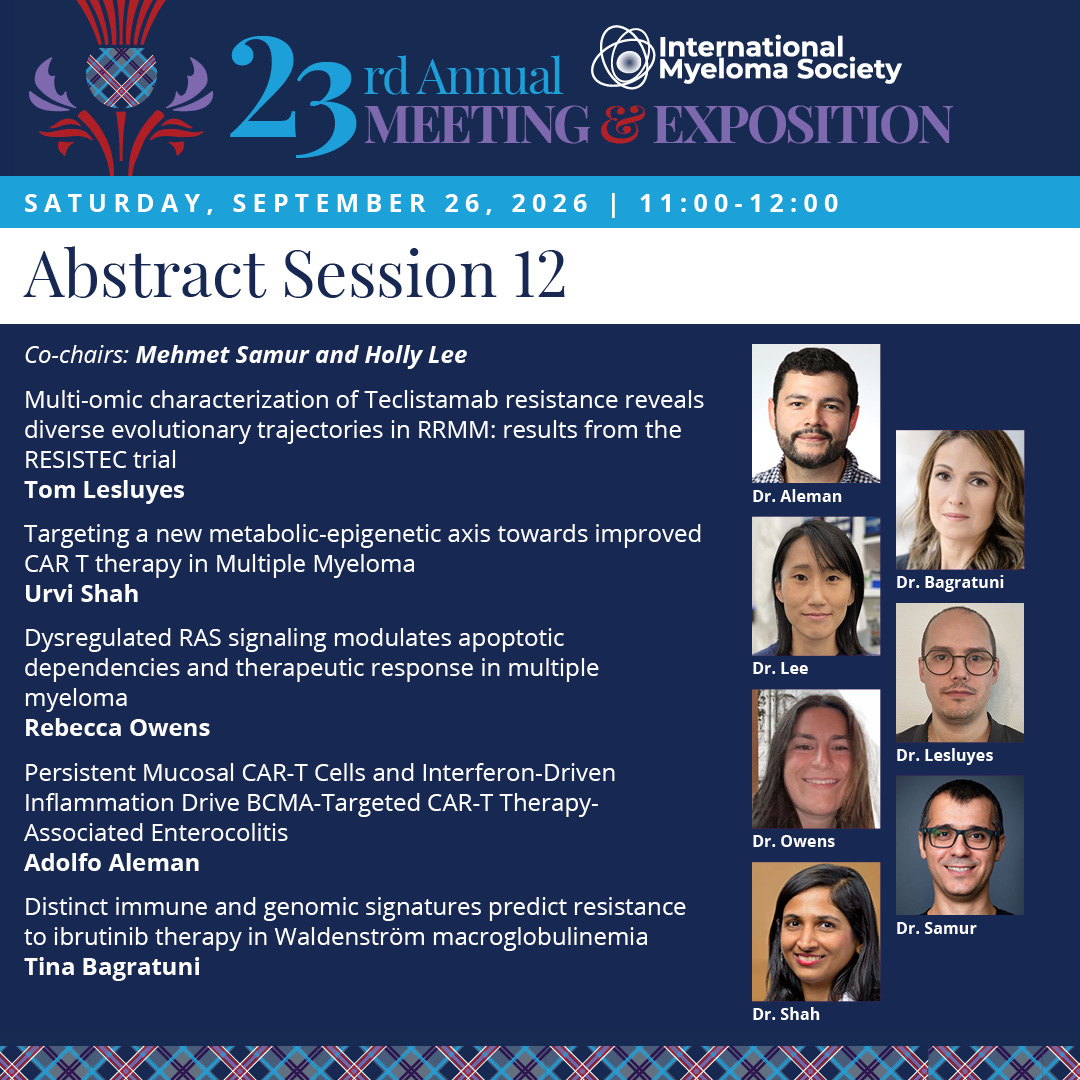
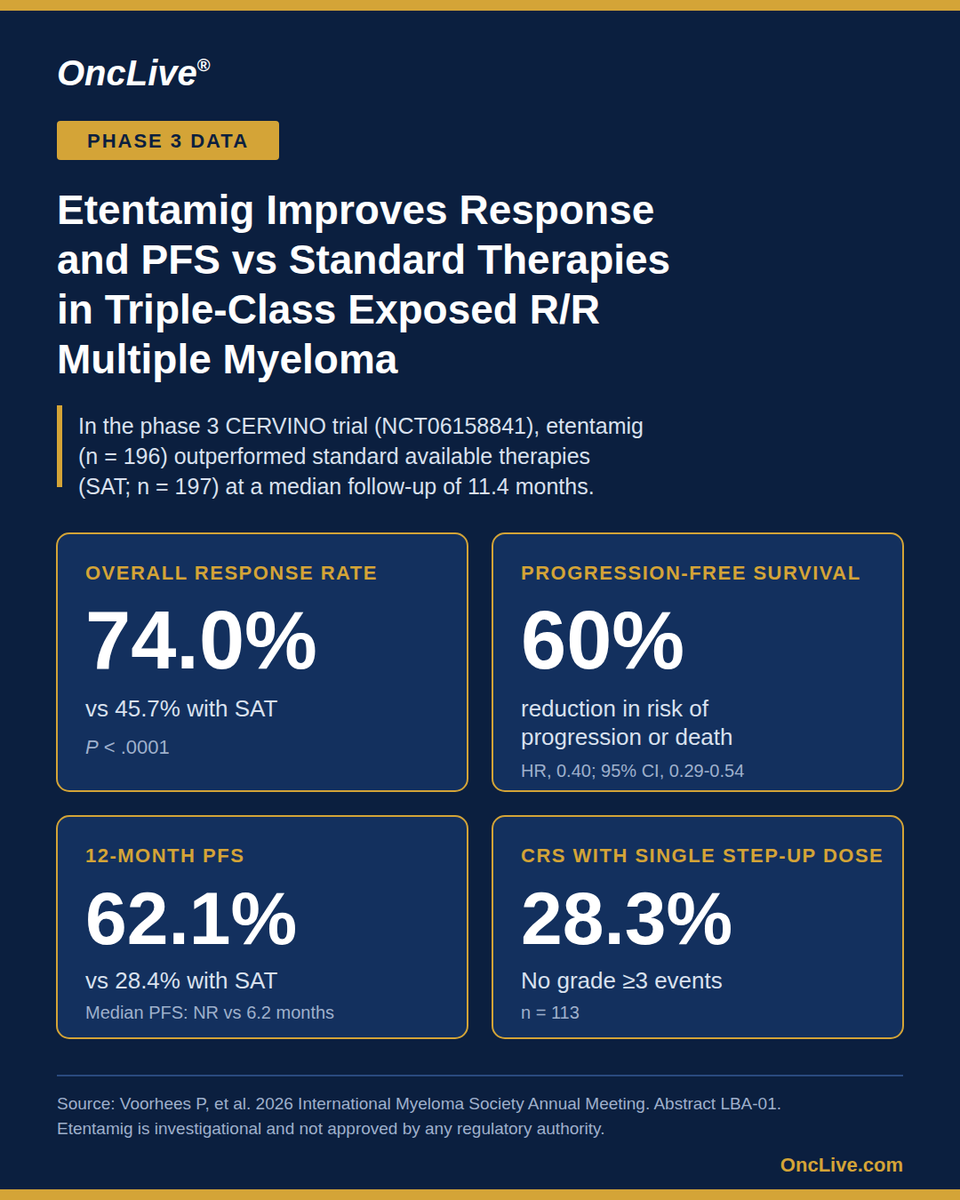


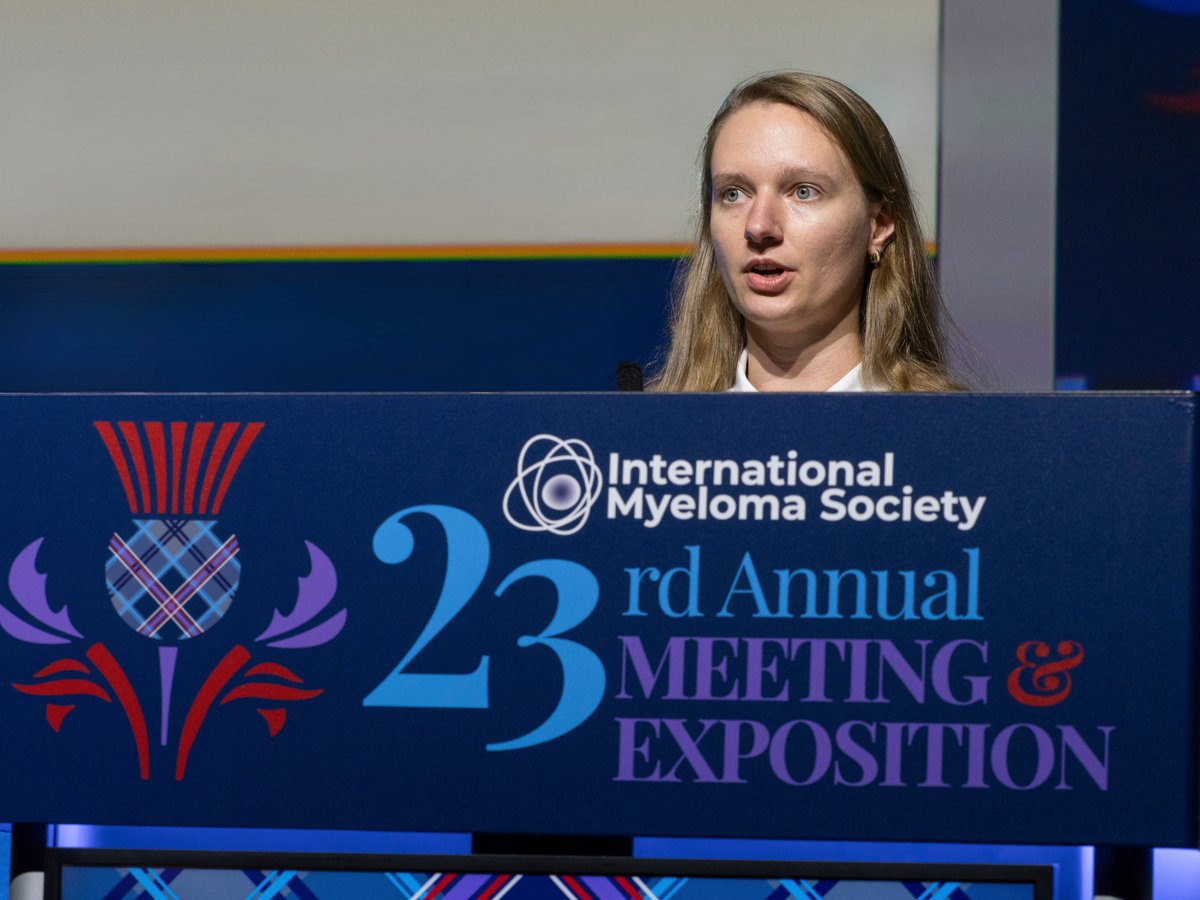
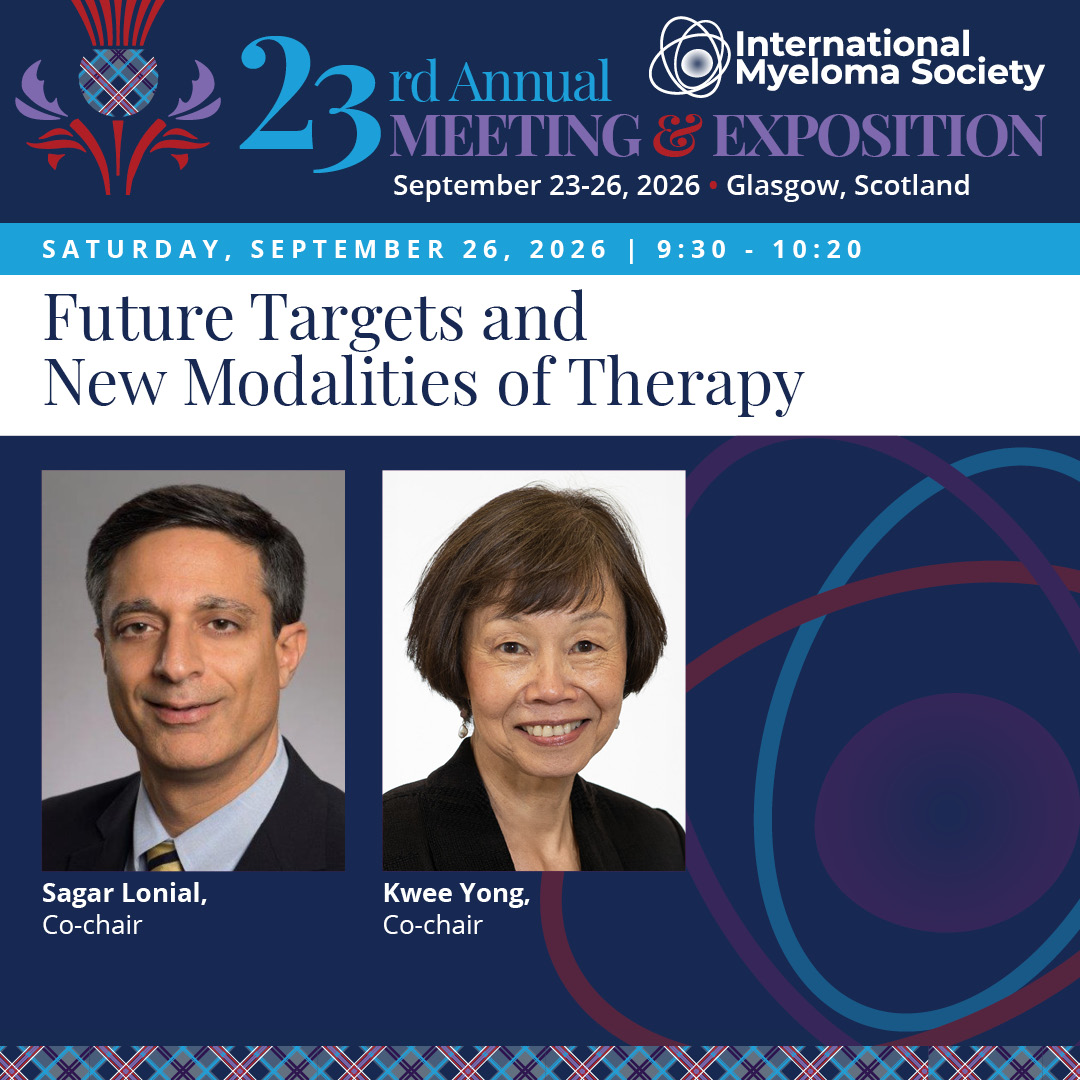


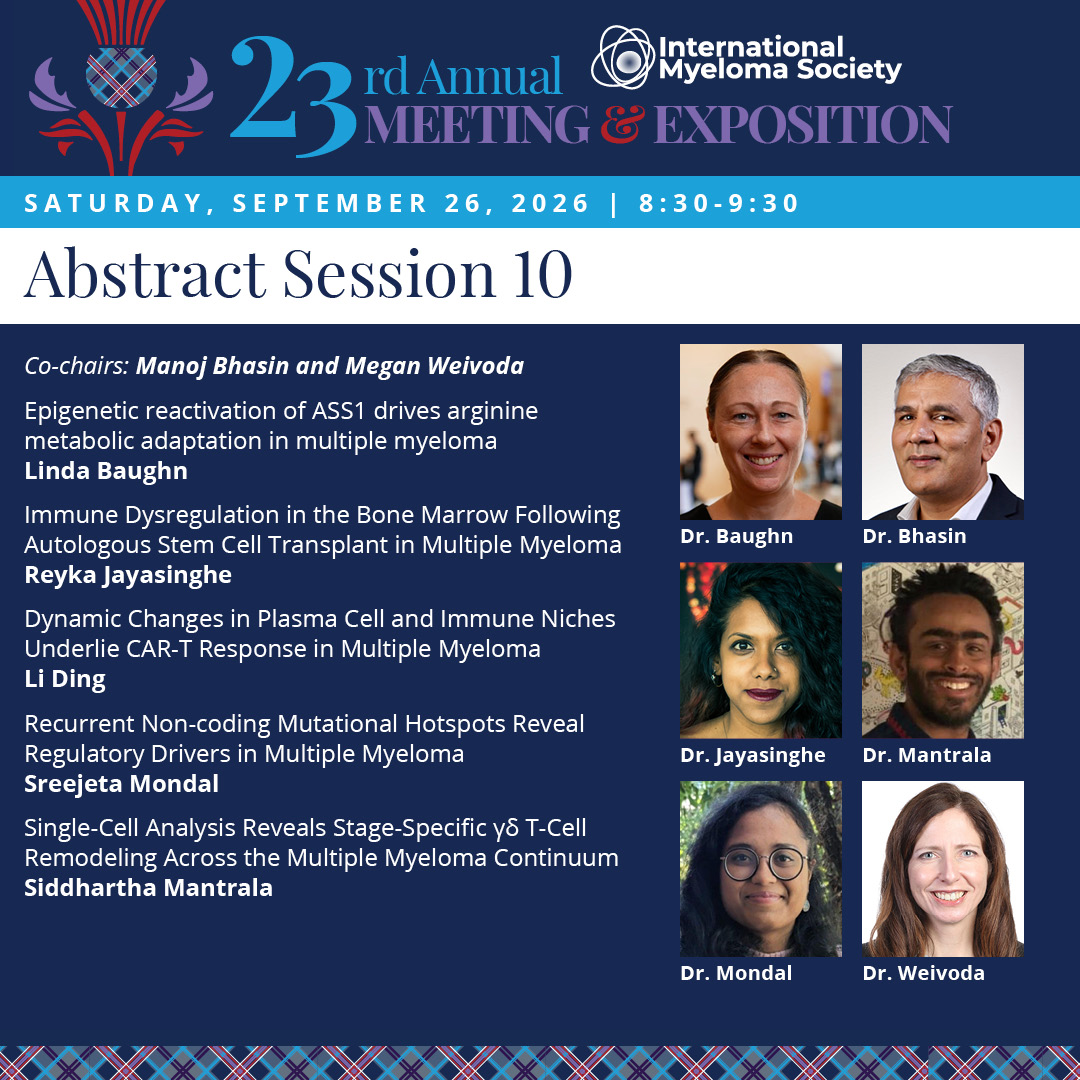


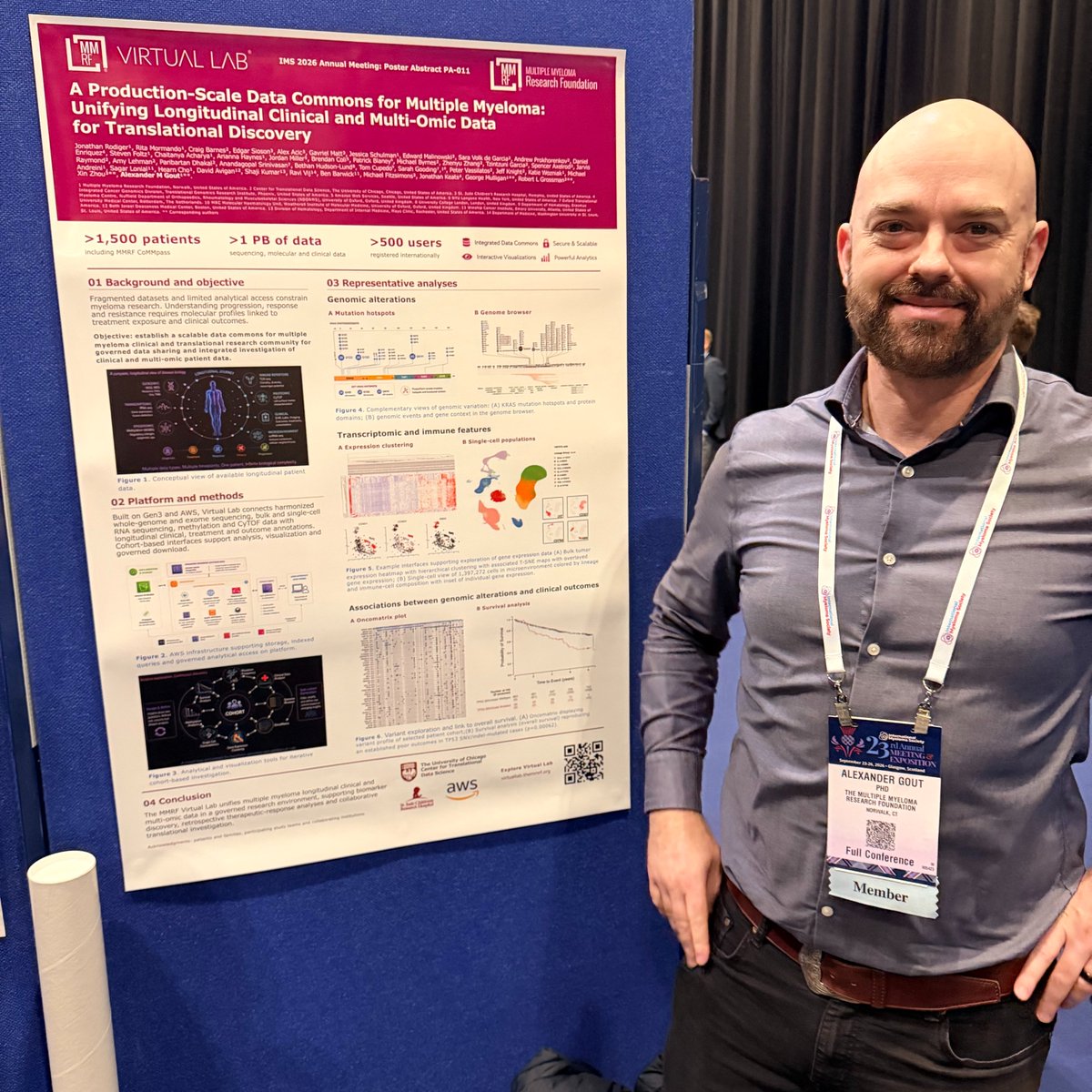

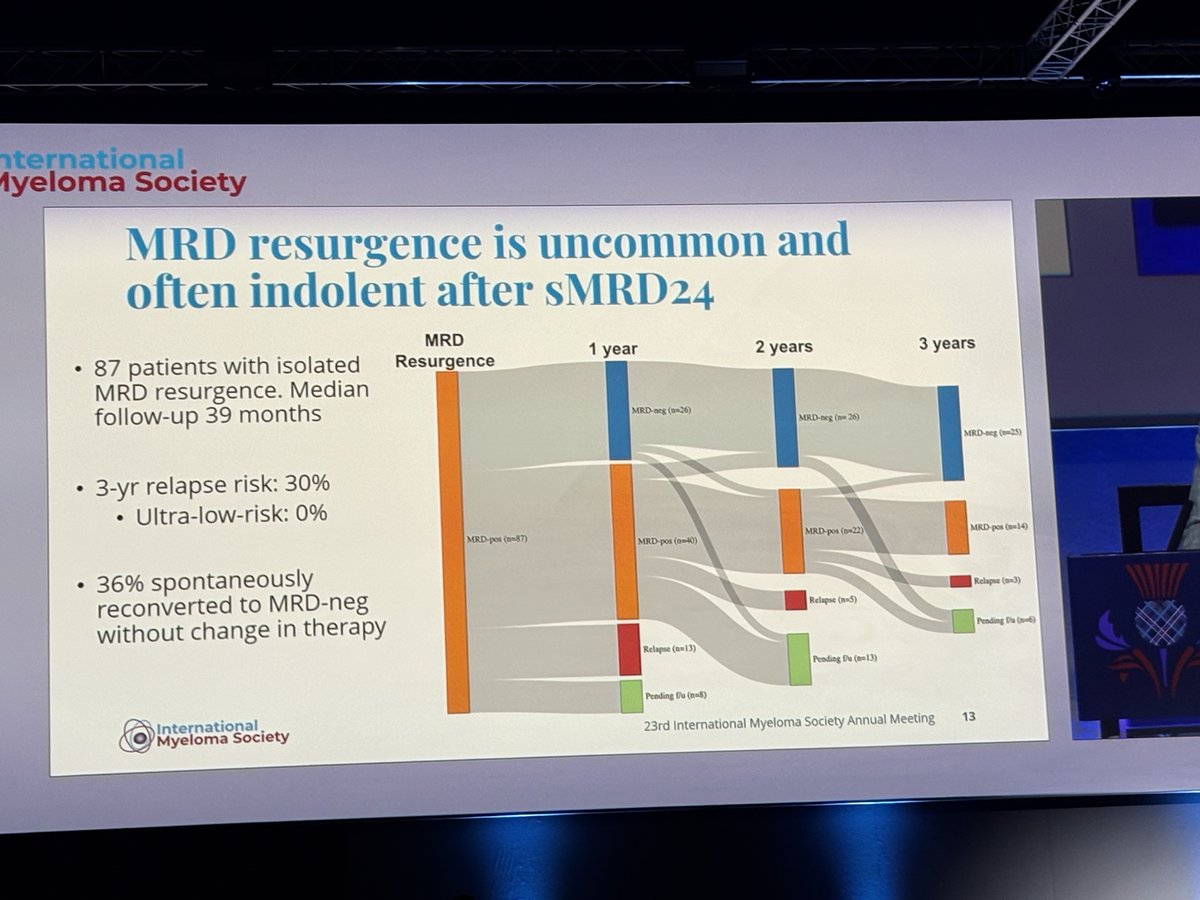
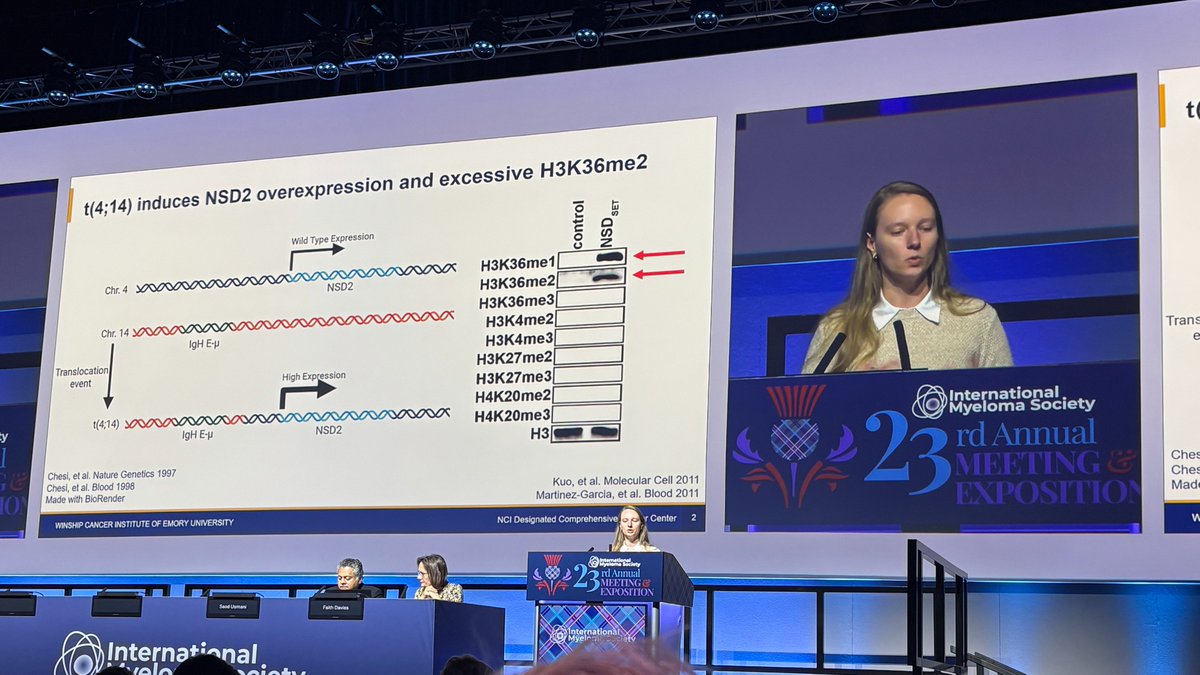
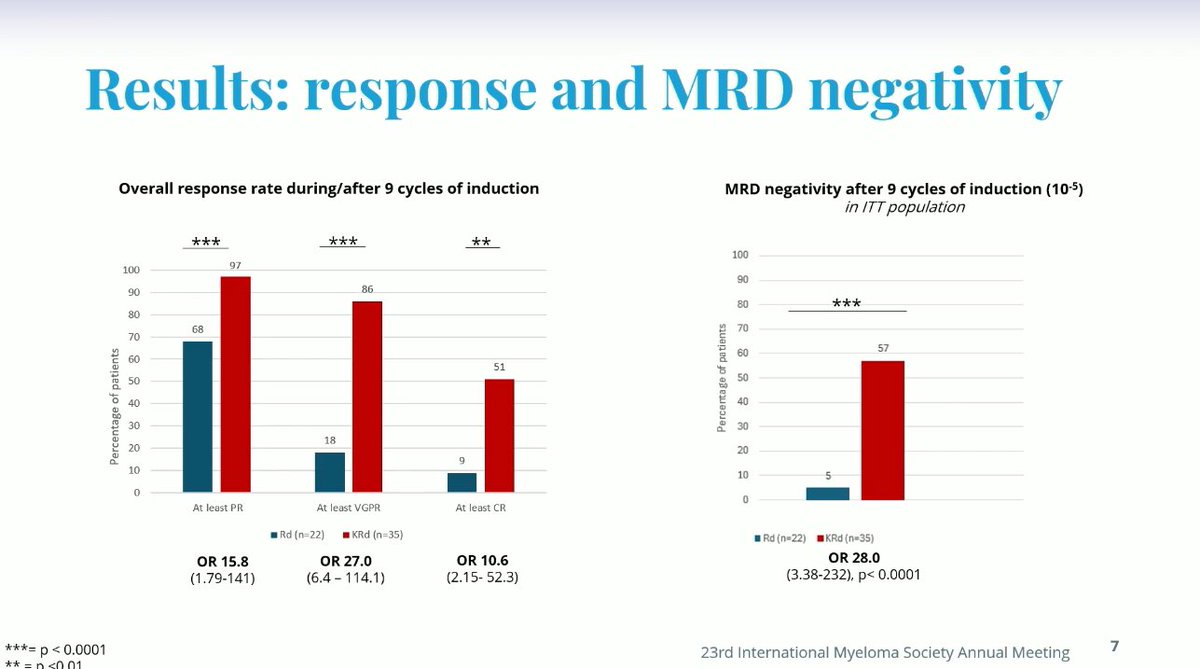
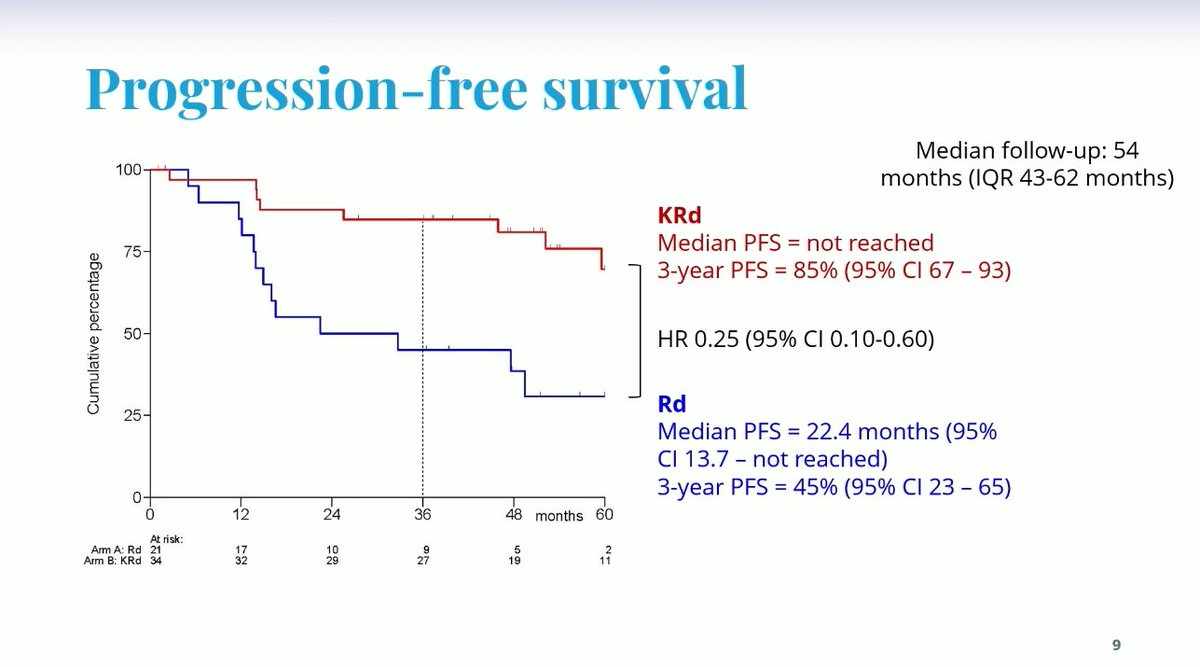
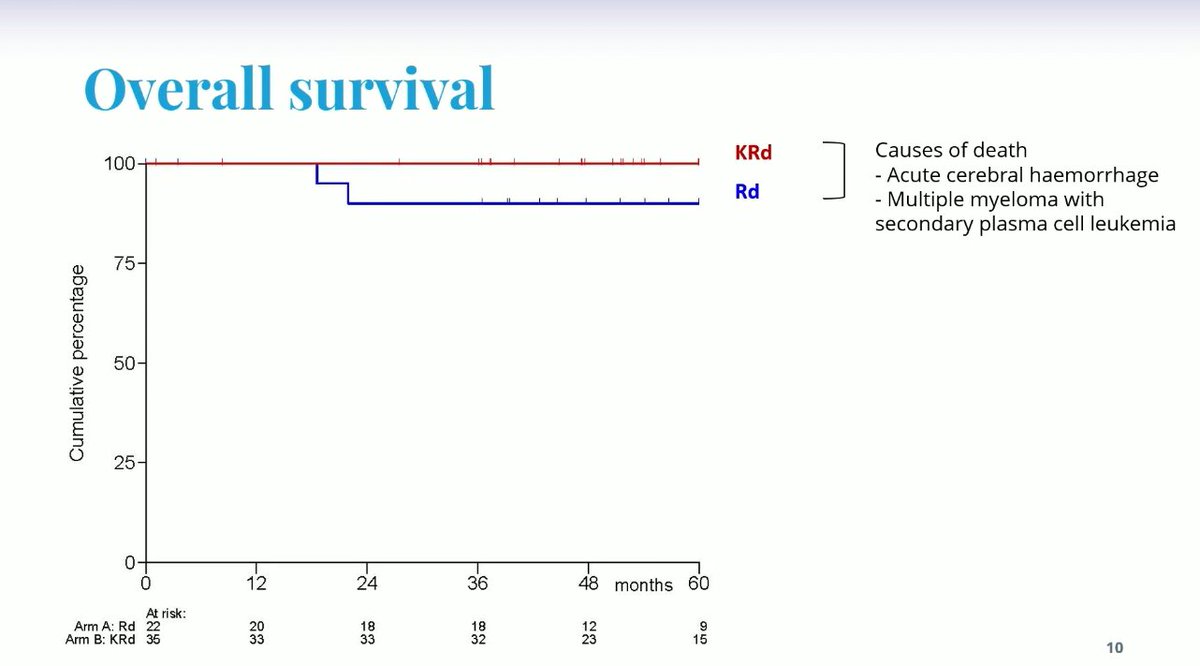
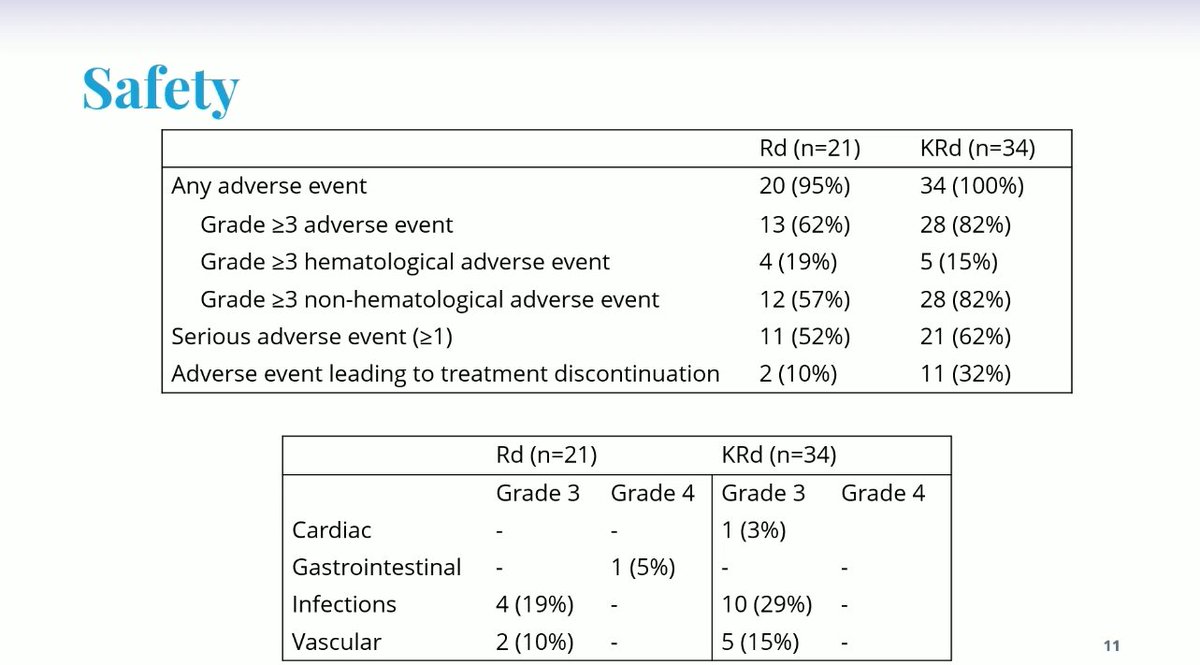

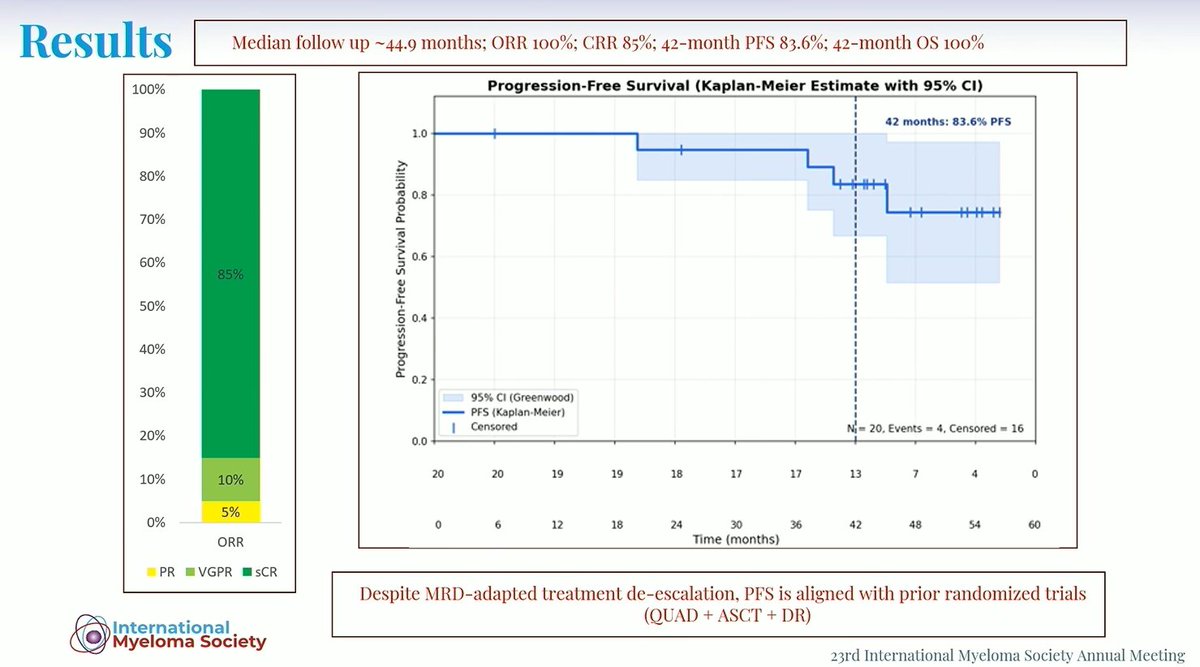
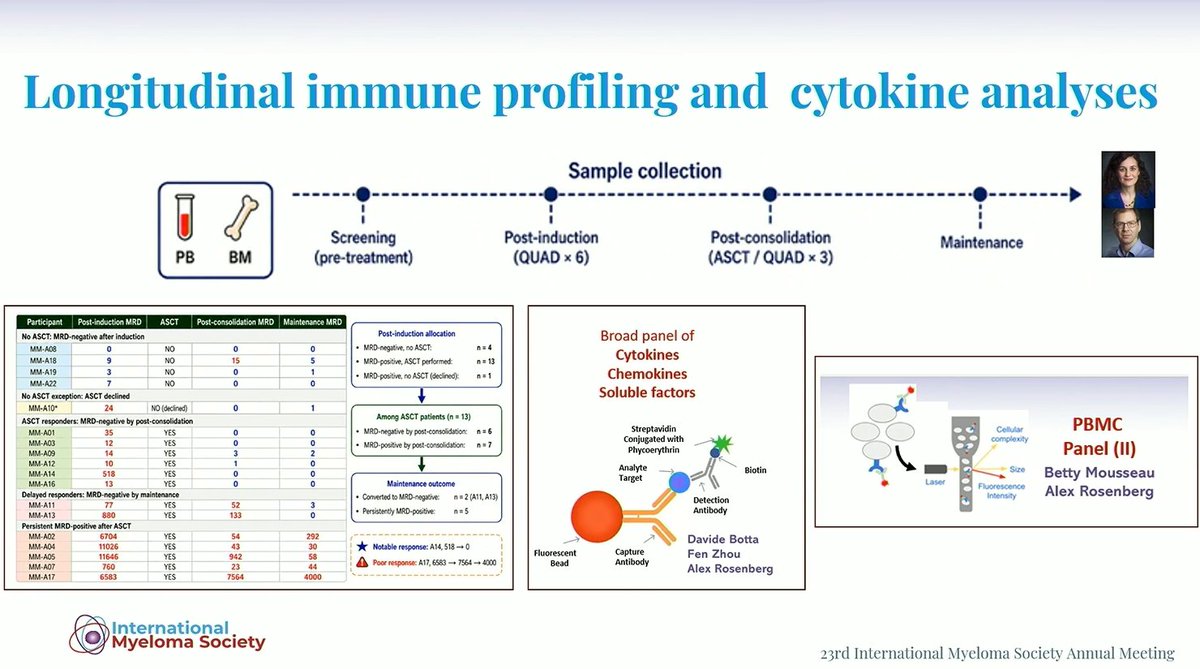
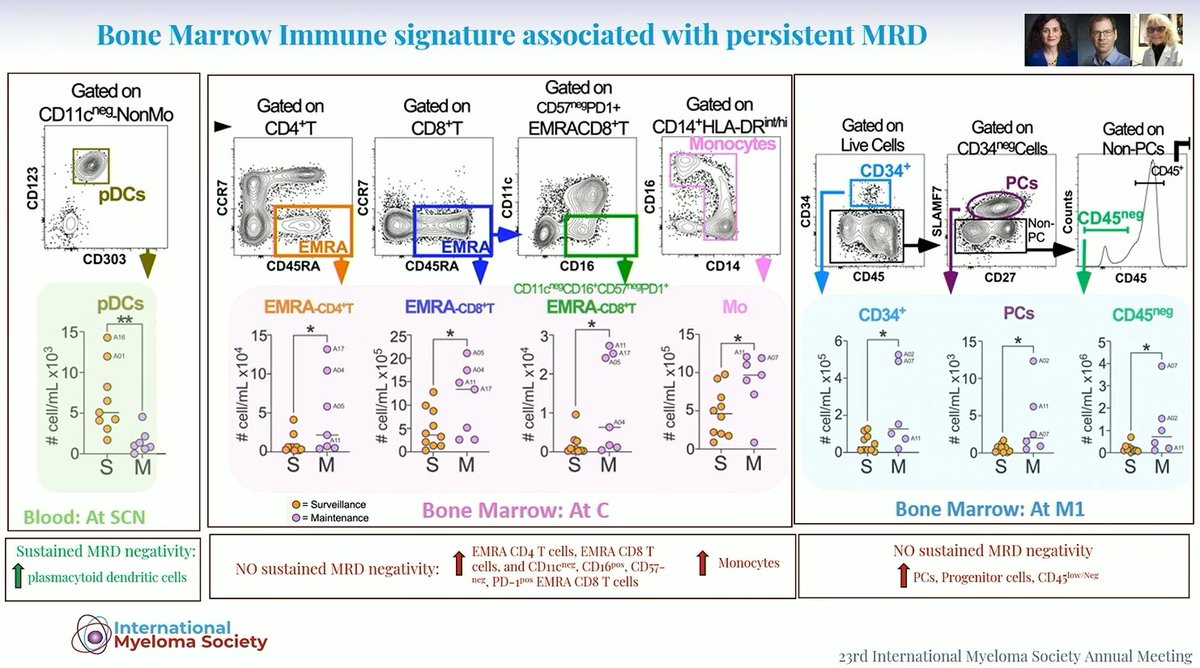
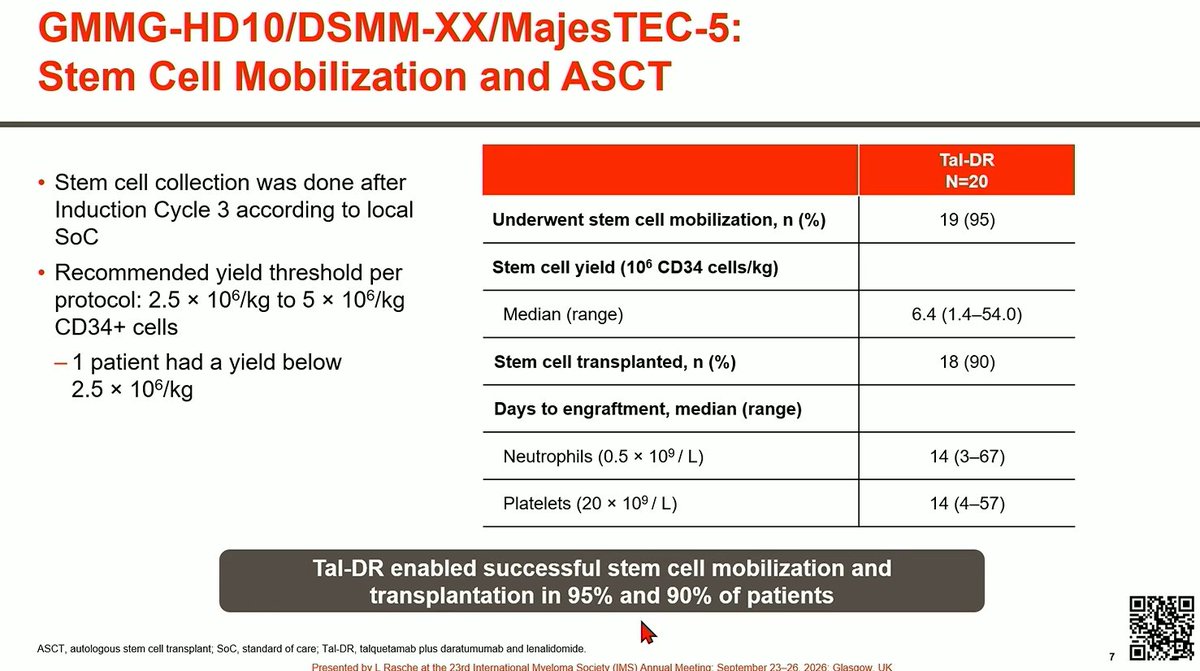
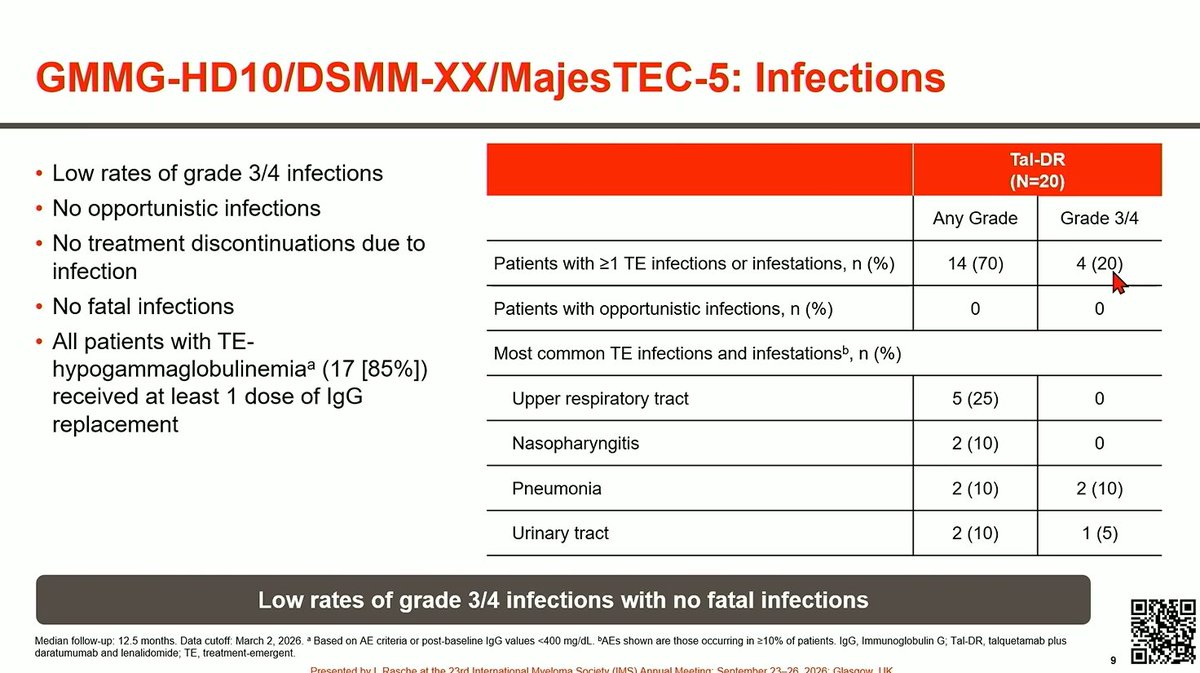
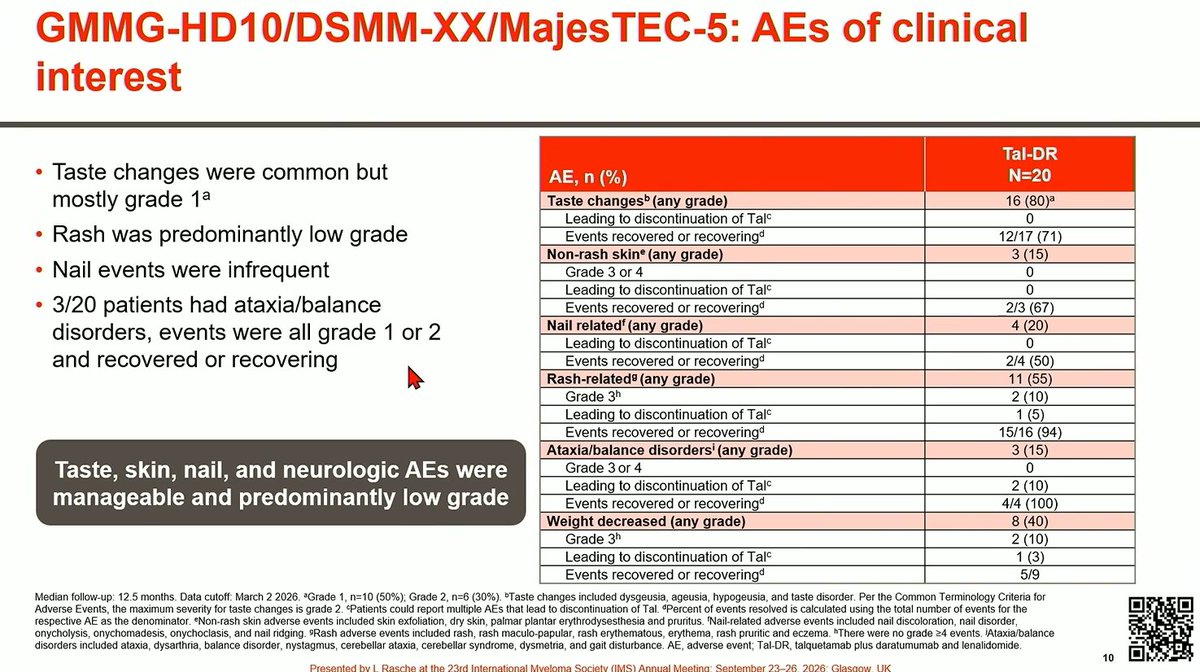
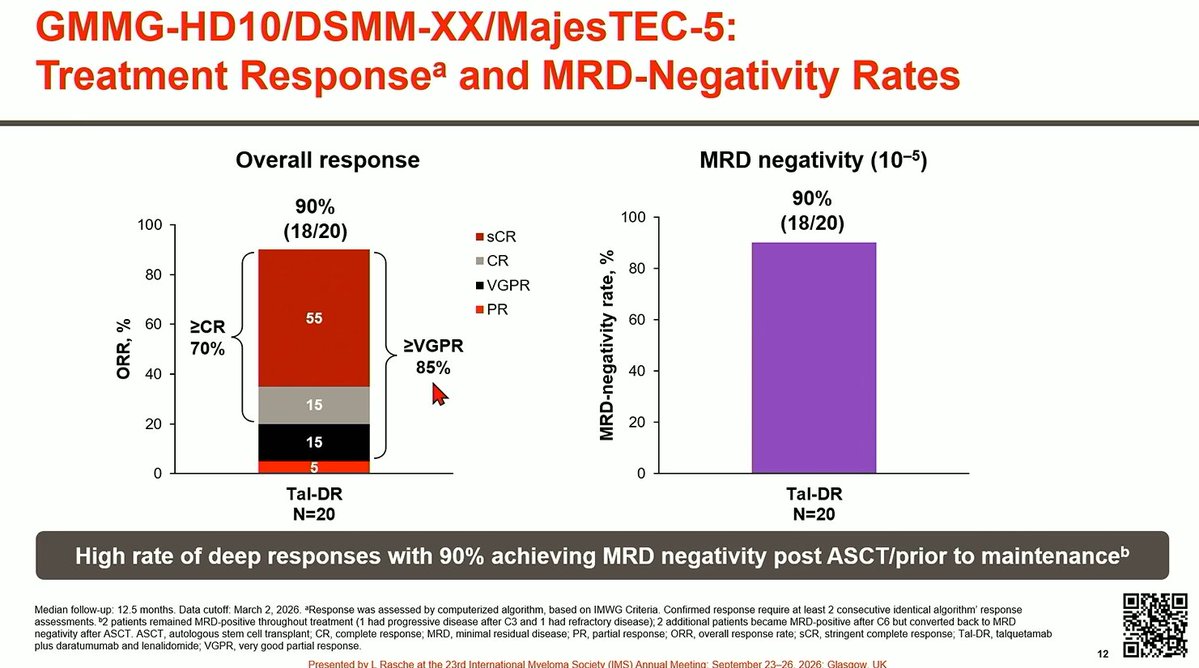
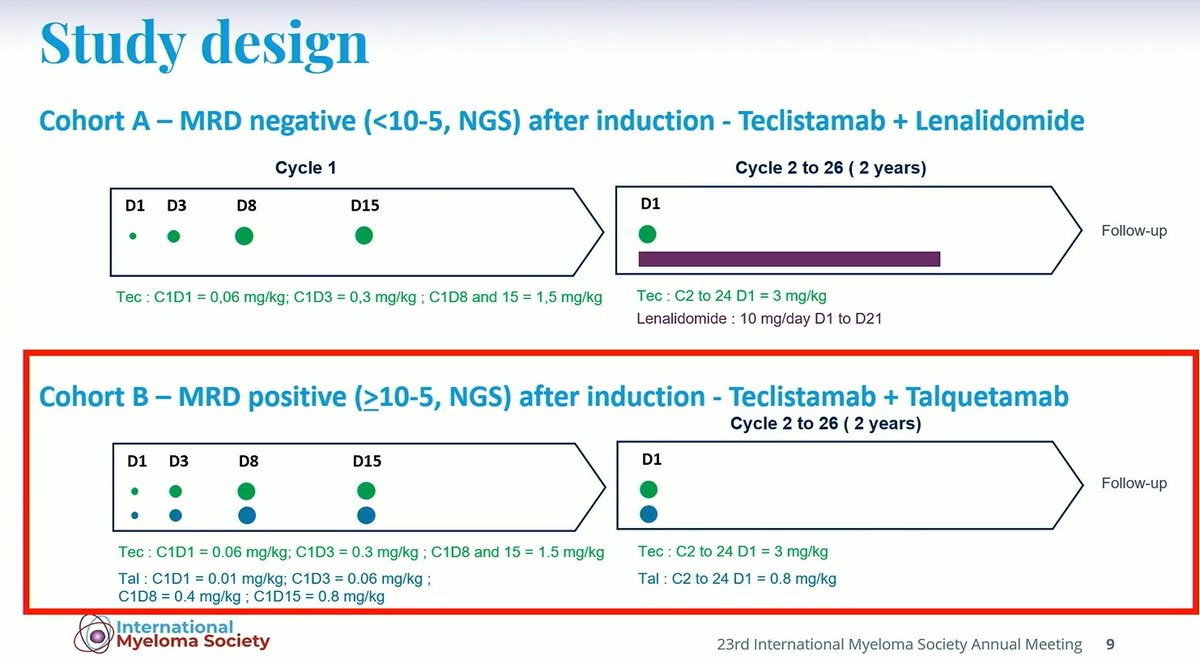
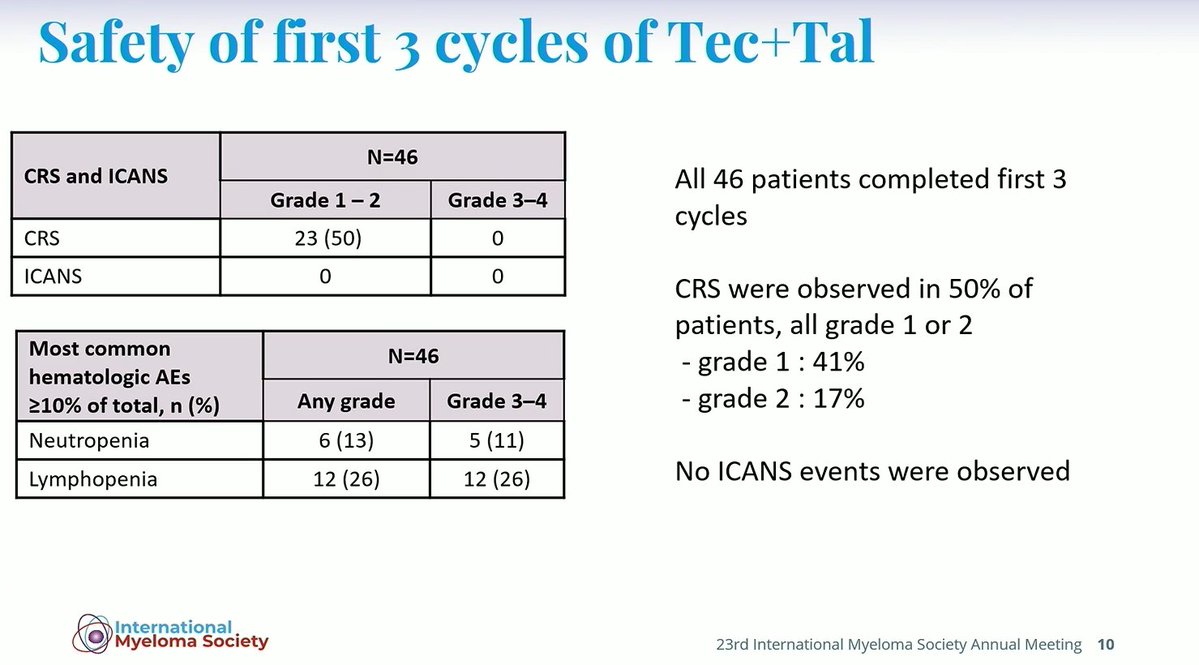
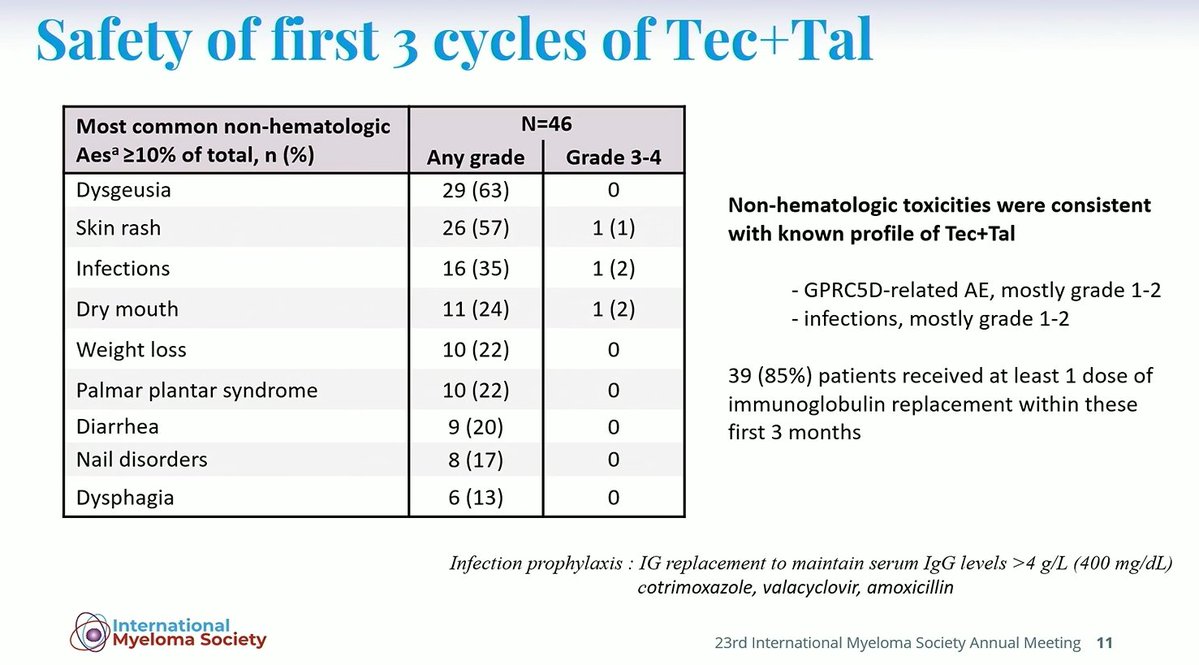

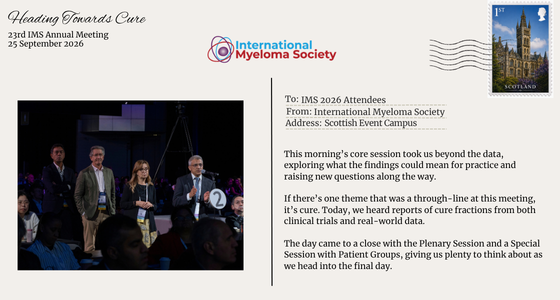

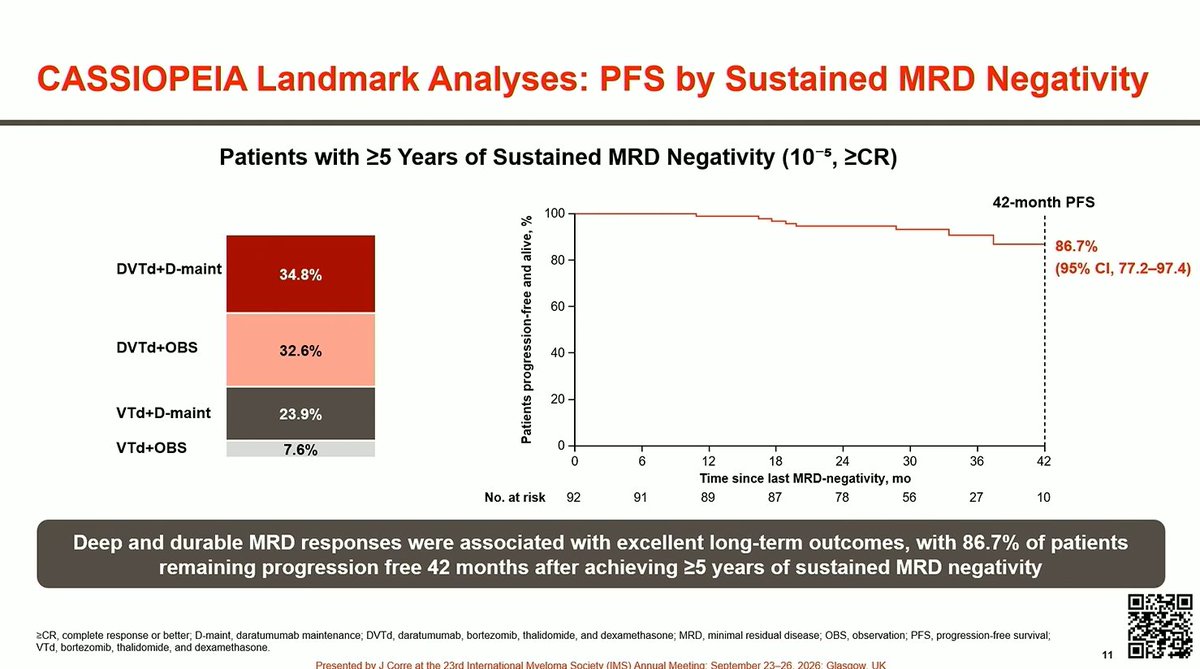



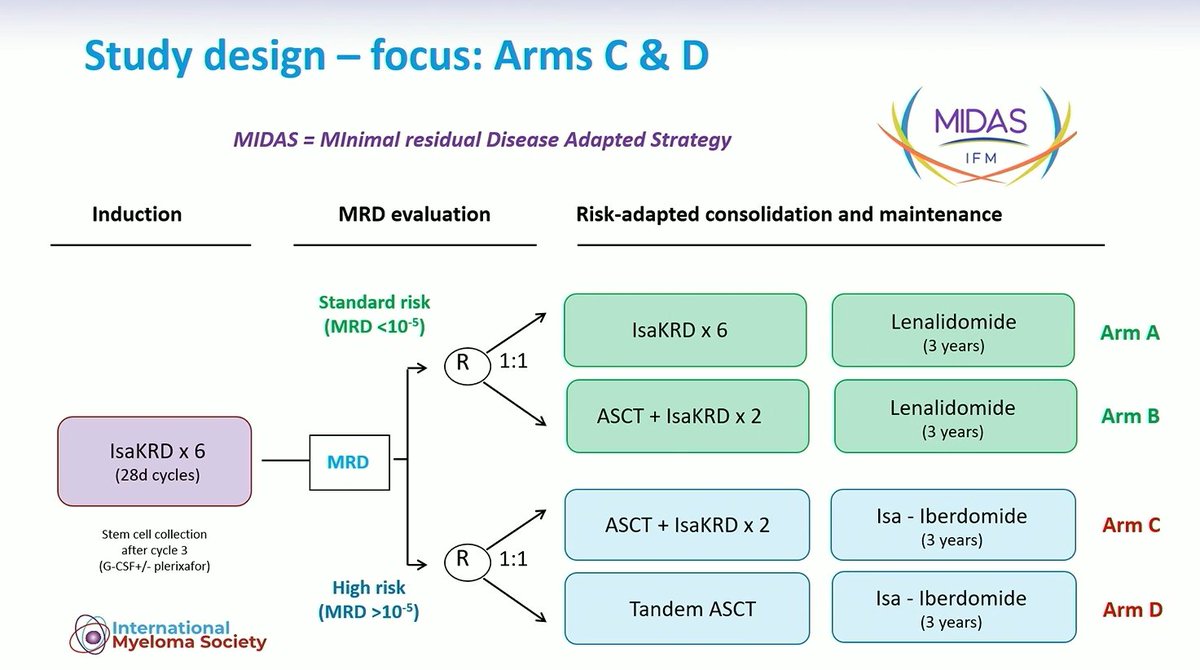
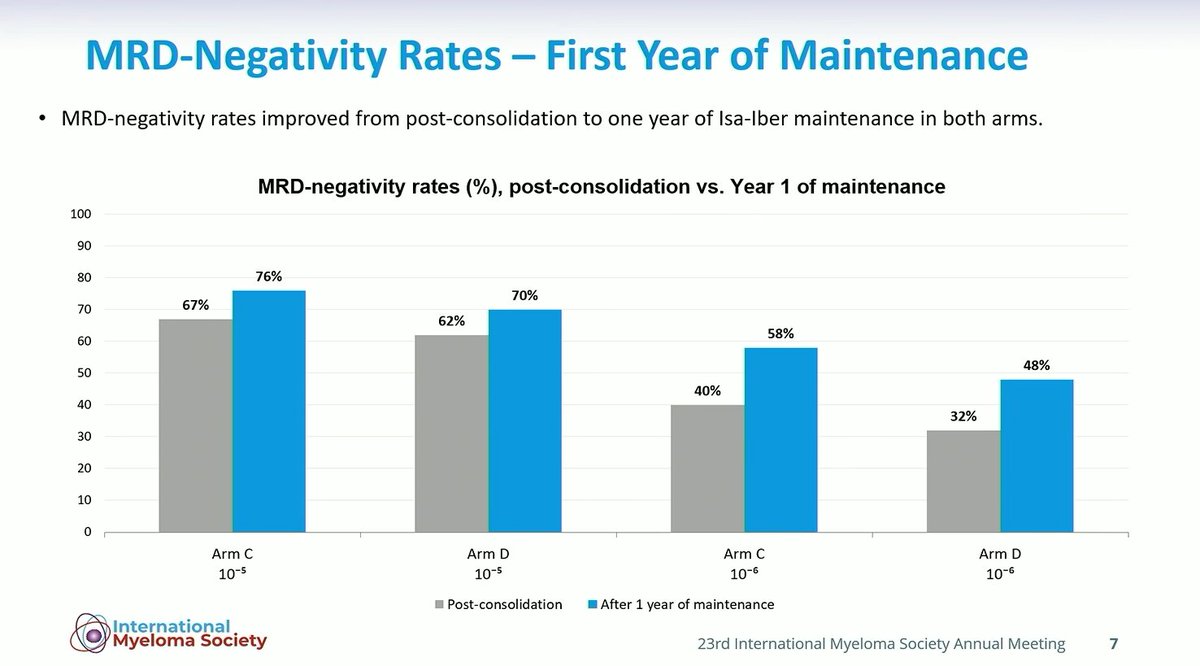
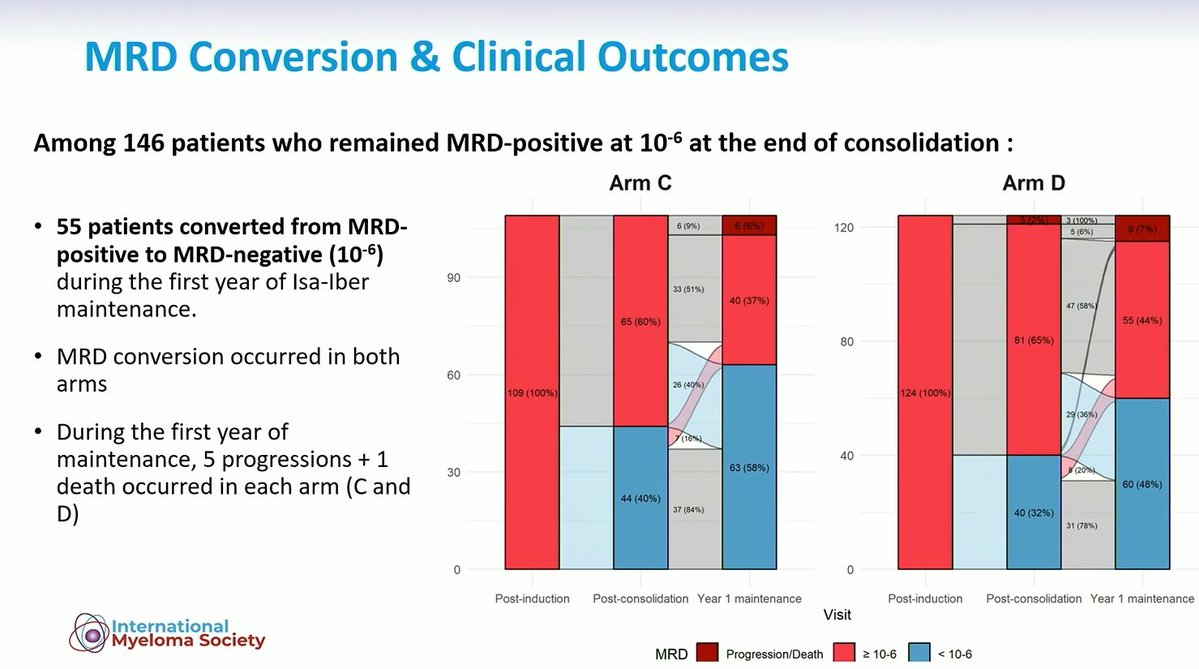

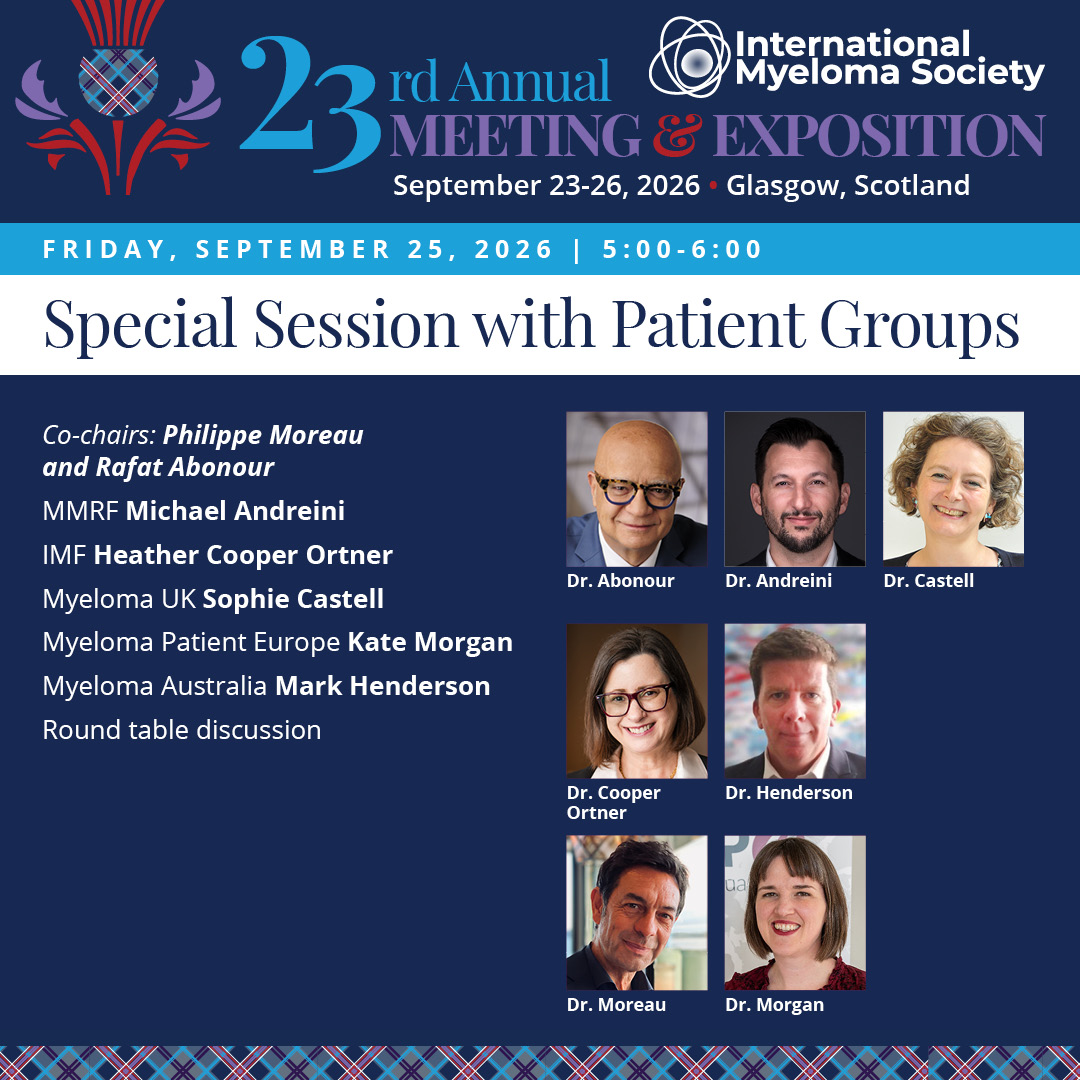


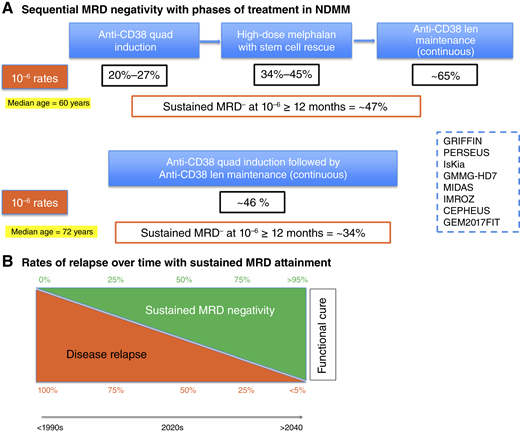


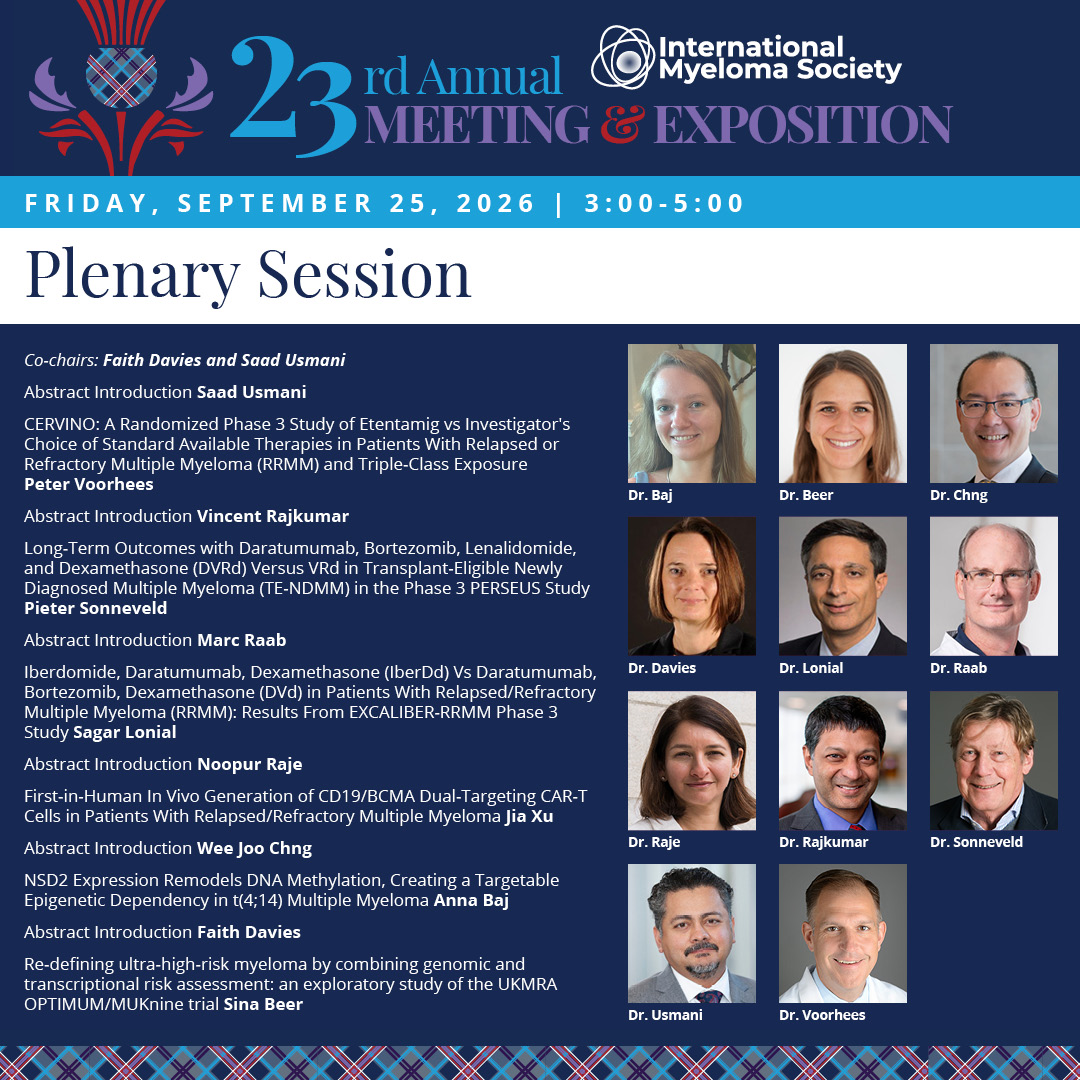






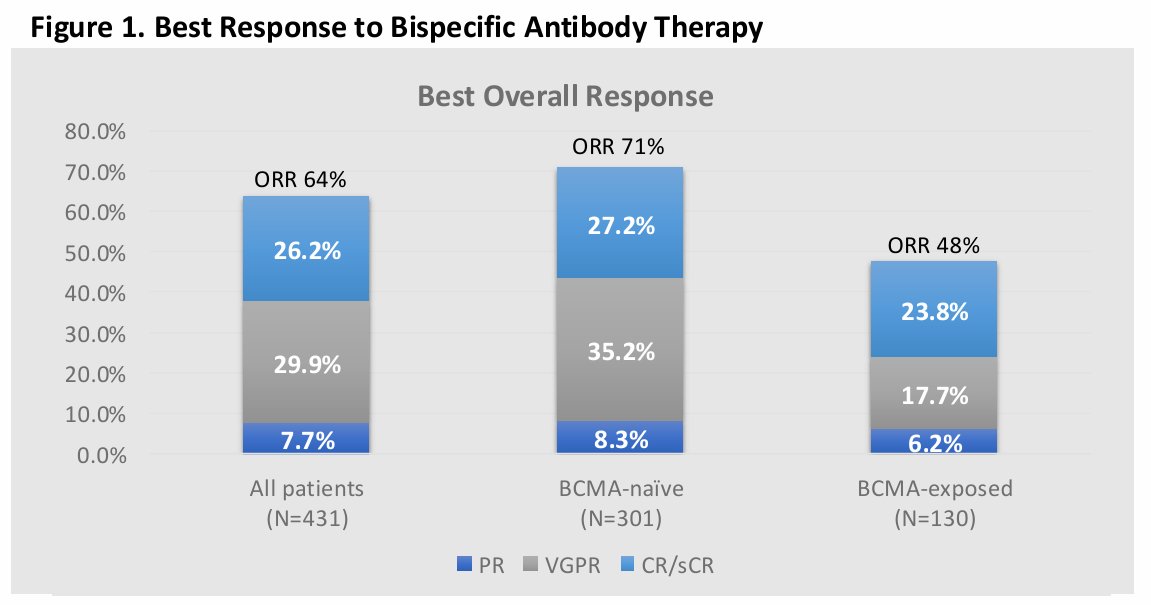
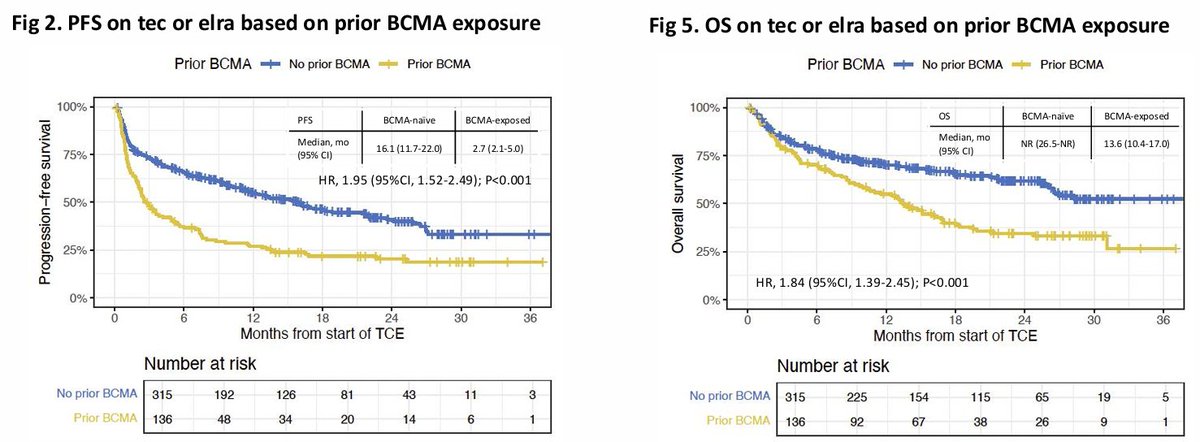
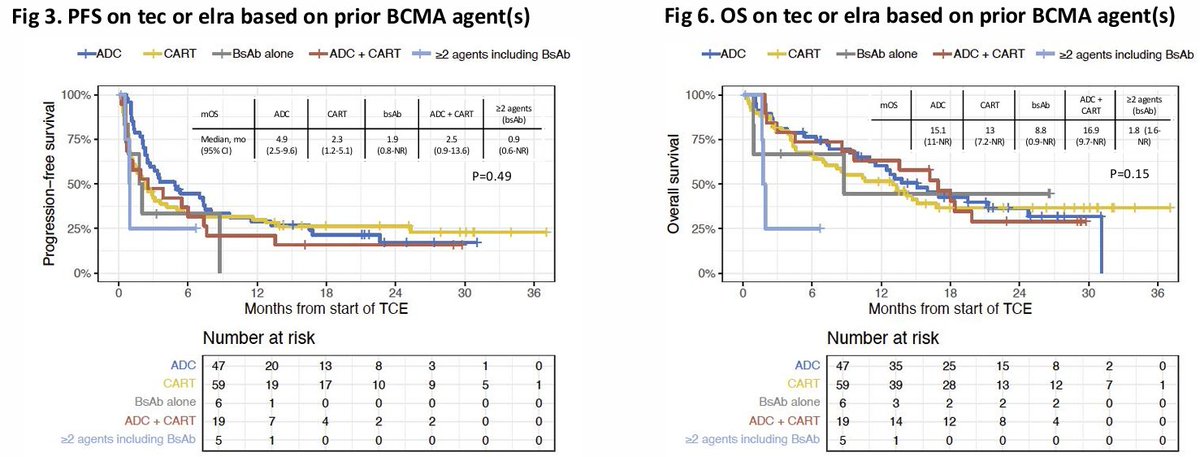
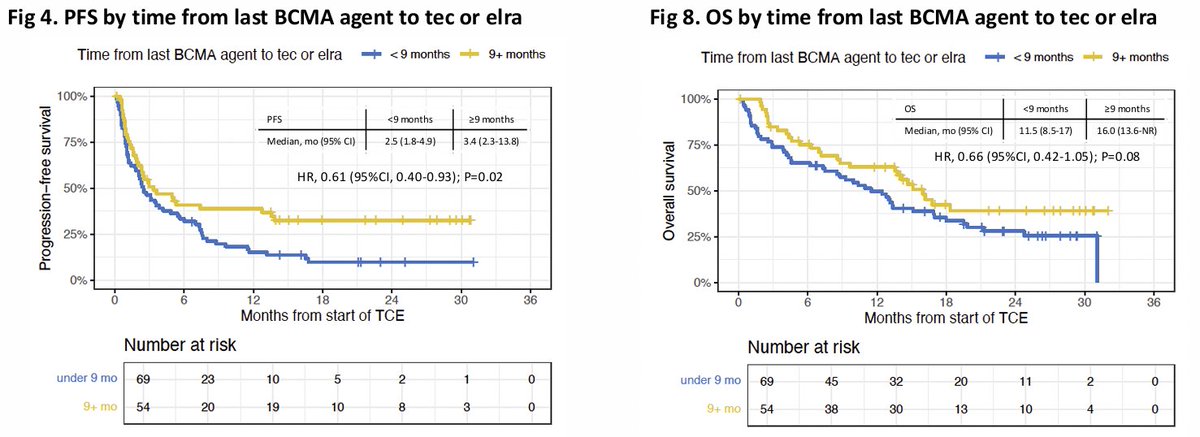





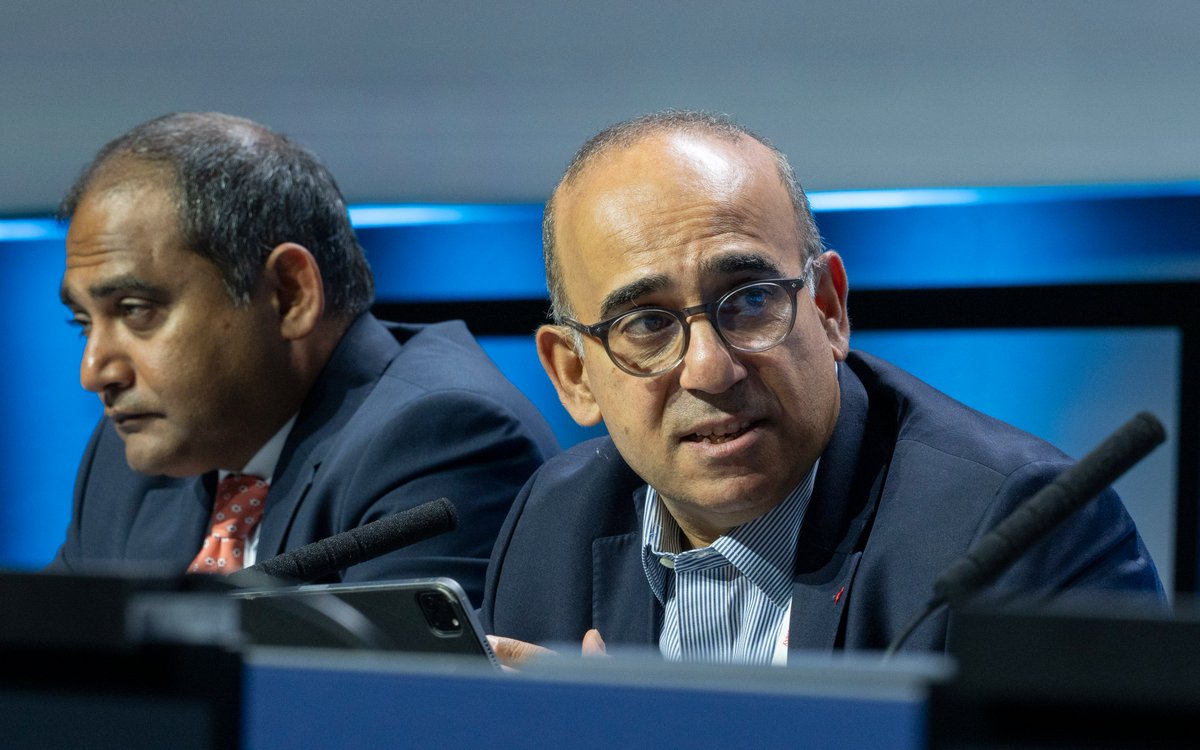


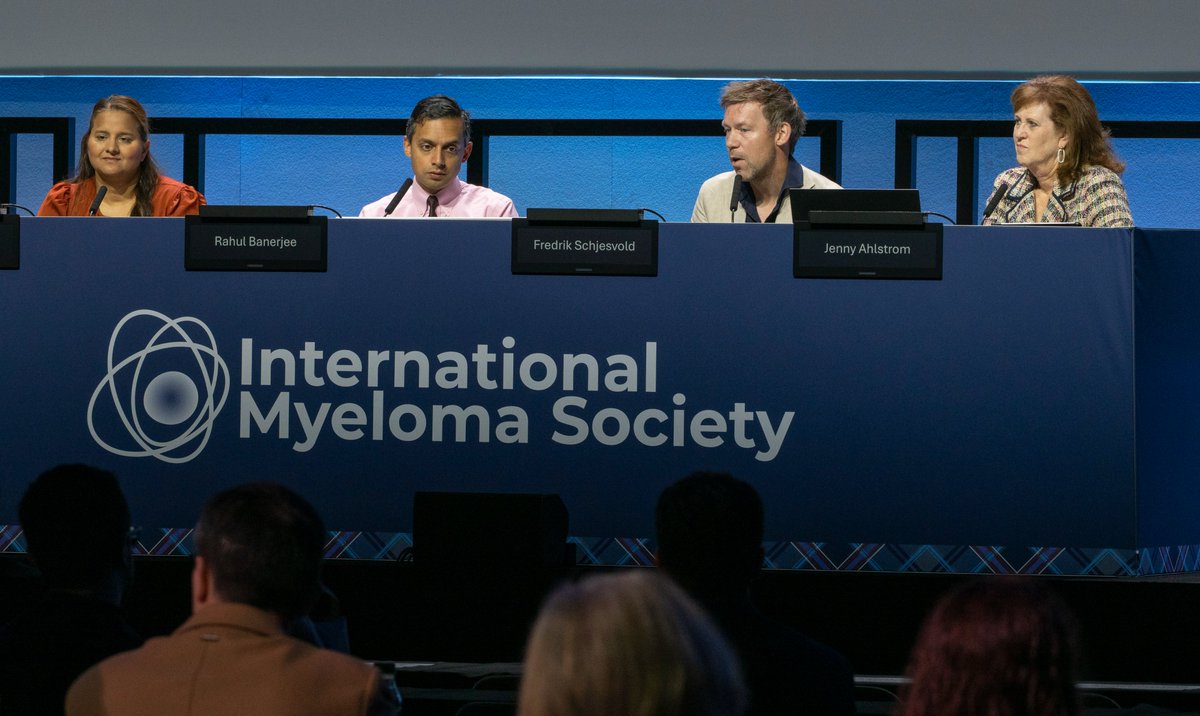

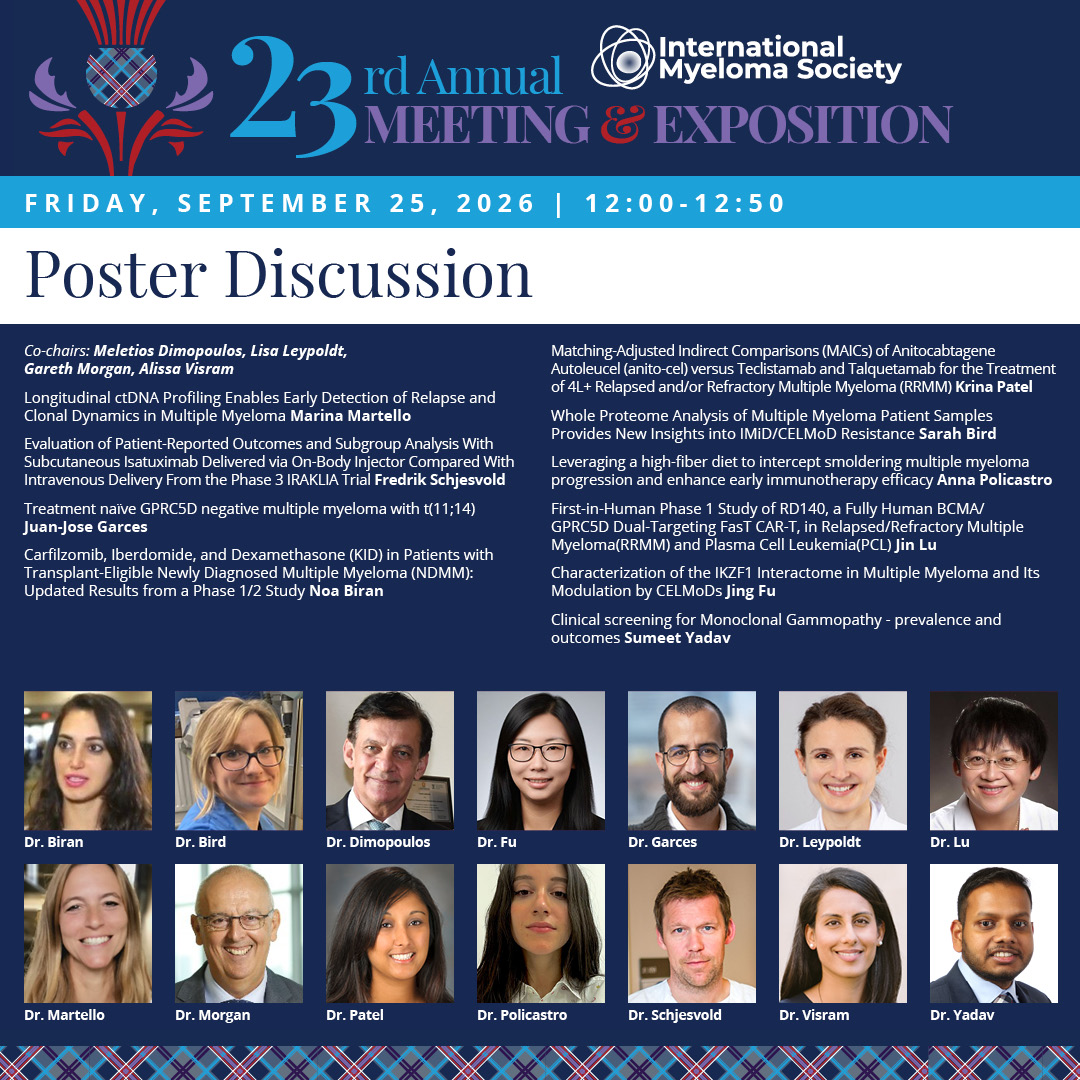



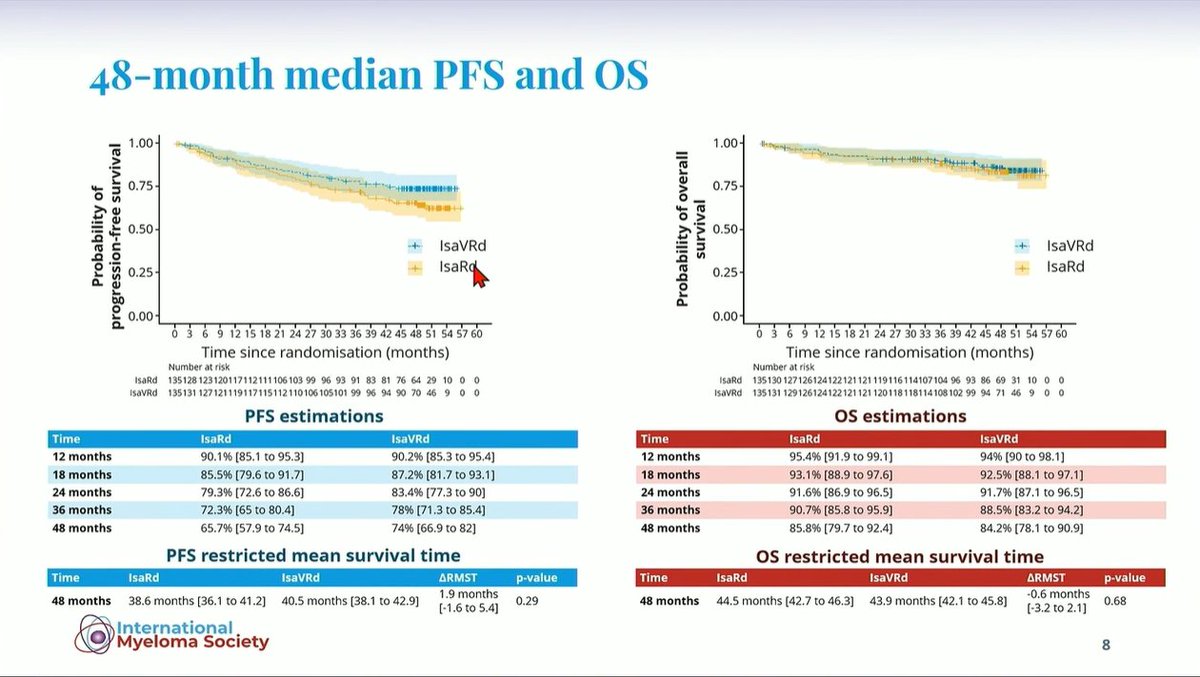
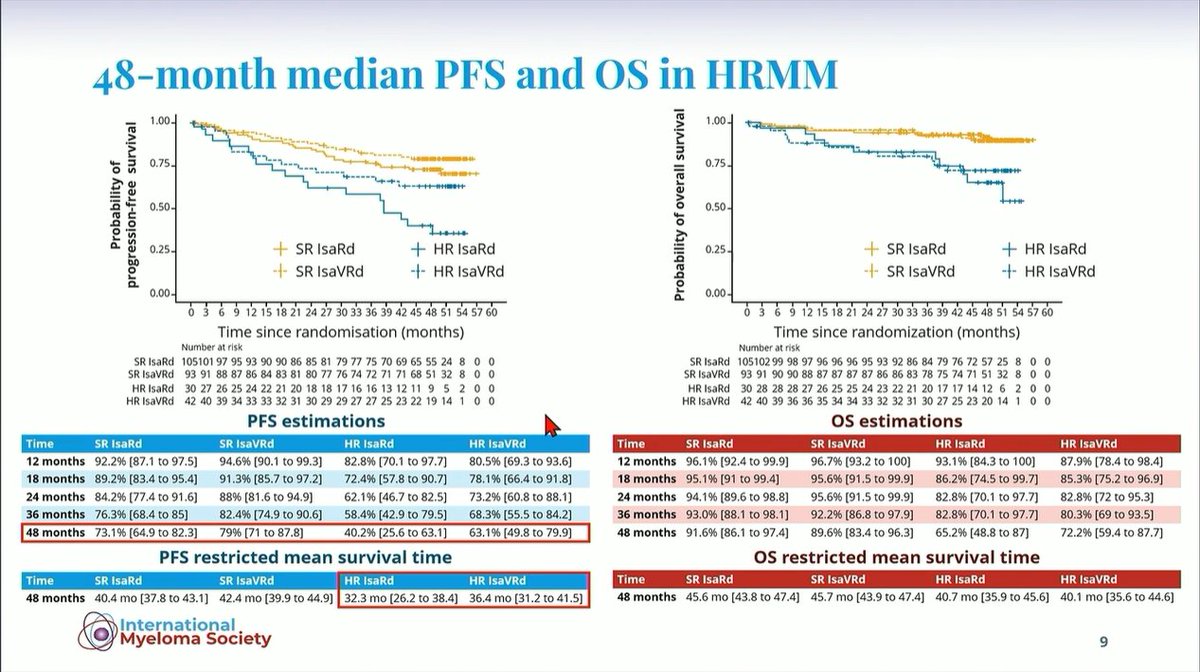
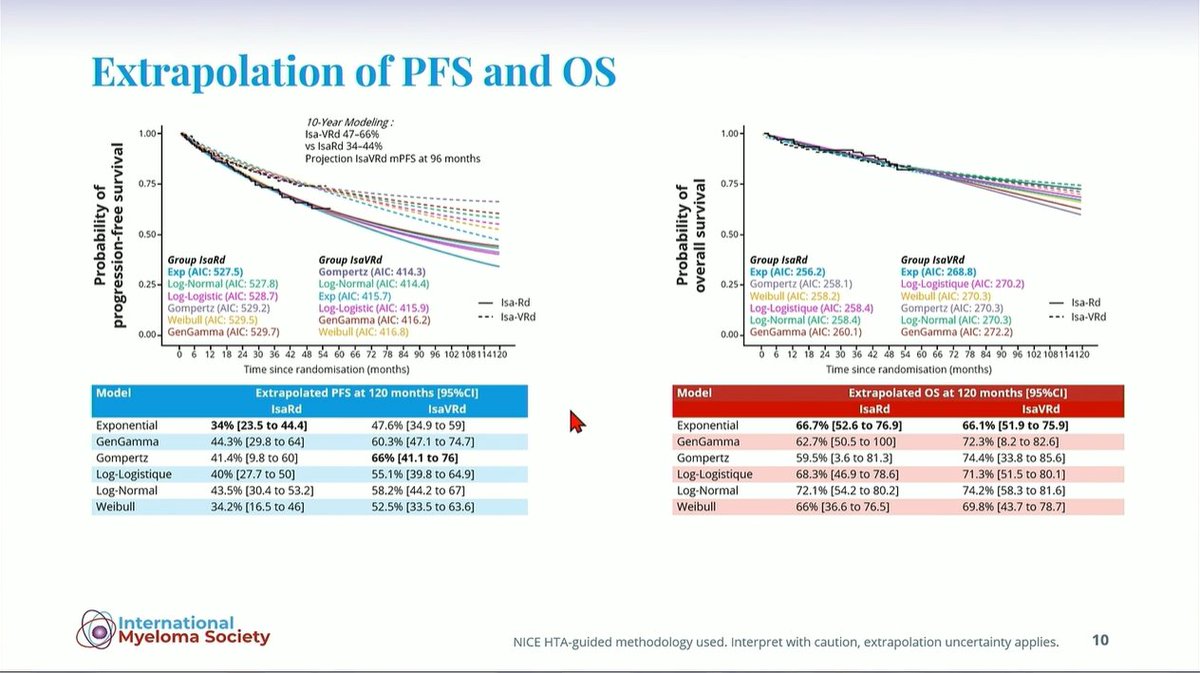
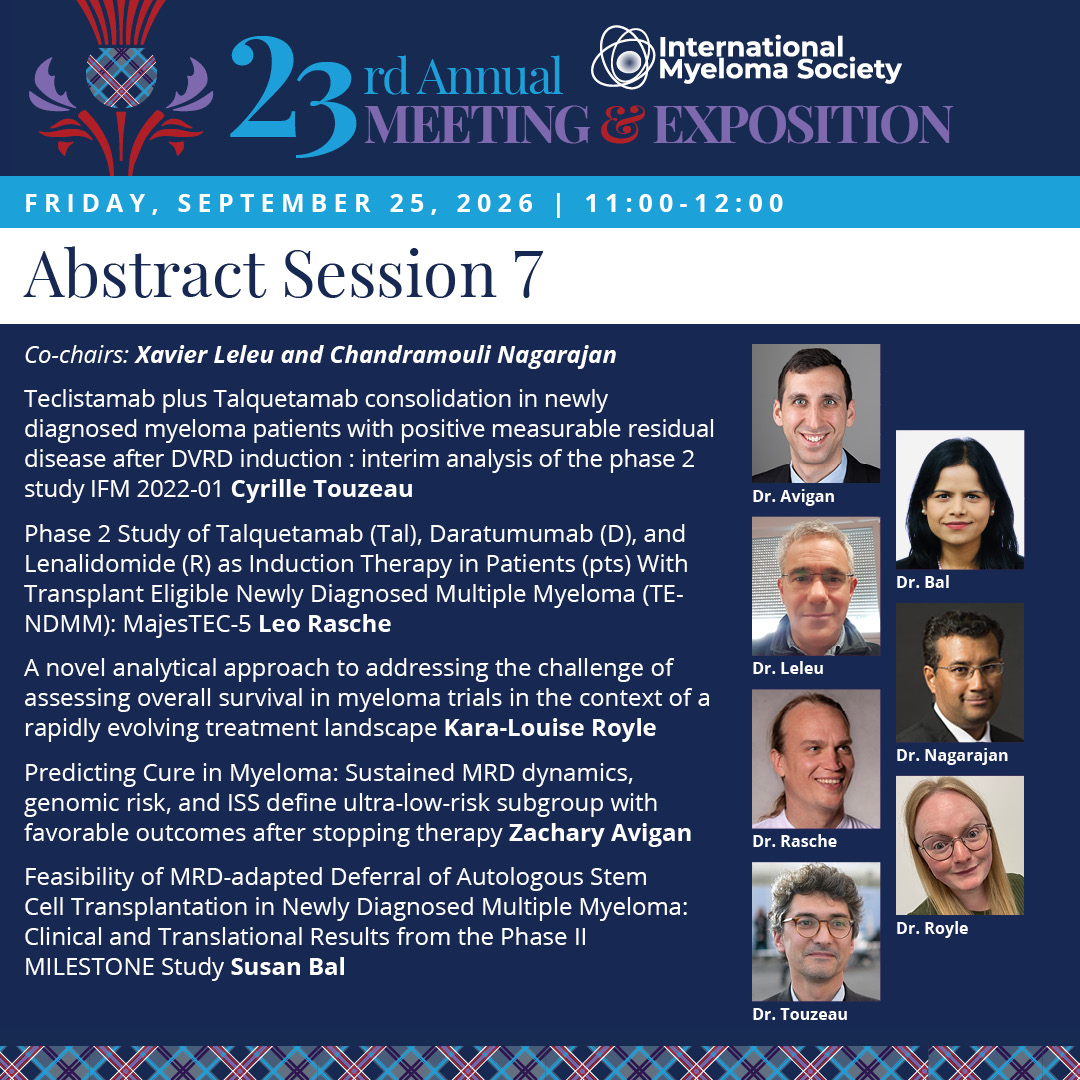
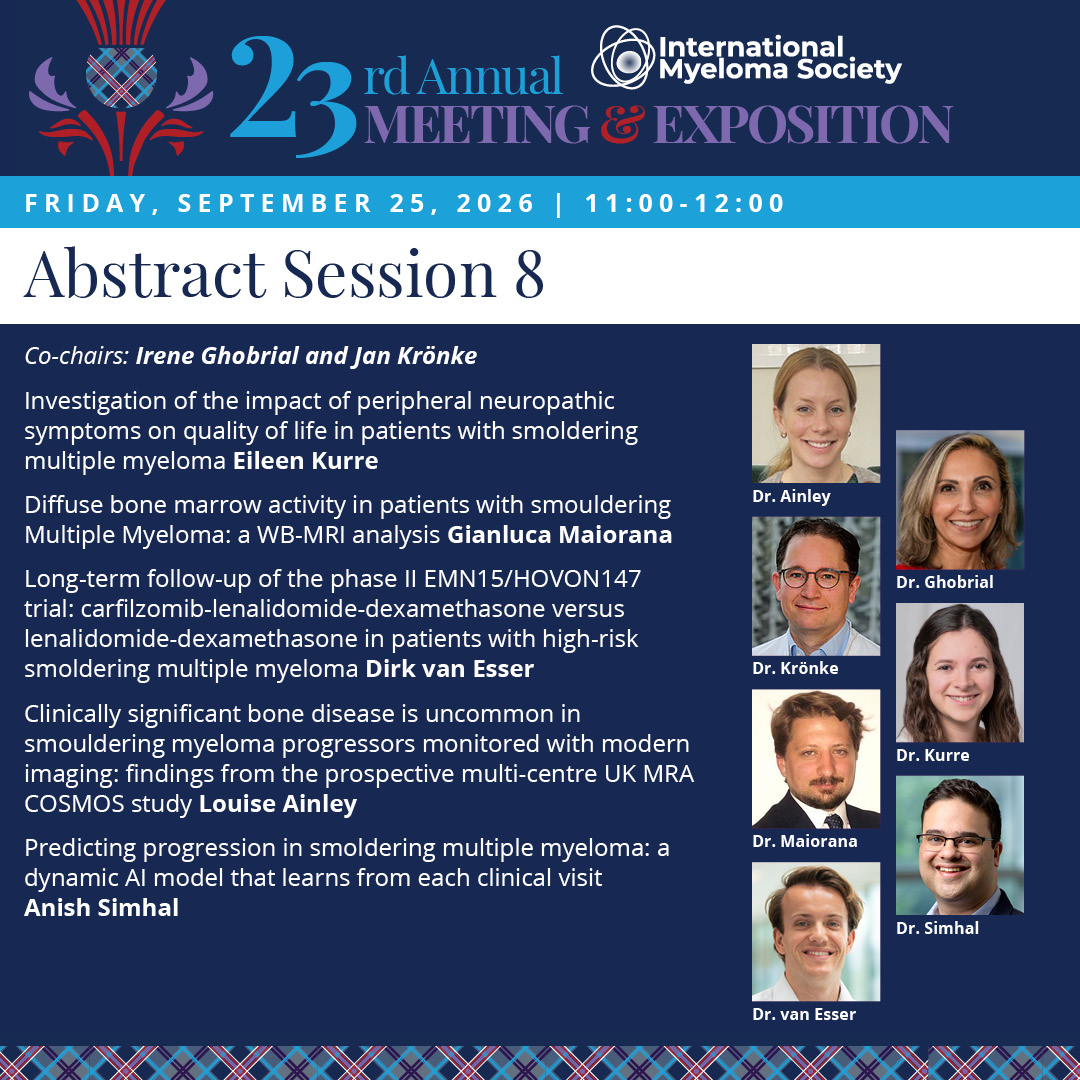



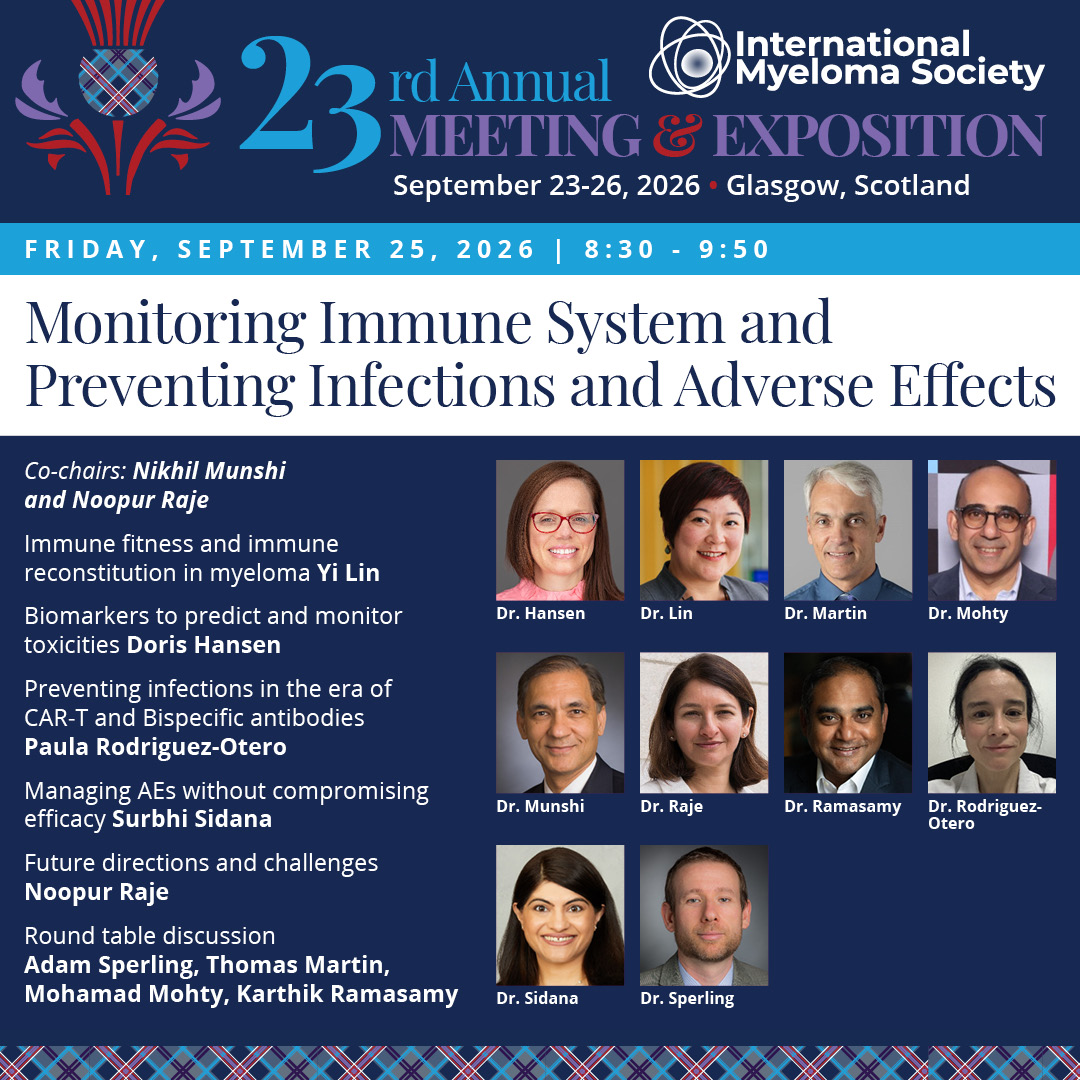


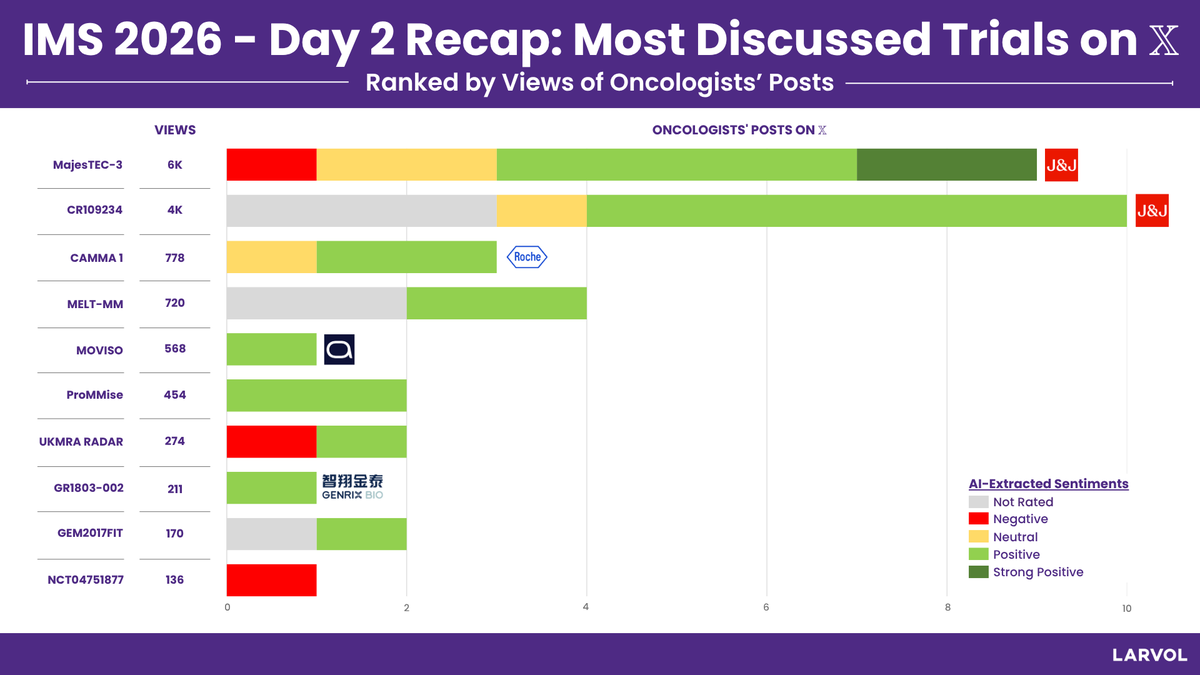
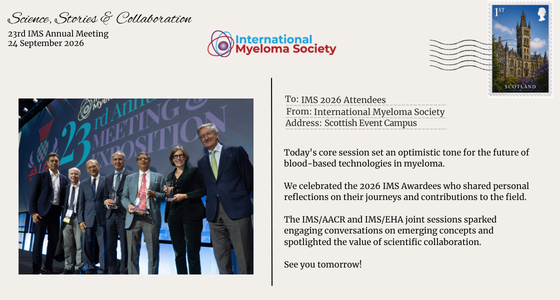



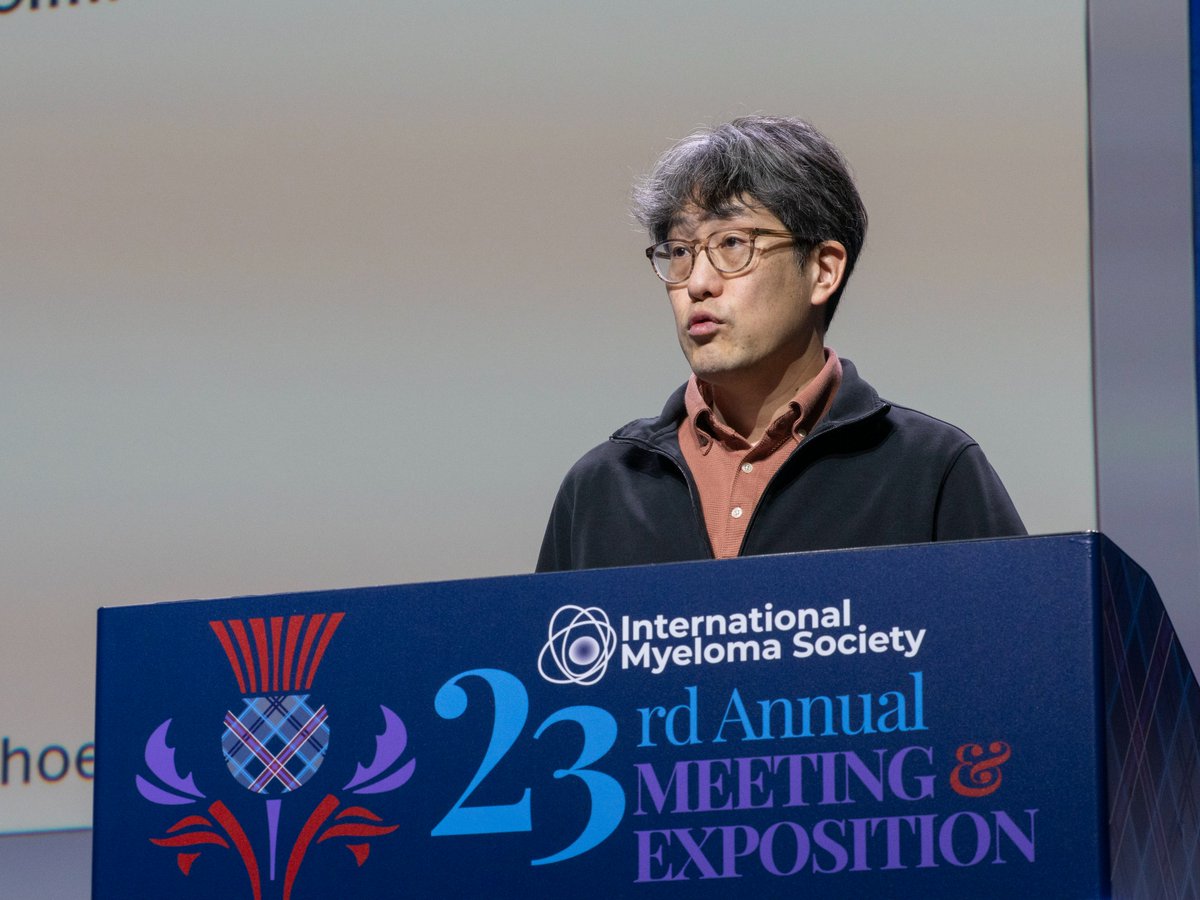
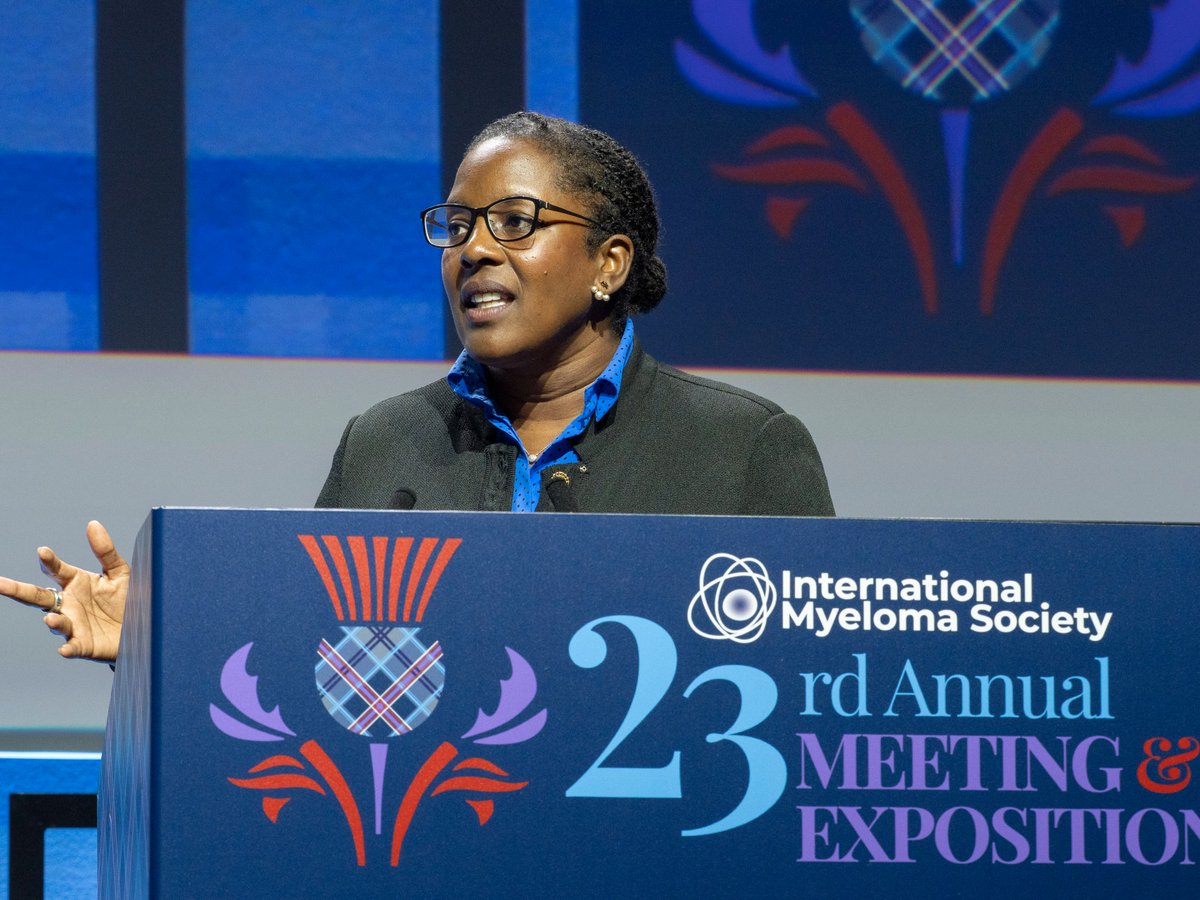
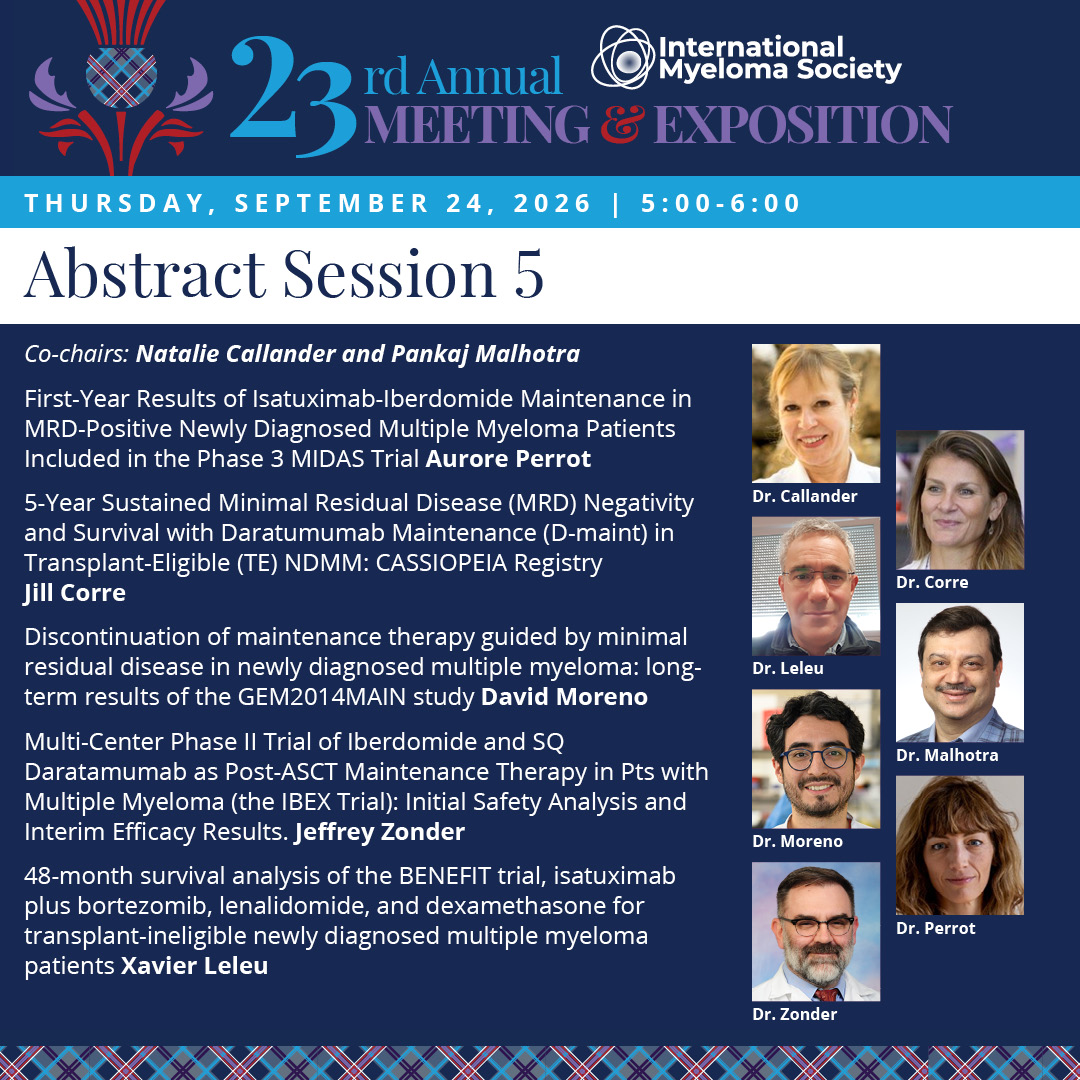
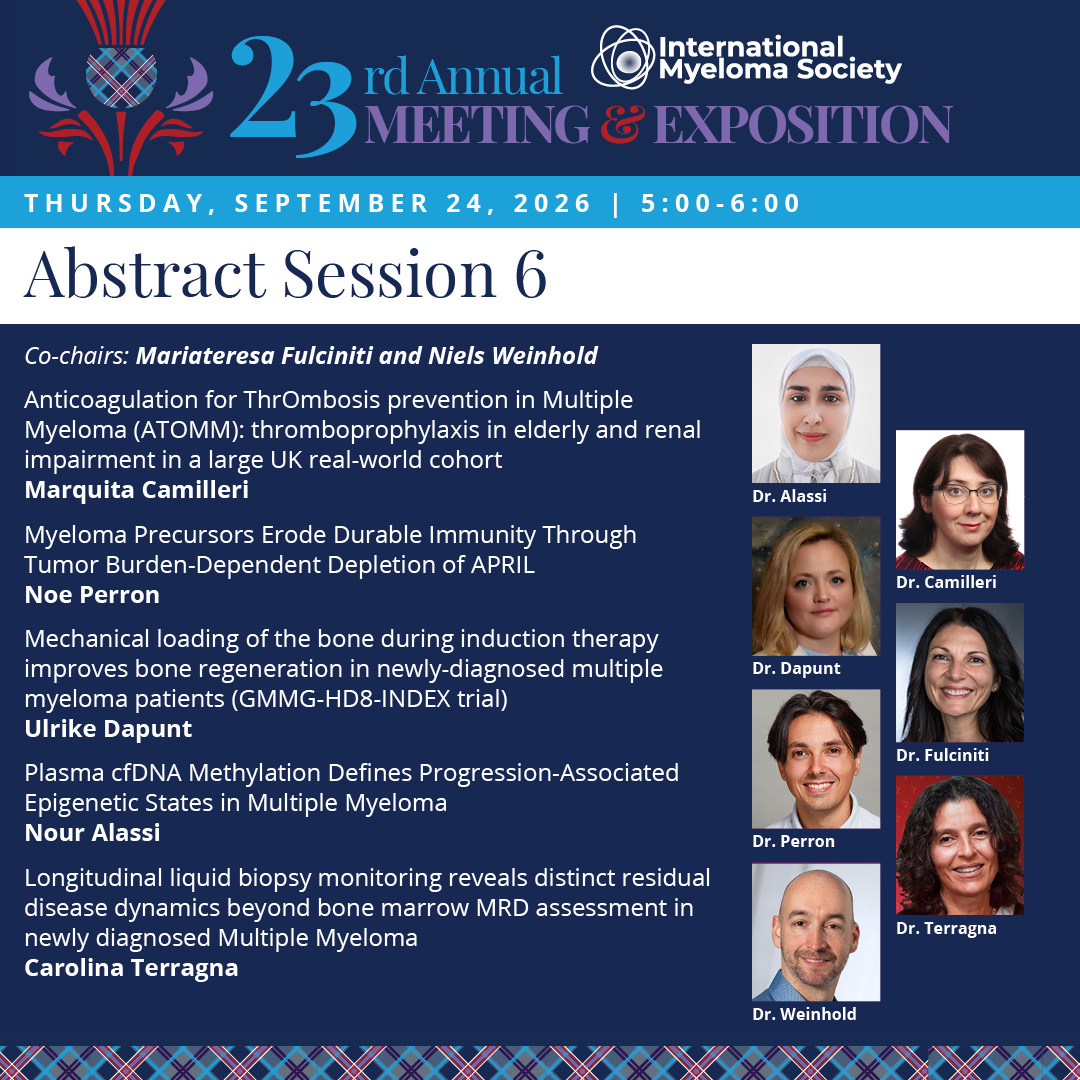
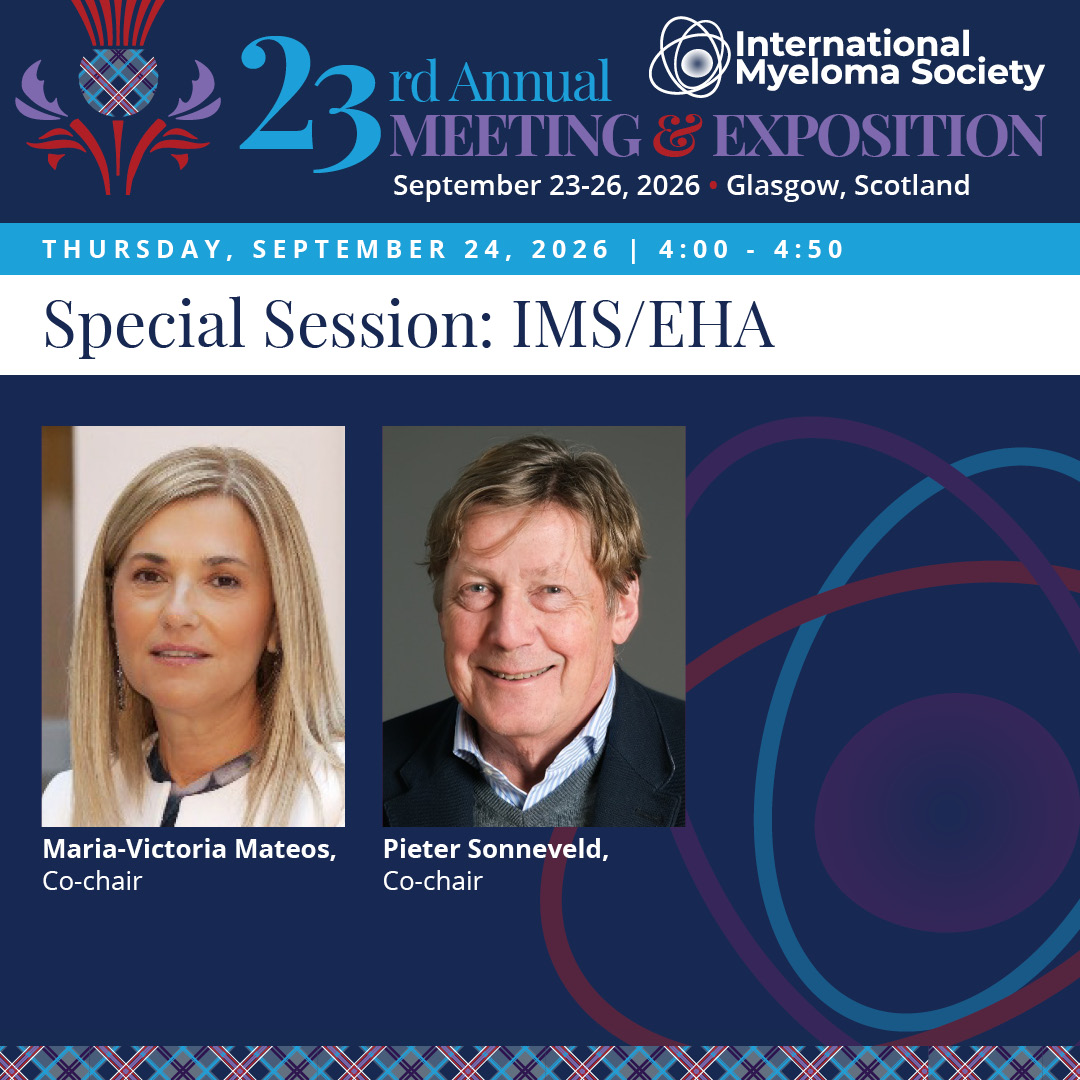



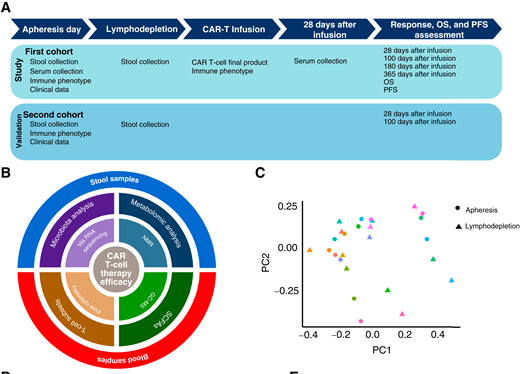


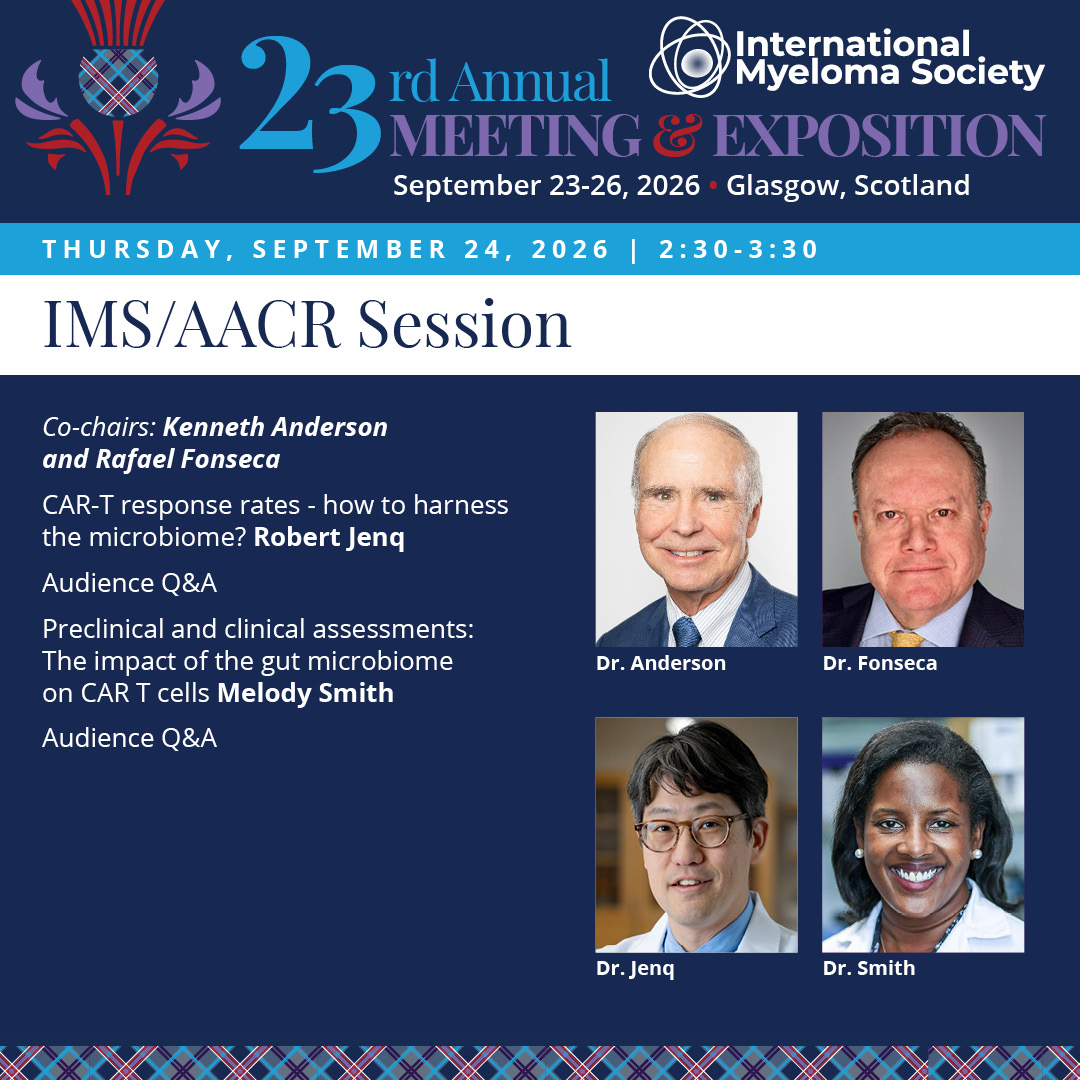


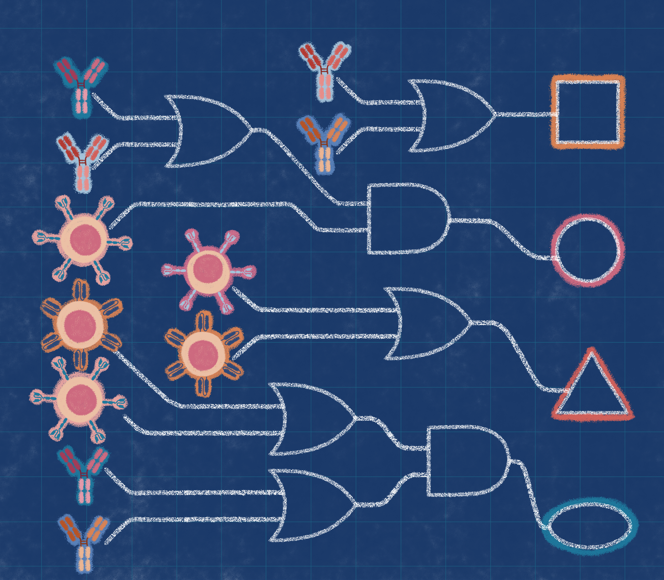




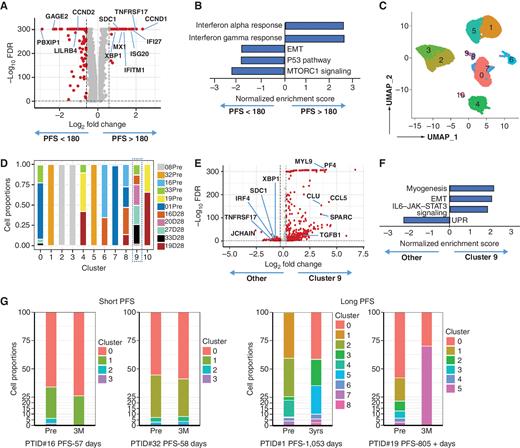
 Sep 24
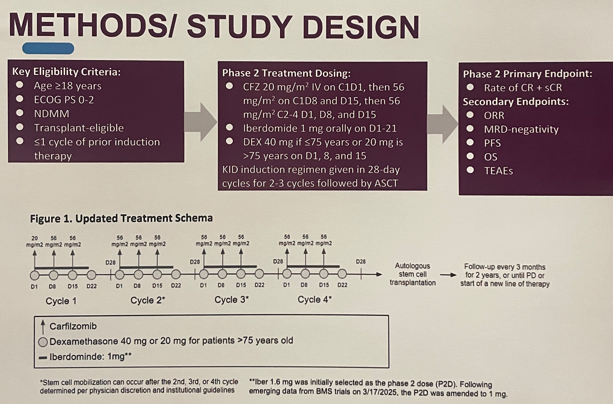
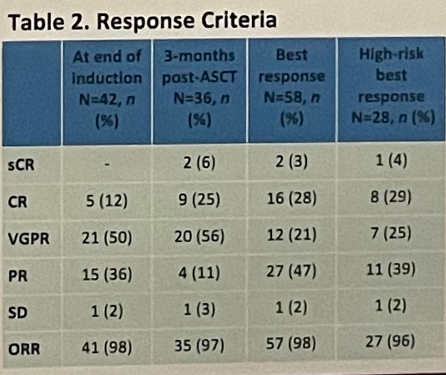


CONGRESS | #IMS26 | POSTER
Noa Biran, Hackensack Meridian Health John Theurer Cancer Center, presented interim results from a multicenter phase I/II study evaluating KID induction followed by ASCT in patients with NDMM (N = 58).
At a median follow-up of 13.3 months, estimated https://t.co/EtIt51zRwV
METHODS/ STUDY DESIGN
Key Eligibility Criteria:
Age ≥18 years
ECOG PS 0-2
NDMM
Transplant-eligible
≤1 cycle of prior induction therapy
Phase 2 Treatment Dosing:
CFZ 20 mg/m2 IV on C1D1, then 56 mg/m2 on C1D8 and D15, then 56 mg/m2 C2-4 D1, D8, and D15
Iberdomide 1 mg orally on D1-21
DEX 40 mg if ≤75 years or 20 mg is >75 years on D1, 8, and 15
KID induction regimen given in 28-day cycles for 2-3 cycles followed by ASCT
Phase 2 Primary Endpoint: Rate of CR + sCR
Secondary Endpoints: ORR, MRD-negativity, PFS, OS, TEAEs
Figure 1. Updated Treatment Schema
Cycle 1: 20/56 mg/m2 D1, D8, D15
Cycle 2*: 56 mg/m2 D1, D8, D15, D22
Cycle 3*: 56 mg/m2 D1, D8, D15, D22
Cycle 4*: 56 mg/m2 D1, D8, D15, D22
Iberdomide dosing shown across cycles
Dexamethasone 40 mg or 20 mg for patients >75 years old
Iberdomide: 1mg**
-> Autologous stem cell transplantation -> Follow-up every 3 months for 2 years, or until PD or start of a new line of therapy
*Stem cell mobilization can occur after the 2nd, 3rd, or 4th cycle determined per physician discretion and institutional guidelines
**Iber 1.6 mg was initially selected as the phase 2 dose (P2D). Following emerging data from BMS trials on 3/17/2025, the P2D was amended to 1 mg.
Table 2. Response Criteria
| At end of induction N=42, n (%) | 3-months post-ASCT N=36, n (%) | Best response N=58, n (%) | High-risk best response N=28, n (%) |
sCR: - | 2 (6) | 2 (3) | 1 (4)
CR: 5 (12) | 9 (25) | 16 (28) | 8 (29)
VGPR: 21 (50) | 20 (56) | 12 (21) | 7 (25)
PR: 15 (36) | 4 (11) | 27 (47) | 11 (39)
SD: 1 (2) | 1 (3) | 1 (2) | 1 (2)
ORR: 41 (98) | 35 (97) | 57 (98) | 27 (96)
Table 3. Treatment-Emergent Adverse Events (Grade III-V)
Adverse Event | # of Patients | Grade
Acute Kidney Injury | 1 | 3
Anemia | 3 | 3
Atrial Fibrillation | 2 | 3
Blood per Rectum | 1 | 3
Constipation | 1 | 3
Death | 1 | 5
Dizziness | 1 | 3
Electrolyte abnormalities | 2 | 3
Fatigue | 2 | 3
Hypovolemia | 1 | 4
Liver enzyme abnormalities | 2 | 3
Maculopapular rash | 2 | 3
Mood, sleep/wake cycle | 2 | 3
Myalgias | 2 | 3
Neutropenia | 11 | 3 (n=11), 4 (n=12)
Syncope | 1 | 3
Thrombocytopenia | 3 | 3
CONCLUSIONS
Induction therapy with KID leads to deep and durable responses regardless of high-risk status, despite the short treatment duration.
Notably, iber-based induction also demonstrated successful stem cell mobilization.
Further studies will evaluate KID with post-ASCT iber + elranatamab consolidation followed by iber maintenance.



 Sep 24

Meet the Experts begins at 12:00 PM. #IMS26
CAR-T in the outpatient setting➡️ Boisdale
Bispecifics in the outpatient setting ➡️ Dochart
Evaluating the immune system in multiple myeloma ➡️ Carron https://t.co/VXfWtyye9P
23rd Annual MEETING & EXPOSITION, International Myeloma Society, September 23-26, 2026 - Glasgow, Scotland
THURSDAY, SEPTEMBER 24, 2026 | 12:00 - 12:50
Meet the Experts
CAR-T in the outpatient setting - Adam Cohen and Amrita Krishnan
Bispecifics in the outpatient setting - Yael Cohen and Sham Mailankody
Evaluating immune system in MM - Madhav Dhodapkar and Bruno Paiva
Speaker photos shown: Dr. A. Cohen, Dr. Y. Cohen, Dr. Dhodapkar, Dr. Krishnan, Dr. Mailankody, Dr. Paiva
Sep 24

At 12:00 PM in Alsh: Poster Discussion. #IMS26 https://t.co/mZfCnSKP5O
23rd Annual Meeting & Exposition, International Myeloma Society, September 23-26, 2026, Glasgow, Scotland
THURSDAY, SEPTEMBER 24, 2026 | 12:00-12:50
Poster Discussion
Co-chairs: Jonathan Kaufman, Prashant Kapoor, Maria Theresa Krauth, Sonja Zweegman
Agenda / abstract list with presenters:
- Cure in Multiple Myeloma is Age-, Risk- and Treatment-Dependent: Long-Term Analyses from 6380 patients across UK Randomised Trials - David Cairns
- Circulating tumor cells and plasma MYD88 Mutation Allele Fraction as Prognostic Markers for Staging and Ibrutinib Response in Waldenstrom Macroglobulinemia - Tina Bagratuni
- Patient-Reported Outcomes (PROs) of Teclistamab-Based Treatment (tx) in Relapsed/Refractory Multiple Myeloma (RRMM) after 1-3 Lines of Therapy (LOT) - Katja Weisel
- Post-Infusion Immunophenotypic And Functional Characteristics Of Arlocabtagene Autoleucel (Arlo-Cel) In A First-In-Human (FiH), Phase 1 Trial In Relapsed/Refractory Multiple Myeloma (RRMM) - Susan Bal
- Neoantigen viral vector vaccination provides effective and durable tumor control in an aggressive Multiple Myeloma model - Marta Chesi
- Co-opting the BAFF-APRIL Pathway in Smouldering Myeloma (SMM) to Fuel Disease Progression - Elise Rees
- Complete-genome multiomics uncovers peri/centromeric rearrangements as hidden drivers of epigenomic rewiring in myeloma - Aneta Mikulasova
- The Role of Prehabilitation in Individuals Undergoing CAR-T Therapy for Relapsed or Refractory Multiple Myeloma - Shannon Strader
- Dasatinib and Quercetin in Patients with Relapsed, Refractory Multiple Myeloma receiving CAR-T Therapy: First report from the Safety Run-in of the Phase II DART Trial - Christoph Schaefers
- Quantifying the Rise of Non-Cancer Mortality in Multiple Myeloma: A SEER Database Analysis (2000-2030) - Muhammad Talha Shaukat
Headshots of all 14 named presenters/co-chairs are shown with name captions (Dr. Bagratuni, Dr. Bal, Dr. Cairns, Dr. Chesi, Dr. Kapoor, Dr. Kaufman, Dr. Krauth, Dr. Mikulasova, Dr. Rees, Dr. Schaefers, Dr. Shaukat, Dr. Strader, Dr. Weisel, Dr. Zweegman)
Sep 24
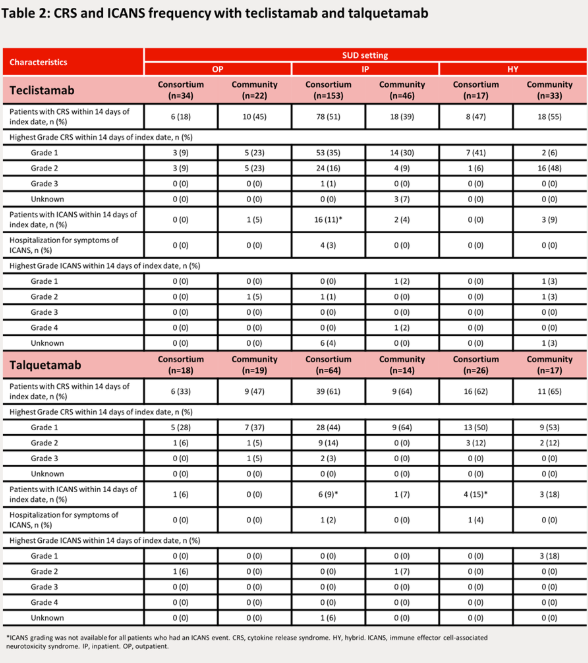
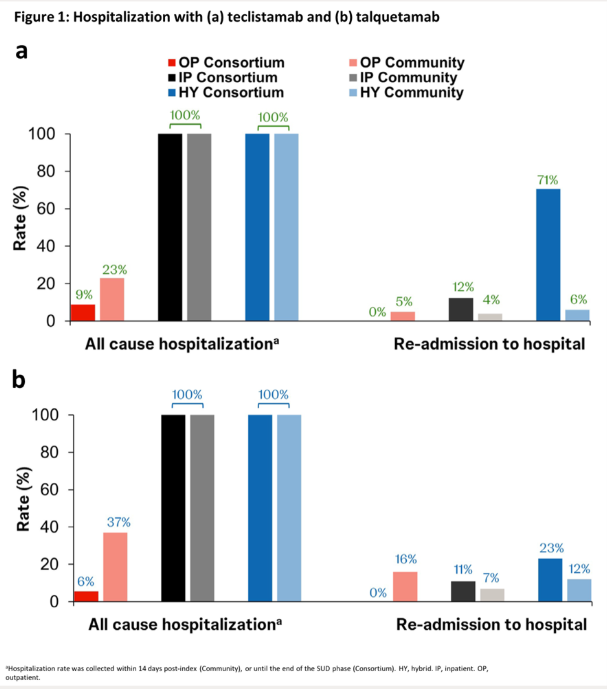
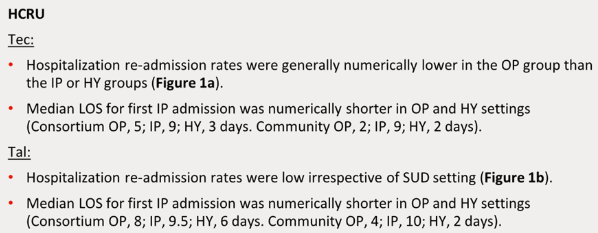
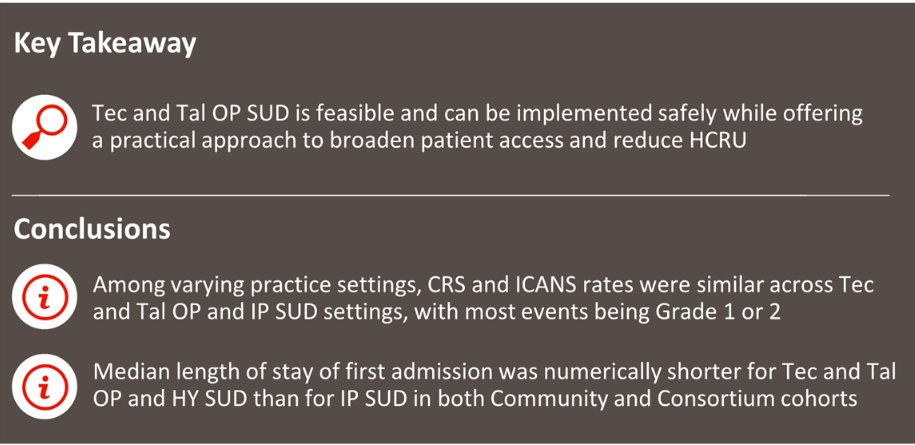
CONGRESS | #IMS26 | POSTER
Lisa Raff, One Oncology, presented results from a retrospective, multicenter study evaluating safety outcomes and HCRU across outpatient (OP), inpatient (IP), and hybrid settings for teclistamab and talquetamab SUD in patients with RRMM across a https://t.co/QPCYSNvN1k
Table 2: CRS and ICANS frequency with teclistamab and talquetamab
SUD setting
OP IP HY
Characteristics | Consortium | Community | Consortium | Community | Consortium | Community
Teclistamab (n): 34 | 22 | 153 | 46 | 17 | 33
Patients with CRS within 14 days of index date, n(%): 6(18) | 10(45) | 78(51) | 18(39) | 8(47) | 18(55)
Highest Grade CRS within 14 days of index date, n(%):
Grade1: 3(9) | 5(23) | 53(35) | 14(30) | 7(41) | 2(6)
Grade2: 3(9) | 5(23) | 24(16) | 4(9) | 1(6) | 16(48)
Grade3: 0(0) | 0(0) | 1(1) | 0(0) | 0(0) | 0(0)
Unknown: 0(0) | 0(0) | 0(0) | 3(7) | 0(0) | 0(0)
Patients with ICANS within 14 days of index date, n(%): 0(0) | 1(5) | 16(11)* | 2(4) | 0(0) | 3(9)
Hospitalization for symptoms of ICANS, n(%): 0(0) | 0(0) | 4(3) | 0(0) | 0(0) | 0(0)
Highest Grade ICANS within 14 days of index date, n(%):
Grade1: 0(0) | 0(0) | 1(2) | 0(0) | 1(3) | 0(0)
Grade2: 0(0) | 1(5) | 1(1) | 0(0) | 0(0) | 1(3)
Grade3: 0(0) | 0(0) | 0(0) | 0(0) | 0(0) | 0(0)
Grade4: 0(0) | 0(0) | 0(0) | 0(0) | 0(0) | 0(0)
Unknown: 0(0) | 0(0) | 0(0) | 1(6) | 0(0) | 1(3)
Talquetamab (n): 18 | 19 | 64 | 14 | 26 | 17
Patients with CRS within 14 days of index date, n(%): 6(33) | 9(47) | 39(61) | 9(64) | 16(62) | 11(65)
Highest Grade CRS within 14 days of index date, n(%):
Grade1: 5(28) | 7(37) | 28(44) | 9(64) | 13(50) | 9(53)
Grade2: 1(6) | 1(5) | 9(14) | 0(0) | 3(12) | 2(12)
Grade3: 0(0) | 1(5) | 2(3) | 0(0) | 0(0) | 0(0)
Unknown: 0(0) | 0(0) | 0(0) | 0(0) | 0(0) | 0(0)
Patients with ICANS within 14 days of index date, n(%): 1(6) | 0(0) | 6(9)* | 1(7) | 4(15)* | 3(18)
Hospitalization for symptoms of ICANS, n(%): 0(0) | 0(0) | 1(2) | 0(0) | 1(4) | 0(0)
Highest Grade ICANS within 14 days of index date, n(%):
Grade1: 0(0) | 0(0) | 0(0) | 0(0) | 0(0) | 3(18)
Grade2: 1(6) | 0(0) | 0(0) | 1(7) | 0(0) | 0(0)
Grade3: 0(0) | 0(0) | 0(0) | 0(0) | 0(0) | 0(0)
Grade4: 0(0) | 0(0) | 0(0) | 0(0) | 0(0) | 0(0)
Unknown: 0(0) | 0(0) | 0(0) | 1(6) | 0(0) | 0(0)
*ICANS grading was not available for all patients who had an ICANS event. CRS, cytokine release syndrome. HY, hybrid. ICANS, immune effector cell-associated neurotoxicity syndrome. IP, inpatient. OP, outpatient.
Figure 1: Hospitalization with (a) teclistamab and (b) talquetamab
Legend: OP Consortium (red) / OP Community (light red) / IP Consortium (black) / IP Community (gray) / HY Consortium (blue) / HY Community (light blue)
(a) Teclistamab: All-cause hospitalization: OP Consortium 9%, OP Community 23%, IP Consortium/Community 100%/100%, HY Consortium/Community 100%/100%. Re-admission to hospital: OP Consortium 0%, OP Community 5%, IP Consortium 12%, IP Community 4%, HY Consortium 71%, HY Community 6%
(b) Talquetamab: All-cause hospitalization: OP Consortium 6%, OP Community 37%, IP 100%/100%, HY 100%/100%. Re-admission to hospital: OP Consortium 0%, OP Community 16%, IP Consortium 11%, IP Community 7%, HY Consortium 23%, HY Community 12%
Footnote: Hospitalization rate was collected within 14 days post-index (Community), or until the end of the SUD phase (Consortium). HY, hybrid. IP, inpatient. OP, outpatient.
HCRU
Tec:
- Hospitalization re-admission rates were generally numerically lower in the OP group than the IP or HY groups (Figure 1a).
- Median LOS for first IP admission was numerically shorter in OP and HY settings (Consortium OP, 5; IP, 9; HY, 3 days. Community OP, 2; IP, 9; HY, 2 days).
Tal:
- Hospitalization re-admission rates were low irrespective of SUD setting (Figure 1b).
- Median LOS for first IP admission was numerically shorter in OP and HY settings (Consortium OP, 8; IP, 9.5; HY, 6 days. Community OP, 4; IP, 10; HY, 2 days).
Key Takeaway
Tec and Tal OP SUD is feasible and can be implemented safely while offering a practical approach to broaden patient access and reduce HCRU
Conclusions
- Among varying practice settings, CRS and ICANS rates were similar across Tec and Tal OP and IP SUD settings, with most events being Grade 1 or 2
- Median length of stay of first admission was numerically shorter for Tec and Tal OP and HY SUD than for IP SUD in both Community and Consortium cohorts

 Sep 24

Are we ready to replace bone marrow testing with blood tests? Not yet. Bone marrow testing remains the gold standard, but future patients may need fewer biopsies as blood-based techniques are used alongside it to monitor disease and treatment response. #IMS26 #EMD https://t.co/vdUvWeR7C4
Future directions
- Blood is increasingly becoming the source for detecting the presence and measurement of clonal plasma cells
- Sensitivity for detection of intact cells (MFC, CyTOF, Spectral Flow), monoclonal protein (mass spec), tumor DNA, and other tumor derived products continues to increase
- Currently marrow and imaging adds to blood assessments - complementary
- Correlations should not be just cross sectional - we need to ask if repeated measurements in blood replace other modalities?
- In future is likely that we will be doing less of marrow and imaging - but use blood-based assessments to decide when to effectively use the other modalities
International Myeloma Society, 23rd International Myeloma Society Annual Meeting
[Slide number 28]
[Photo of presenter at podium with IMS 23rd Annual Meeting branding]





 Sep 24

At 8:30 AM in Hall 5: Blood-Based Technology for Diagnosis and Monitoring. #IMS26 https://t.co/xJA1n5nP4Q
23rd Annual MEETING & EXPOSITION, International Myeloma Society, September 23-26, 2026 - Glasgow, Scotland
THURSDAY, SEPTEMBER 24, 2026 | 8:30 - 9:50
Blood-Based Technology for Diagnosis and Monitoring
Co-chairs: Shaji Kumar and Kenneth Anderson
Circulating tumor cells - Luca Bertamini
Mass spectrometry - Noemi Puig
Circulating tumor DNA - Suzanne Trudel
Immune markers of disease activity - Samir Parekh
Future directions and challenges - Shaji Kumar
Round table discussion - Ceri Bygrave, Jill Corre, Graham Jackson, P. Joy Ho
Speaker photos shown: Dr. Anderson, Dr. Bertamini, Dr. Bygrave, Dr. Corre, Dr. Ho, Dr. Jackson, Dr. Kumar, Dr. Parekh, Dr. Puig, Dr. Trudel
 Sep 24

Read this review by #IMS26 speaker Ola Landgren, “Minimal Residual Disease as an Early Endpoint for Accelerated Drug Approval in Myeloma: A Roadmap.” https://t.co/pxdT2Oc2Cc @DrOlaLandgren https://t.co/IUZdSEZkMo
Acceptance of MRD-negative CR as a surrogate endpoint reasonably likely to predict clinical benefit ->
Enable streamlined trial designs
Updated FDA guidance on MRD in clinical trials
Inform surrogate endpoint validation processes for other cancers
-> Increase accessibility of novel therapies



 Sep 23

IACH News Live from #IMS26
Rethinking First Relapse in Multiple Myeloma: CAR-T, Bispecifics, ADCs and the Challenge of Sequencing
Listen here:
https://t.co/qqvO5Rr43y
@Mohty_EBMT https://t.co/jGoVvj2M5j
IACH News Live from IMS 2026
Rethinking First Relapse in Multiple Myeloma: CAR-T, Bispecifics, ADCs and the Challenge of Sequencing
September 23rd - Live from IMS 2026: T-cell Engagers to Reorganize the Cytotoxic Immunological Synapse
CME Congresses - Live from IMS 2026: T-cell Engagers to Reorganize the Cytotoxic Immunological Synapse (SoundCloud audio embed, IACH News / International Academy for Clinical Hematology logo)



 Sep 23

At 4:00 PM in Hall 5: How to Treat First Relapse? #IMS26 https://t.co/wIR0YOqT7u
International Myeloma Society
23rd Annual MEETING & EXPOSITION
September 23-26, 2026 . Glasgow, Scotland
WEDNESDAY, SEPTEMBER 23, 2026 | 4:00 - 5:20
How To Treat First Relapse?
Co-chairs: Sagar Lonial and Maria-Victoria Mateos
CAR-T Krina Patel
Combinations Rakesh Popat
ADC-based Vania Hungria
Limited access to new agents Martin Kaiser
Future directions and challenges Maria-Victoria Mateos
Round table discussion Gordon Cook, Francesca Gay, Natalia Schutz, Keith Stewart
[Photo captions] Dr. Cook / Dr. Gay / Dr. Hungria / Dr. Kaiser / Dr. Lonial / Dr. Mateos / Dr. Patel / Dr. Popat / Dr. Schutz / Dr. Stewart



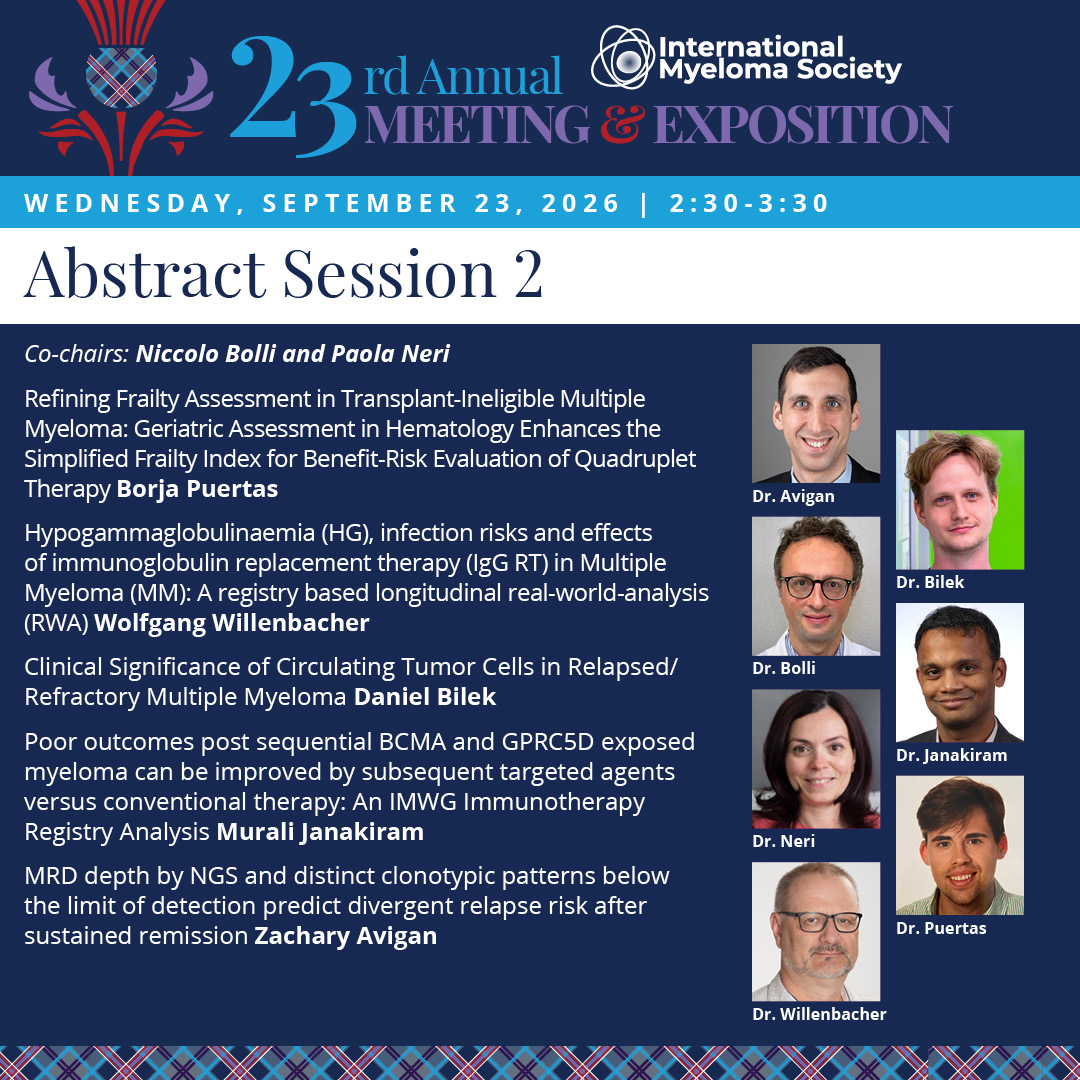








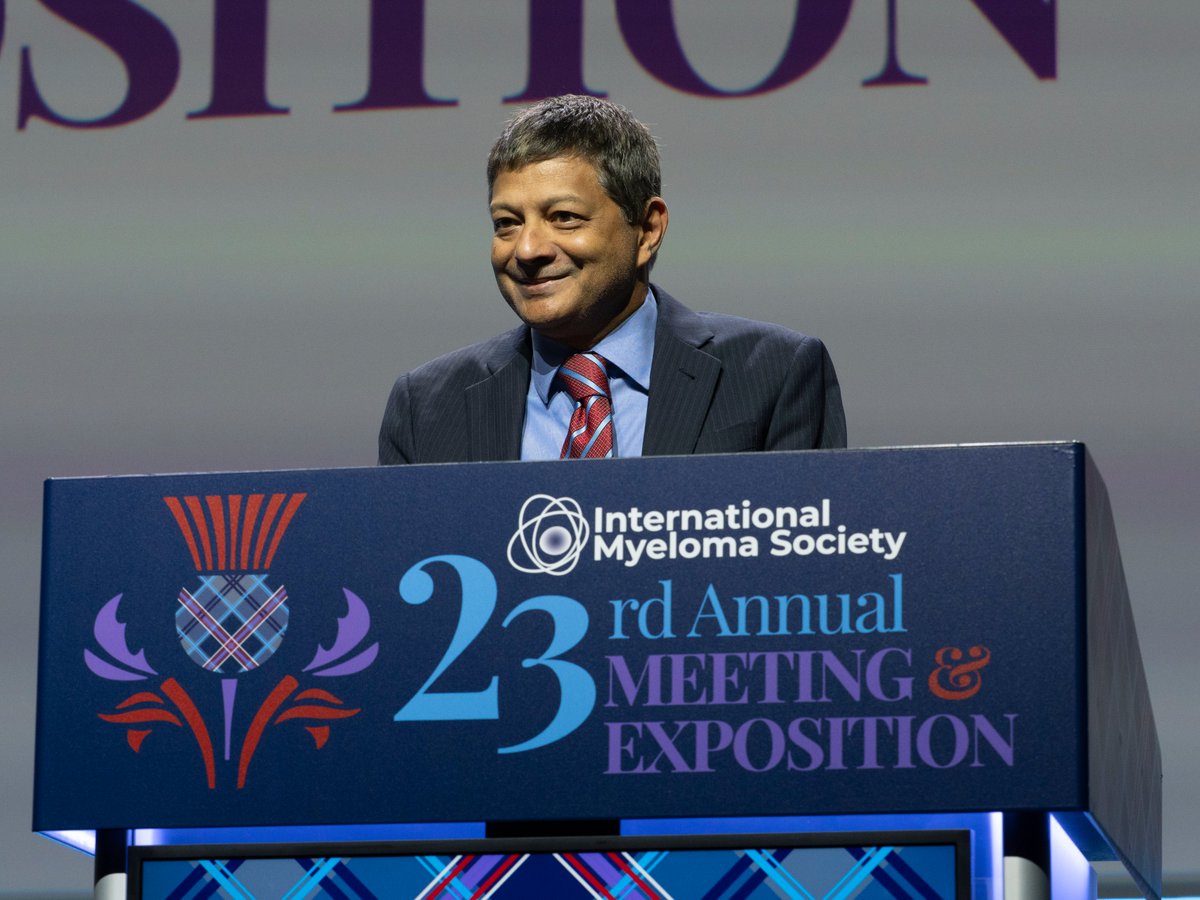

 Sep 23

At 11:30 AM in Hall 5: IMS/IMWG Consensus Update. #IMS26 https://t.co/xuJwuvA1zh
International Myeloma Society
23rd Annual MEETING & EXPOSITION
September 23-26, 2026 . Glasgow, Scotland
WEDNESDAY, SEPTEMBER 23, 2026 | 11:30 - 12:00
IMS/IMWG Consensus Update
Philippe Moreau, Co-chair
Vincent Rajkumar, Co-chair
 Sep 23
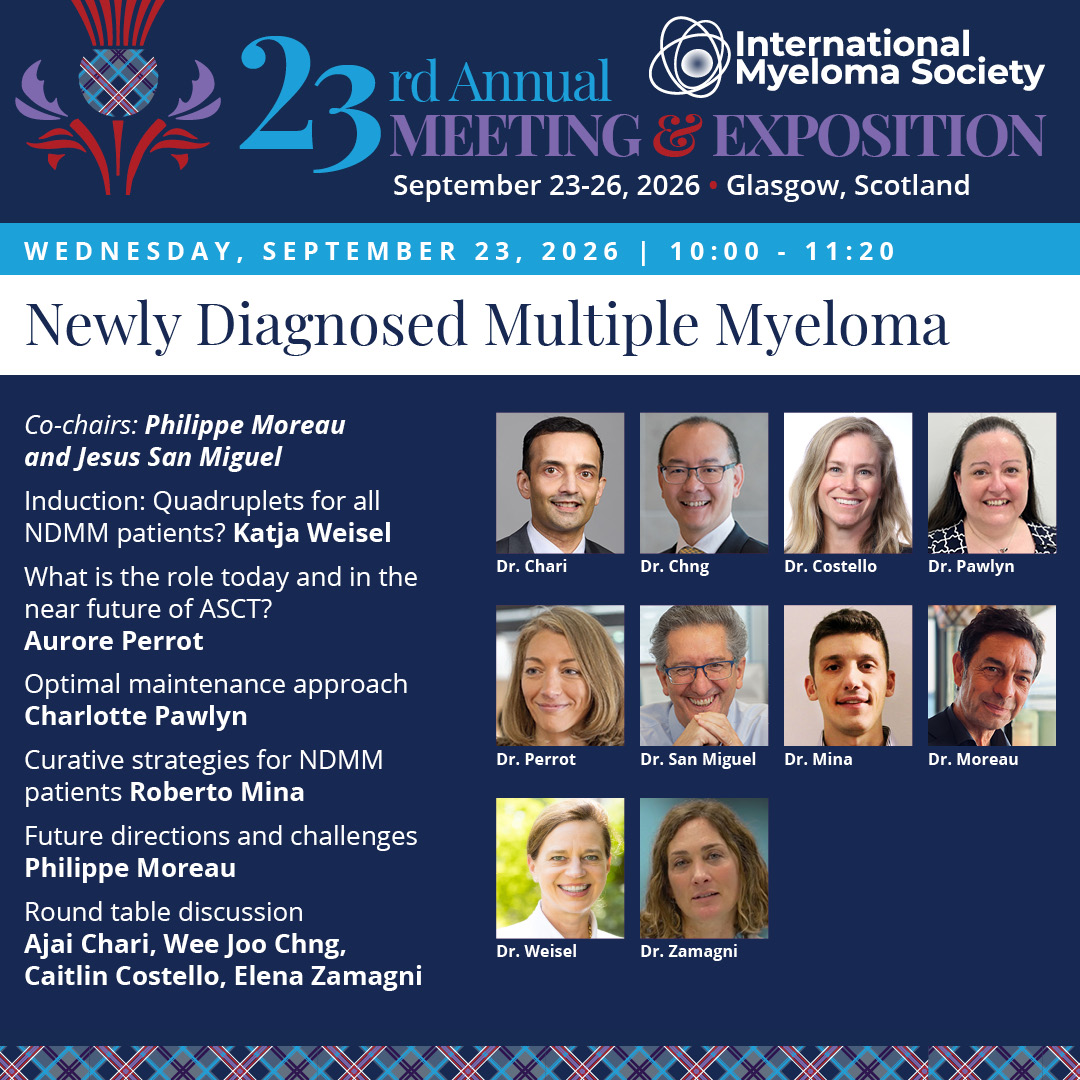
At 10:00 AM in Hall 5: Newly Diagnosed Multiple Myeloma. #IMS26 https://t.co/HOwDj9EiwB
International Myeloma Society
23rd Annual MEETING & EXPOSITION
September 23-26, 2026 . Glasgow, Scotland
WEDNESDAY, SEPTEMBER 23, 2026 | 10:00 - 11:20
Newly Diagnosed Multiple Myeloma
Co-chairs: Philippe Moreau and Jesus San Miguel
Induction: Quadruplets for all NDMM patients? Katja Weisel
What is the role today and in the near future of ASCT? Aurore Perrot
Optimal maintenance approach Charlotte Pawlyn
Curative strategies for NDMM patients Roberto Mina
Future directions and challenges Philippe Moreau
Round table discussion Ajai Chari, Wee Joo Chng, Caitlin Costello, Elena Zamagni
[Photo captions] Dr. Chari / Dr. Chng / Dr. Costello / Dr. Pawlyn / Dr. Perrot / Dr. San Miguel / Dr. Mina / Dr. Moreau / Dr. Weisel / Dr. Zamagni


 Sep 23

Join us at #IMS2026, where Dr. Hermann Einsele will present the first results from a prospective postauthorization safety study of a BCMA-directed CAR-T therapy in relapsed/refractory multiple myeloma. Stay tuned for updates from the meeting.
#MultipleMyeloma #CART #mmsm https://t.co/vfoQw5fdzP
#IMS2026
1 of 3
Abstract #PA-199 Poster
First Results of a Noninterventional, Prospective, Postauthorization Safety Study (PASS) of a BCMA CAR-T in Patients With Relapsed/Refractory Multiple Myeloma
Dr. Hermann Einsele (Universitätsklinikum Würzburg,)
Wed, Sept 23,2026 | 12:00 - 1:00 PM
Hall 4
LEGEND BIOTECH
Intended for US HCPs only.


 Sep 17
We’re sharing new data from our #MultipleMyeloma research programs at this year’s @Myeloma_Society annual meeting. Read more: https://t.co/WqBPfL8L4D
#IMS26 https://t.co/YaAme0d4re
abbvie
Multiple myeloma is the second most common blood cancer worldwide.
See our latest blood cancer research at IMS 2026.
Cancer Research Institute. Immunotherapy for multiple myeloma. Accessed August 2026. https://www.cancerresearch.org/immunotherapy-by-cancer-type/multiple-myeloma
 Sep 17

📌 4 GHG Studies Accepted for Poster Presentation at IMS 2026
Four studies from Dr. Yajing Zhang’s team at GoBroad Healthcare Group (GHG) have been accepted for poster presentation at the 23rd Annual Meeting & Exposition of the International Myeloma Society (IMS 2026), to be held in Glasgow, Scotland, from September 23–26, 2026.
Focusing on relapsed/refractory multiple myeloma, particularly extramedullary disease and other high-risk settings, the four studies explore dynamic antigen evolution, lesion-based target reassessment, sequential CAR-T strategies, and the relationship between CAR-T expansion and clinical efficacy.
🧬 Together, these studies reflect GHG’s continued effort to move precision cellular therapy from static target selection toward more dynamic, evidence-driven treatment decisions that better follow the evolving biology of disease.
International Myeloma Society 23rd Annual Meeting & Exposition
September 23-26, 2026 - Glasgow, Scotland
GHG | GoBroad Healthcare Group
GHG | 4 Posters Accepted for IMS 2026
PA-498: Tissue-Defined Antigen-Immune States Reveal Actionable Evolution in Extramedullary Myeloma
PA-439: Serial EMD Antigen Mapping Guides Sequential CAR-T Targeting in Relapsed/Refractory Multiple Myeloma
PA-278: Lesion-Based Antigen Remapping Reveals Dynamic Target States for Sequential CAR-T Therapy in Relapsed/Refractory Multiple Myeloma
PA-438: Sequential BCMA/FCRL5-Based Multi-Target CAR-T Reveals an Expansion-Efficacy Paradox in Ultra-High-Risk RRMM with EMD/sPCL


