EGFR-mutant non-squamous NSCLC post-3rd-gen EGFR TKI (e.g., osimertinib) — Akeso Biopharma (global) + Summit Therapeutics (US rights)
Discover KOL Sentiment on HARMONi →On November 15, 2026, Summit Therapeutics announced that the FDA issued a Complete Response Letter for its Biologics License Application for ivonescimab plus chemotherapy in EGFR-mutant, locally advanced or metastatic non-squamous NSCLC after EGFR TKI therapy (PDUFA goal date November 14, 2026). Per Summit, the FDA stated that “substantial evidence of effectiveness is not established in the absence of a statistically significant overall survival (OS) improvement,” and that the PFS benefit without a statistically significant OS benefit does not support a positive benefit-risk profile for approval.
The FDA publishes complete response letters in its openFDA CRL database; this letter was not posted there as of November 15, 2026, so the account above is Summit’s. Summit’s release does not mention resubmitting this application. It says the company will continue developing ivonescimab, listing HARMONi-3 and HARMONi-7 (first-line NSCLC), HARMONi-GI3 (colorectal cancer), HARMONi-GU1 (urothelial cancer) and SMT112-216 (renal cell carcinoma).
Source: Summit Therapeutics press release, Nov 15, 2026 ↗HARMONi met its PFS primary endpoint (median 6.8 vs 4.4 months, HR 0.52; see At a Glance). At the primary OS analysis (labeled the final OS analysis on the WCLC 2025 slides), overall survival showed a favorable trend but was not statistically significant: median 16.8 vs 14.0 months, HR 0.79 (95% CI 0.62–1.01), P=0.057 (WCLC 2025 slide, shown in Key Slides). Summit’s release describes a post hoc, longer-follow-up analysis with an OS hazard ratio of 0.76 in the full population and in Asian and Western patients; it is not a statistically tested result.
Summit release ↗⚠️ Ivonescimab is not FDA approved for any indication and remains investigational in the US. It is approved in China (NMPA). Per Summit, ivonescimab development continues in other trials, including HARMONi-3 and HARMONi-7.
Posts by physicians on November 15, 2026, including replies within their threads. Each post is shown in full and verbatim and linked to the original on X.

the @FDA has declined to approve ivonescimab in advanced NSCLC because of lack of OS benefit*. Interesting how the 'culture' of different diseases affects norms and standards for regulatory approval. The landscape of advanced breast cancer treatment would look very different and have different kinetics if OS was required for approval. *this instance may also be affected by the fully ex-US nature of the particular trial https://t.co/l85y44eaKT

🚨 Major FDA setback for Ivonescimab! FDA issues a Complete Response Letter for ivonescimab + chemotherapy in EGFR-mutated NSCLC following the Phase III HARMONi trial. ✅ Significant PFS benefit ❌ OS benefit not statistically significant 📊 Post-hoc OS HR: 0.76 FDA's message: PFS benefit alone was insufficient to establish a favorable benefit–risk profile in this setting. A major regulatory challenge for the promising PD-1/VEGF bispecific antibody Is PFS enough, or should OS remain the ultimate benchmark? @JacobPlieth @RManochakian @OncoAlert @OncBrothers @dr_yakupergun @KolPulseAI
JUST IN: the @FDA has declined to approve PD1/VEGF bispecific ivonescimab in advanced NSCLC with EGFRm, because of lack of OS benefit (via @Reuters) — Having seen approval in several cancers based on PFS, this is somewhat a puzzling rejection. https://t.co/aLPJQm72Iw

Disappointing update - ivonescimab will not be FDA approved for EGFR mutant lung cancer. Unusual trial design may have partly driven the lack of OS benefit but will have to wait for Harmoni-3 in non-AGA lung cancer for an approval it seems #lcsm https://t.co/ARbJvFd5SH

I struggle to understand the FDA’s decision on ivonescimab in light of its previous decisions. Without those precedents, I could understand a rejection based on failure to meet a primary OS endpoint. In TROPION-Breast01, PFS and OS were dual primary endpoints. Despite a positive PFS result and failure to meet the final OS endpoint, Dato-DXd received regular approval. Dato-DXd also received accelerated approval in EGFR-mutated lung cancer after prior EGFR-directed therapy and platinum-based chemotherapy, based on response rate and duration of response. TROPION-Lung01, one of the studies contributing to that approval, also failed to meet its primary OS endpoint in the overall population. Of course, each regimen has a different benefit–risk profile and approval pathway. Still, I look forward to a clear scientific explanation of why a statistically significant OS benefit is indispensable for ivonescimab and what distinguishes this case from these precedents.

Ivonescimab (with chemo) has been rejected by FDA in EGFRm TKI refractory lung cancer. The trial achieved impressive PFS but not OS (with some subgroup inconsistency). We see PFS achieve approvals without OS in other tumours including all 3 GU cancers. It’s not always easy to predict the future in terms of results or regulatory approvals, but the class of drug seems broadly active. VEFF/PD1s are in R3 trials in bladder cancer with EV. @OncoAlert https://t.co/usXdkBYLiL

🚨 FDA declines to approve ivonescimab (PD-1 × VEGF) + chemotherapy for EGFR-mutated NSCLC after EGFR-TKI therapy. Despite significant PFS improvement in the phase III HARMONi trial, the FDA issued a Complete Response Letter (CRL). 📊 HARMONi (co-primary endpoints: PFS and OS) PFS: HR 0.52 ✅ OS (primary): HR 0.79, p=0.057 ❌ OS (updated, post-hoc): HR 0.76, nominal p=0.0151 🔍 Why the rejection? The FDA had previously indicated that statistically significant OS improvement was necessary for approval in this setting. The FDA concluded that the PFS benefit without statistically significant OS improvement was insufficient to establish a favorable benefit–risk profile. 💭 An important regulatory question: Other therapies for EGFR-mutated NSCLC after EGFR-TKI failure have received FDA approval based primarily on PFS benefit. 🔗 https://t.co/9Y8e6Jr1rh

Looks like iwon’tescimab for a while.. Indeed disappointing as HARMONi data seemed to mature well and promising a true clinically meaningful benefit in both OS and PFS. But admit need is less strong in egfr-mutated nsclc w so many other choices- hope other HARMONI trials will strike the right chord with the FDA..

🔥HARMONi: The FDA has issued a complete response letter to Summit Therapeutics, declining to approve the PD-1xVEGF bispecific ivonescimab 🆙 @SMMT_TX 👥Patients: EGFR-mutated, locally advanced or metastatic non-squamous NSCLC, previously treated with a third-generation EGFR TKI 3⃣Phase III ⚖️Ivonescimab + platinum-containing chemotherapy ⚖️Placebo + platinum-containing chemotherapy 🔢NCT06396065 #LCSM @OncoAlert @Larvol @EGFRResisters 🔗 https://t.co/UZryplFREb

Ivonescimab CRL (HARMONi, EGFRm NSCLC post-TKI) ➡️ mPFS 6.8 vs 4.4 mo, HR 0.52 ➡️ OS HR 0.79, P=.057 (co-primary) ➡️ TR SAEs 28 vs 15% Although consistency from @FDA is a question here whats the added value for PFS post-osi ? https://t.co/K2fJAFYlNQ @LungCancerRx @OncoAlert https://t.co/3hfyMyyRG1

🚨 IVONESCIMAB: PFS WIN, OS MISS — FDA SAYS NO! HARMONi Phase III | FDA Complete Response Letter (CRL) 🔹 Population: EGFR-mutated advanced nonsquamous NSCLC after 3rd-generation EGFR TKI. 🔹 Design: Ivonescimab + platinum chemotherapy vs placebo + chemotherapy. 🔹 PFS: Statistically significant improvement ✅ 🔹 OS: Not statistically significant ❌ Post-hoc HR 0.76 — favorable trend, no proven OS benefit. 🔹 FDA verdict: Benefit–risk evidence insufficient for approval as submitted. 🔹 Regulatory status: 🇺🇸 Not FDA-approved | 🇨🇳 Initially approved May 2024. 🔹 What's next? HARMONi-3, HARMONi-7 and broader clinical development continue. 🎯 TAKE-HOME: PFS success ≠ OS success ≠ FDA approval. 📚 Reference: Summit Therapeutics | November 15, 2026 | HARMONi Phase III | FDA CRL announcement. #Ivonescimab #HARMONi #NSCLC #LungCancer #EGFR #FDA #Oncology #ClinicalTrials #MVOnco @OncoDaily @OncoAlert @larvol
🐱🐭 THE FDA DOOR: DATO IN, IVO OUT! 🚪💥 Same PFS success. No statistically significant OS benefit. But two different FDA verdicts! 🤔 🟢 DATO-DXd (Datopotamab Deruxtecan) - Breast cancer: PFS positive ✅ - OS not statistically significant ❌ - FDA APPROVED ✅ (January 2025) 🟢 DATO-DXd (Lung Cancer) - ORR 45%; OS data immature - FDA APPROVED ✅ (June 2025, accelerated approval) 🔴 IVO (Ivonescimab) — HARMONi - PFS significantly improved ✅ - OS not statistically significant ❌ - FDA CRL — NOT APPROVED 🚫 (November 2026) 🤔 THE MILLION-DOLLAR QUESTION If DATO can receive FDA approval without a demonstrated OS benefit, why not IVO? ⚖️ THE CATCH: Different indications, trial designs, comparators, magnitude of benefit, regulatory pathways and totality of evidence. PFS success ≠ Automatic FDA approval. But should the evidentiary bar be more consistent? 🎯 A little cartoon humour. A serious oncology regulatory debate! #MVOnco #FDA #Ivonescimab #DatoDXd #HARMONi #Oncology #LungCancer #ClinicalTrials #OncoDaily #OncoAlert

Interesting weekend surprise. The FDA has rejected ivonescimab (PD-1 × VEGF) in EGFR-mutant NSCLC despite a significant PFS benefit (HR 0.52). The reason? No statistically significant OS benefit. Not GI oncology, but VERY relevant to oncology drug development. Remember MARIPOSA? Amivantamab + lazertinib received FDA approval based on PFS, with OS as a secondary endpoint and immature survival data at approval. Yes. I know. HARMONi had co-primary PFS/OS endpoints, while MARIPOSA had PFS as its primary endpoint. Not identical trials. But here’s my question: Who wants to bet that if ivonescimab had been developed entirely in the US, rather than licensed from China’s Akeso, we’d be looking at an approval today? Maybe the FDA is simply holding sponsors to their prespecified endpoints. Fair enough. But are we applying a consistent evidentiary standard across oncology drugs? Because that matters a LOT more than just this one approval. @OncoAlert @TheGutOncLab @Onco_Nexus https://t.co/FiKxvfOLP9

@SuyogCancer Unbelievable! https://t.co/T7Z1x8i1hs
@FordePatrick @KolPulseAI This is disappointing for patients, yes, but with the PFS/OS dual endpoint vs just have PFS endooint and getting approval, this is going to skew studies in future towards PFS, is my concern.
@ADesaiMD @KolPulseAI I think the issue was because Summit were permitted to include pts already accrued/actively enrolling in China in the study but add a second global cohort to that group to make a global trial FDA said at the start that OS would be required in this specific trial.

@FordePatrick Thanks as always Patrick very helpful Presume they had meetings with the FDA… Agree that this is disappointing but end of act 1/2 in this ‘play’ and I suspect the ending will be more positive
@SuyogCancer @RenoHemonc Let me offer a different viewpoint, I think it matters whether dual vs single primary endpoint the trial was designed with, and I think that hurt Ivo here, although it was the right study to do. So in future, we will see only PFS based studies? Thats my concern https://t.co/yDCtCtu0Ec
@FordePatrick @KolPulseAI This is a decision with farther reaching impact since there are many China based drugs going ex-China and if this is the precedent then all will need OS benefit to be tested, although the gold standard endpoint- this may impact approvals in future as well.

@BalazsHalmosMD I fail to understand the inconsistency in FDA decisions. Ami approved with pfs despite no OS (aware of crossover) and Dato approved from pooled analysis. Can someone explain the discrepancy?
Design - Phase 3 global ivonescimab (PD-1 x VEGF bispecific) + chemotherapy vs placebo + chemotherapy, EGFR-mutant non-squamous NSCLC post-3rd-gen EGFR TKI (NCT06396065); dual primary endpoints progression-free survival and overall survival.
PFS (primary, BICR) - Median 6.8 vs 4.4 mo, HR 0.52 (95% CI 0.41-0.66), P<0.00001 (global HARMONi primary, DCO Apr 2025); consistent with the single-region HARMONi-A (China).
OS (dual primary) - OS was a dual primary endpoint and was not statistically significant at the primary OS analysis (labeled the final OS analysis on the WCLC 2025 slides): median 16.8 vs 14.0 months, HR 0.79 (95% CI 0.62-1.01), P=0.057 (WCLC 2025). Full population with longer follow-up of Western patients: HR 0.78 (95% CI 0.62-0.98), nominal P=0.0332 (WCLC 2025). HARMONi-A (NCT05184712), Akeso's China-only Phase 3 run under the same protocol number (AK112-301), reported a statistically significant final OS HR of 0.74 (95% CI 0.58-0.95), P=0.019 (Summit, November 2025).
Safety - Treatment-related AEs (WCLC 2025): grade ≥3 50.0% vs 42.2%; serious 28.0% vs 15.1%; leading to discontinuation 7.3% vs 5.0%; leading to death 1.8% vs 2.3%; grade ≥3 immune-related 9.6% vs 6.0%; grade ≥3 VEGF-related 7.3% vs 3.2%; grade 3+ bleeding <1%.
Regulatory - Investigational (US) - FDA Complete Response Letter November 15, 2026 (per Summit; no statistically significant OS); approved in China (NMPA). HARMONi-A and HARMONi-2 have their own KOL Pulse pages.
Sponsor / drug - Summit Therapeutics (US) + Akeso Biopharma; ivonescimab (PD-1 x VEGF bispecific).
Compiled and reviewed by the KOL Pulse research team, led by Brian Shields, Founder, KOL Pulse. Last updated November 15, 2026.









Top tweets by impressions — click to view on X
People are going to see into the $SMMT data what they want to see.
1) East-West reproducibility on PFS and impressive HR are encouraging
2) Lack of success on OS so far potentially jeopardizes the…
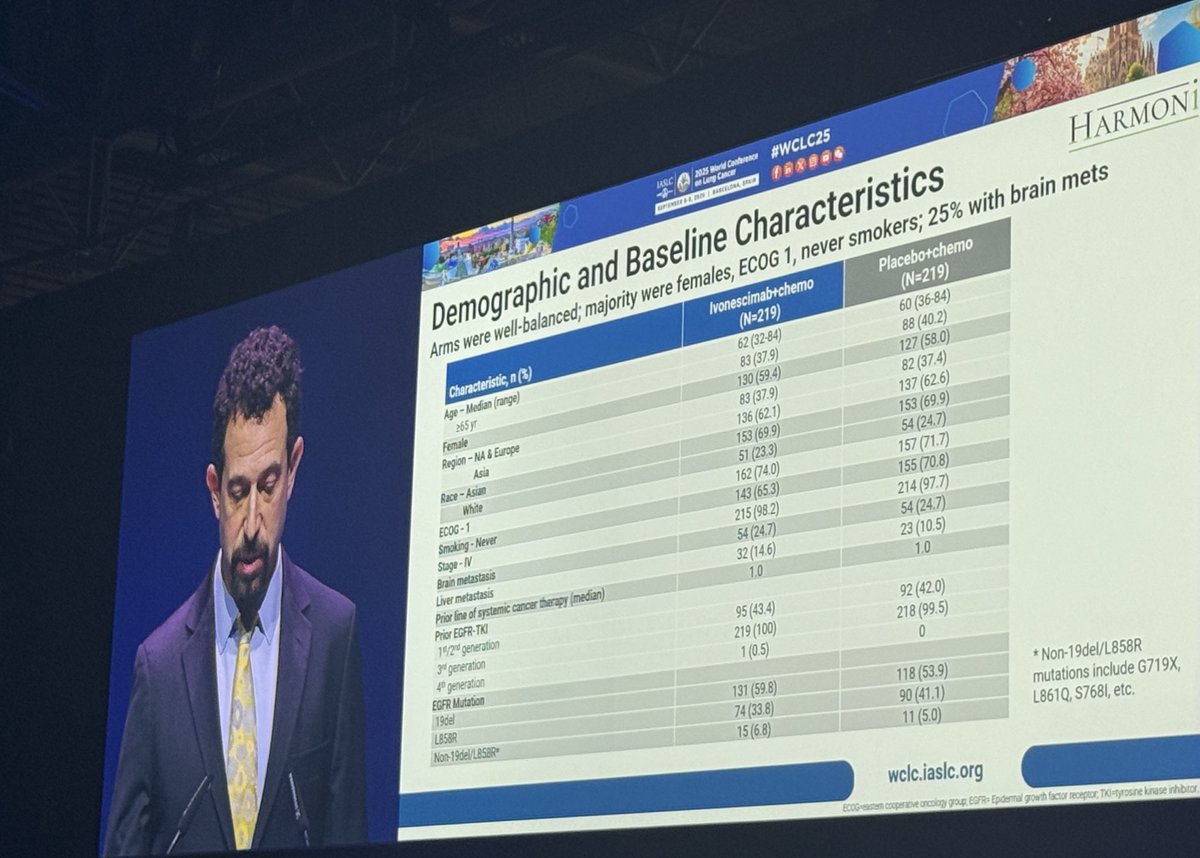
Dr. Jonathan Goldman presents the HARMONi data at #WCLC25. In EGFR NSCLC post TKI, adding ivonescimab (VEGF/PD1 bispecific) improves PFS (4.4 to 6.8m, HR 0.52). Numeric difference in OS in Western…
Awaited results of HARMONi trial evaluating ivonescimab, a PD1/VEGF bispecific presented by Dr. Jonathan Goldman presented
@IASLC #WCLC25
🔹PFS HR 0.52
🔹OS immature
How will this fit into a packed…
I deleted my previous $SMMT post because it was incorrect. Apologies.
Corrected version here:
$SMMT said ivonescimab PFS was stat sig and "consistent" between Chinese and western patient…
Summit $SMMT -24% now. I updated my story.
Summit is expected to present more specific data from the ivonescimab study at a future cancer research meeting, but for now, the sharp drop in the…

🔥🚨@OncoAlert Hot Off The Press
Big #NewsRelease by @SMMT_TX in time with #ASCO25
Results from the #HARMONi Phase III global trial evaluating:
#Ivonescimab + #Chemo vs #Chemo in pts with advanced…
Is this the end ? Or beginning? For ivonescimab. @Alfdoc2 @StephenVLiu @BalazsHalmosMD @RManochakian @OncBrothers @OncoAlert @chulkimMD @dr_yakupergun https://t.co/eqVdanRawk
Remarkable results in pretreated EGFR mutant lung cancer! In global trial, stellar benefit in progression-free survival for the addition of ivonescimab to platinum doublet chemo. Given tox profile…
$SMMT nicely trying to gatecrash #ASCO25 with its Harmoni reveal. Here's my preview of this readout from March: https://t.co/9gsDJeDhaa
𝐒𝐅 𝐇𝐞𝐚𝐥𝐭𝐡𝐜𝐚𝐫𝐞 𝐖𝐞𝐞𝐤: @SMMT_TX has filed for approval on the first indication of its PD1 x VEGF. Will it live up to its promise and set the next standard for cancer care? $SMMT
Full video:…


HARMONi is a positive phase 3 of ivonescimab (PD-1xVEGF bispecific) + chemotherapy vs. chemotherapy in EGFR-mutant non-squamous NSCLC after progression on a 3rd-generation EGFR TKI (e.g., osimertinib). Summit Therapeutics submitted a BLA in Q4 2025; the FDA accepted the BLA for filing in January 2026 with a PDUFA goal action date of November 14, 2026. Ivonescimab holds FDA Fast Track designation. On November 15, 2026 Summit announced an FDA Complete Response Letter for this BLA, citing the absence of a statistically significant overall survival improvement. Ivonescimab is approved in China (NMPA, initial approval May 2024).
Median: 6.8 months (ivonescimab + chemo) vs. 4.4 months (placebo + chemo). HR 0.52 (95% CI 0.41-0.66), P<0.00001, by BICR (global HARMONi primary analysis, DCO Apr 2025). Consistent with the single-region HARMONi-A (China): 7.1 vs. 4.8 mo, HR 0.46 months, HR 0.41 (0.30-0.57), P<0.0001. Crossed prespecified efficacy boundary at interim.
OS was a dual primary endpoint and was not statistically significant at the primary OS analysis (labeled the final OS analysis on the WCLC 2025 slides): median 16.8 vs 14.0 months, HR 0.79 (95% CI 0.62-1.01), P=0.057 (WCLC 2025). Full population with longer follow-up of Western patients: HR 0.78 (95% CI 0.62-0.98), nominal P=0.0332 (WCLC 2025). HARMONi-A (NCT05184712), Akeso's China-only Phase 3 run under the same protocol number (AK112-301), reported a statistically significant final OS HR of 0.74 (95% CI 0.58-0.95), P=0.019 (Summit, November 2025).
Treatment-related adverse events (TRAEs), ivonescimab + chemo vs placebo + chemo (WCLC 2025): grade ≥3 50.0% vs 42.2%; serious 28.0% vs 15.1%; leading to discontinuation 7.3% vs 5.0%; leading to death 1.8% vs 2.3%; grade ≥3 immune-related 9.6% vs 6.0%; grade ≥3 VEGF-related 7.3% vs 3.2%. Grade 3+ bleeding was under 1%.
⚠️ FDA Complete Response Letter, November 15, 2026 (per Summit): not approved in its present form. HARMONi is a positive phase 3 of ivonescimab (PD-1xVEGF bispecific) + chemotherapy vs. chemotherapy in EGFR-mutant non-squamous NSCLC after progression on a 3rd-generation EGFR TKI (e.g., osimertinib). Summit Therapeutics submitted a BLA in Q4 2025; the FDA accepted the BLA for filing in January 2026 with a PDUFA goal action date of November 14, 2026. Ivonescimab holds FDA Fast Track designation. On November 15, 2026 Summit announced an FDA Complete Response Letter for this BLA, citing the absence of a statistically significant overall survival improvement. Ivonescimab is approved in China (NMPA, initial approval May 2024).
Physician posts about this trial captured live during the IASLC 2026 World Conference on Lung Cancer (Seoul, September 12–15). Quotes are verbatim; each card links to the original post. Last updated 2026-09-13.

Updated overall survival data from the #HARMONi clinical trial on ivonescimab will be presented on September 15th at the @IASLC World Congress on Lung Cancer (#WCLC 2026) in Seoul #LCSM https://t.co/gZbFGP34GD
🆙#WCLC26 #LCSM Oral Session 🔥HARMONi: Ivonescimab-Chemo vs Placebo-Chemo in EGFR-TKI-Resistant, EGFR-Mutated NSCLC: Updated Overall Survival Analysis 🎙️ @APassaroMD 🔢OA14.04 🎯mOS 17.5 vs 14.0m in Western Cohort (HR 0.76) 🎯ITT mOS 16.8 vs 14.0mo (HR 0.76) 🎯No New Safety Signals ☑️NCT06396065 🔗 https://t.co/xZaNz9voMP @OncoAlert @Larvol @IASLC @EGFRResisters

1. OA14.05 — HARMONi updated OS. Ivonescimab + chemo after a 3rd-gen EGFR TKI: PFS 6.8 vs 4.4 mo (HR 0.52), OS HR 0.76 in the July analysis. PDUFA is Nov 14. The highest-stakes number of the meeting, presented eight weeks before the FDA decides. @iaslc #wclc26 @SMMT_TX #LCSM https://t.co/MbLtwgCYYO

WCLC 2026 | HARMONi 🇰🇷 With longer follow-up, ivonescimab + chemotherapy continues to show an OS benefit after third-generation EGFR TKI progression. The global data make this one particularly interesting to follow. @OncoAlert @weoncologists @GlopesMd @StephenVLiu @ManuelDomine @OpenMedKate

ivonescimab beat keytruda on overall survival in HARMONi-2, reported in the last hour: HR 0.73, os 30.8 vs 22.6 months. summit filed the same trial's interim data as an 8-k on sept 3. FDA rules on HARMONi in november.

HARMONi (n=438, phase 3): ivonescimab + chemo nearly doubled PFS in EGFR-mutant NSCLC after TKI failure, 6.8 vs 4.4 months, HR 0.52. OS trended better, 16.8 vs 14.0 months, but the CI touched 1.01. Serious treatment-related AEs: 28% vs 15% (that's the trade-off to watch)
HARMONi is the global Phase 3 trial (NCT06396065) of ivonescimab, a PD-1 x VEGF bispecific antibody, plus chemotherapy versus placebo plus chemotherapy in EGFR-mutant non-squamous NSCLC that progressed after a 3rd-generation EGFR TKI such as osimertinib. Progression-free survival and overall survival were dual primary endpoints. HARMONi-A (NCT05184712), Akeso's China-only Phase 3 run under the same protocol number (AK112-301), and HARMONi-2, a separate China-only trial, have their own KOL Pulse pages.
In the global HARMONi primary analysis (data cut-off April 2025), median progression-free survival by blinded independent central review was 6.8 versus 4.4 months (HR 0.52; 95% CI 0.41-0.66; P<0.00001) for ivonescimab plus chemotherapy versus placebo plus chemotherapy. This was consistent with the earlier single-region HARMONi-A study conducted in China.
No. On November 15, 2026, Summit Therapeutics announced that the FDA issued a Complete Response Letter (CRL): the BLA for ivonescimab plus chemotherapy cannot be approved in its present form, because the FDA found that substantial evidence of effectiveness is not established without a statistically significant overall survival improvement. Ivonescimab remains investigational in the United States; it is approved in China (NMPA, initially May 2024).
OS was a dual primary endpoint and was not statistically significant at the primary OS analysis (labeled the final OS analysis on the WCLC 2025 slides): median 16.8 vs 14.0 months, HR 0.79 (95% CI 0.62-1.01), P=0.057 (WCLC 2025). Full population with longer follow-up of Western patients: HR 0.78 (95% CI 0.62-0.98), nominal P=0.0332 (WCLC 2025). HARMONi-A (NCT05184712), Akeso's China-only Phase 3 run under the same protocol number (AK112-301), reported a statistically significant final OS HR of 0.74 (95% CI 0.58-0.95), P=0.019 (Summit, November 2025). On safety (WCLC 2025), grade 3 or higher treatment-related adverse events occurred in 50.0% versus 42.2% of patients, serious treatment-related adverse events in 28.0% versus 15.1%, and grade 3 or higher bleeding in under 1%.
EGFR-mutant NSCLC that progresses after a 3rd-generation EGFR TKI such as osimertinib is an area of high unmet need. HARMONi is a positive Phase 3 trial showing that adding the PD-1 x VEGF bispecific ivonescimab to chemotherapy roughly halved the risk of progression (HR 0.52). If approved, it could offer a new post-osimertinib option, pending the FDA decision expected by November 14, 2026 and the maturing overall survival data.

