What KRYSTAL-10 Showed
Survival — no benefit over chemotherapy
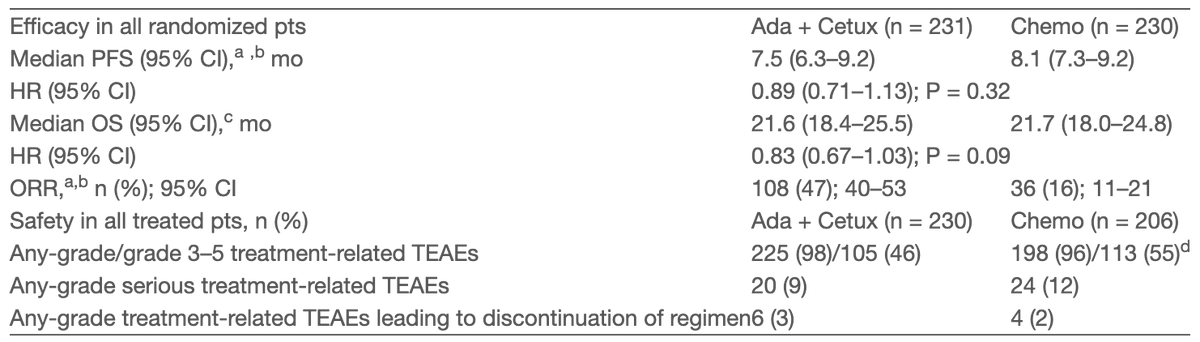
As reported from the ESMO GI 2026 presentation (LBA1): median progression-free survival 7.5 months with adagrasib + cetuximab versus 8.1 months with chemotherapy (HR 0.89; 95% CI 0.71–1.13; p=0.3241), and median overall survival 21.6 versus 21.7 months (HR 0.83; 95% CI 0.67–1.03; p=0.0938). Both primary endpoints were missed.
PFS HR 0.89 · OS HR 0.83 — both primary endpoints missed (ESMO GI 2026, LBA1)
Source: ApexOnco ESMO GI coverage
The response-rate paradox
The chemotherapy-free regimen nearly tripled the response rate — 47% versus 16% (ESMO GI 2026, LBA1) — without improving PFS or OS. That gap is the clinical lesson KOLs keep returning to: as the guest analysis Dr. Timothée Olivier shared puts it, “A waterfall plot can look impressive, and high response rates can create enthusiasm, but they should not be confused with proven clinical benefit.” Dr. Nicholas Hornstein’s counterpoint: the higher response rate “could matter for some patients (like those who you need just a little more shrinkage to enable crative intent therapy)” [sic].
ESMO GI 2026 Presentation Slides (LBA1)


From Accelerated Approval to Withdrawal
How Physicians Read the Withdrawal

Adagrasib was just withdrawn by the @FDA in metastatic colorectal cancer based on the negative results in KRYSTAL-10 "A waterfall plot can look impressive, and high response rates can create enthusiasm, but they should not be confused with proven clinical benefit." From Sahar van Waalwijk, new guest post in https://t.co/P3NUOebqBF !

And just like that, adagrasib + cetuximab is no longer FDA approved for KRAS G12C colorectal cancer. The accelerated approval was officially withdrawn September 1 after KRYSTAL-10 failed to confirm benefit. We talked about KRYSTAL-10 when it was presented earlier this year. The phase III randomized 461 patients in 2L to adagrasib + cetuximab vs chemotherapy ± VEGF inhibition. It missed both primary endpoints: ▪️PFS: 7.5 vs 8.1 months, HR 0.89 ▪️OS: 21.6 vs 21.7 months, HR 0.83 Hard to argue with a negative phase III trial. But I still like the idea of a chemo free option. Response rate was 47% vs 16%. That could matter for some patients (like those who you need just a little more shrinkage to enable crative intent therapy). KRYSTAL-10 asked whether adagrasib + cetuximab was better than chemotherapy in 2L. It wasn’t. That doesn’t mean the concept of KRAS G12C + EGFR blockade was wrong. And it doesn’t mean there aren’t patients for which this isnt valuable. Anyone celebrating this should look themselves in the mirror; this is a tool that has just been removed from our arsenal. However, the FDA did exactly what the system is designed to do; pull back if the Ph III doesnt pan out after accelerated approval. @OncoAlert @TheGutOncLab @Onco_Nexus
#ESMOGI2026 Surprising news for mCRC out of ESMOGI. KRYSTAL-10: Adagrasib + cetuximab misses its primary endpoint in 2L KRAS G12C mCRC. After the accelerated approval and encouraging activity from KRYSTAL-1, many expected dual KRAS/EGFR inhibition to outperform chemotherapy in the second line. That didn't happen. Quick hits: • Primary endpoint (PFS): Negative • mPFS 7.5 vs 8.1 months • HR 0.89 (95% CI 0.71-1.13) • Response rate dramatically improved • ORR 47% vs 16% • CR 7% vs <1% • No improvement in OS at the final analysis despite the higher response rate. So what happened? This is a reminder that response rate ≠ durable disease control. Nearly half of patients responded, but those responses did not translate into longer PFS or OS compared with modern chemotherapy. Targeted therapy works, but mCRC can overcome via resistance mechanisms (such as via massive KRAS upregulation). Will be interesting to see how novel degraders come into the mix here... Remember, this is a first gen KRASi, the future is still bright here. What does this mean for clinic tomorrow? Honestly, I still love a chemo-free option that is at least on par with chemotherapy. This isn't the end of KRAS G12C in CRC. Far from it. The focus now shifts to moving targeted therapy earlier, where combinations with chemotherapy may produce deeper, more durable responses before resistant clones emerge. Multiple frontline studies are already underway. @TheGutOncLab @OncoAlert @Onco_Nexus @myESMO

Results from the phase 3 KRYSTAL-10 trial (2L KRAS G12C-mut mCRC): 👉 adagrasib + cetuximab did not meet its dual primary endpoints of PFS and OS vs chemo ± anti-VEGF/R 👉 ORR was numerically higher (47% vs 16%) @OncoAlert #ESMOGI26 https://t.co/7HeAJkpvdN

Second-line adagrasib + cetuximab vs CTx in KRASG12C-mutated mCRC: Results from the KRYSTAL-10 trial #ESMOGI26 👉ORR with 40% higher, but no PFS & OS benefit for combination over CTx 👉30% crossover 🧐a bit disappointing after the PDAC data @myESMO @ASCO https://t.co/U9Fn5JnHJC

#ESMOGI26 | LBA1 KRYSTAL-10: Ph3 2L adagrasib + cetuximab vs SOC for KRAS G12C mCRC No significant improvements in dual primary endpoints of PFS and OS. @myESMO @OncoAlert https://t.co/f49ShqYCL3

And it ended after 2 years and 2 months . Adagrasib withdrawn by @usfda from CRC. @GIcancerDoc @OncoAlert https://t.co/U2QW3ogLeb https://t.co/5eKBxmGERT

Worth noting that ~30% of patients on the control arm subsequently received a KRAS G12C inhibitor. Makes the OS result, and the question of sequencing vs biological activity a little more nuanced. Also highlights the challenge of evaluating a rapidly evolving target class when multiple KRAS G12C agents are available through trials.
KRYSTAL-10 Questions
What is the KRYSTAL-10 trial?
KRYSTAL-10 (NCT04793958) is the Phase 3, randomized, open-label confirmatory study of adagrasib (Krazati) plus cetuximab versus chemotherapy (mFOLFOX6 or FOLFIRI per ClinicalTrials.gov, with anti-VEGF therapy permitted) in previously treated, KRAS G12C-mutated advanced colorectal cancer. 461 patients were randomized in the second-line setting.
Why was the adagrasib colorectal cancer approval withdrawn?
The June 21, 2024 accelerated approval of adagrasib plus cetuximab was contingent on confirmatory evidence. KRYSTAL-10 missed both primary endpoints as presented at ESMO GI 2026 (LBA1) - PFS 7.5 vs 8.1 months (HR 0.89) and OS 21.6 vs 21.7 months (HR 0.83). Bristol Myers Squibb requested voluntary withdrawal of the indication, and the FDA approved the withdrawal on September 1, 2026 - about two years and two months after the approval was granted. Per the FDA letter: although the postmarketing requirement was fulfilled, the trial did not confirm clinical benefit.
Did adagrasib plus cetuximab show any activity in KRYSTAL-10?
Yes - the response rate was 47% with adagrasib plus cetuximab versus 16% with chemotherapy, per the treating physicians' reports of the ESMO GI 2026 presentation. The debate among KOLs is exactly this gap: a chemotherapy-free regimen with a much higher response rate that nonetheless did not improve progression-free or overall survival.
Does the withdrawal affect adagrasib in lung cancer?
The September 1, 2026 withdrawal is specific to the colorectal cancer indication. Adagrasib's KRAS G12C-mutated non-small cell lung cancer indication is not part of this action - but it is itself an accelerated approval (granted December 2022) with its own confirmatory-evidence requirement, and remains on the FDA's list of ongoing accelerated approvals.
What does the KRYSTAL-10 withdrawal mean for accelerated approvals?
KOLs framed it as the accelerated-approval system functioning as designed - here via sponsor-initiated voluntary withdrawal once the confirmatory trial read out. Dr. Nicholas Hornstein: "the FDA did exactly what the system is designed to do; pull back if the Ph III doesnt pan out after accelerated approval." It landed the same week the FDA granted a new accelerated approval (camizestrant, SERENA-6) on the same contingent-confirmation logic.