Phase II PET-adapted, chemotherapy-free trastuzumab + pertuzumab in HER2+ early breast cancer. 5-year follow-up confirms ~90% iDFS in PET responders, ~30% chemo-free outcomes.
Discover KOL Sentiment on PHERGain →Design - Phase 2 PET-adapted, chemotherapy-free neoadjuvant trastuzumab + pertuzumab (dual HER2 blockade), HER2+ stage I-IIIA early breast cancer (NCT03161353); chemo added only for PET non-responders.
Strategy - De-escalation: ~30% of patients achieved excellent outcomes chemotherapy-free (PET responders with pathologic complete response).
Efficacy (5-yr) - 5-year follow-up confirms ~90% invasive disease-free survival in PET responders per the page.
Safety - Grade >=3 treatment-related AEs 33% (PET-adapted, Group B) vs 62% (full chemo, Group A); SAEs 14% vs 28%; PET-responder pCR subgroup had grade >=3 TRAEs of just 1% with no SAEs.
Regulatory - Investigational STRATEGY - not an FDA-registration trial; trastuzumab and pertuzumab are individually approved, the chemo-free PET-adapted algorithm is not.
Sponsor / drug - MEDSIR (investigator-initiated); trastuzumab (Herceptin) + pertuzumab (Perjeta).
Compiled and reviewed by the KOL Pulse research team, led by Brian Shields, Founder, KOL Pulse. Last updated July 21, 2026.







Trial slides shared by KOLs at ESMO Breast 2026 (#ESMOBreast26). Click any image to expand. OCR text extracted via AWS Textract.


[Slide 1]
2026
ESMO BREAST CANCER
Annual Congress
Chemotherapy-free, pathological
complete response (pCR)-guided strategy
with trastuzumab-pertuzumab (HP) and
T-DM1 in HER2+ early breast cancer
(EBC): PHERGain-2
Laia Garrigos, Manuel Ruiz-Borrego, Jose Manuel Perez-Garcia, Angel Guerrero-Zotano, Alfonso Cortes-
Salgado, Sherko Kümmel, Marco Colleoni, Cristina Reboredo-Rendo, Begona Bermejo, Isabel Blancas, Joaquin Gavila, Alessandra
Fabi, Olalla Ballesteros Griselda Martrat, Simona lacobucci, Olga Boix, Pau Berenguer-Molins, Daniel Alcala-Lopez, Javier
Cortés, Antonio Llombart-Cussac
May 6, 2026
ESMO
ESMO BREAST CANCER

---

[Slide 2]
Content of this presentation is copyright and responsibility of the author Permission $ required for re-use
PHERGain-2 Study Design
TREATMENT
Cohort A
Key eligibility criteria
pCRt
Patients ≥ 18 years
Histologically confirmed
ypTO/is
HP (+ET)
x10
invasive carcinoma of
ypNO
the breast
No prior treatment for
At screening:
Primary Endpoints
Cohort B
Central
breast cancer
HP (±ET)
HER2 IHC 3+"
x8
Breast MRI
Surgery
ypN0(i+)
HER2 status
T-DM1 (±ET)
(1) >10% HRQoL
ypN0(mol+)
EoS
&
ypN1mi
x10
decline rate
Node-negative status
Tumor size 5-30 mm
MRI imaging
(2) 3y-RFI rate
(MRI)
Cohort C
ECOG PS 0/1
ChT' T-DM1
LVEF >55%
ypN1-N3
(+ET)
Adequate organ function
HP: 600 mg H plus 1200 mg P loading
x10
dose, then 600 mg H plus 600 mg P
Physician's choice chemotherapy was allowed
maintenance dose q3w
before adjuvant T-DM1
T-DM1 3.6 mg/kg of body weight q3w
ET up to 5 years and radiotherapy as per
Follow-up*
HR status and institutional practices
PROs
assessments: Baseline
D1C1-C8
≤14d pre-op
Adj D1C1
FU q3m x2y
FU q6m x3y
Annual to EOS
*According to the 2018 American Society of Clinical Oncology/College of American Pathologists criteria
TAII patients who were hormonal receptor positive received ET concomitantly with HP or T-DM1 ET was sex and menopausal status based premenopausal and perimenopausal women receive ovarian function suppression plus tamoxifen (20 mg/day
orally) or letrozole (2 5 mg/day orally). postmenopausal women receive letrozole (2 5 mg/day orally), and men receive tamoxofen (20 mg/day orally)
*All patients must be followed up for 5 years from when the last patient has completed surgery (EoS). even if the assigned treatment is discontinued permanently
Chl, chemotherapy, ECOGPS Eastem Cooperative Oncology Group performance status d, day, EoS end of study ET endocne therapy FU, follow-up, HER2 human epidemal growth factor receptor 2. HP trasturumab and pertuzumab, HRQoL health related quality of
life IHC, immunohistochemistry, LVEF, left ventricular ejection fraction, m, month MRI, magnetic resonance imaging pCR pathological complete response, PRO patient reported outcomes RFI recurrence free survival; q3w, every three weeks y. year
ESMO BREAST CANCER

---

[Slide 3]
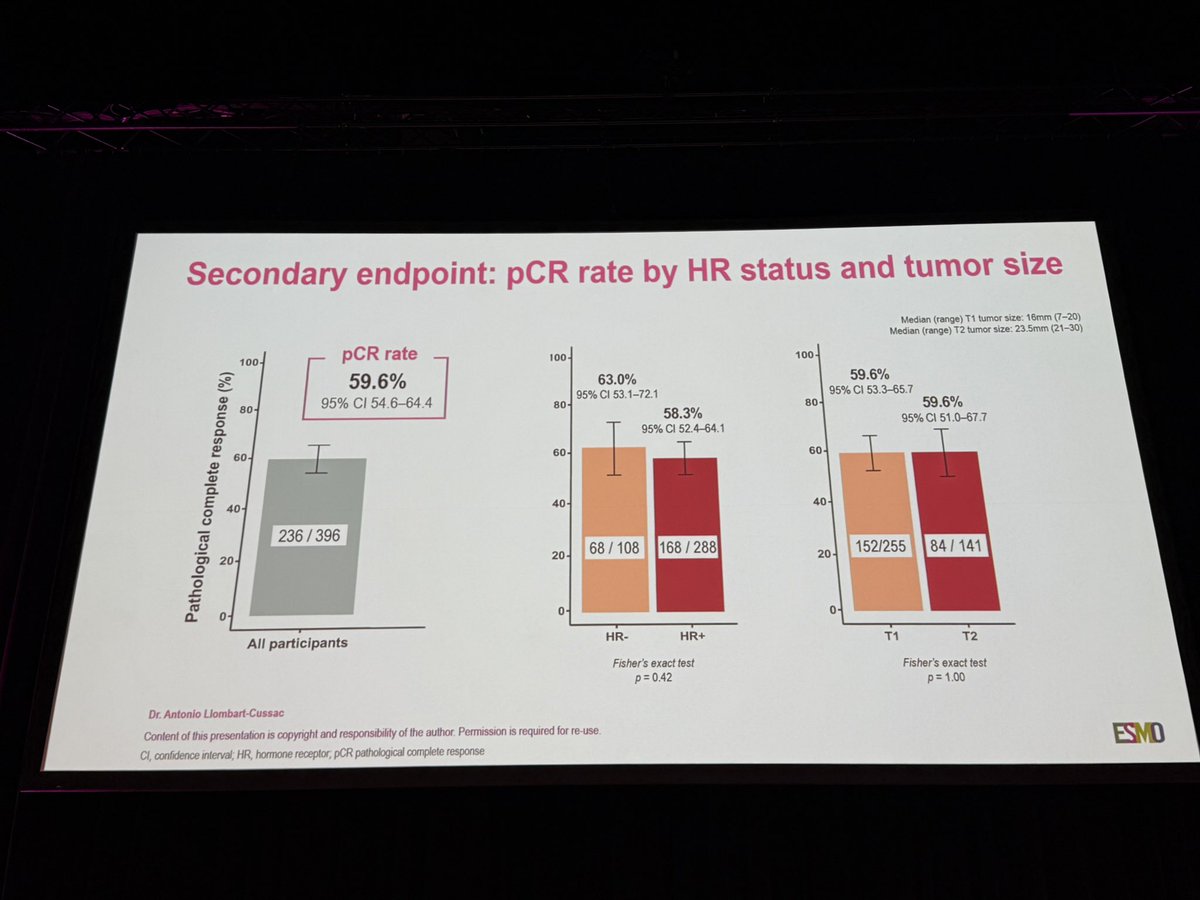
Secondary endpoint: pCR rate by HR status and tumor size
Median (range) T1 tumor size: 16mm (7-20)
Median (range) T2 tumor size: 23 5mm (21-30)
100
pCR rate
100
100
59.6%
63.0%
59.6%
95% CI 54.6-64.4
95% CI 53.1-72.1
95% CI 53.3-65.7
80
80
80
59.6%
58.3%
Pathological complete response (%)
95% CI 51.0-67.7
95% CI 52.4-64.1
60
60
60
40
40
40
236 / 396
68 108
168 288
152/255
84 141
20
20
20
0
0
0
All participants
HR-
HR+
T1
T2
Fisher's exact test
Fisher's exact test
P 0.42
P 1.00
Dr. Antonio Llombart-Cussac
Content of this presentation IS copynght and responsibility of the author Permission is required for to use
ESMO
CI. confidence interval HR hormone receptor, pCR pathological complete response
ESMO BREAST CANCER

---

[Slide 4]
ESMO BREAST CANCER
BERLIN GERMANY
Annual Congress
6-8 MAY 2026
ESMD
Conclusion
PHERGain-2 suggests maintenance of HRQoL over one year of treatment, although
interpretation is limited by treatment heterogeneity and lack of a direct comparator
Patients without pCR experienced greater HRQoL deterioration, likely reflecting treatment
escalation (T-DM1 ± chemotherapy)
The pCR rate of 59.6% observed with this chemotherapy-free strategy is encouraging,
particularly in a population including HR-positive disease
The safety profile was consistent with known effects of trastuzumab/pertuzumab and T-DM1
Pending mature efficacy outcomes (3-year RFI), this response-adapted, chemotherapy-free,
strategy appears clinically feasible and may support treatment individualization in selected
low-risk patients
Dr. Antonio Liombart Cussac
Content of this presentation is copyright and responsability of the author Pomission is required for DO use
ESMO
ESMO BREAST CANCER


[Slide 1]
SAN ANTONIO
BREAST CANCER
ctDNA detection at baseline and pCR
SYMPOSIUM
UT Health
AAGR
- -
Mays Classes Carese
. - -
pCR rate 3-year follow-up
j
Baseline n=288
0301 n=270
Pre-surgery n=243
100
80
p=0.583
ctDNA+
60
84/288
ctDNA-
(29%)
% pCR
40
204/288
(71%)
32/84
85/204
20
(38.1%)
(41.7%)
0
ctDNA-
ctDNA+
No significant correlation was observed between baseline ctDNA status and pCR (p=0.583).
This presentation in the intellectual property of the author/presenter. Contact antenie llembert@maj3 health for permission to reprint and/or distribute

---

[Slide 2]
SAN ANTONIO
BREAST CANCER
Early ctDNA dynamics and pCR
SYMPOSIUM
UT Health
AAGR
No./
- -
- -
Mays Casses
pCR rate 3-year follow-up
Baseline n=288
C3D1 n=270
surgery n=243
p<0.001
100
18%
100
24%
ctDNA+
80
80
p=0.003
71%
ctDNA+
% PET response
60
60
76%
114/126
82%
% pCR
40
(90.5%)
40
ctDNA-
61/126
23/41
29%
20
20
(48.4%)
97%
(56.1%)
9/41
|
ctDNA-
(22.0%)
0
0
Baseline
C3D1
No ctDNA
ctDNA
No ctDNA
ctDNA
clearance
clearance
clearance
clearance
A 76% relative reduction in ctDNA positivity was achieved after 2 treatment cycles.
ctDNA clearance after two cycles strongly correlated with PET response (p<0.001) and pCR (p=0.003).
This presentation is the intellectual property of the author/presenter. Contact antonio.lfombart@maj3.heaith . for permission to reprint and/or distribute

---

[Slide 3]
SAN ANTONIO
BREAST CANCER
Late ctDNA dynamics and pCR
SYMPOSIUM
UT Health
AAGR
I
- -
Mays Casse
. I
pCR rate 3-year follow-up
Baseline n=288
C301 n=270
Pre-surgery n=243
100
17%
12%
ctDNA+
80
p<0.001
70%
ctDNA+
60
83%
% R pCR
88%
40
ctDNA-
0/28
61/124
20
(0.0%)
(49.2%)
30%
ctDNA-
98%
0
Baseline
Pre-surgery
No ctDNA
ctDNA
clearance
clearance
A 83% relative reduction in ctDNA positivity was achieved prior to surgery.
ctDNA clearance at the presurgical time point (p<0.001) was significantly associated with achieving a pCR.
No patient with detectable ctDNA prior to surgery (n=28) achieved a pCR.
This presentation is the intellectual property of the author/presenter. Contact antonia.liombert@maj3.heaith . L for permission to reprint and/or distribute

---

[Slide 4]
SAN ANTONIO
BREAST CANCER
Basal ctDNA status and 3-year iDFS rate
SYMPOSIUM
UT Health
AAGR
-
- -
Mays Casses
- -
PCR
rate
3-year follow-up
Baseline n=288
0301 n=270
Pre-surgery n=243
100%
Hazard ratio
95%
4.1
iDFS (%)
90%
(95% CI 0.7; 23.5)
p=0.046
85%
Group
Events/Total (%)
3-year IDFS
80%
ctDNA.
0/81 (0.0%)
100.0% (100.0; 100.0)
ctDNA+
14/192 (7.3%)
92.5% (68.8;96.4)
0%
0.0
0.5
1.0
1.5
2.0
2.5
3.0
3.5
4.0
4.5
Time (years)
Number at risk
81
78
77
77
76
76
76
7
192
189
187
183
178
176
169
21
ON
:
ctDNA positivity at baseline was associated with a worse 3-year iDFS.
This presentation is the intellectual property of the author/presenter. Contact antonio llembert@maj3 health for permission to reprint and/or distribute


[Slide 1]
SAN ANTONIO
BREAST CANCER
PHERGuide: methodology and objectives
SYMPOSIUM
UT Health
AACR
-
-
- - -
Objective 1: assess the
Neoadjuvant treatment
PET (total body)
pCR rate
correlation between
ctDNA detection and pCR
Diagnosis
Objective 2: evaluate the
3-year follow-up
association between
]
ctDNA detection and/or
Baseline n=336
C3D1 n=311
Pre-surgery n=285
clearance with patient
outcomes
ctDNA isolation and analysis
Guardant Reveal™
Tissue-free epigenomic assay:
ctDNA detection+estimated tumor fraction
This presentation is the intellectual property of the author/presenter. Contact antonio llombart@maj3 health for permission to reprint and/or distribute

---

[Slide 2]
SAN ANTONIO
BREAST CANCER
Early ctDNA dynamics and pCR
SYMPOSIUM
UT Health
AACR
I
pCR rate 3-year follow-up
Baseline n=288
C3D1 n=270
surgery n=243
p<0.001
18%
100
100
24%
ctDNA+
80
80
71%
p=0.003
ctDNA+
% PET response
60
60
76%
114/126
82%
(90.5%)
% pCR
40
40
ctDNA-
23/41
61/126
29%
20
97%
(56.1%)
20
(48.4%)
9/41
ctDNA-
(22.0%)
Baseline
0
0
C3D1
No ctDNA
ctDNA
No ctDNA
ctDNA
clearance
clearance
clearance
clearance
A 76% relative reduction in ctDNA positivity was achieved after 2 treatment cycles.
ctDNA clearance after two cycles strongly correlated with PET response (p<0.001) and pCR (p=0.003).
This
presentation
is
the
intellectual
property
of
the
outhor/presenter.
Contact

---

[Slide 3]
SAN ANTONIO
BREAST CANCER
Late ctDNA dynamics and pCR
SYMPOSIUM
UT Health
AACR
-
pCR rate
3-year
I
Baseline n=288
C3D1 270
Pre-surgery n=243
100
17%
12%
ctDNA+
80
p<0.001
70%
ctDNA+
60
83%
% pCR
88%
40
ctDNA-
0/28
61/124
20
(0.0%)
(49.2%)
30%
ctDNA-
98%
0
Baseline
Pre-surgery
No ctDNA
ctDNA
clearance
clearance
A 83% relative reduction in ctDNA positivity was achieved prior to surgery.
ctDNA clearance at the presurgical time point (p<0.001) was significantly associated with achieving a pCR.
No patient with detectable ctDNA prior to surgery (n=28) achieved a pCR.
This presentation is the intellectual property of the outhor/presenter. Contact antonio.llombart@maj3.health for permission to reprint and/or distribute


[Slide 1]
Secondary endpoint: pCR rate by HR status and tumor size
Median (range) T1 tumor size: 16mm (7-20)
Median (range) T2 tumor size: 23.5mm (21-30)
100
pCR rate
100
100
59.6%
63.0%
59.6%
95% CI 54.6-64.4
95% CI 53.1-72.1
95% CI 53.3-65.7
80
80
80
59.6%
58.3%
Pathological complete response (%)
95% CI 51.0-67.7
95% CI 52.4-64.1
60
60
60
I
40
40
40
236 / 396
68 / 108
168/288
20
152/255
20
84 141
20
0
0
0
All participants
HR-
HR+
T1
T2
Fisher's exact test
Fisher's exact test
P 0.42
P = 1.00
Dr. Antonio Llombart-Cussac
Content of this presentation is copyright and responsibility of the author. Permission is required for re-use
ESMO
CI, confidence interval; HR, hormone receptor; pCR pathological complete response

---

[Slide 2]
Primary safety endpoint: >10% HRQoL decline rate at one
year
>10% HRQoL decline rate
Patient-reported outcomes
N = 396 ; n (%)
42.8 %
Completion rate at baseline
391 (98.7)
95% CI 36.9-48.8
Baseline HRQoL score, mean (95% CI)
78.6 (76.8-8 0.5)
Completion rate at 1 year
360 (90.9)
HR positive: 45.2% (95% CI 38.3-52.3)
Fisher's exact test
1-year HRQoL score, mean (95% CI)
69.6 (67.5-71.8)
HR negative: 36.1% (95% CI 25.4-47.9)
p=0.11
n (%), number of patients (percentage based on N); N, Number of patients.
Patient reported outcomes were analyzed on patients who received at least one dose of study treatment and completed baseline and at least one follow-up questionnaire 1- year post-neoadjuvant treatment
Patients without a >10% decline at one year who discontinued the study due to disease progression, toxicity or death within the first year after starting neoadjuvant treatment were considered events.
Dr. Antonio Llombart-Cussac
Content of this presentation is copyright and responsibility of the author Permission is required for re-use
ESMO
CI, confidence interval; HR, hormone receptor, HRQoL, health-related quality of life

---

[Slide 3]
Baseline Characteristics
N = 396
N = 396
Patient baseline characteristics
Primary tumor baseline characteristics
n (%)
n (%)
Age; Median (range) (years)
55 (24-85)
Median tumor size (mm, Min; Max)
18 (7-30)
Sex
T stage mm
Woman
394 (99.5)
T1b/T1c: >5 to <20
244 (61.6)
T2: >20 to <30
152 (38.4)
Menopausal status
Histologic grade
Postmenopausal
235 (59.3)
Gx*
57 (14.4)
Premenopausal
159 (40.2)
G1
21 (5.3)
Not available
2 (0.5)
G2
185 (46.7)
ECOG performance status
G3
133 (33.6)
0
382 (96.5)
HER2 IHC 3+
396 (100)
1
14 (3.5)
Hormonal receptor status
Multifocal or multicentric breast cancer
15 (3.8)
Negative
108 (27.3)
ECOG PS, Eastern Cooperative Oncology Group performance status; HER2, human epidermal growth factor receptor 2;
Positive
288 (72.7)
IHC, immunohistochemistry
Tumor staging was assessed as per American Joint Committee on Cancer staging manual, 8th edition
"Differentiation status could not be assessed
"All patients who were hormonal receptor-positive received ET concomitantly with HP or T-DM1 ET was sex- and menopausal
status-based premenopausal and perimenopausal women receive ovanan function suppression plus tamoxifen (20 mg/day orally)
or letrozole (2.5 mg/day orally); postmenopausal women receive letrozole (2.5 mg/day orally); and men receive tamoxifen (20
Dr. Antonio Llombart-Cussac
mg/day orally).
Content of this presentation is copyright and responsibility of the author Permission is required for re-use
n (%), number of patients (percentage based on N); N, Number of patients.
ESMO

---

[Slide 4]
Content of this presentation is copyright and responsibility of the author, Permission is required for no-use.
PHERGain-2 Study Design
TREATMENT
Key eligibility criteria
Cohort A
pCR'
Patients 2 18 years
Histologically confirmed
ypTO/is
HP (±ET)
x10
invasive carcinoma of
ypNO
the breast
Primary Endpoints
No prior treatment for
At screening:
Cohort B
Central
breast cancer
HP (±ET)
HER2 IHC 3+*
x8
Breast MRI
Surgery
ypN0(i+)
HER2 status
T-DM1 (±ET)
(1) >10% HRQoL
ypN0(mol+)
EoS
&
ypN1mi
x10
decline rate
Node-negative status
Tumor size 5-30 mm
MRI imaging
(2) 3y-RFI rate
(MRI)
Cohort C
ECOG PS 0/1
ChT' + T-DM1
LVEF >55%
ypN1-N3
(±ET)
Adequate organ function
HP: 600 mg H plus 1200 mg P loading
x10
dose, then 600 mg H plus 600 mg P
Physician's choice chemotherapy was allowed
maintenance dose q3w
before adjuvant T-DM1
T-DM1: 3.6 mg/kg of body weight q3w
ET up to 5 years and radiotherapy as per
Follow-up®
HR status and institutional practices
PROs
assessments: Baseline
D1C1-C8
≤14d pre-op
Adj D1C1
FU q3m x2y
FU q6m x3y
Annual to EOS
"According to the 2018 American Society of Clinical Oncology/College of American Pathologists criteria.
TAII patients who were hormonal receptor-positive received ET concomitantly with HP or T-DM1. ET was sex- and menopausal status-based: premenopausal and perimenopausal women receive ovarian function suppression plus tamoxifen (20 mg/day
orally) or letrozole (2.5 mg/day orally); postmenopausal women receive letrozole (2.5 mg/day orally); and men receive tamoxifen (20 mg/day orally).
*All patients must be followed up for 5 years from when the last patient has completed surgery (EoS), even if the assigned treatment is discontinued permanently.
ChT, chemotherapy; ECOG PS, Eastern Cooperative Oncology Group performance status; d, day, EoS, end of study; ET, endocrine therapy, FU, follow-up; HER2, human epidermal growth factor receptor 2; HP, trastuzumab and pertuzumab; HRQoL, health-related quality of
life; IHC, immunohistochemistry; LVEF, left ventricular ejection fraction; m, month; MRI, magnetic resonance imaging; pCR pathological complete response; PRO, patient reported outcomes; RFI, recurrence-free survival; q3w, every three weeks; y. year


[Slide 1]
Content of this presentation is copyright and responsibility of the author. Permission is required for re-use.
PHERGain-2 Study Design
TREATMENT
Key eligibility criteria
Cohort A
pCR
Patients 2 18 years
Histologically confirmed
ypTO/is
HP (±ET)
x10
invasive carcinoma of
ypNO
the breast
Primary Endpoints
No prior treatment for
At screening:
Cohort B
Central
breast cancer
HP (±ET)
HER2 IHC 3+*
x8
Breast MRI
Surgery
ypN0(i+)
HER2 status
T-DM1 (±ET)
(1) >10% HRQoL
ypN0(mol+)
EoS
&
ypN1mi
x10
decline rate
Node-negative status
Tumor size 5-30 mm
MRI imaging
(2) 3y-RFI rate
(MRI)
Cohort C
ECOG PS 0/1
ChT' T-DM1
LVEF >55%
ypN1-N3
(+ET)
Adequate organ function
HP: 600 mg H plus 1200 mg P loading
x10
dose, then 600 mg H plus 600 mg P
Physician's choice chemotherapy was allowed
maintenance dose q3w
before adjuvant T-DM1
T-DM1: 3.6 mg/kg of body weight q3w
ET up to 5 years and radiotherapy as per
Follow-up*
HR status and institutional practices
PROs
assessments: Baseline
D1C1-C8
<14d pre-op
Adj D1C1
FU q3m x2y
FU q6m x3y
Annual to EOS
"According to the 2018 American Society of Clinical Oncology/College of American Pathologists criteria.
TAII patients who were hormonal receptor-positive received ET concomitantly with HP or T-DM1. ET was sex- and menopausal status-based premenopausal and perimenopausal women receive ovanan function suppression plus tamoxifen (20 mg/day
orally) or letrozole (2.5 mg/day orally); postmenopausal women receive letrozole (2.5 mg/day orally): and men receive tamoxifen (20 mg/day orally).
*All patients must be followed up for 5 years from when the last patient has completed surgery (EoS), even if the assigned treatment is discontinued permanently
ChT, chemotherapy, ECOG PS, Eastern Cooperative Oncology Group performance status; d, day, EoS, end of study, ET, endocrine therapy, FU, follow-up; HER2, human epidermal growth factor receptor 2; HP, trastuzumab and pertuzumab; HRQoL. health related quality of
life; IHC, immunohistochemistry, LVEF, left ventricular ejection fraction; m, month; MRI, magnetic resonance imaging pCR pathological complete response; PRO, patient-reported outcomes; RFI, recurrence-free survival; q3w, every three weeks; y. year

---

[Slide 2]
Baseline Characteristics
N = 396
N = 396
Patient baseline characteristics
Primary tumor baseline characteristics
n (%)
n (%)
Age; Median (range) (years)
55 (24-85)
Median tumor size (mm, Min; Max)
18 (7-30)
Sex
T stage1, mm
Woman
394 (99.5)
T1b/T1c: >5 to <20
244 (61.6)
T2: >20 to <30
Menopausal status
152 (38.4)
Postmenopausal
235 (59.3)
Histologic grade
Gx*
57 (14.4)
Premenopausal
159 (40.2)
G1
21 (5.3)
Not available
2 (0.5)
G2
185 (46.7)
ECOG performance status
G3
133 (33.6)
0
382 (96.5)
HER2 IHC 3+
396 (100)
1
14 (3.5)
Hormonal receptor status
Multifocal or multicentric breast cancer
15 (3.8)
Negative
108 (27.3)
ECOG PS, Eastern Cooperative Oncology Group performance status; HER2, human epidermal growth factor receptor 2;
Positive
288 (72.7)
IHC, immunohistochemistry
Tumor staging was assessed as per American Joint Committee on Cancer staging manual, 8th edition
"Differentiation status could not be assessed
*All patients who were hormonal receptor-positive received ET concomitantly with HP or T-DM1. ET was sex- and menopausal
status-based premenopausal and perimenopausal women receive ovanan function suppression plus tamoxifen (20 mg/day orally)
or letrozole (2.5 mg/day orally); postmenopausal women receive letrozole (25 mg/day orally); and men receive tamoxifen (20
Dr. Antonio Llombart-Cussac
mg/day orally).
Content of this presentation is copyright and responsibility of the author. Permission is required for re-use
n (%), number of patients (percentage based on N); N, Number of patients
ESMO

---

[Slide 3]
Primary safety endpoint: >10% HRQoL decline rate at one
year
≥10% HRQoL decline rate
Patient-reported outcomes
N = 396 ; n (%)
Completion rate at baseline
391 (98.7)
42.8%
95% CI 36.9-48.8
Baseline HRQoL score, mean (95% CI)
78.6 (76.8-8 0.5)
Completion rate at 1 year
360 (90.9)
HR positive: 45.2% (95% CI 38.3-52.3)
Fisher's exact test
1-year HRQoL score, mean (95% CI)
69.6 (67.5-71.8)
HR negative: 36.1% (95% CI 25.4-47.9)
p 0.11
n (%), number of patients (percentage based on N); N, Number of patients.
Patient reported outcomes were analyzed on patients who received at least one dose of study treatment and completed baseline and at least one follow-up questionnaire 1. year post-neoadjuvant treatment
Patients without a >10% decline at one year who discontinued the study due to disease progression, toxicity or death within the first year after starting neoadjuvant treatment were considered events
Dr. Antonio Llombart-Cussac
Content of this presentation is copyright and responsibility of the author Permission is required for re-use
ESMO
CI, confidence interval; HR, hormone receptor, HRQoL, health-related quality of life

---

[Slide 4]
Secondary endpoint: pCR rate by HR status and tumor size
Median (range) T1 tumor size: 16mm (7-20)
Median (range) T2 tumor size: 23.5mm (21-30)
100
pCR rate
100
100
59.6%
63.0%
59.6%
95% CI 54.6-64.4
95% CI 53.1-72.1
95% CI 53.3-65.7
80
80
80
59.6%
58.3%
Pathological complete response (%)
95% CI 51.0-67.7
95% CI 52.4-64.1
60
60
60
40
40
40
236 / 396
68 / 108
168 / 288
152/255
20
84 141
20
20
0
0
0
All participants
HR-
HR+
T1
T2
Fisher's exact test
Fisher's exact test
p=0.42
P 1.00
Dr. Antonio Liombart-Cussac
Content of this presentation is copyright and responsibility of the author Permission is required for re-use.
ESMO
CI, confidence interval; HR, hormone receptor, pCR pathological complete response

[Slide 1]
216 RO: 5-year iDFS of the strategy-based, randomized phase II PHERGain trial evaluating
chemotherapy de-escalation in HER2+ early breast cancer (EBC) patients. Cortes J et al
PHERGain randomization 1:4
Phase 2 study (June 2017-April 2019)
HP
Basal: PET scan (total body)
pCR
ET* x10
F-FDG-PET-based, pCR-adapted
Group A
N=71
HP
N=285
ET*x2
PET scan (Total body)
70% Stage II; 62% ER+/HER2+
PET
HP
responders
ET* x6
Surgery
Follow-up
PET-responders: 38% pCR
Group B
TCHP x6
No adjuvant T-DM1 following residual
non-pCR
HP #ET* x4
PET
disease
non-
TCHP
HP
responders
x6
ET* x10
3y-IDFS:94%
Baseline
C3D1
Pre-surgery
100%
100%
75%
Invasive Disease-Free Survival (IDFS)
Invasive Disease Free Survival (IDFS)
75%
5-year iDFS rate in group B: PET responders with pCR
5-year iDFS rate in group B: 89.5% (95% CI: 85.7-93.4)
and no chemo: 92.4% (95% CI: 86.7-98.5)
50%
50%
25%
25%
5-year DFS rate in group B 89 5% (95% CI: 85 7-93-4)
0%
5-year IDFS rate in group 8 PET responders with pCR: 92-4% (95% Ct: 06 7-98 5)
0
1
2
3
4
5
0%
Time since surgery (years)
0
1
2
3
4
5
Patients risk
Patients risk
Time since surgery (years)
Group
267
261
253
242
202
192
56
84
54
80
69
65
1/3 never received chemo
1 patient with distant recurrence
Sonia Pernas, MD, PhD
Content of this presentation is copyright and responsibility of the author Permission is required for re use
MO


Highest-engagement tweets about this trial, ranked by KOL discussant count (replies + quote-tweets). Replies in green, quote-tweets in blue. Wall Street, stock-promo, and non-substantive replies excluded.
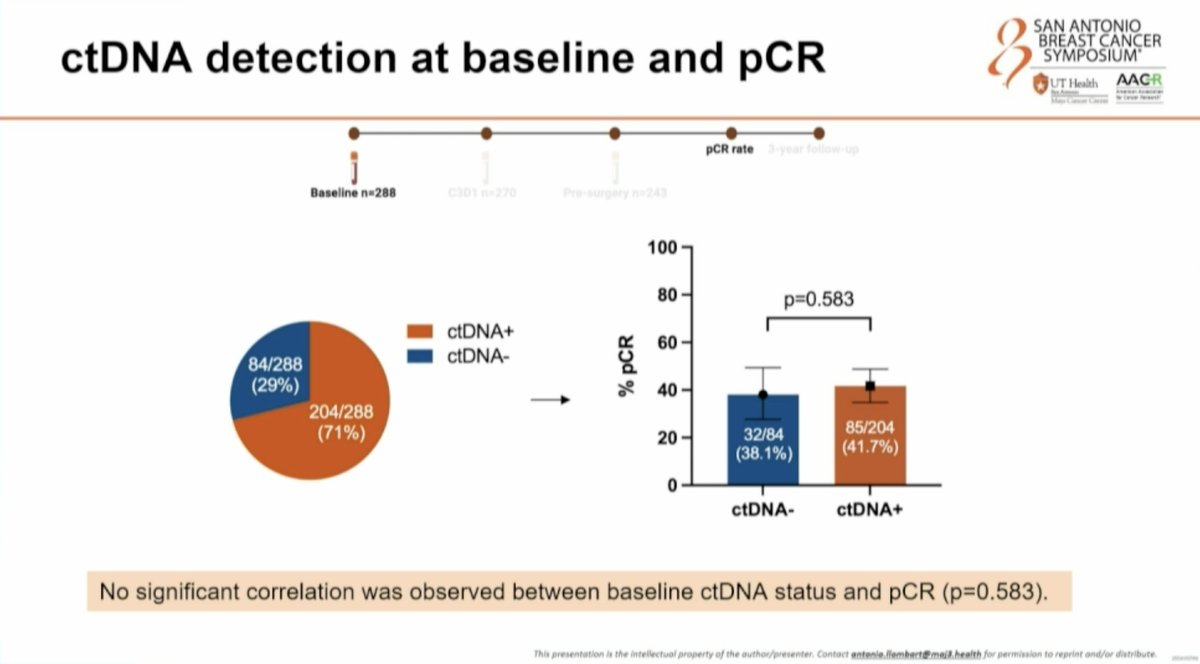
Phergain ctDNA using Guardant Reveal At baseline, 71% detectable No assoc of baseline ctDNA and pCR but assoc w/ worse 3 yr iDFS (HR 4.1, p=0.046) Clearance at C3D1 assoc with pCR ctDNA positivity prior to surgery (17%) has worse iDFS (HR 5.1) @OncoAlert #SABCS25
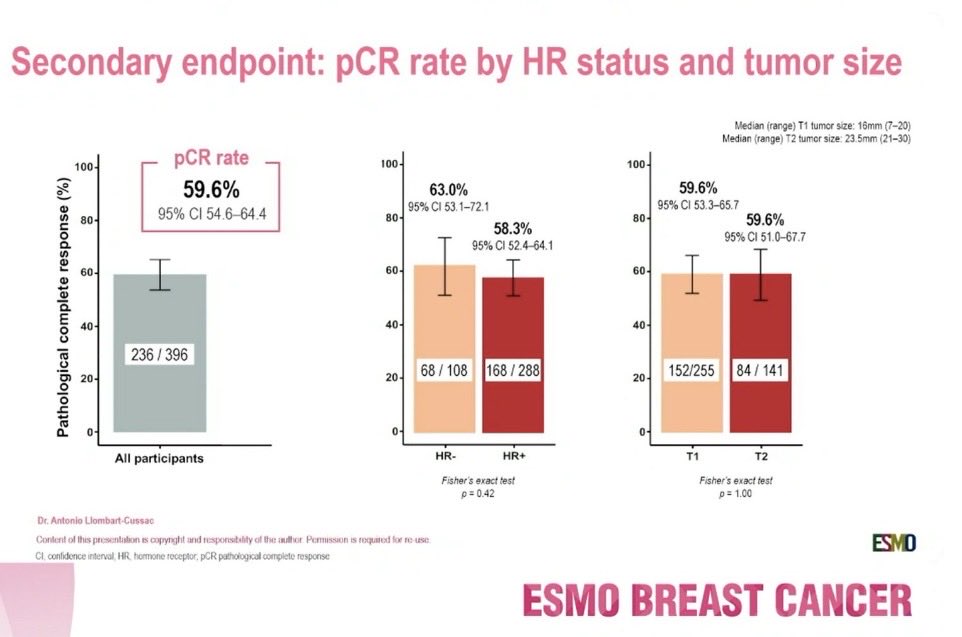
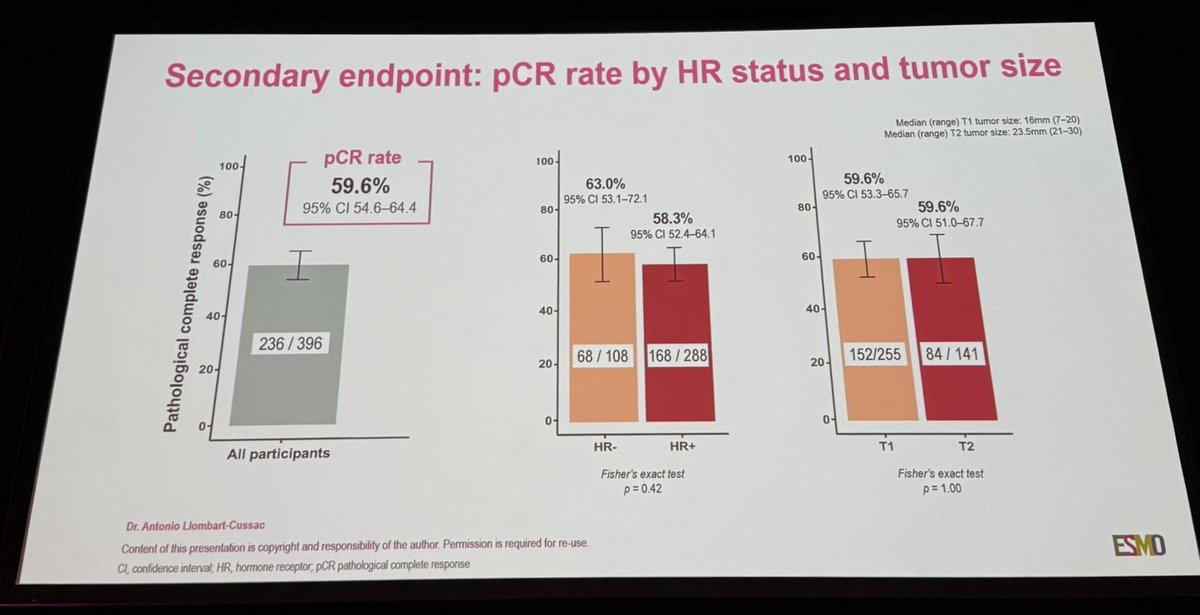
#ESMOBreast26 Can we safely reduce chemotherapy in HER2+ early breast cancer? 👀 PHERGain-2 tested a pCR-guided strategy with HP ± T-DM1. 📊 Key findings: ✅ pCR: 59.6% ✅ Similar across HR+ / HR- ✅ Similar in T1 vs T2 ✅ HRQoL maintained ⚠️ 3-year RFI still immature. 💡 https://t
GS1-06 – #SABCS25 ctDNA predict pCR and outcomes in HER2+ eBC in PHERGain: - ctDNA clearance after 2 cycles and pre-surgery strongly correlated w pCR - Baseline ctDNA+ linked to worse 3y iDFS ➡️No patient with ctDNA+ before surgery achieved pCR ! @OncoAlert @SABCSSanAntonio ht
PHERGain-2: Chemotherapy Free Dual HER2 Blockade Achieves ~60% pCR with Preserved HRQoL—Operationalizing a De-escalation, "Minimum Effective Treatment" Strategy in Low Risk HER2+ Early #BreastCancer @OncoAlert #ESMOBreast26 https://t.co/LSBoAXoB2A
PHERGain is an international, multicentre, randomized open-label Phase II trial that pioneered a PET-guided, pCR-adapted chemotherapy de-escalation strategy in HER2-positive Stage I–IIIA early breast cancer. Originally published in The Lancet (2024) showing 3-year iDFS of 94.8%, the 5-year follow-up presented at ESMO Breast 2026 confirms durability of this approach with close to 90% of patients remaining recurrence-free five years after surgery — establishing the strategy as a safe and durable alternative for the ~30% of HER2+ EBC patients who can avoid chemotherapy entirely.
Population: 356 patients with centrally confirmed HER2-positive, Stage I–IIIA invasive operable breast cancer with at least one PET-evaluable lesion. Group A: n=71. Group B: n=285. 89% (Group A) and 94% (Group B) proceeded to surgery.
Interventions: Group A: docetaxel + carboplatin + trastuzumab + pertuzumab (TCHP). Group B: trastuzumab + pertuzumab × 2 cycles → FDG-PET response assessment → PET-responders continued chemo-free trastuzumab-pertuzumab; PET non-responders switched to TCHP. Adjuvant therapy guided by pCR.
Endpoints: Primary: 3-year iDFS in Group B (met). Secondary: pCR in PET-responders, safety, 5-year iDFS (this update), ctDNA biomarker analyses.
5-year follow-up confirms close to 90% of Group B patients remain free from relapse, validating the durability of the PET-guided, pCR-adapted de-escalation strategy. Approximately one-third of patients successfully omitted chemotherapy. Earlier 3-year iDFS was 94.8% (95% CI 91.4-97.1). ctDNA analysis is emerging as a complementary biomarker for identifying patients with the best prognosis vs those who may need more intensive treatment.
TRAEs and SAEs were numerically higher in Group A (full chemo) than Group B (PET-adapted): grade ≥3 62% vs 33%; SAEs 28% vs 14%. Group B PET-responders with pCR had the lowest incidence of grade ≥3 TRAEs (1%) without any SAEs — the cleanest tolerability profile.
Sara Tolaney highlighted the PHERGain ctDNA biomarker readout using Guardant Reveal, noting that “At baseline, 71% detectable. No assoc of baseline ctDNA and pCR but assoc w/ worse 3 yr iDFS (HR 4.1, p=0.046). Clearance at C3D1 assoc with pCR. ctDNA positivity prior to surgery (17%) has worse iDFS (HR 5.1).” Luca Arecco amplified the finding from SABCS25, writing that “ctDNA clearance after 2 cycles and pre-surgery strongly correlated w pCR” and that “Baseline ctDNA+ linked to worse 3y iDFS,” punctuating the takeaway: “No patient with ctDNA+ before surgery achieved pCR!” The KOL conversation around the 5-year PHERGain follow-up centered on this ctDNA-guided de-escalation question: can pre-surgical liquid biopsy identify which patients can safely stay chemo-free, and which need rescue intensification?
PHERGain is an investigator-initiated Phase 2 randomized trial (NCT03161353) testing a 18F-FDG-PET-adapted, chemotherapy-free neoadjuvant strategy for HER2-positive stage I-IIIA early breast cancer. Patients receive dual HER2 blockade (trastuzumab plus pertuzumab, with endocrine therapy for HR-positive disease), and chemotherapy is added only for tumors that do not respond on PET imaging.
PHERGain demonstrated that a substantial proportion of patients (approximately 30%) can achieve excellent outcomes without chemotherapy. The 5-year follow-up confirmed roughly 90% invasive disease-free survival in PET responders, supporting PET-guided de-escalation for carefully selected HER2-positive early breast cancer.
No. PHERGain evaluates a treatment de-escalation strategy, not a new drug, and it is not an FDA-registration trial. Trastuzumab (Herceptin) and pertuzumab (Perjeta) are individually FDA approved for HER2-positive breast cancer, but the PET-adapted, chemotherapy-free algorithm studied in PHERGain is investigational and not an approved standard.
Grade 3 or higher treatment-related adverse events were markedly lower with the PET-adapted approach than with full chemotherapy (33% versus 62%), as were serious adverse events (14% versus 28%). PET responders who achieved a pathologic complete response had the cleanest tolerability, with grade 3 or higher treatment-related adverse events of only 1% and no serious adverse events.
PHERGain applies to HER2-positive stage I-IIIA operable early breast cancer, using early 18F-FDG-PET imaging after two cycles of dual HER2 blockade to identify metabolic responders who may avoid chemotherapy. It is a research strategy; decisions to de-escalate outside a trial should be individualized and discussed with a multidisciplinary team.
| Handle | Name | Sentiment | Tweet (excerpt) | Imp. |
|---|---|---|---|---|
| @GaiaGriguolo | Gaia Griguolo | Positive | ctDNA analysis in the PHERGAIN trial at #sabcs25 ✅early ctDNA clearance is associated with pCR ✅ctDNA at baseline and … | 575 |
| @DrRishabhOnco | Dr Rishabh Jain | Neutral | #ESMOBreast26 Can we safely reduce chemotherapy in HER2+ early breast cancer? 👀 PHERGain-2 tested a pCR-guided strateg… | 2,494 |
| @stolaney1 | Sara Tolaney | Neutral | Phergain ctDNA using Guardant Reveal At baseline, 71% detectable No assoc of baseline ctDNA and pCR but assoc w/ worse … | 1,374 |
| @Lucarecco | Luca Arecco, MD | Neutral | GS1-06 – #SABCS25 ctDNA predict pCR and outcomes in HER2+ eBC in PHERGain: - ctDNA clearance after 2 cycles and pre-surg… | 643 |
| @Dr_Oncologista | Aya Mohamed | MSc, MD 🎗 | Neutral | PHERGain-2: Chemotherapy Free Dual HER2 Blockade Achieves ~60% pCR with Preserved HRQoL—Operationalizing a De-escalation… | 574 |