Phase II UK trial of ctDNA-guided early switch to fulvestrant + palbociclib in HR+/HER2- early breast cancer. 11.3% MRD detection rate; 42.9% concurrent recurrence.
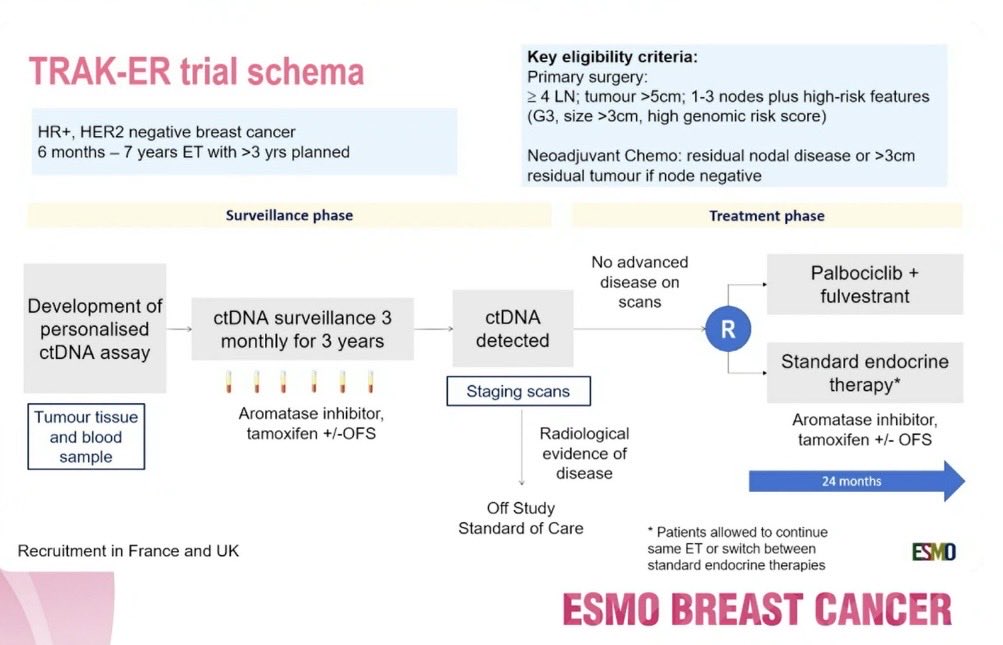
Discover KOL Sentiment on TRAK-ER →Design - Phase 2 investigator-initiated trial: serial ctDNA (molecular residual disease) surveillance to guide an early switch to fulvestrant (Faslodex) + palbociclib (Ibrance) before overt relapse in high-risk HR+/HER2- early breast cancer (NCT04985266; Royal Marsden / ICR, NIHR).
Surveillance yield - Across 2,110 samples from 480 patients, ctDNA was detected in 2.6% of individual tests; 11.3% of patients had ctDNA detected at least once, with higher detection at the first surveillance timepoint.
Concurrent recurrence - 42.9% of ctDNA-positive patients already had concurrent radiological recurrence at the time of ctDNA detection - a key finding for the lead-time question.
Assay performance - The personalized panel design failed in 14.8-16.1% of patients (insufficient tumor material or no trackable variants); the interim surveillance phase is observational with no treatment exposure.
Regulatory / sponsor - Investigational strategy; fulvestrant and palbociclib are approved in metastatic disease but the early-switch strategy here is investigational. Sponsor Royal Marsden / ICR (NIHR). ESMO Breast 2026.
Compiled and reviewed by the KOL Pulse research team, led by Brian Shields, Founder, KOL Pulse. Last updated July 21, 2026.




Trial slides shared by KOLs at ESMO Breast 2026 (#ESMOBreast26). Click any image to expand. OCR text extracted via AWS Textract.

[Slide 1]
ctDNA SURVEILLANCE IN HR+ BREAST CANCER
XXX
TRAK-ER STUDY: SIGNAL VS REALITY
GOAL: Detect molecular relapse earlier than imaging to guide intervention
1
HOW OFTEN IS ctDNA
2
TIMING MATTERS
3
WHAT DOES THIS MEAN?
DETECTED?
Metastatic disease rate
at ctDNA detection
Detection rate
2.6%
62%
L
declines over time
DETECTION
FIRST TEST (MO)
PER TEST
Most early positives already
Early test =
have metastatic disease
lower utility
11.3%
16%
Serial testing improves
PATIENTS EVER
LATER TESTS (M3+)
chance of catching
ctDNA POSITIVE
MRD before metastasis
(≥1 TIMEPOINT)
Later detections = more
"pure MRD" before metastasis
ctDNA surveillance in high-risk HR+ breast cancer is
TAKEAWAY
feasible but not yet practice-changing.
Best role: high-risk patients & MRD-directed trials
@DrRishabhOnco


[Slide 1]
TRAK-ER trial schema
Key eligibility criteria:
Primary surgery:
≥4 LN; tumour >5cm; 1-3 nodes plus high-risk features
(G3, size >3cm, high genomic risk score)
HR+, HER2 negative breast cancer
6 months - 7 years ET with >3 yrs planned
Neoadjuvant Chemo: residual nodal disease or >3cm
residual tumour if node negative
Surveillance phase
Treatment phase
No advanced
Palbociclib +
disease on
.
Development of
scans
fulvestrant
ctDNA surveillance 3
ctDNA
personalised
R
monthly for 3 years
detected
ctDNA assay
Standard endocrine
.
......
Staging scans
therapy*
Tumour tissue
Aromatase inhibitor,
Aromatase inhibitor,
and blood
tamoxifen +/-OFS
Radiological
tamoxifen +/- OFS
sample
evidence of
disease
24 months
Off Study
Standard of Care
. Patients allowed to continue
Recruitment in France and UK
same ET or switch between
ESMO
standard endocrine therapies
ESMO BREAST CANCER

---

[Slide 2]
Disease Recurrence Rate
Recurrence at the Time of ctDNA Detection
Overall, 42.9% of patients had recurrent
No recurrence
Recurrence
disease at the time ctDNA detection
100%-
(45/105)
15
34%
86.7% distant recurrence (39/45)
75%
45
6.7% loco-regional recurrence suitable for treatment
with curative intent (3/45)1
Percentage
74%
50%
4.4% incurable locally advanced recurrence (2/45)
29
2.2% missing (1/45)
66%
25%
16
In patients detected at initial test (M0),
26%
65.9% had recurrent disease
0%
Month 0
Month 3+
In patients detected in subsequent tests
Timepoint ctDNA detected
(M3+) 26.2% had recurrent disease
Dr Niamh Cunningham
1. 2 of the patients had locally advanced curative disease and re-entered surveillance.
Content of this presentation is copyright and responsibility of the author Permission IS required for TO use
Both had ctDNA detected on subsequent testing. 1 had molecular relapse.
MD
ESMO BREAST CANCER

---

[Slide 3]
Conclusion
In patients with higher risk ER positive HER2 negative breast cancer ctDNA
detection was 1.9% per test and 11.6% per patient in serial testing
In patients with initial ctDNA detection in M3+, 26.2% had recurrent disease at the
time of detection
ctDNA detection was more frequent with more advanced anatomical stage, higher
nodal involvement and higher grade
Modelling of data from TRAK-ER, highlights the importance of detecting ctDNA at
low allele fractions, to identify molecular relapse prior to clinical relapse
TRAK-ER demonstrates the feasibility of ctDNA surveillance and informs future trial
design
Dr Niamh Cunningham
Content of this presentation is copynght and responsibility of the outhor Permission is required for no use
ESMO
ESMO BREAST CANCER


[Slide 1]
ESMO BREAST CANCER
BERLIN GERMANY
Annial Congress
6-8 MAY 2026
ESMO
How Can We Integrate New Technologies and
Therapeutics to Optimize Outcomes for HR+ HER2- eBC?
ctDNA detection rates during surveillance in high-risk
PREcoopERA: A window of opportunity (WOO) trial of
HR+/HER2 negative breast cancer from the TRAK-ER
giredestrant +/- LHRH analogue vs anastrozole + LHRH in
study
premenopausal patients with ER+/HER2- early breast cancer
Elsabetta Munzone Ruichae Shi, Vesna Bjelic-Radisic, Antonia Perefio, Roisin M Connolly Joana
Mourato Ribero, Fabio Conforti, Marianna Sinco, Alba Gonzilez Haba Martinez, Eudaid Felp, Verónica
Niamh Cunningham Sofia Sardo inform Claire Swift Rosalind Cutts Karen Thomas,
Luisa Obadio GI, Beatriz Rajas Garoin Serafin Morales, Dagmar Langanke Johanna Frindle, Cornella
Robert D. Daber, Janhua Zhao, Francois Legrand Lemmoner an MacPherson
Leo Laurent Rosset Heid Roschitzki-Voser, Roswtha Kammler, Patrizia Dell'Orto Lola Russo,
Clara O'Brien Carlo Palmieri, Peter Schmid Marie Robert Alca FC Okines Dymphna
Barbara Rupp. Eva Grolimund Meredith Regan Marco Colleges Sherena La Peter Dutsky
Lee, Isaac Garcia-Murilas, Fabrice Andre Nicholas C Turner
Elisabetta Munzone
European institute of Oncology, Milan, staly
TRAK-ER deepens our understanding of ctDNA monitoring
PREcoopERA modulates use of novel therapies in
in the HR+ HER2- adjuvant setting
younger patients to optimize therapeutic balance
EricaL Mayer NO, MPH
Content of the presentation 0 copynght and responsibility of the author Permission 6 required for no use
ESMO
ESMO BREAST CANCER

---

[Slide 2]
ESMO BREAST CANCER
BERLIN GERMANY
Amount Congress
6-8 MAY 2026
ESMD
What Do We Know About ctDNA Detection in HR+/HER2-
Early Breast Cancer?
Confirmed clinical validity: Detection of ctDNA, at baseline or late adjuvant setting, is strongly prognostic for recurrence.
Unconfirmed clinical utility: Does identification of molecular relapse before clinical relapse allow modulation of therapy to
delay or reverse recurrence?
PALLAS
CHiRP
Testing at baseline
Testing >5 years
ctDNA Negative
ctDNA Negative
151 95%C 88, 260
p-value 0001
IDFS
75% of ctDNA+ with
recurrence within years
ctDNA Positive
ctDNA Positive
Time
from
Number
Erical Mayer ND, MPH
Content of this presentation copynght and responsibility of the after Purmission required for "
ESMO
ESMO BREAST CANCER

---

[Slide 3]
IESMO BREAST CANCER
BERLIN GERMANY
Annual Congress
6-8 MAY 2026
ESMO
TRAK-ER ctDNA Detection: In Whom? When? Disease Status?
Annual ctDNA Detection Rate by Year Since Surgery
Recurrence by Visit Category
No recurrence
Recurrence
8%
7.2%
100%
6.1%
15
6%
Annual ctDNA detection rate
5.6%
5.3%
5.4%
75%
34%
4.5%
45
4%
3.5%
Percentage
74%
50%
29
2%
25%
66%
16
26%
0%
0%
1
2
3
4
5
6
7
Month 0
Month 3+
Year since surgery
Visit category
Rate of detection consistent over 7 years after surgery, echoes known persistent recurrence rate for HR+ disease
Detection associated with higher disease burden
Concurrent disease recurrence more likely when ctDNA+ at baseline, with higher allele fraction
EricaL Mayer NO, MPH
Content of the presentation in copyright and responsibility of the author Permission . required for no use
ESMO
ESMO BREAST CANCER

---

[Slide 4]
ESMO BREAST CANCER
BERLIN GERMANY
6-8 MAY 2026
ESMO
CONCLUSIONS: PREcoopERA
What We Know
What We're Waiting For
Are We There Yet?
Preoperative giredestrant +/- OFS leads
Larger experiences with prolonged
Until further data are available, oral
to substantial antiproliferative effect,
SERD monotherapy in premenopausal
SERDs should only be used with
greater with OFS
patients may clarify efficacy, safety, and
OFS in premenopausal patients.
PREcoopERA aligns with other studies in
any preferred population
this setting, showing activity but unable
Novel combinations and novel
to confirm equivalence of SERD alone.
biomarkers are needed
Toxicity concerns about estradiol levels
without ovarian suppression
WAIT
EricaL Mayer MD, MPH
Content of the presentation a copyright and responsibility of the author Permission . required for to use
ESMO
ESMO BREAST CANCER


[Slide 1]
ESMO BREAST CANCER
BERLIN GERMANY
Annual Congress
6-8 MAY 2026
ESMO
2026
ESMO BREAST CANCER
PRINTRIENT
LINES
Annual Congress
ctDNA detection rates during surveillance
in high-risk HR+/HER2 negative breast
cancer from the TRAK-ER study
Niamh Cunningham Sofia Sardo Infirm, Claire Swift, Rosalind J Cutts, Karen Thomas, Robert D. Daber,
Jianhua Zhao, Francois Legrand, Jerome Lemonnier, lain MacPherson, Ciara Brien, Carlo Palmieri, Peter
Schmid. Marie Robert, Alicia FC Okines, Dymphna Lee. Isaac Garcia-Murillas, Fabrice Andre. Nicholas C
Turner
06 May 2026
ESMO
ESMO BREAST CANCER

---

[Slide 2]
ESMO BREAST CANCER
BERLIN GERMANY
Annual Congress
6-8 MAY 2026
ESMO
TRAK-ER trial schema
Key eligibility criteria:
Primary surgery:
≥4 LN; tumour >5cm; 1-3 nodes plus high-risk features
(G3, size >3cm, high genomic risk score)
HR+, HER2 negative breast cancer
6 months - 7 years ET with >3 yrs planned
Neoadjuvant Chemo: residual nodal disease or >3cm
residual tumour if node negative
Surveillance phase
Treatment phase
No advanced
Palbociclib +
disease on
scans
fulvestrant
Development of
ctDNA surveillance 3
ctDNA
personalised
R
monthly for 3 years
detected
ctDNA assay
Standard endocrine
Staging scans
therapy*
Tumour tissue
Aromatase inhibitor,
Aromatase inhibitor,
and blood
tamoxifen +/-OFS
Radiological
tamoxifen +/- OFS
sample
evidence of
disease
24 months
Off Study
Standard of Care
.
Patients allowed to continue
Recruitment in France and UK
same ET or switch between
ESMO
standard endocrine therapies
ESMO BREAST CANCER

---

[Slide 3]
Disease Recurrence Rate
Recurrence at the Time of ctDNA Detection
Overall, 42.9% of patients had recurrent
No recurrence
Recurrence
disease at the time ctDNA detection
100%
(45/105)
15
34%
86.7% distant recurrence (39/45)
75%
45
6.7% loco-regional recurrence suitable for treatment
with curative intent (3/45)1
Percentage
74%
50%
4.4% incurable locally advanced recurrence (2/45)
29
2.2% missing (1/45)
66%
25%
16
In patients detected at initial test (M0),
26%
65.9% had recurrent disease
0%
Month 0
Month 3+
In patients detected in subsequent tests
Timepoint ctDNA detected
(M3+) 26.2% had recurrent disease
Dr Niamh Cunningham
1. 2 of the patients had locally advanced curative disease and re-entered surveillance
Content of this presentation is copyright and responsibility of the author Permission is required for no USA
Both had ctDNA detected on subsequent testing 1 had molecular relapse
ESMO
ESMO BREAST CANCER

---

[Slide 4]
ESMO BREAST CANCER
BERLIN GERMANY
Annual Congress
6-8 MAY 2026
ESMO
Conclusion
In patients with higher risk ER positive HER2 negative breast cancer ctDNA
detection was 1.9% per test and 11.6% per patient in serial testing
In patients with initial ctDNA detection in M3+, 26.2% had recurrent disease at the
time of detection
ctDNA detection was more frequent with more advanced anatomical stage, higher
nodal involvement and higher grade
Modelling of data from TRAK-ER, highlights the importance of detecting ctDNA at
low allele fractions, to identify molecular relapse prior to clinical relapse
TRAK-ER demonstrates the feasibility of ctDNA surveillance and informs future trial
design
Dr Niamh Cunningham
Content of this presentation B copyright and responsibility of the author Permission is required for no use
ESMO
ESMO BREAST CANCER


[Slide 1]
TRAK-ER Trial Schema
Key Eligibility Criteria: High Risk HR+ Node Positive
HR+, HER2 negative breast cancer
Primary surgery: > 4 LN; tumour >5cm; 1-3 nodes plus high-risk features (G3, size >3cm, high genomic risk score)
6 months - 7 years ET with >3 yrs planned
Neoadjuvant Chemo: residual nodal disease or >3cm residual tumour if node negative
Surveillance Phase
Treatment Phase
Development of
No advanced
Palbociclib + fulvestrant
personalised ctDNA assay
ctDNA surveillance 3
ctDNA
disease on scans
R
Plasma Detect ID MRD WES
monthly for 3 years
detected
tumor informed assay
Standard endocrine therapy
Tumour tissue
IIIIII
Staging scans
Aromatase inhibitor,
and blood sample
Aromatase inhibitor,
tamoxifen +/- OFS
tamoxifen +/-OFS
Radiological
24 months
evidence of disease
Primary Endpoints:
Surveillance phase: ctDNA detection rates
Treatment phase: RFS with palbo & fulvestrant VS standard ET in
Off Study
ctDNA detected patients
Standard of Care
Erica L Mayer MD, MPH
Content of the presentation 15 copynght and responsibility of the author Permission is required for re use
ESMO

---

[Slide 2]
ctDNA detection rate
Detection Rate per Visit Month
Detected
Not Detected
ctDNA detected in 1.9% of samples
1000
5.0%
(107/5724)
1.7%
1.2%
750
1.9%
ctDNA detected in 11.6% of patients
0.3%
(105/901) ¹
ctDNA was detected in 5.0% of initial tests
Number of Tests
2.1%
500
1.1%
1.1%
0%
250
(MO) vs 1.3% of subsequent tests (M3+)
1.5%
0%
(p<0.001)
4.9%
0%
0
58.9% of ctDNA detection occurred after an
0 3 6 9 12 15 18 21 24 27 30 33 36
Visit Month
initial negative test
Median allele fraction: 0.02% (0.001-7.97%)²
No trend in detection rates from M3+ onwards (p=0.2154)
Number above bar indicates ctDNA detection rate per test
1. Two patents had ctDNA detected in 2 timepoints. Both received treatment for local recurrence
Dr Niamh Cunningham
and re-entered surveillance and subsequently had ctDNA detected
ESMO
Content of this presentation is copyright and responsibility of the author Permission IS required for 10 use
2.
Weighted average variant allele frequency reported for each positive timepoint

---

[Slide 3]
Disease Recurrence Rate
Recurrence at the Time of ctDNA Detection
No recurrence
Recurrence
Overall, 42.9% of patients had recurrent
disease at the time ctDNA detection
100%-
(45/105)
15
34%
86.7% distant recurrence (39/45)
75%
45
74%
6.7% loco-regional recurrence suitable for treatment
with curative intent (3/45)¹
4.4% incurable locally advanced recurrence (2/45)
Percentage
50%
29
66%
2.2% missing (1/45)
25%
16
In patients detected at initial test (M0),
26%
65.9% had recurrent disease
0%
Month 0
Month 3+
In patients detected in subsequent tests
Timepoint ctDNA detected
(M3+) 26.2% had recurrent disease
Dr Niamh Cunningham
1. 2 of the patients had locally advanced curative disease and re-entered surveillance.
Content of this presentation IS copynght and responsibility of the author Permission is required for use
Both had ctDNA detected on subsequent testing. 1 had molecular relapse.

---

[Slide 4]
Exploratory Clinical Correlation with ctDNA detection
Anatomic Stage
pT Stage
pN Stage
30%
P = 0.018
30%
P 0.691
30%
p<0.001
18/84
20/96
(21%)
33/206
(21%)
ctDNA positive (%)
20%
16/149
ctDNA positive (%)
20%
40/338
16/143
45/376
33/270
28/287
1/11
2/28
ctDNA positive (%)
20%
(16%)
(12%)
(11%)
(12%)
(12%)
37/429
(11%)
(10%)
(9%)
4/69
(9%)
10%
(7%)
10%
10%
(6%)
0%
0%
0%
IIA
IIB
IIIA
IIIB
IIIC
T1
T2
T3
T4
NO
N1
N2
N3
Stage
Pathological Tumour Status
Pathological Nodal Status
ctDNA detection increased with higher nodal stage and numerically more
frequent in stage IIIC tumours
Dr Niamh Cunningham
Content of this presentation is copyright and responsibility of the author Permission is required for re use *Statistical testing: Exploratory time-to-event analyses accounting for delayed study entry.
ESMO


[Slide 1]
2026
ESMO BREAST CANCER
Annual Congress
ctDNA detection rates during surveillance
in high-risk HR+/HER2 negative breast
cancer from the TRAK-ER study
Niamh Cunningham, Sofia Sardo Infirri, Claire Swift, Rosalind J Cutts, Karen Thomas, Robert D. Daber,
Jianhua Zhao, Francois Legrand, Jerome Lemonnier, lain MacPherson, Ciara O'Brien, Carlo Palmien, Peter
Schmid, Marie Robert, Alicia FC Okines, Dymphna Lee, Isaac Garcia-Murillas, Fabrice Andre, Nicholas C
Tumer
06 May 2026

---

[Slide 2]
TRAK-ER trial schema
Key eligibility criteria:
Primary surgery:
≥4 LN; tumour >5cm; 1-3 nodes plus high-risk features
(G3, size >3cm, high genomic risk score)
HR+, HER2 negative breast cancer
6 months - 7 years ET with >3 yrs planned
Neoadjuvant Chemo: residual nodal disease or >3cm
residual tumour if node negative
Surveillance phase
Treatment phase
No advanced
Palbociclib +
disease on
Development of
scans
fulvestrant
ctDNA surveillance 3
ctDNA
personalised
R
monthly for 3 years
detected
ctDNA assay
Standard endocrine
Staging scans
therapy*
Tumour tissue
Aromatase inhibitor,
Aromatase inhibitor,
and blood
tamoxifen +/-OFS
Radiological
tamoxifen +/- OFS
sample
evidence of
disease
24 months
Off Study
Standard of Care
* Patients allowed to continue
Recruitment in France and UK
same ET or switch between
ESMO
standard endocrine therapies

---

[Slide 3]
ctDNA detection rate
Detection Rate per Visit Month
Detected
Not Detected
ctDNA detected in 1.9% of samples
1000
5.0%
(107/5724)
1.7%
1.2%
750
ctDNA detected in 11.6% of patients
1.9%
(105/901) ¹
Number of Tests
0.3%
2.1%
500
1.1%
ctDNA was detected in 5.0% of initial tests
1.1%
0%
(MO) VS 1.3% of subsequent tests (M3+)
250
1.5%
(p<0.001)
0%
4.9%
0%
0
58.9% of ctDNA detection occurred after an
0
3
6
9
12
15
18
21
24
27
30
33
36
initial negative test
Visit Month
Median allele fraction: 0.02% (0.001-7.97%)²
No trend in detection rates from M3+ onwards (p=0.2154)
Number above bar indicates ctDNA detection rate per test
1. Two patents had ctDNA detected in 2 timepoints. Both received treatment for local recurrence
Dr Niamh Cunningham
and re-entered surveillance and subsequently had ctDNA detected
Content of this presentation is copyright and responsibility of the author Permission is required for re-use
2. Weighted average variant allele frequency reported for each positive timepoint
MD

---

[Slide 4]
Disease Recurrence Rate
Recurrence at the Time of ctDNA Detection
Overall, 42.9% of patients had recurrent
No recurrence
Recurrence
disease at the time ctDNA detection
100%
(45/105)
15
34%
86.7% distant recurrence (39/45)
75%
45
6.7% loco-regional recurrence suitable for treatment
with curative intent (3/45)1
Percentage
74%
50%
4.4% incurable locally advanced recurrence (2/45)
29
2.2% missing (1/45)
66%
25%
16
In patients detected at initial test (MO),
26%
65.9% had recurrent disease
0%
Month 0
Month 3+
In patients detected in subsequent tests
Timepoint ctDNA detected
(M3+) 26.2% had recurrent disease
Dr Niamh Cunningham
1. 2 of the patients had locally advanced curative disease and re-entered surveillance.
Content of this presentation is copyright and responsibility of the author Permission is required for re-use
Both had ctDNA detected on subsequent testing. 1 had molecular relapse.
ESMD


Highest-engagement tweets about this trial, ranked by KOL discussant count (replies + quote-tweets). Replies in green, quote-tweets in blue. Wall Street, stock-promo, and non-substantive replies excluded.
ctDNA surveillance in HR+ breast cancer is promising… but here’s the reality 👇 #ESMOBreast26 🧬 TRAK-ER study 👥 High-risk HR+ / HER2- on adjuvant ET ⚡ Strategy: Serial ctDNA → detect relapse BEFORE imaging 📊 Key findings: • Detection per test: just 2.6% • 11.3% pts https://t.




 +2
+2
Dr. Erica Mayer (@elmayermd) delivered an excellent discussion of the TRAK-ER and PREcoopERA trials at #ESMOBreast26. https://t.co/E8IQiBXcdB
Can ctDNA detect relapse before scans? 👀 #ESMOBreast26 TRAK-ER evaluated serial ctDNA surveillance in high-risk HR+/HER2- EBC. 🧬 ctDNA+ at first test (M0): • 65.9% already had recurrence 🧬 ctDNA+ later (M3+): • Only 26.2% had recurrence → Potential molecular lead-time https://
TRAK-ER Trial: Serial ctDNA Monitoring Uncovers Subclinical Relapse with Significant Lead-Time Advantage in High Risk HR+/HER2− Breast Cancer Moving from Radiologic Detection to Molecular Intervention @OncoAlert #ESMOBreast26 #bcsm #BreastCancer https://t.co/xRiz8DUXSb
#ESMOBreast26 In TRAK-ER, ctDNA positivity appeared to be associated more with nodal burden than with pT stage. At the time of ctDNA detection, 42.9% of patients already had recurrent disease; among those detected during M3+ surveillance, this rate decreased to 26.2%. ctDNA ht
TRAK-ER is a UK-led randomized multicentre study evaluating serial circulating tumor DNA (ctDNA) surveillance every 3 months for 3 years in patients with high-risk HR+/HER2- early breast cancer receiving adjuvant endocrine therapy. The primary aim is to detect molecular relapse before clinical or radiographic progression and randomize ctDNA-positive patients to palbociclib + fulvestrant vs. continued standard endocrine therapy. The interim surveillance analysis presented at ESMO Breast 2026 reports detection rates and clinical correlates from the first 480 patients with successful panel design.
Population: Patients with high-risk early-stage ER+/HER2- breast cancer (Allred 6/8+ ER, IHC 0/1+ HER2 or ISH-negative). High-risk defined by nodal status, tumour size >3 cm, grade 3, or high genomic risk (Oncotype DX RS≥26, Prosigna ≥60, EPclin ≥4.0, MammaPrint high). Currently 901 patients with successful panel design have started surveillance.
Interventions: Surveillance phase: tumour-informed ctDNA assay every 3 months. Treatment phase (post-randomization for ctDNA+ patients): palbociclib 125 mg/day 3 wks on/1 wk off + fulvestrant 500 mg IM monthly vs continued standard endocrine therapy.
Endpoints: Surveillance phase: ctDNA detection rate, lead time to clinical relapse, association with clinicopathologic features. Treatment phase primary: relapse-free survival.
Across 2,110 samples from 480 patients, ctDNA was detected in 2.6% of tests; 11.3% of patients had ctDNA detected at least once. Detection was higher at the first surveillance timepoint (Month 0: 6.2%) than later samples (Month 3+: 1.5%; p<0.0001). 42.9% of patients had concurrent metastatic disease at the time of initial ctDNA detection (65.9% at M0, 26.2% at M3+). Median allele fraction was 0.034%. Detection was numerically more frequent in higher-stage and node-positive disease. Annual detection rates declined over time: 7.6% Y1, 2.9% Y2-3, 1.8% Y4, 2.0% beyond Y7.
The interim surveillance analysis is observational — no treatment exposure. Panel design failed in 14.8-16.1% of patients (insufficient tumour material or detectable variants), highlighting need for more sensitive tumour-agnostic assays. Treatment phase safety (palbo + fulvestrant) is consistent with established profiles for those agents.
Rishabh Jain framed TRAK-ER as “ctDNA surveillance in HR+ breast cancer is promising… but here’s the reality,” noting “Detection per test: just 2.6%” and that detection “declines over time.” In a follow-up post he pressed the lead-time question: “ctDNA+ at first test (M0): 65.9% already had recurrence; ctDNA+ later (M3+): Only 26.2% had recurrence.” Yakup Ergün flagged that “ctDNA positivity appeared to be associated more with nodal burden than with pT stage,” and that “at the time of ctDNA detection, 42.9% of patients already had recurrent disease.” Aya Mohamed described the result as “Serial ctDNA Monitoring Uncovers Subclinical Relapse with Significant Lead-Time Advantage in High Risk HR+/HER2− Breast Cancer Moving from Radiologic Detection to Molecular Intervention.” Dana-Farber’s Breast Oncology Center noted that Erica Mayer “delivered an excellent discussion of the TRAK-ER and PREcoopERA trials,” setting up the open question of whether ctDNA-guided intervention can translate signal into outcome.
TRAK-ER (NCT04985266) is a Phase 2, investigator-initiated trial run by The Royal Marsden and the Institute of Cancer Research (with NIHR support). It uses serial circulating-tumor-DNA (ctDNA) surveillance to detect molecular residual disease in high-risk HR-positive/HER2-negative early breast cancer and tests whether an early switch to fulvestrant plus palbociclib - triggered before overt clinical relapse - can improve outcomes.
In the surveillance interim analysis, across 2,110 samples from 480 patients, ctDNA was detected in 2.6% of individual tests and 11.3% of patients had ctDNA detected at least once, with the highest detection at the first surveillance timepoint. Importantly, 42.9% of ctDNA-positive patients already had concurrent radiological recurrence at detection, which informs how much lead time ctDNA surveillance actually provides.
No. TRAK-ER tests an investigational ctDNA-guided early-switch strategy in early breast cancer. Fulvestrant (Faslodex) and palbociclib (Ibrance) are separately FDA-approved in metastatic HR-positive/HER2-negative breast cancer, but using ctDNA surveillance to trigger an early switch to this combination in the early/adjuvant setting is investigational and not FDA approved.
The interim data are nuanced: while ctDNA identified molecular residual disease in a meaningful subset of patients, 42.9% of ctDNA-positive patients already had concurrent radiological recurrence at the time of detection, meaning the anticipated lead time was smaller than hoped for many patients. This tempers expectations about how far in advance current ctDNA surveillance can trigger a pre-emptive treatment switch.
The interim surveillance analysis is observational (no treatment exposure yet), and the personalized ctDNA panel design failed in roughly 15-16% of patients because of insufficient tumor material or a lack of trackable variants. These assay-performance and lead-time findings are important for designing future ctDNA-guided intervention trials in early breast cancer.
| Handle | Name | Sentiment | Tweet (excerpt) | Imp. |
|---|---|---|---|---|
| @DrRishabhOnco | Dr Rishabh Jain | Neutral | ctDNA surveillance in HR+ breast cancer is promising… but here’s the reality 👇 #ESMOBreast26 🧬 TRAK-ER study 👥 High-r… | 4,210 |
| @DrRishabhOnco | Dr Rishabh Jain | Neutral | Can ctDNA detect relapse before scans? 👀 #ESMOBreast26 TRAK-ER evaluated serial ctDNA surveillance in high-risk HR+/HER… | 2,251 |
| @DFCI_BreastOnc | Dana-Farber’s Breast Oncology Center | Neutral | Dr. Erica Mayer (@elmayermd) delivered an excellent discussion of the TRAK-ER and PREcoopERA trials at #ESMOBreast26. ht… | 785 |
| @dr_yakupergun | Yakup Ergün | Neutral | #ESMOBreast26 In TRAK-ER, ctDNA positivity appeared to be associated more with nodal burden than with pT stage. At the… | 764 |


