This edition
AI spots pancreatic cancer three years early, most oncologists use AI without governance — and Epic points AI at its own code
In this edition: Eric Topol, MD on AI detecting pancreatic cancer up to 3 years before diagnosis · Yan Leyfman, MD on the governance gap — 83% of surveyed oncology clinicians use AI independently, 71% report no institutional policy · Katy Beckermann, MD on Epic running Anthropic's Mythos across its own codebase · Chadi Nabhan, MD on AI tumor twins with Bishoy Faltas, MD.
Early detectionAI governanceHealth-system AIDigital twins
Eric Topol@EricTopol on XPhysician-scientist; founder, Scripps Research Translational Institute.
Aug 27, 2026
The revolution in pancreatic cancer is not just about the new, impressive FDA approved drug or the vaccine treatment. It's also about AI detection up to 3 years before it is currently diagnosed. wsj.com/opinion/fda-ap… ↗ 
Yan Leyfman, MD@YLeyfman on XPhysician, Memorial Sloan Kettering; director, MedNews Week.
Aug 31, 2026
AI didn’t wait for oncology to build the rules. It simply arrived.
Today, clinicians are increasingly using AI to interpret complex information, navigate treatment options and clinical trials, and support decisions that are becoming more personalized—and more complicated.
But that raises an important question: Who is responsible when AI gets it wrong?
That question became the foundation for our new article on AI governance in precision oncology.
In our survey of 52 U.S. oncology clinicians, 83% reported independently using AI on personal platforms, while 71% reported no institutional AI governance policy and 77% were operating without institutional oversight.
Perhaps most striking was what we call the “verification paradox.” Nearly everyone intended to verify AI-generated recommendations—yet 23% would still have followed an intentionally embedded dosing error.
That matters even more as we move into increasingly complex areas of oncology: CAR-T therapy, bispecific antibodies, molecular classification, MRD monitoring, and highly individualized treatment decisions. These are areas where AI has enormous potential, but where confidently incorrect recommendations can also carry serious consequences.
Our conclusion is simple:
The oncologist of the AI era cannot simply be an AI user. We must become AI curators.
That means selecting the right tools, understanding their limitations, validating their performance, recognizing when they fail, and ultimately maintaining human accountability for the patient in front of us.
Technology will continue to evolve. Clinical accountability cannot.
I’m incredibly grateful to Dr. Arturo LoAIza-Bonilla MD for his tremendous mentorship and for continually challenging me to think more deeply about how we responsibly bring emerging technologies into cancer care.
I also sincerely thank the AIPO Journal, Dr. Douglas Flora, Dr. Nikhil Thaker, and Dr. Sanjay Juneja for providing a platform for these important conversations at the intersection of AI, innovation, and oncology.
The future of oncology will undoubtedly involve AI. The question is how we ensure that we remain worthy stewards of it.
journals.sagepub.com/doi/10.1177/29… ↗
#ArtificialIntelligence #Oncology #PrecisionOncology #AIinHealthcare #ClinicalAI #PatientSafety #CancerCare #PrecisionMedicine 
Katy Beckermann@katy_beckermann on XGU medical oncologist — clinical trials and drug development.
Aug 28, 2026
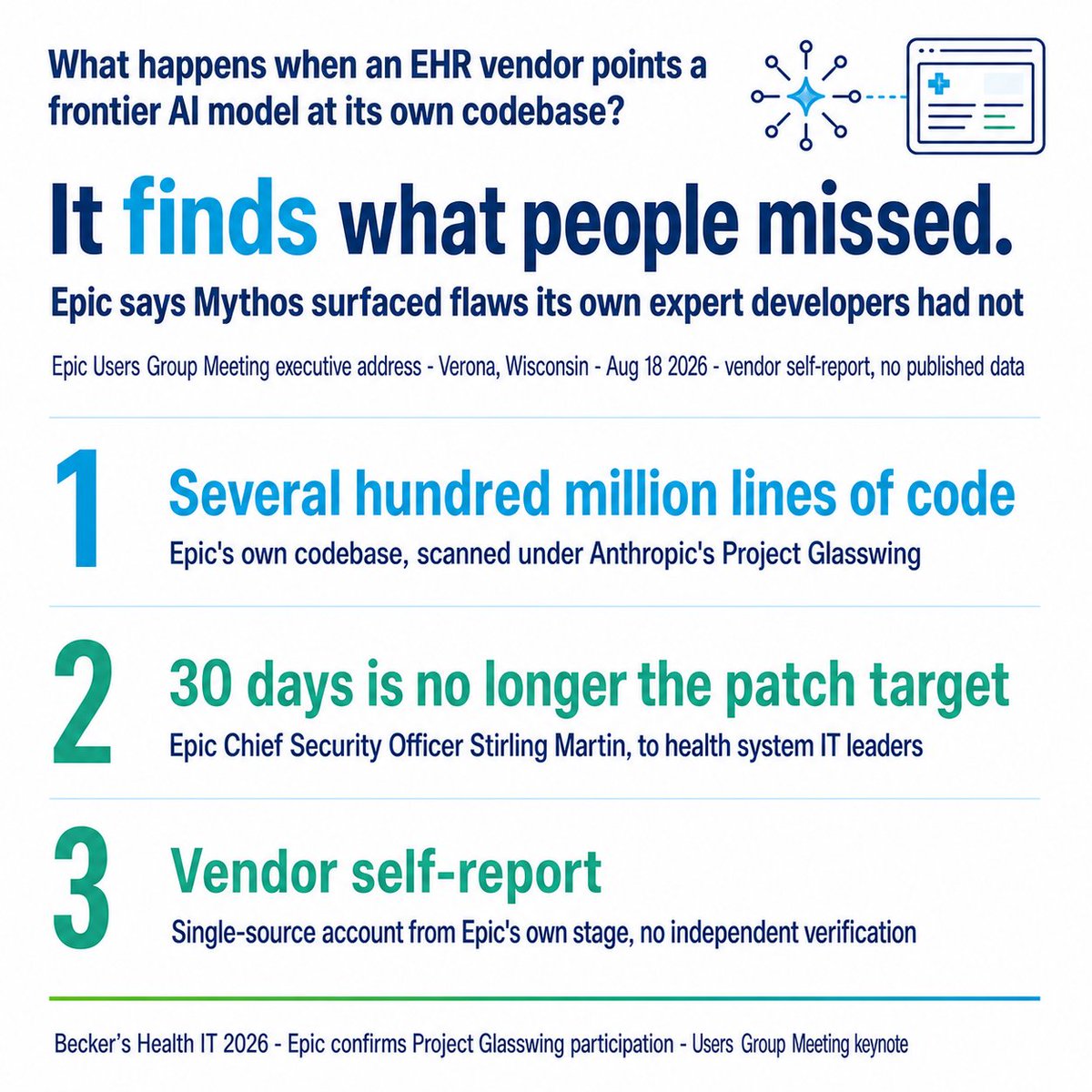
Epic EMR shared that AI using Mythos found security flaws their engineers had missed.
🔬 Epic ran Anthropic's Mythos models against its own codebase, several hundred million lines, under Project Glasswing
⚠️ The CIO conveyed that patching within 30 days is no longer good enough
How is your research IT handling validation when the LLM find issues in the code quickly? 🩺
#ClinicalAI #AIinMedicine #GlassWinga @claudeai
Free Access · KOL Pulse Intelligence
Track oncology’s top KOLs in your specialty
Create a free account, pick the tumor types you cover, and go beyond the tweet — the intelligence pharma teams use to map influence and prepare for engagement:
- ✓Enhanced KOL profiles
- ✓Pharma influence & potential advisory-board patterns
- ✓2025 Open Payments financial analysis
- ✓Social-media sentiment & trend signals
Get free access — pick your specialty
Choose the tumor types you follow. No cost, unsubscribe anytime.

chadi nabhan MD, MBA, FACP@chadinabhan on XHematologist-oncologist; host, Healthcare Unfiltered.
Aug 31, 2026
AI Tumor Twins with Dr. Bishoy Faltas youtu.be/wpw4wBXveEM?is… ↗ via @YouTube
Streaming on @YouTube with @FaltasLab - as this research matures, it will be a game changer.
Check it out and subscribe.