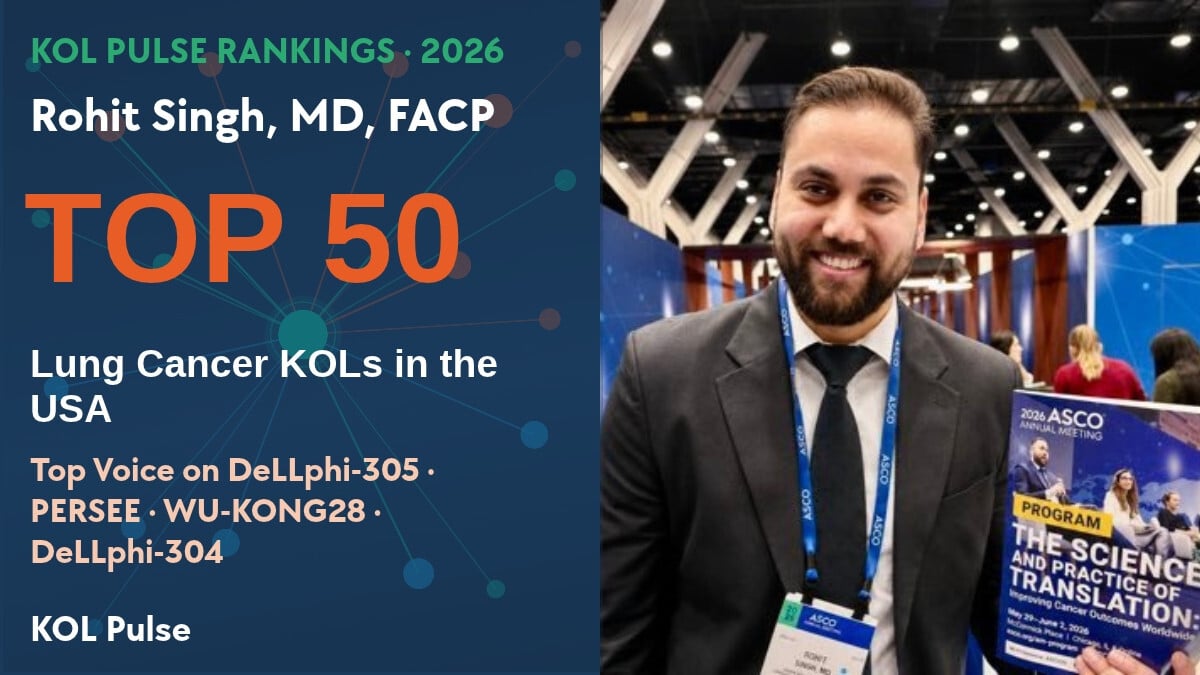
Rohit Singh, MD, FACP (@RohitBanwar) ranks #44 among US lung cancer KOLs on X in 2026, by engagement from fellow physicians. 3 physicians shared, quoted or replied to their posts this year. Most-discussed trials in 2026: PERSEE (GFPC 01-2020), DeLLphi-305, IMforte.
At a Glance
- 5 posts naming a trial in 2026
- 6 trials discussed by name
- Lung Cancer: US #44 · 3 physicians engaged
This Month
What Rohit Singh, MD, FACP has posted in the last 30 days. Updated November 10, 2026.
PERSEE trial addresses a question I often discuss with patients: if PD-L1 is >50%, should we use pembrolizumab alone or add chemotherapy? In this randomized phase III trial, adding chemotherapy improved median PFS from 6.9 to 16.1 months (HR 0.56) and response rates from 50.3% to 77.5%. That is a substantial difference in disease control. The tradeoff was also substantial: grade ≥3 treatment-related toxicity increased from 19.3% to 53.8%. Median OS is numerically way longer, 50.2 vs 29.9 months, but the difference was not statistically significant (HR 0.77; 95% CI 0.57–1.05). We should be careful about how we describe that finding. These results would strengthen my preference for chemoimmunotherapy in a fit patient with symptomatic or rapidly progressing disease, where an early response matters. I would still discuss pembrolizumab alone with selected patients. High PD-L1 expression is useful, but the treatment decision also needs to account for disease burden, symptoms, comorbidities and what the patient values. I’d particularly like to see the quality of life results, subsequent treatments and detailed subgroup analyses. This is a very important and relevant study that gives us better evidence for a very practical conversation. Decroisette et al. PERSEE, ESMO 2026, abstract 2614O. @LungSummit @lcrf_org @myESMO @UVMLarnerMed @UVMcancercenter #ESMO26 #LCSM #NSCLC
Big update in extensive-stage SCLC. DeLLphi-305 showed that adding tarlatamab to durvalumab maintenance improved median OS from 12.7 to 21.1 months and PFS from 1.9 to 7.4 months, measured from maintenance randomization. These are impressive results, and I can see this changing our maintenance discussions with patients. I’m still thinking through two questions. First, where does this leave lurbinectedin + atezolizumab maintenance from IMforte? The DeLLphi-305 numbers look better, but we cannot establish superiority by comparing results across trials. Second, what do we give after progression on tarlatamab + durvalumab? Trials, platinum rechallenge in selected patients, and lurbinectedin/topotecan are considerations, but we need better evidence in patients whose disease has progressed on tarlatamab. Keeping tarlatamab for second line is an understandable argument. In clinic, though, we also see patients deteriorate too quickly to receive the next treatment. One detail I’d particularly want to examine is how many patients in the control arm received tarlatamab after progression. That matters when discussing early treatment versus reserving it for relapse. I’m encouraged by these results. Alongside working out the best sequence, we’ll need to make treatment accessible and have the staffing, monitoring and caregiver support to deliver it safely. https://t.co/IKFyOZ8ln6 #ESMO26 #LCSM #SCLC @UVMcancercenter @myESMO @lcfamerica @SclcSMASHERS
Who Amplifies Rohit Singh, MD, FACP
Physicians who reposted Rohit Singh, MD, FACP’s trial posts most often in 2026.


2026 Rankings
| List | US rank | Global rank | Physicians engaged | Physician engagements | |
|---|---|---|---|---|---|
| Lung Cancer | #44 | — | 3 | 3 | Full ranking |
Trials Rohit Singh, MD, FACP Discussed in 2026
| Trial | Posts | Rank among physicians posting | Latest |
|---|---|---|---|
| PERSEE (GFPC 01-2020) | 1 | #29 of 34 | Oct 25, 2026 |
| DeLLphi-305 | 1 | #45 of 86 | Oct 24, 2026 |
| IMforte | 1 | #5 of 12 | Oct 24, 2026 |
| CheckMate-77T | 1 | #4 of 5 | Aug 14, 2026 |
| WU-KONG28 | 1 | #28 of 29 | May 30, 2026 |
| DeLLphi-304 | 1 | #10 of 23 | May 22, 2026 |
Rohit Singh, MD, FACP on PERSEE (GFPC 01-2020)
PERSEE trial addresses a question I often discuss with patients: if PD-L1 is >50%, should we use pembrolizumab alone or add chemotherapy? In this randomized phase III trial, adding chemotherapy improved median PFS from 6.9 to 16.1 months (HR 0.56) and response rates from 50.3% to 77.5%. That is a substantial difference in disease control. The tradeoff was also substantial: grade ≥3 treatment-related toxicity increased from 19.3% to 53.8%. Median OS is numerically way longer, 50.2 vs 29.9 months, but the difference was not statistically significant (HR 0.77; 95% CI 0.57–1.05). We should be careful about how we describe that finding. These results would strengthen my preference for chemoimmunotherapy in a fit patient with symptomatic or rapidly progressing disease, where an early response matters. I would still discuss pembrolizumab alone with selected patients. High PD-L1 expression is useful, but the treatment decision also needs to account for disease burden, symptoms, comorbidities and what the patient values. I’d particularly like to see the quality of life results, subsequent treatments and detailed subgroup analyses. This is a very important and relevant study that gives us better evidence for a very practical conversation. Decroisette et al. PERSEE, ESMO 2026, abstract 2614O. @LungSummit @lcrf_org @myESMO @UVMLarnerMed @UVMcancercenter #ESMO26 #LCSM #NSCLC
Rohit Singh, MD, FACP on DeLLphi-305
Big update in extensive-stage SCLC. DeLLphi-305 showed that adding tarlatamab to durvalumab maintenance improved median OS from 12.7 to 21.1 months and PFS from 1.9 to 7.4 months, measured from maintenance randomization. These are impressive results, and I can see this changing our maintenance discussions with patients. I’m still thinking through two questions. First, where does this leave lurbinectedin + atezolizumab maintenance from IMforte? The DeLLphi-305 numbers look better, but we cannot establish superiority by comparing results across trials. Second, what do we give after progression on tarlatamab + durvalumab? Trials, platinum rechallenge in selected patients, and lurbinectedin/topotecan are considerations, but we need better evidence in patients whose disease has progressed on tarlatamab. Keeping tarlatamab for second line is an understandable argument. In clinic, though, we also see patients deteriorate too quickly to receive the next treatment. One detail I’d particularly want to examine is how many patients in the control arm received tarlatamab after progression. That matters when discussing early treatment versus reserving it for relapse. I’m encouraged by these results. Alongside working out the best sequence, we’ll need to make treatment accessible and have the staffing, monitoring and caregiver support to deliver it safely. https://t.co/IKFyOZ8ln6 #ESMO26 #LCSM #SCLC @UVMcancercenter @myESMO @lcfamerica @SclcSMASHERS
Rohit Singh, MD, FACP on IMforte
Big update in extensive-stage SCLC. DeLLphi-305 showed that adding tarlatamab to durvalumab maintenance improved median OS from 12.7 to 21.1 months and PFS from 1.9 to 7.4 months, measured from maintenance randomization. These are impressive results, and I can see this changing our maintenance discussions with patients. I’m still thinking through two questions. First, where does this leave lurbinectedin + atezolizumab maintenance from IMforte? The DeLLphi-305 numbers look better, but we cannot establish superiority by comparing results across trials. Second, what do we give after progression on tarlatamab + durvalumab? Trials, platinum rechallenge in selected patients, and lurbinectedin/topotecan are considerations, but we need better evidence in patients whose disease has progressed on tarlatamab. Keeping tarlatamab for second line is an understandable argument. In clinic, though, we also see patients deteriorate too quickly to receive the next treatment. One detail I’d particularly want to examine is how many patients in the control arm received tarlatamab after progression. That matters when discussing early treatment versus reserving it for relapse. I’m encouraged by these results. Alongside working out the best sequence, we’ll need to make treatment accessible and have the staffing, monitoring and caregiver support to deliver it safely. https://t.co/IKFyOZ8ln6 #ESMO26 #LCSM #SCLC @UVMcancercenter @myESMO @lcfamerica @SclcSMASHERS
Rohit Singh, MD, FACP on CheckMate-77T
Really interesting biomarker analysis from Tina Cascone and colleagues from CheckMate 77T in Nature. Perioperative nivolumab + chemo increased pre-surgical ctDNA clearance (66% vs 38%), and ctDNA clearance strongly tracked with pCR and EFS. The most striking finding for me: every patient who converted from post-op MRD-negative to MRD-positive ultimately recurred. PD-L1 still appears meaningful, with the strongest EFS signal in PD-L1 >50%, while benefit was still seen across PD-L1 groups. Squamous histology also had a numerically stronger EFS benefit than non-squamous disease. Field is moving toward dynamic, risk-adapted perioperative therapy using ctDNA clearance + pathologic response + post-op MRD rather than relying on static genomics alone. Not practice-changing yet for escalation/de-escalation, but definitely where the next generation of trials should go. @Lung_Cancers #lcsm #lungcancer https://t.co/wDCIK3Usfx
Rohit Singh, MD, FACP on WU-KONG28
EGFR exon20ins NSCLC is finally entering the targeted-therapy era. In the phase III WU-KONG28 trial, first-line sunvozertinib outperformed platinum/pemetrexed: • mPFS: 10.3 vs 7.5 mo (HR 0.65) • ORR: 58.9% vs 31.1% • DoR: 11.2 vs 7.1 mo • 12-mo PFS: 46.1% vs 26.7% An https://t.co/HUj58RIptp
Rohit Singh, MD, FACP on DeLLphi-304
Great to see prospective intracranial activity with tarlatamab in SCLC brain mets. I’ve been using it in selected patients with asymptomatic CNS disease and, at times, deferring upfront radiation. Encouraging to finally see supporting data from DeLLphi-304. #SCLC #ASCO26 https://t.co/V3015i24k6
Rohit Singh, MD, FACP’s Most-Engaged Posts in 2026
Their own 2026 posts that fellow physicians reposted most, quoted word for word.
EA5142/ALCHEMIST may end up being one of the most important “negative” thoracic oncology studies at #ASCO26. In resected EGFR/ALK-negative NSCLC, 1 year of adjuvant nivolumab after surgery +/- chemotherapy did not improve DFS: • median DFS: 71.3 vs 68.8 months; HR 0.97 • No clear benefit even in PD-L1 > 50% And importantly, this came with meaningful toxicity: • grade 3-5 TRAEs: 25% • treatment discontinuation due to AEs: 29% This trial raises a major biologic question in perioperative IO: Is much of the benefit we see in modern perioperative trials actually driven by the neoadjuvant component rather than prolonged postoperative immunotherapy? Neoadjuvant IO occurs while: • intact tumor antigen is present • lymphatic architecture is preserved • T-cell priming may be maximal Once the tumor is removed, continuing the same IO; especially in pts with minimal/no neoadjuvant response may not always make biologic sense. The future may ultimately become: • ctDNA-guided • pathologic response-adapted • biology-driven perioperative therapy rather than a universal “1 year for everyone” approach. A very thought-provoking study. #LCSM @ASCO
Grateful to join the ASCO 2026 Featured Voices cohort. Excited to engage with the oncology community and highlight impactful science, clinical insights, mentorship, and advocacy throughout #ASCO26 @UVMDeptMed @UVMcancercenter @ASCO https://t.co/6vHNpxFdHY
TRITON is one of the more biologically interesting thoracic abstracts at #ASCO26. In STK11/KEAP1/KRAS-mutant NSQ mNSCLC: Tremelimumab + durvalumab + chemotherapy showed modest ORR differences vs pembrolizumab + chemotherapy, but potentially intriguing durability signals on early interim analysis. Not practice changing yet: • PFS still blinded • Follow-up remains early • Small interim dataset But the core question is highly relevant: Can CTLA-4 intensification help overcome immunotherapy-resistant biology in “cold” tumors such as STK11/KEAP1-mutant NSCLC? Worth watching closely as mature efficacy data emerge. #LCSM
One thing that stands out from the #ASCO26 metastatic lung cancer rapid oral session: The field is rapidly moving beyond “PD-1 + chemo for everyone.” The major themes increasingly appear to be: • biomarker-driven IO escalation (TRITON) • bispecific antibodies/VEGF combinations (ROSETTA Lung-02, SSGJ-707) • next-generation resistance targeting (KRAS G12D, 4th-gen EGFR TKIs) • molecularly individualized frontline strategies A few abstracts I’m especially watching: • TRITON (STK11/KEAP1/KRAS biology) • KRAS G12D inhibitor TSN-1611 • DZD6008 in EGFR C797X resistance • Silevertinib in non-classical EGFR mutations The bigger picture: thoracic oncology is increasingly fragmenting into biologically defined disease subsets rather than a single NSCLC paradigm. Exciting times ahead. #LCSM @ASCO
STAMP / EA6174 is one of the most important cutaneous oncology studies at #ASCO26. Adjuvant pembrolizumab in resected Merkel cell carcinoma showed: • 2-yr RFS: 73% vs 66% with observation. RFS trend did not reach statistical significance • Significant reduction in distant metastases: HR 0.58 This is clinically meaningful because MCC is highly immunogenic, but also aggressive, and distant relapse often drives mortality. Prior PD-1 data in advanced MCC established strong activity. Can we prevent relapse after definitive surgery? What I’m most interested to see: • benefit by stage/nodal status • RT interaction • viral vs UV-driven MCC subsets • distant vs locoregional recurrence patterns • toxicity in potentially cured patients Even if RFS was not statistically significant, the DMFS signal may move the field toward more individualized adjuvant IO discussions in high-risk MCC. #ASCO26 #SkinCancer #MCC