Top KOLs Discussing PERSEE




PERSEE Key Slides & Visuals
ESMO 2026 slides




| Pembro + chemo (N=160) | Pembro alone (N=161) | HR (95% CI) | |
|---|---|---|---|
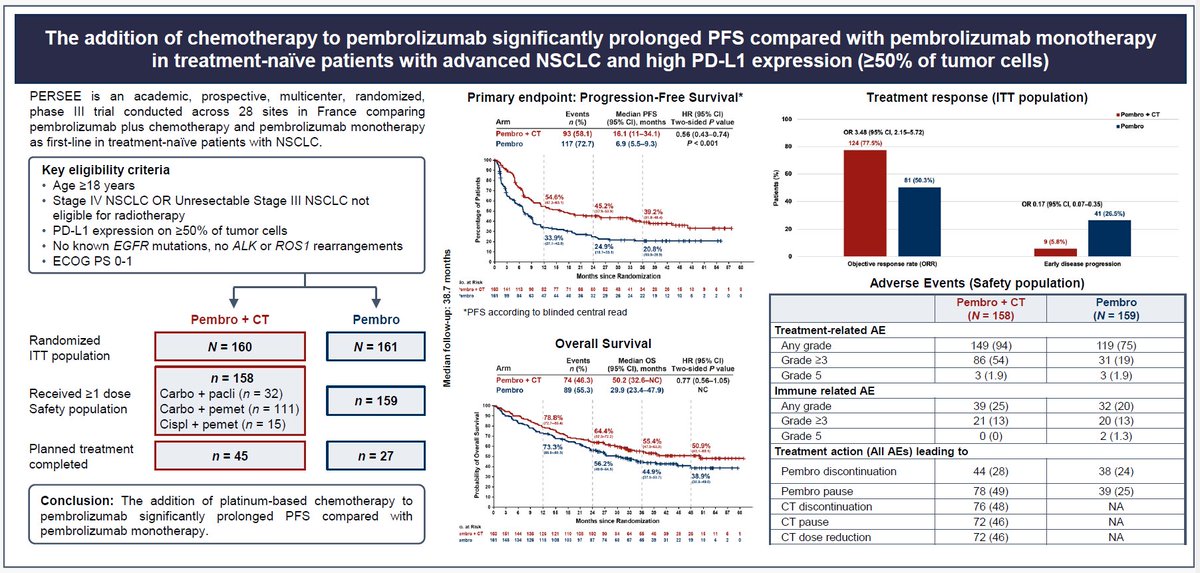
| Events, n (%) | 93 (58.1) | 117 (72.7) | 0.56 (0.43–0.74), two-sided P < 0.001 |
| Median PFS, months (95% CI) | 16.1 (11–34.1) | 6.9 (5.5–9.3) | — |
| 12-month PFS rate | 54.6% (47.3–63.1) | 33.9% (27.1–42.5) | — |
| 24-month PFS rate | 45.2% (37.9–53.9) | 24.9% (18.7–33.1) | — |
| 36-month PFS rate | 39.2% (31.8–48.4) | 20.8% (15.0–28.9) | — |
| PD-L1 stratum (local test) | Pembro + chemo: events, median PFS | Pembro alone: events, median PFS | HR (95% CI) |
|---|---|---|---|
| 50–74% | 32 (59.3%), 17.8 mo (9.3–NC) | 44 (75.9%), 7.0 mo (3.6–10) | 0.46 (0.29–0.74) |
| 75–100% | 51 (56.0%), 16.9 mo (11.1–NC) | 65 (68.4%), 7.1 mo (5.1–11.2) | 0.62 (0.43–0.91) |
| 90–100% | 26 (50.0%), 25.4 mo (11–NC) | 39 (68.4%), 7.1 mo (4.9–18.8) | 0.6 (0.36–1) |
| Pembro + chemo (N=160) | Pembro alone (N=161) | HR (95% CI) | |
|---|---|---|---|
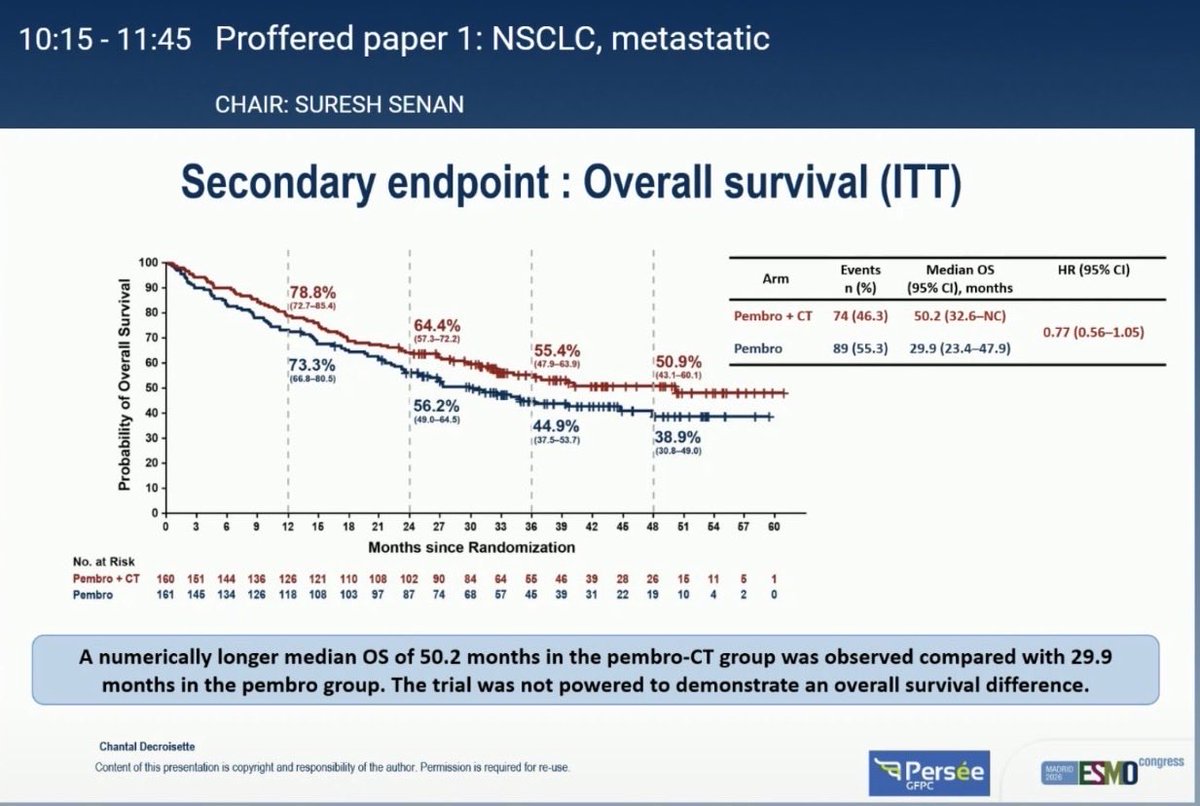
| Deaths, n (%) | 74 (46.3) | 89 (55.3) | 0.77 (0.56–1.05) |
| Median OS, months (95% CI) | 50.2 (32.6–NC) | 29.9 (23.4–47.9) | — |
| 12-month OS rate | 78.8% (72.7–85.4) | 73.3% (66.8–80.5) | — |
| 24-month OS rate | 64.4% (57.3–72.2) | 56.2% (49.0–64.5) | — |
| 36-month OS rate | 55.4% (47.9–63.9) | 44.9% (37.5–53.7) | — |
| 48-month OS rate | 50.9% (43.1–60.1) | 38.9% (30.8–49.0) | — |
Same slides also posted by @HHorinouchi, @JulienMazieres, @StephenVLiu, @DrRiyazShah, @dr_yakupergun, @RobertoFerrara_, @AdamJanuszewski, @Alfdoc2, @dplanchard, @NReguart.


Same slides also posted by @DrRiyazShah.


| Pembro + chemo (N=160) | Pembro alone (N=161) | HR (95% CI) | |
|---|---|---|---|
| Events, n (%) | 79 (49.3) | 101 (62.7) | 0.68 (0.5–0.91) |
| Median PFS2, months (95% CI) | 39 (26.2–NR) | 15.9 (13.2–29.9) | — |
| 12 / 24 / 36-month PFS2 rate | 70.6% / 59.1% / 51.1% | 60.6% / 43.3% / 37.0% | — |


Same slides also posted by @Alfdoc2.


Same slides also posted by @HHorinouchi, @Dr_Doc_, @RManochakian.


Same slides also posted by @RManochakian.

Same slides also posted by @dr_yakupergun.
KOL-Made Infographics
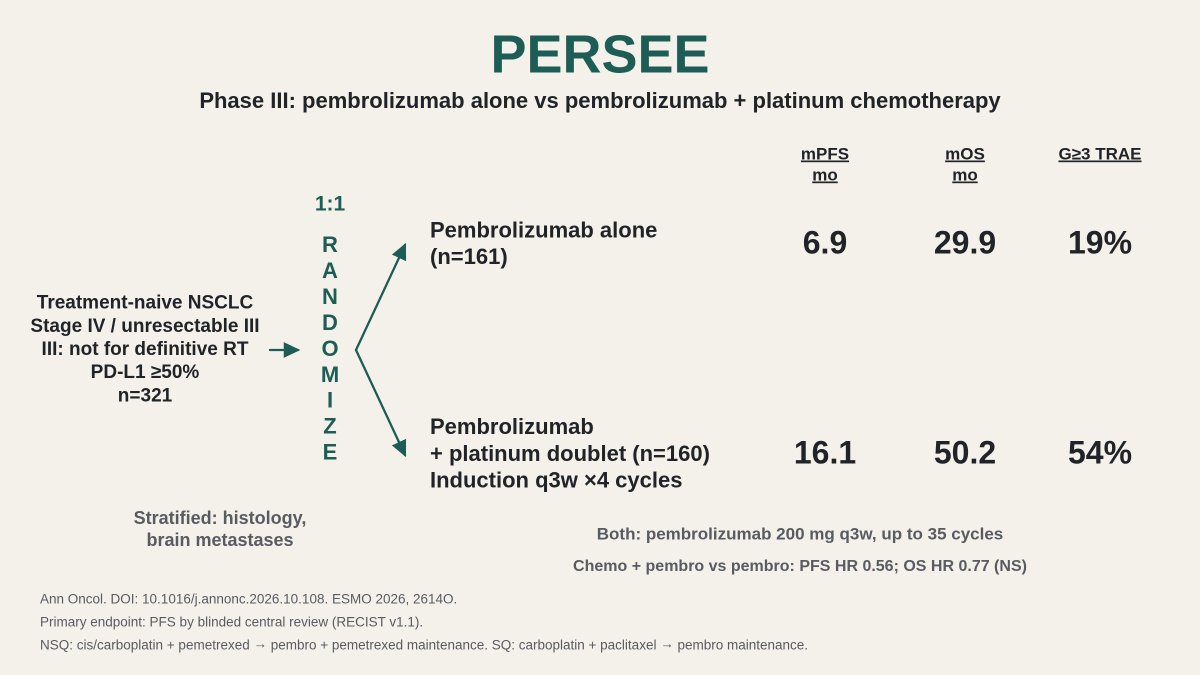
Summary graphics designed by a physician (not conference slides), made from the abstract before the presentation. Values are as the author drew them. Click to enlarge.
 @ChandrakanthMv
 @ChandrakanthMv
 @ChandrakanthMv
 @ChandrakanthMv
PERSEE conversations on X


Posted on October 21 from the abstract, before the presentation.


Physician reactions to PERSEE
#ESMO26 | PERSEE We expected chemotherapy to add benefit, but the magnitude of PFS improvement even in PD-L1 ≥90% patients is striking. Despite the limitations of subgroup analyses, these findings challenge the routine preference for ICI monotherapy in this population. https://t.co/0h3Tn6bVp6 https://t.co/Z817K9TKsB

🔥🚨@OncoAlert Hot off the press. Just published @Annals_Oncology in conjunction with presentation @myESMO #ESMO26 results of: ⭐️#PERSEE phase 3 trial of: ❇️#Pembrolizumab monotherapy Vs #Pembrolizumab + #Chemotherapy 🎯For #1stLine Tx of advanced non-small-cell #LungCancer (#NSCLC) with HIGH #PDL1 (PD-L1 ≥50%). Study showed: ‼️Statistically significant & clinically meaningful ⬆️#ProgressionFreeSurvival Benefit. ✅#mPFS: 16.1 vs 6.9 mo (HR 0.56) ❓#mOS: 50.2 vs 29.9 mo NOT Statistical Significant (HR 0.77; 95% CI, 0.56–1.05) Study not powered for #OverallSurvival 👇🏻 https://t.co/V3yc1U84Bi

@decroisette @FordePatrick Congrats Chantal ! Great study superbly presented 👏🏻👏🏻 A really practice changing academic study funded by the French NCI (INCa)

Very well conducted study with hard to ignore results. Differences aren’t due to post-PD access. Definitely will change how we approach discussions with patients but I don’t think we can adopt a one-size-fits-all. Some patients still get excellent benefit from monotherapy. https://t.co/NySE2fyNVc

Unclear whether mono arm underperformed and the exact role of PD-L1 in Persee. Median PFS mono ICI in PD-L1 >90 : 10-15 months vs 7 months in Persee in all high PD-L1 subcategories. OS>50 months with chemo-ICI unrealistic..need more follow up https://t.co/MP90Br4qTj

המשך עדוכנים מהכנס: #ESMO2026 #ESMO26 @myESMO מחקר PERSEE ששאל האם כדאי להוסיף כימותרפיה לאימונותרפיה גם כש־PD-L1 ≥50%? המחקר שסיפק השוואה ישירה בין pembrolizumab בלבד לבין השילוב עם כימותרפיה ב־NSCLC מתקדם בחולים עם NSCLC מתקדם וביטוי PD-L1 של 50% ומעלה, ללא שינויים אונקוגניים הניתנים לטיפול ממוקד בהתאם לקריטריוני המחקר, שתי אסטרטגיות טיפול מרכזיות עומדות זו לצד זו: pembrolizumab כמונותרפיה, או pembrolizumab בשילוב כימותרפיה מבוססת פלטינום. עד PERSEE, לא היו נתונים מניסוי Phase III שהשלים השוואה ישירה בין שתי האסטרטגיות באוכלוסייה זו. השאלה הקלינית הייתה מרכזית: האם הוספת כימותרפיה משפרת את השליטה במחלה, ומה המחיר מבחינת רעילות? מה למדנו מהמחקרים הקודמים? 1. KEYNOTE-024 ביסוס המונותרפיה המחקר השווה pembrolizumab לכימותרפיה מבוססת פלטינום בחולים עם PD-L1 ≥50%, והדגים יתרון לטובת pembrolizumab ב־PFS ובהישרדות הכוללת. בכך ביסס את המונותרפיה כאפשרות טיפול מרכזית בקו הראשון. 2. KEYNOTE-189 ו־KEYNOTE-407 ביסוס השילוב מחקרים אלה הראו כי הוספת pembrolizumab לכימותרפיה משפרת תוצאות לעומת כימותרפיה בלבד, הן ב־NSCLC שאינו קשקשי והן במחלה קשקשית. התועלת נצפתה גם בחולים עם PD-L1 ≥50%. עם זאת, מחקרים אלה לא השוו ישירות בין השילוב לבין pembrolizumab בלבד אלא מול כימותרפיה בלבד 3. KEYNOTE-598 שאלה טיפולית אחרת הוספת ipilimumab ל־pembrolizumab לא שיפרה את התוצאות והגבירה את הרעילות. חשוב לזכור שמדובר בהוספת אימונותרפיה מסוג אחר, ולא בהוספת כימותרפיה. לכן אין להסיק ממחקר זה ישירות לגבי התועלת האפשרית של כימותרפיה בשילוב עם pembrolizumab. מה בדק המחקר PERSEE? מדובר במחקר פאזה 3 אקראי, פתוח, שנערך ב־28 מרכזים בצרפת. במחקר השתתפו 321 חולים עם NSCLC מתקדם, שלא קיבלו טיפול סיסטמי קודם למחלה המתקדמת, עם PD-L1 ≥50% ו־ECOG 0–1. החולים הוקצו ל־pembrolizumab בלבד או ל־pembrolizumab בשילוב כימותרפיה מבוססת פלטינום. נקודת הסיום הראשית הייתה PFS, בהערכה מרכזית סמויה להקצאת הטיפול. חציון המעקב היה 38.7 חודשים. התוצאות המרכזיות: PFS נקודת הסיום הראשית חציון PFS היה 16.1 חודשים בשילוב לעומת 6.9 חודשים במונותרפיה של אינותרפיה בלבד HR 0.56 (95% CI 0.43–0.74; P<0.001). כלומר, השילוב הפחית בכ־44% את הסיכון היחסי להתקדמות המחלה או למוות בהשוואה ל־pembrolizumab בלבד. ORR שיעור התגובה האובייקטיבית 77.5% בשילוב לעומת 50.3% במונותרפיה. התקדמות מוקדמת: שיעור ההתקדמות המוקדמת היה 5.8% בשילוב לעומת 26.5% במונותרפיה. מדובר בנקודת סיום חקרנית, שהוגדרה כהתקדמות קלינית ו/או רדיולוגית לפני בדיקת ההדמיה הראשונה או במועד הבדיקה, סביב שישה שבועות. משך התגובה: חציון משך התגובה היה 30.0 חודשים בשילוב לעומת 15.6 חודשים במונותרפיה. עם זאת, ה־HR לאובדן תגובה או מוות היה 0.88 (95% CI 0.60–1.29), ולכן אין לקבוע שההבדל במשך התגובה מובהק סטטיסטית. הישרדות כוללת OS חציון OS היה 50.2 חודשים בשילוב לעומת 29.9 חודשים במונותרפיה. HR 0.77 (95% CI 0.56–1.05). ההבדל המספרי נוטה לטובת השילוב, אך לא הודגם יתרון מובהק סטטיסטית ב־OS. המחקר תוכנן לבחון את ה־PFS ולא היה בעל עוצמה מספקת להוכחת הבדל בהישרדות הכוללת. בטיחות: תופעות לוואי הקשורות לטיפול בדרגה 3 ומעלה התרחשו ב־54% מהחולים שקיבלו את השילוב, לעומת 19% במונותרפיה. שיעור תופעות הלוואי החיסוניות בדרגה 3 ומעלה היה 13% בשתי הקבוצות. המשמעות הקלינית: מחקר PERSEE מוסיף ראיות אקראיות ישירות לשאלה שלא נפתרה במחקרים הקודמים. בחולים עם NSCLC מתקדם ו־PD-L1 גבוה, הוספת כימותרפיה ל־pembrolizumab שיפרה באופן מובהק את ה־PFS והייתה קשורה לשיעור תגובה גבוה יותר ולשיעור נמוך יותר של התקדמות מוקדמת. יתרונות אלה עשויים להיות חשובים במיוחד בחולים שבהם יש צורך בשליטה מוקדמת במחלה. מנגד, יש להביא בחשבון את העלייה המשמעותית ברעילות. חשוב להדגיש כי המחקר לא הוכיח יתרון מובהק סטטיסטית ב־OS, ונתוני איכות החיים לא נכללו בדיווח הנוכחי. כמו כן, תוצאות המחקר אינן קובעות שהשילוב עדיף לכל חולה עם PD-L1 ≥50%. בחירת הטיפול צריכה להיות מותאמת למאפייני המחלה, לעומס הגידולי ולקצב התקדמותה, למצבו התפקודי של המטופל, לתחלואה הנלווית, לסבילות הצפויה לטיפול ולהעדפות המטופל. בשורה התחתונה: המסר המרכזי של PERSEE: הוספת כימותרפיה ל־pembrolizumab משפרת באופן מובהק את השליטה במחלה, אך במחיר של רעילות מוגברת. המחקר מחזק את מקומו של השילוב כאפשרות טיפול בקו הראשון גם בחולים עם PD-L1 גבוה, במיוחד כאשר נדרשת שליטה מוקדמת במחלה והמטופל מסוגל לשאת את הטיפול. עם זאת, הוא אינו מבטל את מקומה של מונותרפיה ב־pembrolizumab. ההחלטה בין שתי האסטרטגיות צריכה להתקבל באופן פרטני, תוך שקילת התועלת הצפויה מול הסיכון.

PD-L1 ≥50% does not make the chemotherapy question disappear. PERSEE directly compared pembrolizumab + platinum-based chemotherapy with pembrolizumab alone in untreated EGFR/ALK-negative advanced NSCLC. • Primary BICR-PFS: 16.1 vs 6.9 months • HR 0.56; P<0.001 • OS: 50.2 vs 29.9 months, but NOT statistically significant: HR 0.77; 95% CI 0.57–1.05 • Grade ≥3 treatment-related AEs: 53.8% vs 19.3% A clear PFS benefit comes with substantially more toxicity. Which PD-L1-high patients can reasonably avoid chemotherapy—and which need the higher response rate and longer disease control? @StephenVLiu @CharuAggarwalMD @myESMO @OncoAlert #PERSEE #ESMO26 #LCSM
🚨 PD-L1 ≥50% in NSCLC: Is pembrolizumab alone enough? 🔥 PERSEE Phase III | #ESMO26 Concomitant publication in Annals of Oncology. Pembrolizumab + chemotherapy vs pembrolizumab alone: 📊 PFS: 16.1 vs 6.9 months (HR 0.56) 🎯 ORR: 77.5% vs 50.3% ⚠️ Grade ≥3 toxicity: 54% vs 19% OS: 50.2 vs 29.9 months (HR 0.77), not statistically significant. 💡 Verdict: Better disease control, but at a substantial toxicity cost. Is PD-L1 ≥50% alone sufficient to omit chemotherapy? @ESMO_open @myesmo @ASCO @oncoalert #ESMO26 #LungCancer
‼️ In first line treatment of advanced PD-L1 ≥50% NSCLC, PERSEE demonstrates a significant improvement of PFS with pembro-CT compared to pembro monotherapy regardless of PDL1 level of (over)expression. Practise changing trial. @myESMO @OncoAlert #ESMO26 👏👏👏 @decroisette https://t.co/PXSKgrImYX

Impressive results Academic III PERSEE #ESMO26 @Annals_Oncology First positive random trial adding chemo to pembro in PD-L1 ≥50% NSCLC: 🔹 PFS: 16.1 vs 6.9 mo HR 0.56 🔹 OS: 50.2 vs 29.9 mo HR 0.77, NS 🔹 G≥3 TRAEs: 54% vs 19% Outstanding discussion Prof. Levy @benlevylungdoc. https://t.co/w7SQ8w75QT
Academic & pragmatic phase III trial (PERSEE) #ESMO26 reshaping therapeutic choices for PD-L1 high patients (including ultra-high PD-L1 80/90%). Convincing & impressive results. Huge congrats to the GFPC group 🇫🇷 for leading this unique and crucial study! 👏@decroisette https://t.co/GhrgWTxf8Q
🎯 #ESMO26 | Excellent discussion by @benlevylungdoc on SARON and PERSEE! Two trials, two important lessons for advanced NSCLC. 🔹 SARON: Consolidative radiotherapy improved PFS and local disease control in oligo metastatic NSCLC, but no OS benefit (HR 0.99). 🔹 PERSEE: Pembrolizumab + chemo met its primary endpoint PFS but not OS though numerically better (not powered for OS) in PD-L1 ≥50% NSCLC. Key messages from @benlevylungdoc : • Oligometastatic disease needs better biological definition, beyond the number of lesions. • Treatment intensification should be guided by better patient selection. • More treatment does not automatically mean better outcomes! - Lower threshold to add chemo to pembro in PD-L1 >50% 👏 A thoughtful discussion with practical implications for our clinics. #ESMOAmbassador #LungCancer #NSCLC
Fantastic discussion from @benlevylungdoc. On SARON, tumour heterogeneity may explain negative results. On PERSEE, agree that it is practice changing and clean data. Where do ADCs fit when design removes chemo? Also can we use ctDNA and adaptive design? #LCSM #ESMO26
#ESMO26 Dr. @benlevylungdoc guides a thoughtful discussion on escalation of therapy for driver negative NSCLC. Notes limitations of current tools to guide proper use of local consolidative radiation. Addition of chemotherapy as done in PERSEE is a real win, even in ultra high. Awaiting other studies, including INSIGNA. #ESMOAmbassadors
これはPD-L1高発現のNSCLCにおける日常診療での治療選択を考える上で非常に大事な論文 https://t.co/wIaTSqQr8W
#ESMO26 2614O PERSEE Head-to-head comparison of 1L treatments for NSCLC with PD-L1 ≥50% 📚Ann Oncol 2026 https://t.co/l4gbarp7a1 🔑Key Results 🎯 Population: 321 treatment-naïve advanced NSCLC patients with PD-L1≥50% and no driver mutations 📈 Median PFS: 16.1 months (Combo) vs 6.9 months (Mono) (HR 0.56, P<0.001) 🏆 ORR: 77.5% (Combo) vs 50.3% (Mono) ⏱️ Early progression rate (at 6 weeks): Drastically reduced with Combo (5.8%) vs Mono (26.5%) ⚠️ Grade ≥3 TRAEs: 54% (Combo) vs 19% (Mono) 🔥 The PFS benefit of Combo was maintained even in the ultra-high PD-L1 (90-100%) subgroup (25.4 vs 7.1 months)

Randomised phase 3 Persée study presented at #ESMO26 this morning ➡️ chemotherapy and Pembrolizumab improved OS when compared with Pembro alone in patients with local advanced NSCLC with PD-L1 ≥50% https://t.co/QqFeHafmUH
Context: OS was a secondary endpoint and the difference was not statistically significant: median 50.2 vs 29.9 months, HR 0.77 (95% CI 0.56–1.05). The trial was not powered for OS.
🔥PERSEE: Pembrolizumab + chemo vs pembrolizumab monotherapy in PD-L1 ≥50% advanced NSCLC 🆙 @Annals_Oncology #ESMO26 ☑Phase 3 RCT (GFPC); N=321; mFU 38.7 mo 🎯mPFS 16.1 vs 6.9 mo (HR 0.56, p<0.001); mOS 50.2 vs 29.9 mo (HR 0.77) — chemo adds significant PFS benefit 💡Grade ≥3 irAEs equal (13% each); tolerable combination profile 🎙Dr. Renaud Descourt & Dr. Chantal Decroisette #LCSM @OncoAlert @Larvol @IASLC https://t.co/6ScnxKoasY

Is more better in PD-L1 >50% PD-L1 NSCLC? 🇫🇷 PERSEE trial demonstrated that compared to pembro monotherapy, chemo-pembro showed better ORR and PFS, less early progressions, and numerically longer OS although not statistically significant (secondary endpoint, not powered). Really every patient needs chemo-IO? Is this the end of the discussion or just more data to debate? #ESMO26 #LCSM
#ESMO26 | PERSEE For patients fit enough to tolerate chemotherapy, these results strengthen my preference for pembro + CT, even with very high PD-L1. The sustained PFS benefit and encouraging OS separation deserve attention. Heartfelt congratulations to the investigators for conducting this academic, multicentre trial addressing a question we face every day👏

🫁 PERSEE phase III: Pembro + chemo vs pembro alone in PD-L1 ≥50% NSCLC. 📈 PFS: 16.1 vs 6.9m (HR 0.56) OS: HR 0.77 (95% CI 0.57–1.05) 29.9vs50 mo ⚠️ Grade ≥3 TRAEs: 54% vs 19% Better disease control, numerical better OS. Patient selection key - practice informing #ESMO2026 https://t.co/OTWMrmzFVd
PERSÉE; massive benefit for chemoIO over IO in all PDL1 strata in PFS; OS highly suggestive of benefit but NS; I think this is globally practice influencing #ESMO26 @BTOGORG https://t.co/ZigjqMKvbA
🚨 #ESMO26 | PERSEE phase III trial Dr Decroisette presents PERSEE, comparing pembrolizumab + chemo vs pembrolizumab alone in 1L advanced NSCLC with PD-L1 ≥50%. Numerically better PFS with the combination, but the primary endpoint was NOT met. The study was stopped prematurely, limiting its statistical power. 📉 Importantly, the pembrolizumab-alone arm substantially underperformed expectations in terms of PFS, raising important questions about the interpretation and generalisability of these findings. A numerically longer OS was also observed (50.2 vs 29.9 months), but the trial was not powered to demonstrate an OS difference. A thought-provoking study reminding us that numerical differences, statistical significance and clinical relevance are not always the same thing IMO #ESMOAmbassadors #ESMO26 #PERSEE #NSCLC #LungCancer
Context: in the presentation and the Annals of Oncology paper, the primary endpoint (PFS by blinded central review) was met: HR 0.56 (95% CI 0.43–0.74), P<0.001. The final analysis was run at the planned end of the study with 210 of the 249 planned PFS events, which lowered power from 80% to 73%.
#ESMO26 Dr. @decroisette with the important PERSEE trial: pembrolizumab +/- chemotherapy in PDL1 high NSCLC. Enrolled 321 pts in 3y at 28 sites. Pembro-chemo PFS 16.1 vs 6.9m (HR 0.56), better across strata. OS 50.2 vs 29.9m (HR 0.77, ns) - not powered for OS. #ESMOAmbassadors https://t.co/B9NBt7E1bP
🆙#ESMO26 Proffered Paper I: #LCSM Mets 🔥PERSEE (GFPC 01-2020): Pembrolizumab With or Without Platinum-Based Chemotherapy as First-Line Treatment in Advanced NSCLC With PD-L1 ≥50%, Phase 3 Trial 🎙️ @decroisette 🔢2614O 🎯Pembro-Chemo Improved BCR-PFS vs Pembro Alone 🎯PFS HR 0.56, mPFS 16.1 vs 6.9m 🎯OS HR 0.77 not significant; mOS 50.2 vs 29.9mo 🎯Grade≥3 TRAEs 53.8% vs 19.3% ☑️NCT04547504 🔗 https://t.co/uGHKJfjhvW @OncoAlert @Larvol @myESMO @IASLC

@myGFPC PRESEE trial is now presented by @decroisette #ESMO26. Publication in annals of oncology simultaneously ! So proup of our cooperative group 💪🇨🇵 https://t.co/ZnqX7HeAGH

⭐️Optimal integration and duration of pembrolizumab will be evaluated in two critical studies that I believe address very practical concerns for thoracic oncologists. 1⃣PERSEE phase 3 trial (GFPC 01-2020) - will address the value of pembrolizumab in PD-L1 ≥50% 2⃣IFCT-2103 DIAL phase 2-3 randomized trial - will address value of continuing maintenance pem/pembro beyond 2 yrs in a prospective fashion. @lcsmchat @OncoAlert @OncLive @Onco_Nexus @LungCancerEu @Lung_Cancers @LungCancerRx @MedwatchHQ @YoungLungCancer

🫁 PD-L1 ≥50% has long supported pembrolizumab monotherapy — but PERSEE asks whether some of these patients should receive more upfront. @OncoAlert At #ESMO26, phase III PERSEE compared pembrolizumab + platinum-based chemotherapy versus pembrolizumab alone in first-line advanced #NSCLC with PD-L1 ≥50%. 📊 n=321 ➡️ Median PFS: 16.1 vs 6.9 months HR 0.56 (0.43–0.74), p<0.001 ➡️ Median OS: 50.2 vs 29.9 months HR 0.77 (0.57–1.05) ➡️ ORR: 77.5% vs 50.3% But the trade-off is substantial: ⚠️ Grade ≥3 TRAEs: 53.8% vs 19.3% 🎯 Why this matters: PD-L1 ≥50% may not be enough, by itself, to decide between pembrolizumab alone and chemo-immunotherapy. For me, the real clinical question is now: Which PD-L1–high patients need the deeper and faster disease control of chemotherapy upfront — and which can safely avoid the added toxicity? That is where tumor burden, symptoms, pace of disease, comorbidities and better biomarkers will matter most. Excellent work from @decroisette @BenjaminBesseMD @LGreillier @C_Ricordel @FGuisier and the PERSEE investigators. Pinging @christine_lovly @GlopesMd @DrSanjayPopat @StephenVLiu @jillfeldman4 @CharuAggarwalMD @peters_solange @BRicciutiMD @VanitaNoronha @JordiRemon #OncoAlert #ESMO26 #LungCancer #NSCLC #Immunotherapy #PDL1 #PrecisionOncology

Can pembrolizumab monotherapy still be considered the optimal control arm in actual and future phase III trials for chemotherapy-eligible patients with advanced NSCLC and PD-L1 ≥50%? Looking forward to detailed results! #LCSM @decroisette @myGFPC @myESMO @Larvol @OncoAlert https://t.co/KOZVJ3uFvE
PERSEE | ESMO 2026 PD-L1 ≥50% NSCLC: Is Adding Chemotherapy Worth It? Phase III | 321 patients | Pembrolizumab ± chemotherapy 🔹 PFS: 16.1 vs 6.9 months (HR 0.56; p<0.001) 🔹 ORR: 77.5% vs 50.3% 🔹 OS: 50.2 vs 29.9 months (HR 0.77; not statistically significant) 🔹 Grade ≥3 toxicity: 53.8% vs 19.3% TAKE-HOME: Adding chemotherapy substantially improves disease control but increases severe toxicity, without a statistically proven OS benefit. Better PFS ≠ Proven Longer Survival. Patient selection remains crucial. 📖 Reference: Decroisette C et al. PERSEE (GFPC 01-2020), Phase III trial. ESMO Congress 2026, Proffered Paper — Metastatic NSCLC. #ESMO2026 #PERSEE #NSCLC #LungCancer #Immunotherapy #MVOnco
Hard not to add the PERSEE study, (a GFPC trial 🇫🇷) so eagerly awaited for our daily practice and so often cited for its design and the anticipation of its results (1st in place for the PD-L1 high patient strategy) which are finally here and truly impressive #ESMO26 ! 📈🔥 https://t.co/gbcXhNRn8r
Superb French pragmatic study by the GFPC 🇫🇷 and the only one asking this crucial question: combination therapy vs. mono-pembro in our PD-L1 High patients! 👏 Kudos, and a top highlight from #ESMO26 for lung cancer 🫁✨ https://t.co/5KBL9UbRuF
#ESMO26 | PERSEE – Phase III In advanced NSCLC with PD-L1 ≥50%, adding chemotherapy to pembrolizumab improved median PFS from 6.9 to 16.1 months (HR 0.56). The numerical OS difference was notable (50.2 vs 29.9 months; HR 0.77), but not statistically significant. However, we should remember that OS was not the primary endpoint! Grade ≥3 toxicity: 53.8% vs 19.3%. I think adding chemotherapy provides benefit, but at the cost of increased toxicity. We need to better identify the patients for whom this toxicity is worth it.
Posted on October 20 from the 2614O abstract, before the presentation.
PERSEE, GFPC academic phase III trial meets its primary endpoint! In 1L advanced NSCLC with PD-L1 ≥50%, pembrolizumab + chemotherapy significantly improved PFS vs pembrolizumab alone: 16.1 vs 6.9 months; HR 0.56; p<0.001. 📍 Join us at #ESMO26 !! https://t.co/HBW9zbos6H
Very honored to present the results of the PERSEE phase III trial (GFPC 01-2020) in an oral session at #ESMO26 in Madrid 🇪🇸 📅 Sunday, October 25 🕙 10:15 AM 🎤 Abstract 2614O https://t.co/HBW9zbnUh9 Thank you to the investigators, the GFPC, Brest CHU and Centre Leon Bérard !
PERSEE Trial Design
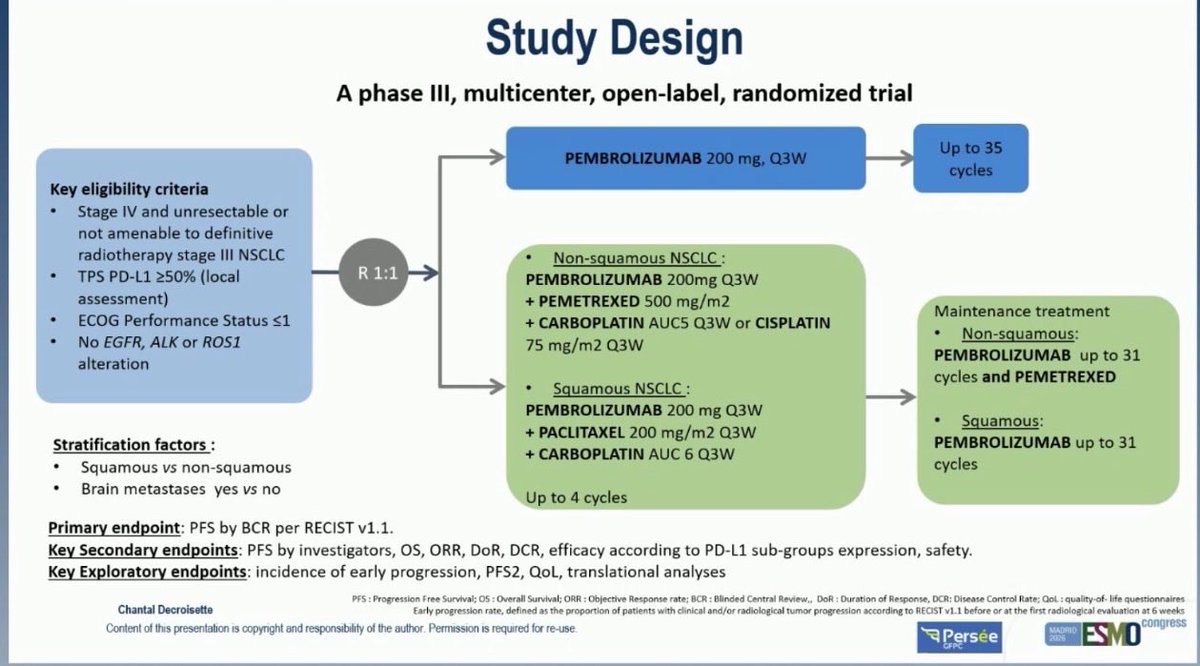
PERSEE asked whether adding platinum-based chemotherapy to pembrolizumab improves outcomes over pembrolizumab alone for patients with untreated advanced NSCLC whose tumors express PD-L1 on at least 50% of tumor cells. Both approaches are standard first-line options, but no completed phase 3 trial had compared them directly. The academic trial is sponsored by University Hospital, Brest, with the Groupe Français de Pneumo-Cancérologie (GFPC), and was funded by the French Hospital Clinical Research Program (PHRC K 20-147) and the GFPC. Between December 22, 2020, and December 21, 2023, 321 patients were randomized at 28 centers in France. Results were presented by Chantal Decroisette, MD, at ESMO 2026 (2614O, Proffered paper 1: NSCLC, metastatic, October 25, 2026), with Benjamin Levy, MD, as discussant, and published simultaneously in Annals of Oncology.
Study Design
Randomized 1:1, open-label, multicenter phase 3 (NCT04547504); 160 vs 161 patients. Stratified by histology (squamous vs non-squamous) and brain metastases. Superiority design for PFS assuming HR 0.70, 80% power, two-sided α 0.05; 249 events planned, 210 observed at the planned end of the study.
Population
Treatment-naive stage IV, or unresectable stage III not amenable to definitive radiotherapy, NSCLC; PD-L1 TPS ≥50% by local test; ECOG 0–1; no EGFR, ALK or ROS1 alteration. Median age 64; 19.6% squamous; 23.4% brain metastases; 2.2% never smokers; PD-L1 90–100% in 34%.
Interventions
Pembrolizumab 200 mg every 3 weeks for up to 35 cycles, alone or with 4 cycles of chemotherapy: pemetrexed with carboplatin AUC 5 or cisplatin (non-squamous; then pembrolizumab + pemetrexed maintenance) or carboplatin AUC 6 + paclitaxel (squamous; then pembrolizumab).
Endpoints
Primary: PFS by blinded central review (RECIST v1.1). Secondary: investigator PFS, iRECIST PFS, OS, ORR, DoR, duration of treatment, safety, PD-L1 subgroups. Exploratory: early progression at 6 weeks, PFS2, quality of life, biomarkers.
Presenter & Discussant
Presenter: Chantal Decroisette, MD (Department of Medical Oncology, Léon Bérard Cancer Center, Lyon), who contributed equally to the Annals of Oncology paper with its first author, Renaud Descourt, MD (Brest University Hospital). Invited discussant: Benjamin Levy, MD (Johns Hopkins Sidney Kimmel Cancer Center at Sibley Memorial Hospital).
Data Cut
Single analysis; database lock and data cutoff April 7, 2026; median follow-up 38.7 months (35.3–41.6). No interim analysis was planned or performed.
PERSEE in the News
PERSEE Questions
What is the PERSEE trial?
PERSEE (GFPC 01-2020, NCT04547504) is an academic, open-label, randomized phase 3 trial run at 28 centers in France. It compared pembrolizumab plus platinum-based chemotherapy with pembrolizumab alone as first-line treatment in 321 patients with advanced NSCLC, PD-L1 ≥50% and no EGFR, ALK or ROS1 alteration. Design: Trial Design.
What did PERSEE show at ESMO 2026?
The primary endpoint was met: PFS by blinded central review was 16.1 vs 6.9 months (HR 0.56; P<0.001). Overall survival, a secondary endpoint the trial was not powered for, was 50.2 vs 29.9 months (HR 0.77; 95% CI 0.56–1.05), not statistically significant. Figures: At a Glance.
Did patients with PD-L1 90% or higher also benefit from adding chemotherapy?
In the descriptive PD-L1 90–100% subgroup (109 patients), median PFS was 25.4 vs 7.1 months, HR 0.6 (95% CI 0.36–1). Subgroup results are descriptive and were not formally tested. Values: At a Glance.
Are pembrolizumab alone and pembrolizumab plus chemotherapy FDA approved for this population?
Yes, both are FDA-approved first-line options. KEYTRUDA (pembrolizumab) is approved as a single agent for NSCLC with PD-L1 TPS ≥1% and no EGFR or ALK aberrations, and in combination with pemetrexed and platinum (nonsquamous) or carboplatin and paclitaxel or nab-paclitaxel (squamous) for metastatic NSCLC. PERSEE compared these two strategies head to head; it did not lead to a new approval.
How much more toxic was the combination?
Grade ≥3 treatment-related adverse events occurred in 54% with pembrolizumab plus chemotherapy vs 19% with pembrolizumab alone; grade ≥3 immune-related adverse events were 13% in each arm, and 48% of patients stopped chemotherapy because of adverse events. Details: At a Glance.
Did the pembrolizumab-alone arm underperform?
Physicians debated this after the presentation (see Discussion Threads). The authors report that the median PFS of 6.9 months with pembrolizumab alone is consistent with KEYNOTE-024 at 5-year follow-up (7.7 months) and KEYNOTE-042 (7.1 months).