Brian Shields
DeLLphi-305 - tarlatamab added to durvalumab after initial chemo-immunotherapy for small lung cancer essentially doubles survival. Hope for all cancers here, if the right target & treatment modality can be refined. Unquestionably a new standard for this disease. #ESMO2026 https://t.co/8ovQ2yB6fr
View post on X ↗
KOL Pulse · ESMO 2026 · Madrid · Days 1–2 (October 23–24)
ESMO 2026 Days 1–2: Top Trials and KOL Reactions
“DeLLphi-305 at #ESMO26, presented by Jacob Sands, got a standing ovation.” That was GU oncologist Alan Tan, one of several physicians who posted about the ovation. Adding tarlatamab to durvalumab maintenance in ES-SCLC improved median OS from 12.7 to 21.1 months (HR 0.42). Then came the crossover question. Thoracic oncologist Misty Dawn Shields wrote that at progression, “only 12.2% of ITT population in the durvalumab arm (34/278) and 18.9% (34/179) of those who received subsequent anti-cancer therapies had access to tarlatamab.” Physicians asked what that means for comparing tarlatamab in first-line maintenance with tarlatamab at relapse. DeLLphi-305 tied with INTerpath-001 for the most physician posts on Days 1–2. Below are ten of the most-discussed trials, each with the result, a presented slide, and physician posts quoted in full.
Physician discussion, Days 1–2
Physician posts on X, October 23–24.
| # | Trial | Physician posts | Physicians posting |
|---|---|---|---|
| 1 | DeLLphi-305 | 94 | 67 |
| 2 | INTerpath-001 | 94 | 60 |
| 3 | VOLGA | 53 | 36 |
| 4 | KEYNOTE-866 | 37 | 24 |
| 5 | NATALEE | 36 | 27 |
| 6 | ENERGIZE | 27 | 19 |
| 7 | KEYNOTE-B15 / EV-304 | 24 | 17 |
| 8 | PANKU-Breast01 | 24 | 21 |
| 9 | TALENT | 21 | 17 |
| 10 | SANO | 17 | 15 |
DASL-HiCaP (posts), FOURLIGHT-1 (posts) and KEYNOTE-B49 (posts) also drew heavy physician discussion. See the DASL-HiCaP and KEYNOTE-B49 trial pages for full results and physician reactions; FOURLIGHT-1 posts are on the ESMO 2026 trials page.
Lung cancer
DeLLphi-305: tarlatamab + durvalumab as first-line maintenance in ES-SCLC
Phase 3, N=563: tarlatamab (IMDELLTRA, Amgen) plus durvalumab vs durvalumab alone after first-line chemo-immunotherapy. Median OS 21.1 vs 12.7 months, HR 0.42 (95% CI 0.32–0.54), P<0.001, at a prespecified interim analysis. 12-month OS 79.4% vs 53.3%. PFS 7.4 vs 1.9 months, HR 0.34 (0.28–0.42). ORR 26.4% vs 4.1%. (ESMO 2026 LBA3, Jacob Sands; NEJM; data cutoff Jul 7, 2026) Grade ≥3 TEAEs 46.8% vs 40.6%. CRS 49.6%, grade 3 0.4%, no grade 4 or 5. ICANS 1.1%, none grade ≥3. (LBA3 abstract and slides) The first-line combination is investigational. Tarlatamab has full FDA approval for ES-SCLC that progressed on or after platinum chemotherapy (November 19, 2025). (KOL Pulse DeLLphi-305 page)
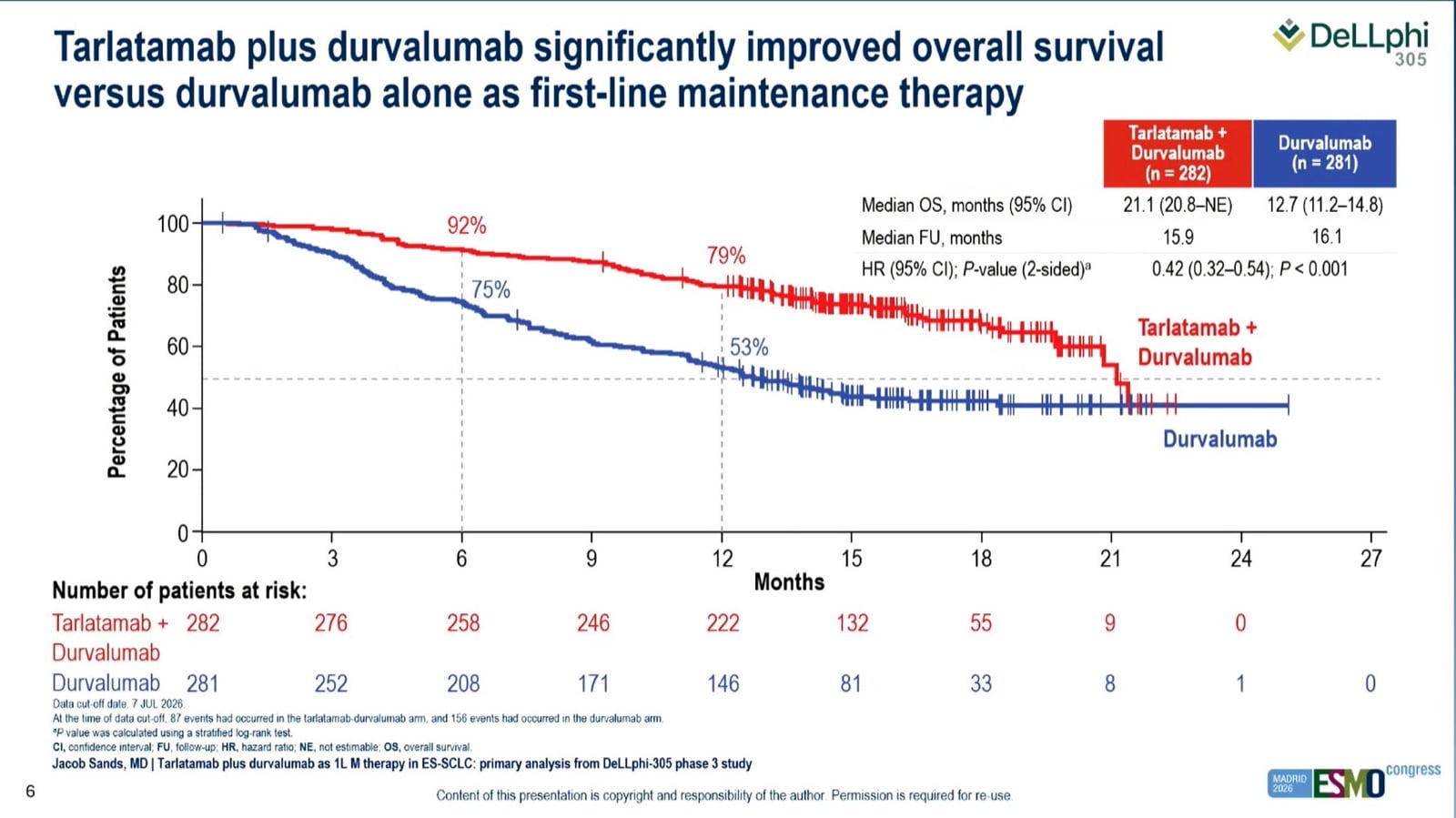
Physicians called it a new standard. The questions raised were cost, toxicity outside trials, access to tarlatamab, and the low complete response rate.
Agreement and open questions
#ESMO26 Presidential 1 Excellent state-of-the art discussion on #Dellphi-305 by the 1@only @StephenVLiu emphasizing on: ➡️ 1L maintenance Tarla setting a new SoC with a mOS of>20 months ❓High attrition rate from induction to maintenance, need for earlier TCE ( Dellphi-312) ❌Only 19% of pts in control arm received 2L Tarla post-progression reflecting access hurdles ✅ Global access to Tarla will make innovation meaningful for our patients @@myESMO #ESMOAmbassadors
View post on X ↗DeLLphi-305. Immpresive curves . Additional Toxicity and cost in real world needs to be seen . Good for patients with extensive SCLC @myESMO @OncoAlert #esmo26 https://t.co/V2CDG9m0ZR
View post on X ↗Yago Garitaonaindía @YGaritaonaindia
medical oncologist; translational research fellow, Copenhagen · Oct 24
🔥🔥🔥 #ESMO26 DeLLphi-305 in @NEJM Tarlatamab + durva vs durva as 1L maintenance in ES-SCLC (n=563) ➡️ mOS 21.1 vs 12.7 mo | HR 0.42 ➡️ mPFS 7.4 vs 1.9 mo | HR 0.34 ➡️ ORR 26% vs 4% | CR 0.9% | mDoR 12.7 mo ➡️ G≥3 AEs 47% vs 41% | CRS in ~50%, mostly G1-2, manageable 🔍 OS here is a game changer. New 1L maintenance standard, ahead of lurbi-atezo. 🙋CRs almost absent and DoR ~1 year. Still far from the long-term tail we see with PD-1 blockade in other tumour types. We can’t cure without CRs @myESMO @_SEOM @OncoAlert @Larvol #LCSM #SCLC
View post on X ↗The most detailed critical post came from Misty Dawn Shields, a translational SCLC oncologist at Indiana University, after the presentation. She called the OS improvement unprecedented and raised four concerns: access to tarlatamab at progression for patients in the control arm, whether the benefit reflects synergy or additivity (1L maintenance vs second line), patient selection and the need for predictive biomarkers, and treatment options after progression on the combination.
The critical perspective

Misty Dawn Shields @drshieldsmd
translational thoracic oncologist (MD, PhD), Indiana University; founder, SCLC SMASHERS · Oct 25
DeLLphi-305 delivered an unprecedented OS improvement (21.1 vs 12.7 mo, HR 0.42) for patients receiving tarlatamab + durvalumab, compared to durvalumab alone, in 1L maintenance after chemoIO induction for ES-SCLC. Studies like these provide renewed hope. However, this data brings forth multiple concerns regarding international access to care, interpretation of contribution of parts, patient selection, and sequencing. [...] 1️⃣ Equitable access to cross-over: at time of POD, only 12.2% of ITT population in the durvalumab arm (34/278) and 18.9% (34/179) of those who received subsequent anti-cancer therapies had access to tarlatamab.
Read the full post on X ↗"Equitable access to cross-over: at time of POD, only 12.2% of ITT population in the durvalumab arm (34/278) and 18.9% (34/179) of those who received subsequent anti-cancer therapies had access to tarlatamab." @drshieldsmd https://t.co/PuYlaxfI4q https://t.co/RDMQKqGIMK
View post on X ↗DeLLphi-305 trial page · All physician posts on DeLLphi-305 at ESMO 2026
Melanoma
INTerpath-001: an individualized mRNA vaccine plus adjuvant pembrolizumab
Phase 3, N=1,137, resected stage IIB–IV melanoma: intismeran autogene (V940/mRNA-4157, Moderna and Merck) plus pembrolizumab vs placebo plus pembrolizumab. RFS HR 0.58 (95% CI 0.45–0.75); 24-month RFS 82.2% vs 70.0%. DMFS HR 0.62 (0.45–0.85). OS is immature and did not meet its significance boundary: HR 0.77 (0.45–1.31), P=0.33. (ESMO 2026 LBA1, Georgina V. Long; data cutoff Jun 30, 2026; median follow-up 24.6 months) All-cause grade 3–5 AEs 23.6% vs 20.3%. All-cause AEs led to death in 8 (1.1%) vs 0 patients; 2 (0.3%) vs 0 were treatment-related, none related to intismeran. (LBA1 AE summary slide) Intismeran is investigational.
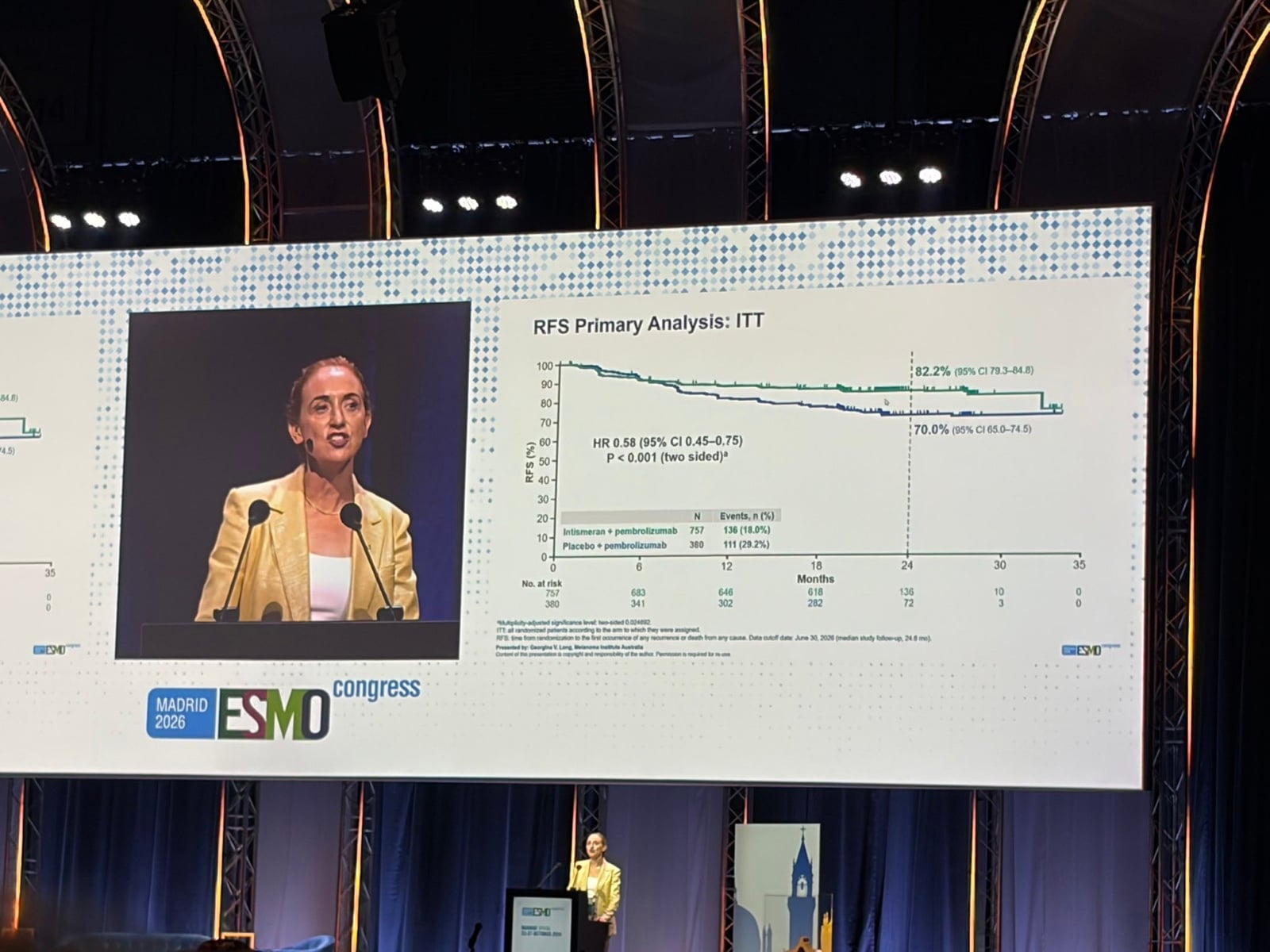
Physicians called the result positive. They debated the comparator (adjuvant pembrolizumab alone, when SWOG S1801 and NADINA moved immunotherapy before surgery), the deaths in the experimental arm, and tissue requirements.
Agreement and debate
Topline ESMO data from INTerpath-001 (#Moderna's personalized cancer vaccine) reportedly leaked elsewhere: RFS HR 0.58 (Honestly shame on people for breaking embargo’s). There is a huge divide here between physicians and non-physicians on the outcome. To me, this was huge and clearly worked. This hazard ratio puts it in the company of the most paradigm-changing adjuvant trials in oncology history. Yes, the same outcome can be generated from giving pembro in the neoadjuvant space [SWOG S1801 neoadjuvant + adjuvant pembro vs adjuvant pembro alone: EFS HR 0.58.] That isn't the point. A peptide vaccine strategy yielded the same outcome as having a tumor in vivo. This demonstrates the tech worked, now it can be applied more broadly or potentially even supercharge the neoadjuvant space with less immunogenic tumors. Time to do better and apply to more things (like colon cancer pls). #ESMO26
@OncoAlert @TheGutOncLab
View post on X ↗
🚨 #ESMO26 | Phase III INTerpath-001 🚨 After an early embargo breach, @myESMO brought the abstract release forward!!!!!! And yes, it’s clearly positive: 📉 RFS HR 0.58 📉 DMFS HR 0.62 But here’s the uncomfortable part: SWOG S1801 also reported an HR 0.58…simply by moving 3 doses of pembrolizumab BEFORE surgery… ☝🏼Not the same population. Not the same endpoint. Not a cross-trial comparison. Still, in 2026, should a personalized mRNA vaccine really be benchmarked against adjuvant pembro alone? Before calling this a new standard, I want to see the vaccine face the NEOADJUVANT era. Same HR. Different path. And that may be the real INTerpath question 👀 @OncoAlert @OncoReporte @myESMO @_SEOM @GrupoMelanoma What do you think? @SuyogCancer @OncBrothers @A_May_MD @Dr_R_Kurzrock
View post on X ↗#ESMO26 INTerpath-001 8 Grade 5 AEs in the experimental arm, 0 in the control arm. Of course, it could all be pure coincidence! After all, 6 of the 8 events were not considered TRAE Perhaps it was just the excitement of being randomized to the experimental arm? I'm genuinely curious about the independent causality assessment.
View post on X ↗#INTerpath001 amazing adjuvant melanoma trial of a personalized vaccine plus pembrolizumab. 17% of patients didn’t have sufficient tumor sample to create the neoantigen vaccine. DFS highly positive and OS immature. @oncoalert #ESMO26 excited to see other tumor data coming soon! https://t.co/VyUKabIWE2
View post on X ↗INTerpath-001 trial page · All physician posts on INTerpath-001 at ESMO 2026
Bladder cancer
VOLGA: durvalumab + 3 cycles of neoadjuvant EV, cisplatin-ineligible MIBC
Phase 3, N=695, cisplatin-ineligible or refusing. Durvalumab + EV vs control: EFS HR 0.51 (95% CI 0.38–0.67), 24-month EFS 64% vs 45%. OS HR 0.58 (0.40–0.83), 24-month OS 78% vs 69%. pCR 45% vs 10% (local review). The triplet arm with tremelimumab: EFS HR 0.61 (0.47–0.80); OS HR 0.77 (0.54–1.07), not significant. Grade 3–4 AEs 64% (durvalumab + EV), 70% (triplet), 44% (control). (ESMO 2026 LBA2, Tom Powles; data cutoff Mar 2, 2026) Investigational. FDA granted Priority Review to durvalumab + EV on September 25, 2026. (KOL Pulse VOLGA page)
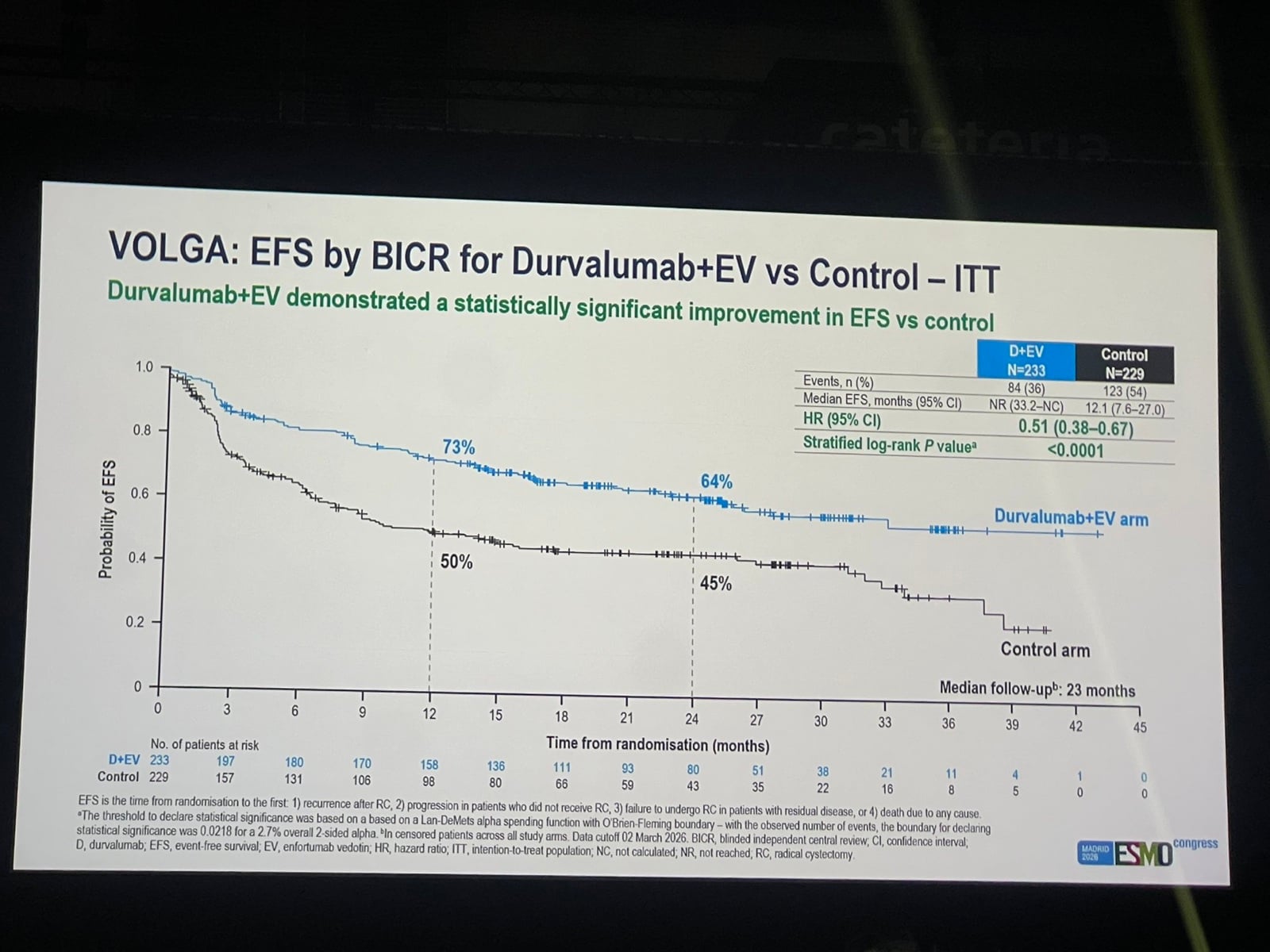
Physicians favored the doublet. The debate was the triplet’s added toxicity and how much EV is needed, since VOLGA gave no adjuvant EV.
The doublet vs the triplet
VOLGA also explored short periods of EV with duvalumab and tremelimumab in muscle invasive bladder cancer #ESMO26 @NEJM. Results showed EVDT improved EFS vs cystectomy (HR 0.61). Significant OS was not reached at this interim (HR 0.77 -ongoing analysis). EVDT = 10% higher rates of G3/4 toxicity and less EV delivery than the EV durvalumab arm. More is not always better. It appears the addition of treme partly compromised delivery of EV, which likely accounts for the more modest results compared to the doublet @OncoAlert
View post on X ↗
Kudos @tompowles1 on a fantastic #VOLGA presidential @ #ESMO26 👏 Less is More! • Cis-inelig MIBC, 25% were cis refusers
• D+EV x3 → RC → adj D x9 (NO adj EV)
• EFS HR 0.51
• OS HR 0.58
• pCR 45 vs 10%
• G3-4 TRAE 30%,
• neuropathy only 18%
• imAEs 33% (G3-4 11%)
• GHS/QoL maintained post-RC • Treme ↑tox (G3-4 42%, 5 deaths), NO OS gain. My take: it's not just about chasing bigger numbers. Tox matters too, especially when OS is achieved. Need to discuss the pros and cons with patients. Less PN and skin tox, and fewer G3+ immune AEs than more cycles and that's a win for patients ! 🙌 @Uromigos @OncoAlert @brian_rini @LosUromigos @drenriquegrande
View post on X ↗🚨 VOLGA: chemo-free durvalumab + enfortumab vedotin beat surgery alone in muscle-invasive #bladdercancer 🚨 @NEJM today 🧵1/2 👥 n=695, cisplatin-ineligible or declined MIBC 📊 Phase 3 RCT, 1:1:1 💊 Perioperative durva + EV vs durva + tremelimumab + EV vs radical cystectomy alone ⏱️ Estimates at 24 mo ✅ Durva + EV EFS 63.5% vs 45.1%, HR 0.51 (0.38-0.67), p<0.001 ✅ OS 78.4% vs 69.4%, HR 0.58 (0.40-0.83), p=0.003 ✅ Durva + treme + EV EFS HR 0.61 (0.47-0.80), but grade ≥3 AEs 79.5% vs 71.1% ⚠️ The 2 durvalumab arms were not compared head-to-head, so the CTLA-4 add is not clearly worth the added toxicity 🎯 Another cisplatin-free ADC + IO backbone for cisplatin-ineligible MIBC
View post on X ↗VOLGA trial page · All physician posts on VOLGA at ESMO 2026
KEYNOTE-866 and ENERGIZE: two negative Phase 3 trials of PD-1 + cisplatin chemotherapy
Both trials added a PD-1 inhibitor to neoadjuvant gemcitabine-cisplatin, continued after cystectomy, in cisplatin-eligible MIBC. KEYNOTE-866 (pembrolizumab, N=907): EFS HR 0.88 (95% CI 0.71–1.10), one-sided P=0.1366, not significant. OS HR 1.00 (0.79–1.27). pCR 44.4% vs 35.8%; OS and pCR were not formally tested. (ESMO 2026 4735O, Jens Bedke; data cutoff Jan 26, 2026) ENERGIZE (nivolumab, N=653): EFS HR 0.94 (0.72–1.24), P=0.6697. pCR 39.1% vs 29.6%, not significant after multiplicity adjustment. Both co-primary endpoints were missed. (ESMO 2026 4736O, Andrea Necchi; median follow-up 54.5 months) Neither regimen is approved for MIBC. NIAGARA, with durvalumab on the same chemotherapy backbone, was positive.
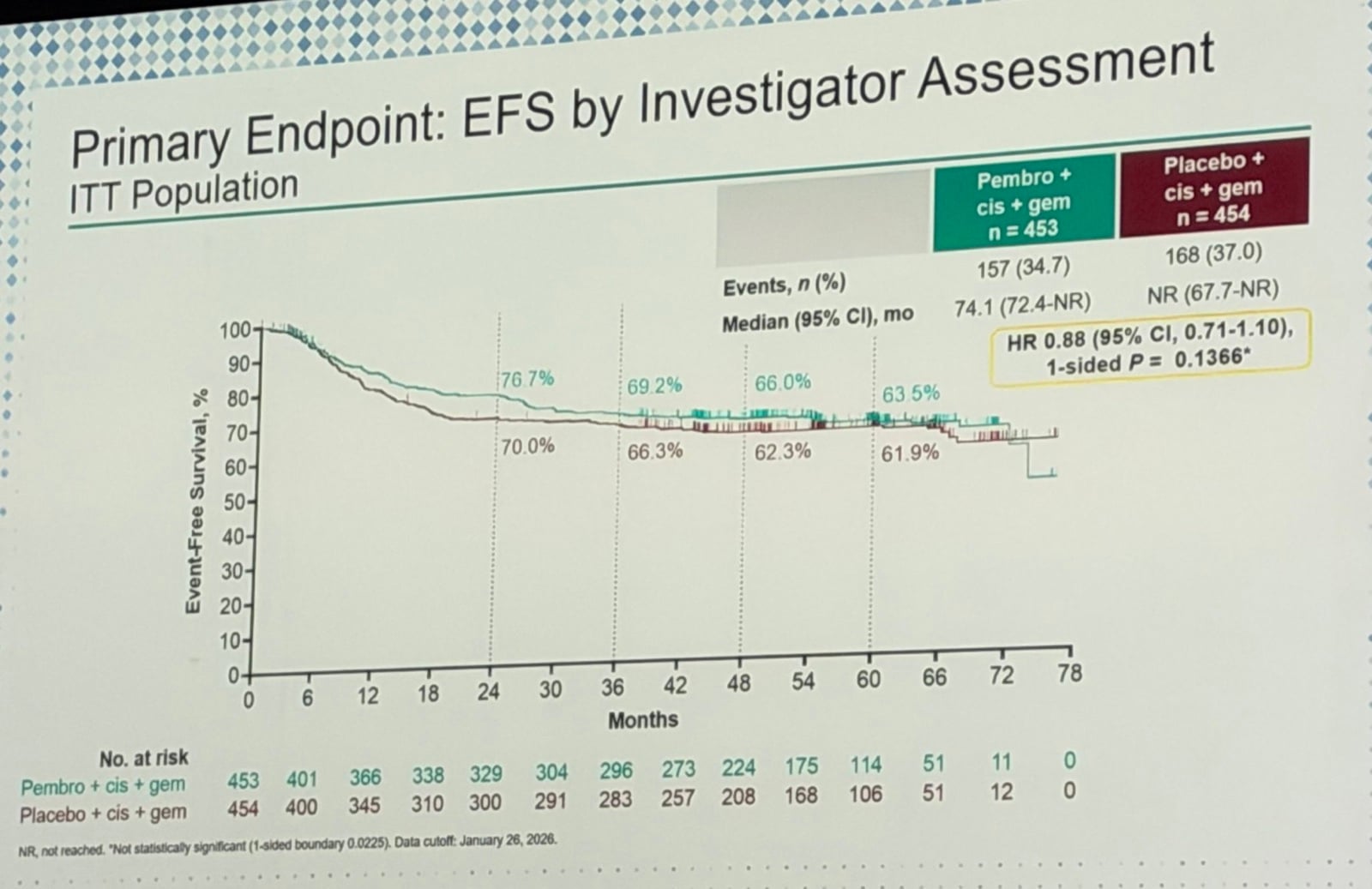
Physicians noted that higher pCR did not translate into EFS. Explanations offered for the difference from NIAGARA included control-arm outcomes and the need for biomarker selection.
Why NIAGARA and not these two?
Negative Ph.III KEYNOTE-866 by #DrJensBedke: perioperative pembrolizumab + neoadjuvant Gem/Cis vs placebo + Gem/Cis in cis-eligible MIBC. EFS HR 0.88 (95% CI 0.71-1.10), p=0.137. pCR 44.4% vs 35.8%; OS HR 1.00. Higher pCR did not translate into EFS benefit. #ESMO26 #BladderCancer @myESMO @OncoAlert
View post on X ↗Tian Zhang, MD, MHS, FASCO (@tiansterzhangmd.bsky) @TiansterZhang
GU oncologist, UT Southwestern · Oct 23
Nice comparison chart @tompowles1 — control cohorts in the #ENERGYZE & #Keynote866 trials both did much better than #NIAGARA control cohort… some may have had access to adjuvant IO to contribute to EFS? #ESMO26 @myESMO @OncoAlert https://t.co/K6ubio90xc
View post on X ↗Overall Day 1 message in bladder cancer: Not all perioperative IO strategies are equal. Adding PD-1/PD-L1 inhibitors to cisplatin-based chemotherapy has now failed in two large Phase 3 trials (KEYNOTE-866 and ENERGIZE), while EV + pembrolizumab-based approaches (and NIAGARA) have succeeded. Biomarker selection is increasingly important. @myESMO @OncoAlert @OpenMedicineHQ @tompowles1 @AndreaNecchi @Uromigos @urologysummit #ESMO26
View post on X ↗KEYNOTE-866 trial page · All physician posts on KEYNOTE-866 at ESMO 2026
ENERGIZE trial page · All physician posts on ENERGIZE at ESMO 2026
KEYNOTE-B15 / EV-304: ctDNA from the approved perioperative EV + pembrolizumab regimen
Exploratory ctDNA analysis (Signatera) presented by Jonathan Chatzkel. ctDNA clearance from baseline to surgery 82.1% vs 66.7% with EV + pembrolizumab vs gemcitabine-cisplatin. ctDNA-positive after surgery 4.8% vs 13.5%. pCR 72.4% vs 43.7% in patients ctDNA-negative before surgery, and 3.7% vs 2.2% in those still ctDNA-positive. ctDNA-positive status was associated with worse EFS in both arms. (ESMO 2026 Abstract 4734O and slides; discussant slide for pCR by ctDNA; data cutoff Oct 27, 2025) ctDNA is not validated to guide treatment. Perioperative EV + pembrolizumab has been FDA approved for MIBC since July 10, 2026, based on the trial’s EFS and OS results. (KOL Pulse KEYNOTE-B15 page)
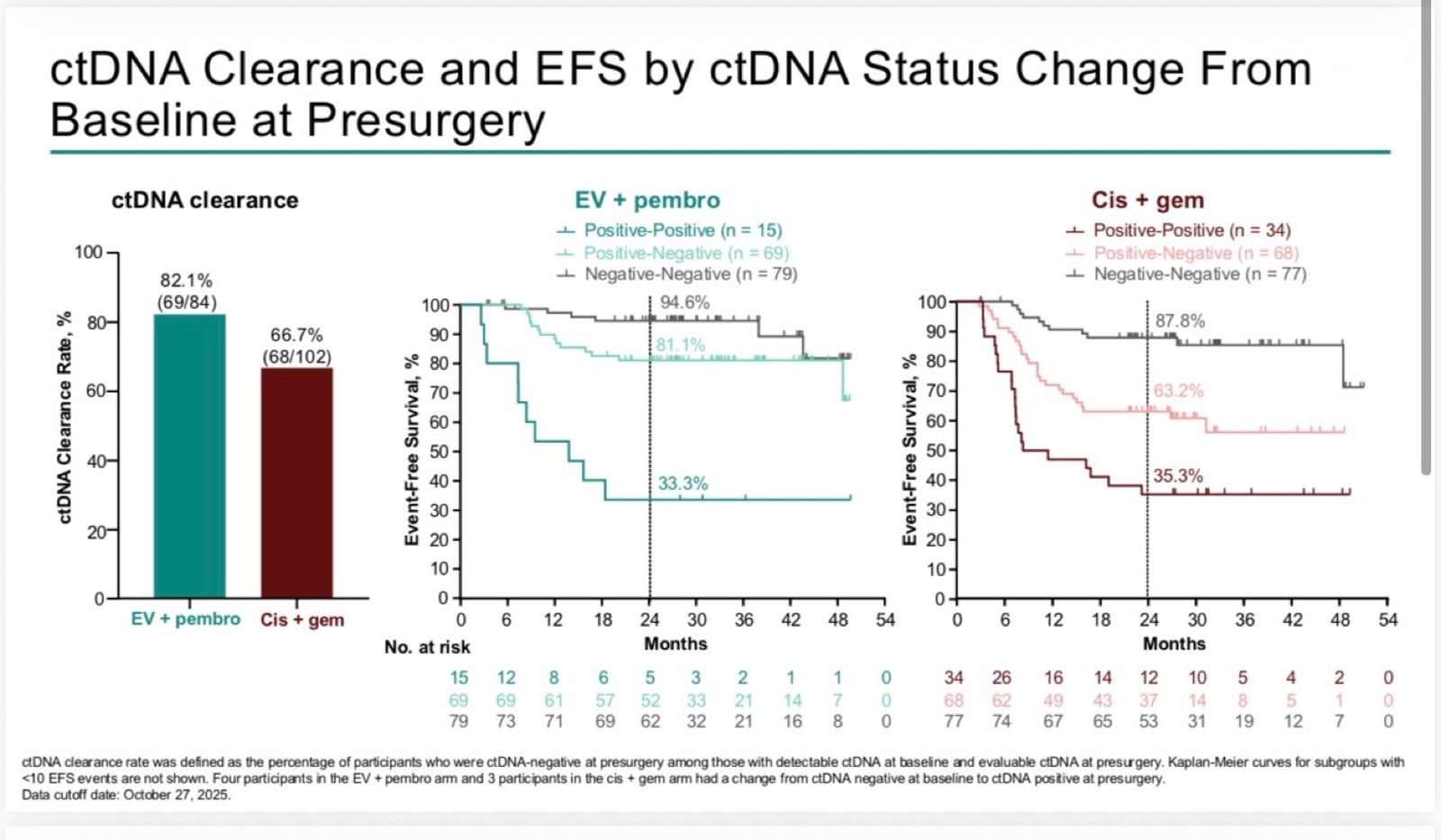
Physicians agreed ctDNA is prognostic. The open question is whether ctDNA and pCR can guide de-escalation, including adjuvant EV and bladder sparing.
Prognostic now; de-escalation later?
ctDNA analysis from the EVP vs chemotherapy muscle invasive bladder cancer trial (B15/EV304) shows ctDNA is strongly prognostic at all time points for both arms. EVP has higher clearance rates across time points, underlining its ⬆️ activity. Results for the control arm are strikingly similar to the ctDNA results in the chemo control arm in the NIAGARA trial. This consistency underlines the utility of ctDNA from a prognostic perspective.#ESMO26 @OncoAlert
View post on X ↗KEYNOTE-B15 ctDNA analysis presented by Jonathan Chatzkel at #ESMO26, with Min Teo as discussant 🧬 In cisplatin-eligible MIBC, ctDNA+ before surgery meant almost no pCR with either regimen (3.7% with EV + pembro, 2.2% with cis/gem). Among ctDNA− patients, pCR was 72.4% with EV + pembro vs 43.7% with cis/gem. In the EV + pembro arm, patients who cleared ctDNA had 24-month EFS of 81% vs 33% with persistent ctDNA+. The postsurgery results replicate NIAGARA. Serial ctDNA could open the door to bladder-sparing and surveillance questions. #MRD #ctDNA #BladderCancer
View post on X ↗🚨 Important new ctDNA data from KEYNOTE-B15 at ESMO 2026! In cisplatin-eligible MIBC, EV+pembrolizumab achieved: 🔹 82.1% ctDNA clearance during neoadjuvant treatment vs 66.7% with gemcitabine/cisplatin. 🔹 87.0% ctDNA negativity before surgery vs 80.3% with chemotherapy. 🔹 95.2% ctDNA negativity after cystectomy vs 86.5% with chemotherapy. Strikingly, only 4.8% remained ctDNA-positive after neoadjuvant EV+pembrolizumab and surgery! We know from IMvigor011 that postoperative ctDNA can identify patients at high risk of recurrence and help guide adjuvant treatment strategies. But what about patients achieving both pCR and sustained ctDNA negativity? Do they really need another 5–6 cycles of adjuvant EV, with the potential for cumulative tox/ neuropathy? Could pCR + ctDNA clearance, followed by longitudinal ctDNA monitoring, define a population suitable for treatment de-escalation? VOLGA will add another important piece to this puzzle, using only 3 neoadjuvant EV cycles without adjuvant EV. Of course, neither KEYNOTE-B15 nor VOLGA can establish the necessity of adjuvant EV through cross-trial comparisons. We urgently need prospective, biomarker-guided de-escalation trials—not simply more treatment for everyone. @OncoAlert Faculty @DrChoueiri , @tompowles1 , @apolo_andrea , @neerajaiims , @montypal , @Silke_Gillessen , @AOmlin , @brian_rini , @PGrivasMDPhD , @TiansterZhang , @amerseburger , @DrDanielHeng , @HHammersMD , @scocmem , @AndreaNecchi , @AmandaNizamMD , @drenriquegrande , @nataliagandur , @AlbigesL , @cdanicas , @declangmurphy , @seanmmcbride , @shilpaonc , @DrRanaMcKay , @scserendipity1 , @DrYukselUrun , @ravikanesvaran , @BraunMDPhD , @EfstathiouEleni , @mzugman , @crisbergerot @Markuseckstein3
View post on X ↗KEYNOTE-B15 trial page · All physician posts on KEYNOTE-B15 at ESMO 2026
Free Access · KOL Pulse Intelligence
Track oncology’s top KOLs in your specialty
Create a free account, pick the tumor types you cover, and go beyond the tweet — the intelligence pharma teams use to map influence and prepare for engagement:
- ✓Enhanced KOL profiles
- ✓Pharma influence & potential advisory-board patterns
- ✓2025 Open Payments financial analysis
- ✓Social-media sentiment & trend signals
Get free access — pick your specialty
Choose the tumor types you follow. No cost, unsubscribe anytime.
Breast cancer
NATALEE: 6-year overall survival with adjuvant ribociclib
Ribociclib + NSAI vs NSAI alone in stage II–III HR+/HER2− early breast cancer. 6-year OS 91.86% vs 89.73% (difference 2.1%); HR 0.809 (95% CI 0.661–0.989); nominal one-sided P=.019. Breast cancer–specific survival HR 0.706 (0.559–0.890). 6-year iDFS 83.23% vs 77.92%, HR 0.741 (0.646–0.849). (ESMO 2026 LBA25 abstract, Dennis Slamon; data cutoff May 15, 2026; median OS follow-up 66.5 months) Adjuvant ribociclib has been FDA approved since September 17, 2024. (KOL Pulse NATALEE page)
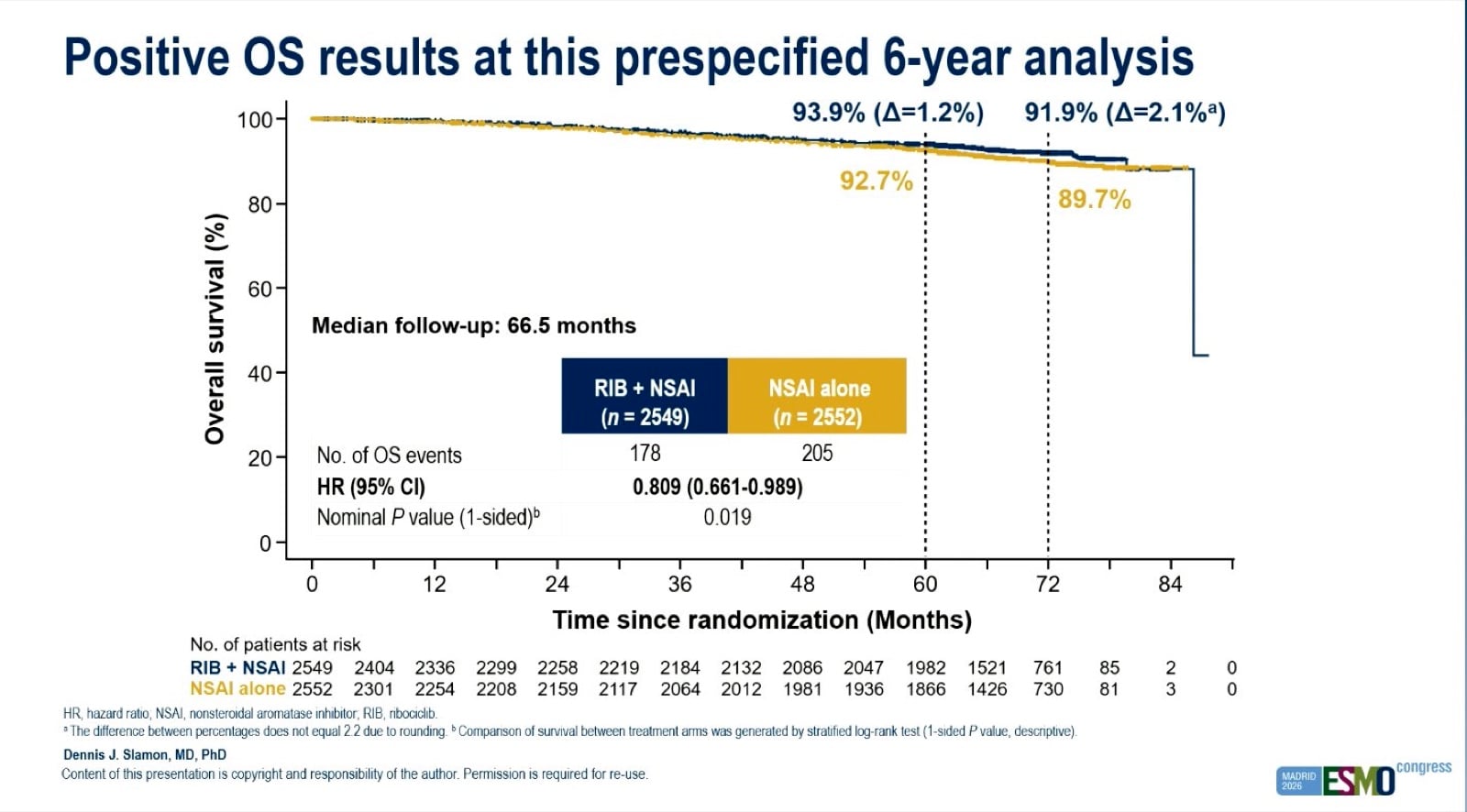
The debate was whether a 2.1-point OS difference with a nominal P value should change practice, and how much post-progression CDK4/6 inhibitor use in the control arm matters.
“Only 2%”?
Today at #ESMO26, the 6-year results of NATALEE will be presented. Ahead of the presentation, my personal view on the survival gains with adjuvant CDK4/6 inhibitors… The 6-year OS rates in NATALEE were 91.86% vs 89.73%: an absolute gain of 2.1 percentage points (HR 0.809; 95% CI 0.661–0.989; nominal one-sided p=0.019). The absolute 7-year OS gain in monarchE was 1.8 percentage points (HR 0.842; p=0.027). I do not think these gains should be dismissed as “only 2%.” In the EBCTCG analysis, adding taxanes to anthracycline-based chemotherapy—an approach we have accepted as standard for years—provided an absolute 5-year OS gain of approximately 1.9 percentage points. The populations and follow-up periods differ, so we cannot directly compare treatment efficacy. However, the standards we use to judge a few percentage points of survival benefit should be consistent. Moreover, 95.4% of patients in monarchE had already received chemotherapy. This survival gain represents an additional benefit on top of chemotherapy and endocrine therapy. Patient selection, toxicity, treatment duration, and cost certainly deserve discussion. However, the survival benefit of adjuvant CDK4/6 inhibitors in appropriately selected patients should not be underestimated.
View post on X ↗NATALEE 6-y results are out! #ESMO26 2.1 delta in survival at 6 years. Thanks @Annals_Oncology for reporting subsequent therapy data! 👉Only 44.4% of control arm patients with distant recurrence received a first-line CDK4/6i Does this survival difference truly inform clinical practice in settings where CDK4/6i are standard of care for metastatic disease? In my opinion, the answer is no.
View post on X ↗
NATALEE: OS data Adjuvant ribociclib in ER+ breast cancer 6 yr OS HR 0.809 (delta 2.1%) BCSS: 0.706 (delta 2.6%) 6 yr iDFS HR 0.741 (delta ~5%) DDFS: HR 0.744 @OncoAlert #ESMO26
View post on X ↗NATALEE trial page · All physician posts on NATALEE at ESMO 2026
PANKU-Breast01: iza-bren vs chemotherapy in pretreated HR+/HER2− disease
Phase 3, N=383, conducted in China: iza-bren (izalontamab brengitecan, an EGFR×HER3 bispecific ADC) vs physician’s-choice chemotherapy. PFS by BICR 8.18 vs 4.01 months, HR 0.41 (95% CI 0.33–0.53), P<0.0001. ORR 40.5% vs 20.2%. OS immature. ILD in 2 patients (1.1%), grade 1–2. (ESMO 2026 LBA50 abstract, Bo Lan; data cutoff Jul 21, 2026) Grade ≥3 TRAEs 85.3% vs 65.8%; dose reductions 64.7% vs 28.5%; grade ≥3 neutropenia 53.7%, anemia 49.5%, thrombocytopenia 46.3% with iza-bren. (LBA50 slides) Iza-bren is investigational and not FDA approved in any indication.
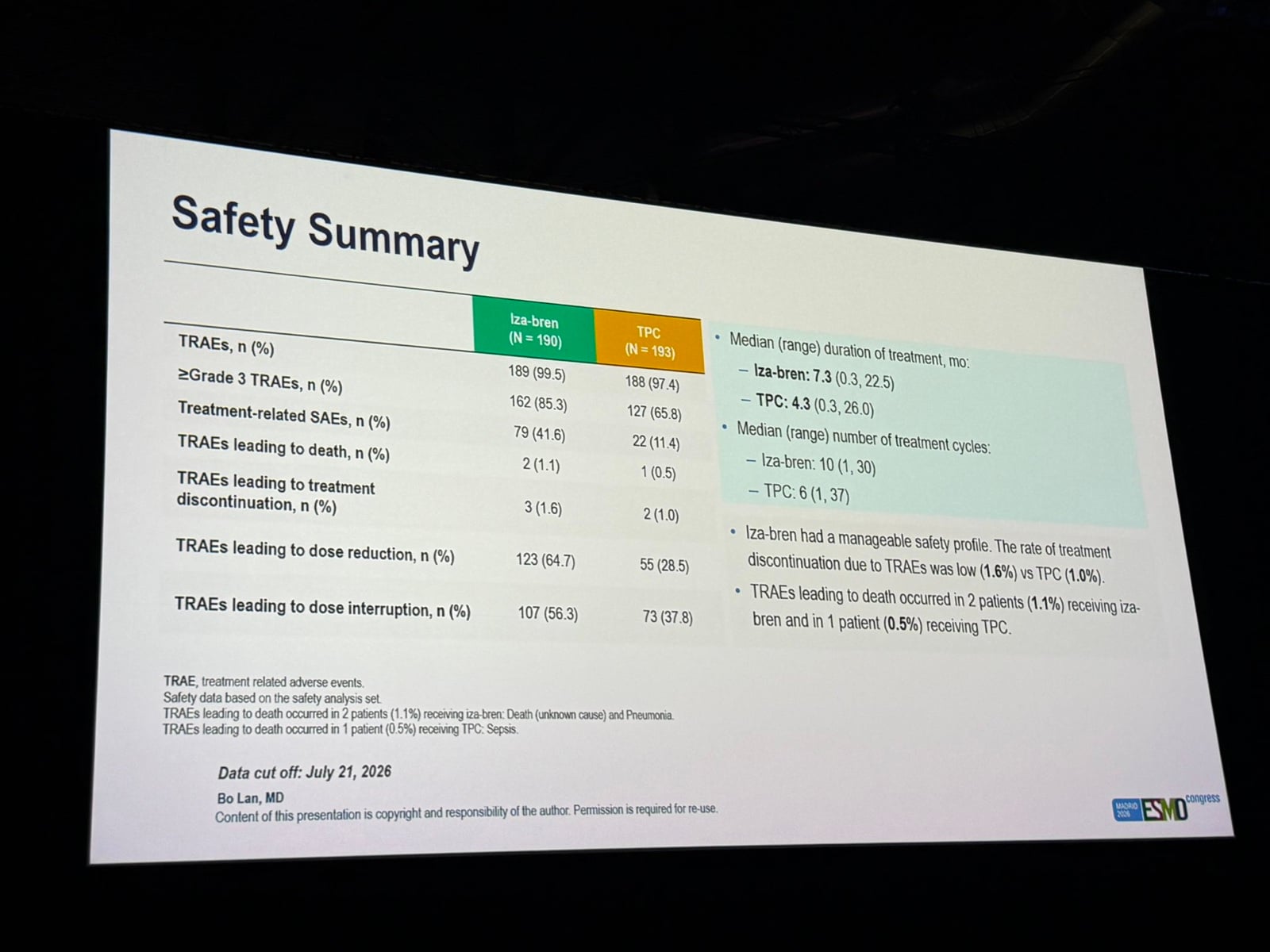
Physicians noted the PFS and response gains. The questions were hematologic toxicity and what comes next in sequencing.
Efficacy vs hematologic toxicity
Erika Hamilton, MD, FASCO @ErikaHamilton9
breast oncologist, Sarah Cannon Research Institute · Oct 23
#PANKUBreast01 Ph III results for iza bren (bispecific EGFR/HER3 ADC) vs TPC chemo, in previously treated HR +/HER- MBC 🔹mPFS: 4.0 vs. 8.1 mo, HR 0.41 🔹 ORR: 20% vs 40% 🔹 DoR: 4.2 vs. 6.9 mo 🔹 ILD: only 1.1% & all grade 1/2 #ESMO26 #ESMOAmbassadors https://t.co/ikHLXiLHX1
View post on X ↗🇨🇳 PANKU-Breast01: the HER3-EGFR bispecific TOPO1 ADC Iza-Bren improved PFS vs chemo in HR+/HER2- MBC (OS immature). High rate of hematologic toxicity, with ~50% G3+ anemia, neutropenia and thrombocytopenia, and most patients requiring dose reductions⚠️. #ESMO26 #ESMOAmbassadors https://t.co/f1zn2X0bpe
View post on X ↗#ESMO2026 Panku-breast01 Izabren sig. improves PFS in met HR+HER2 post CDK4i #BreastCancer 👏New targets 🎈impressive ORR too ➡️broadly comparable to DB04 - here all HER2 But 🎈haem tox Still have the what next issue 🤷🏻♀️ Online publication in @TheLancetOncol #ESMOAmbassadors #bcsm @OncoAlert @myESMO
View post on X ↗PANKU-Breast01 trial page · All physician posts on PANKU-Breast01 at ESMO 2026
TALENT: neoadjuvant T-DXd in HR+/HER2-low early breast cancer
Phase 2, 132 patients, three arms: T-DXd alone, T-DXd + anastrozole, or T-DXd followed by docetaxel-cyclophosphamide. pCR (RCB0) 7% (3/45), 3% (1/29) and 9% (5/58). RCB0/1 16%, 17% and 17%. Grade ≥3 treatment-related AEs 24%, 17% and 28%; 3 cases of grade 2 ILD; 1 treatment-related death in the T-DXd-alone arm. (ESMO 2026 LBA23 slides, Sara A. Hurvitz) Neoadjuvant T-DXd is investigational. Enhertu is FDA approved in HER2-low breast cancer only for unresectable or metastatic disease. (KOL Pulse TALENT page)
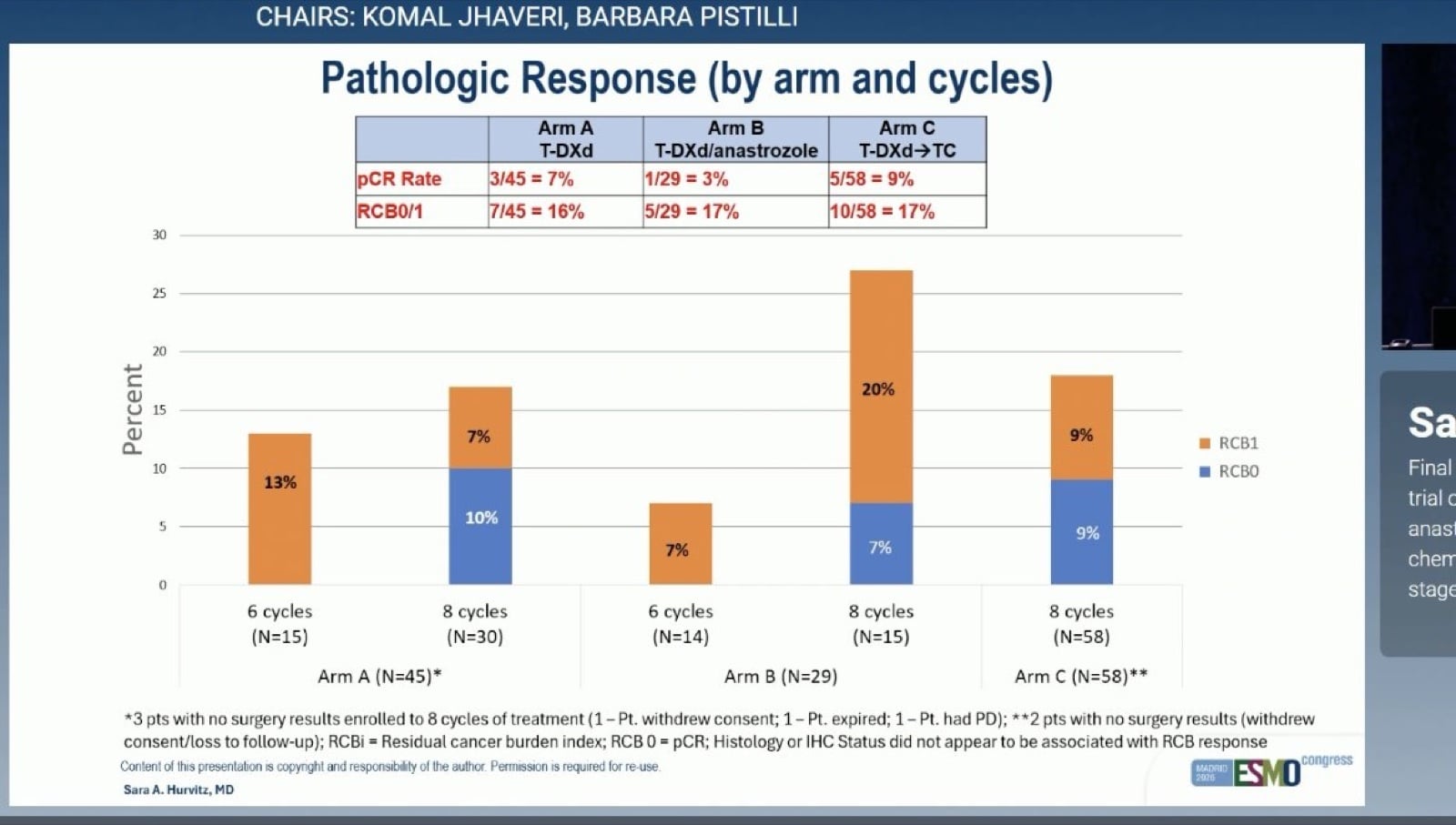
Physicians called the pCR rates low. One noted that pCR is a limited surrogate endpoint in HR+ disease.
High response, low pCR
#ESMO26 | TALENT Neoadjuvant T-DXd showed very low pCR rates in HR+/HER2-low early breast cancer: - T-DXd: 7% - T-DXd + anastrozole: 3% - T-DXd → chemotherapy: 9% We should remember that pCR is a limited surrogate endpoint in HR+ disease. However, these results do not support T-DXd as an alternative to standard neoadjuvant chemotherapy. Moreover, given the heterogeneity of HER2-low disease, I find it unsurprising that the success of T-DXd in the metastatic setting does not translate into similar outcomes in early-stage disease, despite the lower tumor burden.
View post on X ↗Erika Hamilton, MD, FASCO @ErikaHamilton9
breast oncologist, Sarah Cannon Research Institute · Oct 23
TALENT- neoadj T-DXd in HR+/HER2-low #bcsm RCB0/1: 🔹 T-DXd alone: 16% 🔹 T-DXd + anastrozole: 17% 🔹 T-DXd → TC chemo: 17% *no pCRs w/out 8 cycles Despite high ORR ~66%, pCR LOW! We know w/ HR+ we don't get high pCRs rates, but still disappointing #ESMO26 #ESMOAmbassadors https://t.co/smlF5DmAAt
View post on X ↗TALENT trial presented by Sara Hurvitz: Preop TDXd in HR+ HER2-low breast cancer Preop TDXd: 7% TDXd+AI: 3% TDXd-->TC: 9% Adding endocrine therapy and sequencing chemo with TDXd didn't seem to improve pCR @OncoAlert #ESMO2026 https://t.co/dArlOO4Mpa
View post on X ↗TALENT trial page · All physician posts on TALENT at ESMO 2026
GI cancers
SANO: active surveillance vs esophagectomy after clinical complete response
Phase 3 stepped-wedge, cluster-randomized trial, N=309, after neoadjuvant chemoradiotherapy. 5-year OS 50% with active surveillance vs 54% with surgery, HR 1.17 (95% CI 0.77–1.77), not significantly different; the confidence interval is wide and equivalence was not formally shown. DFS HR 1.39 (0.94–2.06). 5-year distant metastases 46% vs 29%, P<.01. 85 of 198 patients (43%) under surveillance were spared esophagectomy; the slide labels this figure hypothetical. (ESMO 2026 LBA78 abstract and slides; median follow-up 76 months) SANO tests a treatment strategy, not a drug.
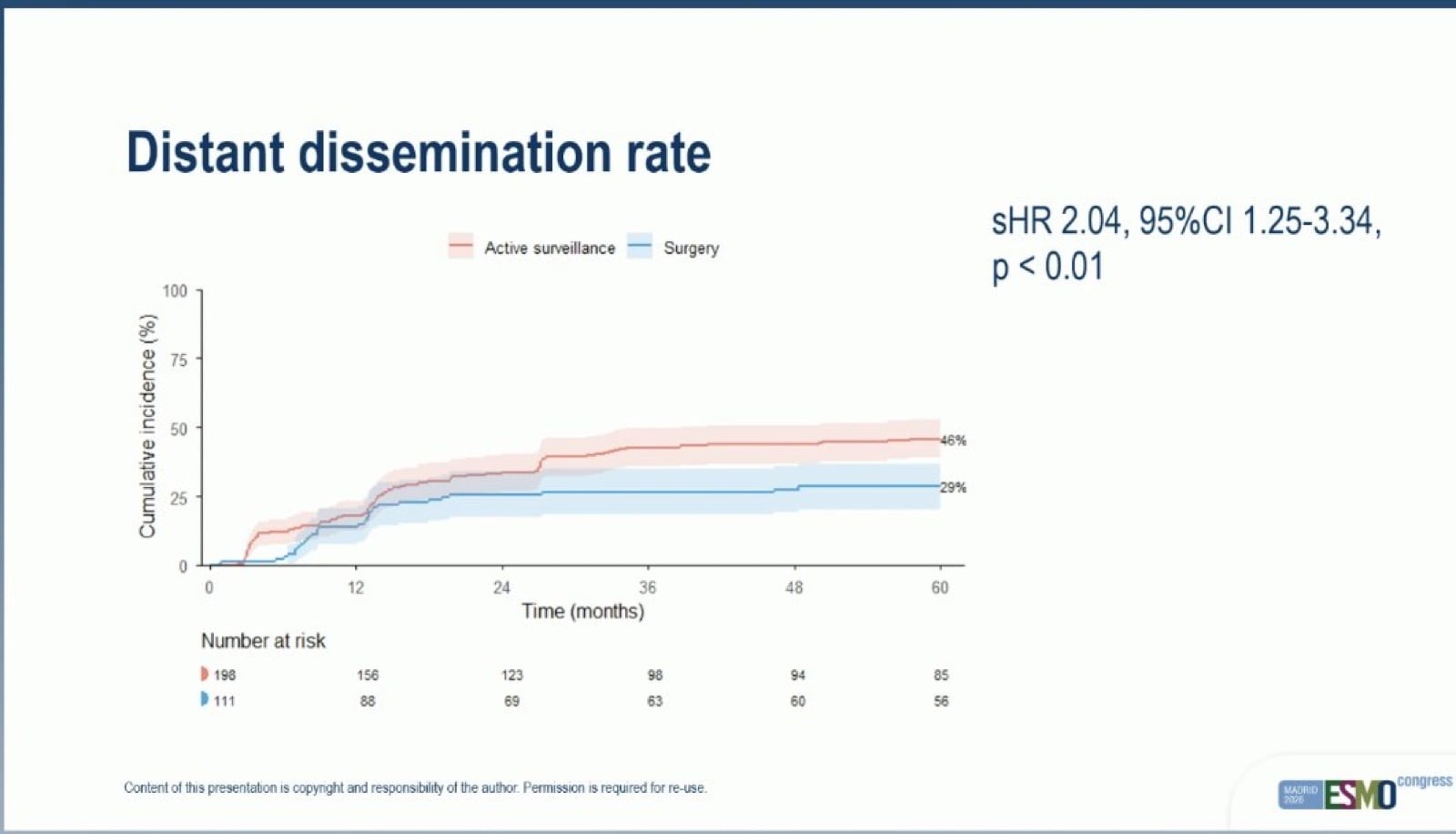
Physicians focused on the distant-metastasis signal, the wide confidence intervals and the 41.4 Gy preoperative radiation dose.
Similar OS, more distant metastases
🚨SANO 5y: surveillance vs surgery after cCR OS 50% vs 54% (NS) Distant mets 46% vs 29% (P<.01) Reminder: only 41.4 Gy/23 fx, a pre-op, arguably non-definitive dose, especially with/ ~75% adenocarcinoma. Nonsignificant OS doesn't establish noninferiority. #ESMO26 #RadOnc #OncTwitter
View post on X ↗Daisuke Kotani, MD, Ph.D 小谷 大輔 @DaisukeKotani
GI medical oncologist, National Cancer Center Hospital East · Oct 23
#ESMO26 | LBA78 Long-term results from SANO: Active surveillance vs standard surgery after nCRT in EC ▪️5y-OS: 50% vs 54%, HR 1.17 (95% CI 0.77-1.77) ▪️DFS: HR 1.39 (95%CI 0.94-2.06) ▪️5y-distant mets: 46% vs 29%, p<0.01 👉Despite no significant OS or DFS differences, the wide CIs and significantly higher distant mets rate highlight important challenges for implementing active surveillance in clinical practice. Looking forward to the presentation! @myESMO @OncoAlert
View post on X ↗🔥 SANO 5-year results🔥 Esophagus cancer 👥 309 pts with cCR after nCRT 🔍 Surveillance vs surgery ✅ 5y OS: 50% vs 54% (HR 1.17) ⚠️ Distant mets: 46% vs 29% (P<.01) 💥 43% organ preservation Active surveillance remains a feasible strategy albeit we must recognize the DM risk despite no OS difference. Perhaps TNT, like D-FLOT ➡️CRT with subsequent AS for cCR may be an optimal next strategy to test. Improved response assessment strategies also needed #ESMO26
View post on X ↗What to watch, Days 3–5
- Regulatory next steps: VOLGA’s durvalumab + EV is under FDA Priority Review. Amgen will engage regulators with the DeLLphi-305 interim data. Merck and Moderna plan to engage regulators on filings for intismeran.
- Follow-up data: INTerpath-001 OS is immature. PANKU-Breast01 OS is immature.
- Physician discussion on DASL-HiCaP, FOURLIGHT-1 and KEYNOTE-B49, and new readouts through October 27, on the ESMO 2026 trials page.
FAQ
Which ESMO 2026 trials did physicians discuss most on Days 1-2?
By physician posts on X on October 23-24, the most-discussed trials included DeLLphi-305, INTerpath-001, VOLGA, KEYNOTE-866, NATALEE, ENERGIZE, KEYNOTE-B15, PANKU-Breast01, TALENT and SANO.
What did DeLLphi-305 show?
Adding tarlatamab to durvalumab as first-line maintenance in extensive-stage small cell lung cancer improved median OS from 12.7 to 21.1 months (HR 0.42, 95% CI 0.32-0.54) at a prespecified interim analysis (ESMO 2026 LBA3). The first-line combination is investigational; tarlatamab is FDA approved after platinum chemotherapy.
Is the INTerpath-001 vaccine approved?
No. Intismeran autogene is investigational. INTerpath-001 showed RFS HR 0.58 (95% CI 0.45-0.75) with adjuvant pembrolizumab; OS is immature (HR 0.77, P=0.33).
Why were KEYNOTE-866 and ENERGIZE negative?
Both added a PD-1 inhibitor to neoadjuvant gemcitabine-cisplatin and missed EFS (HR 0.88 and 0.94) despite higher pCR. Physicians on X pointed to control-arm outcomes, patient selection and biology. These are cross-trial observations, not head-to-head results.
Does NATALEE show an overall survival benefit?
At 6 years, OS was 91.86% vs 89.73% (HR 0.809, 95% CI 0.661-0.989) with a nominal one-sided P=.019. Physicians disagreed on how much weight to give it. Adjuvant ribociclib has been FDA approved since September 17, 2024.
KOL Pulse tracks what oncologists and hematologists post on X. Posts quoted here are shown in full, verbatim, and link to their source. Trial figures come from KOL Pulse trial pages, with the source and data cutoff in parentheses.