Brian Shields
Pre #esmo26 poll 🙂
Which one of the following trial will get standing ovation during esmo 2026 @myESMO
What u think? @dr_yakupergun @OncBrothers . Any other trial ? Put it in comments 🙂 @KolPulseAI
View post on X ↗
KOL Pulse · ESMO 2026 · Madrid, October 23–27
The ESMO 2026 Debates
Through day 2 of ESMO 2026, the most active physician threads on X were arguments, not applause: whether INTerpath-001 (RFS HR 0.58) beats what neoadjuvant immunotherapy already does, whether NATALEE's 6-year OS (HR 0.809, nominal one-sided P=0.019) counts as a survival win, whether three HER2 TOP1 ADCs are me-too drugs, and why higher pCR in two bladder trials did not move EFS. Every post below is verbatim and linked.
Before Madrid: who gets the standing ovation?
On October 19 an oncologist asked which ESMO 2026 trial would get a standing ovation. The replies ranged from comparator and endpoint questions to skepticism about standing ovations themselves.
The pre-ESMO poll
↳ replying to @SuyogCancer
I’d applaud these trials, but I’d remain seated 😅😅
INTerpath-001 is an innovative treatment approach. However, there is no comparison with neoadjuvant nivo + ipi, a strong option particularly in macroscopic stage III melanoma.
DeLLphi-305 showed a survival benefit with maintenance tarlatamab + durvalumab. But the comparator is durvalumab monotherapy. We also have positive results from IMforte with maintenance atezo + lurbinectedin. So this is another potential maintenance option; its place among the existing options remains to be defined.
In HARMONi-GI1, even if not one but three trucks could fit between the Kaplan–Meier curves, global validation will still be expected because the trial was conducted exclusively in China 🫣
For me, VOLGA’s most interesting feature is the omission of adjuvant EV. As for the survival benefit of perioperative EV + immunotherapy, we already have strong data.
View post on X ↗↳ replying to @dr_yakupergun
@dr_yakupergun @SuyogCancer @myESMO @KolPulseAI I second that! All these will be practice changing but not sure about standing ovation (unless Interpath data is so provocative…)
View post on X ↗↳ replying to @SuyogCancer
@SuyogCancer @KolPulseAI @myESMO @dr_yakupergun @OncBrothers Depends on where the sales reps are. We need to stop doing this.
View post on X ↗On October 24 STAT reporter Adam Feuerstein, in the room for the INTerpath-001 presentation, posted: “Limited standing O, extended applause.” (journalist, context)
INTerpath-001: the vaccine vs. moving pembrolizumab before surgery
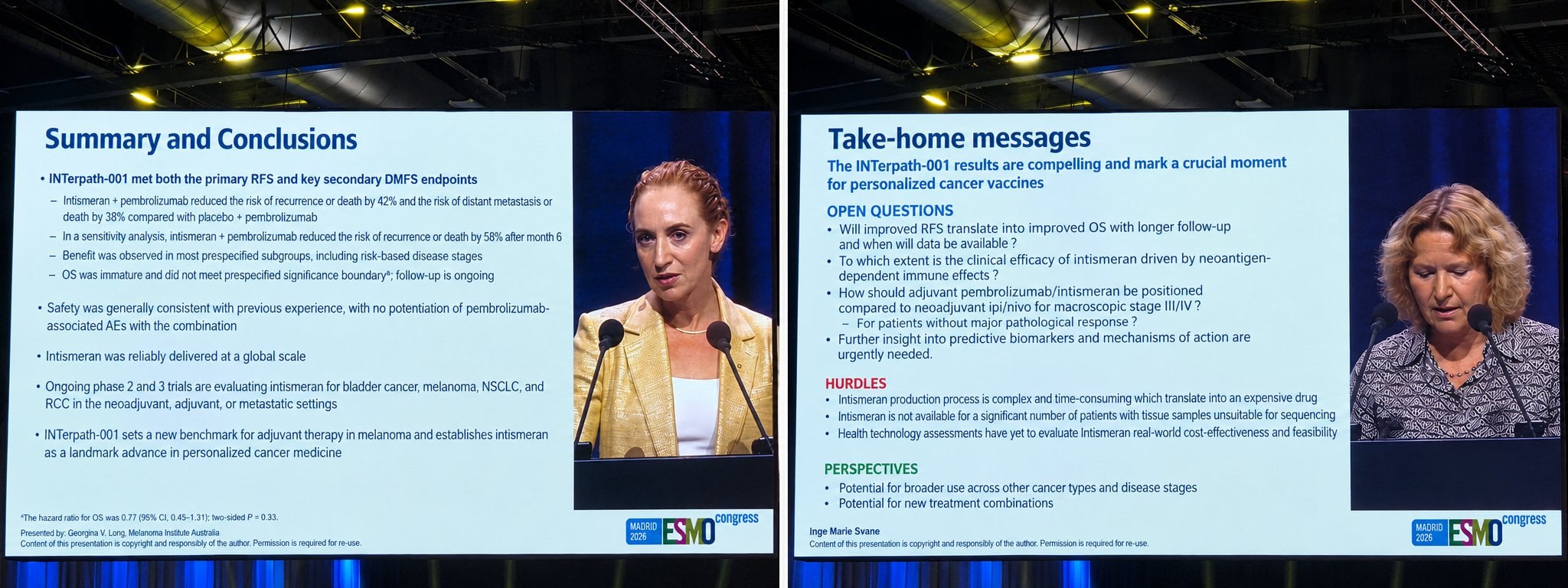
INTerpath-001 is the phase 3 trial of adjuvant intismeran autogene (V940/mRNA-4157, Moderna and Merck) plus pembrolizumab vs placebo plus pembrolizumab in resected stage IIB–IV melanoma. RFS HR 0.58 (95% CI 0.45–0.75); 24-month RFS 82.2% vs 70.0%. DMFS HR 0.62 (95% CI 0.45–0.85). OS was immature: HR 0.77 (95% CI 0.45–1.31), two-sided P=0.33. (ESMO 2026 LBA1, Georgina V. Long; data cutoff Jun 30, 2026) Intismeran is investigational. The argument started when the abstract posted on October 22: SWOG S1801, which moved pembrolizumab before surgery and compared it with adjuvant pembrolizumab, also reported an EFS HR of 0.58. (KOL Pulse INTerpath-001 page)
Patrick Forde's post, and the neoadjuvant question
These results with adjuvant Moderna personalized vaccine added to pembro for melanoma look good to me, and are a positive indicator for the adjuvant and perioperative lung cancer trials. #LCSM https://t.co/Ip7pevw91P
View post on X ↗↳ replying to @FordePatrick
@FordePatrick NADINA HR 0.4
SWOG 1801 HR.58
- few doses of neoadj IO while primary is intact appears to be way better than jumping through the hoops to make individualized neoantigen vaccines on top of adj IO.
View post on X ↗Context: NADINA tested neoadjuvant ipilimumab + nivolumab and SWOG S1801 tested neoadjuvant pembrolizumab. NADINA’s EFS hazard ratio was 0.32 (99.9% CI 0.15–0.66) at the primary analysis (Blank et al, NEJM 2024; the figure on the discussant’s slide) and 0.40 (95% CI 0.28–0.57) at the 2-year update (ESMO 2025, LBA57).
↳ replying to @RenoHemonc
@RenoHemonc Likely the best approach will ev neoadjuvant IO and then create the vaccine from any residual tumor that is remaining. I see this result as proof of concept, remembering the many vaccine trials that have enrolled 1000s of pts without ultimate benefit. This is different.
View post on X ↗↳ replying to @FordePatrick
@FordePatrick Don’t think MRNA will risk running that trial
View post on X ↗↳ replying to @RenoHemonc
@RenoHemonc The phase 3 post neoadjuvant is already ongoing in nsclc https://t.co/SmwIRfBrcf
View post on X ↗↳ replying to @FordePatrick
@FordePatrick To a barber, hair cuts look good
To a plumber, installing new pipes look good
To a roofer: you need a new roof!
To a medical oncologist, more drugs always look good. 😉
What does this vaccine add vs neoadjuvant pembro here?
View post on X ↗↳ replying to @FordePatrick
@FordePatrick melanoma👍, colorectal👎, lung tbd https://t.co/if9CrcpE3P
View post on X ↗The counterpoint: different patients
Yago Garitaonaindía @YGaritaonaindia
medical oncologist; translational research fellow, Copenhagen · Oct 23
Some thoughts on the INTerpath-001 backlash, and the simplistic "neoadjuvant already does better, so why bother" take. I think it misses a few important things.
➡️ First, the neoadjuvant data (S1801, NADINA) come from patients with macroscopic, clinically detectable nodal disease. INTerpath-001 also includes node-negative IIB/IIC and patients whose nodal disease only showed up on sentinel node biopsy. In the big SLN trials, about two thirds of SLN+ patients had deposits ≤1 mm. None of these patients are neoadjuvant candidates. We see the same confusion in #NSCLC all the time, when people compare stage IIIA from adjuvant trials (pathological staging) with stage IIIA from neoadjuvant trials (clinical staging). Same stage on paper, not the same patients.
➡️ Second, INTerpath-001 was designed before NADINA read out, when adjuvant anti-PD-1 was still the default for resected stage III. Judging it against today's practice is a bit of hindsight.
➡️ Third, I suspect the most logical place for a neoantigen vaccine is after neoadjuvant ICI in patients who don't reach pCR. INTerpath-009 is already testing exactly this in NSCLC, so we'll get some hints there.
➡️ And all of this comes with only an absolute ~3% increase in grade ≥3 toxicity, which also belongs in the balance.
For macroscopic stage III, the critique lands. I want to see the full data and the stage breakdown at LBA1. But I'd be careful firing at this result before we've even seen it properly.
@OncoAlert @Larvol @KolPulseAI @_SEOM @myESMO
#Melanoma #ESMO26
View post on X ↗↳ replying to @YGaritaonaindia
@YGaritaonaindia It’s not a hindsight, S1801 primary results were published in NEJM in March 2023, before INTerpath-001 began. They could have done if they wanted it
View post on X ↗↳ replying to @QuaestorFi
Yago Garitaonaindía @YGaritaonaindia
medical oncologist; translational research fellow, Copenhagen · Oct 23
When INTerpath-001 opened, neoadjuvant pembro had only one randomized phase 2 behind it. The phase 3 evidence came later with NADINA. Adjuvant pembro was a justified control arm. Evidence often moves faster than trials, that's everyday oncology. But I insist, it only applies to macroscopic disease, not to IIB-IIC or cN0 stage III.
View post on X ↗↳ replying to @YGaritaonaindia
@YGaritaonaindia Great post as always Yago…
There is nuance here but also a lot of the market leading the medicine
Let’s not put the cart before the horse
View post on X ↗↳ replying to @scserendipity1
Yago Garitaonaindía @YGaritaonaindia
medical oncologist; translational research fellow, Copenhagen · Oct 23
@scserendipity1 Thanks Simon! 100% agree with you. I've been discussing this with colleagues…The medical conversation and timing are being set by stock analysts rather than cancer researchers.
View post on X ↗Eric D Whitman, MD @Melanoma_doctor
surgical oncologist, melanoma/IO specialist; INTerpath-001 investigator (per his post) · Oct 23
Sad that the @myESMO embargo was broken...
It is difficult to compare results between an adjuvant study and a neoadjuvant study (ie, S1801) in any cancer, including #melanoma. The patient populations were different and the primary endpoint (RFS vs EFS) was of necessity different for technical reasons that as @adamfeuerstein points out don't translate well to this platform. Until tomorrow's presentation we won't have all the data necessary to even try and compare.
It is also important to note that NO drugs are technically @FDA approved for neoadjuvant treatment for melanoma. It's a moot point as several studies including S1801 and NADINA have made neoadjuvant therapy standard of care in some situations.
I think it's great that the study (that I participated in) appears to have hit its primary endpoint, which typically ultimately translates into FDA approval.
Tomorrow (1030 ET) will be interesting...
View post on X ↗The discussant, Inge Marie Svane of the University of Copenhagen, raised the same questions on stage (slide above). Feuerstein described her tone as “measured.” (journalist, context)
Unresolved: No trial has compared intismeran with neoadjuvant immunotherapy. INTerpath-009 (NSCLC) tests the vaccine after neoadjuvant treatment. OS is immature.
Free Access · KOL Pulse Intelligence
Track oncology’s top KOLs in your specialty
Create a free account, pick the tumor types you cover, and go beyond the tweet — the intelligence pharma teams use to map influence and prepare for engagement:
- ✓Enhanced KOL profiles
- ✓Pharma influence & potential advisory-board patterns
- ✓2025 Open Payments financial analysis
- ✓Social-media sentiment & trend signals
Get free access — pick your specialty
Choose the tumor types you follow. No cost, unsubscribe anytime.
NATALEE: is a nominal p-value an OS win?
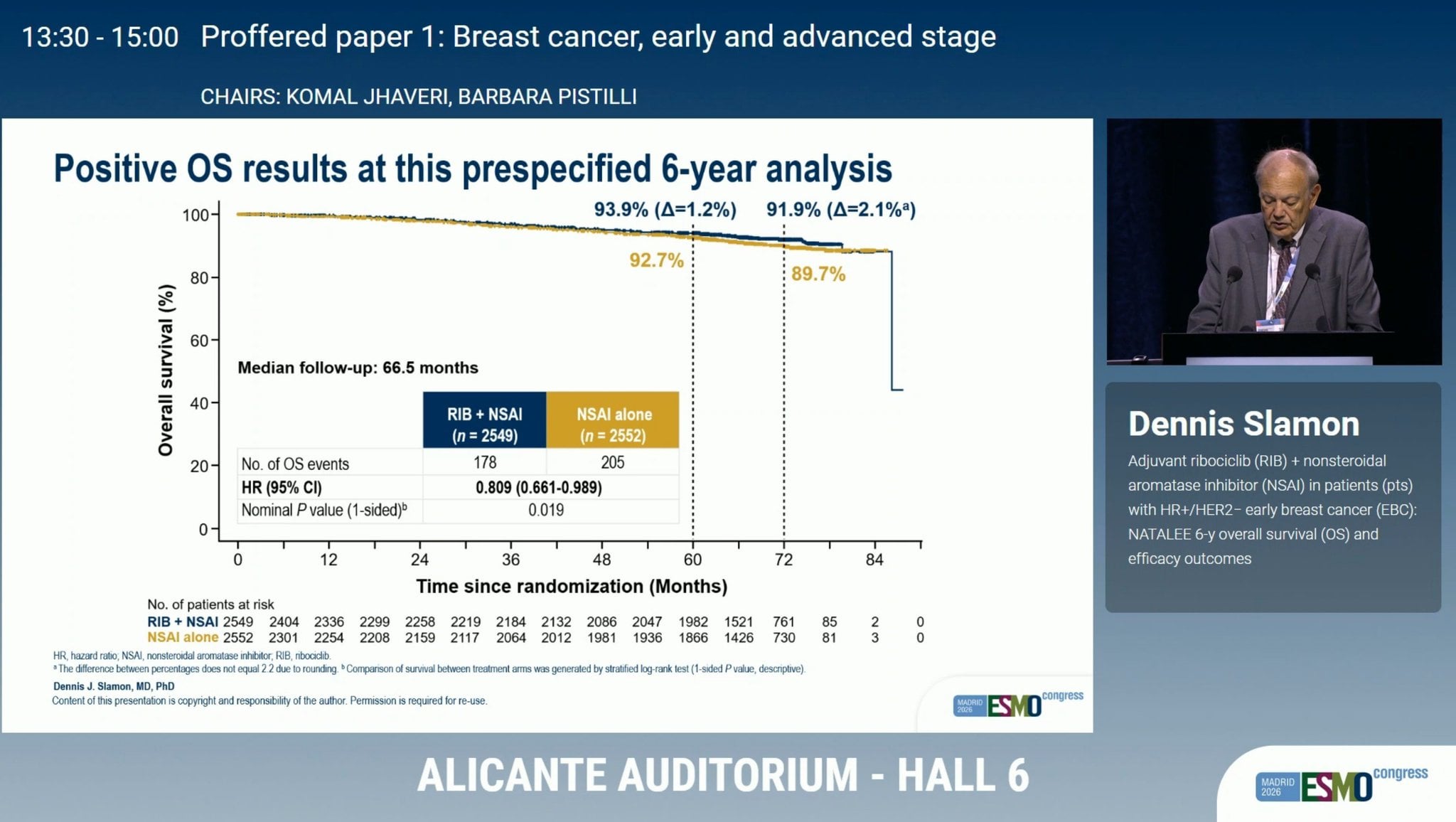
NATALEE tested 3 years of ribociclib plus a nonsteroidal aromatase inhibitor vs NSAI alone in stage II–III HR+/HER2− early breast cancer (n=5,101). 6-year OS 91.9% vs 89.7% (difference 2.1%); 178 vs 205 deaths; HR 0.809 (95% CI 0.661–0.989); nominal one-sided P=0.019. The slide footnote calls the P value descriptive. Median follow-up 66.5 months. (ESMO 2026 LBA25, Dennis Slamon; data cutoff May 15, 2026) 6-year iDFS HR 0.741 (95% CI 0.646–0.849). (LBA25 abstract) Adjuvant ribociclib has been FDA approved since September 17, 2024; this readout does not change that.
“Is this OS statistically significant?”
Today at #ESMO26, the 6-year results of NATALEE will be presented. Ahead of the presentation, my personal view on the survival gains with adjuvant CDK4/6 inhibitors…
The 6-year OS rates in NATALEE were 91.86% vs 89.73%: an absolute gain of 2.1 percentage points (HR 0.809; 95% CI 0.661–0.989; nominal one-sided p=0.019).
The absolute 7-year OS gain in monarchE was 1.8 percentage points (HR 0.842; p=0.027). I do not think these gains should be dismissed as “only 2%.”
In the EBCTCG analysis, adding taxanes to anthracycline-based chemotherapy—an approach we have accepted as standard for years—provided an absolute 5-year OS gain of approximately 1.9 percentage points. The populations and follow-up periods differ, so we cannot directly compare treatment efficacy. However, the standards we use to judge a few percentage points of survival benefit should be consistent.
Moreover, 95.4% of patients in monarchE had already received chemotherapy. This survival gain represents an additional benefit on top of chemotherapy and endocrine therapy.
Patient selection, toxicity, treatment duration, and cost certainly deserve discussion. However, the survival benefit of adjuvant CDK4/6 inhibitors in appropriately selected patients should not be underestimated.
View post on X ↗↳ replying to @dr_yakupergun
@dr_yakupergun Is this OS statistically significant? 🤔
View post on X ↗↳ replying to @SuyogCancer
We can wait an hour or two to hear the study authors’ answer, but my personal view is as follows:
Absolute benefits in NATALEE become more apparent over time: within the same data cut, the OS difference increases from 1.2 percentage points at 5 years to 2.1 points at 6 years, while the iDFS difference increases from 4.1 to 5.3 points. Breast cancer–specific survival findings also support this pattern. Given that recurrences and subsequent deaths in HR-positive disease extend over many years, early OS differences should not be viewed as the limit of a treatment’s overall contribution.
The statistical distinction needs to be clear. OS is a secondary endpoint in NATALEE, and a confirmatory testing strategy controlling the overall type I error across multiple endpoints and repeated OS analyses was not prespecified. In monarchE, OS was assessed against a prespecified significance boundary accounting for repeated analyses. I wish NATALEE had included a similar framework for OS.
However, saying “the p value is nominal, therefore the OS result is not significant” is also an oversimplification. The 6-year OS analysis shows nominal statistical significance: HR 0.809; 95% CI 0.661–0.989; one-sided nominal p=0.019. This does not carry the same evidentiary weight as a multiplicity-adjusted, confirmatory OS result, but it does not invalidate the observed survival difference either. The emergence of an OS benefit with longer follow-up in monarchE illustrates why time matters in this disease.
I consider a 2.1-percentage-point absolute OS benefit at 6 years clinically meaningful in this study population. Although there is no head-to-head comparison, I believe abemaciclib and ribociclib may provide long-term benefits of a similar magnitude in appropriately selected populations. This is my interpretation of the available evidence, rather than a demonstrated equivalence.
We can certainly discuss NNT, censoring, numbers at risk, uncertainty around the estimates, toxicity, and treatment burden. But if we reduce our assessment to whether a p value crosses a threshold, we risk overlooking clinically valuable gains—particularly in HR-positive breast cancer.
Sorry, this turned into quite a long comment, almost like a letter. I just wanted to go into a bit more detail🙏
View post on X ↗↳ replying to @dr_yakupergun
@dr_yakupergun @SuyogCancer This 2 % comes at an astronomical financial toxicity
View post on X ↗The journal framing

“Prespecified descriptive OS analysis.” Those words should give us pause. Calling this a “positive OS result” in a phase 3 trial manuscript is misleading when OS was outside the formal testing strategy. The results are encouraging, but an OS benefit has not been formally demonstrated in this analysis.
I’m surprised this framing passed journal review. Oncologists and patients shouldn’t need to close-read a manuscript like English professors to understand whether a trial formally demonstrated an OS benefit. Put the bottom line up front.
@Timothee_MD @oncology_bg @SusanGKomen @BCRFcure @OncoAlert @Annals_Oncology @myESMO @ASCO @AACR @SABCSSanAntonio
View post on X ↗↳ replying to @NeilVasan
@NeilVasan 🤦♂️
I gave a 20 minute talk earlier today on how to read these trial reports critically but I guess this doesn’t even require any “critical” thinking. It’s obvious.
View post on X ↗“By about the width of a pixel”
These Kaplan-Meier curves finally separate… by about the width of a pixel...
The curves ride on top of each other for years before a modest late subatomic divergence, and then the blue arm takes a dramatic vertical plunge at the far righ, right about the time the numbers at risk collapse to single digits. Truly a triumph of statistical significance over clinical drama.
Novartis is already calling a ~20% relative reduction “clinically meaningful.” Somewhere a health economist is quietly calculating the cost per life-year for treating 5,100 patients to avert ~27 deaths.@5_utr
View post on X ↗↳ replying to @StrijbosMichiel
@StrijbosMichiel Classic example of statistical significance (a term I hate and should be banned) vs clinical significance
View post on X ↗↳ replying to @5_utr
@5_utr @StrijbosMichiel Yep. Too often the patients get forgotten in the race for P-values. People forget why we're here in the first place
View post on X ↗↳ replying to @Urodoc46
Absolutely. Patients and real clinical benefit have to come firs. Statistical significance was never supposed to be the finish line.
A “significant” result with a trivial effect still gets celebrated, while a well-powered study that just misses 0.05 is dismissed or called “hypothesis-generating,” even when the confidence interval is clear and informative. That imbalance distorts research and, ultimately, care.
We don’t need to abandon frequentist methods, but we should stop treating the p-value as the main currency. Prioritizing effect sizes, confidence intervals, and clinically meaningful thresholds (or using Bayesian approaches that directly speak to the chance of real benefit) should be our main focus.
View post on X ↗Mali Barbi, MD MSc | Breast & Gyn Oncologist @DrBarbiOnc
breast and gyn oncologist, Northwell · Oct 23
#NATALEE OS is here. HR 0.81, 178 vs 205 deaths, 6-year OS difference 2.1%. monarchE was HR 0.84, 1.8% at 7 years. Two CDK4/6 inhibitors, two schedules, strikingly similar survival effect.
The OS gap widens after ribociclib stops at year 3, as expected since deaths lag relapses. More importantly, the iDFS curve is still separating after treatment ended. And control patients who relapsed could get a CDK4/6i for metastatic disease, which should shrink the OS difference. The benefit held.
What NATALEE adds over monarchE is N0, about 12% of the trial. The iDFS signal is there. N0 OS will be underpowered for a long time, so that conversation in clinic stays an iDFS conversation. #bcsm #ESMO26
View post on X ↗Unresolved: NATALEE OS was not part of a multiplicity-controlled testing strategy. Whether a 2.1-point 6-year OS difference justifies 3 years of therapy, especially in N0 disease and outside the US, is open.
Breast cancer ADCs: crowded targets, one payload class
Three TOP1-payload ADC trials were presented in the same October 23 breast session, two of them HER2-directed in HER2-low disease. HORIZON-Breast06 (trastuzumab rezetecan, Jiangsu HengRui): chemo-naive PFS 16.6 vs 6.8 months, HR 0.25 (95% CI 0.19–0.33). (LBA13; data cutoff Mar 20, 2026) APEX-Breast01 (TQB2102, a biparatopic HER2 ADC): HR+/HER2-low PFS 16.4 vs 5.5 months, HR 0.29 (95% CI 0.22–0.39). (presented slide, Shusen Wang) PANKU-Breast01 (iza-bren, an EGFR×HER3 bispecific TOP1 ADC) in pretreated HR+/HER2− disease: PFS 8.18 vs 4.01 months, HR 0.41 (95% CI 0.33–0.53); grade ≥3 TRAEs 85.3% vs 65.8%; grade ≥3 neutropenia 53.7%, anemia 49.5%, thrombocytopenia 46.3%; ILD 1.1%, all grade 1–2. (LBA50, Bo Lan; KOL Pulse PANKU-Breast01 page) All three are investigational in these settings.
“Three me-too ADCs???”
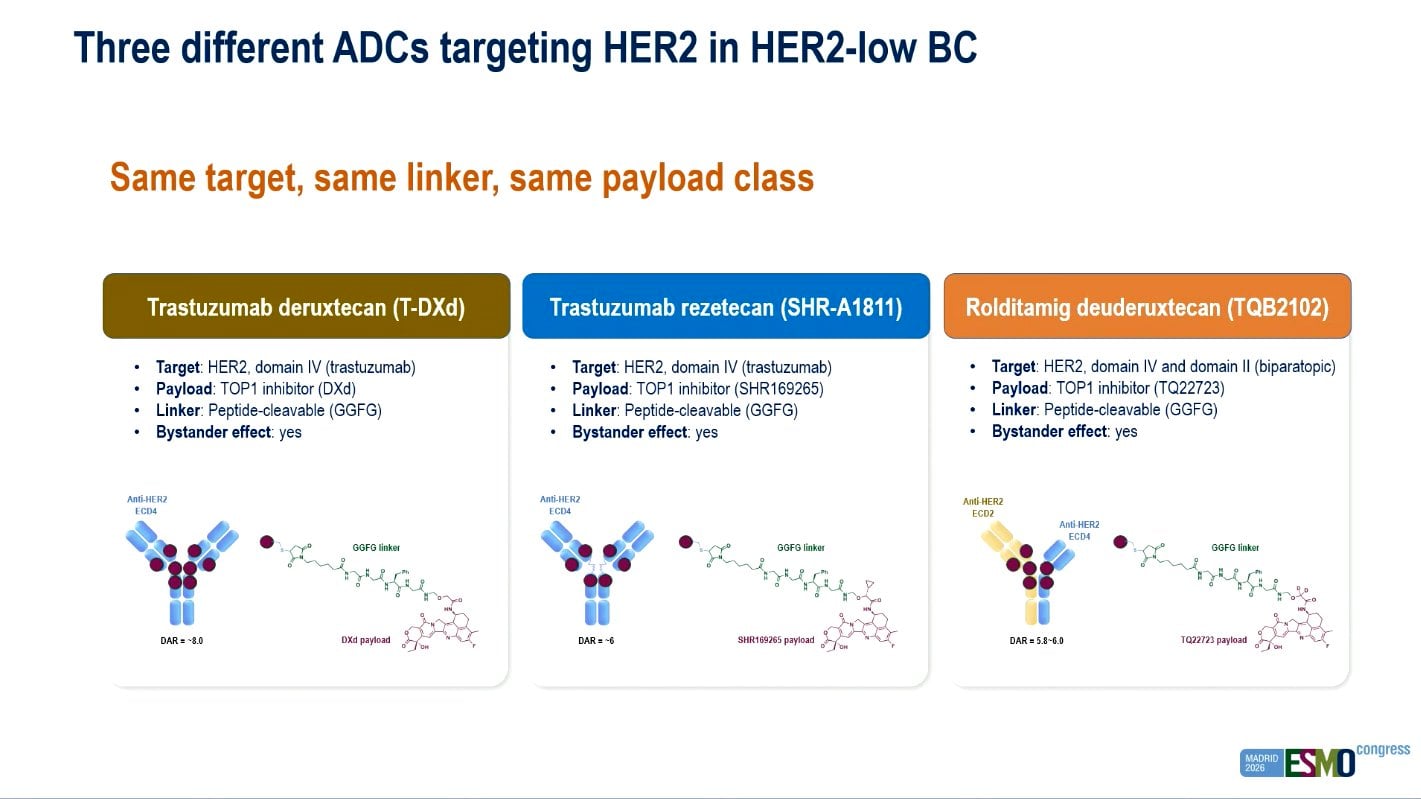
Three HER2-targeting ADCs in HER2-low breast cancer.
Same target, same linker, same payload class (TOP1 inhibitors).
Three ADCs superior to chemotherapy. Three me-too ADCs??? https://t.co/slDB7fjMte
View post on X ↗APEX Breast01
TQB2102 (biapotropic ADC against HER2 with topo1 payload)
Rolditamig Deuderuxtecan (TQB2102) vs TPC Chemo in HER2low MBC, no prior chemo (461 HR+, 81 TNBC)
PFS HER2low: 16.4 vs 5.5 mo, HR 0.29
ILD 1.1%
@OncoAlert #ESMO2026 https://t.co/tTbO5g3ofI
View post on X ↗↳ replying to @stolaney1
@stolaney1 @OncoAlert 3 similar ADCs ! https://t.co/PXN18IBbwl
View post on X ↗🇨🇳 TQB2102 (biparatopic HER2 TOPO1 ADC) also passes the truck test in mostly HR+/HER2-low MBC. PFS 16.4 vs 5.5 mo, HR 0.29, p<0.01. Unclear whether the biparatopic design adds anything. The HER2 TOPO1 field is getting quite crowded with excellent agents. #ESMOAmbassadors #ESMO26 https://t.co/nOV5QhN7PR
View post on X ↗PANKU-Breast01: “manageable” or not? Two posts, same minute
PANKU-Breast01
#ESMO26
Iza-bren (EGFRxHER3-ADC) significantly improved PFS vs chemotherapy in pretreated HR+/HER2− advanced breast cancer (8.2 vs 4.0 months; HR 0.41). ORR doubled (40.5% vs 20.2%), with manageable safety (ILD 1.1%). OS remains immature. https://t.co/EfZyLTGV02
View post on X ↗🇨🇳 PANKU-Breast01: the HER3-EGFR bispecific TOPO1 ADC Iza-Bren improved PFS vs chemo in HR+/HER2- MBC (OS immature). High rate of hematologic toxicity, with ~50% G3+ anemia, neutropenia and thrombocytopenia, and most patients requiring dose reductions⚠️. #ESMO26 #ESMOAmbassadors https://t.co/f1zn2X0bpe
View post on X ↗The payload question
We now have prospective data with TOPO1 ADC sequencing from:
- SATEEN (#ESMOBreast26)
- HER3-DXd (#ESMOBreast26)
- SWITCH (upcoming #ESMO26)
All validate prior retrospective data, showing that TOPO1 ADC resistance is not overcome by target switch.
New payloads urgently needed. https://t.co/tsl3hjj9o5
View post on X ↗Mali Barbi, MD MSc | Breast & Gyn Oncologist @DrBarbiOnc
breast and gyn oncologist, Northwell · Oct 22
#ESMO2026. The ADC question I am watching this week is not which target. It is which payload, and in what order.
Monday, one breast session: SWITCH (4RO), ADC after ADC. OptiTROP-Breast01 (4639RO), final OS for sac-TMT in pretreated TNBC. Bulumtatug fuvedotin (4640RO), MMAE after a TopoI ADC.
Same day, Presidential Symposium: TroFuse-005 (LBA11), sac-TMT in previously treated endometrial cancer.
TROP2 is expressed in most endometrial tumors. If sac-TMT works, the target was never the hard part. The hard part is what comes after. I give the best treatment first. The tumor that progresses is then already resistant to that payload, and the next line needs a different mechanism. That is where we need more small molecule targeted drugs, not another antibody carrying the same payload. #gyncsm #bcsm
View post on X ↗
I hate watching experimental therapeutics sessions where they say their drug is active in a wide range of “solid tumors” yet breast was excluded. We need new drugs too! Especially in #TNBC and Luminal B #BreastCancer . Please give us some non-TOPO-1 ADCs!!! #ESMO26
View post on X ↗Meanwhile, in the Presidential Symposia
Breast oncologists searching for breast cancer trials in the #ESMO26 Presidential Sessions 🔍👀😅 https://t.co/sxbCUR4968
View post on X ↗↳ replying to @dr_yakupergun
@dr_yakupergun I had the same feeling… lol, especially after last year's impressive lineup.
View post on X ↗↳ replying to @dr_yakupergun
@dr_yakupergun Yeah disappointed we did have more major readouts hete this year. I guess they figured 2025 was our year and we need a time out. 🫤 #ESMO26
View post on X ↗Unresolved: No trial has shown a HER2 TOP1 ADC improves outcomes after another TOP1 ADC. OS is immature in all three HER2-low/HR+ readouts.
Bladder cancer: higher pCR, no EFS benefit
Two phase 3 trials added a PD-1 inhibitor to neoadjuvant gemcitabine/cisplatin and continued it after cystectomy in cisplatin-eligible MIBC. KEYNOTE-866 (pembrolizumab): EFS HR 0.88 (95% CI 0.71–1.10), OS HR 1.00 (95% CI 0.79–1.27), pCR 44.4% vs 35.8%. (ESMO 2026 4735O; data cutoff Jan 26, 2026) ENERGIZE (nivolumab): EFS HR 0.94 (95% CI 0.72–1.24), pCR 39.1% vs 29.6%. (ESMO 2026 4736O) NIAGARA (durvalumab) met EFS (HR 0.68) and OS (HR 0.75) with pCR 37.3% vs 27.5% and is FDA approved. (KOL Pulse NIAGARA page) On October 24, VOLGA (cisplatin-ineligible or refusing): durvalumab + 3 cycles of neoadjuvant enfortumab vedotin vs control (a third arm added tremelimumab), EFS HR 0.51 (95% CI 0.38–0.67), 24-month EFS 64% vs 45%; OS HR 0.58 (95% CI 0.40–0.83), 24-month OS 78% vs 69%; pCR 45% vs 10%. (ESMO 2026 LBA2, Tom Powles; data cutoff Mar 2, 2026) Durvalumab + EV is investigational in MIBC and under FDA Priority Review. (KOL Pulse VOLGA page)
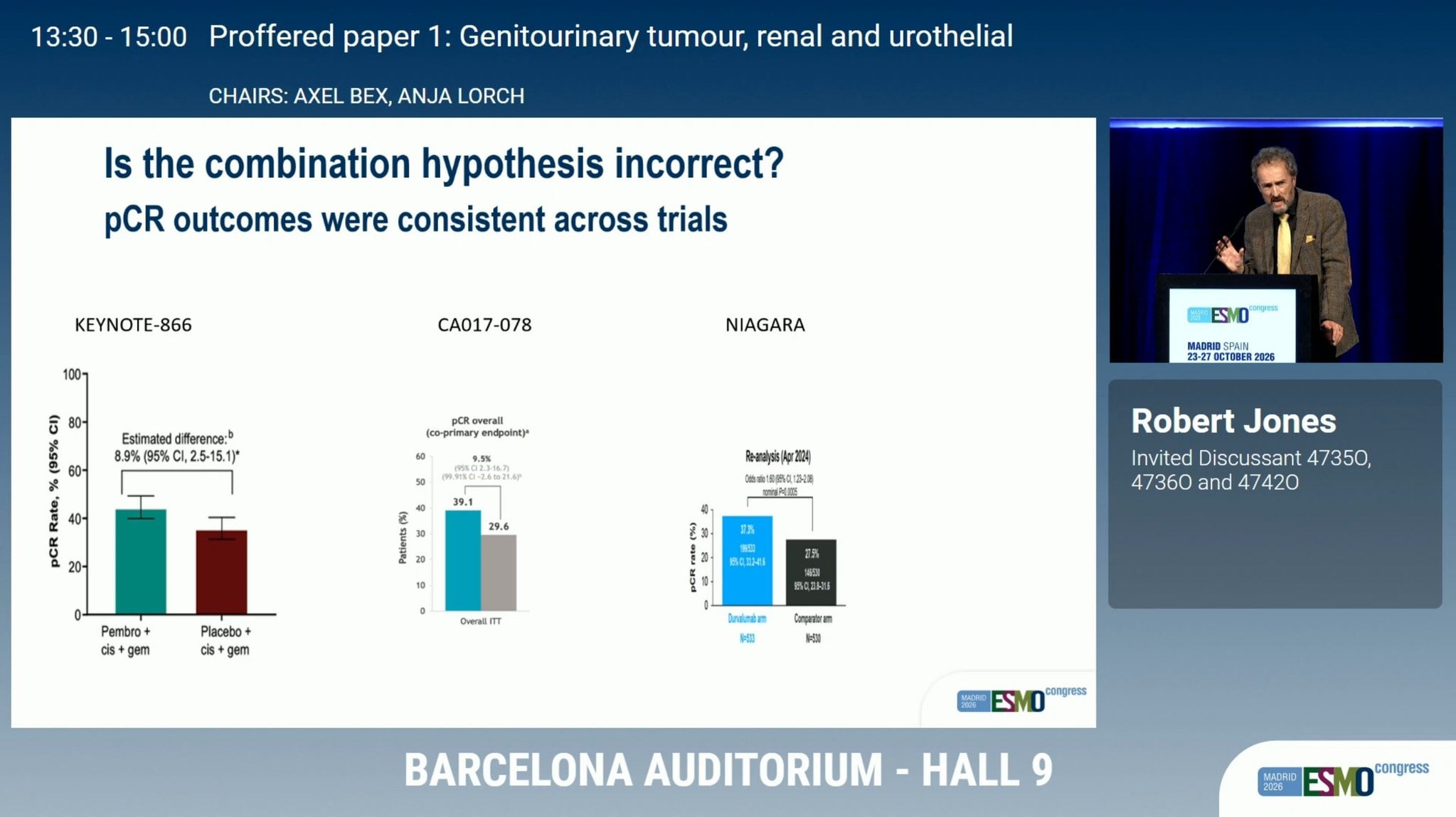
“No one knows why Durvalumab worked”
So no one knows why Durvalumab worked and Pembrolizumab and Nivo failed in perioperative MIBC trials. @DrChoueiri @tompowles1 @HHammersMD @montypal @OncoAlert @myESMO #esmo26 https://t.co/3kilxJWJnB https://t.co/xf4MDnwcxJ
View post on X ↗↳ replying to @SuyogCancer

It is a bit of a mystery! Appreciate that you highlighted this slide. It does distill some of the important differences among the trials - but agree with your implications - it may not be a substantive enough difference to explain these results. @OncoAlert @DrChoueiri @neerajaiims @PGrivasMDPhD
View post on X ↗↳ replying to @SuyogCancer
I think it’s so obvious. The key point lies in the fact that NIAGARA's inclusion criteria for cisplatin were broader than those of KEYNOTE-866 and CA017-078.
NIAGARA allowed more patients with CrCl 40–<60 mL/min to enroll, using split-dose cisplatin for neoadjuvant chemotherapy, whereas KEYNOTE-866 and CA017-078 essentially only enrolled patients with CrCl >60 mL/min per (the traditional Galsky criteria).
This leads to an important consequence: the efficacy of the control arm (gem/cis alone) in NIAGARA was actually weaker.
Because these patients with mild renal impairment tolerated chemotherapy less well, their baseline EFS was shorter, and their risk of recurrence or progression was higher.
In this context of NIAGARA, adding IO to gem/cis was more likely to get a statistically significant difference.
Conversely, the control arm in KEYNOTE-866 and CA017-078 had a better baseline (patients with better renal function, CrCl >60).
Chemotherapy (gem/cis) alone was already relatively effective in this population, so adding IO to chemotherapy is hard to cross the statistical significance threshold. That’s why they are both negative study.
View post on X ↗Context: per the presented design slides, ENERGIZE required GFR ≥50 mL/min and KEYNOTE-866 GFR ≥60 mL/min. The discussant's slide listed 24-month control-arm EFS of 70.0% (KEYNOTE-866), 71.6% (CA017-078) and 59.8% (NIAGARA).
↳ replying to @SuyogCancer
@SuyogCancer @DrChoueiri @tompowles1 @HHammersMD @montypal @OncoAlert @myESMO Very simple answer : different event definition
View post on X ↗↳ replying to @SuyogCancer
@SuyogCancer @DrChoueiri @tompowles1 @HHammersMD @montypal @OncoAlert @myESMO Keep calm and give EVP https://t.co/AGi4MYm4Tu
View post on X ↗Negative Ph.III KEYNOTE-866 by #DrJensBedke: perioperative pembrolizumab + neoadjuvant Gem/Cis vs placebo + Gem/Cis in cis-eligible MIBC.
EFS HR 0.88 (95% CI 0.71-1.10), p=0.137.
pCR 44.4% vs 35.8%; OS HR 1.00.
Higher pCR did not translate into EFS benefit.
#ESMO26 #BladderCancer @myESMO @OncoAlert
View post on X ↗VOLGA: how much EV is needed?
🚨 VOLGA is positive! But how much perioperative EV do we really need in MIBC?
Interesting comparison with KEYNOTE-905 at #ESMO26:
🔹 VOLGA (EV + durvalumab): 2-year EFS 64%, OS 78%, pCR 45%. EFS HR 0.51.
🔹 KEYNOTE-905 (EV + pembrolizumab): 2-year EFS 74.7%, OS 79.7%, pCR 57.1%. EFS HR 0.40.
Numerically lower EFS and pCR in VOLGA. Why?
Different patient populations and tumor characteristics? Different study designs? It seems premature to attribute these differences to pembrolizumab vs durvalumab.
But the most intriguing question is how much benefit does adjuvant EV actually add?
VOLGA achieved a significant OS benefit with just 3 neoadjuvant EV cycles and NO adjuvant EV, whereas KEYNOTE-905 planned 9 EV cycles (3 neoadjuvant + 6 adjuvant)—and fewer than half of patients reportedly completed the full planned EV course.
Could pCR and ctDNA clearance help us safely omit adjuvant EV and reduce cumulative toxicity?
⚠️ Cross-trial comparisons are hypothesis-generating, not evidence of superiority or equivalence. Only prospective trials can establish the incremental benefit of adjuvant EV.
More EV ≠ necessarily better outcomes. Let’s identify who really needs it! 🔬
@OncoAlert @weoncologists @tompowles1 @urotoday @Uromigos
@OncoAlert Faculty @DrChoueiri , @tompowles1 , @apolo_andrea , @neerajaiims , @montypal , @Silke_Gillessen , @AOmlin , @brian_rini , @PGrivasMDPhD , @TiansterZhang , @amerseburger , @DrDanielHeng , @HHammersMD , @scocmem , @AndreaNecchi , @AmandaNizamMD , @drenriquegrande , @nataliagandur , @AlbigesL , @cdanicas , @declangmurphy , @seanmmcbride , @shilpaonc , @DrRanaMcKay , @scserendipity1 , @DrYukselUrun , @ravikanesvaran , @BraunMDPhD , @EfstathiouEleni , @mzugman , @crisbergerot @Markuseckstein3
View post on X ↗↳ replying to @niklas_kluemper
This is the right question: not “is VOLGA positive?” but “how much perioperative EV do we need?”
Cross-trial caveats apply (populations, control arms, follow-up), so HR shopping is fragile. Still: VOLGA tests neoadjuvant-only EV + peri-op durvalumab; KN-905 keeps postoperative EV + pembro.
If absolute rates hold at slides, the SoC debate for cisplatin-ineligible MIBC is now endpoint + regimen intensity, not whether EV belongs in the peri-op space.
View post on X ↗“How was clinically meaningful defined?” (KEYNOTE-B15 quality of life)
Elegant presentation by @Uro_Oncologist reporting HRQoL from #Keynote-B15.
Perioperative EV-P was not associated with clinically meaningful detriment in general HRQoL or cystectomy-specific HRQoL !
#ESMO26 #Day2 @myESMO @OncoAlert https://t.co/eSoiNht3Jw
View post on X ↗↳ replying to @DrChoueiri
@DrChoueiri @weoncologists @Uro_Oncologist @myESMO @OncoAlert @Uromigos @urotoday @oncodaily @yekeduz_emre How was clinically meaningful defined?
View post on X ↗Six phase III trials. Six different stories.
Higher pCR does not guarantee better survival.
In muscle-invasive bladder cancer, EFS and OS matter more than impressive response rates.
Are we measuring what truly matters to patients?
@myESMO @OncoAlert @OpenMedicineHQ #ESMO26 @tompowles1 @urologysummit @Uromigos @Uroweb @urotoday
View post on X ↗Unresolved: Why NIAGARA was positive and KEYNOTE-866 and ENERGIZE were not. Whether adjuvant EV adds benefit after neoadjuvant EV.
KEYNOTE-B49: a 0.7-month PFS gain, no OS gain
KEYNOTE-B49 (Merck, LBA51) added pembrolizumab to chemotherapy in PD-L1 CPS ≥1 HR+/HER2− metastatic breast cancer after endocrine therapy. PFS 6.7 vs 6.0 months, HR 0.74 (95% CI 0.58–0.95), P=0.0089, meeting the primary endpoint at the interim analysis. (presented slide; IA data cutoff Sep 22, 2025) OS at the final analysis: 21.0 vs 22.2 months, HR 1.04 (95% CI 0.81–1.33), P=0.6185, not significant. Grade ≥3 treatment-related AEs 37.6% vs 32.7%. (presented slides; FA data cutoff Mar 16, 2026)
“Complicated for practice”
KN-B49 @hoperugo PDL1+ HR+ MBC after ET tx w/chemo +/-Pembro
Chemo: cape, doxil, taxanes
Pembro improved mPFS 6 to 6.7 mos; no OS gain
Complicated for practice w/ modest gain, ADCs in a competing space, and the pt burden of adding Pembro to oral cape. #ESMO26 @OncoAlert https://t.co/durudyjrCs
View post on X ↗↳ replying to @DrSGraff
@DrSGraff @hoperugo @OncoAlert Biomarker restricted trials and different chemo (ADC) backbones needed! ER low subgroup is key here!
View post on X ↗↳ replying to @DrSGraff
@DrSGraff @weoncologists @hoperugo @OncoAlert Calling 0.7 months an improvement seems a bit of a stretch...
View post on X ↗Unresolved: Whether any HR+ subgroup (ER-low, higher PD-L1) benefits enough to use pembrolizumab with chemotherapy.
ECLYPse: don't drop the EC
ECLYPse is a single-arm phase 2 trial (n=25) in BRAF V600E metastatic colorectal cancer progressing on encorafenib + cetuximab (EC). Patients continued EC with FOLFIRI. It met its primary endpoint: 6-month PFS rate 66.7% (12 of 18 evaluable). Median PFS 7.1 months; ORR 15.0%; disease control 80%; median OS not reached. (presented slides, Maria Alessandra Calegari; data cutoff May 8, 2026) No randomized comparison.
From a phase 2 to a practice question
Encorafenib plus cetuximab beyond progression in combination with FOLFIRI in BRAF V600E mCRC progressing on EC: Results from the ECLYPse phase II trial
#ESMO26 #ESMOAmbassadors
👉 mPFS: 7.1
👉 mOS: NR
👉ORR 15%
🧐Interesting signal to continue EC, more translational data would be great
@myESMO @ASCO
View post on X ↗
My takeaway is (I know massively extrapolating but biologically makes perfect sense)- if there is progression on 1L mFOLFOX+EC—>switch to mFOLFIRI+EC 2L. Don’t drop the EC. https://t.co/k44AxLTzzO
View post on X ↗↳ replying to @UGrewalMD
@UGrewalMD #ESMO26 we have had many patients get to conversion therapy & resection of oligo-metastatic disease. Rendered NED.
Against treatment nihilism for patients with metastatic BRAFV600E mutant colorectal cancer.
With better systemic options, surgery depending on sites is an option. https://t.co/1ZVYNhh1eY
View post on X ↗↳ replying to @pashtoonkasi
Absolutely! In oligometastatic disease- that should be the standard now, with excellent data for ORR, PFS and OS from BREAKWATER…Systemic therapy followed by resection/MDT. However, most of my patients have presented with widely metastatic disease in the setting of BRAF V600E mt CRC.
View post on X ↗↳ replying to @UGrewalMD
@UGrewalMD Just in time as I was going to do this for my patient! @GIMedOnc as you clearly pointed out this week!
View post on X ↗↳ replying to @UGrewalMD
@UGrewalMD This is a great take @UGrewalMD.
Other @myESMO data doesn’t support rechallenge per GONO BRICKET, so something important with chemo and continuing EC as a more viable strategy (akin to Bev beyond progression?)
View post on X ↗Unresolved: Single-arm, 25 patients. A randomized trial would be needed to make EC beyond progression a standard.
More from ESMO 2026
- ESMO 2026 conference page: themes, top physician voices and trial buzz by tumor type
- ESMO 2026 trials: every trial with physician posts
- ESMO 2026 slide library: presented slides by tumor and trial
FAQ
What was the main debate about INTerpath-001 at ESMO 2026?
INTerpath-001 added the individualized mRNA vaccine intismeran to adjuvant pembrolizumab in resected stage IIB-IV melanoma (RFS HR 0.58, 95% CI 0.45-0.75; OS immature, HR 0.77). Oncologists debated whether the comparator was right, because SWOG S1801 also reported an EFS HR of 0.58 by moving pembrolizumab before surgery, and NADINA showed benefit with neoadjuvant ipilimumab + nivolumab. Others noted INTerpath-001 enrolled node-negative and micrometastatic patients who are not neoadjuvant candidates. Intismeran is investigational.
Did NATALEE show an overall survival benefit?
At the 6-year analysis, OS was 91.9% vs 89.7% (HR 0.809, 95% CI 0.661-0.989) with a nominal one-sided P=0.019. The presented slide labels the P value descriptive; OS was not tested within a multiplicity-controlled strategy. Physicians disagreed on whether to call it an OS benefit. Adjuvant ribociclib has been FDA approved since September 17, 2024.
Why did KEYNOTE-866 and ENERGIZE miss while NIAGARA was positive?
No one has a confirmed answer. KEYNOTE-866 (EFS HR 0.88) and ENERGIZE (EFS HR 0.94) had numerically higher pCR but did not improve EFS; NIAGARA met EFS (HR 0.68) and OS (HR 0.75). Physicians on X pointed to differences in eligibility, control-arm outcomes and event definitions. These are cross-trial comparisons, not head-to-head results.
What did oncologists say about new HER2 ADCs in breast cancer?
HORIZON-Breast06 (trastuzumab rezetecan) and APEX-Breast01 (TQB2102) both beat chemotherapy on PFS in HER2-low disease, and PANKU-Breast01 (iza-bren) beat chemotherapy in pretreated HR+/HER2- disease. Oncologists called the HER2 TOP1 ADC space crowded, questioned whether the new agents add anything over trastuzumab deruxtecan, debated whether the hematologic toxicity of iza-bren (an EGFRxHER3 ADC) is manageable, and asked for non-TOP1 payloads.
KOL Pulse tracks what oncologists and hematologists are discussing on X. Every post quoted here is full, verbatim and links to its source. Posts from journalists and investors are labeled as context. Michiel Strijbos is co-founder and CMO of AitriumOS (per his X profile). Eric D. Whitman states in his post that he participated in INTerpath-001.