Brian Shields
First prospective switch trial of Top1 ADC post Top1 ADC in MBC.
0-8% ORR
Switching target with same payload simply does not work.
Resistance is in payload.
Let’s stop talking about “sequencing”. It simply does not work. We need new payloads.
#MBC #BCSM #ESMO26 https://t.co/YremeiDWkt
View post on X ↗
KOL Pulse · ESMO 2026 · Madrid · Breast cancer · October 23–26
ESMO 2026: Top Breast Cancer Trials and KOL Voices
SWITCH drew the most physician posts on breast cancer on Day 4 of ESMO 2026, October 26. After a prior ADC, four investigational ADCs with a TOP1-inhibitor payload and a new target gave confirmed response rates of 0–8.3%. Breast medical oncologist Sarah Sammons wrote: “Switching target with same payload simply does not work.” Breast medical oncologist Rebecca Shatsky answered: “ADCs are basically all we have as far as control of brain mets and leptomeningeal disease.” Also new on October 25–26: BRIDGET, the final overall survival analysis of OptiTROP-Breast01, a DESTINY-Breast09 analysis in patients with brain metastases, and the OPTIMA cost analysis. Below are those five trials, then the trials presented October 23–25, each with the result, a presented slide and physician posts quoted in full, then the top breast cancer physicians on X and the last session ahead.
Physician discussion, October 23–26
Physician posts on X, October 23–26.
| # | Trial | Physician posts | Physicians posting |
|---|---|---|---|
| 1 | NATALEE | 48 | 31 |
| 2 | KEYNOTE-B49 | 31 | 24 |
| 3 | PANKU-Breast01 | 25 | 21 |
| 4 | FOURLIGHT-1 | 23 | 20 |
| 5 | TALENT | 22 | 17 |
| 6 | TROPION-Breast02 | 21 | 19 |
| 7 | SWITCH | 21 | 18 |
| 8 | BRIDGET | 17 | 16 |
| 9 | postMONARCH | 15 | 14 |
| 10 | APEX-Breast01 | 14 | 13 |
| 11 | HORIZON-Breast06 | 14 | 12 |
| 11 | NSABP B-42 | 14 | 12 |
| 13 | DESTINY-Breast09 | 14 | 11 |
| 14 | evERA | 13 | 11 |
| 15 | OptiTROP-Breast01 | 12 | 10 |
| 16 | VIKTORIA-1 | 11 | 8 |
| 17 | lidERA | 8 | 7 |
| 17 | FINER (CCTG MA.40) | 8 | 7 |
| 24 | OPTIMA | 2 | 2 |
Four trials presented on October 26 are in the table: SWITCH and BRIDGET, now seventh and eighth for the congress, plus DESTINY-Breast09 and OptiTROP-Breast01. Their sections come first below, followed by OPTIMA (presented October 25) and the other trials presented October 23–25.
Days 3–4: October 25–26
1. SWITCH: a TOP1-inhibitor ADC with a new target, after a prior ADC
Phase 2 platform trial (NCT06649331), sponsored by Fudan University, in HER2-negative metastatic breast cancer after a prior ADC. Patients were assigned, based on their prior treatment, to one of four investigational ADCs from Jiangsu Hengrui, all with a topoisomerase I inhibitor (TOP1i) payload but each with a different target: SHR-A1811 (HER2), SHR-A1921 (TROP2), SHR-A2009 (HER3) or SHR-A2102 (Nectin-4). Lei Fan presented (4RO); Sherene Loi was the invited discussant. Confirmed ORR, the primary endpoint (investigator-assessed), was 0% (n=10), 8.3% (n=12), 0% (n=12) and 5.0% (n=20): 2 partial responses among 54 patients. No cohort met the prespecified Bayesian efficacy criterion (posterior probability of ORR above 20% greater than 0.80). Median PFS, a secondary endpoint, was 3.0, 1.4, 1.5 and 2.7 months. (ESMO 2026 4RO slides, Lei Fan; data cutoff Jul 31, 2026; median follow-up 8.6 months) Both responders had previously received disitamab vedotin, an ADC with a microtubule-inhibitor (MMAE) payload; 94.4% of patients had prior exposure to a TOP1i-based ADC. (ESMO 2026 4RO abstract) None of the four ADCs is FDA approved; their use in this setting is investigational. (KOL Pulse SWITCH page)
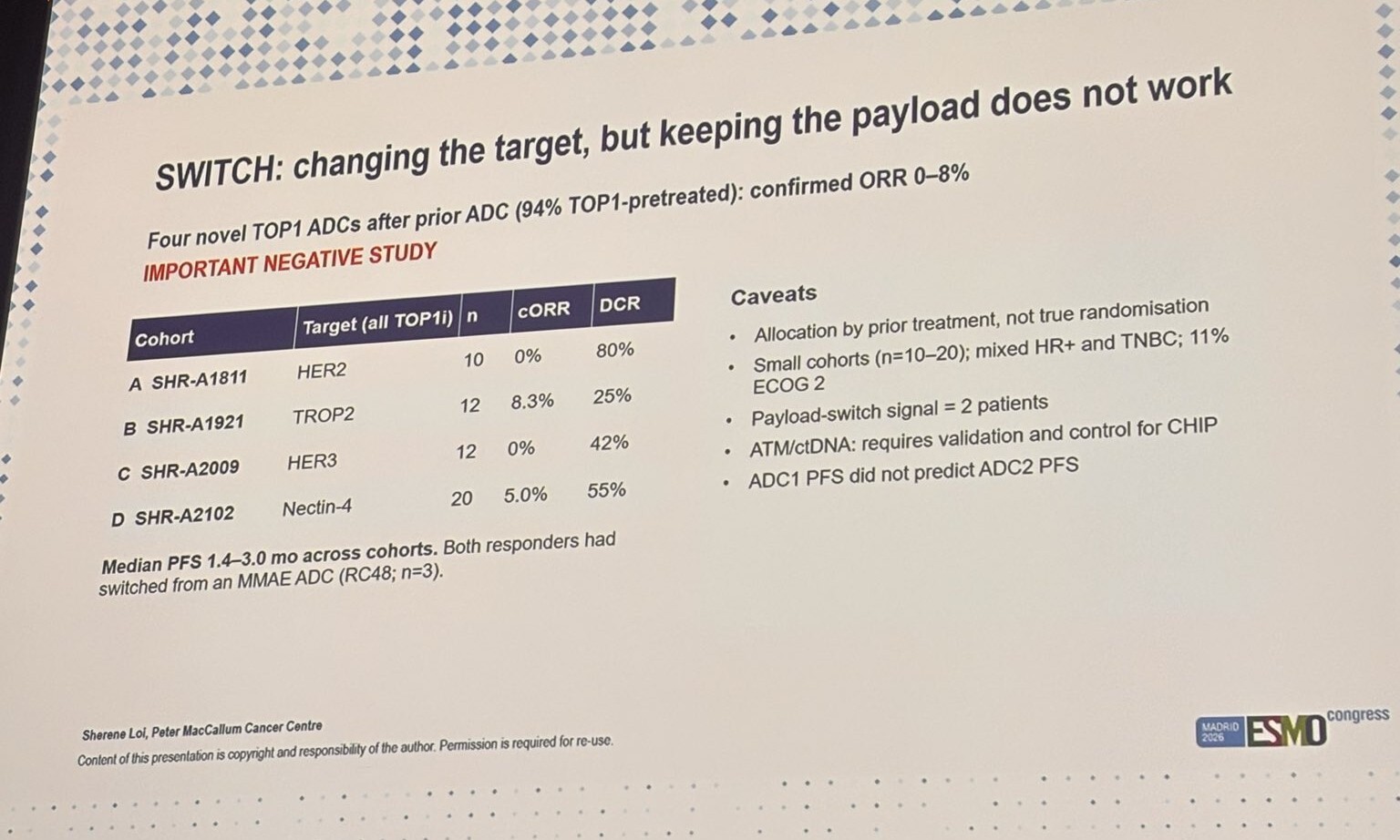
Physicians read SWITCH as evidence that resistance follows the payload, not the target. The counterpoint came from the clinic: for patients with brain metastases, ADCs are often the most active option left.
Stop sequencing, or no alternative?
The SWITCH trial adds important prospective data on TOPO1 ADC sequencing. Among TOPO1-ADC pretreated pts with MBC, barely any activity was observed with a second TOPO1 ADC, with <10% ORR and <3 mo PFS, despite switching target. Payload cross-resistance dominates. #ESMOAmbassadors https://t.co/cDuYuM5qNv
View post on X ↗The worst part about the Switch trial proving what we knew to be true about payload resistance is that ADCs are basically all we have as far as control of brain mets and leptomeningeal disease. For our CNS disease patients chemo just doesnt cut it. #ESMO26 #Breastcancer #ADC
View post on X ↗2. BRIDGET: tucatinib added after local therapy for isolated brain progression in HER2+ disease
Single-arm Phase 2 (NCT05323955) in HER2-positive metastatic breast cancer with isolated intracranial progression on trastuzumab/pertuzumab (TP) or T-DM1: after local therapy (radiosurgery or resection), tucatinib was added and the same backbone continued. Sarah Sammons presented (1767RO); the results are published in ESMO Open. The primary endpoint, intracranial PFS (RANO-BM), was met against a historical control: in 47 evaluable patients, median intracranial PFS was not reached vs a prespecified historical median of 5.0 months (one-sample log-rank P<0.0001). Intracranial PFS was 64% at 12 months and 59% at 18 months. (ESMO Open and 1767RO slides, Sarah Sammons; data cutoff Apr 17, 2026; median follow-up 19.6 months) Extracranial progression occurred in 2 patients (4.3%), and 46 of 47 were alive at the data cutoff. Grade 3 treatment-related AEs occurred in 32%, with no grade 4 or 5 treatment-related events; diarrhea was the most common (74%; grade 3, 11%). (ESMO Open; data cutoff Apr 17, 2026) Tucatinib (TUKYSA) is FDA approved with trastuzumab and capecitabine after one or more prior anti-HER2 regimens in the metastatic setting, including in patients with brain metastases, and with trastuzumab and pertuzumab as maintenance after induction (October 7, 2026). The BRIDGET strategy is investigational as tested, and tucatinib with T-DM1 is not FDA approved. (KOL Pulse BRIDGET page; FDA TUKYSA label, October 2026)
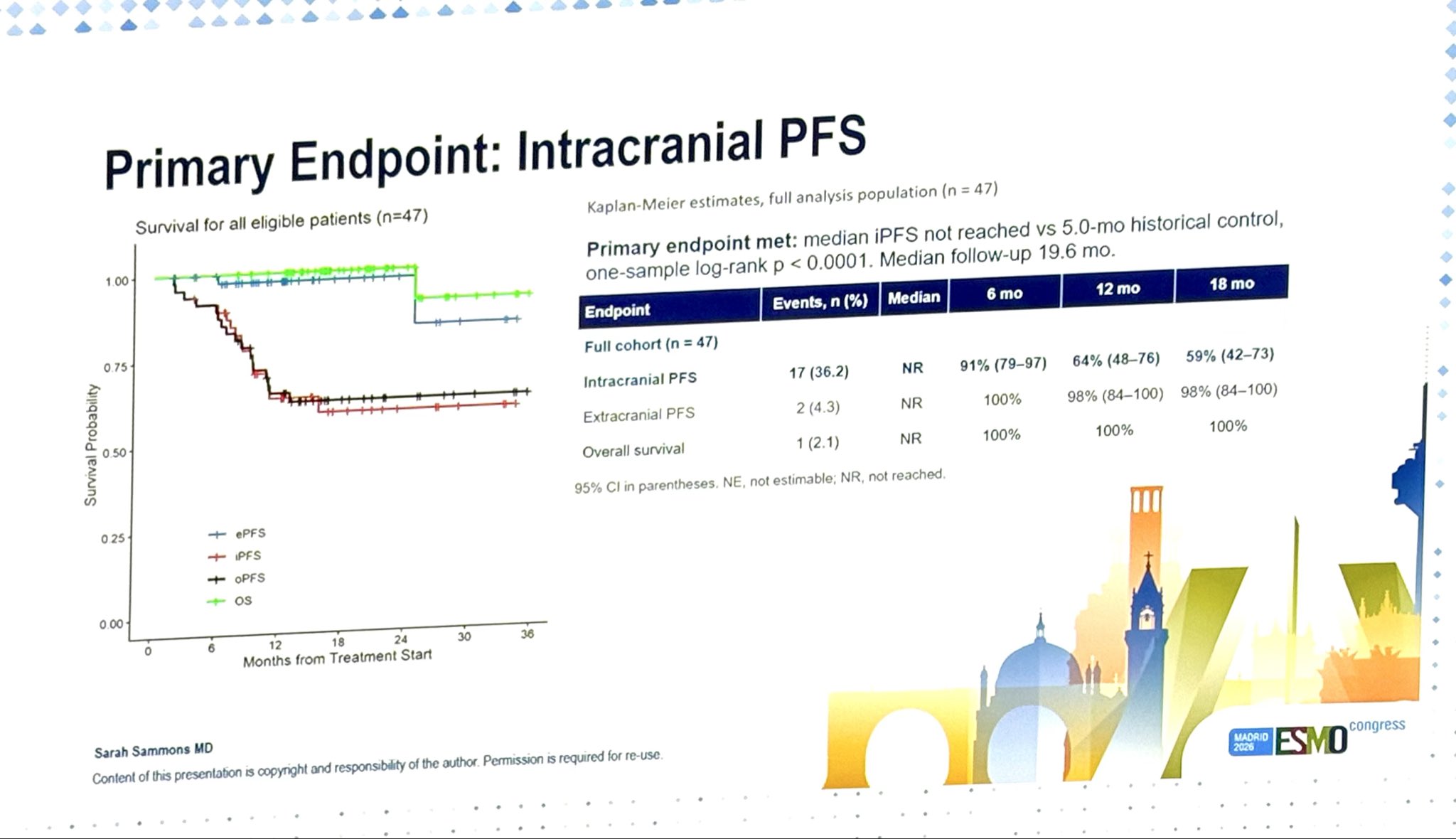
Physicians agreed the intracranial control was durable. They differed on whether a single-arm trial is enough to use the strategy now.
Use it now, or wait for randomized data?
Primary results from BRIDGET ph2 trial presented by @drsarahsam and published in @ESMO_Open. Adding tucatinib to HP after an isolated intracranial PD led to impressively long PFS (59% free from PD or death at 18mo!!). Reasonable strategy from next Monday in TKI-naive patients. https://t.co/VvCfgdCBey
View post on X ↗Erika Hamilton, MD, FASCO @ErikaHamilton9
breast oncologist, Sarah Cannon Research Institute · Oct 26
Fantastic data by @drsarahsam in #BRIDGET showing the activity of #tucatinib in pts with 🧠 mets....used in combo w/ standard therapies..building upon what we saw in HER2CLIMB.
⬆️ unmet need!
#ESMO26
#ESMOAmbassadors
@OncoAlert https://t.co/1Rw2hsE4dh
View post on X ↗BRIDGET evaluated tucatinib after local therapy for isolated CNS progression in HER2+ metastatic #BreastCancer , showing durable intracranial control in a Phase II study.
Randomized data are still needed to confirm the benefit.
@OncoAlert #ESMO26 @drsarahsam #ESMOAmbassadors https://t.co/Ip2nkxnS2E
View post on X ↗3. OptiTROP-Breast01: final overall survival with sac-TMT in pretreated metastatic TNBC
Phase 3, N=263, conducted in China (Kelun-Biotech): sacituzumab tirumotecan (sac-TMT), a TROP2 ADC, vs physician’s-choice chemotherapy in metastatic triple-negative breast cancer after at least two prior systemic therapies, at least one for metastatic disease. The primary endpoint, PFS by blinded independent central review, was met at the interim analysis; at the final PFS analysis, median PFS was 6.7 vs 2.5 months, HR 0.32 (95% CI 0.24–0.44). Overall survival, the key secondary endpoint, met its prespecified significance criterion at the interim analysis: HR 0.53 (0.36–0.78), one-sided P=0.0005. (Nature Medicine 2025; data cutoff Nov 30, 2023) Man Li presented the final OS analysis (4639RO), which the slides describe as descriptive: median OS 14.7 vs 9.9 months, HR 0.60 (95% CI 0.45–0.80), nominal P=0.0004; 24-month OS 33.8% vs 21.4%. 27.8% of the chemotherapy arm received a subsequent ADC; a prespecified RPSFT adjustment gave an HR of 0.55 (0.39–0.73). Grade ≥3 treatment-related AEs 64.6% vs 57.6%. (ESMO 2026 4639RO abstract and slides, Man Li; Annals of Oncology; final analysis, data cutoff Sep 17, 2025; median follow-up 29.4 months) Sac-TMT is approved in China (NMPA, November 2024) for this population. It is not FDA approved and is investigational in the US, where the TROP2 ADC approved in this setting is sacituzumab govitecan. (KOL Pulse OptiTROP-Breast01 page)
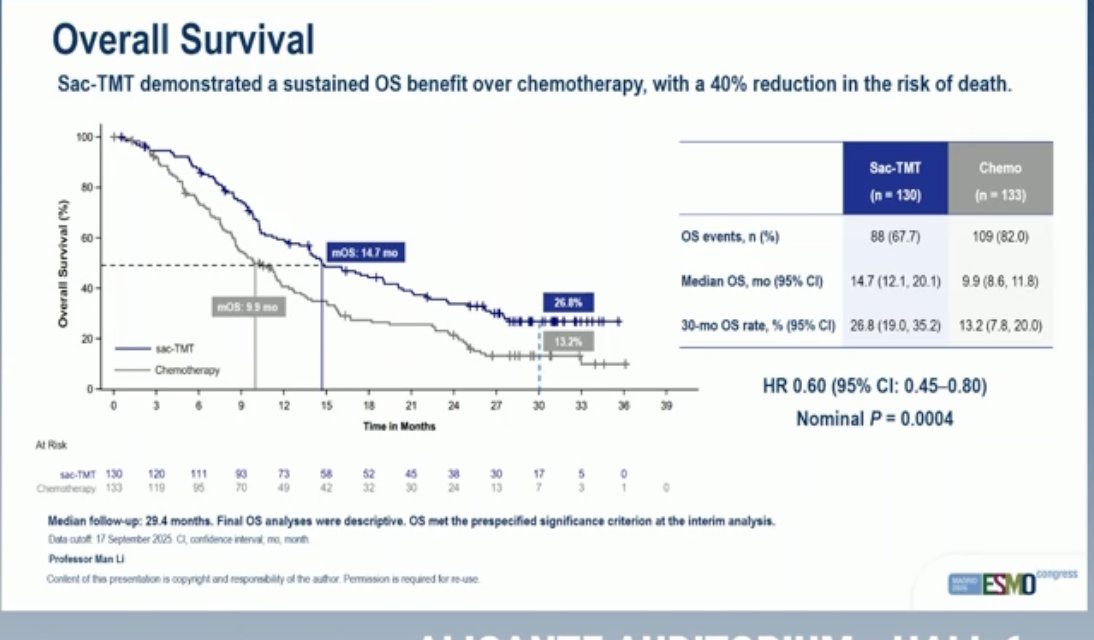
Physicians agreed the OS gain held at the final analysis. The open question was how to sequence TROP2 ADCs.
Sustained OS benefit, sequencing open
OptiTROP-Breast01
Sac-TMT vs chemo in mTNBC (≥2chemo/≥1 in MBC)
OS: 14.7 vs 9.9 mo, HR 0.60, p=0.0004
@OncoAlert #ESMO26 https://t.co/PLdWIbtkyF
View post on X ↗OptiTROP-Breast01:
Sac-TMT improved median OS in pretreated mTNBC (14.7 vs 9.9 months; HR 0.60), reinforcing the role of ADCs in later-line treatment.
@OncoAlert #ESMO26 #ESMOAmbassadors #ESMOcommunity @myESMO #BreastCancer #bcsm https://t.co/KExulTOhAR
View post on X ↗#ESMO26 | OptiTROP-Breast01: sustained OS benefit with sac-TMT in pretreated advanced TNBC.
Median OS: 14.7 vs 9.9 months; HR 0.60.
Encouraging durability despite subsequent ADC use in 27.8% of controls. How best to sequence TROP2 ADCs remains a key question.
@OncoAlert @Larvol #breastcancer
View post on X ↗4. DESTINY-Breast09: first-line T-DXd + pertuzumab in patients with brain metastases
DESTINY-Breast09 is the Phase 3 trial (Daiichi Sankyo and AstraZeneca) of first-line trastuzumab deruxtecan (T-DXd) + pertuzumab vs taxane + trastuzumab + pertuzumab (THP) in HER2-positive metastatic breast cancer. PFS by BICR, the primary endpoint, was 40.7 vs 26.9 months, HR 0.56 (95% CI 0.44–0.71), P<0.0001. (NEJM) The combination has been FDA approved since December 15, 2025 for first-line HER2-positive metastatic breast cancer; there is no separate brain metastases indication. (KOL Pulse DESTINY-Breast09 page) At ESMO 2026, Cristina Saura presented an exploratory analysis (LBA49) of the 61 patients with brain metastases at baseline confirmed by BICR (31 vs 30); these endpoints were not prespecified in the protocol. Median systemic PFS was 36.5 vs 11.1 months, HR 0.30 (95% CI 0.14–0.60). Median CNS-PFS was not estimable vs 9.7 months, HR 0.26 (0.11–0.57); 12-month CNS-PFS 88.9% vs 42.5%. The confirmed CNS response rate was 51.6% vs 26.7%. The slides advise caution because of the small number of patients. (LBA49 slides, Cristina Saura; data cutoff Feb 26, 2025; median follow-up 23.6 months)
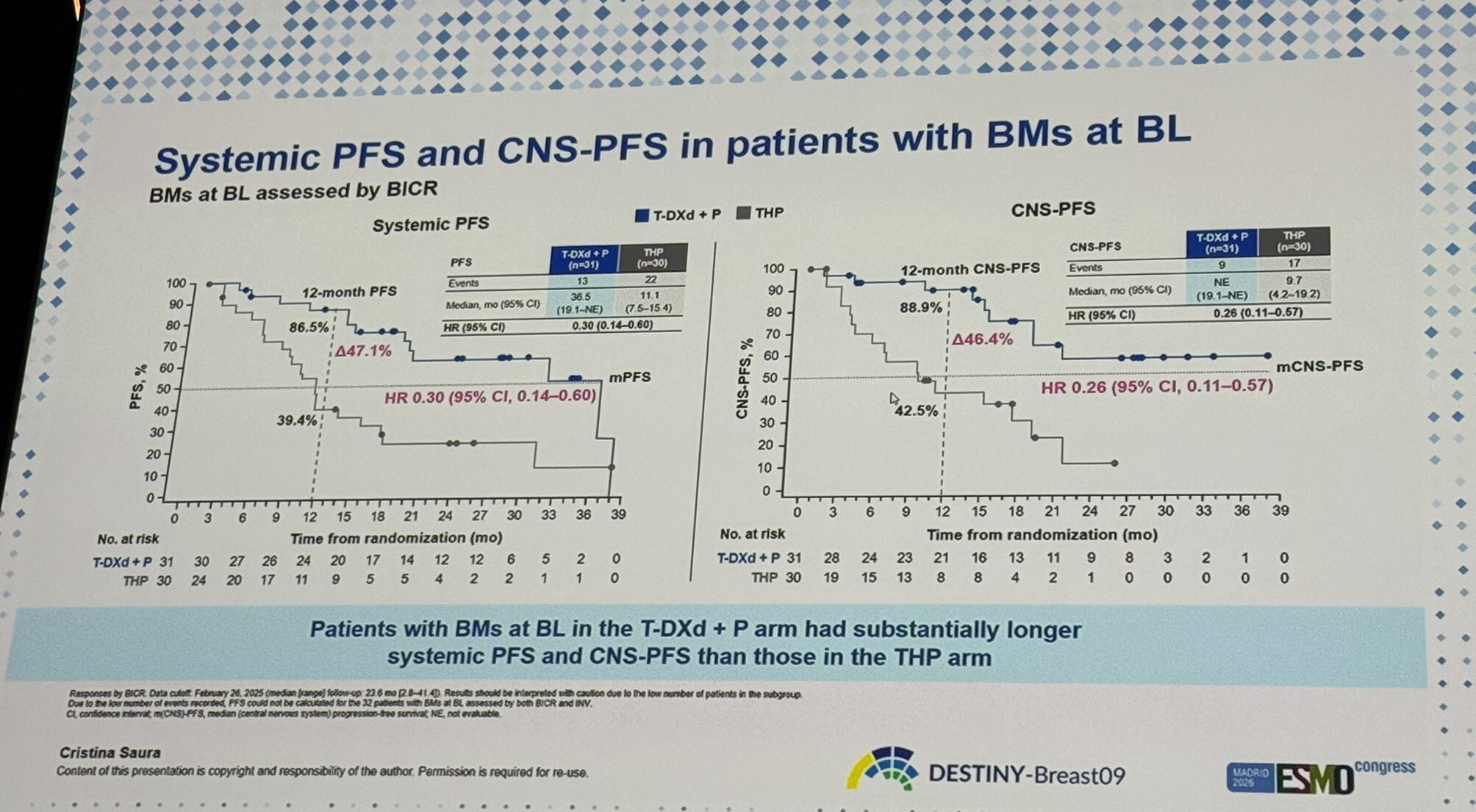
Physicians called the intracranial results striking, and one called the regimen the standard of care for these patients. Jeff Ryckman, who works in radiation oncology, pointed to what the abstract did not report: prior local therapy to the brain and the split between active and treated brain metastases. Per the slides, included patients had brain metastases that were clinically inactive, or treated and asymptomatic.
Standard of care for brain metastases?
#ESMO26 | DB-09 | BM efficacy
We already knew T-DXd had strong intracranial activity. Here are the first-line data: in HER2+ breast cancer with BM, T-DXd+pertuzumab vs THP delivered a median PFS of 36.5 vs 11.1 mo and 12-m CNS-PFS of 88.9% vs 42.5%. Nearly double the intracranial response rate!
View post on X ↗Doubling in intracranial ORR (51 vs 26%) and dramatic improvement in intracranial PFS with T-DXd/P vs THP in 1L HER2+ mBC. The DB09 regimen is the clear SoC for patients with brain metastases at metastatic diagnosis. #ESMO26 #ESMOAmbassadors https://t.co/i7NAbeJFk1
View post on X ↗Longer CNS-PFS w/ T-DXd + pertuzumab in the DESTINY-Breast09 (DB-09) brain mets subgroup (LBA49).
📌 Exploratory subgroup of randomized phase 3 DESTINY-Breast09: 61 pts w/ HER2+ advanced/metastatic breast cancer, baseline brain mets by BICR and ≥1 follow-up brain scan. T-DXd + pertuzumab (n=31) vs taxane + trastuzumab + pertuzumab (THP, n=30).
📌 Median follow-up 23.6 mo. mCNS-PFS NE vs 9.7 mo; HR 0.26 (95% CI 0.11-0.57).
📌 CNS-cORR 51.6% (95% CI 33.1-69.8) vs 26.7% (95% CI 12.3-45.9), by BICR.
📌 mPFS 36.5 vs 11.1 mo.
📌 Parent-trial drug-related ILD/pneumonitis: 12.1% (incl 2 grade 5) vs 1.0%. Brain mets subgroup AE rates aren't reported.
Side note: prior CNS local therapy and the active/treated brain mets split aren't reported in the abstract.
https://t.co/1kEnVk7VEw
#ESMO26 #BCSM
View post on X ↗5. OPTIMA: the 2-year cost analysis of test-directed chemotherapy
OPTIMA (ISRCTN42400492; UK NIHR, UCL and Warwick Clinical Trials Unit) randomized 4,429 patients with clinically high-risk HR+/HER2− early breast cancer, aged 40 or older, with 0–9 involved nodes to chemotherapy for all or to Prosigna (PAM50 ROR) test-directed treatment, in which only patients with an ROR score above 60 received chemotherapy. The efficacy primary endpoint, invasive breast cancer-free survival, met non-inferiority: HR 1.03 (90% CI 0.85–1.25) on the presented slide. (ASCO 2026 presented slide, Robert Stein; per-protocol population) The Abstract 500 text reports HR 0.99 (90% CI 0.81–1.20), non-inferiority p=0.013. (ASCO 2026 Abstract 500; median follow-up 3.9 years) On October 25, Peter S. Hall presented the prespecified 2-year within-trial economic evaluation of cost-effectiveness, OPTIMA’s other primary outcome per the trial registry and protocol, from the UK NHS perspective (LBA86; n=3,425 UK per-protocol participants). Test-directed treatment cost £654 less per patient (95% CI −£1,525 to £218, which crosses zero) and gave 0.05 more QALYs (0.02 to 0.08); 32% of the test-directed arm received chemotherapy. Lower chemotherapy costs (−£3,611 per patient) outweighed the £1,955 test. The investigators concluded that test-directed treatment dominated standard care over 2 years; a lifetime model is in progress. (ESMO 2026 LBA86 abstract and slides, Peter S. Hall; 2-year within-trial analysis) OPTIMA is a strategy trial, not a drug approval; Prosigna is an FDA-cleared test. (KOL Pulse OPTIMA page)
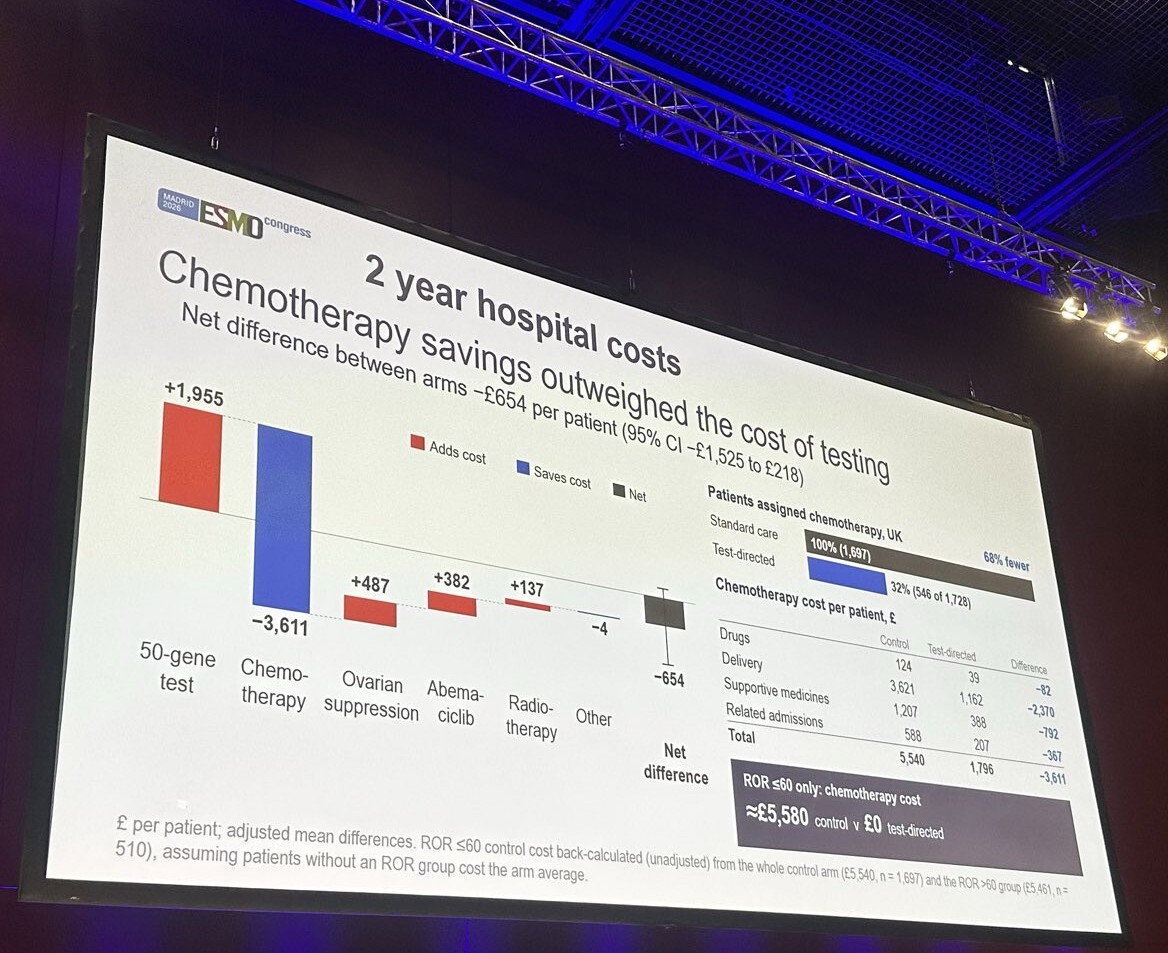
Lower cost at 2 years, per the investigators
Co-primary endpoint of OPTIMA-health economics (#ESMO26 LBA86): test-directed treatment cut chemo costs by £3,611/pt. After the £1,955 assay: net −£654/pt, +0.05 QALYs.
Much better for patients, not more expensive for the NHS #bcsm https://t.co/vvSVZvMxiK
View post on X ↗Precision medicine not only benefit patients, but also systems! @breastDoktor https://t.co/6SMQTkwgY6
View post on X ↗October 23–25: the most-discussed trials
6. NATALEE: 6-year overall survival with adjuvant ribociclib
Ribociclib + NSAI vs NSAI alone in stage II–III HR+/HER2− early breast cancer. 6-year OS 91.86% vs 89.73% (difference 2.1%); HR 0.809 (95% CI 0.661–0.989); nominal one-sided P=.019. Breast cancer–specific survival HR 0.706 (0.559–0.890). 6-year iDFS 83.23% vs 77.92%, HR 0.741 (0.646–0.849). (ESMO 2026 LBA25 abstract, Dennis Slamon; data cutoff May 15, 2026; median OS follow-up 66.5 months) Adjuvant ribociclib has been FDA approved since September 17, 2024. (KOL Pulse NATALEE page)
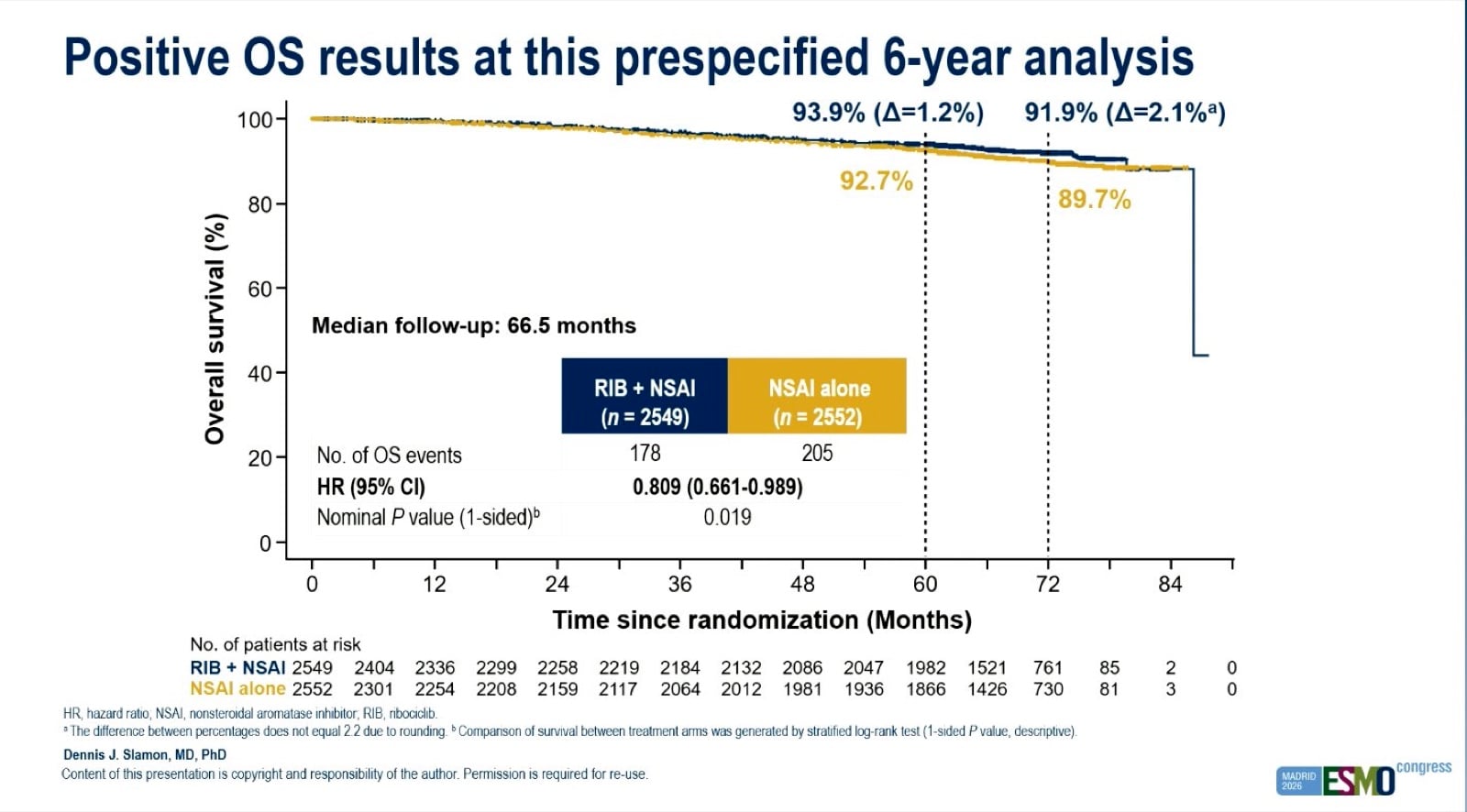
The debate was whether a 2.1-point OS difference with a nominal P value should change practice, and how much limited CDK4/6 inhibitor use after relapse in the control arm matters.
“Only 2%”?
Today at #ESMO26, the 6-year results of NATALEE will be presented. Ahead of the presentation, my personal view on the survival gains with adjuvant CDK4/6 inhibitors…
The 6-year OS rates in NATALEE were 91.86% vs 89.73%: an absolute gain of 2.1 percentage points (HR 0.809; 95% CI 0.661–0.989; nominal one-sided p=0.019).
The absolute 7-year OS gain in monarchE was 1.8 percentage points (HR 0.842; p=0.027). I do not think these gains should be dismissed as “only 2%.”
In the EBCTCG analysis, adding taxanes to anthracycline-based chemotherapy—an approach we have accepted as standard for years—provided an absolute 5-year OS gain of approximately 1.9 percentage points. The populations and follow-up periods differ, so we cannot directly compare treatment efficacy. However, the standards we use to judge a few percentage points of survival benefit should be consistent.
Moreover, 95.4% of patients in monarchE had already received chemotherapy. This survival gain represents an additional benefit on top of chemotherapy and endocrine therapy.
Patient selection, toxicity, treatment duration, and cost certainly deserve discussion. However, the survival benefit of adjuvant CDK4/6 inhibitors in appropriately selected patients should not be underestimated.
View post on X ↗Mali Barbi, MD MSc | Breast & Gyn Oncologist @DrBarbiOnc
breast and gynecologic oncologist, Northwell Health · Oct 23
#NATALEE OS is here. HR 0.81, 178 vs 205 deaths, 6-year OS difference 2.1%. monarchE was HR 0.84, 1.8% at 7 years. Two CDK4/6 inhibitors, two schedules, strikingly similar survival effect.
The OS gap widens after ribociclib stops at year 3, as expected since deaths lag relapses. More importantly, the iDFS curve is still separating after treatment ended. And control patients who relapsed could get a CDK4/6i for metastatic disease, which should shrink the OS difference. The benefit held.
What NATALEE adds over monarchE is N0, about 12% of the trial. The iDFS signal is there. N0 OS will be underpowered for a long time, so that conversation in clinic stays an iDFS conversation. #bcsm #ESMO26
View post on X ↗NATALEE 6-y results are out! #ESMO26
2.1 delta in survival at 6 years.
Thanks @Annals_Oncology for reporting subsequent therapy data!
👉Only 44.4% of control arm patients with distant recurrence received a first-line CDK4/6i
Does this survival difference truly inform clinical practice in settings where CDK4/6i are standard of care for metastatic disease?
In my opinion, the answer is no.
View post on X ↗7. KEYNOTE-B49: pembrolizumab + chemotherapy in PD-L1–positive HR+/HER2− metastatic disease
Phase 3, N=342 (Merck): pembrolizumab or placebo added to chemotherapy in HR+/HER2− locally recurrent inoperable or metastatic breast cancer with PD-L1 CPS ≥1, after endocrine therapy. Hope S. Rugo presented the final analysis (LBA51), published the same day in Annals of Oncology. PFS by BICR, the primary endpoint, was 6.7 vs 6.0 months, HR 0.74 (95% CI 0.58–0.95), P=0.0089; 24-month PFS 15.0% vs 4.3%. In the CPS ≥10 subgroup (72 patients, a secondary endpoint), PFS HR was 0.59 (0.35–0.98). (ESMO 2026 LBA51 abstract and slides; interim analysis, data cutoff Sep 22, 2025) Overall survival, the key secondary endpoint, was 21.0 vs 22.2 months, HR 1.04 (0.81–1.33), P=0.6185, not met. Grade ≥3 treatment-related AEs 37.6% vs 32.7%; 3 treatment-related deaths (1.8%) with pembrolizumab vs none. (LBA51 slides; final analysis, data cutoff Mar 16, 2026) Pembrolizumab in HR+/HER2− breast cancer is investigational; its FDA-approved breast cancer indications are in triple-negative breast cancer. (KOL Pulse KEYNOTE-B49 page)
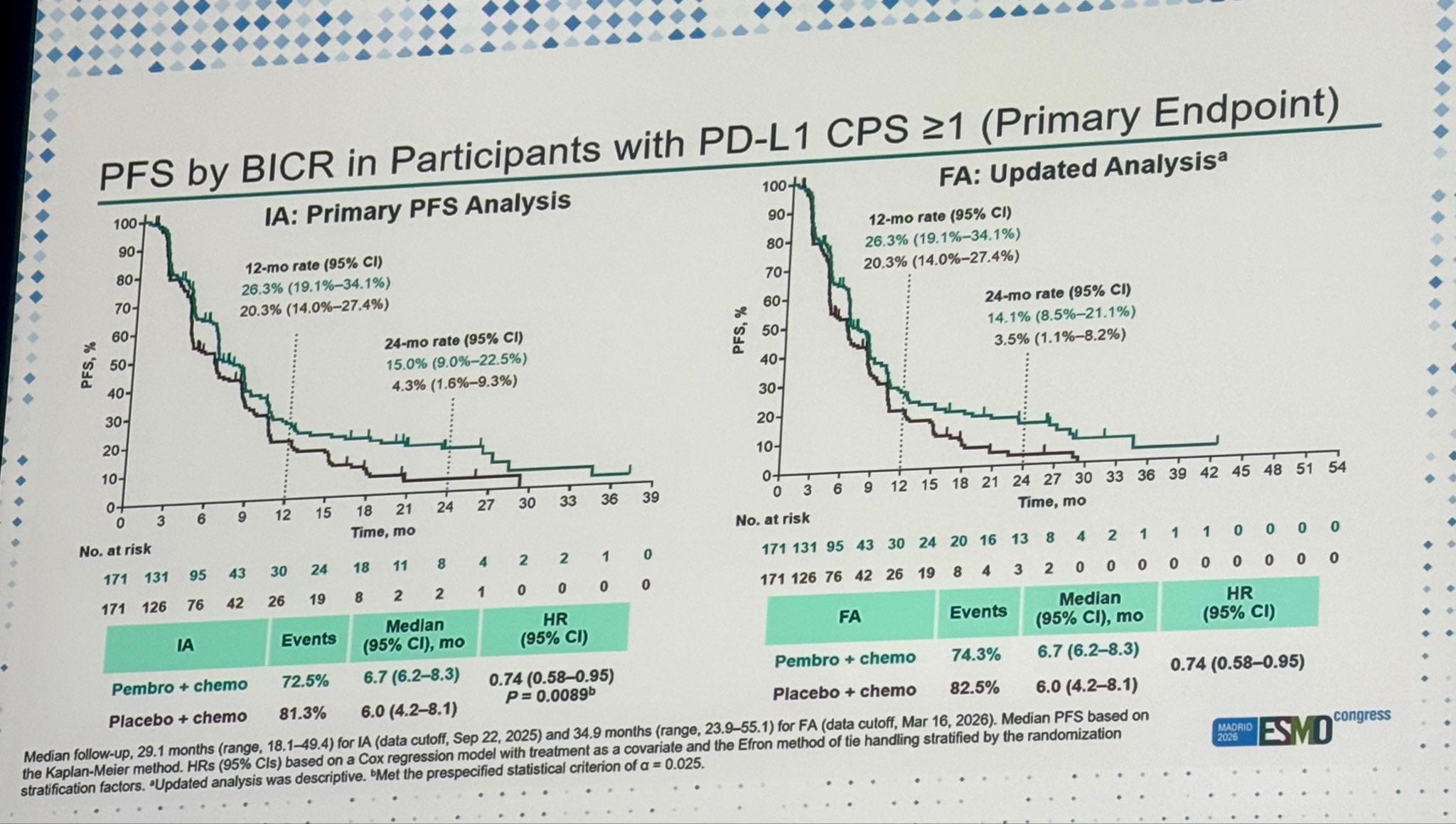
Physicians agreed the median PFS gain was small. The counterpoint was the tail of the PFS curve and the CPS ≥10 subgroup. A co-author of the study, Giampaolo Bianchini, called for better biomarkers. On October 25, Sherene Loi, a co-chair of Monday’s advanced breast cancer rapid oral session, pointed to early high-grade HR+ disease instead.
Modest median, longer tail
Giampaolo Bianchini @BianchiniGP
head of the breast cancer group, San Raffaele, Milan; KEYNOTE-B49 co-author · Oct 24
🔥 KEYNOTE-B49 meets its primary endpoint, but benefit seems limited to few patients
👉 ICIs benefit selected ER+/HER2− BC pts (CPS≥10, ER-low)
👉 Are ADCs better ICI partners than CT?
👉 What about PD-1/VEGF bispecifics?
➡️ Better biomarkers urgently needed!
#ESMO26 https://t.co/xtA0X9K0CZ
View post on X ↗Stephanie Graff, MD, FACP, FASCO @DrSGraff
director of breast oncology, Brown University Health · Oct 24
KN-B49 @hoperugo PDL1+ HR+ MBC after ET tx w/chemo +/-Pembro
Chemo: cape, doxil, taxanes
Pembro improved mPFS 6 to 6.7 mos; no OS gain
Complicated for practice w/ modest gain, ADCs in a competing space, and the pt burden of adding Pembro to oral cape. #ESMO26 @OncoAlert https://t.co/durudyjrCs
View post on X ↗
Erika Hamilton, MD, FASCO @ErikaHamilton9
breast oncologist, Sarah Cannon Research Institute · Oct 24
KNB49 HR+ adv #bcsm with PDL+, chemo +/- pembro once chemo appropriate
Only 19.4% of pts eligible (majority weren't PDL1+)
~79% of + were CPS 1-9
PFS improved 6 to 6.7 mo, but tail of curve much better at 24 mo 4.3 vs. 14% remaining on
PFS CPS of 19 4.4 vs. 7.5 mos
#ESMO26 https://t.co/pwtswREUTg
View post on X ↗STATISTICALLY POSITIVE. CLINICALLY THIN.
KEYNOTE-B49: pembrolizumab + chemo delivered just +0.7 months median PFS in PD-L1 CPS≥1 HR+/HER2− advanced breast cancer with no OS benefit.
Significance ≠ meaningful benefit.
@hoperugo #ESMO26 https://t.co/KrBy46HOX1
View post on X ↗
#keynoteB49- @myESMO #ESMO26
Adding ICB/ immunotherapy in advanced HR+ #breastcancer - wishful thinking 🤔 this context is immune deplete! -PFS 6-6.7 mo
➡️ Early high grade immune + HR + BC is the right place for it
#ESMOAmbassadors https://t.co/nTuY30fwfU
View post on X ↗8. PANKU-Breast01: iza-bren vs chemotherapy in pretreated HR+/HER2− disease
Phase 3, N=383, conducted in China: iza-bren (izalontamab brengitecan, an EGFR×HER3 bispecific ADC) vs physician’s-choice chemotherapy. PFS by BICR 8.18 vs 4.01 months, HR 0.41 (95% CI 0.33–0.53), P<0.0001. ORR 40.5% vs 20.2%. OS immature. ILD in 2 patients (1.1%), grade 1–2. (ESMO 2026 LBA50 abstract, Bo Lan; data cutoff Jul 21, 2026) Grade ≥3 TRAEs 85.3% vs 65.8%; dose reductions 64.7% vs 28.5%; grade ≥3 neutropenia 53.7%, anemia 49.5%, thrombocytopenia 46.3% with iza-bren. (LBA50 slides) Iza-bren is investigational and not FDA approved in any indication.
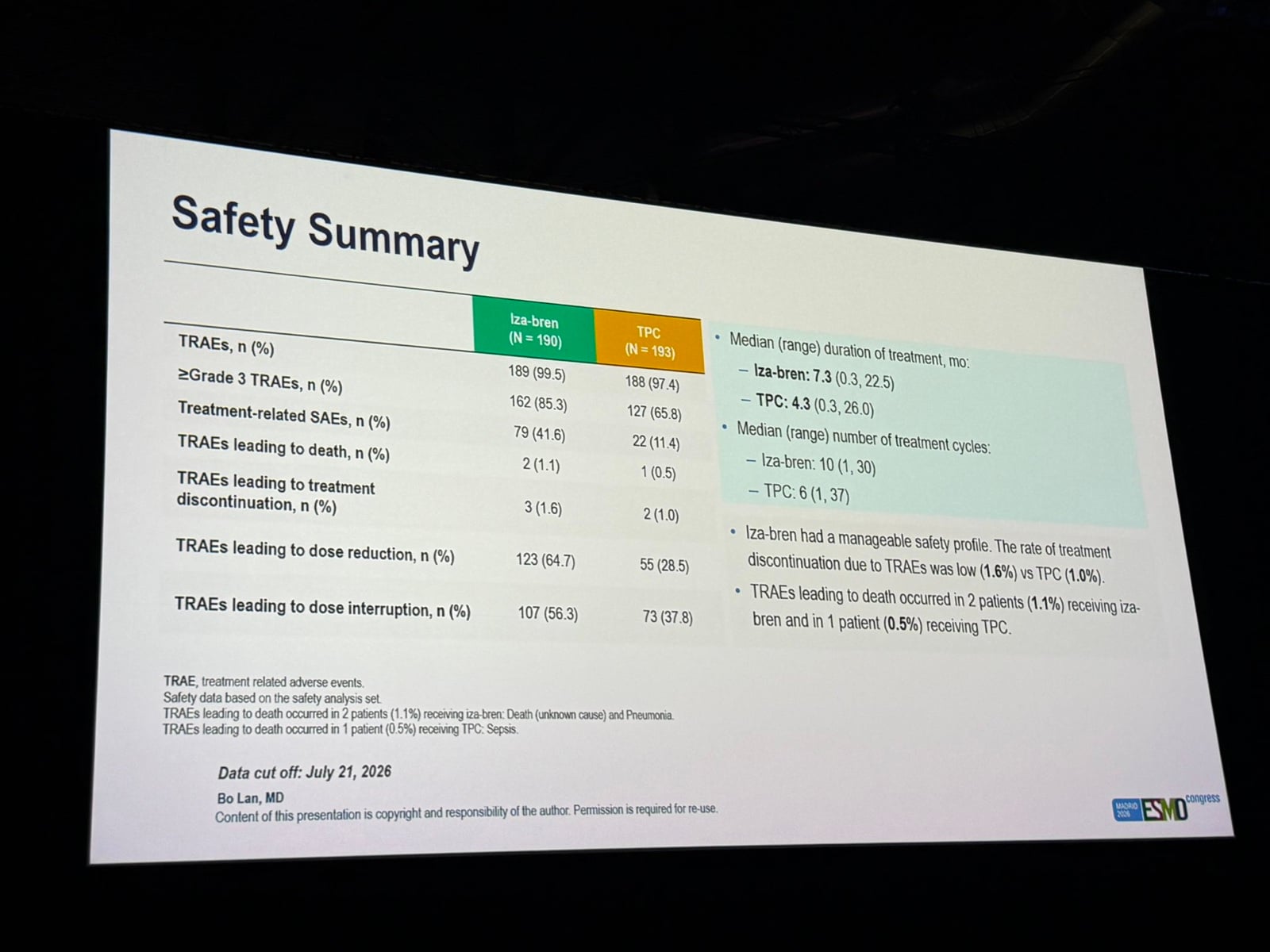
Physicians noted the PFS and response gains. The questions were hematologic toxicity and sequencing after other ADCs.
Efficacy vs hematologic toxicity
Erika Hamilton, MD, FASCO @ErikaHamilton9
breast oncologist, Sarah Cannon Research Institute · Oct 23
#PANKUBreast01
Ph III results for iza bren (bispecific EGFR/HER3 ADC) vs TPC chemo, in previously treated HR +/HER- MBC
🔹mPFS: 4.0 vs. 8.1 mo, HR 0.41
🔹 ORR: 20% vs 40%
🔹 DoR: 4.2 vs. 6.9 mo
🔹 ILD: only 1.1% & all grade 1/2
#ESMO26 #ESMOAmbassadors https://t.co/ikHLXiLHX1
View post on X ↗
🇨🇳 PANKU-Breast01: the HER3-EGFR bispecific TOPO1 ADC Iza-Bren improved PFS vs chemo in HR+/HER2- MBC (OS immature). High rate of hematologic toxicity, with ~50% G3+ anemia, neutropenia and thrombocytopenia, and most patients requiring dose reductions⚠️. #ESMO26 #ESMOAmbassadors https://t.co/f1zn2X0bpe
View post on X ↗#ESMO2026
Panku-breast01
Izabren sig. improves PFS in met HR+HER2 post CDK4i
#BreastCancer
👏New targets 🎈impressive ORR too
➡️broadly comparable to DB04 - here all HER2
But 🎈haem tox
Still have the what next issue 🤷🏻♀️
Online publication in @TheLancetOncol
#ESMOAmbassadors #bcsm @OncoAlert @myESMO
View post on X ↗9. FOURLIGHT-1: atirmociclib, a CDK4-selective inhibitor, after a CDK4/6 inhibitor
Randomized Phase 2 (Pfizer): atirmociclib + fulvestrant vs investigator’s choice of endocrine-based therapy in HR+/HER2− advanced breast cancer after a CDK4/6 inhibitor. Antonio Giordano presented. Investigator-assessed PFS favored atirmociclib. Atirmociclib is investigational. Physicians pointed to the first-line Phase 3 trial, FOURLIGHT-3, as the next readout.
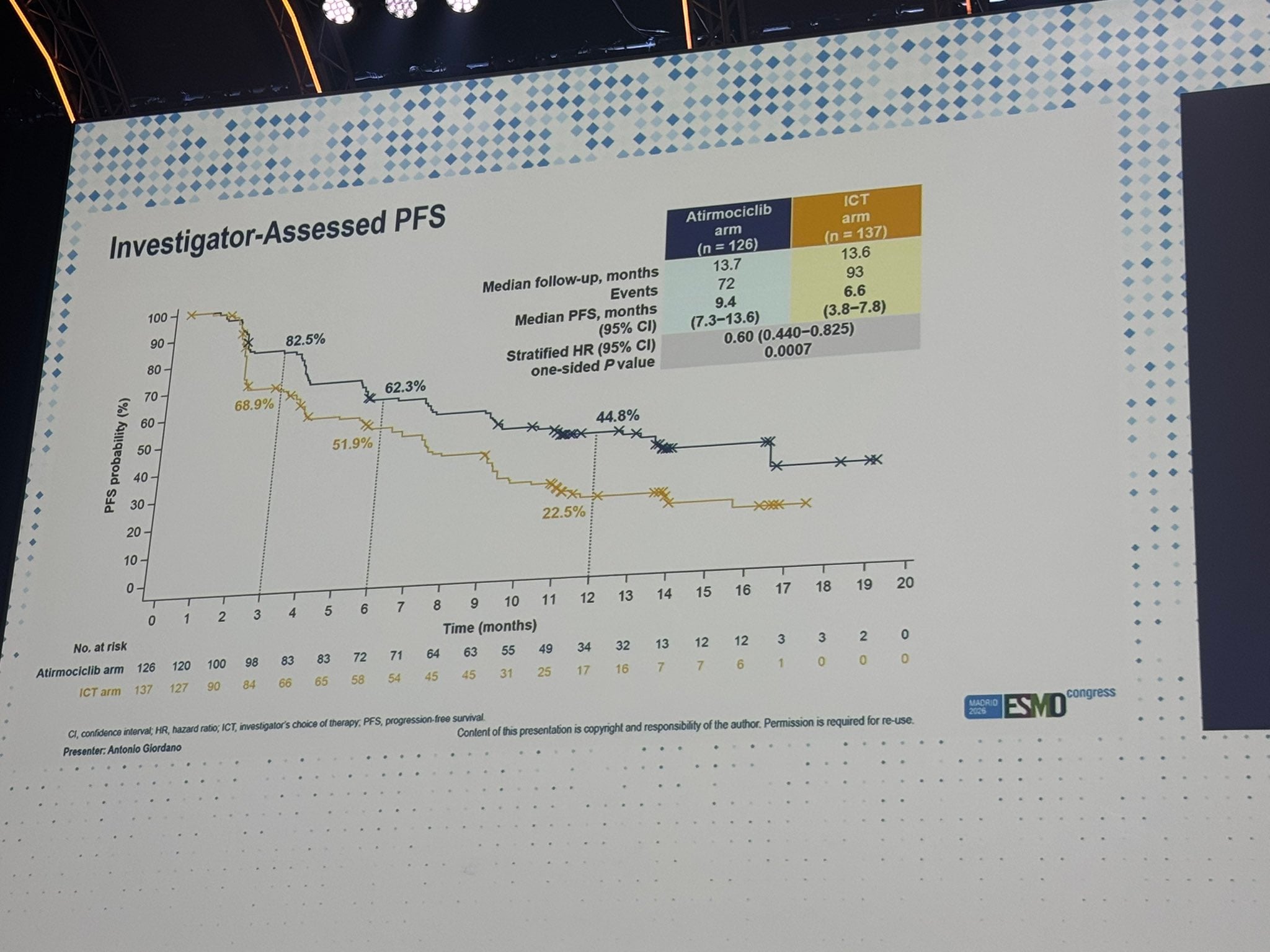
A co-author called the data strong. Others noted this is a Phase 2 result and that the control arm matters.
Phase 2 signal, Phase 3 next
@antgiorda beautifully presents our data from Fourlight 1 with the CDK4i atirmociclib/fulv vs fulv or eve/exe as 2nd line Rx for HR+ MBC. At 13.7 mo med FU, n=263, 38%esr1m, 40% PIKm, PFS 9.4 v 6.6mo HR 0.6 p0.007. Beautiful data. Await Fourlight 3 1st line study! @OncoAlert
View post on X ↗🔥 FOURLIGHT-1 demonstrates atirmociclib efficacy post-CDK4/6i
⚠️ Phase II trial: not practice-changing yet
👉 These results reinforce expectations that atirmociclib may outperform other CDK4/6i
➡️ FOURLIGHT-3 results eagerly awaited
Congrats to my friend @antgiorda
#ESMO26 https://t.co/IBGIoA05Rc
View post on X ↗Mali Barbi, MD MSc | Breast & Gyn Oncologist @DrBarbiOnc
breast and gynecologic oncologist, Northwell Health · Oct 24
After CDK4/6i in HR+ MBC, the control arm is the story at #ESMO2026.
FINER: fulvestrant alone, median PFS 1.9 mo. Ipatasertib + fulvestrant 5.4 mo, HR 0.68. In AKT pathway-altered tumors, HR 0.55.
FOURLIGHT-1: atirmociclib, a CDK4-selective inhibitor, 9.4 vs 6.6 mo with investigator's choice, HR 0.60. 85 to 92% randomized within 3 months of their last CDK4/6i.
Fulvestrant alone after a CDK4/6i is close to no treatment. FINER helped even without selection, but with toxicity FOURLIGHT-1 tests whether keeping CDK4 pressure on, more selectively, beats switching. #bcsm #ESMO26
@myESMO
View post on X ↗Free Access · KOL Pulse Intelligence
Track oncology’s top KOLs in your specialty
Create a free account, pick the tumor types you cover, and go beyond the tweet — the intelligence pharma teams use to map influence and prepare for engagement:
- ✓Enhanced KOL profiles
- ✓Pharma influence & potential advisory-board patterns
- ✓2025 Open Payments financial analysis
- ✓Social-media sentiment & trend signals
Get free access — pick your specialty
Choose the tumor types you follow. No cost, unsubscribe anytime.
10. TALENT: neoadjuvant T-DXd in HR+/HER2-low early breast cancer
Phase 2, 132 patients, three arms: T-DXd alone, T-DXd + anastrozole, or T-DXd followed by docetaxel-cyclophosphamide. pCR (RCB0) 7% (3/45), 3% (1/29) and 9% (5/58). RCB0/1 16%, 17% and 17%. Grade ≥3 treatment-related AEs 24%, 17% and 28%; 3 cases of grade 2 ILD; 1 treatment-related death in the T-DXd-alone arm. (ESMO 2026 LBA23 slides, Sara A. Hurvitz) Neoadjuvant T-DXd is investigational. Enhertu is FDA approved in HER2-low breast cancer only for unresectable or metastatic disease. (KOL Pulse TALENT page)
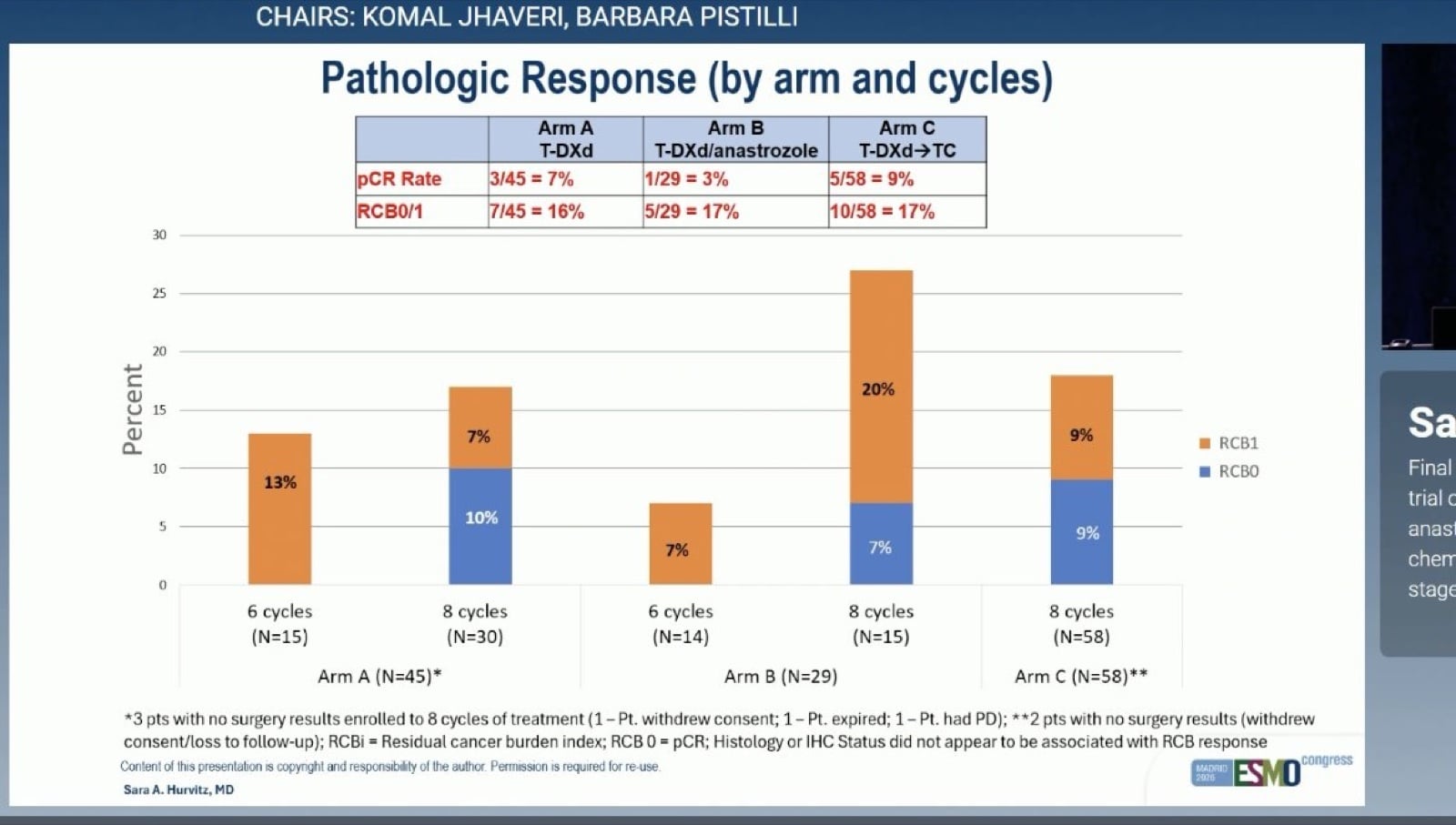
Physicians called the pCR rates low. One noted that pCR is a limited surrogate endpoint in HR+ disease.
High response, low pCR
TALENT trial presented by Sara Hurvitz: Preop TDXd in HR+ HER2-low breast cancer
Preop TDXd: 7%
TDXd+AI: 3%
TDXd-->TC: 9%
Adding endocrine therapy and sequencing chemo with TDXd didn't seem to improve pCR
@OncoAlert #ESMO2026 https://t.co/dArlOO4Mpa
View post on X ↗Erika Hamilton, MD, FASCO @ErikaHamilton9
breast oncologist, Sarah Cannon Research Institute · Oct 23
TALENT- neoadj T-DXd in HR+/HER2-low #bcsm
RCB0/1:
🔹 T-DXd alone: 16%
🔹 T-DXd + anastrozole: 17%
🔹 T-DXd → TC chemo: 17%
*no pCRs w/out 8 cycles
Despite high ORR ~66%, pCR LOW! We know w/ HR+ we don't get high pCRs rates, but still disappointing
#ESMO26 #ESMOAmbassadors https://t.co/smlF5DmAAt
View post on X ↗#ESMO26 | TALENT
Neoadjuvant T-DXd showed very low pCR rates in HR+/HER2-low early breast cancer:
- T-DXd: 7%
- T-DXd + anastrozole: 3%
- T-DXd → chemotherapy: 9%
We should remember that pCR is a limited surrogate endpoint in HR+ disease. However, these results do not support T-DXd as an alternative to standard neoadjuvant chemotherapy.
Moreover, given the heterogeneity of HER2-low disease, I find it unsurprising that the success of T-DXd in the metastatic setting does not translate into similar outcomes in early-stage disease, despite the lower tumor burden.
View post on X ↗11. TROPION-Breast02: Dato-DXd in patients with brain metastases
Phase 3 (Daiichi Sankyo and AstraZeneca): datopotamab deruxtecan vs chemotherapy as first-line treatment for metastatic TNBC in patients who are not candidates for PD-1/PD-L1 therapy. Primary analysis: PFS by BICR 10.8 vs 5.6 months, HR 0.57 (95% CI 0.47–0.69), P<0.0001; OS 23.7 vs 18.7 months, HR 0.79 (0.64–0.98). (ESMO 2025 LBA21; data cutoff Aug 25, 2025; same medians and HRs in the May 22, 2026 FDA approval) Datroway has been FDA approved for this population since May 22, 2026. (KOL Pulse TROPION-Breast02 page) At ESMO 2026, Rebecca Dent presented an exploratory analysis of the patients with brain metastases at baseline (LBA96). In the patients with brain metastases at baseline (35 vs 26), median CNS PFS was 9.5 vs 2.6 months, HR 0.27 (95% CI 0.13–0.56). This analysis is exploratory. (LBA96 slide, Rebecca Dent, as tabulated on the KOL Pulse TROPION-Breast02 page; no data cutoff shown on the slide)
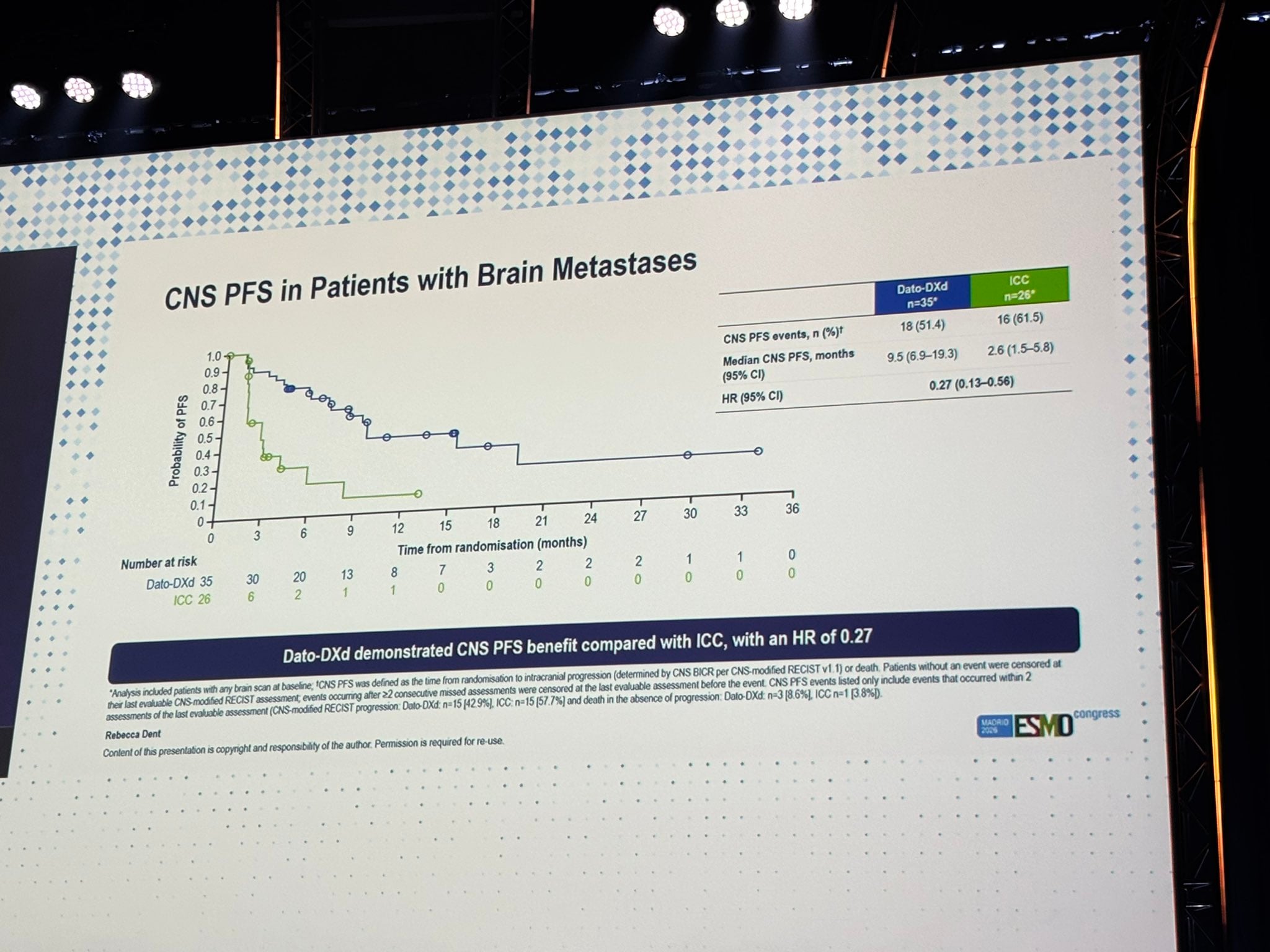
Physicians agreed the intracranial activity is real. They differed on whether it is ready for clinic, given the small, exploratory subgroup.
Ready for clinic?
@RebeccaDSing presents efficacy of Dato-Dxd in patients with TNBC on TB02. In the small subset with BMs Dato DXd improved CNS response and PFS! Nice data immediately applicable to clinical practice. @myesmo #ESMO2026 @OncoAlert https://t.co/AeMylHCL7g
View post on X ↗TROPION-Breast02 brain mets analysis at #ESMO26 (Dent). 1L Dato-DXd vs chemo, mTNBC, n=61 with BMs:
CNS PFS 9.5 vs 2.6 mo, HR 0.27
icORR (measurable) 62.5% vs 37.5%
Untreated BMs: OS HR 0.35
Longest icDoR ~27 mo
Preferred Trop2 ADC for brain Mets! @RebeccaDSing
Exploratory, small n, real CNS signal. #bcsm
View post on X ↗Mali Barbi, MD MSc | Breast & Gyn Oncologist @DrBarbiOnc
breast and gynecologic oncologist, Northwell Health · Oct 24
TROPION-Breast02, brain mets subgroup at ESMO 2026. First-line Dato-DXd vs chemo in mTNBC, n=61.
CNS PFS 9.5 vs 2.6 mo, HR 0.27. Intracranial ORR 62.5% vs 37.5%. Longest intracranial response about 27 mo.
In TNBC, brain mets come early and we usually treat them locally first. This makes me ask whether a patient with small asymptomatic lesions could start Dato-DXd and defer /combine SRS
Not ready for clinic. This is a post hoc subgroup, n=30 with untreated brain mets. And even on Dato-DXd, median OS was 11.6 mo with brain mets vs 23.7 mo without. The CNS benefit is real; the prognosis is still poor. The answer needs a dedicated CNS trial. #bcsm #ESMO26
@myESMO
View post on X ↗12. postMONARCH: final overall survival with abemaciclib after a CDK4/6 inhibitor
Phase 3, N=368 (Eli Lilly): abemaciclib + fulvestrant vs placebo + fulvestrant after progression on a CDK4/6 inhibitor plus endocrine therapy. Final OS (secondary endpoint): median 32.1 vs 24.6 months, HR 0.80 (95% CI 0.60–1.06), log-rank P=0.11, not statistically significant. Updated investigator-assessed PFS (primary endpoint): 5.9 vs 5.3 months, HR 0.78 (0.62–0.99), P=0.039. Exploratory PFS2 HR 0.76 (0.59–0.97) and time to chemotherapy HR 0.76 (0.58–0.99). (ESMO 2026 1RO slides, Kevin Kalinsky; data cutoff Mar 6, 2026; median follow-up 37 months) Abemaciclib after a CDK4/6 inhibitor is investigational; abemaciclib is FDA approved in other HR+/HER2− breast cancer settings. (KOL Pulse postMONARCH page)
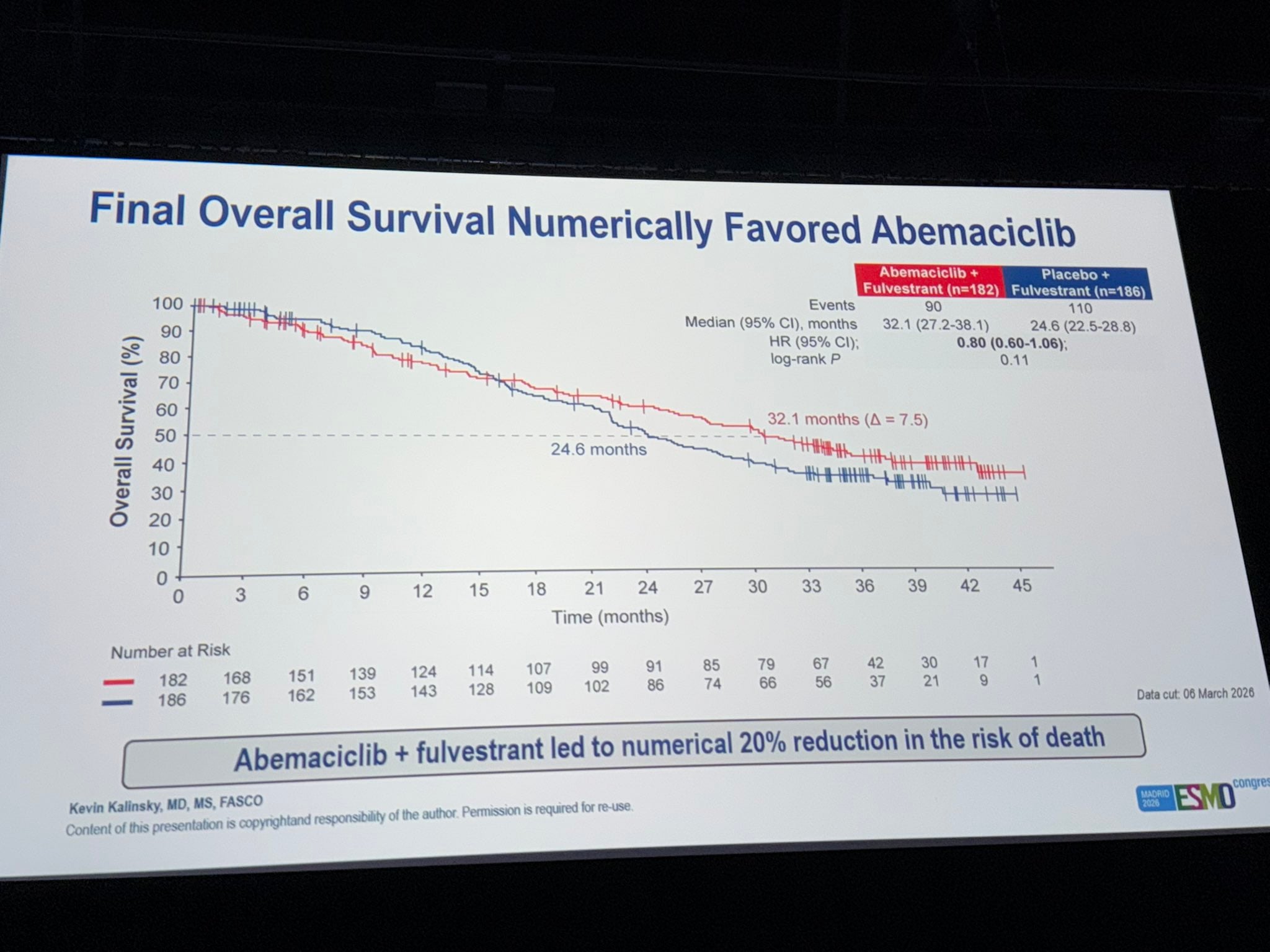
Physicians read the OS result differently: a continued benefit for some, not a preferred second-line option for others, given biomarker-directed therapies.
Numerical OS gain, not significant
#ESMO2026
PostMonarch - change to Fulvestrant v placebo with Abema- continues to show better PFS and OS
➡️ results by ESR1 status eagerly awaited!
#ESMOAmbassadors @OncoAlert
Published online in @Annals_Oncology https://t.co/Bzolx5kqxi
View post on X ↗#ESMO26 | postMONARCH – Final OS
After progression on CDK4/6i + ET, median OS with abemaciclib + fulvestrant was 32.1 vs 24.6 months, but statistical significance was not reached (HR 0.80; 95% CI 0.60–1.06; p=0.11).
The 7.5-month difference in median OS is noteworthy, but these results do not make this combination a preferred second-line option for me, given the availability of biomarker-directed therapies.
View post on X ↗🔥 Abema + fulvestrant after 1L CDK4/6i/AI improves PFS, PFS2 & time to chemo; numerical ↑OS
👉 CDK targeting remains valid post-CDK4/6i, but NOT a class effect!
✅ Abema (postMONARCH, EMBER-3), atirmociclib (FourLight-1), ribo (MAINTAIN)
⛔ Palbo (PACE, PALMIRA)
#ESMO26 https://t.co/KxHmObP6Oc
View post on X ↗13. APEX-Breast01: TQB2102, a biparatopic HER2 ADC, in HER2-low disease
Phase 3 (Chia Tai Tianqing): TQB2102 (rolditamig deuderuxtecan) vs physician’s-choice chemotherapy in HER2-low recurrent or metastatic breast cancer. Shusen Wang presented. PFS by blinded independent review, the primary endpoint in the HR+/HER2-low population, favored TQB2102. TQB2102 is investigational.
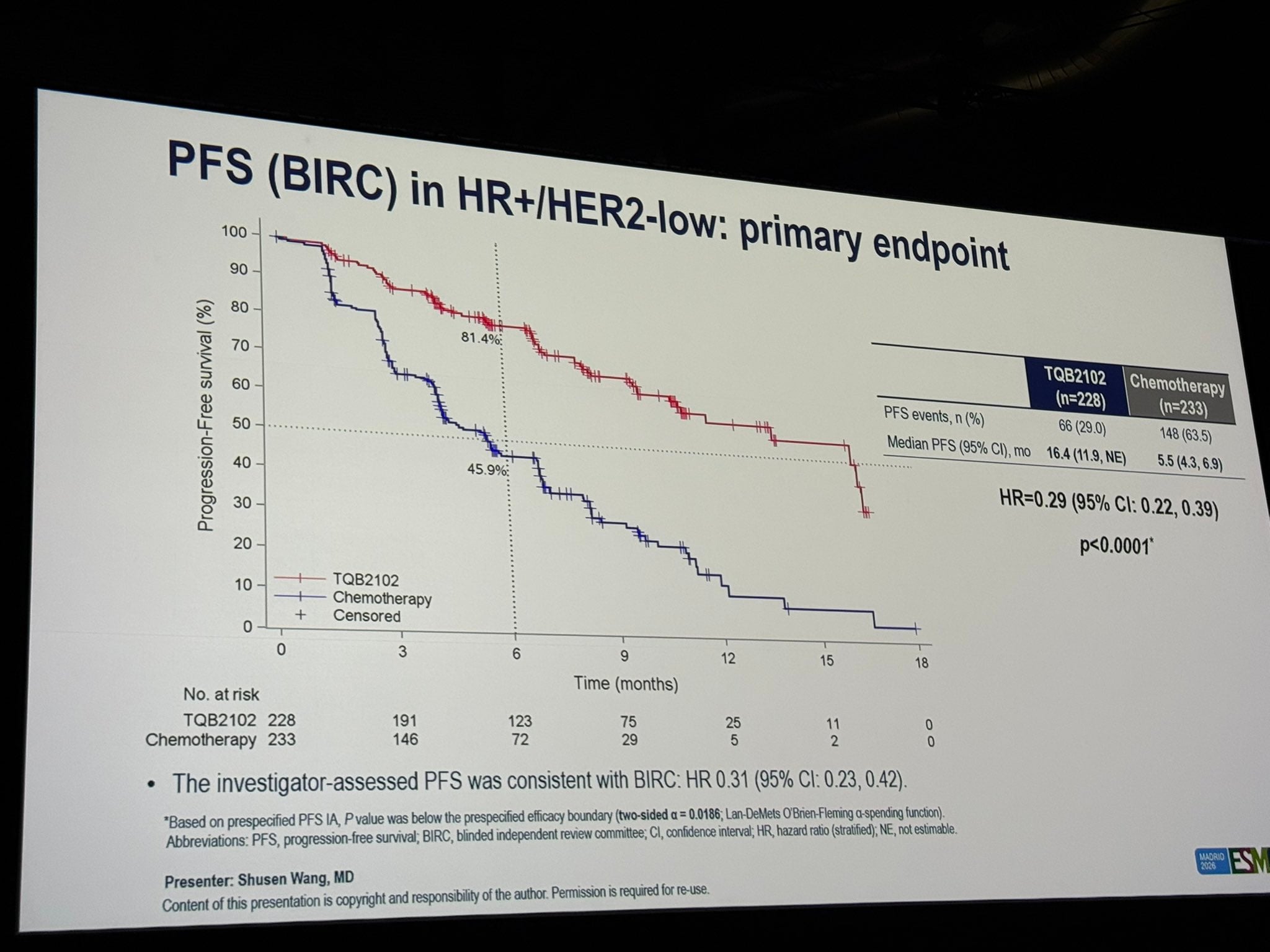
With HORIZON-Breast06 in the same session, physicians asked what a third HER2 ADC with a topoisomerase I payload adds when the comparator was chemotherapy, not T-DXd.
Another HER2 ADC vs chemotherapy
🇨🇳 TQB2102 (biparatopic HER2 TOPO1 ADC) also passes the truck test in mostly HR+/HER2-low MBC. PFS 16.4 vs 5.5 mo, HR 0.29, p<0.01. Unclear whether the biparatopic design adds anything. The HER2 TOPO1 field is getting quite crowded with excellent agents. #ESMOAmbassadors #ESMO26 https://t.co/nOV5QhN7PR
View post on X ↗Three HER2 ADCs now in HER2-low MBC. At #ESMO26, HORIZON-Breast06 & APEX-Breast01 both beat chemo on PFS (HR ~0.25–0.29). But as @BarbaraPistill2 noted: same payload class as Tdxd, tested vs chemo not the standard. Head-to-head ADC trials needed. #ESMOAmbassadors @myESMO https://t.co/Yntya2iiR3
View post on X ↗First breast session at #ESMO26 highlights how China is developing novel drugs at rapid speed.
Positive PFS results with HER2-directed ADCs (HORIZON-Breast06 + APEX-Breast01), but neither compare to current SoC of T-DXd.
Fights for market share, but does it push the needle?
View post on X ↗14. lidERA: patient-reported outcomes with adjuvant giredestrant
Phase 3, N=4,170 (Roche/Genentech): adjuvant giredestrant, an oral SERD, vs standard-of-care endocrine therapy (aromatase inhibitor or tamoxifen) in stage II–III HR+/HER2− early breast cancer. At the prespecified interim analysis, the primary endpoint, invasive disease-free survival, was met: 3-year iDFS 92.4% vs 89.6%, HR 0.70 (95% CI 0.57–0.87), P=0.0014. (SABCS 2025 GS1-10, Aditya Bardia; data cutoff Aug 8, 2025; median follow-up 32.3 months) On October 23, Gustavo Werutsky presented the patient-reported outcomes. More patients on giredestrant than on standard endocrine therapy reported never experiencing joint pain over the first 15 cycles, with comparable severity and interference. Hot flashes and fatigue were comparable, and physical functioning, role functioning and HRQoL were maintained in both arms. Over 50% of patients on giredestrant reported no bother from side effects across more than 3 years of treatment. (ESMO 2026 slides, Gustavo Werutsky; data cutoff Aug 8, 2025) Giredestrant is investigational: it is not FDA approved, and a regulatory submission has been filed. (KOL Pulse lidERA page)
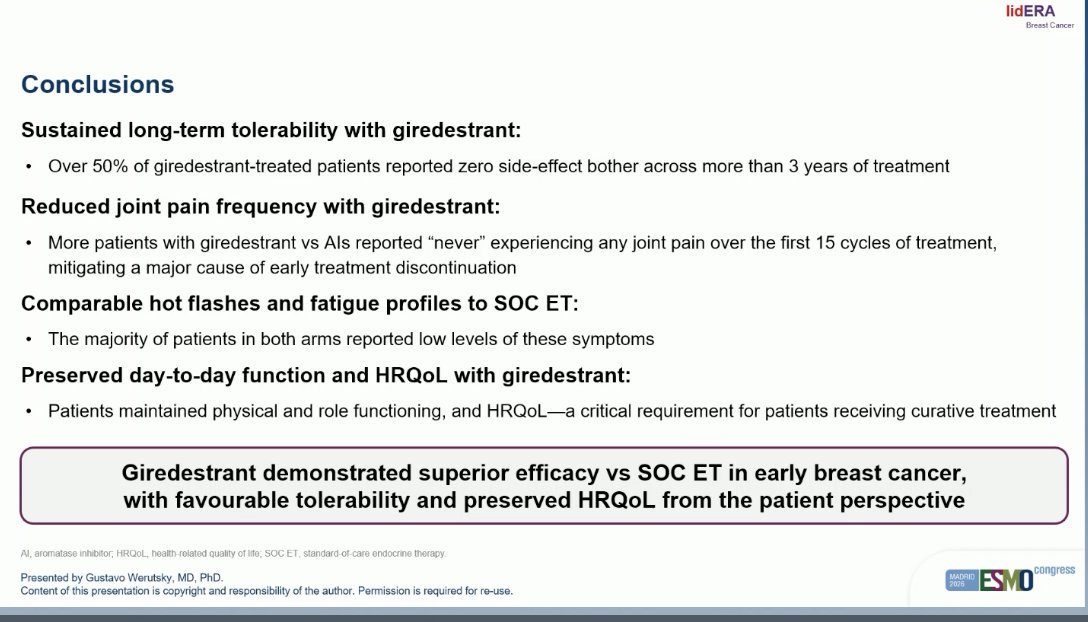
Physicians read the PROs as support for giredestrant’s tolerability. The open question, which Yakup Ergün raised, is where an adjuvant oral SERD fits alongside CDK4/6 inhibitors: lidERA compared giredestrant with endocrine therapy alone, not with a CDK4/6 inhibitor plus endocrine therapy.
Better tolerated; where does it fit?
PROs from lidERA presented by @GustavoWerutsky. Giredestrant appeared associated with comparable QoL vs standard ET. We don’t every day see a drug that improves adjuvant outcomes without adding side effect burden. #ESMO26 #ESMOAmbassadors https://t.co/aQ7Pim2d7p
View post on X ↗Lidera PROs: Adjuvant Giredestrant vs SOC ET
More pts reported never experiencing joint pain with minimal changes in severity from BL compared with SOC endocrine therapy
Hot flashes + fatigue comparable between arms
@OncoAlert #ESMO26 https://t.co/AU8X4cy8V8
View post on X ↗Giredastrant improved IDFS and had a better tolerability (less arthralgia) compared to AI
#ESMO26
#ESMOAmbassadors
#ESMOcommunity
@myESMO @GustavoWerutsky https://t.co/ZrU0BXpSDX
View post on X ↗#ESMO26
lidERA: Can Adjuvant Giredestrant Replace CDK4/6 Inhibitors? https://t.co/K7bzz1qtl0
View post on X ↗KOL Voices: the top breast cancer physicians at ESMO 2026
The top 10 physicians in the breast cancer tab of the ESMO 2026 KOL leaderboard, with one line from each and the trial it is about.
- Yakup Ergün @dr_yakupergun · medical oncologist
on KEYNOTE-B49 → “Evaluating immunotherapy in combination with ADCs or after ADC treatment may be more rational in today's treatment landscape.” - Paolo Tarantino @PTarantinoMD · medical oncologist, Dana-Farber
on NATALEE → “Efficacy comparable to abema (monarchE), with different toxicity profile and wider population (N+ and high-risk N0).” - Erika Hamilton, MD, FASCO @ErikaHamilton9 · breast oncologist, Sarah Cannon Research Institute
on FOURLIGHT-1 → “**1st line trial and curative trials coming!***” - Aya Mohamed | MSc, MD 🎗 @Dr_Oncologista · medical oncologist, breast cancer
on postMONARCH → “Abemaciclib After CDK4/6 Inhibitor Progression — PFS Benefit Without a Statistically Significant OS Improvement” - Sara Tolaney @stolaney1 · chief of breast oncology, Dana-Farber
on NATALEE → “6 yr OS HR 0.809 (delta 2.1%)” - Rebecca Shatsky, MD @Dr_RShatsky · breast medical oncologist, UC San Diego
on FINER → “If we allow 40% de novo metastatic disease on a trial we can’t really say it’s representative of the general MBC population.” - Stephanie Graff, MD, FACP, FASCO @DrSGraff · director of breast oncology, Brown University Health
on TALENT → “ypCR just isn’t the same endpoint w/ ER+ disease” - Matteo Lambertini, MD PhD @matteolambe · medical oncologist, University of Genova
on KEYNOTE-B49 → “more translational research is needed to improve our understanding on how to optimize #immunotherapy use in luminal-like disease” - Kristina Jankovic, MD @JankovicK · medical oncology resident, Niš
on APEX-Breast01 → “Impressive #APEXBreast01 data showing benefit with rolditamig deuderuxtecan over first-line chemotherapy in HR+/HER2-low metastatic #BreastCancer!” - Philippe Aftimos, MD @aftimosp · medical oncologist, Institut Jules Bordet
on FOURLIGHT-1 → “Next step: the FourLight-3 ph3 study in the 1L vs CDK4/6i”
What’s yet to come: the breast cancer highlights on October 27
ESMO 2026 ends on Tuesday, October 27. Times are Madrid time. Physician reactions will appear on the ESMO 2026 trials page as they post.
Tue Oct 27 · 11:40-12:20 (Madrid) · Barcelona Auditorium - Hall 9
Scientific Congress Highlights 2: Breast cancer, early and advanced stage
- 11:40-12:20 Breast cancer, early and advanced stage — Giuseppe Curigliano
FAQ
Which breast cancer trials did physicians discuss most at ESMO 2026?
By physician posts on X over October 23-26, NATALEE, KEYNOTE-B49, PANKU-Breast01, FOURLIGHT-1, TALENT and TROPION-Breast02 led. Of the trials presented on October 26, SWITCH had the most posts (21), followed by BRIDGET (17), DESTINY-Breast09 (14) and OptiTROP-Breast01 (12).
What did the SWITCH trial show?
In HER2-negative metastatic breast cancer after a prior ADC (94.4% had received a TOP1-inhibitor ADC), switching to an investigational TOP1-inhibitor ADC with a different target (HER2, TROP2, HER3 or Nectin-4) gave confirmed response rates of 0% to 8.3% (primary endpoint) and median PFS of 1.4 to 3.0 months (ESMO 2026 4RO slides, data cutoff July 31, 2026). Both responders had previously received disitamab vedotin, an ADC with an MMAE payload. None of the four ADCs is FDA approved.
Did sac-TMT improve overall survival in OptiTROP-Breast01?
Overall survival, the key secondary endpoint, met its prespecified significance criterion at the interim analysis (HR 0.53, one-sided P=0.0005; data cutoff November 30, 2023). At the final analysis, which was descriptive, median OS was 14.7 vs 9.9 months (HR 0.60, 95% CI 0.45-0.80, nominal P=0.0004; data cutoff September 17, 2025). Sac-TMT is approved in China and is not FDA approved.
Did NATALEE show an overall survival benefit at 6 years?
6-year OS was 91.86% vs 89.73% (HR 0.809, 95% CI 0.661-0.989) with a nominal one-sided P=.019 (ESMO 2026 LBA25 abstract, data cutoff May 15, 2026). Physicians disagreed on how much weight to give it. Adjuvant ribociclib has been FDA approved since September 17, 2024.
Did KEYNOTE-B49 improve survival with pembrolizumab in HR+/HER2- breast cancer?
PFS improved: 6.7 vs 6.0 months, HR 0.74 (95% CI 0.58-0.95), P=0.0089 (interim analysis, data cutoff September 22, 2025). Overall survival did not: 21.0 vs 22.2 months, HR 1.04 (0.81-1.33) (final analysis, data cutoff March 16, 2026). Pembrolizumab in HR+/HER2- breast cancer is investigational (ESMO 2026 LBA51, KOL Pulse KEYNOTE-B49 page).
Did postMONARCH improve overall survival?
Median OS was 32.1 vs 24.6 months (HR 0.80, 95% CI 0.60-1.06, log-rank P=0.11). The difference was not statistically significant (ESMO 2026, data cutoff March 6, 2026). Abemaciclib after a CDK4/6 inhibitor is investigational.
Is iza-bren approved?
No. Iza-bren is investigational. In PANKU-Breast01, PFS by BICR was 8.18 vs 4.01 months (HR 0.41, 95% CI 0.33-0.53) vs chemotherapy, with OS immature (ESMO 2026 LBA50 abstract).
What breast cancer sessions are left at ESMO 2026?
On Tuesday, October 27, the last day of ESMO 2026, Giuseppe Curigliano presents the breast cancer congress highlights (Scientific Congress Highlights 2, 11:40-12:20 Madrid time).
KOL Pulse tracks what oncologists and hematologists post on X. Posts quoted here are shown in full, verbatim, and link to their source. Trial figures come from KOL Pulse trial pages, with the source and data cutoff in parentheses.