Brian Shields
HARMONi-GI1 phase 3 trial of ivonescimab + chemo in 1L advanced #BTC
-OS 14.9 vs 12.1 mos HR 0.75 p 0.0031
-PFS 8.4 vs 5.8 mos HR 0.61 p<0.0001
-ORR 53.8 vs 32.5% p<0.0001
A new standard of care in China. Do we need a trial in Western countries?
#ESMO26
#ESMOAmbassadors @myESMO https://t.co/b2U1WNUHf6
View post on X ↗
KOL Pulse · ESMO 2026 · Madrid · October 23–26 · GI cancers
ESMO 2026: Top GI Cancer Trials and KOL Voices
HARMONi-GI1 and CLARITY-Gastric01, both presented on October 25, now lead physician posts on X among GI trials at ESMO 2026, and IROCAS and AZUR-1 were presented the same day. Ivonescimab plus gemcitabine-cisplatin improved OS over durvalumab plus gemcitabine-cisplatin in first-line biliary tract cancer at an interim analysis; on October 26, Angela Lamarca summarized the invited discussion: “OS interim analysis but finding likely to remain”. Sonesitatug vedotin improved OS in CLDN18.2-positive gastroesophageal cancer treated in the third line or later, while PFS in all patients missed significance. Yannick Buccella wrote: “In a cancer where later line treatment has meant 5-9 months for my whole career, doubling that isn't small.” IROCAS was negative for adjuvant intensification in colon cancer, and AZUR-1, the basis of dostarlimab’s October 19 FDA accelerated approval in stage II/III dMMR/MSI-H locally advanced rectal cancer, presented its interim results. Below: the Days 3–4 trials first, then the Days 1–2 GI readouts, the GI leaderboard and the last GI session on October 27.
Physician discussion, October 23–26
Physician posts on X, October 23–26.
| # | Trial | Physician posts | Physicians posting |
|---|---|---|---|
| 1 | HARMONi-GI1 | 39 | 28 |
| 2 | CLARITY-Gastric01 | 27 | 21 |
| 3 | HERIZON-GEA-01 | 20 | 14 |
| 4 | SANO | 19 | 15 |
| 5 | G-HOPE-001 | 16 | 11 |
| 6 | IROCAS | 15 | 11 |
| 7 | COMPANION-002 | 15 | 8 |
| 8 | ACTICCA-1 | 14 | 7 |
| 9 | AZUR-1 | 13 | 10 |
| 10 | RASolute 302 | 12 | 11 |
| 11 | INCB161734 (zecdarasib) + chemotherapy | 12 | 10 |
| 12 | PRABITAS | 11 | 8 |
| 13 | KEYNOTE-975 | 10 | 8 |
| 14 | Telisotuzumab adizutecan + bevacizumab | 7 | 4 |
HARMONi-GI1 and CLARITY-Gastric01, both presented on October 25, moved to the top of the table on Days 3–4. INCB161734 (zecdarasib), an investigational KRAS G12D inhibitor, plus chemotherapy in KRAS G12D-mutant pancreatic cancer entered the table on October 26 (posts). Also discussed on October 26: LEAP-012 (posts) and HRS-4642 (posts).
Days 3–4: GI trials presented on October 25
All four were presented on October 25; physicians kept discussing them on October 26.
1. HARMONi-GI1: ivonescimab + gemcitabine-cisplatin vs durvalumab + gemcitabine-cisplatin in first-line biliary tract cancer
Double-blind Phase 3 (LBA8), N=682, enrolled in China: ivonescimab, a PD-1×VEGF bispecific antibody, plus gemcitabine-cisplatin vs durvalumab plus gemcitabine-cisplatin in untreated advanced biliary tract cancer, presented by Jian Zhou on October 25 in Presidential Symposium II, with James J. Harding as invited discussant. The primary endpoint, OS, was met at a prespecified interim analysis: median 14.9 vs 12.1 months, stratified HR 0.75 (95% CI 0.61–0.92), one-sided P=0.0031; 12-month OS 59.7% vs 50.7%. Key secondary endpoints, investigator-assessed: median PFS 8.4 vs 5.8 months, HR 0.61 (0.51–0.72); ORR 53.8% vs 32.5%. Grade 3 or 4 treatment-emergent adverse events occurred in 82.0% vs 72.3% of patients, and subsequent anti-tumor therapy was given to 31.8% vs 45.9%. (ESMO 2026 LBA8 slides, Jian Zhou; prespecified interim analysis, median follow-up 14.3 months; data cutoff not shown on the slides) The comparator is the approved first-line standard from TOPAZ-1. Ivonescimab is investigational: it is not approved for biliary tract cancer in any country and is not approved for any indication in the US or Europe. In the US, the ECOG-ACRIN Phase 2/3 trial EA2251 will compare ivonescimab plus chemotherapy with pembrolizumab or durvalumab plus chemotherapy. (KOL Pulse HARMONi-GI1 page)
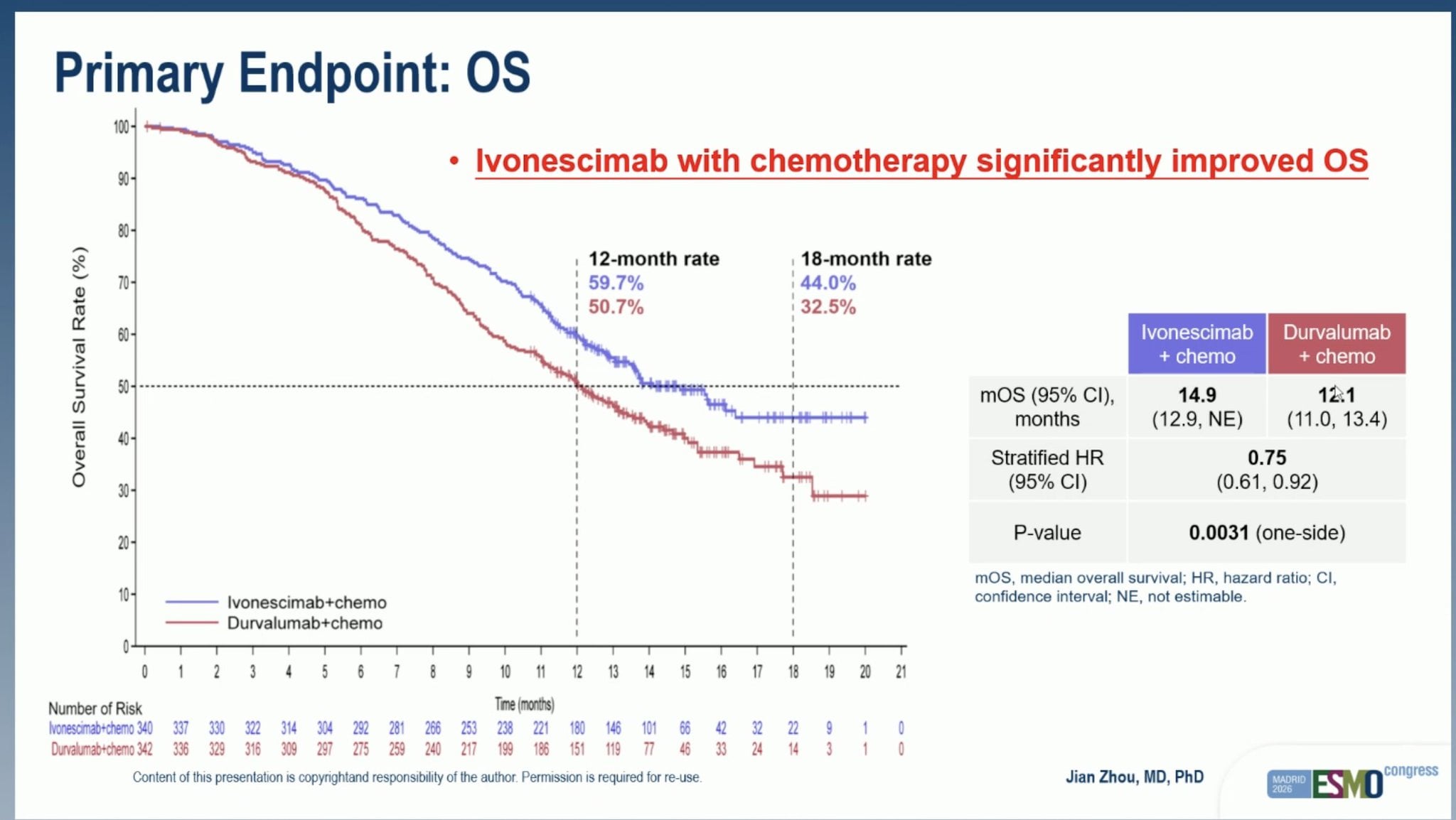
Physicians called the survival gain against an active immunotherapy comparator meaningful, and noted the added toxicity.
After the presentation
🔥Presidential session at ESMO 2026 🔥
HARMONi-GI1 ph-3: Ivonescimab + CTx vs durvalumab + CTx as 1L for BTC
#ESMO26 #ESMOAmbassadors
👉ORR: 53.8 vs. 32.5 %
👉mPFS: 8.4 vs 5.8 mo
👉mOS: 14.9 vs. 12.1 mo
🧐 Very promising Chinese data, would be great to see data in a global population
@myESMO @ASCO
View post on X ↗HARMONi-GI1: OS 14.9 vs 12.1 months.
Grade 3–4 AEs: 82% vs 72%.
A meaningful survival gain, with added toxicity.
@myESMO @OncoAlert @OpenMedicineHQ #ESMO26 https://t.co/17ZBsufXOl
View post on X ↗🔎 HARMONi-GI1 | Safety
Gr3–4 AEs: 82.0% ivonescimab+GemCis vs 72.3% durva+GemCis
Serious AEs similar (43.4% vs 43.7%); gr ≥3 IO-related AEs 4.1% in both
Could dual PD-1/VEGF reshape 1L BTC treatment? Longer followup &validation beyond this trial population needed
#ESMO26
View post on X ↗The debate was the population. Some physicians asked for a global or Western trial before changing practice; Yakup Ergün argued that trials should be judged on their data, not their country of origin. On October 26, Angela Lamarca summarized the invited discussion.
A China-only trial: enough to change practice?
Great discussion by @HardingJJMD
✅OS interim analysis but finding likely to remain
✅Highest ORR in a phIII
👀Adds some tox
🌐Population slightly different to other trials
#ESMOAmbassadors https://t.co/dQSTtAKqP4
View post on X ↗4. HARMONi-GI1: PhIII, Ivonescimab + gem/cis vs durva + gem/cis in 1L advanced BTC (n=682 🇨🇳 only study):
- mOS 14.9 vs 12.1mos (HR 0.75)
- mPFS 8.4 vs 5.8mos (HR 0.61)
- ORR 54% vs 33%
*Global confirmation needed… but we’ll likely see Ivo/PD1-VEGFi in our practice soon*
5/5 https://t.co/FBnWx8ahKl https://t.co/4lva04uqlh
View post on X ↗#ESMO26 Ivonescimab!!!
We should judge trials by the quality of their data and the benefit they bring to patients, not by their country of origin. Scientific scrutiny should follow the same standards for everyone; political biases must not delay patients’ access to effective treatments. Clearly, these studies were considered scientifically worthy of presidential presentation—just look at how many came from China!
View post on X ↗Physicians also looked at subsequent therapy, meaning treatment given after the trial treatment, which was more common in the durvalumab arm on the presented slide (Jian Zhou, LBA8).
A question on subsequent therapy
We already know that ivonescimab is effective. However, something else caught my attention on this slide.
In the control arm, 7% of patients received “Traditional Chinese Medicine” as subsequent antitumor therapy, compared with only 0.6% in the ivonescimab arm.
What exactly are these treatments? Have they demonstrated any survival benefit, or is their efficacy no better than placebo?
And the crucial question: Could this imbalance have influenced OS, given the substantially higher use in the control arm?
Have similar treatments been reported in other randomized oncology trials?
#ESMO26
View post on X ↗Interim analysis of HARMONi-GI1 phase III findings of #Ivonescimab (bispecific Ab for PD-1/VEGF) + chemo vs. durvalumab + chemo for treatment-naive #biliarytract #cancer (N=682). 👏👏
🔹Primary endpoint: OS of 14.9M vs. 12.1 (HR = 0.75)
🔹PFS: 8.4 vs. 5.8M; HR = 0.61
🔹ORR = 53.8% vs. 32.5%
🔹Subsequent therapies was 31.8% vs. 45.9% (more so in control arm)
@curecc #cancer #cancerresearch @OncoAlert @SMMT_TX
View post on X ↗2. CLARITY-Gastric01: sonesitatug vedotin in CLDN18.2-positive gastroesophageal cancer, second line and later
Phase 3 (LBA7): sonesitatug vedotin (Sone-Ve), a CLDN18.2-directed antibody-drug conjugate, vs investigator’s choice in previously treated CLDN18.2-positive gastroesophageal cancer, presented by Rui-Hua Xu on October 25 in Presidential Symposium II, with Salah-Eddin Al-Batran as invited discussant. The trial had two dual primary endpoints. OS in patients treated in the third line or later (n=355) was met: median 10.0 vs 5.0 months, HR 0.47 (95% CI 0.36–0.62). PFS by blinded independent central review in all randomized patients, second line or later (n=532), was not met: median 4.2 vs 3.8 months, HR 0.77 (0.62–0.96), P=0.053193 on the slide, which did not reach the threshold for significance. OS in all randomized patients, the key secondary endpoint, was met through alpha recycling: median 10.6 vs 6.4 months, HR 0.58 (0.47–0.73). In the second-line subgroup, a descriptive analysis, the OS HR was 0.88 (0.60–1.30). Confirmed ORR by central review was 23.3% vs 13.8% in patients with measurable disease, and grade ≥3 treatment-related adverse events occurred in 36.4% vs 44.8%. (ESMO 2026 LBA7 slides and abstract, Rui-Hua Xu; planned interim analysis, data cutoff May 31, 2026; median follow-up 8.6 months) Sonesitatug vedotin is investigational and not approved by the FDA or any other regulator. The only FDA-approved CLDN18.2-directed agent is zolbetuximab, for first-line use with chemotherapy, and only 17 randomized patients had received zolbetuximab before. (KOL Pulse CLARITY-Gastric01 page)
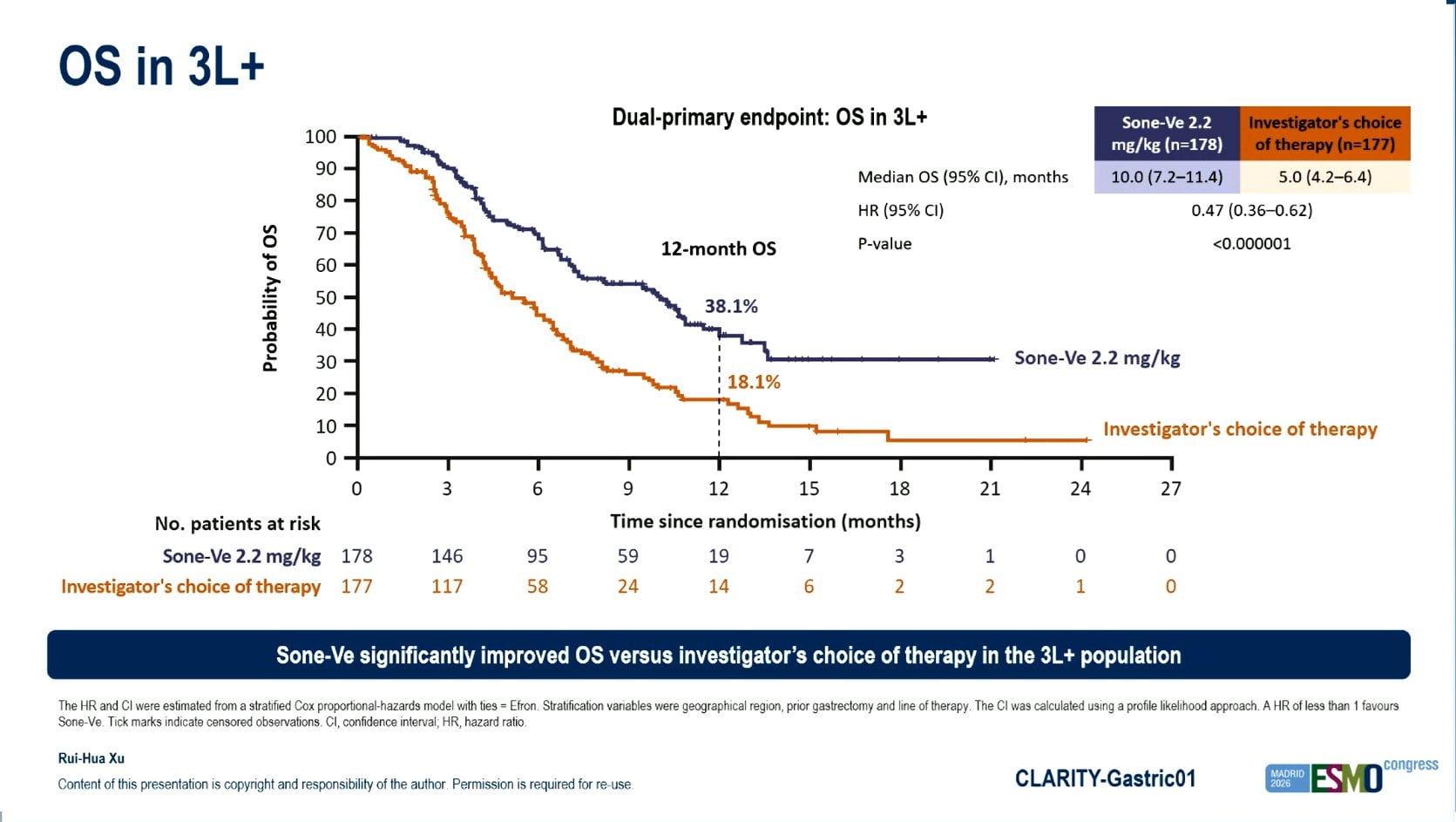
Physicians welcomed the OS result in later lines, including in tumors with lower CLDN18.2 expression.
After the presentation
#ESMO26 | CLARITY-Gastric01
Doubling OS from 5 to 10 months with the CLDN18.2-targeted ADC sonesitatug vedotin in ≥3L is impressive (HR 0.47). Benefit even in patients with lower CLDN18.2 expression is encouraging.
However, the primary PFS endpoint was not met in the ITT population. Its role in 2L and efficacy after zolbetuximab remain unclear.
one question: Given that CLDN18.2 expression can change after treatment, should a fresh biopsy have been mandatory at study enrollment? Or does lowering the positivity cutoff to ≥25% reduce the clinical relevance of this discordance, making archival tissue sufficient?
View post on X ↗🔥Presidential session at ESMO 2026 🔥
CLARITY-Gastric 01: Ph 3 of sonesitatug vedotin in 2L+ CLDN18.2-positive GEC
#ESMO26 #ESMOAmbassadors
👉ORR: 23 vs 13%
👉mPFS: 4.2 vs 3.8 mo
👉mOS: 10 vs 5 mo
👉No new safety signals
🧐 exciting results, new option for 2L+ CLDN18.2+ pts
@myESMO @ASCO
View post on X ↗The Trojan horse was successful.
In patients with pretreated and metastatic gastric/esophageal cancer sonesitatug-vedotin doubled survival to 10.0 versus 5.0 months with standard chemo, risk of death down 53%.
And it worked even in tumors with lower levels of the target label, widening eligibility to around 60% of patients in this setting, not a narrow slice.
In a cancer where later line treatment has meant 5-9 months for my whole career, doubling that isn't small.
It’s a great success for a majority of patients, and there are more ADCs coming, also with Claudin18.2 as a target.
View post on X ↗As co-author, excited to share CLARITY-Gastric01 data. Sone-Ve showed a meaningful survival benefit for pts with previously treated CLDN18.2-positive GC/GEJ cancers, reinforcing CLDN18.2 as a key therapeutic target beyond the frontline setting. #ESMO2026 #GIOncology https://t.co/P1Y1RqW4i2
View post on X ↗The debate was second line, where the OS benefit was less clear, and the CLDN18.2 definition, which differs from the zolbetuximab trials.
Second line, and the CLDN18.2 cutoff
#ESMO26 🚀 CLARITY-Gastric01 | Phase III
🧬 CLDN18.2+ GEC | Sone-Ve vs SOC
🏆 OS benefit:
🔹 3L+: 10.0 vs 5.0 mo (HR 0.47)
🔹 2L+: 10.6 vs 6.4 mo (HR 0.58)
🎯 ORR: 23.3% vs 13.8%
⚠️ PFS: HR 0.77 (NS)
✅ G≥3 TRAEs: 36.4% vs 44.8%
💡 Potential new SOC in 2L+!
@OncoAlert https://t.co/Rx8rIGBoS8
View post on X ↗@DraMartinezLago @OncoAlert @myESMO @GrupoTTD Other claudin 18.2 staining cut offs then in zolbetuximab trials, what a mess😋
View post on X ↗@AbhinitPatil It’s gotta have a minimum Claudin level of 25%, independently of the pretreatment. We don’t know yet how much the Claudin positivity changes after vyloy, so you have to perform a re biopsy. But it’s exciting data for sure.
View post on X ↗3. IROCAS: adjuvant mFOLFIRINOX vs mFOLFOX6 in high-risk stage III colon cancer
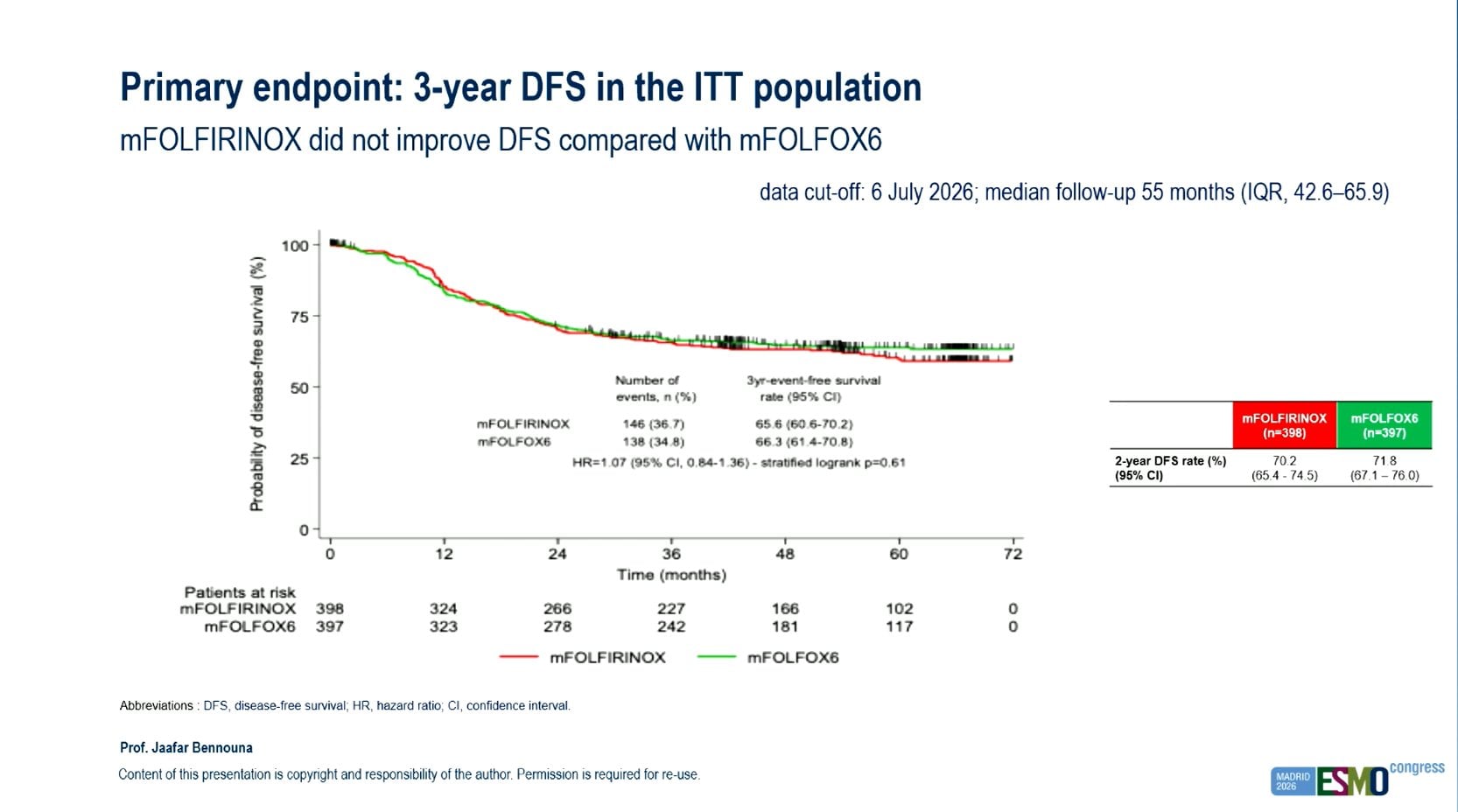
Phase 3 (LBA29) in resected T4 and/or N2 colon cancer, presented on October 25 by Jaafar Bennouna with Jeffrey Meyerhardt as invited discussant, and published concurrently in Annals of Oncology. Adding irinotecan to adjuvant oxaliplatin-based chemotherapy did not improve 3-year DFS, the primary endpoint, and OS did not differ significantly. Diarrhea was more frequent with mFOLFIRINOX. All drugs in both regimens are approved; IROCAS tested whether intensifying the adjuvant regimen helps.
Physicians agreed the trial answers the adjuvant irinotecan question.
A negative trial
#ESMO26 | IROCAS
I think we can finally put this debate to rest
In high-risk stage III colon cancer, intensifying adjuvant chemotherapy with mFOLFIRINOX failed to improve DFS over mFOLFOX6
We need to rethink our approach to treatment escalation in the adjuvant setting. Simply adding more conventional cytotoxic agents is not the answer.
View post on X ↗IROCAS trial disappoints: no DFS or OS benefit for chemo escalation in high risk stg III pts. https://t.co/tFCzo2ZBLe
View post on X ↗More diarrhea, no DFS gain.
IROCAS (LBA29):
Randomized phase 3, 795 pts w/ R0-resected pT4 and/or N2 colon cancer: mFOLFIRINOX vs mFOLFOX6.
3-y DFS 65.6% vs 66.3% (HR 1.07). G≥3 diarrhea 15.6% vs 3.8%.
#ESMO26 #CRCSM
https://t.co/Y75qoSPlXX https://t.co/e0E3s55RN3
View post on X ↗The debate was what to try next in high-risk and ctDNA-positive stage III disease. On October 26, Nicholas Hornstein questioned the irinotecan-based escalation arm of CIRCULATE-US and argued for newer drugs instead.
What next for high-risk stage III colon cancer?
Well, can we now put the adjuvant irinotecan question to bed…? A very important but negative trial. https://t.co/MmeyzukG0J
View post on X ↗Outstanding summary/discussion by Dr. Meyerhardt as expected. Check it out if you can!
View post on X ↗Sharlene Gill, MD, MPH, MBA, FASCO @GillSharlene
GI medical oncologist, University of British Columbia · Oct 25
#ESMO26 @myESMO
IROCAS / CCTGCO.27
Unicancer 🇫🇷 Italy 🇮🇹
@CDNCancerTrials 🇨🇦
@BennounaJaafar
Phase 3 RCT mFOLFIRINOX v FOLFOX in high risk stage 3 CC, n=795
53% T4, 72%N2
⛔️3y DFS improvement - 65 v 66%
⛔️3y OS improvement -91% v 87%
📌 c/w prior signal in DYNAMIC3 ctDNA+
➡️ FOLFOX remains SOC - no change since 2004 findings from MOSAIC!
We need to think differently about hi risk stage 3 CC…
IROCAS now published in @Annals_Oncology
🔗 https://t.co/syndVqrSI0
@oncoalert
View post on X ↗IROCAS trial presented #ESMO26
Have we hit a wall in high risk pathological or ctDNA+ st III CRC (data from DYNAMIC-III?
👉intensifying with irinotecan doesn't work We need to better understand the cancer biology behind these results? #ESMOAmbassadors @myESMO @GrupoTTD @_SEOM https://t.co/yRPoOzAdpF
View post on X ↗IROCAS: PIII adjuvant mFOLFIRINOX vs mFOLFOX6 in high-risk stage III colon cancer, now in Annals of Oncology.
TLDR: Adding irinotecan did nothing (because it has never worked in the adjuvant setting)📉
Key Points
• Adjuvant colon, pT4 and/or pN2
• mFOLFIRINOX vs mFOLFOX6, 12 cycles, n=795
Results
• 3-yr DFS 65.6% vs 66.3%, HR 1.07
• 3-yr OS 91.2% vs 86.7%, HR 0.85
• Grade ≥3 AEs identical at 62% (little surprising, just more diarrhea and GCSF use)
Importantly, the DFS curves sit on top of each other.
Irinotecan doesn’t work in the adjuvant setting, which brings me to my next point, CIRCULATE-US 👀
The escalation arm is cooked.
I wonder if there is still equipoise to enroll there?
After this and DYNAMIC-III failed, do we have enough data? I guess OS is still immature here so there is a minuscule glimmer of hope?
ctDNA keeps getting better at finding the patients who need better treatments, the problem is we didn’t have them until recently.
My pitch? Let’s use the new meds, G12Xs, anti-HER2, ADCs with non-irinotecan payloads. We have to do better for our patients. No one should be reaching for Irinotecan as adjuvant in 2026.
#ESMO26
@OncoAlert @TheGutOncLab
https://t.co/ulj93weSc9
View post on X ↗4. AZUR-1: dostarlimab alone in dMMR/MSI-H locally advanced rectal cancer
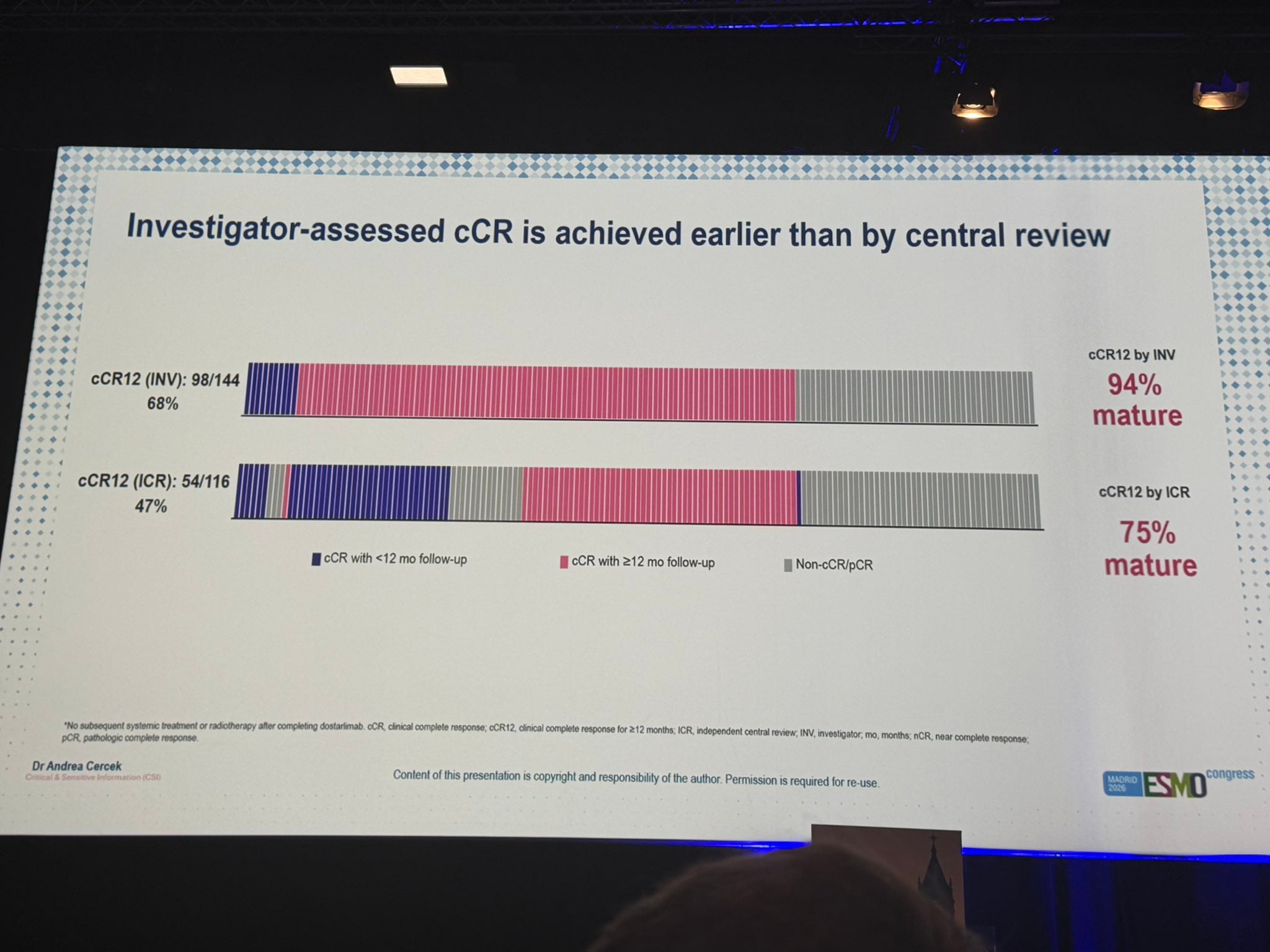
Global, single-arm Phase 2, N=154: dostarlimab for 9 cycles (6 months) in untreated stage II/III dMMR/MSI-H rectal cancer, presented by Andrea Cercek on October 25 (LBA87) with David Tougeron as invited discussant, and published concurrently in Annals of Oncology. At this interim analysis, the primary endpoint, cCR12 (clinical complete response sustained for 12 months) by independent central review, was 47% (54 of 116); 38 more patients in clinical complete response were still being followed toward 12 months, and the presented slides describe the central-review analysis as 75% mature. Investigator-assessed cCR12, a secondary endpoint, was 68% (98 of 144). In an exploratory composite of investigator-assessed cCR12 or pathological complete response, the rate was 76% (110 of 144). 71% of patients (110 of 154) were managed without further treatment after dostarlimab alone, and grade ≥3 immune-mediated adverse events occurred in 3%. (ESMO 2026 LBA87 slides and abstract, Andrea Cercek, and Annals of Oncology; interim analysis, data cutoff Apr 20, 2026; median follow-up 26.3 months) The central-review and investigator figures use different evaluable populations; the presented slide shows that investigators recorded complete responses earlier than central review. FDA granted accelerated approval on October 19, 2026: Jemperli (dostarlimab) for adults with stage II/III dMMR/MSI-H locally advanced rectal cancer, as determined by an FDA-authorized test. (FDA approval notice, Oct 19, 2026, via KOL Pulse AZUR-1 page)
Physicians welcomed organ preservation with dostarlimab alone; Nicholas Hornstein called it an obvious new standard of care.
Organ preservation in dMMR/MSI-H rectal cancer
AZUR-1 delivers. #ESMO26
Phase 2, single arm. Dostarlimab x 9 cycles (6 months) in untreated stage II/III dMMR/MSI-H rectal cancer, 154 patients.
Cercek's 49-patient NEJM cohort gone global.
No control arm, because randomizing these patients to TNT/TME isn't equitable.
cCR12 (complete response held 12+ months, no further treatment):
68% by investigator.
26% needed additional treatment
10% went to surgery
68% is likely lower than reality since many patients probably just needed more time to radiographically respond. Using PET/Biopsy/ctDNA, especially ctDNA, is incredibly helpful in my practice to identify patients who can avoid TME even if a fibrotic tumor remains as they often do.
FDA already gave accelerated approval (way to steal the ESMO thunder) last week which leads me to my next point.
Obvious new standard of care. You should go to oncology jail if you don't treat MSI-H with IO.
@OncoAlert @TheGutOncLab @Onco_Nexus
View post on X ↗#ESMO26 | AZUR-1
Treating rectal cancer with dostarlimab—without ChT, RT or surgery!
Organ preservation in dMMR/MSI-H locally advanced rectal cancer is exactly the kind of progress we want to see in oncology. The FDA granted accelerated approval for this indication on October 19, 2026. Credit where it’s due: a major advance with a direct impact on patients’ lives👏👏
View post on X ↗.#AZUR-1 Dorstalimab (~6mo) #RectalCancer .
-12mo-cCR 68%
-12mo-cCR/pCR 76%
-ICR vs INV ❓
-surgery 10%, Subseq Tx 26%
Important: T4 26% & Low-Rectum 40%.
Great results. #ESMO26 @OncoAlert https://t.co/u6U8Q1fDaz
View post on X ↗The main caveat raised was the gap between investigator and central-review results, along with the single-arm design and the length of follow-up.
The central-review gap and follow-up
AZUR-1 (LBA87):
Single-arm dostarlimab 500 mg q3w x9 in dMMR/MSI-H LARC.
cCR12 by central review, the registry primary: 47% (54/116). Investigator-assessed: 68% among 144 pts. ICR confirmed cCR later, with different evaluable populations.
The dostarlimab-alone surveillance path avoids RT, chemo and surgery.
#ESMO26 #OncTwitter
https://t.co/rOJbf5J8i8
View post on X ↗🔥 AZUR-1 Phase 2, Annals of Oncology (ESMO LBA87)
AZUR-1 is a global, single-arm, Phase 2 trial of
💊 Dostarlimab 500 mg q3w for 9 cycles in adults with
🎯 Untreated stage II/III dMMR/MSI-H rectal cancer
👥 154 enrolled, 144 with ≥12 mo follow-up
✅ Sustained cCR at 12 mo: 68% (investigator)
✅ cCR 1y after end of treatment + pCR: 76%
🔁 98% of cCRs held ≥12 mo, no recurrences in responders
⚠️ Single arm, central review less mature
This is the full dataset behind the accelerated approval we covered on October 20, and it holds up.
2 in 3 pts keep their rectum with a PD-1 antibody alone, and no one in complete response has recurred so far.
Two caveats: it is single-arm, and the investigator read runs ahead of central review, which the authors say is less mature. With a median follow-up of 26 months, late local regrowth is the number to watch.
Everyone must test MMR on every rectal biopsy before anyone starts total neoadjuvant therapy.
#CRC #RectalCancer #dMMR #ESMO26 #GIOnc
https://t.co/Zyg0Eo2gI2
View post on X ↗Free Access · KOL Pulse Intelligence
Track oncology’s top KOLs in your specialty
Create a free account, pick the tumor types you cover, and go beyond the tweet — the intelligence pharma teams use to map influence and prepare for engagement:
- ✓Enhanced KOL profiles
- ✓Pharma influence & potential advisory-board patterns
- ✓2025 Open Payments financial analysis
- ✓Social-media sentiment & trend signals
Get free access — pick your specialty
Choose the tumor types you follow. No cost, unsubscribe anytime.
Days 1–2: the earlier GI readouts
GI trials presented on October 23–24.
5. SANO: active surveillance vs esophagectomy after clinical complete response
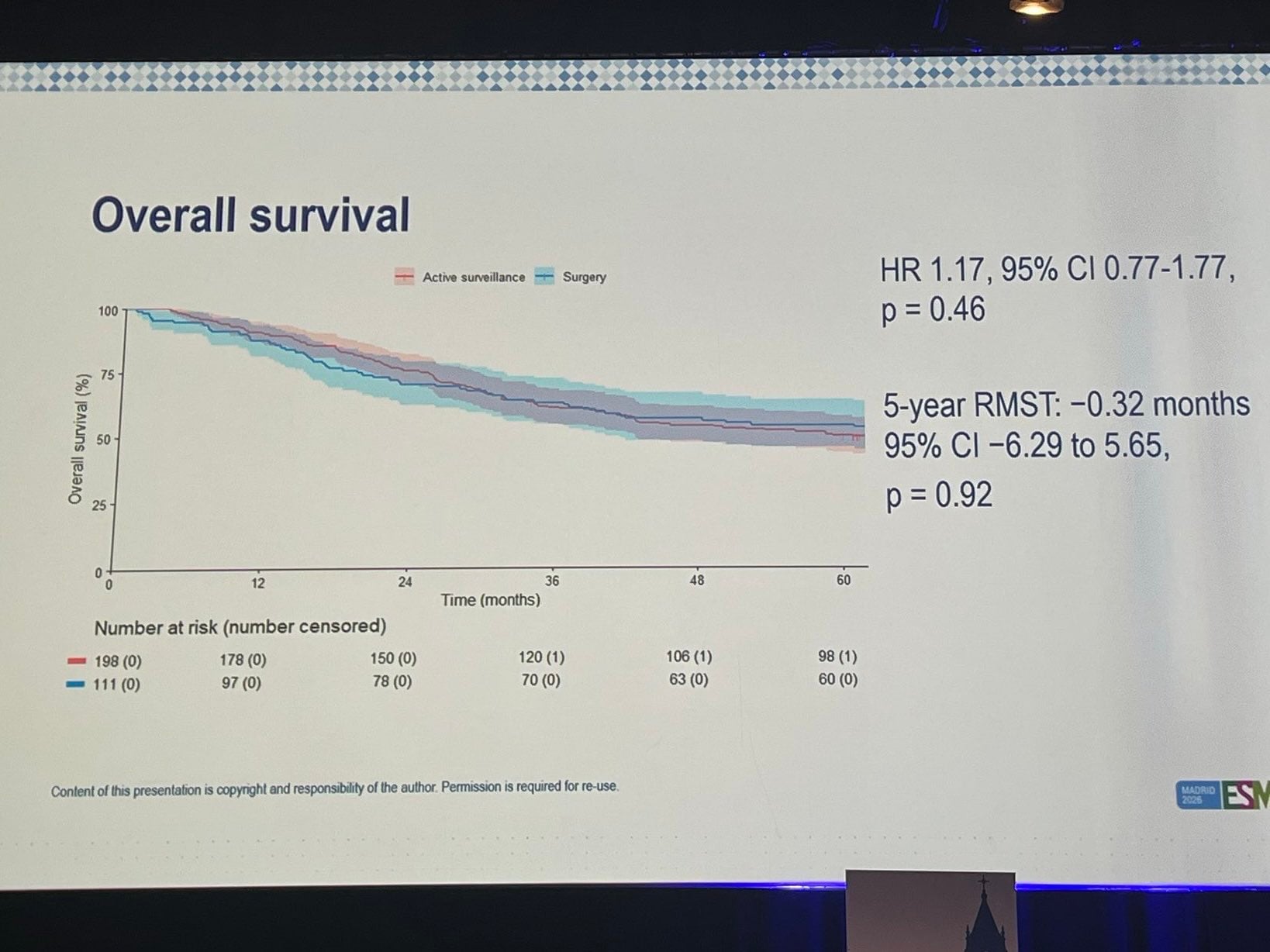
Phase 3 stepped-wedge, cluster-randomized trial, N=309, after neoadjuvant chemoradiotherapy (41.4 Gy). 5-year OS 50% with active surveillance vs 54% with surgery, HR 1.17 (95% CI 0.77–1.77), not significantly different; the confidence interval is wide and equivalence was not formally shown. DFS HR 1.39 (0.94–2.06). 5-year distant metastases 46% vs 29%, P<.01. 85 of 198 patients (43%) under surveillance were spared esophagectomy; the slide labels this figure hypothetical. (ESMO 2026 LBA78 abstract and slides, Sanjiv Gangaram-Panday; median follow-up 76 months) SANO tests a treatment strategy, not a drug.
Physicians split on whether the trial supports offering surveillance. Points raised: the distant-metastasis rate, that a non-significant OS difference does not establish non-inferiority, and the 41.4 Gy dose.
Offer surveillance or not?
SANO trial: Active surveillance vs standard surgery after neoadjuvant chemoradiotherapy for oesophageal cancer: Long-term results
#ESMO26 #ESMOAmbassadors
👉 DFS HR: 1.39
👉 OS HR:1.17
👉Distant mets: sHR 2.04
🧐OS not different, supports consideration of active surveillance
@myESMO @ASCO
View post on X ↗🔥 SANO 5-year results🔥
Esophagus cancer
👥 309 pts with cCR after nCRT
🔍 Surveillance vs surgery
✅ 5y OS: 50% vs 54% (HR 1.17)
⚠️ Distant mets: 46% vs 29% (P<.01)
💥 43% organ preservation
Active surveillance remains a feasible strategy albeit we must recognize the DM risk despite no OS difference.
Perhaps TNT, like D-FLOT ➡️CRT with subsequent AS for cCR may be an optimal next strategy to test. Improved response assessment strategies also needed
#ESMO26
View post on X ↗With increase in distant mets , will you offer wait and watch in Esophageal cancer? I won't. #SANO trial. @myESMO #esmo26 @OncoAlert https://t.co/3zTURZhdao https://t.co/aYOWJzxdyh
View post on X ↗🚨SANO 5y: surveillance vs surgery after cCR
OS 50% vs 54% (NS)
Distant mets 46% vs 29% (P<.01)
Reminder: only 41.4 Gy/23 fx, a pre-op, arguably non-definitive dose, especially with/ ~75% adenocarcinoma.
Nonsignificant OS doesn't establish noninferiority.
#ESMO26 #RadOnc #OncTwitter
View post on X ↗6. HERIZON-GEA-01: zanidatamab ± tislelizumab in first-line HER2+ gastroesophageal adenocarcinoma
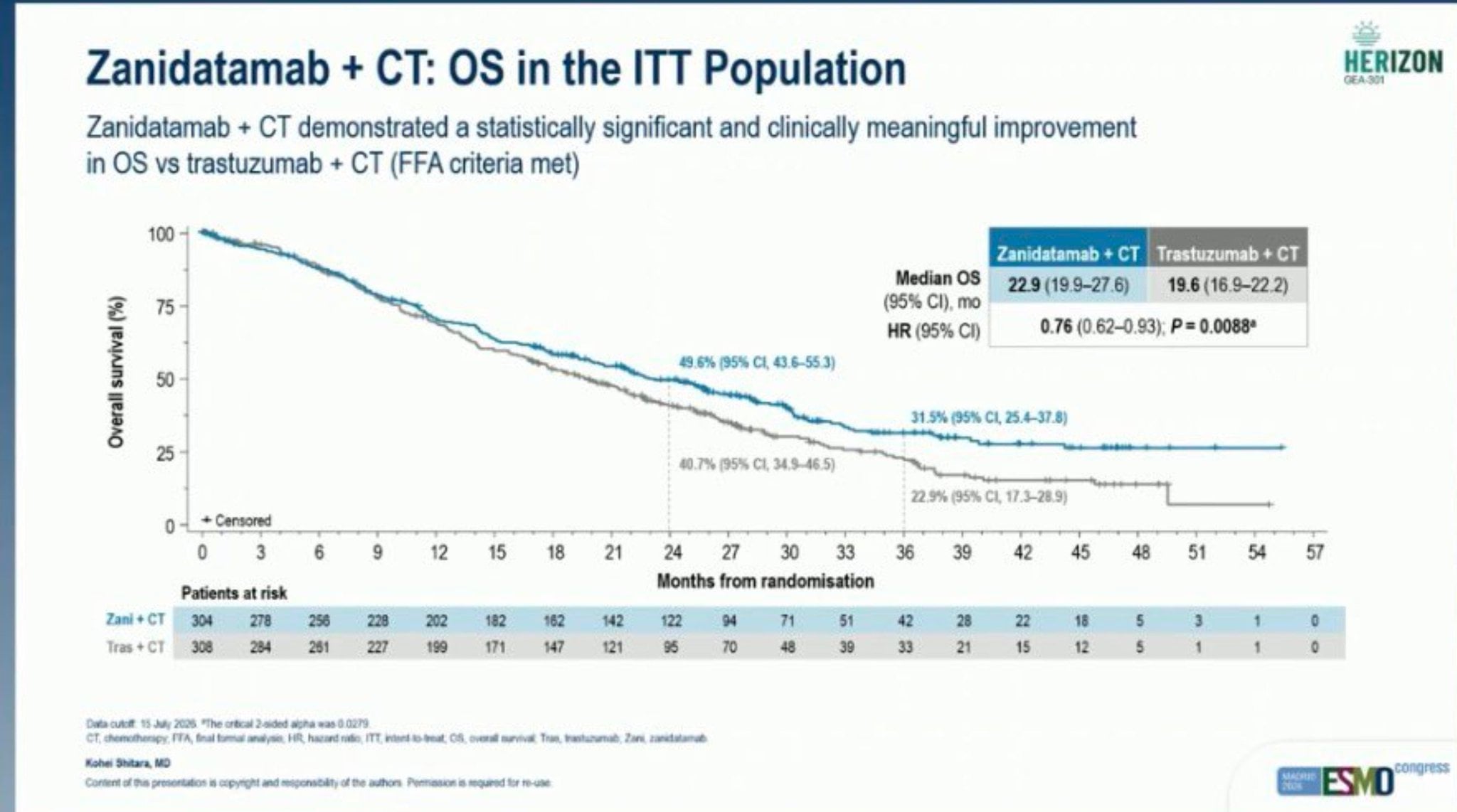
Phase 3, N=914: zanidatamab + chemotherapy, with or without tislelizumab, vs trastuzumab + chemotherapy. At the second interim OS analysis, zanidatamab + chemotherapy improved OS vs trastuzumab + chemotherapy: median 22.9 vs 19.6 months, HR 0.76 (95% CI 0.62–0.93), P=0.0088; 36-month OS 31.5% vs 22.9%. The triplet vs trastuzumab + chemotherapy: median OS 27.0 vs 19.6 months, HR 0.65 (0.52–0.80), a descriptive analysis because significance was already met at the first interim; 36-month OS 39.8%. Triplet vs doublet: HR 0.81 (0.65–1.00), P=0.0502, not statistically significant. (ESMO 2026 LBA79 slides, Kohei Shitara; second interim analysis, data cutoff Jul 15, 2026; median follow-up 35.3 months) The safety profile was consistent with the first interim analysis. (LBA79 safety slide) FDA approved on August 25, 2026: Ziihera + Tevimbra + chemotherapy for HER2 IHC 3+ or IHC 2+/ISH+ disease, and Ziihera + chemotherapy for IHC 3+. (KOL Pulse HERIZON-GEA-01 page)
The doublet’s OS result was not debated. The debate was whether to add tislelizumab, given the P=0.0502 comparison and added toxicity.
Doublet or triplet?
HERIZON-GEA-01 second OS interim at #ESMO26, and I'm a triplet believer.
In January I wondered if tislelizumab was necessary. With 35 months of follow-up, my answer is yes.
914 patients, 1L HER2+ GEA, randomized 1:1:1 to zani + chemo ± tislelizumab vs trastuzumab + chemo.
Median OS
• Zani + chemo + tisle: 27.0 mo
• Zani + chemo: 22.9 mo
• Tras + chemo: 19.6 mo
3-year OS: 39.8% vs 31.5% vs 22.9%
The doublet now has its own OS win over trastuzumab (HR 0.76, 95% CI 0.62–0.93, p=0.0088). The triplet vs trastuzumab got better with time (HR 0.72 at IA1, now 0.65).
Triplet vs doublet: HR 0.81 (95% CI 0.65–1.00), p=0.0502.
Yes, it technically misses. But 4 more months of median OS is clinically meaningful in metastatic gastric cancer.
Patients also stayed on the triplet longer (~47 vs ~30 weeks), with no new safety signal.
Takeaway: zani + chemo + tisle is my 1L default for HER2+ GEA.
Bring on the bispecifics 🔥
@OncoAlert @TheGutOncLab
@OncoAlert
View post on X ↗#ESMO26 | HERIZON-GEA-01 – Updated OS
Her2 positive gastric/ge cancer
At 35.3 months of follow-up, zanidatamab + CT now shows a significant OS benefit over trastuzumab + CT: 22.9 vs 19.6 months (HR 0.76; p=0.0088).
With the addition of tislelizumab, median OS increased to 27 months, but the additional benefit was statistically borderline (HR 0.81; p=0.0502).
Considering toxicity, we need to carefully analyze which patients should receive the triplet regimen.
View post on X ↗
HERIZON-GEA-01 raises a treatment-selection question in 1L HER2+ advanced gastroesophageal adenocarcinoma.
Zanidatamab + chemo improved OS vs trastuzumab + chemo:
22.9 vs 19.6 months; HR 0.76; P=0.0088.
The tislelizumab triplet also sustained its OS benefit vs trastuzumab + chemo.
But the direct comparison matters:
Adding tislelizumab to zanidatamab + chemo gave OS of 27.0 vs 22.9 months; HR 0.81; P=0.0502 — not statistically significant.
This does not establish equivalence between doublet and triplet.
Who gains enough from adding immunotherapy to justify the extra treatment—and can biomarkers help us identify them?
@KoheiShitara @YJanjigianMD @myESMO @OncoAlert
#HERIZONGEA01 #ESMO26 #GICSM
View post on X ↗7. COMPANION-002: tovecimig + paclitaxel in previously treated biliary tract cancer
Phase 2/3: tovecimig, a DLL4×VEGF-A bispecific antibody, plus paclitaxel vs paclitaxel alone after prior therapy for advanced biliary tract cancer, presented by Nilofer Azad. The trial met its primary endpoint of response rate and improved PFS. OS did not differ, and the presented slide describes the OS analysis as confounded by crossover from the paclitaxel arm. Tovecimig is investigational.
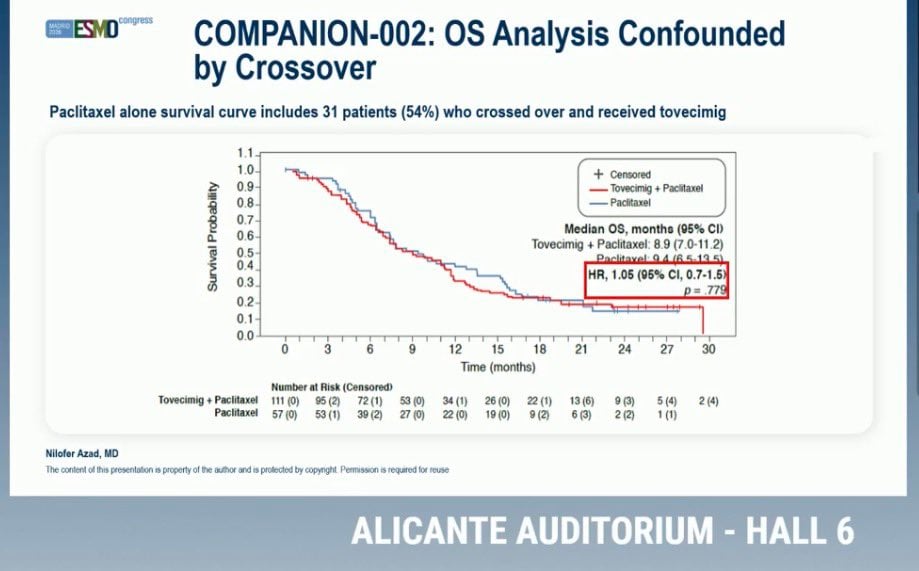
An investigator on the trial highlighted response and PFS. Others pointed to the toxicity, the crossover, and first-line testing.
Response and PFS vs OS and toxicity

ilyas sahin, MD @ilyassahinMD
GI medical oncologist, Mass General; COMPANION-002 investigator · Oct 24
Excited to see our COMPANION-002 trial published in JCO and presented at #ESMO26!
Treatment options remain limited for advanced biliary tract cancer after first-line therapy, especially without targetable mutations.
Tovecimig + paclitaxel vs paclitaxel alone:
• Tumor response (ORR): 18% vs 5.3%
• Time without progression (median PFS): 4.7 vs 2.6 months (HR 0.44)
Proud to have contributed to this multicenter trial!
View post on X ↗A randomized trial of paclitaxel ± tovecimig in previously treated patients with advanced biliary tract cancer
#ESMO26 #ESMOAmbassadors
👉 ORR: 18 vs 5.3%
👉 mPFS: 4.7 vs 2.6 mo
👉 mOS: 8.9 vs 9.4 mo
🧐Active drug, but no OS benefit in 2nd line, could be explored in 1L
@myESMO @ASCO
View post on X ↗Signal in previously treated biliary tract cancer at #ESMO26:
Tovecimig + paclitaxel improves ORR (17% vs 5%) and PFS (HR 0.44)…but with substantial toxicity, and OS remains uninterpretable given 54% crossover 🤷🏻♂️
@OncoAlert 4Sight is already dissecting the abstracts worth watching! 👀
@OncoReporte @_SEOM @myESMO
View post on X ↗Paclitaxel +\-tovecimig: COMPANION-002 ph2/3
➡️prev treated #BTC wo actionable alterations
➡️ORR 17.1 v5.3%; DCR 62 v 37%
➡️mPFS 4.7 v 2.6mths - benefits seen at PFS2 noting crossover
➡️OS not sig but nb crossover
@myESMO #ESMO26 @OncoAlert https://t.co/eeR74Ehqed
View post on X ↗8. G-HOPE-001: arcotatug tavatecan in CLDN18.2-positive gastric/GEJ cancer, third line and later
Phase 3, China and Japan: arcotatug tavatecan (IBI343), a CLDN18.2-directed antibody-drug conjugate, vs treatment of physician’s choice after at least two prior lines, presented by Kohei Shitara. PFS and OS both improved; the OS result was reported at the second interim analysis. Physicians quoted figures from two analyses, the abstract’s first interim and the updated second interim in the presentation, so the numbers differ between posts. Arcotatug tavatecan is not FDA approved.
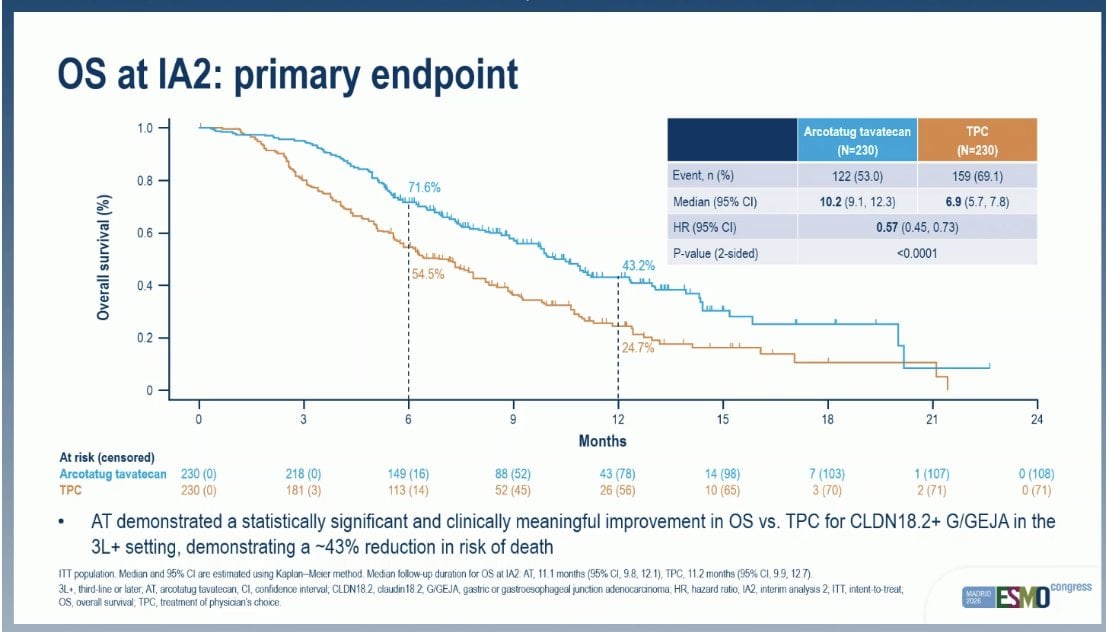
Physicians called it a new option after two lines. Open questions: OS maturity, patients previously treated with zolbetuximab, and the lack of a Western cohort.
A new option, with open questions
Jia (Jenny) Liu MD PhD @JiaJennyLiu
medical oncologist, Kinghorn Cancer Centre; arcotatug tavatecan Phase 1 investigator · Oct 23
From presenting Phase 1 data at #ESMOGI24 → @NatureMedicine publication in 2025 → seeing positive Phase 3 results from G-HOPE-001 in CLDN18.2 positive 3L+ G/GEJA presented by @KoheiShitara at #ESMO26!
Wonderful to have been part of the development journey of arcotatug tavatecan (IBI343), a CLDN18.2-targeting ADC!
📊 OS HR 0.57 (10.2 vs 6.9 mo)
📊 PFS HR 0.45 (7.1 vs 3.1 mo)
💊 Grade ≥3 treatment-related AEs: 47.4% vs 55.9%; dose reductions: 17.8% vs 35.1% compared with chemotherapy.
Congratulations to all investigators and the Innovent & Takeda teams!
Looking forward to exploring rational combinations to further improve patient outcomes!
#ADC #GastricCancer @myESMO @OncoAlert @oncodaily
View post on X ↗#ESMO26
3L gastric cancer means picking between drugs that minimally work (irinotecan, paclitaxel or TAS-102). Modest benefit, real tox.
G-HOPE-001 adds a fourth option 👀🧬
Arcotatug tavatecan (CLDN18.2 ADC, TOPO-I payload) vs TPC
n=408, CLDN18.2 ≥75% 2+, 2–4 prior lines, China and Japan
📈 PFS 5.5 vs 2.9 mo, HR 0.47 (95% CI 0.34–0.65)
🩸 OS 9.9 vs 7.4 mo, HR 0.63 (95% CI 0.45–0.89), interim
🎯 ORR 23.6% vs 5.3%
✅ Grade ≥3 TEAEs 45.8% vs 57.9%
What changes in practice: CLDN18.2 IHC stops being a one-time 1L question. If this holds, the same result matters again two lines later 🔁
OS at IA2 will tell us how much and the paper will tell us about prior CLDN exposure… Needs a western cohort as well…
@OncoAlert @TheGutOncLab @Onco_Nexus
View post on X ↗G-HOPE-001 | ESMO 2026 | LBA77
SAME TARGET. NEW WEAPON. 🎯
Can a CLDN18.2-targeted ADC outperform chemotherapy in heavily pretreated gastric/GEJ cancer?
Arcotatug tavatecan (IBI343) vs chemotherapy | Phase III | N=408
🔹 PFS: 5.5 vs 2.9 months (HR 0.47)
🔹 ORR: 23.6% vs 5.3%
🔹 OS: 9.9 vs 7.4 months (HR 0.63; immature)
🔹 Grade ≥3 TEAEs: 45.8% vs 57.9%
🔹 ILD: No cases observed.
TAKE-HOME
A 53% reduction in progression/death hazard with a favourable safety signal.
But mature OS and efficacy after prior zolbetuximab remain key unanswered questions.
Ref: Shitara K et al. G-HOPE-001. ESMO 2026; LBA77.
#MVOnco #ESMO2026 #GastricCancer #CLDN182 #ADC
View post on X ↗9. ACTICCA-1: adjuvant gemcitabine-cisplatin vs capecitabine in resected biliary tract cancer
Phase 3, presented by Henning Wege. The primary DFS endpoint was not met. OS was numerically longer with gemcitabine-cisplatin but not statistically significant, and toxicity was higher.
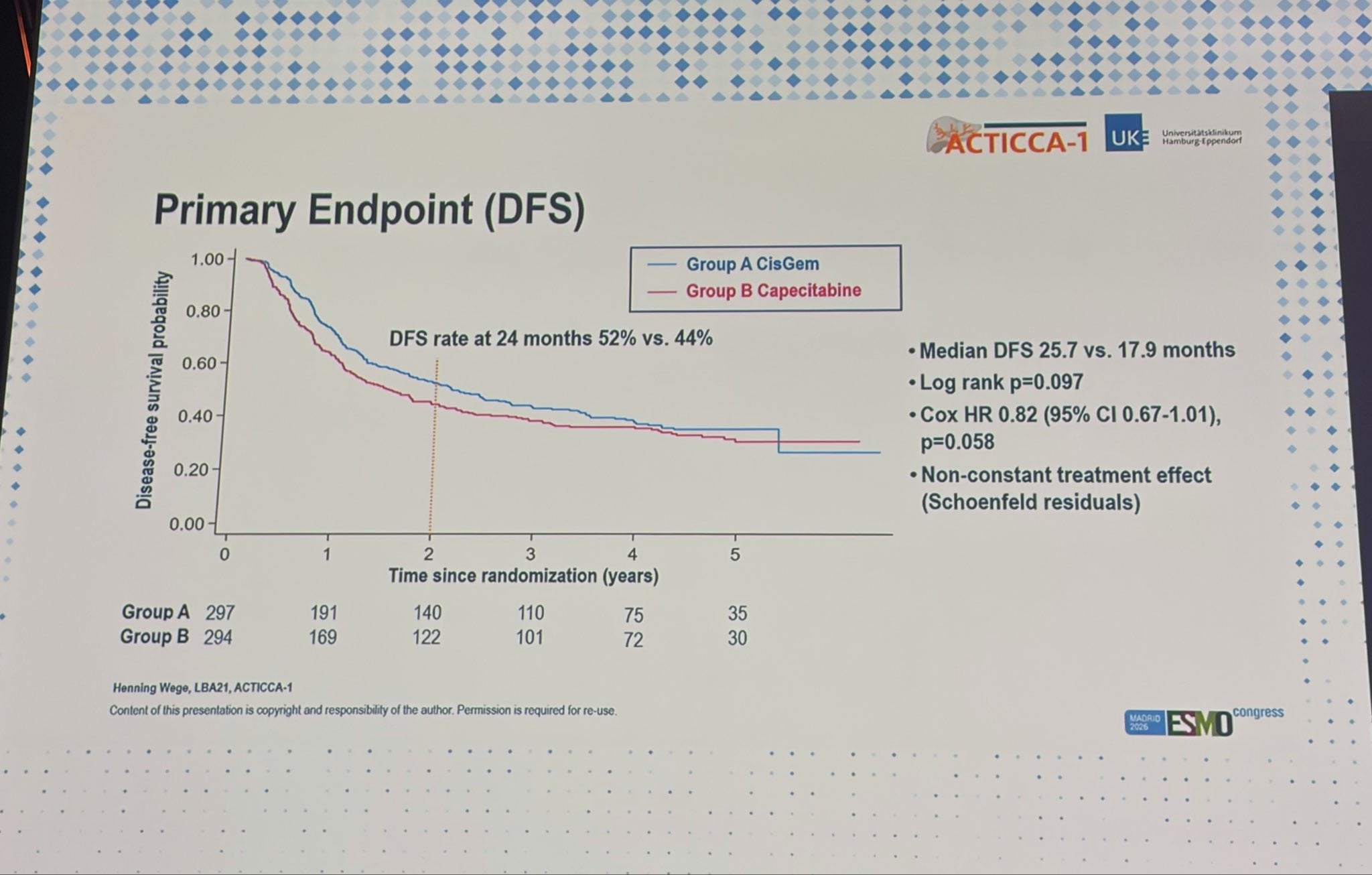
Physicians agreed it does not change the standard. They differed on whether gemcitabine-cisplatin is an option for selected patients.
Not a new standard; an option for some?
🧐 Trend for OS benefit, not an option for all, but may be considered as option for selected pts
Read the full post on X ↗Much anticipated ACTICCA-1
➡️adj cis/gem v cape #BTC
➡️mod ITT n=591
➡️no diff in DFS at 24mth 52% v 44%
RMST at 3 yrs ⬆️DFS by 2.6mth
➡️28% iCCA -no maj subgroup diff
➡️mOS 58.1 v 48.2 p=0.1
❎No change to std ?an option, NB need as backbone 1st line!
@myESMO @OncoAlert #ESMO26 https://t.co/zvbwqujcD1
View post on X ↗⚠️ GemCis ⬆️ toxicity,predom haematological
Take🏠 ACTICCA-1 addresses unmet need for better adj therapy in BTC, but does not establish GemCis as superior to cape
🔦Search for more effective adj strategies continues, including peri-op IO approaches
#ESMO26 #BiliaryTractCancer
View post on X ↗10. RASolute 302: daraxonrasib by RAS genotype in previously treated pancreatic cancer
Phase 3, N=500. Primary results: median OS 13.2 vs 6.7 months with daraxonrasib vs chemotherapy, HR 0.40 (95% CI 0.30–0.53), overall population. (ASCO 2026 LBA5 / NEJM; data cutoff Feb 10, 2026) At ESMO 2026, Zev A. Wainberg presented subgroup analyses from the same data cutoff. OS HR by RAS genotype: G12D 0.49 (0.33–0.74), G12V 0.32 (0.19–0.54), G12R 0.61 (0.29–1.30), Q61 0.37 (0.09–1.44), no RAS mutation identified 0.43 (0.09–1.98). The G12R, Q61 and no-mutation groups were small (30 vs 31, 11 vs 11 and 9 vs 7 patients) and their confidence intervals cross 1. ORR by BICR in G12R was 7% vs 14%. (ESMO 2026 LBA82 slides; subgroup HRs from an unstratified Cox model; median follow-up 8.5 months) FDA approved on August 26, 2026 as Rasonque for metastatic pancreatic adenocarcinoma after at least one prior systemic therapy, or in patients who are not candidates for multiagent therapy. The label does not restrict use by RAS status. (KOL Pulse RASolute 302 page)
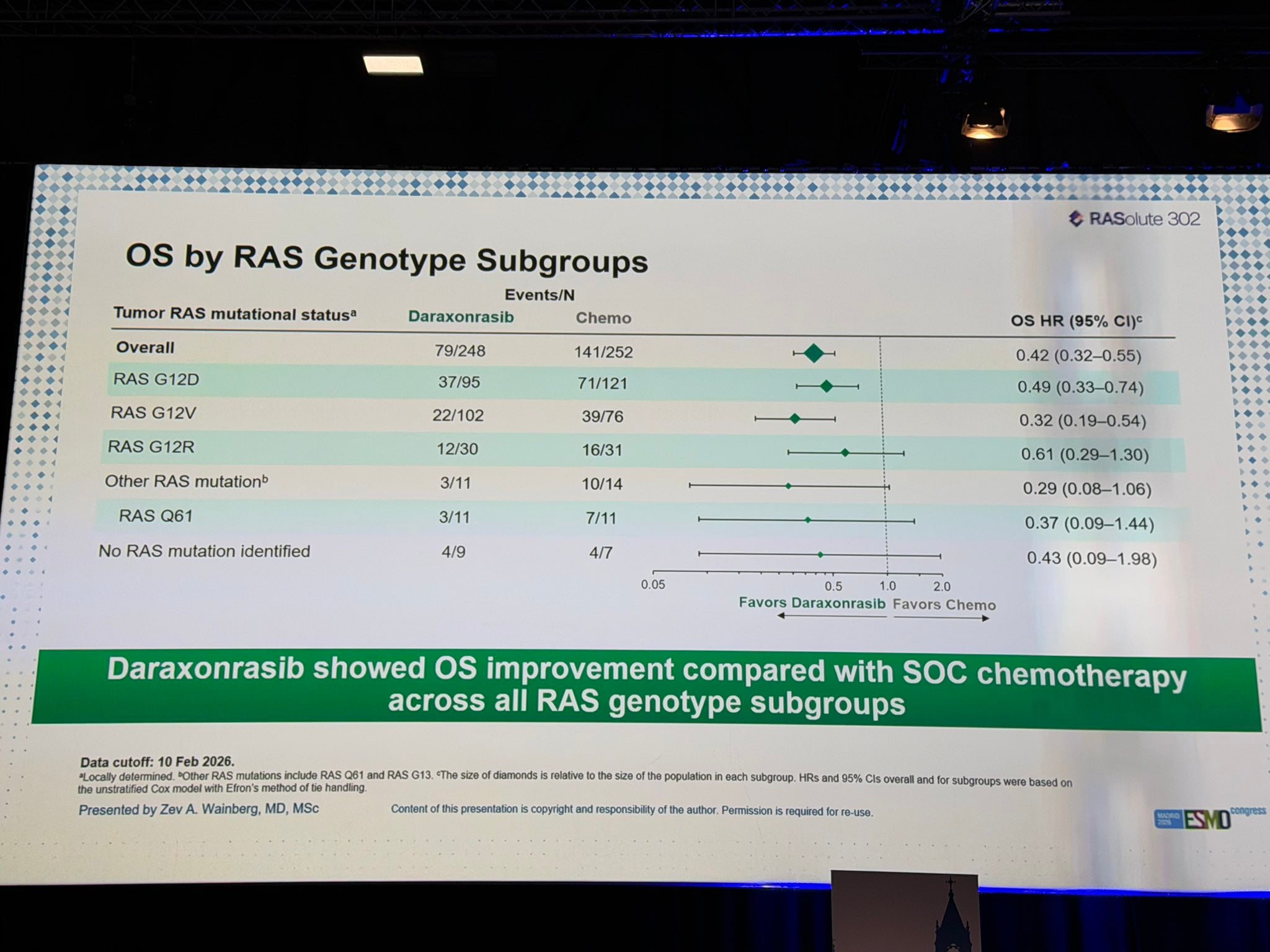
Physicians agreed on the overall benefit. The question was RAS G12R.
Consistent benefit, and the G12R question
RASolute 302 ph3 study: Daraxonrasib, a RAS(ON) multi-selective inhibitor vs chemotherapy in previously treated mPDAC
#ESMO26 #ESMOAmbassadors
👉 mOS: 13.2 vs 6.7 mo
👉ORR improved in all RAS mutations
👉PFS & OS: small subgroups, favourable for all
🧐great data, consistent benefits for all pts
@myESMO @ASCO
View post on X ↗#LBA82 subgroup analysis RASolute 302 #PDAC
➡️HR for OS across subtypes 0.32-0.46
➡️G12R 0.61 (0.29-1.30)
➡️RAS WT numbers small (3%) but still OS benefit!
🤔perhaps ORR and mPFS not as pronounced in these populations!
✅std second line treatment
@myESMO #ESMO26 @OncoAlert https://t.co/J43sTtOscN
View post on X ↗Nice update of the RASolute 302 at #ESMO26
Looking at the outcomes. Although small numbers, are we facing a roadblock with the KRAS G12R variant?
Represents between 12-15%
Could protein degraders be a viable alternative?
#ESMOAmbassadors @myESMO @GrupoTTD https://t.co/bKh7kUhKzk
View post on X ↗11. KEYNOTE-975: pembrolizumab with definitive chemoradiotherapy in esophageal cancer
Phase 3: pembrolizumab or placebo with definitive chemoradiotherapy in unresectable esophageal or GEJ cancer, presented by Manish Shah. EFS was not improved in PD-L1 CPS ≥10 tumors, and OS was not formally tested. Pembrolizumab is not approved with definitive chemoradiotherapy for esophageal cancer.
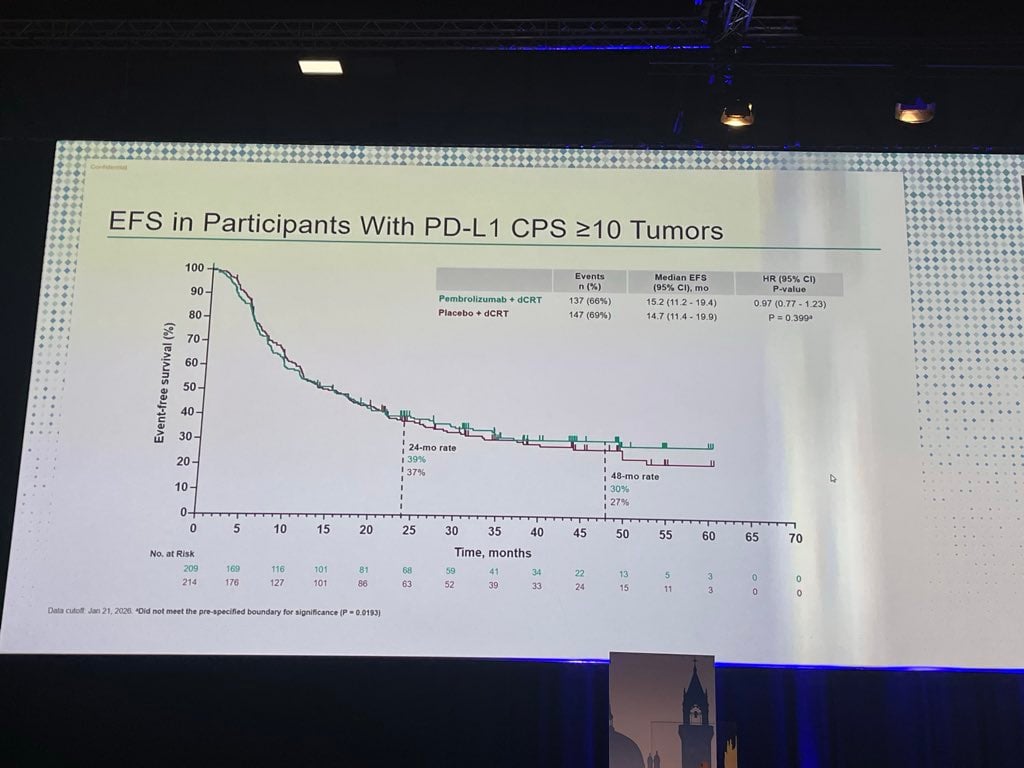
Physicians agreed the trial was negative. Discussion turned to radiation dose, timing of immunotherapy relative to radiation, and toxicity.
Negative, and why
KEYNOTE-975: adding pembro to definitive CRT didn't improve EFS in CPS>=10 esophageal/GEJ cancer. HR 0.97 (95% CI 0.77-1.23).
Hierarchy stopped there; OS wasn't formally tested. Another reason not to assume IO helps every CRT backbone.
#ESMO26 #radonc
https://t.co/JCWWmcCZHS https://t.co/SCdkZqxsjS
View post on X ↗WHAT IF THE CLOCK MATTERS? ⏰
RT–immunotherapy trials can produce strikingly different results. KEYNOTE-975 was negative but when is IO actually given relative to RT?
Future RT–IO trials should not treat chronotherapy as an afterthought.
Presented by @MDmanishshah #ESMO26 https://t.co/BSCCkCYxos
View post on X ↗🚨 Another reminder that adding immunotherapy to a curative-intent backbone does not automatically improve outcomes.
@OncoAlert
At #ESMO26, phase III KEYNOTE-975 tested pembrolizumab + definitive chemoradiotherapy versus dCRT alone in untreated, unresectable esophageal/GEJ cancer.
📊 n=703
In PD-L1 CPS ≥10:
➡️ Median EFS: 15.2 vs 14.7 months
HR 0.97 (0.77–1.23)
➡️ Median OS: 32.2 vs 35.0 months
HR 1.00 (0.77–1.30)
⚠️ Grade 5 AEs: 13% vs 10%
⚠️ Treatment discontinuation due to AEs: 34% vs 27%
The primary efficacy signal was negative.
🎯 Why this matters: biologic plausibility and activity in metastatic disease are not enough to assume benefit in the definitive setting.
For me, KEYNOTE-975 reinforces a critical principle:
treatment intensification must earn its place with meaningful outcome improvement — especially when toxicity and treatment burden increase.
Important data from @MDmanishshah @BennounaJaafar @cbcbc1971 and the KEYNOTE-975 investigators.
Pinging @CathyEngMD @BenWestphalen @graokane @NiuSanford @GillSharlene @pashtoonkasi @DrVilmaPBarcia @GIMedOnc @DaisukeKotani @KoheiShitara
#OncoAlert #ESMO26 #GICancer #EsophagealCancer #GEJCancer #Immunotherapy #Chemoradiotherapy
View post on X ↗12. PRABITAS: biweekly vs conventional trifluridine-tipiracil + bevacizumab in refractory colorectal cancer
Pragmatic, non-inferiority Phase 3 trial from Japan, presented by Hiroya Taniguchi and published in The Lancet. The biweekly (14-day) schedule was compared with the conventional 28-day schedule. OS met non-inferiority, with less grade ≥3 neutropenia on the biweekly schedule. Trifluridine-tipiracil plus bevacizumab is FDA approved for previously treated metastatic colorectal cancer; PRABITAS tested the dosing schedule, not a new drug.
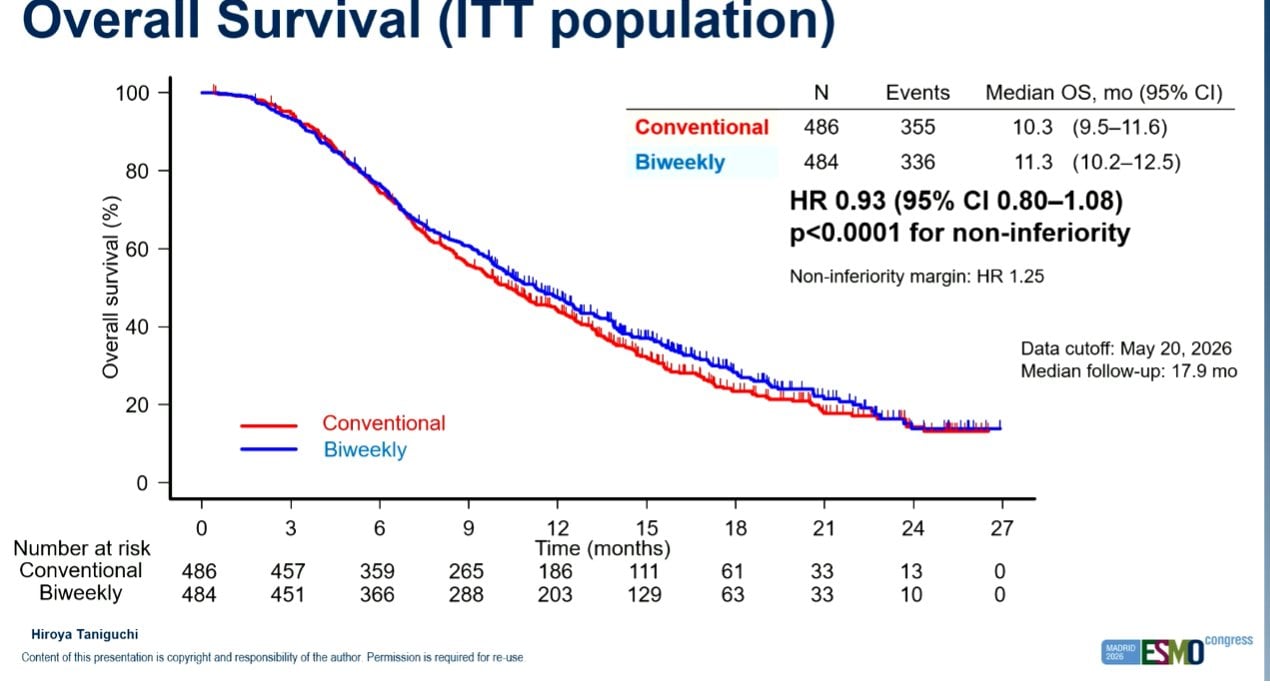
Physicians agreed on the schedule. The debate was why it took a randomized trial, after earlier real-world and Phase 2 data.
A new standard schedule, or overdue?
Nobuhiro Shibata MD, PhD @shibanob
medical oncologist, Kansai Medical University; PRABITAS co-author · Oct 24
#ESMO26 LBA31 PRABITAS Phase 3 Trial
A pragmatic phase 3 non-inferiority trial comparing biweekly vs conventional FTD/TPI + bevacizumab in refractory mCRC.
Efficacy:
• OS: 11.3 vs 10.3 mo (HR 0.93, 95% CI 0.80–1.08)
• PFS: 3.9 vs 3.9 mo (HR 0.93, 95% CI 0.81–1.06)
Safety:
• Grade ≥3 neutropenia: 13% vs 39%
• Febrile neutropenia: 1% vs 5%
Biweekly FTD/TPI + bevacizumab demonstrated non-inferior OS with reduced toxicity compared with the conventional schedule.
Our institution, Kansai Medical University Hospital, participated in this study. I am pleased to have contributed as a co-author.
Simultaneously published in The Lancet!
https://t.co/O0yd2m1dqc
#PRABITAS #mCRC #ColorectalCancer
@OncoAlert
View post on X ↗
Sharlene Gill, MD, MPH, MBA, FASCO @GillSharlene
GI medical oncologist, University of British Columbia · Oct 24
Shout out to the PRABITAS study team 🇯🇵 for providing Level 1 evidence to confirm earlier RWE (with a pragmatic design and no industry funding!)
➡️ biweekly TAS102 should be the new standard for SUNLIGHT
➡️Simultaneous publication in @TheLancet
https://t.co/o6Vor5Ms9a
➡️Great discussion by @KaiKeenShiu
#ESMO26 @myESMO
View post on X ↗PRABITAS: PIII biweekly vs conventional TAS-102 + bev in refractory mCRC 🇯🇵, presented at #ESMO26.
Yay for confirmation. But everyone should have been doing this since the OG publications (and certainly after @CathyEngMD published).
The SUNLIGHT schedule (TAS-102 days 1–5 and 8–12, bev days 1 and 15, every 28 days) works, but the neutropenia is savage at almost 50% G3-4 on SUNLIGHT.
PRABITAS has the same dose but spreads it out a littttttle more: TAS-102 days 1–5 + 15-19 and bev every 14 days. 970 patients, dosing at physician discretion. The primary endpoint was OS with an NI margin of 1.25.
OS 11.3 vs 10.3 mo, HR 0.93 (95% CI 0.80–1.08). Non-inferior, and the curves are the same.
Massive tox reduction, consistent with prior data.
This shouldn't surprise anyone. Cathy Eng's group published this schedule in 2025: 16% grade ≥3 neutropenia, no febrile neutropenia, no G-CSF. The Japanese phase 2 data go back to 2020.
Do we really always need randomized data to change practice? Do patients deserve to wait for 5+ years?
Asking for a friend.
@OncoAlert @TheGutOncLab @Onco_Nexus
View post on X ↗PRABITAS phase III trial pragmatic trial enrolled 972 pts in 17M evaluating the schedule of TAS-102 + bev (2 weeks on/2 weeks off) vs. (1 week on/1 week off) which validates non-inferiority and less dose reductions validating our RWD approach in the US. #colorectal #cancer #ESMO2026 @OncoAlert
View post on X ↗Also new: telisotuzumab adizutecan
Telisotuzumab adizutecan + bevacizumab in refractory metastatic colorectal cancer
Long-term follow-up of a randomized Phase 1 comparison (791RO): telisotuzumab adizutecan (Temab-A, ABBV-400), a c-Met-directed antibody-drug conjugate, plus bevacizumab vs trifluridine-tipiracil plus bevacizumab in third-line or later disease. Michael Cecchini presented it on October 24 in the lower GI rapid oral session; Lisa Salvatore discussed it. The paper was published concurrently in Annals of Oncology. Efficacy favored Temab-A plus bevacizumab, with hematologic toxicity the main concern. A Phase 3 trial is ongoing, and Temab-A is investigational.
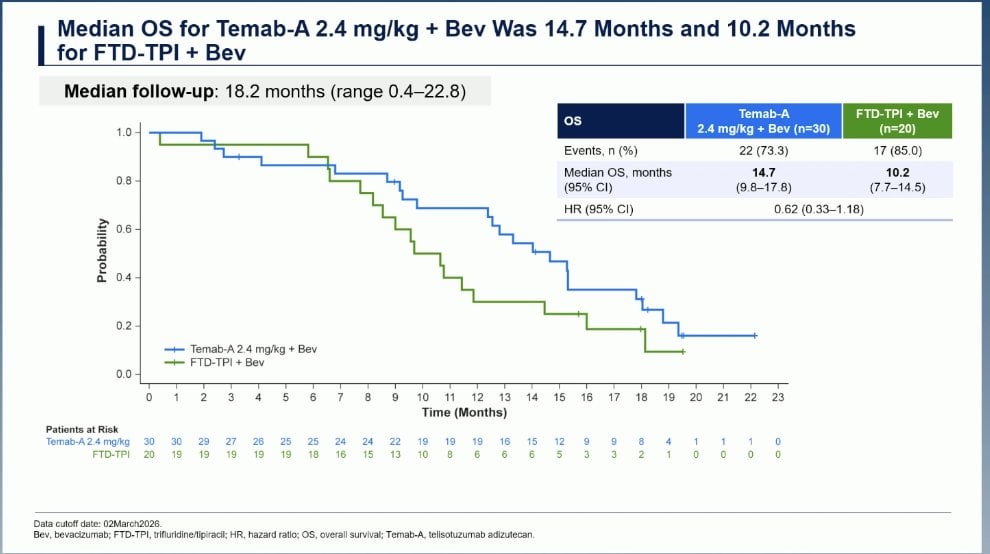
Promising, with open questions
Thoughtful discussion by Lisa Salvatore: Temab-A + Bev shows promise in mCRC, but haematological toxicity matters.
Questions unanswered: What does Bev add? Can c-Met guide selection? What is the optimal dose? Awaiting Phase III validation #ESMO26 #ESMOAmbassadors @OncoAlert https://t.co/n0clts8P3q
View post on X ↗Long-term follow-up of Temab-A with Bev vs SOC in 3L+ CRC: Updated results of a ph 1
#ESMO26 #ESMOAmbassadors
👉 mPFS: 6.8 vs 4.2 mo
👉 mOS: 14.7 vs 10.2 mo
👉 manageable safety
🧐Promising, ph-3 ongoing
@myESMO @ASCO https://t.co/wPzOVvO83s
View post on X ↗TEMAB-A (ABBV-400) is an ADC focused on on cmet with topo 1 payload in a ph I trial of ABBV-400 + bev vs. TAS-102 + bev in previously treated metastatic #colorectal #cancer. @OncoAlert @oncodaily #ESMO2026
Median follow-up: 18.2 M
Median OS 14.7M and HR = 0.62
Proceeding onto Ph 3 trial: NCT06614192
@Cecchini_OncMD
View post on X ↗KOL Voices: GI cancer leaderboard
The top physicians on the ESMO 2026 KOL leaderboard, GI tab. One line from each, verbatim, with the trial it is about.
- 1Nicholas Hornstein GI medical oncologist, Northwell · 51.6K impressions, 22 posts
- 2MV Chandrakanth medical oncologist, Narayana Health Kolkata · 48.7K impressions, 63 posts
- 3Nieves Martinez Lago MD PhD GI medical oncologist · 44.1K impressions, 38 posts
- 4Jeff Ryckman radiation oncologist · 34.2K impressions, 32 posts
- 5Arndt Vogel liver cancer and precision oncology, Princess Margaret / MHH · 31.8K impressions, 28 posts
- 6Anirban Maitra GI pathologist and pancreatic cancer researcher · 31.2K impressions, 5 postson Daraxonrasib + vopimetostat (Tango) study “Reduced toxicity data is particularly important as a lower Daraxonrasib dose can be used.”
- 7Angela Lamarca HPB and NET medical oncologist · 22.0K impressions, 42 posts
- 8
 Daisuke Kotani, MD, Ph.D 小谷 大輔 GI medical oncologist, National Cancer Center Hospital East · 21.7K impressions, 16 posts
- 9Shankar Siva radiation oncologist, Peter MacCallum Cancer Centre · 20.2K impressions, 9 posts
- 10Erman Akkus medical oncologist · 17.4K impressions, 7 posts
What’s yet to come: the last GI session, October 27
Times are Madrid time. ESMO 2026 ends on October 27.
Tuesday, October 27, 09:00 - 13:00 (Madrid) · Congress highlights
Almeria Auditorium - Hall 9 · Chairs: James Larkin (London, United Kingdom); Yelena Y. Janjigian (New York, United States of America)
- 12:00 - 12:20 Gastrointestinal tumours, lower digestive · Erika B. Ruiz-García (Mexico City, Mexico)
- 12:20 - 12:40 Gastrointestinal tumours, upper digestive · Florian Lordick (Leipzig, Germany)
FAQ
Which GI cancer trials did physicians discuss most at ESMO 2026?
From October 23 to 26, HARMONi-GI1 drew the most physician posts on X among GI trials, followed by CLARITY-Gastric01, HERIZON-GEA-01, SANO and G-HOPE-001.
What did HARMONi-GI1 show at ESMO 2026?
At a prespecified interim analysis (LBA8, median follow-up 14.3 months), ivonescimab plus gemcitabine-cisplatin improved OS, the primary endpoint, vs durvalumab plus gemcitabine-cisplatin in first-line advanced biliary tract cancer: 14.9 vs 12.1 months, stratified HR 0.75 (95% CI 0.61-0.92), one-sided P=0.0031. Grade 3 or 4 adverse events were 82.0% vs 72.3%. The trial enrolled patients in China only. Ivonescimab is investigational and not approved for biliary tract cancer in any country.
Did CLARITY-Gastric01 meet its primary endpoints?
One of its two dual primary endpoints. OS in patients treated in the third line or later was met: 10.0 vs 5.0 months, HR 0.47 (95% CI 0.36-0.62). PFS by central review in all randomized patients was not met: HR 0.77 (0.62-0.96), P=0.053193. OS in all randomized patients, the key secondary endpoint, was met: HR 0.58 (0.47-0.73). These are planned interim results (LBA7, data cutoff May 31, 2026). Sonesitatug vedotin is investigational.
What did HERIZON-GEA-01 show at ESMO 2026?
At the second interim analysis (ESMO 2026 LBA79, data cutoff July 15, 2026), zanidatamab plus chemotherapy improved OS vs trastuzumab plus chemotherapy: 22.9 vs 19.6 months, HR 0.76 (95% CI 0.62-0.93), P=0.0088. Adding tislelizumab vs zanidatamab plus chemotherapy: HR 0.81, P=0.0502, not statistically significant. Both regimens have been FDA approved since August 25, 2026, with different HER2 criteria.
Does SANO show active surveillance is as good as surgery?
SANO found no statistically significant difference in 5-year OS (50% vs 54%, HR 1.17, 95% CI 0.77-1.77), but distant metastases were higher with surveillance (46% vs 29%). Equivalence was not formally shown, and physicians on X disagreed on whether to offer surveillance.
What was new for RASolute 302 at ESMO 2026?
Subgroup analyses (LBA82) showed OS hazard ratios below 1 across RAS genotypes, with small subgroups such as G12R (HR 0.61, 95% CI 0.29-1.30) having wide confidence intervals. Daraxonrasib (Rasonque) has been FDA approved since August 26, 2026 without a RAS-status restriction.
What did AZUR-1 show at ESMO 2026?
At the interim analysis presented as LBA87 (data cutoff April 20, 2026; median follow-up 26.3 months), cCR12 by independent central review, the primary endpoint, was 47% (54/116), with 38 more patients in clinical complete response still being followed. Investigator-assessed cCR12 was 68% (98/144), and 71% of patients (110/154) were managed without further treatment after dostarlimab alone. Dostarlimab (Jemperli) received FDA accelerated approval for stage II/III dMMR/MSI-H locally advanced rectal cancer on October 19, 2026.
Which GI sessions are still ahead at ESMO 2026?
On October 27, the last day of the congress, Scientific Congress Highlights 1 includes highlights for lower GI cancers (Erika B. Ruiz-Garcia) and upper GI cancers (Florian Lordick).
KOL Pulse tracks what oncologists and hematologists post on X. Posts quoted here are shown in full and verbatim unless marked as an excerpt, and link to their source. Trial figures come from KOL Pulse trial pages, with the source and data cutoff in parentheses.