PREVIEW ASH 2026 — New Orleans, Dec 12–15: the abstracts hematologists are watching, top voices and trial buzz See the ASH 2026 preview →

17 min read

ESMO 2026: Top Gynecologic Cancer Trials and KOL Voices

ESMO 2026: Top Gynecologic Cancer Trials and KOL Voices
KOL Pulse · ESMO 2026 · Madrid · Gynecologic cancers · October 23–26

ESMO 2026: Top Gynecologic Cancer Trials and KOL Voices

Two endometrial cancer trials in Presidential Symposium III on October 26 drew the most physician discussion of the gynecologic cancer readouts at ESMO 2026. In TroFuse-005, sacituzumab tirumotecan improved overall survival after platinum chemotherapy and immunotherapy. Gynecologic oncologist Kathleen Moore wrote: “That is clinically meaningful and warrants use.” She also flagged the toxicity. In KEYNOTE-C93, first-line pembrolizumab alone improved progression-free survival vs carboplatin-paclitaxel in dMMR disease, and the debate was the control arm. Amol Akhade wrote: “Important caveat: Comparator was chemotherapy alone, NOT the current chemo-immunotherapy standard.” Earlier in the congress, two antibody-drug conjugates in platinum-resistant ovarian cancer led the discussion; Mali Barbi wrote: “With TOPO1 payloads, the gate is falling.” Below are the Day 4 trials first, then the Days 1–3 ovarian and endometrial readouts, each with a presented slide and physician posts quoted in full, and the last gynecologic cancer session on October 27.

Physician discussion, October 23–26

Physician posts on X, October 23–26.

The two endometrial cancer trials in Presidential Symposium III on October 26, TroFuse-005 and KEYNOTE-C93, went straight to the top of the gynecologic cancer table on the day they were presented. Before them, NRG-GY020, DUO-E and BEHOLD-1 drew the most physician posts; Kathleen Moore wrote many of them, in threads on each readout. Two other October 24 readouts, both presented by Ana Oaknin, drew little physician discussion on X: REJOICE-Ovarian02, raludotatug deruxtecan plus bevacizumab (posts), and the BEATcc final overall survival analysis in cervical cancer (posts).

Day 4: two endometrial cancer trials in Presidential Symposium III

TroFuse-005: sacituzumab tirumotecan after platinum and immunotherapy

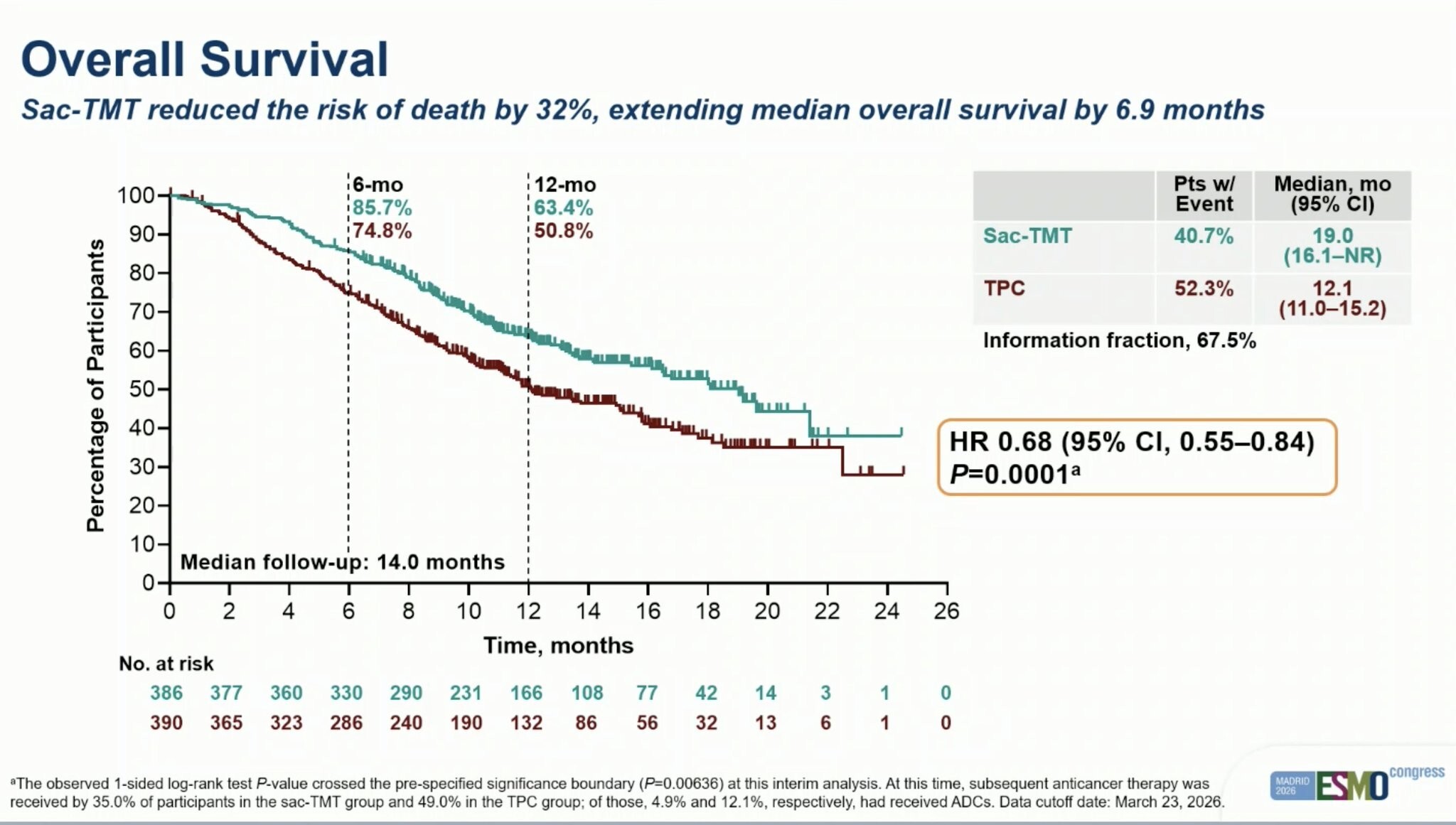
TroFuse-005 (ENGOT-en23/GOG-3095; Merck) is a Phase 3 trial of sacituzumab tirumotecan (sac-TMT), a TROP2-directed antibody-drug conjugate, vs doxorubicin or paclitaxel (treatment of physician’s choice) in 776 patients with advanced or recurrent endometrial cancer after platinum chemotherapy and immunotherapy. Domenica Lorusso presented it on October 26 (LBA11); Joyce Liu was the invited discussant, and the results were published in The Lancet. Both dual primary endpoints were met at the prespecified interim analysis. Median OS was 19.0 vs 12.1 months, HR 0.68 (95% CI 0.55–0.84), one-sided P=0.0001. Median PFS by blinded independent central review was 7.2 vs 3.9 months, HR 0.59 (0.50–0.70), one-sided P<0.0001. Confirmed ORR by blinded independent central review, a key secondary endpoint, was 35.1% vs 17.3%. (ESMO 2026 LBA11 abstract and slides, Domenica Lorusso; interim analysis, data cutoff Mar 23, 2026) Grade ≥3 treatment-related AEs occurred in 54.4% vs 41.4%, and 3.1% vs 4.9% discontinued for treatment-related AEs. Among adverse events of special interest (any grade, regardless of attribution), oral mucositis/stomatitis occurred in 57.0% vs 17.4%, ocular surface toxicity in 30.5% vs 6.8% and anemia in 71.4% vs 46.6%. (LBA11 abstract and slides; data cutoff Mar 23, 2026) Sac-TMT is investigational in endometrial cancer and is not approved by the FDA or EMA for any use. Merck reports that the FDA accepted a Biologics License Application for priority review in this setting, with a target action date of June 15, 2027. (Merck press release, Oct 26, 2026) Sac-TMT is a different drug from sacituzumab govitecan.

Nirmal Raut ESMO 2026 slide photo: TroFuse-005 overall survival Kaplan-Meier, sacituzumab tirumotecan vs treatment of physician's choice, median 19.0 vs 12.1 months, HR 0.68 (95% CI 0.55-0.84), presented by Domenica Lorusso
TroFuse-005 overall survival, a dual primary endpoint. Domenica Lorusso, ESMO 2026 Presidential Symposium III, LBA11. Photo posted by @oncologician.

Physicians posting on X described the survival benefit as clinically meaningful in a setting with few options. The concern was toxicity: Kathleen Moore listed stomatitis, ocular toxicity and anemia, said the drug requires aggressive counseling and mitigation, and hoped other ADCs in Phase 3 will match the efficacy with better tolerability.

Clinically meaningful, and the toxicity question
Kathleen Moore
Kathleen Moore @DrKatyMoore
gynecologic oncologist; deputy director, Buffett Cancer Center · Oct 26
TroFuse-005/GOG-3095 (Lorusso, #ESMO26): Options after carbo/paclitaxel/ICI in recurrent endometrial cancer are limited and poor. Sac-TMT is the first TOP1 ADC to read out positive in phase 3: PFS HR 0.59 (7.2 vs 3.9 mo), ORR 35% vs 17%, plus an OS benefit. That is clinically meaningful and warrants use. The tox is a concern. Stomatitis 57% (mostly low grade, needs prophylactic steroid mouthwash), ocular 31%, anemia 71%. Requires aggressive counseling and mitigation. Several other ADCs are in phase 3, and I hope they match this efficacy with better tolerability. Time will tell. @myESMO
View post on X ↗
Christi Kim @ChristiKimMD
medical oncologist, breast and gynecologic cancers · Oct 26
Trop2 ADC Sac-TMT in Recurrent Advanced Endometrial Cancer significantly improved OS, PFS, DOR, double the ORR (TroFuse-005) #EndometrialCancer https://t.co/cYXDyaLoQA
View post on X ↗
Ana Maderuelo @anamg_98
medical oncology resident, Hospital Universitario 12 de Octubre, Madrid · Oct 26
🩷 #ESMO26 TroFuse-005 (ph III): sacituzumab tirumotecan vs chemo after platinum + IO in advanced endometrial cancer. PFS 7.2 vs 3.9 mo (HR 0.59) OS 19.0 vs 12.1 mo (HR 0.68) ORR 35% vs 17% Potential new option; monitor stomatitis and cytopenias. #gynonc https://t.co/q21z0FcOGy
View post on X ↗
A potential new option after chemotherapy plus immunotherapy
Oncology Brothers @OncBrothers
community oncologists Rohit and Rahul Gosain · Oct 26
3. TroFuse-005: PhIII, sacituzumab tirumotecan (TROP2 ADC) vs dox/paclitaxel in endometrial ca after platinum + IO (n=776), global study - mOS 19.0 vs 12.1 mos (HR 0.68) - mPFS 7.2 vs 3.9 mos (HR 0.59) - ORR 35.1% vs 17.3% - When available, new option post IO-Chemo 4/5 https://t.co/bgi8JTLemt https://t.co/b0QcW0kzYb
View post on X ↗
JOSE ALEJANDRO PEREZ FIDAL @PerezFidal
medical oncologist · Oct 26
We have new changing practice trial in endometrial cancer in #ESMO2026 !!!! Again the presentation of Dr Lorusso has been absolutely perfect!! Sac-tmt was superior to CT in heavily pretreated endometrial cancer https://t.co/kwqVIBzSgP
View post on X ↗

KEYNOTE-C93: first-line pembrolizumab alone vs chemotherapy in dMMR disease

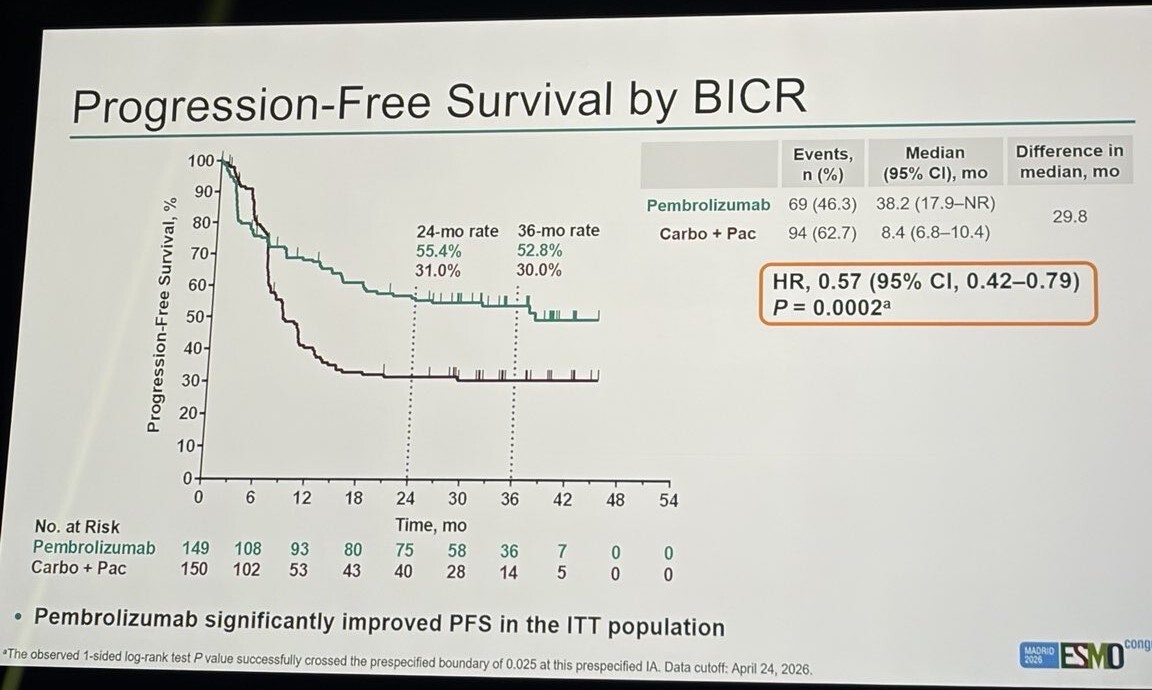
KEYNOTE-C93 (GOG-3064/ENGOT-en15; Merck) is an open-label Phase 3 trial of first-line pembrolizumab alone vs carboplatin-paclitaxel in 299 patients with mismatch repair-deficient (dMMR) advanced or recurrent endometrial carcinoma. Brian M. Slomovitz presented it on October 26 (LBA12); Christian Marth was the invited discussant, and the results were published in The Lancet. The trial has two primary endpoints. At the prespecified interim analysis, PFS by blinded independent central review met its endpoint: median 38.2 vs 8.4 months, HR 0.57 (95% CI 0.42–0.79), one-sided P=0.0002. Overall survival did not meet its significance criterion at this interim analysis: HR 0.77 (0.52–1.15), with median OS not reached in either arm. In the chemotherapy arm, 85.2% of patients with progression received crossover pembrolizumab or another PD-1/PD-L1 inhibitor. (ESMO 2026 LBA12 abstract and slides, Brian M. Slomovitz; The Lancet; interim analysis, data cutoff Apr 24, 2026) Grade ≥3 treatment-related AEs occurred in 18.1% vs 50.7%. (LBA12 abstract; data cutoff Apr 24, 2026) First-line pembrolizumab monotherapy is investigational and not an FDA- or EMA-approved use. Approved first-line regimens in the US combine immunotherapy with carboplatin-paclitaxel, followed by maintenance immunotherapy; KEYNOTE-C93 did not compare pembrolizumab alone with any of them. (KEYTRUDA, JEMPERLI and IMFINZI US prescribing information; The Lancet)

Ana Maderuelo ESMO 2026 slide photo: KEYNOTE-C93 progression-free survival by BICR, pembrolizumab vs carboplatin plus paclitaxel, median 38.2 vs 8.4 months, HR 0.57 (95% CI 0.42-0.79), presented by Brian M. Slomovitz
KEYNOTE-C93 progression-free survival by BICR, a dual primary endpoint. Brian M. Slomovitz, ESMO 2026 Presidential Symposium III, LBA12. Photo posted by @anamg_98.

Physicians welcomed a potential chemotherapy-free first-line approach with far less toxicity. The debate was the control arm: the trial compared pembrolizumab with chemotherapy alone, not with chemotherapy plus immunotherapy. The discussant, Christian Marth, put the question on screen, and Amol Akhade and Ana Maderuelo raised the same caveat. Overall survival is still immature.

Was chemotherapy alone the right comparator?
Dr Amol Akhade @SuyogCancer
medical oncologist · Oct 26
ESMO 2026 | KEYNOTE-C93 (LBA12): Can we omit chemotherapy in 1L dMMR advanced/recurrent endometrial cancer? Pembrolizumab monotherapy vs Carboplatin–Paclitaxel (n=299) 📊 Key results: • Median PFS: 38.2 vs 8.4 months (HR 0.57; p=0.0002) ✅ • 3-year PFS: 52.8% vs 30.0% • 3-year OS: 70.7% vs 62.0% (HR 0.77; not statistically significant) • ORR: 64.1% vs 62.1% • Grade ≥3 treatment-related AEs: 18.1% vs 50.7% • Better quality of life with pembrolizumab. Important caveat: Comparator was chemotherapy alone, NOT the current chemo-immunotherapy standard. #ESMO26 #EndometrialCancer #KEYNOTEC93 @OncoAlert @myESMO
View post on X ↗
Dr Amol Akhade @SuyogCancer
medical oncologist · Oct 26
Pembrolizumab alone for dMMR advanced ca endometrial cancer ? Wait for IO plus Chemo vs IO alone trial ? Nice discussion by Dr Marth @OncoAlert @myESMO #esmo26 https://t.co/FLbfPIkv4K
View post on X ↗
Ana Maderuelo @anamg_98
medical oncology resident, Hospital Universitario 12 de Octubre, Madrid · Oct 26
🩷 #ESMO26 KEYNOTE-C93 (ph III): pembrolizumab alone vs carboplatin/paclitaxel in 1L dMMR endometrial cancer. PFS 38.2 vs 8.4 mo (HR 0.57) 3y PFS 52.8% vs 30.0% Chemo-free option? OS not significant; not compared with chemo-IO. #gynonc https://t.co/s16wMyLpyG
View post on X ↗
Chemotherapy-free, but is it the new default?
Mustafa Özdoğan, MD @ozdogan_md
oncologist, Turkey · Oct 26
dMMR endometrial cancer: do we still need chemo upfront? #ESMO26 KEYNOTE-C93: pembrolizumab alone delays progression longer, with far less toxicity. Survival still unclear. New default? Dr Brian Slomovitz #EndometrialCancer https://t.co/bCYTXjSSlM
View post on X ↗
Oncology Brothers @OncBrothers
community oncologists Rohit and Rahul Gosain · Oct 26
4. KEYNOTE-C93: PhIII, pembro mono vs carbo/paclitaxel in 1L dMMR advanced/recurrent endometrial ca - mPFS 38.2 vs 8.4 mo (HR 0.57) - G≥3 TRAEs 18.1% vs 50.7% - DoR NR vs 10.2 mo - OS immature. IO/ICI regardless of aite, in dMMR, this remains the preferred backbone. 5/5 https://t.co/RqZCCHauwq
View post on X ↗

Ovarian cancer

BEHOLD-1: mocertatug rezetecan (B7-H4 ADC) in platinum-resistant ovarian cancer

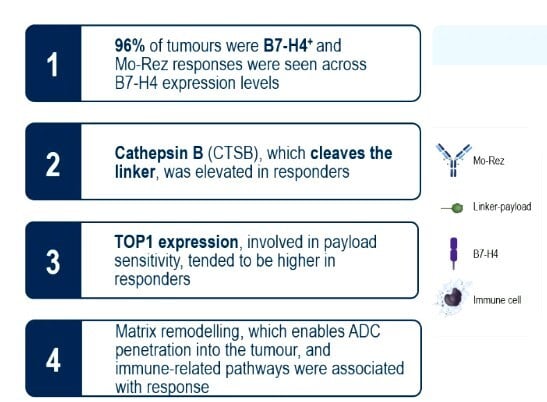
Mocertatug rezetecan (Mo-Rez, GSK) is a B7-H4-directed antibody-drug conjugate with a topoisomerase I payload. Updated BEHOLD-1 results with longer follow-up (LBA41, Vanda Salutari) and a translational biomarker analysis (1248RO, Stephanie Lheureux) were presented on October 24; Camilla Nero was the discussant. Mo-Rez is investigational; the Phase 3 BEHOLD-Ovarian01 trial is enrolling.

Kathleen Moore ESMO 2026 slide image: BEHOLD-1 translational findings for mocertatug rezetecan in platinum-resistant ovarian cancer, B7-H4 expression, cathepsin B and TOP1 expression in responders
BEHOLD-1 biomarker findings. ESMO 2026, 1248RO (Stephanie Lheureux). Photo posted by @DrKatyMoore.

Physicians agreed that responses were seen across B7-H4 expression levels. The discussion was about what predicts response instead: linker cleavage and payload sensitivity rather than antigen level. Kathleen Moore also flagged the neutropenia that comes with the higher dose.

Responses across B7-H4 levels, and the cost of the higher dose
Kathleen Moore @DrKatyMoore
gynecologic oncologist; deputy director, Buffett Cancer Center · Oct 24
2/ Mocertatug rezetecan (MoRez) (B7-H4, TOP1i payload), BEHOLD-1, 136 patients with PROC. Confirmed ORR 36% → 57% → 62% across 2.8, 4.8 and 5.8 mg/kg. Median DoR 12.2 months at 5.8 mg/kg, with 90% still in response at 6 months.(Claudeai used to summarize) https://t.co/tqx0Ob0dJQ
View post on X ↗
Kathleen Moore @DrKatyMoore
gynecologic oncologist; deputy director, Buffett Cancer Center · Oct 24
3/ The dose story is the toxicity story. From 4.8 to 5.8 mg/kg: Grade ≥3 neutropenia 24% → 60% Any-grade neutropenia 49% → 87% ILD or pneumonitis 7% overall, 8/9 grade 1-2 Primary G-CSF is now recommended across the program. https://t.co/6VZ829L7jz
View post on X ↗
Kathleen Moore @DrKatyMoore
gynecologic oncologist; deputy director, Buffett Cancer Center · Oct 24
4/ In the MoRez trial, 96% of the tumors were B7-H4 + and responses occurred at every expression level. Correlative work suggests Cathepsin B, TOP1 expression and matrix remodeling all associated with response. https://t.co/cwJWw8ydje
View post on X ↗
JOSE ALEJANDRO PEREZ FIDAL @PerezFidal
medical oncologist · Oct 24
Mo-Rez achieved activity even in patients with low expression of B7-H4. Nice translational data of the behold1 cathepsin B and Topo1 expression potential predictive biomarkers for Mo-Rez. Congrats to Dr Lhereux @LHeresy33502 for an outstanding presentation #ESMO2026 @myESMO
View post on X ↗
One post on two ovarian ADC readouts
Mali Barbi, MD MSc | Breast & Gyn Oncologist
Mali Barbi, MD MSc | Breast & Gyn Oncologist @DrBarbiOnc
breast and gynecologic oncologist, Northwell Health · Oct 24
Two #ovariancancer ADC readouts at ESMO 2026, and together they challenge how we select patients. #BEHOLD_1 mocertatug rezetecan (B7-H4, TOPO1 payload), platinum-resistant ovarian: confirmed ORR 62% at 5.8 mg/kg, median DoR 12.2 mo. Responses at every B7-H4 level. Response tracked with cathepsin B, the enzyme that cleaves the linker, and with TOP1, the payload's target. Torvutatug samrotecan (FRα, TOPO1 payload): ORR 48% in FRα ultralow/null, 57% low, 62% high, with overlapping CIs. ctDNA complete molecular response 47%, no clean link to FRα. What I make of it:
With mirvetuximab, a DM4 payload, FRα-high was the gate. With TOPO1 payloads, the gate is falling. Nearly half of FRα-null tumors respond.
The biology that predicts response sits in the payload path: release and sensitivity, not antigen density.
That changes three things. Who we test: target IHC may exclude patients who would respond. How we sequence: after one TOPO1 ADC, the question is payload resistance, not a new target. How we design trials: stratify by payload biology, not by the antigen on the label. Exploratory and single arm. But the direction is consistent, and it is where the field should look next. #gyncsm #ESMO26 @myESMO
View post on X ↗

FONTANA: torvutatug samrotecan (FRα ADC) in platinum-resistant ovarian cancer

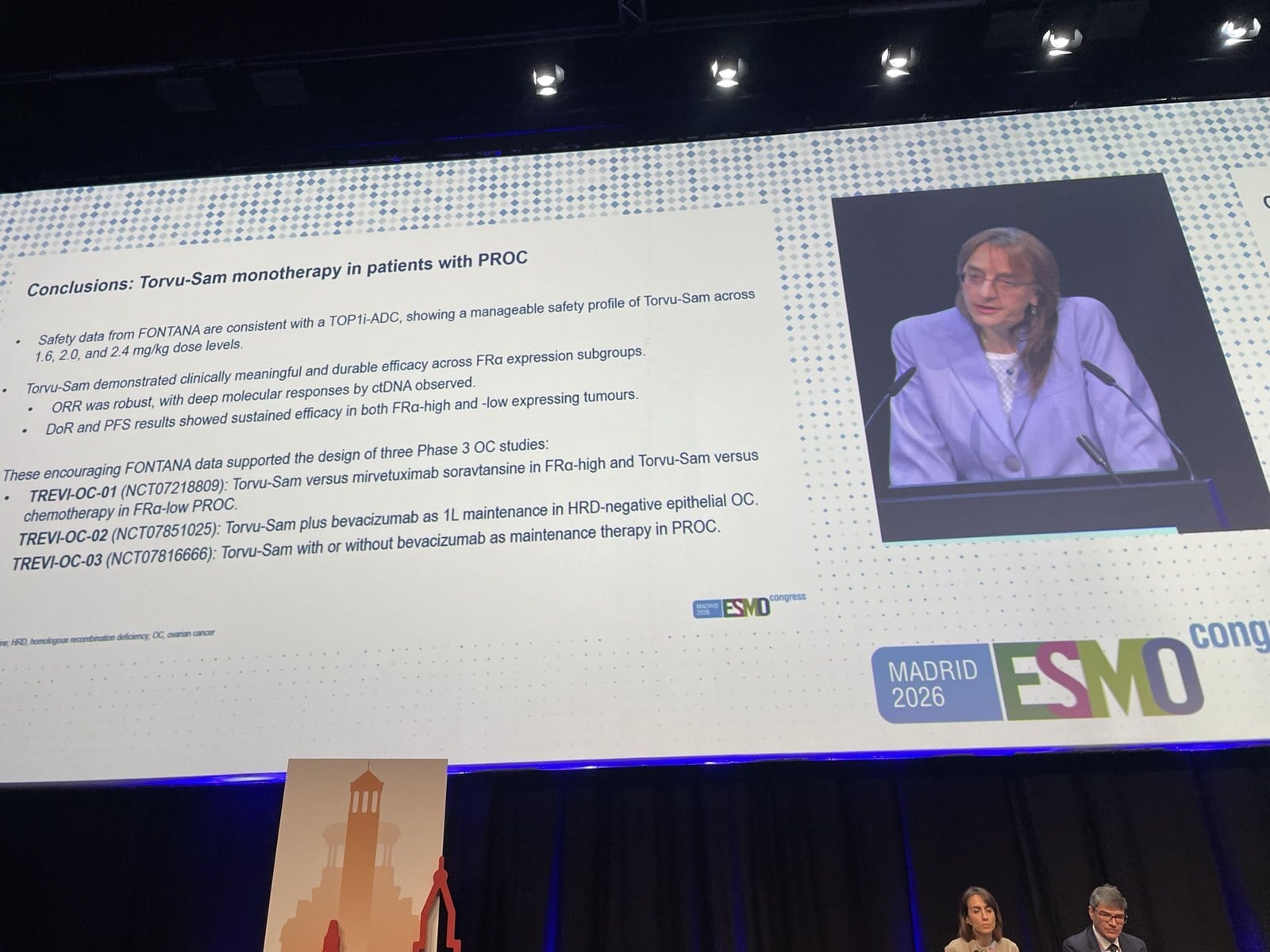
Torvutatug samrotecan (Torvu-Sam, AZD5335, AstraZeneca) is a folate receptor alpha (FRα)-directed ADC with a topoisomerase I payload. Funda Meric-Bernstam presented updated FONTANA results on October 24 (1245RO); Philipp Harter was the discussant. The conclusions slide lists three Phase 3 ovarian cancer trials: TREVI-OC-01, TREVI-OC-02 and TREVI-OC-03. Torvu-Sam is investigational.

Jose Alejandro Perez Fidal ESMO 2026 slide photo: FONTANA conclusions for torvutatug samrotecan monotherapy in platinum-resistant ovarian cancer, efficacy across FR-alpha expression subgroups and three planned Phase 3 TREVI-OC studies, presented by Funda Meric-Bernstam
FONTANA conclusions. Funda Meric-Bernstam, ESMO 2026, 1245RO. Photo posted by @PerezFidal.

Both physicians who posted noted activity across FRα expression levels. They read it differently: one asked whether a biomarker is needed at all; the other concluded that all patients with platinum-resistant disease can benefit.

Is FRα testing still needed?
Kathleen Moore @DrKatyMoore
gynecologic oncologist; deputy director, Buffett Cancer Center · Oct 24
5/ Torvutatug samrotecan (FRα/topo1) ORR 48.1% in FRα ultralow/null, 57.1% low, 61.7% high. A gradient, yes. But the confidence intervals overlap , and nearly half of FRα-null tumors responded. So do we need a biomarker at all here? https://t.co/m2mYihxMDD
View post on X ↗
JOSE ALEJANDRO PEREZ FIDAL @PerezFidal
medical oncologist · Oct 24
Torvu-sam showed an encouraging activity with an ORR around 60% in both high and low FRalpha groups supporting that all PROC patients can benefit regardless of FRalpha expression. Results from Fontana trial. #Esmo2026
View post on X ↗

INCB123667 + bevacizumab: a CDK2 inhibitor in platinum-resistant ovarian cancer

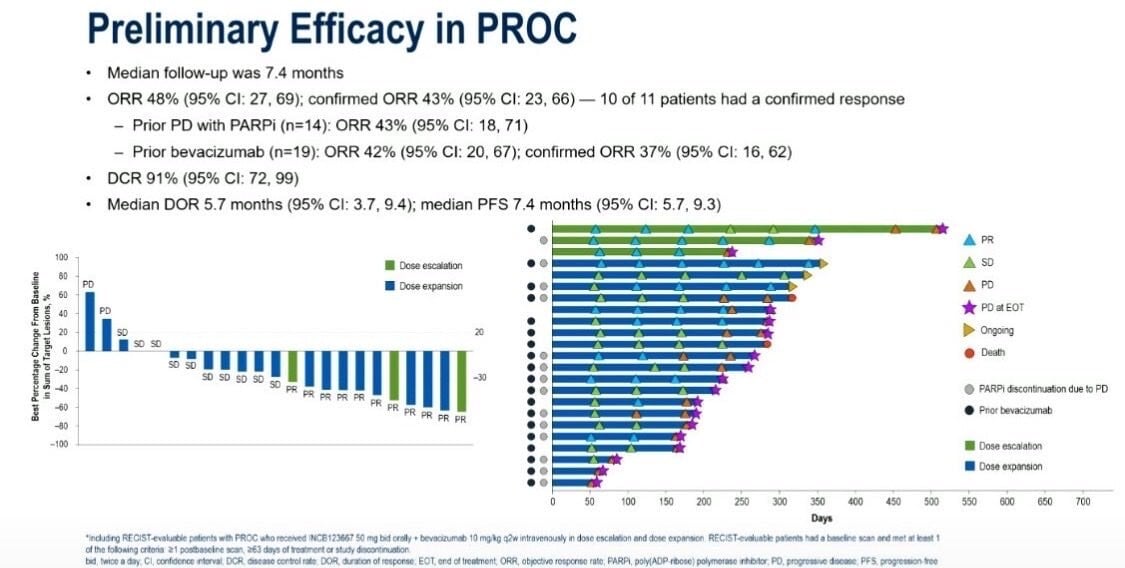
INCB123667 (Incyte) is an oral selective CDK2 inhibitor, tested with bevacizumab in recurrent ovarian cancer. Domenica Lorusso presented the platinum-resistant cohort (1241RO, October 23); Iain McNeish discussed it with DENALI. INCB123667 is investigational.

Mali Barbi ESMO 2026 slide photo: INCB123667 plus bevacizumab preliminary efficacy in platinum-resistant ovarian cancer, waterfall and swimmer plots
INCB123667 plus bevacizumab, preliminary efficacy. Domenica Lorusso, ESMO 2026, 1241RO. Photo posted by @DrBarbiOnc.

Physicians noted the single-arm design and asked how patients should be selected: by cyclin E1 overexpression on IHC or by CCNE1 amplification.

Activity, and who to select
Kathleen Moore @DrKatyMoore
gynecologic oncologist; deputy director, Buffett Cancer Center · Oct 23
2/8 INCB123667 + bev in PROC, n=23: 87% cyclin E1 overexpressed (35% of those CCNE1 amplified), 43% with ≥4 prior lines, 83% prior bev. ORR 48% (confirmed 43%) DCR 91% mDOR 5.7 mo mPFS 7.4 mo https://t.co/dXGJFhswAK
View post on X ↗
Mali Barbi, MD MSc | Breast & Gyn Oncologist @DrBarbiOnc
breast and gynecologic oncologist, Northwell Health · Oct 23
INCB123667 + bev in #PROC. Selective CDK2 inhibitor, n=23. ORR 48%, mPFS 7.4 mo, responses after PARPi and after prior bev. Single arm. Bev alone in PROC was about 16%. MAESTRA 3 will test CDK2i + bev vs bev. 87% cyclin E1 overexpressed, so IHC barely selects. We need response by CCNE1 amplification. Endometrial was in phase 1. All three pivotal trials are ovarian. 28% of p53abn endometrial cancers carry CCNE1 amplification, enriched in carcinosarcoma. That cohort deserves its own trial. #gyncsm #ESMO26
View post on X ↗
Kathleen Moore @DrKatyMoore
gynecologic oncologist; deputy director, Buffett Cancer Center · Oct 23
3/8 Next: MAESTRA3 (NCT07797283), a phase 3 of INCB123667 + bev vs bev as first-line maintenance in cyclin E1-overexpressing EOC, starts in 2026. Cyclin E1 biology is heading to the front line.
View post on X ↗

DENALI (GOG-3066): azenosertib, a WEE1 inhibitor, in platinum-resistant ovarian cancer

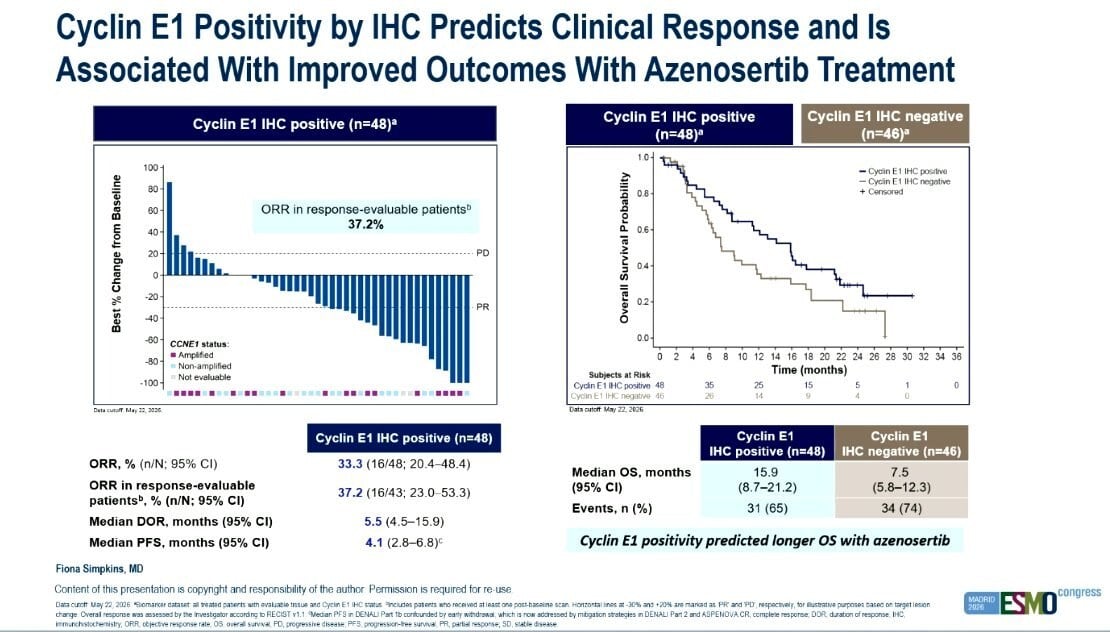
DENALI Part 1b tested azenosertib, an oral WEE1 inhibitor, in platinum-resistant ovarian cancer and reported overall survival by cyclin E1 status (1242RO, Fiona Simpkins, October 23). Azenosertib is investigational. One physician posted about it: Kathleen Moore, in the same thread as INCB123667.

Kathleen Moore ESMO 2026 slide image: DENALI Part 1b azenosertib, cyclin E1 positivity by IHC and clinical response, overall survival by cyclin E1 status, presented by Fiona Simpkins
DENALI Part 1b, cyclin E1 positivity and outcomes. Fiona Simpkins, ESMO 2026, 1242RO. Photo posted by @DrKatyMoore.

Kathleen Moore’s thread weighed the overall survival result against how cyclin E1 status was assigned, then turned to tolerability: dose interruptions, reductions and discontinuations.

A drug effect, or selection? And tolerability
Kathleen Moore @DrKatyMoore
gynecologic oncologist; deputy director, Buffett Cancer Center · Oct 23
4/8 DENALI Part 1b, azenosertib 400 mg 5 days on/2 off: n=102 PROC, median 3 prior lines, 91% prior bev, 55% PARPi, 15% MIRV. Cyclin E1 IHC+ in 51% of evaluable tumors vs CCNE1 amplification in 31%. https://t.co/Fj6tVC5W50
View post on X ↗
Kathleen Moore @DrKatyMoore
gynecologic oncologist; deputy director, Buffett Cancer Center · Oct 23
6/8 OS benchmarks: ~13 mo with single-agent chemo (AURELIA), 16.9 mo with mirvetuximab in FRα-high disease (MIRASOL). High cyclin E1 usually carries worse prognosis, so a longer OS in cyclinE1+ tumors points toward a drug effect. But: cyclin E1 status was assigned retrospectively with a proprietary cutoff, the CIs overlap and there is no control arm. ASPENOVA (azenosertib vs chemo, n≈420) and DENALI Part 2 will tell us if this holds.
View post on X ↗
Kathleen Moore @DrKatyMoore
gynecologic oncologist; deputy director, Buffett Cancer Center · Oct 23
7/8 Tolerability is the issue to solve: dose interruptions 57%, reductions 43%, discontinuations 20%, grade ≥3 fatigue 16% and thrombocytopenia 12%. Mitigation in Part 2a reportedly halved discontinuations to ~10%. https://t.co/SBSZhPia0X
View post on X ↗
Kathleen Moore @DrKatyMoore
gynecologic oncologist; deputy director, Buffett Cancer Center · Oct 23
8/8 My takeaways: cyclin E1 overexpression by IHC is becoming the selection biomarker for CDK2 and WEE1 programs, reaching more patients than amplification.
View post on X ↗
Free Access · KOL Pulse Intelligence

Track oncology’s top KOLs in your specialty

Create a free account, pick the tumor types you cover, and go beyond the tweet — the intelligence pharma teams use to map influence and prepare for engagement:

  • ✓Enhanced KOL profiles
  • ✓Pharma influence & potential advisory-board patterns
  • ✓2025 Open Payments financial analysis
  • ✓Social-media sentiment & trend signals
Get free access — pick your specialty
Choose the tumor types you follow. No cost, unsubscribe anytime.

Endometrial cancer

NRG-GY020 and KEYNOTE-B21: pembrolizumab after surgery in dMMR endometrial cancer

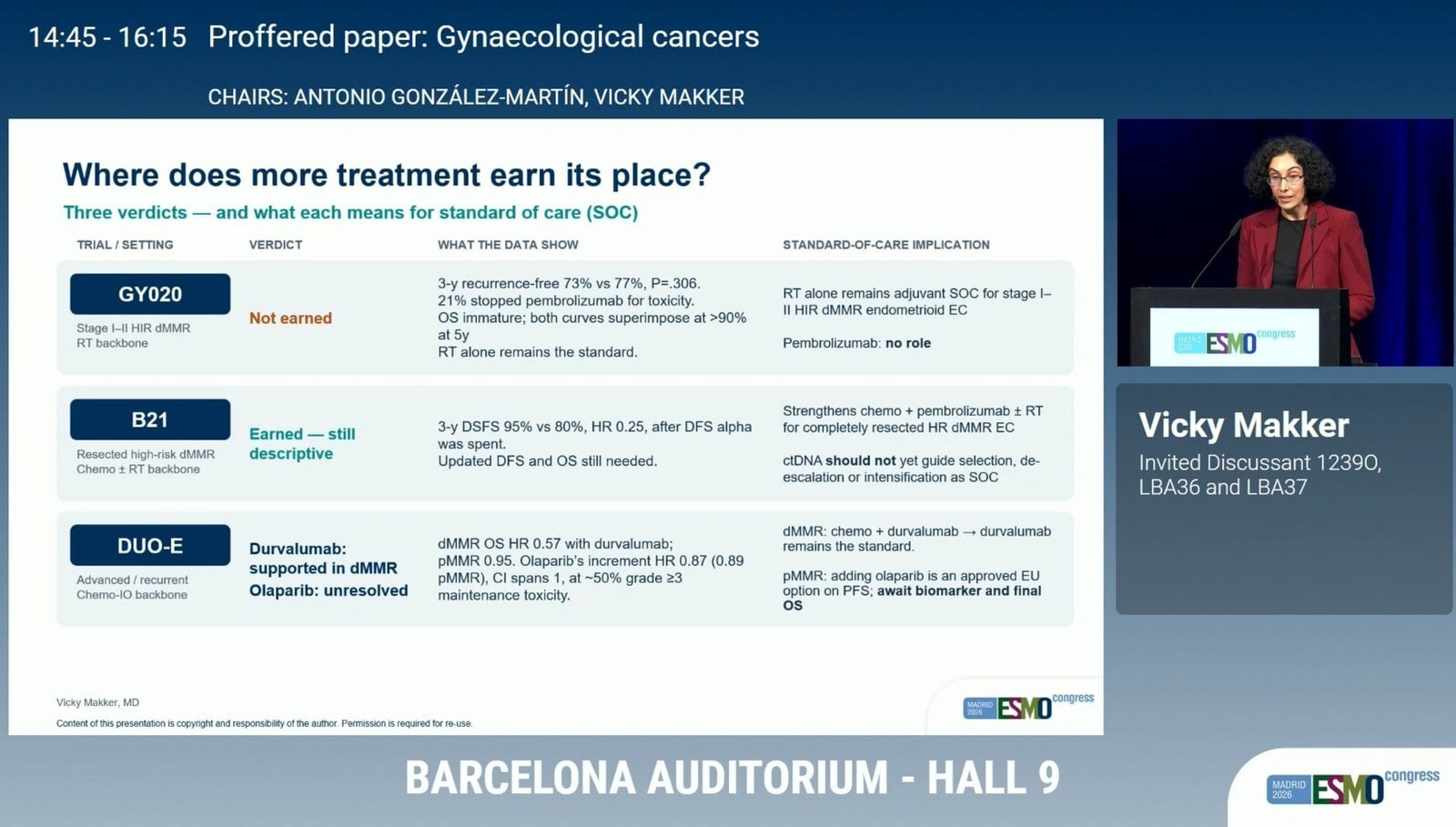
NRG-GY020 (1239O, NRG Oncology/NCI) is a Phase 3 trial of adjuvant radiotherapy with or without pembrolizumab in stage I–II, high-intermediate-risk dMMR endometrioid endometrial cancer. It did not meet its primary endpoint. A ctDNA analysis of KEYNOTE-B21 (pembrolizumab with adjuvant chemotherapy in high-risk dMMR disease) was presented in the same session. Vicky Makker was the invited discussant for both and for DUO-E. Adjuvant pembrolizumab is investigational in these settings.

Amol Akhade ESMO 2026 slide photo: Vicky Makker discussant slide, Where does more treatment earn its place, verdicts for NRG-GY020, KEYNOTE-B21 and DUO-E in endometrial cancer
Discussant slide on NRG-GY020, KEYNOTE-B21 and DUO-E. Vicky Makker, ESMO 2026 proffered paper session, gynecologic cancers. Photo posted by @SuyogCancer.

Physicians agreed the primary endpoint was negative. They disagreed on what that means: one kept radiotherapy alone as his default; another questioned whether the trial was designed to detect a realistic effect. On KEYNOTE-B21, the question was whether postoperative ctDNA can select patients, and whether a negative test is reliable enough to drive de-escalation.

Negative trial, or underpowered trial?
Jeff Ryckman @jryckman3
radiation oncologist · Oct 23
GY020 didn't meet its primary endpoint: 3y success 70% w/ pembro+RT vs 73% RT alone. Leaving study counted as failure. KM RFS numerically favored pembro, but CI crossed 1. G3/4 toxicity 43% vs 15%. RT alone remains my default here. #ESMO26 #radonc https://t.co/tmjNMzulqN https://t.co/KR1rbuVzhW
View post on X ↗
Kathleen Moore @DrKatyMoore
gynecologic oncologist; deputy director, Buffett Cancer Center · Oct 24
@myESMO @FBackesMD 1/ NRG-GY020 at #ESMO26: RT ± 1 yr pembro in stage I/II high-intermediate risk dMMR endometrioid EC (n=168, 1:2). The primary endpoint, 3-yr recurrence-free status, was negative: 73% vs 77%, p=0.31. Question - is this really negative or is this a case of over aggressive statistical design to conserve sample size? 🧵
View post on X ↗
Kathleen Moore @DrKatyMoore
gynecologic oncologist; deputy director, Buffett Cancer Center · Oct 24
6/ GY020 doesn’t show that IO does nothing in early dMMR EC, and it doesn’t show that it helps. The question is still open. The next trial needs a realistic effect size and an endpoint that doesn’t count dropout as recurrence.
View post on X ↗
KEYNOTE-B21: can ctDNA select patients?
Kathleen Moore @DrKatyMoore
gynecologic oncologist; deputy director, Buffett Cancer Center · Oct 24
7/ Also at #ESMO26: the KEYNOTE-B21 ctDNA analysis in dMMR (Signatera, tumor-informed). Only ~20% were ctDNA+ after surgery (and importantly BEFORE chemo not after), and in stage I/II it was 5% and 18% (n=44). That’s lower than I expected for resected high-risk disease.
View post on X ↗
Kathleen Moore @DrKatyMoore
gynecologic oncologist; deputy director, Buffett Cancer Center · Oct 24
9/ The harder finding: in the placebo arm, 15 of 19 DSFS events occurred in pts who were ctDNA− at baseline (sensitivity 21%, NPV 80%). A negative postop test isn’t ready to drive de-escalation. (figure made with claude ai) https://t.co/MbQBVeeIUR
View post on X ↗

DUO-E: durvalumab with or without olaparib, updated overall survival

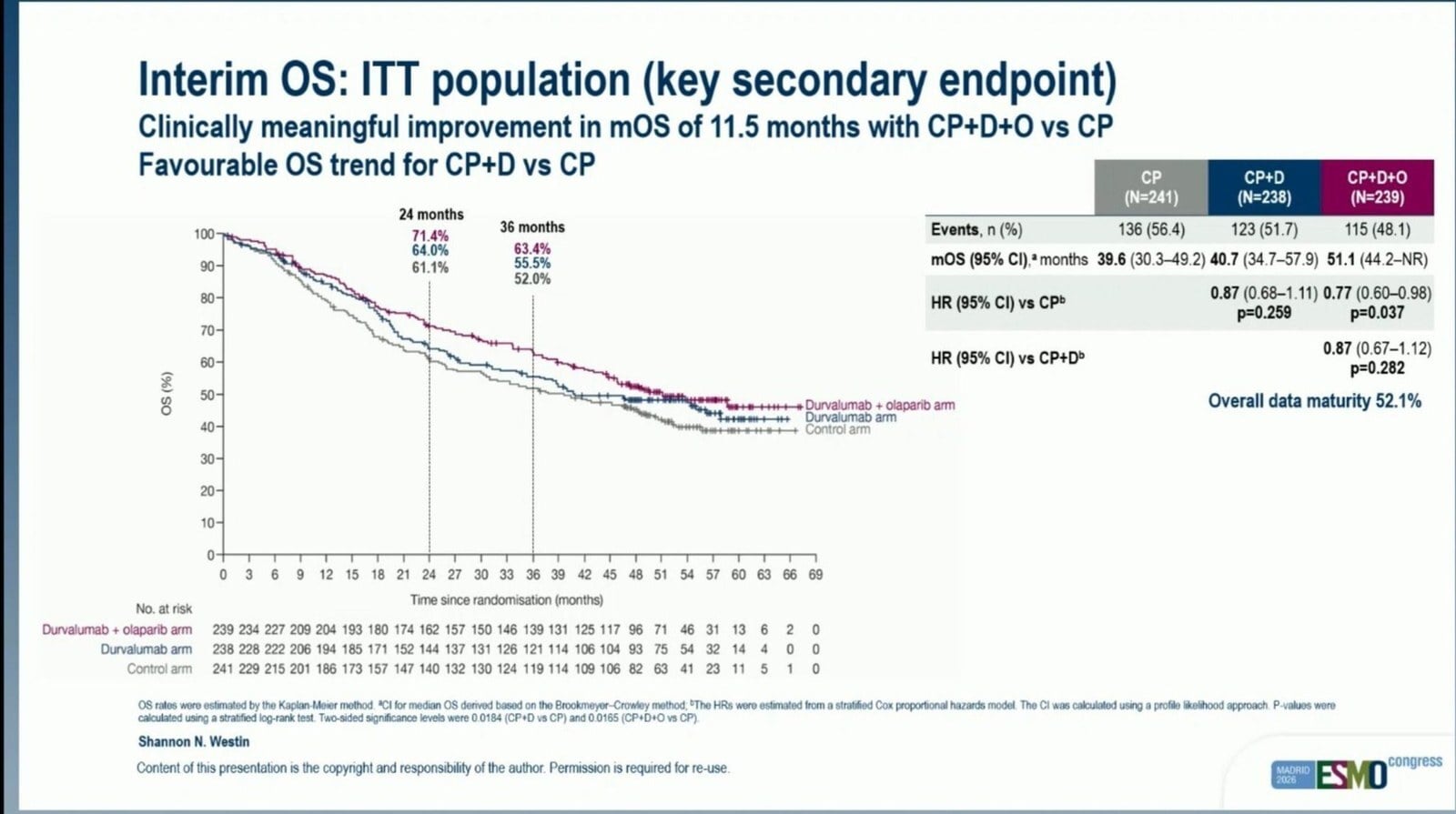
DUO-E (LBA37, Shannon Westin; AstraZeneca) is a Phase 3 trial of carboplatin-paclitaxel plus durvalumab, followed by durvalumab with or without olaparib maintenance, in advanced or recurrent endometrial cancer. The trial met its PFS endpoints earlier. At this interim analysis, the overall survival difference did not reach statistical significance. In the US, durvalumab with chemotherapy followed by durvalumab is FDA approved for dMMR disease. In the EU, the olaparib combination is approved for pMMR disease and durvalumab alone for dMMR disease.

Aya Mohamed ESMO 2026 slide photo: DUO-E interim overall survival, ITT population, carboplatin-paclitaxel vs plus durvalumab vs plus durvalumab and olaparib, presented by Shannon N. Westin
DUO-E interim overall survival, ITT population. Shannon N. Westin, ESMO 2026, LBA37. Photo posted by @Dr_Oncologista.

Physicians agreed the OS difference was not statistically significant at this analysis. They split on the olaparib question: one pointed to a numerical benefit in pMMR disease, another concluded the approach belongs only in dMMR disease, and a third asked whether added PFS justifies added toxicity.

dMMR, pMMR and the value of olaparib
Aya Mohamed | MSc, MD 🎗
Aya Mohamed | MSc, MD 🎗 @Dr_Oncologista
medical oncologist · Oct 24
DUO-E #ESMO26 Overall Survival Signals and the Added Value of PARP Inhibition in Advanced Endometrial Cancer @OncoAlert #ESMOAmbassadors #ESMOcommunity @myESMO https://t.co/vfsuUFj0wf
View post on X ↗
Oncology Brothers @OncBrothers
community oncologists Rohit and Rahul Gosain · Oct 24
6. DUO-E (Updated OS): PhIII, Durva + chemo → Durva + olaparib vs chemo alone in advanced/recurrent endometrial cancer. - mOS 51.1 vs 39.6 mo (HR 0.77) - Interim analysis did not meet formal statistical threshold - Numerical benefit seen in pMMR 8/10 https://t.co/pgdlUuAvCy https://t.co/ququuaxl11
View post on X ↗
Dr Amol Akhade @SuyogCancer
medical oncologist · Oct 24
Conclusion in One line . Trial is negative for OS . And this approach should be used only in dMMR pts . #DUO-E @myESMO #esmo26 @OncBrothers @OncoAlert https://t.co/EpRGmXsAtS
View post on X ↗
MV Chandrakanth
MV Chandrakanth @ChandrakanthMv
medical oncologist, Narayana Health Kolkata · Oct 25
DUO-E | ESMO 2026 — PFS PASSED. OS STILL AWAITS VERDICT! Three-part analysis of advanced/recurrent endometrial cancer. Part 1: Rationale, trial design & PFS benefit. Part 2: Median OS 51.1 vs 39.6 months (HR 0.77). An 11.5-month numerical gain, but formal interim significance not reached. Part 3: Does olaparib truly add value? Incremental PFS benefit, greater toxicity, but unproven additional OS benefit over durvalumab alone. The clinical question: Is the added PFS worth the toxicity while final OS remains awaited? Ref: Westin SN et al. ESMO 2026; LBA37. @myESMO @OncoAlert #MVOnco #ESMO26 #EndometrialCancer
View post on X ↗

On October 25, discussion continued with a comparison of the overall survival results from three first-line endometrial cancer trials: NRG-GY018, RUBY and DUO-E.

October 25: DUO-E beside NRG-GY018 and RUBY
MV Chandrakanth @ChandrakanthMv
medical oncologist, Narayana Health Kolkata · Oct 25
THREE TRIALS. THREE OS STORIES! NRG-GY018 vs RUBY vs DUO-E | Advanced/recurrent endometrial cancer. 🟢 NRG-GY018: Strong PFS benefit. dMMR OS HR 0.56 (nominal); pMMR HR 0.86 (NS). 🟣 RUBY: Overall OS formally positive (HR 0.69). Strong dMMR signal. 🔵 DUO-E: PFS positive. Interim OS not formally significant; incremental OS benefit from olaparib unproven. OS SIGNAL ≠ OS PROVEN! References: Eskander et al., NEJM 2023 (NRG-GY018); Mirza et al., NEJM 2023 & Powell et al., Ann Oncol 2024 (RUBY); Westin et al., JCO 2024 (DUO-E); updated OS: ASCO/ESMO 2026. #ESMO26 #EndometrialCancer #MVOnco @myESMO @OncoAlert
View post on X ↗

KOL Voices: gynecologic cancers

The top physicians in the gynecologic cancer tab of the ESMO 2026 KOL leaderboard, with one line each in their own words and the trial it is about.

  1. Kathleen Moore (@DrKatyMoore), gynecologic oncologist: on NRG-GY020 → “If we want ctDNA to select who needs IO in early dMMR EC, we need more sensitive assays and testing that extends past 2-3 yrs.”
  2. JOSE ALEJANDRO PEREZ FIDAL (@PerezFidal), medical oncologist: on BEHOLD-1 → “Happy to see that translational studies are also oral communications in #ESMO2026.”
  3. Sushil (@Sushilberiwal), radiation oncologist, posting before the congress on October 5: on INTERLACE “The INTERLACE is not positioned as routine intensification .”
  4. Alfonso Cortés Salgado (@AlfonsoCorts9), medical oncologist: on the ESMO 2026 cervical cancer guidelines “Honoured to join Prof. Domenica Lorusso this morning at the @myESMO Clinical Session Guidelines, presenting the new ESMO cervical cancer guidelines”

What’s yet to come: October 27

The last gynecologic cancer session of ESMO 2026. Time is Madrid time.

WhenSessionTalkSpeaker
Tue Oct 27, 10:20–10:40Scientific Congress Highlights 2 (Barcelona Auditorium, Hall 9)Gynaecological cancers highlightsAntonio González-Martín

Physician reactions keep appearing on the ESMO 2026 trials page as they are posted.

FAQ

Which gynecologic cancer trials did physicians discuss most at ESMO 2026?

By physician posts on X on October 23-26, TroFuse-005 (16 posts from 12 physicians) and KEYNOTE-C93 (13 from 9), both presented on October 26, led the gynecologic cancer readouts, followed by NRG-GY020, DUO-E and BEHOLD-1 (mocertatug rezetecan).

What did TroFuse-005 show at ESMO 2026?

In endometrial cancer after platinum chemotherapy and immunotherapy, sacituzumab tirumotecan (sac-TMT) improved overall survival (19.0 vs 12.1 months, HR 0.68) and progression-free survival (7.2 vs 3.9 months, HR 0.59) vs doxorubicin or paclitaxel at the prespecified interim analysis (ESMO 2026 LBA11; data cutoff March 23, 2026). Grade 3 or higher treatment-related adverse events were more frequent (54.4% vs 41.4%). Sac-TMT is investigational in endometrial cancer; Merck reports that the FDA has accepted a Biologics License Application for priority review, with a target action date of June 15, 2027.

Is first-line pembrolizumab alone approved for dMMR endometrial cancer?

No. In KEYNOTE-C93 (ESMO 2026 LBA12), first-line pembrolizumab alone improved progression-free survival vs carboplatin-paclitaxel (38.2 vs 8.4 months, HR 0.57), but overall survival did not meet its significance criterion at the interim analysis. First-line pembrolizumab monotherapy is investigational, and the trial did not compare it with the approved chemotherapy-plus-immunotherapy regimens.

Are mocertatug rezetecan and torvutatug samrotecan approved?

No. Both antibody-drug conjugates are investigational. Phase 3 trials are under way or planned: BEHOLD-Ovarian01 for mocertatug rezetecan and the TREVI-OC trials for torvutatug samrotecan.

What did DUO-E show at ESMO 2026?

The updated overall survival analysis did not reach statistical significance at this interim analysis. Durvalumab with chemotherapy followed by durvalumab is FDA approved for dMMR advanced or recurrent endometrial cancer; the olaparib combination is approved in the EU for pMMR disease.

Did NRG-GY020 show a benefit for adjuvant pembrolizumab?

No. Adding pembrolizumab to adjuvant radiotherapy in stage I-II high-intermediate-risk dMMR endometrial cancer did not meet the primary endpoint. Physicians on X debated whether the trial was designed to detect a realistic effect.

KOL Pulse tracks what oncologists post on X. Posts quoted here are shown in full, verbatim, and link to their source.