Brian Shields

ENERGIZE and KEYNOTE-866: Two Negative Phase 3 Trials in MIBC
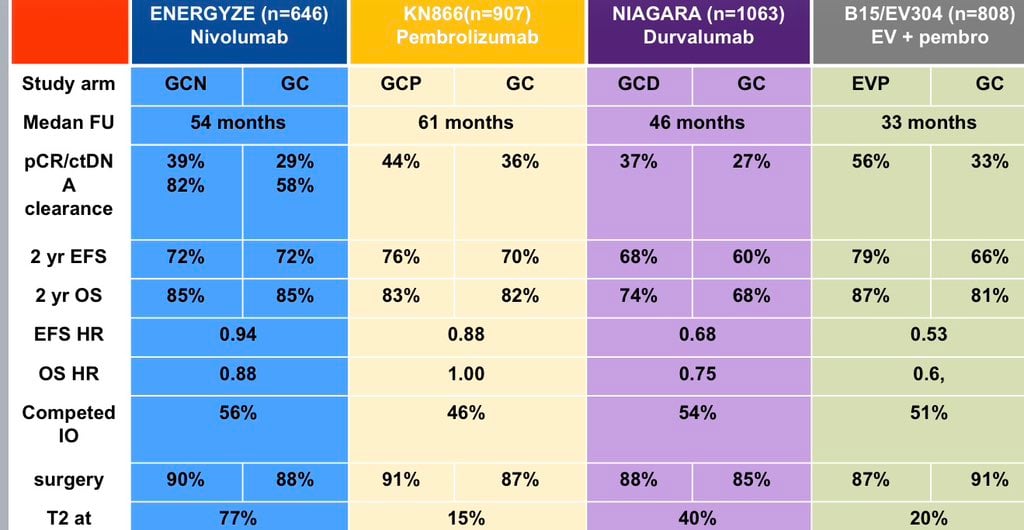
Two phase 3 trials presented at ESMO 2026 on October 23 added a PD-1 inhibitor to neoadjuvant gemcitabine/cisplatin and continued it after cystectomy in cisplatin-eligible muscle-invasive bladder cancer. Neither improved event-free survival: ENERGIZE (nivolumab, Bristol Myers Squibb) EFS HR 0.94; KEYNOTE-866 (pembrolizumab, Merck) EFS HR 0.88, OS HR 1.00. NIAGARA (durvalumab, AstraZeneca) met EFS (HR 0.68) and OS (HR 0.75) and is FDA approved.
ENERGIZE (CA017-078): neoadjuvant nivolumab + gem/cis, then adjuvant nivolumab
Presented by Andrea Necchi, abstract 4736O, Proffered Paper 1: Genitourinary tumour, renal and urothelial. NCT03661320.
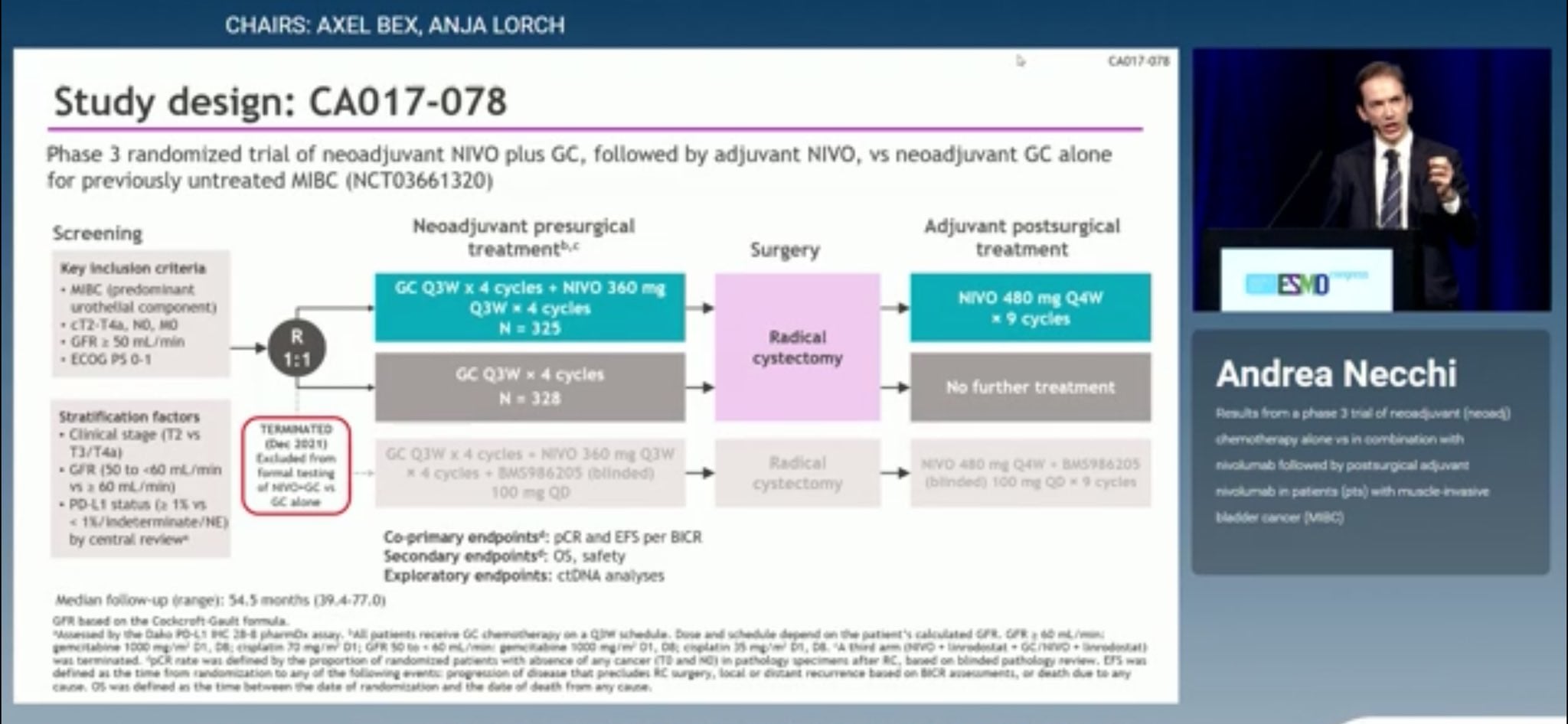
- Phase 3, previously untreated MIBC (cT2–T4a N0 M0, GFR ≥50 mL/min). Nivolumab 360 mg + GC Q3W ×4 → radical cystectomy → nivolumab 480 mg Q4W ×9 (n=325) vs GC ×4 → cystectomy → no further treatment (n=328). (ENERGIZE slide, ESMO 2026 4736O)
- A third arm adding BMS986205 (linrodostat) was terminated in December 2021 and excluded from formal testing. (ENERGIZE slide, ESMO 2026 4736O)
- Co-primary endpoints: pCR and EFS per blinded independent central review. Median follow-up 54.5 months (range 39.4–77.0). (ENERGIZE slide, ESMO 2026 4736O)
- EFS: 104/325 (32.0%) vs 104/328 (31.7%) events. Median not reached vs 67.6 months (95% CI 63.0–NE). HR 0.94 (95% CI 0.72–1.24; 95.74% CI 0.71–1.25), two-sided P=0.6697 against a threshold of 0.0426. EFS co-primary not met. (ENERGIZE slide, ESMO 2026 4736O)
- pCR: 39.1% vs 29.6%, difference 9.5% (95% CI 2.3–16.7; 99.91% CI −2.6 to 21.6). The multiplicity-adjusted analysis did not establish a significant difference. Combined response (≤ypT1N0) 51.7% vs 41.8%. (ENERGIZE slide, ESMO 2026 4736O)
- OS: 71/325 (21.8%) vs 81/328 (24.7%) deaths; median not reached in either arm; HR 0.88 (95% CI 0.64–1.21). OS was analyzed descriptively because the EFS testing condition was not met. (ENERGIZE slide, ESMO 2026 4736O)
- cT2 disease at study entry: 76.6% vs 77.4%. (ENERGIZE slide, ESMO 2026 4736O)
- Exploratory ctDNA (Signatera): neoadjuvant clearance 81.3% (87/107) vs 71.7% (66/92), Fisher exact P=0.130. Pretreatment ctDNA detection was associated with shorter EFS and OS; no clear treatment difference by pretreatment ctDNA status. (ENERGIZE slide, ESMO 2026 4736O)
- Safety figures and the data-cutoff date were not disclosed in the materials reviewed.
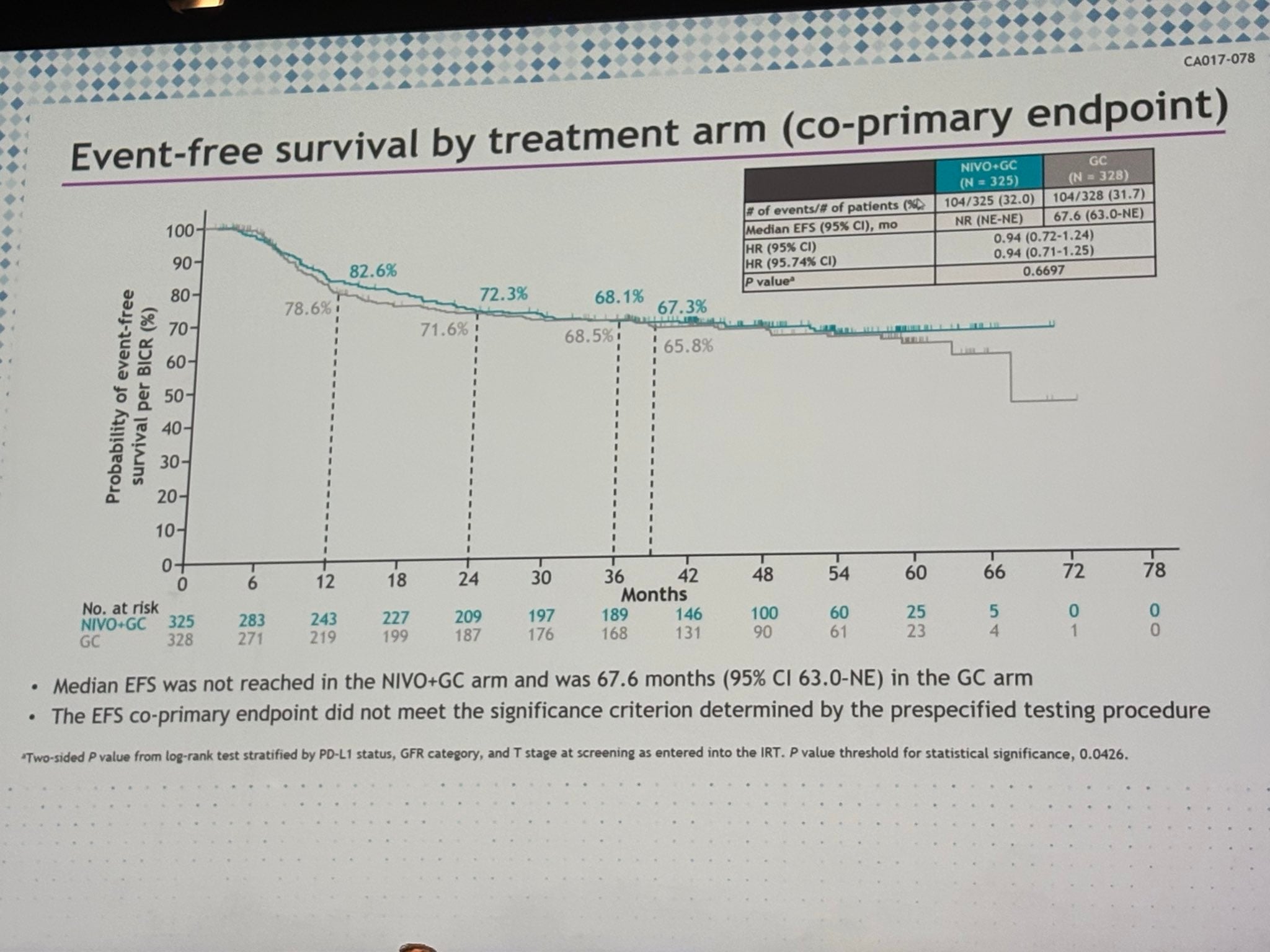
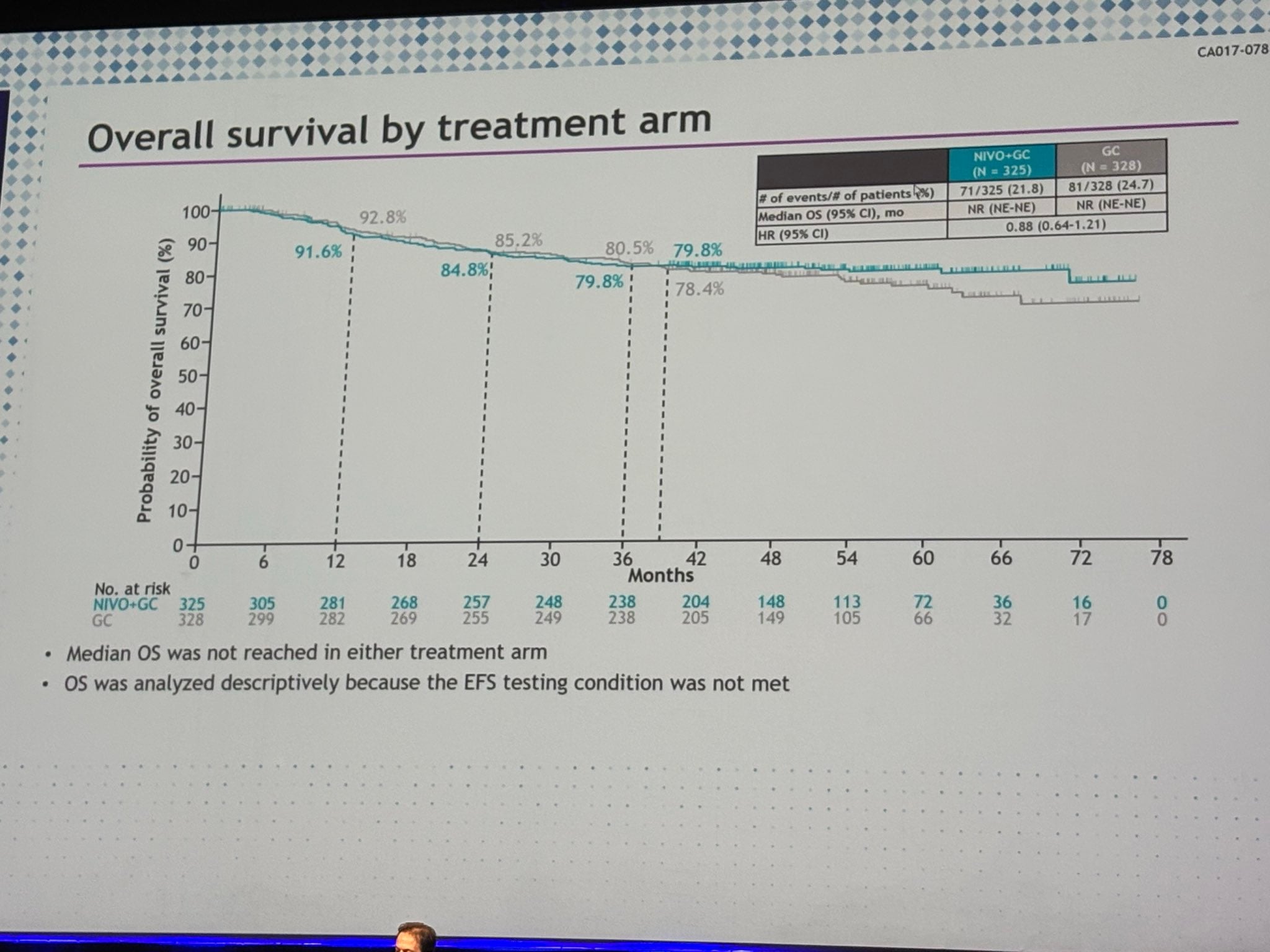
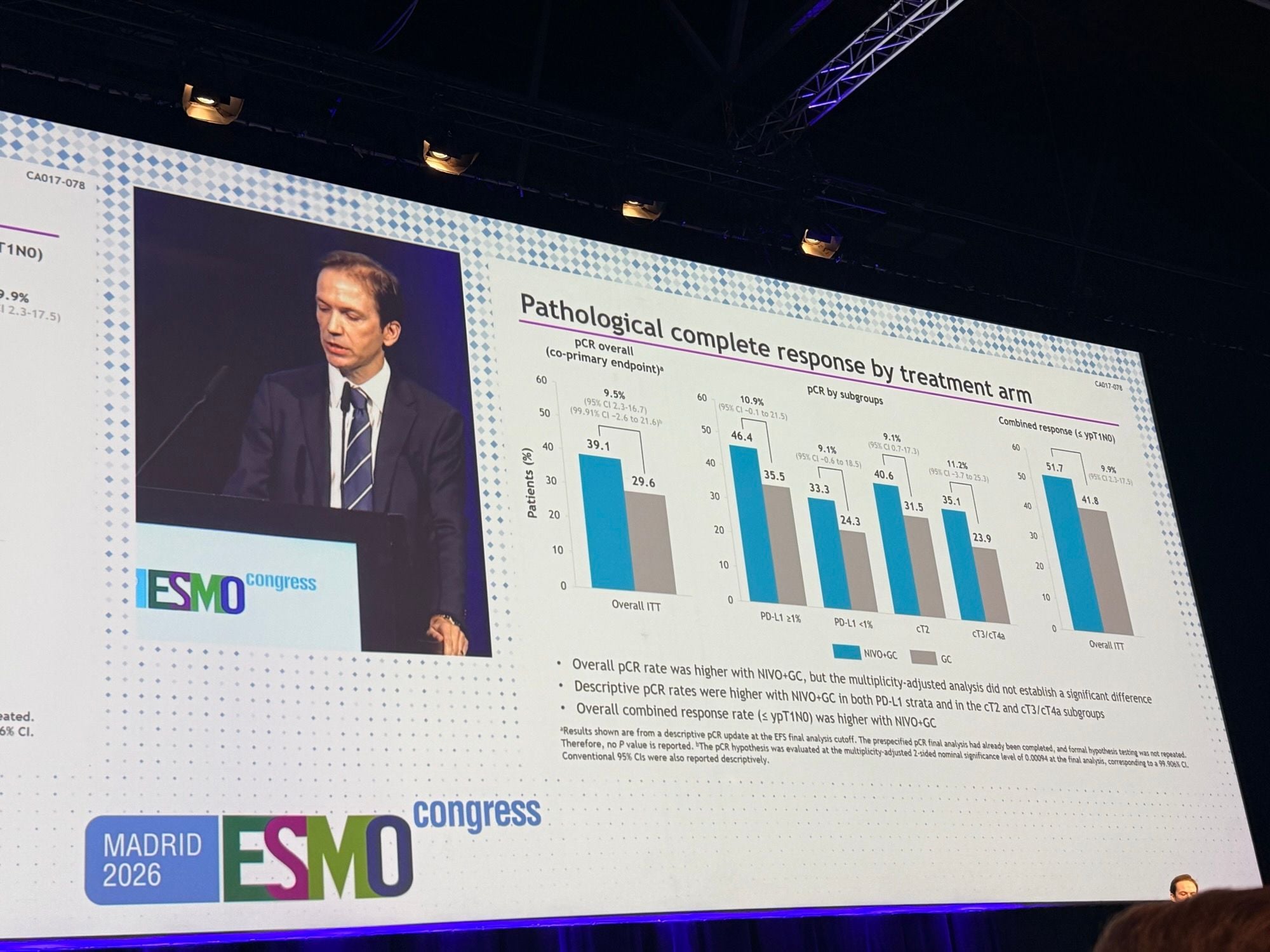

ENERGIZE: Another negative perioperative IO trial in MIBC. Nivo + GC → cystectomy → nivo failed to improve EFS (HR 0.94, p=0.67). OS HR 0.88. Notably, split-dose cisplatin was allowed and 77% had cT2 disease. Again, excellent outcomes in the control arm. #ESMO26 @OncoAlert https://t.co/9g4zjz7Nq7
— David H Aggen, MD PhD (@Dr_Aggen) · View post on X ↗
@AndreaNecchi with phase 3 #ENERGIZE trial results — cis gem nivo vs cis gem in muscle invasive #bladdercancer. 10% path CR rate diff but no diff on EFS or OS. ctDNA (+) at baseline has poor prognosis. @oncoalert #ESMO26 @myESMO https://t.co/HTP7Fwmx6p
— Tian Zhang, MD, MHS, FASCO (@tiansterzhangmd.bsky) (@TiansterZhang) · View post on X ↗
KEYNOTE-866: perioperative pembrolizumab or placebo + neoadjuvant cis/gem
Presented by Jens Bedke, abstract 4735O, same session. NCT03924856. Concurrent publication in Annals of Oncology.
- Phase 3, double-blind. Pembrolizumab 200 mg or placebo Q3W ×4 with cisplatin 70 mg/m² + gemcitabine 1000 mg/m² → RC + PLND → pembrolizumab or placebo Q3W ×13. n=453 vs 454. Cisplatin-eligible (GFR ≥60 mL/min). (KEYNOTE-866 slide, ESMO 2026 4735O; data cutoff Jan 26, 2026)
- Primary endpoint: EFS by investigator assessment. Key secondary: OS and pCR (pT0N0) by central pathology review. (KEYNOTE-866 slide, ESMO 2026 4735O; data cutoff Jan 26, 2026)
- EFS: 157 (34.7%) vs 168 (37.0%) events. Median 74.1 months (72.4–NR) vs not reached (67.7–NR). HR 0.88 (95% CI 0.71–1.10), one-sided P=0.1366; not significant against a one-sided boundary of 0.0225. (KEYNOTE-866 slide, ESMO 2026 4735O; data cutoff Jan 26, 2026)
- OS: 135 (29.8%) vs 135 (29.7%) deaths; medians not reached; HR 1.00 (95% CI 0.79–1.27). Not formally tested. (KEYNOTE-866 slide, ESMO 2026 4735O; data cutoff Jan 26, 2026)
- pCR: 44.4% (95% CI 39.8–49.2) vs 35.8% (31.3–40.4); estimated difference 8.9% (95% CI 2.5–15.1). Not formally tested. (KEYNOTE-866 slide, ESMO 2026 4735O; data cutoff Jan 26, 2026)
- Immune-mediated AEs and infusion reactions: any grade 28.9% vs 9.4%; grade 3–5 8.9% vs 1.8%. (KEYNOTE-866 slide, ESMO 2026 4735O; data cutoff Jan 26, 2026)
- cT2N0 at baseline: 14.8% vs 14.5%. Any subsequent therapy: 18.8% vs 23.8%. (KEYNOTE-866 slide, ESMO 2026 4735O; data cutoff Jan 26, 2026)
- Conclusions slide: perioperative pembrolizumab plus neoadjuvant cisplatin-based chemotherapy is not supported for participants with MIBC; perioperative enfortumab vedotin plus pembrolizumab has become a standard of care in this setting. (KEYNOTE-866 slide, ESMO 2026 4735O; data cutoff Jan 26, 2026)
- Median follow-up was not disclosed in the materials reviewed.
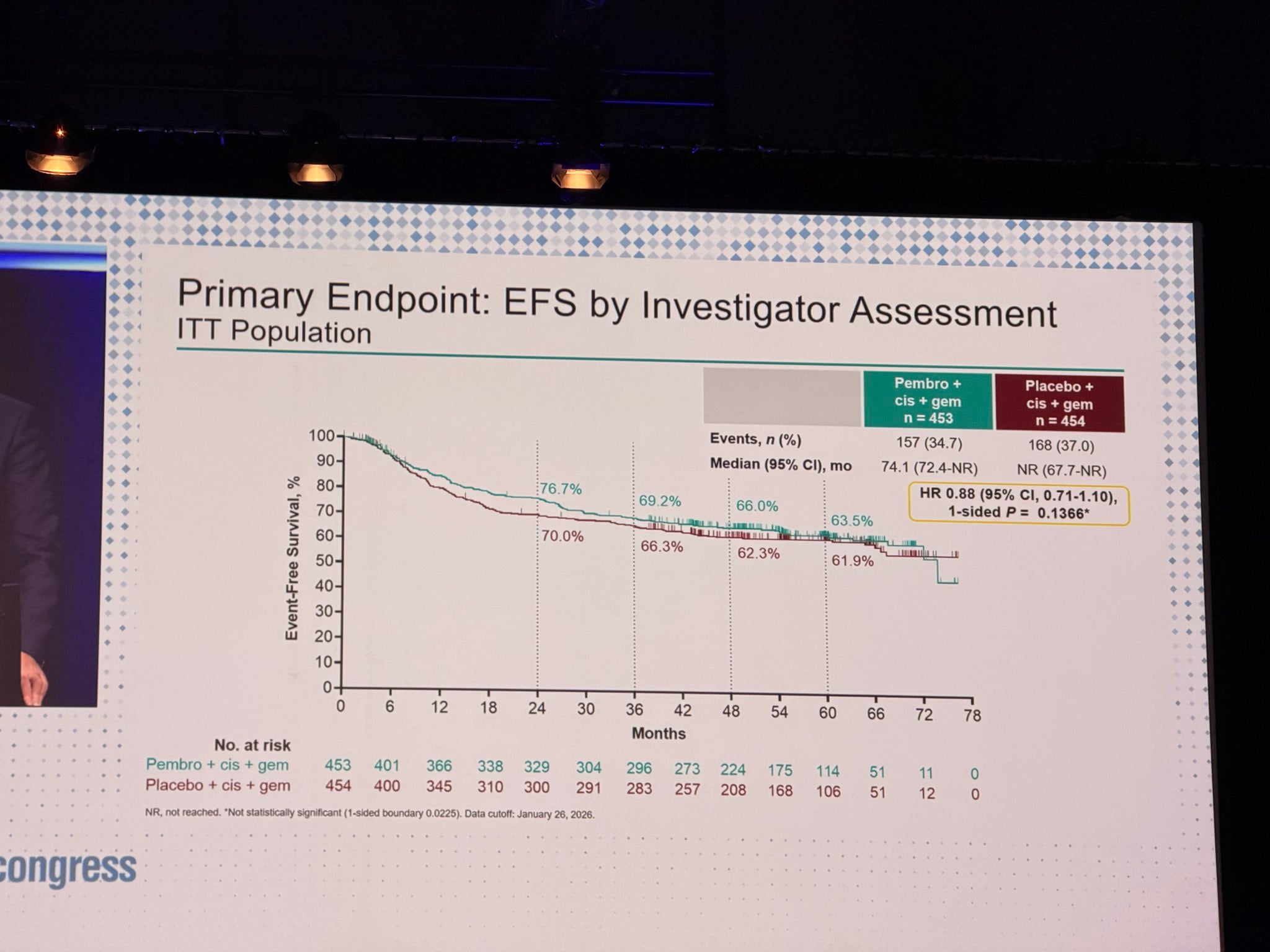
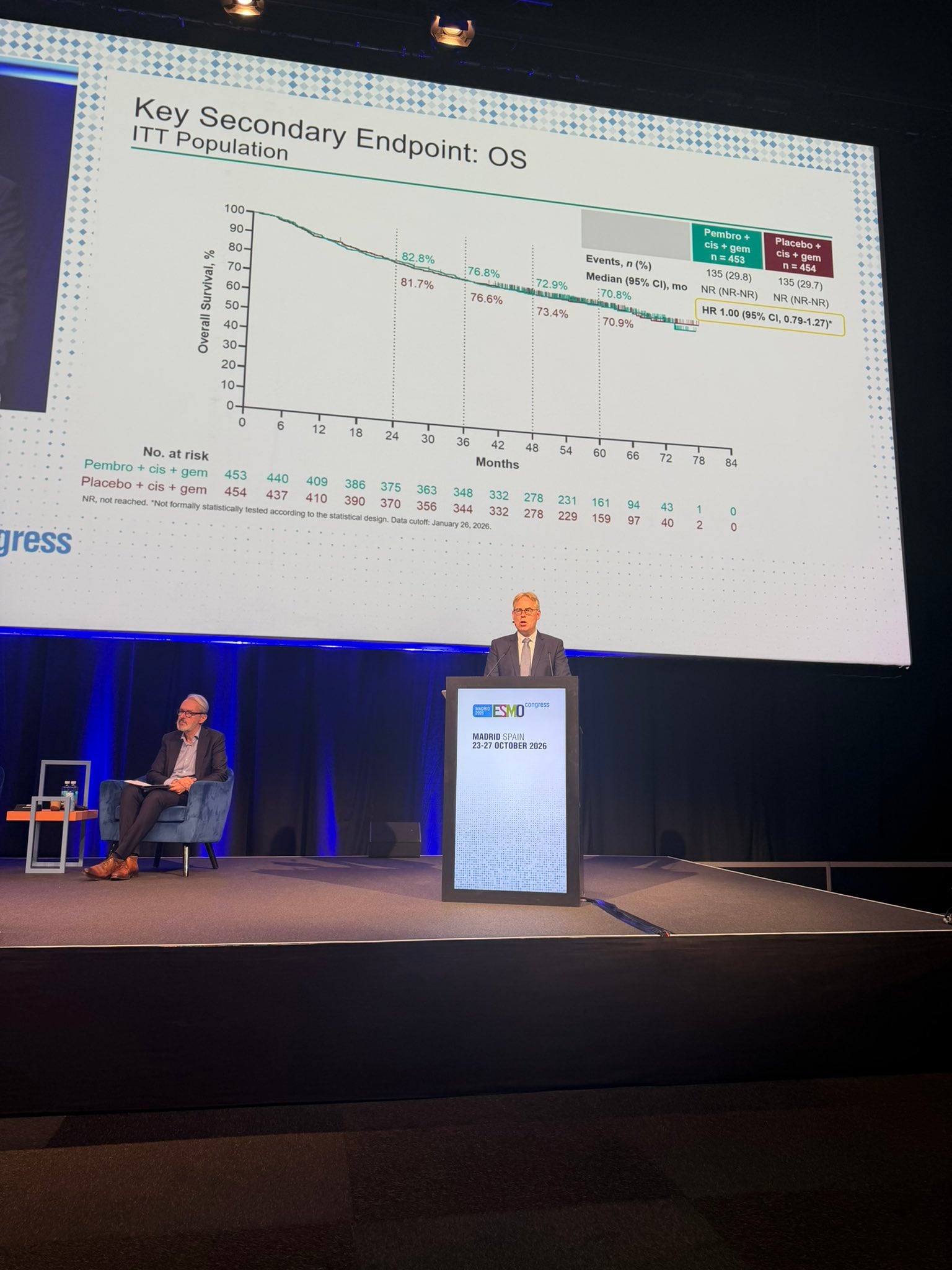
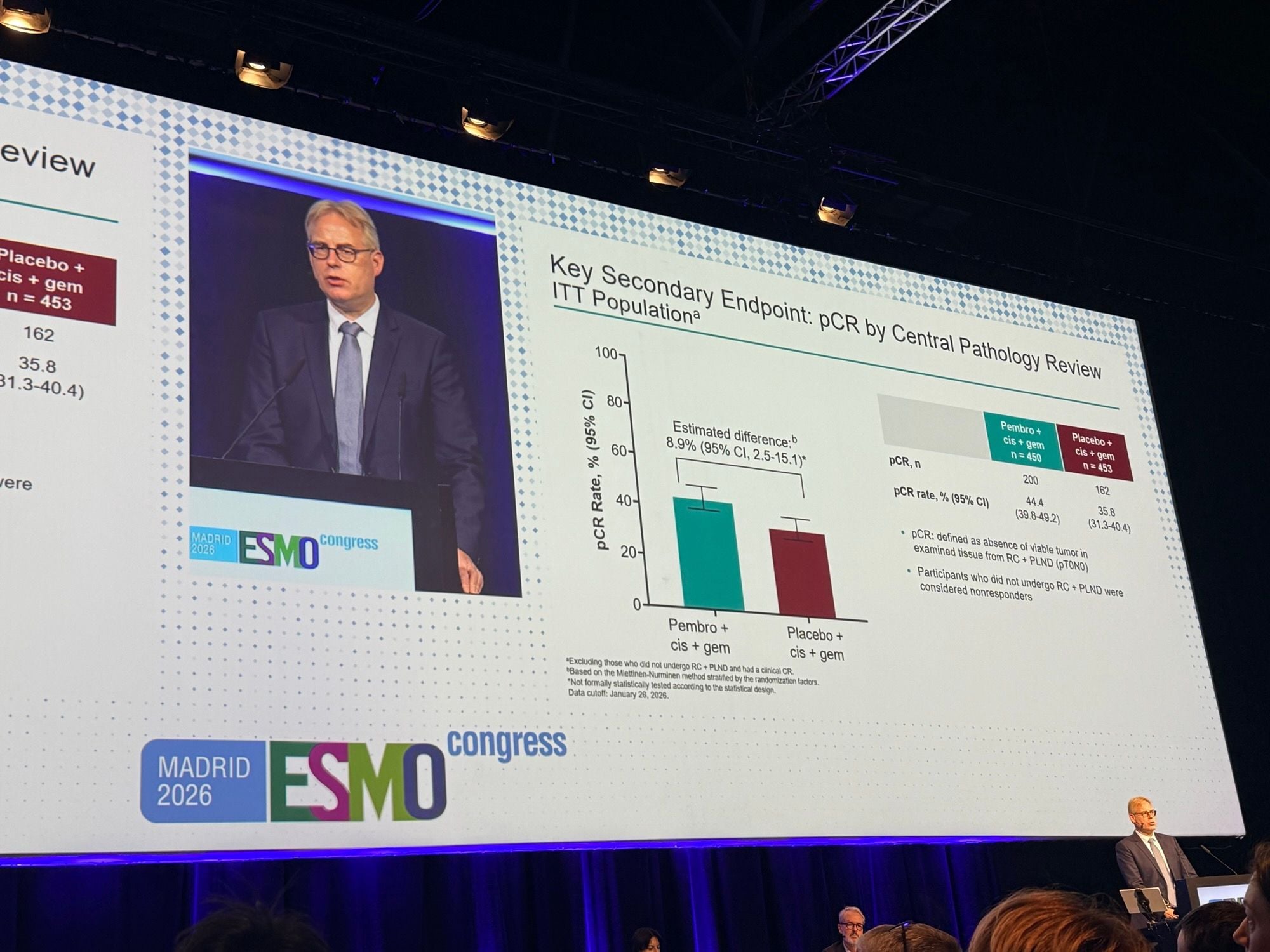


KEYNOTE-866 did not show EFS not OS. Great presentation 👏🏼by Prof Jens Bedke #ESMO26 @OncoAlert @Uromigos @urotoday @Uroweb @DGUrologie @high5md https://t.co/h2WiciZeJF
— Axel S. Merseburger (@amerseburger) · View post on X ↗
KEYNOTE-866: No significant EFS benefit with perioperative pembro + gem/cis (HR 0.88, p=0.14) and no OS signal (HR 1.00). Why did the control arm perform so well? More cT2 disease? No split-dose cisplatin? Important differences vs NIAGARA. #ESMO26 @OncoAlert https://t.co/GWIiavQV7j
— David H Aggen, MD PhD (@Dr_Aggen) · View post on X ↗
The NIAGARA contrast
NIAGARA randomized 1,063 cisplatin-eligible MIBC patients to neoadjuvant durvalumab + GC, cystectomy and adjuvant durvalumab vs neoadjuvant GC alone. 2-year EFS 67.8% vs 59.8%, HR 0.68 (95% CI 0.56–0.82). OS HR 0.75 (95% CI 0.59–0.93, P=0.0106). pCR 37.3% vs 27.5%. (KOL Pulse NIAGARA page; ESMO 2024 / NEJM) The FDA approved durvalumab (Imfinzi) with gemcitabine/cisplatin, then adjuvant durvalumab, for adults with MIBC on March 28, 2025. (KOL Pulse NIAGARA page; FDA)
| Trial | Regimen (all cisplatin-eligible MIBC) | EFS HR | OS HR | pCR | Source |
|---|---|---|---|---|---|
| ENERGIZE (n=653) | Nivolumab + GC → RC → adjuvant nivolumab vs GC → RC | 0.94 (95% CI 0.72–1.24) | 0.88 (95% CI 0.64–1.21), descriptive | 39.1% vs 29.6% | ESMO 2026 slides, 4736O |
| KEYNOTE-866 (n=907) | Pembrolizumab + cis/gem → RC → adjuvant pembrolizumab vs placebo | 0.88 (95% CI 0.71–1.10) | 1.00 (95% CI 0.79–1.27), not formally tested | 44.4% vs 35.8% | ESMO 2026 slides, 4735O; DCO Jan 26, 2026 |
| NIAGARA (n=1,063) | Durvalumab + GC → RC → adjuvant durvalumab vs GC → RC | 0.68 (95% CI 0.56–0.82) | 0.75 (95% CI 0.59–0.93), P=0.0106 | 37.3% vs 27.5% | KOL Pulse NIAGARA page; ESMO 2024 / NEJM |
Cross-trial comparison. Populations, control arms, endpoint definitions (EFS per BICR in ENERGIZE, by investigator in KEYNOTE-866) and follow-up differ; these are not head-to-head results.
The physician debate

@tompowles1 @OncoAlert Durvalumab plus cisplatin showed positive results, while the pembrolizumab and nivolumab trials were negative. I’m not sure how to make sense of this puzzle.
— deniztural (@drdeniztural) · View post on X ↗
A positive trial is not a class effect. A negative trial is not a class verdict. NIAGARA vs KEYNOTE-866/ENERGIZE: the regimen matters. Which patients truly benefit? @myESMO @OncoAlert @OpenMedicineHQ #ESMO26 https://t.co/1dghmBLUER
— Yüksel Ürün (@DrYukselUrun) · View post on X ↗
#ESMO2026 🚨 Three phase III trials with perioperative chemoimmunotherapy. Different outcomes in MIBC. NIAGARA: durvalumab + GC → EFS HR 0.68, OS HR 0.75 ✅ KEYNOTE-866: pembrolizumab + GC → EFS HR 0.88, OS HR 1.00 CA017-078: nivolumab + GC → EFS HR 0.94 Interestingly, all three showed numerically higher pCR rates, but only NIAGARA demonstrated statistically significant survival benefits in the reported analyses. Why? Differences in trial populations, treatment schedules, statistical design—or tumor biology? These are cross-trial observations, not head-to-head comparisons. We should resist attributing the differences simply to PD-1 versus PD-L1 inhibition. The key challenge: identifying which MIBC patients truly benefit from adding immunotherapy to chemotherapy. We urgently need predictive biomarkers and molecularly informed perioperative treatment selection. 🔬 @OncoAlert Faculty @DrChoueiri , @tompowles1 , @apolo_andrea , @neerajaiims , @montypal , @Silke_Gillessen , @AOmlin , @brian_rini , @PGrivasMDPhD , @TiansterZhang , @amerseburger , @DrDanielHeng , @HHammersMD , @scocmem , @AndreaNecchi , @AmandaNizamMD , @drenriquegrande , @nataliagandur , @AlbigesL , @cdanicas , @declangmurphy , @seanmmcbride , @shilpaonc , @DrRanaMcKay , @scserendipity1 , @DrYukselUrun , @ravikanesvaran , @BraunMDPhD , @EfstathiouEleni , @mzugman , @crisbergerot @Markuseckstein3
— Niklas Klümper (@niklas_kluemper) · View post on X ↗
5 phase III perioperative MIBC trials, with differing results. EV-303, EV-304 and NIAGARA improved EFS/OS, while ENERGIZE and KEYNOTE-866 did not meet their EFS endpoints. Important differences in patient populations, regimens and trial design. Cross-trial comparisons require caution. #ESMO26 @OncoAlert
— David H Aggen, MD PhD (@Dr_Aggen) · View post on X ↗
Two periop cis gem based phase 3 trials, adding a PD-1 to neoadjuvant cis-gem in MIBC did not improve EFS. 📉 KEYNOTE-866 pembro: EFS HR 0.88, OS HR 1.00 📉 CA017-078 nivo: EFS HR 0.94, pCR 39.1% vs 29.6% missed sig 🔍 Both continued the PD-1 after cystectomy, 13 cycles of pembro and 9 of nivo ctDNA was prognostic in but did not enrich for who benefited #ESMO26 #BladderCancer #MIBC #GUonc
— Katy Beckermann (@katy_beckermann) · View post on X ↗
🚨⭐🟠 #ESMO26 GU Oncology Invited Discussion 🎤 Prof. Robert Jones 🇬🇧 @OncoAlert 🔬 Why did NIAGARA succeed while KEYNOTE-866 and ENERGIZE failed to meet their primary efficacy endpoints? 📊 EFS HR: ✅ NIAGARA: 0.68 ❌ KEYNOTE-866: 0.88 ❌ ENERGIZE: 0.94 🧩 Different populations, baseline risks, eligibility criteria and trial designs complicate comparisons. ⭐ MY POINT OF VIEW Different outcomes across trials do not establish superiority of PD-L1 over PD-1 blockade. 💡 In curative-intent MIBC, patient selection, endpoint definitions and absolute clinical benefit matter as much as the HR. Cross-trial comparisons generate hypotheses, not definitive conclusions. 🌍 GU Oncology Community @gbanna74 @ravikanesvaran @urologysummit @tompowles1 @PGrivasMDPhD @apolo_andrea @sonpavde @AndreaNecchi @drenriquegrande @DrYukselUrun @yekeduz_emre @cdanicas @ecancer @UrologyTimes @urotoday @wearemedsir @OpenMedicineHQ @UCSFCancer #BladderCancer #UrothelialCancer #GUOncology #ADC #ClinicalTrials
— Dra. María Natalia Gandur Quiroga (@nataliagandur) · View post on X ↗
KEYNOTE-866: Negative for EFS. ENERGIZE: Negative for EFS. → What made the difference between these trials and NIAGARA? #ESMO26 https://t.co/vqu0TprzZx
— Kohji Takemura, MD (@KohjiToncol) · View post on X ↗
Where EV + pembrolizumab fits
KEYNOTE-905 / EV-303 (cisplatin-ineligible or cisplatin-declining MIBC, n=344): perioperative enfortumab vedotin + pembrolizumab vs surgery alone. 2-year EFS 74.7% vs 39.4%, HR 0.40 (95% CI 0.28–0.57). OS HR 0.50 (95% CI 0.33–0.74). pCR 57.1% vs 8.6%. FDA approved November 21, 2025. (KOL Pulse KEYNOTE-905 page; NEJM / FDA, data cutoff Jun 6, 2025)
KEYNOTE-B15 / EV-304 (cisplatin-eligible MIBC): perioperative EV + pembrolizumab vs gemcitabine/cisplatin. EFS HR 0.53 (95% CI 0.41–0.70); 24-month EFS 79.4% vs 66.2%. OS HR 0.65 (95% CI 0.48–0.89). pCR 55.8% vs 32.5%. FDA approved July 10, 2026 for radical-cystectomy candidates regardless of cisplatin eligibility. (KOL Pulse KEYNOTE-B15 page)
The KN905 MIBC trial includes a 3rd, less celebrated arm of single agent pembro. Results show pembro delivers an important contribution to the EVP. The trial is small and EVP performs better, but pCR rates for pembro of 35% are in the same range as neoadjuvant cisplatin chemo while EFS/OS HRs of 0.71/O.76 vs surgery are impressive. Pembro had about half the toxicity of EVP, underlining the relevance of therapy duration. VOLGA (3 cycles of EVD), is a half way between Pembro alone and 9 cycles of EVP. @Annals_Oncology #ESMO26 @Annals_Oncology @OncoAlert
— Tom Powles (@tompowles1) · View post on X ↗
ctDNA analysis from the EVP vs chemotherapy muscle invasive bladder cancer trial (B15/EV304) shows ctDNA is strongly prognostic at all time points for both arms. EVP has higher clearance rates across time points, underlining its ⬆️ activity. Results for the control arm are strikingly similar to the ctDNA results in the chemo control arm in the NIAGARA trial. This consistency underlines the utility of ctDNA from a prognostic perspective.#ESMO26 @OncoAlert
— Tom Powles (@tompowles1) · View post on X ↗
Interesting ctDNA analysis from #EV304/B15 trial — ctDNA (+) groups w poor prognosis but EV-pembro works regardless of ctDNA status @myESMO #ESMO26 @oncoalert https://t.co/CoJhNDucjN
— Tian Zhang, MD, MHS, FASCO (@tiansterzhangmd.bsky) (@TiansterZhang) · View post on X ↗
🚨 Important new ctDNA data from KEYNOTE-B15 at ESMO 2026! In cisplatin-eligible MIBC, EV+pembrolizumab achieved: 🔹 82.1% ctDNA clearance during neoadjuvant treatment vs 66.7% with gemcitabine/cisplatin. 🔹 87.0% ctDNA negativity before surgery vs 80.3% with chemotherapy. 🔹 95.2% ctDNA negativity after cystectomy vs 86.5% with chemotherapy. Strikingly, only 4.8% remained ctDNA-positive after neoadjuvant EV+pembrolizumab and surgery! We know from IMvigor011 that postoperative ctDNA can identify patients at high risk of recurrence and help guide adjuvant treatment strategies. But what about patients achieving both pCR and sustained ctDNA negativity? Do they really need another 5–6 cycles of adjuvant EV, with the potential for cumulative tox/ neuropathy? Could pCR + ctDNA clearance, followed by longitudinal ctDNA monitoring, define a population suitable for treatment de-escalation? VOLGA will add another important piece to this puzzle, using only 3 neoadjuvant EV cycles without adjuvant EV. Of course, neither KEYNOTE-B15 nor VOLGA can establish the necessity of adjuvant EV through cross-trial comparisons. We urgently need prospective, biomarker-guided de-escalation trials—not simply more treatment for everyone. @OncoAlert Faculty @DrChoueiri , @tompowles1 , @apolo_andrea , @neerajaiims , @montypal , @Silke_Gillessen , @AOmlin , @brian_rini , @PGrivasMDPhD , @TiansterZhang , @amerseburger , @DrDanielHeng , @HHammersMD , @scocmem , @AndreaNecchi , @AmandaNizamMD , @drenriquegrande , @nataliagandur , @AlbigesL , @cdanicas , @declangmurphy , @seanmmcbride , @shilpaonc , @DrRanaMcKay , @scserendipity1 , @DrYukselUrun , @ravikanesvaran , @BraunMDPhD , @EfstathiouEleni , @mzugman , @crisbergerot @Markuseckstein3
— Niklas Klümper (@niklas_kluemper) · View post on X ↗
Excellent presentation by Jens presenting results from KN866 trial that did not meet its primary endpoint in contrast with NIAGARA. Peri-op EV-pembro is the SOC in MIBC, awaiting VOLGA trial tomorrow! @myESMO #ESMO26 #ESMOAmbassadors @OncoAlert @Uromigos @shilpaonc @AndreaNecchi https://t.co/pDpZgq4etv https://t.co/dB1E6AlrWF
— Petros Grivas (@PGrivasMDPhD) · View post on X ↗
As discussed at #ESMO26, data on EV+P in bladder cancer with variant histology remain limited. Together with Emory and Dr. Jacqueline Brown, we’re studying EV+P in tumors with aberrant histologic features including with squamous, plasmacytoid, and glandular features. MSK PI: Dr. Sam Funt. @OncoAlert More info here: https://t.co/vTO2h1aF9u https://t.co/EdeZIrTonS #bladdercancer #esmo2026
— David H Aggen, MD PhD (@Dr_Aggen) · View post on X ↗
FAQ
Did ENERGIZE meet its primary endpoints?
No. Neither co-primary endpoint was met. EFS HR 0.94 (95% CI 0.72–1.24), P=0.6697. pCR 39.1% vs 29.6% did not reach significance in the multiplicity-adjusted analysis. OS HR 0.88 (95% CI 0.64–1.21) was analyzed descriptively. (ENERGIZE slides, ESMO 2026 4736O)
Did KEYNOTE-866 improve event-free or overall survival?
No. EFS HR 0.88 (95% CI 0.71–1.10), one-sided P=0.1366. OS HR 1.00 (95% CI 0.79–1.27), not formally tested. pCR was 44.4% vs 35.8%, not formally tested. (KEYNOTE-866 slides, ESMO 2026 4735O; data cutoff January 26, 2026)
How do these results compare with NIAGARA?
NIAGARA added perioperative durvalumab to neoadjuvant gemcitabine/cisplatin and met EFS (HR 0.68, 95% CI 0.56–0.82) and OS (HR 0.75, 95% CI 0.59–0.93). Durvalumab with gem/cis is FDA approved for MIBC (March 28, 2025). The three trials differ in population, control arm and endpoint definitions and were not compared head to head.
Is perioperative pembrolizumab or nivolumab with gem/cis approved for MIBC?
No. Both regimens are investigational in this setting. The perioperative regimens approved by the FDA in MIBC include durvalumab + gem/cis (NIAGARA) and enfortumab vedotin + pembrolizumab (KEYNOTE-905/EV-303 and KEYNOTE-B15/EV-304).
KOL Pulse tracks what verified oncology and hematology physicians are discussing on X. Every physician post quoted here is verbatim and links to its source. Physicians quoted: Tom Powles, Shilpa Gupta, Karine Tawagi, Toni Choueiri, Axel S. Merseburger, David H Aggen, Tian Zhang, Deniz Tural, Yüksel Ürün, Niklas Klümper, Katy Beckermann, María Natalia Gandur Quiroga, Kohji Takemura and Petros Grivas.