10 min read
The INTerpath-001 Leak: An Embargo Break, a 25% Drop, and What Oncologists Said

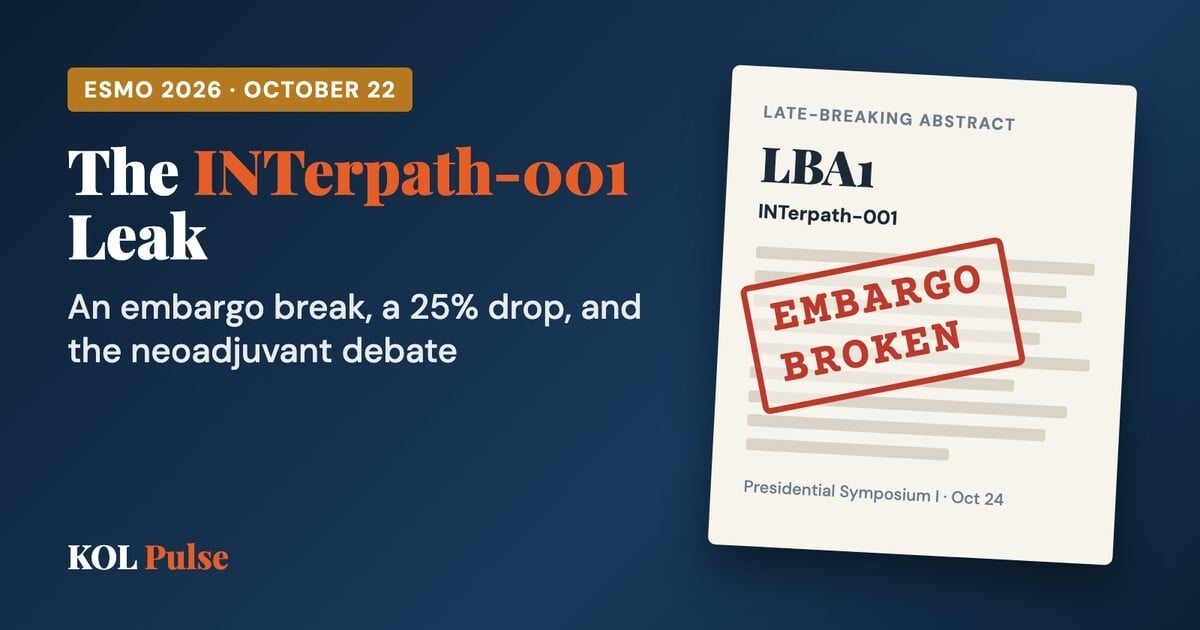
Two days before ESMO’s first late-breaking abstract was due on stage, its numbers appeared on a medical news site and came down. Moderna stock fell 25%. By mid-afternoon ESMO had lifted the embargo and posted the abstract: recurrence-free survival HR 0.58.
INTerpath-001 tests intismeran autogene, Moderna and Merck’s individualized mRNA neoantigen therapy, plus pembrolizumab (KEYTRUDA) against pembrolizumab alone after surgery for stage IIB–IV melanoma. In August the companies said it met its primary endpoint, recurrence-free survival (RFS), and its key secondary endpoint, distant metastasis-free survival (DMFS). They gave no numbers. The numbers were scheduled for LBA1, the opening talk of ESMO 2026’s Presidential Symposium, on Saturday, October 24.
October 22, hour by hour
| Time (ET) | What happened |
|---|---|
| Before 12:22 PM | Results appear on Oncology Central and are taken down shortly afterward. Investing.com put it “around 12:30 p.m. ET.” |
| 12:22 PM | An investor posts the article link and a screenshot of it (below). |
| 12:41 PM | STAT’s Adam Feuerstein posts that he remains under the ESMO embargo. |
| Mid-session | Moderna shares are halted for volatility (Investing.com). |
| 1:48 PM | An investor posts that the Oncology Central data had “disappeared.” |
| 2:11 PM | ESMO says the LBA1 embargo “has been breached” and lifts it on the full dataset. |
| After 2:11 PM | The LBA1 abstract appears on ESMO’s congress site (ESMO 2026 programme). |
| From 2:12 PM | The Wall Street Journal, Forbes, MarketWatch and Seeking Alpha run the story. |
| 2:59 PM | Merck and Moderna issue a joint press release with the full topline results. |
The first post we found, from a healthcare investor, with the Oncology Central article as it appeared:
$MRK $MRNA data amazing HR .58. So $MRK $MRNA data leaked to this website which is now down. HR is .58. https://t.co/s7h2PJ1I0O https://t.co/62P6HbSYgD
— pharmacreep (@pharmacreep) October 22, 2026
What the abstract says
INTerpath-001 is double-blind. Patients were randomized 2:1 to intismeran or placebo, both given with pembrolizumab. Of 1,137 patients randomized, 757 were assigned to intismeran plus pembrolizumab and 380 to placebo plus pembrolizumab. Median follow-up was 24.6 months at the June 30, 2026 data cutoff.
| Endpoint | Intismeran + pembrolizumab (N=757) | Placebo + pembrolizumab (N=380) |
|---|---|---|
| RFS, primary · 24-month rate | 82.2% (95% CI 79.3–84.8) | 70.0% (95% CI 65.0–74.5) |
| RFS · hazard ratio | 0.58 (95% CI 0.45–0.75); two-sided P<0.001 | |
| DMFS, secondary · 24-month rate | 88.5% (95% CI 86.0–90.6) | 80.2% (95% CI 75.6–84.0) |
| DMFS · hazard ratio | 0.62 (95% CI 0.45–0.85); two-sided P=0.002 | |
| Grade ≥3 adverse events | 23.6% | 20.3% |
| Stopped both drugs for an adverse event | 6.5% | 5.3% |
| Pyrexia · injection-site pain · fatigue | 52.2% · 51.0% · 38.5% | 8.2% · 9.5% · 29.7% |
ESMO 2026 abstract LBA1, data cutoff June 30, 2026. Overall survival is a secondary endpoint and is not reported in the abstract. Intismeran autogene is investigational.
The abstract says the benefit was similar in stage IIB–IIIB and stage IIIC–IV disease. The early reports were right on the headline figures: an HR of 0.58 is the “42%” reduction, and 82.2% vs 70.0% is the two-year RFS rate. The abstract’s DMFS hazard ratio is 0.62.
What the companies added at 2:59 PM
Merck and Moderna’s joint release repeated the abstract’s primary results and added analyses that were not in the abstract. All figures below are from the release.
| Analysis | RFS hazard ratio (95% CI) | DMFS hazard ratio (95% CI) |
|---|---|---|
| Primary, intention-to-treat | 0.58 (0.45–0.75); P<0.001 | 0.62 (0.45–0.85); P=0.002 |
| First six months | 0.99 (0.66–1.49) | 1.01 (0.58–1.79) |
| After six months (pre-specified sensitivity analysis) | 0.42 (0.30–0.58) | 0.50 (0.34–0.73) |
| Patients who received at least one dose as planned (pre-specified sensitivity analysis) | 0.51 (0.39–0.67) | 0.55 (0.40–0.77) |
The first six months cover the intismeran regimen of nine doses every three weeks. Over that period the hazard ratio was 0.99. The primary result remains the intention-to-treat HR of 0.58. The other rows are sensitivity analyses. The release also says:
- Overall survival “data are not yet mature, but a favorable trend in OS with intismeran plus KEYTRUDA has been observed.”
- Grade 3–5 treatment-related adverse events occurred in 14.2% versus 13.4%. The abstract’s 23.6% versus 20.3% counts grade ≥3 adverse events of any cause.
- The results “have been accepted for publication in The New England Journal of Medicine,” and the companies are “engaging with regulatory authorities.”
Merck and Moderna press release, October 22, 2026, 2:59 PM ET. Intismeran autogene is investigational.
Why HR 0.58 landed badly with investors. The comparison they reached for was the Phase 2b trial. In KEYNOTE-942, at a median five years of follow-up, intismeran plus pembrolizumab reduced “the risk of recurrence or death by 49% (HR=0.51; [95% CI, 0.294-0.887])” compared with pembrolizumab alone.
That was a different trial: open-label, 157 patients, resected stage IIIB–IV disease. INTerpath-001 is double-blind and placebo-controlled, enrolled 1,137 patients with stage IIB–IV disease, and reports at a median 24.6 months. The two numbers are not a like-for-like comparison.
Investors also pointed to distant metastasis. In KEYNOTE-942 at five years, the DMFS hazard ratio was 0.411 (95% CI 0.200–0.843). In INTerpath-001 it is 0.62 (95% CI 0.45–0.85). Dirk Haussecker, a biotech trader who had posted that he was short Moderna, made that case at 1:52 PM ET:
$mrna stock seems down on DMFS decay from phase 2, but phase 2 counts were quite small, so p2 RFS numbers more robust. https://t.co/HMrKSeUCP3
— Dirk Haussecker (@RNAiAnalyst) October 22, 2026
The table in the post is the author’s. The DMFS hazard ratios in our text are from the companies’ June 1, 2026 release and the ESMO abstract.
The neoadjuvant criticism. The second objection is the comparator. INTerpath-001 tested intismeran against pembrolizumab started after surgery. Two randomized trials in resectable, macroscopic melanoma showed longer event-free survival when immunotherapy started before surgery:
- SWOG S1801 (phase 2, stage IIIB–IVC, 313 patients): three doses of pembrolizumab before surgery and 15 after, versus 18 doses after surgery. Two-year event-free survival was 72% versus 49%, P=0.004.
- NADINA (phase 3, stage III, 423 patients): two cycles of ipilimumab plus nivolumab before surgery, versus adjuvant nivolumab. Twelve-month event-free survival was 83.7% versus 57.2%, HR 0.32 (99.9% CI 0.15–0.66).
Yakup Ergün raised this on October 19, before any numbers were out. Adam May, an investor, built his post around S1801 today. The overlap has limits. Both neoadjuvant trials enrolled patients with disease still in place before surgery. INTerpath-001 enrolled patients after resection, including stage IIB and IIC disease, which neither neoadjuvant trial included. Georgina Long, who presents LBA1 on Saturday, is the senior author of NADINA.
KEYNOTE-942: Moderna and Merck press release, June 1, 2026 (ASCO 2026); Weber et al., Lancet 2024. INTerpath-001: ESMO 2026 abstract LBA1. SWOG S1801: Patel et al., N Engl J Med 2023. NADINA: Blank et al., N Engl J Med 2024.The embargo
ESMO, at 2:11 PM ET:
#ESMO26: The embargo on LBA1, “INTerpath-001: Phase 3 study of the mRNA-based individualised neoantigen therapy intismeran autogene plus pembrolizumab versus pembrolizumab alone for adjuvant treatment of resected stage IIB-IV melanoma”, has been breached. As the data are now publicly available, ESMO has released the information contained in the abstract and has lifted the embargo on the full dataset.
— ESMO - Eur. Oncology (@myESMO) October 22, 2026
Ninety minutes earlier, STAT biotech reporter Adam Feuerstein had said he was holding the line:
Unless instructed otherwise, I remain under the ESMO embargo for the $MRNA $MRK intismeran data.
— Adam Feuerstein ✡️ (@adamfeuerstein) October 22, 2026
STAT’s published piece that day was a preview, “What to expect from the Moderna-Merck cancer vaccine data reveal.” Investing.com called the disclosure “an apparent embargo violation rather than a controlled presentation.” Merck declined to comment to Investing.com. Moderna declined to comment to 24/7 Wall St. Oncology Central had not explained the posting when this was written.
What oncologists said
On the day of the leak, very little. Through 2:30 PM ET, the posts we found came from traders and stock accounts, not practicing oncologists. At 3:21 PM ET, Yakup Ergün, a medical oncologist, quoted ESMO’s statement:
An embargo breach at a congress as prestigious as ESMO is unacceptable. If I remember correctly, something similar happened in 2023.
— Yakup Ergün (@dr_yakupergun) October 22, 2026
It is deeply troubling to feel that sharing scientific data is driven more by stock market movements than by patients and science…!!! https://t.co/5XyqF04mjh
Before the leak, oncologists had already said what they would judge the trial on: the size of the effect, and the comparator. Yakup Ergün flagged the missing comparison with neoadjuvant immunotherapy three days before the numbers came out.
Mustafa Özdoğan, MD, oncologist:
Five Phase 3 Trials to Watch at ESMO 2026
— Mustafa Özdoğan, MD (@ozdogan_md) October 19, 2026
Positive toplines are in for INTerpath-001, VOLGA, DeLLphi-305, KRAScendo 1 and SAFFRON. Madrid must now show the effect sizes: HRs, absolute survival gains and toxicity. That is where practice changing claims will be tested.
#ESMO26 #Oncology
Yakup Ergün, medical oncologist:
I’d applaud these trials, but I’d remain seated 😅😅
— Yakup Ergün (@dr_yakupergun) October 19, 2026
INTerpath-001 is an innovative treatment approach. However, there is no comparison with neoadjuvant nivo + ipi, a strong option particularly in macroscopic stage III melanoma.
DeLLphi-305 showed a survival benefit with maintenance tarlatamab + durvalumab. But the comparator is durvalumab monotherapy. We also have positive results from IMforte with maintenance atezo + lurbinectedin. So this is another potential maintenance option; its place among the existing options remains to be defined.
In HARMONi-GI1, even if not one but three trucks could fit between the Kaplan–Meier curves, global validation will still be expected because the trial was conducted exclusively in China 🫣
For me, VOLGA’s most interesting feature is the omission of adjuvant EV. As for the survival benefit of perioperative EV + immunotherapy, we already have strong data.
Mario Balsa, medical oncologist, melanoma:
🚨 Excited to join the #ESMO26 @OncoAlert PULSE Faculty for melanoma & early drug development!
— Mario Balsa (@MarioBalsaMD) October 15, 2026
💥 My 10 trials to watch (pic 👇🏼)
INTerpath-001 || MOIO || DeLLphi-305 || HARMONi-GI1 || KRASCENDO-1 || CLARITY-Gastric 01 || HERIZON-GEA-01 || NATALEE || SAFFRON/SANOVO || KEYNOTE-B49
And yes, the melanoma trial is #1. Entirely objective ranking, of course 😉
Madrid has a PULSE (an @OncoAlert one 🖤)
@myESMO @_SEOM @OncoReporte @GrupoMelanoma
One patient’s view, posted shortly before the leak:
@LizHighleyman Same, and for me it's personal. I have stage 4 lung cancer and I'm working on my own personalized mRNA vaccine, so INTerpath-001 is the best preview I've got of whether this approach holds up. Melanoma isn't lung, but I'll be watching Saturday!
— Kevin Wimer (@kevinace) October 22, 2026
https://t.co/UIBF31nhU9
The market
Brad Loncar, founder of BiotechTV, summed up the day at 3:11 PM ET:
Imagine if the score of the Super Bowl was leaked a few days before everybody got together for the game. This is biotech’s version of that. Crazy.
— Brad Loncar (@bradloncar) October 22, 2026
The stock had run from the August topline into this week. TradingKey wrote that investors “may be reassessing the optimistic expectations previously priced into the stock.” Citi’s Geoff Meacham kept a Sell rating with an $80 target. TD Cowen raised its target to $90 from $40 and kept a Hold (Investing.com).
The sharpest market argument came from Adam May, a biotech investor who says on X he often tweets about companies he has positions in. His point was the neoadjuvant comparator described above:
$MRNA with the single most hilarious possible outcome in this study. EFS HR 0.58. Down the the hundredth, EXACTLY what *NEO*-adjuvant treatment with pembro yielded against adjuvant pembro (the nerfed comparator $MRNA studied against) in SWOG S1801.
— Adam May (@A_May_MD) October 22, 2026
What does this mean in English? $MRNA’s drug is showing the exact same benefit versus adjuvant pembrolizumab as NEOadjuvant pembrolizumab did.
Even more simply? If you just give patients a few doses of the pembrolizumab BEFORE you cut their cancer out, you do what $MRNA does for you, except with just the free tumor that’s already inside your body. No need to pay for this $400K drug.
And this makes rational sense, right? The whole point of $MRNA’s vaccine is to produce stuff that looks like the tumor.
You know what looks A LOT like the tumor does? THE FREAKING TUMOR!!!!!!
Absolutely poetic that $MRNA produced the EXACT HR benefit as neoadjuvant pembro did. Truly, the most hilarious possible outcome.
Now can we move on from this bullshit? $MRK and $MRNA should feel free to study their vaccine against the REAL standard of care now - NEOadjuvant immunotherapy.
From my perspective, this has been total fugaze, and an amateurish pump and dump worthy of much lesser enterprises.
Investor accounts had framed the day before it started. Dirk Haussecker, a biotech trader who had posted that he was short Moderna, that morning:
$mrna so $450 if results come in slightly worse than phase 2, $150 downside if HR 0.8 or less.
— Dirk Haussecker (@RNAiAnalyst) October 22, 2026
Nicely framed by the ANALysts. Monday should be a volatile day for biotech.
Extra points: which stocks are most exposed if specialist funds that are sig short $MRNA blow up on Monday?
Media coverage
- Moderna, Merck Shares Fall After Possible Melanoma Data Leak · Bloomberg
- Moderna shares plunged after details from a closely guarded mRNA-based cancer vaccine study were shared on social media · The Wall Street Journal
- Moderna Stock Plunges 25% After Possible Cancer Vaccine Data Leak · Forbes
- Moderna’s stock tumbles after reported leak of data for cancer vaccine · MarketWatch
- Moderna shares plunge on leaked cancer vaccine data · Seeking Alpha, Jonathan Block
- Moderna shares plunge on apparent cancer vaccine data leak · Investing.com, Vlad Schepkov
- Why is Moderna stock plunging today? · Investing.com
- Moderna Tumbles 25% After Apparent Early Leak of Melanoma Vaccine Data · 24/7 Wall St., David Moadel
- Moderna Plunges 25% Intraday Ahead of Full Phase 3 Melanoma Vaccine Data · TradingKey, Andy Chen
- What to expect from the Moderna-Merck cancer vaccine data reveal · STAT+, Adam Feuerstein (preview, published before the leak)
What to watch on Saturday
Georgina V. Long presents LBA1 at 4:30 PM CEST (10:30 AM ET). Inge Marie Svane is the invited discussant. Moderna’s investor webcast follows at 1:00 PM ET. The hazard ratio is now known. What the abstract does not answer:
- Overall survival, which the abstract does not report.
- The subgroup forest plot behind “benefit was similar.”
- Where it fits next to neoadjuvant immunotherapy for macroscopic stage III disease, and what the discussant says about it.
- The cost and manufacturing logistics of an individualized therapy made for each patient.
Physician posts, slides and the sentiment table update on the INTerpath-001 trial profile, with ESMO coverage on the ESMO 2026 conference page.
Sources: ESMO 2026 abstract LBA1, INTerpath-001, Long GV et al., data cutoff June 30, 2026 · Merck and Moderna press release, October 22, 2026 · ESMO statement on X, October 22, 2026 · Investing.com leak report, Moderna and Merck market reports, October 22 · Seeking Alpha, October 22 · 24/7 Wall St., October 22 · TradingKey, October 22 · Moderna ESMO late-breaker announcement, September 21, 2026 · Merck and Moderna INTerpath-001 topline, August 19, 2026, and KEYNOTE-942 five-year data, June 1, 2026 · Patel SP et al., N Engl J Med 2023;388:813-823 (SWOG S1801) · Blank CU et al., N Engl J Med 2024;391:1696-1708 (NADINA) · Weber JS et al., Lancet 2024;403:632-644 (KEYNOTE-942). Posts quoted verbatim from X. Times are US Eastern. Trial figures are from the ESMO abstract and the Merck and Moderna press release of October 22, 2026, 2:59 PM ET.
Brian Shields, Founder, KOL Pulse. October 22, 2026.