SANO Key Takeaways
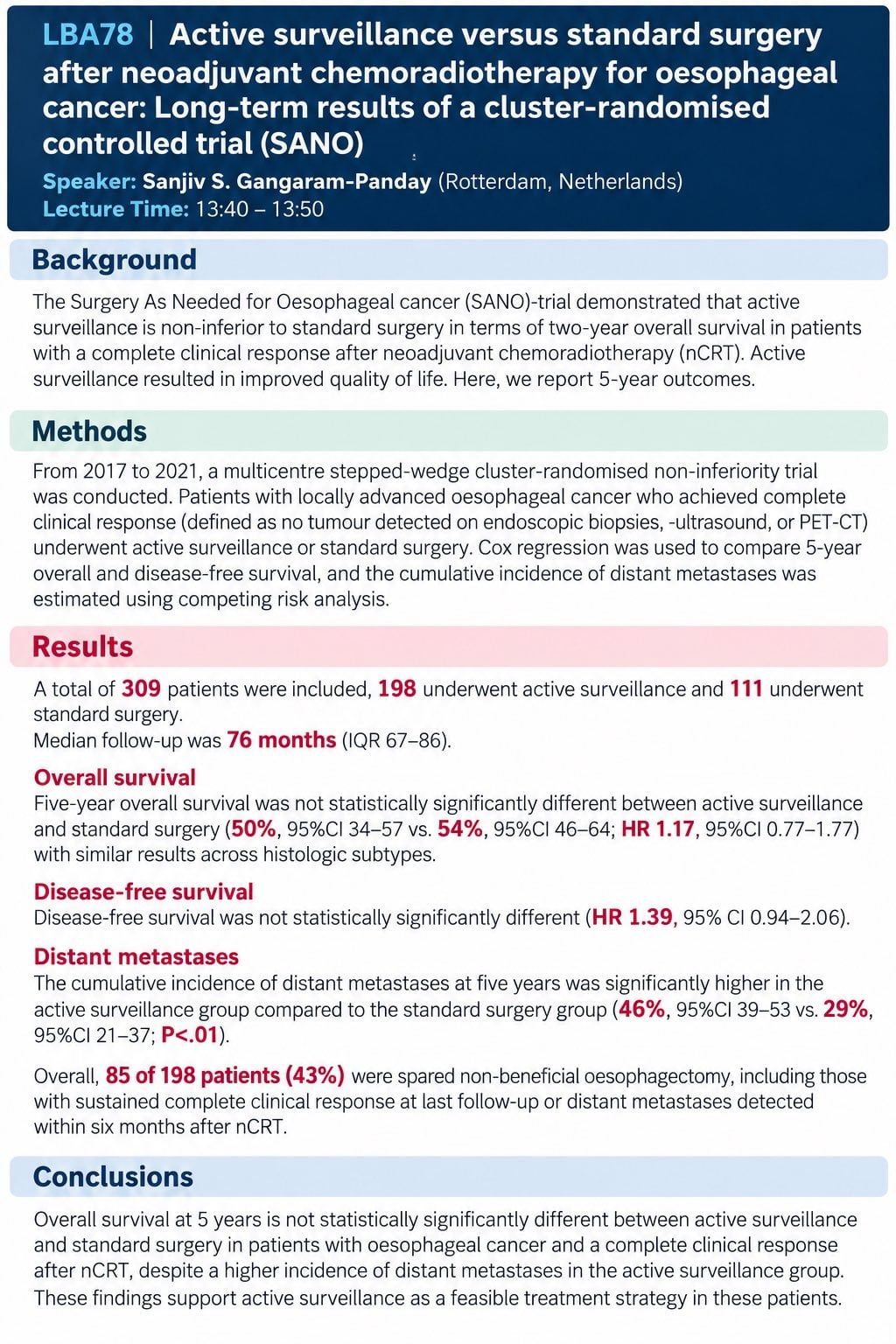
5-year overall survival: no significant difference
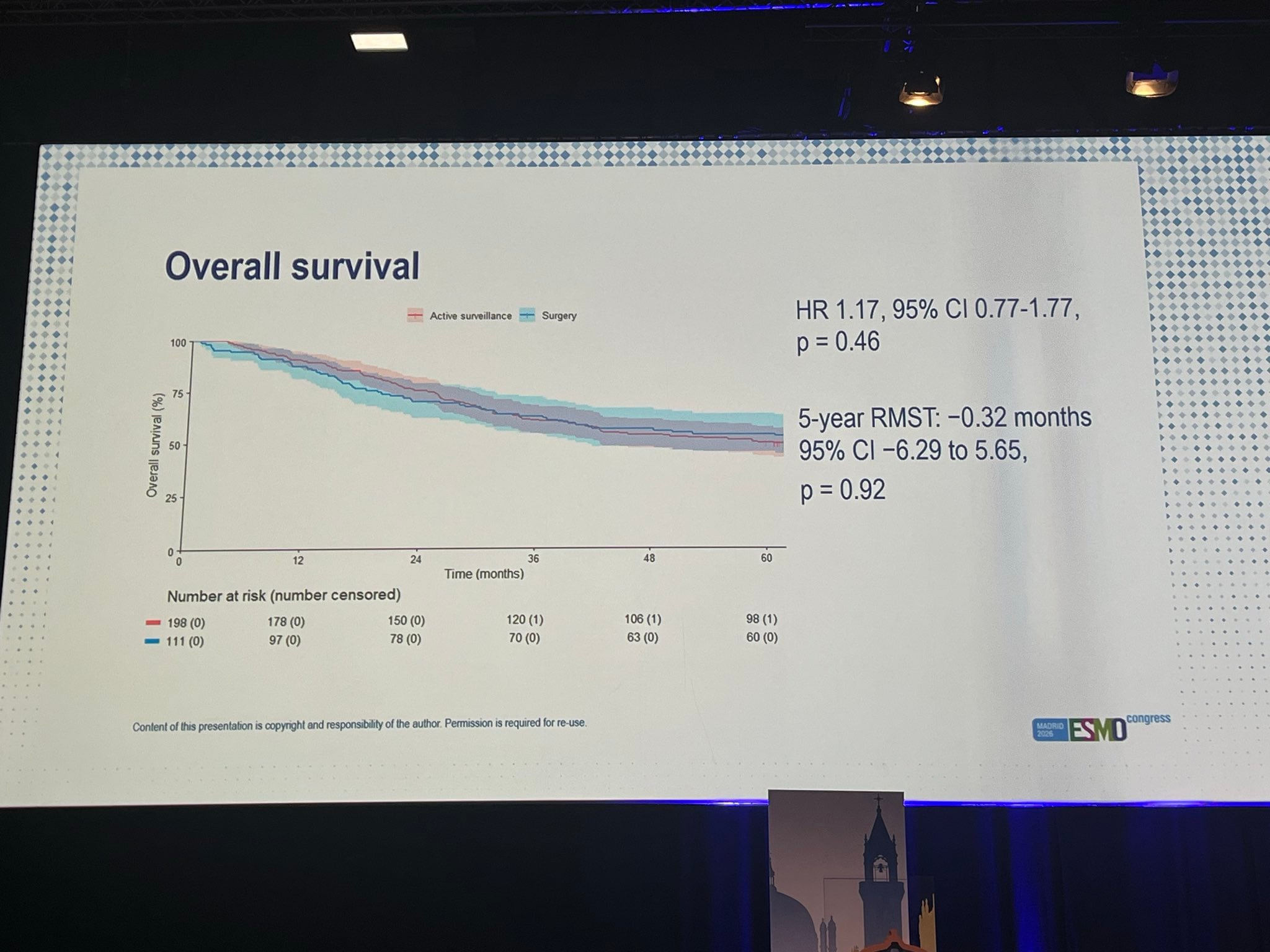
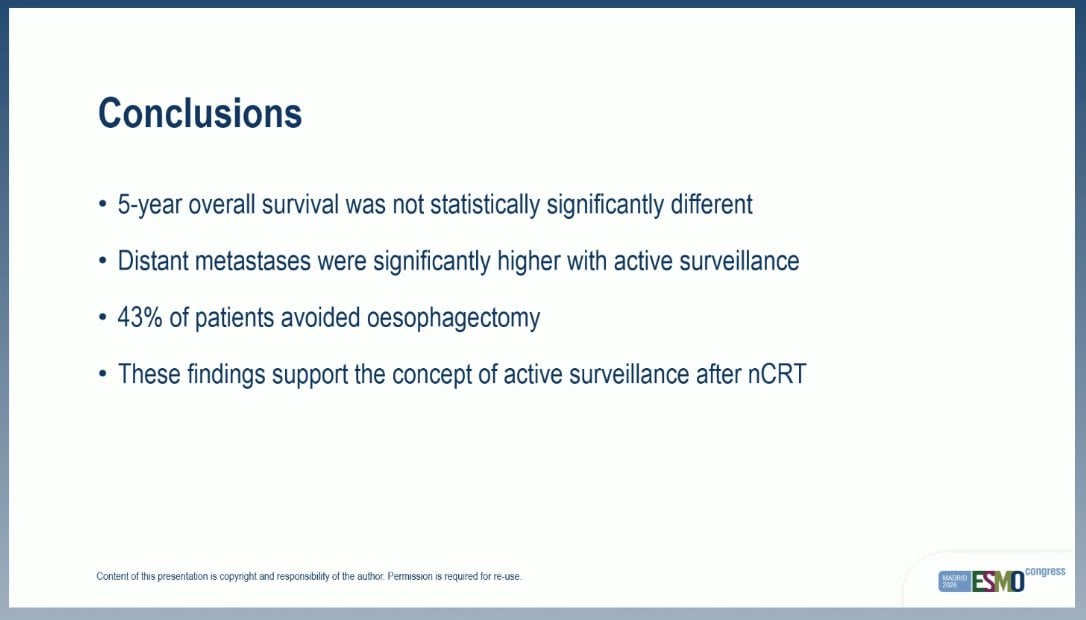
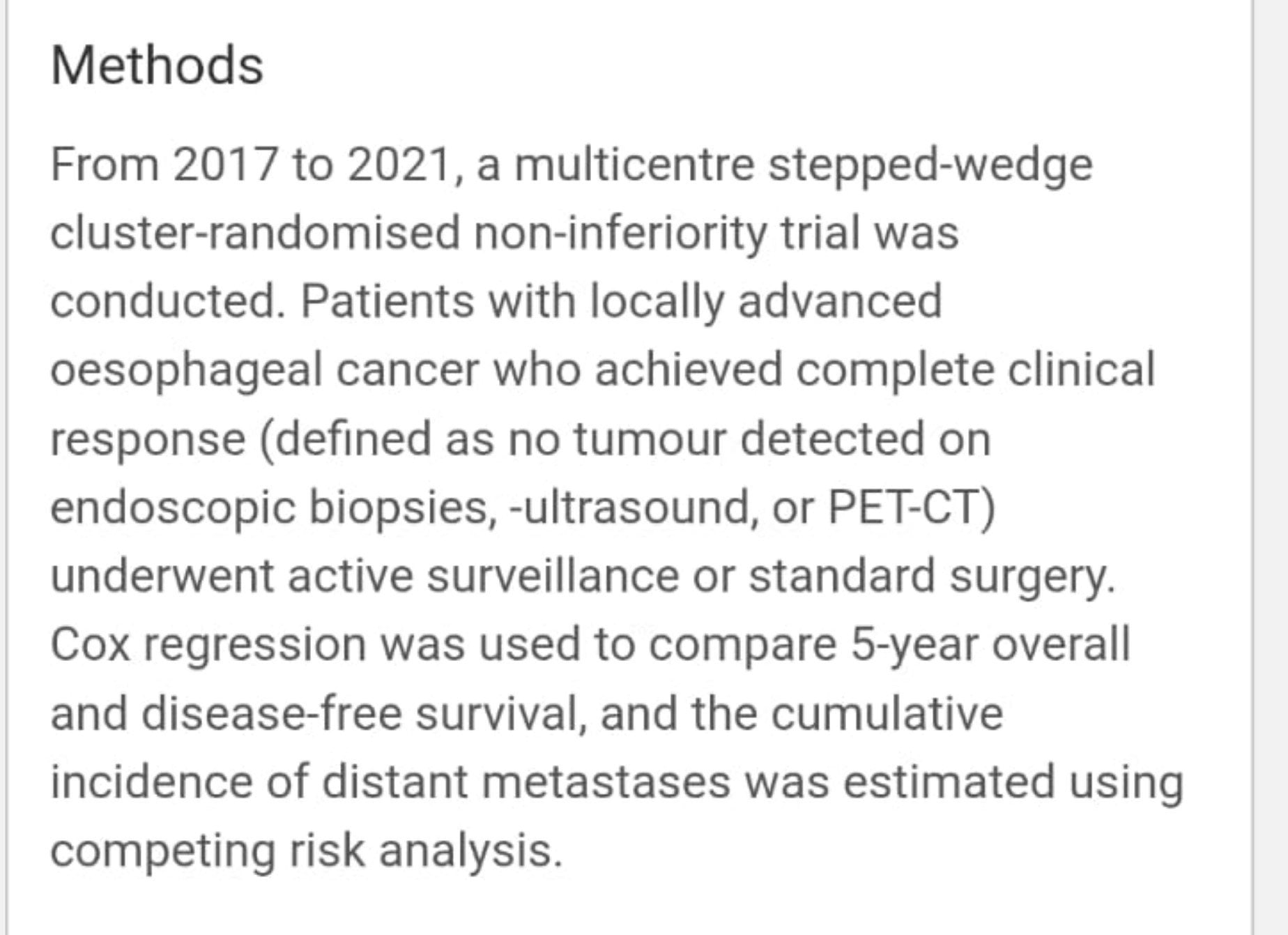
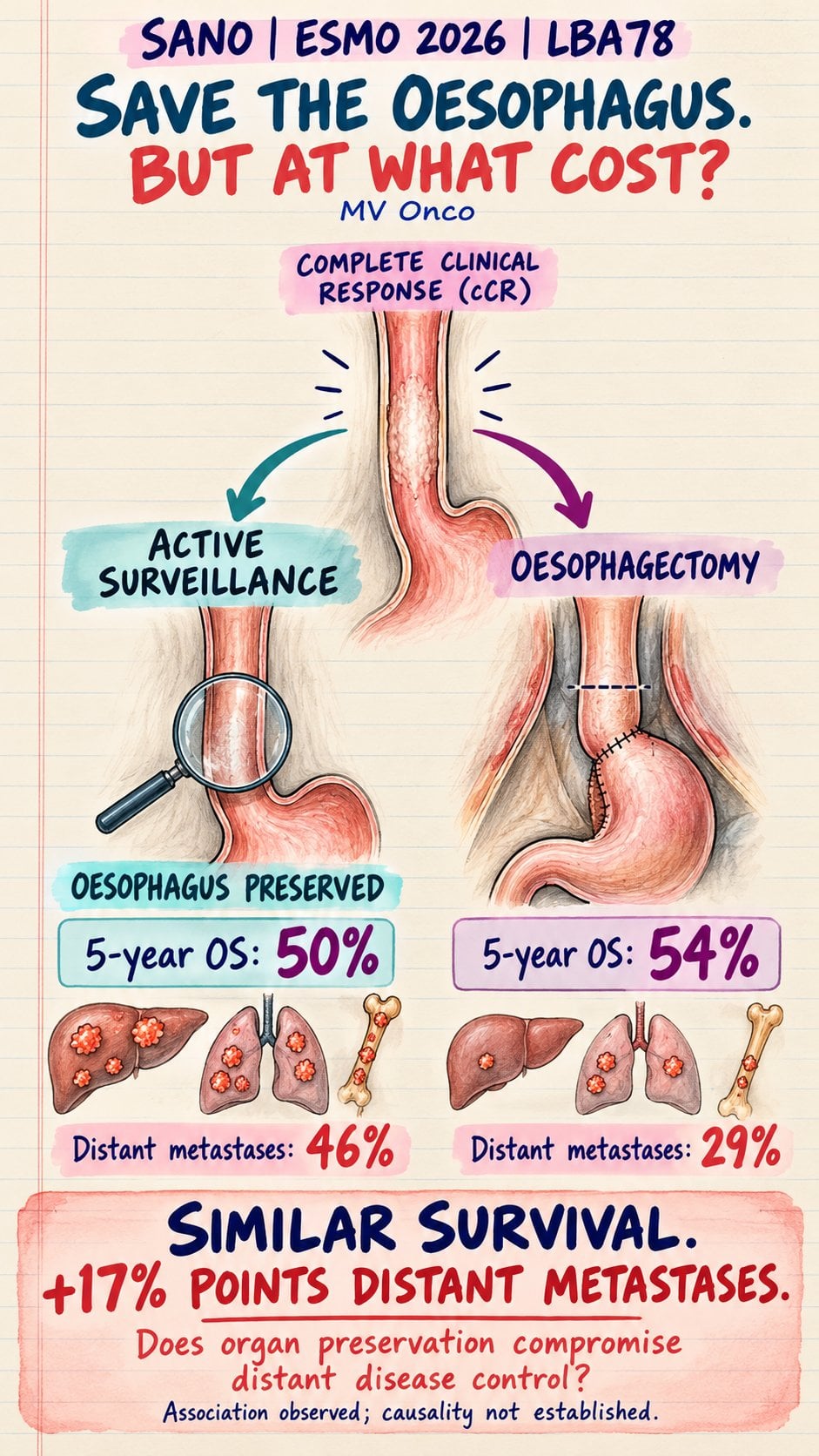
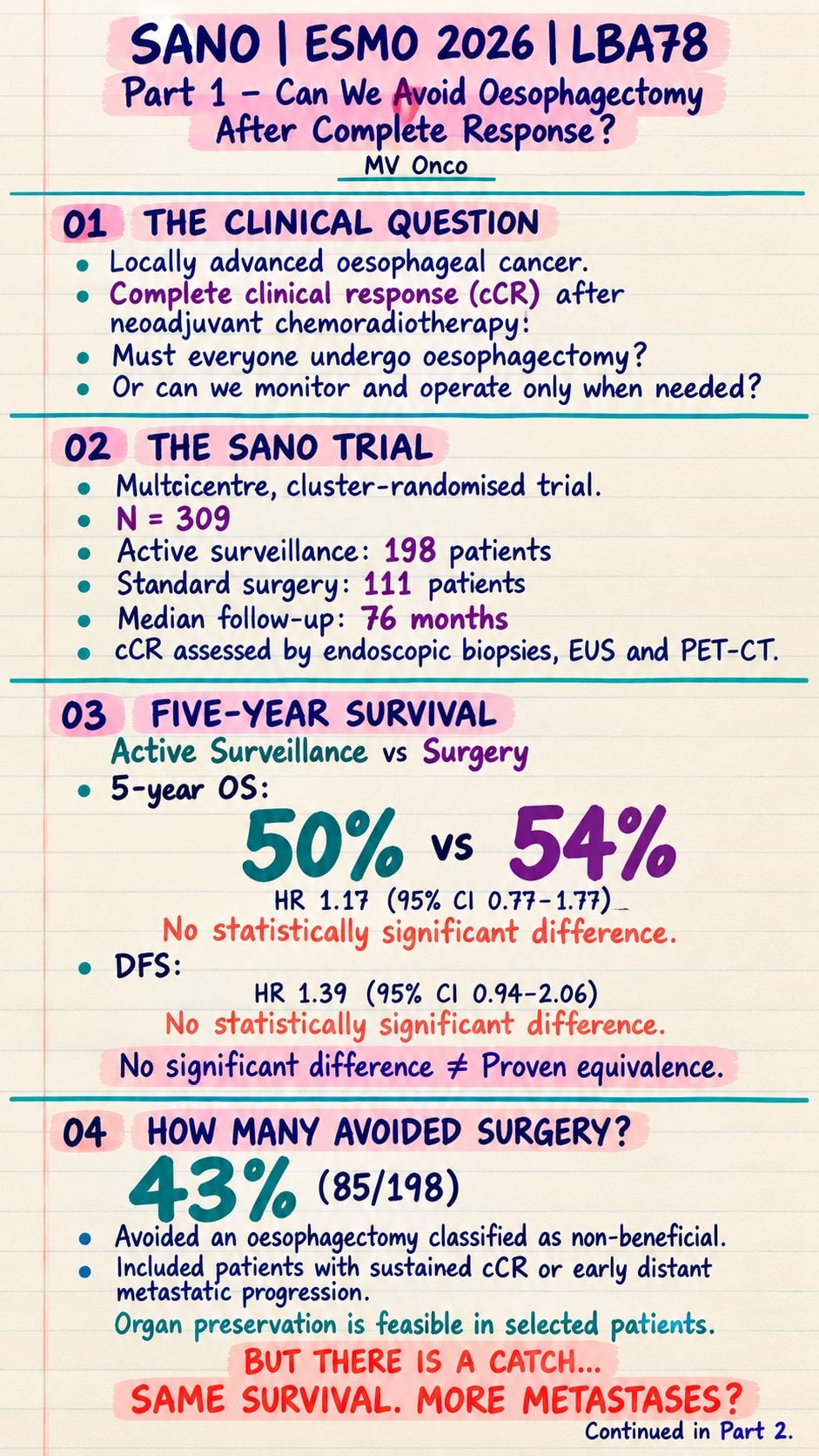
50% with active surveillance vs 54% with standard surgery; HR 1.17 (95% CI 0.77–1.77). The confidence interval is wide; no equivalence was formally shown at 5 years.
OS HR 1.17 (95% CI 0.77–1.77)Distant metastases: significantly higher with surveillance
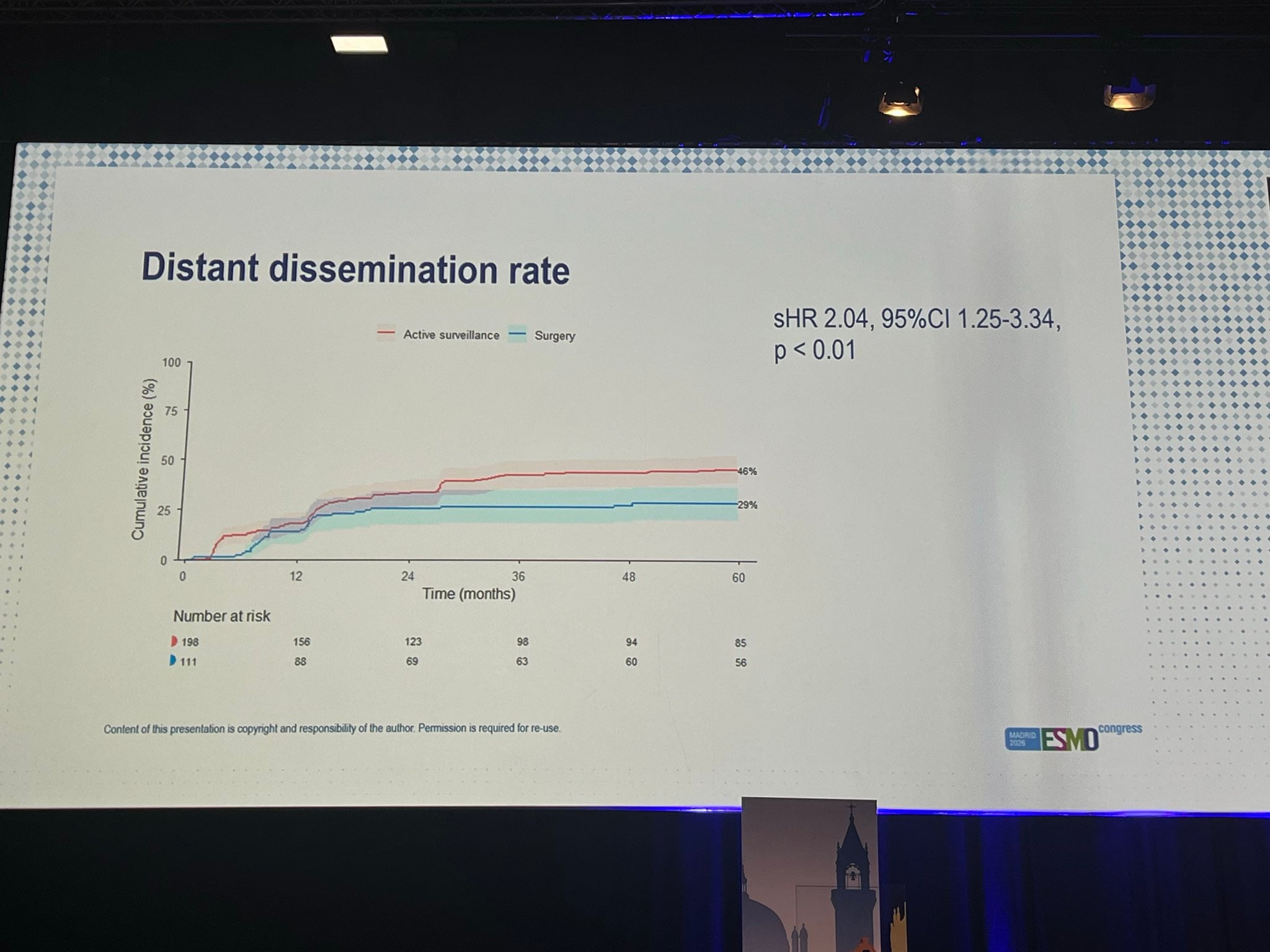
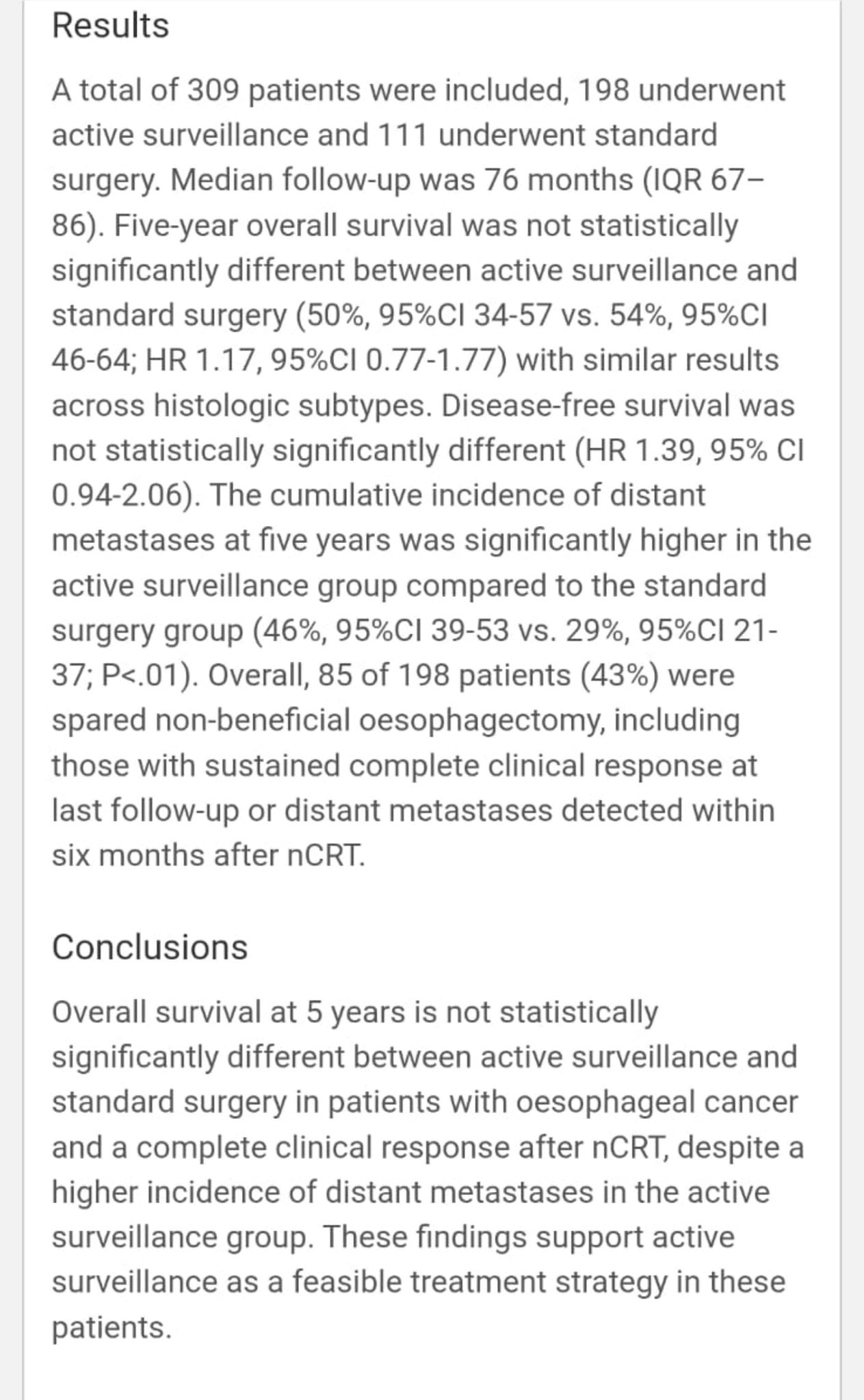
5-year cumulative incidence 46% vs 29% (P<.01); on the presentation slide sHR 2.04 (95% CI 1.25–3.34). Death from oesophageal cancer sHR 1.67 (95% CI 1.02–2.73), p=0.04 (slide).
Distant metastases 46% vs 29%43% spared oesophagectomy
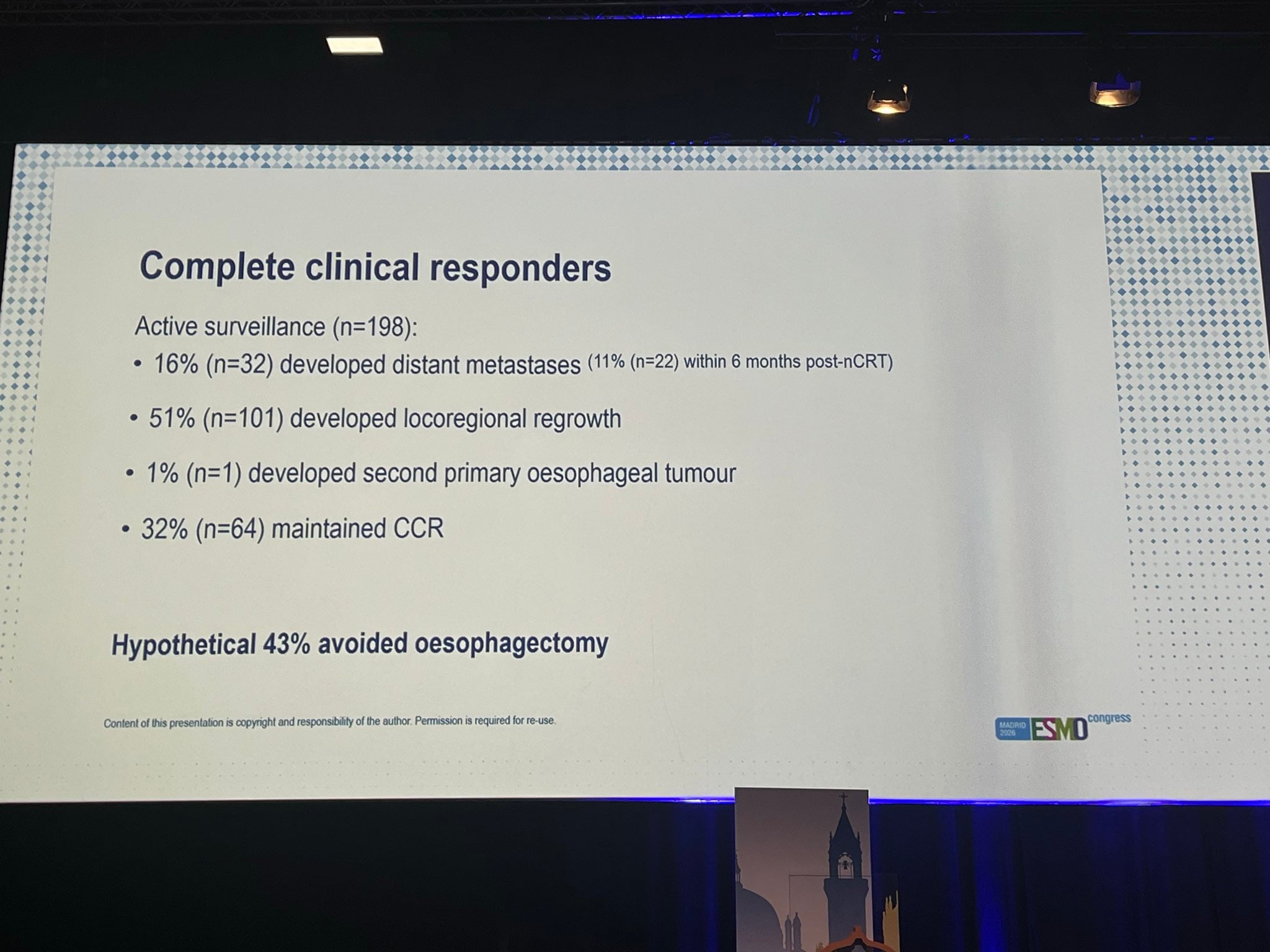
85 of 198 active-surveillance patients, a count that includes sustained clinical complete responders and patients with distant metastases detected within six months after nCRT; the slide calls it a hypothetical 43%.
85/198 (43%)Physicians are split
Reactions on X ranged from “supports consideration of active surveillance” to “will you offer wait and watch in Esophageal cancer? I won't.” Most posts flagged the distant-metastasis signal.
1 positive · 8 neutral · 5 negative postsSources: ESMO 2026 LBA78 abstract and presentation slides (Gangaram-Panday SS, Oct 23, 2026; median follow-up 76 months).
Track oncology’s top KOLs in your specialty
Create a free account, pick the tumor types you cover, and go beyond the tweet — the intelligence pharma teams use to map influence and prepare for engagement:
- ✓Enhanced KOL profiles
- ✓Pharma influence & potential advisory-board patterns
- ✓2025 Open Payments financial analysis
- ✓Social-media sentiment & trend signals
Top KOLs Discussing SANO
Physicians only, ranked by total impressions of their SANO posts (X, Oct 22–23, 2026). The presenter, Sanjiv Gangaram-Panday, has no verifiable X account.
Sano trial; No significant OS difference does not establish equivalence!!!! Higher 5-year distant metastasis incidence with active surveillance (46% vs 29%; p<0.01) is clinically concerning and deserves attention!!! @myESMO @OncoAlert #ESMO26 @OncoAlert @Larvol
— Elvina Almuradova (@Dr_ElvinaA) 2026-10-23
SANO Key Slides & Visuals
| Endpoint (ESMO 2026 LBA78 slides, median follow-up 76 mo) | Active surveillance (n=198) | Standard surgery (n=111) | Between-arm comparison |
|---|---|---|---|
| Overall survival, 5-year | 50% | 54% | HR 1.17 (95% CI 0.77–1.77), p=0.46; 5-year RMST −0.32 months (95% CI −6.29 to 5.65), p=0.92 |
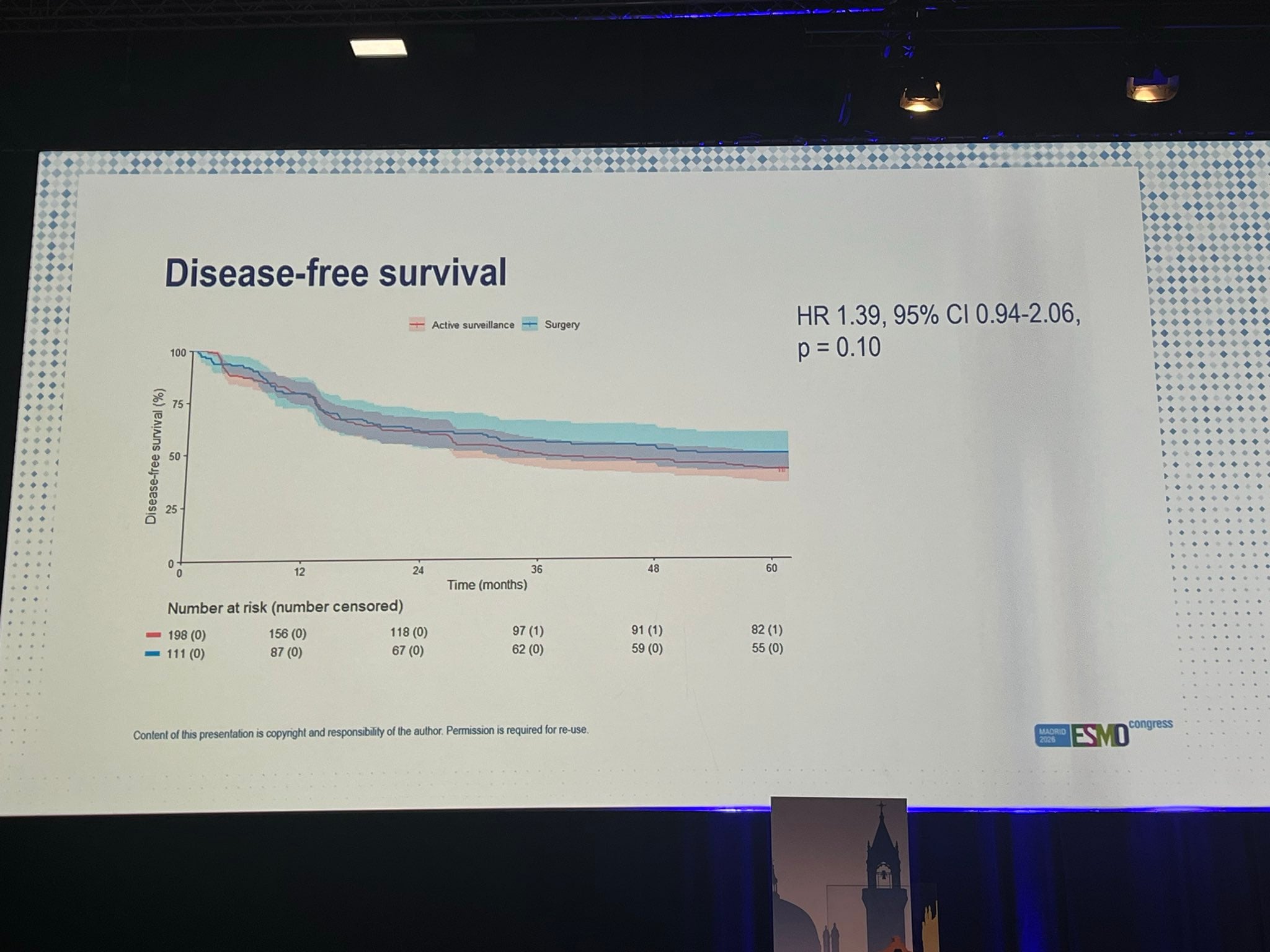
| Disease-free survival | 5-year rates not printed on the slide | HR 1.39 (95% CI 0.94–2.06), p=0.10 | |
| Distant dissemination, 5-year cumulative incidence | 46% | 29% | sHR 2.04 (95% CI 1.25–3.34), p<0.01 |
| Number at risk, OS, at 0/12/24/36/48/60 months: 198/178/150/120/106/98 vs 111/97/78/70/63/60. The 5-year OS rates (50% vs 54%) are from the LBA78 abstract. | |||
Source: ESMO 2026 LBA78 presentation slides (Gangaram-Panday SS), as shared on X by Daisuke Kotani, Oct 23, 2026; 5-year OS rates from the LBA78 abstract.
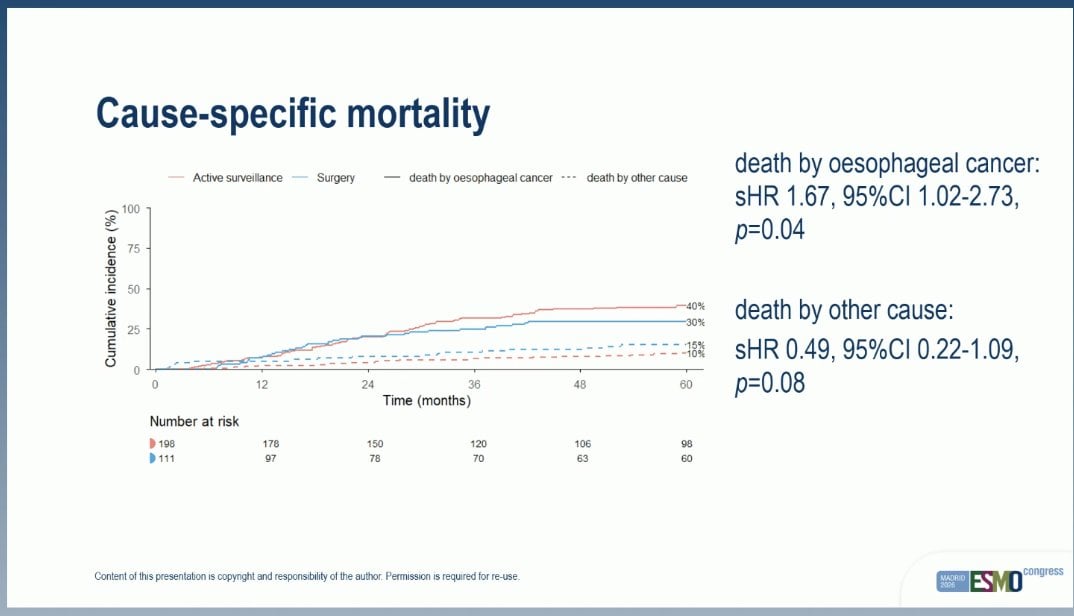
| Cause-specific mortality (ESMO 2026 LBA78 slide) | Active surveillance | Standard surgery | Subdistribution HR |
|---|---|---|---|
| Death from oesophageal cancer, cumulative incidence at 60 months | 40% | 30% | sHR 1.67 (95% CI 1.02–2.73), p=0.04 |
| Death from other causes, cumulative incidence at 60 months | 10% | 15% | sHR 0.49 (95% CI 0.22–1.09), p=0.08 |
Source: ESMO 2026 LBA78 presentation slide (Gangaram-Panday SS), as shared on X by Arndt Vogel, Oct 23, 2026. 60-month percentages are the curve end labels printed on the slide. This is a competing-risk analysis presented at the meeting; it is not reported in the abstract.
MV Onco · headline
MV Onco · part 1
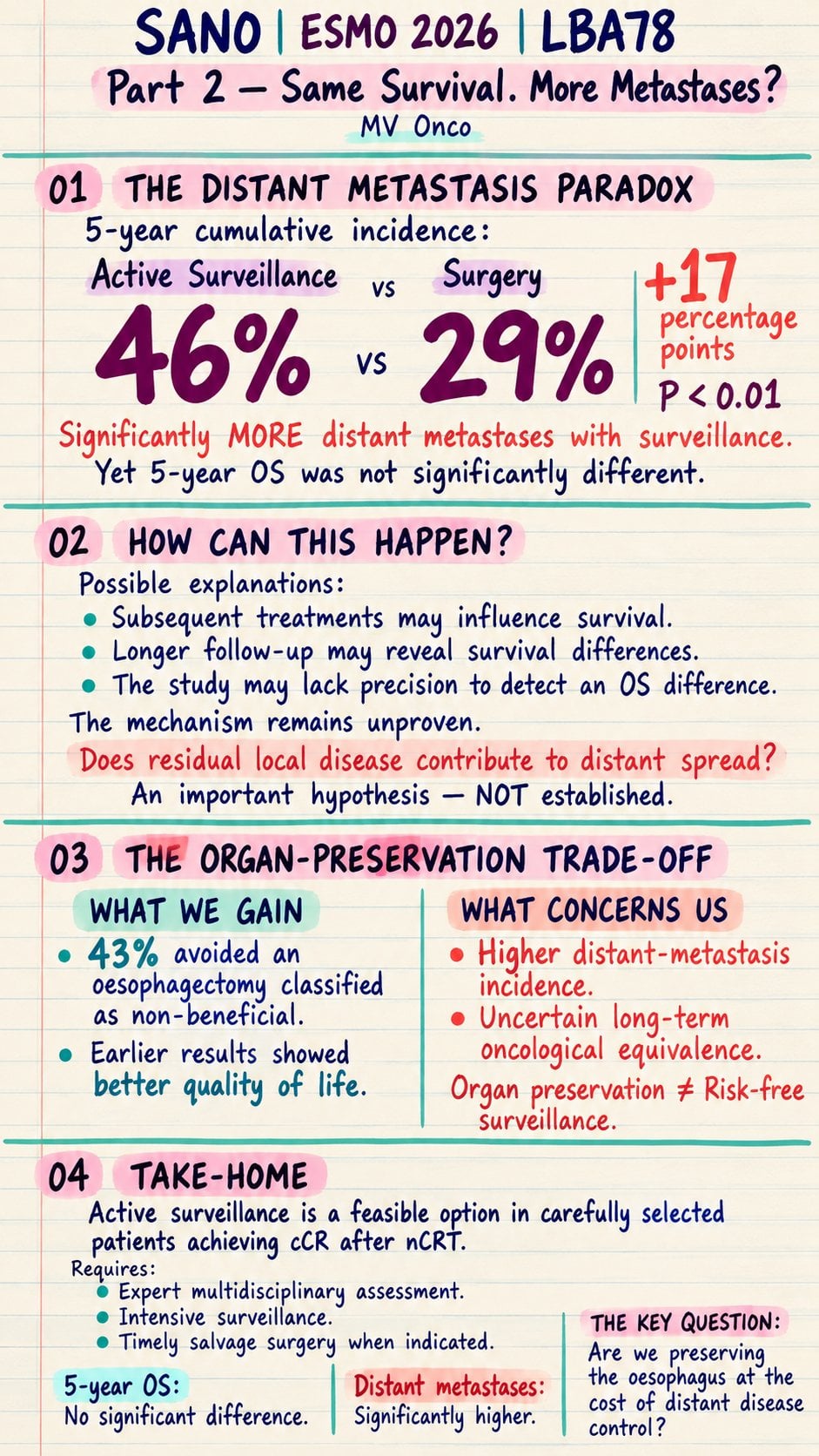
MV Onco · part 2
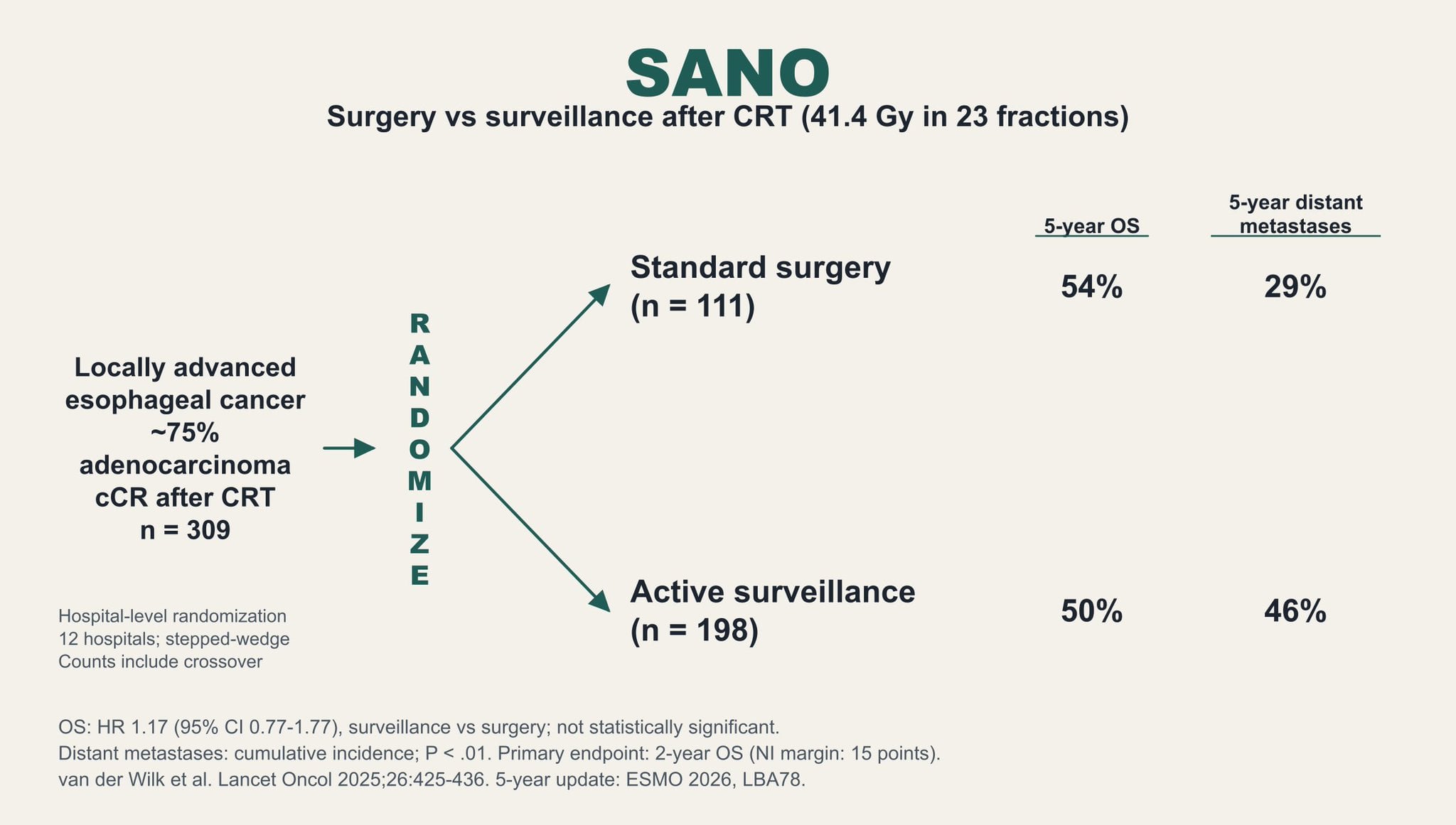
@jryckman3 · schema
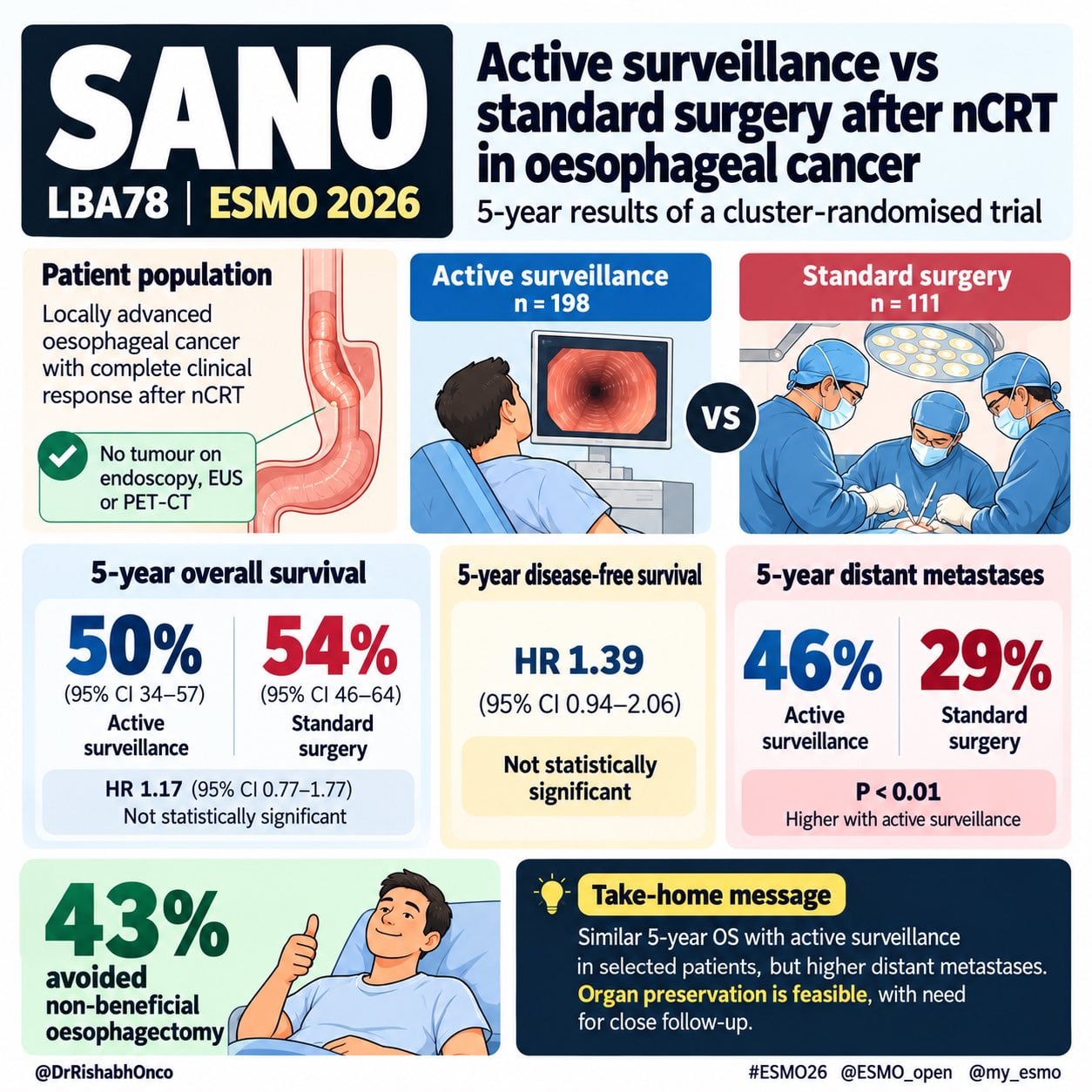
@DrRishabhOnco
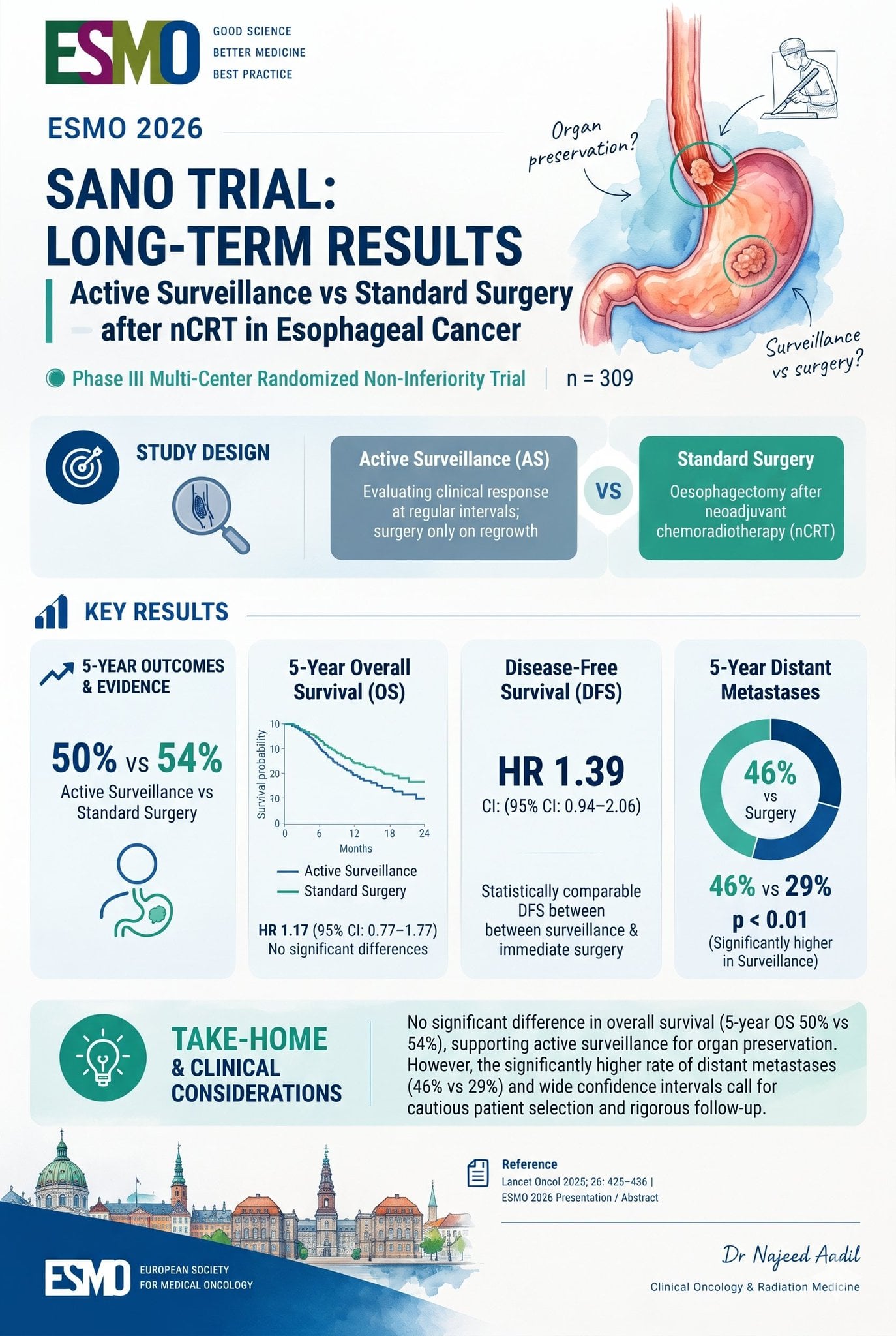
@daakhsaab
@KrishanJethwa · abstract summary
SANO Top Tweets
 𝕏
🚨SANO 5y: surveillance vs surgery after cCR OS 50% vs 54% (NS) Distant mets 46% vs 29% (P<.01) Reminder: only 41.4 Gy/23 fx, a pre-op, arguably non-definitive dose, especially with/ ~75% adenocarcinoma. Nonsignificant OS doesn't establish noninferiority. #ESMO26 #RadOnc #OncTwitter
 𝕏
🚨 ESMO 2026 | SANO Trial (LBA78): 5-Year Result Active surveillance vs surgery (N=309) 🔹 5-year OS: 50% vs 54% (HR 1.17; 95% CI 0.77–1.77) 🔹 DFS: HR 1.39 (95% CI 0.94–2.06) 🔹 5-year distant metastases: 46% vs 29% (p<0.01) 🔹 43% in the surveillance arm were spared a non-beneficial oesophagectomy. An important organ-preservation strategy, but the higher distant metastasis rate is concerning. Would you recommend active surveillance over surgery for a patient achieving complete clinical response? #ESMO26 #EsophagealCancer #SANO @myESMO @NiuSanford @OncoAlert @OncBrothers
 𝕏
🚀Upper GI oral abstracts #ESMO26 Day 1 summary results 1) Arcotatug tavatecan improved PFS in CLDN18.2+ G/GEJA in the 3L+ setting 2) SANO trial, OS at 5 years similar between active surveillance and surgery in patients with oesophageal cancer and a complete clinical response after nCR, despite more distant metastasis 3) Adding pembrolizumab to dCRT did not improve EFS in untreated unresectable esophageal or GEJ cancer with PD-L1 CPS ≥10 4) Daraxonrasib demonstrated consistent OS benefit in different RAS mutatin subgroups in RASolute-302 5) mKRAS-specific lymph node targeted amphiphile immunotherapy in PDAC did not met primary DFS endpoint. 6) Zani + CT +/- tisle keep OS benefit in at IA2 of HERIZON-GEA-01 7) Anbenitamab plus ChT improved OS in patients with HER2-positive GC/GEJC adenoca after previous trastuzumab 8) TQB2102 (HER2 bispecific antibody-drug conjugate) plus bemotrizumab and capecitabine demonstrates promising antitumor activity in 1L of advanced GC/GEJC 9) Dostarlimab in Pts with localized dMMR/MSI-H GEA led to a 62.5% 1y-cCR at the first interim analysis, enabling organ preservation. 10) FOLFIRI and Ram vs paclitaxel in taxan-pretreated GEA imporved PFS but no OS 11) Stage II–IIIB gastric cancer after D2 resection, four months of adjuvant XELOX was noninferior to six months for 3-year DFS 12) Adding durvalumab to dCRT in locally advanced esophagus carcinoma did not improve PFS 13) Adding SBRT to MFOLFIRINOX in high risk, borderline resectable or locally advanced pancreatic cancer mproved LRR and PFS 14) FGFR2b expressing GC/GEJ with co-existing FGFR2 amp may define a biologically distinct subset with potential sensitivity to bemarituzumab #cancer #oncology #MedX #GI #gastrointestinal @OncoAlert
 𝕏
#ESMO26 | LBA78 Long-term results from SANO: Active surveillance vs standard surgery after nCRT in EC ▪️5y-OS: 50% vs 54%, HR 1.17 (95% CI 0.77-1.77) ▪️DFS: HR 1.39 (95%CI 0.94-2.06) ▪️5y-distant mets: 46% vs 29%, p<0.01 👉Despite no significant OS or DFS differences, the wide CIs and significantly higher distant mets rate highlight important challenges for implementing active surveillance in clinical practice. Looking forward to the presentation! @myESMO @OncoAlert
 𝕏
🚨 #ESMO26 | SANO Trial (LBA78) Can we skip surgery after complete response to neoadjuvant CRT in oesophageal cancer? 5-year outcomes (n=309): 🔹 OS: 50% vs 54% (HR 1.17) 🔹 Distant metastases: 46% vs 29% (p<0.01) 🔹 43% spared non-beneficial oesophagectomy. 🎯 Verdict: Active surveillance offers organ preservation without a statistically significant OS difference, but higher distant metastases raise concern. Could surveillance become a standard option for carefully selected patients? @ESMO_open @my_esmo @ASCO @oncoalert #SANO #EsophagealCancer
 𝕏
SANO trial: Active surveillance vs standard surgery after neoadjuvant chemoradiotherapy for oesophageal cancer: Long-term results #ESMO26 #ESMOAmbassadors 👉 DFS HR: 1.39 👉 OS HR:1.17 👉Distant mets: sHR 2.04 🧐OS not different, supports consideration of active surveillance @myESMO @ASCO
 𝕏
🔥 SANO 5-year results🔥 Esophagus cancer 👥 309 pts with cCR after nCRT 🔍 Surveillance vs surgery ✅ 5y OS: 50% vs 54% (HR 1.17) ⚠️ Distant mets: 46% vs 29% (P<.01) 💥 43% organ preservation Active surveillance remains a feasible strategy albeit we must recognize the DM risk despite no OS difference. Perhaps TNT, like D-FLOT ➡️CRT with subsequent AS for cCR may be an optimal next strategy to test. Improved response assessment strategies also needed #ESMO26
𝕏With increase in distant mets , will you offer wait and watch in Esophageal cancer? I won't. #SANO trial. @myESMO #esmo26 @OncoAlert
 𝕏
SANO 5-year update, #ESMO26 LBA78. Some surprises. Study Design: Surveillance vs surgery after cCR to CRT in locally advanced esophageal cancer (n=309). 5-year OS ~50% vs 54% (NS), HR 1.17 (95% CI 0.77–1.77) Distant mets 46% vs 29% (P<.01). This met rate is higher and now significant. Reminder: only 41.4 Gy/23 fx. A pre-op, arguably non-definitive dose, especially with ~75% adenocarcinoma. Does this apply in the DFLOT + post-CROSS era? Either way, upper GI harder to tackle non-op than hoped. @OncoAlert @TheGutOncLab @Onco_Nexus
 𝕏
🚨 SANO | ESMO 2026 | LBA78 SAVE THE OESOPHAGUS. BUT AT WHAT COST? Can we safely avoid oesophagectomy after complete clinical response to neoadjuvant chemoradiotherapy? 🔹 SANO 5-year results (N=309) Active surveillance vs surgery: • 5-year OS: 50% vs 54% (HR 1.17) • DFS: HR 1.39 • Distant metastases: 46% vs 29% (P < 0.01) • 43% avoided an oesophagectomy classified as non-beneficial. ⚠️ The paradox: No statistically significant OS difference, yet 17 percentage points MORE distant metastases with surveillance. TAKE-HOME Organ preservation is feasible in selected patients, but long-term oncological equivalence remains uncertain. Careful selection, intensive surveillance and access to salvage surgery are essential. Are we preserving the oesophagus at the cost of distant disease control? 📖 Ref: Gangaram-Panday SS et al. SANO trial: 5-year results. ESMO 2026; LBA78. #MVOnco #ESMO2026 #SANO #EsophagealCancer #Oncology
About the SANO Trial
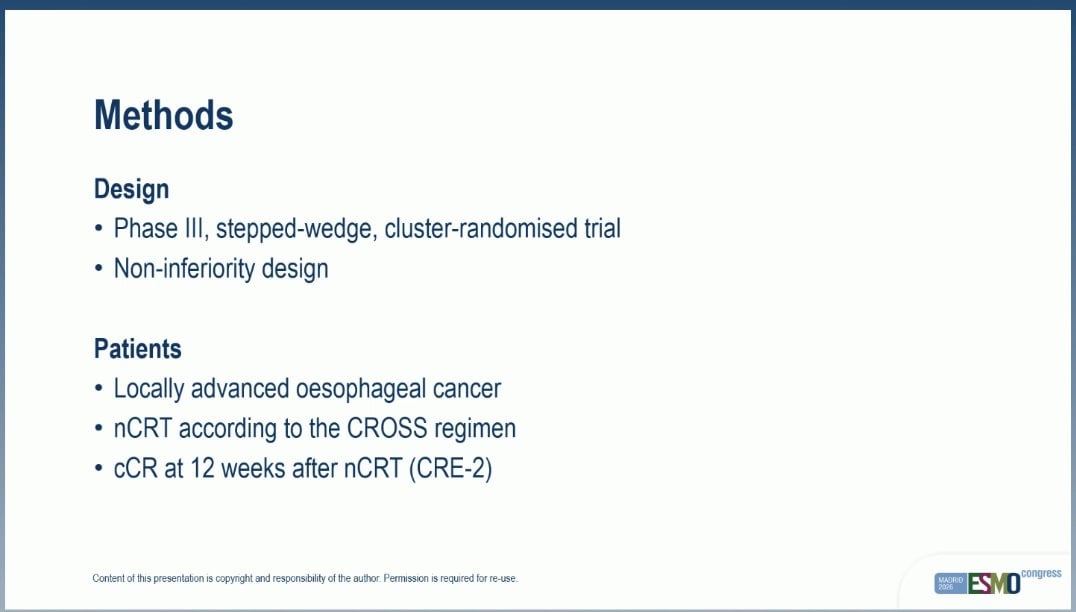
SANO (Surgery As Needed for Oesophageal cancer) asked whether patients whose oesophageal cancer shows no detectable tumour after neoadjuvant chemoradiotherapy need a planned oesophagectomy, or can be followed with active surveillance and operated on only if the tumour regrows locally. A clinical complete response was defined as no tumour detected on endoscopic biopsies, endoscopic ultrasound or PET-CT. Hospitals, not individual patients, were randomised in a stepped-wedge design: all 12 Dutch centres started with standard surgery and switched to active surveillance at randomised time points.
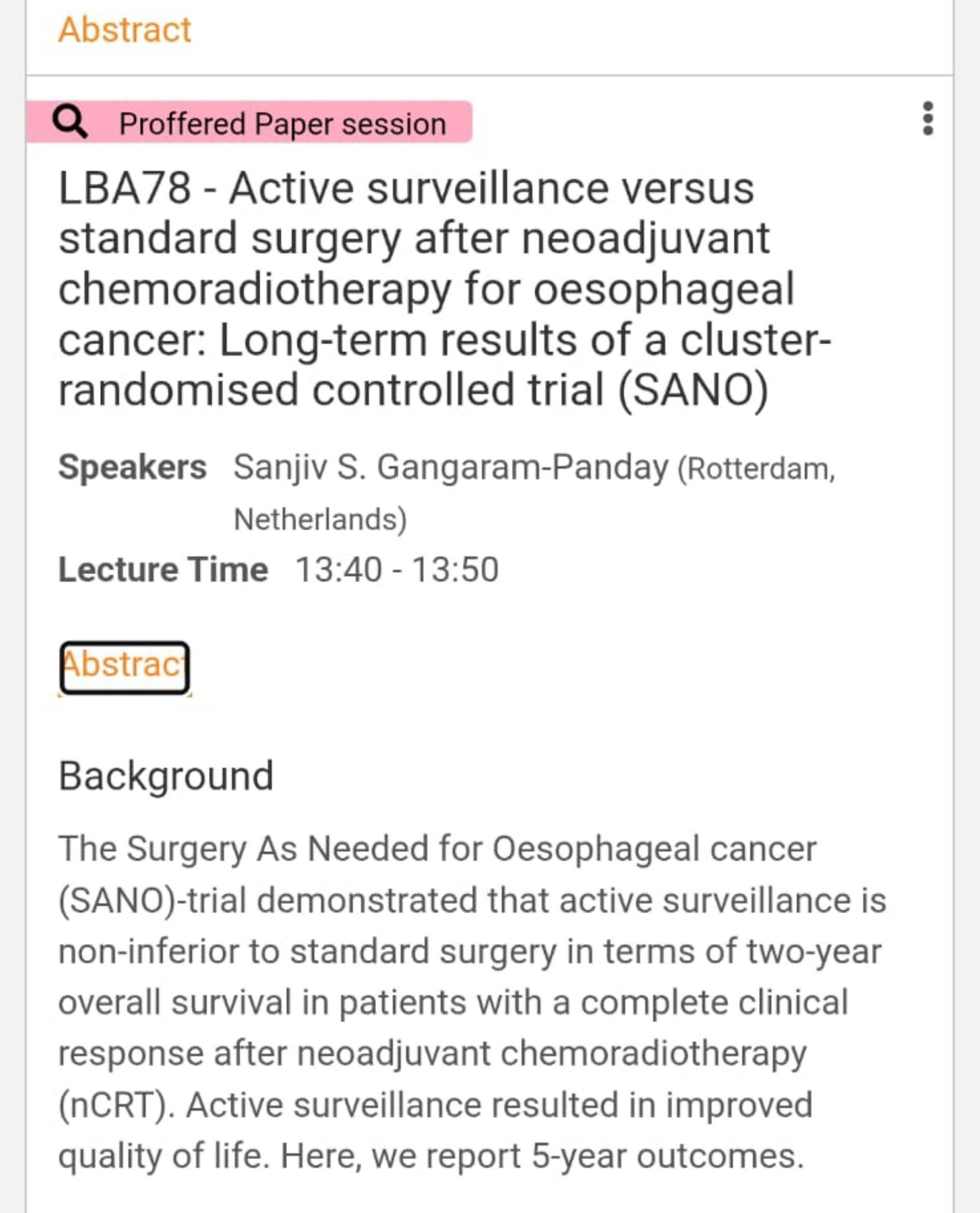
The primary analysis (van der Wilk et al., Lancet Oncology 2025; median follow-up 38 months) found 2-year overall survival of 74% with active surveillance vs 71% with standard surgery (modified intention-to-treat), meeting the pre-specified non-inferiority margin of 15 percentage points; HR 1.14 (95% CI 0.74–1.78). A separate analysis reported less dysphagia, dyspnoea and fatigue and better physical functioning with active surveillance at 6 months after nCRT, with dysphagia still better at 2 years (British Journal of Surgery 2025). The 5-year results were presented at ESMO 2026 as LBA78 and published simultaneously in Annals of Oncology.
The trial is led by Erasmus MC Rotterdam (principal investigator Prof. Jan van Lanschot) and funded by the Dutch Cancer Society (KWF) and ZonMw. It tests a treatment strategy; no drug or regulatory approval is involved.
With increase in distant mets , will you offer wait and watch in Esophageal cancer? I won't. #SANO trial. @myESMO #esmo26 @OncoAlert
— Dr Amol Akhade (@SuyogCancer) 2026-10-23
Trial Methodology & Results
Study Design
Multicentre, phase III, stepped-wedge, cluster-randomised non-inferiority trial in 12 Dutch hospitals, 2017–2021. Registered as NTR6803 (Netherlands Trial Register); also listed as NCT05953181.
Population
Locally advanced oesophageal cancer treated with neoadjuvant chemoradiotherapy per the CROSS regimen, with a clinical complete response at 12 weeks after nCRT (second clinical response evaluation): no tumour on endoscopic biopsies, endoscopic ultrasound or PET-CT.
Interventions
Active surveillance with repeated clinical response evaluations and oesophagectomy only for locoregional regrowth (n=198) vs standard oesophagectomy (n=111).
Endpoints
Primary: overall survival (non-inferiority at 2 years, margin 15 percentage points). 5-year analysis: overall and disease-free survival (Cox regression) and cumulative incidence of distant metastases (competing-risk analysis).
Sponsor & Funding
Erasmus MC Rotterdam; funded by the Dutch Cancer Society (KWF) and ZonMw.
Presenter
Sanjiv S. Gangaram-Panday (Rotterdam), ESMO 2026 Proffered Paper session, LBA78, Oct 23, 2026.
Overall survival at 5 years
Median follow-up 76 months (IQR 67–86). 5-year overall survival was 50% with active surveillance vs 54% with standard surgery, HR 1.17 (95% CI 0.77–1.77), not statistically significantly different, with similar results across histologic subtypes (abstract). The presentation slide adds p=0.46 and a 5-year restricted mean survival time difference of −0.32 months (95% CI −6.29 to 5.65), p=0.92.
OS HR 1.17 (95% CI 0.77–1.77)Source: ESMO 2026 LBA78 abstract and slides; Annals of Oncology 2026 →
#ESMO26 | LBA78 Long-term results from SANO: Active surveillance vs standard surgery after nCRT in EC ▪️5y-OS: 50% vs 54%, HR 1.17 (95% CI 0.77-1.77) ▪️DFS: HR 1.39 (95%CI 0.94-2.06) ▪️5y-distant mets: 46% vs 29%, p<0.01 👉Despite no significant OS or DFS differences, the wide CIs and significantly higher distant mets rate highlight important challenges for implementing active surveillance in clinical practice. Looking forward to the presentation! @myESMO @OncoAlert
— Daisuke Kotani, MD, Ph.D 小谷 大輔 (@DaisukeKotani) 2026-10-23
Disease-free survival
Disease-free survival was not statistically significantly different: HR 1.39 (95% CI 0.94–2.06) (abstract); p=0.10 (slide).
DFS HR 1.39 (95% CI 0.94–2.06)Source: ESMO 2026 LBA78 abstract and slides →
Distant metastases and cause-specific mortality
The 5-year cumulative incidence of distant metastases was 46% (95% CI 39–53) with active surveillance vs 29% (95% CI 21–37) with standard surgery, P<.01 (abstract); sHR 2.04 (95% CI 1.25–3.34) on the presentation slide. In a competing-risk analysis shown at the meeting, death from oesophageal cancer was higher with active surveillance (sHR 1.67, 95% CI 1.02–2.73, p=0.04) and death from other causes was not significantly different (sHR 0.49, 95% CI 0.22–1.09, p=0.08).
Distant metastases 46% vs 29%, P<.01Source: ESMO 2026 LBA78 abstract and slides →
SANO 5-year update, #ESMO26 LBA78. Some surprises. Study Design: Surveillance vs surgery after cCR to CRT in locally advanced esophageal cancer (n=309). 5-year OS ~50% vs 54% (NS), HR 1.17 (95% CI 0.77–1.77) Distant mets 46% vs 29% (P<.01). This met rate is higher and now significant. Reminder: only 41.4 Gy/23 fx. A pre-op, arguably non-definitive dose, especially with ~75% adenocarcinoma. Does this apply in the DFLOT + post-CROSS era? Either way, upper GI harder to tackle non-op than hoped. @OncoAlert @TheGutOncLab @Onco_Nexus
— Nicholas Hornstein (@GIMedOnc) 2026-10-23
What happened in the active surveillance arm
Of 198 patients under active surveillance, 51% (n=101) developed locoregional regrowth, 16% (n=32) developed distant metastases (11%, n=22, within 6 months after nCRT), 1% (n=1) developed a second primary oesophageal tumour, and 32% (n=64) maintained a clinical complete response (slide). The abstract reports that 85 of 198 (43%) were spared non-beneficial oesophagectomy, counting patients with a sustained clinical complete response at last follow-up and those with distant metastases detected within six months after nCRT; the slide labels this a hypothetical 43%.
85 of 198 (43%) spared oesophagectomySource: ESMO 2026 LBA78 abstract and slides; registry NCT05953181 →
Primary 2-year analysis: van der Wilk BJ et al. Lancet Oncol 2025;26:425–436 (median follow-up 38 months). 5-year analysis: Gangaram-Panday SS et al., ESMO 2026 LBA78 (median follow-up 76 months; abstract and slides shared on X by Amol Akhade, Daisuke Kotani and Arndt Vogel) and Annals of Oncology 2026. Values from the two analyses are labelled separately and not combined.
SANO in the News
SANO FAQ
What is the SANO trial?
SANO (Surgery As Needed for Oesophageal cancer) is a Dutch multicentre, phase III, stepped-wedge, cluster-randomised non-inferiority trial led by Erasmus MC Rotterdam in 12 hospitals. It compared active surveillance (repeated clinical response evaluations, with surgery only for locoregional regrowth) with standard oesophagectomy in patients with locally advanced oesophageal cancer who had a clinical complete response after neoadjuvant chemoradiotherapy. 309 patients were included: 198 active surveillance and 111 standard surgery. It is registered as NTR6803 (Netherlands Trial Register) and NCT05953181.
What did the 5-year SANO results show at ESMO 2026?
In the LBA78 abstract (median follow-up 76 months), 5-year overall survival was 50% with active surveillance vs 54% with standard surgery (HR 1.17, 95% CI 0.77-1.77), not statistically significantly different. Disease-free survival was not significantly different (HR 1.39, 95% CI 0.94-2.06). The 5-year cumulative incidence of distant metastases was higher with active surveillance: 46% vs 29% (P<.01).
How many patients avoided oesophagectomy in SANO?
The abstract reports that 85 of 198 active-surveillance patients (43%) were spared non-beneficial oesophagectomy. This count includes patients with a sustained clinical complete response at last follow-up and patients whose distant metastases were detected within six months after nCRT. The presentation slide labels the figure a hypothetical 43%.
Did SANO show active surveillance is equivalent to surgery at 5 years?
No formal equivalence was shown at 5 years. The primary analysis (Lancet Oncology 2025) met its pre-specified non-inferiority criterion for 2-year overall survival. The 5-year analysis reports no statistically significant difference in overall survival, with a wide confidence interval (HR 1.17, 95% CI 0.77-1.77), and a significantly higher incidence of distant metastases with active surveillance. Several physicians noted that a non-significant difference does not establish equivalence.
Is active surveillance after chemoradiotherapy an FDA-approved treatment?
SANO tested a treatment strategy, not a drug, so there is no FDA approval involved. Both arms received neoadjuvant chemoradiotherapy according to the CROSS regimen; the trial compared what happens after a clinical complete response: active surveillance with surgery as needed versus planned oesophagectomy.
Key KOL Sentiments - SANO
Sentiment reflects each physician’s view of active surveillance as stated in the post.