
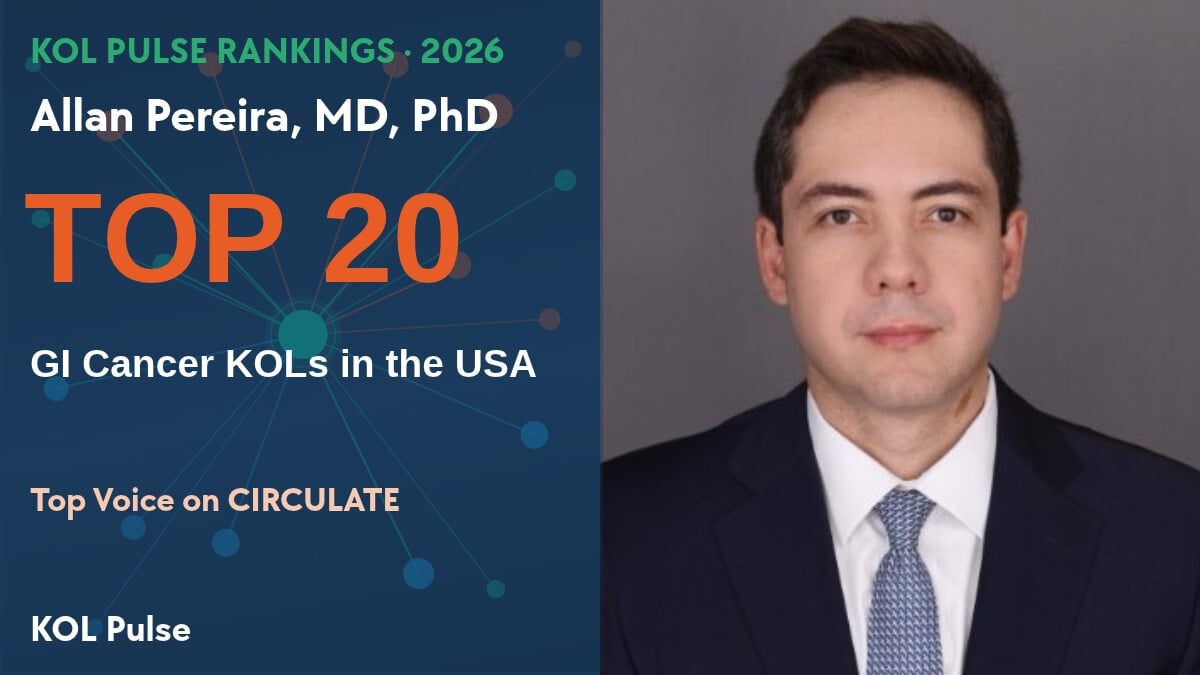
Allan Pereira, MD, PhD (@DrAllanPereira) ranks #14 among US gi cancer KOLs on X in 2026, by engagement from fellow physicians. 11 physicians shared, quoted or replied to their posts this year. Most-discussed trials in 2026: GHOPE001, CLARITY-Gastric01 (CG-01), RASolute 302. CMS Open Payments lists $248 in 2025 general payments.
At a Glance
- 12 posts naming a trial in 2026
- 10 trials discussed by name
- GI Cancer: US #14 · 11 physicians engaged
- CMS Open Payments lists $248 in 2025 general payments.
This Month
What Allan Pereira, MD, PhD has posted in the last 30 days. Updated November 10, 2026.
📊 HARMONi-GI1 - Phase 3 (Akeso release, ESMO LBA8) 🎯 First-line advanced biliary tract cancer, China 💊 Ivonescimab (PD-1/VEGF) + gem-cis vs durvalumab + gem-cis 👥 682 patients, interim analysis ✅ OS 14.9 vs 12.1 mo, HR 0.75 ✅ PFS 8.4 vs 5.8 mo, HR 0.61 📈 ORR 53.8% vs 32.5% 🩸 Grade ≥3 bleeding 1.5% vs 1.8% ⚠️ China only, interim analysis A head-to-head win over TOPAZ-1. The US ECOG-ACRIN trial will decide it for Western patients. Potential new SOC? Yes, but: ⚠️ This is an interim analysis with immature follow-up. Median follow-up was 14.3 months, and the 18-month OS difference rests on few patients still at risk. TOPAZ-1's benefit grew with longer follow-up (HR 0.80 → 0.76 → 0.74 → 0.75). Durability needs to be confirmed in both directions. ⚠️ Post-progression treatment was imbalanced. Only 31.8% of the ivonescimab arm received further therapy vs 45.9% of controls. This would normally dilute an OS benefit, so the HR may be conservative. However, the reasons for the gap (clinical decline, toxicity, how the denominator was defined) need to be in the full report. ⚠️ Subsequent therapy differs from US practice. In the US, second-line care for BTC increasingly involves targeted agents for FGFR2, IDH1, HER2, and others. Whether a China-only OS result carries over depends partly on that downstream care. FDA has stressed that subsequent therapies must match US practice when OS is the endpoint #BTC #Cholangiocarcinoma https://t.co/vnJvi5WVcR
🧑🔬I recently posted data from G-HOPE-001 and CLARITY-Gastric01, two phase 3 trials evaluating their respective ADCs in previously treated CLDN18.2-positive gastric, GEJ, or esophageal adenocarcinoma. 🧐 Can you spot the differences between arcotatug tavatecan and sonesitatug vedotin? Btw, pay attention to the interesting design trade-off between retaining versus silencing the antibody’s Fc region. 😲Non-Fc-silenced ADCs (sonesitatug vedotin): Because ADCC and CDC provide an additional mechanism of tumor-cell killing, this ADCs may retain activity even in tumors with lower levels of CLDN18.2 expression. - Trade-off: Preserving Fc activity may also increase the potential for immune-mediated toxicity, particularly because normal gastric mucosa expresses CLDN18.2. 🤐Fc-silenced ADCs (arcotatug tavatecan): Without additional ADCC/CDC-mediated killing, the ADC depends more heavily on target binding, internalization, and intracellular payload release. As a result, higher levels of CLDN18.2 expression may be needed to achieve sufficient payload delivery and tumor-cell killing. --- -ADC (Antibody-Drug Conjugate) -ADCC (Antibody-Dependent Cell-Mediated Cytotoxicity) -CDC (Complement-Dependent Cytotoxicity) -Fc (Fragment Crystallizable region) -ILD (Interstitial Lung Disease) #GastricCancer #CLDN182 #ESMO26 #GIOnc
🔥 CLARITY-Gastric01 - Phase 3 (AstraZeneca release, ESMO LBA7) 🎯 Previously treated (≥2L) CLDN18.2+ gastric, GEJ or oesophageal adenocarcinoma - How positive, you may ask? Not the usual 75%, but rather 25% expression. 💊 Sonesitatug vedotin (CLDN18.2 ADC) vs investigator's choice 👥 532 patients ✅ 3L+ OS 10.0 vs 5.0 mo, HR 0.47 ✅ ITT OS 10.6 vs 6.4 mo, HR 0.58 ➖ PFS co-primary missed, HR 0.77, p=0.053 ⚠️ 2L-only OS HR 0.88, CI crosses 1 ⚠️ Prior zolbetuximab exposure, if any, not reported In 3L+, mOS doubles from 5 to 10 months, in a population defined at 25% CLDN18.2 expression, far broader than the zolbetuximab cut-off. Now read the second line carefully: PFS missed, and the second-line OS HR was 0.88 with a CI crossing 1, so the ITT result leans on later lines. Let’s please approve this already, at least for 3L. 🙏 But wait!! What can be said about patients with prior exposure to zolbetuximab ??? Also, G-HOPE-001 (see below), selected patients at a much stricter threshold (2+ in 75% or more), so do not compare the hazard ratios head to head. The open question for both ADCs is activity after first-line zolbetuximab. #GastricCancer #CLDN182 #ESMO26 #GIOnc https://t.co/m8KiNVjjLL
🧪 G-HOPE-001 - Phase 3 (Takeda/Innovent release) 🎯 CLDN18.2-positive gastric/GEJ after 2-4 prior lines 💊 Arcotatug tavatecan (CLDN18.2 ADC) vs physician's choice 👥 464 patients, China and Japan ✅ OS 10.2 vs 6.9 mo, HR 0.57 ✅ PFS 7.1 vs 3.1 mo, HR 0.45 📈 ORR 37.4% vs 7.7% ⚠️ Prior zolbetuximab exposure not reported Here CLDN positive meant the usual IHC 2+ or higher in at least 75% of tumour cells. An OS HR of 0.57 and a response rate > 37% in 3L-or-later gastric cancer are hard to ignore. What I want from the full presentation is prior *zolbetuximab* exposure: the release does not report it, and in the West that is now the question for any CLDN18.2 agent after first line. The low rate of severe gastrointestinal toxicity is a genuine differentiator if it holds. Until there is a non-Asian dataset, this is a (very) strong signal rather than a global standard. #GastricCancer #CLDN182 #ADC #ESMO26 #GIOnc #GastricCancer #CLDN182 https://t.co/QSWSPa6TjC
📊 PRABITAS - Phase 3, The Lancet A better way to deliver a bad treatment. Phase 3 non-inferiority trial 🎯 Refractory mCRC, 178 Japanese hospitals 🔀 Lonsurf (FTD-TPI) + bev: 14-day vs standard 28-day schedule 👥 970 patients ➖ OS 11.3 vs 10.3 mo, HR 0.93: non-inferior 📉 Grade ≥3 neutropenia 13% vs 39% 📉 Grade ≥2 anorexia 15% vs 26% ⚠️ 2 treatment-related deaths in the 14-day arm This is the regimen that I already use in practice. However, I must still say that this is the trial I wish we had more of: academic, pragmatic, about 1,000 patients, and asking how to give a drug we already use. The 14-day schedule keeps survival and drops severe neutropenia from 39% to 13%. In the refractory setting, where every clinic visit and every treatment delay due to neutropenia costs valuable quality time, that matters. That said, I hope we will have better options than Lonsurf in the near future. #mCRC #CRC https://t.co/Tfng5cZ0eP
🔥 AZUR-1 Phase 2, Annals of Oncology (ESMO LBA87) AZUR-1 is a global, single-arm, Phase 2 trial of 💊 Dostarlimab 500 mg q3w for 9 cycles in adults with 🎯 Untreated stage II/III dMMR/MSI-H rectal cancer 👥 154 enrolled, 144 with ≥12 mo follow-up ✅ Sustained cCR at 12 mo: 68% (investigator) ✅ cCR 1y after end of treatment + pCR: 76% 🔁 98% of cCRs held ≥12 mo, no recurrences in responders ⚠️ Single arm, central review less mature This is the full dataset behind the accelerated approval we covered on October 20, and it holds up. 2 in 3 pts keep their rectum with a PD-1 antibody alone, and no one in complete response has recurred so far. Two caveats: it is single-arm, and the investigator read runs ahead of central review, which the authors say is less mature. With a median follow-up of 26 months, late local regrowth is the number to watch. Everyone must test MMR on every rectal biopsy before anyone starts total neoadjuvant therapy. #CRC #RectalCancer #dMMR #ESMO26 #GIOnc https://t.co/Zyg0Eo2gI2
Who Amplifies Allan Pereira, MD, PhD
Physicians who reposted Allan Pereira, MD, PhD’s trial posts most often in 2026.


2026 Rankings
| List | US rank | Global rank | Physicians engaged | Physician engagements | |
|---|---|---|---|---|---|
| GI Cancer | #14 | — | 11 | 12 | Full ranking |
Trials Allan Pereira, MD, PhD Discussed in 2026
| Trial | Posts | Rank among physicians posting | Latest |
|---|---|---|---|
| GHOPE001 | 3 | #4 of 13 | Oct 26, 2026 |
| CLARITY-Gastric01 (CG-01) | 2 | #6 of 26 | Oct 26, 2026 |
| RASolute 302 | 2 | #28 of 73 | Sep 17, 2026 |
| HARMONi-GI1 (AK112-309) | 1 | #16 of 26 | Oct 27, 2026 |
| PRABITAS | 1 | #8 of 9 | Oct 25, 2026 |
| AZUR-1 | 1 | #9 of 14 | Oct 25, 2026 |
| EMERALD1 | 1 | #11 of 14 | Aug 30, 2026 |
| HERIZON-GEA-01 | 1 | #33 of 34 | Aug 25, 2026 |
| EMERALD3 | 1 | #14 of 18 | Jun 3, 2026 |
| CIRCULATE | 1 | #5 of 5 | Jun 3, 2026 |
Allan Pereira, MD, PhD on GHOPE001
🧑🔬I recently posted data from G-HOPE-001 and CLARITY-Gastric01, two phase 3 trials evaluating their respective ADCs in previously treated CLDN18.2-positive gastric, GEJ, or esophageal adenocarcinoma. 🧐 Can you spot the differences between arcotatug tavatecan and sonesitatug vedotin? Btw, pay attention to the interesting design trade-off between retaining versus silencing the antibody’s Fc region. 😲Non-Fc-silenced ADCs (sonesitatug vedotin): Because ADCC and CDC provide an additional mechanism of tumor-cell killing, this ADCs may retain activity even in tumors with lower levels of CLDN18.2 expression. - Trade-off: Preserving Fc activity may also increase the potential for immune-mediated toxicity, particularly because normal gastric mucosa expresses CLDN18.2. 🤐Fc-silenced ADCs (arcotatug tavatecan): Without additional ADCC/CDC-mediated killing, the ADC depends more heavily on target binding, internalization, and intracellular payload release. As a result, higher levels of CLDN18.2 expression may be needed to achieve sufficient payload delivery and tumor-cell killing. --- -ADC (Antibody-Drug Conjugate) -ADCC (Antibody-Dependent Cell-Mediated Cytotoxicity) -CDC (Complement-Dependent Cytotoxicity) -Fc (Fragment Crystallizable region) -ILD (Interstitial Lung Disease) #GastricCancer #CLDN182 #ESMO26 #GIOnc
🔥 CLARITY-Gastric01 - Phase 3 (AstraZeneca release, ESMO LBA7) 🎯 Previously treated (≥2L) CLDN18.2+ gastric, GEJ or oesophageal adenocarcinoma - How positive, you may ask? Not the usual 75%, but rather 25% expression. 💊 Sonesitatug vedotin (CLDN18.2 ADC) vs investigator's choice 👥 532 patients ✅ 3L+ OS 10.0 vs 5.0 mo, HR 0.47 ✅ ITT OS 10.6 vs 6.4 mo, HR 0.58 ➖ PFS co-primary missed, HR 0.77, p=0.053 ⚠️ 2L-only OS HR 0.88, CI crosses 1 ⚠️ Prior zolbetuximab exposure, if any, not reported In 3L+, mOS doubles from 5 to 10 months, in a population defined at 25% CLDN18.2 expression, far broader than the zolbetuximab cut-off. Now read the second line carefully: PFS missed, and the second-line OS HR was 0.88 with a CI crossing 1, so the ITT result leans on later lines. Let’s please approve this already, at least for 3L. 🙏 But wait!! What can be said about patients with prior exposure to zolbetuximab ??? Also, G-HOPE-001 (see below), selected patients at a much stricter threshold (2+ in 75% or more), so do not compare the hazard ratios head to head. The open question for both ADCs is activity after first-line zolbetuximab. #GastricCancer #CLDN182 #ESMO26 #GIOnc https://t.co/m8KiNVjjLL
🧪 G-HOPE-001 - Phase 3 (Takeda/Innovent release) 🎯 CLDN18.2-positive gastric/GEJ after 2-4 prior lines 💊 Arcotatug tavatecan (CLDN18.2 ADC) vs physician's choice 👥 464 patients, China and Japan ✅ OS 10.2 vs 6.9 mo, HR 0.57 ✅ PFS 7.1 vs 3.1 mo, HR 0.45 📈 ORR 37.4% vs 7.7% ⚠️ Prior zolbetuximab exposure not reported Here CLDN positive meant the usual IHC 2+ or higher in at least 75% of tumour cells. An OS HR of 0.57 and a response rate > 37% in 3L-or-later gastric cancer are hard to ignore. What I want from the full presentation is prior *zolbetuximab* exposure: the release does not report it, and in the West that is now the question for any CLDN18.2 agent after first line. The low rate of severe gastrointestinal toxicity is a genuine differentiator if it holds. Until there is a non-Asian dataset, this is a (very) strong signal rather than a global standard. #GastricCancer #CLDN182 #ADC #ESMO26 #GIOnc #GastricCancer #CLDN182 https://t.co/QSWSPa6TjC
Allan Pereira, MD, PhD on CLARITY-Gastric01 (CG-01)
🧑🔬I recently posted data from G-HOPE-001 and CLARITY-Gastric01, two phase 3 trials evaluating their respective ADCs in previously treated CLDN18.2-positive gastric, GEJ, or esophageal adenocarcinoma. 🧐 Can you spot the differences between arcotatug tavatecan and sonesitatug vedotin? Btw, pay attention to the interesting design trade-off between retaining versus silencing the antibody’s Fc region. 😲Non-Fc-silenced ADCs (sonesitatug vedotin): Because ADCC and CDC provide an additional mechanism of tumor-cell killing, this ADCs may retain activity even in tumors with lower levels of CLDN18.2 expression. - Trade-off: Preserving Fc activity may also increase the potential for immune-mediated toxicity, particularly because normal gastric mucosa expresses CLDN18.2. 🤐Fc-silenced ADCs (arcotatug tavatecan): Without additional ADCC/CDC-mediated killing, the ADC depends more heavily on target binding, internalization, and intracellular payload release. As a result, higher levels of CLDN18.2 expression may be needed to achieve sufficient payload delivery and tumor-cell killing. --- -ADC (Antibody-Drug Conjugate) -ADCC (Antibody-Dependent Cell-Mediated Cytotoxicity) -CDC (Complement-Dependent Cytotoxicity) -Fc (Fragment Crystallizable region) -ILD (Interstitial Lung Disease) #GastricCancer #CLDN182 #ESMO26 #GIOnc
🔥 CLARITY-Gastric01 - Phase 3 (AstraZeneca release, ESMO LBA7) 🎯 Previously treated (≥2L) CLDN18.2+ gastric, GEJ or oesophageal adenocarcinoma - How positive, you may ask? Not the usual 75%, but rather 25% expression. 💊 Sonesitatug vedotin (CLDN18.2 ADC) vs investigator's choice 👥 532 patients ✅ 3L+ OS 10.0 vs 5.0 mo, HR 0.47 ✅ ITT OS 10.6 vs 6.4 mo, HR 0.58 ➖ PFS co-primary missed, HR 0.77, p=0.053 ⚠️ 2L-only OS HR 0.88, CI crosses 1 ⚠️ Prior zolbetuximab exposure, if any, not reported In 3L+, mOS doubles from 5 to 10 months, in a population defined at 25% CLDN18.2 expression, far broader than the zolbetuximab cut-off. Now read the second line carefully: PFS missed, and the second-line OS HR was 0.88 with a CI crossing 1, so the ITT result leans on later lines. Let’s please approve this already, at least for 3L. 🙏 But wait!! What can be said about patients with prior exposure to zolbetuximab ??? Also, G-HOPE-001 (see below), selected patients at a much stricter threshold (2+ in 75% or more), so do not compare the hazard ratios head to head. The open question for both ADCs is activity after first-line zolbetuximab. #GastricCancer #CLDN182 #ESMO26 #GIOnc https://t.co/m8KiNVjjLL
Allan Pereira, MD, PhD on RASolute 302
💊💊💊Too many KRAS inhibitors in pancreatic cancer to keep up with. Two early-phase trials in "heavily pretreated" pts were published this week. (Nature Medicine and Cancer Cell). Remember: RASolute 302 was a strictly second-line trial. (More to come). https://t.co/uIA60UWURG
What I think: RASolute 302 was designed with dual primary endpoints (OS and PFS) specifically in the RAS G12 population, which was >90% of the patients. As far as I remember, RAS-WT was relegated to key secondary endpoints So, 'Evidence-based', ESMO is right. However: - Daraxonrasib is a RAS(ON) multiselective tri-complex inhibitor active against mutant and wild-type KRAS/NRAS/HRAS across G12, G13, and Q61. So there would be no allele-specific reason to fence off non-G12 patients the way a G12C inhibitor (e.g. adagrasib) would be fenced and it can engage the active GTP-bound form of wild-type RAS too. - RAS-wt PDAC is often still RAS-pathway dependent. - In the very very small non-G12 subgroup, mOS was better (despite PFS in the 'wrong direction'). Things may change regarding future FDA restrictions, but at least new ON/OFF KRAS inhibitors are coming.
Allan Pereira, MD, PhD on HARMONi-GI1 (AK112-309)
📊 HARMONi-GI1 - Phase 3 (Akeso release, ESMO LBA8) 🎯 First-line advanced biliary tract cancer, China 💊 Ivonescimab (PD-1/VEGF) + gem-cis vs durvalumab + gem-cis 👥 682 patients, interim analysis ✅ OS 14.9 vs 12.1 mo, HR 0.75 ✅ PFS 8.4 vs 5.8 mo, HR 0.61 📈 ORR 53.8% vs 32.5% 🩸 Grade ≥3 bleeding 1.5% vs 1.8% ⚠️ China only, interim analysis A head-to-head win over TOPAZ-1. The US ECOG-ACRIN trial will decide it for Western patients. Potential new SOC? Yes, but: ⚠️ This is an interim analysis with immature follow-up. Median follow-up was 14.3 months, and the 18-month OS difference rests on few patients still at risk. TOPAZ-1's benefit grew with longer follow-up (HR 0.80 → 0.76 → 0.74 → 0.75). Durability needs to be confirmed in both directions. ⚠️ Post-progression treatment was imbalanced. Only 31.8% of the ivonescimab arm received further therapy vs 45.9% of controls. This would normally dilute an OS benefit, so the HR may be conservative. However, the reasons for the gap (clinical decline, toxicity, how the denominator was defined) need to be in the full report. ⚠️ Subsequent therapy differs from US practice. In the US, second-line care for BTC increasingly involves targeted agents for FGFR2, IDH1, HER2, and others. Whether a China-only OS result carries over depends partly on that downstream care. FDA has stressed that subsequent therapies must match US practice when OS is the endpoint #BTC #Cholangiocarcinoma https://t.co/vnJvi5WVcR
Allan Pereira, MD, PhD on PRABITAS
📊 PRABITAS - Phase 3, The Lancet A better way to deliver a bad treatment. Phase 3 non-inferiority trial 🎯 Refractory mCRC, 178 Japanese hospitals 🔀 Lonsurf (FTD-TPI) + bev: 14-day vs standard 28-day schedule 👥 970 patients ➖ OS 11.3 vs 10.3 mo, HR 0.93: non-inferior 📉 Grade ≥3 neutropenia 13% vs 39% 📉 Grade ≥2 anorexia 15% vs 26% ⚠️ 2 treatment-related deaths in the 14-day arm This is the regimen that I already use in practice. However, I must still say that this is the trial I wish we had more of: academic, pragmatic, about 1,000 patients, and asking how to give a drug we already use. The 14-day schedule keeps survival and drops severe neutropenia from 39% to 13%. In the refractory setting, where every clinic visit and every treatment delay due to neutropenia costs valuable quality time, that matters. That said, I hope we will have better options than Lonsurf in the near future. #mCRC #CRC https://t.co/Tfng5cZ0eP
Allan Pereira, MD, PhD on AZUR-1
🔥 AZUR-1 Phase 2, Annals of Oncology (ESMO LBA87) AZUR-1 is a global, single-arm, Phase 2 trial of 💊 Dostarlimab 500 mg q3w for 9 cycles in adults with 🎯 Untreated stage II/III dMMR/MSI-H rectal cancer 👥 154 enrolled, 144 with ≥12 mo follow-up ✅ Sustained cCR at 12 mo: 68% (investigator) ✅ cCR 1y after end of treatment + pCR: 76% 🔁 98% of cCRs held ≥12 mo, no recurrences in responders ⚠️ Single arm, central review less mature This is the full dataset behind the accelerated approval we covered on October 20, and it holds up. 2 in 3 pts keep their rectum with a PD-1 antibody alone, and no one in complete response has recurred so far. Two caveats: it is single-arm, and the investigator read runs ahead of central review, which the authors say is less mature. With a median follow-up of 26 months, late local regrowth is the number to watch. Everyone must test MMR on every rectal biopsy before anyone starts total neoadjuvant therapy. #CRC #RectalCancer #dMMR #ESMO26 #GIOnc https://t.co/Zyg0Eo2gI2
Allan Pereira, MD, PhD on EMERALD1
🔥 TALENTACE - Lancet Gastroenterology & Hepatology Phase 3, 40 centers across China and Japan 👥 n=342, untreated TACE-eligible HCC 🔀 On-demand TACE + atezolizumab/bevacizumab vs TACE alone ⏱️ TACE-PFS 11.30 vs 7.03 mo, HR 0.71 (95% CI 0.55 - 0.92), p=0.0089 ➖ OS at first interim 34.53 vs 35.38 mo, HR 0.96 - immature The first Phase 3 to win on its primary endpoint, but it was TACE-PFS: time to unTACEable/untreatable progression, TACE failure/refractoriness, or death). It was not the conventional RECIST-based PFS used by the other trials.. Let alone OS. TACE-PFS bundles local progression with re-treatment need, and the survival curves are still superimposed. We want the OS gain. However, alongside EMERALD-1, LEAP-012, and CARES-005, all four trials point to the same core conclusion: adding an ICI + anti-VEGF to TACE significantly improves disease control compared with TACE alone, but none has yet demonstrated a statistically significant OS benefit. #GIOnc #HCC #LiverCancer https://t.co/j2LZI97YUC
Allan Pereira, MD, PhD on HERIZON-GEA-01
🚨 FDA approves a new first-line treatment regimen for adults with HER2-positive advanced gastric, gastroesophageal junction, or esophageal adenocarcinoma! 🚨 August 25, 2026 HERIZON-GEA-01 trial (Chemo + zanidatamab + tislelizumab) Zani doses every 3 weeks and every 2 weeks are now available. Watch for diarrhea, and don’t forget prophylactic loperamide. #GIOnc #GastricCancer https://t.co/WcCb5SUeRY
Allan Pereira, MD, PhD’s Most-Engaged Posts in 2026
Their own 2026 posts that fellow physicians reposted most, quoted word for word.
📊 ASPEN-06 - Randomised Phase 2, Nature Medicine Evorpacept (CD47–SIRPα blocker) added to trastuzumab + ramucirumab + paclitaxel (TRP) in pretreated HER2+ gastric/GEJ This drug is being studied in breast cancer too, so let's see what happened in gastric cancer: 👥 127 randomised, evo+TRP vs TRP 📈 ORR 40.3% vs 26.6% in ITT 📈 ORR 54.8% vs 23.1% when HER2 was reconfirmed on a fresh post-trastuzumab biopsy ⚠️ More hematologic toxicity 🧬 The real finding here is selection: 1- Re-biopsying HER2 after trastuzumab more than doubled the gap. 2- In the retained-HER2 ASPEN-06 subgroup, benefit was seen only in CD47-high tumors, with no benefit (and a numerically unfavorable trend) in CD47-low tumors. Said that, DESTINY-Gastric04 (phase 3 study w/ n=494) compared T-DXd against the same ramucirumab-plus-paclitaxel backbone used in ASPEN-06, in the 2nd-line, and remains the champion here. HOWEVER, interesting to say that 14% of patients in the ASPEN-06 had received previous TDxd. The ASPEN-09-03 Trial is evaluating the role of Evorpacept in Post–T-DXd HER2+ Breast Cancer. #GIOnc #HER2 #GastricCancer https://t.co/u7PApGKhpB
🚨 After the FDA approval of zanidatamab for HER2-positive advanced gastricc cancer yesterday, today FDA finally approved daraxonrasib for the treatment of adults with metastatic pancreatic adenocarcinoma (who have received at least one prior systemic therapy). Btw, @MoffittNews was (likely) the very first to enter a commercial Rx for Daraxonrasib! https://t.co/9KKXVfZhvY
Last week I posted ESMO guidelines recommendations for daraxonrasib in pancreatic cancer. Yesterday: FDA approval. Spot the differences: https://t.co/Nltuml9enH vs. https://t.co/uvfr4eyPZx https://t.co/i7nDi3u1pZ
🌍 #4 PANKU-Esophagus01 / Iza-bren (ASCO Abstract 4008) - EGFR/HER3 Bispecific ADC in 2L Recurrent/Metastatic ESCC (n=497) Izalontamab brengitecan (BL-B01D1) vs investigator's choice chemo after prior PD-1 + platinum: • mOS 9.8 vs 7.2 mo, HR 0.64, p=0.0004 • mPFS 4.2 vs 2.0 mo by BICR, HR 0.50, p<0.0001 • ORR 35.3% vs 13.1% • Grade ≥3 TRAEs 85.1% vs 60.2% — toxicity is real (anemia, neutropenia, ILD) First positive 2L ESCC Phase 3 in years. Bispecific ADCs are doing what monovalent ADCs couldn't in ESCC. Dual-receptor targeting + topo-1 payload is the architecture. Toxicity profile demands careful selection. #EsophagealCancer #ADC #GIOnc #ASCO26 https://t.co/LFdGz47b6m
Industry Payments
CMS Open Payments · 2025 general payments
$248 across 5 payments