Top KOLs Discussing TALENT


TALENT trial presented by Sara Hurvitz: Preop TDXd in HR+ HER2-low breast cancer Preop TDXd: 7% TDXd+AI: 3% TDXd-->TC: 9% Adding endocrine therapy and sequencing chemo with TDXd didn't seem to improve pCR @OncoAlert #ESMO2026 https://t.co/dArlOO4Mpa
— Sara Tolaney (@stolaney1) Oct 23, 2026
TALENT Key Slides & Visuals


| Endpoint | Arm A: T-DXd (N=45) | Arm B: T-DXd + anastrozole (N=29) | Arm C: T-DXd → TC (N=58) |
|---|---|---|---|
| pCR (RCB0) | 3/45 (7%) | 1/29 (3%) | 5/58 (9%) |
| pCR or near-pCR (RCB0/1) | 7/45 (16%) | 5/29 (17%) | 10/58 (17%) |
| RCB0 / RCB1, 6 cycles | 0 / 13% (N=15) | 0 / 7% (N=14) | — |
| RCB0 / RCB1, 8 cycles | 10% / 7% (N=30) | 7% / 20% (N=15) | 9% / 9% (N=58) |
| ORR (CR / PR) | 28/45 (62%) (11% / 51%) | 19/29 (66%) (7% / 59%) | 42/58 (72%) (16% / 57%) |




KOL-Made Infographics
Summary graphics designed by physicians (not conference slides). Values are as the authors drew them; the ORR figures (65–67%) are the abstract’s evaluable-patient numbers. Click to enlarge.
 @ChandrakanthMv
 @ChandrakanthMv
 @ChandrakanthMv
 @DrRishabhOnco
 @SuyogCancer
 @ozdogan_md
ESMO 2026 slides


Physician reactions to TALENT

#TALENT at #ESMO26 🇪🇸 : neoadjuvant T-DXd alone, T-DXd + anastrozole, or T-DXd followed by TC showed high response rates but pCR <10% across all arms in HR+/HER2-low early #BreastCancer Better biomarkers are needed to guide patient selection. @OncoAlert https://t.co/fLXRulAGXD

3. TALENT: Neoadj TDXd ± AI or → TC in HR+/HER2-low early BC. - pCR: T-DXd 7%; +AI 3%; →TC 9% - Adding ET or seq chemo did not meaningfully improve pCR. Not practice-changing. What does this mean for triple positive mBC? 👇👇 4/8 https://t.co/pjM1GHYOOb https://t.co/VQxclEhYKm
T-DXd is approved in HER2-low & ultra-low HR+/HER2- MBC after it improved outcomes in pivotal ph3 trials. ❓A role for T-DXd in HER2-low/HR+ early breast cancer? Final resuls from TALENT presented today at #ESMO26 are described & commented by @breastDoktor #ESMOAmbassadors 👇 https://t.co/hzd7KBcJk8
In TALENT, adding anastrozole did not increase pCR. In light of these data, how should we approach concurrent ET with T-DXd in DB-05/09? Are subgroup results by ET use available? What are your thoughts? #ESMO26 https://t.co/KjcRXZkCBd
Some take-away points from @BarbaraPistill2 ‘s dicussion of the anti-HER2 ADCs abstracts 🔹Trials with 3 ADCs with the same target, linker & payload class 🔹In TALENT, the low pCR rate is comparable to NACT and other ADCs in HR+/ HER2- EBC @myESMO #ESMOAmbassadors #ESMO26 1/2 https://t.co/xITGw7JxRA

TALENT: neoadjuvant Tdxd in HER2-low, HR+ early breast cancer - modest activity, pCR ~7%, not improved by adding anastrozole or sequencing chemotherapy. A useful reminder that HER2-low is not the same as HER2-driven in the curative setting. #ESMO26 #ESMOAmbassadors @myESMO https://t.co/ajzGVU6sAE

Cowabunga! 🌊 Riding the Breast Cancer Wave 🏄🏻♂️🤙🏻 from #ESMO26 TALENT: neoadjuvant trastuzumab deruxtecan in luminal HER2-low tumors. Residual Cancer Burden 0/1: 16–17%. Tumors shrink, rarely disappear. Wrong endpoint or wrong combination? @OncoAlert @Larvol https://t.co/U9z38ZdilM
T-DXd as neoadjuvant therapy for HR+/ HER2-low early breast cancer: 🔹pCR rate of 7%. 8 cycles needed. 🔹No benefit from the addition of endocrine therapy in combination. 🔸1 fatal adverse event. Low rate of ILD. 🔸More grade 3 AEs in the arm with chemo #ESMOAmbassadors #ESMO26 https://t.co/dkFjN8HNqy
Probably first negative trial for Trastuzumab deruxtecan. Talent trial. For early stage HR positive Her2 low EBC @myESMO #esmo26 @OncoAlert https://t.co/1m62ih9PrE

TALENT trial at #ESMO26 Neoadjuvant T-DXd +/- anastrozole or sequentially with TCx4 shows modest activity in HER2-low Hr+ early BC pCR TDXd 7%, TDXd +anastroxole 3%, TDXd x 4 -> TC×4 9% High baseline levels of HER2 prot potentially associated with higher pCR rates @OncoAlert https://t.co/8P5pLJfrg6
TALENT: neoadjuvant T-DXd, +/- anastrozole or TC, led to a disappointing pCR rate of <10% across arms for HR+ eBC. A hint of superior benefit was observed in patients with high HS-HER2 at baseline. Biomarkers clearly needed to unlock the potential of ADCs in the curative setting. https://t.co/gwUJ6UxMUT

Oral abstract #BreastCancer session at #ESMO26: updated data from the TALENT trial showing activity of neoadjuvant #TrastuzumabDeruxtecan in HER2-low HR+ disease @OncoAlert @myESMO https://t.co/Lk2cvsDAFg

TALENT—neoadj TDXd (6-8 cycles) +/- AI in HER2 low HR+ early stage breast ca ypCR // RCB TDXd 7% // 16% T-DXd/AI: 3% // 9% T-DXd→ TC: 17% // 17% Author concludes “modest” benefit; I would say “disappointing”. ypCR just isn’t the same endpoint w/ ER+ disease #ESMO26 @OncoAlert https://t.co/3jg6NTqiyH
Context: the pathologic response slide reports pCR / RCB 0-1 of 7% / 16% with T-DXd (Arm A), 3% / 17% with T-DXd + anastrozole (Arm B) and 9% / 17% with T-DXd then TC (Arm C).

ESMO 2026 | TALENT Trial Neoadjuvant T-DXd: modest activity in HR+/HER2-low early breast cancer. pCR rates: T-DXd: 7% T-DXd + anastrozole: 3% T-DXd → chemotherapy: 9% Adding endocrine therapy did not improve pCR, while sequential chemotherapy offered only marginal benefit. ⚠️ 3 cases of grade 2 ILD and 1 patient death. Take-home: Impressive metastatic efficacy has not translated into meaningful neoadjuvant activity. Not practice-changing. #ESMO2026 #BreastCancer #ESMO26 @OncoAlert
TALENT試験。HR+/HER2-low早期乳がんに術前T-DXd±アナストロゾール、T-DXd→TCを検討。ORR約65%だがRCB0は3〜9%。ILDは稀。 HER2高発現例でRCB0が多く、治療中HER2は低下。 #ESMO26 https://t.co/VV2CvR6ARN

Low activity of TDXD in HER2 low ER+ EBC #ESMO26 #ESMOAmbassadors #ESMOcommunity @myESMO https://t.co/OSRlebNcRP

TALENT trial #ESMO26 Neoadjuvant T-DXd showed modest efficacy (pCR 3–9%), with limited benefit from additional therapy and potential safety concerns. https://t.co/XCmqAJXtYW
#ESMO26 | TALENT In HR+/HER2-low early breast cancer, neoadjuvant T-DXd ± anastrozole or sequential chemotherapy achieved pCR/near-pCR rates of only 16–17%. Adding anastrozole or sequential chemotherapy showed no clear benefit. https://t.co/pWaagTkKtu https://t.co/KjcRXZkCBd
TALENT- neoadj T-DXd in HR+/HER2-low #bcsm RCB0/1: 🔹 T-DXd alone: 16% 🔹 T-DXd + anastrozole: 17% 🔹 T-DXd → TC chemo: 17% *no pCRs w/out 8 cycles Despite high ORR ~66%, pCR LOW! We know w/ HR+ we don't get high pCRs rates, but still disappointing #ESMO26 #ESMOAmbassadors https://t.co/smlF5DmAAt
🚨 TALENT | #ESMO26 | LBA23 T-DXd in HR+/HER2-low early breast cancer: Tumors shrink, but pCR remains low! 📊 pCR rates: • T-DXd alone: 7% • + Anastrozole: 3% • → Chemotherapy: 9% ✅ ORR: 65–67% across arms 🔍 Verdict: Encouraging tumor shrinkage, but limited pathologic clearance. No clear benefit from adding endocrine therapy or sequential chemotherapy. Not practice-changing. @ESMO_open @my_esmo @oncoalert #ESMO26 #BreastCancer

🚨 Important biomarker signal from #ESMO2026—highly relevant beyond breast cancer! In the neoadjuvant TALENT trial T-DXd achieved relatively low pCR/near-pCR rates (16–17%) in HER2-low breast cancer. Importantly, higher baseline HER2 expression was associated with better pathological response, while HER2 expression declined substantially during treatment. Could the same principle apply to perioperative enfortumab vedotin + pembrolizumab in MIBC? We urgently need to understand whether low or absent membranous NECTIN4 expression identifies patients less likely to achieve pCR—and potentially at higher risk of recurrence despite EV+pembro. Histology, quantitative membranous NECTIN4 expression, spatial heterogeneity and ctDNA dynamics should be integrated into prospective biomarker studies. @Markuseckstein3 @DrRosenbergMSK @Dr_Aggen Precision perioperative therapy must start before cycle 1—not only after cystectomy. 🔬 @OncoAlert Faculty @DrChoueiri , @tompowles1 , @apolo_andrea , @neerajaiims , @montypal , @Silke_Gillessen , @AOmlin , @brian_rini , @PGrivasMDPhD , @TiansterZhang , @amerseburger , @DrDanielHeng , @HHammersMD , @scocmem , @AndreaNecchi , @AmandaNizamMD , @drenriquegrande , @nataliagandur , @AlbigesL , @cdanicas , @declangmurphy , @seanmmcbride , @shilpaonc , @DrRanaMcKay , @scserendipity1 , @DrYukselUrun , @ravikanesvaran , @BraunMDPhD , @EfstathiouEleni , @mzugman , @crisbergerot

TALENT | ESMO 2026 | LBA23 The tumour shrank. But the cancer survived. Neoadjuvant T-DXd in HR+/HER2-low breast cancer: • ORR: 65–67% • pCR: Only 3–9% • Adding anastrozole or sequential TC showed no clear pCR improvement. The biological surprise: HER2 expression declined during treatment, while TROP2 remained relatively stable. TAKE-HOME: Shrinkage ≠ eradication. Low pCR does not necessarily exclude long-term benefit. Residual disease biology may hold important clues to ADC resistance. Ref: Hurvitz SA et al. TALENT final results. ESMO 2026; LBA23. NCT04553770. #MVOnco #ESMO2026 #BreastCancer #TDXd
🚨 ESMO 2026 | TALENT Trial (LBA23) Disappointing results for neoadjuvant T-DXd in HR+/HER2-low early breast cancer ? 🔹 T-DXd alone: pCR/near-pCR 16% 🔹 T-DXd + anastrozole: 17% 🔹 T-DXd → TC chemotherapy: 17% Despite ORR ~65–67%, pCR rates remained low. Adding endocrine therapy or sequential chemotherapy did not meaningfully improve response. Looking forward towards full dataset. @OncoAlert @myESMO @OncBrothers #ESMO26
Posted before the presentation, from the LBA23 abstract. The abstract reports ORR in evaluable patients (67%, 66%, 65%); the presentation slide reports ORR in all treated patients (62%, 66%, 72%).

Can an ADC move from metastatic benefit into curative-intent early breast cancer? At #ESMO26, TALENT (LBA23) will test neoadjuvant trastuzumab deruxtecan in HER2-low / HR+ early breast cancer-with or without anastrozole, or sequenced with chemotherapy. The real question: activity is not enough. How should we weigh efficacy, ILD risk, and treatment positioning in early disease? Presenter: Sara Hurvitz #bcsm
Posted before the presentation (preview).
TALENT Trial Design
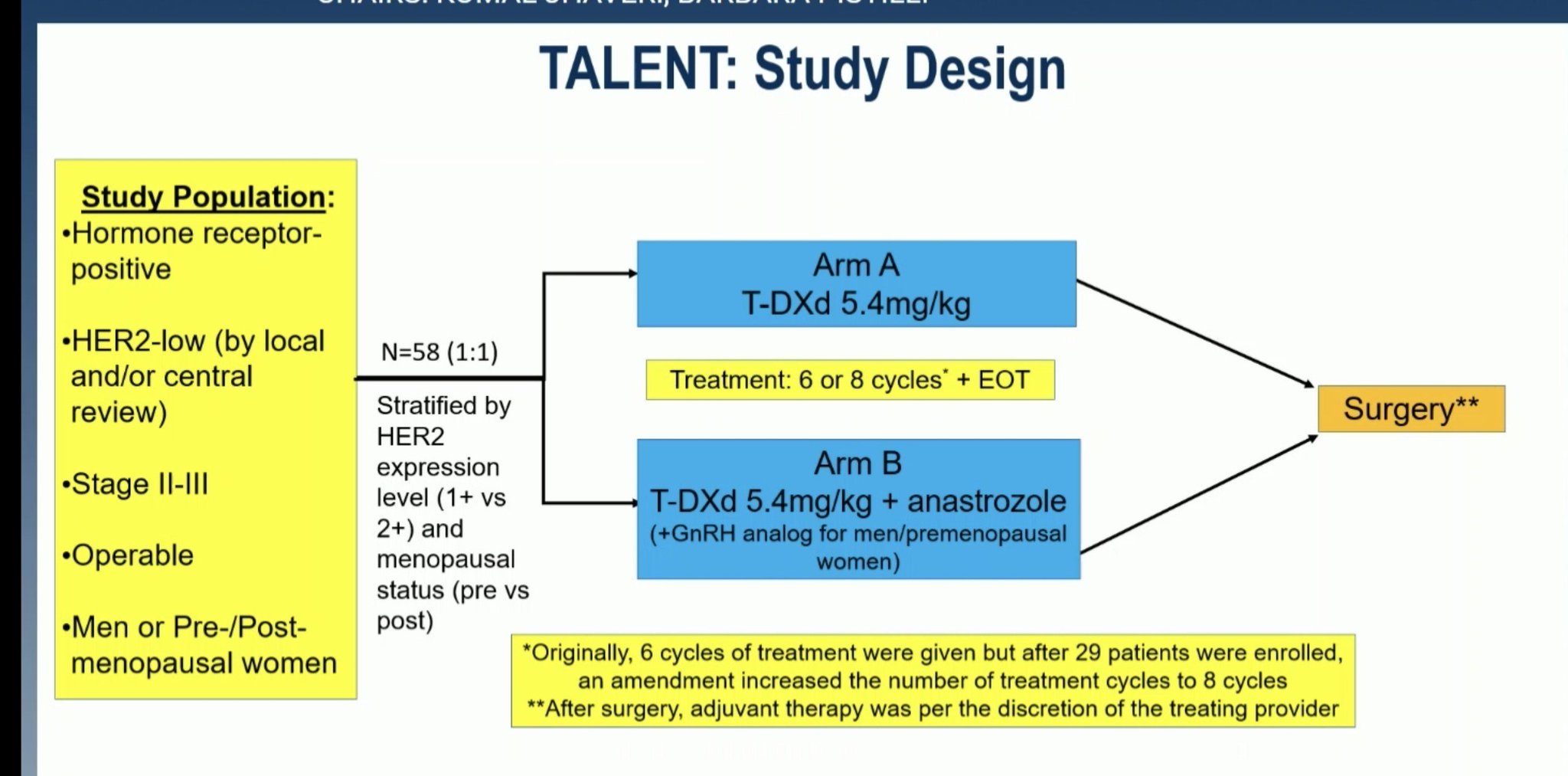
TALENT asked whether trastuzumab deruxtecan, which improves progression-free and overall survival over chemotherapy in metastatic HER2-low breast cancer, could produce pathologic complete responses before surgery in HR-positive, HER2-low early breast cancer, a setting where pCR is uncommon. The investigator-initiated trial (TRIO-US B-12) is sponsored by UCLA’s Jonsson Comprehensive Cancer Center with Translational Research in Oncology (TRIO-US) and funded by Daiichi Sankyo. Arms A and B were randomized 1:1; Arm B (with anastrozole) stopped after stage 1, while Arm A and the later-added Arm C (T-DXd followed by docetaxel plus cyclophosphamide) were expanded. Interim stage-1 results were first reported at SABCS 2022 (abstract GS2-03); the ESMO 2026 LBA23 presentation by Sara A. Hurvitz, MD, reports the final results. Event-free survival, breast-conserving surgery rates and further biomarker analyses are ongoing.
Study Design
Phase 2, open-label, two-stage neoadjuvant study (NCT04553770). Arms A/B randomized 1:1 (N=58 in stage 1), stratified by HER2 IHC 1+ vs 2+ and menopausal status; an arm advanced if ≥2 pCRs were seen. 132 patients enrolled, Nov 2020 to Feb 2026.
Population
Previously untreated, operable stage II–III HR-positive, HER2-low (IHC 1+ or 2+/ISH-) breast cancer; men and pre- or postmenopausal women. Node-positive: 53%, 55% and 81% (Arms A, B, C).
Interventions
Arm A: T-DXd 5.4 mg/kg every 3 weeks. Arm B: T-DXd plus anastrozole 1 mg daily (+GnRH analog for men/premenopausal women). 6 cycles, then 8 after 29 patients. Arm C: 4 cycles T-DXd, then 4 cycles docetaxel 75 mg/m² plus cyclophosphamide 600 mg/m².
Endpoints
Residual cancer burden (RCB; RCB0 = pCR, ypT0/is ypN0), safety, ORR and biomarkers (central Ki67, HER2, ER, PR; HER2 and TROP2 quantified by TROPLEX in Arms A/B).
Presenter
Sara A. Hurvitz, MD (Fred Hutch Cancer Center, University of Washington); senior author Aditya Bardia, MD.
Data Cut
Final results; no data-cutoff date is printed on the abstract or slides. Enrollment Nov 2020 to Feb 2026.
#ESMO26 | TALENT Neoadjuvant T-DXd showed very low pCR rates in HR+/HER2-low early breast cancer: - T-DXd: 7% - T-DXd + anastrozole: 3% - T-DXd → chemotherapy: 9% We should remember that pCR is a limited surrogate endpoint in HR+ disease. However, these results do not support T-DXd as an alternative to standard neoadjuvant chemotherapy. Moreover, given the heterogeneity of HER2-low disease, I find it unsurprising that the success of T-DXd in the metastatic setting does not translate into similar outcomes in early-stage disease, despite the lower tumor burden.
— Yakup Ergün (@dr_yakupergun) Oct 23, 2026
TALENT in the News
TALENT Questions
What is the TALENT trial?
TALENT (TRIO-US B-12; NCT04553770) is a phase 2, two-stage neoadjuvant trial of trastuzumab deruxtecan alone, with anastrozole, or followed by docetaxel plus cyclophosphamide in operable HR-positive, HER2-low stage II-III breast cancer; 132 patients were enrolled. Arms, dosing and sponsor: Trial Design.
What did TALENT show at ESMO 2026?
Pathologic complete response rates were low in all three arms (7%, 3% and 9%), although most tumors shrank. The investigators concluded that neoadjuvant T-DXd showed modest activity. Figures and denominators: At a Glance.
Was TALENT a negative trial?
TALENT is a phase 2 two-stage study; an arm advanced to stage 2 if at least 2 pCRs were seen. The investigators' own conclusion was "modest clinical activity". Several physicians described the result as disappointing or not practice-changing, while others noted that pCR is a limited surrogate in HR-positive disease and that event-free survival is still being analyzed.
Is trastuzumab deruxtecan approved for early-stage HER2-low breast cancer?
No. In HER2-low breast cancer, Enhertu (fam-trastuzumab deruxtecan-nxki) is FDA approved only for unresectable or metastatic disease: after prior chemotherapy (DESTINY-Breast04, August 2022) and, for HR-positive HER2-low or HER2-ultralow disease, after one or more endocrine therapies in the metastatic setting (DESTINY-Breast06, January 2025). Neoadjuvant use as in TALENT is investigational.
What safety signals were reported in TALENT?
On the presentation slides, grade 3 or higher treatment-related adverse events occurred in 24% (Arm A), 17% (Arm B) and 28% (Arm C), with three cases of grade 2 ILD/pneumonitis and one treatment-related death. Details: At a Glance.
What did the biomarker analyses show?
HER2 protein measured by TROPLEX fell during T-DXd treatment while TROP2 stayed relatively stable, and HER2 was higher in tumors that reached RCB0; the sample size is small. Values: At a Glance.