
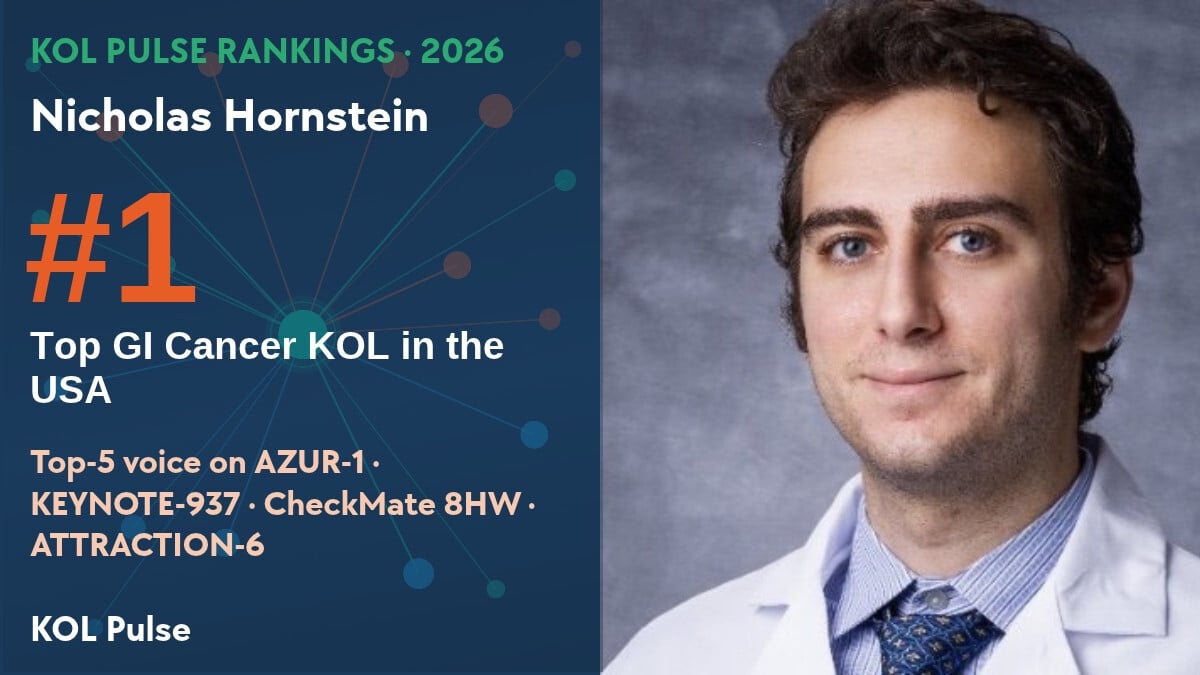
Nicholas Hornstein (@GIMedOnc) ranks #1 among US gi cancer KOLs on X in 2026, by engagement from fellow physicians. 182 physicians shared, quoted or replied to their posts this year. Most-discussed trials in 2026: RASolute 302, AZUR-1, HERIZON-GEA-01. CMS Open Payments lists $24,397 in 2025 general payments.
At a Glance
- 35 posts naming a trial in 2026
- 30 trials discussed by name
- GI Cancer: US #1, Global #2 · 182 physicians engaged
- Leading physician voice: #1 of 14 physicians on AZUR-1; #1 of 12 physicians on KEYNOTE-937
- CMS Open Payments lists $24,397 in 2025 general payments.
This Month
What Nicholas Hornstein has posted in the last 30 days. Updated November 10, 2026.
IROCAS: PIII adjuvant mFOLFIRINOX vs mFOLFOX6 in high-risk stage III colon cancer, now in Annals of Oncology. TLDR: Adding irinotecan did nothing (because it has never worked in the adjuvant setting)📉 Key Points • Adjuvant colon, pT4 and/or pN2 • mFOLFIRINOX vs mFOLFOX6, 12 cycles, n=795 Results • 3-yr DFS 65.6% vs 66.3%, HR 1.07 • 3-yr OS 91.2% vs 86.7%, HR 0.85 • Grade ≥3 AEs identical at 62% (little surprising, just more diarrhea and GCSF use) Importantly, the DFS curves sit on top of each other. Irinotecan doesn’t work in the adjuvant setting, which brings me to my next point, CIRCULATE-US 👀 The escalation arm is cooked. I wonder if there is still equipoise to enroll there? After this and DYNAMIC-III failed, do we have enough data? I guess OS is still immature here so there is a minuscule glimmer of hope? ctDNA keeps getting better at finding the patients who need better treatments, the problem is we didn’t have them until recently. My pitch? Let’s use the new meds, G12Xs, anti-HER2, ADCs with non-irinotecan payloads. We have to do better for our patients. No one should be reaching for Irinotecan as adjuvant in 2026. #ESMO26 @OncoAlert @TheGutOncLab https://t.co/ulj93weSc9
Been chewing on non-GI data. This readout is in lung but highly relevant to high grade extrapulmonary NET. DeLLphi-305 at #ESMO26. Tarlatamab, a DLL3 x CD3 T-cell engager, added to durvalumab as 1L maintenance in extensive-stage SCLC. Design • Phase 3, randomized, open-label, n=563 • durva + platinum/etoposide induction -> Durva + tarlatamab vs durva alone • OS primary, interim analysis OS 21.1 vs 12.7 mo, HR 0.42 12-mo OS 79% vs 53% ES-SCLC survival creeping from around a year, now nearly at 2 years. DLL3 isn't a lung target, it's a neuroendocrine one. (Right @UGrewalMD ? This is your thing for sure). Extrapulmonary NEC has the same story SCLC had: a short response to chemo, then minimal on-label options. The catch is CRS and ICANS, so you need the infrastructure. Maintenance Tarla seem well worth the survival advantage. @OncoAlert @TheGutOncLab @Onco_Nexus
For the final act of CheckMate 8HW, we finally have the significant OS data the doubters have been asking for. What happens when you have a great treatment and an even better one for a study (and almost everyone crosses over)? You have to wait a really, really long time for OS. Also, some thoughts on splitting the alpha I won’t get into here. Nivo/ipi vs nivo alone vs chemo, MSI-H/dMMR mCRC. Final OS analysis. Response rate 72% with nivo/ipi, 58% with nivo alone. Median OS still not reached. OS HR 0.66 for nivo/ipi over nivo, statistically significant. 77% of nivo/ipi patients alive at 5 years. Three out of four patients alive at five years. In metastatic colorectal cancer. 🤯 Not even going to talk about the chemo arm. It's clearly worse, and there is never a time to give chemo in MSI-H unless someone has extreme, active autoimmune disease. “Debulking” is absolute nonsense. Bottom line: the doubters got their OS. Nivo/ipi is the first-line standard for MSI-H mCRC. Next steps: how do we decide length of therapy, and how do we manage oligometastatic progression? #ESMO26 @OncoAlert @TheGutOncLab @OncoAlert
HARMONi-GI1, presidential session at #ESMO26. @UGrewalMD guessed .7 HR I guessed .8 HR We were equally right (.75 HR). Phase 3, 1L advanced biliary tract cancer: ivonescimab (PD-1 x VEGF) + GemCis vs durvalumab + GemCis. 682 patients, median follow-up 14.3 mo. OS 14.9 vs 12.1 mo, HR 0.75 (95% CI 0.61-0.92), p=0.0031 PFS 8.4 vs 5.8 mo, HR 0.61 (95% CI 0.51-0.72) ORR 53.8% vs 32.5% This was an appropriate comparator for 2026 and compelling data (although really did need every one of those patients to power). Probable new first line once the full data comes out. The bispecifics era is in full force. @OncoAlert @TheGutOncLab @UGrewalMD @Onco_Nexus
AZUR-1 delivers. #ESMO26 Phase 2, single arm. Dostarlimab x 9 cycles (6 months) in untreated stage II/III dMMR/MSI-H rectal cancer, 154 patients. Cercek's 49-patient NEJM cohort gone global. No control arm, because randomizing these patients to TNT/TME isn't equitable. cCR12 (complete response held 12+ months, no further treatment): 68% by investigator. 26% needed additional treatment 10% went to surgery 68% is likely lower than reality since many patients probably just needed more time to radiographically respond. Using PET/Biopsy/ctDNA, especially ctDNA, is incredibly helpful in my practice to identify patients who can avoid TME even if a fibrotic tumor remains as they often do. FDA already gave accelerated approval (way to steal the ESMO thunder) last week which leads me to my next point. Obvious new standard of care. You should go to oncology jail if you don't treat MSI-H with IO. @OncoAlert @TheGutOncLab @Onco_Nexus
PRABITAS: PIII biweekly vs conventional TAS-102 + bev in refractory mCRC 🇯🇵, presented at #ESMO26. Yay for confirmation. But everyone should have been doing this since the OG publications (and certainly after @CathyEngMD published). The SUNLIGHT schedule (TAS-102 days 1–5 and 8–12, bev days 1 and 15, every 28 days) works, but the neutropenia is savage at almost 50% G3-4 on SUNLIGHT. PRABITAS has the same dose but spreads it out a littttttle more: TAS-102 days 1–5 + 15-19 and bev every 14 days. 970 patients, dosing at physician discretion. The primary endpoint was OS with an NI margin of 1.25. OS 11.3 vs 10.3 mo, HR 0.93 (95% CI 0.80–1.08). Non-inferior, and the curves are the same. Massive tox reduction, consistent with prior data. This shouldn't surprise anyone. Cathy Eng's group published this schedule in 2025: 16% grade ≥3 neutropenia, no febrile neutropenia, no G-CSF. The Japanese phase 2 data go back to 2020. Do we really always need randomized data to change practice? Do patients deserve to wait for 5+ years? Asking for a friend. @OncoAlert @TheGutOncLab @Onco_Nexus
Who Amplifies Nicholas Hornstein
Physicians who reposted Nicholas Hornstein’s trial posts most often in 2026.


2026 Rankings
| List | US rank | Global rank | Physicians engaged | Physician engagements | |
|---|---|---|---|---|---|
| GI Cancer | #1 | #2 | 182 | 356 | Full ranking |
What Colleagues Are Saying About Nicholas Hornstein
2026 posts by fellow physicians that mention @GIMedOnc, quoted word for word.
Almost there, excitement is at its peak! A clinical compass to practice-changing oncology! The #ASCO26 Annual Meeting is rapidly approaching, and the plenary lineup is historic. #Oncology #MedTwitter | @Larvol | @DrRishabhOnco | @DraMartinezLago | @GIMedOnc | @Erman_Akkus | @SuyogCancer | @graokane | @GillSharlene | @DaisukeKotani | @NiuSanford | @ArndtVogel | @jgong15 | @aparna1024 | | @marklewismd | @MPishvaian | @DrYukselUrun | @dr_yakupergun | @UmutDisel | @tugbawitter | @drmukremin
RASolute 302 highlighted as a #OncoAlertTopTweet for Day 3 of #ASCO26. 🚨 @ASCO @GIMedOnc @OncoAlert A major moment for previously treated metastatic pancreatic cancer — with concomitant NEJM publication and a long-awaited signal for RAS targeting. 🧬 Key takeaways: ✅ Oral RAS(ON) inhibition with daraxonrasib improved outcomes vs investigator’s choice ✅ This may mark a turning point for RAS-directed therapy in pancreatic cancer ✅ The next questions are sequencing, toxicity, access, and how quickly this can be implemented in real-world care For a disease with limited later-line options, this is a genuinely field-shaping result. 🩺 #ASCO26 #PancreaticCancer #GIOncology #OncoAlert
Watch me and my buddies @GIMedOnc and @TimothyJBrownMD discuss what all we’re looking forward to the most in GI oncology abstracts at #ESMO26 @TheGutOncLab https://t.co/4dt7M5xc4q
Trials Nicholas Hornstein Discussed in 2026
| Trial | Posts | Rank among physicians posting | Latest |
|---|---|---|---|
| RASolute 302 | 5 | #6 of 73 | Oct 16, 2026 |
| AZUR-1 | 4 | #1 of 14 | Oct 25, 2026 |
| HERIZON-GEA-01 | 4 | #7 of 34 | Oct 23, 2026 |
| CheckMate 8HW | 3 | #1 of 9 | Oct 25, 2026 |
| BREAKWATER | 3 | #2 of 22 | May 31, 2026 |
| IROCAS | 2 | #5 of 11 | Oct 26, 2026 |
| HARMONi-GI1 (AK112-309) | 2 | #4 of 26 | Oct 25, 2026 |
| SANO | 2 | #4 of 16 | Oct 23, 2026 |
| GHOPE001 | 2 | #5 of 13 | Oct 23, 2026 |
| KRYSTAL-10 | 2 | #2 of 7 | Sep 5, 2026 |
| DYNAMIC-III | 1 | — | Oct 26, 2026 |
| DeLLphi-305 | 1 | #44 of 86 | Oct 26, 2026 |
| PRABITAS | 1 | #7 of 9 | Oct 25, 2026 |
| MASTERPLAN | 1 | #2 of 11 | Oct 24, 2026 |
| KCWISE | 1 | #1 of 4 | Oct 23, 2026 |
| ECLYPSE | 1 | #6 of 7 | Oct 20, 2026 |
| ACTICCA-1 | 1 | #8 of 8 | Oct 16, 2026 |
| AMPLIFY7P | 1 | #6 of 7 | Oct 16, 2026 |
| CLARITY-Gastric01 (CG-01) | 1 | #19 of 26 | Oct 16, 2026 |
| EMT2 | 1 | — | Oct 16, 2026 |
| KEYNOTE975 | 1 | #9 of 12 | Oct 16, 2026 |
| HARMONi-2 | 1 | #10 of 19 | Sep 13, 2026 |
| ATOMIC | 1 | #3 of 9 | Jul 4, 2026 |
| CROWN | 1 | #13 of 36 | May 30, 2026 |
| OptiTROP-Lung05 | 1 | #8 of 19 | May 30, 2026 |
| ATTRACTION6 | 1 | #1 of 3 | May 22, 2026 |
| SERENA-6 | 1 | #18 of 39 | Apr 30, 2026 |
| MOUNTAINEER | 1 | — | Jan 15, 2026 |
| COMMIT | 1 | #13 of 14 | Jan 10, 2026 |
| KEYNOTE-937 | 1 | #1 of 12 | Jan 9, 2026 |
Nicholas Hornstein on RASolute 302
ESMO 2026: GI abstracts I’m watching ESMO is a week away so time to post thoughts on studies that will either change practice, move the field forward or are thought provoking! Gut Onc Lab video next week once text is released. BELOW THE BELT AZUR-1: Dostarlimab for dMMR/MSI-H locally advanced rectal cancer (LBA87) When: Sun Oct 25, 11:00 CET. Lower GI Proffered Paper session. What: Stage II/III MSI-H rectal cancer (n=154) treated with dostarlimab alone. My take: This will be positive. Incredibly positive. This is already what I’m doing in clinical practice and is a massive step forward for the 5–10% of rectal cancer patients that are MSI-H. Yay. IROCAS: Adjuvant mFOLFIRINOX vs mFOLFOX6 in high-risk stage III colon cancer (LBA29) When: Sun Oct 25, 10:15 CET. Lower GI Proffered Paper session. What: Phase 3 of adjuvant mFOLFIRINOX vs mFOLFOX6 in T4 and/or N2 stage III colon cancer. My take: Important study, and honestly, it is going to predict if US-CIRCULATE will be positive. If this is negative, CIRCULATE will be a nail-biter. Encorafenib + cetuximab + FOLFIRI beyond progression in BRAF V600E mCRC (788RO) When: Sat Oct 24, 14:50 CEST. Lower GI Rapid Oral session. What: Continuing EC past progression, adding FOLFIRI, in BRAF V600E mCRC. My take: Already doing this in clinical practice with patients who have BRAF+ disease w/o resistance mechanism on ctDNA at progression. Data for its use is HUGELY welcome. CheckMate 8HW: Final overall survival (LBA32) When: Sat Oct 24, 15:42 CEST. Lower GI Rapid Oral session. What: Final OS for nivo/ipi vs nivo vs chemo in MSI-H metastatic CRC. My take: What happens when you do a trial with an agent that essentially cures a disease against another that cures most people? It is a really long damn trial. Excited for the final OS data. Will it be positive? TBD, but I certainly think the magnitude of benefit of dual IO makes it better than single agent, and this data could reinforce that practice. UNION: Short-course RT → camrelizumab + CAPOX in locally advanced rectal cancer (3530O) When: Sun Oct 25, 11:10 CET. Lower GI Proffered Paper session. What: Phase 3 of SCRT → camrelizumab + CAPOX vs long-course CRT → CAPOX in locally advanced rectal cancer. My take: pCR reported at ~40% in 2024, let’s see if more people were cured. Some criticism in changing radiation schedule and adding IO compared to standard, but will set the stage for future studies. EMT2: Omega-3 EPA after resection of colorectal liver metastases (LBA30) When: Sun Oct 25, 10:25 CET. Lower GI Proffered Paper session. What: Phase 3, double-blind, EPA vs placebo after CRLM resection. My take: It’s like fish oil but better. File this in the ALASCCA category of “costs nothing, helps people” if positive. ALASCCA + CHALLENGE ❤️ QTX3034 + cetuximab ± mFOLFOX6 in KRAS G12D CRC (790RO) When: Sat Oct 24, 15:15 CEST. Lower GI Rapid Oral session. What: Early data on an oral G12D-preferring KRAS inhibitor + cetuximab ± mFOLFOX6 in KRAS G12D mCRC. My take: Sick study. Moving us to molecularly driven treatments in earlier line settings for CRC. Where the field MUST move. If this isn’t positive I will eat a hat (a small one, preferably organic). BOT/BAL in the real world: refractory MSS mCRC and advanced sarcoma (905eP, 3771P) When: 905eP is an ePoster available throughout the meeting. 3771P is Mon Oct 26, 12:00 CET, sarcoma poster session. What: Real-world botensilimab + balstilimab in refractory MSS mCRC (AGEO, France) and advanced sarcoma (Spanish expanded access). My take: Gives us a look at Bot Bal in real world. Important data, multiple attempts to use CPI in advanced disease have provided mixed results, what happens when we use stronger agents? Runner-up: Biweekly vs conventional TAS-102 + bevacizumab in refractory mCRC (LBA31) When: Sat Oct 24, 15:37 CEST. Lower GI Rapid Oral session. What: Randomized comparison of biweekly vs standard-schedule TAS-102 + bev in refractory mCRC. My take: Runner up only because @cathyengmd already convincingly showed this is the dosing schedule we should be using. I already use this in clinical practice. Great to randomize but should be positive. UPPER GI CLARITY-Gastric01 + G-HOPE-001: CLDN18.2 ADCs in pretreated gastric/GEJ cancer (LBA7, LBA77) When: CLARITY-Gastric01 is Sun Oct 25, 17:18 CET, Presidential Symposium II. G-HOPE-001 is Fri Oct 23, 13:30 CEST, Upper GI Proffered Paper session. What: Two phase 3s of CLDN18.2 ADCs vs physician’s choice. Sone-Ve (CLARITY) was positive for OS, and arcotatug tavatecan (G-HOPE) was positive for PFS. My take: The next generation of CLDN18.2 is here. Expect less explosive emesis and improved outcomes. KEYNOTE-975: Pembrolizumab + definitive chemoradiotherapy in esophageal/GEJ cancer (2875O) When: Fri Oct 23, 13:50 CEST. Upper GI Proffered Paper session. What: Phase 3 of pembro vs placebo with definitive chemoradiation in esophageal/GEJ cancer. My take: Merck joins the D-FLOT era for patients still receiving definitive chemoRT. After the CROSS/FLOT study the impact of this is going to be less, but still important for patients receiving definitive chemoRT. HERIZON-GEA-01: Zanidatamab + chemo ± tislelizumab in 1L HER2+ GEA, second interim (LBA79) When: Fri Oct 23, 16:15 CEST. Upper GI Rapid Oral session. What: Second interim of zanidatamab + chemo ± tislelizumab vs trastuzumab + chemo in 1L HER2+ GEA. My take: My practice in HER2+ upper GI/GEA has moved to Zani, will be helpful to see the longer-term outcomes here. SANO: Active surveillance vs surgery after neoadjuvant chemoradiotherapy for esophageal cancer, long-term results (LBA78) When: Fri Oct 23, 13:40 CEST. Upper GI Proffered Paper session. What: Long-term outcomes of active surveillance vs esophagectomy after nCRT in esophageal cancer. My take: People deserve to keep their organs. Our ability to offer this only improves when we layer in tools like ctDNA. Interested in what we can extrapolate to other organ systems (especially for MSI-H). PANCREAS RASolute 302: Daraxonrasib vs chemotherapy in previously treated mPDAC, subgroup analyses (LBA82) When: Fri Oct 23, 14:22 CEST. Upper GI Proffered Paper session. What: Additional subgroup analyses from the phase 3 of daraxonrasib vs chemo in 2L+ metastatic PDAC. My take: Everyone benefited. G12V more than others. Maybe there will be another standing ovation? Come for the science, stay for the clapping. AMPLIFY-7P: mKRAS vaccine ELI-002 7P vs observation in resected PDAC (LBA83) When: Fri Oct 23, 14:32 CEST. Upper GI Proffered Paper session. What: Randomized phase 2 of an off-the-shelf mKRAS vaccine vs observation after PDAC resection. It missed its DFS endpoint. My take: Vaccine therapies are the next frontier. Merck has pushed them forward in Melanoma where they are an amazing success, very interested in the randomized data here. Even if negative it will be critical data to learn from. HCC / BILIARY HARMONi-GI1: Ivonescimab vs durvalumab + GemCis in 1L biliary tract cancer (LBA8) When: Sun Oct 25, 17:42 CET. Presidential Symposium II. What: China-only phase 3 of a PD-1/VEGF bispecific vs durvalumab, both with GemCis. It was positive for OS. My take: PD-1/VEGF emerges in GI. Let’s see the benefit. China only. ACTICCA-1: Adjuvant gemcitabine + cisplatin after resected biliary tract cancer (LBA21) When: Sat Oct 24, 10:25 CEST. Upper GI Proffered Paper session. What: Phase 3 of adjuvant GemCis vs standard of care (capecitabine) after resection of cholangiocarcinoma or gallbladder cancer. My take: Might immediately change the standard of care for resected BTC. Worth tuning in for. @TheGutOncLab @Onco_Nexus @OncoAlert @oncodaily
GI Oncology saw some major changes in NCCN this week. 🔥 🧬 1. Daraxonrasib is officially in the pancreatic cancer guidelines You knew it was coming, now it is here. Preferred, Category 1. Use it. RASolute-302 in previously treated metastatic PDAC: OS: 13.2 vs 6.6 months, HR 0.40 PFS: 7.3 vs 3.5 months, HR 0.45 Subsequent therapy, and importantly it also sneaks into 1L as “useful in certain circumstances,” although only 2B for fit patients (but still there, YAY). So no, we are not throwing FOLFIRINOX/NALIRIFOX in the garbage (yet). But a RAS inhibitor is now a standard treatment for pancreatic cancer. 🔵 2. Zanidatamab + tislelizumab in NCCN for HER2+ GEA Zanidatamab + tislelizumab + chemo vs trastuzumab + chemo: PFS: 12.4 vs 8.1 months, HR 0.63 OS: 26.4 vs 19.2 months, HR 0.72 NCCN now lists zanidatamab-based therapy as Preferred first-line treatment. But… Category 2A. Why? 2A still means uniform NCCN panel consensus (≥85%) that the treatment is appropriate (so yes, you should be using this for these patients), but officially reflects lower-level evidence than Category 1. Except HERIZON was a randomized phase III trial with positive outcomes. So why 2A? Two informed guesses. 1. No US patients were enrolled. It was a large international study, and frankly the incredibly diverse patients I see in NYC probably look more like a global trial population than many historical US trials. 2. The control arm didn't include PD-1. HERIZON compared against trastuzumab + chemo, while our current US standard for PD-L1 CPS ≥1 is pembrolizumab + trastuzumab + chemo. But before we poo-poo HERIZON because of the comparator, let's look at what those studies actually achieved. KEYNOTE-811, CPS ≥1: PFS 10.9 months OS 20.1 months HERIZON: PFS 12.4 months OS 26.4 months Of course, no one would ever compared across trials. 😅 But HERIZON's own trastuzumab/chemo control arm had an OS of 19.2 months. This wasn't a control arm falling over. To me, these data show a real advance in HER2 therapy. If you’re using it, do watch for the diarrhea. NCCN specifically recommends antidiarrheal prophylaxis with zanidatamab and avoiding bolus 5-FU. Grade ≥3 diarrhea was 24.8% with the quadruplet but can be controlled and is only during the first few treatments. 3. And very briefly, MATTERHORN FLOT + durvalumab was upgraded 2B → 2A for PD-L1 <1 and diffuse-type EGJ adenocarcinoma. Overall MATTERHORN: 2-year EFS 67.4% vs 58.5%, HR 0.71, with pCR 19.2% vs 7.2%. Love seeing forward progress in GI Oncology. @TheGutOncLab @OncoAlert @Onco_Nexus @oncodaily
Coming in hot! @OncoAlert covering the most important day of #ASCO2026 including RASolute-302. https://t.co/ss971Wpg8N
Nicholas Hornstein on AZUR-1
AZUR-1 delivers. #ESMO26 Phase 2, single arm. Dostarlimab x 9 cycles (6 months) in untreated stage II/III dMMR/MSI-H rectal cancer, 154 patients. Cercek's 49-patient NEJM cohort gone global. No control arm, because randomizing these patients to TNT/TME isn't equitable. cCR12 (complete response held 12+ months, no further treatment): 68% by investigator. 26% needed additional treatment 10% went to surgery 68% is likely lower than reality since many patients probably just needed more time to radiographically respond. Using PET/Biopsy/ctDNA, especially ctDNA, is incredibly helpful in my practice to identify patients who can avoid TME even if a fibrotic tumor remains as they often do. FDA already gave accelerated approval (way to steal the ESMO thunder) last week which leads me to my next point. Obvious new standard of care. You should go to oncology jail if you don't treat MSI-H with IO. @OncoAlert @TheGutOncLab @Onco_Nexus
So many hot drops leading up to #ESMO26. Not to be outdone by AZUR-1, CheckMate 8HW, or any of the other incredible IO breakthroughs, Chalabi comes out with the long-term NICHE-2 follow-up. In a word? Perfect. 111 patients with locally advanced dMMR colon cancer. Just 6 weeks of neoadjuvant nivolumab/ipilimumab followed by surgery. Zero recurrences. 100% overall survival at 5 years. And remember, these weren’t all low-risk tumors. Many had high-risk stage III disease. We’re curing patients with just weeks of immunotherapy. Now, can we avoid the surgery altogether? What a time to be treating GI cancers. @TheGutOncLab @OncoAlert @Onco_Nexus https://t.co/VAAAN6dcFz
🚨 FDA approval for dostarlimab in locally advanced dMMR/MSI-H rectal cancer! This was based on AZUR-1, with full data coming at @myESMO. #ESMO26 No recurrences among responders after more than 2 years of median follow-up! We know immunotherapy works, and when patients respond, those responses can be incredible. I’ve been using immunotherapy with curative intent in these patients, and I haven’t been disappointed. The fact that we’re potentially curing solid tumors with systemic therapy alone, without chemotherapy, radiation, or surgery, is magical. Looking forward to the full data and seeing this approach become more broadly available to patients. @OncoAlert @Onco_Nexus @TheGutOncLab https://t.co/WH5EwpBi02
Nicholas Hornstein on HERIZON-GEA-01
HERIZON-GEA-01 second OS interim at #ESMO26, and I'm a triplet believer. In January I wondered if tislelizumab was necessary. With 35 months of follow-up, my answer is yes. 914 patients, 1L HER2+ GEA, randomized 1:1:1 to zani + chemo ± tislelizumab vs trastuzumab + chemo. Median OS • Zani + chemo + tisle: 27.0 mo • Zani + chemo: 22.9 mo • Tras + chemo: 19.6 mo 3-year OS: 39.8% vs 31.5% vs 22.9% The doublet now has its own OS win over trastuzumab (HR 0.76, 95% CI 0.62–0.93, p=0.0088). The triplet vs trastuzumab got better with time (HR 0.72 at IA1, now 0.65). Triplet vs doublet: HR 0.81 (95% CI 0.65–1.00), p=0.0502. Yes, it technically misses. But 4 more months of median OS is clinically meaningful in metastatic gastric cancer. Patients also stayed on the triplet longer (~47 vs ~30 weeks), with no new safety signal. Takeaway: zani + chemo + tisle is my 1L default for HER2+ GEA. Bring on the bispecifics 🔥 @OncoAlert @TheGutOncLab @OncoAlert
ESMO 2026: GI abstracts I’m watching ESMO is a week away so time to post thoughts on studies that will either change practice, move the field forward or are thought provoking! Gut Onc Lab video next week once text is released. BELOW THE BELT AZUR-1: Dostarlimab for dMMR/MSI-H locally advanced rectal cancer (LBA87) When: Sun Oct 25, 11:00 CET. Lower GI Proffered Paper session. What: Stage II/III MSI-H rectal cancer (n=154) treated with dostarlimab alone. My take: This will be positive. Incredibly positive. This is already what I’m doing in clinical practice and is a massive step forward for the 5–10% of rectal cancer patients that are MSI-H. Yay. IROCAS: Adjuvant mFOLFIRINOX vs mFOLFOX6 in high-risk stage III colon cancer (LBA29) When: Sun Oct 25, 10:15 CET. Lower GI Proffered Paper session. What: Phase 3 of adjuvant mFOLFIRINOX vs mFOLFOX6 in T4 and/or N2 stage III colon cancer. My take: Important study, and honestly, it is going to predict if US-CIRCULATE will be positive. If this is negative, CIRCULATE will be a nail-biter. Encorafenib + cetuximab + FOLFIRI beyond progression in BRAF V600E mCRC (788RO) When: Sat Oct 24, 14:50 CEST. Lower GI Rapid Oral session. What: Continuing EC past progression, adding FOLFIRI, in BRAF V600E mCRC. My take: Already doing this in clinical practice with patients who have BRAF+ disease w/o resistance mechanism on ctDNA at progression. Data for its use is HUGELY welcome. CheckMate 8HW: Final overall survival (LBA32) When: Sat Oct 24, 15:42 CEST. Lower GI Rapid Oral session. What: Final OS for nivo/ipi vs nivo vs chemo in MSI-H metastatic CRC. My take: What happens when you do a trial with an agent that essentially cures a disease against another that cures most people? It is a really long damn trial. Excited for the final OS data. Will it be positive? TBD, but I certainly think the magnitude of benefit of dual IO makes it better than single agent, and this data could reinforce that practice. UNION: Short-course RT → camrelizumab + CAPOX in locally advanced rectal cancer (3530O) When: Sun Oct 25, 11:10 CET. Lower GI Proffered Paper session. What: Phase 3 of SCRT → camrelizumab + CAPOX vs long-course CRT → CAPOX in locally advanced rectal cancer. My take: pCR reported at ~40% in 2024, let’s see if more people were cured. Some criticism in changing radiation schedule and adding IO compared to standard, but will set the stage for future studies. EMT2: Omega-3 EPA after resection of colorectal liver metastases (LBA30) When: Sun Oct 25, 10:25 CET. Lower GI Proffered Paper session. What: Phase 3, double-blind, EPA vs placebo after CRLM resection. My take: It’s like fish oil but better. File this in the ALASCCA category of “costs nothing, helps people” if positive. ALASCCA + CHALLENGE ❤️ QTX3034 + cetuximab ± mFOLFOX6 in KRAS G12D CRC (790RO) When: Sat Oct 24, 15:15 CEST. Lower GI Rapid Oral session. What: Early data on an oral G12D-preferring KRAS inhibitor + cetuximab ± mFOLFOX6 in KRAS G12D mCRC. My take: Sick study. Moving us to molecularly driven treatments in earlier line settings for CRC. Where the field MUST move. If this isn’t positive I will eat a hat (a small one, preferably organic). BOT/BAL in the real world: refractory MSS mCRC and advanced sarcoma (905eP, 3771P) When: 905eP is an ePoster available throughout the meeting. 3771P is Mon Oct 26, 12:00 CET, sarcoma poster session. What: Real-world botensilimab + balstilimab in refractory MSS mCRC (AGEO, France) and advanced sarcoma (Spanish expanded access). My take: Gives us a look at Bot Bal in real world. Important data, multiple attempts to use CPI in advanced disease have provided mixed results, what happens when we use stronger agents? Runner-up: Biweekly vs conventional TAS-102 + bevacizumab in refractory mCRC (LBA31) When: Sat Oct 24, 15:37 CEST. Lower GI Rapid Oral session. What: Randomized comparison of biweekly vs standard-schedule TAS-102 + bev in refractory mCRC. My take: Runner up only because @cathyengmd already convincingly showed this is the dosing schedule we should be using. I already use this in clinical practice. Great to randomize but should be positive. UPPER GI CLARITY-Gastric01 + G-HOPE-001: CLDN18.2 ADCs in pretreated gastric/GEJ cancer (LBA7, LBA77) When: CLARITY-Gastric01 is Sun Oct 25, 17:18 CET, Presidential Symposium II. G-HOPE-001 is Fri Oct 23, 13:30 CEST, Upper GI Proffered Paper session. What: Two phase 3s of CLDN18.2 ADCs vs physician’s choice. Sone-Ve (CLARITY) was positive for OS, and arcotatug tavatecan (G-HOPE) was positive for PFS. My take: The next generation of CLDN18.2 is here. Expect less explosive emesis and improved outcomes. KEYNOTE-975: Pembrolizumab + definitive chemoradiotherapy in esophageal/GEJ cancer (2875O) When: Fri Oct 23, 13:50 CEST. Upper GI Proffered Paper session. What: Phase 3 of pembro vs placebo with definitive chemoradiation in esophageal/GEJ cancer. My take: Merck joins the D-FLOT era for patients still receiving definitive chemoRT. After the CROSS/FLOT study the impact of this is going to be less, but still important for patients receiving definitive chemoRT. HERIZON-GEA-01: Zanidatamab + chemo ± tislelizumab in 1L HER2+ GEA, second interim (LBA79) When: Fri Oct 23, 16:15 CEST. Upper GI Rapid Oral session. What: Second interim of zanidatamab + chemo ± tislelizumab vs trastuzumab + chemo in 1L HER2+ GEA. My take: My practice in HER2+ upper GI/GEA has moved to Zani, will be helpful to see the longer-term outcomes here. SANO: Active surveillance vs surgery after neoadjuvant chemoradiotherapy for esophageal cancer, long-term results (LBA78) When: Fri Oct 23, 13:40 CEST. Upper GI Proffered Paper session. What: Long-term outcomes of active surveillance vs esophagectomy after nCRT in esophageal cancer. My take: People deserve to keep their organs. Our ability to offer this only improves when we layer in tools like ctDNA. Interested in what we can extrapolate to other organ systems (especially for MSI-H). PANCREAS RASolute 302: Daraxonrasib vs chemotherapy in previously treated mPDAC, subgroup analyses (LBA82) When: Fri Oct 23, 14:22 CEST. Upper GI Proffered Paper session. What: Additional subgroup analyses from the phase 3 of daraxonrasib vs chemo in 2L+ metastatic PDAC. My take: Everyone benefited. G12V more than others. Maybe there will be another standing ovation? Come for the science, stay for the clapping. AMPLIFY-7P: mKRAS vaccine ELI-002 7P vs observation in resected PDAC (LBA83) When: Fri Oct 23, 14:32 CEST. Upper GI Proffered Paper session. What: Randomized phase 2 of an off-the-shelf mKRAS vaccine vs observation after PDAC resection. It missed its DFS endpoint. My take: Vaccine therapies are the next frontier. Merck has pushed them forward in Melanoma where they are an amazing success, very interested in the randomized data here. Even if negative it will be critical data to learn from. HCC / BILIARY HARMONi-GI1: Ivonescimab vs durvalumab + GemCis in 1L biliary tract cancer (LBA8) When: Sun Oct 25, 17:42 CET. Presidential Symposium II. What: China-only phase 3 of a PD-1/VEGF bispecific vs durvalumab, both with GemCis. It was positive for OS. My take: PD-1/VEGF emerges in GI. Let’s see the benefit. China only. ACTICCA-1: Adjuvant gemcitabine + cisplatin after resected biliary tract cancer (LBA21) When: Sat Oct 24, 10:25 CEST. Upper GI Proffered Paper session. What: Phase 3 of adjuvant GemCis vs standard of care (capecitabine) after resection of cholangiocarcinoma or gallbladder cancer. My take: Might immediately change the standard of care for resected BTC. Worth tuning in for. @TheGutOncLab @Onco_Nexus @OncoAlert @oncodaily
🔥 FDA APPROVAL Zanidatamab is now FDA approved in 1L HER2+ metastatic/unresectable gastric, GEJ, and esophageal adenocarcinoma. Back at #GI26, after HERIZON-GEA-01, I wrote: We have a new first line. Now its official. For context: ToGA established trastuzumab + chemo in 2010. KEYNOTE-811 added pembrolizumab. But trastuzumab stayed the HER2 backbone for ~15 years. HERIZON changes that. Zanidatamab + tislelizumab + chemo vs trastuzumab + chemo: 📈 PFS 12.4 vs 8.1 mo HR 0.63 🔥 OS 26.4 vs 19.2 mo HR 0.72 That is a meaningful step forward (with one caveat). This was not compared against trastuzumab + pembrolizumab + chemo, so we do not have a direct KEYNOTE-811 head-to-head. Practically though, ✅ IHC 3+ or IHC 2+/ISH+, IO eligible: zani + PD1+ chemo is now my 1L option ✅ IHC 3+, no IO: zani + chemo is also FDA approved (although the PDL1 null subgroup is its own complicated + somewhat confusing discussion) And please, for the love of all things GI oncology: 🚨 WATCH FOR DIARRHEA. ESPECIALLY THE FIRST 2 CYCLES. Any-grade diarrhea was 83%. Grade ≥3: ~25%. Most first episodes happened early. The study mandated loperamide prophylaxis in cycle 1. PLEASE counsel aggressively, have loperamide in hand before treatment starts, and watch hydration/electrolytes closely. With that said, excited that we finally have a new HER2 backbone in gastroesophageal cancer. 🔥 https://t.co/V9Xx0uLCmt @Onco_Nexus @TheGutOncLab @OncoAlert @oncodaily
Nicholas Hornstein on CheckMate 8HW
For the final act of CheckMate 8HW, we finally have the significant OS data the doubters have been asking for. What happens when you have a great treatment and an even better one for a study (and almost everyone crosses over)? You have to wait a really, really long time for OS. Also, some thoughts on splitting the alpha I won’t get into here. Nivo/ipi vs nivo alone vs chemo, MSI-H/dMMR mCRC. Final OS analysis. Response rate 72% with nivo/ipi, 58% with nivo alone. Median OS still not reached. OS HR 0.66 for nivo/ipi over nivo, statistically significant. 77% of nivo/ipi patients alive at 5 years. Three out of four patients alive at five years. In metastatic colorectal cancer. 🤯 Not even going to talk about the chemo arm. It's clearly worse, and there is never a time to give chemo in MSI-H unless someone has extreme, active autoimmune disease. “Debulking” is absolute nonsense. Bottom line: the doubters got their OS. Nivo/ipi is the first-line standard for MSI-H mCRC. Next steps: how do we decide length of therapy, and how do we manage oligometastatic progression? #ESMO26 @OncoAlert @TheGutOncLab @OncoAlert
So many hot drops leading up to #ESMO26. Not to be outdone by AZUR-1, CheckMate 8HW, or any of the other incredible IO breakthroughs, Chalabi comes out with the long-term NICHE-2 follow-up. In a word? Perfect. 111 patients with locally advanced dMMR colon cancer. Just 6 weeks of neoadjuvant nivolumab/ipilimumab followed by surgery. Zero recurrences. 100% overall survival at 5 years. And remember, these weren’t all low-risk tumors. Many had high-risk stage III disease. We’re curing patients with just weeks of immunotherapy. Now, can we avoid the surgery altogether? What a time to be treating GI cancers. @TheGutOncLab @OncoAlert @Onco_Nexus https://t.co/VAAAN6dcFz
ESMO 2026: GI abstracts I’m watching ESMO is a week away so time to post thoughts on studies that will either change practice, move the field forward or are thought provoking! Gut Onc Lab video next week once text is released. BELOW THE BELT AZUR-1: Dostarlimab for dMMR/MSI-H locally advanced rectal cancer (LBA87) When: Sun Oct 25, 11:00 CET. Lower GI Proffered Paper session. What: Stage II/III MSI-H rectal cancer (n=154) treated with dostarlimab alone. My take: This will be positive. Incredibly positive. This is already what I’m doing in clinical practice and is a massive step forward for the 5–10% of rectal cancer patients that are MSI-H. Yay. IROCAS: Adjuvant mFOLFIRINOX vs mFOLFOX6 in high-risk stage III colon cancer (LBA29) When: Sun Oct 25, 10:15 CET. Lower GI Proffered Paper session. What: Phase 3 of adjuvant mFOLFIRINOX vs mFOLFOX6 in T4 and/or N2 stage III colon cancer. My take: Important study, and honestly, it is going to predict if US-CIRCULATE will be positive. If this is negative, CIRCULATE will be a nail-biter. Encorafenib + cetuximab + FOLFIRI beyond progression in BRAF V600E mCRC (788RO) When: Sat Oct 24, 14:50 CEST. Lower GI Rapid Oral session. What: Continuing EC past progression, adding FOLFIRI, in BRAF V600E mCRC. My take: Already doing this in clinical practice with patients who have BRAF+ disease w/o resistance mechanism on ctDNA at progression. Data for its use is HUGELY welcome. CheckMate 8HW: Final overall survival (LBA32) When: Sat Oct 24, 15:42 CEST. Lower GI Rapid Oral session. What: Final OS for nivo/ipi vs nivo vs chemo in MSI-H metastatic CRC. My take: What happens when you do a trial with an agent that essentially cures a disease against another that cures most people? It is a really long damn trial. Excited for the final OS data. Will it be positive? TBD, but I certainly think the magnitude of benefit of dual IO makes it better than single agent, and this data could reinforce that practice. UNION: Short-course RT → camrelizumab + CAPOX in locally advanced rectal cancer (3530O) When: Sun Oct 25, 11:10 CET. Lower GI Proffered Paper session. What: Phase 3 of SCRT → camrelizumab + CAPOX vs long-course CRT → CAPOX in locally advanced rectal cancer. My take: pCR reported at ~40% in 2024, let’s see if more people were cured. Some criticism in changing radiation schedule and adding IO compared to standard, but will set the stage for future studies. EMT2: Omega-3 EPA after resection of colorectal liver metastases (LBA30) When: Sun Oct 25, 10:25 CET. Lower GI Proffered Paper session. What: Phase 3, double-blind, EPA vs placebo after CRLM resection. My take: It’s like fish oil but better. File this in the ALASCCA category of “costs nothing, helps people” if positive. ALASCCA + CHALLENGE ❤️ QTX3034 + cetuximab ± mFOLFOX6 in KRAS G12D CRC (790RO) When: Sat Oct 24, 15:15 CEST. Lower GI Rapid Oral session. What: Early data on an oral G12D-preferring KRAS inhibitor + cetuximab ± mFOLFOX6 in KRAS G12D mCRC. My take: Sick study. Moving us to molecularly driven treatments in earlier line settings for CRC. Where the field MUST move. If this isn’t positive I will eat a hat (a small one, preferably organic). BOT/BAL in the real world: refractory MSS mCRC and advanced sarcoma (905eP, 3771P) When: 905eP is an ePoster available throughout the meeting. 3771P is Mon Oct 26, 12:00 CET, sarcoma poster session. What: Real-world botensilimab + balstilimab in refractory MSS mCRC (AGEO, France) and advanced sarcoma (Spanish expanded access). My take: Gives us a look at Bot Bal in real world. Important data, multiple attempts to use CPI in advanced disease have provided mixed results, what happens when we use stronger agents? Runner-up: Biweekly vs conventional TAS-102 + bevacizumab in refractory mCRC (LBA31) When: Sat Oct 24, 15:37 CEST. Lower GI Rapid Oral session. What: Randomized comparison of biweekly vs standard-schedule TAS-102 + bev in refractory mCRC. My take: Runner up only because @cathyengmd already convincingly showed this is the dosing schedule we should be using. I already use this in clinical practice. Great to randomize but should be positive. UPPER GI CLARITY-Gastric01 + G-HOPE-001: CLDN18.2 ADCs in pretreated gastric/GEJ cancer (LBA7, LBA77) When: CLARITY-Gastric01 is Sun Oct 25, 17:18 CET, Presidential Symposium II. G-HOPE-001 is Fri Oct 23, 13:30 CEST, Upper GI Proffered Paper session. What: Two phase 3s of CLDN18.2 ADCs vs physician’s choice. Sone-Ve (CLARITY) was positive for OS, and arcotatug tavatecan (G-HOPE) was positive for PFS. My take: The next generation of CLDN18.2 is here. Expect less explosive emesis and improved outcomes. KEYNOTE-975: Pembrolizumab + definitive chemoradiotherapy in esophageal/GEJ cancer (2875O) When: Fri Oct 23, 13:50 CEST. Upper GI Proffered Paper session. What: Phase 3 of pembro vs placebo with definitive chemoradiation in esophageal/GEJ cancer. My take: Merck joins the D-FLOT era for patients still receiving definitive chemoRT. After the CROSS/FLOT study the impact of this is going to be less, but still important for patients receiving definitive chemoRT. HERIZON-GEA-01: Zanidatamab + chemo ± tislelizumab in 1L HER2+ GEA, second interim (LBA79) When: Fri Oct 23, 16:15 CEST. Upper GI Rapid Oral session. What: Second interim of zanidatamab + chemo ± tislelizumab vs trastuzumab + chemo in 1L HER2+ GEA. My take: My practice in HER2+ upper GI/GEA has moved to Zani, will be helpful to see the longer-term outcomes here. SANO: Active surveillance vs surgery after neoadjuvant chemoradiotherapy for esophageal cancer, long-term results (LBA78) When: Fri Oct 23, 13:40 CEST. Upper GI Proffered Paper session. What: Long-term outcomes of active surveillance vs esophagectomy after nCRT in esophageal cancer. My take: People deserve to keep their organs. Our ability to offer this only improves when we layer in tools like ctDNA. Interested in what we can extrapolate to other organ systems (especially for MSI-H). PANCREAS RASolute 302: Daraxonrasib vs chemotherapy in previously treated mPDAC, subgroup analyses (LBA82) When: Fri Oct 23, 14:22 CEST. Upper GI Proffered Paper session. What: Additional subgroup analyses from the phase 3 of daraxonrasib vs chemo in 2L+ metastatic PDAC. My take: Everyone benefited. G12V more than others. Maybe there will be another standing ovation? Come for the science, stay for the clapping. AMPLIFY-7P: mKRAS vaccine ELI-002 7P vs observation in resected PDAC (LBA83) When: Fri Oct 23, 14:32 CEST. Upper GI Proffered Paper session. What: Randomized phase 2 of an off-the-shelf mKRAS vaccine vs observation after PDAC resection. It missed its DFS endpoint. My take: Vaccine therapies are the next frontier. Merck has pushed them forward in Melanoma where they are an amazing success, very interested in the randomized data here. Even if negative it will be critical data to learn from. HCC / BILIARY HARMONi-GI1: Ivonescimab vs durvalumab + GemCis in 1L biliary tract cancer (LBA8) When: Sun Oct 25, 17:42 CET. Presidential Symposium II. What: China-only phase 3 of a PD-1/VEGF bispecific vs durvalumab, both with GemCis. It was positive for OS. My take: PD-1/VEGF emerges in GI. Let’s see the benefit. China only. ACTICCA-1: Adjuvant gemcitabine + cisplatin after resected biliary tract cancer (LBA21) When: Sat Oct 24, 10:25 CEST. Upper GI Proffered Paper session. What: Phase 3 of adjuvant GemCis vs standard of care (capecitabine) after resection of cholangiocarcinoma or gallbladder cancer. My take: Might immediately change the standard of care for resected BTC. Worth tuning in for. @TheGutOncLab @Onco_Nexus @OncoAlert @oncodaily
Nicholas Hornstein on BREAKWATER
#ASCO26 BREAKWATER: Encorafenib + cetuximab + FOLFIRI in 1L BRAF V600E-mutant mCRC Abstract LBA3503 Presentation: May 31, 2026 BRAF V600E-mutant CRC has always been different. More aggressive biology. Worse prognosis. Less forgiving clinical course. For years, the question was whether we could move targeted therapy earlier and make a real dent in outcomes, not just response. BREAKWATER keeps answering that question. This cohort evaluated encorafenib + cetuximab with FOLFIRI in the first-line setting for BRAF V600E-mutant mCRC. Quick hits: 📌 1L BRAF V600E-mutant mCRC Encorafenib + cetuximab + FOLFIRI vs FOLFIRI ± bevacizumab 🎯 Response 64.4% vs 39.2% 📈 Median PFS 15.2 vs 8.3 months HR 0.44 📊 Overall survival HR 0.56 🔥 18-month OS 72.0% vs 54.5% This is the kind of result that matters because it is not just one endpoint moving. Response matters in symptomatic disease. PFS matters in aggressive biology. OS matters always. And here, all three are positive. The practical piece is also important: FOLFIRI gives clinicians flexibility. For patients with neuropathy, prior oxaliplatin exposure, or concern about cumulative oxaliplatin toxicity, this helps support a fluoropyrimidine/irinotecan backbone with EGFR/BRAF targeting. My take: for BRAF V600E-mutant mCRC, the treatment frame has changed. This is no longer a disease where we wait for later-line targeted therapy. The targeted backbone belongs up front. @TheGutonclab @UGrewalMD @TimothyJBrownMD @OncoAlert @Onco_Nexus @ASCO @NazliDizman @LauraAlderMD @DVAraujoMD @DrBarbiOnc @LauraEsfeller @FunchainMD @YGaritaonaindia @DrSAHaddad @jgong15 @iandresmeraz @SakditadMD @RamilaShilpakar @RohitBanwar @lungoncdoc
I’ve been using a lot of 5FU + CE in my clinic as maintenance, and it seems that is a very common practice in other clinics. Remember, the one reason neuropathy appears worse in the BREAKWATER regimen is because patients do better and stay on treatment longer. Maintenance strategies are critical but don’t have as much data (yet).
BREAKWATER Cohort 3 at #GI26 👀 Presented by @skopetz @ASCO Important context first. This is unlikely to be practice changing in the US, where we generally favor upfront FOLFOX. But in Europe and Canada, FOLFIRI is used upfront a meaningful amount of the time, so these data matter 🌍 BREAKWATER Cohort 3 1L BRAF V600E–mutant mCRC, n=147 FOLFIRI plus encorafenib and cetuximab vs FOLFIRI control What we saw: 1️⃣ ORR 64% vs 39% 2️⃣ OS trend favoring EC plus FOLFIRI HR 0.49 (95% CI 0.24 to 1.03), median OS not reached 3️⃣ Results look very consistent with what we saw in the FOLFOX cohort 4️⃣ No new safety signals Takeaway: Not a paradigm shift in the US, but reassuring and useful data, especially for 🇨🇦 and parts of 🇪🇺 where FOLFIRI is commonly used upfront. Always good to have more validated options for BRAF-mutant disease. Lingering question for me: If you start EC with FOLFIRI, do you continue EC at progression the same way many of us do after FOLFOX? Would love to see data addressing that. At least we know toxicity is ok now. #GI26 @OncoAlert @TheGutOncLabi
Nicholas Hornstein on IROCAS
IROCAS: PIII adjuvant mFOLFIRINOX vs mFOLFOX6 in high-risk stage III colon cancer, now in Annals of Oncology. TLDR: Adding irinotecan did nothing (because it has never worked in the adjuvant setting)📉 Key Points • Adjuvant colon, pT4 and/or pN2 • mFOLFIRINOX vs mFOLFOX6, 12 cycles, n=795 Results • 3-yr DFS 65.6% vs 66.3%, HR 1.07 • 3-yr OS 91.2% vs 86.7%, HR 0.85 • Grade ≥3 AEs identical at 62% (little surprising, just more diarrhea and GCSF use) Importantly, the DFS curves sit on top of each other. Irinotecan doesn’t work in the adjuvant setting, which brings me to my next point, CIRCULATE-US 👀 The escalation arm is cooked. I wonder if there is still equipoise to enroll there? After this and DYNAMIC-III failed, do we have enough data? I guess OS is still immature here so there is a minuscule glimmer of hope? ctDNA keeps getting better at finding the patients who need better treatments, the problem is we didn’t have them until recently. My pitch? Let’s use the new meds, G12Xs, anti-HER2, ADCs with non-irinotecan payloads. We have to do better for our patients. No one should be reaching for Irinotecan as adjuvant in 2026. #ESMO26 @OncoAlert @TheGutOncLab https://t.co/ulj93weSc9
ESMO 2026: GI abstracts I’m watching ESMO is a week away so time to post thoughts on studies that will either change practice, move the field forward or are thought provoking! Gut Onc Lab video next week once text is released. BELOW THE BELT AZUR-1: Dostarlimab for dMMR/MSI-H locally advanced rectal cancer (LBA87) When: Sun Oct 25, 11:00 CET. Lower GI Proffered Paper session. What: Stage II/III MSI-H rectal cancer (n=154) treated with dostarlimab alone. My take: This will be positive. Incredibly positive. This is already what I’m doing in clinical practice and is a massive step forward for the 5–10% of rectal cancer patients that are MSI-H. Yay. IROCAS: Adjuvant mFOLFIRINOX vs mFOLFOX6 in high-risk stage III colon cancer (LBA29) When: Sun Oct 25, 10:15 CET. Lower GI Proffered Paper session. What: Phase 3 of adjuvant mFOLFIRINOX vs mFOLFOX6 in T4 and/or N2 stage III colon cancer. My take: Important study, and honestly, it is going to predict if US-CIRCULATE will be positive. If this is negative, CIRCULATE will be a nail-biter. Encorafenib + cetuximab + FOLFIRI beyond progression in BRAF V600E mCRC (788RO) When: Sat Oct 24, 14:50 CEST. Lower GI Rapid Oral session. What: Continuing EC past progression, adding FOLFIRI, in BRAF V600E mCRC. My take: Already doing this in clinical practice with patients who have BRAF+ disease w/o resistance mechanism on ctDNA at progression. Data for its use is HUGELY welcome. CheckMate 8HW: Final overall survival (LBA32) When: Sat Oct 24, 15:42 CEST. Lower GI Rapid Oral session. What: Final OS for nivo/ipi vs nivo vs chemo in MSI-H metastatic CRC. My take: What happens when you do a trial with an agent that essentially cures a disease against another that cures most people? It is a really long damn trial. Excited for the final OS data. Will it be positive? TBD, but I certainly think the magnitude of benefit of dual IO makes it better than single agent, and this data could reinforce that practice. UNION: Short-course RT → camrelizumab + CAPOX in locally advanced rectal cancer (3530O) When: Sun Oct 25, 11:10 CET. Lower GI Proffered Paper session. What: Phase 3 of SCRT → camrelizumab + CAPOX vs long-course CRT → CAPOX in locally advanced rectal cancer. My take: pCR reported at ~40% in 2024, let’s see if more people were cured. Some criticism in changing radiation schedule and adding IO compared to standard, but will set the stage for future studies. EMT2: Omega-3 EPA after resection of colorectal liver metastases (LBA30) When: Sun Oct 25, 10:25 CET. Lower GI Proffered Paper session. What: Phase 3, double-blind, EPA vs placebo after CRLM resection. My take: It’s like fish oil but better. File this in the ALASCCA category of “costs nothing, helps people” if positive. ALASCCA + CHALLENGE ❤️ QTX3034 + cetuximab ± mFOLFOX6 in KRAS G12D CRC (790RO) When: Sat Oct 24, 15:15 CEST. Lower GI Rapid Oral session. What: Early data on an oral G12D-preferring KRAS inhibitor + cetuximab ± mFOLFOX6 in KRAS G12D mCRC. My take: Sick study. Moving us to molecularly driven treatments in earlier line settings for CRC. Where the field MUST move. If this isn’t positive I will eat a hat (a small one, preferably organic). BOT/BAL in the real world: refractory MSS mCRC and advanced sarcoma (905eP, 3771P) When: 905eP is an ePoster available throughout the meeting. 3771P is Mon Oct 26, 12:00 CET, sarcoma poster session. What: Real-world botensilimab + balstilimab in refractory MSS mCRC (AGEO, France) and advanced sarcoma (Spanish expanded access). My take: Gives us a look at Bot Bal in real world. Important data, multiple attempts to use CPI in advanced disease have provided mixed results, what happens when we use stronger agents? Runner-up: Biweekly vs conventional TAS-102 + bevacizumab in refractory mCRC (LBA31) When: Sat Oct 24, 15:37 CEST. Lower GI Rapid Oral session. What: Randomized comparison of biweekly vs standard-schedule TAS-102 + bev in refractory mCRC. My take: Runner up only because @cathyengmd already convincingly showed this is the dosing schedule we should be using. I already use this in clinical practice. Great to randomize but should be positive. UPPER GI CLARITY-Gastric01 + G-HOPE-001: CLDN18.2 ADCs in pretreated gastric/GEJ cancer (LBA7, LBA77) When: CLARITY-Gastric01 is Sun Oct 25, 17:18 CET, Presidential Symposium II. G-HOPE-001 is Fri Oct 23, 13:30 CEST, Upper GI Proffered Paper session. What: Two phase 3s of CLDN18.2 ADCs vs physician’s choice. Sone-Ve (CLARITY) was positive for OS, and arcotatug tavatecan (G-HOPE) was positive for PFS. My take: The next generation of CLDN18.2 is here. Expect less explosive emesis and improved outcomes. KEYNOTE-975: Pembrolizumab + definitive chemoradiotherapy in esophageal/GEJ cancer (2875O) When: Fri Oct 23, 13:50 CEST. Upper GI Proffered Paper session. What: Phase 3 of pembro vs placebo with definitive chemoradiation in esophageal/GEJ cancer. My take: Merck joins the D-FLOT era for patients still receiving definitive chemoRT. After the CROSS/FLOT study the impact of this is going to be less, but still important for patients receiving definitive chemoRT. HERIZON-GEA-01: Zanidatamab + chemo ± tislelizumab in 1L HER2+ GEA, second interim (LBA79) When: Fri Oct 23, 16:15 CEST. Upper GI Rapid Oral session. What: Second interim of zanidatamab + chemo ± tislelizumab vs trastuzumab + chemo in 1L HER2+ GEA. My take: My practice in HER2+ upper GI/GEA has moved to Zani, will be helpful to see the longer-term outcomes here. SANO: Active surveillance vs surgery after neoadjuvant chemoradiotherapy for esophageal cancer, long-term results (LBA78) When: Fri Oct 23, 13:40 CEST. Upper GI Proffered Paper session. What: Long-term outcomes of active surveillance vs esophagectomy after nCRT in esophageal cancer. My take: People deserve to keep their organs. Our ability to offer this only improves when we layer in tools like ctDNA. Interested in what we can extrapolate to other organ systems (especially for MSI-H). PANCREAS RASolute 302: Daraxonrasib vs chemotherapy in previously treated mPDAC, subgroup analyses (LBA82) When: Fri Oct 23, 14:22 CEST. Upper GI Proffered Paper session. What: Additional subgroup analyses from the phase 3 of daraxonrasib vs chemo in 2L+ metastatic PDAC. My take: Everyone benefited. G12V more than others. Maybe there will be another standing ovation? Come for the science, stay for the clapping. AMPLIFY-7P: mKRAS vaccine ELI-002 7P vs observation in resected PDAC (LBA83) When: Fri Oct 23, 14:32 CEST. Upper GI Proffered Paper session. What: Randomized phase 2 of an off-the-shelf mKRAS vaccine vs observation after PDAC resection. It missed its DFS endpoint. My take: Vaccine therapies are the next frontier. Merck has pushed them forward in Melanoma where they are an amazing success, very interested in the randomized data here. Even if negative it will be critical data to learn from. HCC / BILIARY HARMONi-GI1: Ivonescimab vs durvalumab + GemCis in 1L biliary tract cancer (LBA8) When: Sun Oct 25, 17:42 CET. Presidential Symposium II. What: China-only phase 3 of a PD-1/VEGF bispecific vs durvalumab, both with GemCis. It was positive for OS. My take: PD-1/VEGF emerges in GI. Let’s see the benefit. China only. ACTICCA-1: Adjuvant gemcitabine + cisplatin after resected biliary tract cancer (LBA21) When: Sat Oct 24, 10:25 CEST. Upper GI Proffered Paper session. What: Phase 3 of adjuvant GemCis vs standard of care (capecitabine) after resection of cholangiocarcinoma or gallbladder cancer. My take: Might immediately change the standard of care for resected BTC. Worth tuning in for. @TheGutOncLab @Onco_Nexus @OncoAlert @oncodaily
Nicholas Hornstein on HARMONi-GI1 (AK112-309)
HARMONi-GI1, presidential session at #ESMO26. @UGrewalMD guessed .7 HR I guessed .8 HR We were equally right (.75 HR). Phase 3, 1L advanced biliary tract cancer: ivonescimab (PD-1 x VEGF) + GemCis vs durvalumab + GemCis. 682 patients, median follow-up 14.3 mo. OS 14.9 vs 12.1 mo, HR 0.75 (95% CI 0.61-0.92), p=0.0031 PFS 8.4 vs 5.8 mo, HR 0.61 (95% CI 0.51-0.72) ORR 53.8% vs 32.5% This was an appropriate comparator for 2026 and compelling data (although really did need every one of those patients to power). Probable new first line once the full data comes out. The bispecifics era is in full force. @OncoAlert @TheGutOncLab @UGrewalMD @Onco_Nexus
ESMO 2026: GI abstracts I’m watching ESMO is a week away so time to post thoughts on studies that will either change practice, move the field forward or are thought provoking! Gut Onc Lab video next week once text is released. BELOW THE BELT AZUR-1: Dostarlimab for dMMR/MSI-H locally advanced rectal cancer (LBA87) When: Sun Oct 25, 11:00 CET. Lower GI Proffered Paper session. What: Stage II/III MSI-H rectal cancer (n=154) treated with dostarlimab alone. My take: This will be positive. Incredibly positive. This is already what I’m doing in clinical practice and is a massive step forward for the 5–10% of rectal cancer patients that are MSI-H. Yay. IROCAS: Adjuvant mFOLFIRINOX vs mFOLFOX6 in high-risk stage III colon cancer (LBA29) When: Sun Oct 25, 10:15 CET. Lower GI Proffered Paper session. What: Phase 3 of adjuvant mFOLFIRINOX vs mFOLFOX6 in T4 and/or N2 stage III colon cancer. My take: Important study, and honestly, it is going to predict if US-CIRCULATE will be positive. If this is negative, CIRCULATE will be a nail-biter. Encorafenib + cetuximab + FOLFIRI beyond progression in BRAF V600E mCRC (788RO) When: Sat Oct 24, 14:50 CEST. Lower GI Rapid Oral session. What: Continuing EC past progression, adding FOLFIRI, in BRAF V600E mCRC. My take: Already doing this in clinical practice with patients who have BRAF+ disease w/o resistance mechanism on ctDNA at progression. Data for its use is HUGELY welcome. CheckMate 8HW: Final overall survival (LBA32) When: Sat Oct 24, 15:42 CEST. Lower GI Rapid Oral session. What: Final OS for nivo/ipi vs nivo vs chemo in MSI-H metastatic CRC. My take: What happens when you do a trial with an agent that essentially cures a disease against another that cures most people? It is a really long damn trial. Excited for the final OS data. Will it be positive? TBD, but I certainly think the magnitude of benefit of dual IO makes it better than single agent, and this data could reinforce that practice. UNION: Short-course RT → camrelizumab + CAPOX in locally advanced rectal cancer (3530O) When: Sun Oct 25, 11:10 CET. Lower GI Proffered Paper session. What: Phase 3 of SCRT → camrelizumab + CAPOX vs long-course CRT → CAPOX in locally advanced rectal cancer. My take: pCR reported at ~40% in 2024, let’s see if more people were cured. Some criticism in changing radiation schedule and adding IO compared to standard, but will set the stage for future studies. EMT2: Omega-3 EPA after resection of colorectal liver metastases (LBA30) When: Sun Oct 25, 10:25 CET. Lower GI Proffered Paper session. What: Phase 3, double-blind, EPA vs placebo after CRLM resection. My take: It’s like fish oil but better. File this in the ALASCCA category of “costs nothing, helps people” if positive. ALASCCA + CHALLENGE ❤️ QTX3034 + cetuximab ± mFOLFOX6 in KRAS G12D CRC (790RO) When: Sat Oct 24, 15:15 CEST. Lower GI Rapid Oral session. What: Early data on an oral G12D-preferring KRAS inhibitor + cetuximab ± mFOLFOX6 in KRAS G12D mCRC. My take: Sick study. Moving us to molecularly driven treatments in earlier line settings for CRC. Where the field MUST move. If this isn’t positive I will eat a hat (a small one, preferably organic). BOT/BAL in the real world: refractory MSS mCRC and advanced sarcoma (905eP, 3771P) When: 905eP is an ePoster available throughout the meeting. 3771P is Mon Oct 26, 12:00 CET, sarcoma poster session. What: Real-world botensilimab + balstilimab in refractory MSS mCRC (AGEO, France) and advanced sarcoma (Spanish expanded access). My take: Gives us a look at Bot Bal in real world. Important data, multiple attempts to use CPI in advanced disease have provided mixed results, what happens when we use stronger agents? Runner-up: Biweekly vs conventional TAS-102 + bevacizumab in refractory mCRC (LBA31) When: Sat Oct 24, 15:37 CEST. Lower GI Rapid Oral session. What: Randomized comparison of biweekly vs standard-schedule TAS-102 + bev in refractory mCRC. My take: Runner up only because @cathyengmd already convincingly showed this is the dosing schedule we should be using. I already use this in clinical practice. Great to randomize but should be positive. UPPER GI CLARITY-Gastric01 + G-HOPE-001: CLDN18.2 ADCs in pretreated gastric/GEJ cancer (LBA7, LBA77) When: CLARITY-Gastric01 is Sun Oct 25, 17:18 CET, Presidential Symposium II. G-HOPE-001 is Fri Oct 23, 13:30 CEST, Upper GI Proffered Paper session. What: Two phase 3s of CLDN18.2 ADCs vs physician’s choice. Sone-Ve (CLARITY) was positive for OS, and arcotatug tavatecan (G-HOPE) was positive for PFS. My take: The next generation of CLDN18.2 is here. Expect less explosive emesis and improved outcomes. KEYNOTE-975: Pembrolizumab + definitive chemoradiotherapy in esophageal/GEJ cancer (2875O) When: Fri Oct 23, 13:50 CEST. Upper GI Proffered Paper session. What: Phase 3 of pembro vs placebo with definitive chemoradiation in esophageal/GEJ cancer. My take: Merck joins the D-FLOT era for patients still receiving definitive chemoRT. After the CROSS/FLOT study the impact of this is going to be less, but still important for patients receiving definitive chemoRT. HERIZON-GEA-01: Zanidatamab + chemo ± tislelizumab in 1L HER2+ GEA, second interim (LBA79) When: Fri Oct 23, 16:15 CEST. Upper GI Rapid Oral session. What: Second interim of zanidatamab + chemo ± tislelizumab vs trastuzumab + chemo in 1L HER2+ GEA. My take: My practice in HER2+ upper GI/GEA has moved to Zani, will be helpful to see the longer-term outcomes here. SANO: Active surveillance vs surgery after neoadjuvant chemoradiotherapy for esophageal cancer, long-term results (LBA78) When: Fri Oct 23, 13:40 CEST. Upper GI Proffered Paper session. What: Long-term outcomes of active surveillance vs esophagectomy after nCRT in esophageal cancer. My take: People deserve to keep their organs. Our ability to offer this only improves when we layer in tools like ctDNA. Interested in what we can extrapolate to other organ systems (especially for MSI-H). PANCREAS RASolute 302: Daraxonrasib vs chemotherapy in previously treated mPDAC, subgroup analyses (LBA82) When: Fri Oct 23, 14:22 CEST. Upper GI Proffered Paper session. What: Additional subgroup analyses from the phase 3 of daraxonrasib vs chemo in 2L+ metastatic PDAC. My take: Everyone benefited. G12V more than others. Maybe there will be another standing ovation? Come for the science, stay for the clapping. AMPLIFY-7P: mKRAS vaccine ELI-002 7P vs observation in resected PDAC (LBA83) When: Fri Oct 23, 14:32 CEST. Upper GI Proffered Paper session. What: Randomized phase 2 of an off-the-shelf mKRAS vaccine vs observation after PDAC resection. It missed its DFS endpoint. My take: Vaccine therapies are the next frontier. Merck has pushed them forward in Melanoma where they are an amazing success, very interested in the randomized data here. Even if negative it will be critical data to learn from. HCC / BILIARY HARMONi-GI1: Ivonescimab vs durvalumab + GemCis in 1L biliary tract cancer (LBA8) When: Sun Oct 25, 17:42 CET. Presidential Symposium II. What: China-only phase 3 of a PD-1/VEGF bispecific vs durvalumab, both with GemCis. It was positive for OS. My take: PD-1/VEGF emerges in GI. Let’s see the benefit. China only. ACTICCA-1: Adjuvant gemcitabine + cisplatin after resected biliary tract cancer (LBA21) When: Sat Oct 24, 10:25 CEST. Upper GI Proffered Paper session. What: Phase 3 of adjuvant GemCis vs standard of care (capecitabine) after resection of cholangiocarcinoma or gallbladder cancer. My take: Might immediately change the standard of care for resected BTC. Worth tuning in for. @TheGutOncLab @Onco_Nexus @OncoAlert @oncodaily
Nicholas Hornstein on SANO
SANO 5-year update, #ESMO26 LBA78. Some surprises. Study Design: Surveillance vs surgery after cCR to CRT in locally advanced esophageal cancer (n=309). 5-year OS ~50% vs 54% (NS), HR 1.17 (95% CI 0.77–1.77) Distant mets 46% vs 29% (P<.01). This met rate is higher and now significant. Reminder: only 41.4 Gy/23 fx. A pre-op, arguably non-definitive dose, especially with ~75% adenocarcinoma. Does this apply in the DFLOT + post-CROSS era? Either way, upper GI harder to tackle non-op than hoped. @OncoAlert @TheGutOncLab @Onco_Nexus
ESMO 2026: GI abstracts I’m watching ESMO is a week away so time to post thoughts on studies that will either change practice, move the field forward or are thought provoking! Gut Onc Lab video next week once text is released. BELOW THE BELT AZUR-1: Dostarlimab for dMMR/MSI-H locally advanced rectal cancer (LBA87) When: Sun Oct 25, 11:00 CET. Lower GI Proffered Paper session. What: Stage II/III MSI-H rectal cancer (n=154) treated with dostarlimab alone. My take: This will be positive. Incredibly positive. This is already what I’m doing in clinical practice and is a massive step forward for the 5–10% of rectal cancer patients that are MSI-H. Yay. IROCAS: Adjuvant mFOLFIRINOX vs mFOLFOX6 in high-risk stage III colon cancer (LBA29) When: Sun Oct 25, 10:15 CET. Lower GI Proffered Paper session. What: Phase 3 of adjuvant mFOLFIRINOX vs mFOLFOX6 in T4 and/or N2 stage III colon cancer. My take: Important study, and honestly, it is going to predict if US-CIRCULATE will be positive. If this is negative, CIRCULATE will be a nail-biter. Encorafenib + cetuximab + FOLFIRI beyond progression in BRAF V600E mCRC (788RO) When: Sat Oct 24, 14:50 CEST. Lower GI Rapid Oral session. What: Continuing EC past progression, adding FOLFIRI, in BRAF V600E mCRC. My take: Already doing this in clinical practice with patients who have BRAF+ disease w/o resistance mechanism on ctDNA at progression. Data for its use is HUGELY welcome. CheckMate 8HW: Final overall survival (LBA32) When: Sat Oct 24, 15:42 CEST. Lower GI Rapid Oral session. What: Final OS for nivo/ipi vs nivo vs chemo in MSI-H metastatic CRC. My take: What happens when you do a trial with an agent that essentially cures a disease against another that cures most people? It is a really long damn trial. Excited for the final OS data. Will it be positive? TBD, but I certainly think the magnitude of benefit of dual IO makes it better than single agent, and this data could reinforce that practice. UNION: Short-course RT → camrelizumab + CAPOX in locally advanced rectal cancer (3530O) When: Sun Oct 25, 11:10 CET. Lower GI Proffered Paper session. What: Phase 3 of SCRT → camrelizumab + CAPOX vs long-course CRT → CAPOX in locally advanced rectal cancer. My take: pCR reported at ~40% in 2024, let’s see if more people were cured. Some criticism in changing radiation schedule and adding IO compared to standard, but will set the stage for future studies. EMT2: Omega-3 EPA after resection of colorectal liver metastases (LBA30) When: Sun Oct 25, 10:25 CET. Lower GI Proffered Paper session. What: Phase 3, double-blind, EPA vs placebo after CRLM resection. My take: It’s like fish oil but better. File this in the ALASCCA category of “costs nothing, helps people” if positive. ALASCCA + CHALLENGE ❤️ QTX3034 + cetuximab ± mFOLFOX6 in KRAS G12D CRC (790RO) When: Sat Oct 24, 15:15 CEST. Lower GI Rapid Oral session. What: Early data on an oral G12D-preferring KRAS inhibitor + cetuximab ± mFOLFOX6 in KRAS G12D mCRC. My take: Sick study. Moving us to molecularly driven treatments in earlier line settings for CRC. Where the field MUST move. If this isn’t positive I will eat a hat (a small one, preferably organic). BOT/BAL in the real world: refractory MSS mCRC and advanced sarcoma (905eP, 3771P) When: 905eP is an ePoster available throughout the meeting. 3771P is Mon Oct 26, 12:00 CET, sarcoma poster session. What: Real-world botensilimab + balstilimab in refractory MSS mCRC (AGEO, France) and advanced sarcoma (Spanish expanded access). My take: Gives us a look at Bot Bal in real world. Important data, multiple attempts to use CPI in advanced disease have provided mixed results, what happens when we use stronger agents? Runner-up: Biweekly vs conventional TAS-102 + bevacizumab in refractory mCRC (LBA31) When: Sat Oct 24, 15:37 CEST. Lower GI Rapid Oral session. What: Randomized comparison of biweekly vs standard-schedule TAS-102 + bev in refractory mCRC. My take: Runner up only because @cathyengmd already convincingly showed this is the dosing schedule we should be using. I already use this in clinical practice. Great to randomize but should be positive. UPPER GI CLARITY-Gastric01 + G-HOPE-001: CLDN18.2 ADCs in pretreated gastric/GEJ cancer (LBA7, LBA77) When: CLARITY-Gastric01 is Sun Oct 25, 17:18 CET, Presidential Symposium II. G-HOPE-001 is Fri Oct 23, 13:30 CEST, Upper GI Proffered Paper session. What: Two phase 3s of CLDN18.2 ADCs vs physician’s choice. Sone-Ve (CLARITY) was positive for OS, and arcotatug tavatecan (G-HOPE) was positive for PFS. My take: The next generation of CLDN18.2 is here. Expect less explosive emesis and improved outcomes. KEYNOTE-975: Pembrolizumab + definitive chemoradiotherapy in esophageal/GEJ cancer (2875O) When: Fri Oct 23, 13:50 CEST. Upper GI Proffered Paper session. What: Phase 3 of pembro vs placebo with definitive chemoradiation in esophageal/GEJ cancer. My take: Merck joins the D-FLOT era for patients still receiving definitive chemoRT. After the CROSS/FLOT study the impact of this is going to be less, but still important for patients receiving definitive chemoRT. HERIZON-GEA-01: Zanidatamab + chemo ± tislelizumab in 1L HER2+ GEA, second interim (LBA79) When: Fri Oct 23, 16:15 CEST. Upper GI Rapid Oral session. What: Second interim of zanidatamab + chemo ± tislelizumab vs trastuzumab + chemo in 1L HER2+ GEA. My take: My practice in HER2+ upper GI/GEA has moved to Zani, will be helpful to see the longer-term outcomes here. SANO: Active surveillance vs surgery after neoadjuvant chemoradiotherapy for esophageal cancer, long-term results (LBA78) When: Fri Oct 23, 13:40 CEST. Upper GI Proffered Paper session. What: Long-term outcomes of active surveillance vs esophagectomy after nCRT in esophageal cancer. My take: People deserve to keep their organs. Our ability to offer this only improves when we layer in tools like ctDNA. Interested in what we can extrapolate to other organ systems (especially for MSI-H). PANCREAS RASolute 302: Daraxonrasib vs chemotherapy in previously treated mPDAC, subgroup analyses (LBA82) When: Fri Oct 23, 14:22 CEST. Upper GI Proffered Paper session. What: Additional subgroup analyses from the phase 3 of daraxonrasib vs chemo in 2L+ metastatic PDAC. My take: Everyone benefited. G12V more than others. Maybe there will be another standing ovation? Come for the science, stay for the clapping. AMPLIFY-7P: mKRAS vaccine ELI-002 7P vs observation in resected PDAC (LBA83) When: Fri Oct 23, 14:32 CEST. Upper GI Proffered Paper session. What: Randomized phase 2 of an off-the-shelf mKRAS vaccine vs observation after PDAC resection. It missed its DFS endpoint. My take: Vaccine therapies are the next frontier. Merck has pushed them forward in Melanoma where they are an amazing success, very interested in the randomized data here. Even if negative it will be critical data to learn from. HCC / BILIARY HARMONi-GI1: Ivonescimab vs durvalumab + GemCis in 1L biliary tract cancer (LBA8) When: Sun Oct 25, 17:42 CET. Presidential Symposium II. What: China-only phase 3 of a PD-1/VEGF bispecific vs durvalumab, both with GemCis. It was positive for OS. My take: PD-1/VEGF emerges in GI. Let’s see the benefit. China only. ACTICCA-1: Adjuvant gemcitabine + cisplatin after resected biliary tract cancer (LBA21) When: Sat Oct 24, 10:25 CEST. Upper GI Proffered Paper session. What: Phase 3 of adjuvant GemCis vs standard of care (capecitabine) after resection of cholangiocarcinoma or gallbladder cancer. My take: Might immediately change the standard of care for resected BTC. Worth tuning in for. @TheGutOncLab @Onco_Nexus @OncoAlert @oncodaily
Nicholas Hornstein’s Most-Engaged Posts in 2026
Their own 2026 posts that fellow physicians reposted most, quoted word for word.
RevMed absolutely stole the show at AACR with their Pan-RAS and G12D inhibitors. First line panc, second line NSCLC, even in early trials this is extremely compelling data. 2L NSCLC anti G12D (early data): PFS: 11 months ORR: 52% G3 AEs: 13% (Now compare that to 10 months with Osimertinib in 2L NSCLC)… This can’t be FDA approved soon enough. @OncoAlert @TheGutOncLab
RevMed with huge news for pancreatic cancer (daraxonrasib). The headline is hard to ignore 👀 • Median OS 13.2 vs 6.7 months • HR ~0.4 📉 • Activity across KRAS variants (not just G12C) • Manageable safety If that signal is real, this isn’t incremental. It changes how we think about KRAS. But—caveat applies ⚠️ This is a press release! PR as a rule is rosier than real data. Still… an OS HR like that gets your attention. Feels like we may be moving from mutation-specific inhibition → broader KRAS control. That’s the difference between niche utility and something that touches CRC, pancreas, lung… everything we see. Now we wait for the data behind the headline. @TheGutOncLab @OncoAlert @Onco_Nexus https://t.co/MBsxalyQT3
Every company developing G12X drugs should pay attention to this data at #ESMO26 Zecdarasib (G12Di) plus chemo in 1L metastatic PDAC, phase 1 ORR 89% with mFOLFIRINOX (n=27) ORR 69% with gem/nab-paclitaxel (n=26) Awesome safety for early DE. For context, other early 1L PDAC response rates (cross-trial which we would neeeeever do): Zoldonrasib + FOLFIRINOX: 82% Zoldonrasib + gem/nab-P: 61% Daraxonrasib + gem/nab-P: 59% Daraxonrasib alone: 47% Chemo clearly still matters. Starting to think about this like Breakwater… In PDAC, monoallelic inhibitors are extremely effective, just more effective with a little extra oomph behind them. They will land in adjuvant, neoadjuvant, metastatic and every space you can imagine in the next few years. Question is do we combo single plus pan or single plus chemo, and what is the added agent (especially in CRC)? @OncoAlert @TheGutOncLab @Onco_Nexus @Incyte
#GI26 LBA285 🔥 HORIZON-GEA-01 is presenting now. We have a new first line. Phase III, 1L HER2+ GEA Zanidatamab + chemo ± tislelizumab vs trastuzumab + chemo Key takeaways 👇 PFS significantly improved in both zanidatamab arms OS significantly improved with zanidatamab + chemo + tislelizumab Zanidatamab + chemo alone not significant at first interim Cross-trial context matters. Median OS 26.4 months here vs ~20 months in KEYNOTE-811. Zanidatamab + chemo + tislelizumab is a new 1L standard for HER2+ GEA 🚀 @OncoAlert @TheGutOncLab
Drug development is supposed to be linear. Build the drug → use the drug → resistance shows up → then figure out what to do next. Aaaand not what Revolution Medicines is doing. 🧬 At #AACR26 they disclosed RM-055, which honestly is a unique concept. Before daraxonrasib is even fully in the world, they’re building around resistance. How it works: • Most mutant RAS proteins are relatively resistant to GAP-mediated hydrolysis • That helps keep RAS in the active state • They’ve found a way to enhance that hydrolysis with RM-055 RM-055 can: • restore hydrolysis in mutant RAS • flatten daraxonrasib-resistant models • generate activity even in RAS-amplified settings 👀 That’s a very smart way to think about this space. Not just “here’s our inhibitor.” More like: we already know resistance to our drug is coming, so let’s start building now. That’s how we cure cancer, not more me-toos (if I hear about another new PD1 program I’m going to cry). @OncoAlert @TheGutOncLab @Onco_Nexus
Industry Payments
CMS Open Payments · 2025 general payments
$24,397 across 24 payments