Brian Shields
Oncology didn't wait for permission.
Across the last nine editions of the KOL Pulse AI in Oncology Digest, oncologists have described AI in their own words. It is already in the clinic, at the desk, in the trial workflow, and inside the peer-review stack. The question in the community is no longer whether to use AI. It is who curates it, who is liable when it's wrong, and what still needs a human.
Yan Leyfman, MD (@YLeyfman) put it plainly: "The oncologist of the AI era cannot simply be an AI user. We must become AI curators." (Aug 31 edition)
Welcome to the Curator Era. Here are the six trends defining it.
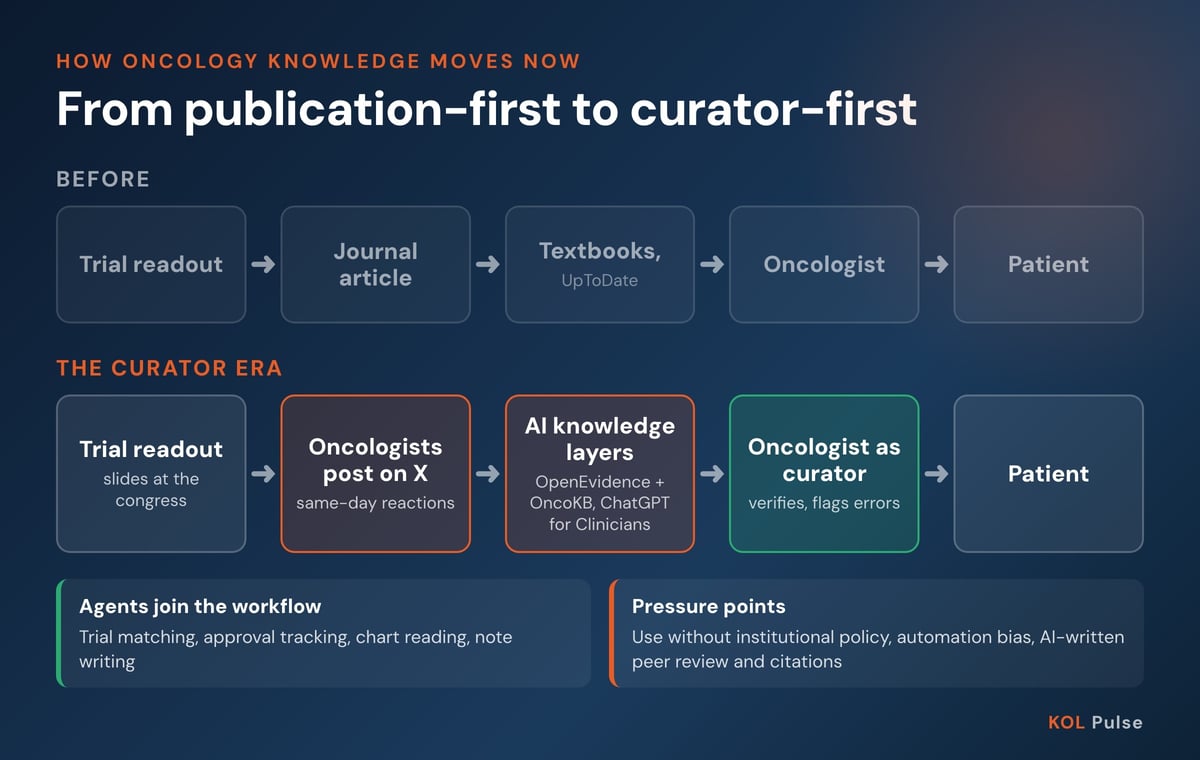
1. What is replacing UpToDate in oncology? Free AI knowledge layers, and they're going global
Oncology's reference stack is being rebuilt in real time. Aaron Goodman, MD (@Papa_Heme) said it bluntly: "UpToDate is going the way of the old medical textbook." (Aug 12) Weeks later he described calling "a lot less ID consults now with AI." Paul Sax, MD (@PaulSaxMD) called that "fascinating," and said it raises important questions for the cognitive specialties (Oct 2).
The institutions are moving too. Memorial Sloan Kettering and OpenEvidence announced an integration inside MSK's Epic workflow, and they are bringing OncoKB into OpenEvidence for physicians outside MSK (Sep 18). OpenEvidence and Anthropic are bringing a specialized version free to clinicians in about 100 low- and middle-income countries (Oct 2). Vineeta Agarwala (@vintweeta) of a16z Bio called it "sub-specialty knowledge becoming more democratized with AI."
Why it matters: Whoever controls the default answer at the point of care now shapes oncology practice worldwide.
We put OpenEvidence to the test against fresh conference data in Can OpenEvidence Keep Up With This Weekend's Lung Cancer KOLs?
2. How many oncologists use AI without a policy? Most of them
Adoption came before governance. In Leyfman's survey of 52 U.S. oncology clinicians, 83% used AI independently on personal platforms, 71% reported no institutional AI governance policy, and 77% worked without institutional oversight (Aug 31). Doximity's figure of 66% physician AI adoption points the same way (Aug 25).
The sharpest finding is what Leyfman calls the verification paradox. Nearly everyone intended to verify AI recommendations, yet 23% would still have followed an intentionally embedded dosing error. The ASCO Post flagged a related problem: automation bias that persists even when physicians get outcome feedback (Aug 12).
Why it matters: CAR-T, bispecifics, and MRD decisions are exactly where "confidently incorrect" carries the high stakes.
3. Do AI agents improve clinical trial enrollment? Not on their own
This is the most important null result of the season. Roupen Odabashian, MD (@RoupenMD) described a randomized trial in 20,707 patients where oncologists were notified about genomic trial matches. "The notifications worked. Enrollment did not move." His diagnosis: "a logistics problem wearing an information problem's clothes." (Sep 7) Benjamin Herzberg, MD (@bherzbergmd) agreed: "you only go as fast as your slowest step. Right now that's enrolling trials."
Agents are still landing where information is the bottleneck. Odabashian launched OncoPulse, an AI agent that tracks the oncology topics you pick. Jason Locasale (@LocasaleLab) had Astra draft five NIH R01 proposals in about an hour for roughly $20 of compute. Mount Sinai deployed Triomics-based trial matching across seven sites, and Odabashian's question is whether enrollment numbers actually move (Sep 22). At ASTRO, Kishan Patel (@KM__Patel) presented agentic AI across 14 radiation oncology disease sites: "AI shows promise, but physician oversight matters." (Oct 2)
Which AI tools are oncologists using and building?
The digest also shows which tools oncologists name in their own posts, and what some of them are building themselves.
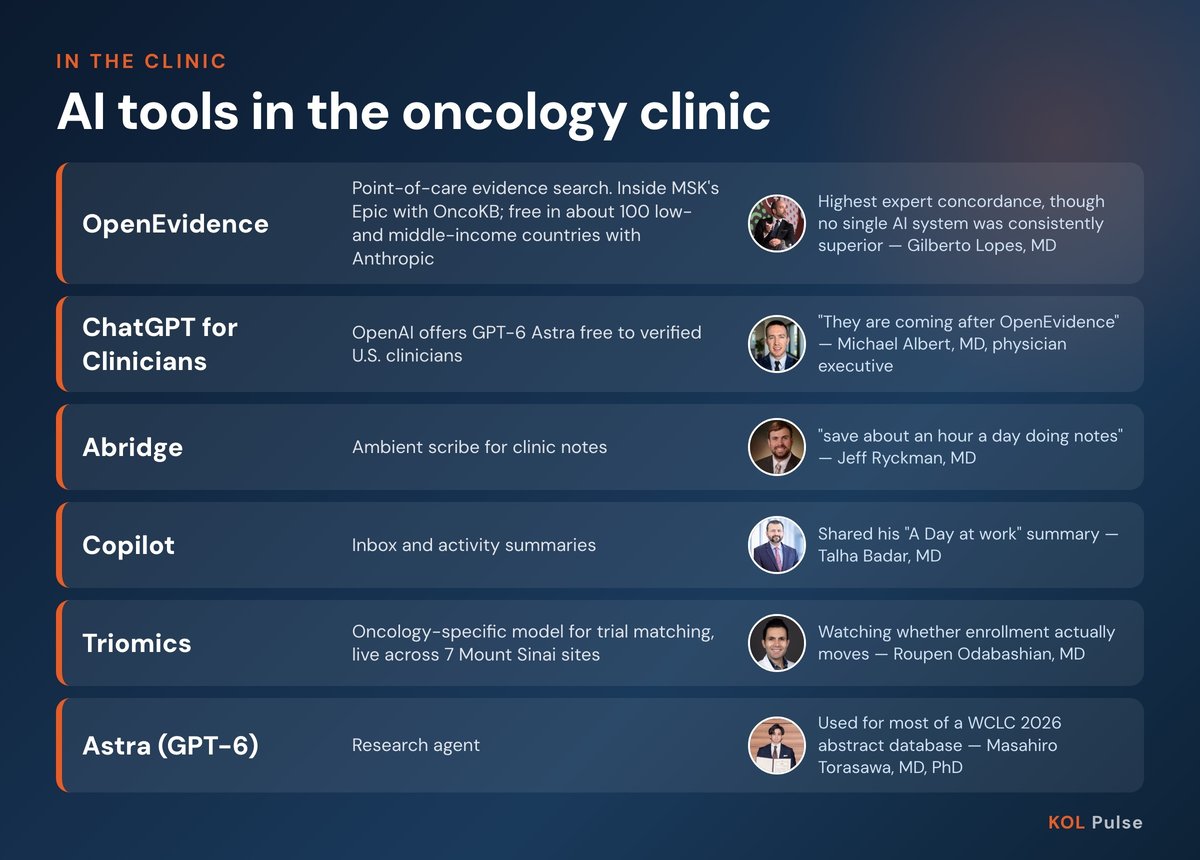
- OpenEvidence: point-of-care evidence search, now inside MSK's Epic workflow with OncoKB (Sep 18) and free in about 100 low- and middle-income countries with Anthropic (Oct 2).
- ChatGPT for Clinicians: OpenAI's clinician plan with free GPT-6 Astra access for verified U.S. clinicians (Sep 18).
- Abridge: ambient scribe. Jeff Ryckman, MD said it saves him "about an hour a day doing notes" (Aug 18).
- Copilot: inbox and activity summaries, shared by Talha Badar, MD (Sep 18).
- Triomics: oncology-specific trial matching, deployed across seven Mount Sinai sites (Sep 22).
Read the posts:
Key findings: • OpenEvidence highest expert concordance: τ=0.561 • Grok lowest expert divergence: JS=0.275 • Gemini + ASCO AI highest pairwise concordance: τ=0.876 • No single AI system was consistently superior
— gilberto lopes (@GlopesMd) September 12, 2026
ChatGPT for Clinicians. Looks like you can sign a BAA and also earn CME. They are coming after OpenEvidence. chatgpt.com/plans/clinicia…
— Michael Albert, MD (@MichaelAlbertMD) September 11, 2026
has allowed me to save about an hour a day doing notes, using more accessible language than my notes prior to abridge. However, even if I am seeing a female patient, it will often attribute my voice to the patient or their family members and incorporate it in the HPI or AP section. Has the @AbridgeHQ team ever thought about storing a voice clip of the clinician +/- additional HCWs who may be in the room within the local healthcare system to be able to tell HCW vs patient and family member voices, say, by using software such as FluidAudio + sortformer, NeMoSpeaker-iOS or speech-swift to be able to tell HCW vs. “other” more reliably? I was able to vibe code software that uses FluidAudio + Sortformer just over this past weekend using Claude Code and Grok on two independent projects, so I’m thinking this may be low hanging fruit if felt to be of value by the @AbridgeHQ team! Thanks for building such a great tool 🙏
— Jeff Ryckman (@jryckman3) August 18, 2026
#A_Day_at_work Most people see the clinic visit. What they don’t see is everything happening behind the scenes. 👇🏽 This is how copilot summaries by inbox activity today: 😇 ✅ Reviewing and supporting a translational research proposal aimed at personalizing treatment for patients with aggressive blood cancers. ✅ Responding to clinical operations issues to help ensure patients are scheduled with the right specialists and receive the most appropriate care. ✅ Reviewing and approving research protocol modifications to help advance ongoing scientific studies. ✅ Coordinating with research teams, pharmacists, and clinical trial staff regarding enrollment of patients into cutting-edge studies. ✅ Reviewing manuscript drafts and collaborative research projects with national and international colleagues. ✅ Evaluating collaborative opportunities focused on the future role of artificial intelligence in medicine ✅ Addressing compliance and documentation requirements essential for patient safety, quality care, and regulatory standards. ✅ Following up on occupational health and safety matters requiring physician review and communication. Throughout the day, the work moved constantly between: 🔬 Research 🩺 Patient care 📚 Education 🤝 Collaboration 📊 Administration ⚖️ Compliance
— Talha Badar (@TalhaBadarMD) September 8, 2026
Mount Sinai Health Systemi just deployed an AI platform, built on Triomics' oncology specific model, to match cancer patients to clinical trials systemwide, across seven sites including Mount Sinai Hospital, Brooklyn, Morningside, Queens, and South Nassau. It became the first NCI designated comprehensive cancer center in New York City to do this at that scale. I pay close attention to this specific problem because I have spent the last several months building a version of it myself. Matching a real patient to a real trial is not a keyword search. It is reading a full chart, weighing inclusion and exclusion criteria that are often written ambiguously, and doing that fast enough that the patient is still eligible by the time anyone acts on it. Most oncologists I know do this manually, or lean on a research coordinator who is already stretched across a dozen open protocols. The bottleneck was never a lack of interest in trials. It was time and staffing. What I want to know now is not whether the model can find matches. Plenty of tools can find matches. Custom GPT today can match a patient to a trial It is whether trial enrollment numbers actually move at Mount Sinai over the next year, or whether this becomes another well built tool that plateaus at the pilot stage because referral patterns and staffing did not change alongside it.
— Roupen Odabashian (@RoupenMD) September 17, 2026
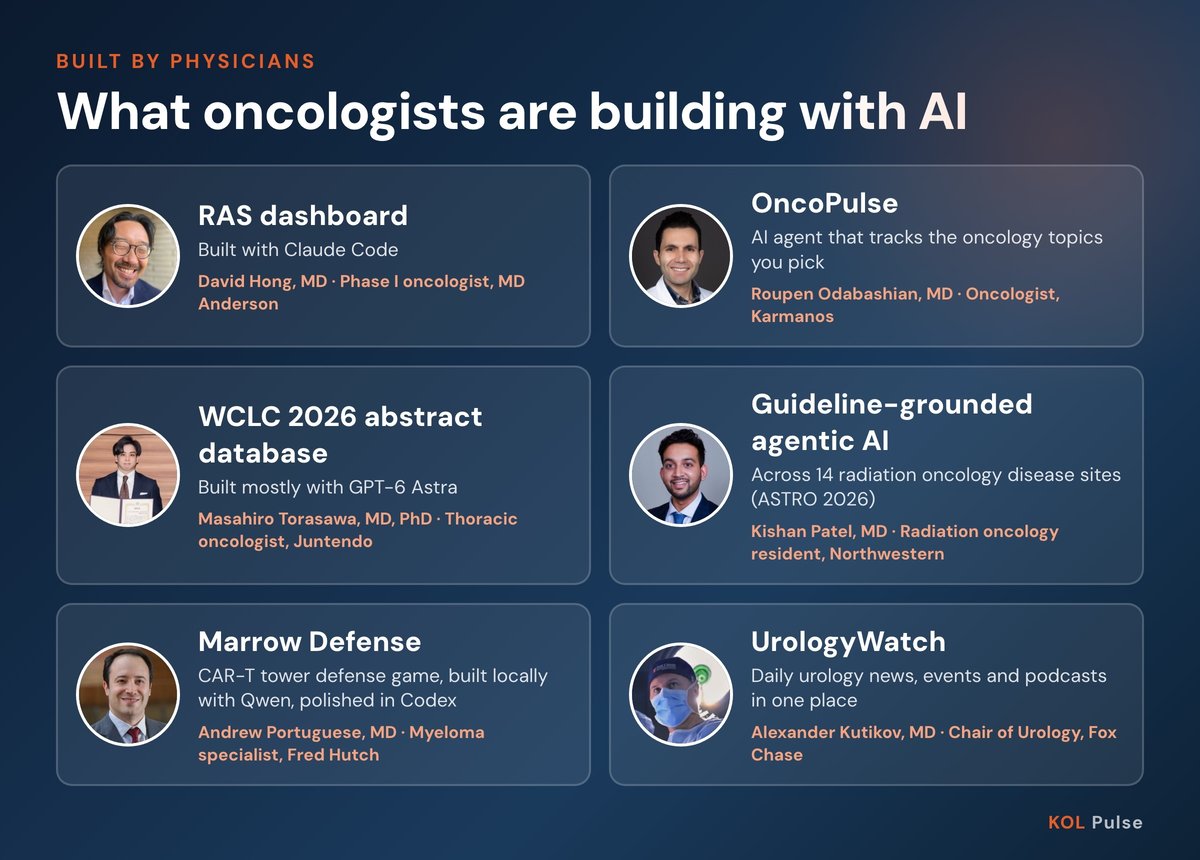
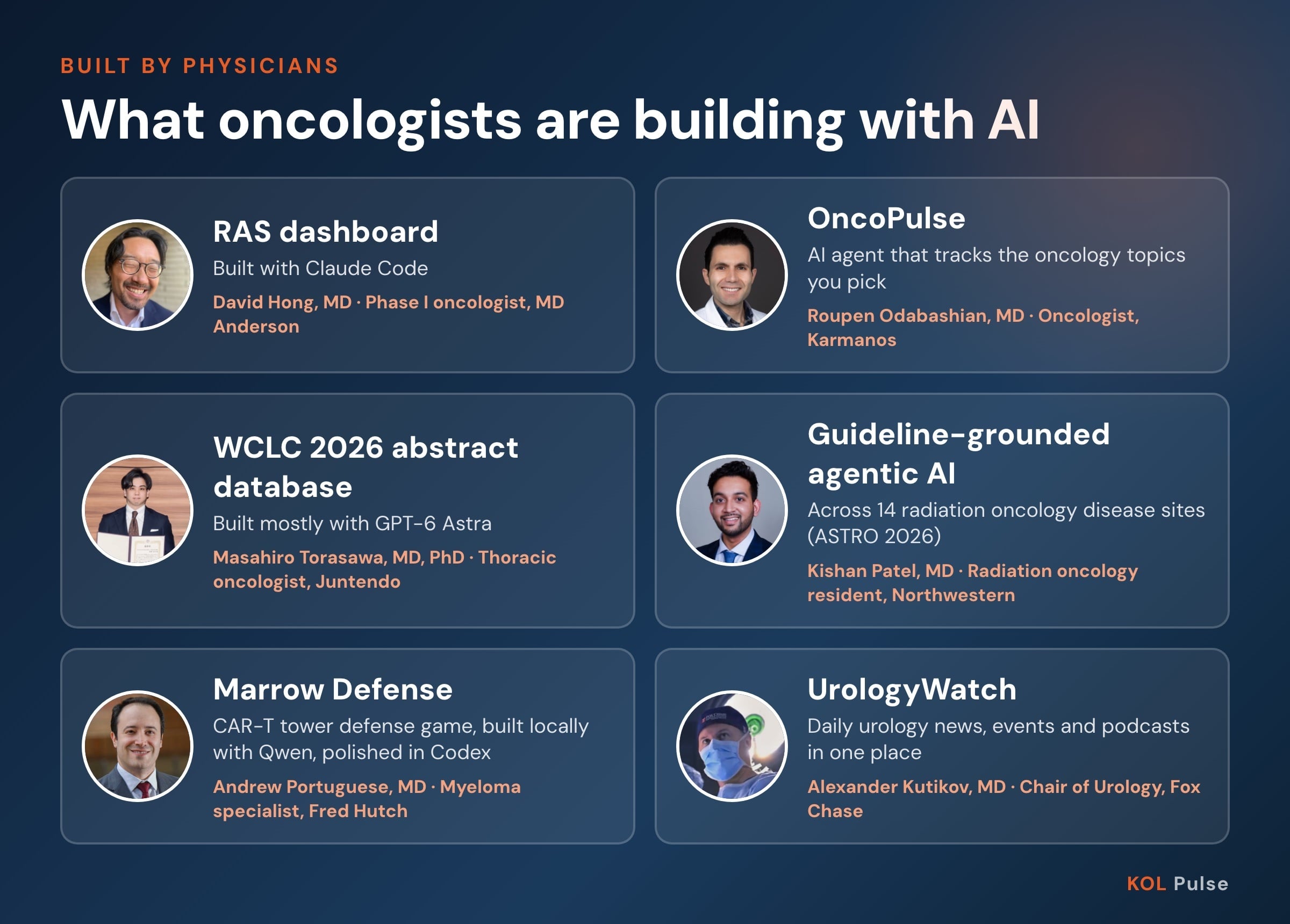
- RAS dashboard by David Hong, MD of MD Anderson, built with Claude Code (Aug 12).
- OncoPulse by Roupen Odabashian, MD, a free AI agent that tracks the oncology topics you pick (Sep 7).
- A WCLC 2026 abstract database by Masahiro Torasawa, MD, PhD, built mostly with GPT-6 Astra (Sep 7).
- Guideline-grounded agentic AI across 14 radiation oncology disease sites, presented at ASTRO 2026 by Kishan Patel, MD (Oct 2).
- Marrow Defense, a CAR-T tower defense game by Andrew Portuguese, MD, built mostly locally with Qwen and polished in Codex (Aug 25).
- UrologyWatch by Alexander Kutikov, MD, one place for daily urology news, events and podcasts (Oct 2).
Read the posts:
Created this RAS dash board through Claude code-check it out and let me know if I should add or modify anything: claude.ai/code/artifact/…
— David S. Hong MD (@DavidHongMD) August 8, 2026
No oncologist can read every FDA approval and every phase 3 readout. We all pretend otherwise. The honest math: dozens of label changes a year, hundreds of practice-relevant trials, and a clinic schedule that does not move. So you skim an abstract on your phone between patients and hope you did not miss the one that changes what you do on Monday. Today we are launching OncoPulse from @MeDucationai , and it is free. You create an account, pick the topics you care about, and set up an AI agent that tracks them for you. Mine emails me at 8am every day with what moved in GI oncology. That is it. No feed to scroll, no newsletter you never open. Oncologists, hematologists, NPs, PAs, fellows, students. If you are responsible for knowing what changed, this is built for you. Set up your agent here: meducationai.com/tutor/signup Every oncologist should have an agent doing this. Tell me what your agent should be watching.
— Roupen Odabashian (@RoupenMD) September 5, 2026
🫁 Ready for #WCLC26! 🇰🇷
— Masahiro TORASAWA, MD. PhD. (@M_Torasawa) September 6, 2026
I’ve put together a Notion database:
📚 210 Plenary, Oral & Mini Oral presentations
📝 181 summaries of abstracts released so far 🏷️ Biomarker, stage & treatment tags
https://t.co/rHMSF0NSgz
@guicorreiamd Thank you! I used GPT-6 Astra for most of the work this time. 🤖
— Masahiro TORASAWA, MD. PhD. (@M_Torasawa) September 6, 2026
It’s made things so much easier than when I used to do everything manually! 😂
Honored to present our @ASTRO_org #ASTRO2026 Quick Pitch on agentic AI across 14 radiation oncology disease sites. Takeaway: AI shows promise, but physician oversight matters. Grateful to @theabzlab , @troyteo & our @NUFeinbergMed + @NorthwesternEng team. #RadOnc
— Kishan Patel (@KM__Patel) September 30, 2026
Local AI is getting GOOD! I built most of Marrow Defense in OpenCode with Qwen3.8 27B locally, then polished it in Codex with GPT-5.6-sol. The best (and only?) CAR-T tower defense game. Vaguely educational. 🧬🎮 aportugu.github.io/marrow-defense/ #MultipleMyeloma #Myeloma #CARTCellTherapy
— Andrew Portuguese, MD (@AJPortuguese) August 25, 2026
My son’s Jones Beach IRONMAN was canceled this morning, so I built something I’ve wanted for a while: one place for daily urology news, events & podcasts. Introducing UrologyWatch.com . Tell me what works, what doesn’t, and whether it’s worth maintaining.
— Alexander Kutikov MD (@uretericbud) September 26, 2026
We build this way too: see How I Built a Claude Science Skill That Writes Its Own FDA-Approval Comparison Tables and AI-Native Workflows with Your Favorite Tools: 5 Prompts to Copy.
What's new this month? Oncology AI applications from the feed
Since our last digest edition, oncologists have shared a fresh wave of tools they built, use or are watching.
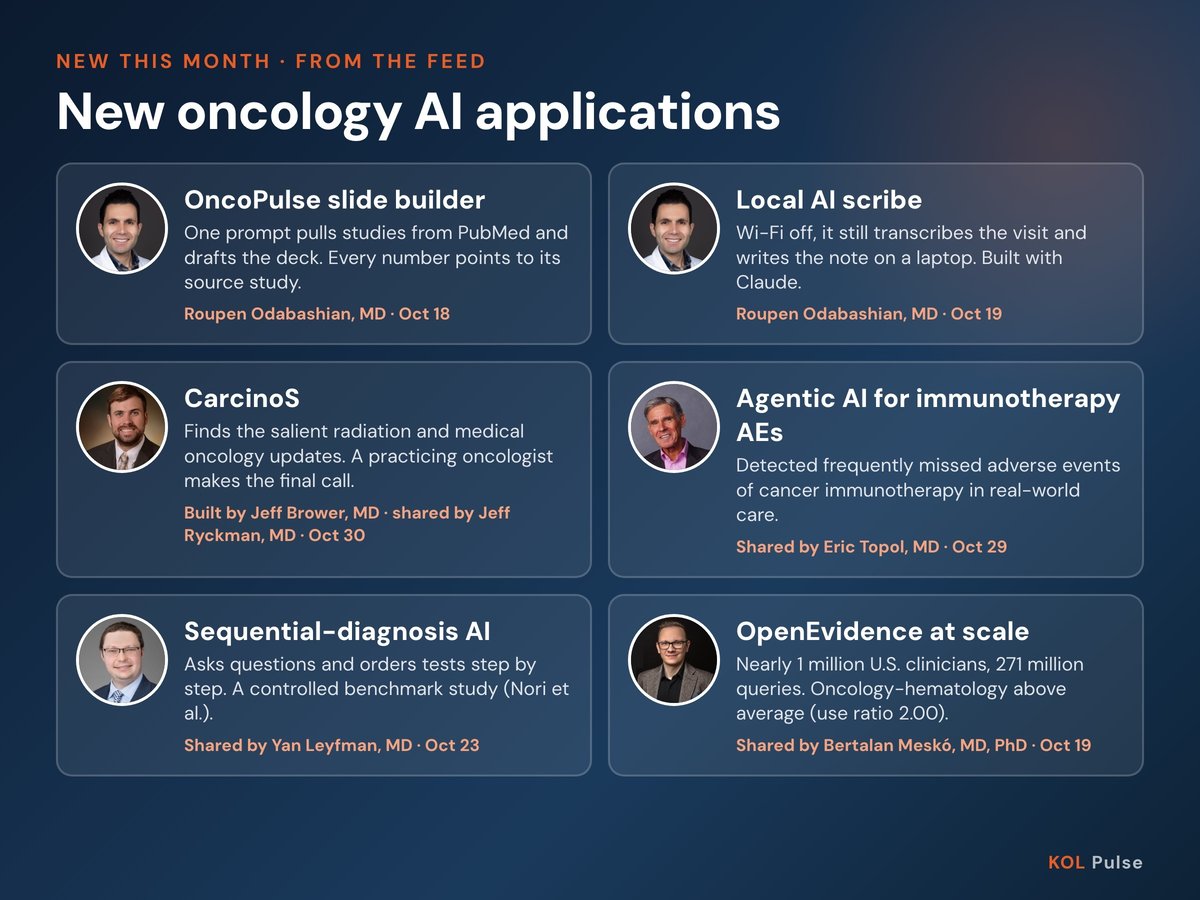
- OncoPulse slide builder. Roupen Odabashian, MD: "You write one prompt. It pulls the studies from PubMed and builds the deck." (Oct 18)
- A local AI scribe. Odabashian again: "Wi-Fi off, it still transcribes the visit and writes the note, all on my laptop." Built with Claude, driven by doctors' privacy and cost concerns. (Oct 19)
- CarcinoS. Jeff Ryckman, MD on a tool built by Jeff Brower, MD: it "finds the salient updates for both radiation and medical oncology, and a practicing oncologist makes the final call on every one." (Oct 30)
- Agentic AI for immunotherapy adverse events. Eric Topol, MD: "Agentic AI detected adverse events of cancer immunotherapy, which are frequently missed, in real world medicine." (Oct 29)
- Sequential-diagnosis AI. Yan Leyfman, MD on Nori et al.: 83.2% accuracy on NEJM Clinicopathological Conference cases vs 36.1% for generalist physicians, with the caveat that "the findings remain limited to controlled benchmark settings." (Oct 23)
- OpenEvidence at scale. Bertalan Meskó, MD, PhD shared a study of almost a million U.S. clinicians and 271 million queries, in which oncology and hematology users had a higher-than-average share (use ratio 2.00). (Oct 19) OpenEvidence itself says over 85% of MSK oncologists use it, now with OncoKB built in (Oct 22).
- Multi-agent workflows. Jeff Ryckman, MD splits his work between Grok Bot and Cursor (more below).
Read the posts:
I used to lose whole evenings building slides for journal club, tumor board and conference prep.
— Roupen Odabashian (@RoupenMD) October 18, 2026
So we built a tool that does the first draft. You write one prompt. It pulls the studies from PubMed and builds the deck.
Every number on a slide comes from a real paper, and the slide points to the exact study, so you can check it in seconds.
These slides came from a single prompt. It's still a first draft you own and edit. But it gets you most of the way there.
The goal isn't prettier slides. It's getting your evenings back and generating accurate slides for presentations.
Free inside OncoPulse. https://t.co/dm4KRX1IKE
#Oncology #HemOnc #MedicalEducation #AI @MeDucationai
I built a local AI scribe. Wi-Fi off, it still transcribes the visit and writes the note, all on my laptop.
— Roupen Odabashian (@RoupenMD) October 19, 2026
This was inspired by a recent talk I gave to doctors and was shocked by the number of people who do use AI scribes, and the two most common reasons were privacy and the extra cost of AI scribe tools where these companies are increasing their prices, so I built something that runs locally and doesn't need any AI subscription.
This was built with Claude by @AnthropicAI , over the last two weeks.
It was not a one-shot prompt. It took a lot of work, testing, and iteration. But it works, and it works on-premises.
#HealthcareAI #AIScribe #LocalAI
Tons of oncology papers every week, and only a few change how we treat patients.
— Jeff Ryckman (@jryckman3) October 30, 2026
CarcinoS, built by my friend Dr. Jeff Brower, finds the salient updates for both radiation and medical oncology, and a practicing oncologist makes the final call on every one. Concise, quiet, and refreshingly human.
Highly recommend subscribing (free) and following @Carcino_S.
https://t.co/IBI44mHVNY
#RadOnc #MedOnc #OncTwitter
Agentic AI detected adverse events of cancer immunotherapy, which are frequently missed, in real world medicine
— Eric Topol (@EricTopol) October 29, 2026
https://t.co/2uRyucJhZY
What if an AI had to diagnose a patient the way a physician actually does?
— Yan Leyfman, MD (@YLeyfman) October 23, 2026
Most medical AI benchmarks begin with a neatly written clinical vignette. Real patients don't.
In a new study, Nori et al. tested sequential diagnosis—starting with a brief presentation and requiring the AI to decide which questions to ask, which tests to order, and when enough information had been gathered to make a diagnosis.
The system continuously revised its differential diagnosis while selecting tests based on both diagnostic value and cost.
The results were striking:
• 83.2% accuracy on NEJM Clinicopathological Conference cases
• 80.3% accuracy on MIMIC-IV-ED emergency department admissions
• Compared with 36.1% and 46.8% for generalist physicians, respectively
• Achieved these results while considering workup cost
The important innovation isn't simply that the model answered more questions correctly. It was asked to navigate uncertainty, actively acquire information, and determine what information was worth obtaining next.
That makes the benchmark much closer to the reality of clinical reasoning—where the challenge isn't just knowing the diagnosis, but knowing what to ask, what to test, and when to stop.
The findings remain limited to controlled benchmark settings, but they point toward an important evolution in medical AI:
From answering clinical vignettes → to actively participating in the diagnostic process.
#AIinHealthcare #ArtificialIntelligence #ClinicalAI #MedicalAI #DigitalHealth #ClinicalReasoning #PrecisionMedicine
https://t.co/c8yOw2l8Y1
OpenEvidence, as a physician-facing LLM, is being used by more healthcare professionals month by month. Now, a study analyzes how almost a million US clinicians use it while submitting 271 million AI-enabled clinical queries!
— Berci Meskó, MD, PhD (@Berci) October 19, 2026
"Early-career physicians (use ratio, 2.54) and those in oncology and hematology (2.00), internal medicine (1.88), and family medicine (1.80) submitted a higher-than-average share of queries; treatment and management accounted for 33.1% of physician queries and diagnosis for 13.9%."
I really liked their concluding remark:
"For much of modern medicine, clinicians have been expected to internalize a body of knowledge through training and maintain it through continuing education. Study findings suggest a growing share of knowledge access is shifting from recall to retrieval."
We cannot expect physicians to know everything, but we can expect them to know where to find the information they need.
The study: https://t.co/gUhb3TnDWZ
Over 85% of oncologists at Memorial Sloan Kettering Cancer Center use OpenEvidence.
— OpenEvidence (@OpenEvidence) October 22, 2026
Together, @MSKCancerCenter and OpenEvidence have built OncoKB, MSK’s expert interpretation of a tumor’s genetics, directly into OpenEvidence, putting it in the hands of oncologists across the United States.
As Dr. Anaeze Offodile puts it: “Our mission is to end cancer for life.” As of today, we are widening OncoKB’s reach so that patients everywhere benefit from the same rigor as patients at MSK. Watch the story.
How one radiation oncologist splits the work between Grok Bot and Cursor
Jeff Ryckman, MD, a radiation oncologist and former medical physicist, has been open about how he builds. On October 8 he wrote: "Just downgraded Claude and ChatGPT and funneled the price difference into Cursor and Grokbots." Asked about it two days later, he described the division of labor: "Grok Bot holds the task, skills, context, and what not to touch. Cursor does the coding." And the rule he uses: "If I can define the job and leave it, I send it to the bot. If I need to iterate in real time, I stay in Cursor."
It is the Curator Era in miniature. The physician defines the job and decides what the agent may not touch, and the tools do the work.
Just downgraded Claude and ChatGPT and funneled the price difference into Cursor and Grokbots. Both are absolutely unstoppable!
— Jeff Ryckman (@jryckman3) October 8, 2026
Building an AI workspace that supports pivoting b/t multiple harnesses is incredible. Between platforms, not sure I’ll ever hit usage limits again! 🥰
@DrPaulyDeSantis Biggest use case so far is the split. Grok Bot holds the task, skills, context, and what not to touch. Cursor does the coding.
— Jeff Ryckman (@jryckman3) October 10, 2026
If I can define the job and leave it, I send it to the bot. If I need to iterate in real time, I stay in Cursor. Really liking that workflow so far!
4. Can AI detect cancer earlier? Yes, but biomarkers face a validation tax
The detection signal is real. Eric Topol, MD (@EricTopol) highlighted AI detecting pancreatic cancer up to 3 years before current diagnosis (Aug 31). He also flagged Oncoformer, a multimodal EHR plus chest X-ray model in 3.67 million people that predicted cancer at least a year before diagnosis (AUROC 0.869 across all cancers) (Sep 22). Other work includes a histology model that reads breast margins in seconds and an MSK model predicting smoldering myeloma progression at IMS26 (Oct 2).
The community is also asking the hard question. Mali Barbi, MD (@DrBarbiOnc) said AI-counted TILs may be a "thermometer, not target," and noted the only thing that held up was spatial arrangement. Ilana Schlam, MD (@IlanaSchlam) reported that AI TILs in NSABP B-41 were associated with pCR and may complement manual scoring (Aug 25).
Why it matters: Precision AI has to change decisions, not just describe the tumor back to us.
5. Is AI breaking peer review? The community thinks it's straining
Samer Al Hadidi, MD (@HadidiSamer) published "Peer-Unreviewed: When the Thread Replaces the Paper" in Annals of Internal Medicine (Aug 25). JAMA issued guidance on where AI assistance ends and authorship begins, and Yüksel Ürün, MD (@DrYukselUrun) noted "that line will keep moving" (Aug 12). Jeff Ryckman, MD flagged an EviCore denial built on AI-hallucinated literature (Aug 18). Data scientist Selçuk Korkmaz went further: "AI just killed the peer-review." (Oct 2)
Why it matters: When papers, reviews, and denials can all be machine-written, verified human signal becomes the scarce asset.
It's the same shift we described in The KOL Layer Now Loads Before the Publication Layer in Oncology.
6. What does oncology AI still need? Verified oncologist signal
Every trend above points to the same gap. Curators need trustworthy inputs: what credentialed oncologists actually say, attributed and verbatim. That is the backbone of the AI in Oncology Digest. Oncology-hematology also led specialty AI use in the JAMA OpenEvidence analysis.
What should pharma and medical affairs do now?
- Listen to the curators. The oncologists shaping AI norms are posting in public now. Track them by name on our KOL hub.
- Treat AI answers as a channel. If OpenEvidence-style tools are the new reference stack, your evidence has to be legible there.
- Measure what moves. As the enrollment RCT showed, identification is not impact. Our trial profiles show which oncologists react to each readout.
Follow along with the AI in Oncology Digest and our ESMO 2026 hub. If your team wants to see which oncologists are defining the Curator Era in your tumor type, work with KOL Pulse.
Related reading
- AI in Oncology Digest: all editions
- The KOL Layer Now Loads Before the Publication Layer in Oncology
- Can OpenEvidence Keep Up With This Weekend's Lung Cancer KOLs?
- AI-Native Workflows with Your Favorite Tools: 5 Prompts to Copy
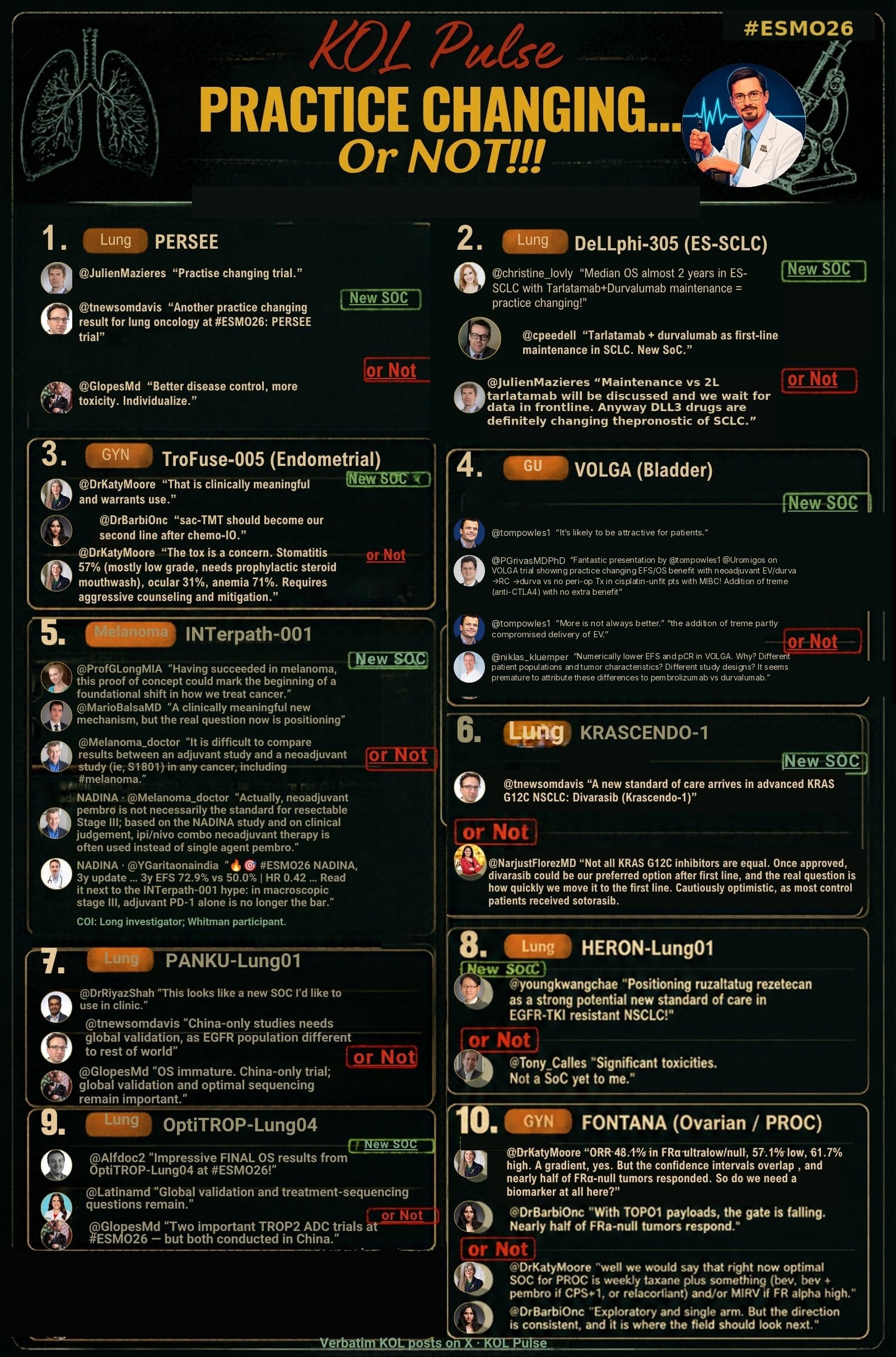
- 10 ESMO26 Controversies Oncologists Debated on X
Quotes are verbatim from public posts compiled in the KOL Pulse AI in Oncology Digest.